Categories
Musings of a Copywriter

When Books have Wings

By Devraj Singh Kalsi

Courtesy: Creative Commons

Book thieves are essentially good people who restore a modicum of respect to the business of stealing. When there are so many valuable items to filch, from cows to jewellery to cash, this is a minuscule coterie of genteel, sophisticated thieves who have realised that the most valuable item worth pilfering in the world is books.

While knowledge acquired from stolen books carries the same value, it shows the passion and obsession for seeking knowledge ranks high in book thieves. They are enterprising and adventurous to risk everything including their dignity, without harbouring any fear of getting caught or facing any discomfiting situation for the sake of acquiring knowledge by hook or by crook. Perhaps a stolen book holds special charm and becomes more gripping as the ‘borrower’ would not like to lose it after putting in such hard work to acquire it. Desperate readers who steal and read make it a habit to read stolen books alone.

There are smart operators who politely seek books from your collection even though they have ample opportunity to pick up the titles and drop the stuff in their shopping bags. These people have no compunction, no intention of returning the borrowed titles despite a litany of reminders. Although these books cannot be dubbed stolen as prior permission is sought, the promise of returning them within a week or a month is never honoured. These books become a permanent member of their prized collection. Such collectors have built large bookshelves with borrowed books and stolen titles.

During school days, my English tutor borrowed the complete works of Shakespeare from my father’s collection, promising to return it soon. But the tome did not stage a comeback. Three years later, when we went to his house, we saw the book displayed prominently in a glass showcase. I was thrilled to find it there but before I could utter a word, his wife thanked my mother for gifting them the big, fat book on their silver jubilee wedding anniversary.

His clever spouse handled it smartly and we did not contest it. My mother perhaps hoped he would read the text thoroughly and explain Shakespeare properly to me.  When he started teaching me Shakespeare, I found him fumbling and referring to a paraphrase guide to explain the content.

There were several other instances of borrowing from the collection on the pretext of reading. Another English tutor took novels from my collection for his wife who was fond of reading. He took many books at the same time and returned most of them on time. But one title always went missing — perhaps the one book his wife desperately wanted to have in her collection.

Some friends in college and university also wanted to read the books that I was reading.  They borrowed the titles just before the vacation started. After the holidays they said they had lost it on the train or left it behind in the lodge they stayed in. But the sad truth was waiting to be discovered if you went to their apartment.

When guests with the habit of reading arrive at your place, you need to exercise caution and stay alert. They will not gaze at the aquarium with colourful fish but swim deeper with malicious intent: gape at the spine of books, checking out the new arrivals. They pose innocent questions about your choices and recommendations. It is always better to say a bland no. Your confirmation would mean the sudden departure of some books from the collection as the guest would definitely seek those tomes.  Once they are gone, the guest does not come back to return it ever. Maybe he shifts to another city and takes it with him, forgetting it was his duty to return it to you.  Ever since the habit of gifting books has lost appeal, the art of stealing and usurping books has gathered momentum.

These guests are not hardcore book thieves you encounter in book fairs or bookstores, but they have a similar mindset of reading books acquired through dubious means. When they do not return what is not theirs, they are indulging in an unfair practice but there is no sign of regret or remorse. Since they get original titles at zero cost, they do not need to visit second-hand books market for a big haul of books or seek low-priced pirated editions.

The same tricks are played by so many people over the years and half their collection comprises books acquired through shady means – that is, books they have not paid for. The true believers in the saying that knowledge is free for all!

In case you ask them to return the books, you will be shown the book with the flamboyant signature of another person as the page with your initials has probably already been ripped off, leaving no scope of return to the original owner. Like wealth acquired through shady means is never discriminated, books acquired through dubious means are also most welcome in the bookshelves.

visited the book fair to buy everything except books.

.

Devraj Singh Kalsi works as a senior copywriter in Kolkata. His short stories and essays have been published in Deccan Herald, Tehelka, Kitaab, Earthen Lamp Journal, Assam Tribune, and The Statesman. Pal Motors is his first novel.  


PLEASE NOTE: ARTICLES CAN ONLY BE REPRODUCED IN OTHER SITES WITH DUE ACKNOWLEDGEMENT TO BORDERLESS JOURNAL. 

Categories
World Poetry Day

Imagine…

And as imagination bodies forth 
The forms of things unknown, the poet's pen 
Turns them to shapes and gives to airy nothing 
A local habitation and a name. 

-- Midsummer Night's Dream (premiered 1605)by William Shakespeare

Imagine… if words could weave a world in harmony! Perhaps… then as Shakespeare declared and more recently John Lennon wrote in his song ‘Imagine’ (1971), we might have constructed a new world…

In hope of the same perhaps, Nazrul had published his poem, ‘Bidrohi‘ or the rebel a hundred years ago, a few months before TS Eliot published Wasteland, again a poem raising humane concerns and reinforcing values post the First World War. More recently Akbar Barakzai who has passed on at the start of this month, wrote about a better world in his poem, ‘We are all Human‘. And yet we have a war …

In response to the war, we have modern voices that ring out in harmony, including the voice of a Ukranian refugee. In reaffirmation of a world that can transcend divisions created by human constructs and soar in a virtual world, we also present to you interviews of half-a-dozen poets.

From the Treasury

Rebel or ‘Bidrohi’: Nazrul’s signature poem from 1922, ‘Bidrohi, translated by Professor Fakrul Alam. Click here to read.

A Special Tribute

We are All Human by Akbar Barkzai, translated by Fazal Baloch, has been published as not only a tribute to the poet who left us forever on 7/3/2022, but also as his paean to humanity to rise about differences which lead to war and horror, to unite us as one humankind. Click here to read.

War, Peace and Poetry

Poetry from across the world in support of peace and voicing concerns over the humanitarian crisis in Ukraine, we have Ukranian Lesya Bakun give us poetry as a war victim, a refugee. Rhys Hughes, Ron Pickett, Michael R Burch, Kirpal Singh, Malachi Edwin Vethamani, Suzanne Kamata, Mini Babu, Sybil Pretious and Mitali Chakravarty have contributed poetry written for the Ukraine crisis. Click here to read.

Poets across Borders

Half-a-dozen poets from different continents tell us about their poetry. The poets include Ryan Quinn Flanagan, George Freek, Luis Cuauhtémoc Berriozabal, Ihlwha Choi, Sutputra Radheye, Anusuya Bhar. Click here to read.

Categories
World Poetry Day, 2021

Celebrating Poetry without Borders

“And as imagination bodies forth
The forms of things unknown, the poet’s pen
Turns them to shapes and gives to airy nothing
A local habitation and a name”

(William Shakespeare, A Midsummer's Night's Dream,1596)

Like clouds float, words waft through currents of ideas and take shapes and forms. We celebrate poetry across the world, across space and time, with the greatest and the new… our homage in words to the past, present and future…

A paean to the skies, the Earth and empathy with nature sets the tone for this poetic treat. I offer you a translation/transcreation of a Tagore song, from the original lyrics penned by the maestro in Bengali…

The Star-Studded Sky  by Rabindranath Tagore

( A translation/transcreation of Akash Bhora, Shurjo Tara, 1924)

The sky replete with sun and stars, the Earth brimming with life,
In the midst of this universe, I have found my abode.
Spellbound by the plenitude, songs awaken in my being. 

The infinite, eternal waves that create planetary tides 
Resonate through the blood coursing in my veins.

As I walk to the woods, I step on the grass. 
Heady perfumes of flowers startle me into a rhapsody.
Benefactions of joy anoint the universe.

I have listened, I have watched, I have poured my life into the Earth.
Through knowing, I have sought the unknown. 
Spellbound by the plenitude, songs awaken in my being. 

(Translated/transcreated by Mitali Chakravarty on behalf of Borderless Journal,2021)

Poetry connects with eternal human emotions over space and time with snippets from old and verses from new.

Poets continue to draw from nature to express and emote. In empathy with the forces that swirl around us are poems written by moderns, like Jared Carter.

 What is that calling on the wind
           that never seems a moment still?
 That moves in darkness like a hand
           of many fingers taken chill?

(Excerpted from Visitant by Jared Carter)

Click here to read Jared Carter’s Visitant and more poems.

Tagore wrote and painted. Here we have a poem about a painting done by the poet-artist herself, Vatsala Radhakeesoon.

An endless expanse swirls
over the tropical island.
At the foot of the Meditative Mountain,
birds, bees and butterflies wonder --
who is this mystic blue?

(Excerpted from Swirling Blues by Vatsala Radhakeesoon)

Click here to read Swirling Blues by Vatsala Radhakeesoon and gaze at the painting.

Separated by oceans and decades, were poets empathetic?

I CELEBRATE myself, and sing myself,
And what I assume you shall assume,
For every atom belonging to me as good belongs to you...

The smoke of my own breath,...

My respiration and inspiration, the beating of my heart, the passing of blood and air through my lungs,
The sniff of green leaves and dry leaves, and of the shore and 
dark-color'd sea-rocks, and of hay in the barn,
The sound of the belch'd words of my voice loos'd to the eddies of the wind,
A few light kisses, a few embraces, a reaching around of arms,
The play of shine and shade on the trees as the supple boughs wag,
The delight alone or in the rush of the streets, or along the fields and hill-sides,
The feeling of health, the full-noon trill, the song of me rising from bed and meeting the sun.

(Excerpted from Song of Myself, Walt Whitman, 1881)

And despite exuberance of poets and their love of nature, came wars from across continents. Here are some of the responses of poets from all over the world to war and the pain it brings…

A soldier and a poet, Bijan Najdi (1941-1997) wrote in Persian, he captured the loss and the pain generated by war on children for us. This has been translated by Davood Jalili for Borderless

The world does not become bitter with the sword.

It does not become bitter with shooting, cries and fists.

The bitterness of the world

Is not the deer’s necks

And leopard’s tooth

And the death of a fish...

(Excerpted from Our Children by Bijan Najdi)

Click here to read Our Children by Bijan Najdi

Maybe children have a special place in poets’ hearts. Michael R Burch from across the Pacific writes of their longings too…

I, too, have a dream …

that one day Jews and Christians

will see me as I am:

a small child, lonely and afraid,

staring down the barrels of their big bazookas,

(Excerpted from I, too have a dream by Michael R Burch)

Click here to read Dreams of Children by Michael R Burch and more by him.

From Nepal, Manjul Miteri travelled to Japan to design a giant Buddha. While visiting the Hiroshima museum, he responded to the exhibits of the 1945 nuclear blast, a bombardment that ended not just the war, but many lives, many hopes and dreams… It heralded the passing of an era. Miteri’s poem was translated by Hem Biswakarma for us from Nepali.

Orimen*!
Oh, Orimen!
Mouthful of your Tiffin
Snatched by the ‘Little Boy’*!
The Tiffin box, adorned with flowers,
Scattered and spoilt,
Blown out brutally.

(Excerpted from Oh Orimen! by Manjul Miteri)

Click here to read Majul Miteri’s Oh Orimen!

Continuing on the theme of war, what can war weapons not do? Karunakaran has written a seemingly small poem about warplanes in Malayalam that embraces the nuclear holocaust and more. The words are few but they say much… It has been translated by Aditya Shankar for us.

No warplane 
has ever flown like a bird,
has lost way like a bird,
has halted mid-flight reminiscing a bygone aroma.

(Excerpted from No Warplane Has Ever Flown Like A Bird by Karunakaran)

Click here to read No Warplane Has Ever Flown Like A Bird by Karunakaran.

From wars and acquisition of wealth, grew the greed for immortality.

Aditya Shankar writes rebelling against man’s greed, greed that also leads to war.

Through the tube,

the world poured into that room

with news of war and blood.

(Excerpted from Human Immortality Project  by Aditya Shankar)

Click here to read Human Immortality Project by Aditya Shankar.

Continuing the dialogue on discrepancies is a poem written by a visiting professor from Korea. Ihlwha Choi was in Santiniketan and just like Tagore found poetry in Krishnokoli, he found poetry in Nandini…

There was Nandini’s small shop along with fruits' stalls and the bike shop.

Cows passing by would thrust their heads suddenly

Into the shop thatched with bamboo stems....

...There lived a flower-like little girl selling chai near the old house of Poet R. Tagore.

(Excerpted from Nandini by Ihlwha Choi)

Click here to read Nandini by Ihlwha Choi

Poetry is about moods — happiness and sadness, laughter and tears.

Reflecting on multiple themes that mankind jubilates and weeps about is the poetry of John Grey, camping out in Australian outbacks, revelling in the stars and yet empathising with hunger… A few lines from his poem hunger.

Hunger can sing soft but compelling

in the voice of the one who last

provided you with three meals a day.

That’s years ago now.

Hunger has no memory

but it assumes that you do.

(Excerpted from Hunger by John Grey)

Click here to read Camping out, Hunger and more … by John Grey

And now we introduce some laughter. A story-poem by Rhys Hughes, about an alien who likes to be tickled…

“Oh, tickle me under the chin,
   the chin,
 please tickle me
 under the chin.
 It might seem quite fickle
 or even a sin
 to make this request,
 to ask such a thing,
 but I must confess
 that to ease my distress
 there’s nothing so fine
    as a tickle.
 So please tickle me 
 under the chin,
    the chin.
 Tickle me under the chin.” 

(Excerpted from The Tickle Imp by Rhys Hughes)

Click here to read The Tickle Imp by Rhys Hughes

And here is a poem by Tamoha Siddiqui, jubilating the borderless world of friendship.

Yesterday I heard the sound of colourful feet

to Indonesian beats, in the middle of Michigan:

white, black, brown, all were one

pitter-patter paces in a conference hall.

(Excerpted from Birth of an Ally by Tamoha Siddiqui)

Click here to read Tamoha Siddiqui’s Birth of an Ally

We share with you now from the most unusual poetry we have on our site, from a book called Corybantic Fulgours. If you want to know what it means, click here to check it out!

Concluding our oeuvre to jubilate a world without borders, here are lines from a poet who probably has influenced and united majority of writers across the world…another truly universal voice.

Time present and time past
Are both perhaps present in time future,
And time future contained in time past.
If all time is eternally present
All time is unredeemable.
What might have been is an abstraction
Remaining a perpetual possibility
Only in a world of speculation.
What might have been and what has been
Point to one end, which is always present.
...
The dance along the artery
The circulation of the lymph
Are figured in the drift of stars
Ascend to summer in the tree
We move above the moving tree
In light upon the figured leaf
And hear upon the sodden floor
Below, the boarhound and the boar
Pursue their pattern as before
But reconciled among the stars.

Excerpted from TS Eliot's Four Quartets, Burnt Norton(1936)

The poetry of the historic greats are all woven by eternal threads that transcend man made boundaries. They see themselves almost as an extension of the Earth we live. Tagore, Whitman and Eliot write of the universe coursing through their veins. Shakespeare gives the ultimate statement when he brings in the play between imagination and nature to lift the mundane out of the ordinary. With inspiration from all these, may we move into a sphere, where poetry not only moves but also generates visions for a more wholistic and inclusive future.

.

PLEASE NOTE: ARTICLES CAN ONLY BE REPRODUCED IN OTHER SITES WITH DUE ACKNOWLEDGEMENT TO BORDERLESS JOURNAL

Categories
Poetry

An Anguished Father

By Ashok Suri

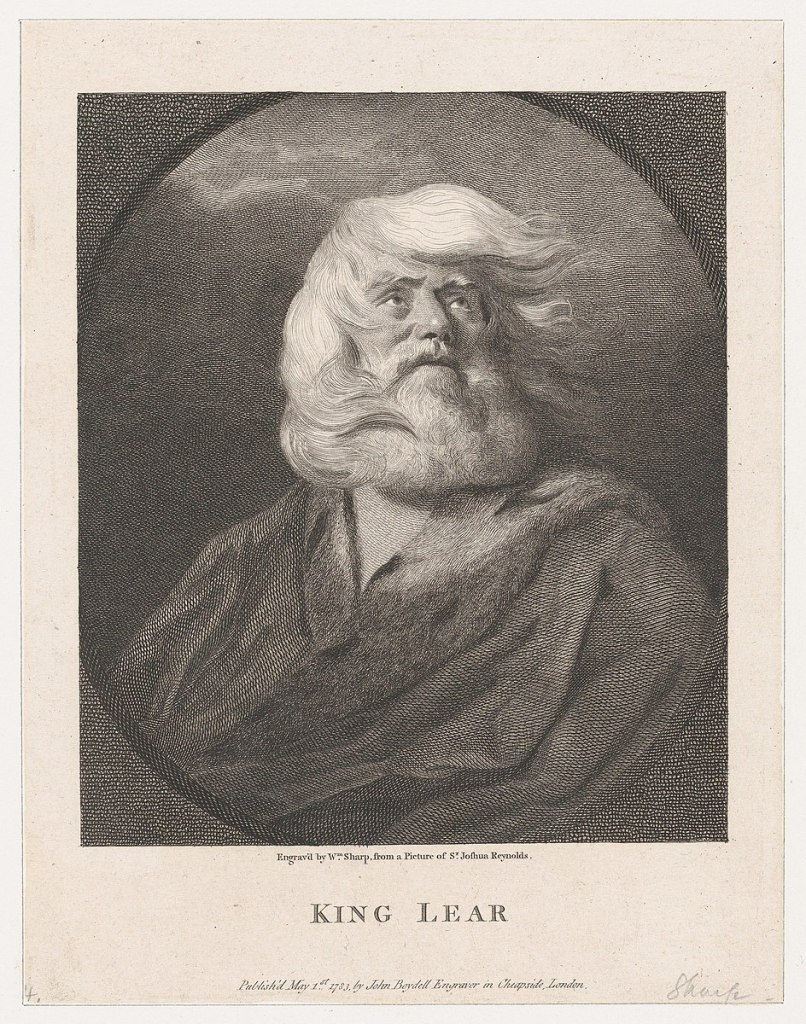
King Lear by Joshua Reynolds: Wiki


 An Anguished Father
  
  
 Happy he was 
 To be the rock,
 Out of which flowed  
 Streams of their delight.
  
 Now that age is no more on his side,
 At home, he is lavishly criticized.
 His jokes are no longer funny, 
 His talks are considered silly and despised.
  
 Slowly, he returns home,
 With his head bent down
 Pondering his own plight --
  
 No wonder,
 With thankless kids around,
 He feels eternally exiled.
  
 Perhaps what The Bard* said was right:
 “How sharper than a serpent’s tooth it is
 To have a thankless child!” 

*The Bard: William Shakespeare. The quoted lines are from King Lear

Mr. Ashok Suri retired from Revenue Service, and is settled with his family in Mumbai. He loves to read and sometimes write. He tries to convey in simple words what he wants to say.

Categories
Essay

No One Is Tamed, No One Is Equal

Dustin Pickering on Shakespeare’s The Taming of the Shrew

A literary work is often a code that reveals distinct things. Sometimes these things are simply too advanced or the logic of them too cruel. The Taming of the Shrew is one of Shakespeare’s most performed plays and its language is easily read and understood. However, the embedded symbolism may pass by even the most astute mind.

The play is obviously about gender battles, and it seems to some that Kate is tamed by her husband. However, a deeper look at the intricately woven tropes exhumes a critique of culture, a sense of equal justice, and the way institutions impress on our minds. The play extends beyond property relations and the inequality of women. It also poaches one of theatre’s daunting faults. In Shakespeare’s day, women could not play the female roles and instead teenage boys were selected. The theatre was considered dangerous and women too unfit to perform. There was lead in the makeup and the stage action too rough. Theatre was too bawdy.

The Taming of the Shrew contains puns on horses, games, “moveables”, music, and theatre itself. Props or “furniture” signify costumes; there are witty puns revealing the dissembling nature of appearances. In Act IV, Scene III, Petruchio says, “And as the sun breaks through the darkest clouds, / So honor peereth in the meanest habit.” The sun in this respect is the human mind because it is “the mind that makes the body rich”. After Petruchio is delivered a faulty wedding dress, he pontificates on the problem of physical beauty. It is true that he uses this reasoning to tame Katherina. It is part of the ploy to obfuscate her with a list of her own faults. He seeks to embody her worst aspects so she can learn from them how devilish they are. This discussion concerning the gown further moves toward critiquing the use of teenage boys to fill roles meant for females. Again, Petruchio: “is the adder better than the eel, / Because his painted skin contents the eye?” I remind the reader of the lead makeup.

Perhaps Shakespeare intends to remind us real world experience supplements bookish learning. When Vincenti is confused with a young virgin boy by Katherina (Act IV, Scene V), she realizes her error and admits to being “bedazzled with the sun”. Taking up from the aforementioned sun symbolism, Katherina’s error stands in as a trope for pure reason. With pure reason absent of categories, all things merge without identity or qualities. Her vision of green is one of seeing the world “light”. Much of the symbolism in The Taming of the Shrew references binaries such as bottom/top and heavy/light. There is a wild pun on the nature of matter. Actualities contain density while potentialities are ethereal. In an early passage, Tranio prescribes a middle way between the Stoics and Ovid. He advises Lucentio, “The mathematics, and the metaphysics, / Fall to them as you find your stomach serves you: / no profit grows where no pleasure is ta’en.”

Other engaging puns bring to mind property relationships of the Elizabethan era. A role reversal encouraged by Petruchio, of Katherina and Dian, and the playful engagement of dungeon metaphors parody imprisonment. I doubt it can be said with certainty what sort of political statement Shakespeare is making. Is he reflecting the faults of that era, or is he acclimatised to them? The bandying about concerning an imprisoned Kate, her shrewness, and the several occasions where property relations speak on their own behalf invite me to this conclusion: the play is comedic not just in form, but it is a satire of an unequal socio-political environment.

Continuous role reversals, contradictions, and allusions to myths concerning rape and chastity lead me to assume the play indicates that property relations sever our deepest humanity. Katherina can either be her husband’s chattel slave, or she can remain chaste. Both these options are not appealing and neither can be safely ruled out. Perhaps Petruchio marries for the dowry, or maybe he realises his error. After all, the play puns and moralises on looking beyond surface appearances.

Katherina is intent on remaining a shrew but Petruchio is set in taming her. Perhaps in the process both learn something new.

Dustin Pickering is the founder of Transcendent Zero Press and editor-in-chief of Harbinger Asylum. He has authored several poetry collections, a short story collection, and a novella. He is a Pushcart nominee and was a finalist in Adelaide Literary Journal’s short story contest in 2018. He is a former contributor to Huffington Post.