October spins a series of celebrations that carry on to herald a glorious start of a new year and beyond. From the Chinese Festival of the Nine Emperor Gods which happens to coincide with Navratri to Christmas and beyond — festivals bring joy into our lives. Majority of these human constructs ring in happiness and hope while reflecting the victory of what we consider good over evils. Often these celebrations are syncretic, roping in people from all cultures and religious creeds, creating a sense of oneness in a way that only a stream of contentment can.
In I Went to Kerala, Rhys Hughes treads a humorous path bringing to us a mixed narrative of Christmas on bicycles . Click here to read.
Hold the roast turkey please Santa Celebrating the festive season off-season with Keith Lyons from New Zealand, where summer solstice and Christmas fall around the same time. Click here to read.
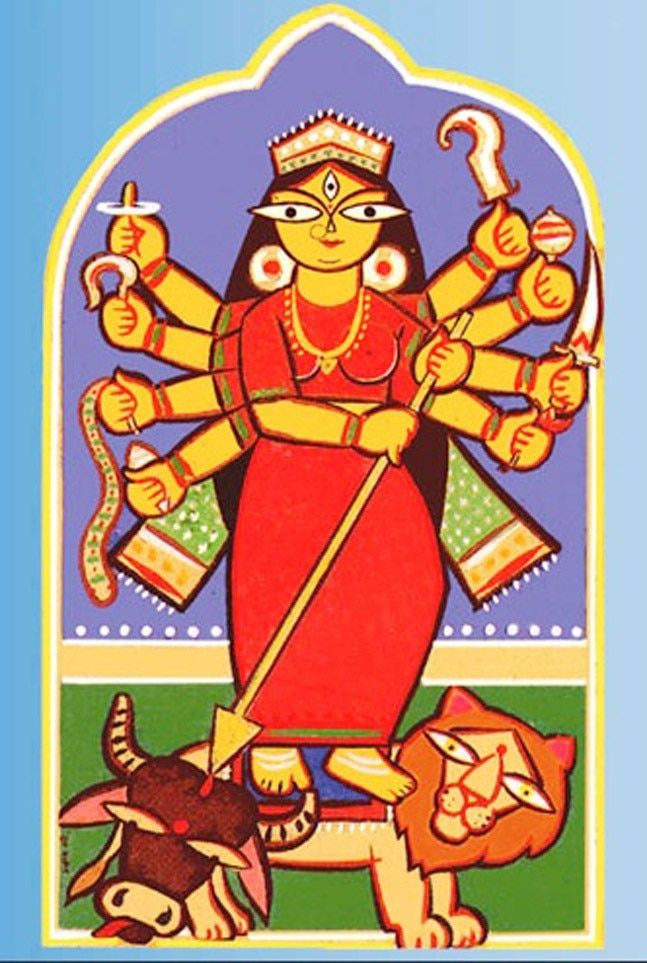
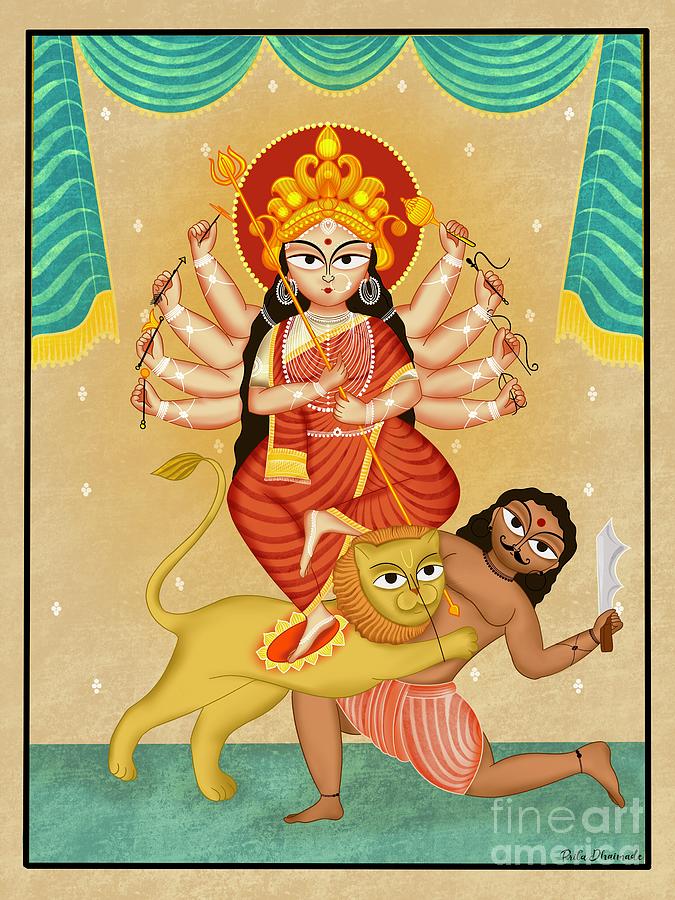
Durga Puja, a community- based festival. Courtesy: Creative Commons
Long ago as children, we looked forward to the autumnal festival of Durga Puja. For those who lived outside Bengal, there was no holiday but it was still a break, a season filled with joie de vivre, when family and friends would gather to celebrate the community-based festival, Durga Puja. Parallelly, many from diverse Indian cultures celebrated Navratri — also to do with Durga. On the last day of the Durga Puja, when the Goddess is said to head home, North Indians and Nepalese and some in Myanmar celebrate Dusshera or Dashain, marking the victory of Rama over Ravana, a victory he achieved by praying to the same Goddess. Perhaps, myriads of festivals bloom in this season as grains would have been harvested and people would have had the leisure to celebrate.
Over time, Durga Puja continues as important as Christmas for Bengalis worldwide, though it evolved only a few centuries ago. For the diaspora, this festival, declared “Intangible Cultural Heritage of Humanity” by UNESCO, is a source of joy. While devotees welcome the Goddess Durga and her children home, sons and daughters living away would use this event as a reason to visit their parents. Often, special journals featuring writings of greats, like Satyajit Ray, Tagore, Syed Mujtaba Ali, Nazrul would be circulated in the spirit of the festival.
The story around the festival gives out that like an immigrant, the married Goddess who lived with her husband, Shiva, would visit her parent’s home for five days. Her advent was called Agomoni. Aruna Chakravarti contends in her essay, Durga’s Agomoni “is an expression, pure and simple, of the everyday life of women in a rural community –their joys and sorrows; hopes and fears”. While some war and kill in the name of religion, as in the recent Middle Eastern conflict, Chakravarti, has given us an essay which shows how folk festivities in Bengal revelled in syncretism. Their origins were more primal than defined by the tenets of organised religion. And people celebrated the occasion together despite differences in beliefs, enjoying — sometimes even traveling. In that spirit, Somdatta Mandal has brought us travel writings by Tagore laced with humour. The spirit continues to be rekindled by writings of Tagore’s student, Syed Mujtaba Ali, and an interview with his translator, Nazes Afroz.
We start this special edition with translations of two writers who continue to be part of the syncretic celebrations beyond their lives, Tagore and Nazrul. Professor Fakrul Alam brings to us the theme of homecoming explored by Nazrul and Tagore describes the spirit that colours this mellow season of Autumn
Poetry
Nazrul’s Kon KuleAaj Bhirlo Tori ( On which shore has my boat moored today?), translated from Bengali by ProfessorFakrul Alam, explores the theme of spiritual homecoming . Click here to read.
Tagore’sAmra Bedhechhi Kasher Guchho (We have Tied Bunches of Kash), translated from Bengali by Mitali Chakravarty, is a hymn to the spirit of autumn which heralds the festival of Durga Puja. Click here to read.
Somdatta Mandal translates from Bengali Travels & Holidays: Humour from Rabindranath. Both the essay and letters are around travel, a favourite past time among Bengalis, especially during this festival. Click here to read.
The street lay wet and shimmering after the afternoon rains. I stood at the window sipping tea, enjoying the cool breeze for a moment entranced by the glitter of the raindrops falling off the potted plants, on window sills and ledges, down electric poles and wires by the street crossings where crows and pigeons preened and shivered like musical notes. In the sudden burst of sun warmed air, the rainbow hued petrol drips trembled in the puddles. It was a single moment of evanescence and peace, as in Robert Browning’s poem,‘Pippa Passes’ in ‘God’s in his Heaven/All’s right with the world!’
The mood gave way when I suddenly noticed the gait of a woman on the street. She turned into the street bent down with the weight of the bags on her shoulders and trudged slowly with the open black umbrella even though the rains had stopped. I could not see her face but I recognised her.
Staring at her, my heart thumped with sudden anxiety as I turned away and tried to quell the panic inside me. I knew her. I had seen her since my childhood following the same set routine as a young woman. Now as an old lady without changing her daily habit for more than fifty years, she continued doing the same thing, a creature of habit.
I felt the need to sit down. On the way to the sofa the ornamental mirror on the wall caught my reflection.
I could not stop staring at it in fear and fascination. That person was me now. Where had I gone? Alone with myself ! Age! Time! The sinuous whisper of crawling fear made me tremble. Age is just a number! I am as young as I feel — love is ageless.
All those self-assertions were hopeless. I could feel the sweat break out of my pores.
I sat down and gripped the poetry book I had been reading. He had insisted I read it when he gave it as a surprise gift — a good friend and colleague who had kept in touch. Why did he still remain kind and nice. Was he like or unlike others with whom I had been on good terms? Did he expect anything from me. Have I missed the signals all my life?
I was now a middle-aged single woman and fear gripped me as the thought that sprung to my mind was, I would also end up like her. My calm was tattered to pieces, fluttering away in confusion. I was caught in a whirl of emotions and thoughts. Why did she disturb me so much?
I had definitely traversed a very different path from her. There were no parallels in our lives. But now at this moment, suddenly when I was enjoying my ‘me’ time, the splintering truth struck out of the blue. I am alone. The sprawling apartment spoke of comfort, care and luxury with a live-in maid, with all the gizmos and art and cultural ambience of a successful life and career, a single woman could achieve; I suddenly felt like a cipher. Raw, exposed and empty. Why did I feel like that?
The demon called loneliness mocked my aloneness. It had no shape or size or smell. It was like a vapour, like air that sometimes crept silently or jumped up terrorising my very breath. Those moments of sheer emptiness and choking sensations that I had thought were over, seized me again.
Who are you.? What have you achieved. Have you made any one happy? Does anyone wait for you, ask about you ? Such were the dark numbing thoughts that gathered inside me and gave way to spontaneous outflow of tears. My sighs cradled unknown sorrows I could not fathom. Melancholy and depressed, moody and restless all the shine was tarnished and lost meaning. I thought I was beyond it and a very stable person. But I knew now that I was deluding myself.
My eyes fell on the page I had been reading, Andrew Marvell’s poem ‘To His Coy Mistress’.
Had we but world enough and time,
This coyness, lady, were no crime.
We would sit down, and think which way
To walk, and pass our long love’s day.
Thou by the Indian Ganges’ side
Shouldst rubies find; I by the tide
Of Humber would complain. I would
Love you ten years before the flood,
And you should, if you please, refuse
Till the conversion of the Jews.
My vegetable love should grow
Vaster than empires and more slow;
An hundred years should go to praise
Thine eyes, and on thy forehead gaze;
Two hundred to adore each breast,
But thirty thousand to the rest;
An age at least to every part,
And the last age should show your heart.
Am I lonely? Am I old ? Why am I still single? The looping thoughts suffocated me in its coils.
The naked bulbs of truth has a harsh way to call attention in the most make-believe moment of tranquillity. The mirror held me in its snare but it did not crack my image — vanity, pride, self-delusions shatter inside me.
I look at the degrees framed on the wall; the decorative pieces brought from the different countries during my world-wide travels, and wander into a mental fog .
What use are these papers to me now? In my loneliness, do I crave aloneness? However high I go, I must come down to earth among people, to get applause; hear it, share it to have meaning.
My mind was filled with her image. I knew without looking she would stop under the old banyan tree, pause for breath and turn into the narrow lane where the cluster of chawls[1] with the rows of common toilets and bathrooms existed since I could remember. They were all built more than eighty years ago and opened into the central courtyard. The multi-storied building and high-end gated communities I occupied came later and had gates, gardens and lifts with bathrooms and toilets inside our homes.
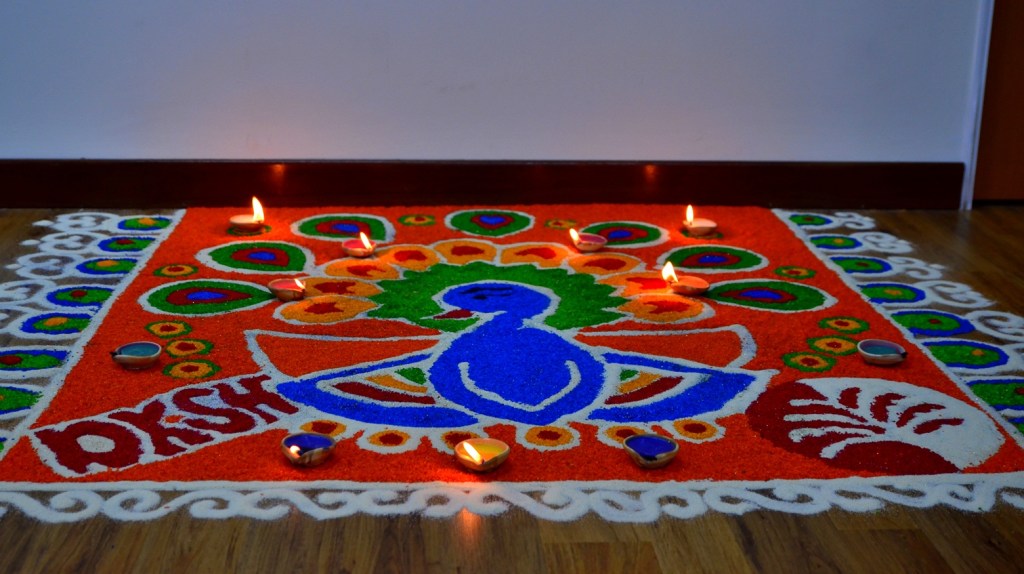
Her name was Kokilaben. All knew her as she was well known in the locality called Gaiwadi, for singing and dancing during the nine day garba festival[2] during Navaratri. She would decorate others homes with beautiful rangoli designs if requested. Whether it was her nickname or her real one, whether her dark complexion contributed to her remaining single, no one knew and no one confirmed. Since I could remember, she was a slim young woman who wore her saree in the traditional Gujarati style, taught in the primary Muncipal school and looked after her ailing mother after her father passed away.
I remember the ladies in our old building talking about her in whispers sometimes, and at other times, praise her spirit and dedication to her mother for taking care of her.
Growing up, the difference I perceived in my teenage mind, was that she was single, unmarried and had a job unlike the married women who looked after their husbands, children and ran a budgeted households. They cooked, cleaned, argued with the vegetable and fruit vendors, hung clothes and gossiped across their balconies and windows . They fought with other women for water and at the ration shop, women who looked dishevelled and pulled up their sarees tight, and knotted its end as if ready to fight and take on the world. After 4 O’clock they became ladies and dressed up in the evening to await their husbands return.
Kokilaben was a permanent subject of gossip ; no one spoke to her but about her. Her immediate neighbours kept watch on who visited her. They watched out to see if she spoke to men of the locality – whether strange men visited her. They wondered why she showed no interest in marriage.
Everyone kept an eye on her while they gossiped about the new couples, which boy made eyes at which girl. Inquisitiveness and curiosity was a virtue here. They spoke of not giving dowries and cursed the burden of daughters, but secretly took it for their sons on the pretext of marrying their daughters. They gossiped about , mothers-in-law, sisters-in-law and good husbands, saintly husbands and philandering ones, of shame and cruelty and all that happened in their lives, but the worst was kept for the working single girl and she was suspected of committing the worst crimes. They praised their children, told lied about them too. Behind the closed doors, they beat them and abused them and took out their frustrations in secret silence. All wore masks.
One common topic for a long time I remember was the marriage of Kokilaben, as she was the one who chose to live alone after her mother passed away. She used to go missing for a week every three months and no one knew where she went . After some years, she did not disappear. Once her hair turned grey she ceased to exist.
Realisation struck me when I passed my civil service exams, from the security of my loving family how she must have craved the sense of freedom after carrying the burden of a home and her parents. I understood she was a rarity in the conservative middle class of 1960s.
Now I too stay alone. Kokilaben had no one and she had still lived the way she wanted. People spread stories about her. She was a transgender. She was a witch. She brought bad luck if you met her on the way. She ate children. She was not the pleasing friendly auntie but did not disturb any one and gave money for the annual Holi, Ganesh Chathurthi, and Navaratri festivals when the colony held mass celebrations. She lived quietly and asked no body’s help as she grew old. She paid her bills and fed the street dogs during the monsoons. She gave shelter in her chawl verandah to dogs during downpours and then drove them away when the rains ceased.
So today why was my calm broken by this familiar figure.?
She had not existed in my daily frame. She had merged with my memories even though she was alive like part of the furniture in the background. Living a full animated, varied life, only the present and exciting future mattered. On a certain day called retirement, all that ceased with the strike of a government rule. We all had to retire at the age of sixty. I suddenly became a senior, a retired officer, a suffix, a past tense, a marginalised peripheral person brought down from the tabletop, kept in a corner sometimes consulted. My importance diminished. I was an afterthought, with no fresh shoots , only roots.
It was not loss or failure in love; A spinster missed the bus for not making efforts to find a mate. It was not a voluntary decision to be single. It was not even a decision to be self-sufficient and complete. It was not out of vanity waiting for the best catch or being rejected. I had security, love, care and many relatives and friends looking out for me .
Still I stayed unmarried. I did not have an affair or secret liaisons. I felt I was not ready. I did not know how to handle that particular relationship while I could handle anything else. I feared domination or giving in to being used or abused, being beholden to someone, losing independence, feared not sharing common values and ideas on what I cared or despaired about, feared of the other not being empathetic or sympathetic with me on all issues. Would I be mentally free without commitments?
In my case, it was because of a personality trait of fear, anxiety or disorder as you may call it. Externally, I seemed like a perfect apple but the insides was not perfect. It was flawed with delusional mental problems and phobias. Seeing the woman today, the realisation was stunning. There was no difference between me and her. Both lived but at the end of day, I was alone and lonely and she was not. She lived within herself content with her difficulties.
I lived in my mental cocoon, a moth, and did not struggle to come out as a butterfly. She did emerge out of her pupa. I hid all the broken glass pieces of my mind well and succeeded by external calibration to become a versatile achievement-oriented woman. Kokilaben lived and lives while I now search for the shades and shadows with regret. I fooled myself for I never learnt to depend on myself for my happiness.
Why did he give this book to me, I wondered? The suspicions started gathering like thundered clouds before a storm. The old pain of not believing in my own capacity and struggling to get appreciation and achieve heights of fame and praise imploded inside me. I could not form a trusty relationship; commitment phobic for the fear of failure as anxiety eroded my fragile feelings and left me feeling numb. I was convinced that it was safer to hide behind my own self, not sharing my life with anyone.
But at my back I always hear
Time’s wingèd chariot hurrying near;
And yonder all before us lie
Deserts of vast eternity.
Thy beauty shall no more be found;
Nor, in thy marble vault, shall sound
My echoing song; then worms shall try
That long-preserved virginity,
And your quaint honour turn to dust,
And into ashes all my lust;
The grave’s a fine and private place,
But none, I think, do there embrace.

(Andrew Marvell’s poem ‘To His Coy Mistress’, published posthumously in 1681)
My single hood was surely inferior to Kokilaben’s life. I took the cup to wash in the sink and did not know where the detergent and wipe was kept. I had to wait for the maid to return from the market. I felt my illusions of grandeur turn to mundane sniggers of self-pity.
Kokilaben opened up my deep seated fears and the truth sprang punching my face.
Life is for living. I dreamt my life away. Yes, with luck and some help I slid through life, but at some point or moment, like now my face smashed on that reflection on the mirror. I will taste the salt of blood and tears of reality, feel the self-demeaning regret and pain of not having experienced the love, the hurts and happiness of having a partner.
Kokilaben had self-respect I did not , for I lived in others words and mind .
Why did he still remain my friend or was he trying to say something? Was it too late? I must call him. Talk to him now! Can I live a life time in the time I have? Time was dripping drop by drop, but now I felt life gushing by in my tears .
The panic attack when it came was bad. I struggled up panting to swallow the tablet that was kept handy as an ‘sos’ , but at that moment the telephone rang and I trembled as I took the call, in hope, in fear, in desperation.
Now therefore, while the youthful hue
Sits on thy skin like morning dew,
And while thy willing soul transpires
At every pore with instant fires,
Now let us sport us while we may,
And now, like amorous birds of prey,
Rather at once our time devour
Than languish in his slow-chapped power.
Let us roll all our strength and all
Our sweetness up into one ball,
And tear our pleasures with rough strife
Through the iron gates of life:
Thus, though we cannot make our sun
Stand still, yet we will make him run.

(Andrew Marvell’s poem ‘To His Coy Mistress’, published posthumously in 1681)
[2] Traditionally, garba is performed during the nine-day Indian festival, Navarātrī, that is held around September-October.
Nirmala Pillai is a writer, painter, and an Ex-Civil Service Officer, who has published three collections of poems and one of short stories. Her published works have appeared in PEN, The Asian Age, Indian Literature, Bare Root review from Minnesota University, Poetry Can, UK [Poetry Southwest], The Telegraph, The Little Magazine, Cha; An Asian literary journal.
PLEASE NOTE: ARTICLES CAN ONLY BE REPRODUCED IN OTHER SITES WITH DUE ACKNOWLEDGEMENT TO BORDERLESS JOURNAL
In my naive childhood, I thought that Deepavali was one big celebration all over India and of those of the Indian diaspora the world over, at least of those of the Hindu faith. Bizarrely, I must have thought the whole of India would be up in jubilation anticipating the arrival of the festival of lights. Obviously not: the discussions surrounding the recent UNESCO recognition of Durga Puja as an Intangible Cultural Heritage are anything but unison. Now the Gujaratis want Navaratri[1] as a cultural loom. Interestingly, the people in power in Tamil Nadu want the harvest festival of Pongal as the main Tamil festival.
Indians who were brought in by the British to work in the Malayan rubber estates in the 1930s were mainly from Tamil Nadu. They celebrated Thaipusam[2] and Deepavali with much pomp and fanfare. Both days were soon declared holidays in many states of Malaysia.
I do not particularly remember my childhood memory of Deepavali being particularly joyous. Deepavali was another unnecessary expenditure in my home. We were a lower middle-class Malaysian Indian family of the 1970s. My thrifty Amma looked at this merrymaking as a hindrance. It was also the busiest time of the year for her. She was a kind of Indian Auntie Scrooge. She would drum up upon us at every moment that if one is healthy and wealthy, every day would be Deepavali. Deepavali comes once a year, right. But then, it comes every year.
Amma was a kind of local rock star amongst the flat dwellers when it came to stitching saree blouses. She was the go-to person for the aunties to enhance their assets and anatomy to look good in their sarees, even though most of them were overtly oversized and out of shape, to look trim and alluring, in their eyes, of course. Amma would use her talent to supplement Appa’s meagre take-home after the creditors’ scavenging.
She took in more orders than she could chew in her zeal to make hay while the sun was out. As the days grew nearer, she would become edgier and edgier. She would burn the midnight oil trying to finish the orders, as her customers would trickle in, demanding in desperation for their Deepavali blouses. She would smile apologetically to her clientele, but once they left, all of us, including Appa, would be the brunt of her frustrations. She would go on a monologue about the hopelessness of life, blaming all the people in her life, including God, for her miseries.
My sister, Sheela, grudging, had to help her, cutting loose ends, stitching buttons, edgings, and general tidying the blouses. Occasionally, Amma would cut or sew something wrongly, and that was when all hell would break loose. No one was spared of her screaming tirade. The smacking of children was legal then.
Deepavali was generally not what Malaysian Indian students, that is, those keen to score well in the Malaysian public examinations, looked forward to. Most, if not all, major public examinations were held at the end of the year. It made perfect sense as that was when the rest of the school would have finished their academic year, and there would be peace and quiet to conduct examinations. The trouble is that Deepavali mainly falls in late October or early November. Sometimes, the celebrations fell right smack between papers. The school would also be holding their end-of-year examinations if it was not for the public papers. Hence, we thought Deepavali was just another off-day to cramp up for the tests.
We, the children, could look forward to our annual sort of ‘pilgrimage’ thronging the bargain-hunting haven of Penang’s Campbell Street’s cheap sale’s stores two to three weeks before the auspicious day. We could look forward to the only two sets of new attire they would buy for the next twelve months. Seeing Amma bargain with the shopkeepers for the best price, I sometimes pitied the sellers. Sometimes, I feel like telling Amma to just pay what he asked. No, she would not do that. She would go to another shop, start another boxing match, loose, and return to the first shop smiling sheepishly.
As the days got closer, Amma would get even more and more high-strung. The children would be at the receiving end as the sewing orders piled up, and she could not find the correct thread colours for her blouses. In the midst of all that, some cloth piece or button would go missing, and then there would be a ruckus. Everyone would be roped in to search only to find the missing item right under her nose, where it would have been all the while.
Amma would become more desperate. The children, all preparing for the examinations, would be nagged for not helping enough, unlike other children – as if we were the only children in the world who needed to study! The sewing sessions would go on and on till the morning of Deepavali. On one occasion, probably due to fatigue, she actually cut out the wrong design for the wrong customer, and Amma had to replace the material later. Probably that customer must have ‘celebrated’ Deepavali that year with no saree blouse! She might have passed it off as another new fad – as an empress in ‘new clothes’, perhaps!
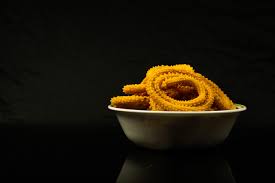
About a week before Deepavali, cookies would have to be prepared in the middle of this entire melee. By tradition, the first to be cooked must be oil based; hence the opening ceremony was done by pressing murukku (a deep-fried snack made from rice flour and spices) and ghee balls (ney orundei). With a traditional and cumbersome murukku squeezing device, I would be assigned to give my muscle power to press down the murukku dough. A few other cookies would be baked in the then-spanking-new electric oven. To add to the local flavour, Amma would stir up sticky glutinous in brown sugar for a delicacy called ‘wajik‘.
One particular Deepavali eve, I remember an incident that triggered a stir in my neighbourhood. We were living on the 15th floor of a 17-storey low-cost flat. Residents were packed into tiny pigeonholes we called home. Privacy was the most diminutive of the priorities as we paved through life. Sheela was left to guard the fortress as my parents went off to the evening market to get groceries for the big day. I had gone off to school. I was in the afternoon session[3] that year.
I returned home to a big commotion outside my flat. Most of the neighbours were standing outside the unit, banging on the door, calling for Sheela and talking loudly amongst themselves. I peeked through the blind panel of the door. I could see Sheela slouched cosily on a sofa with her hands on her right cheek deep in slumberland. The television in front of her was blaring loudly, further drowning all the commotion outside. She was not too far from the door, but she continued snoozing. I guess all the late nights helping Amma must have gotten to her.
Residents getting locked out was nothing new in our neighbourhood. I suppose it is one of the events that got the neighbours together to mingle and get to know each other. Among us were self-appointed ‘specialists’ who devised their own gadgets to deal with any locked-out situation. The most typical item used by most was a charcoal stirrer. I guess that is how laparoscopic surgeons got the idea of performing keyhole surgery. One with hyper-flexible joints was sometimes sorted after to insert his hand through the door blinds!
Yours truly saved the day when I managed to manoeuvre my hand through the door to flip the lock open. All through the melee, my sister was in total bliss. Finding her snoring, oblivious to all the pandemonium outside, Appa went on to reprimand her in the usual way – KABOOM! (i.e. smack).
With all that build-up, preparation and countdown, Deepavali was actually an anti-climax – except for the new clothes, the food and the angpows (money packets) we received after distributing cookies to our neighbours. Amma would be sleeping after finally finishing her sewing and cooking. Appa would catch his forty winks on his easy chair, and we, the children, would watch all the special programmes on TV. Nobody actually came to visit us, even on Deepavali day. The afternoon would come, and the family would again manifest in front of the idiot box to watch the Deepavali special Tamil movie on TV. When this was over, essentially Deepavali was over and reality bit in. It was time to prepare for school the following day. On Deepavali nights, we would fire up a couple of Chinese sparklers.
All the money collected in the angpows would go straight into our Post Office Savings accounts in the next few days. The grand finale of the Deepavali curtain would fall a few days later with the family outing to the movies, a Tamil movie, packed with cookies that Amma had prepared as viewing snacks. Then, it was the school holidays, and another school year would come.
[1] A Western Indian festival in honour of the Goddess Durga, celebrated around the same time as Durga Puja
[2] The festival in January- February (called Thai in the Tamil calendar) commemorates the occasion when Durga gave her son, Murugan (or Kartikeya) a divine spear to defeat a demon. It is also commonly believed that Thaipusam marks Murugan’s birthday. It is a national holiday in many countries such as Malaysia, Sri Lanka and Mauritius. In India, in Tamil Nadu, it is declared as a holiday but not celebrated in other parts of India.
[3] Schools in Malaysia and Singapore often ran two session – morning and afternoon.
Farouk Gulsara is an occasional writer who blogs at riflerangeboy.com. Whenever he gets nostalgic about the time that whisked by, he pens down whatever his grey cells are still able to retrieve.
.
PLEASE NOTE: ARTICLES CAN ONLY BE REPRODUCED IN OTHER SITES WITH DUE ACKNOWLEDGEMENT TO BORDERLESS JOURNAL




 Borderless