
Categories
Contents

Borderless, August 2025

Art by Sohana Manzoor

Editorial

Storms that Rage… Click here to read.

Translations

Nazrul’s Jonomo, Jonomo Gelo (Generations passed) has been translated from Bengali by Professor Fakrul Alam. Click here to read and listen to a rendition by the famed Feroza Begum.

Ajit Cour‘s short story, Nandu, has been translated from Punjabi by C Christine Fair. Click here to read.

The Scarecrow by Anwar Sahib Khan has been translated from Balochi by Fazal Baloch. Click here to read.

Five poems by Aparna Mohanty have been translated from Odia by Snehprava Das. Click here to read.

Angshuman Kar has translated some of his own Bengali poems to English. Click here to read.

Sunflower, a poem by Ihlwha Choi,  has been translated from Korean by the poet himself. Click here to read.

Tagore’s Shaishabshanda (Childhood’s Dusk) has been translated from Bengali by Mitali Chakravarty. Click here to read.

Poetry

Click on the names to read the poems

Ron Pickett, Fakrul Alam, William Miller, Meetu Mishra, Heath Brougher, Laila Brahmbhatt, Luis Cuauhtémoc Berriozábal, Snigdha Agrawal, George Freek, Ashok Suri, Scott Thomas Outlar, Dustin P Brown, Rajorshi Patranabis, Ryan Quinn Flanagan

Poets, Poetry & Rhys Hughes

From the Vale of Glamorgan are two poems on the place where Rhys Hughes grew up. Click here to read.

Musings/Slices from Life

Menaced by a Marine Heatwave

Meredith Stephens writes of how global warming is impacting marine life in South Australia. Click here to read.

The Man from Pulwama

Gowher Bhat introduces us to a common man who is just kind. Click here to read.

More than Words

Jun A. Alindogan writes on his penchant for hardcopy mail. Click here to read.

To Bid or Not to Bid… the Final Goodbye?

Ratnottama Sengupta ponders on Assisted Dying. Click here to read.

Musings of a Copywriter

In Syrupy Woes, Devraj Singh Kalsi looks at syrupy health antidotes with a pinch of humour. Click here to read.

Essays

‘Verify You Are Human’

Farouk Gulsara ponders over the ‘intelligence’ of AI and humans. Click here to read.

Does the First Woman-authored Novel in Bengali Seek Reforms?

Meenakshi Malhotra explores Somdatta Mandal’s translation of Manottama, the first woman-authored Bengali novel published in 1868. Click here to read.

Bhaskar’s Corner

In Bidyut Prabha Devi – The First Feminist Odia Poet, Bhaskar Parichha pays a tribute to the poet. Click here to read.

Stories

The Sixth Man

C. J. Anderson-Wu tells a story around disappearances during Taiwan’s White terror. Click here to read.

I Am Not My Mother

Gigi Baldovino Gosnell gives a story of child abuse set in Philippines where the victim towers with resilience. Click here to read.

The Archiver of Shadows

Hema R explores shadows in her story set in Chennai. Click here to read.

Ali the Dervish

Paul Mirabile weaves the strange adventures of a man who called himself Ali. Click here to read.

The Gift

Naramsetti Umamaheswararao moulds children’s perspectives. Click here to read.

Notes from Japan

In American Wife, Suzanne Kamata gives a short story set set in the Obon festival in Japan. Click here to read.

Conversation

Neeman Sobhan, author of Abiding City: Ruminations from Rome, discusses shuttling between multiple cultures and finding her identity in words. Click here to road.

Book Excerpts

An excerpt from M.A.Aldrich’s From Rasa to Lhasa: The Sacred Center of the Mandala. Click here to read.

An excerpt from Neeman Sobhan’s An Abiding City: Ruminations from Rome. Click here to read.

Book Reviews

Somdatta Mandal reviews Chhimi Tenduf-La’s A Hiding to Nothing. Click here to read it.

Madhuri Kankipati reviews O Jungio’s The Kite of Farewells: Stories from Nagaland. Click here to read.

Bhaskar Parichha reviews Snehaprava Das’s Keep it Secret: Stories. Click here to read.

.

Click here to access the Borderless anthology, Monalisa No Longer Smiles

Click here to access Monalisa No Longer Smiles on Amazon International
Categories
Excerpt

From Rasa to Lhasa

Title: From Rasa to Lhasa: The Sacred Center of the Mandala

Author: M.A.Aldrich

Publisher: Speaking Tiger Books

In 1904 at the behest of a suspicious imperial government in India, a British expeditionary force under Colonel Francis Younghusband occupied Lhasa in a fruitless search for evidence of Russian meddling in Tibetan politics. Prior to this bellicose assignment Younghusband had spent years exploring the remote, blank spaces of late nineteenth century Central Asian maps and acquiring an unusually sensitive insight into Asian religion for someone in his position. After visiting the Jokhang Temple, Tibet’s most sacred shrine, he penned a description that still resonates today.

Here it was that I found the true inner spirit of the people. The Tibetans from their mountain homes seemed here to draw on some hidden source of power. And when from the far recesses of the temple came the profound booming of great drums, the chanting of the monks in deep reverential rhythm, the blare of trumpets, the crash of cymbals, and the long rolling of lighter drums, I seemed to catch a glimpse of the source from which they drew. Music is a proverbially fitter means than speech for expressing the eternal realities; and in the deep rhythmic droning of the chants, the muffled rumbling of the drums, the loud clang and blaring of cymbals and trumpets, I realized this sombre people touching their inherent spirit, and in the way most fitted to them, giving vent to its mighty surgings panting for expression.

For Tibetans, the Jokhang Temple is at the heart of a mandala, a circular geometric design that serves as a symbol of the universe as well as a visual guide to complex and esoteric Buddhist principles. The devotional ritual of circumambulation around the temple reinforces its status as the sacred center or a “life-pole.” It is the geometric center of Lhasa’s three imaginary concentric circuits: the three korlam that are pathways for pilgrims to practice the dharma by circumambulating the Jokhang.

Eight protective shrines were built around the Jokhang. There are other nearby sites tied to the legendary account of the construction of the temple in the seventh century. Some of these sites are still used for worship, while others have become shops or residences; sadly, some have disappeared into the ether over time. The sacred and the secular were not separated in the streets of Lhasa, just as the normal and supernormal were entwined indivisibly. To expect otherwise would have come as a shock to the residents of old Lhasa and sounded downright silly to them.

For nearly all of its existence, the Jokhang Temple was Lhasa in the minds of Tibetans. Ninth-century Tang dynasty chronicles suggest Lhasa might have consisted of nothing more than mobile encampments for nobles, soldiers, and nomads, with only two permanent buildings constructed in stone (the Jokhang and its sister temple, Ramoche); but Chinese chroniclers did not always examine the ways of barbarians with much care. Lhasa did not come into being as a modest-sized city until the seventeenth century. Nevertheless, the Jokhang was felt to be synonymous with Lhasa, the “Place of the Gods.” Even in recent times the city’s bus drivers cried out “Lhasa” to their passengers to announce arrival at stops near the Jokhang Temple.

Tibetans reaffirm their view of religion as permeating all elements of the phenomenal world by perceiving them in the form of a mandala. Indeed, the mandala model applies equally to the universe as a whole, to the country, … to each city, to each temple and shrine, and, tantrically, to the worshipper’s own body. The realization of one’s own identity with these larger designs is the attainment of salvation.

ABOUT THE BOOK

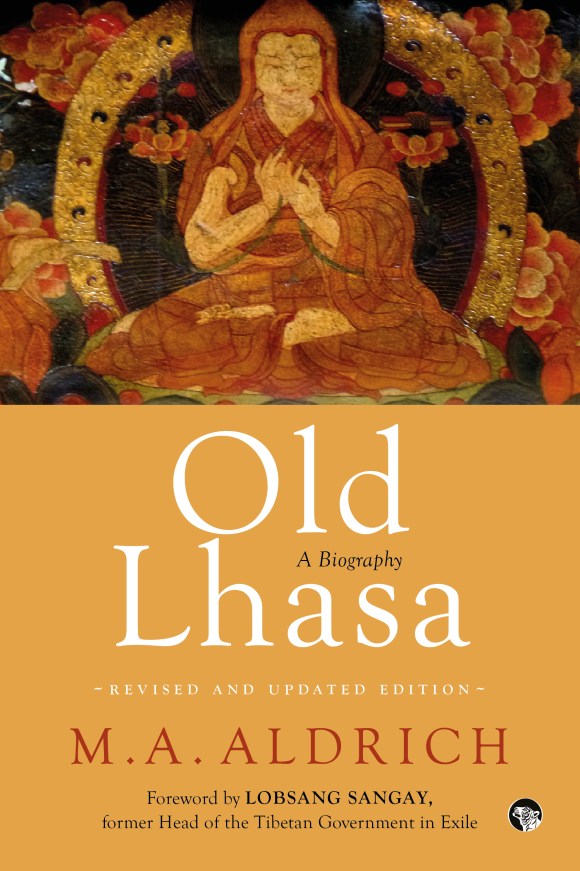
A sweeping, magnificent biography—which combines historical research, travel-writing and discussion of religion and everyday culture—Old Lhasa is the most comprehensive account of the fabled city ever written in English. It is a portrait not only of a city but also an entire people—both those who still live in occupied Tibet, and those who are in exile.

‘[This book] brings you closer to the real spirit of Lhasa.’—Lobsang Sangay, former head of the Tibetan Government in Exile

‘This remarkable history should be compulsory reading for travellers, academics and armchair historians. Experts will find that Aldrich has shaken the kaleidoscope of the history and geography of Lhasa and Tibet into new and illuminating patterns. Immersing himself in the place and its past, he unravels the colourful threads that make Lhasa and Tibet so fascinating… This splendid book is a compendium of knowledge about the city and its place in Tibetan history and culture—including, of course, religion.’—Alan Babington-Smith, President of the Royal Asiatic Society, Beijing

‘Aldrich has provided in these pages a whole simulacrum of a country and its wonders. What shines in the book and gives it life is not only his amazing knowledge and understanding of Lhasa and Tibet but also his passion, enormous humour and, above all, love for its people.’—Adam Williams, author of The Palace of Heavenly Pleasure

‘Aldrich has produced an outstanding narrative focused on one of the most interesting cultural capitals in Asia… [A] fascinating history that will continue to attract readers for a long time to come.’—Jonathan S. Addleton, author of The Dust of Kandahar

ABOUT THE AUTHOR

M.A. Aldrich is a lawyer and author who has lived and worked in Asia since the 1990s. Besides Old Lhasa: A Biography, he is the author of The Search for a Vanishing Beijing: A Guide to China’s Capital Through the Ages,The Perfumed Palace: Islam’s Journey from Mecca to Peking and Ulaanbaatar—Beyond Water and Grass: A Guide to the Capital of Mongolia.

.

PLEASE NOTE: ARTICLES CAN ONLY BE REPRODUCED IN OTHER SITES WITH DUE ACKNOWLEDGEMENT TO BORDERLESS JOURNAL