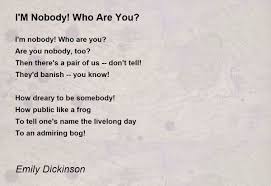
"I'm nobody! Who are you?
Are you a nobody, too?"
(Emily Dickinson)

NOBODY

It is not easy to tell the tale of nobody.
A nobody's tale is without a
beginning or an end,
Like jumbled up letters on a mussy page,
Obscure sketches from a hand untrained.

A nobody's anonymous world
Battered by the day, and
Bruised by the night,
Spins and shatters in a gyrating vortex
Of liquid darkness and light.

A nobody lives and dies and again lives
And breathes a dream in between,
Desperate to see just one come true, and
For a glimpse of green in a bald ruin.

The crimson dawn in a nobody's sky
Burns hopes to ash.
A moon flings shards of silver
At nobody’s world, aiming a cruel slash.

The fog settles forever thick and grey
Outside a nobody's  window.
In a nobody's land, seasons don't change.
There settles permanent a season of snow.

Songs painted black by storm clouds
Croak beyond a nobody's door.
The wind mourns in the hollow orchards
Roses bleed on a cracked floor;

It is hard to tell a nobody's tale
That has neither a beginning, nor an end.
It's the story of a doomed  soul,
That neither has a foe, nor a friend!!
From Public Domain
Snehaprava Das is an academic, translator and writer. She has multiple translations, three collections of stories and five anthologies of poetry to her credit. She has been published in Indian Literature, Oxford University Press, Speaking Tiger, Penguin and Black Eagle Books.
.
PLEASE NOTE: ARTICLES CAN ONLY BE REPRODUCED IN OTHER SITES WITH DUE ACKNOWLEDGEMENT TO BORDERLESS JOURNAL.
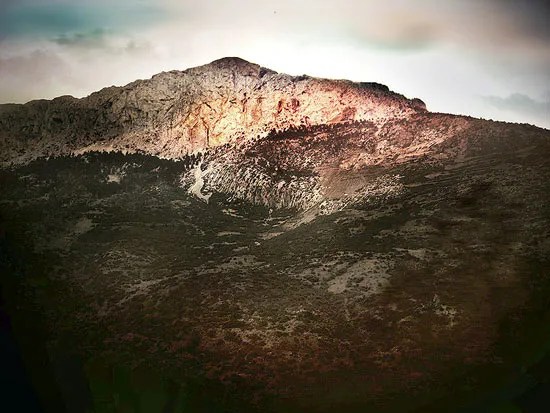
Mount Parnassus in Greece, where the muses were said to gather, was regarded as the home of poetry: From Public Domain
For the longest time, women were uncomfortable occupants of the house of poesy[1], particularly where there were existing canons of poetry established by the institutional gate-keepers and male custodians of literature. At best, they were viewed as Jane-come-latelies who sought to transgress the hitherto hallowed domains of high verse, interlopers to the hallowed heights of Parnassus who dared not “drink the milk of paradise”.
This ‘absence’ of women from the terrain of poetry is in spite of the fact that women have always written poetry, from ancient times to now. Sappho in the western tradition, was a Grecian poet from 5th-6th century BCE who was the pioneer of lyric poetry, a genre which apart from being set to music, also inaugurated the poetic ‘I’. In India, Buddhist nuns in the Mahayana and Theravadas who wrote poems known as the therigathas were early precursors of female poets. These early women poets engaged in the sometimes forbidden, sometimes lascivious charms of verse and versification. Down the ages, there were many others who joined them and kept the lamp of women’s versification lit. However, if women have always been versifiers, why has there been a resistance and grudging admission for women to the poetic domain, which becomes a sort of “No (Wo)man’s land”? Why do women poets have only a token presence in traditional poetic anthologies?
Some reasons have been offered, not least among them being the preponderance of male poets who have often also been self-proclaimed and self-appointed guardians, legatees and arbiters of poetic tradition. Canonical poetic traditions, many claim, require a knowledge and understanding of Latin and Greek in the West while a knowledge of Sanskrit/Persian in the Asian context was deemed necessary. Thus women, who, for the most part, lacked formal education and had but small Latin and less Greek, could only hover around the margins and fringes of poetry. The situation with Sanskrit and Persian was similar and women remained mostly absent from or shadowy denizens of poetic terrains. Even if and when women were writing, they were doing so in colloquial registers and in the languages of the common people and not in formal or decorative language, deemed essential for poetry, for the most part. Almost the first group of women writing poetry in India were Buddhist nuns who wrote in Pali, one of the many ancient languages in the ancient Indian subcontinent, which enshrined its own scholarly tradition. Sappho wrote in the Greek Aeolic dialect, which was difficult for Latin writers to translate.
Between 12th and 17th century, there was an advent of devotional mystic poetry called “Bhakti” and “Sufi” poetry. While the poems were uttered/written in a devotional idiom, the poems and songs were often rebellious and iconoclastic, rejecting institutional religions and social norms. This poetry was rooted in personal and unmediated devotion and rejected formal languages and established societal norms. Some of this poetry was in an informal register, colloquial language and performative with a strong dramatic quality. Thus we have lines in Kannada from Akka Mahadevi (1130-1160) who rejects her earthly husband:
I love the handsome one: He has  no death decay nor form… no end no clan, no land.
Take these husbands who die, decay, and feed them to your kitchen fires.(Vachanas)
Women poets for the longest time had a crisis of identity, identification and non-belonging. They laboured under the anxiety of authorship where they felt the absence of precursors and fore-mothers and the lack of a poetic tradition to which they could belong. They were often made to feel as if they lacked genuine poetic talent or that they were transgressors against womanhood and femininity.
In Aurora Leigh (1855) by Elizabeth Barrett Browning, the eponymous title character, considers the diverse fields of literature where women can exercise their talent and claim a space. The field of dramatic writing poses a challenge because the former demands that the woman writer be in the public eye in order to promote her plays. Further, to achieve or even aspire to the rank of Poet, Aurora must become capable of “widening a large lap of life to hold the world-full woe”. Over the course of the long epic poem, she tries to reconcile her femininity with her artistic aspirations. In both cases, she is denied emotional fulfilment. She refuses to accept the role of an obedient wife, since it would mean foregoing the intellectual independence needed to develop as an artist, but then she must also refuse the love of a husband. In Book Five, she mentions three poets, none of whom she admires for their “popular applause”. Yet she admits that she envies them for the time they can devote to their chosen vocation and the adoring women that surround them and provide emotional support and fill their days with glory.
Another issue with women’s writing and poetry is the uncomfortable positioning of women in relation to patriarchal language or male centred language. If as Dale Spender declares in “Man-made Language”, the masculine is asserted as the norm, where do we position women’s voices? While language is a universal medium of communication, man-made language is full of sexism and chauvinism and expresses reality from a predominantly masculine and patriarchal perspective. If language is a social system which women are persuaded or co-opted to use, how do they work within its confines to express their poetic aspirations? How do they stretch, bend, subvert language to express their own realities? Can we read techniques of irony, satire and other figurative and metaphoric strategies of defiance and subversion and an attempt to undermine from within?
Juliet Mitchell in her essay on ‘Femininity, Narrative and Psychoanalysis’ states that the woman writer/novelist must of necessity be a hysteric, straddling two opposed worlds. One world is that of male definitions and conceptions of femininity and the other, a resistance and defiance of such conceptualising, accompanied by an attempt to undermine from within. Her defiance and resistance makes her character that of a hysteric, one who defies accepted notions and standards of femininity and is therefore considered transgressive. She troubles fixed gender categories, roles and definitions. She also disrupts and challenges the symbolic order of language, one which insists on rules of grammar and linguistic structures through the semiotic order which uses word play, repetitions and childish rhymes, in order to express inner desires and drives. The symbolic order deals with the denotative aspects of language and the semiotic order with the affective aspect.
Women’s poetry often houses and accommodates the semiotic, seeming psychobabble that plays with and disturbs fixed notions of femininity and binary gender identities.
What are the popular themes that inform women’s poetry? Some themes are to with women’s search for authentic self-hood and identity, their search for roots and a space of their own. As we see in Aurora Leigh, much of women’s poetry is self-conscious and self-reflexive, about the act of writing itself, the “awful daring of a moment’s surrender which an age of prudence could never retract.”(T.S.Eliot)
Many contemporary women poets, across continents, have evinced a substantial interest in exploring their poetic self through their poems. On the one hand is the confessional poetry of Sylvia Plath and Anne Sexton, on the other the brief gnomic utterances of Emily Dickinson. Before the advent of the twentieth century, one hears of Barrett Browning, Emily Dickinson and Christina Rossetti, among many others. Names like Aphra Behn and Anne Bradstreet have been included in many syllabi, often as a token inclusion in an otherwise male centric course.
Women poets have talked about the horrors of war including rape, pillage and destruction. In their critique of war and violence, we find the forging of transnational solidarities, whether it is women’s poetry from Sri Lanka or Birangona (War heroines).
In India the many names that come to mind are that of Kamala Das, Eunice D’Souza, Meena Alexander, Sujata Bhatt and Sunuti Namjoshi. Women poets have employed effective means to explore the entire gamut of experience.The private and the public domain, their process of self-analysis; the process of poetic creativity and a probe into poetic identities are all significant fields of exploration. For these women writers, analysing the creative process becomes much more than just a poetic theme. As they unravel the mystery of their poetic psyche in their writings, it becomes an epiphanic journey for the poets and their readers.
Dr Meenakshi Malhotra is an Associate Professor of English Literature at Hansraj College, University of Delhi, and has been involved in teaching and curriculum development in several universities. She has edited two books on Women and Lifewriting, Representing the Self and Claiming the I, in addition to numerous published articles on gender, literature and feminist theory. Her most recent publication is The Gendered Body: Negotiation, Resistance, Struggle.
.
PLEASE NOTE: ARTICLES CAN ONLY BE REPRODUCED IN OTHER SITES WITH DUE ACKNOWLEDGEMENT TO BORDERLESS JOURNAL
She died last week and the family convened to box up all her things: a few jewelry box keepsakes, the new-fangled salad spinner from eight birthdays ago that she could never work and refused to use, that blazon of 50 little angels on the mantle, hands clasped and eyes ascended in silent porcelain deference; a small army thrown into boxes, taped up and sent to storage, so the landlord could list the place in the papers the following Tuesday, champion an eat-in kitchen and proximity to public transit.
(First appeared in Rusty Truck)
A Giant Bear Jumps Up the Rockface Outside Sudbury, Ontario
You never realize how helpless you would actually be if the cards came calling.
A giant bear jumps up the rockface outside Sudbury, Ontario. A single leap up over twenty feet after sprinting in front of my truck.
Across three lanes of traffic. Those powerful hind legs digging claws deep into billions of years of solid Canadian Shield.
Power windows don’t seem so great after that. We have a long way to go.
It was just a moment, but it was everything to me.
Why anyone would count carbs after that seemed completely farcical to me.
I was in control of nothing. And all the power steering in the world could not help me with that.
(First appeared in Setu) Foreclosure Town
What the level of hand soap was at when your brother died.
I would never forget that. How many rings were failing the shower curtain.
How many tubes of toothpaste were left in the pantry, were all the labels facing out?
That is the difference. I remember everything.
How the air felt against the side of my nose as the wind picked up.
Peeling railings on my fingers.
Those careless brown flecks with the orange underside. How nothing seems to get everywhere.
(First appeared in Rusty Truck)
About the Book:
“Ryan Quinn Flanagan’s These Many Cold Winters of the Heart begins with an epigraph from Emily Dickinson “I am out with lanterns looking for myself,” a perfect depiction of this collection. You will be riveted from the opening poem, “I Grew Up in a Brewery Town,” where the Molson plant closes down but “people survived, they usually do” although “everyone had to pay for their beer now/and they were drinking more than ever” to the powerful “wonderful bloody magic” in “The Butterfly Hunter” near the end. Flanagan has no shortage of acute observations on everything from a humorous pair of crows and the homelessness of tents in winter, to Bob Dylan and Lawrence of Arabia. A plentiful array of humorous, everyday usually irreverent pieces, also stunning moments of awe, and sometimes addressing tough subjects without flinching, from unexpected violence and death, to family mental illness, the loss of a brother, and the suicide of a childhood friend and an uncle and its after-effects. These latter poems will sneak up on you and take your breath away….I highly recommend These ManyCold Winters of the Heart and look forward to having the book in hand. Susan Ward Mickelberry, author of And Blackberries Grew Wild.” (From Susan Ward Mickelberry Reviews).
“Ryan Quinn Flanagan walks us through daily life in These Many Cold Winters of the Heart. ‘This is no simple dirty ditty[.]’ The moments he captures come running off the page like a giant bear ‘A single leap up over twenty feet after sprinting/in front of my truck.’ He explores death, work, and all the minutiae of life somehow knowing how all the pieces fit together…” Karen Cline-Tardiff, Gnashing Teeth Publishing.
About the Author:
Ryan Quinn Flanagan is a Canadian-born author who lives in Elliot Lake, Ontario, Canada with his wife and many bears that rifle through his garbage. His work has been published both in print and online in such places as: The New York Quarterly, Rusty Truck, Borderless Journal, Evergreen Review, Red Fez, Horror Sleaze Trash and The Blue Collar Review. He enjoys listening to the blues and cruising down the TransCanada in his big blacked out truck.
PLEASE NOTE: ARTICLES CAN ONLY BE REPRODUCED IN OTHER SITES WITH DUE ACKNOWLEDGEMENT TO BORDERLESS JOURNAL
In conversation with Radha Chakravarty about her debut poetry collection, Subliminal, published by Hawakal Publishers
Radha Chakravarty
Words cross porous walls
In the house of translation—
Leaf cells breathe new air.
We all know of her as a translator par excellence. But did you know that Radha Chakravarty has another aspect to her creative self? She writes poetry. Chakravarty’s poetry delves into the minute, the small objects of life and integrates them into a larger whole for she writes introspectively. She writes of the kantha — a coverlet made for a baby out of soft old sarees, of her grandmother’s saree, a box to store betel leaves… Her poetry translates the culture with which she grew up to weave in the smaller things into the larger framework of life:
Fleet fingers, fashioning
silent fables, designed to swaddle
innocent infant dreams, shielding
silk-soft folds of newborn skin
from reality’s needle-pricks,
abrasive touch of life in the raw.

--'Designs in Kantha’
She has poignant poems about what she observes her in daily life:
At the traffic light she appears
holding jasmine garlands
selling at your car window for the price
of bare survival, the promise
of a love she never had, her eyes
emptied of the fragrance
of a spring that, for her, never came.

--‘Flower Seller’
Some of her strongest poems focus on women from Indian mythology. She invokes the persona of Sita and Ahalya — and even the ancient legendary Bengali woman astrologer and poet, Khona. It is a collection which while exploring the poet’s own inner being, the subliminal mind, takes us into a traditional Bengali household to create a feeling of Bengaliness in English. At no point should one assume this Bengaliness is provincial — it is the same flavour that explores Bosphorus and Mount Everest from a universal perspective and comments independently on the riots that reft Delhi in 2020… where she concludes on the aftermath— “after love left us and hate filled the air.”
The poems talk to each other to create a loose structure that gives a glimpse into the mind of the poetic persona — all the thoughts that populate the unseen crevices of her being.
In Subliminal, her debut poetry book, Radha Chakravarty has brought to us glimpses of her times and travels from her own perspective where the deep set tones of heritage weave a nostalgic beam of poetic cadences. Chakravarty’s poems also appear in numerous journals and anthologies. She has published over 20 books, including translations of major Bengali writers such as Rabindranath Tagore, Bankim Chandra Chatterjee, Mahasweta Devi and Kazi Nazrul Islam, anthologies of South Asian writing, and several critical monographs. She has co-edited The Essential Tagore (Harvard and Visva-Bharati), named ‘Book of the Year’ 2011 by Martha Nussbaum.
In this conversation, Radha Chakravarty delves deeper into her poetry and her debut poetry book, Subliminal.
Your titular poem ‘Subliminal’ is around advertisements on TV. Tell us why you opted to name your collection after this poem.
Most of the poems in Subliminal are independent compositions, not planned for a pre-conceived anthology. But when I drew them together for this book, the title of the poem about TV advertisements appeared just right for the whole collection, because my poetry actually delves beneath surfaces to tease out the hidden stories and submerged realities that drive our lives. And very often, those concealed truths are startlingly different from outward appearances. I think much of my poetry derives its energy from the tensions between our illusory outer lives and the realities that lurk within. In ‘Memories of Loss’, for example, I speak of beautiful things that conceal painful stories:
In a seashell held to the ear
the murmur of a distant ocean

In the veins of a fallen leaf
the hint of a lost green spring

In the hiss of logs in the fire,
the sighing of wind in vanished trees

In the butterfly’s bold, bright wings,
The trace of silken cocoon dreams
So, when and why did you start writing poetry?
I can’t remember when I started. I think I was always scribbling lines and fragments of verse, without taking them seriously. Poetry for me was the mode for saying the unsayable, expressing what one was not officially expected to put down in words. In a way, I was talking to myself, or to an invisible audience. Years later, going public with my poems demanded an act of courage. The confidence to actually publish my poems came at the urging of friends who were poets. Somehow, they assumed, or seemed to know from reading my published work in other forms, that I wrote poetry too.
Did being a translator of great writers have an impact on your poetry? How?
Yes, definitely. In particular, translating Tagore’s Shesher Kabita(as Farewell Song), his verses for children, the lush, lyrical prose of Bankimchandra Chatterjee (Kapalkundala) and the stylistic experiments of contemporary Bengali writers from India and Bangladesh (in my books Crossings: Stories from India and Bangladesh, Writing Feminism: South Asian Voices, Writing Freedom: South Asian Voices and Vermillion Clouds) sensitised me to the way poetic language works, and how the idiom, rhythm and resonances change when you translate from one language to another. Translating poetry has its challenges, but it also refined my own work as a poet. Let me share a few lines of poetry from Farewell Song, my translation of Tagore’s novel Shesher Kabita:
Sometime, when you are at ease,
When from the shores of the past,
      The night-wind sighs, in the spring breeze,
	The sky steeped in tears of fallen bakul flowers,
Seek me then, in the corners of your heart,
    For traces left behind. In the twilight of forgetting,
	Perhaps a glimmer of light will be seen,
The nameless image of a dream.
	And yet it is no dream,
For my love, to me, is the truest thing …
What writers, artists or musicians have impacted your poetry?
For me, writing is closely associated with the love for reading. Intimacy with beloved texts, and interactions with poets from diverse cultures during my extensive travels, has proved inspirational.
Poetry is also about the art of listening. As a child I loved the sound, rhythm and vivacity of Bengali children’s rhymes in the voice of my great-grandmother Renuka Chakrabarti. She has always been a figure of inspiration for me, a literary foremother who dared to aspire to the world of words at a time when women of her circle were not allowed to read and write. A child bride married into a family of erudite men, and consumed by curiosity about the forbidden act of reading, she took to hiding under her father-in-law’s four-poster bed and trying to decipher the alphabet from newspapers. One day he caught her in the act. Terrified, she crept out from her hiding place, and confessed to the ‘crime’ of trying to read. Things could have gone badly for her, but her father-in-law was an enlightened individual. He understood her craving to learn, and promised that he would teach her to read and write. Under his tutelage, and through her own passion for learning, she became an erudite woman, equally proficient in English and Bengali, an accomplished but unpublished poet whose legacy I feel I have inherited. Subliminal is dedicated to her.
As a child I absorbed both Bengali and English poetry through my pores because in our home, poetry, and music were all around me. I was inspired by Tagore and Nazrul, but also by modern Bengali poets such as Jibanananda Das, Sankho Ghosh and Shamsur Rahman. In my college days, as a student of English Literature, I loved the poetry of Shakespeare, Donne, Yeats, T. S. Eliot and the Romantics.
Later, I discovered the power of women’s poetry: Emily Dickinson, Sylvia Plath and Adrienne Rich, to name a few. I am fascinated by the figure of Chandrabati, the medieval Bengali woman poet who composed her own powerful version of the Ramayana. Art and music provide a wellspring of inspiration too, for poetry can have strong visual and aural dimensions.
You translate from Bengali into English. How is the process of writing poetry different from the process of translation, especially as some of your poetry is steeped in Bengaliness, almost as if you are translating your experiences for all of us?
Translation involves interpreting and communicating another author’s words for readers in another language. Writing poetry is about communicating my own thoughts, emotions and intuitions in my own words. Translation requires adherence to a pre-existing source text. When writing poetry, there is no prior text to respond to, only the text that emerges from one’s own act of imagination. That brings greater freedom, but also a different kind of challenge. Both literary translation and the composition of poetry are creative processes, though. Mere linguistic proficiency is not enough to bring a literary work or a translated text to life.
English is not our mother tongue. And yet you write in it. Can you explain why?
Having grown up outside Bengal, I have no formal training in Bengali. I was taught advanced Bengali at home by my grandfather and acquired my deep love for the language through my wide exposure to books, music, and performances in Bengali, from a very early age. I was educated in an English medium school. At University too, I studied English Literature. Hence, like many others who have grown up in Indian cities, I am habituated to writing in English. I translate from Bengali, but write and publish in English, the language of my education and professional experience. Bengali belongs more to my personal, more intimate domain, less to my field of public interactions.
Both Bengali and English are integral to my consciousness, and I guess this bilingual sensibility often surfaces in my poetry. In many poems, such as ‘The Casket of Secret Stories,’ ‘The Homecoming’ or ‘In Search of Shantiniketan’, Bengali words come in naturally because of the cultural matrix in which such poems are embedded. ‘The Casket of Secret Stories’ is inspired by vivid childhood memories of my great-grandmother’s daily ritual of rolling paan, betel leaves stuffed with fragrant spices, and arranging them in the metal box, her paaner bata[1]. When she took her afternoon nap, my cousins and I would steal and eat the forbidden paan from the box, and pretend innocence when she woke up and found all her paan gone. Of course, from our red-stained teeth and lips, she understood very well who the culprits were. But she never let on that she knew. It was only later, after I grew up, that I realised what the paan ritual signified for the housebound women of her time:
In the delicious telling,
bright red juice trickling
from the mouth, staining
tongue and teeth, savouring
the covert knowledge
of what life felt like in dark corners
of the home’s secluded inner quarters,
what the world on the outside looked like
from behind veils, screens,
barred windows and closed courtyards
where women’s days began and ended,
leaving for posterity
this precious closed kaansha* casket,
redolent with the aroma of lost stories

*Bronze
But I don’t agree that all my poetry is steeped in Bengali. In fact, in most of my poems, Bengali expressions don’t feature at all, because the subjects have a much wider range of reference. As a globe trotter, I have written about different places and journeys between places.
Take ‘Still’, which is about Mount Everest seen from Nagarkot in Nepal. Or ‘Continental Drift’, about the Bosphorus ferry that connects Asia with Europe. Such poems reflect a global sensibility. My poems on the Pandemic are not coloured by specific Bengali experiences. They have a universal resonance. I contributed to Pandemic: A Worldwide Community Poem (Muse Pie Press, USA), a collaborative effort to which poets from many different countries contributed their lines. It was a unique composition that connected my personal experience of the Pandemic with the diverse experiences of poets from other parts of the world. The poem was nominated for the Pushcart Prize. I guess my poems explore the tensions between rootedness and a global consciousness.
What are the themes and issues that move you?
I tend to write about things that carry a strong personal charge, but also connect with general human experience. My poems are driven by basic human emotions, memory, desire, associations, relationships, and also by social themes and issues. Specific events, private or public, often trigger poems that widen out to ask bigger questions arising from the immediate situation.
Sometimes, poetry can also become for me what T. S. Eliot calls an “escape from personality,” where one adopts a voice that is not one’s own and assume a different identity. ‘The Wishing Tree’ and the sequence titled ‘Seductions’ work as “mask” poems, using voices other than my own. This offers immense creative potential, similar to creating imaginary characters in works of fiction.
There are a lot of women-centred poems in Subliminal. Consider, for example, ‘Designs in Kantha’, ‘Alien’, ‘River/Woman’, ‘That Girl’, ‘The Severed Tongue’ and ‘Walking Through the Flames’. These poems deal with questions of voice and freedom, the body and desire, and the legacy of our foremothers. Some of them are drawn from myth and legend, highlighting the way women tend to be represented in patriarchal discourses.
The natural world and our endangered planet form another thematic strand. I am fascinated by the hidden layers of the psyche, and the unexpected things we discover when we probe beneath the surface veneer of our exterior selves. My poems are also driven by a longing for greater connectivity across the borders that separate us, distress at the growing hatred and violence in our world, and an awareness of the powerful role that words can play in the way we relate to the universe. ‘Peace Process’, ‘After the Riot’ and ‘Borderlines’ express this angst.
How do you use the craft of poetry to address these themes?
Poetry is the art of compression, of saying a lot in very few words. Central to poetry is the image. A single image can carry a welter of associations and resonances, creating layers of meaning that would require many words of explanation in prose. Poems are not about elaborations and explanations. They compel the reader to participate actively in the process of constructing meaning. Reading poetry can become a creative activity too. Poems are also about sound, rhythm and form. I often write “in form” because the challenge of working within the contours of a poetic genre or form actually stretches one’s creative resources. In Subliminal, I have experimented with some difficult short forms, such as the Fibonacci poem, the Skinny, and the sonnet. Take, for instance, the Skinny poem called ‘Jasmine’:
Remember the scent of jasmine in the breeze?
                   Awakening
                    tender
                   memories
                  bittersweet,
                   awakening
                    buried
                    dormant
                    desires,
                   awakening,
in the breeze, the forgotten promise of first love. Remember?
The last two lines of the poem use the same words as the beginning, but to tell a different story. The form demands great economy.
I pay attention to the sound, and even when writing free verse, I care about the rhythm. Endings are important. Many of my poems carry a twist in the final lines. I mix languages. Bengali words keep cropping up in my English poems.
Are your poems spontaneous or pre-meditated?
The first attempt is usually spontaneous, but then comes the process of rewriting and polishing, which can be very demanding. Some poems come fully formed and require no revision, but generally, I tend to let the first draft hibernate for some time, before looking at it afresh with a critical eye. Often, the final product is unrecognisable.
Which is your favourite poem in this collection and why? Tell us the story around it.
It is hard to choose just one poem. But let us consider ‘Designs in Kantha’, one of my favourites. Maybe the poem is important to me because of the old, old associations of the embroidered kantha with childhood memories of the affection of all the motherly women who enveloped us with their loving care and tenderness. Then came the gradual realisation, as I grew into a woman, of all the intense emotions, the hidden lives that lay concealed between those seemingly innocent layers of fabric. The kantha is a traditional cultural object, but it can also be considered a fabrication, a product of the creative imagination, a story that hides the real, untold story of women’s lives in those times. Behind the dainty stitches lie the secret tales of these women from a bygone era. My poem tries to bring those buried emotions to life.
As a critic, how would you rate your own work?
I think I must be my own harshest critic. Given my academic training, it is very hard to silence that little voice in your head that is constantly analysing your creative work even as you write. To publish one’s poetry is an act of courage. For once your words enter the public domain, they are out of your hands. The final verdict rests with the readers.
Are you planning to bring out more books of poems/ translations? What can we expect from you next?
More poems, I guess. And more translations. Perhaps some poems in translation. My journey has taken so many unpredictable twists and turns, I can never be quite sure of what lies ahead. That is the fascinating thing about writing.
"Beauty is truth, truth beauty,—that is all
Ye know on earth, and all ye need to know."
Ode to a Grecian Urn, John Keats, 1819
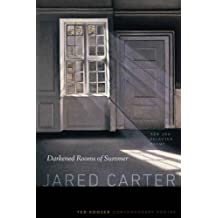
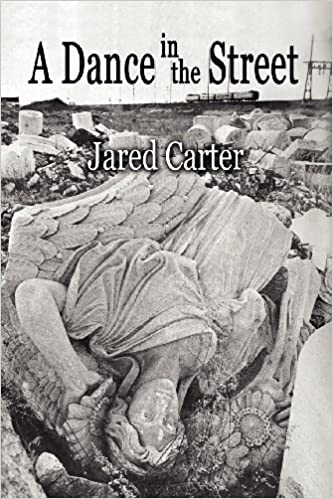
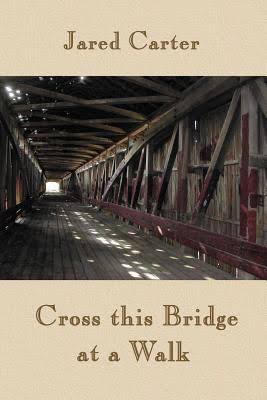
It was a challenge to interview a poet who does not want to talk of his work or of himself. And yet, here was a person whose poetry moved me and from who, I was sure, we had much to learn. I am talking of an acclaimed poet from America, Jared Carter. He permitted me to introduce him with this: “Jared Carter is an American poet who has published seven books of poetry. His volume of new and selected poems, Darkened Rooms of Summer, was issued in 2014 by the University of Nebraska Press. He lives in Indianapolis, Indiana.” If you are more curious about him, his achievements, education and awards, visit his Wiki Page.
Jared Carter
Carter’s poetry is remarkable in giving us glimpses of American life and thoughts, especially as he talks of the wind, the snow and cicadas, as he wrenches poignancy in the hearts of readers bringing out the cruelty in the slaughter of cattle. He draws from the life of common people and their work. At times, he could write of changing a lightbulb and yet create a sense of wonder with his crafting. Despite his obvious Western outlook, he has written of the elusive Yeti – a most beautiful composition. He does tell us in the interview how he wrote it. One would also wonder why he selected to represent ephemerality with such a mythical creature from the East when most of his poems reflect life in America. The poem strangely captures the quality of elusiveness perfectly with extensive crafting.
For him, poetry is more than the first part of the Wordsworthian concept , “the spontaneous overflow of powerful feelings”. It is about working on the concept further “in tranquillity” and making it exquisite, like an artifact. We started this interview by reflecting on artifacts that impacted him. Despite his reluctance to speak of himself, Carter does tell us much about his Victorian upbringing and the impact it has had in making him who he is and writing as beautifully as he does. And perhaps, we can also get a glimpse of why he wrote of the “Yeti”. Let us now step into the world of Jared Carter.
You are fascinated by certain artifacts from India and China. Tell us the story around those. Why do they move you?
I mentioned those two heirlooms — a chess set made of ivory, from China, and a carved wooden box, from India — because they provided my first introduction to those two great cultures, when I was a boy growing up in a small town in Indiana, a state near the center of the United States.
My father had purchased the chess set in September of 1945, in a pawnshop in Chicago, when he was on the last leg of his journey home from serving three years in the war in the Pacific. It was a set of delicate white and red figures, in elaborate costumes, the white side in Victorian dress, the red side in traditional Chinese robes, and on both sides, horses rearing and elephants carrying castles.
If my memory is correct, the attire of the pieces was the very embodiment of colonialism. I was told much later that the set was among several that had been made for the export trade in the nineteenth century.
As a child, of course, I had heard the word “China” and the country was mentioned in school, which I was just beginning at the age of six. But in those days, I had no strong impression of China, nor even much interest in it. In contrast, my father’s ivory chess set was a tangible object that I could look at and admire, and sometimes even be allowed to touch. It had traveled many thousands of miles, from the other side of the world, to be in our home, and was held in great esteem by my father and my older brother, who were both avid chess players.
Once a year, on my father’s birthday, as I recall, they would take down the set from the glass case they had built to display it and play a game of chess with those fantastic pieces. This was always a solemn occasion in our household, and a memorable one. In my young mind, it was an almost ceremonial way of being in touch with a mysterious land that lay far across the seas.
If today, almost eighty years later, I try to think back to my first awareness of China — what it was, where it is, what it might be like — I return to my memory of that chess set. I return to the sight of those delicately carved pieces, in their remarkable formality and fragility, arranged in rows on a chequered board. That image is suspended now, and outside of time, and yet in my mind’s eye, the figures are still waiting to be moved, in ways that will begin once more that most ancient and traditional of games. In this way I was first introduced to the very idea of China’s existence.
By our best estimates, chess was originally invented in India, although I did not know this at the time. In a way, as I look back now, perhaps my memory of the ivory chess set puts me in touch, even now, with something great and lasting about the contributions of both of those cultures.
The elaborately carved box from India had a similar effect on my young imagination. It was a box in which my father’s mother kept her few items of simple jewelry. Sometimes she would let me and my two cousins take it down from her dresser and examine it more closely. There were already a few books in my grandfather’s library about India. We were familiar with the name of that country, and we knew it was quite distant. But the box was an actual object that had come all the way from India, we were told, and that made it special.
The box had been given to my grandmother by her only brother, who was an artist, and who had purchased it sometime in the 1930s, along with a great many other art objects and artifacts with which I would become familiar as I grew older. But this box — again, something made in the nineteenth century — spurred my first awareness of India. I could peer into its carvings of elephants and monkeys and exotic plants and imagine that I was seeing into the heart of that mysterious, far-off place.
India and China of course constitute much, much more than what was suggested by those two objects. But we are speaking of first impressions here, which are precious to a child, and which, in my case, have proved to be lasting.
You had an interesting story about your aunt being in India. Can you tell us about that?
The artist mentioned, my grandmother’s only brother, took as his second wife, in the 1930s, after the death of his first wife, a teacher of English literature, who taught for the Baltimore school system. She had been brought up in India and was evidently the child of missionary parents.
She may actually have been born in India, and most likely left it in about 1923, to attend an American university. She lived until 1959, and I was taken to visit her on several occasions, and when I was old enough to drive, I would ferry my grandmother down to visit her, in a summer studio located in southern Indiana. She spoke with a British accent — perhaps the first I had ever heard — and preferred tea rather than coffee. After the artist’s death, in 1946, she would speak knowingly of his own works of art, and of the various items and artifacts he had collected during his lifetime.
Those things were from many cultures, many eras — a handsome 15th-century refectory table from Italy, a pair of large, nineteenth-century ceramic jars from China, an unglazed wine vessel that may have been Etruscan, a variety of pieces in English pewter, and so on. The spacious, high-ceilinged, two-story building had been a lodge hall before it was converted into the artist’s studio by my father and grandfather. It was utterly chock-a-block with beautiful objects and gorgeous paintings.
On a number of occasions I was allowed to wander through those rooms on my own, and to consider those different objects. There was no teacher, no guidebook, except for the widow’s occasional comment about where this or that artifact had come from, or when he had acquired it. I simply looked at what was there. This was a part of my informal introduction to art, and exotic places, a tutelage that had begun with the chess set and the carved box. If nothing else, the experience may have made me into a lifelong museum goer, especially when museums of art are available.
But you asked about my Aunt Carolyn, as we called her, and her origins in India. She sometimes referred to that Indian childhood, although unfortunately I remember little of what she said. I do recall her speaking of a time in the early 1920s when she witnessed a crowd of Indian nationalists demonstrating in a non-violent manner. Raj policemen carrying lead-weighted wooden cudgels waded into the crowd, shattering the kneecaps of the demonstrators with their clubs. The authorities knew, she said, that a broken kneecap was not a mortal injury, but that it would render a demonstrator unable to walk for months on end, thus preventing that person, for a time, from joining future demonstrations. To say nothing of discouraging him from joining any demonstrations at all. Aunt Carolyn seemed to have a very low opinion of the British.
Are you familiar with Indian and Chinese literature?
Only as a reader and an amateur. In about 1961 a younger sister brought home from college, as a houseguest, an Indian student she had met. He was very polite and serious, and generously gave me a copy of a translation of the Gita, which I still have, and which was my first introduction to the classic literature of India. I’ve been sampling that literature ever since, reading essays and an occasional book, attending a lecture or two, taking in a traveling exhibition. So, I have a layman’s understanding of subcontinent history and culture, but it is no more than that, and I am far from being well-versed.
My introduction to the history, art, and culture of China came slightly earlier and has been a bit more extensive. As an undergraduate at Yale, I studied history of art with the scholar Nelson Ikon Wu. It was an introductory course, but he placed special emphasis on landscape paintings of the Southern Song, and with that influence, in later years, I seem to have gone on to develop an interest in many things Chinese, especially art of the T’ang dynasty.
Also while an upperclassman at Yale, I had the good fortune to make the acquaintance of a young graduate student from Clare College, Cambridge, named Jonathan Spence, who subsequently became a well-known scholar of Chinese history and culture. Over the years, my conversations with Jonathan, and my having read his numerous books, have formed an important part of my informal education.
For two semesters in the 1980s I served as a visiting writer at Purdue University in West Lafayette, Indiana, where I met and talked with Professor Sanford Goldstein, the eminent Japanese scholar and specialist in tanka, who for many years now, following his retirement, has resided in Japan. Thanks to Professor Goldstein, and one of his students with whom I am still in touch, and not immediately, but gradually, my awareness of Japanese literature in translation has increased, along with my curiosity about haiku and tanka in English. I have published a few haiku and tanka, and have corresponded with other scholars in that field, such as Professor Bryce Christensen, who is only recently back from a year of lecturing in Taiwan. By virtue of my acquaintance with these talented individuals, I hope I have developed a better understanding of both Japanese and Chinese literature — especially the poetry of the T’ang dynasty, in translation, for which I have a great liking.
Do you read translations? What is your opinion on the role of translations?
Without translators and translations, we would be utterly lost. For example, whatever I am privileged to know about the poetry of Li Bai (701-762) and Du Fu (712-770, also spelt as Tu Fu) and all of their marvelous contemporaries, I know their poetry only because they reach me through various translations. So, I have accumulated a small library of translated works by the major world poets — Sophocles through Dante, Basho to Neruda. Every serious poet does this. I would like to think we are perhaps the wiser for it.
Any poet writing in English is immeasurably indebted to Arthur Waley for his masterful translations. Another translator I might mention is the American, Kenneth Rexroth, who happens to have been a fellow Hoosier — which means he was born in the state of Indiana. Rexroth emigrated eventually to California, where after World War Two he became an eminent poet, scholar, and translator of poetry from both the Chinese and Japanese traditions.
I possess a number of Rexroth’s books, and thanks to them, and to other translations by many different hands, I have come to have a great admiration for the T’ang poet Du Fu. He is my favourite, perhaps the poet that I return to, most frequently, in my own reading. In the following quotes, Rexroth, in a book published in 1971, employs a transliteration of the poet’s name different from the one in general use today. Rexroth alleges that Du Fu is
in my opinion, and in the opinion of a majority of those qualified to speak, the greatest non-epic, non-dramatic poet who has survived in any language. Sappho, for instance, can hardly be said to have survived. He shares with her, Catullus, and Baudelaire, his only possible competitors, a sensibility acute past belief.
I agree with that, except the part about his competitors, since there are a few more who might be mentioned. But the remark about Du Fu having “sensibility acute past belief” — surely that is apt. And for me, as for Rexroth, there is even more to Du Fu. It is something almost personal. Rexroth attempts to sum it up:
Tu Fu comes from a saner, older, more secular culture than Homer and it is not a new discovery with him that the gods, the abstractions and forces of nature, are frivolous, lewd, vicious, quarrelsome, and cruel, and only man's steadfastness, love, magnanimity, calm, and compassion redeem the night bound world. It is not a discovery, culturally or historically, but it is the essence of his being as a poet.
Rexroth goes on to say how Du Fu’s writing has affected him as a person, an admission with which I happen to agree, and have found to be true in my own life:
I am sure he has made me a better man, as a moral agent and as a perceiving organism. I say that because I feel that . . . the greatest poetry answers out of hand the problems of the critic and the esthetician. Poetry like Tu Fu's is the answer to the question, "What is the purpose of Art?"
What writers do you read? Why?
As a young person, in university and later, dreaming of becoming a writer, I read a great many novels and short stories, and was initially drawn to the work of the American novelist, William Faulkner.. The world he created seemed recognizable to me, and authentic. I hoped to create a similar world. Other American authors I have admired, and tried to learn from, have been Sara Orne Jewett, Willa Cather, and Sherwood Anderson. But there are dozens more, and dozens more European and world writers whom I admire.
I have been fortunate, too, in having known Joseph Love, a prominent historian of Brazilian history, and author of a splendid study of a remarkable moment in Brazilian history, The Revolt of the Whip. He and I were undergraduates together (he was at Harvard), and I have known him ever since, and through his many gifts and thoughtful recommendations, I have been introduced to a great deal of the literature and culture of Central and South America.
In the last few years most of my reading has been in history. I am a great admirer of the British historian Richard J. Evans, whose history of the Third Reich is unrivaled. Another of my favorites is John Julius Norwich and his history of the Byzantine Empire. I am extremely fond of Shelby Foote’s history of the American Civil War. And at the moment I am reading the late Tony Judt’s Postwar, a history of Europe from 1945 to the near present and am finding out how little I knew about that period, even though I lived through it.
These days I spend much more time reading history than either fiction or poetry. I have a large bookcase full of nothing but books about classic Egyptian history and art, and I have a smaller group of books about Meso-American prehistory and culture, and particularly Mayan art. I am simply curious about such matters.
Which are your favourite poets? Why?
I would have difficulty naming even a few. I have attempted to read them all, which of course is impossible, since new ones appear every day, and one is constantly discovering earlier ones. It has never seemed acceptable to me to list the names of poets who “influenced” me or the way I write. There are a few poets whose work I keep at my bedside, and whose books I still read. Two in particular are poets writing primarily in German, Rilke and Hölderlin. Among Americans, Frost. Among the English, Hardy and Larkin.
What do you learn from these writers? Do they impact you in any way?
I really don’t know. They’re just writers that I particularly like, and find myself re-reading, over the years. Kafka is another. So is Flaubert. I continue to read Henry James and Turgenev — all of those persons on whom, as James pointed out, “nothing is lost.”
Why is it you are reticent to talk of your work and poetic sensibilities?
I seem to be naturally reticent, even introverted. As a child I spent a certain amount of time with my grandmother and with a great-great aunt, both of whom were born in the 1870s. Both were thoroughgoing Victorians who exemplified the traditional virtues — thrift, honesty, industry, steadfastness. And perish the thought of anything vainglorious. I think a bit of that rubbed off on me.
I’ve done a little talking about myself in this interview, but only because you asked. My parents, too, taught me that one should avoid talking about oneself to others. It is also a professional attribute — physicians and attorneys traditionally do not advertise or promote themselves — and although I do not consider myself a professional in that sense, I can understand the reasoning. Professionalism in any undertaking is not a matter of office, title, or entitlement; it is a standard to be lived up to.
At university, it was explained to me that in polite society one does not discuss politics, religion, or how one earns a living. Ezra Pound says somewhere that you can always spot the bad critic if he focuses on the poet and not the poems. Add all of that up, and I seem to have little to say about myself or what I do.
I really loved your poem “Yeti”. You had said that while writing “Yeti” you disposed of a number of lines and picked a few. Would it be possible to share this part of your poetic process with us?
Well, again, “poetic sensibilities,” “poetic process” — I am not a critic, scholar, or professor, and I have no insights to offer about such matters. It is not my business to do so. Instead, I make poems, and I have been privileged to have published a few of them. So that our readers will know what we’re referring to, here is my poem “Yeti,” which your journal kindly published, for the first time, in its May 2021 issue. The poem conjures up the mysterious creature of the Himalayas, whose existence has never been verified, but which continues to haunt the imagination:
            Yeti

Tell me again that nothing’s there,
          that never was
At all, except in places where
          things slip, or pause,

Yet register, on some high ridge
          where something moves
And then is gone. As though a bridge
          of snow should lose

Its grip, and drop away, but leave
          a shadow where
Such vanishing might still deceive
          in that thin air.
The first thing one notices about this poem, which is in a relatively new form called an Alexandroid, are its formal aspects — its lines end with rhymes, and it has repetitive stanzas and lines of a predictable length. A second thing one notices is its brevity — twelve lines in all, and a total number of syllables amounting to half of those in a typical sonnet in English. It is a small poem, then, in a range of length favoured by the American poet, Emily Dickinson. Longer than a haiku or tanka, but still very brief.
A third characteristic, perhaps not immediately apparent, is the way in which the “sh” sound in the closing lines — should, shadow, vanishing — suggests the texture of something slipping away. Or the sound of a bridge of snow suddenly collapsing into a crevasse. In certain cultures, it is the same sound we make when we put a forefinger to our lips to signal for silence — shhhh.
That sound is followed by the stark, icy i’s and e’s, at the poem’s very end, of might, deceive, thin, and air. The trail has gone cold, the Yeti has disappeared. That poetry can suggest strange moments like this, with such minimal input, is one reason why I like it so much.
In the making of such a poem there is, literally, no place to hide. Whoever reads it will be affected, consciously or not, by the smallest detail. It goes almost without saying that to make a poem within these parameters, the writer must, to borrow your phrase, “dispose of a number of lines and pick a few”. This is inescapable. There is simply no room in which to say whatever one likes, or to run on interminably. No room for the vainglorious.
Somewhere there may be a poet who can write a similar poem without hesitation, as though copying it out, not pausing to substitute or change a single word.
I suppose I do the opposite. I experiment and try out many different words, many lines, many drafts, in order to arrive at what I believe to be a poem. In doing this I don’t think I am any different from most other poets.
It has been pointed out that one interesting thing about poems is the way they can talk about one thing while implying something entirely different. “Yeti” is presumably about an elusive, folkloric creature, but at the same time it is talking about poetry, and how it disappears even while you are reading it, and sometimes you are not sure about what you have just read. Something still seems to be there, even while it vanishes into thin air.
What is it you look forward to?
I look forward to making more poems, and more books of poems. There’s an old American saying, from the days of vaudeville, which holds that “You ain’t seen nothing yet.”
But clearly I am an old man of the forest now, and I think the best claim from an aging artist, about what can still be accomplished in the years ahead, is by the Japanese painter and printmaker, Hokusai. Since we’re discussing art and culture of the East, I’ll suggest that his marvelous statement, in his colophon to One Hundred Views of Mount Fuji, is a perfect way to end this interview:
From the age of six, I had a passion for copying the form of things and since the age of fifty I have published many drawings, yet of all I drew by my seventieth year there is nothing worth taking into account. At seventy-three years I partly understood the structure of animals, birds, insects and fishes, and the life of grasses and plants. And so, at eighty-six I shall progress further; at ninety I shall even further penetrate their secret meaning, and by one hundred I shall perhaps truly have reached the level of the marvelous and divine. When I am one hundred and ten, each dot, each line will possess a life of its own.
In some translations, Hokusai adds, at the very end, with reference to what he has just affirmed, this invitation: “I beg those who live as long as I to see if I do not keep my word.”
Hokusai lasted until he was 88. That final sentence has always seemed to me to be a blessing he is bestowing on readers and admirers — a wish, for whoever might be listening, that those persons too might have long and fruitful lives.
I would hope Hokusai’s spirit still lingers, and that I might join him in wishing that for you, Madame Chakravarty, and for all of your journal’s most admirable readers, there on the other side of the planet Earth. Thanks to all of you for allowing me to come into your world.
Thank you very much Mr Carter for your kind words.
Click hereto read the more from Jared Carter in Borderless Journal.
(This is an online interview conducted by Mitali Chakravarty.)
.
PLEASE NOTE: ARTICLES CAN ONLY BE REPRODUCED IN OTHER SITES WITH DUE ACKNOWLEDGEMENT TO BORDERLESS JOURNAL
Over 150 Authors and Artists from five continents, wrote on mental illness. Candice Louisa Daquin, a psychotherapist and writer and editor, tells us why this is important for healing
A watercolor of King Lear and the Fool from Act III, Scene ii. Courtesy: Creative Commons
When Indie Blu(e) put feelers out about creating an anthology based on mental illness, the passionate reception galvanized our belief it was a necessary subject. However, a few expressed concerns that an anthology about mental illness, would be ‘depressing’ and they wondered ‘who would want to read about mental illness?’ It is this perspective, acting like a fog, that separates those inflicted with mental illness from those who are not.
Such responses exacerbate feelings of isolation, unworthiness, and loneliness that many with mental illness already have. Through The Looking Glass, a metaphor from Alice in Wonderland, evokes this common feeling of separation, as poetry and prose has long had a tradition of doing. For many, this lack of understanding may be the tipping point leading to a premature death. If there is one reason to embrace mental illness in an anthology of art and poetry, it is to speak for, speak with and represent those who would be otherwise denied. To continue a tradition of poets and artists elucidating on the subject of suffering mentally:
If you Google ‘what causes depression?’ among the top ten searches will be ‘free yourself of depression’ and ‘depression is a choice’. As long as we blame the sufferer, the malady will become more entrenched. Mental illness is the only malady, aside from lung cancer caused by smoking, that we actively blame the sufferer for inflicting on himself. We bandy around terms like ‘chemical imbalance’ and ‘deficit of proteins in the brain caused by trauma’ but nobody really knows what ‘causes’ depression because like most disease, depression is epigenetic, hereditary and mal-chance and so many things we do not understand.
Depression can be a learned behavior, it can be transmitted through a virus, be the result of a series of debilitating personal events, or because you have stomach problems, and the serotonin and other chemicals are not manufactured in sufficient quantity. Depression can be the result of faulty mood regulation by the brain, genetic vulnerability, dementia, old-age, youth, hormones, drugs, eating disorders and sexual abuse. Or, depression can be caused by absolutely nothing! Usually it’s more than one thing, deeply complex and difficult to replicate in a laboratory setting.
As long as we as a society utilize words like ‘snap out of it’ and ‘be strong like …’ we will entirely miss the point. Not one person living chooses to be depressed, it is not a simple matter of one chemical being too low and another too high that can be ‘fixed’ with a pill or an adjusted attitude to life. We must distinguish between sadness, melancholy, situational sorrow, grieving, bouts of misery, feeling sorry for oneself, and medically defined depression.
The latter is a mental illness, it doesn’t mean you’re delusional or mad or unreliable, in fact depression strikes all but typically the more intelligent are more prone to it. One could argue, depression is a disease of insight and awareness of our ‘unbearable lightness of being.’ For some it manifests in childhood, others not until they’re elderly. All forms of depression are legitimate, and should not be shamed, rebuked, repulsed, diminished or ignored.
Whilst there is sense in saying we should not obsess over the subject, to the exclusion of efforts to brighten one’s life, by whatever means possible, we should equally not ignore those who are desperately struggling and usually without a single person to help them.
If your neighbor had cancer, you would not shame him for his ‘weaknesses tell him he was making a ‘bad choice’ and ask him to ‘get over it’ so why should you ever think it’s acceptable to do that for depression? Just as we are re-writing language for Trans Generations to be inclusive and supportive of insight and change, we should reconsider how we talk about depression. As long as we perceive depression to be a ‘bad attitude’ or ‘personality deficit’ or believe if Oprah could ‘get over it’ so could you, we condemn those who have obviously tried hard to do just that. They might feel it is their fault if they have not ‘succeeded’.
Encouraging someone to do things that help them when they are depressed, believing for some there is an end to their depression, those are all positive actions. We should take our depressed friends out for walks, to remind them there is joy in the world even when they are not able to see it, through no fault of their own. But we should also be careful that our well-intentioned prescriptivism does not become dogmatic and suggest the individual isn’t doing all they can. If they’re not (doing all they can), it may be that’s all they can do for now. Equally if you really believe someone isn’t doing enough, you can suggest things you feel might help without seeming accusatory.
From inception, we at Indie Blu(e) sought to offer a platform for those who might otherwise find no platform. Artists have historically endured mental illness in higher numbers than average. Reasons abound but there is no final analysis, it is thought whatever spurs creativity, may equally make certain illnesses more likely, just as left-handed-people are often more creative, perhaps it is about what parts of the brain are utilized and how.
No one group of people, based on gender, ethnicity, culture, doesn’t suffer from mental illness. Varied cultures have sought to shame others.
Likewise, mental illness has long been thought to affect women more than men and is tied inexorably with ‘hysteria’ (hyster/womb, the once-thought seat of mental illness in women). However, in The Noonday Demon: An Atlas of Depression, Andrew Solomon has said: “If one discounts depression triggered by anxiety about offspring, the rate of depression for men and women appears to equalize”, especially, with women seeking mental health counseling in higher numbers because of cultural approbation toward men owning any perceived vulnerability. This is further proven by the higher rate of completed suicide and ‘accidents’ among men, pointing to a social cause rather than one gender suffering more than the other.
With the stigma of mental illness well entrenched in most societies, and not likely to be eliminated, despite best efforts, the only course of action must be in continued awareness. The more we are aware and exposed to diversity, the more accepting we ultimately become, or so sociologists tell us. If there is any truth to this idea of ‘acceptance by exposure’ then being a vehicle of awareness is how to eventually overcome prejudice and bigotry. Solomon tells us: “The insistence on normality, the belief in an inner logic in the face of unmistakable abnormality, is endemic to depression.” These kinds of ‘certitudes’ can be the triggers that push someone suffering from moderate mental illness, to a breakdown. It is the lack of support, empathy or compassion that acts as a sharp rebuke to those who need the very opposite.
For those suffering from the myriad of mental illnesses that exist; stigma and shame are daily companions. While logically we know people never ‘choose’ mental illnesses, a societal prejudice can be deeply engrained, making it a greater challenge than ever not to blame oneself. How often have we heard the sayings: “If I could beat it, then I think anyone can and they’re not trying hard enough if they still suffer,” or something to that effect? How often do pronouncements like: “They don’t seem to be able to get themselves together,” or similar, indite people who are sick, when we would rarely use those same pronouncements on those with physical ailments?
In ‘The Will To Power’, Friedrich Nietzsche tells us: “(the mentally ill) represent the same ills. Health and sickness are not essentially different, as the ancient physicians and some practitioners even today suppose. I fact, there are only differences in degree between these two kinds of existence: the exaggeration, the disproportion, the nonharmony of the normal phenomena constitute the pathological state.”
Our penchant for judging, putting ourselves above others, ridiculing and labeling, seems boundless, and causes those who are already struggling to stay afloat, further grief. Why we feel the need to do these things, is too long a consideration for this foreword, but suffice to say, the more we put others down, the better we seem to feel about ourselves, if history is anything to go by. In many ways then, prejudice against the mentally ill, is not dissimilar to racism, homophobia or sexism. It shares that delight in rebuking someone else for who they are, and a relish in implying the accuser is of superior stock. When we look at it like that, it seems quite pathetic, and obvious, but when it’s subtly employed in modes of speech, everyday considerations and overall responses, it can be insidious and incredibly damaging. This could be a reaction from people who are unable to process the condition. They attack, as a form of unconscious self-defense.
In Psychology and Freudian Theory, Paul Kline says: “When we speak of defenses, we actually mean whole ways of perceiving reality such that important attitudes, for example prejudices and sexual views, are affected.”
When I trained as a psychotherapist, I wanted to ensure children and adults who were depressed had someone to go talk to, rather than fall into despair. Sadly, I found in the profession, such a high rate of ‘burn out’ that I could understand why therapists seemed so disinterested, uninvested and fatigued. If you see 12 clients a day, each for an hour and then have to write long notes and take phone calls, you simply cannot give enough of yourself to be competent. Psychotherapists have a duty through their profession to ‘nonmaleficence (do not harm) and beneficence (promote good) but psychotherapists are only human and possess human flaws, including their own prejudices and biases. When you combine those with an unrealistic workload, you may find psychotherapy doesn’t work as well in practice as it should, which is a pity, considering how necessary it remains.
Even in countries where insurance companies do not dictate how we label people, in order to be reimbursed, there are too many sick people for too few therapists and the patients really suffer a lack of quality care. One could argue this is an improvement from the days of mass mental institutions or even, the ‘care in the community’ model, that fell flat on its face and led to mass homelessness. One could also argue, what other way realistically exists? But we seem to find the money for other things, just not mental health, so the real issue is priorities. Mental health, despite its terrible fallout, has never been a priority and it doesn’t matter how many mentally ill mass shooters there are, it never seems to significantly alter policy or be considered important enough to truly invest in. Easier to dose with pills that are supposed to be short-term and have long-term side-effects.
Instead, stereotypes abound, and few people outwardly admit to being mentally ill for fear of condemnation or it is affecting their job or right to keep their children. Draconian as that might seem, without sufficient protections in place, mentally ill people have fewer rights than anyone else. This ‘going underground’ response means those in need, are even less likely to receive it and the sheer cost means those with serious mental disorders, are often unable to earn enough to pay for treatment. Whilst this echoes modern medicine and the health industry at large, mental illness has more in common with chronic illness, the kind that are invisible, or misunderstood, like Chronic Lyme and Fibromyalgia. The same brutal disregard for the suffering of these individuals is shared by those with chronic mental illnesses, they are an inconvenience at best, in societies that prize profit above all else.
In Owning Your Own Shadow: Understanding the dark side of the psyche, Robert A. Johnson contends: “The balance of light and dark is ultimately possible – and bearable. All nature lives in polarity – light and dark, creation and destruction, up and down, male and female. It is not surprising that we find the same basic laws functioning in our psychological structure.”
When reading submissions, we realized, even among mental health professionals, there is so much disagreement, and implied judgement. When someone talks of ‘those who can fight their way out of it’ they imply, those who cannot, are weaker. I’m sure that is not what is meant but language is so crucial when considering impression. Just as with racism, how we speak, indicates our biases and level of empathy. If we want to be non-judging, we should start with reworking how we speak about mental illness and consider how many times those suffering have been humiliated and judged by our lack of care in how we refer to their problem.
This is no less true in poetry, and some of those poems not selected for the anthology, whilst good and raw, had components within them that could have been misconstrued. This means even those who suffer mental illness may inadvertently judge themselves and others, through learned behaviors and language. One of the most judging people I spoke to about this anthology was an acquaintance with Bipolar 1 disease. Ironic yes, but not entirely surprising when you consider how we often emulate what has been done to us, so if we were judged our entire lives, we do it in turn.
Others would argue, what’s the harm in holding an opinion? When dealing with vulnerable populations who are trying to be treated equally and not labeled or dismissed, we must consider the importance of how we express ourselves. Of course, we’re all entitled to hold an opinion, but hate and prejudice are different, and judging is a form of prejudice that can act like a slow cancer. We should ask ourselves instead, why we feel the need to judge others when they are not like us, rather than consider how they are like us, or what we can do to help them? Why is claiming to be stronger than someone else, such a ‘thing’ in our society? Why do we relish putting others down?
When we learn to stop doing that, we may reach Psychologist Abraham Maslow’s highest level in his Hierarchy Of Needs, that of self-actualization, where we no longer live based on basic needs (physiological, safety, self-esteem) and begin to consider what we can do for others. If we don’t wish to do this, at least we could do no harm. When considering harm, we should bear in mind, words do not seem as apparently harmful as actions, but putting someone who is already struggling down, could be the last straw. Would any of us want to push someone over the edge just because we can?
Indie Blu(e) has published anthologies in response to the #metoo movement, LGBTQ equality and other socially minded subjects and with 2021 emerging from a year of hell, we saw how those with chronic mental and physical illnesses suffered silently without recourse. The umbrella of ‘art’ is one means by which, we have as humans have always expressed ourselves best. Art has led to societal change, acceptance, tolerance, elucidation. Art can heal, art has power.
It is our hope mental illness will one day be seen for what it is, an unavoidable malady that people try their entire lives to overcome. We have seen some of the best creative expression come from those suffering from mental illness and without mentally ill people, our world would be bland indeed. Mentally ill people are not typically mass shooters; they are creative, expressive, intelligent, and incredibly strong. A collection of work celebrating the talent of those who suffer from mental illness, seemed to be a necessary way to begin to shift old prejudices and shine light through the looking glass.
Candice Louisa Daquin is a Psychotherapist, LPC/NBCC. She is a Senior Editor at Indie Blu(e) Publishing & Co-Editor of their anthology exploring madness, Through The Looking Glass.
.
PLEASE NOTE: ARTICLES CAN ONLY BE REPRODUCED IN OTHER SITES WITH DUE ACKNOWLEDGEMENT TO BORDERLESS JOURNAL




 Borderless
