“Beauty is truth, truth beauty — that is all
                Ye know on earth, and all ye need to know.”

John Keats (1795-1821), Ode to a Grecian Urn
‘Beauty is Truth’ : The Potato Eaters(1885) by Vincent van Gogh (1853-1890). Courtesy: Creative Commons
What makes for great literature? To me, great literature states the truth — the truth that touches your heart with its poignancy, preciseness, sadness, gentleness, vibrancy, or humour. If Khayyam, Rumi, Keats, Tagore, Frost or Whitman had no truths to state, their poetry would have failed to mesmerise time and woo readers across ages. Their truths – which can be seen as eternal ones — touch all human hearts with empathetic beauty. Lalon Fakir rose from an uneducated illiterate mendicant to a poet because he had the courage to sing the truth about mankind — to put social norms and barriers aside and versify his truth, which was ours and still is. This can be applied to all genres. Short stories by Saki, O’ Henry or plays and essays by Bernard Shaw — what typifies them? The truth they speak with perhaps a sprinkle of humour. Alan Paton spoke the truth about violence and its arbitrariness while writing of South Africa — made the characters so empathetic that Cry, My Beloved Country(1948) is to me one of the best fictions describing divides in the world, and the same divides persist today. The truth is eternal as in George Orwell’s 1984 (1949) or Suskind’s Perfume(1985). We love laughter from Gerald Durrell or PG Wodehouse too because they reflect larger truths that touch mankind as does the sentimentality of Dickens or the poignancy of Hardy or the societal questioning of the Bronte sisters, George Eliot, and Jane Austen. The list of greats in this tradition would be a very long one.
Our focus this time is on a fearless essayist in a similar tradition, one who unveiled truths rising above the mundane, lacing them with humour to make them easily digestible for laymen – a writer and a polyglot who knew fourteen languages by the name of Syed Mujtaba Ali (1904-1974). He was Tagore’s student, a Humboldt scholar who lived across six countries, including Afghanistan and spoke of the things he saw around him. Cherished as a celebrated writer among Bengali readers, he wrote for journals and published more than two dozen books that remained untranslated because his witticisms were so entrenched by cultural traditions that no translator dared pick up their pen. Many decades down the line, while in Afghanistan, a BBC editor for South and Central Asia, Nazes Afroz, translated bits of Mujtaba Ali’s non-fiction for his curious friends till he had completed the whole of the travelogue.
The translation named In a Land Far from Home: A Bengali in Afghanistan was published and nominated for the Crossword Awards. This month, we not only run an excerpt from the translated essays but also have an interview with the former BBC journalist, Afroz, who tells us not only about the book but also of the current situation in ravaged Afghanistan based on his own first-hand experiences. Nazes himself has travelled to forty countries, much like our other interviewee, Sybil Pretious, who has travelled to forty and lived in six. She had been writing for us till she left to complete her memoirs — which would cover much of history from currently non-existent country Rhodesia to apartheid and the first democratic election in South Africa. These would be valuable records shared with the world from a personal account of a pacifist who loves humanity.
We have more on travel — an essay by Tagore describing with wry humour vacations in company of his niece and nephew and letters written by the maestro during his trips, some laced with hilarity and the more serious ones excerpted from Kobi and Rani, all translated by Somdatta Mandal. We have also indulged our taste for Tagore’s poetry by translating a song heralding the start of the Durga Puja season. Durga Puja is an autumnal festival celebrated in India. An essay by Meenakshi Malhotra explains the songs of homecoming during this festival. It is interesting that the songs express the mother’s views as highlighted by Malhotra, but one notices, never that of the Goddess, who, mythology has it, gave up her life when the husband of her own choosing, Shiva, was perceived by her family as ‘uncouth’ and was insulted in her parent’s home.
In spirit of this festival highlighting women power and on the other hand her role in society, we have a review by Somdatta of T. Janakiraman’s Wooden Cow, translated from Tamil by Lakshmi Kannan, where the protagonist upends all traditional values ascribed to women. Another book which is flavourful with food and would be a real fit on every festive occasion is Mohana Kanjilal’s A Taste of Time: A Food History of Calcutta. Bhaskar Parichha tells us in his review, “In the thriving universe of Indian food books, this clearly stands out.”
Aruna Chakravarti’s review of Shazia Omar’s Golden Bangladesh at Fifty also stands out embracing the colours of Bengal. It traces the title back to history and their national anthem — a Tagore song called ‘Amaar Sonar Bangla – My Golden Bengal’. Gracy Samjetsabam’s review of Suzanne Kamata’sThe Baseball Widow, a cross cultural novel with an unusual ending that shuttles between America and Japan, winds up our review section this time.
As Kamata’s book travels across two continents in a pre-covid world, Sunil Sharma in reality moved home from one continent to another crossing multiple national borders during the pandemic. He has written an eye-opening account of his move along with his amazing short story on Gandhi. Another unusual story creating a new legend with wonderful photographs and the narrative woven around them can be relished in Nature’s Musings by Penny Wilkes. This time we have fiction from India, Malaysia, Bangladesh and America. Steve Davidson has given a story based partly on Tibetan lore and has said much in a light-hearted fashion, especially as the Llama resumes his travels at the end of the story. Keeping in step with light humour and travel is Devraj Singh Kalsi’s account of a pony ride up a hill, except it made me laugh more.
The tone of Rhys Hughes cogitations about the identity of two poets across borders in ‘Pessoa and Cavafy: What’s in a Name?’ reminds me of Puck or Narada! Of course, he has given humour in verses with a funny story poem which again — I am not quite sure — has a Welsh king who resisted Roman invasion or is it someone else? Michael Burch has limericks on animals, along with his moving poem on Martin Luther King Junior. We have much poetry crossing borders, including a translation of Akbar Barakzai’s fabulous Balochi poetry by Fazal Baloch and Sahitya Akademi winning Manipuri poet, Thangjam Ibopishak, translated by Robin S Ngangom. A Nazrul song which quests for a spiritual home has been translated from Bengali by no less than Professor Fakrul Alam, a winner of both the SAARC award and Bangla Academy Literary Award.
Former Arts Editor of Times of India, Ratnottama Sengupta, has shared an essay on how kantha (hand embroidered rug) became a tool to pass on information during the struggle against colonial occupation. The piece reminded me of the narrative of passing messages through mooncakes among Chinese. During the fourteenth century, the filling was of messages to organise a rebellion which replaced the Yuan dynasty (1271-1368) with the Ming (1368-1644). Now the filling is delicious lotus paste, chocolates or other edible delicacies. Women were heavily involved in all these movements. Sameer Arshad Khatlani has highlighted how women writers of the early twentieth century writing in Urdu, like Ismat Chughtai, created revolutionary literature and inspired even legendary writers, like Simone de Beauvoir. There is much more in our content — not all of which has been discussed here for again this time we have spilled over to near fifty pieces.
We have another delightful surprise for our readers – a cover photo of a painting by Sohana Manzoor depicting the season titled ‘Ode to Autumn’. Do pause by and take a look at this month’s issue. We thank our writers and readers for their continued support. And I would personally like to give a huge thanks to the team which makes it possible for me to put these delectable offerings before the world. Thank you all.
Sunil Sharma unravels the mystique of the Spanish ingénue, the man who fights windmills and has claimed much much literary attention post Quichotte
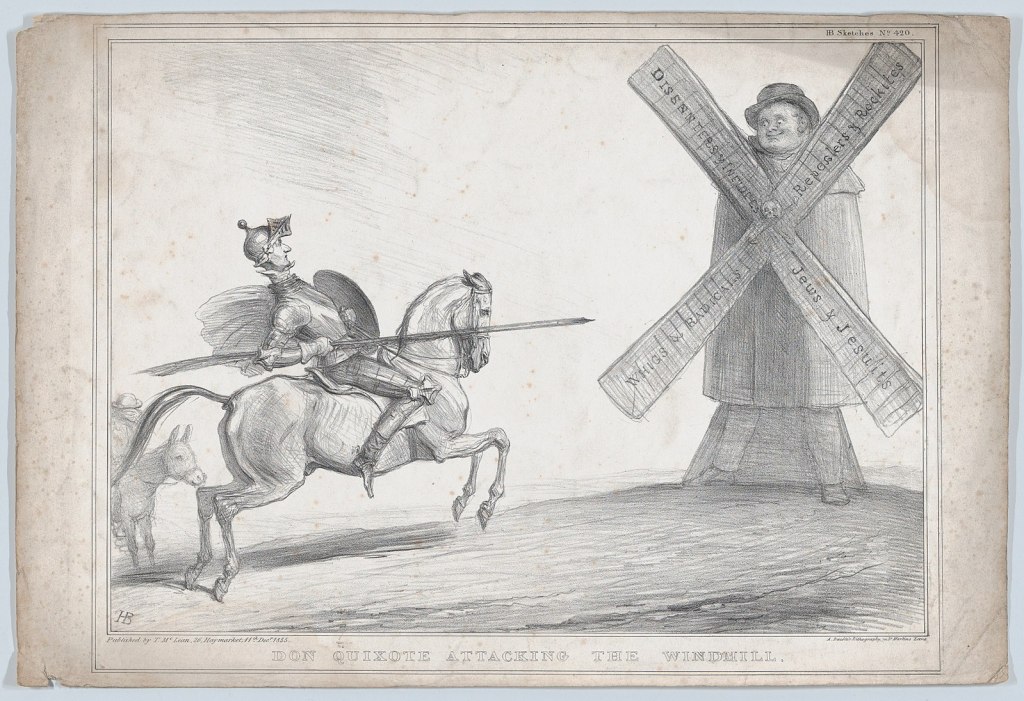
Don Quixote attacking the Windmill by John Doyle. Courtesy: Wiki
While learning Spanish in Mumbai recently, I came to enjoy Don Quixote immensely. And I also came to discover a unique tutor who came from the same enchanting land once traversed by the great philosophical Don on his poor steed Rocinante and in the company of his trusted fellow-adventurer, Sancho Panza. The shared links to Spain and her present and past culture made my wiry tall tutor a valuable guide. His observations vastly added to the pleasure of understanding the more than four-hundred-year-old sacrosanct text. He proved to be a skillful navigator, guiding me through the thick maze of the interesting book, generally considered to be the first modern novel of the West.
Spanish language is called the language of Cervantes — so rich is the effect and contribution of this artist on the overall national language and culture of Spain, and, on Western cultural life, by extension. The bulky rambling novel has inspired a host of great writers like Flaubert and Dostoevsky, among others. Picasso was said to be inspired by the adventures of this loveable simple man seeking beauty and romance in the most prosaic age of commerce and overseas conquest for colonies.
The Don’s creator can be called the precursor of magical Marquez and Isabel Allende and other experimental fictionists of the last century. The way even the mundane in Spain is fantastically transformed in the pages of this novel is an astonishing feat of unmatched artistic skill. It is a charming but lost place you come to see; a strange country that is conjured up for you. It is like catching a fleeting historical moment and preserving that elusive moment forever, for the succeeding generations of mind-travelers who want to revisit a famous literary site and be a participant in the unfolding seductive landscape marked by the surprising visual contraries.
The sheer magnitude, the solidity, the hugeness of the windmills can be experienced afresh by the reader through the eyes of the Don questing for the extraordinary in an ordinary age. The banal becomes the marvelous.
Don Quixote celebrates the creative difference in human perceptions — very much like the artistic genius of a Picasso or Dali who see things differently from the rest. This can disorient and yield a new insight. The windmills are not the ordinary windmills but are perceived to be giants. With the Don, the conventional view is drastically changed, and you get radicalised by a totally alien view. The usual appears unusual.
The artistic inversion and the radical reversal produce a startling breakthrough — the kind experienced in Kafka or Grass. There are other dramatic modifications. Deep transformations occurring in the text and within the reader. The world gets topsy-turvy. Don destabilizes stale perspectives and blasé viewpoints and manufactures refreshing realities, far removed from his current context and location.
The gentle sheep become an army of marauding mercenaries, a shocking opposite: the commonplace taverns and non-descript inns shed their dull features and turn into mysterious dark castles housing the secrets and weaponry of the ideal knights; the scheming magicians, it is claimed, make the precious libraries vanish. It is a continual collision of the real and the unreal, fact and fiction, heroic past and pedestrian present. In short, lands miraculous where things appear to be their reverse: everything appears to be whatit is not.
For example, Dulcinea is a fair princess for the smitten fifty-year-something Don; in reality, she is an ordinary farm girl. Cervantes has upturned the existing conventions of romance by describing ordinary real people of his country in a most favourable light and this bold gesture inaugurates the process of democratisation of literature that deepens further in succeeding centuries. A working farm girl serving as the original for an ideal princess itself is a remarkable advance, a literary breakthrough, a literary coup.
These ideas did not come naturally to me in my readings of Don Quixote but were a result of my constant interaction with my tutor. He was, incidentally, from Madrid and had a strong resemblance to Don. He went by a long name of Juan Rodriguez de Silva but preferred to be called Amando. Once, during a break in the long afternoon lessons, the 45-year-old Mumbai-based freelance writer and part-time Spanish tutor — in the country for a year for some research on the early proselytizing of the Spanish Catholic priests in Goa, Mumbai, Cochin and Chennai, among other coastal cities of the South India — told me that the father of my favourite author, Don Rodrigo de Cervantes, was a very interesting figure, largely ignored by the later scholarship.
He said: “I found him, Cervantes senior, quite fascinating. He was a surgeon who wandered from one place to another in search of work. The family led a difficult and unsettled life due to this reason. In those days, in sixteenth-century Spain, the job of a surgeon was not high-paying and considered lowly. It did not enjoy any social prestige. The poor family suffered many financial problems on account of this vagrant lifestyle.”
I listened attentively to this family history that was like opening a window on the hoary past of a different era and nation. “Spain was feudal. Aristocracy prevailed. Finding acceptability, honour and respect was difficult for the disinherited and dispossessed. The senior Cervantes was a man of ingenuity, very much like Don Quixote of La Mancha. I have this feeling that the immortal Don Quixote was modeled to some extent on Rodrigo. A few parallels can be seen,” said Amando.
“How?” I asked.
“Well, the guy was like to-day’s harmless imposter, not willing to violate the law or break rules but willing to twist facts and invent a bit of illustrious history or lineage to make him look grand. You can call such desperate persons as simple pretenders who mean no harm. Cervantes’ father thought what he was actually not. He was very inventive. The wandering barber-surgeon claimed he was descended from a noble family. An aristocratic past, I would say, for his impoverished family. But, in the long run, this fiction did not help, and he landed up in the debtors’ prison for unpaid arrears, very much like John, the unfortunate overspending dad of Dickens, who served as a model for Mr. Micawber. In fact, both the writers were much haunted by the imprisonment of their failed fathers and the misfortunes that attend such a situation. Poverty and inequalities of an unjust system are sympathetically described by both chroniclers of two great societies, most poignantly by Dickens and satirically, by Cervantes.”
This sounded exciting.
Amando continued, “You can call them forgeries. Innocent ones, of course. Who does not want to have a duke or duchess in their blood? People invent an interesting past for themselves for different reasons.”
I agreed. I know of a young man who had created a Christian past to woo a European woman in a multinational corporation in Mumbai and was successful in this deception. In America, many Indians have adopted Anglican names to blend well in their society and avoid hostility.
“You see, we all are like that. We all fictionalise, invent and re-create things for ourselves, at one point or other, in our unremarkable lives. Don is an avid reader of books that talk of romance and chivalry and wants to re-create that lapsed order of things in an age hostile to such revival and the entire project is doomed from the beginning.” I nodded.
Amando went on: “I know many poor young men who say they are from wealthy families, but the lies get exposed. The truth is to be confronted. Rodrigo lived in a dual world of lies and bitter truths. He was escaping from bitter facts into the comforts of fiction. Don was also like him. The imaginative man wanted to revive an entire age that was gone forever. Naturally, such an attempt was going to be farcical and ultimately tragic, simply because history can never be reversed. You cannot run away from your present and reality catches up—finally.”
He was right. Fiction does not last forever. They do not help, either. One has to return — to a normal sane world or die dubbed insane. This dramatic tension between the past and the present, between romance and grim reality, between an imagined past and an impoverished stark present, continually informs the life and the optimistic but hopeless quest of the man from La Mancha.
“Rodrigo was using a language no longer understood in a cynical age of greed. Like Don Quixote, he was caught up in a cusp of crucial change. A new world order was starting and the older solid one was dying. Folks like Don could see things others could not. Don is a visionary or a mad prophet—take your pick. A genius or a phony. In fact, forgeries, deceptions, self-deceptions, thefts are all common in art world. All art, if you permit, is itself, a great forgery. It may scandalize the establishment, but it is a truth that cannot be denied. The Bard is a known literary thief. Many painters did forgeries and were never caught. Forgery proves one point: No art can claim to be original except the precocious Greeks. Everything else is a mere re-telling or mere re-working of the original. That is why geniuses like Shakespeare or Picasso never bothered about originality but, ironically, could produce some of the most original works that were commentaries on the preceding ones, kind of meta-fiction or meta-work or meta-criticism. Borges did that through his short fiction called ‘Pierre Menard, the Author of the Quixote’ raises the question of continued relevance of an artwork for the coming generations. It tells us how we re-create the classics and fashion them in our own image. A text is never static but an open and dynamic series. Borges himself did successful literary forgeries to prove the point that search for originality of vision is futile exercise and need not be undertaken by the modern artists. It also undermined the seriousness of art.”
Talking of Cervantes, the insightful Spanish tutor said somberly, “Even Miguel Cervantes did forgery of a different sort by inventing an exotic authorship for the fictional Don Quixote and his adventures that defy common sense. He attributed authorship of this long text to one Arab Benegeli. He said it was originally written by the Moor, translated by another and edited by him. But then, it was a common practice for many writers to do like that only. Stevenson did that. Authorship, originality and artistic vision were not exclusive preserves of the narrating voice but were diffused in the wider culture of the day.”
I nodded.
He was quiet for long and then said, “In fact, this desire to recreate and represent the given facts is an act of forgery but since we are aesthetically conditioned or trained to view these as art objects, we miss the obvious and call it as a creation.” Now, this was revelation. “Don Quixote is an exquisite example of this human creative desire to recreate older realities or traditions in newer ways that can be shockingly, startlingly, daringly different from the older ones. They call them these days as revisions. In fact, every new voice is a renewed older voice. If you acknowledge the source, it becomes a tribute. Otherwise, it is plagiarism. Then there are other issues as well.”
I looked at him. A fine but unknown reader and critic, Amando said after a long pause, “The value of popular traditions, the value of books and the fictional truth and the outcome of a desire to implement these literary truths in the altered context of the contemporary reader of that text or tradition are all discussed by the writer. Rodrigo changes his pedigree, Don Quixote wants to re-create an imagined past in the romantic tradition of an era yet to come. Cervantes creates an Arab author for this history of an individual that reflects the seventeenth-century Spain and in the process, mocks that tradition and anticipates the emergence of another world that is no longer feudal. All these acts are forgeries of the prevalent facts. They challenge and change the facts and are changed by the subsequent facts of the succeeding generations.”
Yes, he was right.
He continued: “It is — great art — both local and universal. It is both temporal and eternal. It is both present and future. Now, the question is, can the great art of last century or much earlier, speak to us directly? Borges raises the same query in the Pierre Menard fiction and says a creative engagement with great texts like Don can be historically productive as we try to interpret these texts in the light of our own times. We try to refashion these multi-layered rich texts pregnant with multiple meanings and try to extricate valuable insights into the nature of time, humanity, life and society. Both creation and critical reading is a continual process of re-inventing, recreating, altering historical facts with imagination and then trying to make it give some historically true conclusions that can be called progressive at a later stage of its evolution. In a way, a great artist is able to transcend the limits of his social condition and rise above his historical moment and see the dawn of another moment. The past, present and future are all sedimented in great art that belongs to all the centuries and not to its century of creation. It is the great paradox of art. You commit artistic forgeries and produce genuine serious art out of this act of self-conscious tampering. Old knowledge being made contemporary and relevant by reading the present into the text of the old and making it yield new truths whose echoes can be found distinctly in that of the old text. Postmodern fiction does perform only this task for us. The only difference is they call it parody and avoid the term forgery.” That was brilliant.
“In our life ordinary, we all tend to fictionalise to some extent but have to return to bitter realities of the human existence. Fictionalised worlds are delightful ad hoc realms but fail to provide permanent sanctuaries. The real for a previous era or eras is unreal for us; the unreal for us was the real for our ancestors and out of the dramatic tension of the two, emerges newer dimensions and newer texts in a ceaseless manner. As the wise, not mad, Don says to Sancho, in chapter sixty-six, that each person is a forger of his own destiny and he, of his own but without necessary prudence. This results in one disaster after another. This view marks a radical juncture between the ideologies of the feudal and the emerging world and shows the inevitability of the decay and death of the former and the birth of the latter.”
After another long pause, he said, this somber Spaniard, a look-alike of Miguel Cervantes, “Last consideration on Don. Last three centuries, the imaginary Don has shed his fictional character and become real — like Mephistopheles, Hamlet, Wilhelm Meister or Young Werther, Raskolnikov and Madame Bovary. These characters have become super real and cultural figures of eminence and reached cult status. It is amazing transformation within art. They speak to the curious and the willing. The Don could see backwards and forwards, Janus-like. The historically well-located Cervantes could witness the dialectics of change vividly. He announced the total eclipse of a dominant world order and the arrival of another world order. In painting, the same was achieved by another brilliant Spanish genius. Velazquez achieves the same prophecy in his painting, Las Meninas, whereby he foresees the fading of monarchy and signals the end of the monolithic worldview of feudalism by splintering the single unified view into multiple perspectives. By rupturing the old and inaugurating the novel, serious art becomes prophetic and consecrates the new point of view that may look scandalous to many but gradually becomes accepted as the official version — till a new voice terminates the outdated and heralds the new beginnings for a changed age. Don does all this for us and by the inherent dualism of artistic projection and artistic cognition, renews and revitalizes the narrative traditions and their continuities. By constant re-engagement with the classics, we fulfill deeper needs for epistemologies and gain bold insights into the past, our present and dim future based on this temporal cycle. Great artists explain the world present past and future and tell us that nothing is eternal but subject to historical change. As long as they perform this task, they will never be irrelevant to us or others after us.”
Amando had just unfolded so many dimensions that others could not perceive in Don. But then, that is the art of reading and critically explaining to us through a consecrated cultural text of the yore. Is it not? All of us write our own Don Quixotes in our own way as close collaborators and gain rare insights, epistemes by this joint process. And feel educated or enlightened. ‘Epiphanies’ is what Joyce called these lucid moments.
Reading Don was such a moment for me in the company of my imagined Spanish tutor…
Sunil Sharma is the editor of SETU. He is a senior academic, critic, literary editor and author with 21 published books, seven collections of poetry, three of short fiction, one novel, a critical study of the novel, and, eight joint anthologies on prose, poetry and criticism, and, one joint poetry collection.
.
PLEASE NOTE: ARTICLES CAN ONLY BE REPRODUCED IN OTHER SITES WITH DUE ACKNOWLEDGEMENT TO BORDERLESS JOURNAL

 Borderless
