Categories
Review

Along the Tibetan Edge in China

Book Review by Bhaskar Parichha

Title: Journey to the End of the Empire: In China Along the Edge of Tibet

Author: Scott Ezell 

Publisher: Speaking Tiger Books

This is one of the rare travelogues written by a gifted writer. The topic Scott Ezell covers is equally intriguing- China and Tibet. In about two hundred eighty pages, he takes readers on a tour of the most contentious part of China. Journey to the End of the Empire: In China Along the Edge of Tibet is an essential read.

American musician and poet Scott Ezell has a background in Asia and indigenous cultures. Between 1992 and 2004, he lived in Taiwan and traveled extensively in China, India, and Japan. He has been working on a project since 2009 that documents the impacts of centralised state power, civil conflict, and destructive resource extraction in the China-Southeast Asia border region. A Far Corner is an account of his experiences living and working with an indigenous artist community in Taiwan over a period of three years.

Says the blurb: “On foot, by rattling truck and local bus, by jeep and motorcycle, American poet and musician Scott Ezell explores the Tibetan borderlands in the twenty-first century Chinese empire. The journey starts in Dali, in the foothills of the Himalaya in southwestern China, and extends north a thousand miles through towns and villages along the edge of Tibet, finally arriving at Kekexili, the highest plateau in the world, and crossing the Kunlun Mountains. Ezell takes us through landscapes of blond and gold barley fields, alpine meadows ablaze with wildflowers, silver-blue rivers beneath ‘clouds like burning aluminium’, and snow peaks ‘cracking and shattering into jagged resplendence against the sky’.”

Along the way, Ezell speaks Mandarin with farmers, shopkeepers, lamas, nomads, and police officers. Throughout Ezell’s account, there is also outrage, as he observes the rise of militarization, surveillance, destructive resource extraction, and the destruction of entire river ecosystems by massive dams over the course of many years and numerous trips.

Writes Ezell in the introduction: “In September 2004 I set out on a journey along the edge of Tibet. Starting from the foothills of the Himalayas in southwest China, I traveled north into further, higher landscapes by local bus, hitchhiking, and a motorcycle I bought along the way. I speak Mandarin, which allowed me to communicate all down the road with villagers, Buddhist lamas, nomads with chunks of bone braided in their hair, and police at security checkpoints. After six weeks and 1,200 miles, I reached Kekexili, a wilderness reserve 17,000 feet above sea level. From there I crossed the Kunlun Mountains and descended to Golmud, a city at the crossroads of Tibet, China proper, and Xinjiang. That journey is the basis for the narrative.

“Over the next fifteen years I returned a dozen times to Tibet and southwest China. I witnessed transformations so shocking that I felt I was taking blows to my own bones. Massive dam systems killed rivers and displaced communities, mountains were raked apart to provide gravel for construction projects, and the region was increasingly militarized and surveilled as China tilted toward its grim police state superpower status.”

Ezell strikes a sympathetic note when he says : “Today China holds one million Uyghurs in concentration camps in Xinjiang, democratic freedoms have been smashed in  Hong Kong, human rights lawyers are held in black jails, and the government openly surveils its population. But the systematic oppressions of ‘empire’ are not unique to China. The seizure of land and genocide against indigenous peoples in the United States and elsewhere, the legacy of slavery and the present-day wage-slavery of the global economy, and the colonization of Tibet as a means of territorial expansion and resource extraction these are all variations of centralized authority exerting power over minority, marginalized, and disenfranchised peoples.”

The book evokes the majesty of Tibetan landscapes, the unique dignity of the Tibetan people, and the sensory extremity of navigating nearly pre-industrial communities at the edge of the map, while also encompassing the erosion of cultures and ecosystems. Journey to the End of the Empire is both a love song and a protest against environmental destruction, centralised national narratives and marginalised minorities.

.

Bhaskar Parichha is a journalist and author of UnbiasedNo Strings Attached: Writings on Odisha and Biju Patnaik – A Political Biography. He lives in Bhubaneswar and writes bilingually. Besides writing for newspapers, he also reviews books on various media platforms.

.

PLEASE NOTE: ARTICLES CAN ONLY BE REPRODUCED IN OTHER SITES WITH DUE ACKNOWLEDGEMENT TO BORDERLESS JOURNAL

Click here to access the Borderless anthology, Monalisa No Longer Smiles

Click here to access Monalisa No Longer Smiles on Kindle Amazon International

Categories
Poetry

Maithili Poetry by Vidyanand Jha

Translated by Vidyanand Jha from Maithili to English

Madhubani Painting or Mithila Art
TRANSLATION

My eyes made through swimming 
in the waters of the pond full of algae
carry greenery, see greenery everywhere. 

My blood made of the juice of Ladubbi mangoes,
flow in my veins continuously, sweet, juicy.

Made from pieces of Rohu fish,
made from Garai Garchunni fish, 
my body is shimmering, slick. 

The sound of the hooves of Salhesh’s* horses, 
the reverberations of the sound of the Chaukitora dance, 
the desolation of the consequences of Vidyapati*,
and my voice, my clear language
made from mixing all these — 

Gets translated —
speaking an unknown language outside my home, 
spending my life in an unknown place, some other place, 
losing myself, making myself into someone else 
making myself into a customer in a glittering market. 

And my Maithil existence
gets translated
into Indian citizenship. 

*Salhesh is a folk deity in Mithila(Nepal and Terai region in India)
*Vidyapati (1352-1448) was a Maithili poet


TOGETHERNESS

A filled in disused well reverberates with 
the mumbled Sahajiya song of a Vaishanvi*,
mixed with your name whispered softly,
mixed with the sound of a thundering river flowing in full spate. 
So many eager songs swirl,
straining to come out of our souls
to touch the heights of the sky.
Sounds are mumbled, words are mumbled
in a filled disused well. 

On the banks of a water tank
under a tree with leaves falling, 
in a locked old box
are kept for many years so many embraces, kisses so many,
pressed and folded for many years, 
the touch of your skin on mine - quivering, exciting,
impulses so many, so many disappointments. 
Everything is folded and kept inside. 
A box that is rusting slowly is thrown away. 
It’s becoming one with the earth slowly.

Routes to many cities utterly unknown, 
paths to many villages deserted
wait to be measured 
by your feet, by my feet. 
Many fabulous scenes, strange scenes many, 
sad scenes many, grotesque scenes many
await our eyes,
lost in an unknown corner of this Earth,
in a deathly silent lost village,
Or in an utterly unknown strange city.

Would my being be
yours?
Or maybe on the path of annicca*, 
I would be, you would be
separately, alone.
Or is that that I wouldn’t be, you wouldn’t be?

*Sahajiya -- a form of Hindu tantric Vaishnavism; Vaishnavi -- a woman follower of Vishnu
*annicca—Buddhist principle of impermanence 
Photo courtesy: Ira Jha

Vidyanand Jha is a poet, short story writer and literary critic in Maithili. He is also a translator translating texts from and into Maithili primarily to and from English. He has been publishing Maithili poems in literary journals since 1980s. He has three poetry collections to his credit: Parati Jakan (Like a Morning Song), published by Sahitya Akademi in 2002, now in its second edition; Bicchadal Kono Pirit Jakan (Like a Lost Love) published by Antika Prakashan in 2019 and Danufak phool Jakan (Like Danuf Flowers) published in 2021. He has received many prestigious awards for his poetry in Maithili. His translations from Maithili have appeared in journals like Indian Literature and Anthologies like The Book of Bihari Literature. He was awarded Katha Translation Award in 1998.

.

PLEASE NOTE: ARTICLES CAN ONLY BE REPRODUCED IN OTHER SITES WITH DUE ACKNOWLEDGEMENT TO BORDERLESS JOURNAL

Click here to access the Borderless anthology, Monalisa No Longer Smiles

Click here to access Monalisa No Longer Smiles on Kindle Amazon International

Categories
Stories

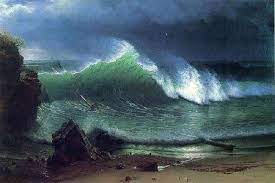
The Wave of Exile

By Paul Mirabile

Mr Richards, employed by the British Council, had been teaching English at a posh, private preparatory school in Thailand for more than four years in the Province of Prachuap Khira Khan in a coastal town named Mawdaung. His first and sixth form pupils enjoyed his humour much more than his tedious grammatical explanations, and Mr Richards had no qualms about this.

Mr Richards taught twelve hours a week which offered him ample time to learn Thai, travel extensively throughout the country, especially up North in the dusk-filled jungles and along the Mekong River shores exploring villages and temples.

The one-storey school, perched high up on the brow of a hill, overlooked the turquoise-tainted Indian Ocean. The large windows of his class afforded pupil and professor much visual pleasure when grammar became too much of a bore, and Mr Richards too weary or hot to break the boredom.

“Now, instead of casting cursory glances out of the windows,” shouted a nettled Mr Richards, one very grey, windy day, “who can tell me what function the word ‘chewing’ plays in the composed word ‘chewing-gum’ ?” All the smiling faces and darting eyes happily translated their perfect ignorance of the answer. However, a minute later, a very pretty girl, one of the brightest in his class, excitedly cried out, “A verb, sir !” Mr Richards gave her a benign smile and shook his head.

“No, no. It is not because it ends in -ing that it is a verb,” he lectured in a paternal tone, so overtly exercised by Mr Richards, and so perfunctorily accepted by the pupils. He scanned the eager heads of the others ; alas none had the desire to crack the enigma. He checked his watch : “Oh well, I’ll let them out ten minutes or so before the bell rings. I have to catch that bus to Bangkok,” he sighed, still waiting for an answer that never came.

“No bother. Tonight think about it and tomorrow morning let me know, right ?” He stood up. “Go on now … down the hill … off to the beach, I’ll give you a treat this afternoon.”

Before he had even finished the word ‘afternoon’ the whole class, besides two girls, grabbed their books and scrambled for the door. Out they stormed, racing downhill towards the shingled beach of the crescent-shaped bay. Mr Richards observed them from the large windows. Their delightful screams made him a bit queasy: he had been told never to allow the pupils out before the bell. He, nevertheless, had done so on several occasions. He shrugged his shoulders, picked up his books and papers from the wooden desk and was about to make for the door when a terrible thundering or roaring sound froze him in his footfalls. He swivelled on his heels and gasped in horror as rolls and rolls of water smashed against the plate glass of the window panes. The violence of the impact threw the two girls to the floor screaming, but besides a few chinks through which spouts of water gushed in, the windows had miraculously withstood the brunt of the tidal wave. For a tidal wave it was, and a tremendous one! The two girls remained lying on the floor, crying but unhurt.

Mr Richards ran to the windows. The waves had receded, but what he espied below on the crescent-shaped seascape, or what had been a crescent-shaped seascape, caused him to fall back and scream involuntarily : “Dear God! There’s nothing left!” Indeed nothing remained: no palm trees, no vendors’ shacks along the shore, no boulders. No shore ! Only a vast ocean that lay several metres below the school, now churning a glaucous thickness under grey, sultry skies, upon which floated a myriad bobbing flotsam: uprooted palm-trees, lifeless cows and dogs, shoals of bloated fish, roofs of straw, pots and pans, planks, bright coloured robes with or without their proprietors’ bodies inside them !

“Bodies !” he cried covering his mouth. “My pupils … Have they all …” He dared not finish his sentence. The two girls stared at him, mouths agape, eyes deorbited. “The boys and girls floating in the water … Dear God they’ve all drowned !” He wept and wailed, stamping his feet, grabbing at his hair. The girls too began to weep and wail.

In an instant he came to himself. “Their deaths are my fault,” he mused. “I let them out too soon … against all school regulations. Blast ! Why did I do that … just today ?” He soon realised that the headmaster would be on to him soon enough; he feared his starched character. And the parents ? They would accuse him of manslaughter.  He would be arrested and put in prison, even hanged for involuntary homicide ! He had every call to be frightened …

Taking hold of himself, Mr Richards knew he had to flee very quickly from Thailand before the headmaster and the parents learned about his unpardonable blunder. And they would learn about it soon enough when the panic and hysteria had died down.

He leapt over the still supine girls and rushed out the door. Once outside he noted that the town near the school had hardly been damaged. But below, he caught glimpses of undulating corpses being poled out of the waters by villagers and policemen in pirogues, rowboats or catamarans. The tidal wave had been gigantic. He turned his attention away from the catastrophe and fled home …

He jogged up to his bungalow further up the grassy hill at the edge of town. Speedily he gathered what he could, for the alert would be out for him at any moment … Or, so he believed. A change of clothes, one or two books and his official documents he stuffed into a small backpack, and without locking his door quickly made a bee-line for the bus station, where luckily he managed to jump on a bus for Bangkok. Apparently no one recognised him, nor followed him. He paid the fare, settled into one of the many empty seats and stared stony-eyed out of the window. His red, puffy eyes filled with tears. What a blithering fool he had been ! And now, what had he become ? A fugitive … no, worse, a murderer ! “Dead ! All dead !” rose a ghastly whisper in his ear.  He had to get away as far as possible as the scenes of the bloated pupils danced before his bloodshot eyes.

Once in Bangkok he wasted no time. Further North he travelled by bus into the Province of Chiang Rai. There, in a village whose name he hardly recalled, he spent two nights pondering his dilemma, assuaging his jaded nerves, chary of leaving any sign or evidence of his frantic intinerary, thinking only of a plan to save his neck. He couldn’t possibly stay in Thailand, the police surely were now on his trail, or would be very soon. Neither could he return to England: the bobbies would be waiting for him at the airport, ready to handcuff the murderer of over a dozen innocent children !

Then in the middle of a hot, sleepless night it suddenly occurred to him: he would shave his head and eyebrows, don a monk’s robe, change his expensive Russell and Bramley shoes for sandals and set out for Laos. He had travelled widely in Laos and could even speak a smattering of Kra-dai. He had taught in Luang Prabang for three years and had many friends amongst his former pupils, two of whom had entered monkhood in Pak Beng at the Wat or temple Jin Jong Jaeng. “I shall escape naked from the shipwreck of mundane life,” he  murmured, smiling inwardly at his little metaphor which he recollected from his childhood upbringing. But would he ?.. Mr Richards sunk into his lumpy bed: the figure of an outlaw, a pariah, a self-exile stood before him like a shadow … a double of himself: -swollen little bodies drift like flotsam in waters, darkly … that fey voice droned above a tumult of incongruous thoughts.

Mr Richards shook his head and said aloud, “To Pak Beng. There I’ll join the sangha[1] of the Theravada monks. There I shall seek spiritual solace, rid my mind and spirit of those drifting bodies of cheerful boys and girls, swept away from the joys of life because I had a bus to catch!” So he hoped.

Yet the obstacles of reaching the temple caused him concern. The Laotian government frowned upon Western spiritual-seekers cluttering their monasteries and temples. He needed a visa. Where would he find a consulate in the North of Thailand ? And would they issue one to a ‘Western monk’ ?

He jumped up from the bed, and as he did his mind cleared of all that tumultuous tossing. He had befriended many of his pupils’ parents whilst working in Luang Prabang, and he knew, by correspondence, and his frequent voyages to Laos, that one of them, Mr Inthavong, had been appointed consul in one of the North Thailand consulates. He rushed down to the reception and asked at the desk where the nearest Laotian consulate could be found.

“You must travel by bus to Wiang Kaen near the Mekong River, sir.”

“Are there any other consulates ?”

“Not that I know of, sir.”

Mr Richards heart skipped a beat; Mr Inthavong must be working there. He had to take the chance.

The next morning the ‘Western monk’ got on a bus for Wiang Kaen, carrying only a small bag for his passport, photos and a bit of lunch. All along the tedious journey to the North-Eastern town Mr Richards prayed that Mr Inthavong would be there; it was his only chance to obtain a visa for Laos.

He reached Wiang Kaen by nightfall, found accommodations at a temple guest house and spent a horribly sleepless night, tormented now by the thought of the failure of his plan, now by the screeching rats and buzzing mosquitoes.

At nine o’clock sharp he was at the front gate of the bright new consulate, a lovely two-storey bungalow-like edifice enshrined by lush gardens carpeted with the most perfume-scented fruit trees and flowers. He rang. The security guard strolled out and sized him up. Mr Richards politely mentioned his friend’s name. The unshaven security guard raised two quizzical eyebrows, but took his passport and photo and left him to ruminate the events that were about to unfold behind that iron barrier, inside the lovely bungalow. It all seemed hours to him as that voice repeated  “irresponsible murderer !” Suddenly the security guard stood before him, together with a small, portly man dressed in a suit and tie.

“Can that be you Mr Richards? A bonze? A monk? What have you done? Where is all your beautiful black hair ?” All this was said in imperious tones much to the delight of the monk who sighed in relief: his pupil’s father had recognised him! He wiped the perspiration off his furrowed brow. “Step in, please … out of the heat,” the consul pleaded. So they both strolled into the air-conditioned consulate, Mr Inthavong wearing Russell and Bramley shoes, recently polished, Mr Richards, a pair of worn-out sandals.

Inside the monk was served tea and a bowl of rice in Mr Inthavong’s office, he himself abstaining from joining him since he had already breakfasted. “I’m so happy to see you Mr Richards,” began the enthusiastic consul. “What brings you here, and dressed like that ? Are you really a monk now ?” Mr Richards broke into a tapestry of lies that, as time went by, he himself began to believe: Living so long in Asia had infused his soul with the compassionate virtues of Buddhism, and in Laos, he hoped to pursue his path deeper in the compassionate depths of Buddhahood in order to glean its treasures. The consul smiled like a child does when listening to his or her favourite nursery rhyme.

Mr Richards then got down to business: his visa ! Mr Inthavong nodded, examining his passport and two photos. “You shall have it in three days. Meanwhile, you are to be my guest here, upstairs with my wife and two children.”

And so the first snag had been circumvented. For those three days, Mr Richards, plied with food, drink and homely conversation, had all but forgotten the wave, the floating bodies and merciless whisper … the abominable figure of a self-exiled …

On the morning of the fourth day, armed with a three-month visa, the Western monk set out to cross the Mekong River to Ban Houei Sai on a Nam Ou boat with six other passengers. It had been so long since he had been on the Mother of all Rivers. He inhaled the tropical river air in silent jubilation. As they navigated slowly downstream, his thoughts interlaced with the flecks of foam, wandered back to his days spent on the Mekong at Guan Lei on the Chinese border, where having been temporarily stranded, he finally was welcomed aboard a small six-cabin dai, a Chinese boat, heading for Thailand.

What a voyage! They had anchored by the soundless jungles at night, machetted through them in the evenings in search of mangoes, navigated by bathing rosy water buffalows and by tiny golden stupa-tipped isles. What an adventure! The crew had left him off in a small Laotian village where he made his way to Luang Prabang on one of those blue, wooden box-boats, gliding by stilt-home villages under whose piles lounged or snorted huge black pigs, scenes so reminiscent of Alix Aymé’s paintings[2] housed at the Luang Prabang Royal Palace. Then the real adventure began, upstream on the Nam Ou in a frail six-seater river boat, slowly weaving between treacherous snags and swift cross-currents. He passed the Park Ou caves, Nong Khiaw and Muang Khwa, sleeping in bungalows and eating rice with thick pieces of pork in the pristine territories of the Hmong tribal peoples. Alas, his grand voyage to Hatsa ended in Sop Pong near the Vietnamese border, the authorities refusing him an entry visa to cross Vietnam then back into Laos where he wished to continue on his river voyage to Chao Dan Tra at the Chinese border.

Ah yes, those were the days of freedom … of existential sovereignty. And now ? A fugitive … a prisoner to his own wretched egoism, Mr Richards suddenly felt overwhelmed by a deep loneliness. His mixed recollections were suddenly interrupted by shouts from the shore : they had reached Ban Houei Sai.

Once the formalities were completed, Mr Richards managed to hop on a collective taxi which sped him towards Pak Beng on a smooth road. He reached the town before nightfall, and to his joy he spotted his two former pupils seated on the temple steps. Were they waiting for him ? Indeed they were, thanks to a letter sent by Mr Inthavong who had explained in great detail to the Satu or Venerable Father of the temple-sangha Mr Richards’ religious fervour and enthusiastic intentions to enter monkhood. The consul had added that nothing should be said to the police or to other state authorities of his entry into Buddhahood.

His former pupils, who had grown into full manhood, heads shaven and bare foot, happily led him to meet the Satu Father. To tell the truth, Mr Richards hardly recognised them. But that made no difference. As expected, he deposited a large donation (all the cash he had on him which amounted to some six hundred pounds), then was given three bright new ochre-coloured robes of pure cotton, shown to his splayed window cell, through which he had a slight view of the inner temple gardens, and was told the daily procedures of his initiation as a pha or a novice: collective prayers in the Prayer Hall, breakfast, Sutra readings until lunch, discussion, rest period, an hour or two of manual labour such as gardening, restoring frescoes or termite-riddled woodwork, personal perpetual moving meditations, yoga exercises, then a light meal before the final collective prayer and sleep until the sound of the gong at four o’clock in the morning.

When the two monks had left him, Mr Richards lay back on the straw mat on the earthen floor that served as a bed. He had been given immaculately clean sheets and a pillow. A mosquito net had been nailed to the splayed window. The walls bore no images nor any other colour than a light beige. Putting his hands behind his head he followed the slowly turning ceiling fan with his eyes: yes, his plan had succeeded. No one would ever find him here. Yet he had no reason to rejoice. He would never again see his aging parents seated at the hearth reading or conversing in low voices, his trusty Irish Setter … his friends at the pub. A sharp pain of remorse, or better put, compunction stabbed at his chest. “Dead! Drowned ! All dead !” the whispers hammered at his temple. Would that relentless voice ever grant him respite ? Would anyone ever forgive him ? Only penance. Only the fires of tribulation could scrape away the rust of vice that had corroded his being. A life of contrition would be the most appropriate path for him, the most responsible. Tears again began to well up in his eyes. He fell asleep and awakened to the cascading sound of two or three vibrating gongs.

So began Mr Richards’ initiation into Therevada monkhood. He had to learn the akkara alphabet in order to read the sutras, the Buddhist acriptures. His practice of many languages enabled him to accomplish this in two months. What he enjoyed most was the tham nong or the musical rhythm method which empowers the monks to memorise the hundreds of sutras of the Sacred Books ; it formed part of the didactic games that the bonzes played every morning and afternoon. These didactic games also included dancing and chanting sessions. The ‘western bonze’ adapted quite rapidly to his new lifestyle … his new home … No doubt his last …

As time passed, the rigours of the monastic code, the kindness of all the monks towards him, his slow but steady immersion into the Kra-Dai language and the marvels of the modality of Buddhist life attenuated, to a certain extent, the mortifying effects his spirit and body had suffered since that horrendous wave. Images of the drowned bodies did wake him up in the middle of certain nights, heaving and panting in one sweaty mass of anguish. However, the whispered voice had long since been silenced. His prayers and ruminations served as a watershed for those waves of guilt, an oceanic ointment for his slowly healing wounds. He was so glad to do service at the temple, run errands for the personnel who worked in the kitchen, wash and hang to dry the three robes of all twenty or so monks.

Gradually he succumbed to the beauties of Buddhahood, of attaining inner peace, his mind having all but vacated that remorseful past. His wide struggles between jubilation and despondency, gaiety and sorrow, ecstasy and debasement dwindled to a few chinks of dread. In short, he enjoyed his laborious leisure …

It was his seventh year at the temple. In spite of his three-month visa having expired, the Satu Father allowed him to take up his begging bowl and go into town to beg for donations, and even have a bite to eat at one of the roadside stands if he so desired. Mr Richards beamed with joy. In all those seven years he had hardly stepped out of the temple. He knew nothing of Pak Bent besides several photos that had been left behind by some tourists on the bench of the veranda of the main Prayer Hall.

He strolled about the crowded streets of the main arteries admiring the colourful markets and smelling the cooked food that had once given him pleasure, especially the pork and prawns. He went from shop to shop, his bowl filling with dented coins and frazzled bills. He was about to order himself a vegetarian meal in one of the market eateries when a group of well-dressed men addressed him in broken English. He shrugged his shoulders, prudently. They then spoke in Thai which he feigned to understand a bit. They appeared to be part of a large tourist group. One man placed a five-dollar bill in the monk’s bowl. They spoke very politely to him, and even invited the good monk to their hotel for a bite to eat … vegetarian of course ! The monk hesitated at first, but finally agreed. Who knows, perhaps these good men, quite wealthy-looking, would donate a fine sum to the temple-sangha.

They hailed two taxis and soon stood outside the palacial Le Grand Pakbeng, a sumptious five-star hotel. The finest in Pak Beng. In the lift that shot them up to the Presidentielle Suite, he looked at himself in the lift mirror ; he hadn’t seen his face for over seven years (the temple-sangha had no mirrors) and noted that the corners of his eyes had shrivelled into crow’s eyes. He winced.

ThePresidentielle Suite was fabulously fitted out with an outdoor spa and living area. The majestic terrace looked out upon the rolling Mekong which snaked through the rich greens of the mountainous forests.

The door was slammed shut and locked behind him … 

And that was the last time anyone ever saw the monk from the Wat Jin Jong Jaeng, alias Mr Richards.

An investigating detective, sent by the Richards’ family, after a year or two of intense enquiry, believed that their son had been abducted by the group of Thai tourists who had checked into Le Grand Pakbeng. The detective, once learning their names, discovered that three or four of them were the parents of the pupils who had drowned in the terrible tidal wave that struck southern Thailand some nine or ten years back. Alas nothing could be proven against them. What proved very odd was the fact that Mr Richards’ parents had no idea their son had been the cause of the drowned children in Thailand, and even ignored his entry into monkhood, having received no letter from him for over seven years ! The detective had nothing to say about this silence. Nor did he wish to say anything.

The detective concluded in his report to the grief-stricken parents, rather sententiously, that no human being has ever disappeared completely, however altered his or her appearance. This trite remark hardly brought a ray of solace to them.

.

[1]        A monastery or convent of Buddhist monks.

[2]        (1894-1989) French painter. She discovered the use of lacquer in her landscape paintings of Southeast Asia.

.

Paul Mirabile is a retired professor of philology now living in France. He has published mostly academic works centred on philology, history, pedagogy and religion. He has also published stories of his travels throughout Asia, where he spent thirty years.

.

PLEASE NOTE: ARTICLES CAN ONLY BE REPRODUCED IN OTHER SITES WITH DUE ACKNOWLEDGEMENT TO BORDERLESS JOURNAL
Click here to access the Borderless anthology, Monalisa No Longer Smiles

Click here to access Monalisa No Longer Smiles on Kindle Amazon International

Categories
Slices from Life

Kardang Monastery: A Traveller’s High in Lahaul

Narrative and photographs by Sayani De

I sipped on my cup of piping hot, sugary tea at Kardang monastery, twelve thousand feet above sea level. The chomo who prepared it chatted away the details of the snow festival that happened a few months ago. The edges of her maroon robes fluttered in the wind. ‘Chomo’ — I learned a new word that day – in Tibetan, it means a female Buddhist monk.

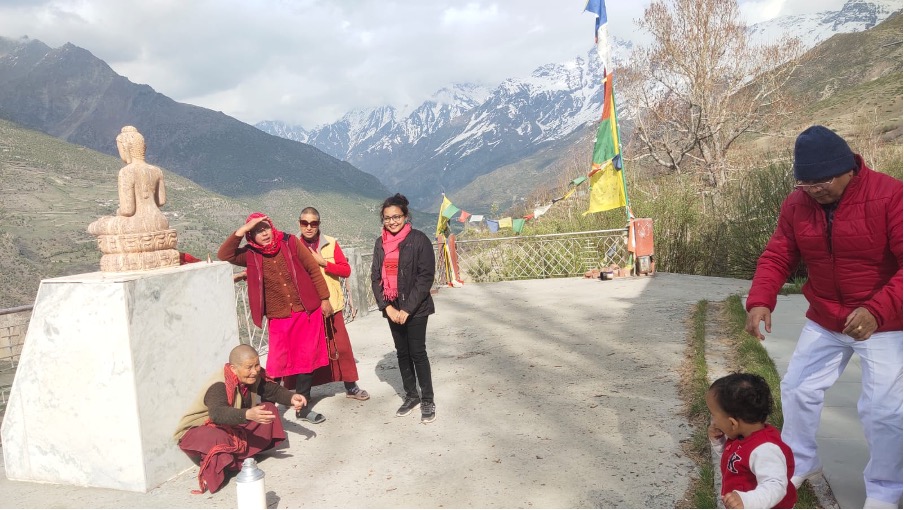
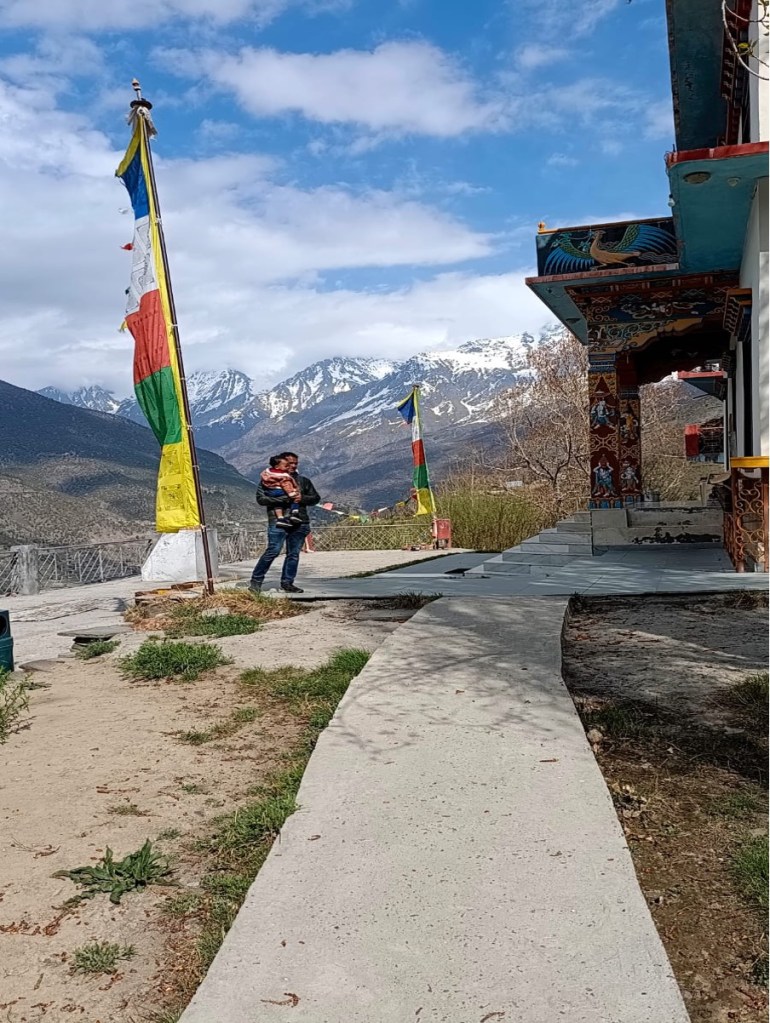
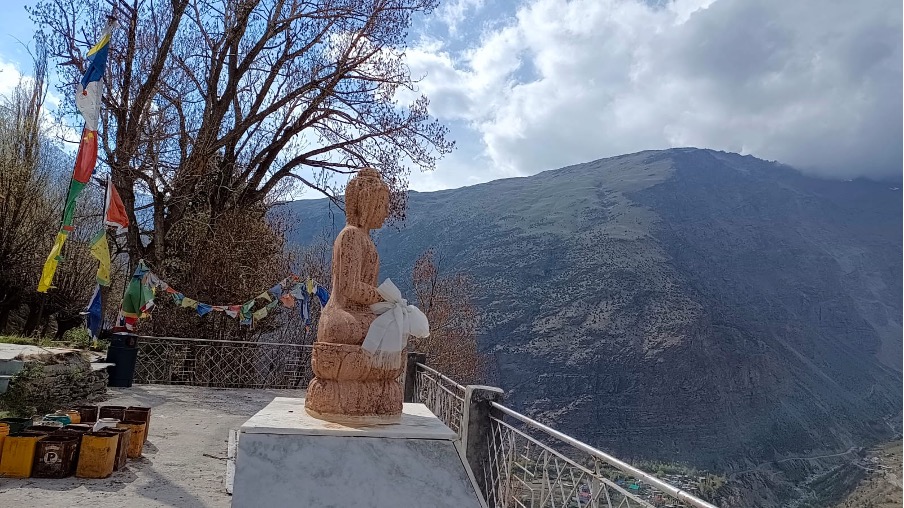
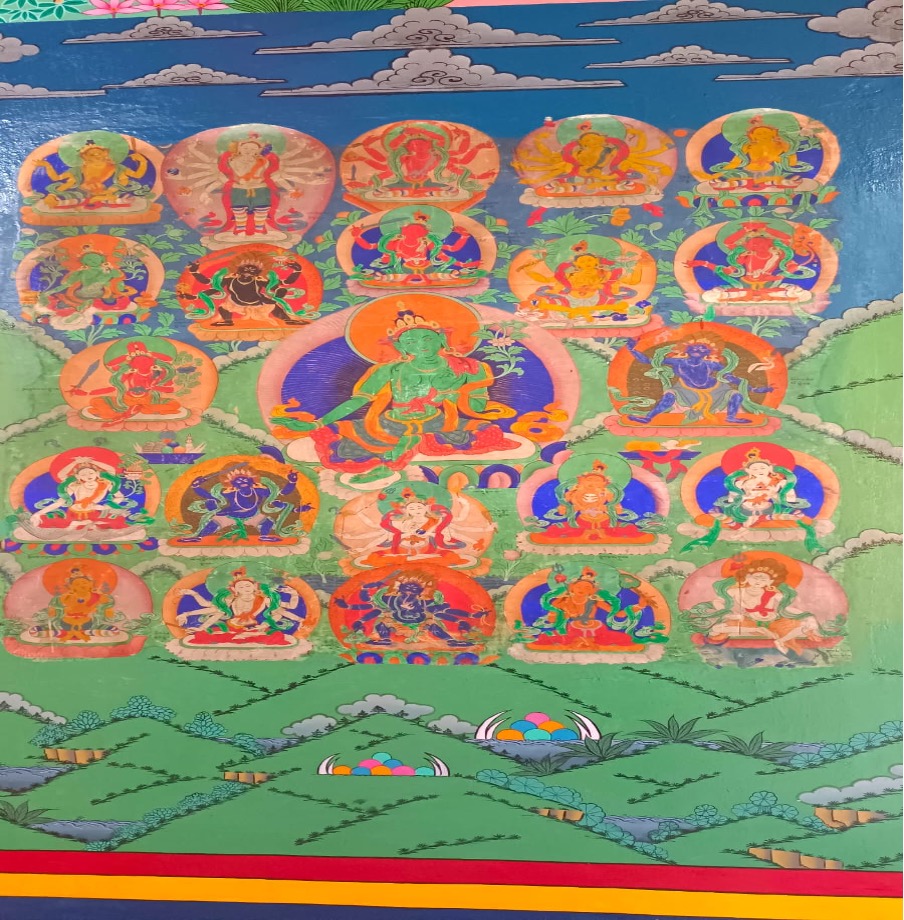
The monastery is an important one of Drukpa lineage[1] built in the twelfth century. The beautiful white facade with gold details gleamed in the sunlight. Intricate thangka paintings adorned the walls and ceiling of the monastery. It was perched on the barren mountain of Lahaul with multi-coloured Buddhist flags swaying in the wind. An imposing statue of Lord Buddha sat in the courtyard, looking over the whole valley. There was still some snow on the mountain tops, spring had just set in.

The chanting of the lamas filled the air. It was part of the evening ritual. Gentle drum beats punctuated the chanting. I felt fortunate to be in such a tranquil space. It was a happy concoction of the high altitude, the rhythmic rituals, and the lack of human habitation around the monastery that left me in a self-contained peace bubble.

A thangka painting

“How did you know about this place? Not a lot of tourists come here,” the chomo asked me with a twinkle in her eyes. My mind browsed through the incidents that led me here. 

It all started two years ago. My penchant for zoning out to Tibetan chanting mantras on YouTube, and love for off-beat places in the Himalayas led me to some serious research. Lahaul district in Himachal seemed to fit the bill perfectly to get a taste of both. It was easily approachable from Manali, where my family could stay with all creature comforts. Our travel group included our one-year-old son and elderly parents.

The beautiful monasteries in dramatic mountainous settings were as much a reason to visit Lahaul as the adventure to travel to such harsh terrains. We based ourselves in Manali and acclimatised ourselves for a few days before climbing to twelve thousand feet. We hired a local car and driver to visit the Lahaul district. When we told our local driver that we wanted to go to the Kardang monastery, he looked at us blankly. It dawned upon me that it was even more remote than I had realised. 

We started from Manali towards the Atal tunnel, a nine-kilometre-long highway underpass in the Pir Panjal range of Himalayas, on the Manali- Leh highway that connects two districts of Himachal. The Atal tunnel was opened in October 2020 after several years of work and today connects the remote Lahaul district with the rest of Himachal. 

We left the verdant coniferous forests and mountains with gushing streams on one side of the tunnel and gaped at the dry snowy mountains with freshly sowed fields at the base of the mountains of Lahaul on the other side. It was a dry desert with farming done in little patches at the base of the mountains. The difference was stark.

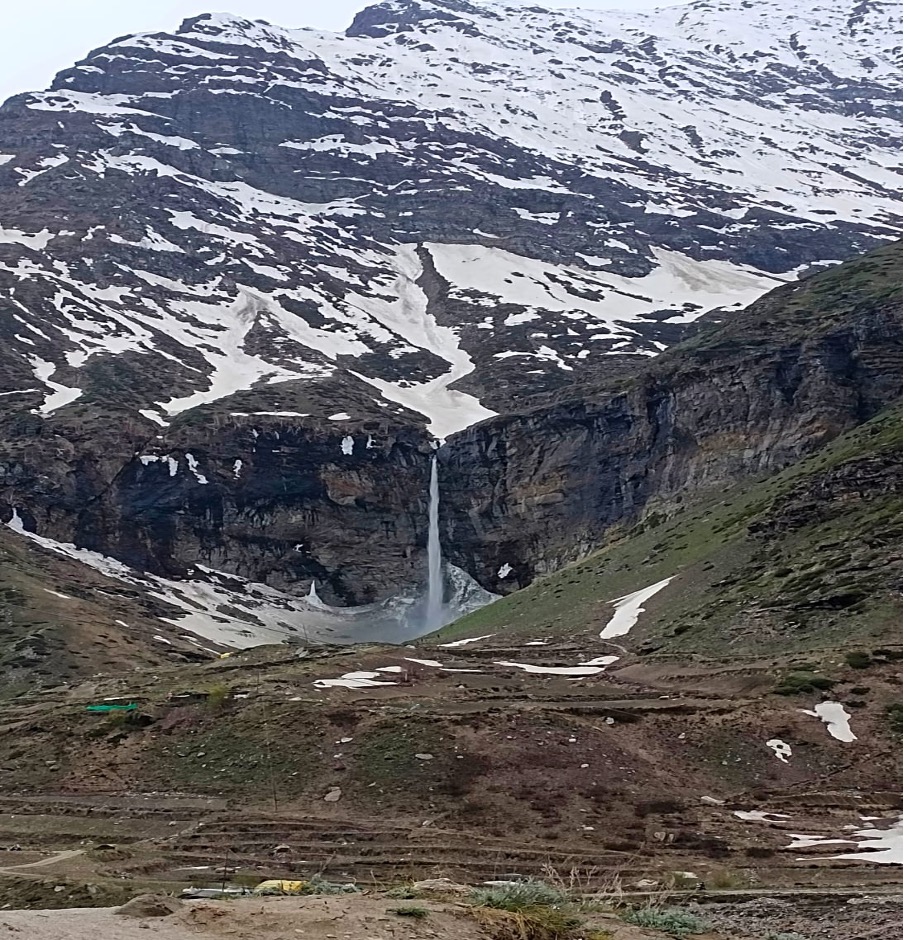
We stopped at the helipad by the Sissu waterfall in Lahaul district, to recharge ourselves with tea and steaming momos. I saw my father-in-law skip around like a little boy, his jaws dropping every time he looked at the waterfall coming straight out of the glacier that cradled it. It was his first time being in such a terrain. All of us, including my one-year-old son, seemed to be breathing fine and enjoying ourselves, in spite of the sudden gain of altitude to eleven thousand feet. I sighed in relief; no acute mountain sickness (AMS) for us.

We set out to the monastery following google maps and stopped for lunch on the way. After some conversation, the restaurant folks told us that we were going in the wrong direction. Apparently, google maps didn’t work very well in this region beyond the well-travelled tourist circuit. They told us how to reach and from the sound of it would involve off-roading. After losing our way twice, we finally discovered a bumpy path that led to the monastery. We found out later that the best option was to take the mud road on the right after the lone petrol pump in Sissu.

The bumpy mud road that we took instead was devoid of human habitation or road signs till the Kardang village. On each serpentine turn, I could see my travel companions digging their fingers deep into the seat in anxiety. On some stretches, there were walls of ice on the mountain side and the car had to cross the several streams that these walls caused. Later, we all laughed about how each of us was praying for dear life during that treacherous journey.

After a good thirty-minute climb we finally reached the Kardang village and the metalled road was in sight. The Kardang village had a few homestay signposts but none were open in spring. Soon we crossed the signs of the pilgrimage trek of Mt. Drilbu Ri and we were at the gate of the monastery. The short walk to the monastery was nice but we did it slowly as the lack of oxygen was palpable. Kardang monastery is nestled in the ridge below the fifteen thousand feet Rangcha peak. Kardang is the starting point for the Buddhist pilgrimage of Mt. Drilbu Ri. 

Upon reaching, we found the door of the monastery closed. Soon we were greeted with the Tibetan greeting ‘Juley Juley’ by a smiling monk who opened the door for us. His name was Sonam Dawa. He was happy to show us around and answer our questions about the prolific thangka paintings on the walls and ceiling of the monastery, on Buddha’s life, dakinis [woman spiritualists], and other important figures of Tibetan Buddhism. Tibetan Buddhism with its characteristic animism and symbolism of Bon culture is a hallmark of this Lahauli monastery. A few lamas and chomos joined us and offered us tea. We were touched by their warmth. They played with my son, told us a lot about the snow festival that happens every February and asked us to come back during the celebration.

To this day I am not sure if it was the high altitude, the aromatic incense, or the space itself that made it feel so special. I remembered the chant on Youtube that started this journey for me and am glad I followed that instinct.

.

[1] The Drupka lineage of Tibetan Buddhism dates back to the twelfth century.

.

Sayani De is a bibliophile, compulsive traveller and sustainability enthusiast.  Her work has been featured on Women’s Web and  been selected for publication at Muse India for its May-June issue. 

.

PLEASE NOTE: ARTICLES CAN ONLY BE REPRODUCED IN OTHER SITES WITH DUE ACKNOWLEDGEMENT TO BORDERLESS JOURNAL
Click here to access the Borderless anthology, Monalisa No Longer Smiles

Click here to access Monalisa No Longer Smiles on Kindle Amazon International

Categories
Stories

The Mysterious Murder of Adamov Plut

By Paul Mirabile


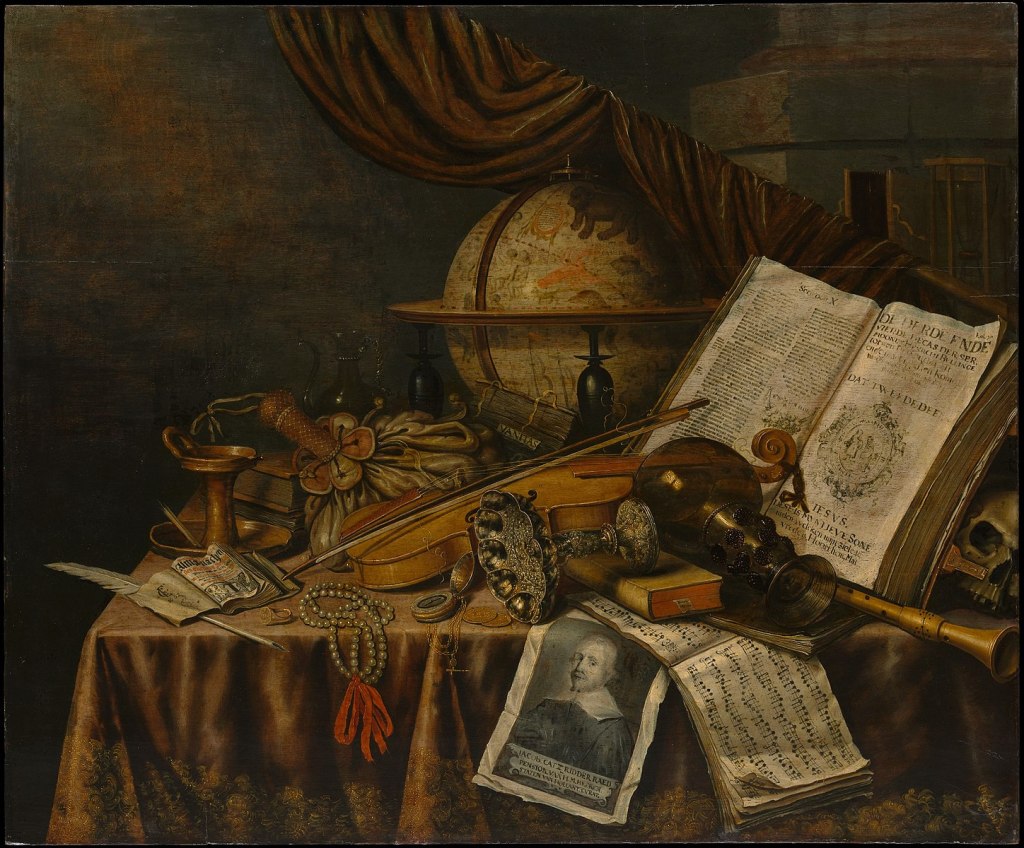
Vanitas Still Life, painting by Evert Collier(1640 –1708). Courtesy: Creative Commons

Back home in Madrid, having abandoned Adamov Plut to his posthumous fate, I was a bit surprised that neither the New York Times nor the Washington Post reported anything about the murder, not even a paragraph, or as the French so imagitively put it, an entre-filet ! I soon realised, due to this journalistic silence, that the time had come for me to give a full account of my relation to Mr Plut ; that the time had come for me to expose, publicly, by way of this revelation, his ‘mysterious murder’.

My information is of the surest sources for the simple reason that it was I who had Mr Plut murdered ! Yes, I ! And for reasons that shall be shortly disclosed. A mysterious man he might have been; however, his methods of acquiring priceless books and other inestimable valuables can hardly be called mysterious: Mr Plut was a vulgar thief, a scoundrel, an ingenious trickster whose singular flair caused much grief to many individuals, enraged those whose trust had been flouted.

It was in Istanbul, where I was invited to sojourn with an Armenian merchant, that I witnessed Mr Plut’s dupery. And if my naive friend fell for his crooked smile, I certainly didn’t swallow his high tale of returning to pay him for the two illuminated manuscripts my friend had graciously offered the blighter on condition that he be held accountable for them. His thick, coarse lips translated a smile that held contempt and disdain towards those who trusted him. So infuriated and insulted did I feel on behalf of my friend that that I reacted on a lightning urge and decided to follow him. I said nothing of this to my disbelieving companion, but left immediately in pursuit of my game — and game it was — for I, to tell the truth, had nothing more substantial to do at the moment and felt disposed for a good hunt.

I said that Mr Plut was a genius. Yes, in his own way. However, genius has its limitations. His arrogance and haughtiness knew no bounds, although he knew that his foul doings had attracted the attention of police and Interpol. Some may surmise that a certain paranoia drove him to invent individuals tracking him down like a wild boar or moose. No, no one was tracking him down except me, and that as subtlety as possible. In Uzbekistan, I actually chatted with him over a cup of coffee on two occasions disguised as a professor of Slavic philology, dressed in a quilted chapan robe and silk embroidered tubeteyka cap. There we sat in Samarkand, sipping our thick beverages in the vaulted bazaar at one of the storied cafés that dot the town. He was all smiles, obsequious and gold-toothed. I had the impression that I was dealing with a child or a mentally-dwarfed man whose sense of reality lacked all discernment or sagacity. I concluded that he had come into quite a bit of money, and never having had to work for a livelihood, traipsed about the world at his leisure, buying or stealing books, cheating people out of their invaluable collections. So self-indulgent and confident was he that he never saw through my masquerade as we conversed in broken Russian.

It was at that café where I learned about his fabulous treasure, as he called his book hoard. Only an idiot would have divulged this information to a perfect stranger, but as I said, Mr Plut’s contemptible demeanour caused him to fall into the most infantile traps. Traps that I began laying out for him, and that would lead to his downfall. For I had begun to design my own plan to relieve the rogue of his fabulous possessions, all the more so since he also let slip that his parents had passed away, and he had inherited the house. How I would make his treasure mine and ‘disinherit’ the  owner  still remained vague in my mind.

We departed as ‘friends’, as two strangers seeking an answer to the mystery of their existence. Or so I made him believe. Mr Plut appeared to me a dying species, a worldly aesthete, in spite of his extreme vulgarity and ponderous gait, whose debonair demeanour masked a loathing for his victims, a bent for the lowest duplicity, a gratification in spinning the most treacherous stratagems in order to allay his desire to prevail.

Mr Plut slipped out of Uzbekistan without my knowing it. He probably used his Russian passport, one of the four of five in his possession. I felt a twinge of misgiving. Had the fat fellow got on to me? After many enquiries, I finally discovered that he had crossed into China at the Xinjiang border, and was hastening towards the Yunnan. Why ? I hadn’t the faintest idea …

His brief sojourn in the town of Lijiang enabled me to catch up with him. My Chinese was fluent enough not only to query his whereabouts in that lovely town, but more important still, to learn of his new ‘purchases’, once I had questioned the director of the Dongba Museum of Culture. Mr Plut had planned to gone there to acquire several Naxi pictographic sacred books, which he did from a rather corrupt priest with whom he had been corresponding for some time, using a special code so as not to be unmasked by the Chinese authorities of the Centre. The director only learned of this a week after the unlawful negotiations had occurred, and three or four very valuable Dongba liturgical books had been stolen. It goes without saying that the rapacious priest was severely punished.

I immediately left Lijiang much to my displeasure for it was indeed a quiet, pleasant place, and set out in hot pursuit of the marauder. I followed his all too familiar scent through Nepal into North-western India to the Zanskar region where he put up for a while at the Phuktal Gompa[1], a strange spot to make a halt. But a perfect hideout to gain time in order for planning his next move, whilst at the same time inveigling in the most repulsive manner his generous hosts.

The monastery is nestled in the most remotest of valleys, ensconced within a cliff of tuft of fairy chimneys, crags and honey-combed spires which bulge black and red against the background of sandy, dazzling ash and cinerous tones of hemp. I had trekked there from Lamayuru in twenty days, and as I was to learn, Mr Plut had arrived there three days ahead of me, but by way of Padum. To gain the main entrance of the gompa, the pilgrim had to climb a steep path, keeping his or her right shoulder to the seventeen chortens[2] that mark the steep climb towards the vaulted entrance. I had shaved my head, grown a long beard and donned a woollen chuba tightened around my waist with a long colourful sash. It kept me warm, for in spite of it being Summer, the nights were very cold, and my cell had only a small wood-burning stove to keep me warm.

I spent three weeks at the monastery, sleeping on a ratten matting, eating skieu, tsampa and chappatti, drinking steaming salt-buttered tea off a chopsey — a low, small table — reading or gazing out of the little window that offered me a full view of the dusty, treeless courtyard below, where monks would mutter their mantras, and beyond into soundless nights whose stars were generally veiled.

Without Mr Plut’s slightest suspicions, I assisted at all the ceremonies, mornings and evenings, even vigils, while in the afternoon, I would venture out into the monastic complex, twisting and turning in the warren of lanes, under the low archways and high ladders, at times pursuing my promenades upon the rather precipitous mountain paths. As to Mr Plut, he hardly left his cell, and when we did cross paths, he most probably took me for a Buddhist pilgrim. Once or twice I sat near him in the prayer hall in the meditation grotto, but he never attempted to communicate with me, albeit he did not seem very deep in prayer or contemplation. He was probably scheming his next miserable move. His face had become terribly pale and flabby. His darting, black eyes seemed to have sunk deeper into their sockets. Unable to sit cross-legged on the low benches at the back of the prayer hall, he sat ‘western style’, staring off into the clusters of chanting monks, tilting his huge, bobbing head every so often to the banging drums, blowing ox-horns and tinkling triangles. Observing him from afar, I sought to sound his soul, to wring out his innermost thoughts, to extract from his evident lassitude and apathy his flight from both his victims and himself. But Mr Plut was a sphinx. Would he rise out of his own ashes when his hour came ?

I left the good monks three days after his departure, a hasty one indeed. And they were furious! The scoundrel had stolen several pustuks[3] and thangkas, and failed to pay for the prayer masks that he ‘purchased’. They implored me to find the culprit, inform the police and recover their stolen property. It was perhaps the beseeching words of the infuriated monks, after having received such incomparable hospitality from them, that my plans to have the thief killed began to germinate ! The theft was not only gratuitous, it exposed the very ugliness of the man’s heart, blackened by greed, cynicism and remorselessness. It would only be a matter of time before he tasted a soupçon of his own medicine.

Meanwhile the cat would play with the mouse, a rather fat mouse at that ! I boarded the cargo ship that took the fugitive from Karachi to Oakland via Japan. On the long, monotonous voyage across the Pacific, my ominous shadow crossed his at the most unsuspecting moments. Attired as a Pashtun merchant, bearded, long-haired and turbaned, Mr Plut sensed an onerous presence whenever he laboriously carried his huge body across the decks. How many times had my eyes penetrated his anguish, his torment, his pangs, not of compunction, but of incomprehension. He scented a sleepless menace pressing him. Fear inflamed his dark, beady, mirthless eyes like the burning incision of the trenchant knife.

Oakland … Sacramento … Reno … Tombstone … Boulder … Santa Fe … Saint Louis … Chicago … New Orleans … Birmingham … Miami … Atlanta and finally New York. Yes, New York, where the curtains would finally fall on this tragic fat figure. Where upon the stage of 8 million walk-ons, and against the backdrop of the grottiest of hotels, the last act of Mr Plut’s abominable performance would be played out.

His infatuation with Louis Wolfson amused me, as well as his grandiose project to write twelve stories in twelve different languages signed by twelve different authors. I found all this quite pompous and pathetic. A real exercise in self-indulgence to say the least. All this information I culled when I ‘accidentally’ met him in the ill-lit corridor of that hotel on Water street in downtown Manhattan. In New York, I played the role of a French researcher in mediaeval literature, a field that he completely ignored, in spite of possessing several manuscripts of Anglo-Norman stamp, apparently purchased (so he said ?) from a London book-seller. I pretended to be interested, taking the opportunity to study him closely. Besides, he was such an inveterate liar how could one believe anything he said ? He lied to curry favour and win confidence, only to swindle and steal from the naive and simple-hearted. Better to observe his eyes, his gestures, his bouncing from one tongue to another. These were all genuine signs of his distorted psychological make-up. To play my part well, I sported an immaculate white suit, orange tie, a pair of silver-rimmed glasses and spanking new alligator shoes. I had shaved my beard and moustache and had my hair cut very short, leaving a few gossamer wisps which touched the tips of my ears and fell bouncily on my forehead.

Every day I followed his Humpty Dumpty gait as he waddled to and from the public library, in and out of Central Park. And it was there, in Central Park, that I noted two blond-haired rough fellows slouching on a bench, eating the remains of fried chips or chicken sandwiches, cursing and making gross signs at the passers-by, drinking beer and spitting. They were seated at the same bench daily — the bench that Mr Plut walked by every day. They seemed to know him because they would hoot at him, call him names and ask for money. Fatso passed by without even a glance at them.

One Saturday, I decided to approach the two ruffians. They sized me up with obvious contempt, and made it perfectly clear that I was intruding on their ‘territory’. I sat down none the less, and exposed my scheme to be rid of Mr Plut once and for all, explaining how the culprit had cheated and robbed so many people. The two burly blokes, former marines in the Green Beret (or so they vaunted!) listened attentively as I unfolded my plan: Three thousand dollars for each if they would simply walk up to his room in the early morning hours, the night porter always being asleep, knock at his door and kill him, however, without any blood shed or theft of his belongings. It must be a murder without reason, without any sign of bestial violence. One of them suggested strangulation. Yes, excellent idea. It would thus be a ‘clean’ murder.

And so it was, very professional at that I must say. They were paid off, as agreed. And I left New York two days later, as planned, a very satisfied man indeed …

This all happened five years ago. Now … well, here is where my account ends and my confession begins. For you see, Mr Plut was never really murdered ! Those two ‘ruffians’ were in fact F.B.I. agents who had been trailing me since disembarking in California. To tell the truth, Interpol and local police had been following me since the Istanbul affair. How and why they began doing so I cannot say. During my trial neither the judge nor the prosecuting attorney afforded any information as how the F.B.I. learnt of my scheme, nor why they had decided, at one point in time, to cooperate with Plut. What was I convicted of ? What was my indictment ? As to my appointed lawyer, a young short-sighted clerk more than a seasoned lawyer, who could be easily cajoled by the ‘evidence’ against me, pliantly manipulated by the prosecutor, after he had taken the floor and had made an absolute fool of himself. He let out a sigh of relief when the judge pronounced a sentence of fifteen years instead of twenty-five! The wigged judge, a grotesque figure studded with huge warts, yawned throughout my lawyer’s deplorable speech for the defense, as well as during my feeble plea. There was no jury either to lament or to applaud his verdict. It was a trial held at ‘huis clos’[4], military style. I buried my face in my hands. As expected, my lawyer made no effort to appeal.

Had Plut sensed my innermost aversion towards him ? Or seen through my many disguises ? He was a clever man, and probably had hired detectives to learn why I was following him. The hotel room murder was staged. Plut lay recumbent on the floor, waiting for me to steal his papers so that I would be indicted for premeditated murder (although there was no murder!), of paying off hoodlums to commit this murder (although they were F.B.I. agents!) and the theft, which indeed it was (but fifteen years for that?) of his household papers, keys, and other official documents concerning his inheritance … and that vile short story of his.

So here I sit in my rancid smelling cell in Madrid, having been arrested at the aeroport on my arrival some five years ago, writing out this confession. I do not to repent mind you, I have no intention of atoning for my doings, nor avowing my sins. These words wrenched from my pen seek to vent the animosity and hatred I harbour towards that fat impostor who had the cheek to write me a letter from the Seychelles revealing how he had got on to me since Uzbekistan, and how our little cat and mouse game had amused him greatly : “You thought me a fool, deary, but I saw through your pusillanimous scheme in Samarkand ; that was some outfit, but you forgot the galoshes ! Not to mention your pilgrim weeds at Phuktal which truly charmed me, and your blazing orange tie in New York. Come, come, what French professor would ever sport an orange tie with a badly tailored, cheap white suit ?” The vicious irony underlining these sentences, along with a soupçon of cynicism caused me to gag. The blighter added in a post-script that he had sold all his books for a fabulous sum of money, and had retired from the world’s wearisome fair. In the envelope I found a photo of him sipping coconut juice, lying on the golden sands of a crescent-shaped beach under groves of swaying palm trees and an indigo blue sky. I laughed bitterly, and yet, in spite of my nettled nerves, pinned up the blasted photo in my lonely cell, a sort of souvenir of our enshrouded relationship …

One day at the prison library, browsing idly through a dull, detective story, I thought of Plut’s or Hilarius Eremita’s story The Enchanted Garden, which I had taken and read to amuse myself on the aeroplane to Buenos Aires. Had anyone ever published such ridiculous trash? To my horror, the answer came three days later whilst I rummaged through a new batch of literary magazines, some of which contained short stories in English, French and German. And there it was — The Enchanted Garden, by Hilarius Eremita, Plut’s pen name. I couldn’t believe my eyes — someone had published that rubbish ! Plut indeed had the last laugh, adding insult to injury, salt to my festering wounds.

I savagely tore out the pages of his story from the magazine, went to the toilet, ripped them into tiny pieces and flushed the filth down the bowl. So much for hiss ‘first of the twelve’ ! I shan’t be punished for it, no inmate in this prison reads any language besides Spanish, and that with a dictionary … I’m sure it was Plut who sent me that magazine to drive the knife deeper into my wounded pride. The miserable rat !

So here I sit at my iron table, staring at Plut’s photo as he sips his coconut drink under the blue skies and swaying palm trees whilst I sip my wretched thin noodle soup with strips of hard, nervy beef under a cracked, peeling, dirty grey prison ceiling …

.

[1]          Monastery in Tibet

[2]          The Tibetan word for stûpa, a Buddist shrine which initially housed the relics of the Buddha.

[3]          Books used for Buddhist ceremonies written in Tibetan.

[4]          Behind closed door without any public participation or observers. It is a French legal term.

Paul Mirabile is a retired professor of philology now living in France. He has published mostly academic works centred on philology, history, pedagogy and religion. He has also published stories of his travels throughout Asia, where he spent thirty years.

.

PLEASE NOTE: ARTICLES CAN ONLY BE REPRODUCED IN OTHER SITES WITH DUE ACKNOWLEDGEMENT TO BORDERLESS JOURNAL

Click here to access the Borderless anthology, Monalisa No Longer Smiles

Click here to access Monalisa No Longer Smiles on Kindle Amazon International

Categories
Poetry

Lunch Time

Written in Korean and translated by Ihlwha Choi 

Courtesy: Creative Commons
LUNCH TIME

Magpies eat the cat's lunch after the feline finishes.
Sparrows eat the leftovers after the magpies finish.
Since a monk gave the cat something to eat,
The cat ate lunch with relish.
The magpies and sparrows also were satiated. 
After all finished their lunch,
The monk entered his sunbang* to take a nap.
The cat climbed to the hill to rest in the shade.
The magpie and sparrows scattered in the field to play with friends.

*sunbang(禪房):A room for Zen meditation at a Buddhist temple

Ihlwha Choi is a South Korean poet. He has published multiple poetry collections, such as Until the Time When Our Love will FlourishThe Colour of TimeHis Song and The Last Rehearsal.

.

PLEASE NOTE: ARTICLES CAN ONLY BE REPRODUCED IN OTHER SITES WITH DUE ACKNOWLEDGEMENT TO BORDERLESS JOURNAL
Click here to access the Borderless anthology, Monalisa No Longer Smiles

Categories
Review

Ashoka and the Maurya Dynasty

Book review by Bhaskar Parichha

Title: Ashoka and the Maurya Dynasty: The History and Legacy of Ancient India’s Greatest Empire

 Author: Colleen Taylor Sen

Publisher: Speaking Tiger Books

In The Outline of History, H. G. Wells wrote of Ashoka: “In the history of the world, there have been thousands of kings and emperors who called themselves their highnesses, their majesties their exalted majesties and so on. They shone for a brief moment, and as quickly disappeared. But Ashoka shines and shines brightly like a bright star, even unto this day.”

Ashoka and The Maurya Dynasty: The History and Legacy of Ancient India’s Greatest Empire by Colleen Taylor Sen is a refreshingly ravishing account of the Mauryan empire. Two things stand out prominently in the book: flawless and wide-ranging. Sen has done something extraordinary in dealing with the most powerful empire in India – the amount of material she has used to write the book.

Says the blurb: “At its peak in 250 BCE the Maurya Empire was the wealthiest and largest empire in the world, extending across much of modern India, except a small area in the far south, Pakistan, and parts of Afghanistan up to the Iranian border. The Maurya capital, Pataliputra, was one of the largest cities of antiquity. India (although it was not yet called by that name) was a global power that traded and maintained peaceful diplomatic relations with its neighbors, as far afield as Greece and Egypt.”

Chicago-based, Dr. Colleen Taylor Sen is a culinary historian – having authored several books on food from across continents. A widely translated author, this book does full justice to the subject.

Says the book: “[O]f the seven or eight Maurya emperors, two are remembered today as among India’s greatest leaders: Chandragupta Maurya and his grandson Ashoka. Chandragupta, the founder of the Maurya dynasty, created his empire through both war and peaceful means. He was the first Indian leader known to have signed an international treaty (with the Greeks in the northwest). His grandson Ashoka, after conquering Kalinga in a bloody war in 261 BCE, renounced violence. He then spent the rest of his life advocating and propagating a policy of religious tolerance, kindness to all creatures, and peaceful coexistence in a multicultural society—a policy he called Dhamma.”

Sen discusses Emperor Ashoka’s life, achievements, and his legacy in her book. It also explores the legacy and influence of the Mauryas in politics throughout Southeast Asia, China, and India, as well as in contemporary popular culture. That makes the book broad-based.

An anecdotal reference to the book is in order. While searching for food histories in India, Sen found herself intrigued by Ashoka and began exploring more about him. After conquering Kalinga in a bloody war in 261 BCE, Ashoka renounced violence. He spent the rest of his life propagating religious tolerance and peaceful coexistence in a multicultural society.

In a book of about two hundred sixty adrenaline-charged pages, Sen deals with the rise, the highest point it reached, and the fall of the dynasty. She focuses on the accomplishments of Ashoka. In addition to a truthful account, she discusses Buddhist legends, the legacy of the Mauryas, and colonial South Asia. A captivating add-on tells the story of the rediscovery of the long-forgotten historical Mauryas in the 19th and 20th centuries. The intricacies of Mauryan historiography do not take her away from storytelling and she tells it rather profoundly. The result is a glowing record of one of the world’s most remarkable political eras.

The appendix to the book is as fascinating as it is inquisitive. She does a thorough analysis of how several historians unearthed the Mauryas and what led to those explorations. In her view, the post-Independent Indian historians took a ‘patriotic line’ and presented Ashoka as a ruler free of foreign influences. India’s first Prime Minister, Jawaharlal Nehru, saw in Ashoka the embodiment of a secular role. The Marxist historian, DD Kosambi, wrote that the Ashoka edicts were the first bill of rights for citizens. Then she says, despite extensive scholarship, many questions about the Mauryan empire remain unanswered. For example, what did the city of Pataliputra look like, and will it ever be excavated?

The book is a brilliant addition to the existing literature on Ashoka and the Mauryan Empire. A must-read for history professionals and general book lovers.

.

Bhaskar Parichha is a journalist and author of UnbiasedNo Strings Attached: Writings on Odisha and Biju Patnaik – A Political Biography. He lives in Bhubaneswar and writes bilingually. Besides writing for newspapers, he also reviews books on various media platforms.

PLEASE NOTE: ARTICLES CAN ONLY BE REPRODUCED IN OTHER SITES WITH DUE ACKNOWLEDGEMENT TO BORDERLESS JOURNAL
Click here to access the Borderless anthology, Monalisa No Longer Smiles

Categories
Stories

Do Not Go!

By Moazzam Sheikh

Pleased, beaming, yum yumming, she finished cooking pasta sauce the way he liked ‒ a bit more garlic and a dash of chilli powder ‒ and turned down the flame real low, the sauce simmering indolently. She was about to reach for a packet of flat spinach noodle to add to the boiling water when she fully realized that he wasn’t home yet. Mid-November and already dark beyond the windows, he could catch a cold, a flu, perhaps pneumonia. Touch wood, she whispered. One could trip, break wrist, hip, summoning visits to the hospital, restricted movement, crutches. A train of thought too frightening, she shook her head and cleared her throat. She set down the pasta on the countertop, unopened, reading the label mindlessly.

He went for his walk in the daylight though sometimes he did step out in the late afternoon. However, as far as she could remember he always returned before sundown. His routine she could depend on for the last two years. He must have misjudged, she shuddered, suddenly feeling hot in the kitchen. Although she breathed deep to calm her nerves, she couldn’t concentrate. The moment she tossed noodles into the water followed by a pinch of salt and half a spoon of olive oil, she regretted it. Pasta didn’t like to be left in water half-cooked. Agitation nudging her fear, she felt she’d have to turn off the stove and go out looking for him if he didn’t return in the next five minutes.

Five minutes passed and she frittered away a few more, paralyzed by indecision, when she cocked her ear to the noise of feet shuffling out in the corridor, nearing the apartment door. It turned out to be a sound conjured by hope. She snapped out, turned off the stove, and grabbing her keys and a light sweater, which Ronny had bought for her on her birthday, exited the building. Encountering the actual darkness which the onset of winter had ushered, despite the street pole lights, her heart sank further.

He could be anywhere, she inferred, and not knowing where that anywhere was, she could be walking in the opposite direction, away from him, lengthening his torment. She took a deep breath, again, and walked to the corner where her avenue intersected the busy street. From there she tried to scan the foot traffic in four directions. Her eyes traveling as deep as a block and beyond, and despite the thinness of the crowd due to the nippy winter air, she failed to spot a lost figure resembling him. She walked eastward unaware of the silent prayers her subconscious mind had been offering with little regard for her resolve throughout her adult life to not rely, as she put it many times, on the crutches of religion. She recognised it and let the prayers continue consoling her heart recalling the distinction she sometimes made between religion and spirituality. The fact that she also didn’t consider herself very spiritual, though nothing wrong with being one, amounted to very little right now. She was most concerned, at the moment, with his safety; her personal problems could wait.

A big sigh of relief! She spotted him outside Fresh Donuts, looking lost as she called out to him from across the street.

“I don’t know what happened. I just couldn’t figure out which way to go,” he explained, embarrassed.

She’d too felt like that many times, she came this close to voicing her thought, mesmerized by the doldrums, juggling personal life, work, moral obligations. As they walked home, she holding him by the arm lest he trip, he said he knew she’d be worried. The more he worried the more he lost his sense of reference. When he thought of asking a stranger for help, he shied away because he couldn’t remember the address or the cross street. He had enough sense to accept that he stood lost on Clement Street. That didn’t help much though, he laughed. She told him she was grateful and impressed he didn’t panic. Help would’ve come sooner or later. Nervous giggles escaped from their mouths as they neared the apartment. A combination of relief and premonition. At home, he went straight to the bathroom to relieve himself and heard her say that the pasta was going to be a little below his standard, not what counts for normal, a little soggy, fluffy perhaps, but the yummy sauce, she promised, would make up for it. She didn’t have to tell him about the tiny bit of rum she’d added to the sauce.

“Don’t worry, honey. Your father is hungry and will eat anything.”

She wanted to say thank god, you’re an easy eater. Not like Ammi, but she bit her tongue. When they sat down to eat, she hesitated but eventually wondered aloud if he remembered her phone number, which to her relief he rattled off without a hitch. Ah, the memory had returned. He said he’d eventually stop a passerby. She felt relieved and the food began to amble down to her stomach with more ease. The sips from her beer soothed her throat. She wished he’d share her beer, relax his strict adherence to the doctor’s advice. Perhaps another time. That night when she went to bed, her mind drifted to her brother struggling to survive in New York, in and out of rehab several times for the last couple of years. He’d already done his bit, taking care of their parents till mother died, mercifully quickly, without a whisper in her sleep. A silent heart attack, they said. Soon after her brother’s life unraveled. He couldn’t take care of father, who then faced a choice of moving back to Lahore or San Francisco.

She avoided sharing with Ronny the episode of father getting lost, but when she saw him a few days later she realized he had the right to know what’s been on her mind. Despite all the good qualities Ronny possessed as a human being, and lover, there was a cold side to him. A person is like a coin, Ronny relished using that metaphor, with two sides, at least. Where she saw his insensitivity, or impatience, towards certain things, he saw drawn boundaries, standing up for what was right, his rights, personal values, spaces, desires, likes and dislikes, cultural or personal baggage and so on. After having dated for more than a year, they were going through the process of exploring the possibility of getting hitched to each other. They both agreed they wouldn’t mind having a child or two. Her eggs were drying up. With a sense of urgency, one day Ronny did ask if she’d consider marrying him first in order to get pregnant. Though he was far from being Mr. Perfect, she’d already weighed the pros and cons of living with her boyfriend Ronald Ngyuen. Their plans got disrupted when Mr. Bhutta — that’s how Ronny preferred to address her father instead of by first name ‒ was brought by her to live in San Francisco. Despite old age, her father would’ve liked to live near his son. Even if that meant moving into a facility for elderly living. He also suggested moving back to Lahore. Neither choice was practical when emotional and economic reasons were taken into consideration.

Kausar initially cheered up to the idea of having father around. His liberal, open-minded side had pleasantly surprised her when he indicated that he considered his children adult now and the fact that they weren’t living in Pakistan anymore, his son and daughter had all the right to lead their lives without any pressure from the parents. Her mother turned out to be a bit more conservative than the children had realised, but she too sided with her husband’s wisdom. The couple tried their best to warm up to whoever their children were dating in college, and when a new partner showed up, they accepted him or her. There was a brief period, before the mother passed away, when the parents wondered if the mess their son had found himself in was, in fact, something do with their hands-off attitude once he went to college. But in their defense, they argued, Why, then, had Kausar turned out fine?

He went missing again. That time she couldn’t find him anywhere in the neighborhood. Blocking off a deep sense of foreboding, she called Ronny, busy assisting with the mounting of his photographs for an exhibition.

“I’d call police,” he suggested coldly. “They’ll spot him soon wandering around, lost.”

“I wondered if you were on your way, we could drive around in your car and look for him,” she said calmly, stifling her panic.

She knew he couldn’t come just like that. His suggestion made sense. Yet her fingers froze recalling the incident, was it somewhere in New Jersey? A cop seriously injured an elderly Indian man on a neighborhood stroll. He’d been visiting his son to help babysit his year-old grandson. A woman called the police about a suspicious looking man wandering around her neighborhood. The man from India, short and effeminate looking, in his mid-fifties, wearing glasses with thick lenses, did not speak English, only Hindi and Gujrati, was admiring neat looking cookie cutter suburban houses, their large fronts, mowed lawns, trimmed hedges. The already irritated cop lost his patience and slammed the visitor to the floor, paralyzing him forever. The jury, comprising of majority of white men, acquitted the cop because the man who’d come to help his son and daughter-in-law had ‒ the defense attorney pointed out ‒ committed a misdemeanor by leaving the house without identification papers. It made sense to people defending the cop. Don’t frustrate a cop; it doesn’t matter whether you pose a threat or not. The burden of failure to communicate is on you. She shook her head. She only hoped the San Francisco cops had more humanity and better training. Tonight!

In the end she dialed 911. Yes, an older man matching his name and description had been reported lost and an ambulance had taken him to General Hospital. Ronny had to stop everything and drive her to the hospital’s emergency ward. Thank god, he’s okay. He smiled sheepishly, his guilty smile although it wasn’t his fault. The old man had blanked out and made the mistake of approaching a passerby, who, unable to help and make father remember Kausar’s address, or phone number, had taken upon himself to call the ambulance. As per their procedure, by law, they had to run all kinds of tests now, check his vitals, to make sure he was fit to leave. It’s going to take a couple of hours. A senior nurse told her she’d have to be patient. Ronny had to return to help with the exhibition but would come back soon to take them home.

“What happened, Abba?” she asked, patting his hand, consoling a worried, defeated father.

She dreaded the moment she would have to contemplate the possibility of dementia snatching him from her. The fact that he actually stood right below her flat but couldn’t recognise it left Kauser stunned. What is he going to forget next? she wondered. As melancholy crept in, she tried to fight it off with positive thoughts. She was going to do everything in her power to make sure he didn’t succumb to the cruel malady without a fight. She admitted she could never have imagined it’d come knocking on her door so soon. She made up her mind to read up on the latest research, borrow or buy books on physical and mental exercises, and foods that help keep memory strong. She wouldn’t let him forget his wife and children’s names.

He didn’t forget their names or the names of his friends, past neighbors, even colleagues. As days went by, she felt relieved seeing him settle down a bit while accepting that he couldn’t venture out alone anymore. He’d never been the stubborn type. He could be feisty but not of late. She relied on Ron and one of her neighbors Doug to give company to her father when she had to go out. Thankfully, she could do most of her work from home. Both Ron and Doug enjoyed conversations with him on topics of mutual interest, especially foreign policy and history. Father’s humility impressed Doug, who besides having a crush on Kauser which he’d hinted at a few times, studied History with a minor in International Relations at Kent, Ohio State. On and off, he’d been reshaping the old man’s worldview crystalized by what he called Eurocentric education, although her father considered himself a political person, having taken part in ending General Ayub’s reign. Even when Bhutto was hanged, he openly criticized the military takeover under General Zia, right around when she left Pakistan. It’s a miracle that he didn’t lose his job at the Mayo Hospital.

“It’s the rigor, intensive studying at medical schools which kill critical analysis among most doctors. It decimates nuanced thinking. Otherwise, they’re very intelligent people,” Doug once said to her after he’d finished a long conversation with father on the topic of African countries and their independence from European powers. Ron and Doug, on the other hand, tolerated each other courteously. Doug saw Ron as a typical Vietnamese American unable to criticize America openly lest someone accused him of ungratefulness. Or worst still, telling him to go back to Vietnam! He found Ron’s critique of modern society, by which Ron meant modern western society, inadequate through his photography. Ron was content with what he’d been doing for the last several years, visiting Vietnamese seniors all over the country, photographing them in black and white, their faces, creased and ageless, eyes nostalgic and confused, capturing the front of their homes and apartments, the interior where east and west adjusted around each other. True, he avoided asking overt political questions, he still considered his work political. Kauser agreed with both.

Without appearing to be overt, Kauser played mind games with Father to see if he forgot important names. She asked him about their childhood, his childhood, when he first saw Ammi-jan, whether he remembered his grandparents, his neighborhood in Ludhiana before Partition. To her surprise his memory was crystal clear. She began to breathe a sigh of relief. What a scare he gave her! She’d hate to part with him, send him to a nursing home or back to live with one of her cousins. Better to be at the mercy of your own children, she insisted, however spoiled they might be, than the nurses or distant relatives.

“But what about your life, Kay?” asked Ronnie rhetorically one afternoon as they sat at a sidewalk table of a bar for happy hours near her apartment. She had set Mr. Bhutta up with munchies and a clean print of a classic of early Hindi cinema which she’d found on Youtube. One certain way to tie him down for two hours, she smiled sadly.

“What about it?” she asked, puzzled.

“I thought we were supposed to try living together . . .”

She picked up where he trailed off, “Get married,” she paused, sighed, “and make a go at having a child.”

Was she smirking or smiling? She couldn’t tell because her face had quickly reverted to appearing placid. Then as she took a sip of her drink, her forehead furrowed a bit.

“Kay, I know you have a lot on your mind and it’s affecting your work,” he waited for her to interrupt him, but she just looked away, far to the end of the block milling with neighbors out shopping. “But I am not sure what your plan is.”

“Plans about what, babe?” she asked without irritation.

“Oh, forget it!” he said, pretending to relax. “This is not the time.”

She fixed him with a stare. He dared her. Her face softened, a crease appearing around the side of her mouth. A beautiful woman, he thought. Still, he didn’t smile back.

“Are you quitting on me, sweetie?”

“No!” he replied. “I’m afraid I might lose you.”

She was tempted to ask how? Instead, she opted for silence. She knew the answer. Both Ronny and she had small apartments, and with rents the way they were, they couldn’t afford to quit their rent-control apartments and risk eviction. She hated to see her father as a burden or a barrier to her happiness. When he looked at her again, she nodded gently, conveying that she understood his apprehension. She placed her hand on his, then squeezed it.

“Me too. We have to trust,” she said.

As they walked back to Kausar’s apartment, they held each other close, her head nudging into his chest despite they almost tripped a few times when their legs bumped into each other. Yet they persisted, mimicking an image from a movie most likely, ignoring the awkwardness his short height had produced, bravely laughing it off. They kissed, outside the building, under the faint glow of streetlights, her ajar eyes catching an anti-Trump sign in a neighboring window.

“I’ll come over soon as he falls asleep,” she said. 

She heard him puttering around in the kitchen when she entered. Had the movie ended? She called out, asking if he needed help with something, as she took off her shoes. He emerged, smiling nervously, like a child caught rummaging through kitchen closets looking for cookies and candies.

“How was the film?” she asked.

“I’d seen it before but had forgotten it. One of Dilip’s best I think,” he said. “His acting so subtle, so controlled.”

“So you enjoyed it. That’s good.”

The screen had been turned off. The plates were still there which she collected now. Only when she went to the kitchen did she notice one of his shirts slung across his shoulders. Was he thinking of changing into a clean shirt? A dress shirt? She observed him quietly. He stood in the living room for a long moment, then turned to the wall and took a step. She couldn’t see him, so she left the kitchen and hid herself from him, beside the door. He was looking at the calendar. She’d forgotten to change the month. Did he know it was the wrong month?

“Why do you have that shirt on your shoulder?” she asked casually.

He noticed the shirt, surprised, held it, examined it, still puzzled, then looked at Kauser for an answer, smiling vulnerably. “Did you put it here?”

“Me? Abba, why would I? You must have done it.”

“Why would I do it? You’re crazy,” he mocked her and put the shirt down on a chair.

She called Ronny a little later and made up an excuse about feeling a little ill. Could be a cold, no, not a flu, she hoped, but rest was probably the best option. He said, okay, he too was feeling tired and ready to hit the sack.

A few days later when she returned from Ronny’s place a little after one in the morning, he was gently snoring away. Relieved, she decided to take a quick shower. His snores had stopped. She changed into her pajamas and crawled under her duvet covers. She’d hoped to fall asleep right away, after a nice time with Ronny, but found herself tossing and turning, questioning if it was the absence of his snores that disquieted her. She zoned out briefly before becoming fully awake. She got out and tiptoed to his room only to be shocked to notice the blanket pushed aside. Not in bed. When did he get up? Is he in the kitchen or living room? Both rooms were unlit, though her eyes by now had adjusted to the dark.

“Abba?” but no response came.

Did he collapse? She rushed through the apartment switching on the lights. He was nowhere. And then she noted the unlocked front door. She almost fainted. It was ten after three in the morning. Oh god! she cried. She chided herself instantly as she recognized her first impulse was to call Ronny.

Standing at the corner, she looked as far as her eyes could see, north, south, east, west, deserted streets with shuttered down shops, a sprinkle of cars parked on either side of the streets. She felt paralyzed. Too scared to cover the neighborhood territory on her own at this time of night. An uncanny fear, a sense of embarrassment, made her resist calling police. What if they arrest her for elderly negligence! What could she have done to stop him from sneaking out like this? Tears began to roll out of her eyes. Who could she wake for help? She dialed her brother’s number with unsteady fingers. It rang and rang with no possibility of leaving a message. Unawares, she shouted into the phone, “Come on, for god’s sake, pick up the phone! Abba’s missing! Again!” She cursed a few times before hanging up.

Taking a deep breath, she dialed 911. A professional, sympathetic voice came on. She was about to offer Father’s description after a standard drill of questions when she heard the front door in her building’s portico opening. She was startled to see Doug and her voice faltered.

“Kay, your father is with me,” he said.

“What? . . . Wait. Officer, I think my neighbor has found him . . . Thank you,” and as she hung up, she asked Doug, “How the hell did he . . .” and she burst out crying.

Doug walked up and held her, escorting her back into the building.

“I’m so afraid of him getting hurt,” she explained through sobs.

“He’s back at your place,” he said. “Lights were on in every room, and I knew you’d gone looking for him. You can always wake me up.”

She thanked him before finding her own balance with her feet searching for the stairs. He followed her down the corridor.

She stopped. “What did he say?”

“I heard the knock. Honestly, I was worried,” he giggled. “I opened the door and there he was, standing, looking confused. He almost didn’t recognise me when I said, ‘What’s wrong Anjum?’ Instead, he said he was hungry.”

“Just three doors down he lost his bearing?” she marveled aloud.

She knew from his expression that the fear in her eyes was clearly discernible. She tried to soften the tension on her face. They now stood outside her apartment, momentarily, lost for words.

“You should get some sleep, Doug,” she said.

“I won’t be able to. I’ll be up if you need me,” he replied before turning.

“I won’t be either,” she paused. “You’re welcome to come in if you like.”

“You sure?”

She nodded before pushing the door. She could hear his snores. Instead of calming her down, the sound made her furious.

Kauser didn’t bring up her father’s encroaching dementia, only found it ironic, when Ronny began talking about his exhibition of photographs of the Vietnamese American diaspora. He found the population of elders divided into half and half, those who had somehow managed to live with or nearby their children and those who either lived alone or in nursing homes.

“I plan on visiting Vietnam after the reception. You wanna come with me?”

Insensitive! was her first reaction, but she rebuked herself for focusing on the negative.

“Is it to see your father?” she asked. “I hope he’s not ill.”

“No, he’s very fit. I just want to visit, not particularly him, but he’ll be there of course. I want to surprise him.”

“You know I can’t. I have to sort out . . .”  she said.

Two weeks passed without an incident, except that once or twice he mixed up Kauser with his wife and his sister. It could be dementia, or it could be just old age. She, too, once called Ronny by her ex’s name John, the bread maker, always called him Johnny, never John.

Ronny flew to Vietnam for a month but left the idea of extending his stay open. Kauser understood now more than ever. He’d mentioned it before, though always wavering, afraid of encountering a father who, after defecting to the North, had abandoned him and his mother, who had no choice but to rely, as she put it, on the help provided by her brother employed by the Americans.

When Ronny, a year old, got sick, and was taken to the hospital, his mother and Ronny were eventually taken care of by an American soldier, a nurse until the Fall of Saigon. Thereafter, they continued with the American. The two younger sisters born in Cotati, California, lived together as a family. That was why it was always difficult to watch Vietnam War movies which portrayed all South Vietnamese women as whores for the pleasure of American soldiers, Ronny had explained it to Kauser and others. Dylan, Ronny’s stepdad died young from heart trouble, overweight, diabetes, and failed kidneys. It was more from grief that his mother, Ronny alleged, cursed Dylan for things which didn’t make sense to him or his sisters, having moved away to different colleges. One of the sisters, the elder, said that Dylan’s death was caused by his memories of American War in Vietnam. Kauser had met the mother and sisters several times and liked them very much, enjoyed getting together with them in Cotati, despite her dislike for similar places, over Thanksgiving and Christmas.

“Dylan was more a Buddhist, than Presbytarian,” intoned Ronny’s mother.

The sisters grew up more or less atheists, even before they moved to Cal, two years apart.

Kauser’s brother had promised to visit soon, said he’d been going clean and things were starting to work out on his end. There was something about the whole conversation which failed to convince her of a probable happy ending. After speaking with him she’d weep a bit. What is he thinking? she wondered. Is he going to take father off her hands? Abba was also becoming less and less conversant, even forgetting the fact that he’d just been fed, getting annoyed or angry that Kauser was depriving him of food.

“That’s elder abuse, Kauser!” he admonished her weakly.

She couldn’t stop laughing and hugged him tight, fearing she was losing her grip on him. She saw him one mid-morning sitting by the window, staring at the foot traffic, and heard a voice in her head whisper, “He’s gone!” She couldn’t help but shout, “Don’t leave me, father!”

He turned and, as if feeling caught, defended himself, “I am not going anywhere. What made you think so?” he pleaded rather than demanded.

Then she heard her own voice in the realm of silence, “No, you are. Abba, you’re already gone,” walking away.

Suddenly, her friend Miriam was back from traveling and offered to help out with being around her father when Kauser needed to step out for work. Doug was there too. Thanks to her supervisor, she could accomplish most of her work from home. Her brother had to postpone his visit for personal reasons, as he said with an added stress, not because of medical reasons.

“I understand. But I need you to sort this out before something happens,” she told him over the phone and regretted it.

In reply, she heard a sigh. She knew once off the phone, he’d weep too. Perhaps she could think about moving there, but the rent situation was untenable.

“I can’t find him, Kay,” he laughed a sarcastic laugh. “They say he just disappeared one day about six months ago.” She was speaking to Ronnie.

She failed to detect any pain in his voice.

“Oh my god!” she cried sympathetically. “What are you going to do? How are you feeling?”

“I don’t know. I have looked around at all the possible suspect places. I can’t do much.”

“Are you taking care of yourself?”

“Yes, I am. How about you?”
 “I’m okay. Are you coming back then?” she asked.

There was a silence that seemed to linger a tad too long.

“Hello?”

“I’m still here,” he paused again. “I think I’m going to stick around a little longer.”

“I see.”

“There’s this guy, a very good photographer; he wants to do a joint project. About the war,” he explained.

She felt terrible, deflated after hanging up. It turned out to be a wise decision to go out on a stroll with her father. They grabbed fresh spring rolls and sesame balls and ate them in the park watching kids run around the play structure, kicking sand, shrieking, tripping, crying.

“You were like him,” he pointed to a little boy who seemed to burst with energy. “Maqsood was the opposite.”

“You mean Qasim!” she corrected him.

“Yes, Qasim,” he seemed startled. “Who’s Maqsood?” he added before he broke down, weeping.

She didn’t comfort him, simply watched him; just let him be, she reasoned. Perhaps that’s all that was needed to cure his dementia! He stopped soon, raised his head ‒ a complete absence of tears. As if he forgot he’d just wept a minute ago. The food preoccupied him now. She struck up light conversation now and then, but she really wasn’t in the mood. Her thoughts wandered. She needed to be in control of her thoughts or else she wouldn’t survive. The way things were, she told herself, she wouldn’t. She saw herself succumbing to mild depression. Or it is anxiety? she asked. She must preoccupy herself with chores to stop bleak thoughts from entering her head. She saw herself walking out of the park to 19th Avenue which turns into a freeway to Golden Gate Bridge, her thumb sticking up offering herself to be hitchhiked to never come back. His, “Look at that brat,” chuckling, brought her back from her reverie.

Next time they spoke she couldn’t share Ronny’s excitement over his trips into the countryside collecting material for his project.

“There are so many stories here to be told,” he said excitedly.

He went on and on. A method of deflection.

“I am reaching a breaking point,” she said.

“Babe, tell Qasim to come and help out,” Ronny advised.

“He’s coming,” she lied. “I’m just tired.”

The real reason Ronny went to Vietnam was to distance himself from her personal problem, she was convinced. Her father’s health had started to affect her work now, not to mention her personal life. Abba’s doctor had brought up the subject of looking into the possibility of admitting him to a senior facility such as Laguna Honda. It sent shivers down her spine. There would be no way to know if the staff abused him. She imagined forgetting to visit, spacing out, forgetting him. Or worst, he not recognising her. Although she let it sink in, those hard choices had to be made, she wished she could just take him to Pakistan, where relatives and neighbours still stepped in. There was no one she could now rely on, she mourned. Abba had not stayed in touch with anyone because he got tired of helping out for his children worked in the US. He also encouraged the children to not stay in touch with their cousins. And now she was on her own. Just last week she overslept and missed an important meeting. Last night, she had to decline an invitation to Sheila’s baby shower, and she already knew, unless she could get Doug or Miriam to be with Abba, she wouldn’t be able to go to Ajit’s party. An old news item resurfaced in her mind, about a middle-aged Indian immigrant in Foster City hitting his eighty-year-old, wheel-chaired father on the head with a hammer, not with the intension of killing him but so, he mistakenly believed, he could be admitted to a nursing home; he couldn’t look after the old man alone. Sick! She shook off the thought. How people could stoop so low in difficult circumstances, she cried silently.

Qasim was back in rehab. His estranged wife, Laurie, called to tell Kauser that she and her kids have washed their hands off. Narcissism, she said, was at the root of all his problems and now no one could help him, let alone expecting help from him. When Laurie enquired about Anjum, Kauser told her how he’d tried to sneak out again. “Thank god, he couldn’t unlatch the door from inside, and the noise alerted me. I can’t even go to the bathroom!” Kauser pretended to laugh. Laurie understood as only another woman could, relating to her own situation while taking care of two very demanding children without her husband. Laurie said she wished she lived nearby. That sentiment touched Kauser deeply. She didn’t want to worry her sister-in-law too much by telling her that his appetite had also dipped. Should she end father’s misery by suffocating him with a pillow? She thought of shocking Laurie but ended up feeling awful.

That night Kauser snapped at her father for the first time in her recent memory when he began about his father serving in the Indian British army on the African front. She told him curtly to stop beating the dead horse. He was taken aback and gave her a look of deep hurt. She felt remorse but allowed that feeling to be overtaken by a surging wave of melancholy. It also didn’t help that Doug and Miriam had hit it off while having dinner at Kauser’s apartment with Miriam going gaga over a dish brought by Doug. Doug knew Ronny wasn’t coming back anytime soon, then, why, Kauser wondered, hadn’t he made a move? She believed she’d given enough hints. Unconsciously, she blamed her father for this snub. Doug, too, had quietly moved on.

She opened a bottle of wine, thinking, bizarrely, of previous lovers and sat down by the window after tuning the radio to a jazz station. A trumpet seemed to be searching, frantically, for the bluest note possible. But only succeeding in finding a red, blazing hot one. She was on her second glass. The music changed. Then on her third glass, she contemplated the sun lowering itself behind trees and rooftops and actually dropping dead, unleashing a snowstorm. She felt an obscure rage darting in and out of her body.

She wondered, worried, though absent-mindedly, if she was on her fifth or sixth glass when she saw the world around her beginning to spin. She knew better not to get up. Just sit there and follow the movements of the shadows she could vaguely discern, pale ghosts tiptoeing across the hardwood floor of the rooms, faces contorted while smiling and angry making a go at grabbing her attention to say something frivolous or important, cackling and some shouting, a few mocking her, one even sticking its tongue out at her. Sitting at the bottom of a sea of stupor a shadow emerged from one room and dissolved beyond the door frame. A click of the doorknob eventually beyond the water ripples pricked up her ears, only mildly, but her body sank back into the chair of its own volition, drained of the will to assert itself. She thought she heard, as she took another sip, her own voice utter the words Do not go . . . into the night! But the memory of her own sound dissolved slowly.

.

Moazzam Sheikh is the author of The Idol Lover and Other Stories and Cafe Le Whore and Other Stories. He has translated across Urdu, Punjabi and English, notably the fiction of Naiyer Masud, Intizar Husain, Ikramullah and Nadir Ali. He is also noted for being the editor of A Letter From India: Contemporary Pakistani Short Stories (Penguin, India) and Chicago Quarterly Review’s special number on South Asian American Issue (2017). He is a librarian in San Francisco and lives with his wife and two sons.

.

PLEASE NOTE: ARTICLES CAN ONLY BE REPRODUCED IN OTHER SITES WITH DUE ACKNOWLEDGEMENT TO BORDERLESS JOURNAL