The Sun rears its orangey hue over the horizon. Yet another new day dawns. The Sun does not know it is starting a new horizon. It performs its preordained duty, firing nuclear fusion reactions on its surface. It is the round Earth that revolves around the Sun. The Earth does not know a new day has begun. It just revolves counterclockwise on its axis. It has multiple new dawns at its manufactured latitudes. It neither knows where it started nor its point of reference. A series of celestial accidents brought it to be with its speed and its faithful lunar companion.
The day does not know it is a new day. Wednesday does not know it is Wednesday. It is merely an agreed arrangement for convenience. There is nothing specific about Wednesday or, for that matter, any day. It can rain, shine, snow, or be a non-discrete day. Good or bad things can happen, just like any other day. It is daylight, and night befalls before another day.
Earthlings have been miscalculating their calendars anyway. In 1582, Pope Gregory XIII replaced the Julian calendar with the Gregorian calendar. They realised they had miscalculated the solar cycle and had to remove ten days from the Julian calendars to be in sync with a complete revolution. It took the world three centuries to agree on a single calendar. Imagine the ensuing pandemonium. Sweden had to add two leap days to correct their miscalculations. Imagine finding headstones bearing dates like February 30 or 31 as death dates! So, going back, today’s Wednesday could have been a Saturday in the old Julian calendar.
Different cultures view the beginning of the calendar year at various times, depending on whether they follow a solar, lunar, or lunisolar calculation. The Chinese, who follow a lunar system, celebrate theirs in late January or early February, allowing for leap years. The Persians start theirs, Nowruz, on the summer solstice. The Indians and their Southeast Asian counterparts usher it in April with a water festival, prayers and much merriment. Not to forget the Cambodian despotic leader who established Year 0 on 17th April 1975 to whitewash their glorious past, much like the French Year Zero of the 1789 Bastille Day.
In essence, it is just another day. Just as Paul McCartney described in his song, ‘Another Day‘, one merely slips into shoes on the first day of the calendar and follows the same old routine. That is sad. So, to break the monotony, we attach importance to these days. We start a new ledger or a new school term in some countries. In Malaysia, our school term used to begin on the first Monday of January until COVID-19 befuddled everything. The Education Ministry had to close the schools and postpone examinations. The public examinations used to be done at the end of the year those days. Now, nobody knows when the term begins and when the examinations are written.
Many seize the opportunity to use the new year as leverage to get their lives in order. In the post-inebriation hangover following Christmas and New Year’s Eve, one would vow to become a teetotaller. The resurgence of gym memberships can be observed again. The days into the New Year would see new, eager, wannabe Jane Fondas, who would be MIA by mid-January, often seen arguing at the front desk for a refund.
Life is a continuum; it is not compartmentalised. Though it is good to use the birth of a new year as a fulcrum to springboard oneself to greater heights, any day is a good day to start. All it requires is determination and focus. However, it is easier said than done, and the motivational push varies from person to person. Elements that break the will and opinionated naysayers are aplenty.
Anyway, life will be boring if there are no days to look forward to— no birthdays to shower love, no Christmas to bond, no Harvest Festivals to show gratitude to the forces of Nature, and no New Year’s to make new resolutions for the umpteenth time and break them once again. This makes the world go on. There is always something to look forward to.
Photo Courtesy: Farouk Gulsara
Farouk Gulsara is a daytime healer and a writer by night. After developing his left side of his brain almost half his lifetime, this johnny-come-lately decided to stimulate the non-dominant part of his remaining half. An author of two non-fiction books, Inside the twisted mind of Rifle Range Boy and Real Lessons from Reel Life, he writes regularly in his blog, Rifle Range Boy.
.
PLEASE NOTE: ARTICLES CAN ONLY BE REPRODUCED IN OTHER SITES WITH DUE ACKNOWLEDGEMENT TO BORDERLESS JOURNAL
Solitude hardly alienates us when our mind is at peace. It travels with us. It’s a profound pursuit when one embraces the solitude of a city like Lucknow. Our fates travel with the boat of time flowing on the languid currents of the river that flows through the town, Gomti.
As someone born and brought up here, it’s a great joy to walk in the footsteps of those who gave exquisite shape to its countless monuments, their chisels and hammers turning stones into works of art, adorning the city with centuries of hard toil that created exquisite beauty. This beauty hewn into the Bara Imambara enchants me anew everytime I stroll through the compound. Those limestone pillars, graded by years of construction in its classical heyday, are miracles of human hands that mesmerise. The golden paint adorning its architecture courts the sun and that great orb of light gives in to the invitation to be eternal friends for life.
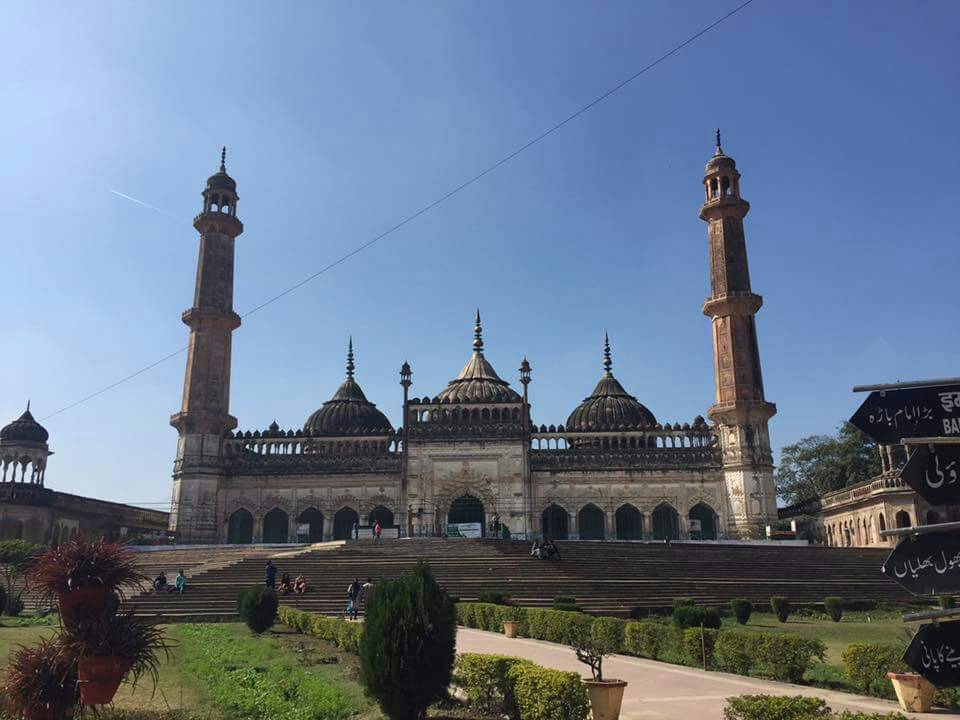
The Bara Imambara, also bestowed with the title of “Asafi Imambara”, was made by the king Asaf Ud Daula out of benevolence. He commissioned the building in order to employ the drought-stricken populace of the city in the 18th Century. Very soon, this structural project expedited as a corollary to supplement the dwindling fortunes of the region became more than a philanthropic feat. Over the centuries, Bara Imambara became a royal palace, a seat of power and knowledge and a quintessential component of the Awadhi [1]identity. It’s convenient to say that it’s the axis around which the entire city revolves. It’s the architectural apex around which Lucknow sculpts its identity with each era.
Throngs of revellers travel across the city to savour its beauty and historicity. The Imambada keeps its tryst with timelessness sacred, giving every discerning eye moments to cherish, feel the same timeless energy course through their mortal bodies, giving them the gift of the spiritual. Then there’s the mystical side to it where on each visit tugs my heart. It’s as if from some intensely private part of the soul emerge these words, “Thank God, you are alive to see it. Thank God that you were born to witness such sublime beauty.”
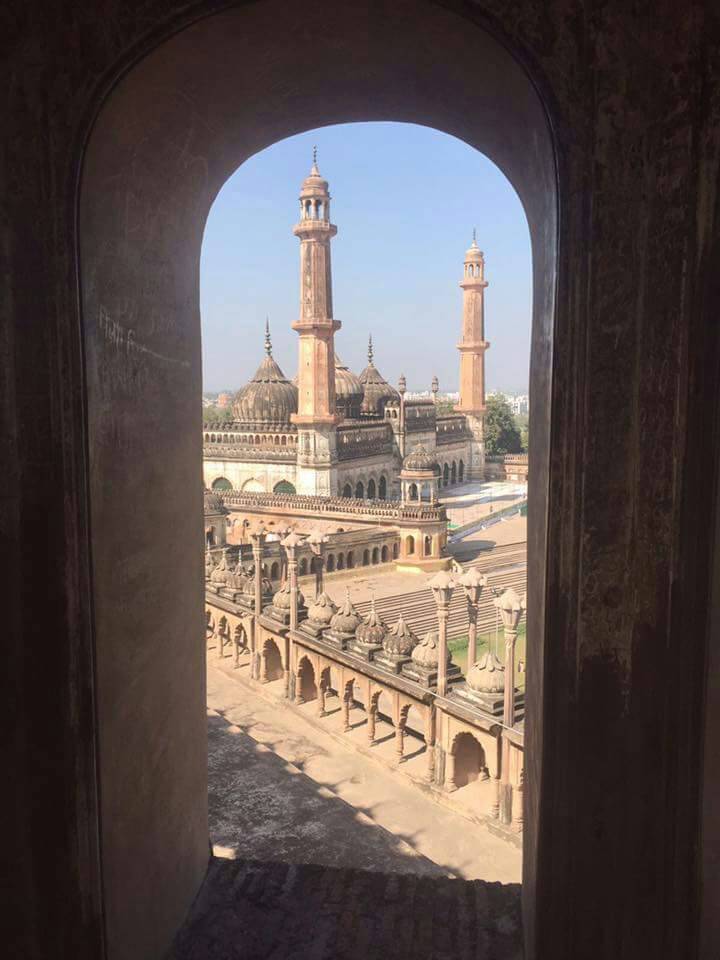
The story of arches, pillars, doorways, the zigzagging mysteries of the Bhool Bhulaiya — its fabled labyrinth, hallways that make a single lighting of the match echo with precision across great distances and the cool atmosphere that envelops it even on muggy or scorching days make it a unique experience. But as the horizon spills its canvas around it and the panorama of life becomes a live orchestra of colours, the Imambara transcends its solemn sanctity as the abode of imams, transcends the rails of religion to diffuse faith to every corner. From some high point in the parapet, when you look straight at the city, each angle reflects the union of the divine and the mundane. It’s a grand gesture that this timeless solitude is something that can be felt even among millions of other feet and voices. It’s the solitude of the dark alleys and the baoli or stepwell within these enchanting premises. It’s this solitude gliding with the birds above the soaring pillars and dome of the Asafi Mosque, making the secular transport tangible in the mouths of those who drink in the air contained in the edifice of this monument.
I may be a dreamer but, in a city, where so many parts feel like a dream come true, the Hussainabad corridor hosting Bara Imambada is immune to modernisation’s whims or the gritty nature of our societal churnings.
As tongas[2] carry dignified visitors on cobblestone roads, Lucknow’s epicenter of culture beseeches us like a best friend to partake in the poetry of its eternal axis. Which is why I always like to walk towards it, crossing a stretch of the road that finds beautiful buildings, parks, wide roads and secular spots lead towards that most handsome of structures. Time stops here yet moves like ripples. Time is of the essence. A lifetime of meetings with the Imambada makes one reconcile with the inherent meanings behind one’s attachment to Lucknow and its Awadhi cheer. I’m fortunate to live and tell the tale, a modest man made to feel grander by these inflections of architecture, stillness and cosmic solitude that only this city has to offer. The Imambada absorbs all of these inflections and stands in good stead, telling me, “You are not a dreamer, son. Your sense of your world is intimate to a fault. Come to us. Come again. There’s so much to seek from each other…”
Prithvijeet Sinha is an MPhil from the University of Lucknow, having launched his prolific writing career by self-publishing on the worldwide community Wattpad since 2015 and on his WordPress blog An Awadh Boy’s Panorama. Besides that, his works have been published in several journals and anthologies.
PLEASE NOTE: ARTICLES CAN ONLY BE REPRODUCED IN OTHER SITES WITH DUE ACKNOWLEDGEMENT TO BORDERLESS JOURNAL
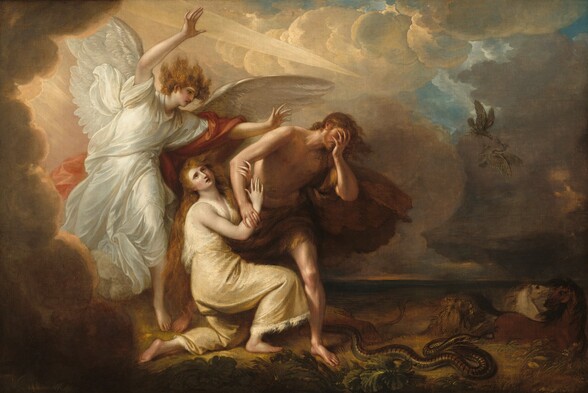
Nusrat Jahan Esa muses on human nature keeping in mind Milton’s Paradise Lost
The Expulsion of Adam and Eve from Paradise by Benjamin West (1738-1820)
Just as dance unveils step by step moving each step towards a new movement to tell a story, so too does the forbidden thoughts. They dance like a flicker of shadow at the edge of our consciousness. They call us, not always with words, but with whispers that tempt, tantalise and stir the mind. To step closer is to cross a line, but is it not also inherently human? Do you think it is possible to categorise humans as purely good or evil?
I was struck by a sudden realisation, one that is not uncanny to my musings. Yet I had never tried to pose to myself. I was exploring the nexus between Satan’s allurement and criminal psychology with Paradise Lost (1677). But why were Adam and Eve ensnared by the temptation of Satan rather than the guidance offered by God? What is it that Satan bestows, and that God misses?
Human beings are frequently pigeonholed into two distinct categories: Good or Evil. To some extent, we may add nuances like “not-so-good” or “not-so-bad”. Yet can we truly define an individual as purely good or purely evil based on their face value? What if one nurtured the attraction of or bore malice, while concealing such tendencies from the world? How do we classify them, good, evil or somewhere in between? Do they forever exist somewhere in the shadowed space?
For instance, there exist a considerable number of individuals who are avid admirers of psychological thriller films, fictions, and documentary series. They appear to be not distasteful to scenes or words of bloodshed, dead bodies, and acts driven by vengeance. They find enjoyment from such scenes and words, and the visual or imagery feels entirely natural to them which astonishes me. So, why would these individuals refrain from imitating these actions in reality? If driven by vengeance, one of the seven deadly sins, why do not they resort to murder? It’s because they are confined with morality. These morals work as a barrier. It stops humans from evoking the sense of their inner darkness or denied feelings.
If one can suppress their repressed and dark desires, how then can they be lured by Satan’s allurement? Let’s say that we are constantly drawn to invitations. Why, then, do we not enthusiastically respond to God’s call? What is it that God fails to offer, while Satan has already taken the lead in his temptations? What thoughts crossed Eve’s mind before eating the forbidden fruit? Is it merely the word “no” that beckons us and draws us with irresistible allure? Or does Satan possess a unique technique to draw us in his magical world?
More importantly, can we truly call those who suppress their dark insides “good”? Or do we dare to believe that a person can possess completely good intentions both outside and inside, without any shadow lurking within?
Nusrat Jahan Esa is currently an undergraduate majoring in English literature at the University of Liberal Arts Bangladesh (ULAB). She writes on criminology, psychology, and education.
.
PLEASE NOTE: ARTICLES CAN ONLY BE REPRODUCED IN OTHER SITES WITH DUE ACKNOWLEDGEMENT TO BORDERLESS JOURNAL
Charminar, an iconic landmark of Hyderabad. Art by Kishore Singh. From Public Domain
Had Paradise survived, the last Hyderabadi[1] would have done as well. Yet what remained of Paradise were shards of its best self-scattered around parts of the country that did not understand what it meant to carry its legacy, of what the endless cups of frothy Irani chai over a pair of lukhmis or nausea-inducing keema-roti[2]meant to the gentry of the city in general. Or, before the advent of the social media, what was the impact of the gentrification of a city better known as a town of small neighbourhoods, harassed yet equally enriched by the countless migrants from the eastern India.
Autumn had finally arrived, and the smell of the tree of sorrow permeated within the crisp, starch-lined shirts of the former politicians of a political party whose hues no one could be certain of anymore. The hijras[3] flocking the bus stop opposite the JBS[4] metro station had no intent in seeking out alms anymore. With the festive season approaching in all its vehemence, life was supposed to get better for them and the countless number of beggars — maimed or otherwise — who made a living out of the charitable pockets of officegoers.
The latter made the famous bus stand their endroit le plus important [5]and fed their starving souls with tidbits of generosity that they could only offer a pregnant prostitute or a vagrant with no feet staring up Akbar Road with a bright barrenness in his eyes. Of course, one could always count upon the Ganesh temple looming in all its gargantuan simplicity through the shards of space between the metro rail pillars and berating simple-minded Hindus for not having enriched its donation box. The last Hyderabadi often thought that this vision — more than ideas of goodwill — dictated the unusual largesse of the usually tight-lipped and parsimonious gentlefolk.
*
What could have been construed as big-heartedness among the lower classes was usually written off with disdain by those who did not have the luxury of being poor. The road that snaked down the Military Engineering Services instalments and evaded the right fork towards Secunderabad Club was sure to have ended up in the dull brown villas of Gunrock; the last Hyderabadi often wished he could spare himself the pain. To think of pain was pain itself. He forced himself off the stool next to Grill 9 where he was smoking a Charminar — a remnant of an era long gone — and joined the serpentining queue of revellers shedding their last moments of joie de vivre[6] from Tivoli, and its apostle up the road that took pride in housing respectable men these days.
Shedding the joie de vivre often took him back to the days when he could have been carefree enough to hop in and out of the multiple breweries that had sprung up like mushrooms on road number 45 in Jubilee Hills, not a million miles away from JBS as the crow flies. Had the last Hyderabadi known how to take the metro rail into the new central business district of the city, he would have reached sooner than he did when hoisting himself upon his trusted Bajaj. The latter frequently needed a pat of encouragement from its owner when it chose to get stuck on clean, wide roads that could only ferry the chief minister and his coterie. Of course, no other road would have had the gall would have had to tidy up as much as the ones here did — the lack of water, sanitation and seepage an accepted norm.
Of what need was there for him to chauffeur his thoughts in a world that had long seemed to dissolve him in a glass filled with water that no longer came from the Musi[7]? Yet, there was the odd occasion when he would find himself seeing the vast encumbrance that the cable bridge over Durgam Cheruvu had become, with the thought of jumping off it never too far from his mind.
Broadway, Prost, Forge, Fat Pigeon, Lord of the Drinks, Forefathers, Daily Rituals — of what use was it that he could reel their names as well as the oldest merlots they had from memory? Had he taken the time to look beyond the sports pages of the Deccan Chronicle, the last Hyderabadi would have found something to relish in times of the infrequent melancholy that knew him by name. Had the drink consumed him, or vice-versa, things may not have changed him for the better, or made the city — once recognisable, and now imperceptible — more hospitable towards him, but he would have known something better to do with his time than count by hand the centuries scored on the numerous pitches at the Parade Ground every Sunday.
*
Oh, how he longed to go back to Shah Ghouse and forget that a world such as the one he was forced to inhabit now existed. A world in which seasons came and went, but autumn — obstinate, stubborn autumn — always hung around far longer than it was welcome. With the lines blurring between right and wrong, it was felt that the city would not live up to its pretentions had the same happened between autumn and winter.
Of course, those settlers from the coastal belts of Andhra who made the northern neighbourhood of Kukatpally their home knew little better than to pull out their jumpers at the first smell of rain or — perish the thought — the temperature dropping below thirty. Yet, the last Hyderabadi plodded along, knowing innately that this season too was bound to leave — like the majority of his dreams — and winter would take over inevitably.
How little he trusted his words these days, delving deep inside his psyche to look for some semblance of sanity that he had held on to during his prime. Chasing another peak, the last Hyderabadi had settled down to accept the inescapable — the city would move on without him — and defy the passage of time that had once held him tightly in its grips. Oh, what he would have given to head back to Paradise, say hello to trusted old Saleem and ask for a cup of tea.
*
There were those moments of immense self-doubt in which the last Hyderabadi felt that his hands would wash away in the sickly Musi underneath Purana Pul[8], leaving him standing on his legs which were clearly giving up. The decisiveness of the issue softened the blow whenever he looked at the paunch he had developed of late — the endless runs up and down Tank Bund on Sundays when the whole world slept, being wrecked by the keema roti for which he would often turn to Garden, bypassing Paradise. (He had sought refuge at the Alfa one morning but was left ruing his choice as hordes of travellers swept past him determined to leave their footprints in the city without quite being welcomed by it.)
Whatever poetry had once risen inside him while tucking into the umpteenth samosa at Lamakaan had been disbursed by the recognition of pain in parts of his mind he seldom acknowledged. The poems were songs in celebration of life, and it was only ironic that he should have to think of these when assailed by the thoughts of an autumn long ago, when Keyes High School had been decked up for the first time, and he had finally realised what he wanted from life.
It was when Hitec City still boasted of barren boulders that one had to hike up to gain a better understanding of the panorama below. He often felt that he could understand the words, but not its meaning. That autumn seems to have flooded Manjeera — the lifeblood of the city — and neglected to pay the last Hyderabadi any tribute worth his while.
When he thought of life, his most recent memories appeared dusted with the coat of nostalgia that one often reserved for emotions felt long ago. His worries had been compounded by his mind’s reluctance to admit that he had become old, that there would not be anyone after him, that he was merely standing upon the shoulders of those who had come before — those who had experienced the greatness of this city and shed an imaginary tear at what it had eventually become.
[8]Purana Pul, along with being a translation of ‘Old Bridge’ in Hindi and Urdu, is also a place of significance in the old city of Hyderabad.
Mohul Bhowmick is a national-level cricketer, poet, sports journalist, essayist and travel writer from Hyderabad, India. He has published four collections of poems and one travelogue so far. More of his work can be discovered on his website: www.mohulbhowmick.com.
PLEASE NOTE: ARTICLES CAN ONLY BE REPRODUCED IN OTHER SITES WITH DUE ACKNOWLEDGEMENT TO BORDERLESS JOURNAL.
Reflecting on the last 12 months, Keith Lyons finds some things fade away, others reveal themselves, and mighty trees fall.
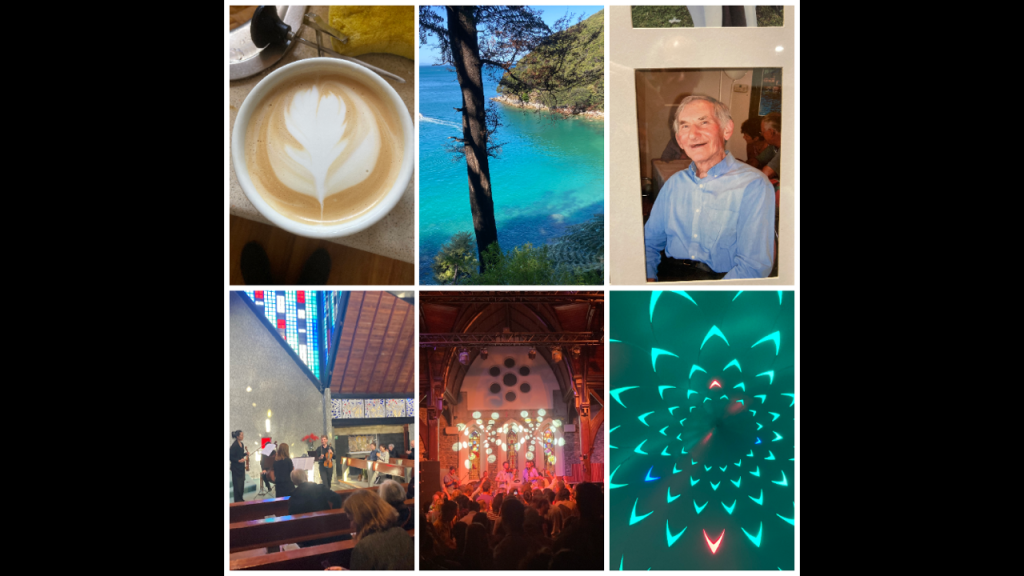
Collage courtesy: Keith Lyons
Am I over-sharing if I confess that the first photo on my iPhone of my 2024 year is a spectacle lens prescription? Or that the summary photo for 2024 — chosen by Apple and its algorithm — is of a coffee cup with the best of my efforts to create the basic latte art design: a monk’s head?
Looking back on the year, I wonder about the interplay of personal and global, a year which started with me learning how to make an origami crane, the symbol of peace, hope, longevity and good fortune, and ended with me getting ill, losing my father, without a paying job, and facing an unexpected massive bill.
The trick to making a paper crane is to have a good teacher. I was fortunate enough to connect with a semi-retired Japanese man (Mocchan) whose gift to the world is to meet strangers, have a cup of coffee, and patiently show them the dozen or so steps how to fold, flip, and unfold a piece of paper until it becomes a paper crane.
As for ill health, loss, unemployment, and debt, there are no easy tricks; you just need to go through them. “Survive til ’25” has been the mantra of bank economists and real estate pundits, recognising that 2024 has been a rough year for many sectors and most people, with inflation (and with it, rising living costs) the primary concern of citizens all around the world. Many countries are in economic recession, geopolitical threats are on the horizon, and the globe is warming faster than expected. The economic challenges were highlighted for me when earlier this year friends admitted to me they had changed their brand of coffee beans to a cheaper, no-frills variety, to cope with the cost of living squeeze. Yes, a First World problem. But who in 2024 has not examined their expenditure, put something back on the shelves, or not completed an online purchase — known as ‘cart abandonment’?
So, if I was to look back at the year in review, as a tapestry or a mosaic, what would I see? Fragments of memories, experiences, events. The days of my life, some almost the same as the previous day, others with unanticipated twists and turns. Welcome to the journey of 2024.
January
In the very centre of my city, Christchurch (New Zealand’s most English of cities), where a quake-damaged cathedral sits un-repaired, I get transported into another world, an immersive world of lights and colours in the giant inflatable sculpture Arborialis Lunminarium, made by the Architects of Air (https://www.facebook.com/watch/?v=901452564787031). Inside the labyrinth of tunnels and designs like cathedral stained-glass windows, I take time to sit in alcoves and lay in the centre of one of the domes, bathing in the natural light filtering through the installation, breathing in the tones, listening to the echoes and reverberations.
February
My next-door neighbour’s house goes on the market. I go across to an open home in the weekend. The neighbours left without saying goodbye. “Gone to Australia,” the real estate agent tells me. “Better jobs.”
Most of the prospective buyers are recent arrivals in New Zealand.
Looking across to my house, I realise, I need to do some work on my property, including having some trees cut and trimmed. I make a mental note to mention it to a friend who often meets with an arborist.
A few weeks later, the house sells at auction, for a price way beyond its valuation.
March
I go on a hiking trip with a friend in Fiordland, at one point missing a direction arrow and going off the trail, with others following us up a rocky stream-bed. After much faffing around, we retreat to the last known marked part of the trail, just as other hikers find the next marker without any problems. Lesson: sometimes the directions are up above your eyesight. Look up.
Back in internet-land, I find much merriment in watching Penn Holderness rapping in the style of Eminem wisdom found on pillows and cushions with quotes. Also, online I find a post detailing things to do for a low-dopamine morning, to sharpen mental clarity, reduce stress and anxiety, and improve long-term brain health. They include not watching Facebook reels or videos first thing in the morning (wait an hour at least), as well as drinking water, getting natural night and fresh air soon after waking, eating a high-protein breakfast, and delaying your first morning coffee for at least an hour.
April
For the first time in ages, I go out to a venue at night, listen to live music, have a few drinks, and end up dancing. The venue is a former Anglican church, built in the Gothic revival style in 1875 with an octagonal layout, and later becoming a theatre and then a Japanese wedding chapel. It is a unique setting with a micro-brewery, stained glass windows, and bouncers at the door. I am trying to recall the last time I went out to a live band and danced. My companion is also speculating that she’d also had not been out dancing since the Covid-19 pandemic. We are both in our 50s but are heartened to see others even older than us moving and grooving to the Balkan-Latin fused dub beats of Yurt Party.
May
I am late for a musical performance in the capital Wellington, and only hear half a composition that has been composed in memory of my brother. Fortunately, the performers agree to repeat the piece afterwards, to enable recording of it, and also so I can call my father so he can listen to ‘Heal’ by Salina Fisher over the phone. It is quite special. I know my father is also deeply moved by the classical composition, even without being in attendance at the Futuna Chapel, regarded as one of the outstanding pieces of 20th-century architecture in New Zealand, combining Maori and European design elements.
A day later we celebrate my father’s 88th birthday. My father is dying. A few weeks later, we are holding him and speaking with him as he takes his last breath.
June
The arborist I wanted to come cut down and trim trees on my property dies suddenly in an accident while felling a large tree on an extensive hillside property he is restoring. At a memorial service the only way through the loss is to retell stories about his character, adventures and humour.
An old friend from school days has sent a native tree to plant in memory of my father, and on the shortest day I think about where I might plant it. Winter is considered the best time to allow trees to establish in the wetter months, but it is cold outside, so I keep the tree inside in my sunroom, and ponder where it might grow best.
July
One night after visiting my mother, I come across an event that seems both crazy and appealing in the coldest time of the year. ‘Rogaining’ is a cross-country navigation sport where teams try to visit as many checkpoints as possible within a time limit. A winter series mixing strategy, adventure, orientation and the challenges of darkness. I resolve to rope in some friends to form a team. Can I offer to be the main navigator given that I’ve gotten lost in unfamiliar terrain more than once?
A pair of WWII binoculars used by my father as a naval navigator ended up in a private collection museum. It is a bittersweet part of letting go, hoping that something once connected to someone special will be put to good use, and is in good hands. When I show the photo to my mother and sister, we have a small sense of closure.
August
My work contract finishes, as our programme wraps up. The significance of the end dawns on me, as I realise the impact on many people and communities from the end of the collaborative research, including early career scientists who now may have to change professions, or go overseas in the hope of work.
In my garden, daffodils bloom bright yellow, and I bring in the flowers to spread the promise of new beginnings inside. My parents planted the bulbs when we were children.
September
Having put off appointments because of being busy at work, I get advice from a dietary nurse, fitness trainer and stress coach on improving my health, fitness, and sleep. Ultimately, I am caring for my heart. My blood pressure and cholesterol have been high in recent years. I don’t want to die ‘young’.
I go on holiday to the comforting golden sands and clear waters of Abel Tasman National Park, where I have fond memories from family trips in the 1970s. I make new memories and feel more connected to my father and brother as I gaze at night up to the vast Milky Way, with the five stars of the Southern Cross emerging over the horizon.
October
In an effort to improve my skills for employment and leisure, I start a coffee-making barista course. Each week, there is a test and challenge. I have to learn the names of the parts of the espresso machine, because at the start I only know their functions and not their exact names: group head/gasket, portafilter, basket, drip tray, steam wand.
A friend of my brother visits, bringing his partner and their child, whose first name is a composite of my brother’s name Ian, and the boy’s grandmother’s name.
November
On the barista course, we learn how to pull the perfect shot of espresso, by ensuring the best combination of freshly roasted beans, fine grind size, and how it is pressed (or tamped) to extract the full flavour of the coffee. At each one-on-one session, my tutor Masako extends my knowledge and practical skill. I have to prepare two different styles of coffee in under four minutes, from order to dispatch. I don’t make them in time. The next week, I have to make four coffees in under eight minutes — latte, long black, mocha, flat white. I am over time. Will I ever improve to be able to work in a busy cafe?
My speaking blood pressure monitor reads out my levels in mercury pilar and concludes: Result Normal. I attribute the reduction — without medication — to taking on board the advice of the Mayo Clinic around improving sleeping, reducing stress, less salt, limiting alcohol, lowering weight, and exercising frequently. After positive feedback from my health professionals on the lifestyle changes I’ve made, I felt like I undo my progress when an old school friend visits my house mid-afternoon with a carton of 18 beers and a six-pack of Guinness.
December
The day after the visit, I find the spot to plant the tree the school friend gave me in memory of my father. The tree will bloom in spring with yellow flowers to attract nectar-eating native birds. My father loved birds.
To get the temptation out of sight, I give the remaining beers away to my builder who turns up to guide an engineer through recent quake repairs to my house. The engineer, originally from China, finishes his inspection saying everything seems allright. His visit has cost me over $2,000, an unexpected extra cost due to the previous professional’s work being discredited.
I don’t even get an interview for a job I thought I was dead-certain to be shortlisted for. But another door opens, and I get a job offer for a role starting in the new year. I know I am lucky, given the tough employment market, but I know that while I might be ‘pale’ and ‘male’, I ain’t stale.
I finish my barista course, and take away the need for patience, consistency and practice.
But then, after feeling tired from a gym session, a bike ride and a hydrotherapy class, I come home and feel inertia drag me down. Will I have time to finish this piece for Borderless, I wonder? Then I test positive for Covid-19.
Best wishes to you, wherever you are.
May the past be your lesson, the present your gift, and the future your motivation.
.
Keith Lyons (keithlyons.net) is an award-winning writer and creative writing mentor originally from New Zealand who has spent a quarter of his existence living and working in Asia including southwest China, Myanmar and Bali. His Venn diagram of happiness features the aroma of freshly-roasted coffee, the negative ions of the natural world including moving water, and connecting with others in meaningful ways. A Contributing Editor on Borderless journal’sEditorial Board, his work has appeared in Borderless since its early days, and his writing featured in the anthology Monalisa No Longer Smiles.
.
PLEASE NOTE: ARTICLES CAN ONLY BE REPRODUCED IN OTHER SITES WITH DUE ACKNOWLEDGEMENT TO BORDERLESS JOURNAL.
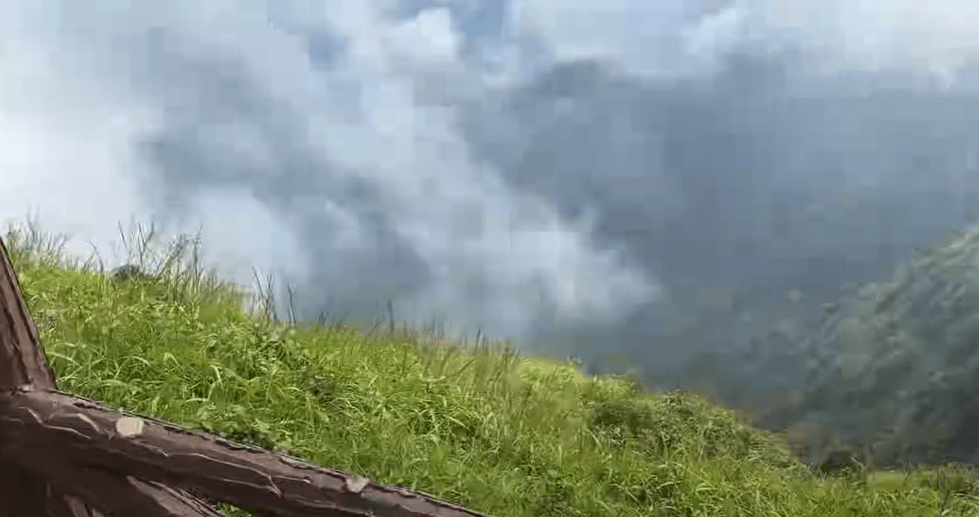
Mists in Shillong. Photo Courtesy: Luke Rimmo Lego
There’s something about Shillong that clings to you long after you leave. Perhaps it’s the way the mist rolls down from the hills, soft and heavy, wrapping everything in a cool, damp embrace. Or perhaps it’s the scent of pine that seems to seep into your very bones, mingling with the smell of wet earth and firewood. Well, for me, it’s the scent of the hot-dog cart right across my school gate. Needless to say, Shillong is the kind of place that stays with you, even when you’re miles away, even when the bustling streets of a big city like Delhi try to drown out the echoes of your childhood.
I always find myself thinking about Shillong on quiet afternoons, especially when the weather here in Delhi turns cold, but never quite cold enough to feel like home. Shillong was never just a place; it was a feeling—a mix of crisp mountain air, the distant sound of school bells ringing through the fog, and the soft, rhythmic drizzle of rain that seemed to fall endlessly. It’s funny how places like that can stay with you, like a song stuck in your head or a scent that reminds you of something just out of reach.
I still recall that day vividly — we were in fourth or fifth grade then. She always arrived early outside my school, waiting for her younger brother, who studied at my school too. Her school was right across the street, an all-girls convent nestled among the hills, its blue-tiled roof barely visible through the trees. She used to sit on those giant stone slabs by the gate, her feet barely touching the ground, swinging back and forth as she hummed some tune only she knew. At first, we didn’t speak much—just exchanged glances, maybe a shy smile here or there. But one day, she was the one who broke the silence.
“Do you think the clouds ever touch the ground?” she asked out of nowhere, her voice soft and curious, as though the mist around us might hold the answer.
I blinked, caught off guard. “What?”
“The clouds,” she repeated, pointing up at the sky, where the gray-white mist hung low, almost grazing the tops of the trees. “Do you think they ever come down all the way?”
I laughed, not really knowing how to answer. “I guess they do sometimes. It feels like it, doesn’t it?”
That was all it took. From then on, those quiet afternoons outside the school turned into our own little world. We would sit on the cold, rough slabs, waiting for our parents to come pick us up, talking about everything and nothing. The clouds became our constant companions, always there, floating lazily through the hills, sometimes so close that it felt like we could reach out and touch them. We talked about school, the weird things our teachers said, the dreams we had of growing up and leaving this tiny town behind.
But even then, I think we both knew that Shillong had a way of holding onto you. No matter how far we went, it would always be there, waiting in the mist.
Shillong was unlike any other place. It wasn’t just the scenery, though the hills were beautiful—lush green peaks rolling in every direction, cradling the city in their embrace. It wasn’t just the weather either, though the cool air that always smelled faintly of rain and pine was unforgettable. It was something deeper, something that I cannot just say by words, it’s what wraps around you like the mist that never quite cleared.
I remember the streets vividly, even now. Narrow and winding, they seemed to have no real direction, just curling their way through the hills, bordered by little shops and homes that clung to the slopes like they were a part of the landscape. Shillong wasn’t loud or hurried. It was the kind of city where the mornings started slowly, with the sound of crows echoing through the fog and the soft clatter of people sweeping their front steps. And in the evenings, the world seemed to settle into itself, as the clouds rolled in, draping everything in a thick, quiet blanket.
The air tasted clean, with a sharp, cold bite that felt refreshing after the endless humidity of summer. You could hear everything in Shillong—the chirping of birds, the rustling of leaves as the wind whispered through the pine trees, the distant clink of cowbells as farmers led their herds down the narrow roads. The town had a rhythm, a steady hum of life that moved at its own pace, never in a rush.
And there was always the mist. It was as much a part of Shillong as the people themselves, thick and ever-present, curling around the hills and streets, softening the edges of everything. It made the town feel like it existed in its own little bubble, a place suspended in time, where the rest of the world seemed far away and unimportant.
Sitting on those slabs, she’d lean back, watching the clouds drift by, her hair frizzing in the damp air. We’d talk about all sorts of things—small things, big things, things that made sense only to us. Sometimes, I’d bring a bag of pinecones I’d collected from the hill behind our house, and we’d throw them into the road, seeing who could roll theirs the farthest down the slope. We made up little games, shared snacks, and every now and then, we’d make pinky promises about things we both knew we could never control.
“Promise me you’ll always remember this, no matter where you go,” she said one evening, holding out her pinky with a serious expression on her face.
I grinned, hooking my pinky around hers. “I promise.”
Then, I left. My family moved to Delhi when I was in the sixth grade, and suddenly, those afternoons on the stone slabs were gone. Delhi was everything Shillong wasn’t—loud, chaotic, hot. The streets were wide and crowded, filled with the constant honking of cars and the clamour of people always in a hurry. The air was thick with dust and petrol, and the clouds, when they appeared, were just smudges of grey against the relentless silver sky.
I missed Shillong terribly. I missed the mist and the cool air, the way the town felt like a hidden secret tucked away in the hills. I missed the slow mornings, the smell of rain-soaked earth, and the way everything seemed softer there, quieter. I missed her too—her laughter, her teasing bets, the way she’d swing her feet just above the ground, like she was waiting for something.
Years passed, and I settled into life in Delhi. But Shillong never really left me. Every now and then, something would remind me of it—a particularly cool breeze, the distant smell of wet leaves, or the sight of a tree-lined street disappearing into fog. And in those moments, I’d find myself back there, sitting on the stone slabs, talking about clouds and pinky promises, as if no time had passed at all.
Then one day, as I sat in Nehru Park—one of the few places in Delhi that felt quiet, even peaceful—I heard a familiar voice.
“I thought you said you’d always remember Shillong.”
I looked up, and there she was. The same grin, the same frizz in her hair from the humidity, the same spark in her eyes that I remembered from all those years ago. For a moment, I couldn’t speak, couldn’t move, as if the fog from Shillong had somehow followed her to Delhi, wrapping us both in the memory of that little town in the hills.
“I promised, didn’t I?” I finally managed to say, standing up to meet her.
We laughed, and suddenly, it was like nothing had changed. We spent the rest of the afternoon walking through the park, talking about everything and nothing, just like we used to on those stone slabs. But this time, the air was warm, and the clouds were nowhere to be seen. Still, in some strange way, it felt like we were back in Shillong, as if the mist and the pine trees had followed us, whispering their secrets in the wind.
And as we walked, I realised something—no matter how far you go, some places never really leave you. Shillong was one of those places. It was the smell of pinecones, the feel of cool stone beneath your hands, the sound of laughter carried on the wind. It was the town that lived in the clouds, a place of pinky promises and afternoons spent waiting for something that never came but always felt just within reach.
I never really left Shillong. And neither did she.
.
Luke Rimmo Minkeng Lego is a biomedical engineering student passionate about Biomimetics, CRISPR, language preservation, and research. He enjoys leaf collecting, reading, biking, badminton, Tottenham, and debating diverse topics.
.
PLEASE NOTE: ARTICLES CAN ONLY BE REPRODUCED IN OTHER SITES WITH DUE ACKNOWLEDGEMENT TO BORDERLESS JOURNAL
Yet another sop story on slimming woes from a fat woman, you might think. But, no, this is about an erstwhile slim woman trying to stay slim.
At the turn of the century, I had just discovered the art of slimming. But my smiles in front of the mirror turned to frowns at the dinner table. While following a strict diet: breakfast of two slices of plain bread, lunch of vegetable salad, and dinner of two chapathis[1], I used to motivate myself with images of me going as slim as those skinny girls, who we’d all admire for their hourglass figures. Finally, after loads of exercising, yoga, and dieting, I slimmed down to a figure my friends called “Chic”. In those six months, I also learned the art of dressing well—an exclusive knowledge only the affluent had back then.
As time went on, I went to work, married, switched jobs, made money, lost money, gained fame, and graced anonymity. I had found dealing with people — be they friends or relatives — unpredictably tough. Sandwiched between my parents and in-laws, my emotion too had its highs and lows. Moments of clarity could follow chunks of confusion. But, through all those tranquil and torrid times, my determination to follow my dietary routine and exercises never wavered. I was unbelievably steadfast in balancing feasts with fasts and idleness with mobility. I bought a lot of expensive dresses, well-cut and flowing, and prided myself in them. I stayed slim.
Pandemic happened. Recipes crowded the YouTube listings. Women doled out never-before-heard dishes. Kids, when not running around bringing the roof down, went about relishing and demanding varieties of snacks. Everyone I knew burst out of their blouses. Amidst all the pandemonium, I was overly cautious about—you guessed it—eating. For my part, I also doled out varieties of dishes, but not for me. My family savoured every last bit. To maintain my routine, I went for long walks in nearby parks to offset all the sitting that work brought along with it. While my friends graduated to buying XL-size dresses, I stayed slim. Although I looked wistfully at the expensive dresses I had bought earlier, I saved them for wearing to work after the lockdowns.
Alas, little did I know that that ‘wearing’ was never to come. Imagine my shock when I could not bring the kameez[2]down my neck! I felt like somebody had slapped the insides of my head. My vanity went for a toss. How could I not know I was putting on weight? Wait, was it some health issue? Checkups followed. No problems there. Then, what was wrong? Had I become complacent? By now, I knew all the tricks to staying slim, and they had never let me down. What happened? Was I overconfident?
Last year, a mischievous aunt’s comment on my getting fat made matters worse. Up until then, she had never acknowledged my slim figure—not that I had expected her to, relatives being what they are. But she was quick to point out that I had grown fat and hoped there was no underlying disease. The overfamiliarity on her part, especially when she had never bothered to interact with me, filled me with disgust. But the damage was done. My expensive dresses went to charity. I started buying XLs. XXLs were in the offing too. My blouse size matched my husband’s shirt. I began exercising with greater vigour. Every morning, panting and puffing, I would jog, do floor exercises, and yoga.
One beautiful morning, I was exercising with full energy, pushing in my tummy hard, and I sighed with defeat at my fat waist and protruding tummy. When I sat down with a huff, my husband said, “Why are you torturing yourself? Don’t exercise to lose weight. Just do it to stay fit.”
A great relief engulfed me.
He said, “Do you know you look really beautiful now? Your face has broadened. That makes you look pretty. The dark circles under your eyes are vanishing so fast.”
Shobha Sriram is a writer from Chennai and a former fellow at Amherst College, US. Her writing has appeared in print and online magazines and journals, including The Wire, The New Indian Express, Muse India, Funny Pearls UK, and others.
.
PLEASE NOTE: ARTICLES CAN ONLY BE REPRODUCED IN OTHER SITES WITH DUE ACKNOWLEDGEMENT TO BORDERLESS JOURNAL
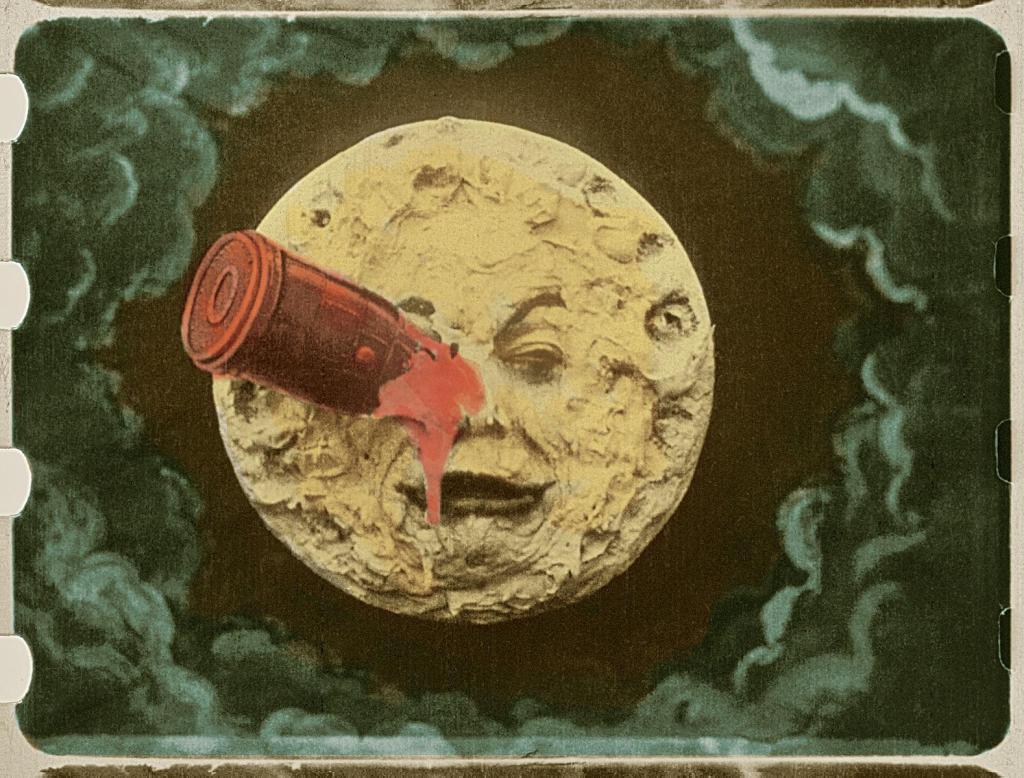
From A Trip to the Moon, a 1902 film by Georges Méliès (1861-1938). From Public Domain
A teacher lost all her life savings, around RM 200,000, to spammers. Over 400 children were rescued from orphanages in two states from sexual predators in Malaysia. Stories like these are not ground-breaking anymore but happen on a daily basis. The worrying trend of late is that these are no isolated incidents perpetrated by individual wackos with ill intents. It is, in fact, a well-organised, well-lubricating establishment with vast tentacles lurking all over the globe.
The brains behind all these schemes are super intelligent, erudite people who can judge what is good and what is evil. They are also aware of what is beneficial and what is detrimental and brings misery. Yet, these same people wilfully devise newer schemes to prey on people’s weaknesses year after year.
They know how every action has an equal and opposite reaction. They understand what goes around comes around. Yet, without an iota of guilt, they carry on life.
Is the lure of materialism too strong to resist? Is the power that money yields too compelling that it becomes an addiction? Is this business a quicksand too strong to extricate one out of? Like a politician trapped in a quagmire that needs to feed his cronies, perhaps this scamming business is multilayered and needs to be fed at many levels, from mafias to enforcement units.
Only the conscientious person worries and regrets any of their deeds. He will have sleepless nights pondering and regretting his actions. He would fear its implications or pursuant legal ramifications. He would shudder to visualise how it hurt his reputation or embarrass his family.
So, when people say humanity lives in each of us and that there is still goodness in the world, are they correct? Are we all innately evil and only conditioned to behave in a particular way because our wise ancestors told us so?
Have we developed a consciousness so advanced that we can justify all our devious actions? We say the people who lost their hard-earned savings can afford to lose some. It is all part and parcel of the circle of life’s ups and downs, karma, warts and all. It is a zero-sum game. One party loses for the other to live. Life is not fair, and we have to live with it. Nature is hostile and humans are part of nature. Our duty, first and foremost, is that we are obliged to take care of ourselves and our own at all costs. In the meantime, the conscientious brood over the evil that is spewed throughout the world. They make their lives purpose to correct the balance. They yearn for equality and social justice and lose valuable sleep over it.
Meanwhile, fraudsters and psychopaths cheat without an iota of guilt. They justify all their crimes. In fact, they feel entitled to do what they do and obtain inner gratification from their manipulations. On the other hand, the conscientious ones constantly assess and reassess their actions, aiming to do the correct thing. These thinkers carry much guilt and regret. They consider their own actions and try to do the ‘right’ thing.
This topic is nothing new. It was tackled by the legendary Tamil philosopher-poet Valluvar[1]. His origin is hazy, but many parties claim him to be part of their tradition. He was probably a Jain-Hindu poet. His short couplets are recited daily by most primary schoolchildren in Tamil schools. These couplets generally talk about righteousness, love and wealth. He sarcastically comments in one of his lines (Kural #1072), “Blessed are the cheats who do not think about good and bad.”
[1] Dated to have lived between 4th and 5th century BC
Farouk Gulsara is a daytime healer and a writer by night. After developing his left side of his brain almost half his lifetime, this johnny-come-lately decided to stimulate the non-dominant part of his remaining half. An author of two non-fiction books, Inside the twisted mind of Rifle Range Boy and Real Lessons from Reel Life, he writes regularly in his blogRifle Range Boy.
.
PLEASE NOTE: ARTICLES CAN ONLY BE REPRODUCED IN OTHER SITES WITH DUE ACKNOWLEDGEMENT TO BORDERLESS JOURNAL
I decided to care for my ailing octogenarian mother, not because she willed me a great fortune or because I have a great liking to care for the sick. Neither do I want to gaslight her for all the not-so-nice things she said about me and my family in better health all through her healthy life.
I volunteered because, given the circumstances the rest of my siblings were in, I was in the best position to keep her. As the son and her firstborn, I had to also fulfil my filial duties. Maybe, I thought, that there is no such thing as a free lunch. Everything has a price. All that nocturnal supply of breast milk and immaculate care during the trying times of infancy and toddlerhood are not free. Maybe she drilled it subliminally into my young mind as she nursed me during those formative years.
Through her babbling and rumbling, I can see she is not happy where she is now. Her apoplexy-stricken grey cells cannot comprehend that her lifeless limbs cannot carry her atrophied body to care for herself. Yet, she wants to stay on her own. She wants to be the Queen of her little space and controller of her destiny. In her demented mind, she imagines herself as her usual 30-year-old buxomly go-getter who wants to pave a future for her three children.
She explicitly expresses her dissatisfaction to her caretaker (i.e. me) with cusses and hurtful words a mother would not utter to her offspring; however, she is not in control. She sees herself as the young lady she once was, with a one-track mind to succeed despite whatever curveballs life throws. She wants to walk back to her house, some 300km away, the home she and my father built so many years ago. She vehemently thinks she can.
She grew up never having anything called coming of age. She whizzed through her adolescence and early teenage years like it was a non-event. Robbed of a mother at 15 to breast cancer, she grew up fast to fit into her working boots. She had to fend for herself. Her widowed father did not want to be bogged down by his four teenage children running around clinging to his trousers, demanding this and that. After all, he was young and had a life to live. Even before the soil settled on his wife’s grave, her father was already busy wooing his new wife. This early loss and the subsequent responsibilities she had to shoulder shaped her into the person she is today.
Without a mother’s embrace to comfort and a shoulder to lay her uncertainties on, this teenage girl became an adult overnight. She looked at the world as an evil beast waiting to engulf her. Her view of the future was bleak; she wanted to be prepared for a rainy day, even for the monsoon season. This outlook apparently has stayed until now. She thought it worked for her then; why should it not work for her now.
I do not want this current image of my mother as the only memory of her for the rest of my life. I long for the nurturing mother of my toddler years, with her cooking and bedtime stories. I long for that comforting mother.
May this transition be smooth for both of us. May you forgive me for all the times, I get angry with you, and for all the times you make it challenging to care for yourself. I must tell myself that you have lost that one thing that makes a human a human—rational thinking and free will. Your actions do not reflect your inner soul. They are mere peripheral reflexes responding to defective neuronal connections. This role of a caregiver is not easy, and I acknowledge the difficulties it brings.
I forgive you for all the pain and hard times you gave me growing up. You did not believe in mollycoddling the children but chose to follow the example of a tiger mum. You did the best with your life experiences and what you learnt to be the best form of upbringing. Like you used to say, ‘Spare the rod and spoil the child’ in your own way, your version sounded brutal. Your version was that there was nothing like an excellent periodic whacking to get the kids’ chakras aligned appropriately.
Rather than forgiving you, a thank you is long overdue for a work well done. Or it is not for me to say but the downlines who would be at the receiving end of my existence.
Farouk Gulsara is a daytime healer and a writer by night. After developing his left side of his brain almost half his lifetime, this johnny-come-lately decided to stimulate the non-dominant part of his remaining half. An author of two non-fiction books, Inside the twisted mind of Rifle Range Boy and Real Lessons from Reel Life, he writes regularly in his blog Rifle Range Boy.
.
PLEASE NOTE: ARTICLES CAN ONLY BE REPRODUCED IN OTHER SITES WITH DUE ACKNOWLEDGEMENT TO BORDERLESS JOURNAL
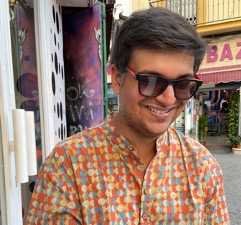
It’s been 12 years since the day I stepped out of Navrang Opticians as a happy-but-slightly-embarrassed owner of an expensive pair of sunglasses. I remember feeling an inexplicable, capitalism-infused sense of confidence and eye-mancipation, like this pair of sunglasses was all I had needed to kickstart my post-college journey into adulthood.
But wow! 12 years! The world that I first witnessed from behind your tinted lenses has now changed beyond recognition. That’s how long you’ve been there for my eyes.
You have been my trusted companion through all my adventures in the past decade. You helped conceal the deep apprehensions in my eyes when I tried, as an unsettled young Masters’ student, to blend into the daily rhythms of life in a foreign country. You were there reassuringly embracing my face all through the 600-kilometre-long road journey when I decided to leave behind the only life I had known and move to Goa. You adapted with me, without any complaints, when you had to carry the additional weight of two face masks wrapped around you during those two horrific pandemic years. You were there alongside my amazed eyes and overwhelmed heart when I saw the mighty Pyrenees, the pristine blue sea and white-sand beaches in Andaman, and other parts of this country and the world that I never believed I’d actually see. And amid all this, you even managed to make my face look somewhat presentable at times, thanks to which I was able to get at least few decent photographs.
You have always been a safe space for me; like when you allowed foolish and outlandish hopes and dreams to float freely in the pool of my eyes as I watched a beautiful sunrise on top of a hill. And also, when my eyes needed to shed tears of disappointment and sadness as I watched a sunset on December 31st of another painfully unfulfilling year.
I am realising now that I may have taken you for granted. That you will always just be there in my backpack when I travel, on the mantel as I step out from home, or resting in my pocket or on a table in a cafe. I don’t even want to think about the day when you are damaged beyond repair or worse if I misplace you, because I don’t know what eye will do without you.
*’dhan‘ is wealth in Hindi and ‘bandhan‘ is the word for ties.
Uday Deshwal claims to have an ‘always wanted to be a writer but was diagnosed with impostor’ syndrome.
.
PLEASE NOTE: ARTICLES CAN ONLY BE REPRODUCED IN OTHER SITES WITH DUE ACKNOWLEDGEMENT TO BORDERLESS JOURNAL




 Borderless