Categories
Excerpt Independence Day

Beyond The Himalayas by Goutam Ghose

Title: Beyond the Himalayas: Journeying Through the Silk Route

Author: Goutam Ghose

Publisher: Niyogi Books

Major Hari Ahluwalia was a young officer in the Indian Army when he climbed Everest in 1965. He was a member of the first Indian expedition to successfully scale the mountain and one of the first to reach the summit. Our then prime minister, Jawaharlal Nehru, awarded him India’s coveted Arjuna Award and India had a new national hero. But within two months of receiving the award, he was wounded in combat along the India-Pakistan border and permanently disabled. Despite the setback, Hari continued organizing mountaineering expeditions and writing books about his life and travels.

It was as the chairman of the Youth Exploring Society of India that he invited me to film an expedition he was planning along an ancient trade route connecting India with Central Asia and Tibet. But most of the route lay within modern China. This would be the first time any group was being allowed to make a journey with its own vehicles – a diplomatic breakthrough and a personal triumph for Hari.

In 1962, a border dispute between India and China had erupted into a brief war which left the two countries estranged  for the next thirty years. In the two most populous nations of the world, a generation of young people had grown up, knowing little or nothing about one another.

Hari’s idea was to encourage peaceful dialogue between India and her northern neighbour through new cultural exchanges. In Beijing, he met with the president of the Disabled Federation, who, like Hari, is confined to a wheelchair. As it happened, he is also the son of China’s leader, Chairman Deng Xiaoping, and is thus perfectly placed to help Hari fulfil his dream.

I live in Calcutta and I make films about India. My country was run by the British for 200 years, yet it preserves an ancient culture that conditions every aspect of its daily life. Because we live in a world of our own, separated from the north by politics and geography, I have always wanted to see what lay just a few hundred miles from me on the other side of the mountains. Excited about Hari’s proposal, I abandoned my new idea for a feature film and began to think about journeying along the ancient Silk Road.

The first place I decided to visit was The Asiatic Society. Founded by Sir William Jones in 1784, the society pioneered the rediscovery of Asia and its past. All the early expeditions were organized and monitored from here. I was suddenly filled with curiosity and an impetuous desire to delve into all the rare books and manuscripts on its shelves. The Travels of Marco Polo describe the wonders of the Silk Road – cities far greater than his own and a world more magnificent than anything imagined by the insular backward Europe of the thirteenth century. But he was a late traveller. The Silk Route was one of the greatest trade routes in history and men had already been travelling there for four thousand years. Before sea routes were discovered in the fifteenth century, this trans-Asian highway was the sole link between the east and the west. It ran from Xi’an in China all the way to the Mediterranean. There were, moreover, many tributaries to the mighty river, not least of which were caravan routes across the Himalayan mountain range between India and Central Asia.

A facsimile of Hari’s letter to me –

Dear Goutam,

You will be delighted to know that we now have all our permissions. Because of the current turmoil in Afghanistan, we cannot drive through the Khyber Pass into the Central Asia as planned. All the members of the expedition including the jeeps and equipment will be flown from Delhi to Uzbekistan on the 18th of May.

I believe I told you about my London-based friend Michael, who is a filmmaker with a longstanding interest in Buddhism. He has wanted to make this trip for a long time and I’m sure he will be immensely helpful to you. Do please get in touch with him.

As per Hari’s suggestion I met Michael Haggiag in his London home. Michael was preparing for the trip with great excitement. I filmed him and his wife there.

A conversation between Michael and his wife Katherine in London –

Katherine – ‘Want some tea?’

Michael thanks her. ‘This is what Marco Polo had to say about the women of Hami and their very nice customs.

‘I give you my word – when a stranger comes to a house here to seek hospitality, he receives a very warm welcome.

The host makes his wife do everything the guest wishes and he leaves the house and goes about his own business and stays away for two or three days. Meanwhile, the guest stays with his wife in the house and does what he will with her – lying with her in one bed, just as if she was his own wife, and they lead a gay life together. The women are beautiful and vivacious and always ready to oblige.

‘I am not sending you there.’

‘No? It’s also very hot. It’s 40˚C in the shade – that’s over 100˚F. They also have the largest cockroaches.’

‘Sounds like it’s terrible out there!’

‘Anyway, I’m preparing for the trip. Look at these wonderful books here … this is Bukhara and this, Samarkand … these are some really old pictures of the way it was in the 1890s!’

‘Beautiful places!’

‘Do you realize how long Hari had to wait for permission for this? He started organizing his expedition eight years ago and he just got confirmation now. And if we don’t go within the next three weeks, we can’t go at all.’

The Armada starts on its journey. Courtesy: Extracted with permission from Beyond The Himalayas: Journeying Through The Silk Route, by Goutam Ghose (published by Niyogi Books)
Guri Amir mausoleum, Samarkand.Courtesy: Extracted with permission from Beyond The Himalayas: Journeying Through The Silk Route, by Goutam Ghose (published by Niyogi Books)
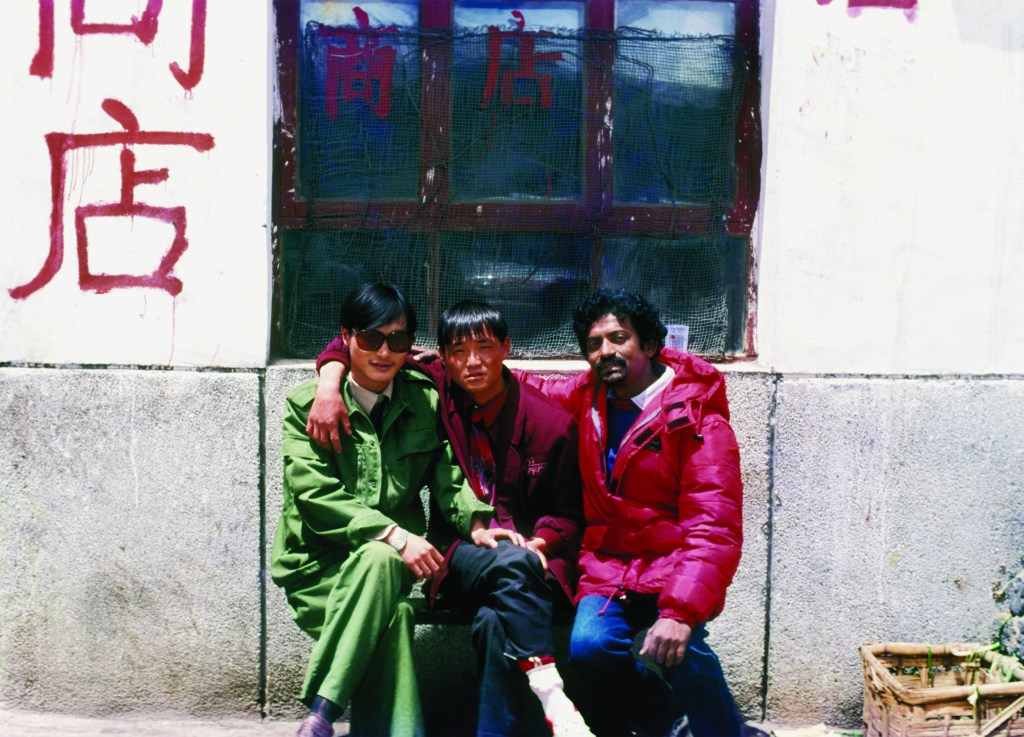
Goutam Ghose with the two Chinese. Courtesy: Extracted with permission from Beyond The Himalayas: Journeying Through The Silk Route, by Goutam Ghose (published by Niyogi Books)

About the Book: Filmmaker Goutam Ghose was part of the Central Asian expedition organised by Major H.P.S. Ahluwalia in 1994, the first of its kind. They undertook an arduous 14,000 km journey through Central Asia, China and Tibet tracing the ancient trade route. Ghose captured this once-in-a-lifetime adventure as a five-part series in his film Beyond the Himalayas (1996). This film book is a pictorial chronicle of Ghose’s incredible experience on the Silk Route. Much of the text is the narration of the original soundtrack of the series which has been adapted for the benefit of book readers. His lens captures breathtaking visuals of a less travelled road. The tapestry of history, travel anecdotes, local legends and titanic characters lend a cinematic quality to the whole narrative. The fabled past and the present are intercut by cinematic jumps in this fascinating record of an enduring memory in the collective consciousness of the history of mankind.

Goutam Ghose launched into documentaries, group theatre and photo journalism in 1973. His documentary, Hungry Autumn won him the main award at the Oberhausen Film Festival. Since then Ghose has produced several documentaries on personalities like Ustad Bismillah Khan, Satyajit Ray and HH Dalai Lama, in addition to ten feature films and a number of advertisement, corporate and short films. He has won fifteen National Awards, besides Filmfare Awards and a number of international awards like Silver Balloon, Nantes Film Festival, UNESCO Award at Venice, Golden Semurg at Tashkent, Fipresci Award and Red Cross Award at Verna Film Festival. He is the only Indian to win the coveted Vittori Di Sica Award and was awarded the Knighthood of the Star of Italian Solidarity in 2008.

Click here to read Goutam Ghose’s interview.

.

PLEASE NOTE: ARTICLES CAN ONLY BE REPRODUCED IN OTHER SITES WITH DUE ACKNOWLEDGEMENT TO BORDERLESS JOURNAL

Categories
Independence Day Interview

In Conversation with Goutam Ghose

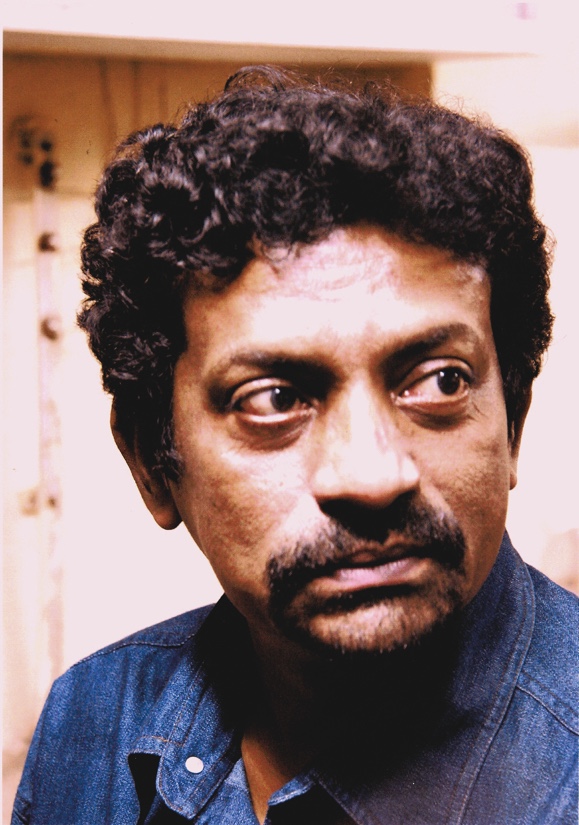
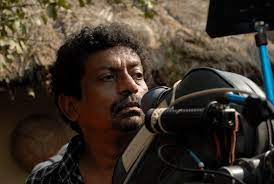
Goutam Ghose: Photo provided by Niyogy Books

Goutam Ghose is a well-known award-winning film director, scriptwriter and even actor. He has been the only Indian to have received the Vittorio Di Sica Award from Italy in 1997 and was awarded the Knighthood of the Star of the Italian Solidarity in July 2006. Ghose has won fifteen National Awards, besides Filmfare Awards and a number of international awards like Silver Balloon, Nantes Film Festival, UNESCO Award at Venice, Golden Semurg at Tashkent, Fipresci Award and Red Cross Award at Verna Film Festival.

But did you know he has also authored a number of books? Just as he bridges borders with his poetic films that touch the human heart with a range of emotions, he does the same with his books. He takes up burning issues with artistry, never inciting with rage or hatred but conveying by his skill with the camera and words. He has created a world without borders with his transcontinental outlook and approach.

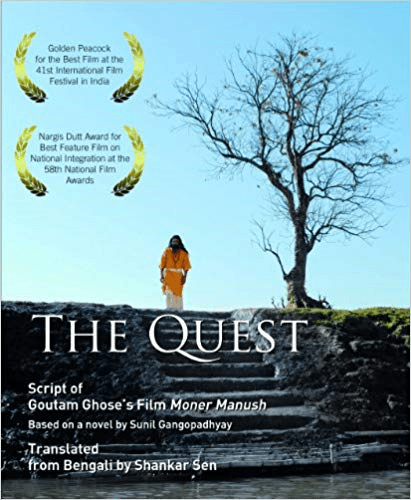
His reaction to the Ram Janmabhoomi riots was Moner Manush (2010), a film based on Lalon Fakir’s life, knitting together the best in Muslim and Hindu traditions instead of filming the clashes and the violence. Published in English as The Quest (2013), the book is a powerful dramatisation with pictures from the film. The book, like the film, is also an emotional lesson in humanism. Based on Sunil Gangopadhyay’s novel on Lalon Fakir’s life, the film is beautiful. But the book allowed me to mull over the words, which have been translated by Sankar Sen. It is a book that needs to be read when casteism and religious divides take precedence over humanitarian values. By bringing these songs into translation to readers unfamiliar with Bengali, both Ghose and Sen have opened a world of love and tolerance to new readers, who will hopefully find the time to mull over the wisdom of these songs.

‘What was your caste when you came here,
What caste did you take on arrival, dear,
What would be your caste when it’s time to go -- 
Ponder and tell me if you know.’

-- Translated by Sankar Sen, from The Quest

 His other book that traverses the silk route and journeys through China, Beyond the Himalayas (2019), transcends boundaries and fills the reader with a sense of exhilaration. It is based on his documentary of the same name. Both these recordings of their journey along the silk route are worth viewing and reading. They show humans are the same across all borders. The book, interspersed with lovely pictures of the landscape and mature writing pauses on history at the right junctures. The narration is poetic in both the book and the documentary.

Though Ghose claims that these texts and photographs capture memories of the film, both his books transported me to a different time and space. I saw the films after reading the books, but both were energising, emotionally charged and entertaining. The journey takes one through different parts of the world and gives a new perspective to a 4000-year-old route. Initiated and organised by Major Hari Singh Ahluwalia and Deng Xiaoping’s son, the travels in Beyond the Himalayas took me across borders to areas I have never visited and now, I hope to visit post pandemic. Both the book and the film acquainted me with cultures that excite. And The Quest reinforced the belief, through the depiction of Lalon’s life, that humanism exists despite the degradations of history. That riots can be calmed with the soothing notes of Lalon’s lyrics, rich in wisdom, would be a win for the human spirit.

Like all great artistes, Ghose speaks in beautiful poetic sentences about concepts that touch the human heart and imagination. In this exclusive, he speaks not just about his film-books, but about the real journey and issues he is facing through the pandemic, including the delay of his film with an Italian male lead and his new short film on the current times, Covid-worn and waiting…

You are a very well-known film director, cinematographer, and music director. You have directed award winning Bollywood and Tollywood movies. Normally books come before films but from two of these films, you have made books. Why did you go in for making books of the films?

I have loved books since my childhood. The shape and form of it, the touch and smell of a book fascinate me. They will never die even if we read on the screen rather than by turning pages of a physical object. A certain sense of the sacred has surrounded books from civilisations’ inception. In cinema, be it fiction or non-fiction, we write a script at the pre-production stage. A film-book is all about times gone by — a book of memories, of both cyclic and linear time. My producer from Bangladesh, Habibur Rehman Khan, had liked the idea of film books and had published three wonderful books on Padma Nodir Majhi (Boatman of the Padma River, filmed in 1993), Moner Manush (filmed in 2010 ) and Shankhachil (Unbound, filmed in 2016) in Bengali. Niyogi books of India has published a beautiful pictorial English version of Moner Manush as The Quest and also Beyond the Himalayas, my journey along the Silk Road. Another lovely film book is Pratikshan’s bilingual centenary tribute to Bismillah Khan (Bismillah in Banaras the film Goutam Ghosh made, 2017).

Is dubbing or subtitling the film not an easier option than doing a film-book?

Well, dubbing or subtitling is for watching a language film, but a film book is meant for reading. It becomes a part of your book collections. I have some wonderful film books published from Europe and United States.

Moner Manush is based on Lalon Fakir’s life and on the novel by Sunil Gangopadhyay. Why did you feel there was a need for a separate book after you made a very powerful film on it?

Lalon Fakir is an eternal savant. Scholars have been doing research on Lalon’s life and philosophy since long. It is heard that Lalon was an illiterate man. But going through the words of his songs and the implied significance, it seems as if he was an erudite scholar tutored in an age-old system of education.  His faith was not guided by any particular religion, rather it could be said to be comprised of the mysticism of Sufi and the love and forgiveness of Vaishnavism and the liberalism of the tantric sect of Buddhism. My film on Lalon fakir is research on this great man aswell. The Bengali film book contains important articles by scholars besides the script, reviews and memoirs.

Do you feel that the message of Moner Manush is relevant in a world beset by not just divides but even a pandemic? Is there something we can learn from the story?

Yes, of course the message of Moner Manush is even more relevant in today’s intolerant world, a world of greed and opportunism. The pandemic has victimised the togetherness of the human race but how can we survive without empathy? I don’t know how good the film is, but Moner Manush will serve as a gospel to those who revere humanity.

Lalon says as his own introduction “I am a human.” How important is that for humankind to see themselves as humans over titles of caste, profession, and economics?

The baul (minstrels in Bengal) community had renounced all recognised institutions of religion and revolted against long established rites, customs and faiths. Breaking down the barriers of the narrow confines of communal faith, they had found a large expanse under the sky which had served as a bountiful meeting place of many religions. Under that open sky, Lalon had found the truth in Humanism.

Lalon dreamt of a borderless world. Do you think adopting his outlook can change the outlook of nations which draw borders between the species? Do you think it is implementable at a personal, national or international level?

I think all mystics believe in borderless space of Earth where all centennial beings live in peace and harmony. But the wheel of time had moved in the direction of Divide and Rule. John Lennon’s Imagine has become the iconic song on the dream of a borderless world. It may have been a failed dream, but I confess it might have been one I shared growing up in India and will cherish till the last breath of my life. Let it be a dream and a wonderful utopia.

Beyond The Himalayas was first a documentary film. How long was it and when was it screened? How many episodes is the film?

Beyond the Himalayas was made as a documentary film during our expedition through the Silk Road in 1994. The final edited version is four-and-a-half hour long. It was shown in Discovery Channel in five parts in the late nineties. A shorter version was screened in BBC as well. The Indian national TV had screened a Hindi version of all five episodes.

The book seems to cover lesser than the documentary. Is that true or do the visuals/ music just seem to impact us more? Why did you leave out Pakistan?

Well watching the film with arresting visuals and absorbing the soundtracks of the trail is a linear viewing of our journey along the fabled Silk Road. It is very, very exciting indeed. But the film is also a journey back in time with many references and anecdotes from history. For instance, while showing the travel through the deadly Taklamakan desert, I referred to Sven Hedin’s(1865-1952) expedition of the region. I quote: ‘The first European to map this desolate region was the Swedish explorer, Sven Hedin. His first expedition in 1895 was very nearly his last.  The local guide supplied enough water for four days in the desert instead of ten requested. When the caravan lost its way, the guide was the first to die. The others became insane with thirst, drinking anything — even Sheep’s blood and camel’s urine. By the fifth day, the men, camels and other livestocks were all dead except for Sven Hedin and one other man. Hedin writes in Through Asia, “If I was doomed to die in the sand, I wanted to be properly attired. I wanted my burial clothes to be both white and clean.” But fate was on its side. Spying the dark green side of an oasis, he dragged himself to safety. “I stood on the brink of a pool with fresh cool water, beautiful water. I drank, drank, drank time after time. Every blood vessel and tissue of my body sucked up the life-giving liquid like a sponge.”’

Here the film-book helps the readers. One can refer back to the time past and time present more deeply to understand time as a metaphor of history.

How many days were you on the road? What was the experience like?

We were out for almost ten weeks covering a distance of 14,000 kms. The journey was fascinating for the entire team. There can be no journey more enchanting than the route we took. The collective trove of memories has made the Silk Road so memorable. We had to negotiate extreme weather conditions in Central Asia and Tibet. In a single day, we experienced two extremes. While negotiating the desert, temperatures rose to 48 degrees Celsius, and by nightfall when we pitched camp at Tianshan mountains, the temperature fell to 2 degrees. The situation is almost like the scenes of Satyajit Ray’s Goopy Gyne Bagha Byne — desert to snow in the blink of an eye.

Did you travel through the part of the route Marco Polo used? Did you find it much different from what you had imagined?

Well, the travels of Marco Polo described the wonders of the silk road, cities far greater than his own and a world more significant than anything imagined by the insular backward Europe of the thirteenth century. But he was a late traveller. The silk road was one of the greatest trade routes in history and men had already been travelling along for 4,000 years. Before sea routes were discovered in the fifteenth century, this trans-Asian highway was the sole link between the East and the West. It ran from Xian in China to all the way to the Mediterranean. There were many tributaries to the mighty river, not least of which were caravan routes across the Himalayan mountain range between India and Central Asia.  We could not follow the planned route through Pakistan and Afghanistan to Central Asia via Khyber Pass because of the civil war. The government of India did not want us to take such risks. All the members of the expedition, including the jeeps and equipment, were flown from Delhi to Uzbekistan on 18th May, 1994.

With the silk route being revived, do you think this film has significance?

Xuanzang took back over 600 Sanskrit text. Courtesy: Creative Commons

Yes, the film is still significant because it carries the memories of time. We were the first group of travellers after many, many years to cross three new republics after the collapse of Soviet Union and a vast territory of China. Now, the route is open to tourists, and I was told that many travel packages are available all along the mighty river and its tributaries. I would like to revisit the cauldron once again to understand how those multi-ethnic republics have survived the onslaught of modern times with its regional rivalries, new mafias, and consumerist pressures. I wish the new silk route trade brings peace and harmony in this intolerant world. Travellers today can choose from many trails as we did during our expedition. My favourite was Xuanzang’s (602-664 AD) trail. I quote from my book. “At 27, he set out his pilgrimage until he was 43. Unconvinced by the translations available in China, he sought the true teachings of Buddha in the holy lands of India. He walked alone into the great unknown, crossing the world’s greatest deserts and its highest mountain ranges. He faced death many times and his courage and equanimity impressed kings, bandits and barbarians alike. He lectured at monasteries and debated with learned monks and by the time he reached his destination, his reputation as a great sage had already preceded him. Xuan Zhang was not the only Chinese pilgrim to visit the homeland of Buddhism, but he was the most important. Like a death star that keeps releasing energy for thousands of years, he continues to be a valuable source of knowledge and inspiration.”

You are making a new film I believe rooted in the present pandemic. What is it about? Will you be making that too into a book?

My 2019 film Rahagir or Wayfarer, starring Adil Hussain, Tillotama Som, Neeraj Kabir, had travelled to many festivals and received awards and appreciations but unfortunately, we could not release it in public theatres due to the pandemic. Another multilingual film is also stuck for obvious reasons. I could finish the Italian shoot in January 2020, but the Indian shoot did not happen till date. It is so frustrating.

Meanwhile, I have finished a short film Memories of Time on pandemic days. It is about a happy, cultured couple living in the heart of Kolkata. Like everyone else, they are caught in the claustrophobia of the pandemic and the consequent lockdown. The film travels back and forth in time as they try to navigate through these hard times and search for fresh air and sanity. The film is an exploration of their fears, realisation and going back to nature. It’s from my own experience — how I have navigated 2020 and moving through the course of this pandemic. I think one can really publish a film-book because it has so many elements, the fear of people and the inhuman approach of the human race and then the migrant labours — their terrible conditions, the psychological problem of people confined inside their home and the most importantly, the problem of the children. They are confined as if in a prison. They can’t go to school. They can’t really meet their friends. I think this could be a very, very interesting material for a film-book.

Thank you for giving us your time.

Click here to read an excerpt and see photographs from his book Beyond the Himalayas.

Goutam Ghose: Courtesy: Creative Commons

(This is an online interview conducted by Mitali Chakravarty)

.

PLEASE NOTE: ARTICLES CAN ONLY BE REPRODUCED IN OTHER SITES WITH DUE ACKNOWLEDGEMENT TO BORDERLESS JOURNAL
Categories
Essay

The Idea of India

Anasuya Bhar explores the history of the National Anthem of India, composed by Tagore in Bengali and translated only by the poet himself and by Aruna Chakravarti. Both the translations are featured here.

1700 AD: An illustrative map of the world in the early colonial period. The Mughal Empire in India was at its greatest territorial extent. Courtesy: Creative Commons

The national anthem and the national song of India are both parts of a post-colonial narrative and did not originate prior to the British colonisation of the country, which happened effectively, from the middle of the eighteenth century. India has been broadly classified as a civilisation and a cultural phenomenon, rather than a race or a territorial presence prior to the British colonisation.

India has remained an idea ever since the ancient times, perhaps even prior to the advent of the Classical Graeco-Roman civilisation of the west. The historicisation of India’s past has been a much debatable issue, with European historians representing India from their perspective. Much damage was done, for instance, by James Mill’s The History of British India (1817), which rubbished the country as thoroughly debased and wanting the civilisational touch of the European west. The reality of India, or more correctly Bharat, inhered in the local and regional historical specificities, its literature, culture, myths and legends. The historical perspective of our inhabitants was that of the Puranic history whose chronology, order and narrativity depended on a time scale different from the idea of time in the western rationale for chronology. In other words, the European west’s rationale consequent of the enlightenment, and the enlightened concept of history, was a later addition to the Indian consciousness.

The concept of a distinct nation, and as an individual entity in the consciousness of a socio-political presence in the history of the world, was also, a comparatively belated concept in our country. In fact, it was not earlier than the Mughals that the country was conceptualised as a unified entity from the North to the South, from the East to the West. The Indian sub-continent is strategically guarded by the geographical presence of the Himalayan range, the Indian ocean, the Bay of Bengal and the Arabian Sea. Hence, the territorial boundaries which become crucial in determining the political borders of the European or the American west are not of much consequence over here. The borders that are present in the former continents are a result of political aggression and imperialism. The borders that ensued in the Indian subcontinent and eventually created Afghanistan, Pakistan, India, Nepal, Burma, Bangladesh and also Sri Lanka, are, however, a result of the European and, particularly, British intervention.

The consciousness of India’s nationalism was, as mentioned in the beginning, a later one and quite clearly a colonial aftermath. Among the first to mention the lack of an indigenous history was Bankimchandra Chattopadhyay (1838 – 94), the celebrated novelist and intellectual of nineteenth century Bengal, who himself attempted to write, through his various essays, a historical consciousness for his country. The writer of our national song ‘Bande Mataram’ (in Anandamath, 1882), Bankimchandra was also the first to think of a ‘jatiyo’ or a nationalist consciousness, and attempted to take a fresh look at the puranic history based on myths and legends. He rewrote the narrative of Krishna, and also looked afresh at the fundamentals of the Hindu religion.

The nationalist consciousness was given a fresh lease through the several attempts for promoting indigenous products and enterprises by the Tagores of Jorasanko in Kolkata. The Hindu Mela (Hindu fair), begun since the mid-1860s by Dwijendranath Tagore (1840 – 1926) was among the first to strike concepts of an indigenous nationhood, by giving impetus through homespun fabrics, cultivation of rural handicrafts and traditional food items like pickles or ‘bori’, such that a space could be created independent of the parameters used by the colonial masters. Rabindranath (1861 – 1941) also refers to several attempts of his elder brother Jyotirindranath (1849 – 1925), in creating the matchstick factory or even striking a competition in the ship trade with their English counterparts in the waters of Bengal in his autobiographical Jibansmriti (My Reminiscences, 1911). He also mentions the latter’s attempt at designing a national dress for the country, trying to fuse various drapes of traditional clothing. This is again very interesting because, a distinctive sartorial appearance would help in identifying the Indian from the European, even externally. The sari  as we wear it now, was first conceptualised by Jnanadanandini Devi (1850 – 1941) of the Tagore household. She gave the Indian women a dignified attire by fusing the styles of Parsis and Gujaratis, and also by improvising on the styles of the European gown to give us the blouse-jacket. The unification of various styles automatically veered towards a oneness in the same territorial boundaries and the nationalistic consciousness came first through cultural means.

The Tagores of Bengal were also among the first, after Rammohan Roy (1772 – 1833), to venture beyond their homes. Dwarakanath (1794 -1846), grandfather of Rabindranath, not only stayed in England for a substantial period of time, but also endeared himself to Queen Victoria as the ‘Prince’. Debendranath (1817 – 1905), his son, was in the habit of touring the Himalayas extensively, and even took his youngest son Rabi along with him. Satyendranath (1842 – 1923), another of his sons, was the first Indian to qualify in the Indian Civil Service; he too, extensively toured several parts of India and abroad. Rabindranath was a frequent traveller from a very early age. The women of the Tagore household, beginning with Jnanadanandini Devi also moved out of their antarmahal  (inner quarters) and into the other parts of their country and even the world. Indira, Mrinalini, Sarala, Pratima along with Jnanada were frequent travellers both within and outside the country. Hence, the country and the ideology of India as a nation were familiar concepts to the members of this remarkable family from Bengal. Of course, there were other influential households in nineteenth century Bengal, but none so extensively influential.

The formation of the Indian National Congress (INC) in 1885, marked the culmination of several isolated and scattered attempts at nurturing a nationalist consciousness. I have, however, given a few instances from Bengal. I am sure similar attempts were made in other states as well. Even in the formation of the INC, we see the pivotal role played by Janakinath Ghosal (1840 – 1913), husband of the well-known litterateur Swarnakumari Devi (1855 – 1932), elder sister of Rabindranath. According to the memoirs of his elder daughter Hiranmayee, Janakinath was a key presence at the time of the formation of the Congress. Later, Sarala (1872 – 1945), their younger daughter, not only became a part of the Congress, but was also among the foremost figures in Bengal to enthuse young men into the national struggle through cultivation of physical fitness programs. Sarala also worked closely with Swami Vivekananda and Sister Nivedita in some of their philanthropic programs.

Jana Gana Mana, now venerated as our National Anthem, was most possibly first composed as a hymn, by Rabindranath Tagore. This hymn was first recited on the second day of the annual session of the Indian National Congress on 27th December 1911, by none other than Rabindranath himself. This was followed by a second performance of it in January 1912, in the annual event of the ‘Adi Brahmo Samaj’ or the Brahmo Congregation, and then it was published, for the first time in the January edition of the Tattwabodhini Patrika, which was the official journal of the ‘Adi Brahmo Samaj’, with the title ‘Bharata Bhagya Bidhata’ or ‘the determinant of Bharat’s destiny’. The journal was, at that time, edited by Rabindranath himself. The original song, composed in Bengali, has five stanzas. The Anthem makes use of only the first of the five and usually covers an average time of 52 seconds when sung. The original language has been retained, although its intonation is Devanagiri.

The Song in Bengali. Photo courtesy: Anasuya Bhar

The song is a hymn to the all-pervasive, almighty, and the maker of the country’s destiny, the power of whom presides over her natural boundaries of the Himalayas and other mountains and the rivers, and where resides individuals of all races, cultures and religions. It has been the benefactor, through thick and thin, assimilating the good with the bad, and when the country has been lying destitute in trouble and pain, has extended its hand in empathetic wonder. The sun of Bharat’s destiny will rise again and the pall of darkness shall be drowned in the light of a new dawn – a new beginning and a new hope. Rabindranath did not live to see this dawn, but his visions were realised and honoured by the makers of the Constitution of the Republic of India.

The hymn that originated in the poet’s fiftieth year, perhaps had its germs planted in him through his entire life as the beginning of this essay tries to elaborate. It was only time and the political needs of the country that expedited its utterance in the year 1911. The poet’s vision found embodiment in other and similar creations as well. His Gitanjali (1912) contains the well-known poem, ‘Where the mind is without fear’  (XXXV) –

Where the mind is without fear and the head is held high
Where knowledge is free
Where the world has not been broken up into fragments by narrow domestic walls
Where words come out from the depth of truth
Where tireless striving stretches its arms towards perfection
Where the clear stream of reason has not lost its way into the dreary desert sand of dead habit
Where the mind is led forward by thee into ever-widening thought and action —
Into that heaven of freedom, my Father let my country awake.

The year in which he composed and first presented Jana Gana Mana, that is 1911, was in many ways a very crucial year in his personal history. As mentioned earlier it was his fiftieth birth-year, and he was gradually beginning to be acknowledged for his poetic greatness in his own land. The following year, that is 1912, he would go to England, with some of his own translations into English, and which would, introduce him to the world as a major poet, among other poets. 1911, was also the year which marked the coronation of King George V and the transfer of the British capital from Calcutta to Delhi. In fact, Rabindranath’s hymn was initially mistaken to be sung in honour of the new Emperor of the British dominions, but was later clarified to be otherwise, and was acknowledged to be a ‘prayer’ for his own native land and independent of such intentions.

The period that we are considering is also a very significant one in Rabindranath’s own consciousness of the nation and his concept of nationalism. In 1910, he published his novel Gora where he underlined the irony inherent in religious exclusivity and bigotry. His protagonist, a staunch votary of Hindu values and virtues, ironically emerges to be an Irish foundling reared in a Hindu home. Through him Rabindranath proves the efficacy of such conservative religious bigotry. His song ‘Bharata Bhagya Bidhata’ pledges to go beyond external divisions of religion and politics, and endorses the value of humanity; nor does it discount the importance of the west, but believes in the fruitful coming together of the best of all worlds. His school at Santiniketan, later to be identified as Visva-Bharati, exemplifies this coming together of the best of all the worlds. In 1919, he delivered a series of lectures on nationalism, which came together in a single volume called Nationalism, and further endorsed his beliefs in finding the nation through culture, history and habits rather than through and in territorial, narrow parochial walls.  In Ghare Baire (The Home and the World, 1916), published around the same time, he offers us a critique of the Swadeshi Movement that dominated colonial politics in the first decade of the twentieth century in Bengal. He subtly interweaves a tale of the ‘personal’ with the ‘political’ in the triangular narrative structure of Bimala, Nikhil and Sandip, only to expose the petty hypocrisies that inhere within the grand narratives of ‘nationalism’, ‘patriotism’ and even ‘swadeshi’ at the cost of the common good and humanity at large.  

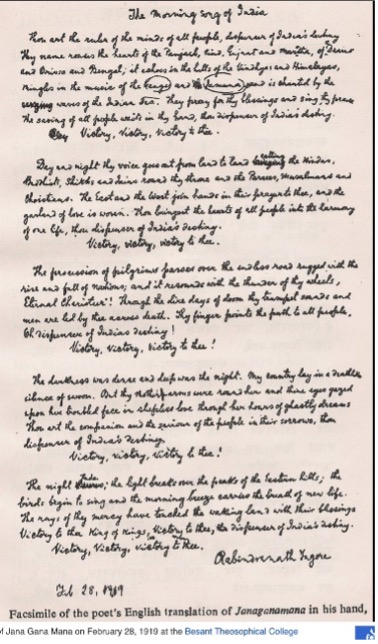
Jana Gana Mana was sung by Sarala Devi Chaudhuri, Rabindranath’s niece and daughter of Janakinath, in 1912, and who had distinguished herself as one of the earliest women nationalists of the country. The song was, then, performed in front of veteran Congress leaders. Outside Bengal, the song was perhaps performed for the first time by Rabindranath in the annual session of Besant Theosophical College in Madanapalle, Andhra Pradesh, on 28th February 1919. The Vice-Principal of the college, Margaret Cousins, was so enthralled by the song that she asked the poet to translate it for her. This Tagore did, and the translation is called ‘The Morning Song of India’. A facsimile image of the same is shown here.

The Morning Song of India in Rabindranath’s handwriting. Photo courtesy: Anasuya Bhar

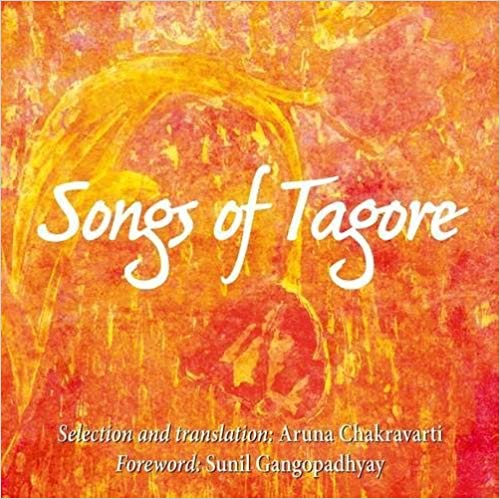
‘Jana Gana Mana’ has been translated into English by noted writer, academic and translator, Aruna Chakravarti. She is perhaps the only person to accomplish this beside the poet himself. The following is the translation made by her, along with the English transliteration of the Bengali original (Songs of Tagore, Niyogi Books):

Leader of the masses.
Lord of the minds of men. 
Arbiter of India’s destiny.
Hail to you! All hail!

Your name resounds through her sea and land 
waking countless sleeping souls
from Punjab, Sindh, Gurarat, Maratha
to Dravid, Utkal, Banga.
Her mighty mountains—Himachal, Vindhya, 
her rivers—Yamuna, Ganga,
the blue green sea with which she is girdled; 
her waves, her peaks, her rippling air
seek your blessing, carry your echoes. 
Oh boundless good! Oh merciful! 
Hail to you! All hail!

At the sound of your call the people assemble 
from myriad streams of life.
Hindu, Muslim, Buddhist, Jain.
Christian, Parsee and Sikh.
East and West stand by your throne 
hands held in amity,
weaving a wreath of fraternal love; 
of empathy, unity.
Oh you who bring us all together! 
Hail to you! All hail!

Nations rise and nations fall
on the perilous path of history.
And you Eternal Charioteer
guide the world’s destiny.
Through day, through night, your wheels are heard 
renting the air with sound,
dispelling terror, banishing pain;
blowing the conch of peace.
Oh true arbiter of India’s fate!
Hail to you! All hail!

In the deep dark of a turbulent night, 
when our swooning, suffering land 
lifted her eyes to your face in hope, 
she saw your unwavering gaze
raining blessings, alight with love,
banishing evil dreams.
Like a loving mother you held out your arms 
and changed her destiny.
Oh you who wipe out the pain of the masses! 
Hail to you! All hail!

A new day dawns; a new sun rises
from the mountains of the east.
Song birds trill; new sap of life
is borne on the holy breeze.
India awakes from aeons of slumber
to the strains of your lofty song.
Head bowed to your feet oh King of kings! 
Hail to you! All hail!

(Republished with permission from Songs of Tagore, Niyogi Books)

Outside of the country, the song was also performed as the ‘national anthem’ of independent India, under the leadership of Subhas Chandra Bose on the occasion of the founding meeting of the German Indian Society on the 11th of September 1942, in Hamburg, Germany. The Indian Constituent Assembly allowed the performance of Jana Gana Mana on the midnight of 14th August 1947, marking the close of the historical session in the Parliament. It was on the 24th of January, 1950 that only the first stanza of the song was accepted as the National Anthem of independent India. The paeans of a land millennia old, perhaps heading the dawn of all human civilisation alone, is sung through glory to the world over, till date, bearing the torch of an all tolerant, enduring land, by the name of Bharat. Perhaps we still need to be in quest of its  philosophy of oneness.

A full rendition of Jana Gana Mana by Swagatalakshmi Dasgupta

Dr. Anasuya Bhar is Associate Professor of English and Dean of Postgraduate Studies, at St. Paul’s Cathedral Mission College Kolkata, India. She has many publications, both academic and creative, to her credit.

.

PLEASE NOTE: ARTICLES CAN ONLY BE REPRODUCED IN OTHER SITES WITH DUE ACKNOWLEDGEMENT TO BORDERLESS JOURNAL

Categories
Bhaskar's Corner

Tagore & Odisha

Odisha and West Bengal, two geographically contiguous states of India, are as much a proximate in culture and language. Both states have a close link – from people movements to culinary familiarity. More to that. Puri attracts lakhs of people from Bengal. In truth, it is the Bengalis around whom the holy city of Puri revolves. They contribute greatly to the city’s economy. The Tagore family of Jorasonko too had a close connection with Odisha and it stretches back to generations. Rabindranath Tagore’s great grandfather Nilamani Thakur had come to Cuttack as a ‘Sirastadar‘ (revenue collector) duly appointed by the British.

In 1840, Rabindranath’s grandfather Prince Dwarakanath Tagore had bought a small estate near Pandua in the present Jagatsinghpur district. Tagores even had a house built in Cuttack’s Tulasipur area. Later, Rabindranath’s father Maharshi Debendranath Tagore visited Odisha sometime around  1851 to supervise the estate at Pandua  from where he visited Puri.

Records of those times bring out how the Tagore family was fascinated by Puri’s pristine beach, the camaraderie, and the cool breeze.

In 1891, Rabindranath Tagore visited Odisha for the first time to oversee the land his ancestors had bought. Tagore’s maiden visit to Odisha was memorable and soul-stirring. The bard’s fascination for Puri finds mentioned in ‘Chinnapatra’ — his letters to Indira Devi, Tagore’s niece. In one such letter, Tagore wrote: 

“The road from Cuttack to Puri is good. It is high with low-lying fields on both sides. There are big shady trees, mostly mango. At this time, all the mango trees are in blossom, filling the way with fragrance. Some villages are seen surrounded by mango, pipal, banyan, coconut and palm trees.”

Tagore informs further:

“In places covered carts are standing on the banks of shallow rivers. There are confectioners under palm-leaf thatches. Inside the huts in rows, under the trees on both sides of the road, the pilgrims are taking their meals. The beggars are shouting in strange languages, whenever they see fresh batches of pilgrims or carriages or palanquins.”

He wrote fabulously about what he saw on his way to the glorious city of Puri:

“As one approaches Puri, the pilgrims are seen in greater numbers. Covered carts are seen moving in lines. People are found lying down, looking or gossiping together on the banks of tanks. On the right side of the road, a big spire of the Jagannath temple rises. Suddenly at one place, crossing the line of trees and bushes, the wide stretch of sandy sea-beach and the azure line of the sea become visible.”

Tagore visited Odisha once more in 1893.This time it was Cuttack with his nephew Balendranath. Tagore was a guest at the then District magistrate BL Gupta, ICS ( Malati Chaudhury’s grandfather). Having spent a few days there, Tagore  set out to Puri  on a palanquin and he was spellbound  over the unspoiled  sceneries on both sides of  the Jagannath Sadak as it was called then. Tagore’s last visit to Odisha was in 1939. 

 He came on the request of Biswanath Das, the then Chief Minister (called Prime Minister) of Odisha   to visit the province. When Das was in Kolkata to attend a meeting of the All India Congress Committee, he personally met the poet to pay respects and extend the invitation.

Tagore reached Puri on 19th April in 1939. He was warmly received by the ministers and government officials. The poet stayed in the Circuit House as the state government’s guest. But all his engagements were canceled as the poet developed a slight fever and the doctors advised him complete rest.

On 8th May 1939, the poet was given an ovation on behalf of the women of Odisha. The next day — his birthday – was celebrated with gusto. The birthday bash was held on a well decorated pandal with an opening song. The poet was welcomed with the chanting of Vedic hymns by the pundits of Puri’s Sanskrit College. Flower, sandal paste, vermilion and coconuts were offered to the poet as a mark of veneration.

So enthralled was Tagore at this spirit of love and affection that he wrote in a letter to his former Secretary Dr. Amiya Chakravarti:

“I have come to Puri. I am the invited guest of those who are now at the helm of the affairs of Orissa. There is something novel in this fact. In older days, they who were kings or heads of the state, used to honour the meritorious, thereby honouring their own countries and governments. By this liberality, they used to keep contact with human culture and admit the universal heritage in the development of faculties.”

He further wrote:

 “We have learnt the modern system of political administration from the English. The talented have no place in it. The statesmen of Europe wield the outward aspect of that power which is based upon economic and administrative laws. They cannot have the right to govern the spirit that lies underneath but it is needless to argue that having acknowledged and paid due regard to it, a noble environment can be created for the government. In oriental system of administration, the scope for acknowledgment of the individual talent has, however, not been neglected.”

In the same letter, he was a bit apologetic: 

“Let me now tell you about myself. I have no work here, nor am I of any use to anybody. Those who are taking care of me here, expect no material advice from me. That salutary and refreshing effect with which the sea breeze is touching my body and mind is the very symbol of the hospitality of the newly responsible Orissa Government. Administrative procedure has created no obstacle to it, nor has it been affected by the budgetary economy.”

On human relations Rabindranath wrote when he was convalescing:

“Sitting on the first floor of the Circuit House, I have unhesitatingly given myself up to pure idleness. The ministers here, having noticed the tired condition of my health, come every day to encourage me to spend my days without any purpose. The mentality of admitting human relationships even in the midst of heavy pressure of work is still inherent in our country; and this has been felt by me especially after I have come over here.”

During his stay at Puri, the Raja of Puri – an institution by himself – and the Superintendent of Sri Jagannath temple, bestowed upon Rabindranath, the title Parama Guru (the great teacher). As the poet was indisposed, the ceremony was not held publicly. The Dewan (manager) of the king came down to the circuit house in a procession to confer the title. The panegyric was read out in the hallowed Sanskrit language. Then a camphor garland, head dress and a pair of silk clothes were offered as a mark of respect by the chief priest. 

Historian Prof. Pravat Mukherji later wrote about Tagore’s acceptance of the recognition thus: “He had been warmly received in many countries of the world, but the reception which was given that day by the people of Odisha touched his heart, as it was according to the traditional Hindu style.”

Tagore’s stay in Puri had a few other blissful moments. Many poets and freedom fighters met him. Among them were Lexicographer and compiler of ‘Purnachandra Bhashakosh’ (Odia Encyclopedia), Gopal Chandra Praharaj, Pandit Raghunath Mishra, freedom fighter Sarala Devi, poet and novelist Kalindi Charan Panigrahi and yet another gentleman from Jajpur, Chandrasekhar Das, about whom Tagore penned a few lines:

“O’ my unknown admirer,

Today you have become known.

With my blessings I repay

My admirer your loan.”

Two contemporary Odia poets — Bhaktakabi Madhu Sudan Rao and Kantakabi Laksmikanta Mohapatra (creator of the state song ‘Bande Utkal Janani’) – were inspired by Tagore and wrote two books – Kusumanjali (Posy of Flowers) and Jiban Sangeeta (Life Song) respectively, which are rare beginnings in modern Odia literature. 

It was also during the Puri layover that Tagore wrote the dance drama ‘Chitrangada’ – the theme he seemed to have overheard from the local epic-sayers. Tagore also wrote some of his famous poems: Pravasi (Expatriate), Janmadin (Birthday) and Epare Opare (This side and that side) in Puri. In Pravasi, Tagore describes himself as a “man of the world and he does not consider anybody to be alien”

Tagore loved the people of Odisha so much that he concluded: 

“From a distance I have formed an idea about the love of the people and the efficiency of those who are at the helm of the administration of Orissa at present, and now I am appreciating it from close quarters.”


References:

Guru Kalyan Mohapatra: Puri & the Poet

Sambad by Prof Basanta Kumar Panda ( Odiya translation of Chinnapatra). The excerpts from the Chinnapatra have been translated by Bhaskar Parichha from Odiya.

.

Bhaskar Parichha is a journalist and author of No Strings Attached: Writings on Odisha and Biju Patnaik – A Political Biography. He lives in Bhubaneswar and writes bilingually. Besides writing for newspapers, he also reviews books on various media platforms.

.

PLEASE NOTE: ARTICLES CAN ONLY BE REPRODUCED IN OTHER SITES WITH DUE ACKNOWLEDGEMENT TO BORDERLESS JOURNAL

Categories
Tagore Translations

Deliverance by Tagore

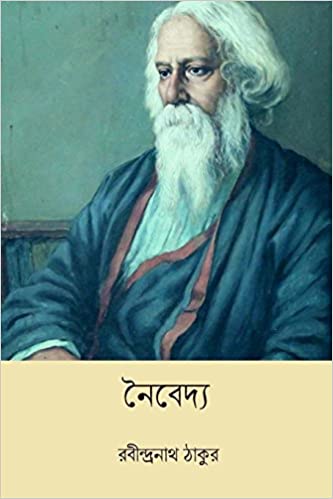
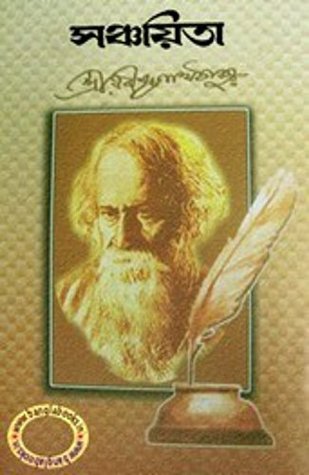
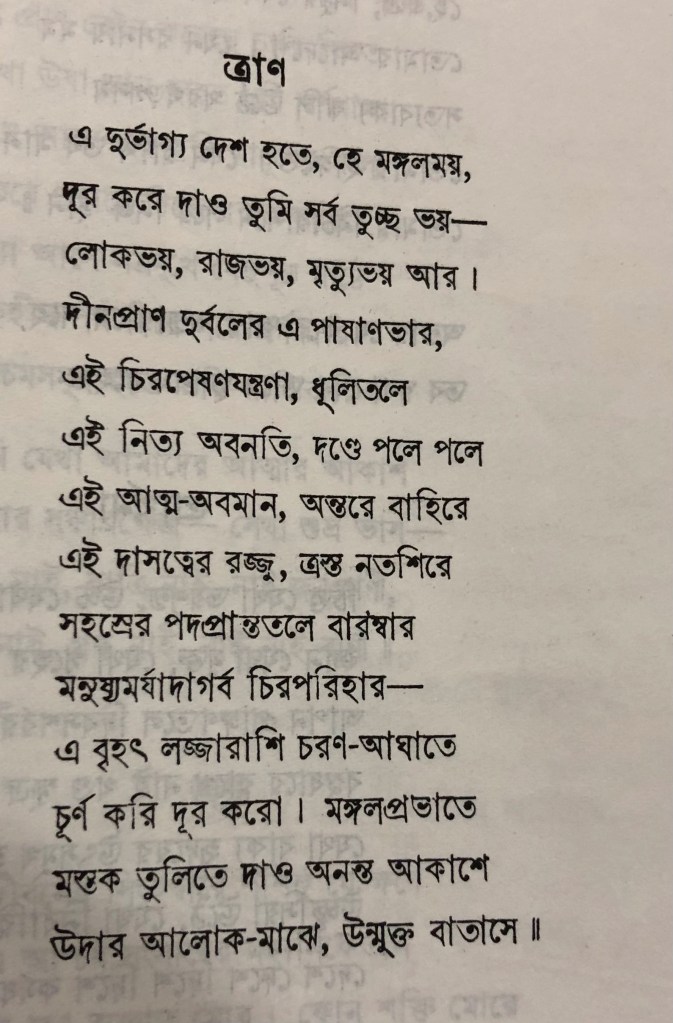
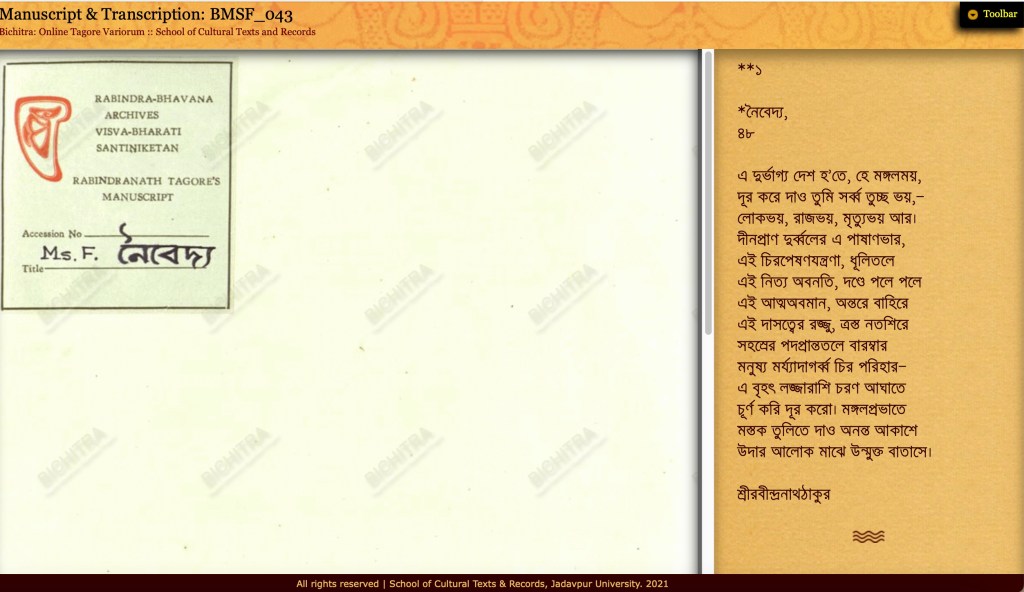
Tran (Deliverance)’ was first published in 1901 in a collection known as Naibedya (Offering to God). Here we present a translation from the Bengali poem as found in Sanchayita (Collection), a compilation of poems published by Visva-Bharati to mark the Tagore septuagenarian celebrations in 1931.

Art by Sohana Manzoor
Deliverance

From this hapless country, oh Benevolent One, 
Efface all petty fears —
Fears of society, governance and death. 
The rock-like burden borne by the impoverished and the weak,
This pain of being ground under dust, 
This endless abuse, reinforced each second,
This self-debasement, within and without,
This yoke of enslavement, terror, subjugation,
Is trod on again and again by many marching feet.
Beaten out of self-worth, pride —
Break this enormous pile of shame
With your foot. On this auspicious dawn,
Let us hold our heads high in the infinite sky 
Amidst the light of bounteousness and the heady breeze of freedom.

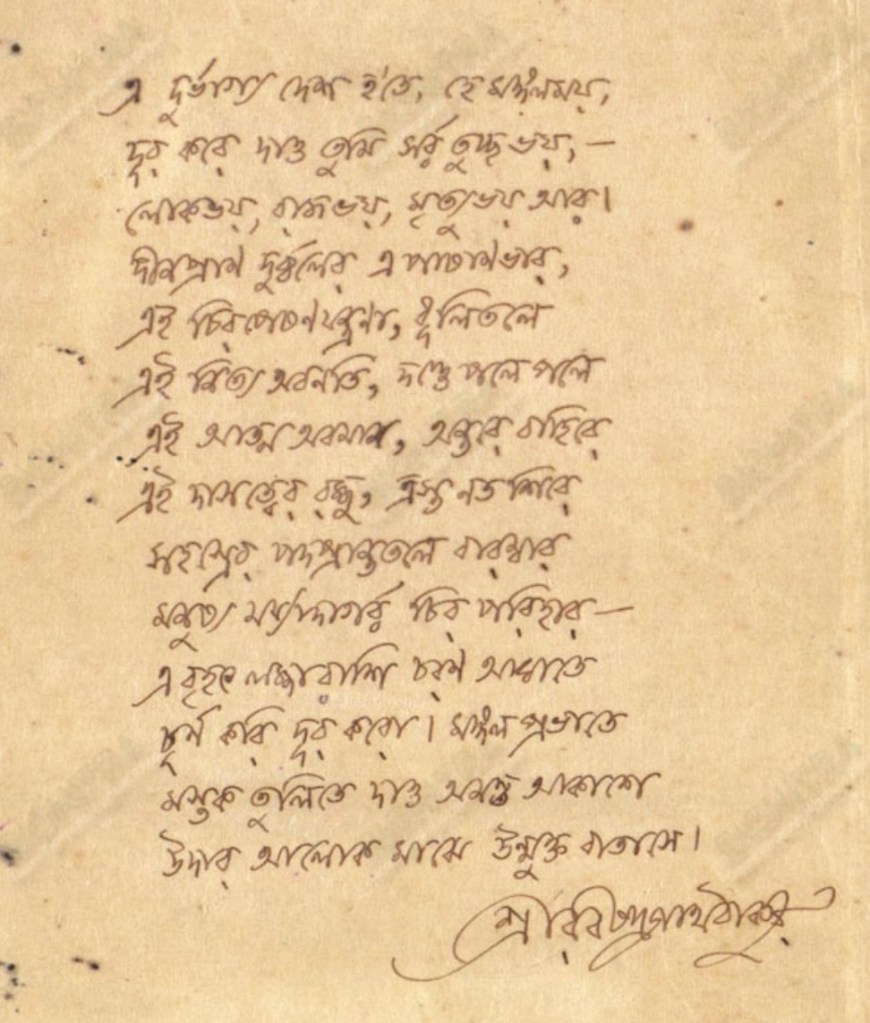
Subsequently, it was translated by Rabindranath Tagore himself as ‘Freedom from Fear’ and published in the Vishwa Bharati Journal in 1933; then, in Modern Review in 1934 according to Bichitra, an online Tagore valorium. It was first anthologised in Collected Poems and Plays of Rabindranath Tagore (Macmillan, London). The translation varies from the original Bengali poem with the last two lines missing completely.

(Translated by Mitali Chakravarty, edited by Sohana Manzoor on behalf of Borderless Journal. Thanks to Anasuya Bhar, Associate Professor of English and Dean of Postgraduate Studies, at St. Paul’s Cathedral Mission College Kolkata University, for helping with the research. Also thanks to Fakrul Alam and Aruna Chakravarti for their feedback.)

.

PLEASE NOTE: ARTICLES CAN ONLY BE REPRODUCED IN OTHER SITES WITH DUE ACKNOWLEDGEMENT TO BORDERLESS JOURNAL
Categories
Travel

Once Upon a Time in Burma: Land of a Thousand Pagodas

John Herlihy explores the magnificent sites of Mandalay in company of a Slovenian friend in the first episode of his quartet on his Myanmar

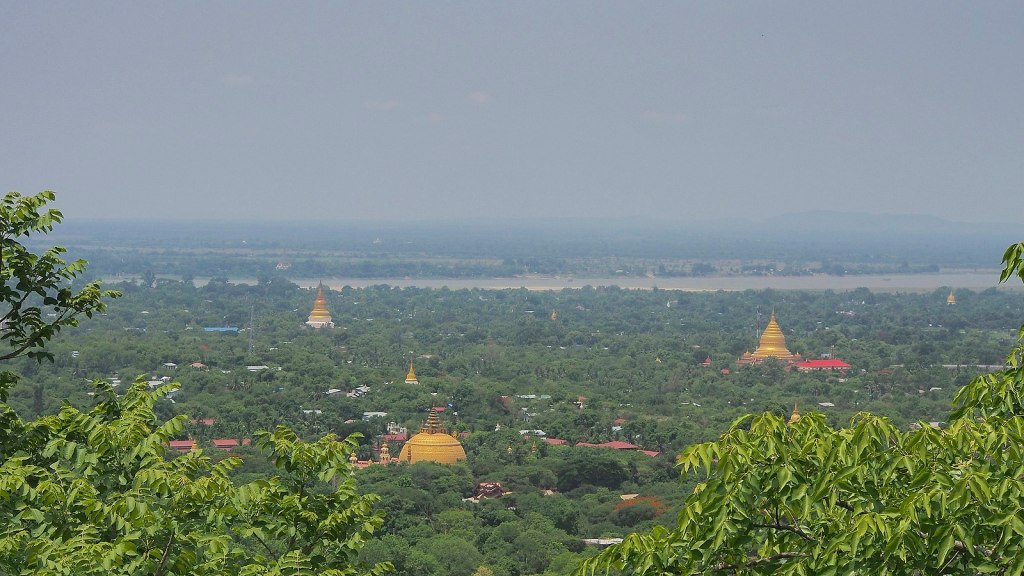
Mandalay overview. Courtesy: Creative Commons

Exotic journeys to far distant climes begin to take shape in the realm of the imagination. We roam verdant savannas, cut our way through savage jungles, climb into eagle’s nests on mountain crags, cross parched Mongolian deserts, and ply on ancient vessels across vast oceans, all in search of new sights and sounds, new pathways into the unknown, new visions into the future, anything that will take us far from our humdrum lives. Ah, how the imagination works overtime and takes us there, takes us where we want to go, offers up an experience we would not have savoured otherwise. The imagination opens doors for travelers to pack their bags and see other worlds not of their making, worlds that become a reality with the first step taken along the road of a fresh journey into the realm of the unknown.

A recent trip to Myanmar, formerly the much beloved and written about country of Burma of the 19th century, ended up fulfilling my wayward dreams of an adventure and experience that would take me out of myself and into another time and place. Indeed, the title of this adventure says it all, once upon a time in Burma, a country that once entered, will not leave us alone and will wrap the traveler up in its loving embrace. With all geo-political interests and concerns put aside for a moment, it is the people, the culture, the craftsmanship, the ancient land that we wish to know and experience, the lapping of lazy rivers, the sky-mirrored brilliance of expansive lakes, the shadowy curves of rugged mountains, the lush and verdant plains and paddy fields that fill the soul of the traveler to such exotic lands with the peace and serenity of its ancient way of life. Regimes, corruption, injustice, indeed political leaders come and go; it is the land that endures and the spirit of a people that will never die.

Whose heart will not be stirred by the name of Mandalay, immortalized by the British poet, Rudyard Kipling, whose poem, “Mandalay” still echoes resoundingly down through the corridors of time with its lush verses of charm and enchantment. It is this memory that leads me bravely onward as I plan my well-earned winter holiday in a brief respite from my duties as a writing professor at a new university on the outskirts of Kuwait, a city of sky-scraping towers wishing to be iconic and smoky oil fields wishing to be productive. I am now, in the world of Rudyard Kipling, “on the road to Mandalay // where the flyin’-fishes play // an’ the dawn comes up like thunder outer China ‘cross the bay.”

I never tire of flying into a new country that is totally unknown to me and yet soon to be less of a mystery, soon to be known. As I gaze down upon the scene below my comfortable perch on the plane, I see that we are entering a land seemingly lost to time. The blackened highlands turn to rugged mountains with nary a tree to see. The mountains themselves seem to cradle the surrounding land like a mother cradles her child, and a sense of balance and harmony prevails as I gaze upon this landscape of primordial nature, as if lifted from some remote paradise from another planet, captured out of time for the 21st century traveler such as myself to see. Already my expectant heart begins to stir as I eagerly await our arrival.

I am once again travelling with my Slovenian friend, Peter, and a better traveling companion one could never hope for. They say that if you want to really get to know people, you have only to take a trip with them to find out what they are really like. No truer words were ever spoken. My smart, brave, thoughtful, selfless friend would never let me down, brought his own unique approach to travelling with him, took delight in planning and doing background research about a place, and was able to monitor the number of steps (my three to his two giant strides) on our daily trails with his fashionable Garnett geo-watch (when it worked!).

We entered the subdued arrivals hall in Mandalay only to realise a half-hour time difference from Bangkok where we had met up from our different locations the night before.

“That can’t be right,” Peter knowingly quipped. “But it is,” I quickly responded, knowing how he liked to impose his will on things.

“Goa, on the west coast of the Indian Subcontinent is an hour and a half ahead of Dubai.” I added as supporting evidence of what I said.

We had easily arranged e-visas done online beforehand and quickly passed through customs control without a hitch. “Let’s change money,” I suggested. “But you get a better rate in town,” Peter countered. “We won’t get into town without local money,” I murmured, knowing he couldn’t counter-argue that. Indeed, at roughly 1,500 kyat to the dollar, after changing a mere $100, we walked away with 150,000 kyat. Hmm, that should get us into town, I thought to myself.

I won’t belabour the point, but the exchange rate of the currency turned out to be an interesting element in our economic calculations. When you are dealing in the thousands of any currency, it can be confusing. We all know what a dollar or euro values at, but what about 150,000 kyat and how much would it buy locally. Seems like a lot, yet it is only ten dollars in value, about the price of a sandwich and a zero coke on the streets of Manhattan. Now through immigration and customs and with local money in hand, the ever-intrepid researcher, Peter, marched over to the information booth to inform himself about getting into the town center where we had booked our hotel. While there were traditional taxis available for about 15,000 kyat (roughly $10), we learned that we could take a local bus outside the airport terminal that would take us directly to our hotel for about 3,000 kyat for the two of us (roughly a dollar each!). That won’t break the bank, I chirped to Peter. He agreed with a toothy grin and off we went on our great adventure.

The ride into town was uneventful, but long, leisurely and fascinating. I was beginning to experience the sense of laid-back calm and serenity that would follow me throughout my days of travel through this exotic, ancient land. In the distance, through the myriad lush and wind-blown trees that lined the side of the make-shift highway into town, a rough patch of roadway if there ever was one, we could glimpse the golden spires of pagodas upon hilltops extended clear to the horizon, a vision that would become the iconic characteristic to mark the bucolic setting of this rural landscape with its timely sense of spirituality.

“The trees,” I kept remarking to my friend Peter, “look at the variety and lushness of the grand, old trees. Have you ever seen the like of them?” Over an hour later in a place where time really had no meaning but that it could be filled with miracle and wonder, we were deposited at our more than adequate three-star hotel where we were greeted with timid smiles, folded hands and a humble bow.

Once unpacked and his geo-watch turned on, Peter exulted, “Let’s explore the town, the old palace isn’t far off.” I have traveled before with Peter and have come to realise that “not far off” doesn’t mean the same to him as it does to most other people. Nevertheless, I was game and still do my own 8-km run three times a week to keep fit and, in the running, as it were. Once outside, Peter tends to walk ahead in great strides, and I follow three steps to his two; but I didn’t mind. He faced the brunt of the chaotic traffic that came up, down and toward him in every which way, including the ever-present motorbikes that never follow the rules and seem to have license to come and go as they please. “Remember Peter,” I shouted to him over the din of dust and horns, “they drive British-style here, on the other side of the road, so take care where you look to cross.” Yet Peter strode confidently onward, like a giant amid pygmies, ready to brush aside any vehicle or motorbike that may dare to come his way. Indeed, the traffic seemed to have a rhythm of its own, despite the noise, and flowed like a river around his colossal bulk.

Well forward at the end of the main street of the town, again lined amid the grand cacophony of shops and workshops with multiple trees blocking the pathway along the side of the road and forcing us time and again out onto the perilous danger of the streets, we beheld the inner sanctum of a walled palace surrounded by an extensive, medieval moat. Up close, when we finally arrived at the historic premises, we gazed across the extensive mote nearly a half kilometer in width at the heightened red brick wall, periodically adorned with brick latticework and towers featuring ferocious fang-filled mouths of animals out of which lotuses hung out like tongues. On the Google map, the palace walls that now house the military Myanmar government formed a perfect square. From where we stood, we could hardly see to the end of the first line of wall that we stood before. Undaunted, Peter started to walk the outside of the moat for about a kilometer until we found a little embellished wooden 19th century bridge that led across the extensive moat up to the face of the outer wall of the former palace that now up close towered over us, even over Peter.

Mandalay Palace. Courtesy: Creative Commons

The Mandalay Palace itself was constructed between the years 1857 and 1859 and housed the last Burmese monarchy, in honor of King Mindon’s founding of the new royal capital city of Mandalay. The palace itself was the center of the citadel and faced East. Built of teak wood in the traditional Burmese design, it rested inside a walled fort surrounded by a moat. The complex ceased to be a royal residence and seat of government in 1885 when, during the third Anglo-Burmese War, the British entered the palace and captured the royal family. To this day, the Mandalay Palace stands as the primary symbol of the once enchanted city of Mandalay, in another time and in another place now gone by.

As we perilously neared the gate to the military enclosure, a guard slumped on a metal chair in the shade of an awning looked up at Peter towering over him as he pointed his finger in the opposite direction and shook his fist to make his point. “Oh hello, my little friend,” Peter said ingratiatingly in a sugar-sweet ironic tone that the poor fellow would never pick up, even if Peter thought he might. I cringed and headed in the direction where the soldier was pointing, so as not to offend. The guy was smiling and trying to be friendly. “But I want to go there,” Peter asserted glancing in the opposite direction, as if looking at a tidbit. “We need to go this way,” I shouted back to Peter over my shoulder, “Where the restaurants were indicated on the map.” That did the trick and at the thought of food, Peter was soon striding far in front of me, like a giant panda intent on his destination, his money (and mobile) belt tightly secured around his waist. No one was going to come near that!

Peter finally found a young, presentable fellow who looked like he knew something, especially English, to ask about a restaurant. “Yes, yes,” the fellow obliged. It turned out he was actually from India but had lived in Myanmar many years. “Restaurant very good,” he affirmed. “I will be going there later with my family.”

Indeed, I thought. What a strange coincidence. Peter soon tracked the restaurant down on the map on his mobile (I still don’t have one, I am waiting for the hand-held technology to give way to something more sophisticated), a small place open to the street with tables spilling invitingly out onto the sidewalk. This promised to be our first meal in Mandalay and Peter was not taking any changes on eating unhealthy and/or getting sick with stomach trouble.

“We will eat here,” he announced although I wasn’t especially impressed and it was a little early, just around sunset, to be eating to my taste. When one travels alone, one may feel lonely, but if travelling with a companion, one has to make compromises. I did the menu test and with a quick scrutiny found little that inspired me. Also, the stools at the tables had no backs. Not exactly the leisurely environment I was anticipating for evening dinner, our one main meal of the day when travelling.

I grumbled and mumbled to no avail. Peter had already ensconced himself on the tiny stool with a big grin on his face, looking forward to eating. He expected me to extract the best of the savoury delights from the menu, and after some time was able to come up with various curry and vegetables dishes that seemed promising from the little photos that accompanied the text. The prices were also note-worthy, 2,000 to 3,000 kyat for the main courses (let me remind my readers that 1,500 kyat equals one dollar at the time of our visit!). We can afford that I chuckled to myself. As we waited in the open-air restaurant in the dust and heat sipping our cool fruit drinks, the cars and motorcycles made their mad dashes to God knows where in such a hurry, and the mosquitoes suddenly came alive in the twilight hush!

I sat there feeling tired and dreamy after the long day and the long walk around the palace walls, but Peter suddenly seemed uncomfortable and agitated. “What’s the matter, Peter,” I asked, as he swatted his hands in front of his face and slapped his naked legs. “Mosquitoes,” he cried, “they are biting me.” Welcome to the tropics, I thought, but kept quiet until I couldn’t help but launch into the story of dengue fever that some mosquitoes can transmit. Admittedly, it’s a long shot, but I couldn’t help but make fun of my friend who had been so insistent about eating in this restaurant at this time. From then on, we took much more care in planning our evening meals as we travelled throughout the country heading south from Mandalay to Yangon (formerly Rangoon).

The next morning, we were promptly met by out little guide whose name was Swan. We would later come to know that Burmese names were different and unique. Peter in particular always got a kick out of asking Swan questions, but always addressing him by name. “Swan, why do the women wear powder on their faces (a natural product to protect against the sun)? Swan, how many motorbikes are there in this town (far too many to my reckoning)? Swan do you have brothers and sisters (he had a younger brother that he spoke fondly of)?” True enough, when you travel with a guide, the guide, if you are lucky, becomes a kind of father, brother, son. They are there as a font of knowledge, the shipmaster on a voyage into the unknown, a protector and a stranger turned friend in a stranger than strange land. Swan was all of those things and much more. When we came to learn that as we moved south, he would be replaced by another guide. Both Peter and I felt disappointed and when eventually we did say goodbye to him, knowing we would never see him again, we felt sad and at a loss. When I shook his hand, the thousands of kyat I left behind didn’t seem enough.

For the time being, Swan was with us at every temple, stupa and pagoda. “What’s the difference?” Peter wondered aloud, giving voice to my own question.

“You can enter a temple,” Swan patiently replied, as if he had never been asked that question before. Indeed, the trick of a new guide leads the tourists in his charge to believe that everything is fresh and new, questions, statements, explanations that had never been uttered before and may never be uttered again. “The pagoda is there in commemoration and as a gift or charity that could bring merit and blessing. But you cannot enter inside as it is a solid structure pointing heavenward. A stupa is a domed or bell-shaped monument traditionally used to store religious relics of the Buddha.” Whether temple of worship, stupa or pagoda, to enter its confines, we were required to take off our shoes and socks. In the land of a thousand pagodas/stupas, tourists end up taking off their shoes perhaps more than they would like. I kept silent, but Peter grumbled and complained as we wandered in and around these sacred places during our 10-day tour, Peter meticulously cleaning off his sizable feet with the moist wipes provided every time by the guide. I simply brushed off the sand and grit and re-socked my feet until it was time to enter the next temple, thinking that traveler dust is well earned.

After ambling through the chaotic fruit and vegetables markets of Mandalay, we made our way with our guide, Swan, to our first memorable site, the Shwenandaw Monastery, located at the foot of the Mandalay Hill overlooking the city and countryside. The monastery was speckled with trees, golden domes and bell-shaped towers gleaming in the winter sunlight. The intrepid guide explained everything in great detail, and perfect English I might add. I remember asking Swan how he had learned English, but never got a satisfactory answer to account for the ease with which he spoke.

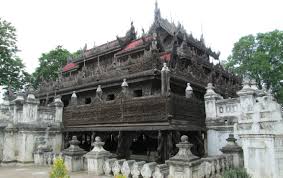
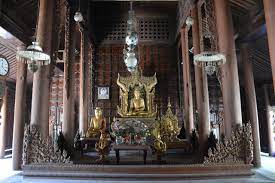
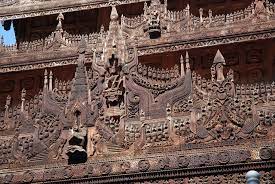
The monastery was built in 1878 by King Thibaw Min, who dismantled and rebuilt the inner apartments formerly occupied by his father, King Mindon Min, believing the premises to be haunted by the spirit of his dead father. The entire structure was made of teak wood in the traditional style and heavily gilded with gold and glass mosaic work. The monastery is also known for its teak carvings of Buddhist myths, which adorn the walls and roofs in all their intricate, exquisite detail. As we roamed around the eerie premises, we came to see the commemorative preservation of a former royal way of life, particularly the colossal inner room where the king was known to have performed ritual meditation. We were even able to observe the meditation couch upon which he sat, creating in my mind dreamy reflections of a world I would never know, but had come to learn about in my travels.

The time of sunset was not far off. We made our way in the car midway up the Mandalay Hills into a parking lot and from there were able to take a series of escalators to the top of the hillside that provided fabulous views in every direction of the once enchanted city of Mandalay below, now a bustling metropolis that from the distance still held its mystical lure although up close, the 21st century left its mark of noise and pollution. The rolling hills and flattened plain leading to the city below provided the perfect backdrop for the flaming sunset that soon followed, bestowing upon the fabled city below the streaming golden light of twilight.

CLICK HERE TO READ THE EPISODE 2

CLICK HERE TO READ THE EPISODE 3

CLICK HERE TO READ THE EPISODE 4

John Herlihy, travel writer and poet, has published two collections of travel essays, Journeys with Soul and his more recent Distant Islands and Sealight, available at online booksellers and Amazon.

.

PLEASE NOTE: ARTICLES CAN ONLY BE REPRODUCED IN OTHER SITES WITH DUE ACKNOWLEDGEMENT TO BORDERLESS JOURNAL
Categories
Poets, Poetry & Rhys Hughes

Dinosaurs in France

Eiffel Tower Paris. Courtesy: Creative Commons

I am still confused as to how many continents there are. Is Oceania the same as Australasia? Do North and South America count as two or just one? Is Antarctica a proper continent and not just a frozen phoney? What about the subcontinent of India? Does that count as half, quarter, or some other fraction? What continent does Greenland belong to? And the islands of the mid Atlantic, what about them?

When I was younger the issue was simpler. There were six continents, Africa, America, Asia, Australasia, Europe and Great Britain. There was absolutely no doubt that Britain was separate from Europe geographically and spiritually. In fact, the mainland of Europe was the continent and things that came from it were ‘continental’ and mostly malodorous, quilts and kisses on the hand being exceptions.

In Europe people did peculiar things; they spread chocolate on bread for breakfast and melted cheese in communal pots in the evenings. Or so it was said. Europe was a place of mystery, a patchwork of suspense, and crossing its multifarious internal borders wasn’t likely to be easy. If you had to travel there, a large vulcanite suitcase that could be plastered with triangular destination labels was the minimum requirement. Better not to go at all! The greasy food, cooked in nasty olive oil, was certain to upset your stomach. And there were yodellers.

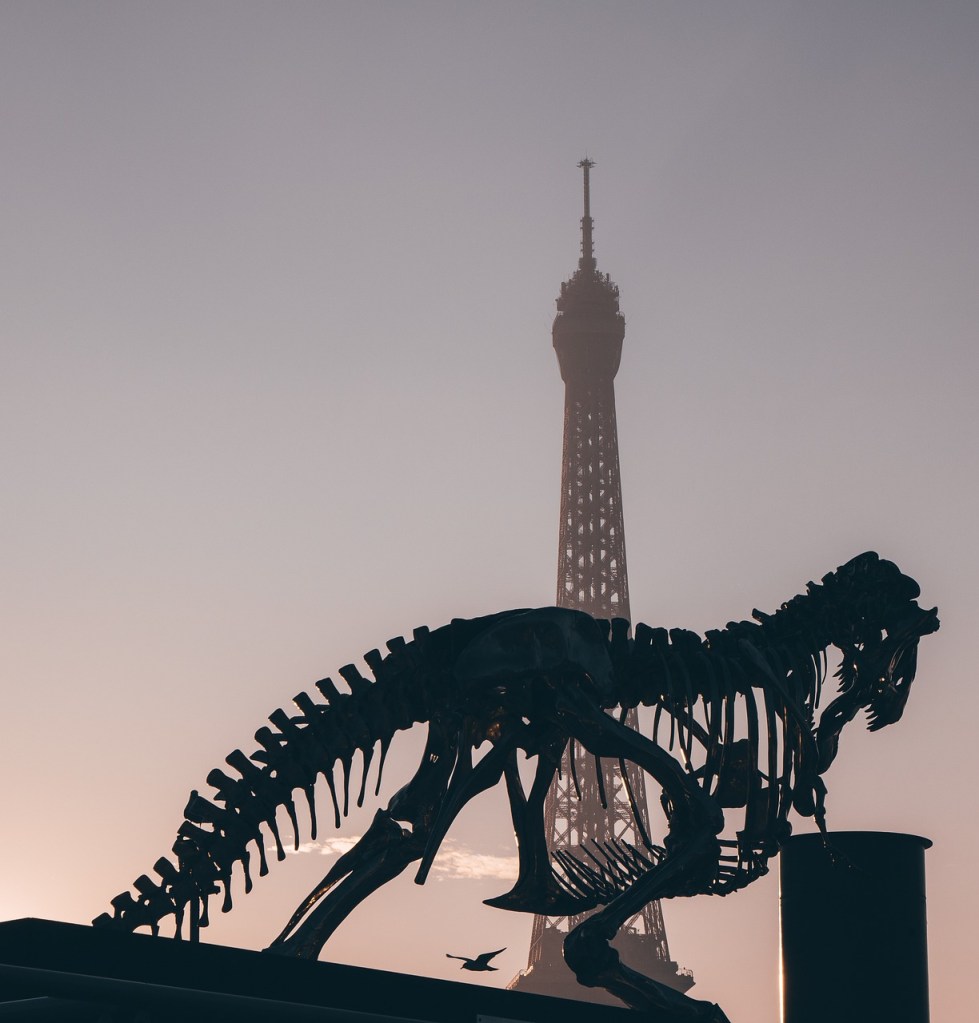
My great childish dream back then was to build a raft and paddle it to France. There were enough fallen trees in the forest near my home to provide wood for the construction. France seemed an incredibly exotic destination and my enthusiasm was increased rather than diminished when I was told that dinosaurs existed there. They had become extinct everywhere else but still flourished in France. Thus, I couldn’t wait to drag my raft ashore and encounter my first stegosaurus. Other lies that adults told me about France included the assertion that the Eiffel Tower was something that horses jumped over in the Grand National. Having no idea what a ‘Grand National’ was I felt only a vague sense of awe. It was many years before I learned that it is a horse race famous for being dangerous to horses and for the ludicrous hats worn by upper class drunken women who watch it and chortle.

Adults in those days told outrageous untruths as a matter of course. It was an accepted part of life. I grew up in an environment where no one said anything sensible but instead would make the most absurd statements with a straight face. It was an uncle who claimed that France was jammed with dinosaurs. He also informed me that we were living in Australia, not Britain, but that everyone else would try to trick me into thinking it was Britain and that they were all in the joke together and I shouldn’t believe them. The truth of the matter, he added, was that Britain was a fiction, it didn’t exist, or it had sunk beneath the sea, it was a joke or a memory and nothing more. This was Australia and when he was my age, he had made a raft, from twigs, and sailed it around the world and started a successful property business with a gorilla in a jungle.

And he told me that he once pulled the plug out of the bath while he was still in it and got sucked down the hole and ended up at the bottom of the sea where he lived in a gigantic air bubble with a dolphin who taught him dolphin language and how to make crêpes. None of this was said in a joking manner but in a tone of utter seriousness. Everyone was like this. The postman once told me that he lived in a marshmallow house and was terrified of lightning strikes because the heat would alter the flavour of his roof and that people were taxed on the flavours of their roofs, so for him it was a major concern that his tiles weren’t toasted.

One of my favourite absurdities concerned the International Date Line. Because Australia was so many hours in the future, people who lived there (like ourselves) could phone relatives in Europe with the results of football matches, horse races and boxing competitions that hadn’t yet happened, enabling those relatives to make a big profit at the betting shop. These European relatives could then phone America to pass on the same information, enabling friends over there to also make money through betting. However, because of the Date Line it wasn’t possible for America to do any such favours for any countries west of them. In other words, America took but didn’t give, and as a consequence, was building up a large debt to the rest of the world.

One day all the other nations of the world, all those living in a future time relative to America, would form an alliance and invade America and loot all its treasures in retaliation. I am fairly sure it was one of my schoolteachers who told me all this. Even supposedly ‘responsible’ adults liked to be ridiculous in a blasé manner and play jokes on children. I remember one outing to a pond in a park as part of a nature class. We were required to sketch any animals that we might encounter, and, in my mind, I can still see the teacher crouching over a child’s sketch pad and pointing to a duck that was paddling slowly on the water.

“What it that, boy?”

“A duck, sir.”

“No, boy, it’s a fish.”

“But it has a beak and wings, sir!”

“Yes, but it has a tail too. Can’t you see the tail? Fish have tails, don’t they? That means it’s a fish. Draw it exactly as you see it and write the word ‘fish’ under the drawing and tomorrow I will hand your work to the headmaster so he can form a judgment of your educational progress and I am sure the result will interest him.”

That’s how life was in Britain when I was younger. Practical jokes and getting other people into trouble for the purposes of comedy was standard behaviour. If you didn’t tell amusing fabrications then you were regarded as rather odd, dubious even, a spoilsport and also, perhaps, a saboteur or foreigner. I would look at adults in the street and wonder if any of them were French and on familiar terms with dinosaurs.

Then everything changed and the countries and cultures of Europe became much more accessible. Going to Paris, Madrid or Lisbon for a weekend took no more effort than visiting Weymouth, Blackpool or Margate. In fact, it usually took less effort. I began to genuinely feel like a European citizen, something generally considered not feasible for a British fellow, but I am Welsh, not English, and the Welsh, who are the original Britons, are hardly British. To feel European required only my desire and acquiescence, and I had that desire and yes, I was willing to acquiesce. Feeling European wasn’t an option denied to me at that time and I never thought it would be, at least not until plate tectonics reformed the continents and Europe ceased to physically exist.

It sounds ludicrously obvious, but it still apparently needs to be said. Britain isn’t a continent by itself. That was just a childhood myth, similar to the story that if you swallow an apple pip a tree will grow inside you, and in fact I once deliberately swallowed many pips in order to have an orchard in my stomach and never grow hungry. I would only have to jump up and down at mealtimes for the fruit to fall from the branches. Because the fruit was already in my stomach, actually eating it would be unnecessary. It seemed such a wonderful solution that I couldn’t work out why everyone didn’t do it. I supposed that maybe adults didn’t really like convenience. But no, we can’t have trees growing inside us. And sadly, dolphins don’t know how to make crêpes.

Politely we call such things myths. They are deceits, of course. But the world seems to have gone back in time. Travelling abroad is truly difficult again, impossible in many instances. I spend my days bewailing the reversal. I have started wondering if my old plan of building a raft might be my best option of leaving these shores and visiting other lands. There might be dangerous dinosaurs off the coast of France, those long-necked plesiosaurs, but I will take a big detour around them. I will steer by the light of the stars and satisfy my hunger by eating the walls of my marshmallow cabin. Everything will work out fine.

Rhys Hughes has lived in many countries. He graduated as an engineer but currently works as a tutor of mathematics. Since his first book was published in 1995 he has had fifty other books published and his work has been translated into ten languages.

.

PLEASE NOTE: ARTICLES CAN ONLY BE REPRODUCED IN OTHER SITES WITH DUE ACKNOWLEDGEMENT TO BORDERLESS JOURNAL
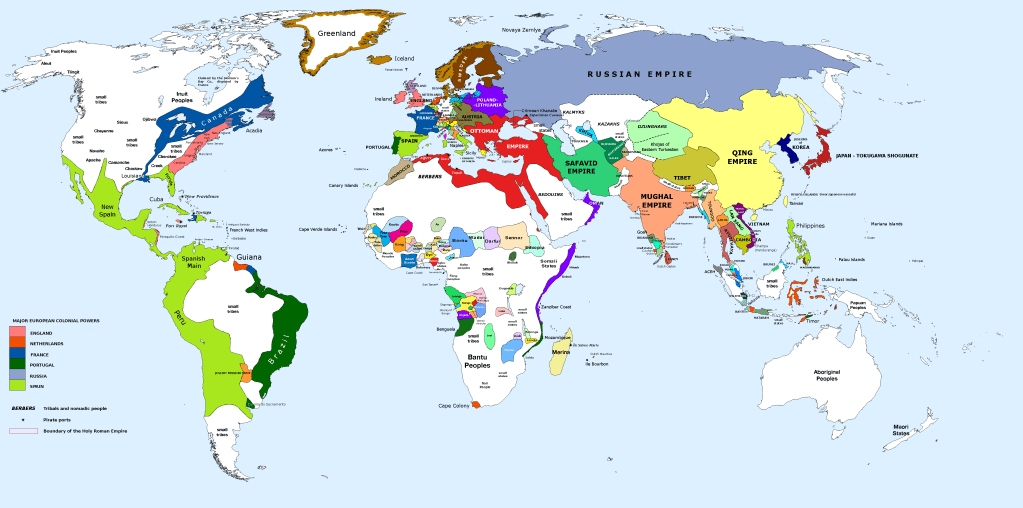
Categories
Review

Women Who Wear Only Themselves by Arundhathi Subramaniam

Book Review by Bhaskar Parichha   

 Title: Women Who Wear Only Themselves

Author: Arundhathi Subramaniam

Publisher: Speaking Tiger Books, 2021
                                                                              

This is an unusual book–unusual because of the theme, approach and style. And when it comes from a skilled author, it ought to be still more engrossing. A tiny book of about two hundred pages but not so diminutive in its journey to profile four women — who are known little outside their small world of followers and who matter in the arena of spirituality. It is a melodious presentation.

Women Who Wear Only Themselves–Conversations with Four Travelers on Sacred Journeys’ by Arundhathi Subramaniam is prophetic, in-depth and counter-revolutionary.

Author of a dozen books of poetry and prose, Arundhathi is an award-winning author. Her most recent book is Love Without a Story. The Other books include an anthology of bhakti poetry, Eating God, and a book of essays, Pilgrim’s India. The Book of Buddha and the bestselling biography of a modern-day mystic, Sadguru: More Than a Life are also the talked about ones. Arundhati is widely known as a poetry editor, curator and critic. Her book, When God Is a Traveller, won the Sahitya Akademi Award 2020 besides being shortlisted for various other prizes.

Arundhathi’s book provides glimpses of four spiritual practitioners – Sri Annapurani Amma, Balarishi Vishwashirasini, Lata Mani, and Maa Karpoori — who unlike the chatty sadhus prominent on the social media, practice in isolation. Arundhati talks at length to these women of substance and in doing so, she gives some promise for the jaded souls. Besides, she looks for a gender-balancing act and tries to widen the circle of women spiritual leaders.

In a world where women have been seen traditionally as someone’s wife, mother, daughter, or sister, why would a woman choose to follow a spiritual path? Perhaps because, deep inside every woman has a longing to be someone in her own self, confident and in control.

In the last two thousand years, women have not fully used their spiritual power. Instead, aspects of the feminine have taken mainly symbolic forms from the Virgin Mary to the vestal virgins, from Earth Goddesses to the Shakti Devis. Women have been put on pedestals and worshiped on account of their purity or femininity; but have been excluded from religious activities and barred from entering places of worship.

In the present book, she talked to Annapurani Amma who left the safety of home and family to follow the summons of a long-dead saint (she lives naked but delivers prophecies.) Balarishi Vishwashirasini who was predicting futures ultimately transformed into a guru. Now in her thirties, she is a gifted teacher of nada yoga. Lata Mani, a respected academician in the US, was plunged into the path of tantra after a major accident left her with a brain injury. The fourth woman is Maa Karpoori, who had a rollercoaster ride that catapulted her from marriage to monkhood.

Writes Arundhathi in the Preface: “The primary motivation behind this book is simple. Thirst. Hopefully, a shared one. As a seeker, I have spent years thirsting for conversations. With spiritual teachers, with fellow travellers committed to the life of the spirit. I cannot complain. My life has been rich in conversations.

“I have had conversations with seekers of various persuasions. I have spent long hours listening to the yogi and mystic who later became my guru. I have eavesdropped on countless conversations with mystics in books — Shirdi Sai Baba, J. Krishnamurti, Ramana Maharishi, Nisargadatta Maharaj, Osho. I’ve even imagined the lapping waters of the Hooghly quieting to listen to the extraordinary exchanges between Ramakrishna Paramahamsa and his disciples. But another kind of thirst remained.”

So, what made her plan this book? “There was no crusading zeal that motivated this book. There was no schematic design. No spirit of advocacy. But there was a longing to listen to the voices of lesser-known women—women who choose to live in relative seclusion and shadow, and yet burn brightly. Women whom I met, accidentally, in the course of my own journey, and who generously allowed me a glimpse of their light. Something shifted within me after each of these chance encounters. I did not leave any of them unmoved.”

Arundhati doesn’t skip history: “The Indian spiritual landscape is not devoid of its women. We are routinely reminded of an illustrious litany: Maitreyi, Gargi, Andal, Karaikal Ammaiyar, Akka Mahadevi, Janabai, Muktabai, Bahinabai, Lal Ded, Rupa Bhavani, Gangasati, Meerabai. The list is long and varied. There are well-known figures in more recent times too, from the 20th-century mystics, Anandamayi Ma and The Mother of Pondicherry, to contemporary guru, Mata Amritanandamayi. Remarkable women. Beacons for many even today.”

 Says Arundhathi admittedly: “These women made no effort to impress. They were gracious enough to share their life journeys, without trying to flaunt their attainments, win recruits, or garner publicity. I am a seasoned listener, and instantly alert to subtle attempts to broker deals. There were no bargains being hatched here. I write about these conversations primarily because they were so remarkably free of agenda.

“My initial encounters with the women in this book were unplanned. I happened to have spent large swathes of time in southern India in the past decade, and so, not surprisingly, that is where these meetings happened. They are not meant to represent the religious plurality of the Indian subcontinent, although I do believe that they reveal the still-vanquished hospitality of vision that characterizes its spiritual ethos.”

While she is on the subject, her incredulity and concerns goes farther than the original remit: “The terror of uncertainty is more blazingly evident in our world than it ever has been. To carve a path between the certitudes of a frozen faith and the dogmas of arid materialism can be challenging. I marvelled at how these women held their own in a world so conceptually fragmented. A world that divides the material and the spiritual into such impermeable categories. How did these women tune into their own inner guidance? How did they come to terms with that simple but oddly elusive truth: that we are both flesh and spirit? That we do not have to masquerade as simply one or the other?”

Elevated or chastised, exonerated or condemned, the perturbation unworldly women in India face is that they have never been treated as equal to men as spiritual leaders. This lack of equality finds its roots not only in sociological and cultural systems, but more particularly at the levels of consciousness upon which spirituality and attitudes are finally based.

Interspersed with her own poems to uphold the content, the four conversations in the book are as fascinating as pathbreaking. Appropriate for an awakened reading!

.

Bhaskar Parichha is a journalist and author of No Strings Attached: Writings on Odisha and Biju Patnaik – A Political Biography. He lives in Bhubaneswar and writes bilingually. Besides writing for newspapers, he also reviews books on various media platforms.

.

Click here to read Arundhathi Subramaniam’s interview and poetry.

PLEASE NOTE: ARTICLES CAN ONLY BE REPRODUCED IN OTHER SITES WITH DUE ACKNOWLEDGEMENT TO BORDERLESS JOURNAL
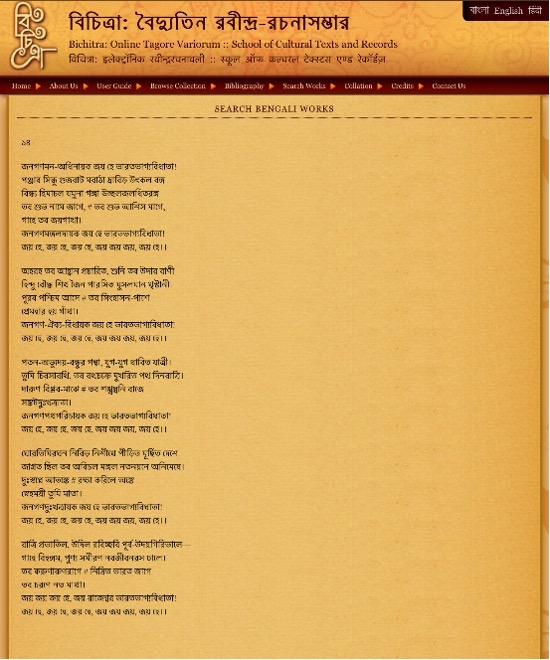

Categories
The Literary Fictionist

The Chained Man Who Wished to be Free

By Sunil Sharma

Prometheus Bound, charcoal by Christian Schussele. Courtesy: Creative Commons

When life itself seems lunatic, who knows where madness lies? Perhaps to be too practical is madness. To surrender dreams — this may be madness. Too much sanity may be madness — and maddest of all: to see life as it is, and not as it should be!

— Miguel de Cervantes Saavedra, Don Quixote

.

Surendra was firm.

So were they.

“You are mistaken,” said Raghu.

“No. I am not.” Surendra replied. “You are mistaken.”

“You are free! Free to move around and visit any place of your choice. Nobody can stop you. Nobody is stopping you. Inside or outside. Doors are open. Go for a stroll. You will realise this freedom. Why do you keep on saying this, father,” said the eldest son, while others listened and nodded.

“No, I am not free here—elsewhere. This is the truth. I am in chains. I carry them as a heavy burden, everywhere.”
“Why do you say that dear brother?” asked Mukesh. “Your son is trying to make you understand that there are no chains around you. But you are adamant…and wrong.”

“Where am I wrong, Mukesh? You know me better.”

“Sorry, bro! But you are wrong.”

“How?”

“You say you are chained.” Mukesh replied patiently. “There are no chains. Look around — no chains. It is your illusion only.”

“It is a fact, Mukesh. I am in chains. Trust me, please,” said Surendra calmly. “I mean it. Every word. You know I never tell lies.”

A collective sigh!

Surendra was his usual composed self. Tall and dignified, he sat on the edge of the bed, in a meditating pose. A subtle aura made him appear otherworldly, a sage, among the philistines.

They sat for long. The distant forest could be glimpsed from an open window, a mass of soft shadows.

Raghu bent a look at his uncle.

“What nonsense, bro! You are totally free. I assure you. Absolutely free.” Mukesh broke the stalemate. “You are a well-read man. Why are you tormenting yourself and the rest of us? Please stop believing this wrong notion. You have always been logical. Now, come on. Walk with me to the nearest hotel on the highway. Nobody will stop you from moving around. I repeat, it is a free country!”

“Uncle is right. For the last three hours, we have been trying to prove the simple fact that you are not in chains. It is only a delusion! Come out of that, please, father and spare us this stressful drama.” Raghu pleaded with folded hands.

Surendra was unmoved: “That is the sad part!”

“What?”

“That my chains cannot be seen by my own son!”

“Please! Do not start again this argument now. It is a democracy in which all of us are free. That is it. Final! I do not want to argue on a given. Period.”
“You are a fool. You are in chains, too, invisible chains but you don’t realize that, right now, like the silent majority. Living under the greatest illusion. That is it.”

Raghu gave his father a resigned look, “No point in talking further about this. Nobody can convince you. I am done.”

Raghu got up to leave.

“Fool! You will realize this fact soon.”  Surendra said quietly. “It took me all these years to understand this simple and fundamental truth! We are all in chains in a free country! That is the biggest irony of human condition globally!”

Raghu did not engage with him. He exited, along with others, into the courtyard.

Ma waited there.

“Wastage of time and energy. Refuses to listen to reason. Stubborn as usual. He has never listened to me anyway. The fact is that he does not want to see reason. If not insane, he is not sane, either!”

Ma nodded. “I knew it from the beginning. Married to a top-class nut. Told you also many times. You never believed. Now face it.”

“He was a graduate, first in the community. Mad guys do not finish a B.Com with a first class,” replied Mukesh agitatedly. “Our mother said you drove him crazy. He was an intelligent man who did a lot to the extended family but you and your constant nagging made him mad.”

Ma retorted, “Defending the elder brother, as usual. You all gang up on me — mother-in-law, five brothers-in-law and two nasty sisters-in-law, all these years.”

The brother glowered. Ma glowered back. Mukesh muttered something and left in a huff.

Raghu and others met again, late night, to discuss ways of avoiding a possible public embarrassment of a rational, law-abiding, articulate man going mad in the autumn of his life, for no apparent reason.

It was a big mystery — his absurd claim of being in chains.

They discussed, debated but were unable to figure out the apparent trigger for such an odd behavior of the patriarch.

“We must act fast. The village should not learn that he has lost his mind,” Raghu said. “It will be great shame!”

They agreed to take him to the mental hospital the next afternoon on some ruse.

The gods willed it otherwise.

The village learnt about Surendra’s madness, very next morning, in a most dramatic manner. The author of this revelation was none other than a composed Surendra announcing it in the morning in the public square.

.

“You all are chained! Listen to me. Break your chains, you fools!”

Surendra shouted at the top of his voice.

People came out and watched, curious by the sudden transformation of a much-lauded supervisor in a textile factory in Kolkata, who had moved to Delhi, after the textile mills had closed down and driven taxi and finally owned three, in the Capital for two decades—saved money in the process, raised a large family and returned home in the village in Bihar to spend remaining years in the shadow of his ancestors. Surendra had renovated his old property in the village still mired in poverty. He taught children from the low-income families English and Math. A well-respected son of the soil who was not claimed by the city, like many others, and had returned to his roots.

At the moment, he appeared the usual self– calm, composed, dressed in simple cotton shirt and trousers, all white, and a pair of sandals. He wore a white Gandhi cap and spoke in measured tones.

As more crowd gathered near him, with children jostling for space and better view, he climbed a pile of crates, outside a grocer’s shop and addressed the audience in his familiar baritone: “Hear the truth! Be liberated!”

An old man asked lightly, “Okay. Give us the truth.”

Surendra smiled and said, “You ready for the shock?”

“Yes. We are.” The old man said. “Nothing surprises us anymore.”

Others chorused a big yes.

“Listen then, old man. This will surprise you a lot…” here he trailed off, building up suspense. Surendra surveyed the crowd and exhaled.

They waited for the fun.

Surendra looked again at the assembly of friends and neighbours and declared loudly: “Listen! The Truth. You are all shackled. All in chains!”

The old man was taken aback. “What? Are you drunk?”

Surendra laughed. “The drunk do not tell the truth. They spill secrets, after a peg too many.”

“That is also the truth,” countered the old farmer who had once stood for local elections. “The drunken truth. It also reveals things.”

“Truth is much higher than the alcohol-induced revelation.”

A murmur went around. Some youngsters jeered at the pompous man standing atop his perch, like a self-appointed guru.

“Fools! I give you the truth and you laugh at me!”

They laughed more.

“There is more.”

“What is that?” the old farmer demanded. “More truths!”

“I am the republic!” declared Surendra. “I am the democracy.”

This made the crowd laugh uproariously.

“He is out of mind,” said a neighbor. “How can a common citizen be the republic and democracy?”

“He always thought in grand terms,” said a school chum. “Treated himself as superior to rest of us!”

They laughed and some repeated derisively, “Hey, Republic! Hey, Democracy!”

“Tomorrow he will say he is the President of the Great Banana Republic!” said the chum.

“And day after, he will be the God!” observed the old farmer.

Surendra did not flinch. “Fools! You do not understand. You, too, are the republic and the democracy.”

They jeered again. “He is the Government.”

“Yes. I am the government.” Surendra shouted at the top of his voice. “I am a citizen — and everything. The basic unit. The fuel that keeps the system going.”

The crowd began enjoying the show.

“You are the government?” They asked.

“Yes, I am.”

“Then solve the problem of poverty, my government.” The farmer mocked.

“Who is the government?” A burly inspector asked in a husky voice. He had joined the crowd few seconds earlier. The crowd made way for the new arrival, haughty and walking with a swagger.

“This old villager says he is the new government,” said the school chum sarcastically.

“And the republic and democracy.” Added the old farmer with glee. “See his arrogance, audacity, a common man claiming to be the government!”

The inspector was amused. “Did you say that, old man?”

Surendra showed no fear. “Yes, I did.”

“What did you say?” the inspector asked. “Say it again.”

“I am a citizen.”

“Right.”

“I am the republic.”

“Wrong.”

“Why?”

“Because I am saying that — the police officer who is the real government. My word is last.”

“You are a mere pawn in the power game.”

“Let it be but I am the real government of this area.”

Surendra was patient and then said quietly, “Let it be. Anyway, I repeat, I am a citizen, the republic, the democracy and the government.”

The crowd laughed. They were enjoying the show now.

The inspector was amazed by the bold assertion. “How dare you?’

“Dare what?”

“How dare you call yourself the democracy, the republic and the government?” blazed the inspector.

“And why not? Why cannot I claim that?” persisted Surendra.

“A puny citizen! A low-life — that is what you are — nothing else.”

“Why low-life, inspector? I am the basic unit, like you, of the democracy.”

“So you say you are the government?” the cop jeered.

“Yes. I am. Part of the elected government.”

The crowd clapped for the puny man facing the cop.

The inspector replied, “That is going too far. I have to arrest you…”

“For what crime?”

“For anti-government stand. Being a grave threat.”

Surendra laughed. “Do I look like a threat? An old man standing in the square? How do I constitute a threat to the mighty state?”

The inspector scratched his bald head, pondered and then said, “I say so. I am the authority to decide that.”

“Then you are abusing your office,” replied Surendra.

Surendra’s statement surprised the fat officer. He thought and then said, “Enough! You are proving to be a danger to the security of the country. You are a public enemy number one. I arrest you for inciting people.”

He clapped the handcuffs on Surendra who said nothing.

People mocked him: “The new government goes in handcuffs!”

Surendra smiled and declared, “Fools! If truth leads to arbitrary arrest, you too, are under threat. I am ready to die for my convictions, my truth, which is the universal truth. The real government is always the public!”

Now few youngsters began shouting, “He is right. We are the real power, the voters. He is right!”

A carload of tourist was passing by. They stopped and filmed the scene. There was a local journalist and a lawyer who demanded an explanation from the cop: “How can you arrest a citizen for claiming that he is the legit democracy?”

The crowd was split into two camps: pro- and anti-police.

The seasoned cop understood the gravity of the situation and the volatile mood of the frustrated masses. He was one pitted again a crowd that might question his ways.

The man in khaki dialed a number desperately. Soon two jeeps arrived and took the disruptor to the police station, 10 miles away, followed by a large crowd and the carload of tourists. Within hours, the video began circulating and became viral. Foreign press caught on. Then the national press arrived and parked itself outside the police station.

The inspector refused to budge. “He is a public enemy number one, out to destroy the general peace and to incite people against the state by his bizarre claims of being the State, Democracy and Republic. A real danger to the legitimacy of an elected government. He needs to be kept behind the bars for the sake of peace and order.”

As the “Free Surendra, the Citizen” drive spread within 24 hours, the cops secreted him away to some other place, and, he was never seen again.

Some said he died due to torture. Others said Surendra was put in a maximum security jail in an island. Others claimed he was offered money and land by an opposition party to run on a ticket against the ruling party member.

The opinion was divided: Surendra, the Mad vs. Surendra, the Prophet: The former challenged the status quo and the latter revealed the plain truth to an unbelieving public!

Meanwhile, Surendra’s joint family had gone underground.

As happens in such viral cases, public memory being short, the world soon forgot Surendra  and moved on with other viral videos about crazy dancers, weddings and stars spotted in the public.

Videos that excited the popular imagination.

Surendra and his disappearance no longer mattered.

After all, he was nothing — a zero.

Add zeros — and you become millions! He had once declared.

Sadly, he was ignored.

The thing did not end so tragically, however.

…on moonless cold nights, the ghost of Surendra could be seen in many locations, breaking his big chains and occasionally heard muttering — some said — two Russian names: Akaky Akakiyevich Bashmachkin and  Gogol. After such sightings, the witnesses too, began mimicking his action and wanted to break out of their chains.

But who knows? These can be urban legends.

Fiction.

Or truth. In these days of doctored versions, it is difficult to decide on such matters…

.

Sunil Sharma is an Indian academic and writer with 22 books published—some solo and joint. Edits the online monthly journal Setu. Currently based in MMR (Mumbai Metropolitan Region).

.

PLEASE NOTE: ARTICLES CAN ONLY BE REPRODUCED IN OTHER SITES WITH DUE ACKNOWLEDGEMENT TO BORDERLESS JOURNAL. 

Categories
Stories

Rituals in the Garden

Flash Fiction from Argentina by Marcelo Medone

Every morning, when the first rays of the sun appear, Martha opens her eyes, takes a deep breath and smiles, grateful to be alive one more day.

She listens to her heartbeat for a full three minutes, leaps up and lands on the small Persian rug next to her bed. There, she flexes and extends her worn joints and stretches and massages her lean muscles.

Then she sits in front of the large mirror on the dresser desk and gently combs her long grey hair, contemplating her image and updating her wrinkle count. It is not because they bother her, on the contrary, she knows that each new wrinkle of expression indicates that her face remains vital. Her only regret is the increasing amount of brittle hair that gets caught in the old mother-of-pearl brush.

Then she goes into the kitchen and she prepares a breakfast of jasmine tea with almond milk, whole wheat toast with blueberry jam, papaya slices and a mango juice. She takes some minutes to enjoy these delicacies, without rush.

Only afterwards, she goes out into the garden, ready to soak her parched skin in the early dew. As the sun begins to cast shadows on all the shapes, she stands next to the scarlet rosebush that never stops blooming, a wide beam spreading over her face. She then gazes at the birds and insects that have risen earlier than her.

Soon she dwells on what treasures and that most visit her: her memories. Memories of when the world was young because she was young, life was carefree and love was everlasting. Memories of her mother combing her long blonde hair as she continues to do so, of her father presiding over the prayers at the table with a firm, baritone voice, of her husband Melvin holding her tenderly and of her son William saying goodbye over and over again.

Many years ago, she forgave Melvin and his absence no longer moves her. In fact, she doesn’t even know if he’s still alive on this planet that’s overcrowded with both good and bad people. Martha decided that her ex-husband belongs to another universe and even to another spiritual plane totally divorced from hers. She has only one or two pleasant memories of him left, embedded in her memory like tombstones.

The memory of her son is what hurts her the most, with a pain that has grown with her during all those years, not comparable to any other. A son hurts his mother when he grows up and makes her uncomfortable inside the pregnant womb, when he is born at childbirth, when he gets ill or undergoes some threat and when he leaves her side. Being a mother implies suffering eternally, in a way that cannot be renounced and cannot be delegated.

Martha knows what pain is first-hand. Nobody has to explain it to her.

Finding strength within herself, Martha chants an ancient mantra that is an epiphany of life and a litany for those who are gone. Her vocal cords vibrate with a magnificent, heavenly coloratura, rising in the breeze that sways the leaves of the poplars and maples that line the garden.

Martha has been at peace for a long time, in communion with nature and with life and death, which for her are only two sides of the same coin. She knows she will soon be transitioning from front to back, from the visible side of experience to the totally unknown.

All this is whispered to her through impertinent moans by her old bones and is confirmed by the latest report from the haematologist oncologist who has been treating her for a year for her leukaemia.

Then, she goes to her meditation corner in the garden, next to a pond lined with rounded white stones, where the water lilies grow under the watchful eye of a Buddha sitting in the posture of meditation with his eyes closed, who invites her to do her asanas and mudras. In those moments, Martha really senses she connects with herself and with the Universe.

The rest of the day finds Martha dedicating herself to small tasks at home, keeping her little world in order, engaging in nostalgia for the past and acceptance of the present.

When the sun starts to go down and the shadows grow long again, Martha returns to the garden with her weary stride and her eternal smile, goes to the evergreen willow tree and places a scarlet rose petal on the memorial of her son William who never returned from the war and still says goodbye to her every afternoon.

In her own way, Martha is happy.

.

Marcelo Medone (Buenos Aires, Argentina) is a fiction writer, poet and screenwriter. His works have received numerous awards and have been published in multiple languages in more than 30 countries.

.

PLEASE NOTE: ARTICLES CAN ONLY BE REPRODUCED IN OTHER SITES WITH DUE ACKNOWLEDGEMENT TO BORDERLESS JOURNAL