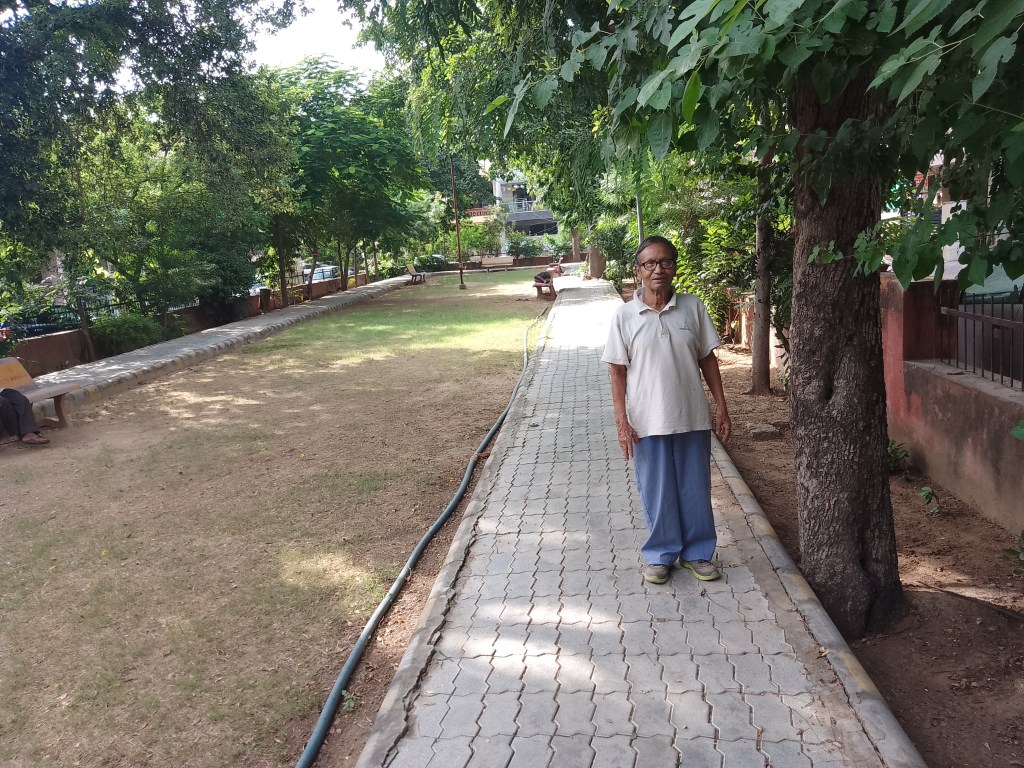
AHILYA PARK

Three monkeys
with their babies
romped merrily in the park,
gambolled and jumped from one branch to another.
Twice, the group of monkeys crossed my path,
Preventing me from walking forward.
Three children swung on the swings.
On the adjoining the pillar,
squirrels, sparrows and sandpipers
shared food together with glee.
All this added to my joy of
walking in the park.
The park is not just an assemblage of trees,
plants and creepers,
but a rendezvous for
men, animals, birds and trees
and together they exist,
happily and blithely.
Sagar Mal Gupta, educated at the University of Edinburgh and the University of Hawaii, earned his Ph. D. in Linguistics from the University of Hawaii USA. He has fifty-six years of teaching experience of English language and Literature in India and abroad. He has published four books of poetry in English and his poems have been published in a number of national and international journals of repute.
PLEASE NOTE: ARTICLES CAN ONLY BE REPRODUCED IN OTHER SITES WITH DUE ACKNOWLEDGEMENT TO BORDERLESS JOURNAL
Getting old is like climbing a mountain, you get a little out of breath
but the view is much better!
                                                                     - Ingrid Bergman, actress
He arrived in the morning. He was carrying a small bag but enough to contain things to stay for three to four days. His visit was unannounced. Although he was cordial, I didn’t inquire into the purpose of his visit. I invited him inside and showed him the spare room where he could rest a while. He was seventy-nine years and could do with some rest. His body language showed he was grateful, yet he didn’t offer a reason for his presence in the morning. I went inside the kitchen so that I could prepare a cup of coffee for him. I heard him move inside his room, the footsteps of an old man. I could hear him take things out from the bag and push some back. After a while, the sounds stopped. The house turned silent. It sounded silent and silence sounds like death. My eyes roved over the kitchen table to check on the things available to make a decent breakfast for uncle. He was in need. He looked famished.
I pushed open the door leading to the backyard, in the kitchen garden, the plants were unkempt. It was a messy area of about forty-four square feet. I plucked brinjals and tomatoes to make the sambar respectable and to add on to the coconut chutney which was already done. There was also coriander, not ready for plucking, but at times like this it could be useful. I heard the sound of the cistern flush, the water drained without giving inkling of anger. I handed him the cup, he took it and kept looking at the floor. He drew an arc with the toe of his right foot. I could not understand what the act meant except he was disturbed. There would be time later to get to know. For the time being I let him feel at home. He didn’t inquire about my husband’s whereabouts. My husband was his nephew. Uncle might have assumed Shyam has gone to office. Actually, Shyam has gone to handover his Renault Kwid for the first unpaid service. He would be late today. Shyam too would have to have his breakfast before starting for work. Maybe they could have it together. We all could.
I hoped uncle would spruce himself and be ready before Shyam returned. I was not going to rush him.
Shyam would be in a terrible hurry. He could catch up with his uncle while he is pushing the idlis[1] down his throat. I have to keep requesting Shyam time and again to eat slowly. Food is meant to be enjoyed and not be dealt with as if it is a task to be completed. Breakfast is the only meal Shyam has at the dining table. He took his lunch in the office canteen and the night meal was invariably at the bar he frequented. I had rehearsals for the coming play at Ranga Shankara in Jayanagar. Most evenings, I was out. I think he ate only fritters and no proper dinner. I never questioned him about his activities. He found that convenient.
I went past the room in which the uncle was lodged. I pretended to go out under some pretext. The garbage collector had entered the street. The garbage needed to be in cans outside the gate. I peered in. The door was open. Uncle was seated on the mattress leaning back on his hands. He was looking up at the ceiling fan, at his own reflection on the chromium plated hub-cap. He had not switched the fan on, the weather was fine. I collected the compost bag and kept tossing handfuls on the potted plants in the courtyard. That was my weekly routine. The plants responded to the manure but the moment the plants shoot buds, insects destroyed them. I tried to give uncle some privacy by remaining in the garden. He looked rather pulled down. If he wanted to make some calls in my absence, I’d rather facilitate it; but he didn’t.
Uncle lived in Hebagoddi with his only son, his house overlooking the wholesale fruit market. Whenever we visited, I found him standing on the open terrace upstairs and watching the trucks loading and unloading. Ajay resigned his job in Hosur and had left to take up new assignment in Abu Dhabi. He told us he wanted to move with his family to Abu Dhabi. I wondered if he could take his father as well. Maybe that was what made uncle preoccupied – the thought of being left alone without his son, who was also his caregiver. Uncle had a handsome pension as a retired school master. He was not dependent monetarily, but he needed someone to assure him everything was going to be fine. An old man required assistance and supervision. My dad’s brother had dementia from being lonely they said. since He had no one to talk to. He was a bachelor with lots of money but dementia doesn’t check the wallet before setting in.
I went back to the kitchen. The decoction had filtered down. I mixed the coffee and took it along with two Marie biscuits. He took it and placed it on the table. His hand shook. He said, “Thanks.” He wasn’t curious about Shyam’s absence. I was surprised he did not inquire. He was Shyam’s uncle not mine.
I told him, “Shyam would be back shortly, I will serve breakfast when he comes.”
“That’s nice”, he said. “In that case I will have the coffee after breakfast. I took Pantacid just now. Let the medicine do the job.” He took the two biscuits, placed them on the paper napkin and returned the cup.
I said, “Fine.” I lifted my chin to scrutinize his face.
“Its difficult to live with Ajay’s wife,” he said. Uncle moved towards the window turning face away from me. The top two panes of the window were open. They overlooked the vegetable garden I was ambitious about curating. Beyond that was a small 30 feet road. I did not attempt to mollify him. I left the job to Shyam. He was Shyam’s his uncle.
Uncle said, “I can grow enough vegetables in my house in the terrace, I mean in Ajay’s house. People these days grow vegetables in plastic grow-bags you know. I can grow enough for the family or even more. She wouldn’t allow.” He meant Ajay’s wife. Growing vegetables is my passion. My conviction is one should try to grow food in lifetime instead of only consuming. It’s my desire to grow at least one kilo of rice with my bare hands at least once in my life, I told this to uncle in order to keep him cheerful until Shyam returned.
“We should find a place in our village and try doing growing the rice there. Being in city, you can’t”, he said and curbed his instinct say more. The conversation cheered him and I believed took his mind away from Ajay wanting to shift his family to Abu Dhabi. I was not sure if Ajay was planning to take his dad there. It may not have been a workable proposition.
I said, “Its good to try, to think on those lines. I guess Shyam would agree to the idea post his retirement. As of now I have this theatre group which pegs me here.”
A car entered the lane, the sound of its engine was echoing from the between the compound walls. The colony would have looked more impressive without the compound walls. The car stopped in front. The driver’s face seemed familiar but I could not place him. Shyam got down from the other side. He thanked the driver and entered. The car sped away, it was an old red-coloured Punto. The driver smiled on seeing I was trying to place him.
I was not sure if I should inform Shyam about the unannounced guest or leave him to find out for himself. Maybe he knew of the arrival and had forgotten to inform me.
Shyam said, “I must rush, Sundar has promised to pick me on the way. Can’t make Sundar wait.” He went straight into the washroom. He was the type who would expect his wife to keep his clothes ready when he came out of the bath. Before that, he would want the towel. I did that part of the chore, returned to the living room from where I could see uncle. He was not affronted by Shyam’s behavior. He seemed to understand. He smiled sympathetically upon seeing my distress.
“Let me set the table for breakfast,” I told him and went about doing so. I wanted to tell Shyam to eat slowly — to get up only when uncle finished. Uncle came out of the room for the first time. He sat quietly in front of the dining table where Shyam sat normally. He leaned using his elbows on the table. He saw me arranging the plates. He opened the lid where idli was stacked. He smiled again. There was plenty. I too sat pretending to remove the speck on my plate.
“I have to find an old age home,”he said nodding his head.
“It would do you good. you can be all by yourself,” I said.
“You don’t understand the point Kamala,” he said. I could hear Shyam coming out of the bathroom. He started dressing. He dressed himself first before using the hair drier and combing his hair. I knew as soon as he finished, he would head for the dining table. I waited for the sound of the drier being switched off. I had not informed Shyam about uncle’s presence as yet. Waiting at the breakfast table, I was not sure I should make the effort. He obviously was not expecting to find uncle. I hoped he would be polite to his uncle.
Shyam came in. He had heard our voices, if not the subject of our conversation. He was pleased perceptibly to see his uncle, he went behind him, put his hand over uncle’s shoulders and gave him a hug from behind. He said, “What a surprise! How is Ajay doing? Is he really liking it out there, it is a dangerous country, not meant for one with his kind of temperament.” Shyam rushed with his words, he wanted to convey whatever he wanted quickly without giving scope for his uncle to respond. He looked at me and said, “I promised uncle that I would find him a comfortable old age home. Better that Ajay takes his family quickly to Abu Dhabi. He has the knack of getting into trouble if left alone.”
Uncle didn’t want to prolong the conversation about his son. He said, “Something that fits my pension, not a paise more, I don’t want to take help from Ajay though he may be earning in Dinars now.”
He craned his neck to see when I would start serving. Shyam pulled the chair away from the table to sit, the chair made a grating noise on the floor. I switched the fan on and started serving. The three of us ate quietly. Shyam kept stuffing idlies as was his habit. He choked a bit but managed to swallow without any issues. I had only one idli. I got up to prepare coffee. Sundaram could arrive any moment, though Shyam had not stated the time of his arrival. Shyam took his uncle to the verandah in front. I could hear them talking, though I could not make out what they discussed. It sounded like they wanted to keep me out.
Uncle left our house after three days. He never went back to Ajay’s house. He went straight to the old age home. I felt sad. Shyam had arranged accommodation where uncle could stay in relative comfort. That’s what Shyam told me the previous night.
Whatever the comfort and care the old age home offered, such homes for the aged could not offer hope. Inmates kept falling sick, became invalids and sunk to death slowly. Besides they all had their own tales of woe which each would share, deepening the shadows in others lives. A home could not offer hope.
Shyam said the three days stay with us had restored uncle’s faith in humanity. It was a tall statement, though I suspected it was true. We tend to seek our own space in the kingdom of self-righteousness, we feed on such feelings. During the afternoons we had watched movies together on Netflix or Prime Video. Uncle made the selection. He always chose a crime thriller or science fiction, avoided movies focused on family relationships.
He took me into confidence and confessed on the last day. Shyam was to drop him at an old-age home named after Mother Theresa the next day. Uncle told me almost in whispers after the movie, as if he didn’t believe what he said, “Ajay’s wife is very loving, I can’t say she was wanting in that faculty.” I wanted to believe uncle.
When uncle left, there were tears in his eyes. He didn’t try to mask his feelings. I could not figure if it was on account of a feeling of gratefulness or of grief. He sprayed the insecticide on the rose plants in the courtyard while Shyam was loading his things in the car. I had presented him warm blanket in case the home didn’t provide one. Shyam promised to visit him often, though he did not specify how often.
Ajay’s family had left. He sent uncle photos of their new home. I had half a mind to tell uncle to stay with us, though I didn’t. He was not a bother, was really not a bother. He would have helped with the kitchen and courtyard garden as well as the proposed one in the terrace upstairs. During his brief stay, he helped to water the plants, folded the laundry, cut vegetables for cooking, he cut such perfect cubes. He enjoyed peeling garlic pods. He loved it. One day when the daily maid absented herself, I even found him doing the dishes quietly without letting me know. I had closeted myself in our room to memorise lines and cues of a new play.
Uncle could have stayed with us if it was not too long. Life looks interminable if we don’t know how long. We didn’t know how long all this would go on had he stayed. He looked healthy though he was seventy-nine. You never know. Love without willingness to take on the responsibility was an aborted child, that much I knew.
Saranyan BV is Bangalore based poet and short-story writer. His works are being published in Indian and Asian journals regularly. He came to the realm of English by mistake but loves being there. He is a big fan of Raymond Carver and Charles Bukowski. He thinks that the genre short story is going to rule literature in the days to come, if the writers are ready to take up the challenge.
.
PLEASE NOTE: ARTICLES CAN ONLY BE REPRODUCED IN OTHER SITES WITH DUE ACKNOWLEDGEMENT TO BORDERLESS JOURNAL
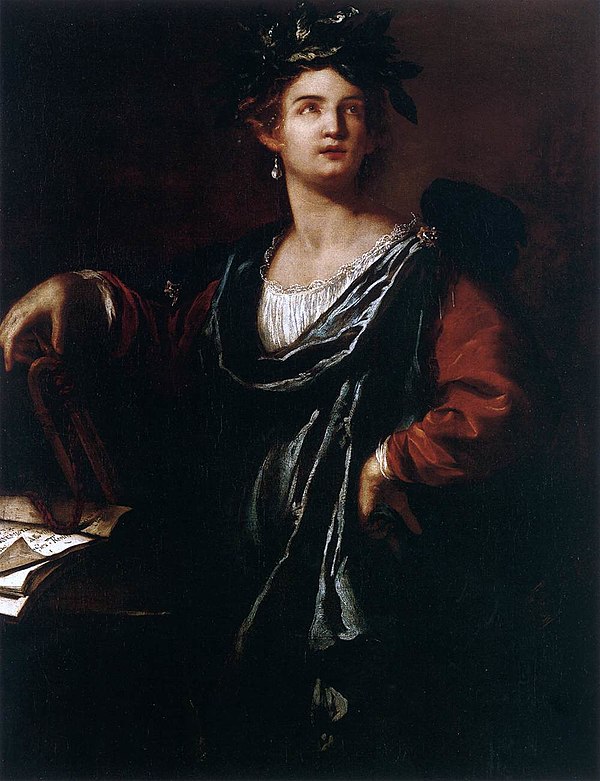
Clio, Muse of History, Painting by Artemisia Gentileschi (1593 – 1656). Courtesy: Creative Commons
History has a long past, shrouded
In layers of the mist of Time,
Most of which is unseen in a museum.
History has a future vast as an ocean.

Of times whose tides are frontline,
We are in the middle of the flow
Between a past catching up on us
And a future we are catching up to.

We must dig deep in the gaping ruins
To perceive all that remains cloaked
In the halls of maligned controversies,
In tune with ruling elites of the times.

Painted dark might be the white,
And painted white might be the black,
This is how history is entrenched
And has seen snowflakes fall in the Sahara.

The past is in the jaws of the present
Which is incessant in its slither
Into the jaws of a future, rather nebulous,
To drag it into the past sliding behind.

A lava of tears flows down the cheeks
Of history as we wield its resolute truth
Until it remains a shadow of itself.
It sheds one last tear and sails on.
Pramod Rastogi is an Emeritus Professor at the EPFL, Switzerland. He is a poet, academician, researcher, author of nine scientific books, and a former Editor-in-chief (1999-2019) of the international scientific journal, Optics and Lasers in Engineering. He has published over ninety poems in international literary journals.
PLEASE NOTE: ARTICLES CAN ONLY BE REPRODUCED IN OTHER SITES WITH DUE ACKNOWLEDGEMENT TO BORDERLESS JOURNAL
G Venkatesh writes about a book from 1946. What is interesting is no women writers are featured in it despite their being a phrase which he quotes in his essay, ‘a stepdaughter of the Muses’…
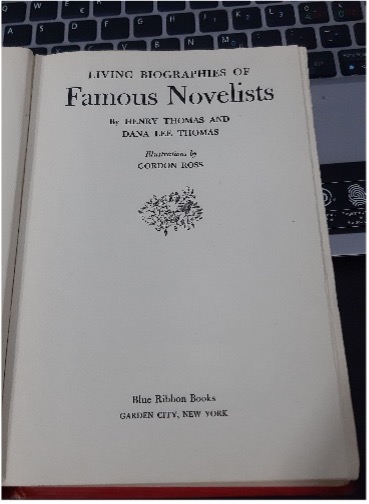
Photo graph by G Venkatesh
There is this book published in 1946 in New York, that I picked up at a Red Cross charity shop in Karlstad (Sweden) of late. A compilation of micro-biographies (make that ‘nano’ if you will) of 20 novelists (fiction-writers in other words) from Italy, Spain, France, England, Scotland, the USA, Russia and Ireland, who graced the world of literature in flesh between the mid-14th and the mid-20th centuries, and will continue to do so, in spirit, forever.
Pillars of fertile imagination, seeded from the idea-realm Visual by G Venkatesh
I venture in this article to present some gleanings from this little gem of a book, to enlighten, motivate, inspire, educate and rekindle interest in the classics of yore. Ralph Waldo Emerson wrote that all writing happens by the grace of God. We witness that in the lives of the twenty writers profiled in the book. Some had an inborn urge to write, some developed the penchant to do so as if the idea floated in from the idea-realm beyond the astral, and some others were blessed by the Divine to transmute their pain and suffering to the written word that has stood the test of time, and will continue to do so, into the distant future. Condemnation paved the way to commendation for some, while rejections emboldened others to transcend the limits of human judgement and rejoice in the sunshine of hard-earned glory.
At its perigee, the ‘novel’, as observed by Henry and Dana Lee Thomas, is an epitome of philosophy as applied to life. The Thomases ask readers to consider the life of every novelist profiled to be a magnum opus in itself – each adorned with facts stranger than fiction.
Boccaccio, Rabelais, Cervantes
This is an Italian-French-Spanish trio (encompassing the 14th to the early 17th century), and perhaps most of the readers may be familiar only with the third-named. Giovanni Boccaccio was a contemporary of Alighieri Dante (whose biography he wrote). A ‘friendly sinner’, he was a devotee of the here and now, while also being profoundly interested in the hereafter.’ Novelists, well and truly, leave behind accounts of their times, couched in fiction (and that, read alongwith factual history, helps us readers to visualise and understand better how things were in the past). The ‘poets’ in them, simultaneously dwell on and dream about how things can, must and will be in the future. Many of them refrain from including a semi-autobiographical element to their novels, and the Thomases have identified Francois Rabelais as being one such. To the Frenchman, all life was an anecdote with a bitter ending, a truth he based his limited fictional creations on.
Miguel de Cervantes, the Spaniard, is presented as a disappointed, shattered and disgusted man, who was chiefly motivated by his own trials, travails and tribulations to pen the famous Don Quixote. This knight who fought windmills, was perhaps what Cervantes thought himself to be – blessed with the good fortune to live in folly and die in wisdom.
Defoe, Swift, Sterne
From the simple Quixote and the clumsy Sancho Panza to the resourceful Robinson Crusoe and his helpful Man Friday, characters created by Daniel Defoe in a novel eponymous with the protagonist. Defoe was a paradox of moral integrity and material ambition (if you can visualise one such blend), who by virtue of the fact that he donned the mantles of businessman, pedlar, politician, pamphleteer and spy (not necessarily in that order) in his life, could interpret mankind expertly in his fiction. A kind of ‘been-there, seen-that, done-that, can-write-about-all-with-authority’. Jonathan Swift, of Gulliver’s Travels fame, was gifted with a supreme intellect and a spiritual-religious leaning, but encumbered by physical weakness. God gives but also deprives at the same time, a mystery which humankind has not been able to solve. Fatherless when barely half-a-year old, he was verily a titan (like the character Gulliver he created) among pygmies (like the Lilliputians). He abhorred injustice and thought and prayed forever for the felicity of humankind. He lived to be 78, but contended on the basis of his experiences that the gift of a long life is bought at a very high price.
Laurence Sterne, the preacher-poet Yorkshireman, left behind several nuggets of wisdom in his novels and a couple of them can be cited hereunder:
“I laugh till I cry, and I cry till I laugh” (reminding one of the Yin and the Yang which feed into each other)
“Give me all the blessings of wisdom and religion if you will, but above all, let me be a man.”
Scott, Balzac, Dumas
Sir Walter Scott, while being a prodigy like Swift, also had to contend with physical disabilities like him. He tided over them marvellously, prudently, gallantly and tirelessly, en route to a knighthood and immortality in the realm of English literature. Dreamy Honoré de Balzac, obdurate and uncompromising, believed that man’s destiny and purpose in life was to “rise from action through abstraction to sight” – a deed-word-thought ascent in other words. “Life lies within us (spiritual), and not without us (material)”, he averred. He never got the glory he deserved when he was alive, and his soul perhaps got the peace it richly merited when fame showed up posthumously.
Athos, Porthos, Aramis and D’Artagnan – characters from The Three Musketeers, a novel by Alexandre Dumas which presents the facts of 19th century France through the medium of fiction – were known to school-goers in the 1970s and 1980s, like yours sincerely. Dumas, as the Thomases have noted, met praise with a shrug and insults with a smile – stoically in other words. However, he had a penchant for sarcasm and trenchant wit which were unleashed whenever required. “I do not know how I produce my poems. Ask a plum tree how it produces plums,” is verily a testimony to his transatlantic contemporary Ralph Waldo Emerson’s “All writing happens by the grace of God.”
Hugo, Flaubert, Hawthorne
Two Frenchman and a New-Englander American comprise this trio. Viktor Marie Hugo, of Les Misérables fame, was born in the same year as Dumas, and was regarded widely as the ‘Head’ of the 19th century to Abraham Lincoln’s ‘Heart’. His crests of hard-won success coincided with the troughs of ill-deserved sorrow (he had to contend with the deaths of his wife and children). The Divine Will strengthened his mind, soul and fingers to move quill on paper, enabling the much-bereaved Frenchman to cope and conquer. “Sorrow,” he wrote, “is but a prelude to joy.” A stoic would however add, “and vice versa”. Quite like Sterne’s “I laugh till I cry, and I cry till I laugh”. Despite all that he had to endure; Hugo always believed in God and the purposes he lays out for human beings in their lives.
Hugo’s friend Gustave Flaubert considered the written word to be a living entity, with a voice, perfume, personality and soul. A concoction of realism and romanticism, if ever there was one, Flaubert was also a peculiar amalgamation of poet-cynic, artist-scientist and humankind’s comforter-despiser. He ardently believed that though the soul is trapped within a mortal corpus on the terrestrial realm, it (which is the actual identity of a human being) lives in the idea-realm, and finds its rewards therein.
Hawthorne, on the other side of the ocean, was charmed by the sea and surf and sand in his childhood and youth, having spent a lot of time along the New England coast in north-western America. That led him to dwell on the mysteries of the human soul (which continue to be mysteries at the time of writing), while rebelling against the Puritanic influences that had engulfed the region. He was on an eternal quest, an intellectual and moral pathfinder in his own right, and a pioneering rebel with the pen and quill in his arsenal.
Thackeray, Dickens, Dostoyevsky
William Makepeace Thackeray, readers will be interested to know, was born in Calcutta (now, Kolkata). A sentimental cynic who glimpsed the stupidity of life through the fog of sorrow, he believed that foolishness of the past is a pre-requisite to wisdom in the present and the future – in other words, simply put, we learn from our errors as we move on. ‘Gifted with a bright wit and an attractive humour’, in the words of Charlotte Bronte, he contended that literature was more a misfortune and less a profession. His cynicism helped him to grasp reality, and feel empowered in the process –“How very weak the very wise; how very small the truly great are.” Kind and wise humans often lack the power to change things for the better, while the powerful ones lack the conscience, will and goodness to want to do so.
Thackeray rivalled with Charles Dickens for fame and glory. Dickens, similar to Scott and Swift, had to contend with physical discomfort in his childhood and adolescence, in addition to a father who was not responsible with the money he earned. These experiences would later feed into the stories he churned out prolifically; semi-autobiographical some of them, while informing readers at the same time about the times that prevailed – “the best of times and the worst of times” (A Tale of Two Cities). His humble beginnings made him burn the midnight oil later in life, fuelled by the ambition to succeed, which he sustained all along. Quite like it was Hugo across the Channel, the troughs of torment annulled the acmes of accomplishment. Yet, he remained grateful to God and fellow-humans for the life he lived, and bade one and all a ‘respectful and affectionate farewell’, before ascending to the astral realm.
Reclusive Feodor Dostoyevsky, like Hawthorne in America, struggled to shake off a Puritan upbringing and sought fodder for his literature among the common man – the suffering proletariat who visited liquor shops to drown their sorrows in alcohol. Man, he believed, was responsible for his own salvation…and not God. He however did believe at times that God saved those whom men punished. But then, he also contradicted himself or seemed to do so, when he said that man is saved only because the Devil exists. But perhaps that was not a contradiction after all – God saves man from what he has to be saved from! The meaning of life, according to Dostoyevsky, was the brute-to-angel and the sinner-to-saint transformation of man; quite on the lines of Balzac’s action-abstraction-sight prescription.
Novelist
Lifespan
Selected works
Giovanni Boccaccio
1313-1375
Filocolo, Filostrato, Teseide, Fiammetta, Amorosa Visione, Ameto, Decameron, Life of Dante
Francois Rabelais
1495 – 1553
Pantagruel, Gargantua
Miguel de Cervantes
1547 – 1616
Galatea, Don Quixote, Novelas Exemplares, Persiles y Sigismunda
Daniel Defoe
1661-1731
The True-Born Englishman, The Apparition of Mrs Veal, Robinson Crusoe, The Dumb Philosopher, Serious Reflections, Moll Flanders
Jonathan Swift
1667 – 1745
The Battle of the Books, The Tale of a Tub, Gulliver’s Travels Children of the Poor, Directions to Servants, Polite Conversation
Laurence Sterne
1713-1768
A political romance, Tristram Shandy, Sermons by Yorick, The Sentimental Journey
Sir Walter Scott
1771 – 1832
The Lady of the Last Minstrel, Ivanhoe, Kenilworth, The Lady of the Lake, Waverley, The Monastery
Honoré de Balzac
1799 – 1850
The Country Doctor, Eugenie Grandet, Jesus in Flanders, Droll Stories, Louis Lambert, Seraphita, A Daughter of Eve, The Peasants
Alexandre Dumas
1802 – 1870
The Three Musketeers, The Count of Monte Cristo, The Black Tulip, The Prussian Terror, The Forty-Five, Chicot the Jester, The Queen Margot
Victor Hugo
1802 – 1885
Les Misérables, The Toilers of the Sea, The History of a Crime, Legend of the Centuries, The Hunchback of Notre Dame, The Supreme Pity
Gustave Flaubert
1821 – 1880
Madame Bovary, The Sentimental Education, The Temptation of St Anthony, Bouvard and Pécuchet, Salambbô
Nathaniel Hawthorne
1804 – 1864
Twice Told Tales, The Blithedale Romance, The Scarlet Letter, Mosses from an Old Manse, The Marble Faun, Tanglewood Tales, The Snow Image
William Thackeray
1811 – 1863
The Great Hoggarty Diamond, Vanity Fair, The Book of Snobs, Henry Esmond, The Virginian, Lovel the Widower, The Newcomes
Charles Dickens
1812 – 1870
Pickwick Papers, Oliver Twist, Nicholas Nickleby, Barnaby Rudge, David Copperfield, A Tale of Two Cities, Great Expectations
Feodor Dostoyevsky
1821 – 1881
Crime and Punishment, Poor Folk, The Double, The Landlady, The Family Friend, The House of Death, The Gambler, The Idiot,
Leo Tolstoy
1828 – 1910
War and Peace, Anna Karenina, Childhood, The Cossacks, Two Hussars, Three Deaths, A Confession, Master and Man, Resurrection, What is Art
Guy de Maupassant
1850 – 1893
Une Vie, The Ball of Fat, Mademoiselle Fifi, The Necklace, Yvette, Our Heart, Bel-Ami, Pierre and Jean, A Piece of String
Emile Zola
1840 – 1902
Doctor Pascal, Therese Raquin, The Dram Shop, Nana, Germinal, The Earth. The Dream, Rome, Paris, Fertility, Work, Truth, Justice
Mark Twain
1835 – 1910
Huckleberry Finn, The Adventures of Tom Sawyer, Joan of Arc, A Connecticut Yankee, What is Man, The Prince and the Pauper
Thomas Hardy
1840 – 1928
A Pair of Blue Eyes, Under the Greenwood Tree, Far from the Madding Crowd, The Trumpet-Major, The Mayor of Casterbridge, Jude the Obscure, Tess of the D’Urbervilles
Table: The novelists profiled, and a list of their selected works
Tolstoy, Maupassant, Zola
Leo Tolstoy, also a Russian like Dostoyevsky, unlike Dickens, was not guided onward and forward by ambition. He believed in stooping to conquer and was motivated in his life’s journey by compassion. Orphaned when not yet a teenager, haunted by an inferiority complex pertaining to his ‘unprepossessing appearance’, and disgusted with organised religion (the Orthodoxy which prevailed in Russia), he discovered his purpose in Rousseau’s philosophy and in ridding the human heart of evil and helping it to live in peace, in communion with Nature. His dissent, rebellion and dissatisfaction with extravagance (of the nobility), bigotry (of the clergy) and tyranny (of the royalty), were the seeds, water and fertiliser for his contributions to Russian literature. Readers know that Mahatma Gandhi was inspired by the philosopher-prophet-penman Leo Tolstoy to set up the Tolstoy Farm in South Africa. Some nuggets which will serve as parts of vade mecums for readers:
“Death, blessed brother death, you are the final deliverance.”
“There are millions of human beings on earth who are suffering. Why do you think only of me?”
Guy de Maupassant was one of those millions who suffered a lot. Reading about the tragic short life led by him, with constant physical and psychological afflictions which led to autoscopy in his 42nd year, and death in the 43rd, makes one sad. It also makes readers turn to his short stories – of which he is known to be a master – more eagerly. Flaubert and de Maupassant knew each other well, the former being a ‘guru’ guiding the latter on from time to time, along his literary journey.
Another Frenchman – Emile Zola – a contemporary of de Maupassant and Flaubert and a good friend of the painter Paul Cezanne, progressed through pitfalls and serendipitous godsends to profile the poor people of France, and ironically rise to richness thereby. A man who defended justice and spoke up against all forms of unfairness, Zola is known for standing up for the French army captain Alfred Dreyfus, a Jew who was wrongly (and knowingly so) accused of treason in 1894, and playing a key role in clearing the Jew’s name in 1906 (four years after Zola passed away). His last written words –“…to remake through truth a higher and happier humanity.”
Twain and Hardy
The man most readers know as Mark Twain, was born Samuel Clemens in America. Though it would not be right to compare and contrast the travails endured by the novelists profiled by Henry and Dana in this book, it can at least be said that a peep into Twain’s life tugs at your heartstrings and the vibrations linger on for a long time. Indeed, as a natural consequence, respect and admiration well up in the heart, for this novelist. He suffered an awful lot, but also learnt to laugh at his own agony as an ‘onlooker’ – the soul observing the pain of the body and the trauma of the mind it enlivens, from a distance, without being affected in any way. Like Hugo on the other side of the ocean, he endured what can be considered as possibly the greatest sorrow a man can face – burying/cremating his own children, one after another. Twain always supported the underdogs while voicing his disgust at the pompousness of the rich and powerful, in his own unique brand of sarcasm. The following words of his may sound cynical, but they are open to interpretation:
“Nothing exists but you. And you are but a homeless, vagrant, useless thought, wandering forlorn among the empty centuries.”
Without letting these words deter you, link them with the other sufferer Viktor Hugo’s “Nothing is as powerful as an idea whose time has come”, and soldier on.
The last of the twenty, Thomas Hardy, is yours sincerely’s favourite (I happen to read all his important works in my twenties, if I remember right). Hardy like his fellow-Britons Swift and Scott was born with a “frail body, strong mind and compassionate soul”. He was compassionate towards and appreciative of the forces and elements of Mother Nature – winds, clouds, bees, butterflies, squirrels, sheep etc., as pointed out by the Thomases. The manner in which he moulded his protagonists in his novels was catalysed by this compassion. Most of them are compassionate themselves, and evoke compassion in the hearts of readers, quite easily. Hardy wanted to teach his fellow-humans how to “breast the misery they were born to”, by using his fictional protagonists as instruments. His life was an exercise in “subduing the hardest fate” and “persistence through repeated discomfitures”. As it often happens with true geniuses, he was much ahead of his times, and the glory that illumined his soul in heaven posthumously, more than compensated for the disappointments which had to be endured when it was encased in his mortal corpus.
Not the last word by any means
Serendipity, it must have been, which made me stride into the Red Cross charity shop in Karlstad in June, wherefrom I purchased this 280-page treasure. To quote Longfellow (who incidentally was a college-mate of Hawthorne’s),
“Lives of great men all remind us/We can make our lives sublime/And departing leave behind us/Footprints on the sands of time.”
The 20 authors profiled in this book represent a huge family of writers who converted fiction from ‘a stepdaughter of the Muses’ to an ‘epitome of the philosophy of life’, except that there were no ‘daughters or stepdaughters of men’ listed among the novelists in this volume.
.
G Venkatesh (50) is a Chennai-born, Mumbai-bred ‘global citizen’ who currently serves as Associate Professor at Karlstad University in Sweden. He has published 4 volumes of poetry and 4 e-textbooks, inter alia.
.
PLEASE NOTE: ARTICLES CAN ONLY BE REPRODUCED IN OTHER SITES WITH DUE ACKNOWLEDGEMENT TO BORDERLESS JOURNAL
The Woman in the Dabb*

Rub –a- dub- a- dub, one woman on the dabb*.1
Absently, she gives her Pinocchio nose a rub.
Is she waiting for some mouth-watering grub?
The belligerent woman smug in the snug dabb.

That woman always strikes a quarrelsome pose.
A contemplative finger perched on her nose,
conferring with cacophonously cawing crows
sitting on the boundary wall in rows and rows.

Nay, I plead guilty to the crime of mendacity.
But, no way am I refuting the crows’ garrulity.
Then, there were no walls etched with bellicosity.
Those times were marked by back-slapping hilarity.

But, my kid brother was a very mischievous sort,
raising a hue and cry when in the slips caught.
This budding cricketeer with everyone fought,
Saddled with a sharp tongue and a temper hot.

Not friends with the shrewish woman in the dabb
who had one eye cocked towards our respected Bub*.2
Brother’s sixer caught the woman’s nose in the dabb.
Profanities followed from the woman in the snug dabb.

Cursing the ball, the boy and the corollary disgraced,
she flailed her pheran-clad arms, singing her own praises.
She had a penchant for evocative Kashmiri phrases,
a rich vocabulary of intriguing phonetic cadences.

Alas, the ball had created a dent in her Pinocchio nose.
Kashmiri expletives freely flowed; belligerent her pose.
Now, Naseem, the woman, was ready to come to blows.
She rolled up her pheran sleeves, bracing to give a dose

Of her tongue to my brother, who had dented her nose.
In a fiery temper vile, no longer could she lie in repose.
Salman, his buddy, said, “You should try giving her a rose.
Quipped my brother, “Will she accept it despite a broken nose?”

Strange but true, after hours two, the team was in her dabb.
Rohit, Sarju, Ashok, Kuku, Salman, Irfan and a doting Bub,
breaking bread; of cherry chuckles, the dabb was now a hub.
Kandurvaan ki roti*3and kehwa*4 and mouthwatering grub.

Down below, the houseboat-dotted Jhelum happily roared.
Over bellicosity and grudges, love had once again scored.
From the pine tree the golden oriole its melody poured.
Grudges and spats had once again been wisely ignored.

The languorous traffic swirled on the ancient Kani Kadal.* 5
Soon, some little folks and a woman were in a group huddle.
Suddenly a cry of ‘Howzat?’  went up like a lilting song.
The woman smiled, her voice ringing like a dinner gong:

“Gobra*6, thankfully, you broke my nose, not my heart.”
Eyes twinkling, she said with a chuckle, a hand on heart.
Now, my kid brother mends hearts, does not break noses.
Violence, and heartlessness, this cardiologist heartily opposes.

With a smile, he often recalls that woman in the dabb.
He grins as he glimpses her giving her Pinocchio nose a rub.
The woman is now history; for my brother it is a mystery
whether she really carried a torch for our beloved bub.
That affectionate pheran-clad woman in the snug dabb.


 *1 Dabb*: A mini balcony with a protruding ledge in old houses in Kashmir.
*2 Bub:   An affectionate term for an elderly person, [short for Babuji]
*3 Kandurvaan ki roti: Baker’s Bread.
*4 Kehwa: Milk less tea garnished with cardamom, crushed almonds, and cinnamon powder [[saffron optional]
*5 Kani Kadal: The name of a bridge in Srinagar, Kashmir
*6 Gobra:  A Kashmiri term of endearment for a child.
Dr. Santosh Bakaya is an academician, poet, essayist, novelist, biographer. She has more than ten books to her credit , her latest books are a biography of Martin Luther King Jr. (Only in Darkness can you see the Stars) and Songs of Belligerence (poetry). She runs a very popular column Morning meanderings in Learning And Creativity.com.
PLEASE NOTE: ARTICLES CAN ONLY BE REPRODUCED IN OTHER SITES WITH DUE ACKNOWLEDGEMENT TO BORDERLESS JOURNAL
When I first came to Japan, it seemed as if people were always wanting to dress me up in traditional Japanese clothing and take my picture. The kimonos were bright, with embroidered cranes and flowers, and long furisode sleeves. I was 22 or 23. I would soon learn that such garments were only meant for young women. After marriage, Japanese women typically wore kimono with short sleeves in shades of gray.
Years later, I remember going to an event at my daughter’s school in a tunic and cardigan of light blue. One of the younger Japanese mothers commented on my outlandish fashion choice. Apparently, in Japan, I was too old for pastels. Also, it is unseemly to stand out.
Women tend to stay behind the scenes in this country. In fact, the word for wife, okusan, means “interior person.” This brings to mind someone who hides out in the depths of the house. Normally wives are not mentioned. Men do things without them. I have no idea what the wife of the current prime minister looks like.
As I became older, I could feel myself fading. For many years, I was conscious of the colour of my clothes. Wanting to be taken seriously and respected, I opted for the dark and somber. But recently I am less concerned with what other people think. This, too, comes with age.
I discovered that there is a stereotype concerning women of certain vintage in Osaka. They wear loud clothing, including leopard print, and say whatever they like. I admire that attitude. I am also a fan of Yayoi Kusama, she of the red wigs and huge polka dot dresses. Why not be iconic? Why not be a little weird?
I recently came across a call for models for a project called “40 over 40.” An American photographer in Tokyo named Tia Haygood had decided to make older women visible, to let them feel glamorous and have a good time. I volunteered to be a subject.
We had a consultation via Zoom in which I answered questions about my preferences and personality. I showed her my closet, and we talked about what I would wear. The champagne sequined dress that I bought for dinner with my daughter at the Eiffel Tower? Yes! And the four-inch heeled leopard print shoes that I had bought to go with the dress? Yes! My African print dresses? Yes! Businesslike black blazer? No!
The photo session would be fun, but I also needed a professional headshot. The author photo that I had been using, which had been hastily taken by my impatient husband in our backyard, was fifteen years old. Whenever someone asked me for a photo for a conference programme or a website, I panicked. All I had were some unsatisfactory selfies.
I packed a suitcase with clothes for the photo shoot and flew up to Tokyo. I spent the night in a hotel, and then took three trains to get to the photo studio. By the time I arrived, I was hot and sweaty.
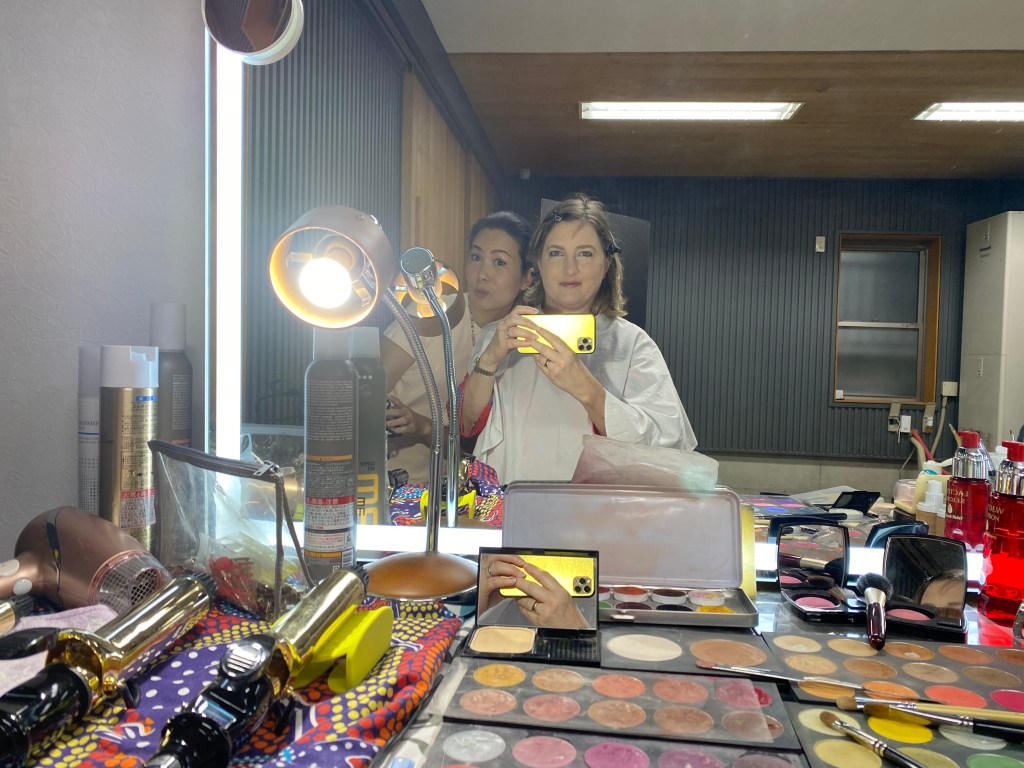
Nobue, the makeup artist, greeted me when I peeked in the door. She ushered me into the breeze of the fan. When I had sipped some water and cooled off, I sat in a chair in front of a mirror and had my face made up.
“Don’t worry,” she kept saying, as she added colour. “Trust me.”
I did.
Tia and I talked about books and people that we knew in common and about the photo project. In December, there would be an exhibition in Tokyo featuring photos of the forty subjects. It would be a celebration, and also a networking opportunity. I vowed to be there.
For the next two or three hours, she took many photos of me in different outfits and poses. Music pumped out of the speakers. She told jokes to get me to laugh. It was fun, and it felt a tad self-indulgent, but I loved it.
While I was in that studio, no one was judging me and I wasn’t invisible. I sparkled.
Suzanne Kamata being jazzed up. Photographs provided by Suzanne Kamata
.
Suzanne Kamatawas born and raised in Grand Haven, Michigan. She now lives in Japan with her husband and two children. Her short stories, essays, articles and book reviews have appeared in over 100 publications. Her work has been nominated for the Pushcart Prize five times, and received a Special Mention in 2006. She is also a two-time winner of the All Nippon Airways/Wingspan Fiction Contest, winner of the Paris Book Festival, and winner of a SCBWI Magazine Merit Award.
PLEASE NOTE: ARTICLES CAN ONLY BE REPRODUCED IN OTHER SITES WITH DUE ACKNOWLEDGEMENT TO BORDERLESS JOURNAL
STILL RINGING

I visit my school,
Sit under the Ashoka tree,
Straight and tall,
Before the gym hall.

Issuing from the tower
Of St.Joseph’s Cathedral,
Floating in the air
Came the sound of the bell,

Peaceful, white,
Sailing light,
The most pleasing notes
I had ever heard.

The bells were still ringing
When I woke up at dawn,
Filling the courtyard,
The garden and the lawn.

By the boundary wall,
Stood the Ashoka tree, tall.
Beyond the low wall
Stretched the Western sky.

Bells were tinkling,
Incessant and merry
At a far-off shrine
By the riverside.
Photo provided by Afshan Aqil
Dr. Afshan Aqil lives in India. She has authored a book titled, The Poetry of Edward Thomas. She has taught English Literature to undergraduates.
PLEASE NOTE: ARTICLES CAN ONLY BE REPRODUCED IN OTHER SITES WITH DUE ACKNOWLEDGEMENT TO BORDERLESS JOURNAL
A story by Ammina Srinivasaraju, translated from Telugu by Johny Takkedasila
Chandu is a smart child studying in the ninth standard at a Government High School in Charla village. He excels not only in his studies but also enjoys playing games. Everyone in the School knows him for his intelligence and hard work.
Every morning, Chandu wakes up early and completes his work. He even helps with household tasks before going to school on time. In class, he pays close attention to his teachers and diligently completes his homework.
Chandu has a habit of thinking deeply about everything and seeking guidance from his elders whenever he has doubts. Sometimes, he recalls the words of his Telugu teacher, Mr. Satyanarayana, who had said, “The one who asks questions is the true student.”
Chandu had come across an article in the newspaper. It mentioned that “Madhuravani” had been honoured as the principal of the school because Chandu’s class had scored good marks and achieved the highest pass percentage in the entire district. However, Chandu felt confused when he read this news.
Chandu had never seen Madhuravani teach a single day. She would come to school and comfortably sit in her room under the fan, signing papers brought by the attender. Sometimes, she would briefly visit the classes and give moral lessons to the students in the morning. This was her daily routine, as Chandu observed.
Chandu knew how hard the teachers worked every day to teach lessons in the classrooms. They put in a lot of effort to ensure the syllabus was completed, and the students could study well. The teachers’ hard work was the main reason for the students’ good results. But something seemed different about the recognition Madhuravani received.
Unable to contain his curiosity, Chandu gathered courage to approach the principal with folded hands and humbly ask her to clarify his confusion.
Madhuravani smiled at Chandu and told him to come back after the evening classes for a detailed explanation during the prayer session.
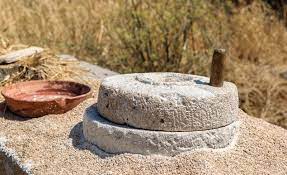
After the evening classes, all the children gathered for the prayer session under the supervision of the physical education teacher. Madhuravani began sharing a meaningful message with the students. She said, “Children, let me tell you a story. In the past, people used a handmill to grind flour. They would rub one stone against the other to make fine flour. It seemed the stone on the top bore the brunt of hard work, while the one underneath remained still and seemingly comfortable. But in reality, all the effort was actually to churn the contents in the stone that lay below.”
A hand mill made of stone.
All the children looked surprised and curious.
Madhuravani continued, “Just like the top stone, in our school, the teachers work hard every day and give lessons to you. Their work is visible and evident. On the other hand, I may not give lessons like the teachers, but my role is equally important. I take care of the administrative tasks and ensure everything runs smoothly behind the scenes.”
Chandu finally understood why the district collector had honoured Madhuravani, the principal, even though she didn’t teach. Her invisible efforts were essential for the school’s success, just like the bottom stone in the grinding process. From that day onward, Chandu developed a newfound appreciation for all the teachers and the principal, realising that everyone’s efforts, whether visible or invisible, contributed to the school’s achievements.
.
Dr. Ammina Srinivasa Raju is a writer and essayist with more than 300 articles and over 100 stories published in various journals. Since the academic year 2009-10, the Maharashtra Government Curriculum (Sarala Bharati) has included the children’s story ‘Adavilo Andala Poti‘ in Class 7. In addition to these achievements, Dr. Raju has delivered many speeches on the Akashavani. In 2005, he received the Pothukuchi Vamsa Award from Vishwasahiti Hyderabad.
Johny Takkedasila is a popular young poet, storyteller, novelist, critic, translator, and editor in Telugu. In 2023, he received the Kendra Sahitya Akademi Award for his criticism book, Vivechani.
.
PLEASE NOTE: ARTICLES CAN ONLY BE REPRODUCED IN OTHER SITES WITH DUE ACKNOWLEDGEMENT TO BORDERLESS JOURNAL
The love story of Kiyya and Sadu is very famous among the Baloch. An anonymous poet has versified the whole story in the form of a romantic ballad in lucid yet captivating language, this story of Kiyya, a young man from western Balochistan, and Sadu, who hailed from Makkuran. When a devastating draught hit the region, Kiyya along with his herd migrated from his hometown and camped somewhere in coastal area of Balochistan. One day by the river, he ran into a fair maiden, Sadu. He was struck by her charm so much that he fell in love with her instantly. He approached Sadu’s father and asked for his daughter’s hand in marriage. Since Kiyya was the member of an illustrious tribe, Sadu’s father accepted his marriage proposal.
A few days later, Kiyya took leave from Sadu’s father asking him that he would come back just in a few days after making necessary preparation for the marriage. However, he did not return in the stipulated time. Time went by. Neither did Kiyya showed up nor did come any message from him. In the meantime, some other men approached Sadu’s father with the desire to tie the knot with Sadu. His father was caught in a dilemma. He had given his words to Kiyya who had almost forgotten his commitment. On the other hand, age was slowly creeping upon her daughter. While, Sadu was not in favour of tying the knot with another man. She wanted to wait for Kiyya. The following poem is the description of Sadu’s message to Kiyya through an emissary bird:
SADU SAYS TO THE BIRD --

O sweet singing lively bird!
Red-eyed and pretty-winged,

When you peck from harvested fields,
Bits of spring yields.
But tiny grains of wild shrubs
Wouldn’t ever feed ye.

Come, alight onto the threshold of my hut,
Away from rest of the flock --
I'll feed you with fragrant grains,
With cardamoms and cloves.

I’ll spread them on my scarf
And water I’ll give you in a silver cup.
In the shade of my sable hair
Perch on my shoulder and chirrup.

Nestle on my lap and sleep.
Whenever you want to leave,
Just coo and forewarn me.
With civet-musk I’ll gild your beak,
With rose-petals your wings,
I’ll dispatch the clouds of mist
To sail you over.

Come and be my messenger
From Belau*, all the way to Bahau*.
Of the lay of the land, I'll give you some clues.
On the land that's called Bahau,
A long river flows through.

Like Zamzam* its water sweet and scared,
Herds of camels and calves,
Roam and graze on the verdant meadows.

A dome-shaped tree stands in grace and awe,
Like a camel’s foot appears its leaves,
Like a scorpion’s sting its spikes,
And branches like a tiger’s paw.

Illustrious men have gathered by the royal court.
In a row, sit the matchless warriors;
In the next, the common folks;
The blue-blooded Kalmatis*, in the third row.

Amongst them, there’s a man
Dressed in exquisite robes.
Handsome of the most handsome fellows,
Indeed, Kiyya is distinct
In appearance and demeanour,
His waist curved by the quiver,
By the glistening shield his shoulder.

Alight on his turban, chirping
Ever so gently whisper in his ear,
The message of Sadu I do bear
Her message and good tidings.

Kiyya! O, you the unfaithful fellow
You promised to return in ten days,
But now it has already been
Six months and a whole year.
You vowed to return but did not.


The lambs kept for the wedding feast
Have now all grown old.
Worms have devoured the flour.
Birds have pecked away the henna.
Your bride has lost all her teeth.
The bridal incense has gathered dust.
Come if you must,
Or henceforth someone else will replace you.

If you’ve fallen in love with someone else,
May death consume her!
May a headache, a deadly cough
And a slow fever claim her mother!
May no harm befall you ever!
It’s a loss alone I’m to suffer!

*Bahau: A place in Western Balochistan.
*Belau: A place in Eastern Balochistan
*Zamazam: A well located in Mecca, Saudi Arabia.
*Kalmati: Name of a Baloch tribe.
{Note from the translator: There are more than one version of this ballad with substantial difference in the text. This is an assortment of different sources primarily from Meeras, (The Heritage) (4th edition) compiled by Faquir Shad, and published by Fazul Adabi Caravan, Mand in 2016}
Fazal Baloch is a Balochi writer and translator. He has translated many Balochi poems and short stories into English. His translations have been featured in Pakistani Literature published by Pakistan Academy of Letters and in the form of books and anthologies.
.
PLEASE NOTE: ARTICLES CAN ONLY BE REPRODUCED IN OTHER SITES WITH DUE ACKNOWLEDGEMENT TO BORDERLESS JOURNAL
Over the past few decades there has been a surge in the publication of Indian historical fiction where the authors are fascinated by India’s rich past, and the many human stories of love and loss buried beneath the larger narratives. Simplistically speaking, historical fiction is a literary genre in which the plot takes place in a setting related to the past events, but is fictional. An essential element of historical fiction is that it is set in the past and pays attention to the manners, social conditions, and other details of the depicted period. Authors also frequently choose to explore notable historical figures in these settings, allowing readers to better understand how these individuals might have responded to their environments. After The Legend of Kuldhara (2017) and Mandu (2020), Malathi Ramachandran has now presented us with a fascinating novel, Begum Hazrat Mahal: Warrior Queen of Awadh (2023). She endeavours in her novel not just to re-create history as it happened long ago, but to also explore the lives and relationships of those who lived in those times.
The setting of the novel is Lucknow, 1857 where the First War of Independence against the British is fought. Wajid Ali Shah, the last Nawab of Awadh has been exiled by the British to Calcutta along with his courtiers and his coterie some months ago. Only his second wife, the beautiful queen Begum Hazrat Mahal, who had refused to accompany her husband to Calcutta stays back with her young twelve-year old prince Birjis Ali. Hazrat vows to fight the British and win back her beloved Awadh for her people and the crown for her son. She builds a rebel army and high drama ensues as they besiege the Residency, the walled British cantonment, for five months. A fictional saga based on actual events, this book takes us within the walls of the Residency where love and passion rage alongside the battle, and into the world of Begum Hazrat and her loyal band. From the beginning we encounter Hazrat’s interactions with Major Kenneth Murphy, the Company’s liaison officer who is enamoured by the beauty of the Begum and succumbs to her machinations. She wants his help to crown Birjis Ali the next Nawab and win back their lands and their properties. Then there are many stereotypical British characters – women who came from England to seek husbands and worked in evangelical missions, doctors, sergeants, and officers who took up native women for sexual gratification, and the like.
When Hazrat decides on action against the Angrez1, she forms baithaks2 comprising of the rich and poor, powerful and subordinate, Hindu, Muslim and Christian, all of whom feel that they had had enough of subjugation by these tyrants from another land. They would not take any more of their religious conversions, their oppression on the streets, their suppression in the garrisons. Her friendship with Jailal Singh, based on a shared love for Hindustan, blossomed and he promised her his allegiance in the fight against the British. She had found in Jailal a confederate, an able accomplice.
A large section of the narrative is then devoted to the details of the fight that ensued. There were times when the natives thought that they had managed to restrict the British soldiers from winning; at other times the tide of fortune turned in their disfavour when even after forming women’s brigade and defiant groups among the natives, success didn’t come in their favour. The reader is kept guessing whether the rebel army would storm the British bastion before their relief forces arrived or the tide would turn in a wave of loss and grief, crushing Hazrat Mahal’s dream for Awadh and her son. In November 1858, after more than nine months of fighting in Lucknow, and finally establishing complete control over North India, the Governor General, Lord Canning, presided over the Queen’s Durbar in Allahabad and read out the Proclamation from Queen Victoria. The territories of India, up until now governed by the East India Company, would now come directly under the Crown, and be governed by the Queen’s civil servants and military personnel.
After several turns of incidents Hazrat realises that defeated she and her army may be, but they would never be vanquished in spirit. In her chamber in the Baundi fort, she paces back and forth, the printed proclamation crumpled in her hand. Her close supporters watched in mute frustration. She would never agree to the British offer of clemency with all its benefits. She would rather live in penury than become one of their vassals. Deep inside the stone fortress, she sits huddled in her quilt, and feeling the loneliness and desolation of one who had fought and lost everything. The story ends with Hazrat and her son silently leaving the already orphaned Awadh and heading into the forests to cross over to Nepal on the other side and seek asylum there.
Malathi Ramachandran must be appreciated for the racy narrative style of the novel that does not weigh down under the plethora of historical events. Here one must mention the similarity of incidents narrated about the plight of another Indian queen in another historical fiction titled The Last Queen written by Chitra Banerjee Divakaruni. This novel also tells us the story of Jindan Kaur, Maharaja Ranjit Singh’s youngest and last queen, his favourite. She became regent when her son, Dalip, barely six-years-old, unexpectedly inherited the throne. Sharp-eyed, stubborn, passionate, and dedicated to protecting her son’s heritage, Jindan distrusted the British and fought hard to keep them from annexing Punjab. Defying tradition, she stepped out of the zenana, cast aside the veil, and conducted state business in public. Addressing her Khalsa troops herself, she inspired her men in two wars against the ‘firangs3.’ Her power and influence were so formidable that the British, fearing an uprising, robbed the rebel queen of everything she had, including her son. She was imprisoned and exiled. But that did not crush her indomitable will. Like Begum Hazrat Mahal, she also had to live the last years of her life in exile, shorn of all her power and wealth. In both the novels, we learn about the strong and determined will power of Indian women who wanted to retain the pride of their motherland despite all odds and machinations of the British. A perfect blending of fact with fiction, the novel is strongly recommended for all categories of readers, serious and casual alike.










 Borderless