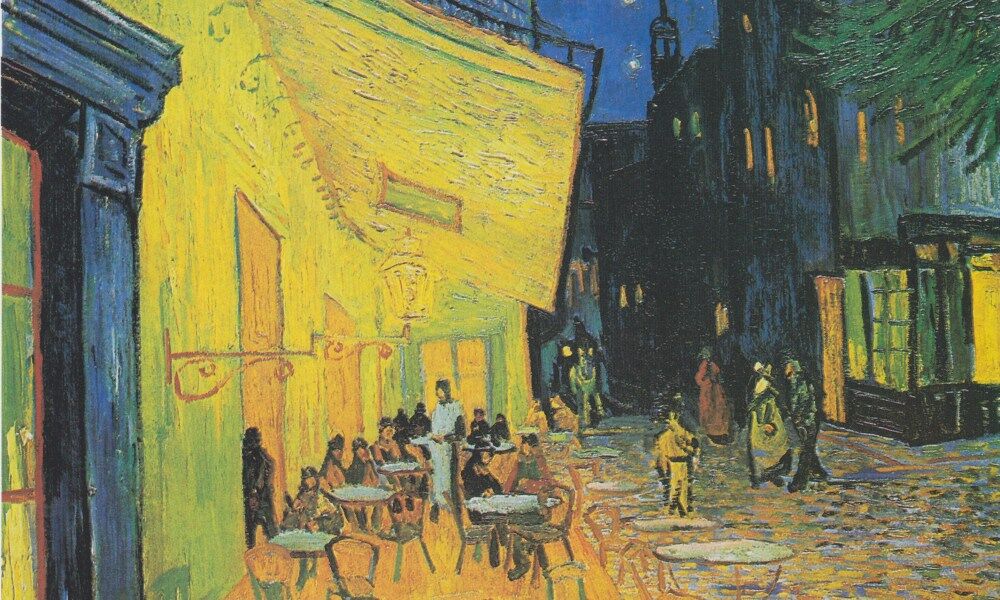
Painting by Vincent van Gogh (1853-1890). From Public Domain
NIGHT IN THE SUBURBS

As the night deepens,
the sky seems like a hole
that stars fall into.
Branches suddenly wave
like spastic arms,
as a wind from nowhere
sets them in motion,
and life quickly passes by,
leaving no time
to even wonder why.
The earth continues spinning,
like an alarm clock
with malfunctioning hands.
My wife is dead.
My friends are old.
Why did I live?
I have no idea.
I was never told.


EVENINGS AT SILVER MOON LAKE

The day stretches before me
like the water in the lake,
flat and dull.
I sit thoughtlessly,
as if riding the waves
like a somnolent gull.
A sudden breeze passes by,
like the rough touch
of an invisible hand,
but it’s quickly gone.
Like bygone days,
it didn’t last long.
As waves beat the shore
like the erratic notes
of a mad composer,
I’ve finally had enough,
and I close my door.
George Freek’s poetry has recently appeared in The Ottawa Arts Review, Acumen, The Lake, The Whimsical Poet, Triggerfish and Torrid Literature.
PLEASE NOTE: ARTICLES CAN ONLY BE REPRODUCED IN OTHER SITES WITH DUE ACKNOWLEDGEMENT TO BORDERLESS JOURNAL
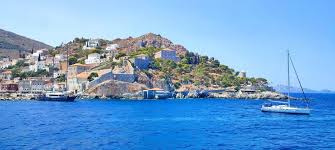
Winter, together with the northern gales, reached the shores of Hydra, an island belonging to the group of Saronic islands in the Aegean Sea. On the north-eastern side of Hydra, save a few monks in two monasteries, few human beings had built their homes. Hoary pines and cypresses intertwined with other plants, providing shelter and shade for the gangs of dangerous feral cats that roamed amongst enormous, solitary rocks and deep precipices hunting for food. Weird, colourful birds built their nests in the crevices of the towering cliffs whose plateaus were carpeted with red poppies and violet cyclamen. It was a desolate landscape unfavourable to human existence, although it was told that certain ‘wild’ islanders did dwell in the porous caves of the cliffs sculptured by the winds and rains overhanging the foamy waters far below …
It was in the south where the islanders enjoyed a relatively decent living, when of course the fish and tourists were plentiful. Now, however, the bathing areas lay silent and the villas, lifeless. Winter was the time for fishing. The sailing dinghies, catamarans and rowboats that had been hauled in for repairs were once again seen bobbing up and down upon the choppy waves. Seabass abound, as well as sea bream and sardines. Brightly painted sailing dinghies brought fish uninterruptedly to the market. But deep in this particular winter, the fishermens’ nets held little catch, and the islanders had to resort to eating vegetables that survived the cold from their gardens, the bread from their ovens, and now and then a partridge or a quail shot by those who owned rifles. Fish could be purchased from other fishermen in the neighbouring islands. But they sold their catch at a dear price.
Old Vasiliki was preparing his multi-pronged fishhooks. The nets that he had mended long ago had snapped and ripped again. Up till then, winter’s catch proved hopeless. He had scarcely earned fifty drachma. Vasiliki still had earnings from renting the second floor of his house to summer tourists, but those savings were slipping away on fishing material, goods from the shops or fish bought from the fishermen of the other islands, where apparently the catch was abundant. Nico, his grandson, had fallen ill that winter and medicine was dear. The poor boy had not been to school for over two weeks …
School and notebooks cost money, too. So be it. Tonight, Vasiliki would go out fishing, so he carried on straightening out his turkey-feathered multi-pronged fishing-hooks, mending the rotten fishing lines, changing the rusting hooks. If he could catch a lot of fish, he could buy a petrol lamp and more candles for the house, a pair of shoes and a woollen vest for Nico. He would buy Nico a book of sailors’ tales that his curious-minded grandson longed to read. He would also buy him a huge picture of a Spanish galleon that he could pin up on to the yellow painted wall of his tiny room.
Vasiliki went out fishing in the evenings. Nico never knew when his grandfather would return …
Every night the boy dreamed the same enigmatic dream in the absence of his grandfather. He stood at the helm of a beautiful boat whose name was written in bold black letters but which he could never read. Enormous waves continuously surged and battered the solid vessel. Then a sudden volley of rocks or missiles assailed him from all sides out of a rising mist, accompanied by a deafening din of hysterical screams and raucous shouts. From above, a huge white-crested wave was about to engulf him … Nico would be startled out of this recurrent dream, never understanding how he escaped the missiles, the monstrous wave and screams because at that very instant he was startled out of sleep by the flapping of the curtains against the paneless window and the slow, heavy footsteps of his grandfather returning from fishing. Vasiliki, smelling of the briny sea, stepped into Nico’s room.
The boy sat up in bed: “Did you catch any fish, grandpa?”
“No, the sea was empty of fish tonight.”
“Empty?”
“A sea monster has surfaced, Nico. It is eating all the fish in the sea.” Nico blinked his eyes in mistrustful wonder.
“Have you seen the sea monster, grandpa?” The exhausted Vasiliki offered no answer. He shuffled out of his grandson’s room and retired to his own.
Whether Vasiliki really saw a monster always remained a mystery to Nico. He had read about weird sea creatures with lamps on their heads in the inky darkness of the deep; read about shoals of huge fish that swallowed dinghies and rowboats whole. His father, Constantine, had been swallowed up along with his crew by those horrible creatures … so his grandfather narrated, sadly. His mother, Myrto, died a few months later of tuberculosis … or of a broken heart. Or both. They were in their early thirties …
Vasiliki and his wife, Nefeli, took their grandson in. They did their best to bring up the lonely, melancholic boy. Then Nefeli fell ill with fever and died soon after. Vasiliki buried his beloved wife at the neighbouring cemetery. All that the old man cherished now was Nico, his taciturn grandson.
Vasiliki owned a small, green, two-storey wooden house, a house that belonged to his father. Summer was not far off so he could again rent out the second floor to tourists and earn a few lepta or drachma.
In the small sitting-room where the flower-dotted wall-paper was peeling off the badly cut boards, he had nailed photos of his wife and daughter, now yellowing due to the humidity. Vasiliki’s home was hardly furnished, although he had made an effort to provide low sofas, wicker chairs and sturdy tables for his guests upstairs. He even built a shower for them, a luxury that he and Nico dispensed with. They washed either in the sea or directly from the wash-basins in the garden behind the house. But since no one occupied the two rooms upstairs, ever so often they would shower upstairs and from the windows look out at the sea. Presently, Vasiliki climbed the five steps to one of the rooms, parted the laced curtains of the recently washed window and looked out towards the sea, whilst he mended his net, sang songs, thought of Nico’s future. His warm eyes slipped from his mending to the brilliant blue waters of the Argolic Gulf. That boy was all he had. His treasure. When he thought of Nico he awoke from his day-dreaming and smiled. He had promised him long ago that they would build a small boat and send it navigating on the high seas, like a bottle thrown amid the waves, and whose destination would be known to no one, a horizonless destiny for that little boat.
Vasiliki sighed: “I have to keep an eye on Nico. Those nasty children from town always take the thump him at school. He’s not big enough to fight on his own.” Vasiliki took up a needle and began stitching Nico’s torn trousers. “I have to walk him home after school so he won’t go sleeping under the olive trees or on the beach where the schoolboys could knock him up.” Vasiliki wondered where his grandson had gone …
Nico stood under a plane tree in front of his grandfather’s house. He was busy making a boat. It wouldn’t be his first boat. But this one would be the boat of all boats ! A long-voyage boat, built for the broad, open seas … the remote and unchartered seas, a boat that would weather stormy waves, glide over placid rolls, sail alongside monstrous creatures of the deep, a boat without a flag, a nationless boat, yet unmanned by pirates or corsairs, a boat completely independent. Nico put his whole heart into this project, his whole imagination of what such a boat should be made of, and how it should be navigated.
“Nico?” cried down Vasiliki from the upstairs window.
“Yes, I’m here, grandpa.”
“What are you doing?”
“Making a new boat.”
“Another one?”
“The biggest and the best, grandpa. It’ll sail to the other side of the world … to China …”
“Tomorrow you must go to school, don’t forget. You can work on your boat after school.”
“Yes, grandpa. I’ll work hard in school.”
“By the way, what will you name your boat?” Nico thought for a moment. At first ‘Neptune’ came to mind, but he quickly changed it as his grandfather’s eyes swelled with pride and joy at his grandson’s aspirations and imagination.
“I’ll call her Nefeli, grandpa.”
Vasiliki gave Nico an odd look. He didn’t know whether to smile or cry. He murmured the name several times on his lips, slowly, intimately. The old man burst out laughing: “Nefeli! Nefeli!” he shouted. “Your grandmother would have been proud to know that her name will navigate the four oceans of the earth, my boy. Don’t forget to prepare your things for school tomorrow. We’ll be having sardines tonight that I bought from Dimitri. He sold more than a dozen at half price.” And Vasiliki returned to his mending and stitching since the yellowish light of late afternoon allowed his eyes to do so …
Nico went to school the following morning, shuffling along the dirt-packed road. What a burden to acquire knowledge that he would never use in ‘real life’. Neither Nico’s classmates nor his teachers held any interest for him. His two weeks’ absence afforded him time to dream … to concentrate on his boat-building. The boys who crossed paths with him on the way to school never wished him a good morning, nor did they enquire about his health. He was ostensibly shunned by all and sundry, even several of his teachers took a dislike to him.
Nico shrugged his shoulders, sitting in the back of the stuffy classroom, heated by a pot-bellied stove, gazing out over the bungalows to the wide sea. He envisioned the decks of galleons gleaming white from a good scrub, their sails bellowing in the refreshing breeze. Nico filled his lungs with the fresh, clean, ocean air. Yes, only the sea afforded the boy a pleasure in life, along with, of course, the voice and affectionate gestures of his grandpa. All other things to him seemed dull, lifeless … empty.
The children in his class thought only of the tediousness and boredom of their school work and the silly games they played with or against each other to compensate for that tediousness and boredom. None had any project to impassion their lives. None envisioned a future further than the next day at school or in the market. Few went swimming in the bay, where he swam too. They shrank away from his boyish laughter splashing about in the water, avoiding his company completely.
When Nico was not day-dreaming in school he was busy reading or making boats — all kinds of boats. Cutter in hand, he whittled small sailboats and rowboats … even catamarans! Everyday he whittled a raft as he contemplated the steamers’ coming and going in the glimmering Aegean. But his next boat would be huge. A huge boat with a bridge, lower and upper decks, a hold for cargo, masts, sails, portholes and a crow’s nest. This boat would be the largest, the loveliest … and the sturdiest of them all. A boat which had never been built before by a fourteen year old boy. And that day came. Nico, the fourteen year old boat-builder had completed his dream boat. For him this boat meant the world. He felt his heart swell with pride and satisfaction. Vasiliki inspected his grandson’s remarkable vessel. It was painted marine-blue. At the bow he had painted the head of Neptune. He had even cut a hole in the starboard for the anchor to be weighed or dropped using a big fish-hook tied to a long, thin rusty chain. The deck had been sand-papered to a dazzling gloss. He equipped her with a four-cornered small jibe[1], as white as the flesh of a sea bream. He had taken great pains to whiten that piece of cloth of a sail, rubbing and scrubbing away with aqua fortis. It took him days to attain that candid sheen …
All the rigging on the bridge was fixed solidly to the wide deck by thin copper wires rising high above all the rest, held securely with copper wires screwed into the thick wood of the deck and reinforced with English twine. Portholes had been carved out on both the portside and starboard for the cabins, for although Nico’s boat would be captainless — unless he himself exercised this task– his imaginary crew would be like the Lilliputians that he had read of in Gulliver’s Travels. How he had enjoyed reading those stories of sea and island adventures … Nico had even cut and inserted pieces of broken glass he found scattered about the streets to window the portholes, which he polished to a shiny, brassy gleam.
When all had been fitted out properly, he painted the endearing name Nefeli in bold, black letters on her portside. Vasiliki stood in quiet admiration of his grandson’s months of hard labour. It was indeed a work of art. He embraced him. His grandson may not be the best of pupils, but he worked wonders with his hands. Someday he would be a great boat-builder, and not just a poor fisherman like his father and grandfather …
The rising sun peeked over the watery orb of the sea. It was Saturday. That day Nico launched his boat into the placid waters of the Argolic Gulf. Vasiliki accompanied him on this long-awaited day, eager to witness her maiden voyage. The Nefeli once launched, slid with ease. At first, the boat floated unsteadily on her portside. But when the wind picked up, she rose to her full splendour and ploughed through the clammy waters with amazing ease, all sails aswell. Nico let the spool of English twine slide quicker and quicker from its spool. It unravelled rapidly, but the boy had full control of the situation. The spool held hundreds of metres of twine.
The Nefeli skimmed over the wavelets like a shark racing towards its prey. Vasiliki stretched out on the pebbly shore to mend a torn net, eyeing both the Nefeli and his mending in mute jubilation. He thought of his daughter and how proud she would have been to see her son manœuvre his own hand-made boat. His grandson, too, jubilated, running to and fro along the shore to manœuvre the cruising vessel as she swayed to the rhythm of the breeze. Suddenly an easterly gale drove her towards the shore. Nico slackened the twine. At the same time, though, he pulled her away from some dangerous rocks and uprooted pines. Any collision might have caused great damage to the Nefeli. After all, it was only a little boat and the sea a powerful force that no one should underestimate. Two hours or so later, Nico pulled her in, and he and his grandfather returned triumphantly homeward to eat.
News of Nico’s remarkable boat reached every ear on that small island. People from the big town would come to the shore to watch this young boy of fourteen manoeuvre his vessel. As promised, Nico launched his boat only after school as soon as he had finished his homework. For weeks now, the Nefeli had withstood the brunt of several white-crested waves and a slight collision against the rocky part of the shore. All in all, Nico’s boat proved robust and his manoeuvring worthy of any captain of the sea.
One fine, sunny Saturday Nico, as always, launched the Nefeli near a large grove of pine trees. A slight south-easterly wind was blowing. The twine unravelled rather quickly, the boat lying on her side, her stern twisting and turning in the foamy waters like a fish’s tail. He pulled at the twine and managed to steady her route. Nico sighed in relief … Suddenly he heard shouts, cries and screams from behind him. A gaggle of children were racing along the shore targeting his boat with huge stones, one of which, incredibly enough, after hitting its target, propelled her further away from the volley of projectiles. Two or three boys, whom he recognised from his class, had sling-shots and were letting fly stones with great rapidity but not necessarily with great accuracy. Nico ran faster, pulled at the twine, quickening the speed of his boat. But there were too many boys, many of them running faster than him. More and more stones were slung or thrown, luckily off their mark. Nico thought to haul the boat back to shore near the rocky cliffs in the hope that the scoundrels’ pockets would be emptied of stones by then.
The poor boy, however, stopped in his tracks. The Nefeli seemed to navigate on her own, wind filling her sails, skimming high and mighty over the angered waves in spite of the deluge of catapulted missiles. Then in one tremendous volley four or five of the bigger boys hurled dozens and dozens of stones at the speeding Nefeli, some of which broke through portside, others splintered the bridge and still others burst into the jibe and crow’s nest.
Nico’s wonderful workmanship managed to stay afloat for a half hour before sinking to the bottom of the sea. The last thing that Nico saw of his boat were the bold, black letters of his grandmother’s name: Nefeli.
The children vanished into the pine groves as quickly as they had appeared …
Nico turned his back to the dramatic sinking of his vessel. Opening the gate to his grandfather’s front garden, he strolled up to him.
Vasiliki, cleaning several fish and shrimp that he had caught the previous night smiled at the approach of his grandson: “So, how did she sail …?” He suddenly noticed that Nico hadn’t the boat in his arms. He frowned and lowered his eyes.
“She set sail for the other side of the world, grandpa. She’s in route to China. The English twine snapped and off she sped out of the gulf towards the open seas disappearing over the edge of the waters …”
“Well, like a bottle thrown into the sea, right? You never know where she’ll land. I just hope the sea monster won’t swallow her up like it does all the fish.”
“No, grandpa. Monsters don’t swallow boats only fish. Did you see the monster last night?”
Vasiliki shook his head. “Can’t say that I did.” He put down his knife and scratched his white beard: “I caught some prawns last night Nico, what the Spanish call gambas. We’ll have a marvellous meal just you and me tonight.”
“It’s always just you and me that eat, grandpa,” Nico reminded his grandfather.
Vasiliki pursed his lips: “How right you are, my boy.” The old man paused for an instant taking up his knife: “Will you build another boat?”
The boy kicked up the yellowing grass in the garden with his torn sandals. “Yes, grandpa, I’ll build another one.”
“Bigger than the one that just sailed to China?”
“Yes, much bigger.”
“What will you name her?”
Nico furrowed his brow. He looked sadly into his grandfather’s eyes: “I’ll name her Myrto.”
Vasiliki eyed his grandson affectionately. “I like that name Nico. It’s a beautiful name …”
“I like it too, grandpa.” And the boy shuffled off to his room …
Paul Mirabile is a retired professor of philology now living in France. He has published mostly academic works centred on philology, history, pedagogy and religion. He has also published stories of his travels throughout Asia, where he spent thirty years.
.
PLEASE NOTE: ARTICLES CAN ONLY BE REPRODUCED IN OTHER SITES WITH DUE ACKNOWLEDGEMENT TO BORDERLESS JOURNAL
Don't you strive for the fame or pursue its fortune -- play a roulette game like a business tycoon, climb a high status ladder? don't even start,
you've already made it, you've got a good heart,
don't boast your conquests - your qualifications, the talent contests -- the expectations, don't conquer the mountains or top the charts --
you've already made it, you've got a good heart,
don't be frightened to lose, or to take a rejection, wear an ego bruise for your imperfection, your legacy is sleeping - you've got a head start,
you've already made it, you've got a good heart,
don't stack on your power, don't you mass on appeal, build the tallest tower or sign a record deal, bin your trophies - certificates - rip them apart,
you've already made it, you've got a good heart.
StephenPhilip Druce is based in Shrewsbury UK. He is published in the USA, India, the UK and Canada. He’s written for theatre plays in London and BBC 4 Extra.
Contact: Instagram – @StephenPhilipDruce
.
PLEASE NOTE: ARTICLES CAN ONLY BE REPRODUCED IN OTHER SITES WITH DUE ACKNOWLEDGEMENT TO BORDERLESS JOURNAL
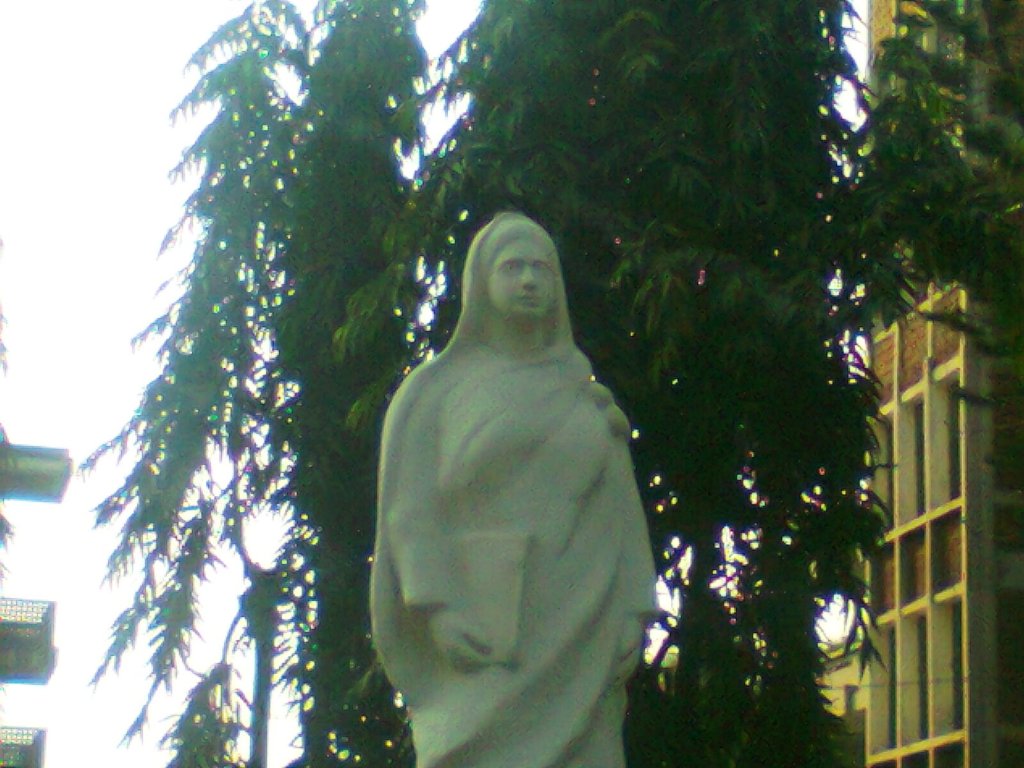
Statue of Begum Roquiah in the premises of Rokeya Hall, University of Dhaka. From Public Domain.
Recently, near Shamsun Nahar Hall, the second women’s hall of the University of Dhaka, a resident student defaced graffiti depicting Roquiah Sakhawat Hossein – popularly called Begum Rokeya. Black paint was used to smear her eyes and her mouth. Later, the student apologised for her action and promised to restore the image.
I do not know what upset the young woman. The picture is not offensive. The woman has her hair modestly covered. However, the manner of the defacing is troubling. The eyes have been painted over so that the woman cannot see; the mouth has been painted over so that the woman cannot speak. Why was the young woman denying the rights that Roquiah fought for, that the women of my generation demanded as their fundamental rights, and that the young women of today take for granted? Why was the young woman who defaced the picture denying the rights that the students against discrimination were claiming?
But, then to my surprise, I learned that this was not the only picture of Roquiah’s that had been defaced after August 5. In this other picture she had been given a beard and the derogatory word “magi[1]” written across it. What had Roquiah done to be dishonoured? What had made her controversial? Why was a young generation denying the changes that Roquiah had brought in young women’s lives by sheer perseverance and strength of will? On October 1, 1909, only four months after her husband’s death, Roquiah Sakhawat Hossein started a school in his name at Bhagalpur where she had been residing at the time. It was with great difficulty that she was able to persuade two families to send their daughters to her school. Of the five students, four were sisters.
Forced to leave Bhagalpur for personal reasons, she moved to Calcutta. However, she did not give up her dream and, two years later, on March 16, 1911, she re-started Sakhawat Memorial Girls’ School with eight students. At the time of her death on December 9, 1932, there were more than 100 girls studying at the school. Apart from teaching, the school encouraged girls to take part in sports and cultural activities. In recognition of her contribution to women’s education, the first women’s hall of the University of Dhaka was renamed “Ruqayyah Hall” in 1964.
From Public Domain
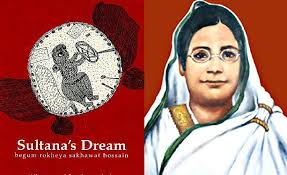
More than a century has passed since Roquiah’s Sultana’s Dream was published in the Indian Ladies Magazine in 1905. In Bangladesh, in recent years, more than half of SSC graduates have been girls – who have also outperformed the boys. Though the female to male ratio goes down at the university level, women are working in different professions. Nevertheless, the danger to women that led to the institutionalisation of purdah and its extremes – which Roquiah questioned and decried for its often fatal results and which in Sultana’s Dream she reverses to put men in the “murdana” – still persists.
According to the UN, “Violence against women and girls remains one of the most prevalent and pervasive human rights violations in the world.” It is estimated that almost one in three women has been subjected to physical and/or sexual intimate partner violence, non-partner sexual violence, or both, at least once in her life. Numbers of women’s deaths in 2023 reveal that a woman was killed every 10 minutes.
Sadly, many of the killings are within the family, by husbands, brothers, fathers, mothers-in-law, and mothers – who have internalised the concept of honour and allow their daughters to be killed by those who should protect them. In early November, the murder of five-year-old Muntaha shocked the nation. We learned to our horror that her female tutor has been charged with the murder.
Neither education nor empowerment is proof against violence. What is the answer? Was Roqiuah wrong?
Had Roquiah been here today she would have been surprised to see so many young women wearing jeans but also hijabs – very different from the all-enveloping burqas of her times. Perhaps she would have been happy to see that the young women in the crowded streets were not afraid of the young men, and that, in August, when the traffic police were absent, they were confidently directing traffic. She would have been happy to see that the burqa had changed – as she had once suggested in an essay on the subject that it should.
However, she would have been shocked to see in recent months young men beating each other up with sticks – some even fatally. She had believed in education, believed that education was the answer to improving lives. She had striven to educate girls because she believed that it was education that would change their lives for the better. She would have been horrified to know that most of the young men beating each other up were students. She would perhaps have asked, Was I wrong? If education is not the answer, what is?
It is not enough then to educate women and to empower them. The tutor was educated and empowered. Perhaps what is important then is to realize as Roquiah did that one must have proper values. In “Educational Ideals for the Modern Indian Girl,” she stressed that India[2] must retain what is best about its traditions. Acquiring education did not mean that Indian women should discard their familial roles or forget their cultural values.
Though in this essay Roquiah emphasised traditional roles for women, she also believed that women had roles outside the family. Thus, in a letter to the Mussulman, dated December 6, 1921, she noted that four of the Muslim girls’ schools in Calcutta had headmistresses who had studied at Sakhawat Memorial Girls’ School.
Roquiah has been an icon for the generation of early feminists in East Pakistan/Bangladesh, many of whom like Shamsun Nahar Mahmud and Sufia Kamal were inspired by her and others like Nurunnahar Fyzenessa and Sultana Sarwat Ara who had studied at her school. She was one of the heroines for the generation of women activists of the mid-1970’s who made her call for emancipation their rallying cry. Women for Women, a research and study group, has a poster which quotes lines from Roquiah’s essay, “Subeh Sadek”: Buk thukiya bolo ma! Amra poshu noi. Bolo bhogini! Amra Asbab noi…Shokole shomobeshe bolo, amra manush. Proclaim confidently, daughter, we are not animals. Proclaim, sister, we are not inanimate objects… Proclaim it together, we are human beings.
Many people are frightened of the word feminism and believe it means a radicalism that would destroy society. But in reality, feminism is a call for equality and justice. Yes, Roquiah was a feminist, who saw the positive side of Islam and decried the absurdity and injustices of society. Roquiah would not have radically changed gender relationships but in both Sultana’s Dream and her novel Padmarag (1924), she suggests that women can have identities that are not dependent on their relationships to men. Yes, she was bound by her times, but the courage with which she lived her life – refusing to be shattered by personal tragedies and trying to make the world better for others – is still relevant today. As is the rationality that she stressed at all times.
He has a degree,
it sits on the shelf gathering dust,
something they told him would unlock doors.
His parents had big dreams,
sold their land, their jewelry,
put everything into his future.
They believed,
and so did he.

He studied hard,
burned the midnight oil,
topped his class.
Teachers said he’d go far.
But now, it’s been months,
maybe years,
since he’s left that classroom,
and the job market is a string of disappointments.

Job fairs, interviews, waiting rooms.
Each time, it's the same—
a door shut quietly,
a nod from the suited man,
"We’ll let you know,"
but they never do.

He learns the truth, spoken in hushed tones:
You need favours,
you need money,
you need things they never taught in school.
Without that,
your degree is just a piece of paper
fluttering in the wind.

Day after day, he watches the world move.
People pass by in suits, cars,
they look like the future he was promised.
But he’s not part of it.
He’s stuck,
in the cracks between his dreams and reality
no one prepared him for.

The calls stop coming,
his father’s voice is quieter now,
his mother doesn’t ask about interviews anymore.
They’ve run out of things to sell,
run out of stories to tell the neighbours.
He feels like a failure,
but it’s not his fault,
still, it feels like it is.

One evening, as the sun sets,
he walks to the edge of the bridge.
The river below is quiet,
more peaceful than his mind.
The weight of all he couldn’t do
pulls him down,
the promises he couldn’t keep
drag him under.

In the morning, they’ll find his body,
but no one will mention the empty job postings,
the bribes he couldn’t pay,
the promises that led nowhere.

They’ll talk about him as if he gave up,
as if the struggle was all in his head.
But he didn’t quit—
he was crushed,
under a weight too heavy to carry alone.

And his parents,
they will sit in silence,
wondering where they went wrong,
not knowing
he was lost long before he fell.
From Public Domain
Aman Alam is an English major at Jadavpur University, with a deep love for literature and a knack for thoughtful conversations. He’s always lost in a good book, writing poetry, or dreaming up ideas for his next big project. Along with his love for words, he’s equally obsessed with cricket and never misses a chance to debate life’s big questions over a cup of chai. Known for his laid-back style and sharp humour, Aman has mastered the art of doing everything at the last minute – yet still manages to pull it off with charm.
.
PLEASE NOTE: ARTICLES CAN ONLY BE REPRODUCED IN OTHER SITES WITH DUE ACKNOWLEDGEMENT TO BORDERLESS JOURNAL.
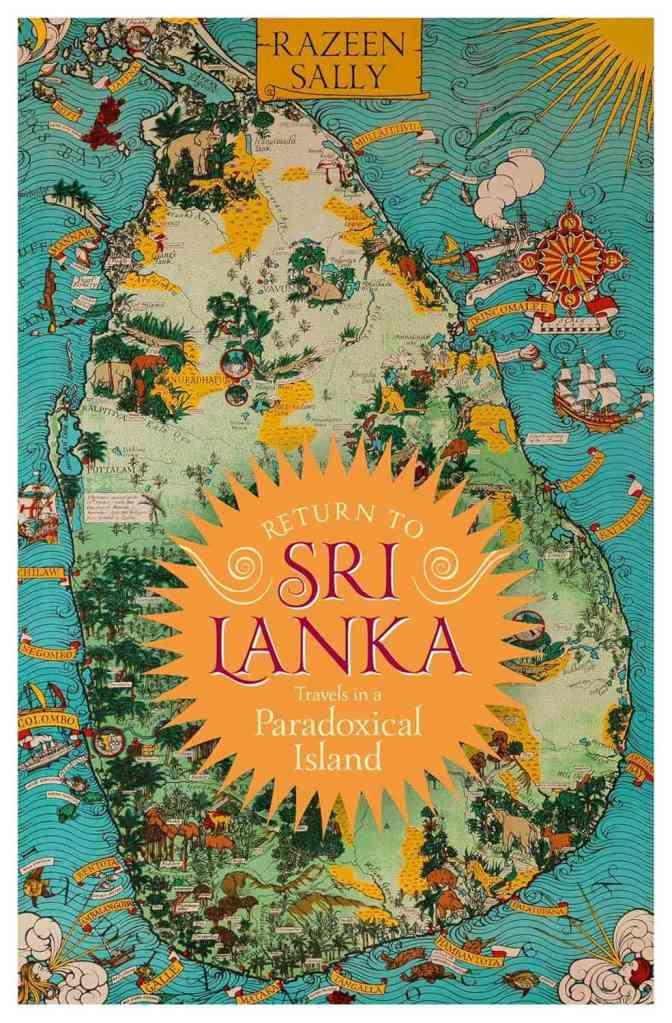
Title: Return to Sri Lanka: Travels in a Paradoxical Island
Author: Razeen Sally
Publisher: Simon & Schuster India
Sri Lanka’s culture is characterised by several paradoxical aspects that reflect its rich history, diverse population, and the complexities of contemporary society. Here are some notable contradictions: Home to various ethnic groups, including Sinhalese, Tamils, and Muslims, each has its distinct languages and traditions. However, there is a prevailing sentiment among some that prioritises Sinhalese culture over others, leading to tensions and conflicts regarding national identity and rights.
While Sri Lanka has a history of female activism and women hold significant positions in politics (e.g., former President Chandrika Kumaratunga), gender inequality persists in many sectors. Women often face societal pressures that limit their roles despite their contributions to the economy and community. The tiny country has made strides in economic development and infrastructure, yet significant poverty remains, particularly in war-affected regions like the North and East. This disparity highlights the uneven benefits of economic progress across different communities
The island is also known for its religious diversity, with Buddhism, Hinduism, Christianity, and Islam practiced by its citizens. However, this coexistence is often marred by sectarian violence and discrimination, particularly against minority groups during political upheavals.
As Sri Lanka embraces globalization and modern influences, there is a tension between adopting new lifestyles and preserving traditional customs. This cultural clash can lead to generational divides within families and communities.
Razeen Sally’s book, Return to Sri Lanka: Travels in a Paradoxical Island, explores these complexities and contradictions. The memoir combines personal narrative with historical and political analysis, offering readers an immersive journey through various regions of Sri Lanka—from the bustling capital of Colombo to the tranquil beaches and verdant hill country. Sally reflects on his childhood experiences while addressing the island’s tumultuous history, including its colonial past and the long-lasting effects of civil war.
Razeen Sally, the son of a Sri Lankan Muslim father and a Welsh mother, was raised in Colombo and educated in the UK. After teaching at the London School of Economics, he now teaches at the Lee Kuan Yew School of Public Policy in Singapore. In his early forties, he felt a strong urge to return to Sri Lanka for the first time since childhood and has spent the past ten years exploring the island.
Sally viewed Sri Lanka as a paradise during his childhood, but conflict soon disrupted their lives, fracturing his family’s connection to the island. Return to Sri Lanka tells the story of his journey towards reconciliation in the twenty-first century, as Sally, now an academic and political adviser, revisits his birthplace. This travel memoir addresses significant political issues and is rich in beauty and profound reflections, written by someone who feels like both a local and a visitor.
The words, “Paradoxical Island”, in the title encapsulates the duality of Sri Lanka, where hospitality coexists with high rates of violence and societal divisions. Despite interactions among ethnic groups like Tamils and Sinhalese, underlying tensions often surface, revealing deep-seated issues regarding rights and representation.
Sally provides insight into how historical events, such as the policies of successive governments and the impact of colonialism, have shaped contemporary Sri Lankan society. He discusses significant political figures and movements while critiquing policies that have led to economic challenges, including a brain drain among educated youth.
The book highlights Sri Lanka’s diverse cultural landscape, examining how various religions and ethnicities contribute to both its charm and its conflicts. Sally emphasises the importance of understanding these dynamics to appreciate the island’s true essence.
Return to Sri Lanka is not just a travelogue but a profound exploration of a nation grappling with its identity. Sally’s reflections offer hope for reconciliation and progress, urging readers to engage with Sri Lanka’s complexities while appreciating its inherent beauty. These paradoxes illustrate the complexities of Sri Lankan culture, where historical legacies continue to shape contemporary realities, creating a vibrant yet challenging social landscape.
Bhaskar Parichha is a journalist and author of Cyclones in Odisha: Landfall, Wreckage and Resilience, Unbiased, No Strings Attached: Writings on Odisha and Biju Patnaik – A Political Biography. He lives in Bhubaneswar and writes bilingually. Besides writing for newspapers, he also reviews books on various media platforms.
.
PLEASE NOTE: ARTICLES CAN ONLY BE REPRODUCED IN OTHER SITES WITH DUE ACKNOWLEDGEMENT TO BORDERLESS JOURNAL
Death is a state That leaves grief in its wake, Tearing souls from their loved ones. In the sieve of this moment, We must not divide “ours” from “others.” We are dwellers of the jungle. For nature’s tidings— Be it the heart or the hut— We must not roll up the mat. Before me came my father, And before him, my grandfather— Weavers of sacred customs. We have taken every shade of the jungle, Draped ourselves in its colours. The jungle has its customs: Nurture envy and hatred As tenderly as you nurture love. Never to strike a hungry foe. You, a soldier from the enemy’s ranks, Who come to slay my people— Eat your fill before you go, For hunger lies ahead. Do you see these towering peaks, These treacherous ravines? My sons, brave as lions, Know them better than you ever will. They wait for you, Hidden in the trenches. The jungle may show you no way out. My brothers, fierce as tigers, Have mastered the craft of survival. We are dwellers of the jungle. And you, a soldier from the enemy’s ranks, Have come to our land Sit. Eat. Leave with a full stomach. For in the jungle, it is custom Never to strike a hungry foe. I will not let blood Stain the sanctity of my tradition. Whether in war or peace, For nature’s tidings— Be it the heart or the hut— We must not roll up the mat.
Ali Jan Dad is a prominent figure in contemporary Balochi literature. He wields equal command over both the genres of ghazal and nazm. Primarily, he is a poet of love and romance, and his poetry is imbued with a melodious and lyrical finesse. Additionally, he addresses the objective issues of life and the complexities of human existence in a highly artistic manner. So far, two collections of his poetry—Dróháp (The Mirage, 2009) and Róchay Sáheg (The Sun-Shade, 2013) have been published. The translated poem has been taken from his website Kodacha.com and is presented here with his permission.
Fazal Baloch is a Balochi writer and translator. He has translated many Balochi poems and short stories into English. His translations have been featured in Pakistani Literature published by Pakistan Academy of Letters and in the form of books and anthologies. Fazal Baloch has the translation rights of of this poem from the poet.
PLEASE NOTE: ARTICLES CAN ONLY BE REPRODUCED IN OTHER SITES WITH DUE ACKNOWLEDGEMENT TO BORDERLESS JOURNAL
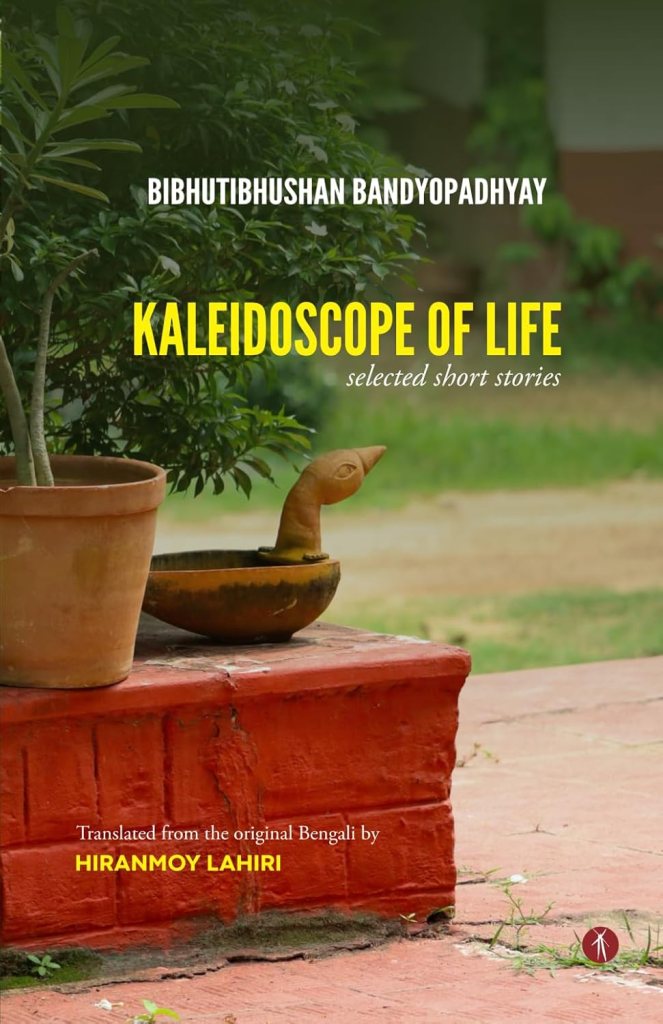
Translated from Original Bengali by Hiranmoy Lahiri
Publisher: Hawakal Publishers
Bibhutibhusan Bandyopadhyay (1894 – 1950) is one of the best-known Bengali writers of the twentieth century and therefore needs no introduction. Though most of his works are largely set in rural Bengal, he didn’t receive much critical attention until 1928. Author of famous novels like Pather Panchali (1929), Aparajito (both of which inspired the famous film director Satyajit Ray make his films based on them), Chander Pahar and Aryanak, he is the also the author of several short story collections like Meghmallar (1931), Jonmo O Mrityu (1937), Kinnardal (1938), Talnabami (1944), Upolkhondo (1945), Kshanavangur (1945), and Asadharon (1946). The multifaceted nature of his short stories has invited translators to explore the different facets of this genre and till date, we find several new translated volumes of his short stories see the light of the day quite frequently.
An interesting feature of the short story is that down the centuries the genre’s changing variety made it difficult to be classified under any fixed notion. Whatever may be the subject matter, structure, or style, a short story tells a ‘story’; otherwise, readers would not read it. Whether events in their stages of development or sequential movements and logical relationships are enough for it to be considered a story have been debated so often that it is not necessary to repeat them here. We just need to remember that as far as the short story is concerned, readers have opted for it because of the beauty that lies within its compact structure, a beauty that thrills the reader when the story ends.
Now to come to this collection of Bibhutibhusan’s short stories selected and translated by Hironmoy Lahiri, a young translator and a freelance writer. Apart from the semi-autobiographical piece “How I began writing,” with which it begins, there are fifteen stories ranging from the sentimental, bizarre, thrilling, meditating, and occult where different other kinds of emotions are also expressed. Except for a couple of already translated pieces by other hands, most of the stories selected here by the debut translator have not been translated earlier and all of them are unique for their theme, style and narrative method. The stories have not been chosen on the criterion of chronology of their appearance in print or a particular theme which is usually resorted to by other translators; instead, the focus has been on the diverse nature of the author’s creative world. The volume thus includes ‘slices of life’ stories, unusual stories such as those of smugglers and dacoits, fictions of remote places and unusual personalities, and even supernatural narratives. They really provide a comprehensive view of Bibhutibhusan’s genius, and the phrase ‘kaleidoscope of life’ mentioned in the title definitely justifies this collection.
The very first story in this collection titled Upekshita, ‘The Disregarded’, is significant because it happens to be Bibhutibhusan’s first published story that appeared in the leading Bengali magazine Prabasi in 1921 and narrates the writer’s special relationship that he had developed with a village lady who took on the responsibility of taking care of his meals and looking after him. Drawn upon his personal experiences, especially during his stint as a teacher at a suburban school in Harinavi, when the myopic residents of the area misrepresented the author’s innocent nature of the relationship with the lady as a scandalous incident, it led to such misunderstanding that Bibhutibhusan eventually resigned from his school and moved to Calcutta.
‘Archaeology’ talks about a statue that mysteriously comes to life and establishes Bibhutibhusan’s interest in ghosts, the mystic and occult that is revealed in several other stories as well. Some of them are simplistic, like the story ‘Motion Picture’ that narrates the vision of seeing a lady djinn swinging outside an old house, or the sighting of the ghost of an opium seller in ‘Gangadhar’s Peril’. But there are also much more complicated ones like the very popular long story of ‘Taranath, the Tantrik’ where the protagonist is a mystic figure and practitioner of occult. With a growing fascination for tantra and tantric practices and philosophy in real life, it is said that the author had interactions with a commanding female ascetic who was a devoted follower of the Hindu goddess Kali, and she offered him words of wisdom about tantra and afterlife. The popularity of this fictional character created by Bibhutibhusan was later continued by his son Taradas Bandyopadhyay and even graphic stories continue to be created on him.
Bibhutibhusan’s penchant for exotic locations in his fiction like Chander Pahar (The Mountain of the Moon, 1937) and Moroner Donka Baje (The Death Knell, 1921) comes out clearly in the story ‘Chyalaram’s Adventure’ where a driver is recruited to help the King and his family escape from Kabul by crossing inhospitable terrain and reach India. The narrative is packed with action and thrilling escapades and Bibhutibhusan portrays Chyalaram’s brave actions and unorthodox approach to life in a positive light. As in the novels mentioned above, it expresses the author’s impressive ability to vividly and accurately describe exotic places he had never visited but write about them imaginatively, totally resting upon ‘the wings of poesy.’
In several stories, we find a delicate twist at the end of the tale, be it ‘Grandpa’s Tale’ narrating how he was forced to marry a dacoit’s daughter with a subtle touch of humour seamlessly integrated into the narrative, or ‘Not a Story’ that focuses on the danger posed by dacoits in rural Bengal at that time, where a traveller narrates the tale about a person called Satish Bagdi; or the sweet romantic ending of ‘The Suitcase Wrap’ that was inspired by an actual event when the author’s sister-in-law’s suitcase was accidentally switched on a train. This story captured the attention of readers and was eventually made into a very popular Bengali feature film called Baksho Bodol. ‘Jawharlal and God’ is a satirical tale born out of the author’s anguish and sorrow caused by the Partition of India and the tumultuous aftermath of World War II. The story was written to depict the loss of human values and how man had lost compassion and wonder for the natural world and distanced himself from God. Each of the remaining stories in this collection is unique and once again the translator needs to be congratulated for such an eclectic selection.
Providing a suitable glossary at the end, Hironmoy Lahiri has tried to stick to the original as far as possible, as well as to keep inconsistencies at bay. He has also taken particular care to maintain the essential Bengali linguistic and cultural nuances in the stories. The book will provide non-Bengali readers a good example of the quintessential Bibhutibhusan Bandyopadhyay, who is definitely a difficult writer to translate. The stories explore several universal themes that transcend cultural boundaries and will prove to be popular with readers from different cultural backgrounds.
.
Somdatta Mandal is a critic and translator and a Former Professor of English, Visva-Bharati, Santiniketan.
.
PLEASE NOTE: ARTICLES CAN ONLY BE REPRODUCED IN OTHER SITES WITH DUE ACKNOWLEDGEMENT TO BORDERLESS JOURNAL.
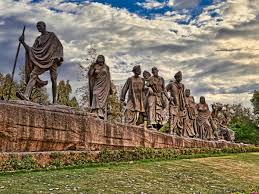
A ‘Truth’ quizzical about the veracity of most truths, Practiced with oneness of adoration As being the eternal bedrock of material life and Trumpeted as God Could only be the ‘Truth’ – the ‘Satya’ - Gandhi experimented.
Fashioning ‘Truth’ as passion, An impulse in his life, So dear to let the freedom perish at its cost, Without wanting deification, Shrouding in mystery and Waiting for the metaphysics to unfold, Gandhi worshiped ‘Truth’ as Supreme Force. He practiced as a means of self-realisation, An instrument of knowing – constructing the knowledge of God, As a quest for being alive; experiencing the material world.
As a seeker of ‘Truth’, that is ‘Satya’, Emanating from the essence – the ‘Sat’, It marked by its omniscience as God. The knowledge of Him was truth enough, Revealed in the form of consciousness, Giving meaning to love, to ‘Ahimsa’ – non-violence, And surpassing language and reason Among believers and non-believers alike.
The practice of ‘Ahimsa’ reveals the ‘Truth’, Leads to its consciousness And brings about the unity of our being. ‘Satya’ and ‘Ahimsa’ begin to define together Human character and conduct – a personal way of living And mediate as the instruments of augmenting humility, Withering away egoism, Addressing social injustices, Setting example of an exemplary life and Harmonising all the creatures on the planet.
But the ‘Truth’ Gandhi espoused for himself, From his vantage point, Turns out in fragments -- in relative terms as relative truths, quite like human existence. For ‘Truth’ cannot be, we are warned, taken as universal Without clinging fragments, taken from different point of views – Together for realisation the of absolute truth, Perhaps through cultivation of pure consciousness and, To evade subjectivity and any impending fanaticism.
G. Javaid Rasool, a Lucknow boy, is a writer, poet and translator. ‘The Wire’ has published good numbers of poetic compositions. International journals/websites/newspapers sometimes carry his writings.
.
PLEASE NOTE: ARTICLES CAN ONLY BE REPRODUCED IN OTHER SITES WITH DUE ACKNOWLEDGEMENT TO BORDERLESS JOURNAL
We were told to be ready for dinner by 6 p.m., so we had one and a half hours to kill before gathering at the lobby. My varsity mates and I, fourteen of us, on our regular bromance outing, had decided to embark on a six-day tour around Sri Lanka. Colombo was our last stop.
I told myself there was time for a shower. I thought I heard the yell of two men. They must be at the heights of merry-making, I reckoned. Nothing wrong. After all, many were holidaying in Colombo, like us, in what was hailed as paradise on Earth. Maybe they took the celebrations too far. It was then that the lights went off. Then I thought I heard a barrage of a loud bang. Did somebody drop something heavy? Then came the indistinctive smell of burning rubber.
Then it clicked. Everything fell into place. Damn. There must be a fire somewhere! I open my room door. I could see a hint of smoke whirling at the ceiling.
What happened to the fire alarm and emergency light or water sprinklers? This is not a rundown half-grade hotel. This is a reputable hotel with its rich Scottish tradition plastered all over its walls, tartans, Scots family insignia and all. Even though we think the British ruled India, the Scottish served in the East Indian Company in big numbers as well. They, too, joined the bandwagon to usurp wealth from unsuspecting natives through their mercantile activities.
As a matter of reflex, I got into the drill. The passive learning from watching all those disaster movies had to be put to good use. Like a child regurgitating what he learnt from rote learning, I fell in line.
“Relax, said the night man!” The first thing that came to mind was, “Don’t panic!” Earlier there had been a blackout. I was too relaxed to think of sitting through the outage and letting the electricians sort it out. That was the wrong move.
Learned experience from flight stewardesses was “in case of emergency, leave behind your belongings and head to the exit”. I realised that it may only work sometimes. Stuck in a third-world country, running around to the fancy of their bureaucracy is not my idea of a holiday. I stuffed my passport, wallet and mobile phone into my jeans and headed out of the room without my luggage. Again, another mistake, I thought.
I remember reading, “Do not use the elevator in case of emergency,” during those long hours spent waiting for lifts. Keeping that in mind, I headed to the stairs. Wow, so far, so good. I began wondering how everything was working like clockwork. Are people so desensitised after watching so many reels on YouTube that they just know what to do? The hotel staff must have been bombarded with so much footage of disasters elsewhere that they could perform the next course of action half asleep.
To be fair, the hotel staff were on their toes, guiding guests down to the exit with the light of their phones. Without their help, the stairs would have been pitch dark. Now, what happened to the emergency lights along the stairway?
Going down was easy, but there was mayhem once I reached the ground floor. Visibility was almost zero, and the lobby was filled with thick smoke. For the first time, panic was palpable. People were coughing and shouting. My first instinct was to pull up my T-shirt to cover my mouth and crouch down as low as possible to minimise smoke inhalation. I switched my mobile phone light on to guide my way forward. My foot hit upon what was the Christmas tree. Huh! I remember observing a giant Christmas tree in the lobby very near the entrance while checking into the hotel. The only differences were it was then brightly lit and covered with fake snow. Now it is dull and grey. I knew the exit was nearby. I followed the steady traffic of the crowd herding out.
Still, the thick smoke was overwhelming, and the pungent smoke slowly irritated my throat. I continued the rest of the journey in anaerobic mode, trying not to inhale more smoke than I had already ingested. Luckily, the way out was short.
It was hard to stay relaxed when everybody else was not. Somehow, I made it out, patting myself for staying calm. What greeted me outside was a crowd surrounding the perimeter of the hotel, directing me to an area nearby. They were pointing up at the building that was supposed to be my two-night stay. There was thick smoke bellowing from its 7th floor.
News spreads like wildfire in this digital world. People were engrossed in getting the best angle for the personal shot with their devices. Soon, the footage would grace their social media and, perhaps, be potentially ‘viralled’. Photographers with zoom lenses were already there as if they had purposely ignited a fire to film it. Curious onlookers with work clothes were locked in their gaze, in awe, as if it were the second coming. I followed.
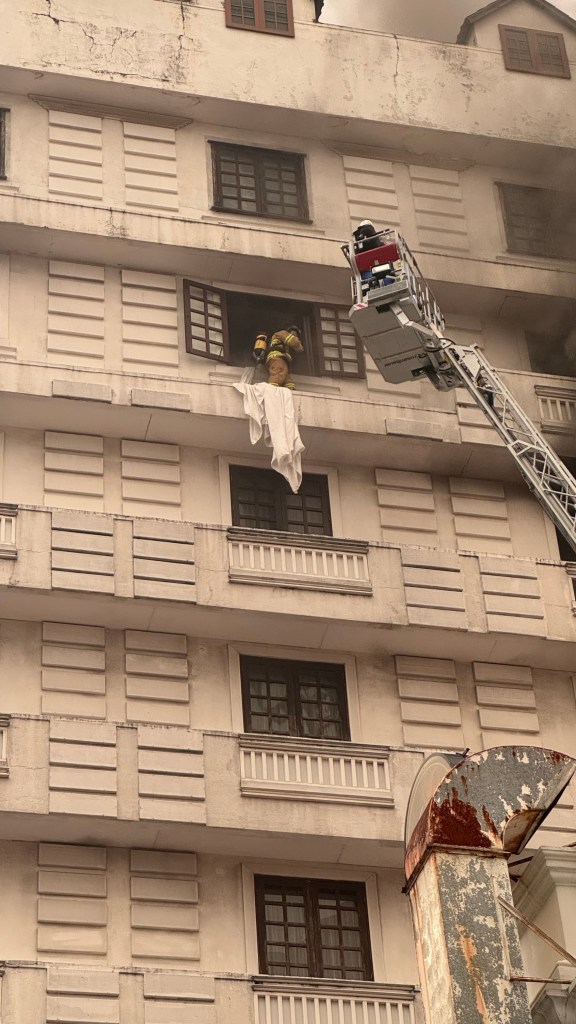
I could see one elderly gentleman out at the window. Yes, I had seen that man before when checking in. He was then struggling to move. He must have opened his window to let the smoke out of his room. But luck had different plans. The smoke had grown in intensity and was blowing directly at his window. Desperate, he climbed out of his window and wanted to jump out against the pleading and yells of onlookers, including me. Maybe it was the confusion of inhaling carbon monoxide; he must have thought the fast out of his misery was to jump down without a safety harness.
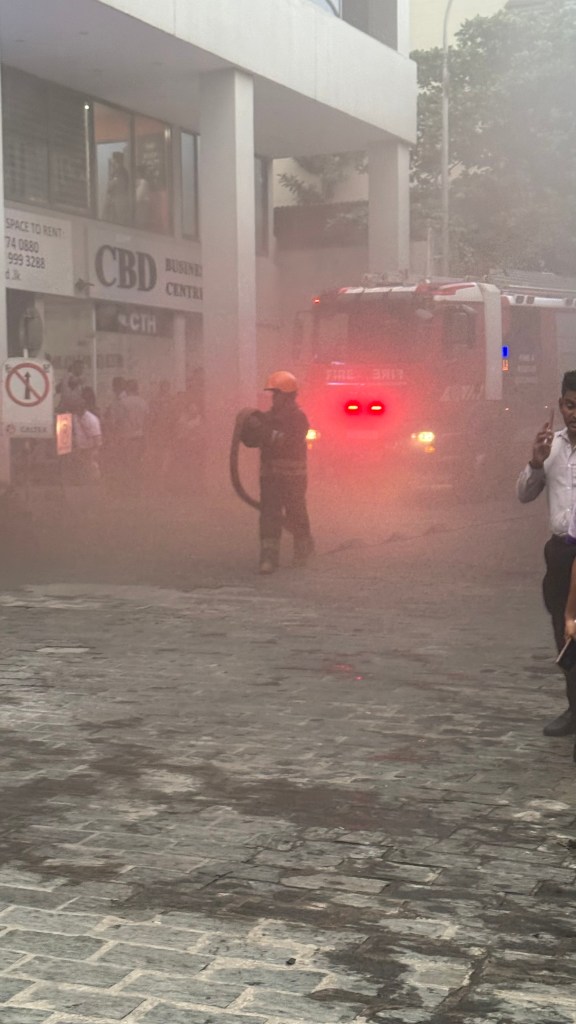
A modern fire engine moved in just then, much to everyone’s relief. In a jiffy, an aerial ladder was summoned to whisk the victim from the window. Applause ensued, and the victim was quickly stretchered to a nearby ambulance.
Firemen at work. Photo Courtesy: Farouk Gulsara
The bellowing smoke quickly settled down, and my friends and I sighed in relief. Though one of my friends went on a tirade of cough. Even before the start of the holiday, he had been recovering from a nasty dry cough. The smoke must have made it worse. The paramedics checked on him, too, and took him in for overnight observation.
The hotel was cordoned off with yellow tape and classified as a crime zone. The police had to investigate to rule out arson. Until then, our luggage was the property of the Sri Lankan Police Department, and no one could go in or out.
We were left out like refugees with only our pants and clothes on our backs.
“… but we have our luggage stuck upstairs. We need them!” we told the hotel staff.
As expected, the reply was, “Sorry, Sir. Nobody can enter the building. But don’t worry, Sir. We will take care of your things.”
We were later given rooms in a nearby hotel, which was better and newer than the drab one we had been given earlier.
We soon left to bury our sorrows in some Ceylonese comfort food: apom[1] and coconut milk-rich crab curry. We had enough action for the day.
In retrospect, leaving the luggage behind was a wise move. Chugging the bags along the dark stairs and smoke-filled foyer is quite daunting. Sleeping with the clothes on our backs without toiletries must have been a trade-off for smoke inhalation and hospital admissions.
Overnight, we had become stars of sorts. Everywhere we went, it became the ice breaker. We became the talk of the town as the ‘guys who cheated the hotel fire”. Of course, we did nothing like that. Still, it spiced up our holiday and gave us friends of more than forty years something to reminisce about in our twilight years.
We only had access to our bags the following morning, which also meant we could not personally enter the premises to collect our belongings. Only designated hotel staff could do that. The hotel was still a crime investigation zone, which must mean we were considered potential arsonists who could tamper with evidence. The police personnel were still busy taking samples and photographs of the crime scene.
Luckily, the fire was localised, and the firefighters did not need to hose the whole building down. Hence, our baggage was dry. My room was on the second floor, while my other friends were on different floors. The fire had been on the seventh. Even though most of our rooms were far from where the fire allegedly started, the retrieved luggage came with a grimy layer of soot, compliments of the furious, fiery invader. Even the garments and bags gave a whiff of smoke for days afterwards, even after sunning it in the open.
Imagine how it would have been if I had waited a little longer. What is damage to property when, above all, health and life matter most? Going back without the luggage is better than returning in a body bag.
.
[1] apom – soft, sweet and fluffy traditional pancake from Southern India and Sri Lanka.
Farouk Gulsara is a daytime healer and a writer by night. After developing his left side of his brain almost half his lifetime, this johnny-come-lately decided to stimulate the non-dominant part of his remaining half. An author of two non-fiction books, Inside the twisted mind of Rifle Range Boy and Real Lessons from Reel Life, he writes regularly in his blog, Rifle Range Boy.
.
PLEASE NOTE: ARTICLES CAN ONLY BE REPRODUCED IN OTHER SITES WITH DUE ACKNOWLEDGEMENT TO BORDERLESS JOURNAL


 Borderless