Mehr’s fingers shivered as she turned the pages of Patrick Hamilton’s Slaves of Solitude. The words in the pages distorted together, but her mind was elsewhere, stuck in a maze of solitude.
Five years and seven months of isolation had made her life dazed with unrelenting queries. Mehr frequently grilled herself… how could she bring her past back? That would be impossible, but it had been beautiful and sad too. She had lost her companion, Nohan, to cancer that night more than five years ago. Nohan, from Mehr’s school cohort, had been her soulmate. During the recess at school, he often says to Mehr, “You are as fine-looking as the moon,” looking at Mehr’s brown eyes with a pure smile on his lips. She never praised but had deeply admired him.
The consciousness of Nohan and Mehr were akin. They loved gentle breeze, striking mountains, the elegant water of Nihing River, and the scenario of Jaalbaar. Most of their debates were grounded on the veneration of Balochistan’s beauty. Mehr had always aired her life’s grievances to Nohan and found relief in being with him. Since the day Nohan had departed from the world, she was in the room – alone.
Her room, once an asylum for her companions, now turned into a prison. The gentle breeze, the echoes of mountains, and the rain created a forlorn opus, adding her depression. Each drop of rain haunted her and reminded her of bygone days. Memories of her past unsettled and haunted her even in her most blessed hours. Her eyes, once perky, now seemed grey, weighed down by the tears she had shed in the isolated room with the pages of the book.
A voice whispered to her, “Take my hand, or you will go astray here—in the world of solitude.” Mehr’s heart pranced a beat. She spun around, however, there was no one there. She remained astound. Past mid night, the voice persisted again, “Look, there is a yellow river beside your room, flowing with blood and sorrows.” The words dripped torment. All of a sudden, Mehr’s gaze drifted towards the window, and for a moment, she saw nothing around. It was so dark, she found a yellowish glow, and after some seconds, the yellowish glow died out.
It was still raining outside. The voice continued to haunt her. Mehr felt like she was drowning in a sea of despair. Afterwards, something budged. The night turned into another day. She picked up another book, One Hundred Years of Solitude by Gabriel Garcia Marquez, which was kept in her personal collection. But nothing changed. She still felt a sense of nervousness.
Mehr’s heart swelled with sensation as she approached the word solitude in the pages of the book. She smiled, and felt a weight lift off her shoulders. For the first time in years, she felt a sense of belonging. Though, the solitude, the memories, and the voices – they had all been a manifestation of her own fears and doubts. She smiled and knew that she still had a long way to go – perhaps an unknown destination. The phrase “Solitude is a kind of freedom” would continue to roll on her mind. She found solace in solitude– a feeling she could own. She lived by the line that said, “In solitude, the mind gains strength and learns to lean upon itself.”
.
Munaj Gul is a lawyer based in Turbat, Balochistan. He tweets @MunajGul
PLEASE NOTE: ARTICLES CAN ONLY BE REPRODUCED IN OTHER SITES WITH DUE ACKNOWLEDGEMENT TO BORDERLESS JOURNAL
Obedient scales march up my body single file, where nails lodge.
It is not enough for deformed skin to don the camouflage of silvery plaques, memorials.
Lift each up and discover the changed base. Unrecognisably worn, undeniably torn, tissue.
Texture that has morphed. Unbecoming, melded. Little wellsprings spurt red underneath the forgotten cause. A scrawled signature of old blood lines.
*The Koebner phenomenon refers to the appearance of skin lesions, usually in linear crops, as a response to injury, in individuals with chronic skin conditions including psoriasis.
Jyotish Chalil Gopinathan is a nephrologist and researcher. The Coppiced House, his first collection of poems, was published by Writers Workshop in 2024. His poems have appeared in Poems India, The Punch Magazine and Poets for Science and are expected in 2025, in Muse India and the Annals of Internal Medicine.
.
PLEASE NOTE: ARTICLES CAN ONLY BE REPRODUCED IN OTHER SITES WITH DUE ACKNOWLEDGEMENT TO BORDERLESS JOURNAL
A lady who had spent over half her life serving at the temple passed away unexpectedly. She had remained unmarried, having lost her family quite early on. In search of solace, she dedicated all her spare time to various activities to ensure the temple ran smoothly. She ensured that even the most minor details were attended to.
One day, she passed away in her sleep. Nobody realised. The daily operations continued as usual. Nobody missed her. There wasn’t even a mention of her death in any of the temple communications. Only the local gossipy housewives had something to discuss during their daily tête-à-tête. They believed she was in a better place and held a higher status in the karmic cycle. But nobody knows…
During one of my weekly cycling routines, I chanced upon a lady who had pulled over her SUV by the road. She gave a gentle honk. As if responding to some intergalactic mothership, I noticed a pack of stray dogs and a troop of wild monkeys hurrying towards the SUV. They gathered around the vehicle patiently as the lady began rummaging through the backseat and distributing food.
I believed this to be the finest form of non-verbal interspecies communication I have ever witnessed. The cynic within me proposed that her actions were not in the best interest of the natural order. Wild animals are meant to hunt for their daily sustenance. By feeding them, they become overweight and less agile, ultimately diminishing their mobility. What will occur when the gravy train halts? Will they resort to attacking passersby for free meals? Nobody knows…
Here I am, cycling and running, hoping it will help me live longer or make me less of a bother to those around me in my twilight years. On the other hand, could exposure to the elements and the dangers associated with the outdoors be the actual cause of my malady? Nobody knows…
The individuals gathered in Prayagraj, India, for the Kumbh Mela share a common belief. The alignment of the Sun, Moon, and Jupiter in a straight line is thought to hold cosmic significance. The Kumbh occurs every 12 years in four locations across India—Prayagraj, Nashik, Haridwar, and Ujjain. This year, in 2025, a rare celestial alignment that occurs once every 144 years[2], offers a unique spiritual renewal and liberation opportunity.
Can a lifetime of wrongdoing and accumulated karma debts be washed away in a single dip at Triveni Sangam[3]? Can one attain moksha so easily? Yet, nobody knows… none who have been there and returned to provide a field report.
The take-home message is that just because no reproducible and tangible proof can be provided does not mean it does not exist. To each their own. Rather than attempting to undermine their beliefs or corner them into adopting our views, we should simply leave them be. Let everyone believe they are making a difference in the world they inhabit during their lifetime.
Photo Courtesy: Farouk Gulsara
[1] Eleanor Rigby is a Beatles song from 1966 about a lonely woman who found solace in the church.
[3] The Triveni Sangam in Prayagraj (formerly known as Allahabad) is the confluence of three rivers: Ganga, Yamuna, and the displaced Saraswati.
Farouk Gulsara is a daytime healer and a writer by night. After developing his left side of his brain almost half his lifetime, this johnny-come-lately decided to stimulate the non-dominant part of his remaining half. An author of two non-fiction books, Inside the twisted mind of Rifle Range Boy and Real Lessons from Reel Life, he writes regularly in his blog, Rifle Range Boy.
.
PLEASE NOTE: ARTICLES CAN ONLY BE REPRODUCED IN OTHER SITES WITH DUE ACKNOWLEDGEMENT TO BORDERLESS JOURNAL
De-Broglie coined the concept of material duality,
It explains the existence of material particles in reality.

Duality means wave character and particle character,
Duality matters for the universe for every matter.

Dual nature amalgamated from Thomas Young’s experiments,
August Fresnel’s transverse wave concepts.

Radiation of light shows a dual nature,
Phenomena of diffraction and polarisation owe to light’s wave character.

In light and shadow, every waves and particles secretly play,
Matter's dual nature in visible world, is physics' grand display.

In duality's realm, truth forever swings,
Unfolding secrets of dancing Quantum dots and photon beams.

Duality in the universe works in a spontaneous manner,
When we change the ‘invisible’, then the ‘visible’ changes occur

Duality is the daily reality,
Mass and Energy
Hot and Cold,
Light and Darkness,
Cause and Effect,
Micro and Macro,
Action and Reaction,
Positive and Negative,
Fast and Slow,
Outer and Inner,
Morning and Evening,
Pleasure and Pain,
Sorrow and Happiness,

No matter how living and non-living beings are classified,
Their dual nature will keep everyone in the universe correlated.

Matter's dual nature is just one of nature’s display,
Science shows  duality in everyday and everyway
Bibhuti Narayan Biswal is a passionate science communicator and science lover. He has been working as a school thought leader for two and half decades. He has to his credit three publications in Consilience Journal. He can be reached by email via Bibhuti.nb@gmail.com
PLEASE NOTE: ARTICLES CAN ONLY BE REPRODUCED IN OTHER SITES WITH DUE ACKNOWLEDGEMENT TO BORDERLESS JOURNAL
We sail into Turtle Bay on East Wallabi Island. I make my way barefoot to the bow. Then I hold the boat hook and crouch at the edge, extending it towards the buoy. I loop the hook under the thick slimy rope covered in algae and yank it upwards.
“It’s too heavy!” I yell, my voice disappearing into the wind.
Alex must have heard because he abandons the helm and races to the bow. He grabs the boat hook from my hands and pulls up the rope, securing the buoy to the cleat.
Turtle Bay is a wide horseshoe. The waters are glistening turquoise and are surrounded by white sands. It’s uninhabited but small planes of tourists regularly fly in and out to walk and dive. Night is descending and it’s too late to disembark, so we look longingly at the shore and wait for the morning.
Once day breaks, we head ashore on the stand-up paddleboard. Alex places his phone in a waterproof bag. He alights from the stern and kneels on the back of the paddleboard. I kneel at the stern and carefully slide over to kneel at the front of the paddleboard. Alex paddles to shore behind me and I try to remain as still as I can, unresponsive to the moving water beneath me, retrieving the muscle memory of riding wayward horses in my youth. Once we arrive, we alight as quickly as we can and drag the paddleboard away from the water’s edge.
A shaft of light catches my eye, and I reach down to pick up the object. It’s a small purple shell lined with brown flecks. As the sun is blinding, I am forced to continue casting my eyes downward. Never have I seen such an array of shells on a beach. Alex, on the other hand, finds his attention caught by even brighter hues than the shells. A blue plastic wrapping. A broken glass bottle. An aluminium-insert from boxed water. He retrieves these items unflinchingly. We continue to walk around this uninhabited island and find yet more rubbish washed up ashore. Most of it is plastic bottles and brightly coloured bottle tops. Then we spot a large blue plastic tub. Alex picks it up and places the rubble within. I respond with strong disgust, so am ashamed to say that I do not help him. Alex does not chide me for this, and I am grateful that he withholds judgement. I continue to admire the multi-coloured shells washed up by the tide.
We beat our way back through the fierce heat to the section of beach where the paddleboard is waiting. Alex affixes the bucket of rubbish to the stretchy cords at the front of the paddleboard. Spray surges as each wave hits the shore. He waits for a lull between the swell. After several more waves hit the shore there is a momentary calm, and he pushes the board forward. I climb on and crouch behind the rubbish. Alex mounts the board behind me and paddles towards the boat. I’m no longer a retiree, but a teenager at the beach with her boyfriend. I close my eyes and now I am keeping balance on my lively horse. Suddenly, when we have nearly reached the boat, I sense Alex is worried. The tide is pushing us away from the boat and he paddles harder. Will the wind push us into the vast empty seas out of the range of mobile devices? Just as we reach the stern Alex thrusts his paddle into the water to do a U-turn. I find myself parallel with the boat, grab the steel handle, and slide onto the boat without tipping Alex and the rubbish into the depths.
All is secure, and now it’s time to sail back to the mainland. We head north-east to the tiny township of Port Gregory, with its population of eighty, renowned for a submarine shelling in 1943, and a vast pink salt lake. After anchoring in the bay, we again secure the rubbish to the front of the paddleboard and kneel behind it. Once on the shore, we are reassured by the sight of multiple rubbish bins. Port Gregory is too remote for recycle bins, so we reluctantly place the island rubbish into one of the general bins, and trudge through the heat to explore the town.
Port Gregory. From Public Domain
Meredith Stephens is an applied linguist from South Australia. Her recent work has appeared in Syncopation Literary Journal, Continue the Voice, MickingOwl Roost blog, The Font – A Literary Journal for Language Teachers, and Mind, Brain & Education Think Tank. In 2024, her story Safari was chosen as the Editor’s Choice for the June edition of All Your Stories.
PLEASE NOTE: ARTICLES CAN ONLY BE REPRODUCED IN OTHER SITES WITH DUE ACKNOWLEDGEMENT TO BORDERLESS JOURNAL
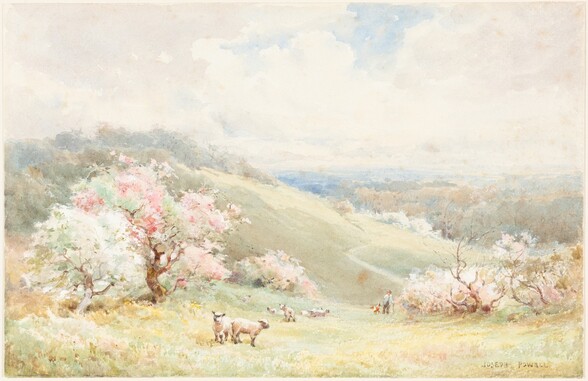
Spring by Joseph Rubens Powell (1823-1896). From Public Domain
THE SANDMAN’S SONG

I sing white water,
    birds on the bough,
        bunnies and redwoods
            to sleep ... to sleep ...
I sing, “Wild forests,
    green meadows, blue seas,
        drink deep ...
            drink deep ... drink deep ...”
I whisper, “Bright robins,
    please, be wise,
        and wily weasels, close your eyes ...
            fierce eyes ...”
I bid all the rivers, “Come, seek your beds!”
    I bid all the children, “Off, sleepyheads!”
         then softly shutter their eyes ...
            eyes ... eyes.
I lullaby, lullaby down the plains,
    echo through mountains
        and moonlit hills ...
            hills ... hills ...
I murmur, “Oh, mothers,
    please don’t rise;
        shadows and stars,
            be still ... be still ... be still.”

And the world sleeps.


HEY PETE!

(for Pete Rose)

hey pete,
it's baseball season
and the sun ascends the sky,
encouraging a schoolboy’s dreams
of winter whizzing by;
go out, go out and catch it,
put it in a jar,
set it on a shelf
and then
you'll be a Superstar.
Pete Rose (1941-2024). From Public Domain
Michael R. Burch’s poems have been published by hundreds of literary journals, taught in high schools and colleges, translated into fourteen languages, incorporated into three plays and two operas, and set to music by seventeen composers.
PLEASE NOTE: ARTICLES CAN ONLY BE REPRODUCED IN OTHER SITES WITH DUE ACKNOWLEDGEMENT TO BORDERLESS JOURNAL
The Devil said, “Look here, old chap, we are still going through your paperwork and it’s more complicated than you suppose. There are very few clear cut cases when it comes to judging a person’s life. You assume there is only one question to be asked. Was he good or bad?”
“Isn’t that what it boils down to?” I asked.
The Devil winced. “I wouldn’t make any references to boiling yet. And no, it can’t be reduced to such a simple question. Just using ‘good’ and ‘bad’ as the only two variables in the equation isn’t a workable approach. No, it’s not. There isn’t even an equation, not really.”
“I am astonished to learn this,” I answered.
“People who come here often are. And it’s the same in the other place. Lots of deliberation is necessary. Listen, I enjoy mathematics but this is morality, not calculus. The issues at stake are intricate. There are many philosophical aspects in any consideration of how an individual is morally rated. Investigations must be thorough and you appear to be a fellow of ambiguous character. For every act of grace, you have a malign one.”
“What am I supposed to do now?” I cried.
“Wait,” came the crisp reply, “in the Waiting Room that has been prepared for cases such as yours.” Then the Devil’s voice became less formal again. With a nudge of his elbow in my ribs, he added, “The Waiting Room isn’t so awful. It is certainly better than Hell itself.”
“How long do you think my case will take?”
He shrugged. “Twenty-four.”
“Hours?” I was alarmed that a whole day would pass in whatever limbo lay in wait for me behind those doors. He shook his horned head and I gasped, “Days?” but he kept shaking and a horrible prospect opened up before me. “Weeks? Months? Years?” I felt hot and cold at the same time. “Centuries?”
“Aeons,” he said. And then he yawned. I blinked. His forked beard was so oily it gleamed in the dim light of the cavern. He took me by the arm, and while his tail lashed from side to side, he guided me to the double doors that appeared to be made from pocked granite.
“Just through here,” he said, as he propelled me with a little push. I lost my balance and tumbled into the igneous doors. They swung open to admit me and I rolled on the floor. Before they shut again, I heard him add, “Plenty of waiting chaps inside you can make friends with. The millennia will seem to fly by, trust me. No restrictions on amusements.”
I wasn’t reassured by his words, which were abruptly cut off by the closing of the granite portals. I knew they wouldn’t open from this side. I was bruised a little on my elbows and knees. But I stood and regarded my surroundings. I was in a chamber so vast there was no visible end to it. There were chairs, sofas and divans of all kinds arranged haphazardly. Some of them were occupied. I licked my lips and took a few paces forward.
“Newcomer, huh?” said a man on a rocking chair.
I nodded. “That’s right.”
“What else could you be? Pointless question. But I asked it anyway. That’s how I pass the time. Infinity,” he added after a pause, “is the heaviest weight on the shoulders of a dead soul.”
“You have been here for a long time?”
“Not really. One hundred years, a century. A grain of sand on the shifting dunes of Forever. But I am getting used to it. Tedium can be stimulating if you don’t take it too seriously and–”
“There are better amusements here,” said another voice, more strident, low in register, and I turned to see a fellow frowning at me from a very comfortable armchair. He was dressed smartly and my intuition told me that he was one of those minor sinners, an embezzler or fraudster, someone who would probably be consigned to a less painful Circle of Hell. Once his paperwork was done, that is. His frown continued. I asked: “Such as?” and I realised my voice was a croak.
“Telling stories,” he said.
He leaned forward, although in the luxurious depths of his particular chair he looked just as stuck as when he was sprawled almost horizontal. “Let me say that I prefer short tales, the briefer the better. Thrills without frills. Long stories annoy me. I seem to lack patience.”
“A major disadvantage in a place like this,” commented the first man, then he chuckled and the shaking of his body made his rocking chair oscillate. With a sigh, the second man continued: “I have only been here for a few months. I am still in full possession of my senses. The decay of my mind hasn’t begun. I will tell you a story and I suggest you tellme one in return.”
At a loss for words, I simply stood there, and my failure to respond quickly enough seemed to irritate him.
“It doesn’t have to be a major epic,” he snapped.
“But my mind is blank.”
He threw up his hands, exasperated. “Then you ought to clear off. It’s far better to be where you belong.”
“Wherever that might be,” said the first man.
“Not near here, I hope,” snarled the man in the armchair, and he scratched his head with unwarranted ferocity. “Well, I don’t care if I don’t get any story in exchange. I intend to tell mine.”
I found this rather mystifying and was about to say so, but he was clearing his throat and preparing to speak. The first man was still chuckling and rocking, but more quietly and less vigorously, and soon he settled back into quietude. At the same moment, the smartly dressed fellow fixed me with his piercing eyes, a gaze too intense for such a casual moment, and then a stream of words came out of his mouth. I was vaguely alarmed.
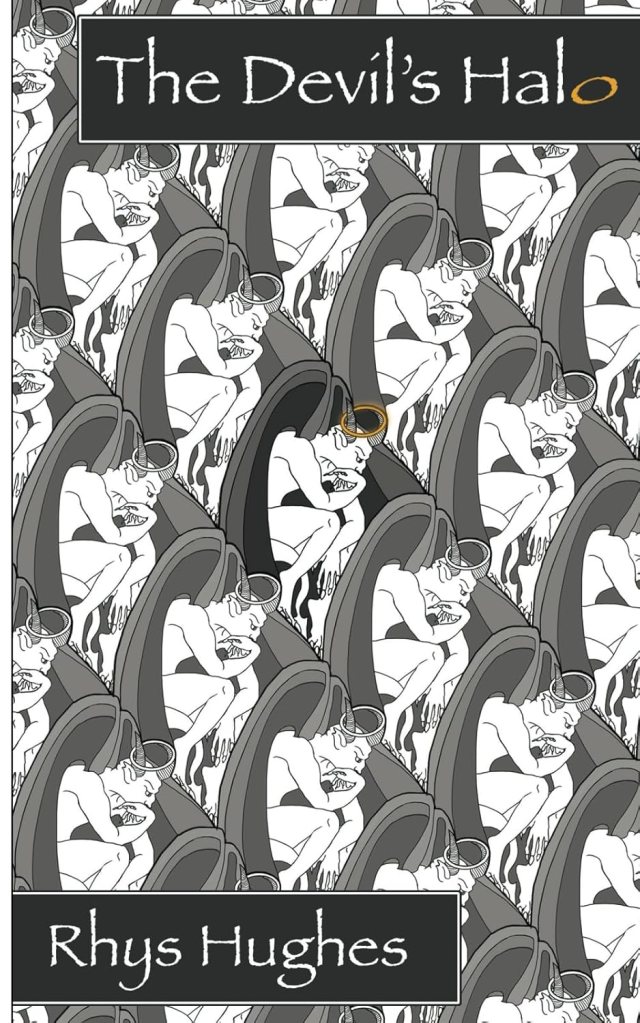
About the Book: In death, as in life, paperwork is hell. The paperwork for the recently deceased Monty Zubris needs to be examined and deliberated upon. So, meanwhile, the Devil has consigned him to the Waiting Room of the Afterlife. It is ordered alphabetically, so he is compelled to make his way to his designated zone, which is, of course, near the very end of the chamber. On this voyage of enormous length, he meets various dead individuals, many of whom wish to tell him their remarkable stories.
A light comedy, a picaresque journey – like a warped subterranean Pilgrim’s Progress.
“Only Rhys Hughes could have written The Devil’s Halo!” – IAN WATSON, European SF Society Grand Master 2024.
About the Author: Rhys Hughes began writing from an early age. His first book, Worming the Harpy, was published in 1995 by Tartarus Press, and since then he has published more than fifty other books, and his fiction has been translated into twelve languages. His work encompasses genres as diverse as fantasy, gothic, experimental, science fiction, magic realism, comedy, absurdism, thrillers and westerns, and he is known for his invention, imagination and wordplay. He recently completed an ambitious project that involved writing exactly one thousand linked short stories. He also writes plays, poems and articles.
PLEASE NOTE: ARTICLES CAN ONLY BE REPRODUCED IN OTHER SITES WITH DUE ACKNOWLEDGEMENT TO BORDERLESS JOURNAL
Time flows into a nothingness that we call eternity, but like an insidious disease, time destroys unseen. Was it for nothing the Chinese sat beside their venerable rivers, studying ancient philosophies, while gazing at the stars, the stars which saw the pyramids built, and empires fall like a house of cards? Unconcerned, time flows over me, as it has flowed for centuries. From the passions of twenty-one to the sorrows of sixty-three is a short time in the history of mankind. It seems even shorter to me.
AT THE END OF A SHORT LIFE
Coming to its end, the year is like a snake crawling into a hole through a rain-soaked field. Years swiftly pass like winds, as they appear to descend, unnoticed, from the sky. Clouds like trucks roll by as if on an invisible assembly line. Stars explode like cosmic firecrackers, when they finally die. Writing a poem for me, is like climbing a tree. In the mirror my face is as ravaged as the Yellow River, and only a month ago, I felt like twenty-five, when my wife was still alive.
George Freek’s poetry has recently appeared in The Ottawa Arts Review, Acumen, The Lake, The Whimsical Poet, Triggerfish and Torrid Literature.
PLEASE NOTE: ARTICLES CAN ONLY BE REPRODUCED IN OTHER SITES WITH DUE ACKNOWLEDGEMENT TO BORDERLESS JOURNAL
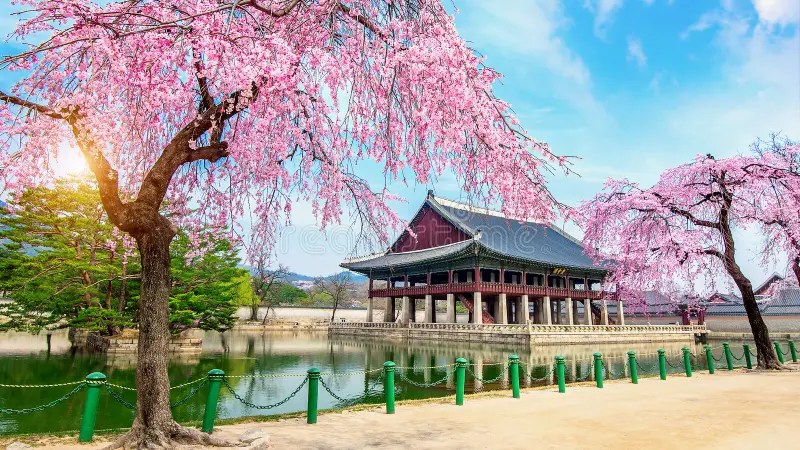
Leaning on her cane, limping along,
An old woman steps out to bask in the spring sun,
And though February’s chill lingers,
The alleyway feels warm.

She tends her garden alone,
Feeds the fire in the hearth…
And so, in the countryside home,
Swallows still build their nests.

Though the mulberry fields have turned to sea,
She lets pumpkin vines climb the fence.
And all summer long,
Balsam flowers bloom in the yard.

With pumpkin vines and swallows,
A garden and balsam flowers under her care,
She is an aged queen,
Ruling over an ancient land.
Ihlwha Choi is a South Korean poet. He has published multiple poetry collections, such as Until the Time When Our Love will Flourish, The Color of Time, His Song and The Last Rehearsal.
.
PLEASE NOTE: ARTICLES CAN ONLY BE REPRODUCED IN OTHER SITES WITH DUE ACKNOWLEDGEMENT TO BORDERLESS JOURNAL.
Storytelling is central to the life and work of Malaysian author, editor and teacher, Daphne Lee. Keith Lyons finds out what keeps her up at night.
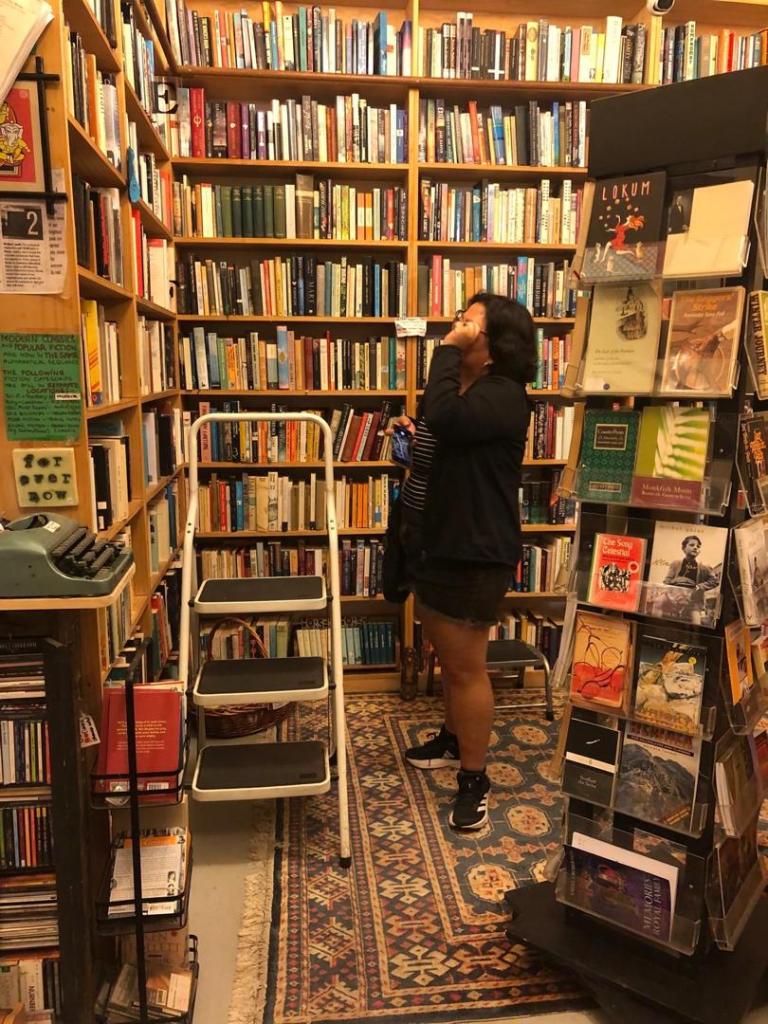
When I1 first met Daphne Lee in person, in a Chinese Buddhist cafe in Christchurch, New Zealand, on a summery day. I was struck by her curiosity. And I came away impressed, not just by how she delights in hearing ghost stories, myths, supernatural tales, and folklore but how she makes connections to the universality of storytelling, and what lies beneath.
Daphne Lee
As well as being a collector and curator of stories, she’s a writer, a creative writing teacher, and an editor—since 2009 she’s been consulting editor at Scholastic Asia. She’s been active in supporting the work of writers and illustrators of children’s and young adult literature with Asian content. Daphne curated and edited Malaysian Tales: Retold & Remixed (ZI Publications) in 2011 and Remang: An Anthology of Ghostly Tales (Terrer Books) in 2018, while Bright Landscapes, Daphne’s first collection of short stories, was published in 2019. She’s working on a new short story collection, and her first novel, which she is currently revising while in New Zealand on a writing retreat, far from the streets of Kuala Lumpur and her Roman Catholic school upbringing.You can find out more about the multi-talented Daphne at her website https://daphnelee.org/.
Interview with Keith Lyons
What inspired you to create Remang: An Anthology of Ghostly Tales?
Malaysians love ghost stories. We would rather any misfortune or unusual occurrence be caused by a spirit or other supernatural phenomena than try to figure out a logical reason. Having said that, I don’t believe in ghosts, but I do enjoy ghost stories. I thought it would be fun to edit a collection of these, but I was wrong …
How do you approach writing and curating ghost stories? What elements do you feel make a truly eerie and memorable tale?
I prefer a story to suggest a mood and to be atmospherically or suggestively spooky than to be full of gory and blood-curdling details. I like the sort of ghost stories that are frightening only if you read between the lines or that seem unremarkable at first, but months later, you suddenly realise what it all means.
Your work often draws from Asian folklore and supernatural beliefs. Are there any particular myths or legends that have influenced your storytelling?
Nothing in particular, but I have heard the same stories all my life and with surprisingly few variations and differences. I enjoy retelling the old tales or building on elements in them. Hopefully, I make a completely new story, but with recognisable features because I like reading stories in which there are some familiar details.
Do you have a personal ghost story or supernatural experience that shaped your interest in this genre?
My family lived in a haunted house in my hometown (Segamat in Johor, the peninsula’s southern-most state) and we experienced things like lights going on and off, footsteps, odd, unexplained sounds, and so on. I can’t remember much, but I don’t think any of us ever felt threatened during the eight years we lived there. If there were spirits, they were not malevolent. My interest in the supernatural was probably more shaped by the films I watched as a child, including The Exorcist and the Hammer House of Horror — Dracula films starring Christopher Lee.
As an editor, what do you look for in a compelling ghost story?
The problem with the ghost stories we tell one another is that they are usually just anecdotal fragments. I look for fully-formed stories with well-developed characters—the ghostly element might even seem merely incidental to the plot yet be significant enough to make an impression. It should haunt you a long time after you’ve stopped reading.
How do you balance creative freedom with maintaining a strong thematic or narrative structure in an anthology?
I’ve curated two anthologies—one of ghost stories and the other of retellings of folktales, myths and legends. For both the brief was quite open and I welcomed a variety of styles and voices.
What are some of the challenges you face when working with authors, particularly in speculative fiction and folklore-based stories?
I find that when it’s an open call, it can be challenging to gather enough suitable stories for an anthology. Once you’ve made the selection, the editing process is usually long and laborious, with more back and forth than the deadline allows. It’s a much more straightforward process when experienced authors are invited to contribute to an anthology. With the authors published by my day-job (at Scholastic Asia), the major challenge is when the author is too precious about what they’ve created and is adamant about retaining something that doesn’t work or refuses to/is unable to develop a half-formed idea. Fortunately, that has rarely been the case. It’s imperative that authors trust their editors and, thankfully, I’ve had a good relationship with most of the writers with whom I’ve worked.
You’ve been deeply involved in the Malaysian publishing scene. How has the landscape for local horror and supernatural fiction evolved over the years?
I’m not directly involved in the scene as most of my work as an editor is with an American publishing house, albeit its Asian imprint. However, I am a reader of locally published books and do read some supernatural fiction written in the Malay language. When I was a teenager, I was a fan of a series of books with the series title Bercakap Dengan Jin (Talking with a Jinn)—they were dark tales that featured a witch doctor, set in rural Malaysia, with lurid covers and badly designed interior pages. The production value of horror fiction has improved, but the stories that are most popular are still the ones we are familiar with, especially about the ghosts that haunt every school and hospital in the country. They are hastily written and barely edited, with high print runs—horror sells, second only to romance novels.
How important is it for Malaysian and Asian supernatural stories to be represented in the broader literary world?
The world needs to realise that there is more to Asia than just what the West is showing it. Right now, a handful of houses controls what most of us are exposed to and end up reading. Even if Asian fiction is getting on the shelves, it’s only what these publishing houses have decided is worthy. In Asia, especially those countries that were colonised, readers are still stuck with the idea that books out of the UK and the US are better than those published locally. In Malaysia, we have some authors who have ‘made it’ in the West—people like Tan Twan Eng, Tash Aw, Preeta Samarasan and Zen Cho. They are excellent writers, but I don’t know if many Malaysians would pay attention to their work if they were published by Malaysian houses. Unfortunately, we don’t appear to be very discerning readers. Penguin Random House SEA, which runs out of Singapore and is riding on the Penguin brand, fails to offer sufficient editorial support to its authors and seems to be prioritising marketability and quantity over quality. Readers buy the books because Penguin is supposed to equal quality. Writers sign contracts with the house because they recognise PRH as a popular brand with a great reputation. They complain about the poor editing but choose to stay with the company. This is a kind of horror story too!
Do you think traditional ghost stories still resonate with modern readers? How do you adapt them to contemporary audiences?
I think so. I think part of the attraction of ghost stories is that people like to be scared as long as they can also feel safe while feeling terrified. Traditional ghost stories are the perfect comfort reads. They are thrilling yet familiar. You know what’s coming—all the scary bits, but there’s usually a happy ending too, when the ghosts are put to rest and the humans go back to their boring lives.
Many Western readers are familiar with ghosts like the vengeful spirit or the haunted house trope. What uniquely Malaysian or Asian ghostly elements do you wish more people knew about?
The Asian ghosts most familiar to Western readers are probably the Japanese yokai. Once again, there is a degree of gatekeeping going on. A Malaysian author I know was looking for a lit agent and was told that although her writing was good, her stories were ‘too South-east Asian’. What does that even mean? Western publishers and agents underestimate the ability of readers to relate to subjects unfamiliar, especially when they originate in South-east Asia. Often you hear that a publisher or agent already has a South-east Asian on their list and does not have room for more. Yet, there are officially eleven countries that make up the region. They are not interchangeable, and do not share a common language, history or culture. Malaysia has many types of ghosts and they each reflect the various beliefs and attitudes Malaysians have towards life and all its big and petty questions. To know these spirits is to know the fears and anxieties of the common Malaysian.
You’re planning an online archive of Malaysian folktales. Could you share more about this project and why it’s important to preserve these stories?
I was recently on a panel about folktales with two other Malaysian authors who write books that draw on folktales for inspiration and one of them said that the folktales that stick around are the ones that mean something to the community. This may have been true in the past when folktales were shared orally. These days, the ones that survive are those that get included in collections or are retold and reimagined into films etc. The same ones get recycled time and time again, probably because they are the most dramatic or sentimental. Collecting as many folktales as possible and storing them online gives them all a fair chance of surviving. What may be insignificant to one generation, may resonate for another. The main thing is to let each generation decide, and for the stories to be available and accessible.
Bright Landscapes was your first personal collection of short stories. How did that experience differ from curating Remang?
For Bright Landscapes I had only myself with whom to argue and disagree. My editor and I were, fortunately, on the same wavelength, but she really helped me improve on the quality of the stories. I wouldn’t undertake another project like Remang unless more time and more resources were available.
Can you share any details about your upcoming novel? What themes or ideas are you exploring?
During the pandemic I completed a novel but on reading it, I realised how rubbish it was. It’s very close to my heart, but I think it’s not quite the right time for a rewrite. It needs to ‘cook’ more, in my subconscious. That novel is set in a world where gods and humans live side-by-side, during a time of religious reform. The protagonists are a priest and a deity, and the story deals with questions of friendship, integrity, religious belief, and faith. I have a second novel that I am currently working on—a coming-of-age story set in a convent school in a small Malaysian town in the 1980s. It also explores questions of friendship and faith. I attended two Convent schools from age five to seventeen, and I was raised Roman Catholic. I did think of becoming a nun when I was in my early teens, like the protagonist of my novel, but I have been an atheist since my early twenties, although I am now probably more agnostic than anything. Religious belief and faith are subjects fascinating to me.
As a creative writing teacher, what advice would you give to aspiring writers interested in supernatural fiction?
The same advice I would give any aspiring writer: Read widely and voraciously. And write every day, about anything and everything.
If you could collaborate with any author—living or deceased—on a ghost story, who would it be and why?
I don’t want to collaborate with anyone, but I would like to have a conversation with Elizabeth Bowen about the handful of ghost stories she published. They are my favourites—quiet, mysterious, melancholy, sardonic. I have questions about them that still keep me up at night, decades after I first read them.
Keith Lyons (keithlyons.net) is an award-winning writer and creative writing mentor originally from New Zealand who has spent a quarter of his existence living and working in Asia including southwest China, Myanmar and Bali. His Venn diagram of happiness features the aroma of freshly-roasted coffee, the negative ions of the natural world including moving water, and connecting with others in meaningful ways. A Contributing Editor on Borderless Journal’s Editorial Board, his work has appeared in Borderless since its early days, and his writing featured in the anthology Monalisa No Longer Smiles.
.
PLEASE NOTE: ARTICLES CAN ONLY BE REPRODUCED IN OTHER SITES WITH DUE ACKNOWLEDGEMENT TO BORDERLESS JOURNAL.





 Borderless