Dearest Ma, My earliest memories of you are loud music and your dancing and singing.
I love loud music, can sing, and try to dance.
I’m often asked what my family values are and I say — a sense of humour in adversity.
Where do you think I learnt that from, ma? The afternoon when I was born was a cold one. The military hospital had a handsome gynaecologist and you told me that
it helped you a lot.
From cooking experiments-cabbage transformed into rasmalai-– to mad fashion sense–including bright orange sleeveless t shirts to greet stiff-upper-lip nephews–I’ve learnt that laughter is therapy.
I laughed when a day before emergency surgery, you asked: are you sure?
I love all your deliberate malapropisms.
Your,’ present continues tense,’ and ‘juvenile delicacy.’ How draining for you is a combination of drizzling and raining. And how you say ‘loitering and poetering.‘ .
Ah ma, but I know. I know you wonder sometimes why I am the way I am.
.
When you struggled to drape a sari on me, I cried at the hideousness that looked back at me.
Did you wonder ma, how could someone you created be so unkind?
When I told you about what I had done, you looked at me, askance. How could the child created by many degrees be this stupid?
When you learnt of my illness, you cried because you thought it was in my genes.
Some of what I write and say worries you. I know, ma.
But haven’t you taught me that choices are mine to make?
People say I look like dad. Maybe true, but I hope that I am less him, more you.
.
Dr. Srividya Sivakumar, a poet, columnist and speaker, has been a teacher-trainer for twenty-one years, and has two collections of verse- The Heart is an Attic and The Blue Note. Her work appears in various journals and anthologies, including the Red River Book of Haibun VOL 1, Quesadilla and Other Adventures: Food Poems, and the Best Indian Poetry 2018. Her poem, Bamboo, was nominated for the Best of the Net Anthology in 2018. Srividya wrote a weekly column, Running on Poetry, for The Hindu’s Metroplus, for eighteen months. Her column currently appears in the journal, Narrow Road.
.
PLEASE NOTE: ARTICLES CAN ONLY BE REPRODUCED IN OTHER SITES WITH DUE ACKNOWLEDGEMENT TO BORDERLESS JOURNAL.
Over years of reading, some authors are likely to emerge as your favourites for various reasons and occupy the venerated position forever. When an author enters your list of favourites, you tend to grow intolerant of criticism of his work or personal life, even on valid grounds. All the foibles are tossed aside as natural or unavoidable. There is no chance of losing respect once an author achieves that glorified status in the eyes of a reader.
Authors of classics are favourites when you are growing-up. They are the first ones to grab your imagination – much before contemporary authors mesmerise you with their narratives and styles. Since they are no longer around, they are admired for leaving behind a wealth of creative assets.
Reading one book makes you eager to read more from the same author and you end up reading everything the author wrote during his lifetime. This fondness makes you curious to read books by the author and books on the author. You dig up the archives, read what his contemporaries wrote about him, what his lovers and friends disclosed about him. The process of unearthing the mysteries throws up shocking disclosures.
One day you discover writings from established names that project him as a brothel-visitor, sadist, voyeur, or sexual pervert. As these graphic details emerge from multiple reliable sources, you are left to wonder why such great, exalted writers had such a dark, kinky side.
Your adoration suffers a jolt as you fail to deify him further. Even though the creative side keeps you inspired to become a good writer, the shady personal life scares you like hell. You begin to wonder whether writing actually involves dilution of character. Is it going to make the lovely people in your life suffer at your hands?
Favourite authors are often reread. They hold a special place in your heart and your bookshelf. If you are proud of displaying your acquisitions, books by your favourite authors will be displayed in front. In case you are secretive, you prefer to conceal your favourites – hide them in the back of the bookshelf to escape getting noticed by others. Many people would like to borrow such titles and you are not ready to lend it to any person – not even to your best friend.
You always prefer to buy books by your favourite authors in hardbound cover – the paperback edition is not meant for you. Your favourite authors are part of your treasured collection that you wish to leave behind for future generations.
Your favourite authors share an intimate relationship with you. You take them to your bed and bedside. You go to sleep reading their writing and wake up fresh. Their magical words would have a soothing effect on your senses.
Sometimes you think these authors should not be read casually. So, you prefer to sit straight in your study and relish the prose with all seriousness. This is also a shade of respect you accord to your favourites. You never dog-ear the pages of your favourite tomes and prefer to place roses, feathers, or bookmarks inside. The sepia pages smell fragrant even after years and you inhale the evergreen freshness and revive the pleasurable experience of reading the long cherished book.
You tell the world who your favourite authors are and the reasons why they hold this exalted status with the fond hope that the other people will agree instantly. You want all your acquaintances to know you have found your favourites and the names should make them feel proud of you.
When you want more people to read your favourite author, you behave like an influencer and hope to multiply the flock of admirers. Adulation expressed with logic or emotion – or with a mix of both – tends to surprise your family and friends who never thought it was easy to select favourites from the vast world of writing and it required some kind of scholarship to be able to do so.
As a reader, if you have simply enjoyed the prose without trying to understand what great literary insight they offered, you are likely to find your favourite authors with ease. The readability factor coupled with reader engagement. A stage when you simply restrict yourself to one concrete line of confirmed admiration: I just love his words. This closes further debate and discussion. No power on earth can stop you from loving their books.
If any of your favourite authors happens to be a living one, anywhere in the world, you consider yourself fortunate to be living in the era of such great writers. You feel a strong urge to connect with them, wish them on their birthday, buy their signed, autographed copies and flaunt the edition.
You take printouts of their photographs and put them up on the bedroom wall just as teenagers treat their rock stars. You pick up the favourite quotes from their books and frame those in your study to inspire and motivate you to greater heights – to credit the source of enrichment of your understanding of the complex world. On many occasions you feel the urge to quote their lines and express your fondness.
Such adulation rarely turns critical because you have grown up loving literature through their works. Their esteemed position remains unchallenged even if the erudite critics have contrary views to offer. After several years if you do not manage to write brilliantly, you remain in awe of their magical powers of expression.
Sometimes, you pick up a few favourites but they are not quite the famous kind. They have not written much but their output appeals to you. The inhibition to mention their names remains within you but your clandestine admiration also stays alive.
Having a favourite author who is not famous is not an aberration. After all, it is an intimate relationship between the author and the reader. In case your list of favourite authors comprises some lesser known types, you sometimes feel the strong urge to pronounce their name and make the world know these writers deserved to be on the top list but they could not make the cut.
Your repeated thrust on those names does not change public perception but if your voice counts, you can surely evoke interest in some people who visit their works to find merit in your observations. As a sincere reader, you have the freedom to get them back in the reckoning – even if the outcome fails to meet your expectations. Your homage and tributes certainly go a long way in reviving the long-forgotten authors who slipped into obscurity.
Favourite writers from your familiar world – the world you live in – and from distant lands leave you with a similar set of experiences. Space and time cease to matter and the reading experience alone decides the worth. When you have favourites from both the worlds, it shows you have no borders in the land of imagination and you respond with emotional force depending on the power of the prose.
Advice doled out by your favourite authors is revered and followed if you harbour literary ambition. You know these literary heavyweights share pearls of wisdom and hope the worth of their words gets recognised by people across boundaries and generations. Some people tend to keep one favourite, some have many favourites and some keep adding to their favourite list from different genres and countries. Whatever be the basis of cherry-picking the favourites, the installation is supposed to remain rooted in the fertile soil of your creative mind.
Sometimes you notice a trend to honour great literary names by picking on famous names and quoting them in your work. Sometimes you begin to like real people with same names as those given to characters of your favourite writer, and sometimes you rename them with those dear names. When a character becomes famous like the author, there is definitely more life in the creation.
Talking about my choices and the kind of relationship I share with my favourites, I must clarify that the choice was made on the basis of reading comfort alone. I had no idea about how great writers are judged and the parameters to define them. It was purely on the basis of pleasure of reading. Pleasure sounds a petty, sinful word for enlightened minds – a basic urge not worth writing about. As I derived pleasure from reading certain authors, I began to read more of them and that is how the relationship grew over the years.
Apart from the pleasure of reading a good story told in a lively manner, in refreshing prose, no other factor made me return to any author. Indulgent writing to show off literary flair put me off. Simple writing appealed a lot. Some living authors entered my system for these qualities. I do not say these alone should be the reasons to select your favourites, but in my case these became the glue factor. When I read A Suitable Boy (less than half), I realised simple writing is not easy. When I read A Fine Balance (just half), I realised simple writing is not easy. When I read The Guide (more than half), I realised simple writing is not easy.
Being a writer you aspire to become someone’s favourite one day and you keep working in that direction. You want a reader to confess your book transformed his life or made him look at writing in a fresh way. The list of favourites will continue to occupy the same slot in my mind. Even if respect does not come out in glowing terms, I feel inspired to write a book with such amazing simplicity some day. More than the name of the author, the name of the book leaves a lasting impact.
I do not foresee the expansion of the list of favourites any further even if there is genuine merit in doing so. Right from early years of my growth as a reader, they have fired my imagination. So I prefer to be guided by the benchmark already set high. Being far, far away from that, despite years of reading and writing, generates a sense of remorse within. The intent is not to surpass these great works but to produce something that celebrates the inclusion of the strengths these works carried. There is no sense of competition of any kind – just the desire to give a new life to the qualities these works were raised with.
.
Devraj Singh Kalsi works as a senior copywriter in Kolkata. His short stories and essays have been published in Deccan Herald, Tehelka, Kitaab, Earthen Lamp Journal, Assam Tribune, and The Statesman. Pal Motors is his first novel.
.
PLEASE NOTE: ARTICLES CAN ONLY BE REPRODUCED IN OTHER SITES WITH DUE ACKNOWLEDGEMENT TO BORDERLESS JOURNAL.
twelve thousand seven hundred and seventy five prayers
Had been answered
She thought, as his tiny fingers wrapped
Around hers, his eyes still closed
‘Ya Allah!’ she thanked God
for Omid
.
‘Omid’ – it means hope
His body still warm
From being nursed
At her breast
Now he lay still
His pure, fresh blood splattered on the white floor
I want to understand why Omid died
Was it her punishment?
For giving birth to hope –
an unforgivable mistake in the eyes of non-believers.
.
I thought like them that thrust the bullet
Into his tender chest. It shattered his ribs
and punctured his heart.
I cannot understand
I think, maybe, because I am not as bad.
I thought like the merciful God who gave him life
Seventeen seconds of motherhood He had granted
In exchange for her every prayer
I cannot understand
I think, maybe, because I am not as good
.
For God is always good
and merciful
my mother says
I cannot understand
So, I pray –
For Omid and
his mother
And others like Omid-
crushed
before they knew what, it means ‘to be alive.’
.
Smitha Vishwanath is a banker turned writer. A management professional, she embarked on the writing journey in 2016, with her blog, https://lifeateacher.wordpress.com, while still heading the regional Cards Operations of a bank. After having worked for almost two decades in senior roles in the banking industry, in the Middle East, she quit and returned to India in July 2018 when her husband was transferred on an assignment. Her poems and articles have been published in various anthologies. In July 2018, she co-authored a book of poetry: Roads – A Journey with Verses. Other than writing, she enjoys reading, travelling, and painting.
.
PLEASE NOTE: ARTICLES CAN ONLY BE REPRODUCED IN OTHER SITES WITH DUE ACKNOWLEDGEMENT TO BORDERLESS JOURNAL.
(.n) a place which has a bustling atmosphere otherwise, has become deserted, abandoned and eerily quiet suddenly.
It’s a new-fangled word which I chanced upon quite recently, all thanks to the pursuits propounded during downtime and this inescapable lockdown. I took upon one of them to building my vocabulary. Though this word was a novel one, the sentiment associated with it was not alien to me. I just didn’t have a name for it back then.
Looking back, in my school days, I had always dilly-dallied on the last day before it closed down for the academic year. While everybody just couldn’t wait to rush home or to hang out with their friends, the arcane sentimental in me would always wait it out until a major part of the crowd had dwindled. I would get captivated and drawn to the emptiness and vacuum of the classroom, which at one point of time would have been bustling with my frolicsome friends and classmates, my schoolmates and their full of beans laughter and cheerful screams all year round.
The hardest challenge to overcome emotionally was when I had to pass out of primary school and no longer had any reason to enter the place the coming year.
This obscurity overwhelmed me so much that I took a walk up and down the old wooden staircase to the floors above where I had first started my primary school journey and relived each classroom and the people I had come to know there and grow fond of.
Oh, talk about mush! The memories—The Good, The Bad and The Mischievous and also that I would never meet my teachers in the same way again swamped me.
That made me wake up and smell the coffee. This was just one phase and more were likely to come…and go.
And it did, three years later when I passed out of High School. A similar vagueness, but I had already familiarised and braced myself for it. Nonetheless, a strange sadness overran me. Standing there and gazing; pondering about how a place of an exuberance of a magnitude this large could possibly transform itself into one of an icy hush in a matter of minutes.
KENOPSIA it was! I was not an oddity. My emotion did have a name.
Today, history repeats itself, though I’m not a school-girl anymore. A short walk after lunch took me providentially to the space where I used to have one of my cardio Zumba classes before it got suspended by the awful coronavirus scare, and now it has been cordoned off… like a crime scene! The upbeat music, the catchy tunes, the energetic dancing group, our bouncing steps, our lively chatter during break, the boundless enthusiasm… our happy place had been rejigged into a dead zone?!
It looked like a surreal ghost town!
Adding to the effect were dried fallen leaves, windswept grounds and unkempt grass around the area. It was KENOPSIA all over again.
Old habits die hard, but after three decades, technology had made it possible for me to articulate and immortalize this.
.
Sangeetha Amarnath Kamath did her schooling from St.Agnes Primary and High School, Mangalore, India. She is a B.Com graduate form St.Agnes College, Mangalore. She is an aspiring self-taught creative writer.
.
PLEASE NOTE: ARTICLES CAN ONLY BE REPRODUCED IN OTHER SITES WITH DUE ACKNOWLEDGEMENT TO BORDERLESS JOURNAL.
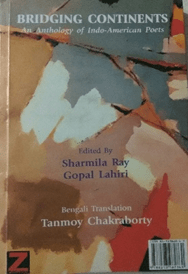
Title: Bridging Continents: An Anthology of Indo-American Poets
Edited by Sharmila Ray and Gopal Lahiri.
Bengali Translation Tanmoy Chakraborty.
Published by: Zahir Publication.
Bridging Continents: An Anthology of Indo-American Poets, edited by Sharmila Ray and Gopal Lahiri, veteran poets and critics with numerous anthologies to their credit is not a run off the mill anthology. It’s a carefully crafted volume comprising thirteen well-known Indian English Poets along with eleven renowned contemporary American Poets. That’s not all, it comes with a translation of these poems at the end of the book, on the reverse, in Bengali by noted poet Tanmoy Chakraborty.
The compilation of living poets is to make the reader dwell on the present, be in the moment across continents, poetically. Contrary to tradition this book doesn’t have a foreword. It begins with ‘Let’s Talk’, a dialogue between the editors Sharmila Ray and Gopal Lahiri, putting forward the poetic intention of the book through a light conversation to give readers a free hand without the direction imposed by a formal foreword: “whatever meaning they come up with will be theirs entirely,” says Sharmila Ray. Gopal Lahiri adds, “I want our readers to be more of a free spirit and enjoy reading with an open mind”.
The editors seem excited in offering something unique. Poets featured in the anthology have been chosen by the editors. Browsing through the book, reading snippets of poetry geographically apart yet united by the richness of texture, one notices certain common grounds which unite mankind across the globe by the similarities in afflictions but their responses vary depending on their diverse cultural lores. The anthology posits both the uniformity and the uniqueness in human conditions across the globe from India to America and the poetic responses of contemporary poets towards common issues but coloured with their individual experiences.
With environmental crises affecting people worldwide, Indian and American poets alike poetize on it. Andrea Witzke Slot expresses her deep empathy with nature with a tone of foreboding in ‘The Time-Being of Oak’.
Hear the branches reverberate. See the mud soften like grief beneath our feet, where ropes of roots, push onward, ripping through steel pipes, cracking foundations, tearing up roads and pavements and fields sown with aversion and hate.
Kashmiri Poet Ayaz Rasool Nazki in ‘Morning at A Dying Lake’paints a pristine image of a mountain lake, shrinking and its flora and fauna gasping for life:
In the mountain sockets
Still laced with
A blemish of deodar trees
Sunil Sharma in ‘Water Dear’ uses very urban images to startle and shock the reader out of apathy:
The rationing is on, in tony neighbourhoods. One day, for one-hour only.
The fat women hoard it like gold
Terrorism is another common enemy tearing lives apart. ‘Bombs’ by Rainer Schulte versifies devastation:
Bombs
turn dreams
into unending screams
Its echoes are heard in ‘Time of Death’ by Rasool who aptly depicts desolation in a terror-struck zone:
Moth had written an epitaph
On the petals
On the marble panel
No one came to read it ever
No one came to light a candle
There was no mourning in death
In a world rife with disunity and discord, sensibilities of the poet cry to reach out, hold hands, cross bridges. Heath Brougher’s free verse ‘Invitation’ makes an urgent call:
I say the time
Is nigh to cast off these antiquated shackles
And free ourselves by taking a step forward.
I say we must cross the boundaries
Jaydeep Sarangi’s ‘True Indian’is a rhetoric on a quintessential secular Indian highly significant in the troubled times:
I see a rose
I gather lotus
I visit churches
The Indo-American poets do write about love, the most primordial emotion or the lack of it though their perspectives differ. In Gjeke Marinaj’s ‘Twenty-Four Hours of Love’ personal emotions beautifully coalesce with nature:
Twilight had sensed our need to seek out a hiding-place somewhere
It melted everything down to the color of chocolate, which ends with a chic modern image:
“New evening and undid the top buttons of her black shirt;
And for us she hung on her neck the moon washed in gold”.
Parneet Jaggi’s ‘Love Transforms’ dwells on the feeling of love and its deep inner nuances:
“Eyes shut themselves to open to subtler visions
Ears turn inward to a wordless world,
Mind waits not for the lover to appear and make love”.
Whereas Sharmila Ray writes about her inability to write on love in a devastated and disillusioned world –‘I’ve forgotten how to write a love poem’.
For those of us fed on English poets Sanjukta Dasgupta’s ‘If Winter Comes…’ stands out as a marker of an Indian winter to be cherished as opposed to its western avatar:
“Winter is our season of feasts and fairs
“We do not long for spring in winter”
“Of kash flowers in autumn
Till winter makes the jaggery drip”
There are poems by Dah Helmer weaving fairy tale characters in its tapestry to tell tales as well as poems that braid Indian and Western mythical characters by, Sunil Sharma and Sharmila Ray. Horrors of history are revisited in Gopal Lahiri’s ‘Jallianwallah Bagh Muse’ making it a living presence:
In the evening memorial lights are falling on the wounds
Empty gaze of water is still misty, still hazy
Mandira Ghosh’s poem blasts into the sun’s periphery, deconstructs human body into atoms yet sees a solar eclipse and prays to the sun:
“Oh Sun! Purify us
Pardon our sins”
Vinita Agarwal’s ‘She wolf’remindsone of Blake’s ‘Tyger’, a pithy image shouting out the state of Indian woman:
She has scented the wolf in her
uprooted the fake pews of pious womanhood…a fight for dignity
a sheet of self-esteem, an iron caress
‘Credit Cards’ by Rainer Schulte warns of the dangers of digitization balancing on the verge of spirituality. Pradip Biswal’s ‘Nero isn’t dead’ echoes the feelings of every man across the globe subject to governmental apathy. Time and space restrict the unravelling of the myriad hues in this collection which entice exploration.
Tanmoy Chakraborty has translated all the poets to introduce them to the Bengali reader as a teaser. However, his translations engage the critic into the processes of translating, word for word or transcreation and more so because arguments are rife about the translatability of poetry. “Poetry is what gets lost in translation,” claims Robert Frost whereas Voltaire says “It is impossible to translate poetry. Can you translate music?”
In a translation of ‘Between my country and the others, as ministry’, he translates ‘forget -me-not blues’ as ‘oporajita’ a blue Indian flower, this can be seen as an attempt to adapt the culture into the target language. However, ‘Twenty-four hours of love’, does lose out on the sophistication in the image of night unbuttoning her shirt to hang ‘amoon washed in gold‘. But these could be seen as lost in translation — in transposing in words from a culture unfamiliar with the gestures of another culture. Bengali readers though can get an idea of the range of contemporary poetry being written in English across the globe.
The Anthology invites a detailed reading and exploration. It deserves a place in any poetry lovers’ bookshelf, for bringing in so many poets from across the world with diverse cultures in one place and offering the reader an eclectic and arresting read.
.
Madhu Sriwastav is an Assistant Professor and Head of the Department of English at Bamanpukur Humayun Kabir Mahavidyalaya. She is based in Kolkata. She is an academician, poet, translator, critic, reviewer and short story writer. Her articles have been published in National and International journals. She is a performing poet and has performed on various National and International platforms such as Guntur Poetry Festival, ISISAR Poetry Festival, Apeejay Kalam Literary Festival etc. She has published her poems in various prestigious National and International journals and anthologies such as The Vase, Setu, Glomag, OPA, Amravati Prism, Culture and Diversity etc.
.
PLEASE NOTE: ARTICLES CAN ONLY BE REPRODUCED IN OTHER SITES WITH DUE ACKNOWLEDGEMENT TO BORDERLESS JOURNAL.
“Hi Nandini… you are still with the text books? Don’t you get bored? Why are you always busy with studies? See we are planning a picnic. Do you want to join? ”
Nandini’s concentration was disturbed and she got annoyed. Her friends, Mini and Renu, were looking at her in anticipation. To their dismay she replied, “Sorry, I am not coming, I am left with enormous amount of studies. Don’t you both remember exams are next week? ”
“We do not want to hear anything. Today you have to come with us. You will be enthralled to see our picnic location. You know we are going to that ancient Fort on the hilltop.” Mini said.
Nandini’s face brightened with a smile. She always wanted to visit that fort. The old fort on the hill was a historical monument.
Nandini and her friends Mini, Renu, Suma and Rajani were excited when they started their journey uphill along the narrow path towards the fort. The majestic fort was seen standing tall atop the hill. Whenever Nandini glanced at the fort, an unknown force had seemed to draw her towards it.
“Oh, what a strenuous climb! We are exhausted and literally gasping for breath. Let us rest for a while, okay? ” Renu suggested. Nandini and her friends relaxed on the lush green lawn in front of the fort.
There was an eerie silence with just distant cooing of pigeons at the hilltop. Suddenly some of them flew away flapping their wings. Nandini was startled but chose to look past it. Melodious bhajans and chants with ringing of temple bells could be heard from the valley downhill. Sunset was close. The sky was painted in hues of red, crimson and purple. Within minutes dark clouds converged in welcoming the calm night. Nandini could feel a chilling hollowness in the air. There was a bizarre feel to the breeze that grew cooler as they climbed.
“Friends let us get back before it is too dark,” Nandini spoke in a tense voice.
“Look at Nandini, all frightened and sweating. Are there any ghosts here, Nandini? ” Suma teased her with a wink and grin.
“Of course, a spirit will come and take our Nandini away. A spirit of a handsome young man, isn’t it Nandini? ” Others laughed when Rajani said this.
“Stop it! Please! Let us just quickly see the fort and head back at the earliest,” Nandini retorted.
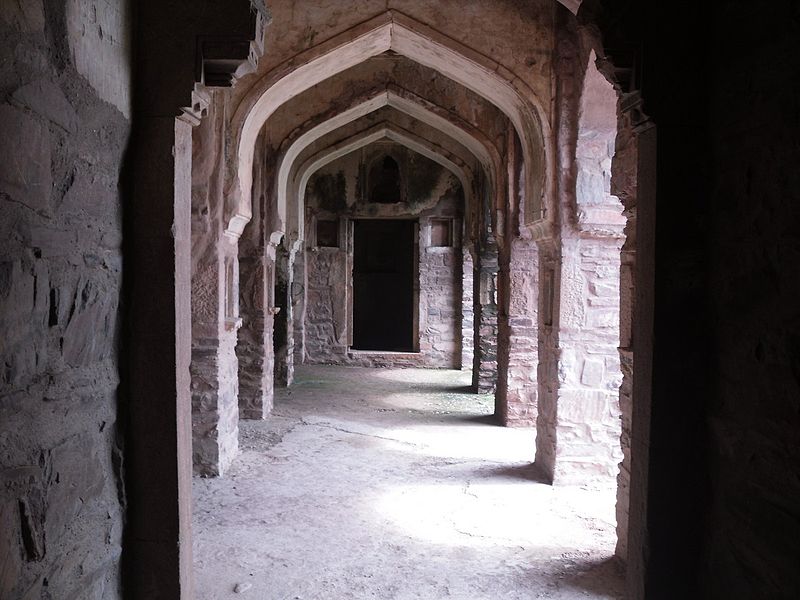
They reached the fort entrance. The main gate was open. The cobble stoned pathway leading to the monument was adorned with trees and bushes on either side. The heavy antique iron door had an enchanting brass handle with tiny contemporary bells hanging from it.
Nandini felt an uncanny presence around herself. The air had a sweet fragrance of evening primrose flowers, though there were none in the vicinity.
“You know girls? This fort is haunted by the spirit of a Prince! It is believed that he attracts beautiful girls! People reported hearing strange sounds and music from this fort. But nobody has seen the ghost of the Prince. Today is a full moon night. The Prince may just walk in…spooky, no?” Mini whispered.
Nandini felt an unknown presence in the courtyard. And a strange fear was enfolding her in its grips. They entered the fort. The fragrance of sandalwood and roses wafted to Nandini’s nostrils. The atmosphere was serene and silent. For a brief moment, she felt as if a pair of eyes were following her.
“Oh it is nothing… probably a figment of my imagination.” Nandini convinced herself and rushed to catch up with her friends.
She reached the courtyard. The open space appeared radiant under the moonlight. The calmness of the night swept through her being like a newlywed bride creating a romantic ambience.
Moving into the main quarters, Nandini continued feeling the presence of the unknown eyes. She shuddered when a cool breeze embraced her. Next moment she felt the gentle touch of an unknown breath caressing her cheeks like a solace.
“Girls, you know something? The Prince used to sleep here and it is claimed that people can still hear the tunes of Gandharv Veena from a distance on moonlit nights! Isn’t that interesting?”
“I so wish I could meet the Prince,” chuckled Rajani. For a scary moment Nandini felt a chill down her spine. What if I had a spooky encounter tonight?
Nandini was looking at the rich design and architectural details which were discretely lighted with concealed bulbs that lit up the darkness of the rooms as the sun set. They had been installed by the archaeological department that maintained ancient buildings. The other girls went on to explore the rest of old fort.
This time suddenly a feathery touch fondled her and gently held her hand and whispered into her ears, “Nandini, can’t you see me? This is me! Have you forgotten me? ”
“Who was that? Who whispered in my ears? Girls, it is not funny,” Nandini turned around suddenly but there was nobody around. “Nandini! You are just being silly now. You are imagining things now,” she reprimanded herself.
There was a primeval majestic Veena at one of the corners. Nandini was fond of musical instruments. She ran her fingers through the rusted strings. A low pitched musical note echoed and she felt a soft kiss on her cheeks. She turned around in shock. The room had ornately carved sculptures of courtesans holding lamps.
Instantaneously the lamps lit up on their own. An unknown, unseen force led her to the featherbed in the centre and she sat there. It was like a fantasy castle… tantalizing music of sitar and veena… fleeting melodies of court music playing in the background. Wind chimes were ringing softly. She was astonished to see a handsome prince lying on the bed decorated with flowers. He was looking at her with anticipation — as if he was waiting for her. She fell for him the very moment she saw him. It was love at first sight!
Lovebirds were cooing at a distance. Romantic melodies enraptured her senses. It was the night of lovers, the night of the union of two souls in love. The prince embraced and kissed her. A symphony of love notes wafted in the air. Nandini closed her eyes. Her mind drowned in the oblivion of romance. She flew like a bird in the sky and then settled down on the branch of a tree with her lover bird.
“Love birds…. see how cute!” Suma exclaimed.
“Ok everyone, come let us go back now. What happened Nandini? Now you don’t seem to be in hurry. It is getting dark. Let us head back to the hostel.” Her friends called out to her.
“No! Where is my prince? I want to sit here for some more time. I can’t go back without meeting my Prince,” Nandini murmured.
“What is wrong with this girl? Come Nandini. ” They dragged her out of the mysterious quarter.
In a calm, low tone she heard him again, “Nandu, why are you getting upset? We are inseparable darling. I was always with you. I am here for you. We are eternally bound. I waited for you over so many decades. I knew you would come for me. Now that we are together, please don’t think of leaving me and going. I can’t bear the sorrow of our separation ever again. We were made for each other Nandu.”
Those words echoed in her ears while his loving fingers caressing her hair… She could feel him… Her unknown lover.
Nandini was forced to depart from her strange reality. Others dragged her out. They were waiting for her. On her way back, she felt euphoric. She seemed to be lost in a trance. Her face was glowing with love. Her lips had a sweet smile. Her eyes were half closed in ecstasy as unknown lips caressed her like soft flower petals. She felt like a feather floating in the air. She felt her passion simultaneously burn with the flames of a hot fire and cool her soul like dew drops that enveloped her heart and soul.
She could feel the longing and deep affection of her lover. Both of them flew towards the horizon like a pair of golden love birds. Her soul had yearned to merge with his soul. His captivating smile, dazzling personality, mesmerising words and eloquent eyes drew her towards him magically. She could feel the warm breath and heartbeats of her Prince — the heart which was beating for her. There was a haunting eeriness in the evening winds.
She gradually started feeling like a princess. She wished her dream would never end or was it real? She wondered.
When Nandini finally reached below the hill, she turned around to take a last glance at the fort. The fort seemed to be glowing with a mystifying aura. Amid all that was strange, she could see the silhouette of her Prince waving at her.
A cool breeze grazed her cheeks. A soft voice whispered in her ears again, “I will ever be yours. You are and will always be my princess. ”
The regal fort was looming against the dark blue sky — the fort of unrevealed stories, the fort of unrequited love, the fort with mysterious secrets.
.
Dr. (Major) Nalini Janardhananis a Family Medicine Specialist who served in Indian Army Medical Corps as an Army Medical Officer in the rank of Major. She is a popular writer of Kerala who got Katha Award and a writer of many medical books for which she got IMA Sahithya Award. She is an All India Radio and Doordarshan approved artist of Ghazals and Bhajans[Light Music].She is felicitated with many awards for her contributions towards society as a doctor,singer, writer ,army officer and for her social service.
.
PLEASE NOTE: ARTICLES CAN ONLY BE REPRODUCED IN OTHER SITES WITH DUE ACKNOWLEDGEMENT TO BORDERLESS JOURNAL.
“…history is potent enough to deliver, on time, in the medium to long run, most of the possible scenarios, and to eventually bury the bad guy.”
Nassim Nicolas Taleb, Fooled by Randomness
This essay assumes a personal and historical tone during time of global unrest. It is my response to the murder of George Floyd and seeks to re-imagine what could be from what is.
My great grandfather on my dad’s side loved Black people. He was respected in the small Mississippi town of Monticello where he frequented Black churches at night. As a Southern Baptist, it was an odd thing for him during that period to appreciate the Black community. This was during a time prior to the Civil Rights Era of the 1960’s.
My grandmother grew up in that era and married at age 13. Her husband was involved with Klansmen. She told me stories about violence against Blacks including an incident where she saw a Black man run into a field followed by an angry mob of white men that included the town sheriff. The sheriff told her not to worry about what was going on. She told me in confidence that when the Civil Rights Act made it possible for Blacks to run for office, she voted for a Black woman running in a local election. She told me stories of Blacks being chased from sidewalks and vapidly discouraged from smiling casually at white women, treated as second-class citizens, jazz clubs being raided, Black musicians portrayed as negative influences on youth and women for smoking marijuana, and newspapers with severely racist headlines. The picture was distant to me other than history books. She told me about the first time she witnessed a sit-in. Her shock was outrun by her admiration. She owned the Autobiography of Malcolm X as told to Alex Haley.
These stories will come as no surprise to Blacks, I’m sure. The Black community has suffered repression by white supremacists and societal conditions imposed on them for hundreds of years in the United States. It seems unjust that even Nature is not even-handed. For instance, the COVID-19 virus and AIDS disproportionately affected Black communities. I attended a short discussion with Tantra Zawadi, an activist and poet, several years ago during which she showed a documentary film about the suffering of Black people due to the AIDS virus. I asked her why she thought it hurt her community particularly. She responded that the Black community has learned to not care for itself. That is a long and frightening discussion.
***
It is often assumed that the American Civil War resolved the problems created by slavery. President Lincoln is reported as stating, “I am not, nor ever have been, in favor of bringing about in any way the social and political equality of the white and black races … I am not nor ever have been in favor of making voters or jurors of Negroes, nor of qualifying them to hold office, nor to intermarry with white people; and I will say in addition to this that there is a physical difference between the white and black races which I believe will forever forbid the two races from living together on terms of social and political equality. And inasmuch as they cannot so live, while they do remain together there must be a position of superior and inferior, and I as much as any other man am in favor of having the superior position assigned to the white race.” This was quoted from his debates with Sen. Stephen Douglas on September 18, 1858. This statement was made in defense against the Democrats who believed Lincoln would abolish slavery, what was then a radical suggestion.
Frederick Douglass said of class struggle, “Where justice is denied, where poverty is enforced, where ignorance prevails, and where any one class is made to feel that society is an organized conspiracy to oppress, rob and degrade them, neither persons nor property will be safe.”
The Black Codes of the Reconstruction era did just this. Even before the Civil War, such codes were designed to protect the institution of slavery. Blacks were expected to turn their guns over to white men upon the white man’s request. Through convict leasing, private parties could employ the free labor of convicts. This practice provided immense revenue to southern states. Time Magazine writes, “Prison privatization accelerated after the Civil War. The reason for turning penitentiaries over to companies was similar to states’ justifications for using private prisons today: prison populations were soaring, and they couldn’t afford to run their penitentiaries themselves.” In fact, the Thirteenth Amendment abolishes slavery except as punishment for a crime. Privatized prisons historically targeted Black males. African American families still suffer from policies such as the Drug War. The 1986 Anti-Drug Abuse Act created tougher mandatory sentences for possession of crack, a drug that was cheaper and easy to transport than powdered cocaine, though not much different in substance. Media hype of the 1980’s created the illusion of a “crack epidemic”, thus leading to the tougher sentencing law. This law was amended by the 2010 Fair Sentencing Act. The Sentencing Project Records the racial disparities of incarceration.
Some statements from The Sentencing Project:
“One contributing factor to the disparity in arrest rates is that racial minorities commit certain crimes at higher rates. Specifically, data suggests that black Americans—particularly males—tend to commit violent and property crimes at higher rates than other racial groups. Other studies, however, demonstrate that higher crime rates are better explained by socioeconomic factors than race: extremely disadvantaged neighborhoods experience higher rates of crime regardless of racial composition. Because African Americans constitute a disproportionate share of those living in poverty in the United States, they are more likely to reside in low-income communities in which socioeconomic factors contribute to higher crime rates.”
“The United States government’s War on Drugs has perhaps contributed more than any other single factor to the racial disparities in the criminal justice system.”
***
We continue to remind one another to “beat our swords into ploughshares.” We must be hungry.
***
In the 19th century prior to the outbreak of the American Civil War, factions of anti-immigrant sentiment developed and coalesced into the Know Nothing Party. They were generally working-class nativists who resented Irish and German Catholics for economic reasons. They came from industrialized cities in the North and spread into the South. The Party was founded in 1844 and rose to prominence in 1853 until the Dred Scott decision and John Brown’s raid proved slavery was a central issue to the nation rather than immigration. John Wilkes Booth was a member.
Once the Kansas-Nebraska Act (1854) replaced congressional edict with popular sovereignty regarding slavery in territories included in the Louisiana Purchase, what is now known as the Republican Party emerged in the North among anti-slavery advocates and Freesoil debaters. Nativists in the South became entrenched in the Know Nothing cause. Such nativist sentiment evolved into the strict anti-immigration policy in the 1920’s that was oddly lax on northwestern European flow into the United States.
It is a commonly understood fact of history that the northern economy was less dependent on slave labor, and more on the surplus capital provided by taxing the products of slave labor. In Hylton v. US (1796), Justice Patterson wrote, “The constitution declares, that a capitation tax is a direct tax; and both in theory and practice, a tax on land is deemed to be a direct tax… The provision was made in favor of the southern states; they possessed a large number of slaves; they had extensive tracts of territory, thinly settled, and not very productive. A majority of the states had but few slaves, and several of them a limited territory, well settled, and in a high state of cultivation. The southern states, if no provision had been introduced in the constitution, would have been wholly at the mercy of the other states. Congress in such case, might tax slaves, at discretion or arbitrarily, and land in every part of the Union, after the same rate or measure: so much a head, in the first instance, and so much an acre, in the second. To guard them against imposition, in these particulars, was the reason of introducing the clause in the constitution.” (bold emphasis is the essayists)
In 1895, the Pollack case redefined direct taxation to include taxes on property and income, and the 16th Amendment restored the original definition of taxation whereby to allow the progressive income tax and other measures.
The northern industrialized economy continued to exploit Black labor. According to thehenryford.org,“No single reason can sufficiently explain why in a brief period between 1910 and 1920, nearly half a million Southern blacks moved from farms, villages, towns and cities to the North, starting what would ultimately be a 50-year migration of millions. What would be known as the Great Migration was the result of a combination of fundamental social, political and economic structural problems in the South and an exploding Northern economy. Southern blacks streamed in the thousands and hundreds of thousands throughout the industrial cities of the north to fill the work rolls of factories desperate for cheap labor.” The population of Detroit nearly doubled between the years 1910-20 with a significant increase in the Black population. The Great Migration provided companies like Ford Motors with cheap labor from African Americans.
Clearly slavery shaped the United States economy and was a major catalyst of dispute as well as change. Some may argue it was necessary for the New World; however, religious groups such as the Mennonites were abolitionists as far back as 1688. Along with immigration and taxation, today’s Republican Party has utilized these antiquated hostilities; yet, the Democrats have convinced a segment of voters with other reasons. They became the party of ‘civil rights.’ Encyclopedia Britannica defines civil rights as “guarantees of equal social opportunities and equal protection under the law, regardless of race, religion, or other personal characteristics.” A July 12, 1964 article in the New York Times states, “…the pressure exerted by militant Negroes had become so great that many businessmen had dropped racial barriers in their establishments. Many others were waiting only for the excuse provided by the new law.” The spirit of the times was changing to oblige equal rights. Some may argue that law does not guarantee equality or fair treatment. However, Rev. Dr. Martin Luther King stated in a rebuttal to Goldwater’s “change of heart, not legislation” approach that he agreed with Goldwater, and although legislation cannot make a man love him it can in fact prevent him from lynching him.
We should not define bigotry, xenophobia, and racial injustice along party or regional lines as the usual contemporary narratives have it. My grandmother and I used to argue about the Old South in contrast to the “New South.” A few years ago, Newsweek ran a cover article along those lines. The changing attitudes of young people and the decline of traditional narratives favoring “states’ rights” were the article’s focus. After reading, I called my grandmother to discuss it with her.
She didn’t seem to agree that the South was changing significantly. She often spoke against the Democrats and their effect on the South historically. Democrats caused enormous civil unrest during the Reconstruction Era, including at the Battle of Liberty Place where white supremacists defeated US troops in an attempted coup against elected governor William Pitt Kellogg. Kellogg was considered a “carpetbagger” by white southern Democrats because of his years collecting customs at the Port of New Orleans. The White League, as the paramilitary white supremacist force was known, intimidated Blacks to prevent them from voting—no poll tax or literacy tests! Reconstruction era Democrats used violence and intimidation to oppose Black emancipation! The grandson of a Confederate soldier, President Lyndon Baines Johnson who passed the Civil Rights Act of 1964, supposedly remarked,“These Negroes, they’re getting pretty uppity these days and that’s a problem for us since they’ve got something now they never had before, the political pull to back up their uppityness. Now we’ve got to do something about this, we’ve got to give them a little something, just enough to quiet them down, not enough to make a difference. For if we don’t move at all, then their allies will line up against us and there’ll be no way of stopping them, we’ll lose the filibuster and there’ll be no way of putting a brake on all sorts of wild legislation. It’ll be Reconstruction all over again.” It is sometimes said President Johnson was simply navigating the political realm wisely, much like President Lincoln.
This began the era of “Southern Strategy”. The term “dog whistle” was used to indicate the new rhetoric of “state’s rights” employed by the GOP. “You start out in 1954 by saying, ‘Nigger, nigger, nigger’. By 1968 you can’t say ‘nigger’—that hurts you. Backfires. So you say stuff like forced busing, states’ rights and all that stuff. You’re getting so abstract now [that] you’re talking about cutting taxes, and all these things you’re talking about are totally economic things and a byproduct of them is [that] blacks get hurt worse than whites,” Lee Atwater stated to explain states’ rights. Atwater further states, “But Reagan did not have to do a southern strategy for two reasons. Number one, race was not a dominant issue. And number two, the mainstream issues in this campaign had been, quote, southern issues since way back in the sixties. So Reagan goes out and campaigns on the issues of economics and of national defense. The whole campaign was devoid of any kind of racism, any kind of reference.” Does making race a central issue hurt or help the cause of equal justice? Have we forgotten the importance of racial dynamics in shaping this country?
I remember as a child in the Reagan 80’s I was tutored to read and write by a Black woman who came to love me as her own. This was in Mississippi, the heart of the Dixiecrat struggle only decades before.
***
In 2013, a high school in Jacksonville, FLA initiated a name change. It was originally named after Confederate general Nathan B. Forrest who was known to have cut off the arms of surrendered black soldiers. My father was at the forefront of keeping the name. I reluctantly signed a petition he created to keep the school’s name even though I strongly disagreed with it. The school’s African-American student population grew to over half the student body. The school used a Confederate flag in its pep rallies. I can see why the name, which was suggested by the Daughters of the Confederacy in the 1950’s, would upset Black students. Nathan Bedford Forrest was also the first Grand Wizard of the Ku Klux Klan. I signed the petition in a lukewarm decision to support my family, believing it was a lost cause. I was later told that the petition would not be used because only current students and their families’ voices mattered in the decision process. My father was irate.
I agree with the decision to change the school’s name. Who wants to be subjected to seeing the symbols of racism—watch videos from the Civil Rights era—symbols used to oppress and intimidate Blacks, or have a school honored after the KKK’s first Grand Wizard who was not even from Florida? I learned of my own temerity and indecision during this dispute. While the petition had few signatories generally, I was one of them. My decision to sign went against my conscience.
The high school is now known as Westside High School.
***
As a matter of general observation, it seems that political grievances are not resolved only politically.
Continuous police brutality against Blacks throughout history from Emmitt Till to Amadou Diallo, from Rep. John Lewis to George Floyd, is a serious concern. Blacks are 2.5 times as likely to face police violence than other racial groups. In 2019, 1,098 incidents of police homicide were recorded. According to mappingpoliceviolence.org, Black people were 24 percent of those homicides while only being 13 percent of the population. In 2017, 1,117 police homicides occurred with 27 percent of them being Blacks. According to a National Institute of Justice study, 50.6 percent of police surveyed believed that it is not unusual for police to turn a blind eye to police misconduct and disagreed that police report abuses of authority at 58.5 percent of those surveyed (Police Attitudes Toward Abuse of Authority, 2000). This study notes that 65.6 percent of those surveyed do not believe the “code of silence” is necessary to good policing. This suggests that in spite of the numbers, our police forces have integrity.
The Black community even retaliates against other Blacks, but Black violent crime is more likely to be interracial. Some solutions to these problems have been suggested. A February 4, 2017 NPR article reports that “as the ration of black officers in police departments rose – up to a certain threshold – so did the number of fatal encounters between officers and black residents… The tipping point appears to be 25 percent. When black officers reach that ratio in the force, the rate of fatal police-involved incidents levels off. The study also found that once a police department became about 40 percent black, the trendline flipped – the more black officers a department has after that point, the less likely the incidence of fatal encounters with black people.” Varieties of strain theory suggest that criminal activity could be due to strain on families, institutional and societal demands on the individual, the Ferguson effect (increased distrust of police due to police violence), and other factors. The National Review reports, “In reality, a randomly selected black man is overwhelmingly unlikely to be victim of police violence — and though white men experience such violence even less often, the disparity is consistent with the racial gap in violent crime, suggesting that the role of racial bias is small. The media’s acceptance of the false narrative poisons the relations between law enforcement and black communities throughout the country and results in violent protests that destroy property and sometimes even claim lives.” The data at mappingpoliceviolence.org notes that Black Americans killed by police are more likely to be unarmed. The broken windows approach encouraged in the 1994 Crime Bill puts undue pressures on poorer communities through increased policing of them. Some suggest juvenile delinquency is caused by the readiness of illegitimate opportunities compared to honest work.
Bloomberg reports a novel addition in this national conversation. Sarah Holder writes in “The City that Remade Its Police Force” that community policing has enabled peaceful protest. Holder writes, “Homicides in Camden [New Jersey] reached 67 in 2012; the figure for 2019 was 25.” With the assistance of New York University’s Policing Department, the police in Camden developed a new manual for use-of-force. (The manual can be read here.) Camden is hoping the rest of the country’s forces follow suit.
***
It seems in recent years there has been some improvement for the Black community. Graduation levels improved under the Obama administration and Black unemployment is at historical lows under the Trump administration (prior to COVID-19). Economist Walter Williams in The State Against Blacks notes how government policies such as minimum wage and affirmative action have worsened conditions and discrimination. Since the book was written in 1982, unemployment among Black youth is still about 50 percent. Redlining began under FDR by housing authorities has also contributed to impoverishment of Black families. The Community Reinvestment Act, passed in the 1970’s to combat redlining, is even said to have played a role in the Great Recession of 2008 by encouraging subprime leasing.
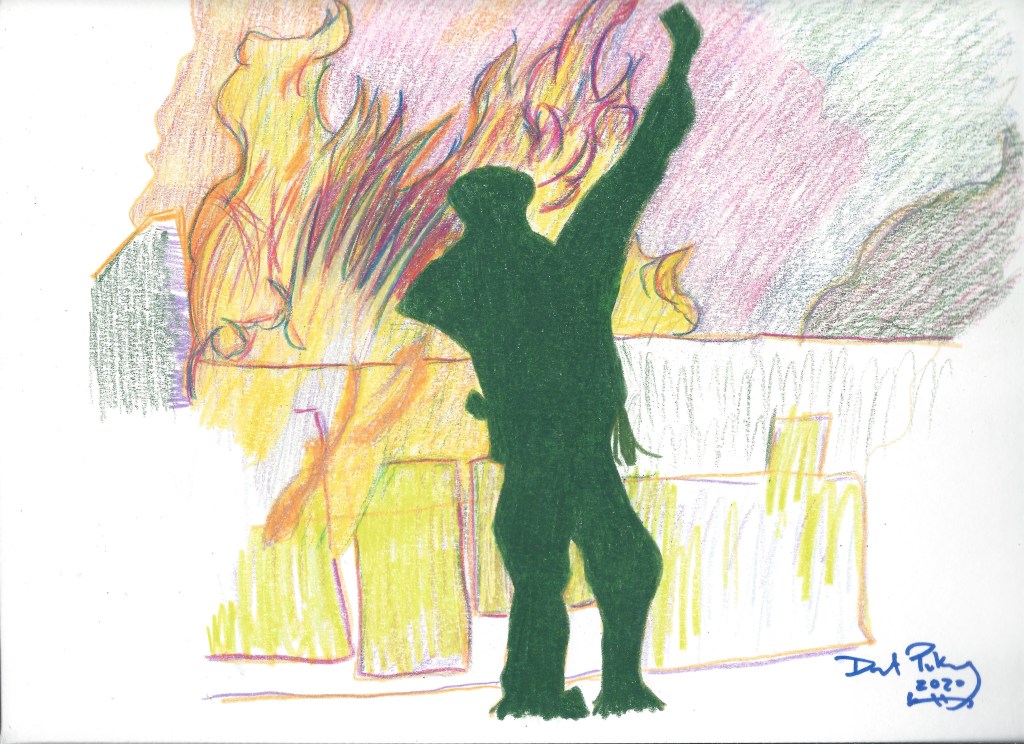
The riots and demonstrations going on in the United States today as a reaction against the murder of George Floyd, an unarmed Black man who was not resisting arrest and cried for his life while an individual officer’s knee clamped on his neck, are not historical anomalies. The problems faced by the African American community are rooted in a history that affects us all as Americans. The cheapening of Black lives, the destruction of their communities, and the ignorance prevailing concerning these matters and their causes should be openly discussed.
***
Aside from institutional violence, other policies have impacted the Black community disproportionately.
Conservatives believe abortion is rooted in the eugenics cause. As evidence they mention Margaret Sanger, a eugenicist and founder of Planned Parenthood. According to a 2017 study by American Journal of Public Health, black women had the highest rates of abortion even though white women had more of them.
The study, which also notes a decline in the number of abortions in the USA between 2008-14 says, “White women accounted for the largest share of abortions among the 4 racial and ethnic groups examined (38.7%), although they had the lowest abortion rate: 10.0 per 1000. Black women were overrepresented among abortion patients and had the highest abortion rate: 27.1 per 1000.” It has been noted that clinics tend to be in poorer communities, granting easier access to minorities who tend to be economically disadvantaged. Sanger herself notes the reason for her activism: “If THE WOMAN REBEL were allowed to publish with impunity elementary and fundamental truths concerning personal liberty and how to obtain it, the birth control movement would become a movement of tremendous power in the emancipation of the working class.” (from “Suppression”) Abortion is a socioeconomic issue more than a race issue. The mistake is easily made when we forget that race and class intersect in the United States.
In spite of these facts, Sanger wrote in “The Eugenic Value of Birth Control Propaganda”, “As an advocate of Birth Control, I wish to take advantage of the present opportunity to point out that the unbalance between the birth rate of the ‘unfit’ and the ‘fit’, admittedly the greatest present menace to civilization, can never be rectified by the inauguration of a cradle competition between these two classes. In this matter, the example of the inferior classes, the fertility of the feeble-minded, the mentally defective, the poverty-stricken classes, should not be held up for emulation to the mentally and physically fit though less fertile parents of the educated and well-to-do classes.” While it is true that the poor tend to have larger birth rates with less means at their disposal to care for the children, this passage indicates Sanger’s early commitment to eugenics.
California’s prison system employed the decision of Buck v. Bell to forcibly sterilize 148 female prisoners without consent between 2006-10. Huffington Post writes, “In the past, sterilization of vulnerable populations in the name of ‘human betterment’ was carried out with legal authority and the backing of political elites. What current and past practices share is the assumption that some women by virtue of their class position, sexual behavior, or ethnic identity are socially unfit to reproduce and parent.” (“Sterilization Abuse in State Prisons: Time to Break with California’s Long Eugenics Patterns”, 7/23/2013) PBS.org states, “While California’s eugenics programs were driven in part by anti-Asian and anti-Mexican prejudice, Southern states also employed sterilization as a means of controlling African American populations.” (“Unwanted Eugenics and Sterilization Programs in the United States”, 1/29/ 2016)
However, Coretta Scott King had this to say about Margaret Sanger upon accepting the Margaret Sanger Award for Human Rights on behalf of her husband: “There is a striking kinship between our movement and Margaret Sanger’s early efforts. … Our sure beginning in the struggle for equality by non-violent direct action may not have been so resolute without the tradition established by Margaret Sanger and people like her.” NPR recognizes in their Race Card Project that “black babies cost less to adopt” because of supply and demand. In other words, there are more black children prepared for adoption and less interest in adopting them.
***
Why have we come this far without questioning ourselves, white friends, white family, white society? It seems when the world turns a mirror to us, for us to look at ourselves, we would rather forget, argue, debate, make excuses.
I am not any better. I admit. I am not any better. It is a tough thing to look at yourself and say, “I can do better. I can encourage more equity.”
***
Don’t get me wrong. This isn’t about the United States. It isn’t about capitalism or socialism. Research South Africa, for instance, and find that the violence against white people is a result of a system that clearly is in favor of white people. Even post-Apartheid, Blacks are being shafted of opportunities. School books are free for white children. White farmers are wealthier and rely on the work of Black people.
This is an issue with humanity. This is an issue with the world. This is not an issue with specific groups, countries, or factions. I framed this essay in the context of my country, the USA, because this is where I see the most immediate effects of the problem. Being in the center of European imperialism and colonialism from the beginning, the United States is responsible for the lack of equity faced today.
In Timbuktu, Islamist insurgents torched two libraries containing historic manuscripts in 2013. Some of the material in the libraries dates back to the 13th century. On the edge of the Sahara, Africa preserves some of its vital history. In a battle for civilization, extremists torch the buildings. These documents include important translations of Plato, Hippocrates, and other Western thinkers, as well as writings on medicine, art, and philosophy. There are also Medieval copies of the Qur’an. Many of the manuscripts were evacuated with financial help from multiple organizations such as the Ford Foundation founded by Edsel and Henry Ford in 1936. Recalling my comments on Ford Motors earlier, perhaps we have come full circle and things are improving although only slightly? Are Blacks being recognized as independent, fully competent individuals now as compared to the Civil War era?
***
It is a difficult and sobering thing to let go of power. In order to see the reflection of one’s skin and the haughtiness of one’s attitude and acts, one must look into the eyes of another’s experiences.
***
Capitalism, emerging from the products of slavery through rapid industrialization, left many people out. Since the founding of the United States under the words “All men are created equal, entitled to life, liberty, and pursuit of happiness” there have been struggles to make this ideal into reality. Once John Jay, founding father, argued that ownership of property should be the sole criteria in considering the right to vote. The values of a capitalist society include the right to the product of one’s labor, free enterprise, and to do with one’s property what one decides in a fair and just manner.
The US Constitution declares we have a right to security in our persons and property. The US Constitution also declares we have a right to freedom of speech, religion, association, and peaceful petition. The world has been inspired by this model of democratic republicanism. The product of many noble minds put together through rational argumentation, the American federalist system provides a positive model for the world in struggles for freedom, as well as great abundance. With its checks and balances, both across government and the economy, the American system is constructed to encourage fairness and rational decision-making among free parties. The right to utilize one’s gifts is the epitome of justice. Human action, not time, will bring these ideals to greater fruition.
The American system is not inherently segregationist, but we still await justice to wash away this culture of supremacy entirely.
.
The author thanks Dr. Reza Parchizadeh, Dr. Troy Camplin, and henry 7. reneau, jr. for their editorial contributions and guidance.
.
Dustin Pickering is the founder of Transcendent Zero Press and editor-in-chief of Harbinger Asylum. He has authored several poetry collections, a short story collection, and a novella. He is a Pushcart nominee and was a finalist in Adelaide Literary Journal’s short story contest in 2018. He is a former contributor to Huffington Post.
.
PLEASE NOTE: ARTICLES CAN ONLY BE REPRODUCED IN OTHER SITES WITH DUE ACKNOWLEDGEMENT TO BORDERLESS JOURNAL.
Mutiu Olawuyi (popularly called the Jungle Poet) is an international award-winning poet – 2013 World Poetry Empowered Poet Awardee, Canada, Honorary Professor of International Art Academy, Volos Greece; World Poetry Cultural Ambassador (2014) – Vancouver – Canada; and Master of Literary Innovation (2019) – World Poetry Conference, Bathinda Punjab, India . He is the producer and host of ArtFlakes on CBA TV, the Voice of East Africa and he is also the Editor-in-Chief of Parkchester Times and MCR newspapers (Print and Online) based in Bronx, New York, USA. He has authored numerous books of poetry (Among them are American Literary Legends and Other Poems [2010], Thoughts from the Jungle [2012], 9/11 Poetry [2012], and The Journey to the Archangels [2013]) and has edited numerous international anthologies, journals and magazines. Mutiu is a teacher, English language and literature curriculum developer, freelance writer/editor, literary critic and inventor of a new form of poetry called 9eleven (a poem of 9 lines written with 11 syllables) and the first writer of a story without verb – The Blotted Pawpaw (published 2013 by Bharat College in India). He is also an editor for TheCriterion International Journal in English based in India. Mutiu has some of his poems, short stories and research papers published in online and offline journals and magazines in India, Ireland, England, Canada, Greece, Nigeria and USA. Finally, some of his works have been translated to Arabic, French, Esperantos, Malayalam, Telugu and Hungarian.
.
PLEASE NOTE: ARTICLES CAN ONLY BE REPRODUCED IN OTHER SITES WITH DUE ACKNOWLEDGEMENT TO BORDERLESS JOURNAL.
Rohingya people, who have no identity of their own, are now facing another danger. The pandemic of COVID-19 took away one of the Rohingyas, who found shelter at a camp at Cox’s Bazar in Bangladesh on the wake of genocide in their own land in Myanmar.
United News of Bangladesh reported that the man died from coronavirus infection while undergoing treatment at the isolation centre at Ukhiya camp in Cox’s Bazar on Monday night.
Referring to Abu Toha MRH Bhuiyan, who works as a health coordinator at the Refugee, Relief and Rehabilitation Commission, the news agency stated that the deceased could not be identified immediately but he was a 71-year-old man.
It was the first confirmed case of death of a Rohingya refugee in Bangladesh. Bangladesh is now home for over one million Rohingyas, who fled atrocities in Myanmar to Bangladesh.
In my earlier article in Countercurrents, I tried to draw attention of the world community so that they would come forward to save Rohingyas from probable contamination of COVID -19. I don’t know whether anybody heard my appeal. In fact, the Rohingyas are no longer safe now from the devastation of COVID-19. We don’t know what is waiting for the densely populated Rohingyas. I also don’t know who will save Rohingyas from further deaths? Is it the Bangladesh government or the world community?
Super power USA is now facing manifold adversity- destructions of COVID-19, street demonstrations across the country and, so on. Many other powerful countriesare also in peril today. And Bangladesh, with 709 confirmed case of death from COVID-19 and 52,445 infected, is has failed to control the spread of the coronavirus.
The Gono Forum came up with the allegation on Tuesday as its president Kamal Hossain and general secretary Reza Kibria in a joint statement said that although World Health Organisation on March 11 declared COVID-19 a pandemic, the government announced general holidays in the last week of the month.
They also said that although Bangladesh had enough time to determine national strategy, the government failed to implement a fruitful strategy, New Age reported.
The Gono Forum leaders said that the rate of COVID-19 tests in the country was very low and people had no confidence on government’s information on COVID-19 infections and deaths.
They also said that the late announcement of public holiday amid relaxation put impacted people’s lives negatively as it failed to control the infections.
They said that only a small part of government aids reached to the poor and vulnerable due to corruption and inefficiency while lakhs of labourers and working class people faced unemployment.
The leaders said that withdrawal of public holidays ignoring recommendations of national technical advisory committee had created much anxiety among the people and the situation was worsening for the lack of adequate number of tests and mismanagement in the health sector.
In this situation, I cannot think of a future for the Rohingyas, at least not the kind I really wished for.
Saifur Rahman Saif is a Bangladeshi journalist. He works at New Age, a popular newspaper.He contributed a story in Freelance Success Stories published simultaneously from the USA and Canada. He can be reached at saifnewage@gmail.com
Chicago O’Hare’s international terminal offers street theatre.
I arrived recently at Terminal 5 to meet a friend, coming from Kathmandu, Nepal, via Abu Dhabi, UAE. Henry sent numerous texts once he landed as to where I might meet him and his luggage. He encouraged me to wait in the quiet of my car till he arrived. True, it was our nation’s busiest airport and often chaotic. But I refused. It was the drama of the arrivals gate that fuelled my 90-minute drive — not souvenirs that he brought back from his time in Kathmandu, Nepal.
The entertainment started immediately. Two middle-aged women from India, dressed in hot-pink saris, walked toward me and tried to exit through the automatic door to their left at Chicago O’Hare’s Terminal Five. Those doors would have been correct in India. But at this American airport’s international arrivals gate, it was the wrong door. It was my entrance, not their exit. I feared my step would trigger the glass portal to swing into their faces; I took a step back. They saw my look of fear and sensed their mistake. They, too, stepped back. We stood on either side of the glass, in a standoff. What should happen next? A porter, watching the narrative unfold, ran to their help and guided them to the right side of the hallway and the proper exit door. As we passed one another, we looked and smiled.
I found Henry’s arrival gate inside. The passengers on the connecting flight from Abu Dhabi began their travel two or three days before, perhaps in a mountainous village or maybe an apartment in a city of 20 million. They came not just from Nepal but India, the Middle East, and all of Africa.
The flight brought many ethnicities, cultures and religions together as they walked the lengthy concourse from the plane, passed through immigration, and gathered their belongings at baggage claim.
Families and friends waited. We served as a kind of reward for the travellers, standing patiently, excitedly, behind two sets of restricting ropes and a gap of 20 feet. Many of our impromptu group pushed towards the front to get a better first view of a loved one’s face — not unlike my father with his brother.
There was room to move behind the group of us waiting. A young woman, who wore a Muslim headscarf, pushed a baby carriage in a small circle. She kept her eyes focused on the baggage area. Her arms went up in a double wave when she saw the person she waited for. She clutched the handles and cried. A few moments later, she walked with more vigour while she pushed the pram.
A passenger claimed the first bag from the flight and walked toward the rope barrier. His family rushed into the exit way to embrace him and clogged the entrance funnel.
A small man negotiated his way through that tight exit sleeve. A tall woman grabbed him and they shared a passionate kiss. They turned to go and caught me staring at their togetherness. They smiled. Guilty, I smiled too.
I looked back to the woman with the baby carriage. Her traveller had not yet joined her. She stopped moving in a small circle and rocked the carriage in one place instead. I moved closer and asked how old the infant was. “Three weeks,” she told me. “His father has never seen him.” She told me he had not been in the U.S. for two years.
That didn’t make sense. “What about nine months ago?” I asked.
“Oh!” She giggled. “Yes! I went to Jordan to see him.” The couple flew to the U.S. where she was a citizen, but he was not. Officials stopped him in Chicago and sent him back to Jordan.
This time, he went through immigration in Abu Dhabi, so they knew there would not be difficulties. “He will get through this time,” she said.
We stood together, waiting, discussing baby names, immigration processes, when the child began to cry. “He’s hungry,” she said as she changed the angle of the pacifier and rocked him faster. “But I doubt I have time to nurse him.”
Just then, she saw her husband leave the baggage area and start through the funnel. Politely, she excused herself and wished me well. Again, I couldn’t help myself as I watched this moment of intimacy. Like with my father and his brother, the moment was full of joy.
Finally, I saw Henry head in my direction. He wheeled one large roller bag with his right hand and, with his left, carried a duffel bag. He grimaced as he tried to manipulate his way around a family reuniting in the middle of the narrow walkway. He looked tired, dark circles lay below his eyes. After our hug, we walked the distance to the car lot and he complained to me about his long-haul flight. He started with the frustrating behaviours of his seatmates — the women talking incessantly followed by the man across the aisle snoring loudly. He continued about a child kicking his seat in the row behind him. He described the difficulties flying without a common language. And he ended with, “The airline served the worst curry!”
I expected him to be positive, given all the thumbs up he had posted on Facebook during his visit, but 48 hours without sleep and 14 hours in one seat interrupted that flow. He was tired and intolerant.
He flew more than 7,000 miles. I drove only 60. We both spent time with the same passengers. Oddly, mine was the savoury souvenir.
.
J.O. Haselhoef is a social artist who writes and travels. Her work appears in Swamp Ape Review, Re-Creating Our Common Chord, Evening Street Press, and Fiction Southeast. Her book, GIVE & TAKE, Doing Our Damnedest NOT to be a Charity in Haiti was published in 2015. She is online at http://www.JOHaselhoef.com.
.
PLEASE NOTE: ARTICLES CAN ONLY BE REPRODUCED IN OTHER SITES WITH DUE ACKNOWLEDGEMENT TO BORDERLESS JOURNAL.







 Borderless