Mutiu Olawuyi (popularly called the Jungle Poet) is an international award-winning poet – 2013 World Poetry Empowered Poet Awardee, Canada, Honorary Professor of International Art Academy, Volos Greece; World Poetry Cultural Ambassador (2014) – Vancouver – Canada; and Master of Literary Innovation (2019) – World Poetry Conference, Bathinda Punjab, India . He is the producer and host of ArtFlakes on CBA TV, the Voice of East Africa and he is also the Editor-in-Chief of Parkchester Times and MCR newspapers (Print and Online) based in Bronx, New York, USA. He has authored numerous books of poetry (Among them are American Literary Legends and Other Poems [2010], Thoughts from the Jungle [2012], 9/11 Poetry [2012], and The Journey to the Archangels [2013]) and has edited numerous international anthologies, journals and magazines. Mutiu is a teacher, English language and literature curriculum developer, freelance writer/editor, literary critic and inventor of a new form of poetry called 9eleven (a poem of 9 lines written with 11 syllables) and the first writer of a story without verb – The Blotted Pawpaw (published 2013 by Bharat College in India). He is also an editor for TheCriterion International Journal in English based in India. Mutiu has some of his poems, short stories and research papers published in online and offline journals and magazines in India, Ireland, England, Canada, Greece, Nigeria and USA. Finally, some of his works have been translated to Arabic, French, Esperantos, Malayalam, Telugu and Hungarian.
.
PLEASE NOTE: ARTICLES CAN ONLY BE REPRODUCED IN OTHER SITES WITH DUE ACKNOWLEDGEMENT TO BORDERLESS JOURNAL.
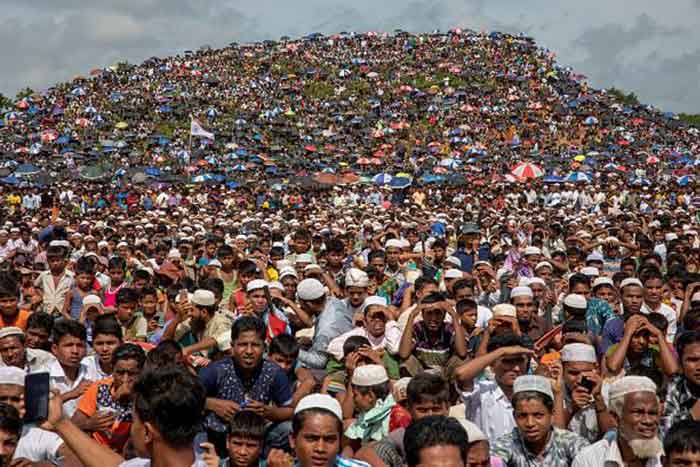
Rohingya people, who have no identity of their own, are now facing another danger. The pandemic of COVID-19 took away one of the Rohingyas, who found shelter at a camp at Cox’s Bazar in Bangladesh on the wake of genocide in their own land in Myanmar.
United News of Bangladesh reported that the man died from coronavirus infection while undergoing treatment at the isolation centre at Ukhiya camp in Cox’s Bazar on Monday night.
Referring to Abu Toha MRH Bhuiyan, who works as a health coordinator at the Refugee, Relief and Rehabilitation Commission, the news agency stated that the deceased could not be identified immediately but he was a 71-year-old man.
It was the first confirmed case of death of a Rohingya refugee in Bangladesh. Bangladesh is now home for over one million Rohingyas, who fled atrocities in Myanmar to Bangladesh.
In my earlier article in Countercurrents, I tried to draw attention of the world community so that they would come forward to save Rohingyas from probable contamination of COVID -19. I don’t know whether anybody heard my appeal. In fact, the Rohingyas are no longer safe now from the devastation of COVID-19. We don’t know what is waiting for the densely populated Rohingyas. I also don’t know who will save Rohingyas from further deaths? Is it the Bangladesh government or the world community?
Super power USA is now facing manifold adversity- destructions of COVID-19, street demonstrations across the country and, so on. Many other powerful countriesare also in peril today. And Bangladesh, with 709 confirmed case of death from COVID-19 and 52,445 infected, is has failed to control the spread of the coronavirus.
The Gono Forum came up with the allegation on Tuesday as its president Kamal Hossain and general secretary Reza Kibria in a joint statement said that although World Health Organisation on March 11 declared COVID-19 a pandemic, the government announced general holidays in the last week of the month.
They also said that although Bangladesh had enough time to determine national strategy, the government failed to implement a fruitful strategy, New Age reported.
The Gono Forum leaders said that the rate of COVID-19 tests in the country was very low and people had no confidence on government’s information on COVID-19 infections and deaths.
They also said that the late announcement of public holiday amid relaxation put impacted people’s lives negatively as it failed to control the infections.
They said that only a small part of government aids reached to the poor and vulnerable due to corruption and inefficiency while lakhs of labourers and working class people faced unemployment.
The leaders said that withdrawal of public holidays ignoring recommendations of national technical advisory committee had created much anxiety among the people and the situation was worsening for the lack of adequate number of tests and mismanagement in the health sector.
In this situation, I cannot think of a future for the Rohingyas, at least not the kind I really wished for.
Saifur Rahman Saif is a Bangladeshi journalist. He works at New Age, a popular newspaper.He contributed a story in Freelance Success Stories published simultaneously from the USA and Canada. He can be reached at saifnewage@gmail.com
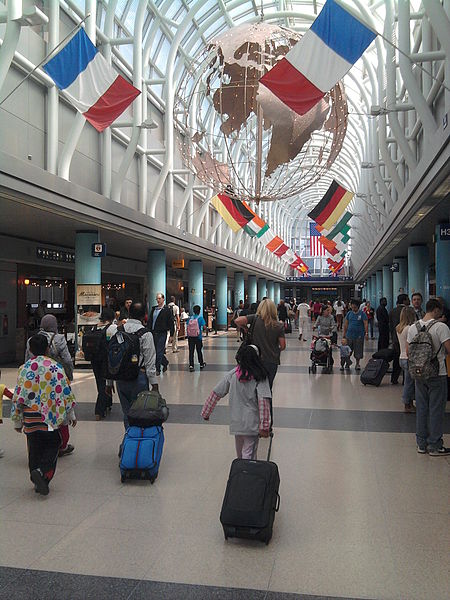
Chicago O’Hare’s international terminal offers street theatre.
I arrived recently at Terminal 5 to meet a friend, coming from Kathmandu, Nepal, via Abu Dhabi, UAE. Henry sent numerous texts once he landed as to where I might meet him and his luggage. He encouraged me to wait in the quiet of my car till he arrived. True, it was our nation’s busiest airport and often chaotic. But I refused. It was the drama of the arrivals gate that fuelled my 90-minute drive — not souvenirs that he brought back from his time in Kathmandu, Nepal.
The entertainment started immediately. Two middle-aged women from India, dressed in hot-pink saris, walked toward me and tried to exit through the automatic door to their left at Chicago O’Hare’s Terminal Five. Those doors would have been correct in India. But at this American airport’s international arrivals gate, it was the wrong door. It was my entrance, not their exit. I feared my step would trigger the glass portal to swing into their faces; I took a step back. They saw my look of fear and sensed their mistake. They, too, stepped back. We stood on either side of the glass, in a standoff. What should happen next? A porter, watching the narrative unfold, ran to their help and guided them to the right side of the hallway and the proper exit door. As we passed one another, we looked and smiled.
I found Henry’s arrival gate inside. The passengers on the connecting flight from Abu Dhabi began their travel two or three days before, perhaps in a mountainous village or maybe an apartment in a city of 20 million. They came not just from Nepal but India, the Middle East, and all of Africa.
The flight brought many ethnicities, cultures and religions together as they walked the lengthy concourse from the plane, passed through immigration, and gathered their belongings at baggage claim.
Families and friends waited. We served as a kind of reward for the travellers, standing patiently, excitedly, behind two sets of restricting ropes and a gap of 20 feet. Many of our impromptu group pushed towards the front to get a better first view of a loved one’s face — not unlike my father with his brother.
There was room to move behind the group of us waiting. A young woman, who wore a Muslim headscarf, pushed a baby carriage in a small circle. She kept her eyes focused on the baggage area. Her arms went up in a double wave when she saw the person she waited for. She clutched the handles and cried. A few moments later, she walked with more vigour while she pushed the pram.
A passenger claimed the first bag from the flight and walked toward the rope barrier. His family rushed into the exit way to embrace him and clogged the entrance funnel.
A small man negotiated his way through that tight exit sleeve. A tall woman grabbed him and they shared a passionate kiss. They turned to go and caught me staring at their togetherness. They smiled. Guilty, I smiled too.
I looked back to the woman with the baby carriage. Her traveller had not yet joined her. She stopped moving in a small circle and rocked the carriage in one place instead. I moved closer and asked how old the infant was. “Three weeks,” she told me. “His father has never seen him.” She told me he had not been in the U.S. for two years.
That didn’t make sense. “What about nine months ago?” I asked.
“Oh!” She giggled. “Yes! I went to Jordan to see him.” The couple flew to the U.S. where she was a citizen, but he was not. Officials stopped him in Chicago and sent him back to Jordan.
This time, he went through immigration in Abu Dhabi, so they knew there would not be difficulties. “He will get through this time,” she said.
We stood together, waiting, discussing baby names, immigration processes, when the child began to cry. “He’s hungry,” she said as she changed the angle of the pacifier and rocked him faster. “But I doubt I have time to nurse him.”
Just then, she saw her husband leave the baggage area and start through the funnel. Politely, she excused herself and wished me well. Again, I couldn’t help myself as I watched this moment of intimacy. Like with my father and his brother, the moment was full of joy.
Finally, I saw Henry head in my direction. He wheeled one large roller bag with his right hand and, with his left, carried a duffel bag. He grimaced as he tried to manipulate his way around a family reuniting in the middle of the narrow walkway. He looked tired, dark circles lay below his eyes. After our hug, we walked the distance to the car lot and he complained to me about his long-haul flight. He started with the frustrating behaviours of his seatmates — the women talking incessantly followed by the man across the aisle snoring loudly. He continued about a child kicking his seat in the row behind him. He described the difficulties flying without a common language. And he ended with, “The airline served the worst curry!”
I expected him to be positive, given all the thumbs up he had posted on Facebook during his visit, but 48 hours without sleep and 14 hours in one seat interrupted that flow. He was tired and intolerant.
He flew more than 7,000 miles. I drove only 60. We both spent time with the same passengers. Oddly, mine was the savoury souvenir.
.
J.O. Haselhoef is a social artist who writes and travels. Her work appears in Swamp Ape Review, Re-Creating Our Common Chord, Evening Street Press, and Fiction Southeast. Her book, GIVE & TAKE, Doing Our Damnedest NOT to be a Charity in Haiti was published in 2015. She is online at http://www.JOHaselhoef.com.
.
PLEASE NOTE: ARTICLES CAN ONLY BE REPRODUCED IN OTHER SITES WITH DUE ACKNOWLEDGEMENT TO BORDERLESS JOURNAL.
In a remote village amidst silent hills of the Himalayas, a tale of the ashes lures every passerby. Smoke lighting up the azure sky in glittery patches invites waste landers to picnic spots. Patches of land covered with ashes- that taste like jaggery, offering not just sweetness, but ethereal elation of mind and spirit. Each day fires turn into ashes. Each day lovers consume their splashy attires to liberate of the two to become one. Taste of their ashes surpasses all tastes.
The Toffee Wrappers
Stripping the toffee wrappers I undressed all whims, colours, glaze, coats of sweetness thrust by automated machinery of prodigal minds. Now toffees at the core remain delectable to be eaten till death. Wrappers dropped down on the road to be trampled and crushed, so that they do not creep into other lives. The heart feels light.
Dr. Parneet Jaggi is an Associate Professor, a bilingual poet, editor, critic and novelist. She has four collections of English poems and two research books. Her name appears in the Directory of Writers of America’s – Poets and Writers. She was honoured with ‘Star Ambassador of World Poetry’ award by Philosophique Poetica, India, 2019. She was declared ‘Poet of the Year 2019’ and ‘Critic of the Year 2019’ by UK’s poetry website, Destinypoets. She won the Wingword Prize 2020 for her Punjabi poem. She has co-edited two books- Poets & Poetry: Spaces Within & Without and Dynamics of Poetry: The Said and The Unsaid. Her first historical fiction (co-authored) The Call of the Citadel is ready for release in 2020. She is the Secretary of Galaxy International Foundation, India, an organization that promotes literature and social activism.
.
PLEASE NOTE: ARTICLES CAN ONLY BE REPRODUCED IN OTHER SITES WITH DUE ACKNOWLEDGEMENT TO BORDERLESS JOURNAL.
Ray copied all the questions from the question paper and looked out of the window. Twenty minutes had passed, and he wasn’t able to answer any question. Mathematics had always been very difficult for him. He always failed in mathematics but passed other subjects. He managed to get promoted to higher classes. He had reached the highest class of school with the lowest grade in mathematics.
“What do you expect out of me?” he would question his mother in an arrogant manner.
“Why don’t you study mathematics during your exams?” his mother would ask.
“Even if I study it, I wouldn’t make it,” he would reply, and scribble poetry.
He had a diary in which he wrote poems. On top of every poem, he would write proverbs, and those proverbs related to his poetry. Writing poems was the only virtue he was gifted with. He wasn’t good at sports either. During the whole duration of a game of football, he would not get a chance to touch the ball — leave alone to kick it.
Ray would question his existence in his poems. He would lament about his life, the life which he had not seen nor lived. He created mountains of words and he lived his life vicariously through his poetry. The thought of writing poems made him feel alive.
Many times in the examination hall he would scribble poetry in rough sheets. His class teacher who was also the examiner was aware that Ray could only copy questions in mathematics but solving them correctly was another matter. He was not the only one who was weak in mathematics; there were many of them in his group. But he was the only one who wrote poetry, and that made all the difference.
Ray would try to solve the questions in mathematics, but his answers never matched with the answers at the back of his book.
Poetry was his only hope.
How fragile his life was without it? Reflections in poetry were like life itself. Poetry could reflect happiness, pain and illusion in life. Mathematics was very abstract for him. The answers never matched and sometimes he doubted the questions too.
On the other hand, poetry also questioned his existence, but always provided him with answers. It made him think and ponder upon the questions of life. And the best thing about poetry was that answers were different for each person and they need not match and be the same. This openness made all the difference.
Ray was finding answers to life in poetry and the answers were his own. The answers did not need to match with the answers in the books. It was unlike the mathematics they taught in school in every sense.
Poetry could be contemplative in nature but mathematics in school was derivative in nature — derived from facts and laws in form of numbers. However, while trying to solve math problems, he glimpsed poetry could be like mathematics and only the ways of finding or reaching conclusions were different. He felt mathematics and poetry were two different paths to examine life and to prove that life exists. The process and methods might be different, but the conclusion was always similar. Both the subjects had a similar derivative – to explain life around us.
He even felt that zero, the smallest number in mathematics could also be meaningful. Zero was capable of having meaning on its own – it could mean nothingness. Yet, when combined with other numbers it could still be meaningful. Similarly, in poetry words were capable of providing infinitesimal meaning when they were on their own but when combined with other words, they could provide infinite meanings.
Mathematics explained the laws of universe in numbers and poetry explained it in words. Mathematics could elaborate a new dimension of time and space. Poetry could also elaborate a new dimension of time, thoughts and space. Senses could be unbound with words and with numbers too.
Mathematics surpassed time in its calculation and poetry was immortal in words. Mathematics could calculate in numbers the wholeness of the universe: poetry could describe the idea of the universe in words. Mathematics helped to create inventions with precision: poetry also invents with words – with brevity and precision.
Ray was only trying to solve the equation of life and draw conclusions in his own way. He felt and saw the subtle differences in both the subjects and yet both had some strains of similarity.
Poetry had brought him to limelight in his class and in school. Since he was good at poetry his teacher felt the urge to help him with his mathematics. He was the same examiner who always noticed Ray while he copied questions in the examination hall.
Ray had begun by copying questions of mathematics, but eventually he was all set to find his answers too. It took him time to find his answers through numbers, but eventually he succeeded to pass his mathematics exam of tenth grade. The difference worked out pretty well for him.
Ultimately, Ray realised the difference between poetry and mathematics. The difference which he realised brought different modes from life together and produced a meaningful ending for him. His teacher read few lines of poetry from Ray’s diary to the class:
For, what is it that Poetry can do?
It can make tremble a single leaf of a tree among many, and make you its master
It can let you climb on clouds while you are on the ground and are finding your stand
When your heart aches and you find pain in others
When you stumble and see others falling too ….
.
Sushant Thapa is an M.A. in English Literature from Jawaharlal Nehru University in New Delhi, India. His poems, essays, short stories and flash fictions are published in Republica Daily, The Writer’s Club, Kitaab.org, firewordsdaily.com, Sahitya Post, Udghosh Daily of Biratnagar and Borderless Journal. Sushant revels in rock music, books, movies and poetry from his home in Biratnagar, Nepal.
.
PLEASE NOTE: ARTICLES CAN ONLY BE REPRODUCED IN OTHER SITES WITH DUE ACKNOWLEDGEMENT TO BORDERLESS JOURNAL.
and the taken life feeds the hungering, blood-rich soil of a nation,
as it has for centuries.
What do the birds cry
over this blood that will not lay silent,
but runs restless, a river unencumbered, through the cindered streets.
What did the birds cry
when in such strange times
men drew up other men by ropes
to hang in trees?
What do the birds cry
when after so many words have been written,
so many speeches delivered,
and so many proclamations proclaimed,
that the sun still sinks upon killings unnumbered,
and the soil continues in its greed.
Cry, you birds, what do you cry?
“Silence, silence!
Until justice rises on the wing,
cry silence.”
.
Melissa A. Chappell is a native of South Carolina living on land passed down through her family for over 120 years. She is greatly inspired by the land and music. She plays several instruments, among them an 8 course Renaissance lute. She shares her life with her family and two miniature schnauzers. She recently published Dreams in Isolation: The World in Shadow: Poems of Reconciliation and Hope with Alien Buddha Press.
.
PLEASE NOTE: ARTICLES CAN ONLY BE REPRODUCED IN OTHER SITES WITH DUE ACKNOWLEDGEMENT TO BORDERLESS JOURNAL.
Personal experience is always a milestone to reminisce in life as its memories evoke mixed feelings of euphoria or exasperation, depending upon the incident that wrought that at the first instance. Though this one occurred a couple of years ago, it flashes in my mind quite often, pushing me to set my thoughts on paper so that I could relieve the feelings I sustained and shift the same to readers for them to partake of the pleasure or pain such narratives impart. With this preliminary let me begin at the beginning.
On a sultry forenoon I boarded a suburban train at the Park Town traversing between Beach Station to Thiruvanmiyur a couple of years ago in the summer when I visited Chennai, Tamil Nadu from Delhi. For a person given to enlivening the evening of existence from the fragrantly sweet blast of the past to derive simple pleasure in such journeys, this trip too was nostalgic and reminiscent of the days I used to travel decades ago between Egmore to Tambaram in the suburban train. I would go to meet a faculty member in the Madras Christian College (MCC) once a fortnight in my pursuit of a post-graduation in English. I would also meet and catch up with friends and relatives who were dispersed across the city in those halcyon days with a little income but a long laundry list of expenses.
The generous academic volunteered to give me wrinkles on how to prepare for the examination untutored as I was then working as a state government employee gathering statistics on the small scale industries in Chennai and its outskirts. He had also been unacquainted with me till my former head of the English Department in Madura College, from where I graduated, introduced us. Throughout my more than three scores of years, I was always a beneficiary of the kindness of strangers, though they are a fast vanishing breed under the blue domed umbrella.
In the current day, most have no time to talk face to face. They are content with selfies, besides chatting online and, occasionally, talking on their smart-phones. Well, this digression from the main track of my journey in the suburban train aside, what transpired subsequently during my less than half-an-hour trip that it remained memorable?
As I had a small handbag and the train was not over-crowded enough to intimidate passengers entering the carriage, I got in. I spotted the last row where a few tech-savvy young fellows going to their shift-duty somewhere in Taramani (the IT hub) area, were in the process of settling themselves. I found a seat vacant between two gentlemen. I went to occupy it but one person on the right side told me that the seat was reserved for his friend who would be there soon!
Other seats in the compartment were occupied and a few people were still pouring in when I thought that the common practice of the first-come-first served commuter was being turned topsy-turvy by this chap who was making a reservation for his own crony. But he was unrelenting in not letting me occupy the vacant seat, obdurately obstreperous in his rage and resentment Exasperated, I coolly asked him ‘empa ni oru ambilaya?’ (In just common parlance in the vernacular, it meant ‘are you a man?).
This set off a flutter in the dovecot and the person so addressed got enraged enough to threateningly question if I could bear even one blow from him for having questioned his manhood? If a youngman is asked whether he is a man, the immediate inference perceived by an impressionable youth is a direct assault on his virility!
Even as the verbal punch and counterpunch got under way in the humid weather, I sat sedately between the two gentlemen and occupied the treasured seat. But not before asking the youth (who challenged me that I could not bear one blow from him) whether he would stomach his dad to be treated in the fashion they were treating me. This made every one aghast and the person who threatened to thrash me was left speechless.
When I was a news agency journalist in the early 1990s in Delhi, I told him how the top official of the Election Commission was peremptorily asked by a journalist at a news conference whether the chief election commissioner was “a man or a Congressman?” Since he put a pause between man and a Congressman, the official was livid with anger as he misconstrued it. That was the last question in the press conference and the matter did not assume any uglier shape to the detriment of all the ones assembled there.
I purposefully recounted this to the intimidating youths. Probably, they would have have misunderstood that famous verse of the Scottish bard, Robert Burns, “A Man’s A Man For A’ That” (a man is a man for all that). Burns spoke of egalitarianism as the hallmark of manhood but modern man equates that to his being virile and robust to fight anyone who cocks a snook at him sans any second-thought!
Then I placidly put before him and his friends the issue in perspective of what I meant when I questioned his being a man, it was a comment on his basic civic responsibility to be gentle, kind and generous in spirit to show respect to people who had transited towards the more ancient stage of existence. They deserved and get reserved seats as senior citizens in public carriers, supported by the government itself.
Heroism is not only any act of bravery but also about being affable, gentle and generous in spirit and in demeanor especially when you are strong. I also told him that I was no match for him; leave aside the combined heft of his muscular chums who could make mincemeat of me. None of the youth went into an offensive mode but kept silent on my plain-speaking. I apologised to the young man but advised him not to hurt elders in public places when civility is an option.
As I reached the end of my journey, the person who threatened to beat me himself, apologised with others in his orchestra and bid me goodbye. I felt relieved that nothing untoward happened in the heat of arguments, compounded by the hot and humid weather!
Did not the oldest philosopher Aristotle say ages ago aptly, “it is the characteristic of the magnanimous man to ask no favor but to be ready to do kindness to others?” Let us not dry up the milk of human kindness in simple gestures to the old without recognizing that youth is but evanescent and human values are eternal.
G Srinivasan is a free-lance journalist from Delhi.
.
PLEASE NOTE: ARTICLES CAN ONLY BE REPRODUCED IN OTHER SITES WITH DUE ACKNOWLEDGEMENT TO BORDERLESS JOURNAL.
the frame lost its right angles, to tell you the fact.
It being the worst of times, you cannot visit an optician
and get it mended – or go for a new acquisition.
.
So I continue wearing my specs bent.
And lo! Visions become unbelievably indecent.
White becomes black, blackness receives a jolt.
One who has been a friend so long seems a foe –
he appears with a false show.
Stranger still, how can one elected in a fair poll
inevitably turn into a mole?
Philanthropes, I believe, are god’s messengers.
How then are they trapped in messy affairs?
They appear as crooked as my neighbour
who for me holds nothing but a sabre.
Hilariously, men and women with sure stigma
are wonderful people – how it happens is an enigma –
who run errands for the aged
and reach out to the caged
during the pandemic, the worst of times!
.
These visions reversed
must have something to do with the specs perverse –
since its fall it behaves strange.
Hope, you’ll excuse me for the change,
for I have nothing to do with the detriment.
Blame it all on the instrument.
.
Bio-noteHimadri Lahiri is former Professor, Department of English and Culture Studies, University of Burdwan, West Bengal. Currently, he is Professor of English at the School of Humanities, Netaji Subhas Open University, Kolkata. He has written extensively on Diaspora Studies, Postcolonial Studies and Indian English Literature. His latest publication is Diaspora Theory and Transnationalism (Hyderabad: Orient Blackswan, 2019). Contemporary Indian English Poetry and Drama (Newcastle on Tyne: Cambridge Scholars, 2019), co-edited by him, has also been published recently. He writes book reviews for newspapers and academic journals. He writes poems at his leisure hours.
.
PLEASE NOTE: ARTICLES CAN ONLY BE REPRODUCED IN OTHER SITES WITH DUE ACKNOWLEDGEMENT TO BORDERLESS JOURNAL.
Born in Nyeri, Kenya, in 1940, she died in Nairobi in 2011. Wangari Muta Maathai founded the Green Belt Movement, which has — through networks of rural women — has planted over 30million trees.
Africa’s future has been the subject of fierce debate with the international media: full of warnings about environmental and economic collapse.
True, development workers continue to create hypothetical solutions to the problems they see, yet with little effect and much controversy. While these outsiders haggle over projections and prophecies, Africans had been working on a variety of small, grassroots projects, which they believe, might change the course of their future.
The Green Belt movement is one such project which has been creating and recreating history. It is so easy, in the modern world, to feel disconnected from the physical Earth!
Despite dire warnings and escalating concern over the state of our planet, many feel out of touch with the natural world. But, the Green Belt organization — which has planted millions of trees throughout East Africa in order to provide sources of fuel, food, and a way to stop soil erosion and environmental degradation — is one example of an indigenous movement working to influence Africa’s ecology.
When Maathai founded the Green Belt Movement in 1977, she began a poor people’s environmental movement, focused on the empowerment of women that soon spread across Africa.
She spent decades working with the Movement to help women in rural Kenya plant—and sustain—millions of trees. With their hands in the dirt, these women found themselves empowered and “at home” in a way they never did before.
Maathai wanted to impart that feeling to everyone and believed that the key lies in traditional spiritual values: love for the environment, self-betterment, gratitude and respect, and a commitment to service.
While educated in the Christian tradition, Maathai drew inspiration from many faiths, celebrating the Jewish mandate ‘tikkun olam‘ (repair the world) and renewing the Japanese ‘termmottainai‘ (don’t waste).
Through rededication to these values, she believed Kenyan women could finally bring about healing for themselves and the Earth. Unrelenting through run-ins with the Kenyan government and personal losses, and jailed and beaten on numerous occasions, Maathai continued to fight tirelessly to save Kenya’s forests and to restore democracy to her beloved country.
The Green Belt Movement became the inspiring story of people working at the grassroots level to improve their environment and their country. Their story offered ideas about a new and hopeful future for Africa and the rest of the world. Besides being a native writer, Wangari Maathai was also a parliamentarian.
In 2002, she was elected to Kenya’s Parliament in the first free elections in a generation. In2003, she was appointed Deputy Minister for the Environment and natural resources.
However, worldwide recognition came her way when she was awarded the Nobel Prize for Peace in 2004. In 2009; she was appointed a United Nations Messenger of Peace. This Nobel Peace Prize laureate recounts her extraordinary journey from her childhood in rural Kenya to the world stage in her autobiography Unbowed: A Memoir.
Her trailblazing story illustrates how African women are striding out.
Infused with her unique luminosity of spirit, Wangari Maathai’s remarkable story of courage, faith, and the power of persistence is destined to inspire generations to come.
.
Bhaskar Parichha is a Bhubaneswar-based journalist and author. He writes on a broad spectrum of subjects , but more focused on art ,culture and biographies. His recent book ‘No Strings Attached’ has been published by Dhauli Books.
.
PLEASE NOTE: ARTICLES CAN ONLY BE REPRODUCED IN OTHER SITES WITH DUE ACKNOWLEDGEMENT TO BORDERLESS JOURNAL.
Ra Sh has published three collections of poetry – Architecture of Flesh (Poetrywala), Bullet Train and other loaded poems (Hawakal) and Kintsugi by Hadni (RLFPA). Forthcoming books are The Ichi Tree Monkey and other stories (translation of Tamil Dalit writer Bama’s short stories) (Speaking Tiger) and Blind Men Write (a play) (Rubric).Rash’s English translations include Mother Forest (Women Unlimited) (from Malayalam), Waking is another dream (Navayana) (Srilankan Tamil poems translated with Meena Kandasmy), Don’t want caste (Navayana) (collection of Malayalam short stories by Dalit writers) and Kochiites (Greenex) (a book on different communities in Kochi.)
.
PLEASE NOTE: ARTICLES CAN ONLY BE REPRODUCED IN OTHER SITES WITH DUE ACKNOWLEDGEMENT TO BORDERLESS JOURNAL.







 Borderless