A Field Most Rare

Beyond the rim of the horizon lies a field,
We can enter thru a back door: thru prayer.
On certain days of our lives, we need a shield,
A safe place to go, no one else to meet there.

Beyond the relativity of the world, a paradise,
With differences, hardship, strife put to rest.
Released finally from the scourge of life’s vice,
An unknown land made available as blessed.

Beyond all the confusion of right and wrong,
Beyond all the differences that keep us apart.
A place where bird melodies become our song,
Two persons now bound together as one heart.

Beyond the rim of the world a field most rare,
A place to settle differences, I’ll meet you there.
John Herlihy has published 20 collections of essays and poetry, including a book of sonnets entitled Simply Sonnets. Retired now, he lives and continues to write poetry in Miami, Florida.
.
PLEASE NOTE: ARTICLES CAN ONLY BE REPRODUCED IN OTHER SITES WITH DUE ACKNOWLEDGEMENT TO BORDERLESS JOURNAL
I have a habit of deep cleaning bookshelves. I mean I take all the books out of their cages and pile them up on the floor. I shuffle their pages pretty fast, to let them get a quick whiff of fresh air. The feather duster – used for the car – goes gently over the book covers.
I decided to alter their positions last time for more pleasure, but I did not have any memory of what had been positioned in the front. So, I picked up the ones with attractive covers and kept them behind, thinking that the attractive ones must have hogged the limelight.
Having finished the dusting, I threw in some naphthalene balls to keep silverfish and other bookworms away. Almost the entire packet was emptied, with the hope of zero damage to the precious books in my collection including the smutty reads. When the books were finally placed on the shelves, the new arrangement did not appeal aesthetically. The colour combination of the covers looked odd or the font did not go well.
The authors who do not gel in real life are certainly going to find it impossible to live harmoniously in that restricted space. I changed it again just like that, without any sense of discrimination. The random new look appeared better than the previous one, so I chose to let it prevail until I was faced with a negative feedback from an objective source. I decide to click pictures of the revamped bookshelf and post it on my social media handles as a display or profile photo. Agreed, this was not the ideal way to publicize the makeover for a bookshelf. With fake likes and comments pouring in, I concluded I was not going to be miserably bad in my choices.
I was suddenly hit by the novel idea of keeping half the bookshelf empty. Did that make the space look better? A crammed bookshelf is scary, gives the feeling of excess of reading stuff, suffocating to the core. I thought I was getting it right. A neighbour who noticed every single minute change was sure to be quick to appreciate by commenting that my bookshelf looked spacious, unlike the messy clutter it had been in the past. Excess of everything is bad, right?
By removing half the load, the bookshelf looked clean and attractive. But it added to my woes. I had to find a place for the other half lying scattered in the open. I had to separate the ones that I had read and did not want to keep, isolate them, sell them or donate them to any local library. It made me think of getting another bookshelf for another room. I began to look for a suitable corner for a new piece of furniture. Would the new bookshelf clutter the room?
I chose to get a small one, to control my impulsive book-buying habit. Before placing an order, I would have to think about where to keep them. I tried to change my mindset but whenever those attractive book deals would appear, it was impossible to stay away from ordering the new stuff. I thought of using a kindle to read books I do not feel like collecting. This was certain to reduce the incoming load. But when the paperback was almost priced the same as the kindle version, I couldnot resist the temptation of having the physical book in my possession.
I decided to start ordering slim books and stick to genres I like to read. But this was not an effective solution to my persistent problem. My favourite books were mostly thick and genre-bending. I decided none of this was going to work so I finally chose to distribute books I had finished reading.
Being the kind of a reader who never returns to the same book again for solace, I thought this would be fairly good solution. But the problem is that the unread books looked menacing unlike the comforting, friendly presence of the titles I already read. Just a look and I could say I had read this with pride. It gave a big boost to my confidence and encouraged me to read more.
I decided I would keep the read ones there instead of discarding them. Honestly speaking, an entire bookshelf of unread books is very insulting and depressing. Restore an ideal balance between the two. For two unread books, there should be one read book. It is a personal way of looking at it and calculating, to find a proper solution.
The idea of hiding books in the attic or the loft instead of displaying them made no sense. I found no merit in doing so. Besides, I had to place a ladder and put my life and limbs at risk to reach them for the occasional clean-up and access. The possibility of suffering a spinal injury after a bad fall scares me so I dropped the idea of making the bookshelf almost ceiling high.
Then how do I maintain a cordial relationship with my books and ensure their health and fitness? Yes, the pages are turning yellow, and I am desperately looking for an age-miracle cream to hide their autumnal years. Perhaps I should take out the ones with delicate pages from the bookshelf and send them to a library. They would find more and more readers in the shortest possible time because their life spans look limited. Well, this made sense to me, and I finally decide to take the seniors off from the bookshelves, to make it a youthful collection again. Instead of keeping the aged ones trapped on the shelves, I should get them more readers. But their appearances were likely not attractive enough to entice young readers. Maybe, the elderly readers or the mature, who believe in the healing power of words and not on the quality of the printed page, would get the chance to go through these treasures before tears set in and the pages simply go missing from the damaged spine, which would have lost its ability to keep the flock together. Sounded like a good idea and I was eager to share the big pile with the world. The best possible use of the books would be made before their end was near. The task of enlightening more minds should be carried out without delay. The act of cleaning the bookshelves brought in a rush of thoughts I that brought me happiness. It was like saying live your life so long as you have the time to live. The books from my collection still had time to live and spread happiness so I put them in front of more eyes.
.
Devraj Singh Kalsiworks as a senior copywriter in Kolkata. His short stories and essays have been published in Deccan Herald, Tehelka, Kitaab, Earthen Lamp Journal, Assam Tribune, and The Statesman. Pal Motors is his first novel.
PLEASE NOTE: ARTICLES CAN ONLY BE REPRODUCED IN OTHER SITES WITH DUE ACKNOWLEDGEMENT TO BORDERLESS JOURNAL.
Sybil Pretious concludes her adventures this round with a fabulous trip to a country with islands and ancient volcanoes
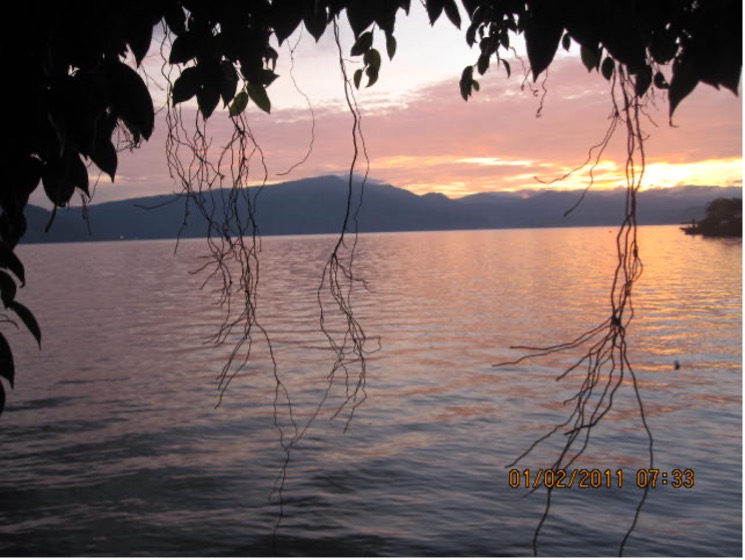
Volcanic Lake Toba. Photo Courtesy: Sybil Pretious
A good traveller has no fixed plans and is not intent on arriving. The way to do, is to BE.
~Lao Tzu
In 2011 (aged 69), I decided to challenge myself and travel alone to Indonesia. I also looked at alternative accommodation to backpacking so I joined Couch surfers. CouchSurfing is an organisation that connects people who wish to find accommodation in other countries while offering to host travellers in their own country. You offer just a couch where you live and can ‘surf’ to find a ‘couch’ with a resident of the country you want to visit. You do not pay for the ‘couch’ and you must supply your own meals and transport. The big advantage of this accommodation apart from no cost is that you get information from a person who is local and loves where they live plus it’s a base to travel from.
Indonesia is a country that spans the equator and consists of at least 17,000 islands. I would only touch on this extended land by visiting Java and Sumatra and yes, I was interested in the people, volcanoes, dance, puppets and woven fabric that I had heard so much about. My Couchsurfing host was Arianne who had written a couple of travel books about Indonesia – perfect.
I flew into Jakarta in the evening and wondered about how I would get to Arianne’s as I didn’t have her address. As so often happens when I leave events to unfold without trying too hard, they do so in a much better way than if I had been more diligent. Without informing me my lovely hostess had sent a chauffeur driven car with refreshments. Her welcome and the help and caring throughout my stay were definitely not included in the description of CouchSurfing hosts.
Her home had wide open spaces with pillars and floors of red concrete so that air flow was optimal in this hot, steamy climate. My ‘couch’ turned out to be an ornate four-poster bed in a bedroom with my own ‘en suite’. The toilet was typically Asian with a bucket of water for flushing. The ‘bathroom’ held a large concrete cube open on top and filled with cold water. A very large scoop was provided. To ‘bath’ I stood naked on the concrete floor, soaped myself and scooped out the water, throwing it in the general direction of my body. It was a bit hit and miss but I did feel cool and refreshed for a short while. There was no hot water. It just wasn’t needed. Every morning, I was woken with the long loud call to prayer.
I mentioned to Arianne as we chatted that I wanted to make a trip to Sumatra and was busy looking for flights and that I wanted to stay on the island of Samosir in the centre of the volcanic lake Toba. The island and lake are the result of a super volcano eruption 75,000 years ago.
“Let me book the flights for you. I do this often and will get the best prices and I can also arrange for someone to meet you.”
I couldn’t refuse her kind offer so it seemed once more that I had a guardian angel at my side. She efficiently took over and booked flights, arranged for people to meet me and take me wherever I needed to go. I would explore Jakarta and possibly go to Bali when I returned.
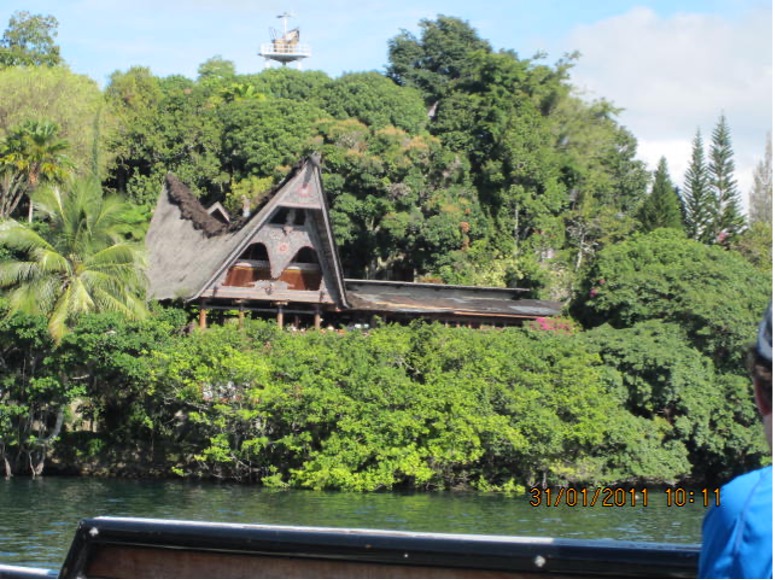
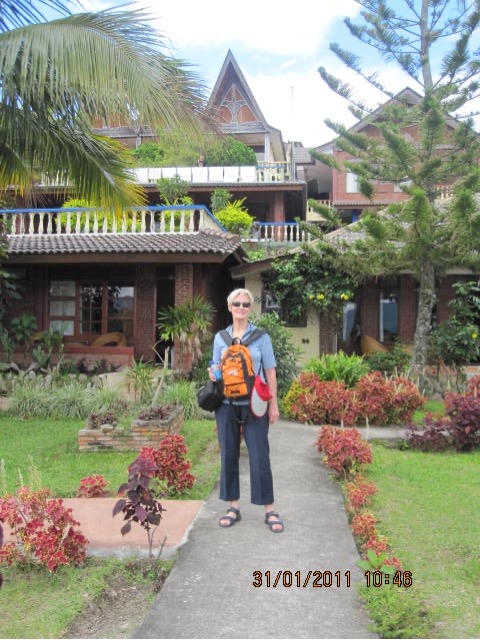
On arrival in Medan, I was met by Argys, a young Indonesian man who had brought his friends along. They were so attentive and concerned that I wouldn’t like the accommodation they had arranged for that night in Parapat before we took the ferry from a small village called Tuk Tuk across to Samosir Island where we stayed at Samosir Cottages.
It was hard to believe that an angry volcano had created this stunningly tranquil Lake. I got up early for the sunrise, a perfect place to meditate and feel grateful. I was ready for the day ahead.
Samosir Cottages. Photo Courtesy: Sybil Pretious
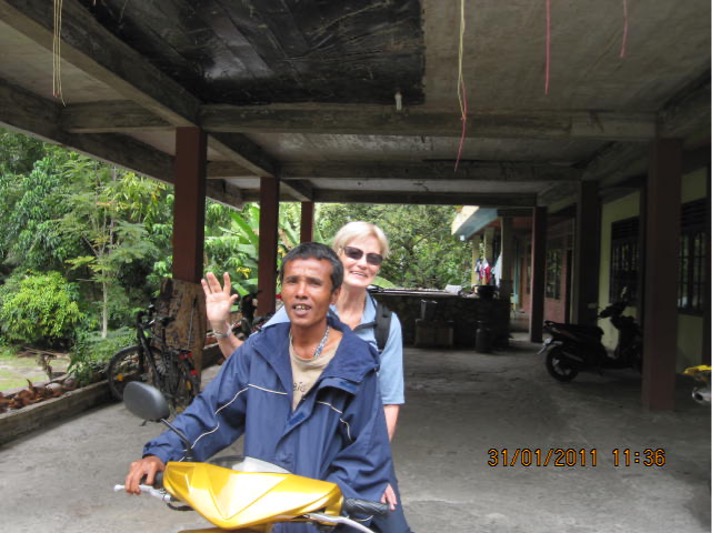
I wanted to see more of the island and was offered a motor bike tour by a local entrepreneur, Banyu. I didn’t give it a second thought, but Argys wasn’t too sure about this and gave Banyu a lecture before we set off. I promised him half the fee at the beginning of our ride and the other half when we returned and after a wonderful trip. He finally got more than he had asked for. It was a good feeling to be supporting local people rather than large touring companies. I have found that trust and acceptance is a must if you are to experience life through the local people’s eyes. Lack of knowledge of the local language is not necessarily a disadvantage.
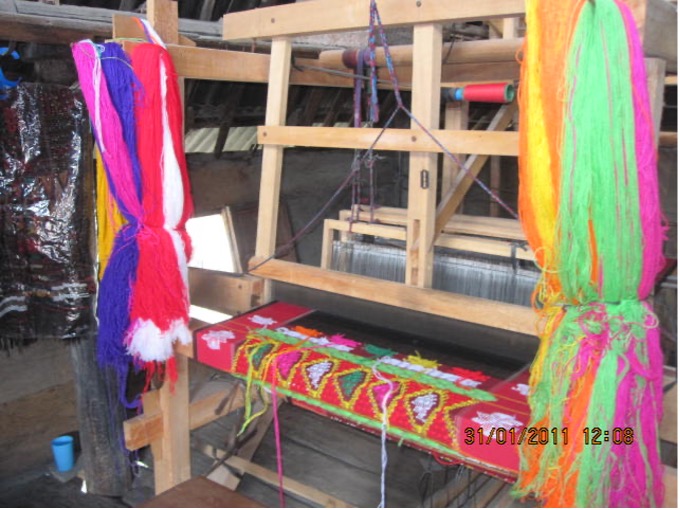
Travelling by motorbike gives an uninterrupted view of the lush vegetation and local scenery. My guide stopped at regular intervals delighting in showing off the wonderful textiles and weaving that local people were demonstrating. I couldn’t resist buying some of the colourful pieces after a demonstration by the weaver who looked delighted at the sale.
Photo Courtesy: Sybil Pretious
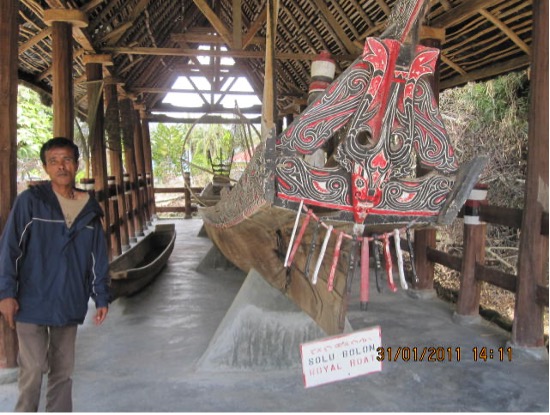
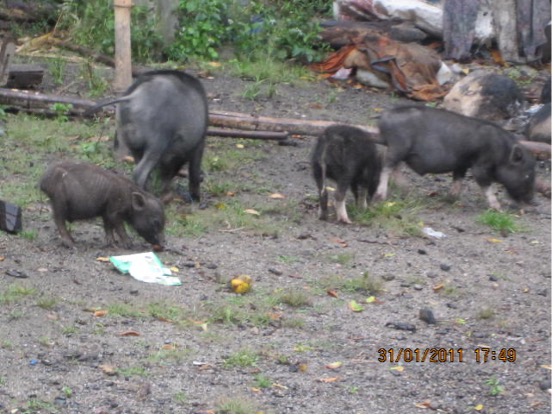
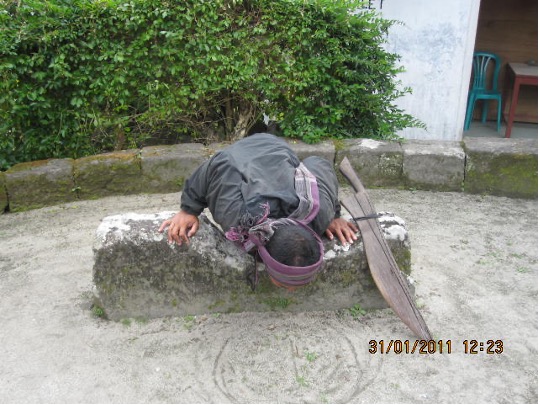
A museum displayed wonderful crafting on a ship, using minimum tools while creating intricate, colourful decoration. We laughed at black pigs foraging and then went to talk to a man who was looking after a ‘castle’. He was happy to demonstrate just how a prisoner would be beheaded. Many hand signals flew between us until he figured I had not understood and finally looking resigned, laid himself down on a specially shaped stone, leaning the massive sword towards his head and laughing when I got agitated.
Demonstrating beheading
Photo Courtesy: Sybil Pretious
Banyu was ever attentive but refused to share the fruit and water I had taken with me. He had not eaten during the tour. At the end I thanked him profusely. I slept well that night dreaming of battling to get through a gate. I woke feeling vaguely disturbed.
The following day was the one I enjoyed the most.
“We want to take you to the Sipiso Piso Waterfall.”
“That sounds wonderful. I could do with some cool water in this heat.”
Argys looked a little worried.
“It’s really high up. It is a waterfall that comes from very high in the side of the lake. We have to go over rivers and rocks and climb through a very muddy forest to get there.”
“I will be okay. I haven’t had the chance to climb any mountains here so this will be good.”
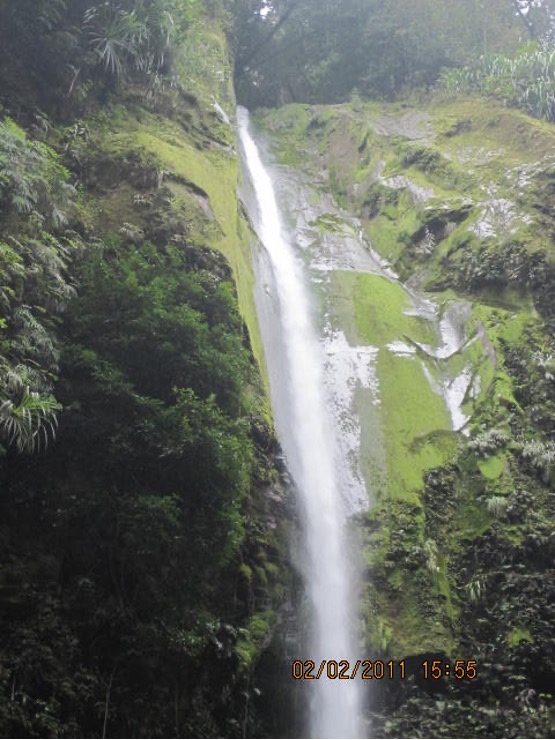
I later found out that the waterfall fell from a height of 120metres above the lake gushing from a cave in the Lake Toba caldera.
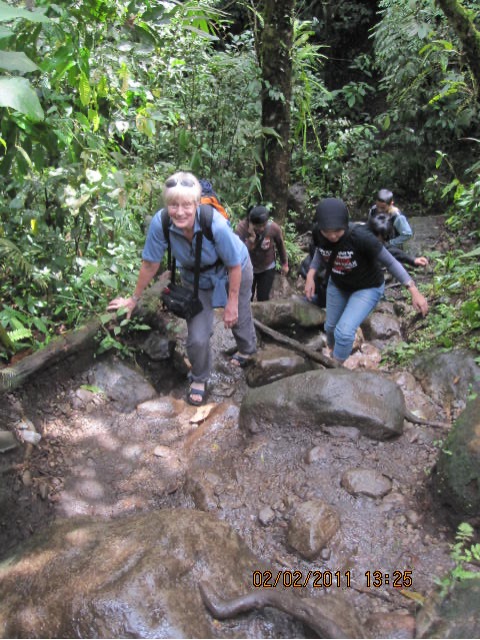
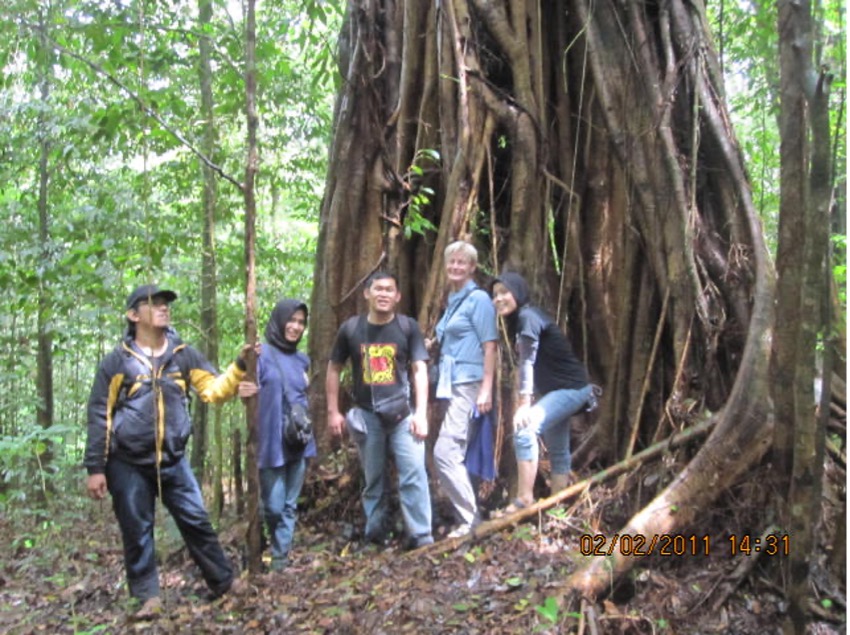
I packed the usual things in my small backpack – water, fruit, biscuits, a first aid pack and an extra blouse as I knew how hot and sweaty I got when climbing. I wore open sandals and the loose top and light slacks I had worn on Kilimanjaro. I was glad I didn’t have to cover my head as the two girls in our little party did. It looked very uncomfortable in that humid heat, but they assured me it wasn’t. The guy’s clothes looked cooler.
The way up was through a forest of giant trees with lush foliage, taking us over a river, rocks and through thick, slippery mud. Bright orchids flowers graced some trees, and a musty smell pervaded the air. Leaning against one of the trees when we stopped for a short while, I felt very small, so tiny. I closed my eyes and gave thanks for the beauty and gifts that trees give us. My back against the thick trunk felt supported and strong, so I harnessed the strength to continue. The going was steep, and I found myself slipping and slowing down. Argys had offered to take my camera so that I would have many pictures without having to stop so often. He literally leapt around snapping photos from every angle — yet another thoughtful gesture.
Photo Courtesy: Sybil Pretious
Finally, we could hear voices amid the sound of rushing water. As we broke through the trees I was awestruck. A bright slither of water plunged in a narrow silver-white ribbon down the steep, rocky side of the caldera splashing into a shallow rocky pool below. The pool was filled with people, laughing and joyful as they cooled themselves in this beauty.
Cool! Photo Courtesy: Sybil Pretious
I was soon soaked and feeling thoroughly refreshed. Several local people came to ask Argys and the girls what I was doing there. I told them that I was living my life to the full and loving Indonesia and its peoples.
In the morning I downloaded all my photos onto my outside hard drive (no tiny memory sticks then) and promptly left it in the hotel computer. It was only at the airport that I remembered. I was devastated – my life was on that piece of equipment. True to form, Argys said he would go back for it and send it to Arianne’s. I was overcome with his selflessness.
I arrived back in Jakarta mid-morning and Arianne, knowing I would need it, after my exertions at the waterfall with the young people on Sumatra, had thoughtfully arranged a day of luxury and beauty. I could not have afforded that if I had been staying in paid accommodation. I languished with a scrub, massage and green tea soak, feeling thoroughly refreshed and pampered.
Arianne had arranged for a guide in Bali, and I was shepherded by Dewa. I explained my interest was not the beaches, but the culture and he obliged.
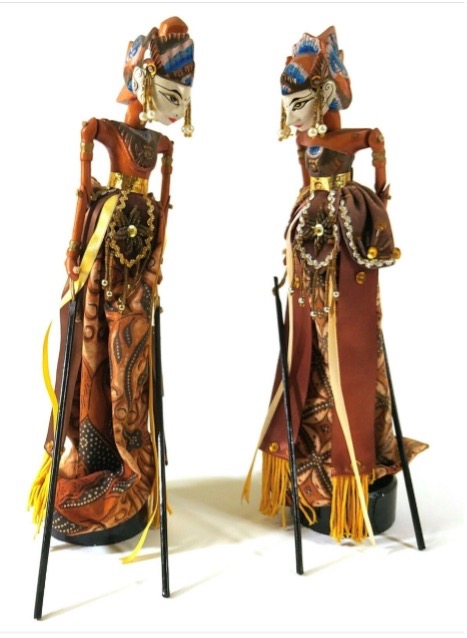
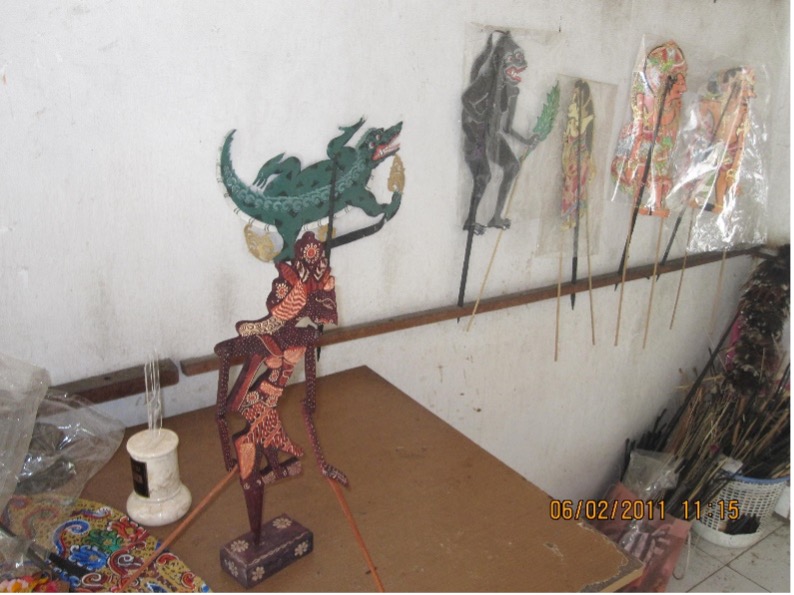
I was entranced with the story telling by dance and puppetry. I have used puppets so often in my teaching especially with young, shy children and children learning a new language. They might not want to respond to me, but they will willingly interact with the puppets. In that way, I gleaned many insights into feelings and thinking. I was determined to buy a Wayang Golek rod puppet. They were so beautifully made with spectacular clothing. At that time I had not known the story behind these puppets. They are always sold in pairs. I fell in love with a pair but felt I couldn’t afford two. The vendor did not want to sell one.
Dewar interpreted for me.
Wayang Golek puppets
Shadow puppets
Photo Courtesy: Sybil Pretious
“They belong together. They cannot be parted.”
But I stupidly insisted and eventually I bought a female one. A strange thing happened when I was at the airport. I accidently left the puppet and a painting on the seat as I rushed to catch the plane. Sitting on the plane I felt sad and knew that the puppet had not wanted to leave her partner and I had not listened to local lore and story telling. I hope she found him again and I hope that I will listen to those that know the ancient stories of their culture, more closely in future.
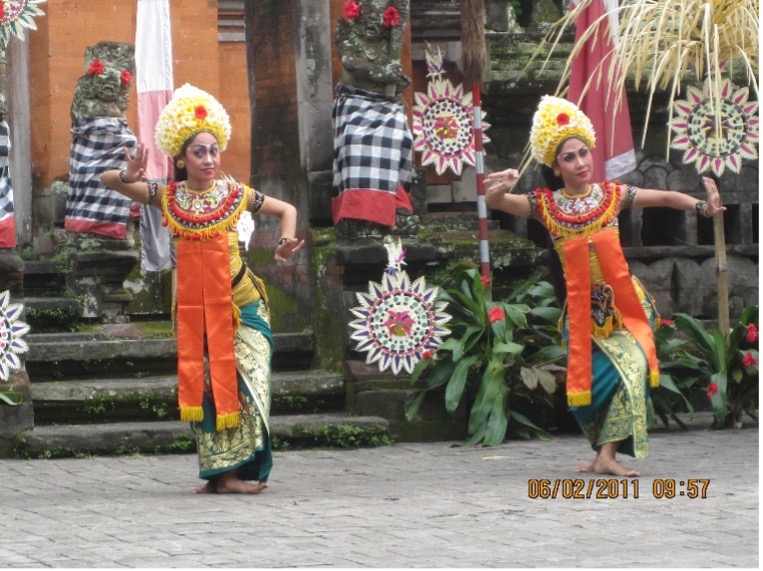
My encounter with Barong and The Kris Dance was enthralling. The dancers in vibrant costumes seemed in a trance as the story unfolded and the dance became more hypnotic. I was drawn in as the Kris, a formidable sword was wielded. Precision and drama could not have been more pronounced.
Barong dance
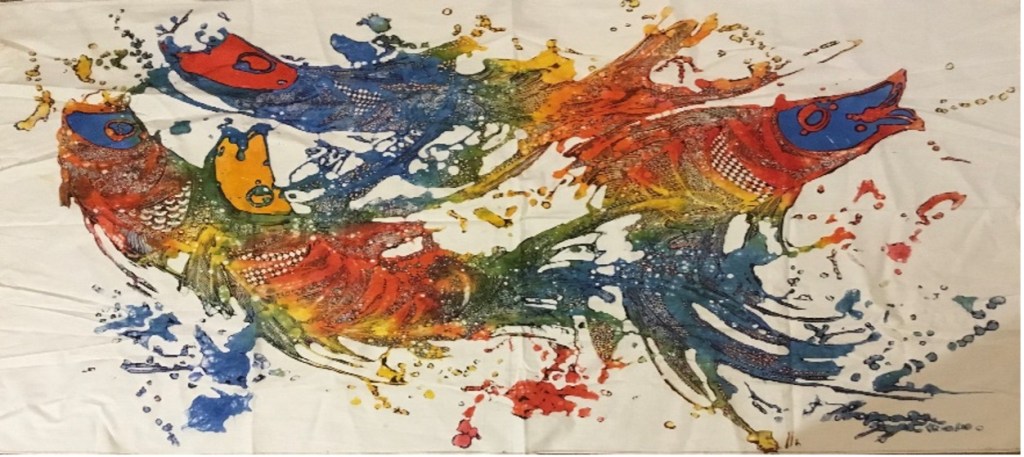
Batik
Photo Courtesy: Sybil Pretious
Dewar couldn’t resist taking me to view some paintings and batik. I fell in love with a batik featuring fish swimming. It was extraordinarily intricate.
After a long day and feeling completely saturated with culture Dewar asked if I would like to meet his family the next day. I told him it would be my privilege and his face burst into a big grin.
His mother and three of his brother’s wives met me. How privileged I felt. They had been at their sewing machines making traditional ceremonial garments, an industry that his mother had started in 1976. There were four houses round a central place for worship and a small temple. Dewar’s parents lived with him and his wife as he is the eldest. There were 20 people living in this family complex. That family is so important was so evident here.
Dewar’s mother and wife
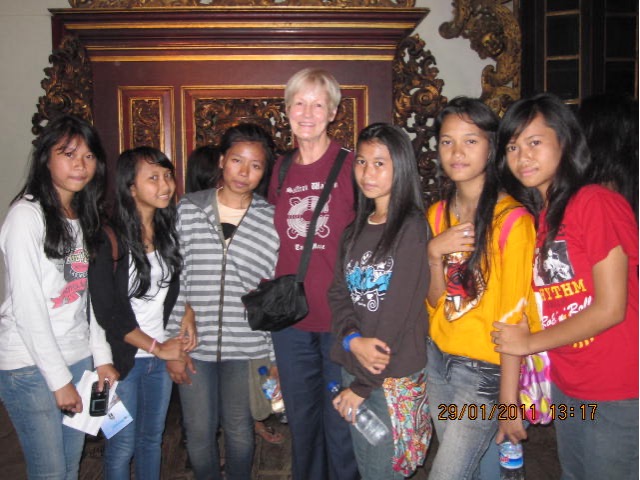
Students interviewing me
Photo Courtesy: Sybil Pretious
Having flown back to Jakarta Arianne arranged for me to stay with a writer friend of hers who also lives in a traditional home. Tita, like Arianne was a very busy lady. At forty two, she had written four books and ran an advertising agency and had a one year old daughter. The surroundings were tranquil, only the faint sound of insects floating on a zephyr breeze.
That afternoon I went out on my own to explore. The bus stops are lovely – there are at least two people manning each one to help with selling tickets and advice. On the bus the conductor helps passengers off at the correct stop ticking them off his list as they alight!
Just wandering down the streets was special. I got to eat street food – Nasi Goreng which was quite delicious – rice, meat, and curry flavours. A group of young students asked if they could interview me, and I obliged. Tita knew of my interest in puppets and arranged for me to buy a pair of the Wayang Golek. This time I knew I had to buy the pair and very beautiful they were. They didn’t fit in my backpack, so I carried them under my arm all the way on the plane back to Suzhou.
Finally, back with Arianne and getting ready to leave she said she had arranged for me to wait in the Emerald Sky Lounge at the airport. I felt very self-conscious sitting on luxury chairs and able to select from a variety of delicious food and drink all for free.
My solo journey turned out to be a travel experience of trust and delight in Indonesia. I felt blessed to have encountered many Indonesian people and places at a local level. Most importantly I had been able to support ground level community in my travel experiences instead of relying on tourist companies.
Travel is not about the sights you see but the people you meet.
.
Sybil Pretious writes mainly memoir pieces reflecting her varied life in many countries. Lessons in life are woven into her writing encouraging risk-taking and an appreciation of different cultures.
.
PLEASE NOTE: ARTICLES CAN ONLY BE REPRODUCED IN OTHER SITES WITH DUE ACKNOWLEDGEMENT TO BORDERLESS JOURNAL
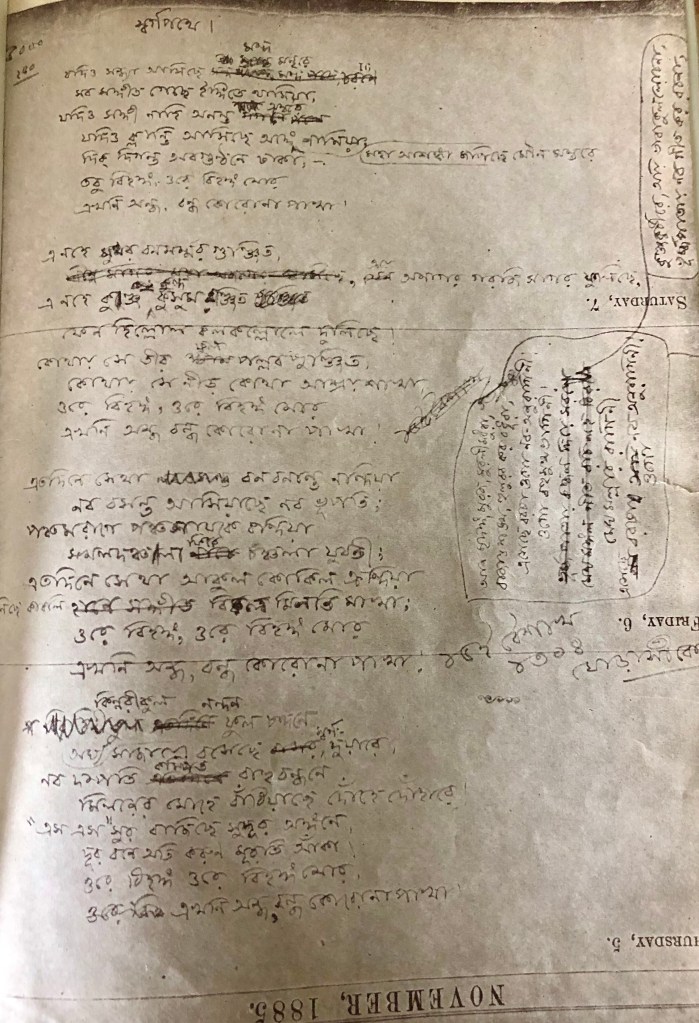
A translation of Dushomoy (bad times), written originally by the poet as Swarga Patthe (On the path to Heaven) in the Bengali month of Boisakh 1304, roughly April 1897 of the Gregorian Calendar.
A Journey of Hope


Though dusk sets in slowly,
    The songs of the spheres have been silenced.
Though you fly companionless in the endless sky,
     Though exhaustion seeps into your body,
A terrifying dread prays in mute chants,
    All horizons across the orb are covered by a veil --
Yet bird, o lone bird of mine,
     Despite the blinding darkness, do not stop beating your wings.

This is not the murmur of woods,
     This is the python-like ocean swelling.
This is not a bower of flowers,
      This is the undulating hood swaying to the music of waves.
Where is that shore full of blossoms and foliage,
     Where is the nest, where is the branch to rest?
Yet bird, o lone bird of mine,
     Despite the blinding darkness, do not stop beating your wings.

The long night stretches ahead,
     The sun sleeps stilled after sunset.
The universe is breathless under restraint.
     In this stunned stance, time meanders.
Swimming across the shades of the limitless night,
     A crescent moon appears in the distant skyline.
Yet bird, o lone bird of mine,
     Despite the blinding darkness, do not stop beating your wings.

High up in the skies, the stars point their fingers
     Towards your path while gazing at you.
Deep below lies restless death in rising crests
      Of hundreds of waves that beckon.
In distant shores, some call out with an offering,
    “Come, come,” they entreat, they plead.
Yet bird, o lone bird of mine,
    Despite the blinding darkness, do not stop beating your wings.

There is no fear, no tie of affection, no attraction,
      There is no expectation, expectation is only a mirage.
There is no language, no futile weeping,
      There is no home, no floral bed to rest on.
There are only these wings, there is the celestial quadrangle,
     The dawn is led astray by the drawing of the sequestered night —
Yet bird, o lone bird of mine,
    Despite the blinding darkness, do not stop beating your wings.
(Translated by Mitali Chakravarty, edited by Sohana Manzoor on behalf of Borderless Journal. Thanks to Dr Aruna Chakravarti for the discussion and feedback which helped improve the translation.)
Tagore’s draft of the poem, ‘Swarga Patthe’, with the signature and date. This is the poem that has come down to us as ‘Dushomoy’, now translated as ‘Journey of Hope’.
Click here to listen to Tagore recite the poem about a lone bird in his own voice in Bengali.
.
PLEASE NOTE: ARTICLES CAN ONLY BE REPRODUCED IN OTHER SITES WITH DUE ACKNOWLEDGEMENT TO BORDERLESS JOURNAL
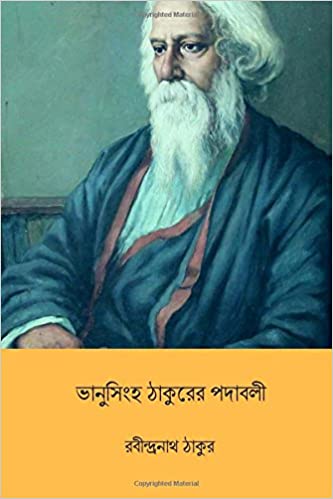
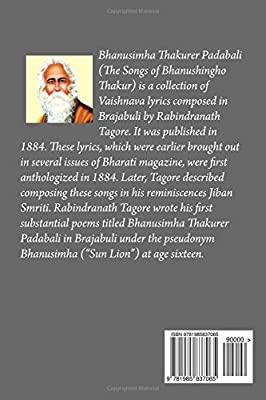
Renowned translator and academic Radha Chakravarty has translated two songs by Tagore written originally in Brajabuli, a dialect based on Maithali that was popularised for poetry by the medieval poet Vidyapati. Composed in 1877. it became a part of Bhanusingher Padabali in 1884. This song draws from the lore of Radha and Krishna.
Bhanu Singher Padavali
Gahana Kusuma Kunja Majhe(Amidst the Densley flowering Bower)
In the densely flowering forest grove
The flute sings softly of tender love.
Shame and scruples cast aside,
O beloved friend, come, step outside!
In delicate, graceful blue attire,
Heart aflame with budding desire,
In your doe-eyed gaze, a guileless smile,
Come to the bower, O friend, awhile!
Flowers pour forth their fragrance, strong
Birds pour forth a river of song
From the moon, pure nectar streams,
In the silver radiance of its beams.
Hear the gently humming bees,
Amidst the countless blooming trees,
Clustered blossoms fill the bower—
Bakul and jasmine, in full flower.
Shyam himself is here, behold!
Eyes overflowing with love, untold.
Immortal glory, grace divine
Shames the moon, and pales its shine.
O band of women, let us race—
On Govinda, to feast our gaze!
Bhanusingha’s hymn of praise
At the sacred feet of Shyam, he lays.
Shaono Gagane Ghor Ghanaghata

(The Dark Monsoon Skies)

So dense the clouds in the monsoon sky, so dark the night’s black veil!
Dare I set out for the forest, friend?—A woman, so alone and frail?
Wild winds flail the Yamuna waves, peals of thunder overhead,
Flashing lightning, crashing trees—my body trembles in sheer dread!
Rain descends in dancing chimes, from the clustered clouds above,
Sal, piyal, tal and tamal—so dark the densely wooded grove!
Tell me, friend, amidst this storm, why Kanha plays this cruel game—
From the grove, on his magic flute, tenderly calling Radha’s name?
Attire me in strands of pearl; with ornaments, my brow adorn;
With champak garlands bind these locks, flowing long and free, unshorn.
In the dark, at dead of night, go not, O maiden! to Nawal Kishore—
Your faithful servant, Bhanu pleads—so terrifying is the thunder’s roar!
Both these songs have been excerpted from Krishna in Indian Thought, Literature and Music, ed. Mandira Ghosh, Shubhi Publishers, 2021
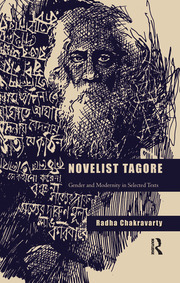
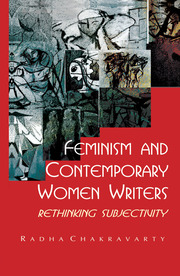
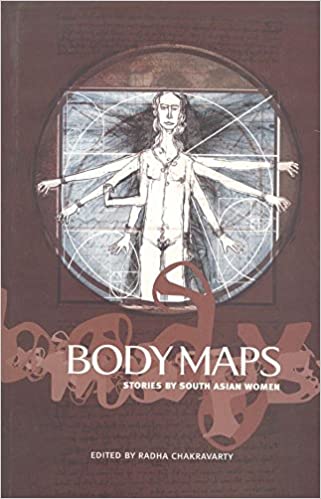
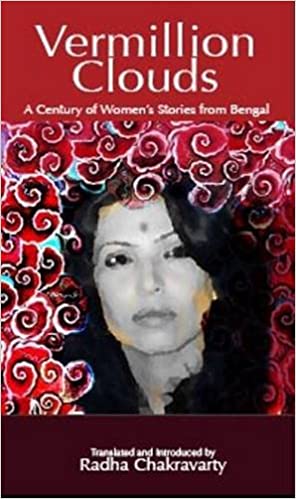
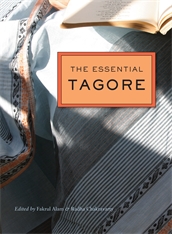
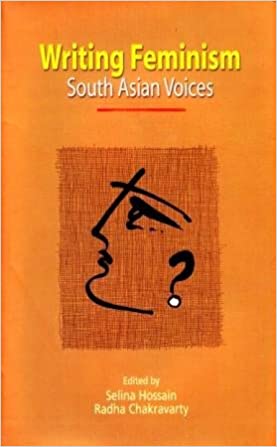
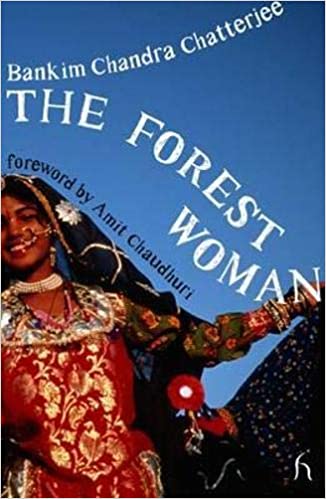
Radha Chakravarty is a writer, critic and translator. She has co-edited The Essential Tagore (Harvard and Visva Bharati), nominated Book of the Year 2011 by Martha Nussbaum, and edited Shades of Difference: Selected Writings of Rabindranath Tagore (Social Science Press, 2015). She is the author of Feminism and Contemporary Women Writers (Routledge, 2008) and Novelist Tagore: Gender and Modernity in Selected Texts (Routledge, 2013). Her translations of Tagore include Gora, Chokher Bali, Boyhood Days, Farewell Song: Shesher Kabita and The Land of Cards: Stories, Poems and Plays for Children. Other works in translation are Bankimchandra Chatterjee’s Kapalkundala, In the Name of the Mother by Mahasweta Devi (nominated for the Crossword Translation Award, 2004), Vermillion Clouds: Stories by Bengali Women,and Crossings: Stories from Bangladesh and India. She has edited Bodymaps: Stories by South Asian Women and co-edited Writing Feminism: South Asian Voices and Writing Freedom: South Asian Voices. Her poems have appeared in Journal of the Poetry Society of India, Contemporary Major Indian Women Poets, The Poet, Hakara, Narrow Road Journal, Krishna in Indian Thought, Literature and Music, The Fib Review, The Skinny Poetry Journal and Indian Poetry through the Passage of Time. Forthcoming books include Our Santiniketan (translation of Mahasweta Devi’s memoirs; Seagull Publishers); The Tagore Phenomenon (Allen Lane), Kazi Nazrul Islam: Selected Essays (Nazrul Centre for Social and Cultural Studies) and Mahasweta Devi: Writer, Activist, Visionary (Routledge, UK). She is Professor of Comparative Literature & Translation Studies at Ambedkar University Delhi.
.
PLEASE NOTE: ARTICLES CAN ONLY BE REPRODUCED IN OTHER SITES WITH DUE ACKNOWLEDGEMENT TO BORDERLESS JOURNAL
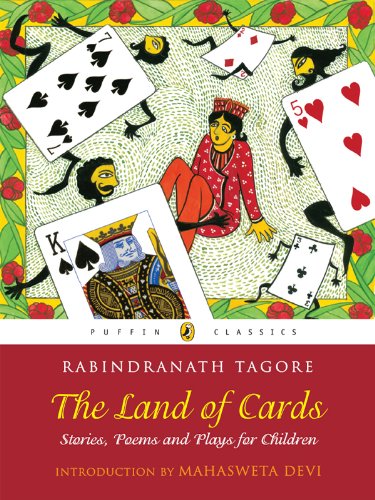
Title: Rabindranth Tagore. The Land of Cards: Stories, Poems and Plays for Children.
Translator: Radha Chakravarty
Publishers: Penguin India: Puffin Classics.
The Parrot’s Tale
Once there was a bird. He was uneducated. He sang, but did not read the shastras. He hopped about and flew, but didn’t know good manners.
“Such a bird is of no use,” declared the king, “but he harms the sale of fruit in the royal market by eating up the wild fruits in the forest.”
He sent for the minister. “Educate this bird,” he ordered.
2
The king’s nephews were given the responsibility of educating the bird.
The pundits assembled and considered the matter at length. The question was: “What is the reason for this creature’s lack of education?”
They concluded that there was not much room for learning in the bird’s nest, made from a few humble straws and twigs. Hence it was necessary, first of all, to make him a proper cage.
Receiving their dues, the royal pundits went home happily.
3
The goldsmith now set about making a golden cage. So marvelous was the cage he made, people from far-off lands came there to admire it. Some said, “It is the height of education.” “Even if he doesn’t get an education, at least he has a cage,” declared others. “What a lucky bird!”
The goldsmith was rewarded with a bagful of money as bakshish. He went home happily.
The pundits got down to the business of educating the bird. “This is not a task to be achieved with just a few books,” they declared, inhaling snuff.
Now the royal nephews summoned all the scribes. Copying many textbooks and making copies of copies, they produced a mountain-high pile of books. Anyone who saw it exclaimed: “Shabash – congratulations! This heap of knowledge is full to bursting!”
Loading a bullock with all the money they received as payment, the scribes rushed home. They no longer had any trouble making both ends meet.
There was no end to the royal nephews’ fussing over the very expensive cage. There was no end to all the repair and maintenance, either. And there was such a to-do about dusting, wiping and polishing, that the sight made everyone declare: “These are signs of progress.”
The work required a lot of manpower, and to keep an eye on the workers, even more men had to be deployed. Month by month, they collected their payments by the fistful and stuffed the money in their safes.
These men, and all their maternal and paternal cousins, settled happily in palatial brick-built mansions.
4
Many other things are lacking in this world, but there is no dearth of fault-finders. “The cage is improving,” they said, “but nobody asks after the bird.”
The matter reached the king’s ears. He sent for the nephews and demanded: “O nephews, what’s this I hear?”
“Maharaj,” said the nephews, “if you want to hear the truth, summon the goldsmiths, pundits, scribes, the maintenance workers and their supervisors. It’s because the fault-finders don’t get enough to eat that they say such evil things.”
From this reply, the situation became clear to the king. Golden necklaces were ordered at once, to adorn the nephews’ necks.
5
The king wanted to see for himself the tremendous pace at which the bird’s education was progressing.
At once, the area near the portico began to resound with the noise of conchs, bells, dhak, dhol, kada, nakada, turi, bheri, damama, kanshi, flutes, gongs, khol, cymbals, mridanga and jagajhampa. With full-throated abandon, shaking the unshaven locks of their tikis, the pundits began to chant mantras. The masons, workmen, goldsmith, scribes, supervisors and their maternal and paternal cousins, sang to the king’s glory.
“Maharaj, can you see what a to-do there is!” observed a nephew.
“Amazing! The noise is quite extraordinary,” observed the Maharaja.
“It’s not just the noise; the money that’s gone into it is not inconsiderable either,” the nephew pointed out.
Delighted, the Maharaja crossed the portico and was about to mount his elephant when a fault-finder concealed in the bushes called out: “Maharaj, have you had a look at the bird?”
The king was startled. “Oh no!” he exclaimed. “I had clean forgotten. I haven’t seen the bird.”
He went back and told the pundit, “I need to observe your technique for training the bird.”
He was duly shown the technique. What he saw pleased him greatly. The method was so much more important than the bird, that the bird could not be seen at all; it seemed needless to see him at all. The king realized that the arrangements lacked nothing. There was no grain in the cage, no water, just a mass of pages torn from a mass of books, being stuffed down the bird’s throat by the end of a quill pen. The bird’s song could not be heard of course, for it was too stifled even to scream. It was a thrilling sight, enough to give one goose-pimples.
Now, while mounting his elephant, the king instructed the Chief Ear-puller to tweak the fault-finder thoroughly by the ears.
6
Day by day, the bird arrived at a half-dead state, in a civilized fashion. His guardians saw this as a hopeful sign. But still, by natural instinct, the bird would gaze at the morning light and flutter his wings in a way that was unacceptable. In fact, one day he was seen struggling to cut through the bars of his cage with his fragile beak.
“What audacity!” cried the Kotwal, the law-maker.
Now the blacksmith appeared in the training quarters, armed with bellows, hammer and fire. How hard he beat the iron! Iron shackles were forged, and the bird’s wings were clipped.
Gravely shaking their heads, the king’s associates declared: “In this kingdom, the birds lack not only brains, but gratitude as well.”
Now, armed with pen in one hand and rod in the other, the pundits accomplished the dramatic feat called education.
The blacksmiths gained so much importance, their wives bedecked themselves with ornaments, and seeing the alertness of the Kotwal, the king bestowed him with a shiropa, a turban of honour.
7
The parrot died. Nobody could say when.
The wretched fault-finder spread the word: “The bird is dead.”
“Nephews, what is this I hear?” demanded the king.
“Maharaj, the bird’s training is complete,” declared the nephews.
“Does he hop about anymore” the king enquired.
“Arre Rama! No,” demurred the nephew.
“Does he fly anymore?”
“No.”
“Does he sing anymore?”
“No.”
“Does he scream if he does not receive grain for his feed?”
“No.”
“Bring the bird to me once,” the king ordered. “Let me see him.”
The bird was brought. Along with the bird came the Kotwal, paiks, and horsemen.
The king prodded the bird. But the bird neither opened his beak, nor made any sound. Only the dry pages torn from books rustled and sighed in his belly.
Outside, stirred by the fresh spring breeze blowing in from the south, the sighing of new leaves spread anguish in the sky, above the newly blossoming woods.
(Published with permission from Penguin Random House India.)
About the Book:
Poet, novelist, painter, musician and Nobel Laureate, Rabindranath Tagore was one of modern India’s greatest literary figures. This collection brings together some of his best works—poems, short stories and plays—in one volume for today’s young readers.
Be it the wit, magic and lyricism of his poetry or the vividly etched social milieu of his stories, or the sheer power and vibrancy of his plays, Tagore’s versatility and unceasing creativity come alive in these writings. The title play ‘The Land of Cards’ is a satire against the bondage of orthodox rules, while in ‘The Post Office’, a child suffocated by his confined existence dreams of freedom in the world outside. From a son’s cherished desire to protect his mother in the poem ‘Hero’ to a fruit-seller’s sentiments for his faraway daughter in the story ‘Kabuliwala’, Tagore’s works convey his broad humanism and his deep awareness of the poignancy of human relationships.
Radha Chakravarty’s lucid translation captures the sheer genius of Tagore’s evocative language, making these works accessible to contemporary readers.
About the Translator: Radha Chakravarty is a writer, critic and translator. She has co-edited The Essential Tagore (Harvard and Visva Bharati), nominated Book of the Year 2011 by Martha Nussbaum, and edited Shades of Difference: Selected Writings of Rabindranath Tagore (Social Science Press, 2015). She is the author of Feminism and Contemporary Women Writers (Routledge, 2008) and Novelist Tagore: Gender and Modernity in Selected Texts (Routledge, 2013). Her translations of Tagore include Gora, Chokher Bali, Boyhood Days, Farewell Song: Shesher Kabita and The Land of Cards: Stories, Poems and Plays for Children. Other works in translation are Bankimchandra Chatterjee’s Kapalkundala, In the Name of the Mother by Mahasweta Devi (nominated for the Crossword Translation Award, 2004), Vermillion Clouds: Stories by Bengali Women,and Crossings: Stories from Bangladesh and India. She has edited Bodymaps: Stories by South Asian Women and co-edited Writing Feminism: South Asian Voices and Writing Freedom: South Asian Voices. Her poems have appeared in Journal of the Poetry Society of India, Contemporary Major Indian Women Poets, The Poet, Hakara, Narrow Road Journal, Krishna in Indian Thought, Literature and Music, The Fib Review, The Skinny Poetry Journal and Indian Poetry through the Passage of Time. Forthcoming books include Our Santiniketan (translation of Mahasweta Devi’s memoirs; Seagull Publishers); The Tagore Phenomenon (Allen Lane), Kazi Nazrul Islam: Selected Essays (Nazrul Centre for Social and Cultural Studies) and Mahasweta Devi: Writer, Activist, Visionary (Routledge, UK). She is Professor of Comparative Literature & Translation Studies at Ambedkar University Delhi.
.
PLEASE NOTE: ARTICLES CAN ONLY BE REPRODUCED IN OTHER SITES WITH DUE ACKNOWLEDGEMENT TO BORDERLESS JOURNAL
Radha Chakravarty has, for many of us, been synonymous to translations that we read – excellent translations of Tagore, Bankim and Mahasweta Devi – major names from Bengal in Literature. A well-respected academic who specialises in translations, Tagore, Mahasweta Devi, Women’s Literature, South Asian Literature, Subaltern Writings and Comparative Literature, in this exclusive she talks to us of the multiple journeys in her development as a translator, critic and writer.
You are an eminent translator, editor, critic and writer. What started you out on this path?
These are separate yet interlinked roles, different journeys yet part of the same narrative of my involvement with the world of words. I started writing when I was a child, but came to think of publishing my creative work many years later, when journal editors began to solicit my poetry for publication. My poems have now appeared in many books and journals, in India and internationally. It was a wonderful collaborative experience to contribute to Pandemic: A Worldwide Community Poem (Muse Pie Press, USA), nominated for the Pushcart Prize 2020.
My work as a critic evolved through engagement with research. Feminism and Contemporary Women Writers(Routledge, 2008) for instance, emerged from my doctoral research, a cross cultural study of writers such as Mahasweta Devi, Anita Desai, Doris Lessing, Toni Morrison, Margaret Atwood and Buchi Emecheta. Novelist Tagore (Routledge, 2013) draws upon my research on gender and modernity in Tagore’s novels. My essays and reviews come from my areas of specialization, including Tagore Studies, women’s writing, South Asian Studies, Comparative Literature and Translation Studies.
As an editor, my work is inspired by the idea of sahitya, the Bengali word for “literature” that Tagore interprets as “being with” or “being together”. This idea of collaboration and dialogue across heterogeneities fascinates me. My edited volumes, such as Bodymaps (Zubaan, 2007), a collection of South Asian women’s stories on the body, Vermillion Clouds(Women Unlimited, 2010), an anthology showcasing a century of fiction by Bengali women and Writing Feminism (co-edited with Selina Hossain; UPL, 2010), containing selections of South Asian feminist writing, are inspired by this principle. My most exciting collaborative project as an editor, so far, was The Essential Tagore (Harvard and Visva-Bharati, 2011), where my co-editor Fakrul Alam and I worked with thirty reputed South Asian translators located in different countries, on the largest anthology of Tagore’s writings across ten genres. The volume, named the ‘Book of the Year’ 2011 by Martha Nussbaum, has since become a standard reference for Tagore scholars worldwide.
As for translation, I started dabbling in informal translations, across Bengali, English and Hindi, even as a child. My grandfather, who taught me advanced Bengali at home, often involved me in these linguistic experiments. My first published translation happened almost by accident, in the 1990s. A friend, an Israeli art historian, asked me to explain the lyrics of the Bollywood song daiya re daiya re charh gaye papi bichhwaa(the poisoned scorpion climbed on me), because she was researching the scorpion motif in the Khajuraho scultpures. I ended up translating the entire song into English, in verse! My friend was amazed. She included my translation of the song with due credit, in her essay on the scorpion, published in the Journal of the Asiatic Society of India. As for my early books in translation, I must thank my friends, the editors and publishers who urged me to take up those projects. They saw in me a potential I had not fully recognised myself. Later, the overwhelming recognition that these books received transformed my self-image. I began to think of myself as a translator, among many other things.
You started by translating Mahasweta Devi. When and why did you start translating Tagore? What moved you from Mahasweta Devi to Tagore?
At the turn of the century, I was immersed in the challenge of translating into English the heterogeneities of contemporary Bengali fiction. Crossings: Stories from Bangladesh and India (2003), my first published book of translations, included the stories of twenty living writers. Alongside, I was working on In the Name of the Mother, my translations of some powerful, unusual stories about motherhood by Mahasweta Devi. The volume appeared soon after Crossings.
Meanwhile, I received a sudden call from Rani Ray—once my teacher, now a friend, mentor and figure of inspiration—urging me to translate Tagore’s Chokher Bali (A grain of Sand) an important but neglected text. I remember the shock and awe I felt at that moment. I protested that I was no Tagore expert, much as I loved and admired his work, but Rani di was adamant. “I think you are the right person to translate this novel,” she insisted. I found myself promising that I would try. And that was how my journey as a Tagore translator began. I read the novel, was struck by its boldness as a path-breaking modern text, and felt daunted but also tremendously excited at the challenge of trying to translate this hundred-year-old text that was at once so rooted in its context, and yet so far ahead of its time. Translating Chokher Bali was an immersive experience. It transformed me, drew me into a lifelong relationship with Tagore, and there has been no looking back.
Was translating Tagore different from translating Mahasweta Devi or Bankim? How was it similar/ different?
As I said, I first translated contemporary writing before turning my attention to Tagore. My translation of Bankim’s Kapalkundala came in 2005, after I had also translated Tagore’s Shesher Kabita as Farewell Song. So the transition from Mahasweta and other contemporary figures, to Tagore’s early twentieth century texts, and then to Bankim’s nineteenth century novel was like a journey back in time, delving further and further into the Bengali literary past. Of late, I have been translating parts of the Chandrabati Ramayana, a sixteenth century composition. Each step in this journey has been a process of exploration and rediscovery through translation, of familiar and much loved texts that I had read avidly in my early life, never dreaming that I might one day aspire to translate these literary jewels.
After working with living writers, the transition to Tagore was not easy. When translating Chokher Bali, I felt the need to evoke the flavour of a bygone age, even in a contemporary translation for the twenty-first century reader. This involved complex creative experiments with style and vocabulary that stretched my abilities as a translator. One felt the importance of bringing to life the cultural ethos of Bengal in the late nineteenth century, a world in many ways unfamiliar to readers of our time. Simultaneously, I recognized the modernity of Tagore’s novel, the new element of interiority that transformed the Bengali novel at his magic touch. That needed to be brought to life too.
Moving from Tagore to Bankim offered a fresh set of challenges. The lyrical, Sanskritised cadences of Kapalkundala are far removed from the more modern idiom of Tagore’s novels. Bankim’s text is set in the Mughal period. Hence the translator must actually negotiate the past at a double level, to bring to the modern reader the late medieval ethos as represented through Bankim’s nineteenth century sensibility. Crossing these temporal and cultural divides demanded daring experiments with language, as well as considerable research to contextualize the source text. It was a learning process for me.
Working with the ChandrabatiRamayana is a different experience altogether. A radical text for its times, and one that challenges the mainstream literary tradition, it remains a text worth returning to in our own context, because it destabilizes monolithic conceptions of our premodern religious and social traditions. Finding in English an idiom that will capture the poetry as well as the content is a hard task though.
These adventures in translation have compelled me to read the Bengali literary tradition from a different angle, from a writerly perspective, as it were. I have realized that translation involves a creative element, but also works as a form of interpretation. It has become clear to me why translation can be described as the most intimate act of reading.
In the Jaipur Literary Festival (2017), you made a very interesting observation that if one does not get into the skin of a writer, one cannot capture the essence of the writer in entirety. Are all good translations more of transcreations that literal translations?
Translation often appears to me a form of ventriloquism, the translator’s voice making itself heard through the voice of the source text. It produces a double-voiced text. My endeavour, when translating, is to bring to life the spirit rather than the literal vocabulary of the source text. One struggles to apprehend, interpret, and then, through one’s own creative ability in the target language, to approximate the impulse behind the original. A doubleness comes into play here, due to the gap in time, location, language, culture and context that separates the translation from the source text. In this tension resides the dynamic potential of translation to simultaneously recognize and displace the original. The success of a translation often depends on the translator’s creativity, as well as the author’s.
What is your opinion of Tagore’s own translation of his works? Can you expand on that?
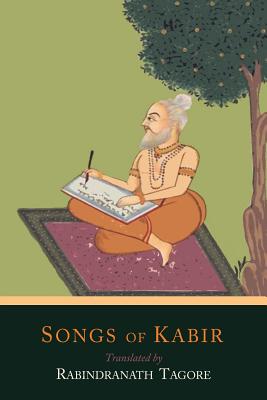
Tagore’s English translations of his own work shot him to international fame and led to the Nobel Prize. Yet he was diffident about his own command of English, and unsure about the quality of his translations. Some of these translations resorted to archaisms and a rather stilted style that did not weather the test of time very well. They were partly responsible, I feel, for the fluctuations in Tagore’s international reputation after the initial flush of success. Certainly, they are not close copies of the original Bengali texts; rather, they are re-creations in a different language, for a different readership. While some readers may cavil at the gap between the source texts and their English versions, these translations, in my opinion, remain important instances of the ways in which translation can connect different cultures through dynamic border crossings. The Kabir translations for instance, drawing upon the work of Kshitimohan Sen, and produced by Tagore in collaboration with Evelyn Underhill, provide a fascinating instance of the translingual and transcultural border-crossings that were involved in this process.
Sometimes Tagore adopted unorthodox collaborative measures when working with translations.
We know about the English translations of course, but it is worth remembering that Tagore also translated numerous premodern poets into Bengali and English, from a range of different languages, often drawing upon eclectic sources and relying on the assistance of others more knowledgeable about the languages and literary cultures of the source texts. I have recently published an essay on Tagore’s translations of medieval poetry, where I argue that these should be read, not as literal, faithful renderings that seek to cling close to the source texts, but rather, as transcreations that resituate these early texts in new, unfamiliar contexts. What takes place in his translations of Bhakti poetry, for instance, is also a meeting of different faiths, across diverse histories and geographies.
Can a translation be done from a translated piece into the same language? Would such a revision be of value?
Intralingual translations can be found in many literary cultures. Sometimes, texts in formal or classical versions of a language get translated into a modern, colloquial idiom, to reach a wider audience in a different time period. Often, these can be read as democratizing moves, arising from dynamic historical shifts that bring about an interrogation of social and linguistic hierarchies. The bridging of gaps between “high” and “popular” cultures can be attempted through such processes. These translations imagine into being new readerships for older texts, giving them a new and altered “afterlife”. The market also dertermines some of these things, especially when it comes to promoting modern versions of enduring texts that are regarded as classics. Intralingual translation can blur the borderline between translation and adaptation.
Can a translation to another language be done from a translation say in English, and still have the authenticity of the original writer?
It is currently a widely prevalent practice to use English translations as source texts for re-translation of texts into other languages. English as the language of global currency provides a useful medium for such translingual, often transnational interchanges. In India, despite our multilingual culture, there is dearth of translators who can work across Indian languages without taking recourse to English as a via media. This is part of the colonial legacy, which transformed our premodern polyglot culture through the compartmentalization and codification of the “modern Indian languages”. Today, bilingual and multilingual Indian scholars and translators are scarce. Hence, traffic across Indian languages tends to take place via English. The need of the hour is to regenerate a culture where the true potential of our multilingualism can be acknowledged, through a revaluation of polyglot scholarship.
Collaborative translation also holds immense possibilities for South Asian cultures, where diverse forms of linguistic and literary expertise can be harnessed, to work directly across our many languages, without always using English as a crutch. We already possess a rich history of collaborative translations in our literary past. This can inspire us to develop models for translation that involve mutual relationships between translators working in different languages.
How do you deal with translating multiple languages used by a writer into English? How would you indicate the presence of dialects or another language in the text you are translating from Bengali to English?
This question is particularly pertinent to the writings of Mahasweta Devi, where we find extraordinary instances of heteroglossia and multilingualism, in ostensibly monolingual texts. In a single story, such as “Draupadi”, we find chaste and colloquial Bengali, Santhal song, Hindi words and phrases, and English expressions, as well as quotations from various sources. Such texts challenge the monolingual paradigm to indicate that our cultural ethos, and also our sensibility, is always already multilingual. The idea of “pure” language is destabilized, to dramatize, in the words of the text, the dynamic interaction of various languages and linguistic registers. The social and political hierarchies that underlie this interplay of languages come to the fore through the rhetoric of the text. In such instances, the translator faces a tremendous challenge, especially with English as a target language so far removed from South Asian linguistic cultures. This tests the translator’s imagination and creativity, and demands the ability to summon up suitable strategies to deal with the challenges posed by the source text.
In my own translations, I prefer to highlight the forms of otherness operational in the source text, instead of erasing these markers of difference in order to create a smooth and easy style that would comfort a reader unfamiliar with written Bengali or South Asian cultures. To a great extent, I try to retain “untranslatable” cultural elements such as kinship terms, or names of trees, flowers, food and clothing. The use of italics also needs to be rationalised, depending on the demands of the source text, as well as the context, purpose and target audience for the translation. I prefer to keep notes and glossaries to a minimum, wanting instead that the reader engage actively in making meaning of the translation. In other words, I like to foreground the “translatedness” of the translation, as a text from elsewhere. At the same time, though, I don’t carry the process of defamiliarization so far as to completely destroy the readability of the target text. After all, I translate in order to be read. And I translate for the general reader, because I want my translations to have as wide and eclectic a readership as possible. It is my mission to bring writers from our own culture to the rest of the world, not just for a select coterie of erudite scholars.
Has translating all these writers impacted your own writing and thought processes as a critic? How?
As a critic, one reads a book from the outside, as it were. It is the analytical faculty that comes to the fore, even in close reading. When translating, something different happens. Translation, like literary criticism, involves close reading, interpretation and contextualization. But the actual process of translating also involves other faculties beyond the rational and intellectual. A feel for language is required, an element of emotion, and a creative ability to find strategies that will make the text viable in a new language for a new audience. One gets drawn into the source text through the process of rewriting or reinventing it, instead of striving for critical distance. Elements of affect, and the pleasure of the text, bring the process of translation alive. Criticism treats the text as a stable entity to be interpreted and analysed, while translation destabilizes the fixity of the “original” and makes us aware of its potential mutability. As a practising translator, I think I have become more sensitive to the “writerly” aspect of the texts that I read as a critic. I have also become more sharply aware of the way canons are formed, and the ways in which translation can trigger transformations in prevalent literary and linguistic hierarchies..
How do you find the time to juggle between academics, translations and writing?
It can be a tightrope walk. But if something matters enough, one tries to make time for it. Always, one is up against the feeling of racing against time. So much to do, and so little time. A lifetime is too short.
What are your future plans? Do we have anything new in the offing?
I find myself immersed in many different adventures with words. Currently, I am working on The Tagore Phenomenon (Allen Lane, forthcoming), a giant anthology that showcases Tagore’s works as a polymath whose oeuvre covers an extraordinary range of subjects, including nationalism, internationalism, education, social issues, nature and environment, spritituality, science, literature and the arts, rural reconstruction, religion, philosophy and humanism, to name a few. A new translation of Char Adhyay (Four Quartets), Tagore’s last novel, is on the way.
Our Santiniketan, to be soon published by Seagull, is my English translation of Mahasweta Devi’s recollections of her days in Santiniketan as a little schoolgirl. An entire ethos, a bygone era, comes to life in these memoirs, invoking the world of Santiniketan in the living presence of Rabindranath Tagore, during the 1930s. Mahasweta Devi: Writer, Activist, Visionary, an edited volume, will bring together scholarly essays and translations showcasing the writer’s life, work and critical reception across cultures. I am also translating selected essays by Kazi Nazrul Islam, whose prose deserves far more attention than it has so far received.
Alongside, my poetry continues to appear in print, in diverse forums. Translations of my poems have also been published. Drawing my poems together in a collected volume is a long overdue project, waiting to happen …
Thank you for giving us your time Professor Radha Chakravarty.
Click here to read Tagore’s prose translations by Radha Chakravarty.
Click here to read Tagore’s poetry translations by Radha Chakravarty.
.
(This is an online interview conducted by Mitali Chakravarty on behalf of Borderless Journal.)
.
PLEASE NOTE: ARTICLES CAN ONLY BE REPRODUCED IN OTHER SITES WITH DUE ACKNOWLEDGEMENT TO BORDERLESS JOURNAL
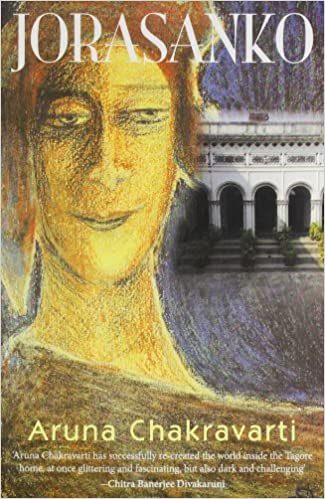
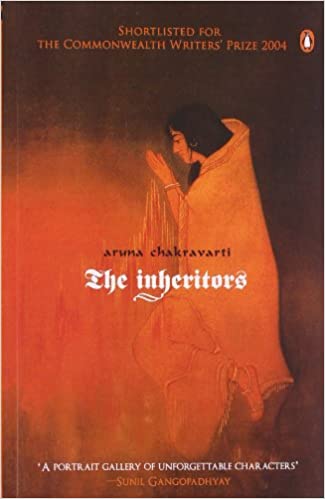
Aruna Chakravarti has been Principal of a prestigious Women’s College of Delhi University for ten years. She is also a well-known academic, creative writer and translator with seventeen published books on record. They comprise five novels, two books of short stories, two academic works and eight volumes of translation. Her first novel The Inheritors (published by Penguin Random House) was shortlisted for the Commonwealth Writers’ Prize and her second, Jorasanko (published by HarperCollins India)received critical acclaim and also became a best seller. Daughters of Jorasanko, a sequel to Jorasanko, (HarperCollins India) has sold widely and received rave reviews.Her novel Suralakshmi Villa, published by Pan Macmillan Ltd under the Picador imprint, has been adjudged “Novel of the year (India 2020)” by Indian Bibliography published in The Journal of Commonwealth Literature U.K. Her latest work, The Mendicant Prince, a semi-fictional account of the Bhawal legal case, was released by Pan Macmillan Ltd, in July this year to widespread media coverage and acclaim. Her second book of short stories Through a Looking Glass: Stories has just been released by Om International Ltd.
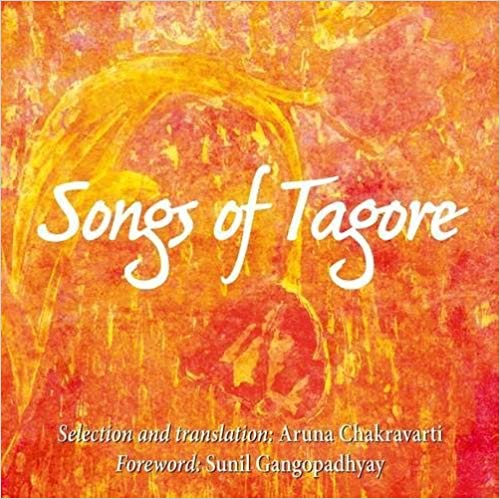
Her translated works include an anthology of songs from Rabindranath Tagore’s Gitabitaan, Sarat Chandra Chattopadhyay’s Srikanta and Sunil Gangopadhyay’s Those Days, First Light and Primal Woman: Stories. Among the various awards she has received are Vaitalik Award, Sahitya Akademi Award and Sarat Puraskar.
She is also a script writer and producer of seven multi- media presentations based on her novels. Comprising dramatised readings interspersed with songs and accompanied by a visual presentation by professional artists and singers, these programmes have been widely acclaimed and performed in many parts of India and abroad.
This conversation between Aruna Chakravarti and Sunil Gangopadhyay that took place at a Tagore Conference organised by the Sahitya Akademi in Kochy in 2011. Clickhereto read.
We launch our Tagore section with the translation of seven of his songs by the gifted Sahitya Akademi winning translator and author, Aruna Chakravarti. Click hereto read.
Tomar eyi Madhuri Chaapiye ( This Loveliness of Yours…)
Jibon Moroner Shimana Charay ( Beyond the Horizons of Life and Death..)
Janaganamana by Tagore (Lord of Masses, National Anthem of India) — complete version translated by Aruna Chakravarty at the end of the essay. Click here to read.
The witch is Aruna Chakravarti’s translation of a short story by renowned writer, Tarasankar Bandopadhyay . The original story titled, Daini, was first published in 1940 in Probashi magazine in Bengali. Click here to read.
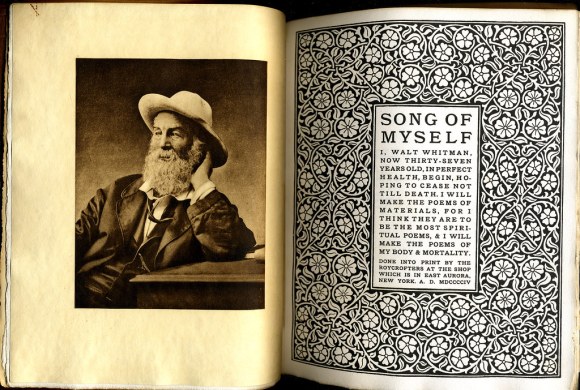
I CELEBRATE myself, and sing myself,
And what I assume you shall assume,
For every atom belonging to me as good belongs to you...

(Excerpted from Song of Myself, Walt Whitman, 1881)
Fourth of July, was the date that Walt Whitman’s anthology, Leaves of Grass, was published for the first time. The year was 1855. This was a book with poetry that embraced all humanity. The writing did not look for philosophical labels but reached out to all mankind touching the hearts of millions beyond the poet’s own lifetime, rising above races, rituals, politics, economics and hatred.
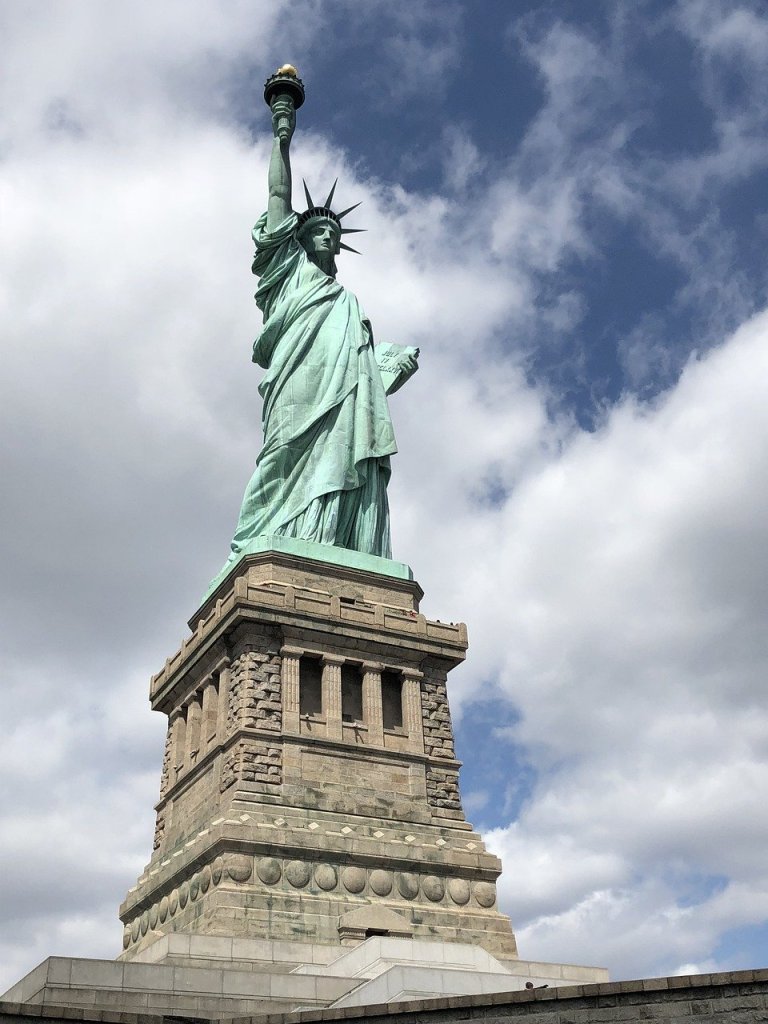
On that same date, in the century preceding the publication of this book — on 4th July, 1776 — thirteen colonies that had been established by immigrants in the continent of North America signed Thomas Jefferson’s Declaration of Independence, freeing themselves from the British yoke after they populated the landmass that had been occupied by American Indians for many thousands of years. The date continues to be celebrated as the American Independence Day with much fanfare. Borderless Journal presents to you writing that celebrates the occasion. Perhaps when at leisure, some of us will pause to wonder if independence and democracy bring freedom to all concerned.
Michael R Burch with his powerful poetry not just reaffirms the history of the country but also brings in the legendary Mohammed Ali to seek the voice of sanity and humanism. Click here to read.
Candice Louisa Daquin’s ruminations tells us what it means to be an American immigrant in today’s world and in the land that prospered under immigrants. Clickhere to read.
It was a white wooden building two stories tall — two long, high-ceilinged rooms, one on each floor, topped by a flat tarpaper roof that sloped toward the back of the property.
Where I grew up, such structures were called “storefront buildings.” Surrounded by elms and maples, it stood a block west of the courthouse, on the northwest corner, facing east. Originally it had been a lodge hall. During the Depression years, the members of the lodge had gradually died off, and the building stood empty until one of my relatives, an uncle who was an artist, acquired it, a few years before the war, and had it fixed up as a studio.
My parents drove us down to this place to visit the artist’s widow in the late 1940s. The town and the building were always the same. There were no sidewalks. My father parked at the edge of the lot. Out front, rising from its square of stone, was the cast-iron pump with the curved handle. Here we would drink cold water from our cupped hands, and refresh ourselves, each time we came to visit.
If the light slanting beneath the canopy of trees seems clear and steady now, it is not simply because I look back on that vanished building through a scrim of fifty years, so that all the wrinkles and irregularities have been smoothed out. We forget not only what certain trees mean to a landscape, to the profile they give to a town; we forget even the quality of light filtering down through their leaves and branches.
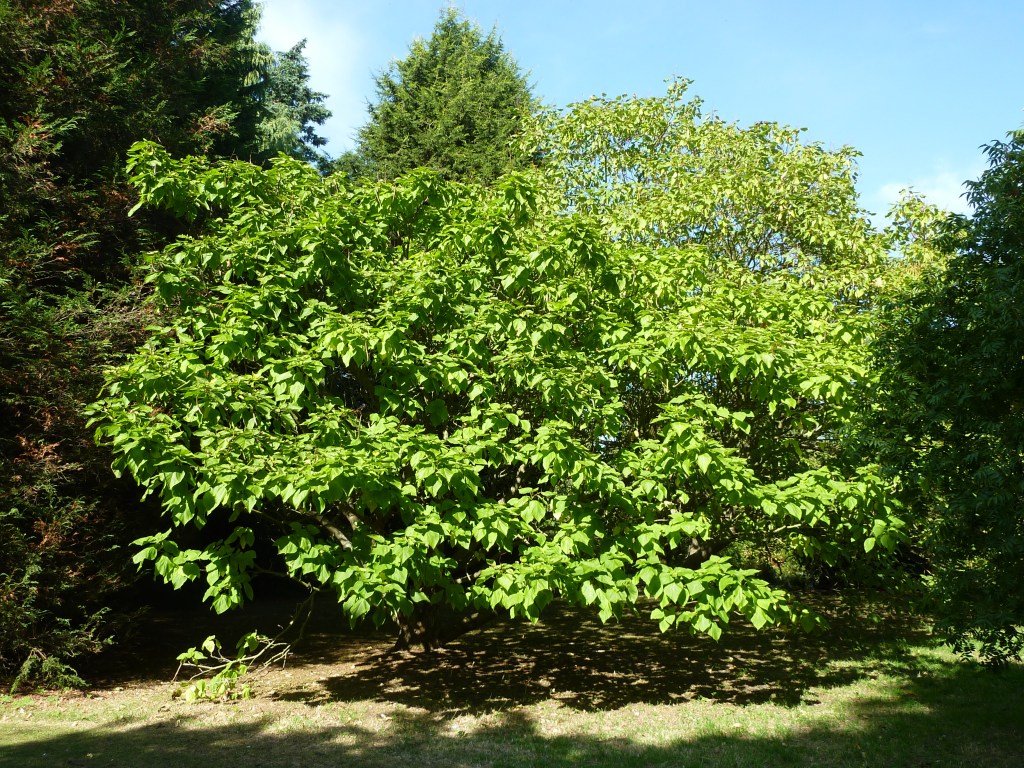
One kind of illumination reaches down when you are a small child playing beneath the limbs of a catalpa tree; another kind settles over you at the base of a willow, or a shagbark hickory. Later, it is almost as though hidden voices had been speaking to you, pointing out certain shadows and profiles — the outlines of small, undiscovered things, the shapes of beetles and lost marbles and blades of grass.
I say this because I know there were elms reaching over the summer studio, and I know they are gone now, all of them. But their handling of the light remains unchanged.
If you asked me to describe that light, I would say that it was notched, pieced together like the irregular swatches and squares of silk and satin and calico that interlock to form the pattern of an old quilt. The stitching along the edges of each of those pieces, even the smallest, would be minute and exact.
There was the light, and the stillness, and the simplicity. Inside, the rooms of the old building were always cool, even on the warmest days. Looking back, I sometimes think of it as an enormous block of ice cut from some snow-covered lake and mysteriously preserved until summer was at its height — a day in late July, with cicadas shimmering in the trees.
But it had been left in that grassy place, as though overlooked or forgotten, and it melted at a glacial rate. Ultimately it was doomed to disappear, but it was still so vast and impermeable that it would take years, or even decades, sitting there among the lilacs and the forsythia, to shrink away.
Most of that great sun-dappled cube of a building has dwindled and grown dim now, even in my memory, but here and there I can still see a milky patch, a section of white clapboard gleaming with opalescent light.
Or I will find myself peering into one of the windows, a square grown blank with sunlight, and gradually it will change, as though a cloud were passing over the sun, or as though tree limbs overhead had begun to stir in a cool wind, rearranging the shadows and reflections below.
At such moments each pane of the window turns clear, and I can see inside, and remember.
(First published in The Aurora Review)
Jared Carter is an American poet with seven books of poetry. He is the recipient of numerous awards, which include the Walt Whitman Award, the Poets’ Prize, a Guggenheim fellowship, and two fellowships from the National Endowment for the Arts.
.
PLEASE NOTE: ARTICLES CAN ONLY BE REPRODUCED IN OTHER SITES WITH DUE ACKNOWLEDGEMENT TO BORDERLESS JOURNAL












 Borderless