Categories
Poetry

Poetry by Candice Louisa Daquin

Courtesy: Creative Commons
POTENTIAL PEACE BENEATH THE WAR

Does humanity, as a concept
exist in a vacuum?
Where humble sentience is 
dislocated in the parched throat of self-interest? 
Where does the common man find solace?
Lost moniker describing individuals seeking equity 
in twitching furnace of somnambulist society,
their labour rebuked for birth right or whimsy,
inequality sewn into flimsy lapel, the holes of their shoes
before any nation’s birth is death; for what nationality
does anyone possess? Or own? What land is
ours or yours? What power? What skin? 
What impotent sieve tries to retain enough water before the monsoon shifts? 
Drunk, before any of us knew we could protest
what was never going to be given freely --
that division of us all, made clay, made stalagmite
what are anyone’s true wishes? Who hears? 
When war makers fabricate the mould and send 
into battle, scolded and uncooked, their children?
What does the crowing babe think; when war flies
its planes and machines overhead? Raining red loss 
upon the downtrodden, seeking only, meagre sense of existing --
hardly able to drag their weary bodies to vote
nor contemplate chess pieces above artificial stations.
Perhaps Marx had a point, the silver infusion
of distraction, an ultimate opiate, or
is it just our water-borne natures? If there is such
collective nature? To fight in dust -- swirl until we’re tired
then lay our guns down and pick on each other
with weary, blooded fists. Is anything appeased in our
vain battles or are mere silly devils playing ruined
games on a board where nobody watches?
Save the ember curl of time, reminding all;
Those who do not remember history
are bound, to repeat its grievous wounds. 
Then: Break free mockingbird 
find your own voice, not choked by common
dust, for we are all, for we all can find 
potential peace beneath the war. 

.

Candice Louisa Daquin is a Psychotherapist and Editor, having worked in Europe, Canada and the USA. Daquins own work is also published widely, she has written five books of poetry, the last published by Finishing Line Press called Pinch the Lock. Her website is www thefeatheredsleep.com

.

PLEASE NOTE: ARTICLES CAN ONLY BE REPRODUCED IN OTHER SITES WITH DUE ACKNOWLEDGEMENT TO BORDERLESS JOURNAL.

Categories
Stories

The Hatchet Man

By Paul Mirabile

Courtesy: Creative Commons

Tonight, in accordance with what I generally find necessary to record, I have mustered the courage to give full account of the singular events that have befallen friends and neighbours. These nightly entries have drained me of energy and patience, produced unusual sounds in my home, like those caused by nests of bees or wasps. Unusual too, the grotesque belief that loneliness and long periods of silence and speaking to one’s self, will give rise to hallucinations or other such aural phenomena. Be that as it may.

In the edition of the May ninth 1973 Daily Mirror, I came across an article which reported a most daring escape made from the Mental Hospital not far from our quiet neighbourhood. In 1968, the escapee had been accused of excoriating the flesh of a sixty-year old widow, so it read. What inflamed the imagination of the good people of our village was the way in which he had let himself in. Knocking at the door he introduced himself as a salesman for an encyclopaedia publishing house. The unsuspecting woman let the killer in and even offered him a cup of coffee. Her husband had died a very long ago, so it was supposed that she must have had an urgent longing to speak to someone. After conversing with her at some length, he casually revealed his hideous companion, an axe, and buried it deep within her brain, so the autopsy showed. He then proceeded to excoriate the poor woman. This odious account he willingly, and I add here, with over-excessive enthusiasm, declared to the authorities shortly after his capture. Owing to the savage and cynical nature of the crime, the monster was committed to the mental institution, and there interred for life …

Quite understandably his flight created a disturbance in our village neighbourhood. The twisted-minded beast was no doubt lurking about the wood surrounding our tranquil homes. The police stated that they had discovered fresh footprints leading from pockets of underbrush in our general direction. They have identified these footprints as his ! He had found an asylum during the hunt, and now was in search for new prey. His bloody doings would not stop at one …

Some time passed before the police gave up hope of locating the mad murderer. No one had seen him nor had my neighbours made any attempt to form a squad of vigilantes to ferret him out of his lair. I, as usual, sat behind my desk as I am doing at present, gazing half dreamily upon my scribbled notes, regarding the affair rather apathetically.

Five nights ago whilst lethargically reading through my writings as was my wont, a scream tore through the stillness of an unusually still night. Looking up from my writings, I imagined a sulking figure dragging itself over a rooftop just opposite my home through the parted serge curtains of my bay window. I state emphatically that the hour was late, and that perhaps my eyes had grown weary. Thinking it was merely my imagination, I returned to my work at hand.

The following morning to my astonishment, the papers reported a grotesque killing during the late hours of the night only six houses from that of my own ! In fact, it was someone with whom I was acquainted. My blood ran cold. He had been found beheaded. Chunks of flesh had been hacked out of his neck and torso. A hatchet undoubtedly was used for this gruesome purpose. What proved singularly frightful was that the unfortunate victim had been having coffee with his killer. Two cups of half-drunk coffee were discovered unmolested on a small, sitting-room settee. As to how the murderer entered, it can only be assumed that his victim let him in. The state of the house was in ruin. Nothing, however, had been stolen. A clear case of premeditated murder, so the police concluded.

This of course brought myriads of police to our quiet street where investigations were carried out with much fanfare and discomfiture. I was visited several times, the police sniffing about my home like a pack of retrievers. The chief inspector questioned me as if I were the criminal.

Did he think I was deflecting his attention from something important to their investigation ? Did he suspect me of foul play ? Of complicity ? He had those shifty pink rabbit’s eyes of a police inspector ! In spite of this ferreting and harassment, I said nothing. He casually flickered the ashes of his pipe in a seashell which I kept on my writing-table, thinking it, no doubt, an ash-tray, then left without a word, a master mustering his hounds. You may ask why I divulged not a word about that phantom on the rooftop. This I have asked myself, and even now at my desk writing this entry, I have no rational answer …

That evening (of the murder), I uneasily noted that my mind had been wandering from its normal systematic chain of thoughts. I was continually straining my eyes to envisage that evil phantom dancing on the roof opposite my home. Suddenly, and I assert my eyes did not deceive me, there it pranced again, sweeping haphazardly from shingle to shingle … from chimney to chimney, brandishing something metallic which glittered in the blue moonlight high overhead. And in one emblazoned second, I believe he gaped at me, mouth open, eyes ablaze! Yes, I am sure of it! And in that one terrible moment I noted that he possessed the same facial features as me: flattened head, black, beady eyes, pug nosed, curled lips. He vanished, darting out of the moonbeams … Throwing down my pen, I clutched at my hair ; my head churned out a series of chilling, bizarre scenes. The uncanny resemblance unsettled me, even alarmed me.  I finally lay on my canopy falling into a troubled, dreamless sleep.

How stunned I was the next morning when I read in the morning papers that my next door neighbour had been brutally butchered, ostensibly by the workings of the same maniac. The killing was identical, as was the means by which the killer entered the house. The police searched frantically. House to house inspections had been ordered and carried out. Again the hounds rummaged through my household belongings in the most disrespectful manner; had they snickered at the scones and boiled eggs I failed to remove from the kitchen table, crushing the shells that lay scattered on the floor under their muddy boots ? They had some cheek. And as they went about their sordid ‘duty’, the chief inspector eyed me with a strange mixture of pomposity and wariness, twitching his pipe inside his mouth from left to right and right to left, his nostrils quivering.

I felt my knees stiffen under that glare. Yet, I dared not return his pinkish rabbit stare, nor divulge my visions of the fleeing phantom. They finally left, then scoured the wooded area with dogs. I heard the howls and barks and yells of the chase. If I’m not mistaken they searched the surrounding woods and glens for days ; alas, the escapee was nowhere to be found. Many of my neighbours began to leave. To tell the truth, I felt no immediate danger, although I was quite naturally disturbed. Dull depictions flooded my thoughts of a hatchet-wielding man breaking down my door. And evening after evening, as darkness mantled the clusters of woods and lonely streets and lanes, icy droplets of fear gripped my heart ; I had seen this maniac, yet said nothing. Knocks rattled my door. Upon answering it, there was no one. Hornet-like droning and bee-like buzzing rattled the drums of my ears. Was it my imagination ? Could fear stir the mind to such heights of fancy ?

And so it was as four or five more nights passed. Two more murders had been reported in an adjacent neighbourhood, notched on the helve of the maniac’s gory weapon. I was in a quandary. Why did this evanescent shadow haunt my nocturnal solitude ? Why did he pertinaciously dance before my window ? Why hadn’t he knocked casually at my front door ? God if I knew. And why hadn’t I been to the police to notify them of this moonlit macabre rite ? Did the killer mock my terror … my  timid reluctance to act ? Did he embrace me as his tacit witness … his accomplice ?

Yes, why hadn’t I gone to the police ? The words are so difficult to express ; they wretch themselves from my pen. How then would they sound, sputtered to the police, or to that pipe-wielding inspector ? Oddly enough, though, I always remained calm. And even as his crazed figure  sauntered under the silver moonlight, I sat stoic, placid, squeezing my pen until my fingers and knuckles turned pale white …

The night of the double murder occurred a week ago. Since then the killer appears to have ceased his bloody onslaught. Perhaps he has been apprehended, or cornered in some distant wooded recluse like a wild animal. I haven’t seen him, and I must confess, on several occasions I’ve actually stepped out my door on to the porch to listen more attentively ; to see him more clearly ; to call out to him, discharging my savage, commingled phantasies and fears …

That night, as I toyed pointlessly with my writing tool, I fixed my bloodshot eyes to that hellish cornice of the roof opposite my house, a roof long since abandoned by its two or three occupants. Nothing. No one. I’ve wondered from time to time if the lunatic had really caught sight of me glaring at him in his frantic flights, my eyes pinned on his as he glided from rooftop to rooftop as if floating puppet-like in mid-air. All this had me chilled. It was unusually damp. My study felt damp and mildewy from insufficient heating. I hear footsteps coming up the street, hollow in the thick night. They halted.

I detect a slight rustling sound outside on my porch, like crispy leaves cracking under a booted foot. Why I write all this down just now is indeed troubling. A faint dizziness has sharpened my aural perceptions. And as I continue to write, in spite of myself, the porch door was opening, slowly … patiently as if the creaking wished not to intrude upon those sleeping at this late hour. And still I scribbled line after line.

There was someone knocking at my front door. I was chuckling as only a deranged man would when sensing foul play afoot, yet patiently waiting for it to strike ! And again, my pen continued to dictate to me. I was completely taken up by my writing. Is it because it mirrored the indelible mark of my solitude … my banal existence ?

There it was again that knocking. Should I answer it ? Perhaps it’s the old codger wanting a cup of hot coffee ! What a shuddering, stupid thought. No, probably some drunkard who noticed my light … or a neighbour in distress, no, better yet, the pipe-twitching inspector hoping to catch me off guard. Yes, I’m sure it’s that snooping blighter. God how my nerves were at an edge! And that tapping and rapping at my chamber door … Some late visitor entreating an entry? Ha ! Who could it be for Heaven’s sake ? Him ? Yes, him ? Rotten luck mate, I hadn’t a grain of coffee to offer him. That blasted door … If only I had a pistol … No, in the kitchen … the cleaver ! I fetched it and decided to see who fared better ! Hatchet against cleaver … I was sorry for the old sod — no coffee that night but a taste of my cleaver. To the kitchen. That hammering was driving me daft ; he’d wake up the whole damn neighbourhood … or what was left of it … First my cleaver, then the door … then to the rooftops … to the rooftops …

Paul Mirabile is a retired professor of philology now living in France. He has published mostly academic works centred on philology, history, pedagogy and religion. He has also published stories of his travels throughout Asia, where he spent thirty years.

.

PLEASE NOTE: ARTICLES CAN ONLY BE REPRODUCED IN OTHER SITES WITH DUE ACKNOWLEDGEMENT TO BORDERLESS JOURNAL

Categories
Review

Orienting : An Indian in Japan

Book Review by Aditi Yadav

Title: Orienting : An Indian in Japan

Author: Pallavi Aiyar

Publisher: Harper Collins

The mention of “Japan” evokes dreamy Instagrammable scenery of Sakura with Fuji-san, serene shrines, grand castles, modern skyscrapers, cute dolls, geishas, bullet trains, cool robots, so on and so forth — a long list of all things ‘kirei[1] and ‘kawaii[2]’. Of late, the world has been swept by the tsunami of Japanese life philosophies of Ikigai, Wabi-sabi, Kintsugi, and Zen. To an outsider, the perception of Japan is mostly curated through social media stories, anime, J-pop and J-drama. However, the first-hand experience as a tourist or resident will have a spectrum of shades to offer.

Orienting : An Indian in Japan by Pallavi Aiyar vibrantly captures this spectrum. Aiyar is an award-winning foreign correspondent and author of several books including travel memoirs on China and Indonesia. In “Orienting”, she shares her insights on Japanese society, history and customs against the background of her globe-trotting experiences and Indian heritage. The book originally published in English in 2021 has recently been translated into Japanese, a rare feat for an Indian author.

Historically speaking, the “Oriental” depiction of the East has been a West orchestrated exercise.  As a result, the world vision and perception of countries like Japan have been dominantly seen through the lens of Western authors, historians and travelers. Aiyar’s book is a fresh breeze in travel literature — a global Asian writing about another Asian country– especially given the shared culture of Buddhist heritage.  From the get-go, the title stands out for its intelligent word play.

The author has a difficult time orienting herself. A country that’s world famous for its punctuality, hits her as “anachronistic” when she discovers how cumbersome it is to buy a mobile connection, open a bank account or use a taxi app. In neighboring China even beggars are open to e-payments while Japan still struggles with credit card usage in stores and restaurants. Yet, to the average Japanese, “Chinese were lacking in good manners”. The book is delightfully sprinkled with cross-cultural comparisons, insights and of course haikus.

It is common to spot young kids traveling on their own to school on buses and subways, as Japanese society watches out for them with solidarity, ensuring their safety. Talking of awe-inspiring features of Japan, the list is long one– literally convenient kobinis, super-smooth public infrastructure, clean public toilets, vending machines, and most strikingly, the land of ‘what is lost-is-always found’. Aiyar narrates how she and her family members lost their iPhones, wallets, laptops, umbrellas, jackets, tiffin boxes and hats during their four-year long stay in Japan. And, every single item was retrieved undamaged. Yet, despite all the community spirit, safety and solidarity, Japan is home to almost one million hikokimoris, people who have withdrawn from society and avoid social interaction. Patriarchy, high rates of suicide, overtime at workplace and death by overwork (karoshi) are hard facts of life in Japan that take some sheen off its ‘first world-ness’. Just like any other place on earth, the bright and dark sides exist together with multiple shades of gray.

The apparently ‘homogeneous’ society has shied away from discussing issues like ‘racism’ or ‘discrimination’. While historically, indigenous race of Ainus, Korean descendant Zainichies and socio-economically backward Burakumin were dealt second grade treatment, in these globalised times, unlike many rich countries, Japan had resisted multiculturism.  The ‘gaijin’ syndrome (prejudice against foreigners) conspicuously stands out given that Japanese invented a whole new script ‘katakana’ to address anything ‘non-Japanese’. The kikokushijo, the children who return to school in Japan after being partly educated abroad, face bullying and harassment for their foreign association. The half- Japanese peculiarly termed as ‘hafus’, are also subjected to prejudices of various kinds.  However, a mild streak of silver lining is evident in cases of Priyanka Yoshikawa – half-Indian, half-Japanese winner of Miss Japan title in 2016 and Yogendra Puranik, an Indian who won the elections for City Councilor (Edogawa ward) in 2019. Such cases, though few and far between, are indicative of some changes in the Japanese air of insularity.  Comparing discrimination in Japan to its Indian counterpart, Aiyar observes that it almost felt churlish to point it out at all. “Indians were the perpetrators of the ugliest kinds racial and religious discrimination”. While Japan’s racism was “more respectable, less violent. It simmered rather than boiled over, and got mixed in with a general shyness and culture of suppression”.

On gastronomic spectrum, India and Japan are almost diagonally opposite. It is relatable how as an Indian, Japanese food strikes the author as “too cold and polite with too many bonito flakes” — too spiceless and raw for Indian tastes.  On a trip to Tottori, she discovers how some restaurants even discourage Indian groups because they carry their own pickles and sauces, a habit which offends most Japanese. The land of mouth-watering sushi, sashimi and mochi quite amusingly is also fond of fugu, the puffer fish, which is 1200 times more poisonous than cyanide! Curry is by far the most loved Indian food. But its Japanised version would hit Indian taste buds differently. The author details how Rash Behari Bose, the Indian nationalist settled in Japan and introduced authentic Indian curry in Nakamuraya café in Tokyo.

Historically, Japan and India share the common thread of Buddhism. The oldest documented Indian resident in Japan was Bodhisen, a monk from Madurai, who held a very exalted status as a Buddhist scholar in his days. He arrived in Osaka in AD 736, and moved to Nara. He taught Sanskrit and helped establish the Kegon school of Buddhism. Japanese Buddhist pantheon even absorbed several Hindu gods in its fold. Aiyar gives an interesting account of the shared culture of yore and also “not always salubrious” relationship during the colonial era. The latter period saw Indian luminaries like Subhash Chandra Bose, Vivekananda, P.C Mozzomdar and Rabindranath Tagore visit Japan, which deepened the connections between the two countries. But when it comes to doing business together, the practical jugaad-proud Indians and perfectionist shokunin-spirit driven Japanese find it difficult to cope up with this dichotomy. The book analyses it all with facts and engaging experiences.  Anyone who has ever been to Japan will find the book extremely relatable and sincere.

Aiyar writes with enthusiasm of a traveler who has pitched her tent in foreign land to capture the richness of landscape in daily travels, with a keen eye, humour and honest penmanship.  The read is indeed a rewarding journey towards “Orienting”!


[1] Clean, beautiful

[2] Cute

Aditi Yadav is a public servant from India. As and when time permits, she dabbles in translation works.   She is an alumnus of Yokohama National University, Japan and  a  devout Japanophile.

.

PLEASE NOTE: ARTICLES CAN ONLY BE REPRODUCED IN OTHER SITES WITH DUE ACKNOWLEDGEMENT TO BORDERLESS JOURNAL

Categories
Poetry

This Plate of Food

By Gigi Baldovino Gosnell

Courtesy: Creative Commons
This plate of food
colours my cheeks
with gentle glow 
or bellowing sullenness

It gives me 
a crawling sensation 
with a crabby sting
cradling a cancerous cringe

My gut grumbles
imagining the bruised 
neck of chicken
hotly parboiled

My mouth twists
with epileptic pleasure
on ground patties
oily and Offaly

Deliciousness for the few
A hundred years of agony
forkprints cruelty
on this plate of food

Gigi Baldovino Gosnell has degrees in Psychology and Education. She lectures in Psychology, worked in various NGOs, and the public service in the fields of women empowerment, land reform, social development and local government.

.

PLEASE NOTE: ARTICLES CAN ONLY BE REPRODUCED IN OTHER SITES WITH DUE ACKNOWLEDGEMENT TO BORDERLESS JOURNAL

Categories
Slices from Life

Moonland

Photographs and text by Rupali Gupta Mukherjee

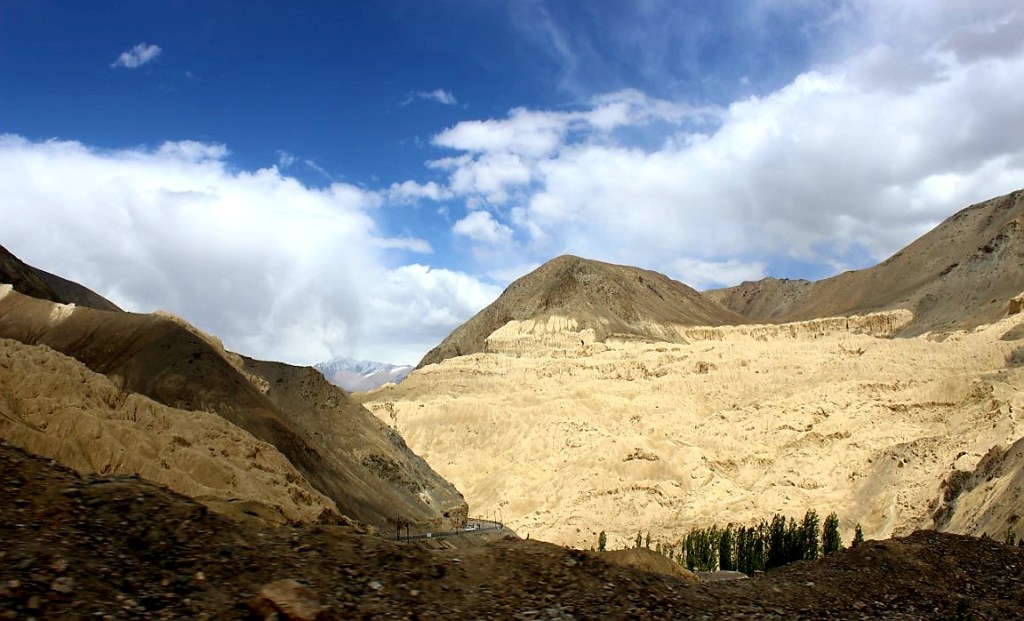
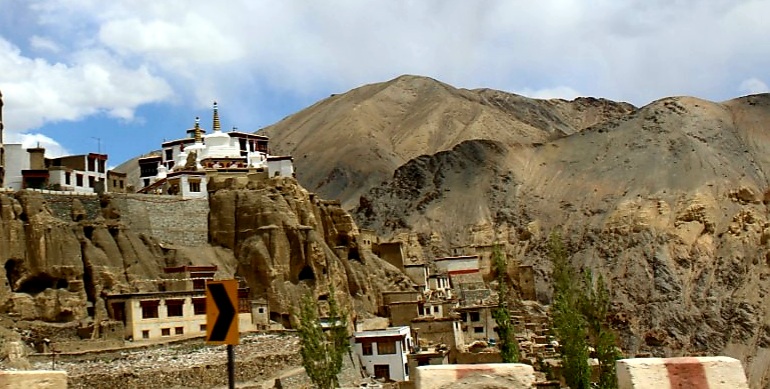
‘The journey matters more than the destination’, this quote came to my mind innumerable times, as our creamy white Xylo sped up from Kargil, crossed the majestic Fotu La pass on the Srinagar Leh highway. My eyes were glued to the splendour that Mother Nature had bestowed copiously all around us. Our driver, a calm, composed friendly person was fairly careful during the sharp turns, twists and terrifying bends. We were headed towards Leh, capital of Ladakh. On our way, roughly hundred kilometres before Leh, we found ourselves in the land of what seemed like strange, supernatural mountains made of rocks that shimmered and changed hues. 

The colours shifted from grey to chocolate brown, crimson to mauve and azure. It was divine. I sat with my camera, filled with awe and wonder of the breathtaking peaks that lay before me and left me mystified.  I was totally smitten. More surprise along the way held me spellbound.  

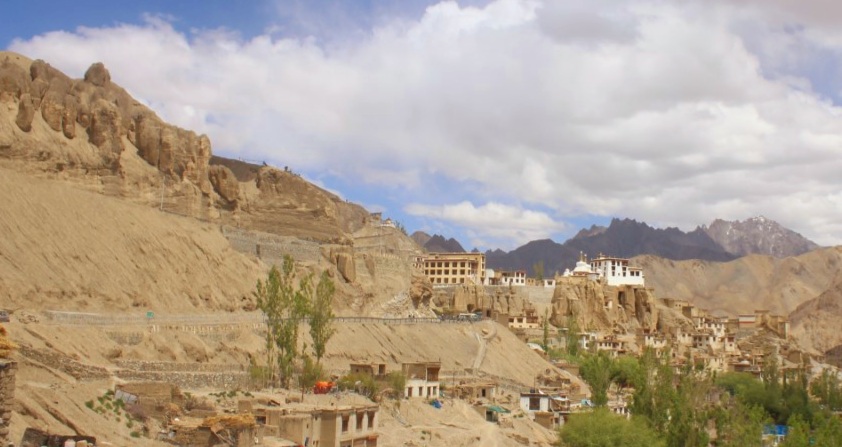
After the barren desert that stretched before us, at the next hairpin bend, was an amazing ancient Tibetan Buddhist Monastery peeping out from the hideout of the world’s most imposing mountain ranges. It was a dreamland, a land of fantasy. I pinched and asked myself, ‘Is this a reverie?’ But no. It was real.

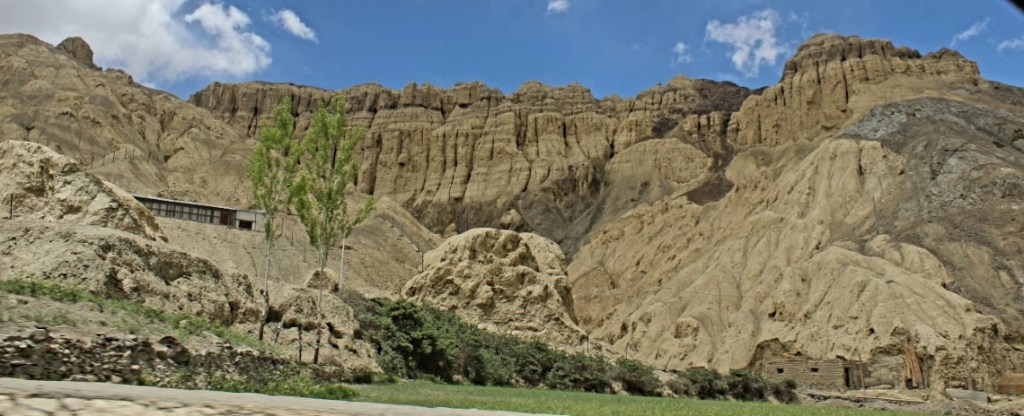
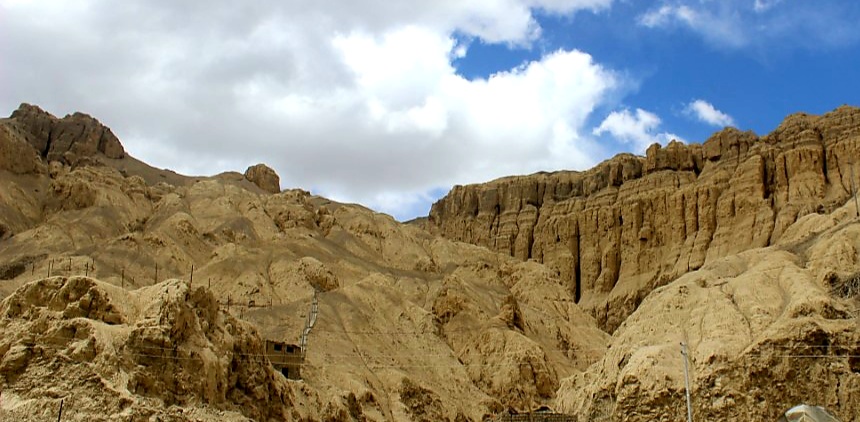
The lunar landscape that greeted my camera on this Earth was synonymous to the legendary ‘Moonland’.  The primeval Lamayuru monastery towered in the unreal moonscape. It dates back to the 11th century. According to myths, a scholar named, Mahasiddhacharya Naropa, had laid the keystone of this mesmeric building. It was said due to his mantras the water in this region retreated and the vicinity took the shape of moonlike alcove and craters.

The setting bears a semblance to the lunar highlands. The profound darker part of the mighty hills is said to be the replica of ‘Maria’, a common panorama found on the surface of the gorgeous silver disc, the shiny crescent in the cobalt diamond studded night sky.

I found the landscape hypnotic and ethereal; its exceptionally outlandish ecological structure made Lamayuru monastery unique and idiosyncratic. 

A drive through this moonscape imprints an incredible chronicle in the mindscape of the traveller. This journey stretched like an implausible odyssey beyond my imagination. It was as if I was watching a documentary on National Geographic.

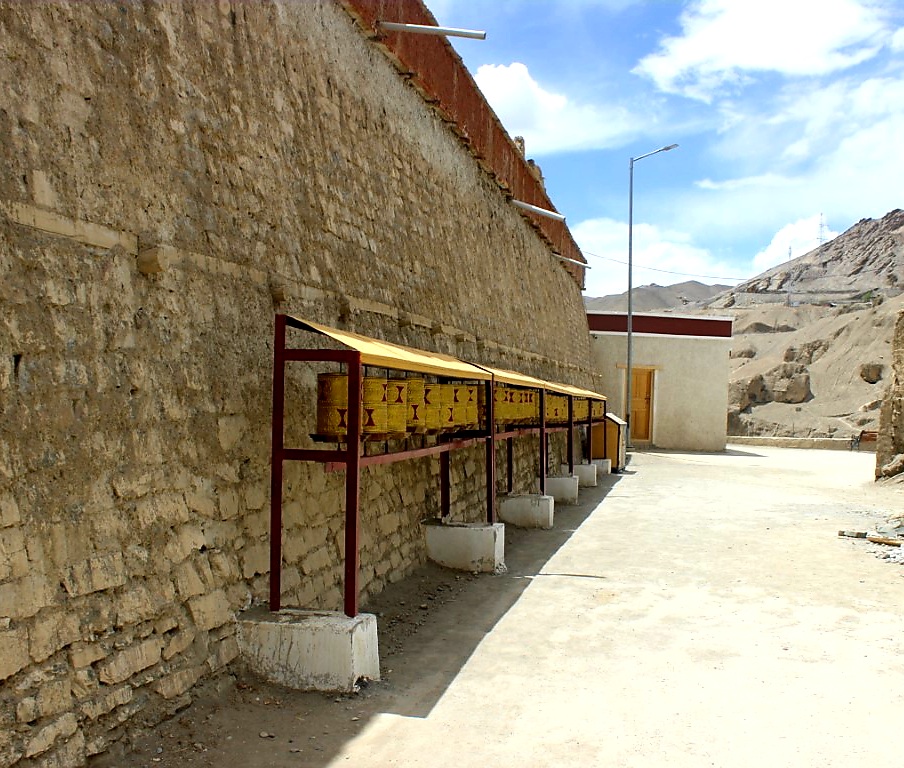
Almost a month after returning from the trip, I still feel mesmerised by the ghostly ‘gompas[1]’, the atypical topography, unknown terrain, unfamiliar cold weather. They beckon me to go back and explore further. No wonder, several voyagers fondly portray Lamayuru’s ‘lunar’ landscape as the ‘Mecca of an adventurous soul’. I promised myself to be back in this magnetic landscape once again, this time on a full-moon night, when the silvery ribbon of moon beams scatter over the baffling purple structures of Lamayuru, bathing the compelling peaks in shimmering platinum dust. Undeniably its startling tinge would be the marvel of art if some artists managed to capture the hues.


[1] Buddhist structures

Rupali Gupta Mukherjee has a passion for reading, writing and reciting poetry.   She is a nature enthusiast, loves to travel and has a zeal for photography.

.

PLEASE NOTE: ARTICLES CAN ONLY BE REPRODUCED IN OTHER SITES WITH DUE ACKNOWLEDGEMENT TO BORDERLESS JOURNAL

Categories
Poetry

Lethal Aid

Poetry By Tony Brewer

LETHAL AID

The kind they give you
when there is no cure
Crackers and ginger ale
ice cream and lollipops
When Dad was stage 4
hey, if he wants a double
cheeseburger let him have it
No need for Asian mushroom tea
No need to try to prolong
Just comfort now
that fat and sugar give
So have some missiles
and mines designed to maim
Frag grenades & nerve gas
No need for heroics
diplomacy or handshakes
or hey, let’s let cooler 
heads prevail – no winner
is possible but let’s
keep the upper hand
Say we tried by flipping
the pillow to the dry cool side
Prevent bed sores on the -ridden
but keep them there
in the only room a nurse
is allowed to turn
off the lights and leave

Tony Brewer is a poet, live sound effects artist, and event producer. His most recent book is Pity for Sale (Gasconade Press, 2022). More at tonybrewer71.blogspot.com.

.

PLEASE NOTE: ARTICLES CAN ONLY BE REPRODUCED IN OTHER SITES WITH DUE ACKNOWLEDGEMENT TO BORDERLESS JOURNAL

Categories
Essay

How Many Ways To Love a Book

By Sindhu Shivprasad

The summers of high school were eight weeks lived between a haze of pages, books borrowed and exchanged (even secreted away) with abandon.

The exchanges were facilitated with much gusto in rooms, parks, benches by the streets, friends looking over shoulders as the item in question was reverently drawn out of the bag. Some sealed the exchange verbally — “I’ll give it back to you in two weeks” — and the deed was done. Others laid out sacrosanct rules. “Don’t fold the corners. Don’t mark the pages. And for God’s sake, don’t underline anything”.

I have an elderly neighbour who keeps two copies of each book — one for reading and the other for lending. When asked why, she said, “my books are sacred”.

“Sacred” has been used as a stand-in for “religion” for so long that it’s become almost synonymous. But there’s a class of ‘sacred” that refers to things set apart with special meaning and not necessarily connected to anything religious, spiritual or metaphysical.

Sounding very much like German theologian Rudolf Otto, American psychologist JH Leuba suggested that the experience of the sacred is characterised by “an element of awe… The sacred object has a hold upon us, we stand in dynamic relation with it, and this relation is not one of equal to equal, but of superior to inferior.”

I like to observe this in others — the reverent handling of pages, the ginger grip over a paperback so the spine doesn’t crease. Much like the devout scrabble to touch the feet of statues or hold hands with holy seers, even the most upright can fall to weeping at the sight of certain books, begging to hold them in their hands. In essence, they feel what author, educator and priest, Andrew Greeley describes: “By the sacred I mean not only the other-worldly, but also the ecstatic, the transcendental, that which takes man out of himself and puts him in contact with the basic life forces of the universe.”

If you’ve said— or heard someone say —something to the effect of “I lost myself in a book”, you’ve felt this. If you’ve curled up to read a novel and felt as though there were two of you — one curled up on the couch and one hurtling through the pages — then you’ve felt this sacredness.

But like there’s more than one way to love someone, there’s more than one way to love a book. Of course, some cults and sub-cults declare the other blasphemous, but the truth is simple: one book can be revered in many ways.

The platonic lovers read books and keep them only in their hearts and minds, if at all. They don’t actively disrespect the book, but they don’t leave way-markers to say they were here, either. If one “buys books intending to read them” and “reads books only in certain situations” were a Venn diagram, platonic lovers of books would fall into that overlapped territory. They’re most likely to pack a recent bestseller in their rattan bag for a beach day or optimistically buy one at the airport bookstore but crack open only a few pages before falling asleep.

There are the preux[1] lovers, for whom form is inseparable from message. These are the ones who strive to preserve the purity of a novel assured to them by their first-hand bookseller. They carefully mark pauses with magnetic bookmarks and high-quality post-it notes aligned to the line they stopped at. Not for them the creased spines, dog-eared pages, and watermarks from dropping a V.E. Schwab[2] into the bath one tipsy night.

No, these are for the physical lovers, the ones for whom some books are as familiar as a partner’s skin. Touch breeds intimacy — marks of use are marks of love. They leave their footprint — dried flowers, bus tickets, clean leaves off the floor, demonetised currency, letters from a daughter, strands of hair — behind with the boldness of a graffiti artist in broad daylight. The book itself is but a vessel, and they prop it open with whatever’s within arm’s reach: the dog’s tail, an AirPod, or the wrapper of a Twix bar. These are the people who know what it is like to love something to pieces.

And then there are the intellectual lovers, who care to pry open layer after layer and document what they find. The most permanent way-marker— writing in books — has haters and zealots in equal proportions, and this is the class of the latter. After all, the margins — or “sophisticated information-processing space”, as mathematician-philosopher John Dee calls them — often hold more heart-stirring epiphanies than diaries can hope to match. These people might also prefer to read vandalised books over virginal ones, getting caught as much in the flow of the text as in the passions of the reader that came before them.

When I was younger, I was much like the preux booklover I describe: a young novel for a young girl. Smudges, watermarks and left-over mementoes invoked the same ‘ick’ in me that vaguely disgusting bugs did. When you’re young, it’s customary to assume ageing is something that happened to other people — I, however, extended that belief to my straight-spined, pristine novels.

Cut to now: in my late twenties, grey hairs are shooting up from my skull at an alarming rate (a hereditary disposition I give my father much grief about). My oldest books haven’t fared any better, ravaged as they are by time, bathwater, and a 2-month sea voyage from Nigeria to India in ‘06. My early-edition Harry Potter copies, in particular, are now perilously held together by duct tape and makeshift covers. (I’m yet to find Inkheart’s Silvertongue in the real world, but I continue to hope).

Over time, I became less preux and more physical, choosing secondhand books over pristine copies for the same reasons that I’d once detested them. “Where is human nature so weak as in the bookstore!” exclaimed Henry Ward Beecher[3] once, and while I can stand strong in a Crossword or an Amazon, before my favourite Church Street antiquarian store, I am weak. My excuse is that it’s a lot more exciting to be the next in line for the throne of a kingdom contained within 600 pages.

I still draw the line at marginalia, though. It feels too much like watching a movie at the cinema while Chris Hemsworth’s[4] dialogues are punctuated by boos, expletives or, if it were Mark Twain sitting beside me, vicious comments like “The Droolings of an Idiot”.

Inscriptions are yet another marker on the long-winding road of time and an invitation to re-imagine what circumstances this book has been through. These are marks that even preux lovers can’t deny because they rank highly in the eyes of a true bibliomaniac, glossing over the worst wear and tear. Even at their briefest, they tell a story, like a lovingly inscribed “To Mom” in a heartbreakingly unused novel on a used-book shelf. Indeed, a stroll through a secondhand bookstore is a study in betrayal, distance, and the melancholy effects of time. A secret taken to the grave is now out in the open for hundreds to witness.

In a Ziploc on one shelf in my library sits a battered first edition copy of Bunyan’s The Pilgrim’s Progress, passed on to me by another elderly neighbour whose home was suddenly devoid of seating space. An inscription on the flyleaf (instead of the title page where only heathens write) reads: “Berhampore, 1908”. This doesn’t hold a candle to most inscriptions out there, including Lord Byron’s 226-word note to Countess Guiccioli, which ends with, “Think of me sometimes when the Alps and the ocean divide us — but they never will, unless you wish it”. But it is a relic of our colonial history, bequeathed to me.

So it’ll remain: the small book’s journey over Hill Difficulty and the Valley of the Shadow of Death ending on this twenty-something-year-old’s shelf, cheek and jowl with other hand-me-down slices of history and mystery.


[1] Gallant in French

[2] American writer

[3] Nineteenth century US minister and speaker

[4] Australian actor

.

Sindhu Shivaprasad is an essayist. Her work has been (or is set to be) published in The Yorkshire Post, Kitaab, The Curator, Thrive Global, and more. When not at her day job or curating for her magazine, Ex Libris, she’s usually curled up in a patch of sunlight with a paperback and lemon tea.

.

PLEASE NOTE: ARTICLES CAN ONLY BE REPRODUCED IN OTHER SITES WITH DUE ACKNOWLEDGEMENT TO BORDERLESS JOURNAL

Categories
Story Poem

Around the World in Eighty Couplets

By Rhys Hughes

We set sail south from Dublin town
with forty-five sailors and one clown.

But before we reached the wide Atlantic
the frantic antics of the clown dismayed us.

Should we therefore throw him overboard?
we asked ourselves in urgent conference.

It would give us a chance to proceed
in peace and harmony, free from jokes.

Ah, to continue our voyage without fuss!
That was the issue we yearned to discuss.

And eventually we came to an agreement
that dunking was no cure for torment.

And murder was too extreme a measure
to improve the leisure of our journey.

The clown was a man, his painted smile
could be easily smudged with a frown.

There was no need to send his soul down
to the circus hell where clown ghosts go.

No! Let us find some alternative method
to restrain the fool and hobble his tricks!

We therefore employed him as a topsail
whenever the breeze turned into a gale.

And as his Pierrot costume billowed out
he would wail and occasionally shout.

Especially if he spied a distant whale
in a white dinner jacket, obviously male.

But that didn’t happen on a daily basis
for most of the whales had female faces.

Anyway, I have gone off on a tangent,
the sound of hornpipes is quite plangent.

And they call me back to my nautical duty
which is to lace up all the crew’s booties.

Not much else happened for several days
until mountains loomed through the haze.

We had reached Sierra Leone on our own,
just forty-five sailors and a lofty buffoon.

What an excellent marker of our progress!
It cheered us up and reduced our stress.

There was room in the hold for tropic fruits
and so we went ashore for an afternoon.

We bought bananas, mangoes and guavas
without anyone causing a hell of a palaver.

And then we set sail again, or should I say
we set clown again, and went on our way.

Shortly we passed the island of São Tomé
engorged on fruit with rather sore tummies.

It was at this point that symmetry suffered
a relatively modest but disturbing calamity.

For we had reached a latitude
where the second line of any couplet has an unbalanced longitude.

But we soon passed to happier frothy waters
full of strong mermen and their daughters.

A little later it was with squids we played
and afterwards with octopuses we prayed.

We safely rounded the Cape of Good Hope
and raised and lowered the clown on a rope.
 
By now he was fully reconciled to his position
and in fact embraced the ideals of our mission.

And those ideals were to circumnavigate Earth
and at the same time, to increase our girth.

Thus we devoured the fruit stored below deck
until juice ran out of our noses, flipping heck!

In the Indian Ocean we played deck test cricket
using the first mate’s wooden legs for a wicket.

Because there wasn’t much else for us to do
apart from stirring big barrels of strong glue.

Why the captain needed adhesive, I can’t say
but sticky wickets were the order of the day.

And that’s why we continued to bowl and bat
using avocado pears for balls that went splat.

But take care, shipmates! That was my shout
when beneath our hull erupted a waterspout.

It was so powerful that it lifted us up high
and then we were sailing through the sky.

Clouds filled the shrouds with damp fleece
and gulls in flight honked at us like geese.

Our altitude increased and we were chilled
and soon I supposed we would all be killed.

But when the waterspout turned itself off
we didn’t drop back into a terminal trough.

No! The clown on a mast extended his arms
and span on his axis to save us from harm.

Like a helicopter he was, but not a good one,
and for him, it can’t have been too much fun.

Yet his rotary action was certainly well-meant
and provided enough lift for our safe descent.

We landed in waters on the far side of Borneo
but jumbled up was our carefully stored cargo.

The clown was quite dizzy, but what of that?
So are rooms in which you might swing a cat.

Or is it the cat that is giddy thereafter? I can
never remember the exact categorical order.

The fruit in the hold had transformed into juice
and some nails in the planks had worked loose.

But we were still seaworthy and shipshape
and would remain so while on the seascape.

So we sloshed along like a wooden breakfast
with the clown, our saviour, sick on the mast.

But he would recover, he needed no physician,
for dizziness is merely a temporary condition.

And now we concentrated instead on the terrific
news that already our vessel was in the Pacific.

Leagues and leagues of unislanded blue water, see!
But is ‘unislanded’ a word that if used, oughta be?

I don’t know about that, I’m not a lexicographer,
and in fact I’m not even a competent geographer.

No matter! Onwards! We are circling the globe
and it doesn’t matter how quickly we are going.

Slow or fast, start and stop, and if the mate bellows:
“Avast!” we all know such a pause will hardly last.

And now we are sailing steadily east with no fruit
to feast on, but plenty of juice to swim in, undilute.

Solid food is what we require, growled the captain!
Though there’s no cellophane for it to be wrapped in.

Thus we stopped off at an island just beyond Fiji
to buy some cream fudge from a Heebie-Jeebie.

In nautical lingo a Heebie-Jeebie is a shrewd adventurer
marooned long ago who now has a commercial venture.

The fudge was copious and also coconut-flavoured
and he gave us extra portions as some sort of favour.

I think it was because he was originally from Dublin
and we reminded him of the things he was missing.

But there was sadly no room on board to take him along
so we departed while singing him a fudge-mangled song.

“Don’t worry too much and don’t make too big a fuss,
keep making your fudge and all will be fine, trust us!”

The lyrics of that song were probably a cruel deception
but when he heard them he gave them a good reception.

Anyway! Enough of that. Without wishing to fudge
the issue, we have other things to trouble our minds.

I’m a little bit concerned about how the lines of each couplet
seem to be getting longer and longer as this poem progresses.

They are almost twice the length of the opening lines
which, if you remember, formed the following rhyme:

“We set sail south from Dublin town
with forty-five sailors and one clown.”

So let us endeavour to sail closer to a shorter length
for the sake of the reader’s mental and poetic health!

And now we are nearing stormy Cape Horn,
as good a place as any for mariners to mourn.

Tossed on the waves for two and a half days
we were lucky to emerge wholly unscathed.

Back into the Atlantic we plunged in alarm
while the clown vibrated from the yardarm.

But finally in calmer waters we settled down,
the odds reduced that any of us might drown.

As for myself, I looked forward to docking
yet again in the harbour of old Dublin town.

Weary of travel and the fathomless blue deep,
tired of this poem and exhausted with sleep.

Lacing booties to furious hornpipe melodies
no longer fills me with joy but only self-pity.

But only a score of leagues or so left to go
and with this wind there is no need to row.

The night was dark like a pint of stout beer
and then I knew that home really was near.

How glad was I to spy right in our midst
the Emerald Isle looming out of the mist!

Mission accomplished, let’s all dance a jig
and finally discard our stale seaweed wigs!


Explanatory Notes

Why take a clown aboard a ship?
Because we were so very bored.

Yes, whales may go to formal dinners.
If they don’t, they will be much thinner

Hornpipes are musical unicorns,
piercing ears like mythical thorns.

Cricket on deck is such an odd sport,
umpires snort when a ball is caught.

Waterspouts are fountains malign,
always of brine and never of wine.

The South Pacific is a very nice place
unless your booties need to be laced.

Cape Horn is loud and rather sharp,
the diametric opposite of Cape Harp.

Ireland, my Ireland, how I love thee!
Two shots of whisky please in my tea.

.

Rhys Hughes has lived in many countries. He graduated as an engineer but currently works as a tutor of mathematics. Since his first book was published in 1995 he has had fifty other books published and his work has been translated into ten languages.

.

PLEASE NOTE: ARTICLES CAN ONLY BE REPRODUCED IN OTHER SITES WITH DUE ACKNOWLEDGEMENT TO BORDERLESS JOURNAL

Categories
Slices from Life

The Loyal Dog in the Loyalty Islands

Photographs and Narrative by Meredith Stephens

Alex and I sailed into the marina in the township of , on Lifou Island, the largest of the Loyalty Islands in New Caledonia. We walked along the main street and took in the houses painted in bright orange and green, alongside traditional huts with conical grass roofs. Smiling children called out Bonjour! Women donned generous calf-length floral frocks in pinks, purple and orange, with bibs in white lace. There were roadside stands offering bunches of green bananas, and pastries. Dogs were not restrained behind fences, nor did they wear collars. Rather they trotted along the footpaths freely, occasionally crossing the road after checking for oncoming traffic. I was fearful of untethered dogs after having once been threatened by an assertive lurcher, over twenty-five years ago. Despite my fears, one dog in this main street insisted on accompanying us all the way back to the marina.

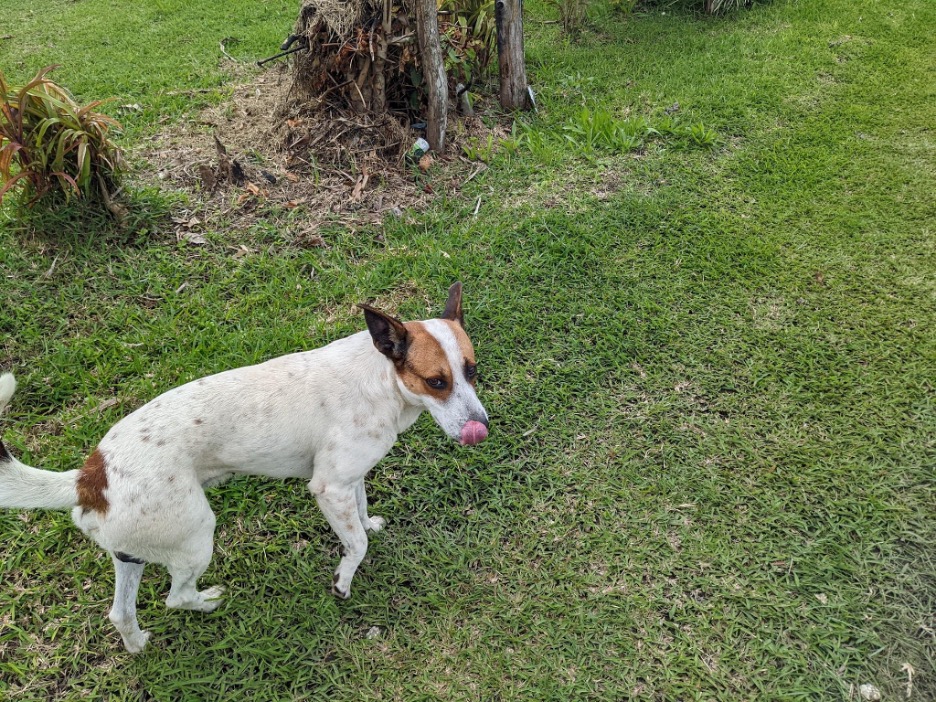
Perhaps the dog was hungry? Alex prepared a bowl of leftover rice, drizzled with olive oil and an egg. Rather than devouring it greedily, the dog took his time gingerly licking up the rice first and finally the egg. I gradually tried to overcome my fear and stretched out my hand to pat him.

Alex and I had been on a ten kilometre walk up the main street of Wé, and back along the adjacent beach. The white sands were soft and fine grained and the water a clear turquoise. After resting back at the boat Alex suggested we walk back to the beach to have a swim. We donned our swimsuits under our clothes and walked back along the road to the beach. The dog trotted alongside us all the way. Once at the beach we took off our clothes and shoes and entered the gently lapping waves. We called for the dog to come and swim with us but he hesitated. Instead, he waited for us on the shore next to our possessions, guarding them.

“What shall we call him Alex?” I asked.

Alex wanted to call him Buddy, but I wanted to call him Lifou, after the island.

After our brief swim we walked back along the footpath to the marina, all the while accompanied by Buddy, or was it Lifou? I crooned to him and he crooned back. He had probably never heard English before but he understood the music of the human voice. Once back at the marina we poked our head into the Capitainerie and asked the manager about the owner.

“I think he belongs to the local electrician,” he informed us.

We retreated to the boat, and Lifou sat just outside the gate. When we emerged later that evening to walk to the restaurant Lifou was still there. We decided to dine at the Thai restaurant a few hundred metres away. Lifou followed us and we chose a table outside. Lifou sat respectfully near the table. A female sausage dog appeared under the table and Lifou was unperturbed. A male black dog appeared and bared his teeth at Lifou. The dogs were about to start fighting but Alex reprimanded them in a forceful tone and they abandoned their fight. After the meal, we put the leftover rice into a plastic bag and took it back to the boat. Lifou trotted back alongside us. Once back at the boat, we upturned the rice into a bowl and fed Lifou a second dinner.

We spent the night on the boat and I half expected Lifou to still be there in the morning. My expectations were confirmed. Lifou was waiting just outside the gate for us to appear. Every time fellow inhabitants of the marina went to the shower block, he accompanied them back and forth. When I had my shower, he waited for me outside the shower block. When I went to complete some paperwork at the Capitainerie, Lifou lay down on the grass just outside the door.

“I want to take him on the boat back to Australia,” I quipped to the officer.

“You should do that!” he affirmed.

‘It’s just that quarantine is so strict in Australia.”

He nodded.

We were ready to leave the marina for our onward travels. I squatted down and hugged Lifou. By now I had learnt to trust him, and I rubbed his neck. When he rolled over, I rubbed his tummy. He offered me a doggie smile.

We returned to the boat ready to untie the ropes from the cleats and throw the fenders aboard ready for departure. Lifou was no longer with us. He had followed our tracks everywhere during the previous twenty-four hours, but now he was nowhere to be seen. Perhaps it was better this way. Maybe he sensed that we were leaving. I had grown attached to Lifou and was reluctant to bid him farewell. Our boat left the marina and as we looked back to the Capitainerie receding behind us we could see the officer waving both hands above his head in a farewell gesture. I think I spotted Lifou next to him.

Once we had left the marina, I sent my daughter Annlie photos of Lifou.

“Is he okay?” she messaged me, worried that I had abandoned a creature who had become dependent upon me.

I wish I could answer that question. Lifou looked healthy and had trotted happily alongside us for kilometres. He was not scrawny and hadn’t eaten our offerings too quickly. Even though he had adopted us for twenty-four hours, I sensed his real home was a happy and content one with the electrician.

Meredith Stephens is an applied linguist from South Australia. Her work has appeared in Transnational Literature, The Muse, The Font – A Literary Journal for Language Teachers, The Journal of Literature in Language Teaching, The Writers’ and Readers’ Magazine, Reading in a Foreign Language, and in chapters in anthologies published by Demeter Press, Canada.

PLEASE NOTE: ARTICLES CAN ONLY BE REPRODUCED IN OTHER SITES WITH DUE ACKNOWLEDGEMENT TO BORDERLESS JOURNAL

Categories
The Observant Immigrant

Can We Create a Better World by Just Wishing for it?

By Candice Louisa Daquin

The wish to laugh and shrug off differences that create unhappiness and wars is a universal one. The majority of us want to avoid unhappiness at any cost. There is however, a downside to trying to avoid unhappiness by being too open about unhappiness. When we begin to pathologize everything as a disorder, we may inadvertently neglect our ability to generate better mental health.

Before mental illness was discussed en mass, it was private and considered shameful. This had obvious detrimental effects on those suffering, but one could also argue there was a benefit to not making everything so extremely public. Like with any argument, there are pros and cons to how far we publicize mental health. The extreme of ignoring it, didn’t work. But does the extreme of talking about it to death, really help people as much as we think?

In the second half of the 20th century, owing in part to a neglect of, and a need for; improved mental health care, societies began to shift from encouraging suppression of emotion to a recognition of psychological distress and its impact. Institutes and then the de-institutionalisation movement, became ways of coping with people who struggled to function in society. But these people didn’t choose to be unhappy. Whilst it’s obvious this shift to publishing mental health instead of hiding it, has been highly beneficial in some regards; we should also consider its far reaching ramifications.

“(Historically) Many cultures have viewed mental illness as a form of religious punishment or demonic possession. In ancient Egyptian, Indian, Greek, and Roman writings, mental illness was categorised as a religious or personal problem. In the 5th century B.C., Hippocrates was a pioneer in treating mentally ill people with techniques not rooted in religion or superstition; instead, he focused on changing a mentally ill patient’s environment or occupation or administering certain substances as medications. During the Middle Ages, the mentally ill were believed to be possessed or in need of religion. Negative attitudes towards mental illness persisted into the 18th century in the United States, leading to stigmatisation of mental illness, and unhygienic (and often degrading) confinement of mentally ill individuals,” states an article on this issue.

By publicising everything, in reaction to the days when mental health was viewed with more stigma, we have not improved suicide statistics or mental illness numbers like we’d logically assume. When something is freed of stigma and shame, more people admit to suffering from mental illness than ever before, which will make it seem like more people have mental illness, when it could simply be that they are more willing to admit to having it. On the other hand, there is an observed phenomena of things becoming socially contagious.

How can we be sure we’re not increasing mental health numbers by making it so acceptable to be mentally ill? By over-emphasising it on social media? Publicising the struggle to avoid stigma, is positive, but the degree to which we discuss mental illness may be so open, as to increase numbers or over-diagnose people. For example, everyone gets sad sometimes, that doesn’t mean everyone suffers from clinical depression. Everyone gets anxious sometimes but that doesn’t mean everyone suffers from anxiety. The distinction is: Is it a disorder or a feeling? Do clinicians spend enough time considering this when they give patients a life-long diagnosis? And what is the effect of such a diagnosis?

When psychiatrists diagnose mass numbers of people, especially easily influenced teenagers, with serious life-changing mental illnesses, that immediately means the reported numbers swell. Who is to say they would be that large if diagnosis weren’t so open ended? Nebulous? Open to outside influence? Or even, the pressure of pharmaceutical companies and desperate doctors wanting quick fixes? What of parents who don’t know how to handle their rebellious teen? Is that mental illness or just life? If they demand treatment and the teen is labeled mentally ill, do they fulfil that prophecy? And if they hadn’t been diagnosed, would their reaction and outcome be different?

Our innate ability to laugh and shrug things off, comes from the challenges in life that were so terrible we had no choice if we wanted to go forward. If we remove those challenges, are we teaching our kids how to cope with hard things or wrapping them in cotton wool and medicating them? When a family of ten children ended up with eight routinely dying, how else could families cope with such tragedy but to have that coping mechanism of laughter and the ability to shrug off despair and horror? It did not mean anyone was less caring, or feeling, but that sensitivity had to be weighed against our ability to endure. We could argue we endure less pain now than ever before, as we are less likely to lose a great number of people we know, die due to disease and famine and other historical reasons for early death. Many will never even see the body of a dead relative, so how can they process that loss?

The modern world brings with it, its own attendant risks and stressors. People growing up in 1850 may not have had to worry in the same way, about looking young to keep a job, or trying to ‘do it all.’ On the other hand, they might have had to worry about not having a society that helped them if they lost a job, or how to stop their families from starving or their village from being raided. They had fewer social cushions in that sense and more of a risky day-to-day. This was starkly true when we compare the recent pandemic outbreak with say the plagues of earlier centuries. People died in the street and were left to rot, whereas now, even as we struggled and many died, we had a modicum of order. For all our terrors with Covid 19, it could have been far, far worse and has been. I say this from a position of privilege where I lived in a society that had access to medical care, and I’m fully aware many still do not, but nevertheless if we directly compare the experience of the Black Death with Covid-19, we can see tangible improvement in what those suffering, could access.

This means whether we believe it or not, appreciate it or not, we have over-all an improved quality of life than even 50 years ago. At the same time, we may have swapped some deficits for others. It may seem a minor consolation for the myriad of modern-day woes, but we are better off than our grandparents who were called ‘The Silent Generation’. They grew up learning to not speak of their struggles but cope with them silently. These days we have outlets. And in other ways, we are more alone, it is a strange mixture of progress and back-tracking. Some would argue our grandparents had a simpler, healthier life. But if average life expectancy is anything to go by, we are growing older because for the majority, our access to medical care and over-all nutrition, are improved. On the other hand, more grow old but sick-old, which is not perhaps, something to aspire to.

When we consider how badly many eat, and in truth, we do ourselves no favour when so many of us are obese and suffering from diseases of modern living such as lack of exercise, heavy drinking, lack of sleep and eating fast-food. It might be most accurate to say we have swapped some deficits such as dying due to curable diseases, and dying from malnutrition or lack of access to care and antibiotics, with modern deficits like increasing cancer rates and increasing auto immune disorders, all of which are increasing with the swell of the modern world and its life-style.

What it comes down to is this; through the wars of the past, people stood next to each other in trenches whilst their friends were blown to pieces or died in agony. They had PTSD[1] then, they suffered from depression and anxiety, but they also had no choice but to carry on. For some, the only way out was suicide or AWOL[2], while for many, they stuffed their feelings down and didn’t speak of it. Clinicians thought this way of coping caused illness and it led along with other reasons, to an improved mental health system.

But, now, in 2022, you might be forgiven for thinking EVERYTHING was a disease, and EVERYONE suffered from something, and you might find yourself wondering if some of this perceived increase was the direct result of going from one extreme to the other. Initially, nobody was mentally ill. Nowadays, who isn’t? Is this a better model?

Having worked with mentally ill people for years as a psychotherapist, I can attest that mental illness is a reality for many. I knew it was before I ever worked in the field, and it was one reason I chose that field. I wanted to help others because I saw viscerally what happened to those who did not receive help. Despite this I came to see the value of sometimes putting aside all the labels and diagnosis and medications and treatments and trying to just get on with the process of living. If we tell someone they are mentally ill and medicate them and coddle them and tell them they don’t need to try because they are so sick, then it doesn’t give them much motivation to see what else they can do.

True, for many, they are too sick to do anything but survive and that in of itself is a big achievement. So, when we talk about the need to motivate ourselves beyond labels, we’re talking about those who we’d call high functioning. People who may suffer from depression, or anxiety, but are very able to do a lot of things despite that. Does medication and therapy and labeling them, really help them make the most of their lives? Is putting them on disability for years without reviewing if things could or have changed, help? Can they learn something from our ancestors who had to just laugh and get on with it, no matter how tough things got?

It may seem a very old-fashioned approach to consider ‘toughing it out’ and having come to America and seen how much onus they put on toughing it out, I have mixed feelings about the value of doing so. The idea of being tough enough means there is always the reverse (not being tough enough) and that feels judgmental. Being judgmental, I think, has no place in recovery.

What does have a place in recovery, is doing the best you can and not letting labels define or defeat you. In this sense, I see a lot of commonalities with those struggling today and those who struggled 150 years ago. Maybe we can all learn from them and combine that with some modern prescriptivism that give us more chance to laugh and thrive, rather than fall under the yoke of a diagnosis and its self-fulfilling prophecy?

I have had many clients who felt their diagnosis disincentivized them from any other course of action than being a patient. The medication route alone is fraught with ignorance. For so long SSRIs[3] and other anti-depressants were heralded as lifesavers for depressed people, but what proof existed for this aside the hope a cure had been found? Years later studies showed only 30% of people seemed to respond to anti-depressants versus placebo.

Then second and third generation drugs were created, all the while charging exorbitant prices, and patients routinely took 2/3/4 medications for one ‘illness.’ Aside the expense and physical toll taking that much medication can do, there was a mental cost. Patients felt over-medicated, but not happier, not ‘better.’ By tputing their faith in drugs, they lost their faith in other ways of getting ‘better’ and some spiraled downward. The reality is we are all different and we process life differently. Some of us are more forward-focused, others, through imitation, genes or experience, may not be. It isn’t a deficit or illness, it’s a personality, that can change somewhat but should also be understood as the diversity of how humans cope.

Treatment Resistant Depression became the new diagnosis when modern medication failed, and new drugs were considered in tangent with current drugs, but this led to people taking more drugs, for longer periods of time, often with little improvement. How much of this is due to a negligent approach to treatment that only saw drugs as the answer? Meanwhile therapy was cut-back or became prohibitively expensive, cutting off other options for treatment. It’s logical that therapy can help avoid feeling isolated, but when the system prefers to medicate than provide therapy, there are so many taking medicines for years, that were only meant as stopgaps.

Should the media or your general physician, be the one telling you what drugs you should be taking, if at all? Preying on the desperation families  by the introduction of for-profit medication, muddies the waters further.  The disparity of information means no one source can be trusted, especially as information is ever-changing. More recently a study showed that anti-depressants may not work at all it was commonly held clinical depression was caused by a chemical imbalance and studies show correcting that imbalance does not improve depression as was once thought.

This shows us that psychiatry still has a long way to go, and when they claim things as facts, they rarely are. It contends we should not blindly trust what has become a profit led industry, where many of its practitioners see patients for a short time but somehow still diagnose them with serious mental disorders. Surely, we should consider equally, the importance of conservative diagnoses and recognise that normal variants are not necessarily disorders. In many cases, it may be that under diagnosing rather than over-diagnosing could work better.

For example, I know of many (too many) patients who told me they were diagnosed with bipolar disorder, before the age of 21 by a regular non-mental health doctor, or by a psychiatrist. Their subsequent mistrust of the system is understandable with that experience. How can someone tell you that you have bipolar disorder at 17 years of age, from a 20-minute conversation?

Even the diagnostic criteria for bipolar 1 or 2 in the DSM (Psychiatric Diagnostic and Statistical Manual), is flawed, because it’s too generalised and only highly trained professionals would be able to understand the nuance. Most are not that trained and therefore take at face value, when a diagnostic tool says someone has bipolar if they experience an episode of mania. But firstly, are they defining mania correctly? Is the patient describing mania correctly or being led? Were there mitigating factors?

If you diagnose a child with a serious mental disorder and medicate them, how can you be sure their brains aren’t affected by taking that strong medication before they have reached full development? How can you be sure they are not becoming what they are told they are? Too often, people spend years under the cloud of medication, only to emerge and realize that what was a discrete episode of depression, was medicated for decades, robbing them of the ability to recover? Doesn’t a label make it likely that some will feel helpless?

Moreover, how much power does a label have on our sub-conscious? If we are told, we are (will not be able to do something, why would we even try? If we believe we are depressed, are we less or more likely to fight against it? Isn’t some fighting a good thing? Likewise, diagnosing older people with a disease like Bipolar (a disease that occurs after puberty), shows the mistakes of the psychiatric world. How can a 70-year-old man ‘suddenly’ be Bipolar unless he has a brain-tumour or otherwise? Dementia is often misdiagnosed as Bipolar because badly trained doctors seek answers for aberrant behavior, without considering the whole story, such as how can someone of 70 develop a disease that affects those around the age of 18? Sure, some can slip through the gaps, but often, it’s the frustration of the family or doctor colouring the diagnosis. Such life-long labels should not be given lightly.

What if we treat mental illness depending upon its severity, in a different way? Consider the value of improving real-world ways of copying despite it, instead of relying on medications that were only ever meant as a stop gap and not developed to be taken for years on end? Nor over-medicating without due cause. Nor medicating young people based on very loose diagnostic expectations. Or assuming everyone who says they feel depressed or anxious, is clinically depressed or anxious, or that medication is their only solution?

Organisations that take vulnerable teens who often have co-morbid diagnosis of drug-or-alcohol abuse alongside mental illness, into the wilds, seem to be a real-world way of encouraging those young people to find coping mechanisms outside of addiction and reliance upon medication. Equally, when a young person (or anyone really) is productively employed in something they feel has meaning, this is one way anxiety and depression can improve.

We’ve seen this with Covid-19 and the necessary isolation of so many school children. Whilst it was unavoidable, the rates of depression spiked, in part because studies show people need interaction with each other. This is why online learning has a poorer outcome than classroom learning, this is why older people are less at risk of dementia if they socialise. We are social animals, we feed off each other and we empower each other. Finding your place in the world is always in relation to others to some extent.

We may never avoid war completely or our human tendency for strife, but we also have a powerful other side that urges people to do good, to help each other, to laugh and shrug off the differences that divide us. What good does’ division ever do? Unhappiness is unavoidable at times, but sometimes it’s a choice. We can choose to recognise something is hard and actively pursue ways of improving it. We can struggle through and feel good about the struggle and the effort we put in. if we take that all away and don’t encourage people to try, we give them no way out. Sometimes there is no way out of suffering or mental illness, but often we cannot know that unless we have tried.

Many years ago, people valued older people because they were considered wise and able to impart valuable life lessons to impetuous youth. Nowadays, the elderly are not respected and are often siphoned off into homes before their time, because people find them an inconvenience. There is a theory that humans became grandparents because grandparents were an intrinsic part of the family make-up. This explained why humans were among the only mammals to live long after menopause. Most animals die shortly after menopause, nature believing once your reproductive years are behind you, you have no value. But humans were distinct because they live long after menopause. The grandparent theory supports this by demonstrating the value of grandparents, and we can learn a lot from what nature already knows. It is never too late to have value, it is never too late to learn and grow, and it is never too late to laugh and come together, setting differences aside.

Those who achieve that, may well be happier and live healthier lives, as laughter is shown to be a great anti-ager as well as an improvement on our overall mental and physical health. Of course, what we can learn from the extremism found in the cult of positivity, illustrates there must be balance and we cannot expect to be happy all the time or unaffected by tragedy when it occurs. But staying there, and not attempting to move beyond it, to reclaim ourselves and our futures, seems to be a way to avoid going down that dark tunnel of no return.

Experience shows, we are what we think. We don’t have to be positive 24/7. To some extent any extreme sets us up for burnout and puts too much pressure on us to be ‘up’ all the time, when it’s natural to have down times. But striving for happiness, or contentment, or just finding ways to shrug off the smaller things and come together, those are things most of us wish for. So, it does no harm to direct our energies accordingly and prioritise our ability to cope. Perhaps our differences are less important sometimes, than what we have in common, and what we can do to make this world a more livable place.


[1] Post-traumatic Stress Disorder

[2] Absent without Official Leave

[3] Selective Serotonin Reuptake Inhibitors

Candice Louisa Daquin is a Psychotherapist and Editor, having worked in Europe, Canada and the USA. Daquins own work is also published widely, she has written five books of poetry, the last published by Finishing Line Press called Pinch the Lock. Her website is www thefeatheredsleep.com

.

PLEASE NOTE: ARTICLES CAN ONLY BE REPRODUCED IN OTHER SITES WITH DUE ACKNOWLEDGEMENT TO BORDERLESS JOURNAL.