Poetry by Dmitry Blizniuk, translated from Ukranian by Sergey Gerasimov
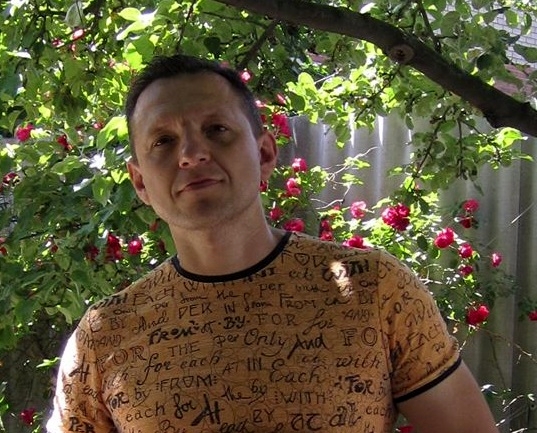
Dmitry Blizniuk
Dmitry Blizniuk is a poet from Ukraine. His most recent poems have appeared in POETRY Magazine, Five Points, Rattle, Los Angeles Review, The Cincinnati Review, The Nation, Prairie Schooner, Plume, The London Magazine and many others. A Pushcart Prize nominee, he is also the author of The Red Fоrest (Fowlpox Press, 2018). His poems have been awarded RHINO 2022 Translation Prize and his folio had been selected as a runner-up in the Gregory O’Donoghue Competition and the 2025 Gabo Prize finalist.
The sky above the highway is low like a cunning dog's muzzle above a steaming saucepan. A one-winged angel of advertising stands by the roadside: Aquafresh, perfect water of gods. And I'm an imperfect verb, just someone in a windbreaker, with pieces of canvas on my head that flap like a pterodactyl. Here's my garden, set back some distance from history, a prehistoric place for ancient bugs, and one of them stands on its hind legs in depression, while the gloomy autumn stares from above.
We've run away from the simmering house like milk that is boiling over. Now I'm single again. The sun hangs behind a ruffled up shed, like a bloody yolk on a cold frying pan until the nightfall dumps it in the garbage, while I'm looking for clean socks, sniffing noisily like a dog with a mallard in its jaws. I've had to leave the city and women behind, make friends with the blissful world of sticks, Like Lorca, I managed to avoid a firing squad. He's grown old, he looks like a grey parrot with an earring, keeps a rapier in his summer kitchen, grows grapes and cucumbers, and something sparkles in his eyes when blood pressure squeezes him like a tube of Aquafresh. If not for the Internet, I wouldn't exist.
A cat called Nostalgia licks his balls on the windowsill. The lampshade is a temple of flies, priestesses of summer schizophrenia. I'm still destined to return, I feel the power of a boomerang within me. It's going to bend my way and carry me back to my youth, otherwise, I don't care where. An eyelid with long lashes has fallen away from the face of a garden doll. The blue eye is unprotected now, and the rubber body under the rain feels so at home in the garden. For how many years will I decompose in the humus in the garden of gods, lie in the ground and see the black earth, black caviar in the eyes of dawn, then stretch up to the sky as a green needle of grass? The smell of the rain that has just stopped is like spilled glue. It's so fresh that I want to run up to the sky, but I can't. A poet in exile is more than just a poet. And a man? -- There is no man anymore.
Sergey Gerasimov is a Ukraine-based writer, poet, and translator of poetry. Among other things, he has studied psychology. He is the author of several academic articles on cognitive activity. His stories and poems written in English have appeared in Adbusters, Clarkesworld Magazine, Strange Horizons, J Journal, The Bitter Oleander, and Acumen, among many others. The poetry he translated has been nominated for several Pushcart Prizes. His books include Feuerpanorama: Ein ukrainisches Kriegstagebuch (dtv Verlagsgesellschaft mbH & Co. KG, 2022) and Oasis (Gypsy Shadow, 2018).
PLEASE NOTE: ARTICLES CAN ONLY BE REPRODUCED IN OTHER SITES WITH DUE ACKNOWLEDGEMENT TO BORDERLESS JOURNAL
A Balochi short story by Nasir Rahim Sohrabi translated by Fazal Baloch
The bus had stopped in front of the roadside hotel, but the dust from the road still hung around it. The passengers, before getting off completely, were busy brushing the dust off the from their travel. The fatigue caused by the delipidated road was visible on their faces and in the creases of their clothes. I had been following the bus and was now sitting under the thatched shelter, drinking tea from a small boy’s cup. The sun was at its peak, glaring down like an angry man. The grime from the boy’s hands on the hot teacup had not yet dried when a red ambulance pulled up in front of the hotel. The dirt and dust stuck to it showed clearly that it had travelled a long way. Two men got out, dusted their clothes, and walked straight toward the water to wash their faces and hands.
The hotel waiter watched them closely. Then the back door of the ambulance opened and their third companion stepped out. His shoulders seemed burdened with many years, and he walked forward with heavy steps until he reached the shade of the shelter. He greeted everyone, and sat down leaning against a wooden pillar. A glass of water was placed before him, but he didn’t touch it. His eyes remained fixed on the ambulance, from which dust continued to rise as though it were still on the road.
After a while, the other two men joined him. Their faces were clean now, but the dust still clung to their ears, eyes, and nostrils. They ordered food. To their third companion they said only, “Come, let’s eat.” But he kept looking at the ambulance fixedly. They didn’t ask him again.
The young boy who had been watching him from a distance placed my tea before me and went toward the man. He touched his shoulder and asked, “Why aren’t you eating?”
The man was startled as if waking from a deep sleep. His gaze shifted from the ambulance to the boy’s face. He looked at him the way someone, seeing the world for the first time after eye surgery.
“I can never eat alone,” he said. “Food never sits well with me unless someone eats with me. Will you sit here with me?”
The boy nodded.
Offering him the first bite, the man said, “I’ve always fed him the first bite. Until I fed him, he wouldn’t eat at all.”
“Who was he?” the boy asked.
The question seemed to trouble him. His teeth tried to chew the morsel while his eyes stayed fixed on the boy’s face. I saw clouds of dust gather in his eyes, and their darkness spread over his face. Pain began to pour like rain. Lakes of grief rose within him. His breath grew heavy. At last, composing himself, he said: “He was my son. But he had taken my father’s place in my life. When he was a child, I fed him. But over time, I became used to eating the bites he offered me. His mother left him and me long ago. She went away with those who were demanding water and electricity along with the young, the old, and the children. I pleaded with her not to go, but she didn’t listen. She left and never returned. At first, people wrote poems about her. But now, people have too much water in their eyes and too much brightness from electricity in their homes. Now they’re concerned only with their own reflection. She once lived in people’s memories, but the world has forgotten her now.”
After a pause, his eyes drifted again toward the ambulance, though the rain inside him didn’t stop.
“He was in a hurry too, just like his mother. He was always in a rush for everything. He would run to school and never delay returning home. He grew up before my eyes. One day he said to me, ‘Now you sit and rest. It’s my turn to look after you. I’ll feed you now.’ I insisted that my turn wasn’t over yet, but he was in a hurry and won the argument. Then he joined Captian Qasim’s boat as helmsman. But he didn’t stay there long. A year later he became a sailor on Ibrahim’s boat. He never hid anything from me, but after joining Ibrahim, I seldom knew when he left for the sea or when he came home. Whenever I asked, he only said, ‘Whenever the boss orders, we’re ready to go.’
This time too he was in a rush. The moment he came home, he said, ‘We’re leaving for the deep sea. We’ll be back in a few days.’ I wanted to stand up and hug him goodbye, but before I could rise, he had already stepped out the door. Then news came that their boat had caught fire. It didn’t sink, but it was badly burnt. Thanks to the boss, they sent us to Karachi by air. But maybe this time it was the order of the Great Boss. Or maybe the son was in a hurry to go to his mother. He didn’t stay in Karachi even for a day.”
The bus horn blared and the passengers hurried toward it. The boy got up too and began to put on his sandals.
“I haven’t even eaten yet,” the man said. “Where are you going?”
“Look, the bus is leaving. I have to hurry,” the boy replied.
The sun had now slipped behind the western mountains. The shelter had emptied. The red ambulance was gone too. But the old man still sat leaning against the wooden pillar, his eyes fixed on the road. The bus sped off, trailing dust behind it.
.
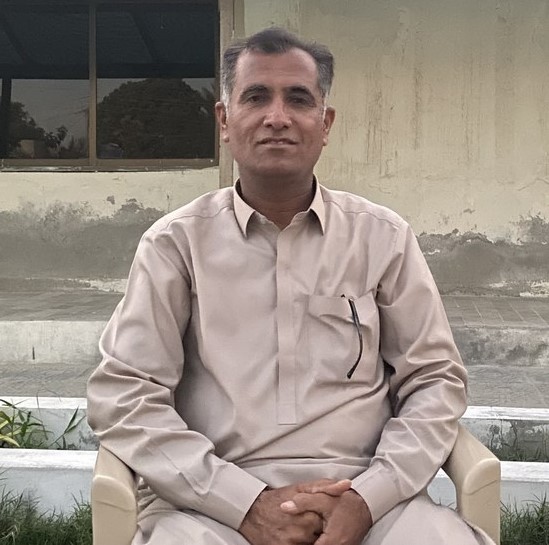
Nasir Rahim Sohrabi lives in Gwadar, Balochistan. He occasionally writes short stories. This story originally appeared in Monthly Balochi, Quetta in year 2000 and translated and published with permission from the author.
Fazal Baloch is a Balochi writer and translator. He has translated many Balochi poems and short stories into English. His translations have been featured in Pakistani Literature published by Pakistan Academy of Letters and in the form of books and anthologies.
.
PLEASE NOTE: ARTICLES CAN ONLY BE REPRODUCED IN OTHER SITES WITH DUE ACKNOWLEDGEMENT TO BORDERLESS JOURNAL
As I watched -- She wrapped the rainbow round her finger, and drifted away -- slowly, ever so slowly. Yet The Heavens saw nothing.
EVENING
The wind wanders, seeking the fragrance of your musk: My heart and a fading leaf are carried along.
SPRING
The poor larks that returned this year peck at the scent of your bosom, still drifting through the footprints along the path of yesteryear.
JUNGLE
Such terror stirs within, none dare to face themselves. The road runs deep with fear— no one walks it alone.
THE WAIT
Shall I open a window? Will you come—or the moon?
Munir Momin is a contemporary Balochi poet widely cherished for his sublime art of poetry. Meticulously crafted images, linguistic finesse and profound aesthetic sense have earned him a distinguished place in Balochi literature. His poetry speaks through images, more than words. Momin’s poetry flows far beyond the reach of any ideology or socio-political movement. Nevertheless, he is not ignorant of the stark realities of life. The immenseness of his imagination and his mastery over the language rescues his poetry from becoming the part of any mundane narrative. So far Munir has published seven collections of his poetry and an anthology of short stories. His poetry has been translated into Urdu, English and Persian. He also edits a literary journal called Gidár.
Fazal Baloch is a Balochi writer and translator. He has translated many Balochi poems and short stories into English. His translations have been featured in Pakistani Literature published by Pakistan Academy of Letters and in the form of books and anthologies.Fazal Baloch has the translation rights to Munir Momin’s works.
.
PLEASE NOTE: ARTICLES CAN ONLY BE REPRODUCED IN OTHER SITES WITH DUE ACKNOWLEDGEMENT TO BORDERLESS JOURNAL
A Tamil story by S Ramakrishnan, translated by B.Chandramouli
From Public Domain
That town had fewer than a hundred homes. Children playing in the street looked at them curiously when they alighted from the car. Kandasamy called one boy and asked him where Venangulam was. That boy asked him mockingly, “Do you want to do a penance in the Venangulam pond?” and pointed him towards the south.
His wife, their only daughter, and the astrologer who had brought them to perform the penance got out of the car. The astrologer tightened his loose dhoti and said, “This is a powerful pond, Sir; all your ‘dosha[1]’s would wash away.”
Kandasamy nodded and started walking towards the south.
Kandasamy had been suffering for over ten years with a skin disease; he had suffered an unexpected loss in his business. There were problems in his daughter’s in-laws home as well. As if these were not enough, he lost an old lawsuit he had been fighting in court. He felt as though the snake in the Snakes and Ladders game had brought him down. He visited many temples, performed pujas[2] and penances; nothing had worked. Only then did an astrologer tell him about Venangulam and the story of the king of Venangulam himself, who had dipped in that pond to get rid of his doshas. Kandasamy felt a sense of hope and agreed to visit Venangulam.
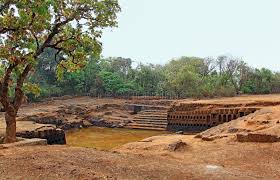
It was a small village with red tile roofs and somewhat broad streets. However, the people had nearly deserted it; some houses were locked up. When they went to Venangulam, they found it to be dry; the steps were dusty. There were four idols on the four sides of the pond.
Doubtful if that was Venangulam, he asked a person splitting logs nearby, “Is this the pond for penance?” That person nodded yes and continued his work.
Kandasamy stood on the dried-up pond’s steps and waited for his wife and daughter.
He wondered if they had come there not knowing that the pond had dried up; he felt angry thinking, “Didn’t the astrologer inquire about this even?”
The astrologer, Kandasamy’s wife and daughter, came near Venangulam.
The pond was full of torn clothes, dried leaves, and plastic waste. Kandasamy said to the astrologer, “There’s no water in this pond.”
The astrologer said,” It had been dry for several years. You get down, imagine that there is water, and sprinkle water on your head.”
“How can I bathe without water?” asked Kandasamy angrily.
“Can you see the sins you have committed with your eyes? But doesn’t the mind feel them? Similar to that, this pond contains invisible water; if you feel that and have a bath, your sins will wash away. Belief is everything, isn’t it?”
Kandasamy descended the steps of the dry pond. Though the pond appeared to have only ten or twenty steps, as he descended, the steps seemed to keep going down forever. Kandasamy kept on descending the steps alone. He did not know how long he had been descending, but when he looked up, it appeared as though he had descended into an abyss. He had not yet reached the bottom of the pond. The steps still kept descending.
He got confused, thinking, “What kind of magic is this? How did this small pond become so huge?” Various thoughts crowded his mind. He thought of how he had deceived his elder brother when they ran a joint business, and how he had cheated money entrusted to him. All these past sins returned as memories.
How can a person who deceived his own brother not fail in life? Suddenly, his elder brother’s face flashed in his mind. In that minute, the thought that until then, he had been pretending as though he had committed no mistakes bothered him. Kandasamy felt that one’s mistakes become weightless when hidden, but once you start realising them, they feel heavy.
Kandasamy realised he was descending the steps of his conscience.
He felt that to relieve himself of his sin, he must return the money he had cheated from his elder brother to his brother’s family. No sooner had this thought occurred to him than he felt a sudden wetness on his feet. The step beneath him seemed to be underwater. He pretended to bend down and sprinkle the water from the pond onto his head.
When his wife asked him loudly, “What are you thinking, standing on the steps?” he came to his senses.
Thinking, “Have I not gone to the depth of the pond? Was it all in my imagination?” He looked closely at the pond. He saw only dried steps and a pond without water.
He realised that the pond awakened the conscience and made you understand the crimes you have committed. It was indeed a magical pond.
He pretended as though he had had a bath and came out of the pond.
The astrologer said, “Think of something in your mind and throw coins into the pond.”
He took coins from his pocket and threw them into the pond, thinking that he would pay back the amount due to the family of his elder brother.
The idols’ eyes in the pond seemed to smile at him mockingly.
S. Ramakrishnan is a writer from Tamil Nadu, India. He is a full-time writer who has been active over the last 27 years in diverse areas of Tamil literature like short stories, novels, plays, children’s literature and translations. He has written and published 9 novels, 20 collections of short stories, 3 plays, 21 books for children, 3 books of translation, 24 collections of articles, 10 books on world cinema, 16 books on world literature including seven of his lectures, 3 books on Indian history, 3 on painting and 4 edited volumes including a Reader on his own works. He also has 2 collections of interviews to his credit. He was awarded the Sahitya Akademi Award in 2018 in the Tamil language category for his novel Sanjaaram.
Dr.B. Chandramouli is a retired Physician. He has published several translations. He has translted Jack Londen’s novel, White Fang and Somerset Maugham’s Razor’s edge (2024) to English and various English translations of Tamil fiction and non-fiction.
PLEASE NOTE: ARTICLES CAN ONLY BE REPRODUCED IN OTHER SITES WITH DUE ACKNOWLEDGEMENT TO BORDERLESS JOURNAL
Five poems by Rohini K.Mukherjeehave been translated from Odia by Snehaprava Das
Rohini K.Mukherjee
AT THE MYSTICAL SANCHI
An unknown voice beckons At the early hours of the morning. Moved by a new surprise Buddha relapses into meditation. A crystal dawn, cold as marble, Is traced On his hands and feet And his eyes and forehead. Some instant, invisible signal prompts him To turn on his side and sleep.
After Buddha’s Nirvana, Calm settles in the valley, slowly. Thousands of Branches and branchlets Radiate blissful divine light. The trees too, in a lavish growth, Spread out everywhere -- From the earth below to the sky above -- And meditate!
THE EXECUTIONER
No one could predict The next scene. But in the one enacted now The executioner has A prominent presence.
The executioner stalks the moon, His face hidden in the veil of clouds, Knife in hand, a gleam of smile On a phony face, A sharp, keen gaze under the glasses, Exuding the smell of An expensive perfume.
The indistinct footfalls may Prompt one to flick a look back But there would be no one behind Only clouds clad in midnight blue Sailing in the sky. From somewhere far floats in the music Of a mountain stream. Slowly, sorrow dissipates and a Path opens up for the spring, A wonderland of fairies. In his unguarded moments, The knife in the executioner’s grip Glitters in the furtive moonlight. Any moment that poison-coated knife Could find the moon’s throat, The moon knows that well. But it forgives, Because it also knows well That the executioner cannot Hide for long And will be trapped in The moonlit garden of tangled clouds.
THE DEATH OF A HAPPY MAN
One day, the eyes lost sleep And all the locusts flew away,
Not one spectator had guessed That one day The man will sprawl out on On the sea beach sands Washed away by the waves From distant lands.
The eyes lost sleep one day. The flock of locusts flew away.
But no one could guess The pains, the sobs That seared that forlorn soul.
Petals drifted in piles To make him a delicate shroud. The smell of sandalwood came wafting In the sea-breeze from the north. Seagulls flocked around the body, Unintimidated by the crowd in the beach, Drowning the voice of The living men there With their loud squawks of dissent. Ooh! What a long wished-for Happy death On a cool and blissful sea beach!
After the flock of locusts flew away Carrying all the dreams back On their wicked wings, The eyes lost sleep!
ANKLETS OF THE NIGHT
There is still time for the nightfall. But the air tinkles with the sound of The anklets of the night As if someone is retreating from An ineffectual, moon-washed garden, As if someone from the grave Watching the landscape, Or someone standing at the riverside Hums the tune of a departed season, Or someone hurrying aimlessly away To escape the approaching dawn.
It is not yet night, But the night’s anklets ring. You are probably returning To your shelter of old times In search of a new hope. Just take a look behind to see The painting of a conflicting wind Fluttering across the courtyard.
It is not yet night But its anklets begin to jingle in the air.
How cool you appear in your Evening chanting of the mantras! How calm and steady you are In the pure fragrance of the descending steps As you set out on the journey Holding your heart on your palm Like a burning clay-lamp. May be when you arrive there The dawn around you would be sonorous With the notations of Raga Bhairavi.
There is still time for the nightfall But the night’s anklets tinkle in the air!
THEY DID NOT COME
I waited for them, but They did not come, I waited all this time in vain, and Knowingly, let myself fall a victim To the first rays of the sun. The sun’s whiplash spurred me on To the jungle. It forced me to cut wood And tie them in bundles. The hunger of the sunset hour Prodded me back to where I had started. The smell of soaked rice, and the aroma of Onions and oil Drifted thick in the air of my house.
The sun came in, an intruder, Sat by me and watched. Then it devoured all the food, Leaving nothing, Not even a single dried-up onion-peel.
Because they did not come, For me the morning was Meaningless in its futility. I knew I was never one In the list of their ultimate interests When their tenure of life here ended.
The footfall of the light Trod easy on my skin. Days rolled on this way In sun and light. The sun was everywhere, all the time. Whenever the door opened, The sun stood there. When the meteor came shooting down, When words rode over the waves of sleep to float in the air, The treacherous sun always appeared.
And for me, there was No hope of their coming back.
But, one day as I leapt up in a hurry At the Sun’s summon, I discovered the Sahara Desert That I believed had Remained hidden in my School Geography book, Lying face down all these days Under my own hooves!
Rohini Kanta Mukherjee has authored, edited and co-edited several volumes of poetry and short stories in Odia and English. Many of his poems have been translated and published in various Indian languages , broadcast over several stations of All India Radio and Doordarshan . Some of his poems and translations have appeared in Wasafiri, Indian Literature, The Little Magazine , Purvagraha, Samasa among others. He retired as Associate Professor of English, from B.J.B Autonomous College, Bhubaneswar, Odisha.
Dr.Snehaprava Das, is a noted writer and a translator from Bhubaneswar, Odisha. She has five books of poems, three of stories and thirteen collections of translated texts (from Odia to English), to her credit.
PLEASE NOTE: ARTICLES CAN ONLY BE REPRODUCED IN OTHER SITES WITH DUE ACKNOWLEDGEMENT TO BORDERLESS JOURNAL
The dragonfly, it seems, wishes to be my companion. Even when October comes, it still hovers close by my side. On a late autumn morning, cloaked in white frost, clinging to a withered blade of grass until its life is spent, the dragonfly loves the fields, loves the sunlight.
As swallows line up in long ranks, packing their final bundles for a faraway journey, news may come from the city of someone’s suicide, yet the dragonfly listens half-heartedly, caring little. Beside the fisherman, beside the farmer gathering beans, following the way of life of distant ancestors, the dragonfly flits about, plays with innocence. And then, from a withered blade of grass, it departs the world as lightly as taking flight— on a morning when leaves and blossoms alike have faded.
From Public Domain
Ihlwha Choi is a South Korean poet. He has published multiple poetry collections, such as Until the Time When Our Love will Flourish, The Color of Time, His Song and The Last Rehearsal.
.
PLEASE NOTE: ARTICLES CAN ONLY BE REPRODUCED IN OTHER SITES WITH DUE ACKNOWLEDGEMENT TO BORDERLESS JOURNAL.
His name was “Nandu”. He was a servant in our neighbour’s house, where he did all of the household chores. He was a smallish boy. Who knows what his actual name was. Everyone just called him Nandu.
Sometimes he would finish his work in the afternoon and would come sit with me. Although he was from Garhwal, he spoke Punjabi well, albeit haltingly. His face always made it appear as though he were laughing. We gave him the nickname “Laughing Man.”
“Nandu, how many brothers and sisters do you have?”
“Four sisters and three brothers. All of the sisters are older than I am, and the brothers are younger.”
Then Nandu fell silent. It was as if he were thinking that if his brothers were older, they would be working, and Nandu would not have cuts on his hands from washing vessels all day at such a young age. Nor would he have been forced to leave his small house nestled in the mountains.
“Nandu, how did you manage to leave your parents and everyone else to come here?”
Then he smiled, and his lips spread out. “Who knows why?” he smiled, but it seemed as if the smile was trying to convince me that it doesn’t matter whether you want to or don’t want to do all of this work, you still have to do it. Right?
“Madam, back there, we barely eat twice a day. We cooked once a day, and we ate the leftovers for a second meal. Moreover, I was not free there at all. I would take the cows outside for grazing. I also bathed them sometimes. I would also feed them fodder. When my mother would milk the cows, I wanted to drink the milk fresh from the bucket. But madam…if we don’t sell the milk, then maybe we won’t even be able to cook one meal.
“And there, people must have their own lands?”
“What kind of lands, Madam? Just small parcels. And then you have to pay land tax and interest on the loan.”
When Nandu spoke like this, it seemed to me that this child was a fifty-year-old man. Yet he was hardly thirteen years old. He was eight or nine when he ran away from his village to come here. Perhaps, he couldn’t tolerate hunger. There had been a time when he had been self-respecting. He would go on saying, “Where I used to work before, the old woman was angry with me one day. And I left.”
I was astonished that now he is verbally abused all day long, but he has gone nowhere. The reason may be that he had grown accustomed to it.
Nandu only spoke Punjabi. He would say that he had forgotten Garhwali. And he never posted letters to his family. He would say that he only knew his father’s name and the name of his village. Nothing else. And the villages in Garhwal had such long addresses. Sometimes he would become very sad thinking of his mother and father. Once, I saw him outside, wiping his eyes with his dirty Ludhiana shirt. But usually, he would try to hide his pain in a smile from which his broad lips would stretch wide. He said carelessly, “According to them, I died long ago.”
Our neighbors were Sikhs. And Nandu bought a gutka[1] with his salary, even though he was completely illiterate. (He only took that part of his salary that he needed for necessities.) He also bought a picture of Guru Gobind Singh Ji and wrapped it in his spare shirt to keep it safe. When the shirt he is wearing gets dirty, he washes it, wraps the picture of Guru Gobind Singh in it, and wears the other shirt.
Over time, he began imitating the children of his boss, a Sikh man, and began wearing a turban. He also got the worn-out turban of his boss’s youngest son. For two annas, he bought some grey dye and dyed the turban. He also acquired a small kirpan[2], which he did not remove while bathing or sleeping. He went from Nandu to Nand Singh.
One time, a man from his village came to find him.
“Does someone by the name of Nandu live here? “There’s no one here by that time. You’ve come here by mistake,” Nandu said with deliberation. He was already afraid that if some man from the village recognised him, he would have to send money home. And maybe he would have to return to that place, where, after caring for the cows all day, he got only one meal, and for the second meal, he was given dried pieces of roti. Here, he could satisfy his hunger at least twice a day. He didn’t need to worry a bit about work. And what about scolding and abuse? Ultimately, a person learns to tolerate these things.
Even though Nandu’s face had completely changed, seeing his wide laughing lips, the man from his village recognised him. He said something to Nandu in Garhwali. Nandu began to say somewhat angrily, “I don’t understand what you are saying. Don’t talk nonsense. Speak correctly.”
And the next day in the afternoon, when he told me that he no longer understood Garhwali, I suddenly let out a sigh. Maybe I sighed because Nandu had forgotten his mother tongue, which must have been the first words he heard when God threw him on this planet, thinking him to be disposable.
“What did he say to you, Nandu?”
“Nothing. He said only that ‘your mother is missing you a lot.’ But I know no one is crying for me. She must be thankful that there is one less hungry mouth to feed. She used to always say to me, ‘May you die.’”
But that man from Nandu’s village kept coming around. Over time, Nandu’s heart softened. Nandu remembered his mother, he remembered his elderly father, who must no longer be able to work the fields. And Nandu remembered his small, dirt shack, whose outside wall was plastered with rocks. The fragrance of fresh soil and paste made of cow dung and mud floated to his mind. And now Nandu was constantly sad. In the end, he was still a child, all of thirteen years old.
Then one day, who knows what happened, but cysts appeared near his ear. The boss, the Sikh, was charry of the illness, thinking no one would keep a sick man in his house. He tossed Nandu out. While leaving, Nandu cried copiously! He gave me the gutka and the picture of Guru Gobind Singh. He was going back to his village. He said he would take them back when he returned from his village.
So much time had passed without hearing from him. On several occasions, my eyes would well up looking at his things. Poor Nandu.
Then one day, there was a knock at my door. It was the afternoon. I opened the door. A smallish boy was standing there wearing a dirty hat and a filthy shirt, and in his hands was a smallish bundle. I thought someone must have come to meet our servant. But seeing those wide lips smiling in his laughter, I immediately recognised him. It was him. Nandu.
Nandu had cut his long hair. Now his name was Anand Ram. I asked him how he was doing and gave him some water. He spoke haltingly. While speaking, he said some words that I had difficulty understanding. In the end, embarrassed, he began to explain that due to living in his village, it was hard for him not to speak Garhwali. In the end, he was still Nandu, who had come to me in the afternoon and to tell me all of his sorrows.
“Your things are still with me, Nandu.”
“You keep them.” It seemed as if words were not coming to him. He didn’t know what to say, “I have another photo.” He began to open his bundle. There were a few pieces of clothing from which Nandu withdrew a picture. It was a picture of Lord Krishna.
I kept on thinking that hunger knows no religion. Wherever one gets food, one adopts that religion and that language. Then what is the essence of a person? A cog that has to fit into every machine because a cog outside of a machine doesn’t get oil, and it becomes rusty. And Nandu? What was Nandu? A thing without life? He was a ball rolling down the mountainside, which, moving very quickly down the hill, would get stuck on a rock momentarily, then again begin rolling. Maybe Nandu was like that same wind-up doll that my little brother has. The only difference is that the wind-up doll is fat, whereas every one of Nandu’s ribs could be counted.
After two years, Nandu came yesterday. There was barely any difference in his build. I recognised him immediately. But he could not recognise my little brother. In those two years, he had grown a lot. The wheels of time leave different marks on different people.
Now Nandu spoke Hindi. He spoke some words very quickly, which I had difficulty understanding.
“So Nandu, where are you these days?”
“I’m working for a woman from Madras. She’s terrible. She harasses me a lot. Otherwise, everything is fine. Initially, I couldn’t eat their food, but now I can.”
Then I thought he was doing this just to keep his belly full, just like sparrows and crows who eat to keep their bellies full. Just like wild dogs roaming the streets to fill their bellies. What is a meal? Whatever you get, you eat, whether it’s leftover food or something else. Something just to fill one’s stomach. But to feed himself, one has to sell himself.
I had thought that Nandu had sometimes become Nand Singh and sometimes Anand Ram. There was a time when he kept a picture of Guru Gobind and a gutka. Now he keeps a picture of Krishna. Sometimes he spoke Garhwali, sometimes Punjabi, and now Hindi. But Nandu kept on washing dishes. Nandu kept on sweeping. He kept on washing clothes. He went on cooking. And he continued to be scolded. Still, he’s a child. Poor Nandu!
“Sister, are you still writing stories?”
“Yes, Nandu. I’m writing now.”
“And you were saying that you were going to write my story?”
I smiled. Feeling demoralized, he began to ask, “But who will read it?”
Then it occurred to me that Nandu couldnot read his story himself, but many others would read it.
“Nandu, the people of future generations will read about Nandu and thousands of Nandus, just like the Bible. And these stories will be worshiped just like you worship these pictures. Because you all strengthen the foundations of the new world.”
Who knows whether he understood what I was saying, but he smiled.
[2] Small dagger, a ritualistic thing carried by Sikh men
Ajit Cour
Ajeet Cour (born 1934) is an Indian writer who writes in Punjabi. She is a recipient of the Sahitya Akademi Award and the Padma Shri, the fourth-highest civilian award by the Government of India. She is the author of twenty-two books, including novels, novellas, short stories, biographical sketches, and translations. Her novellas include Dhup Wala Shehar (The town with Sunshine) and Post Mortem. Her novel, Gauri, was made into a film, while her short story Na Maaro (Don’t Beat) was serialised for television. Her works have been translated into English, Hindi, and several other languages.
C. Christine Fair (born 1968) did her Ph.D. in South Asian Languages and Civilizations at the University of Chicago. She is currently a professor of Security Studies at Georgetown University. Her translations have appeared in Muse India, Orientalia Suecana, The Bangalore Review, Borderless, The Punch Magazine, The Bombay Literary Magazine, and The Bombay Review.
Five poems by Aparna Mohanty have been translated from Odia by Snehaprava Das
Aparna Mohanty
STAR
A tiny star watched me As I groped my way in a blinding darkness Nudged to tears. It sparkled white Exactly the way my mother’s face did. The tiny star was about to climb down When I saw it and waved, stopping it. I knew it could easily understand My unvoiced pleading. So, I closed my eyes and beseeched, “Go back! This is no place For a star that holds such Pure whiteness in its soul. See, how pride and ego here Hiss and howl Cloaked in a guise of false modesty. ‘Selfishness’ is brokering deals In the trade-fair of power Pretending redressal and help. Truth is ineffectual here, So is love! Go back, dear My little lodestar Because I can’t bear to see them Smudge your serene whiteness, Defile you and seat you On a dazzling platform of deceit, And announce ‘Here is one of our bright ancestors We borrow our light from!’”
IN JUST AN INSTANT
Do not hold her in your devouring desire. Hold her in your soul Let the woman be safe.
Do not take her as a prize won, Treasure her with love. Let the woman be happy.
Make her not a commodity. Treat her as a virtue. Let the woman feel elevated.
Just as much— Assure her of Security, happiness And elevation, A vast world of love and compassion. Free from terror and savagery, she Thrives on just that much assurance! Wombs await great souls And there is a promise of A healthy, wholesome future That carries pictures of a million hearts Steeped in love.
Just for once, Unfetter a woman’s body From the scaffold of lust And put it on the altar of worship. You will then see How in more than half of the world, Shrines of love will come up in just an instant.
FEAR
Too many restraints, Numerous forbiddances. “Do not sit here Do not laugh like this Don’t ever dare enter the forest To taste the mangos, There the tiger sits stalking, Fear the tiger!”
I wonder if ever my movements Were easy and unrestricted Like nature. I wonder if the constraints Were ever chosen by An individual autonomy. I am a soul deprived, and Defined in obedience. I drag myself on by your will Slouching under the load of your Approval and disapproval. I lie burning on an untimely pyre At every intersection of the streets, At every city center, Where animal-howls echo day and night. Who knows better than you The trick of championing self-interest Through a pretense of love? You lock me in your embrace To mould me in a pliable shape, Render me spineless, Leaving no strength in My arms to protest. You gift me a heart that wallows In fear and defeat every moment. Why do you hold my Easy growth in check? What are you afraid of? Do you fear that the arms of All the Dusshasanas* will be attracted once I let my hair loose? Do you fear that the spear will pierce the chest of many a Mahishasura* once I let my clothing drop? Do you fear that many a ‘Lanka’ of gold will burn to cinders once I step beyond the ‘Lakshaman Rekha’?
*Dusshasana was Kaurava from Mahabharata who disrobed Draupadi, the wife of the Pandavas. *Mahisasura is an Asura or demon who was killed by Durga *Lakshman Rekha(line) in Ramayan was the circular border drawn by Lakshmana to keep Sita safe. Once she stepped beyond the border, she was kidnapped by Ravana.
THE WOMAN IN THE LAST ROW
The woman sits in the last row lost in some strange unhoped for possibilities. Light and shadow play hide and seek on her face like scenes shifting alternately between a verdant paddy field of Bhadrav* and a gloomy Ashwina* sky.
The lines of mirrors in her front never catch her reflection inside their gilded frames.
Neither has she the time nor the wish to adjust her image in varying postures at every little maneuvering of her body, She just sits there lowering her face, her eyes downcast, speaking to herself, playing with herself, contented in her own company. The woman who sits at the extreme back row could hold anyone’s hand and pull that person to the delicate loneliness of her playhouse.
And, when the meeting disperses amidst accolades and applauses, the great ones stand up weaved in blandishments like mountains tangled in the creepers of Malati* raising their proud heads. Not a single glance is flicked at the last row. No one would know when the woman in the last row had disappeared, stealing the silence from there. No one might believe a river flowed there just a while before.
*Bhadrav—August-September *Ashwina – September -October *Malati – a creeper with pink and white flowers
A SONG FOR THE LITTLE GIRL
The day my little girl Climbed the steps to her green age And reached out to pluck The loveliest flower of Phalguna* And the sweetest berry of Chaitra*, I cried out “Don’t” from below, Stopping her. She heard me and came down To where I stood. Since that day, questions Like the swelling waves Of an unseasonal flood Crash at the edges of her eyes -- Why such prohibitions, why? And I thought, why indeed… My movements would be Held in check. Why must always pain and forbearance Come in my lot?
I am a mother, after all Like all mothers, The spells of Sravana*-showers In her eyes Swept me away in its current… But, will it do if I let myself be tossed away In the rushing flow Of her questions?
I am not a little girl like her. I am rather trapped perpetually In the role of a culinarian That cooks on a holy hearth to Feed the custodians of morals. So now, It is the time to cut and dress my little girl, Cook her to a savoury dish Of her father and her husband’s choice And serve them on a gold plate!
*Phalguna – February-March *Chaitra – March-April *Sravana – July August
Aparna Mohanty(1952) is a conspicuous voice in modern Odia poetry. Her poetry, with its feminist overtone, boldly asserts the significance a woman’s role in the family as well as in the society. They strongly defend the woman against the derogations perpetrated on her by a male-dominated society and defy the societal restraints imposed on her that curb her freedom. Aparna Mohanty has received several accolades for her contribution to Odia literature including the prestigious Odisha Sahitya Akademi Award.
Dr.Snehaprava Das, is a noted writer and a translator from Bhubaneswar, Odisha. She has five books of poems, three of stories and thirteen collections of translated texts (from Odia to English), to her credit.
PLEASE NOTE: ARTICLES CAN ONLY BE REPRODUCED IN OTHER SITES WITH DUE ACKNOWLEDGEMENT TO BORDERLESS JOURNAL
Ratnottama Sengupta introduces a prolific, popular and celebrated Bengali writer and an artist
Dhruba Esh; Courtesy: Kamrul Hasan Mithon
“Dhruba Esh, born 1967, is a full time cover designer – and a part time writer. He has authored stories for children and thrillers for grown-ups. A total of 40 books — or maybe more.”
This is from the cover flap of one of the artist’s published works. Cryptic? Yes. But it does not fail to convey the whimsy every Dhaka-based publisher and poet identifies with the name, Dhruba Esh. Read what Humayun Ahmed (1948-2012), a prolific author, dramatist and director of unforgettable films like Ghetuputra Kamola[1], saysabout the designer in Chaley Jaay Basanta Din[2]. “Must get hold of Dhruba Esh. For some unknown reason he’s been out of reach. Pasted on the front door of the flat he lives in is an A4 sized paper. It is adorned with the sketch of a crow in flight and is signed off with these words in Dhruba’s handwriting: ‘The Bird has Flown the Nest.’
“What I need to do is this: Throw away that A4 sheet and replace it with another, inscribed by these words: ‘Come back, Birdie!’
“Dhruba Esh might not know, but a bird that takes to its wings always returns to its nest. Only the caged bird has nowhere to fly off to. Its only reality is to stay put in one location…”
Why am I taking a serious note of what Humayun Ahmed wrote? Not only because Dhruba Esh has penned the biography, Tumi Achho Kemon, Humayun Ahmed? More so because this custodian of Bangladesh literary culture, who continues to be a top seller at Ekushe Book Fair[3], is one of the cornerstones of modern Bengali literature on either side of the barbed wires.
Dhruba Esh is himself a legend in the Bangla literary firmament, I learn from Kamrul Hasan Mithon, a photographer turned publisher cum writer has been instrumental in reconnecting me with my father, Nabendu Ghosh’s roots in Kalatiya, once a village in Dhaka district that is now a suburb of the capital city. Bhaiti, as I affectionately address him, has been writing a column, Dyasher Bari (Ancestral Home), in Robbar (Sunday) magazine published online from Kolkata. Featured in it are all the major names of Bengali art, literary and cinema world — from Suchitra Sen, Mrinal Sen, Paritosh Sen to Ganesh Haloi, Miss Shefali, Sabitri Chatterjee and not forgetting Baba.
“Dhruba Esh is just one of his kind. He does not have a wife, no mobile, nor a Facebook page. He does not even ride a bus or train. If a destination is too long to walk, he travels only by rickshaw. He is most indifferent to money matters. But he is most enthusiastic about painting and designing.
“Starting in 1989, when he was still a second year student at the Dhaka University, he has designed nearly 25,000 book covers. In addition he has designed music albums – and T’s too! Three years ago he was bestowed with the Bangla Academy Literary Award for his contribution to Children’s Literature – with titles such as Ayng Byang Chang[4] and AmiEkta Bhoot[5].”
I fell for ‘Amiyashankar…’ at the very first reading. How effortlessly the surreal narrative etches a contemporary reality obtaining in the land of my forefathers!
Amiyashankar Go Back Home
Story by Dhruba Esh, translated from Bengali by Ratnottama Sengupta
Subachani or Bar footed Geese flying over Himalayas: From Public Domain
“Amiyashankar Go Back Home!”
“That’s the title of the book?”
“Yes Sir.”
“Is there a poem by this name?”
“No Sir. There’s no mention of Amiyashankar in my poetry.”
“No mention at all? Oh!”
“Can I send you some of my poems?”
“You may send.”
“Can you do the cover within this month?”
“Not this month. You’ll get it on the 12th of the next month. Only sixteen days to go now.”
He started laughing.
He’s a small town poet. A young professor. I have been to the town where he teaches in a girls’ College. It’s like a watercolour painting. There’s a river to the north of the town. Blue mountains in the distance complete the view.
The geese of Subachani had flown over this town on their journey towards the Manasarovar to restore Ridoy to his human size. The poet was unaware of this. He has not read Buro Angla[6].
“What is the book about? Birds?”
“You can find the PDF on Google.”
“Thanks. I will read it.”
Two days later he called. “Reading BuroAngla has sparked some fireflies in my mind. I’d not read the book until now.”
He was given my number by Rasul Bhai, a poet and a cricketer from the same town. He just about looks after the family publishing business. A good person. Last year I had done the cover for his book of poems, Lake Mirror of the Full Moon.
The poet had emailed his poems. He had said he’d send some poems, instead he had sent the PDF of the complete book. On the basis of Divine Selection I read 13 poems. He cannot be faulted for not reading Buro Angla. This poet writes good poetry. In two days I readied the cover for his book.
*
“Is Amiyashankar a friend of yours?”
“No.”
“Why are you telling him to go back home?”
“Because he is Amiyashankar.”
“What?”
“His wife waits for him.”
“He has no one of his own but his wife?”
“He has kids. One son, one daughter.”
“What does he do?”
“He’s a teacher in a government primary school.”
I was startled. Subhankar, Tushar, Amiyashankar, me — we are childhood friends. Our Amiyashankar is a teacher in a government primary school. He has a son and a daughter. The poet who lives in another town has never been to our town. He is not likely to have set his eyes on or made an acquaintance of Amiyashankar. Or, is a person likely to know another person through social media?
“I am not on social media,” said the poet.
“Why?”
“I get disoriented. Confused.”
“Oh. Your Amiyashankar’s wife is named Mitra?”
“Mitra. Yes, I did not tell you, sorry. Amiyashankar’s son is called Arnab, his daughter is Paramita.”
“Why are you creating Amiyashankar?”
“I have no friend.”
Our Amiyashankar’s wedded wife is Mitra. His son is Anu, Miti his daughter.
I call him.
“Hey, what’s the proper name of Anu and Miti?”
“Here — Anu is Arnab…”
“And Miti is Paramita?”
“Yes. You know it already.”
Really tough to suffer this.
I mentioned the poet. Amiyashankar did not read or write poetry. He had never heard of the poet.
“A modern poet?” he was curious.
“A post-modern modern poet.”
“Now what is THAT? Good to eat or wear?”
“Eat. Wear.”
“Does it hide your shame?”
“It covers your shame.”
“Good if it hides all.”
“Yes. Right. Where are you now?”
“I’m here, at Moyna and Dulal’s stall, sipping tea.”
“Aren’t you cold? Go back home.”
Amiyashankar, go back home.
*
On the 12th I sent the EPS file of the cover to the poet.
“If you don’t like it you may discard it,” I messaged.
Reply: “Will you design another cover then?”
Reply: “No.”
Reply: “This will do. I like it. There’s no Amiyashankar but one can visualise him. Thanks. Do I pay you online through bKash?”
I sent my bKash number. He sent the money.
End of give-and-take.
*
I blocked the poet’s number. I deleted every bit of communication in the mail. We had an Amiyashankar in flesh and blood. The poet had concocted an identical Amiyashankar. That Amiyashankar did not live and breathe – how’s that? Such convolution and complication! I was fed up of continuously, endlessly, unendingly living in complexity.
Better to shut my eyes and think of uncomplicated glow worms in my mind.
.
[1] A 2012 film by Humayun Ahmed centring around the exploitation of ghetupatras – young boy performers, Komala being a ghetupatra.
[6] Book by Abanindranath Tagore (1871-1951, nephew of Rabindranath Tagore) published in 1953. Buro Angul is Thumb in Bengali. This is the humorous story about a mischievous boy, Ridoy, who was shrunk to the size of a thumb. He had to journey to the Mansarovar in Himalayas to regain his original size and meets various creatures, including the geese referred to here.
Dhruba Esh, born 1967, is a full time cover designer — and a part time writer. He has authored stories for children and thrillers for grown-ups. A total of 40 books — or maybe more. This story was first published in Bengali in a hardcopy journal called Easel.
Ratnottama Sengupta, formerly Arts Editor of The Times of India, teaches mass communication and film appreciation, curates film festivals and art exhibitions, and translates and writes books. She has been a member of CBFC, served on the National Film Awards jury and has herself won a National Award.
.
PLEASE NOTE: ARTICLES CAN ONLY BE REPRODUCED IN OTHER SITES WITH DUE ACKNOWLEDGEMENT TO BORDERLESS JOURNAL
Five Odia poems by Bipin Nayak have been translated by Snehaprava Das
WITHIN
An equestrian within me Mounts an unbridled horse And plays a violin. A boatman inside me Crosses an imaginary river Again, and again In a non-existent boat.
Within me, there is a wayfarer That refuses to Travel the trodden road And takes a turn.
A lake ripples in me, Waiting futilely To lose itself in the sea, And a waterfall Leaps noisily from above To wet the rocks.
A cloud floats within me, All of a sudden, Flashes a lightning smile And goes back to sleep.
In me, a cowherd Returns home in the twilight Painted in the colours of sunset And lights a kerosene lamp.
A camel inside me Sags under a sack-load of salt, But trudges across the sands Dreaming of a lush meadow.
A mother in me conceives words, Bleeds in labour, Nourishes the vulnerable words With love and care And watches them grow…
PAPER BIRD
My woes pull your neck longer. My beloved words become the air To stuff your insides. I forge your wings from The crumpled paper of my dreams, And mold your beak with my kisses, Paint you in the colour Of my solitary nights…. Trim you with All my fears and frustrations. Because I could not Make a paper-boat of you To sail in the muddy puddle, I lift you up To fly across The monsoon sky. When you climb a little higher Into the air And are drenched out of shape, I, a naked child, Stand here in the rain, look up and cry!
THE MAKING
I pick a few bones of my hardest grief, Scoop some blood Oozing red to create.
I fix a face of smoke or a patch of weepy cloud Mold a nose from the wafting breeze. I fix a pair of eyes, like day and night, There in the face. In one of them, I put a tornado, A bird in the other. With flowers of joy and grief, I shape the lips. The body I try to make Out of a river that hides under it, A fire and a perpetually vain desire To reach the sea or a desolate jungle. I design the limbs from a Lingering surge of green. All these efforts Are but only to replicate What has been made before. I set afloat Because it has been set to drift Much before… And because it has sprinkled A cosmic fervour across A secret sanctum inside me, To bring a god to life, I worship it! I keep trying to create and re-create inside me Because it has made me much before that!
A SKY AS I AM
I have set out to paint a sky of my own -- A sky that is exactly as I am! And for that I have picked up Some nomadic dreams, a sunset, I have collected the blood of flowers, The tune of a stream that has flown away, The chirping of orphan birds, The layers of moss spread over A decrepit piece of rock-writing. I have scooped up A handful of ash from the debris of Perished time, And a wild storm that had retreated After having blown me away. I took out the wet melody from a violin and the primeval music of the insect, throbbing inside the grass. From the reminisces stuck in the sinews I have gathered a few scattered sighs, And from the darkness, the mysteries of nights, I have got warmth from dreams, Sin from pollen grains. With these elements beside me And a canvas in shreds, I sit down to paint a sky of mine A sky that is exactly as I am!
LET THEM SING
Let them sing a song. I do not mind If my wound heals them, Or my tears make them glow, And my blood paints them crimson.
My quick breathing flits about, but I do not mind if someone plays a flute Blowing into the holes of my bones And sings through the lips Borrowed from me.
Let them sing, why must I mind it? The lips are not mine. Nor is the song!
Bipin Nayak
Bipin Nayak (1950), a bold and engaging voice in the literary scenario of modern Odisha, is a trend setter who explored new possibilities for Odia poetry. One of the most significant postmodernist and minimalist poet in Odia, Nayak is a believer in the artefact of words than the meaning and medium. For him poetry is an aesthetic exploration through the fragile, fluid words which could be liberated from its conventional canons and connotations. There is a distinct undertone of metaphysical too in his poetry that hovers over the slim divide between the real and the surreal. Bipin Nayak is a pioneer in Odia auto-fiction writing. His ‘Jatra ra Ketoti Pada’[1], an unprecedented experimental work, that challenges the conventional style through a blending of prose and poetry and does not conform to any traditional literary genre. Besides being the recipient of the prestigious Odisha Sahitya Akademi award the poet has received several accolades for his contribution to Odia literature. Significant amongst them are the Bishuba Jhankar Purashkar, Akhila Mohan Kabita Sammana, Sachivalaya Lekhaka Parishada Sammana and Sammana from Kalinga Sahitya Samaja. He has been widely published in Hindi, Bengali and also in English and has adorned the pages of Indian Literature, Kavya Bharati and other prestigious journals. His major works include Swarachitra (The Painted voice) that fetched him the Odisha Sahitya Akademi award, Nija Nija Barnabodha Apustaka, Sadaja, Bidagdha Bichara, Band Ghara ra Basna.
[1] Translates to ‘how many steps are there in a journey’
Dr.Snehaprava Das, is a noted writer and a translator from Bhubaneswar, Odisha. She has five books of poems, three of stories and thirteen collections of translated texts (from Odia to English), to her credit.
PLEASE NOTE: ARTICLES CAN ONLY BE REPRODUCED IN OTHER SITES WITH DUE ACKNOWLEDGEMENT TO BORDERLESS JOURNAL