There is a marble top chest that fills the small wall to the left of the front door. It’s walked by multiple times a day, but unless you do the dusting, you forget it’s there.
Standing in front of it now waiting on Dee, I realise there is a crystal lamp and three books that stand by themselves, thick like upright bricks, no bookends, makes us look well read, haven’t looked at them in years.
There’s Texas by Michener, The Complete Short Stories of Mark Twain, and The Oxford Book of American Verse. She says she’ll be a few more minutes, this is not a rare occurrence.
I take the Oxford back to the couch and let it fall open to Mnemosyne by Trumbull Stickney. There are 1132 pages, what are the odds that it opens to Trumbull Stickney. Trumbull died at thirty of a brain tumor.
He graduated Harvard in 1895, did his doctorate at the Sorbonne on the Bhagavad Gita. Had he lived longer he would have been one of the greats, his work did not have time to mature. I’m wondering what matures the work of poetry.
Certainly, sitting in this tome at the front door, aging like fine wine, tannins have smoothed the legacy of Trumbull’s goddess of memory. During the next wait, while Dee primps, I’m going to randomly open to a short story.
I lived in Texas for three long years and saw the movie with Glenn Ford, it doesn’t hold a candle to Mark Twain, and can’t touch what is now the undying remembrance, the myth of the near greatness of Trumbull Stickney.
PALM READER
Well, let’s take a look. You haven’t had to work too hard.
I haven’t dug graves or felled trees, but I’ve always worked hard.
I didn’t mean you weren’t productive, I just meant they’re smooth, not roughened, and of course, at your age, a little pruney.
Well, now that we have that out of the way, what about the future?
First the past. You don’t anymore, but you used to bite your nails and cuticles. You have an attention deficit and an inner tension. You also have a soulmate, someone who has loved you unconditionally your whole life. That doesn’t make you exclusive, but it is rare.
Right on both counts. There are children being slaughtered and neglected. It bothers me …. a lot.
It will take time away from you. You should do what you can to step away from these thoughts and this bitterness. Find a happy place as often as possible.
Are you suggesting political ignorance would make me live longer?
No, that would not make you happy, but you dwell on not being able to do anything, and you can. You can care, as you do, you can also spend more time focusing on the good around you and less on the evil. And as we both know you have the hands of a poet.
Craig Kirchner loves storytelling. He has been nominated for the Pushcart three times, and has a book of poetry, Roomful of Navels. He’s been published in Chiron Review, The Main Street Rag, Borderless and dozens of other journals.
PLEASE NOTE: ARTICLES CAN ONLY BE REPRODUCED IN OTHER SITES WITH DUE ACKNOWLEDGEMENT TO BORDERLESS JOURNAL
Title: South to South: Writing South Asia in the American South
Editor: Khem K. Aryal
Publisher: Texas Review Press
Taken together, the stories and essays in the new anthology edited by Khem K. Aryal South to South, Writing South Asia in the American South, offer an intimate, richly articulated expression of what it means to live in the American South as a South Asian immigrant. Several stories construct the enduring feeling of loss, both for new immigrants and old. Sixteen authors have been featured. Some have dealt with the issue through fiction and some, through non-fiction.
In “The Immigrant”, a short story by Chaitali Sen, a young immigrant man Dhruv tries to compose a letter to his parents describing his new life in America but fails to find the language. While dining next to the hotel where he is staying during a work trip, Dhruv is upset by the disappearance of a small boy and the fruitless search of the distraught parents, which reminds him of his own state in America, where he seems to have lost his way. In “Pine” by Hasantika Sirisena, a young Sri Lankan mother of two small children tries to hold on to her customs from home. Her husband walks out on her in a bid to make a new, successful life in America, unburdened by the trappings of culture and religion. She seems in danger of losing her two children also, who are more interested in Christmas trees than the rituals she wants to share with them. In a startling turn of events, she comes to terms with her own uprooting with touching courage.
Several stories remind us of the remarkable flexibility of South Asian immigrants, who transform themselves and become new people after putting down roots in a new place. One such story is Aruni Kashyap’s “Nafisa Ali’s Life, Love, and Friendships Before and After the Travel Ban”, about a young married woman from the war-torn region of Assam, whose mother and husband in India constantly worry about her safety. Nafisa lives next door to a couple as different from her as possible; they do not work, they drink and they have public sex – yet, Nafisa feels drawn to them as she embraces her new relationships and identity in America to escape her traumatic past. In “Nature Exchange”, Sindhya Bhanoo tells the story of a South Asian woman married to a white man whose relationship with her husband comes to an end when their son dies in an all too typical American phenomenon, a school shooting.
Repeatedly, we see immigrant women in a state of extreme desolation and isolation, left to their own devices to find meaning afresh in a foreign land. Whether they feel their children moving away from them or they literally lose a child, children seem to act as an anchor for the immigrant mother, but in each story, this most intimate of relationships only proves transitory. There are also contradictions. Whereas Sirisena’s story shows a man more willing to assimilate and adapt to America, in Kashyap’s story, the husband, sitting in India, draws easy conclusions about America (denouncing drinking, dancing, and their anti-immigration status), whereas the wife in America, tired of the stresses of living in a war-torn country, finds respite from her homeland’s history of trauma by partying with her office mates and Southern neighbors.
Parallel themes run through the entries. Both stories and essays articulate the craving for tea, one aspect of their identity that South Asians have carried overseas. Also poignant are tales of the early days of migration and the transformation people undergo over the years. Jaya Wagle writes of having an arranged marriage and making the long journey by plane with the man she marries to another country. The whole experience of her new marriage seems as unknown, fragmented, and mysterious as the new country to which they have come. The essay is poignant for the specificity of haunting details, and the transformation of an immigrant evident over the years.
But what makes these South Asian immigrant experiences uniquely southern? One pattern apparent through all the stories is the lack of public transport and public space. The new immigrants in these essays and stories are in cars and Ubers, tucked away in suburban houses or secluded apartments in small towns, the lack of public community accentuating their isolation. Added to this physical landscape is the South Asian immigrant’s alienation from the politics of the region.
The essays, compared to the stories, seem more concerned about identity and more strident about equating immigrant identity with patriotism and allegiance to the Democratic Party. In “Gettysburg”, Kirtan Nautiyal writes about playing the game Sid Meier’s Gettysburg based on the battle of Gettysburg, admiring Union army heroes, imbibing American history in school, and watching the film Gettysburg, wanting to prove himself an American. Throughout the essay, he seems to correlate being an immigrant with proving one’s patriotism towards his adopted country. He stretches it to a point where he would be willing die in a battle – a price, it seems, immigrants must be willing to pay to show their love for America. The essay, predictably, ends with the story of Captain Humayun Khan, who was killed in the Iraq war, told at the 2016 Democratic Convention. Anjali Erenjati writes about taking a fun car trip with her new immigrant friends who do not share her trauma of growing up in the deep South, where she faced a racist incident as a young teenager.
Essays, also, seem more directly to address the question of identity, specifically, being questioned about one’s identity. In Tarfia Faizullah’s humorous essay “Necessary Failure”, she is asked repeatedly where she is from, as her answer, “I grew up in Midland, Texas,” fails to satisfy her co-worker in a theater festival box office in Alabama. On Jaya Wagle’s first night in America, two policemen accost her husband in Texan English when she mistakenly calls 911. Later, the old women she meets at her library writing workshop ask her how long it took her to learn English, a language she has spoken all her life.
The editor Khem K. Aryal is an associate professor of English at Arkansas State University. He is a writer, editor, and translator from Nepal. His short-story collection, The In-Betweeners, is forthcoming from Braddock Avenue Books.
.
Gemini Wahhaj is the author of the forthcoming novel The Children of This Madness (7.13 Books, December 2023) and the forthcoming short-story collection Katy Family (Jackleg Press, Spring 2025). Her fiction is in or forthcoming in Granta, Third Coast, Chicago Quarterly Review, and other magazines.
PLEASE NOTE: ARTICLES CAN ONLY BE REPRODUCED IN OTHER SITES WITH DUE ACKNOWLEDGEMENT TO BORDERLESS JOURNAL
Shantanu Ray Chaudhuri in conversation with M.S. Viraraghavan and Girija Viraraghavan
M.S. Viraraghavan and Girija Viraraghavan
In their new book Roses in the Fire of Spring: Better Roses for a Warming World and Other Garden Adventures (Running Head, 2023), world-renowned rose hybridisers, M.S. Viraraghavan and Girija Viraraghavan, record their journey of over fifty years, creating more than a hundred new rose varieties, in a range of colours, shapes and types. The authors spoke to Shantanu Ray Chaudhuri on their lifelong passion for the rose.
The passion for roses goes back a long way – can you recall the first moments when you realised that this was a ‘calling’ you had to follow? Any epiphanic moment that leaps to the mind?
From quite a young age, Viraraghavan was fascinated with roses, but the epiphanic moment was really when his family spent summer vacations in Coonoor, staying at the government guesthouse within Sim’s Park, which overlooked a rose garden. Every morning, he would wander about this garden which was a blaze of colour of the new roses created from the golden rose of Persia, R. foetida by Pernet Ducher, a great French rose breeder. The brilliant, never-before-seen colours of these roses amazed him – from bright gold and apricot to dazzling oranges and reds. In particular, one of the golden roses took his breath away – ‘Julien Potin’, aptly named for a jeweller – its vivid colour was quite overwhelming for the boy of thirteen, already thrilled with roses. From this came the intoxicating thought: ‘If Pernet Ducher could do it, why not I?’
There’s a delightful little bit about Viraraghavan sir’s viva-voce for the IAS and how his knowledge of roses played an important part in him getting through that. Would you like to share that with our readers?
A difficult part of the IAS examination is the viva-voce, where a panel of senior administrators question the aspirant about various aspects of his or her life and ambitions. Viraraghavan was in the middle of this interview when the Chairman, by chance a learned rose grower, asked him what his hobbies were. ‘Growing roses,’ was the response. The next question was meant to be a googly to confuse a nervous candidate. ‘What roses can you grow in Madras City?’ But Viraraghavan had read the CompleteGardening in India by K.S. Gopalaswamiengar, well-known horticulturist of Bangalore, many times, so my answer was nearly verbatim from the chapter on various kinds of roses which do well in low-to-medium elevations, i.e., warm climates, so he reeled off the different rose classifications: Teas, Noisettes, Bourbons, Chinas, Hybrid Teas, Hybrid Perpetuals. The interview committee then decided it was prudent to go on to other questions rather than get a lecture from a young and seemingly unflurried candidate! But his capacity to master detailed information on various subjects had been noted, and he came through with flying colours (pun intended).
You mention making your presence on the world stage as late as 2000. Please give us a brief account of your work on roses before and after – a potted highlights package, if one can call it.
From the start, our rose breeding focused on creating better roses for warm climates based on the dictum of India’s pioneer rose breeder, B.S. Bhatcharji of Bengal and Bihar, who had stressed the need for a separate breeding line for warm climates as distinct from the Western focus on creating cold-hardy roses suitable for them. Thus, in the early years, our work was with those roses which, though Western, performed well in hot climates, and we had bred many which did well in Hyderabad where we lived. Then, after perusal of many books on roses, we realised the potential in two Indian rose species Rosa gigantea (from northeast India) and Rosa clinophylla (perhaps the world’s only tropical rose species). After getting them with great effort, we began to work with them. At every annual national rose convention in India we would present updates of our work. In 1999, at what happened to be a World Regional Rose Convention, in Jaipur, Viraraghavan’s talk, as always, focused on the breeding with the two rose species mentioned. After the talk, the World Federation of Rose Societies President, Helga Brichet, and Vice-President (South America), Mercedes Villar, came up to him and said they had never before heard of this kind of rose work or of these rose species and invited him to be a speaker at the next World Rose Convention to be held in May 2000 in Houston, Texas.
That was the start of a further phase of rose breeding with the realisation that other than India, several warm parts of the world were also looking for roses that would do well there. These two rose species had been personally collected by us from their native habitat. At Houston, and in other places, people were fascinated by this aspect, which no earlier breeder had undertaken, that is, personally collecting rose species in the wild, at great risk, growing them and using them in creating new roses; starting from scratch as it were. It made sense to them when Viraraghavan explained the dictum of that great German breeder Wilhelm Kordes I who said –‘The soup ladle will only bring out what is already in the tureen’, meaning that fresh genetic input was required if new and different roses are to be created. The enthusiastic response to his ideas strengthened his determination to go ahead with this new rose breeding line. There is nothing as intoxicating as the realisation that the rose world is watching our work with great interest.
One of the most fascinating sections of the book is the one titled ‘The Ones Who Came Before’. Please provide readers with a short account of these legendary influences.
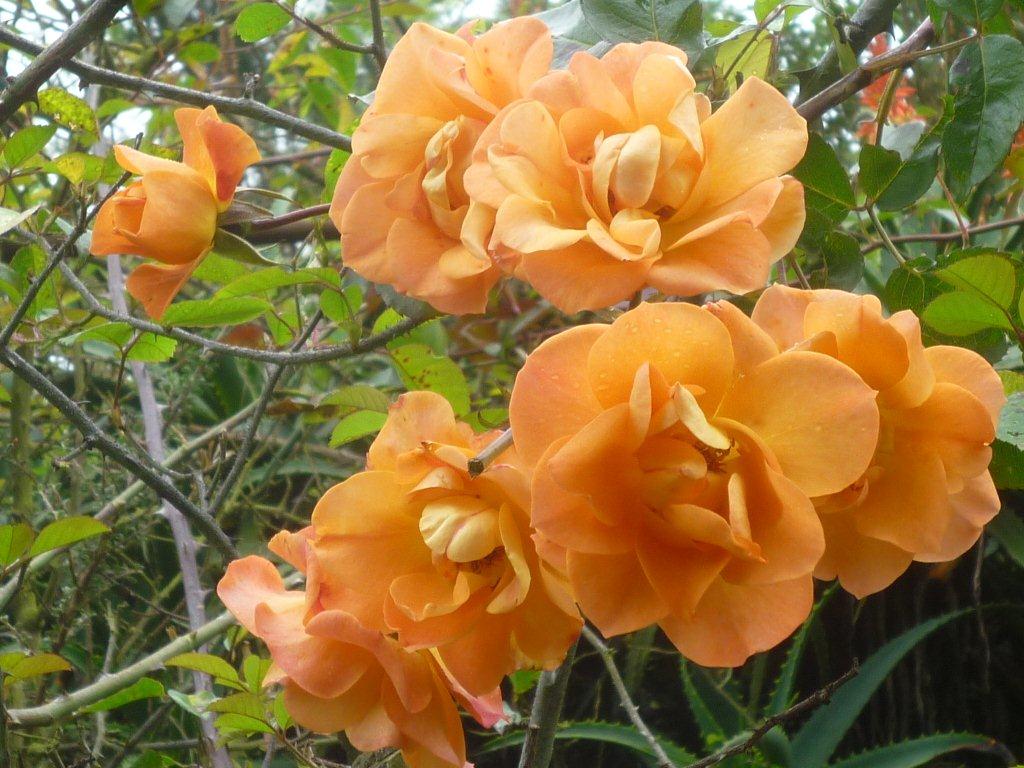
Karrie’s Rose. Photo courtesy: M.S. Viraraghavan and Girija Viraraghavan
We had noticed that invariably roses were named for famous people with often no connection to the world of roses. This made us think: why not name our roses for the intrepid plant-hunters who had discovered roses in the wild, on mountains and in forests, and botanists who had contributed to the knowledge on plants.
One wild Indian rose is R. gigantea, from our north-east, and Myanmar. Three great plant hunters were responsible for collecting this species in the wild – Sir George Watt, General Sir Henry Collett and Frank Kingdon Ward. We decided to name our rose hybrids for all three. Sir George was a medical doctor with an interest in botany, and worked as a surveyor with the British India government. During the course of his work, in the 1880s, he found Rosa gigantea growing on the slopes of Mt Sirohi, now in Manipur, and collected specimens. Almost simultaneously, so did Sir Henry Collett, except in the Shan Hills in what is now Myanmar. Both specimens were identified as being the same and named by the great Belgian taxonomist of the time, François Crepin. Climbing Mt Sirohi in 1990, we came across and collected plants from perhaps the precise location that Sir George had found Rosa gigantea. We named our first hybrid, a creamy yellow climbing rose, for him. We then felt it should be planted near his ancestral home in Scotland. With the help of the Royal Botanic Garden, Edinburgh, we managed to get this new rose planted in the Logan Botanic Garden, very near Sir George’s birthplace. Some years later we embarked on a sentimental journey, along with his descendants and his associates’ descendants, visiting his grave and the hospital he had worked in after retiring from India, to see the rose blooming in Logan.
We named a second seedling we had bred from R. gigantea for General Sir Henry Collett, a rose with big creamy white blooms that has been planted in suitable areas in Britain as well, and, gratifyingly, being grown by some of his descendants. A third rose, a climber with blooms of yellow-suffused pink, was named for Frank Kingdon Ward, the legendary and intrepid plant hunter who collected innumerable new and wild Himalayan plants despite his surprising acrophobia! We then came across a piece by the then BBC 4 gardening anchor, Matthew Biggs, who had visited Kingdon Ward’s grave in Grantchester near Cambridge. He wrote about the neglected condition of the grave of one of the world’s greatest plant explorers. So we decided to make amends by planting ‘Frank Kingdon Ward’ by the wall nearest his grave in the churchyard in a moving ceremony organised by Matthew Biggs, and attended by a number of well-known British horticulturists, as also the family. An urn with the ashes of Sheila Macklin, Kingdon Ward’s wife, for whom he had named a Himalayan lily, and who had died just the previous year, was interred near his grave, and close to where the rose was planted.
We have also named a rose for Leschenault de la Tour, the great French plant explorer who found a beautiful new rose species, called Rosa leschenaultiana after him, in the Western Ghats in the early 1800s; our rose named for him is a climber with pure white blooms.
And of course we have a rose to celebrate the remarkable life and career of the great Indian botanist and cytogeneticist, E.K. Janaki Ammal, who co-wrote the Chromosome Atlas of All Cultivated Plants in 1945. She studied botany at Michigan State University in the 1920s on a full scholarship, later receiving a PhD and DSc honoris causa. Back in India, she played a vital role in creating the ‘Noble’ strain of sugarcane – an extraordinary hybrid of sugarcane and bamboo leading to varieties thick as a man’s arm in contrast to the pencil-thin traditional varieties. But credit was stolen by seniors at the research station, and so she went off to Britain. There she worked at famous institutes, including John Innes, Kew and the Royal Horticultural Society. Later, she met the then Prime Minister Jawaharlal Nehru on a plane, and he put her in charge of reforming the Botanical Survey of India in Calcutta. But sadly she was a forgotten figure by the time of her death in 1984. Our rose named for her has the same colour hues as the saris she wore – orange yellow and saffron. A plant of this rose was planted in 2020 at the World Regional Rose Conference Kolkata, at the Botanical Survey of India garden. The rose has also been planted in the John Innes Institute, in Kew and the Royal Horticultural Society’s garden in Wisley in the UK.
If one were to ask you of one moment each – one particular achievement in the journey and one abiding regret – what would these be and why?
There can be no doubt that the moment which was special in our rose breeding career was the moment described above, when Helga Brichet and Mercedes Villar came up to us in Jaipur in 1999, and said they had never heard such a new approach to breeding roses, pioneered by us, of using two Indian rose species to create a new line of warm-climate roses. It was their invitation to speak in Texas launched us on to the world stage of roses.
As for an abiding regret, that’s all too easy to answer. It’s the systematic neglect of Indian-bred roses by the rose-growing public of India, who remain fascinated by roses raised in Europe and the U.S. though they are utterly unsuited for Indian climates. This unreasonable preference for foreign rose varieties is part of the general craze for all things foreign. Fortunately, more recently, there has been a change, and young rose breeders and growers are realising that Indian bred roses do better in the heat and are slowly beginning to grow these.
Give us an insight into the challenges and pitfalls of growing and creating roses in India, as informed by your journey. Interesting story that highlighted these.
The main challenge was getting Indian roses accepted by the Indian rose growing public, as highlighted above. Indeed, now our roses are being grown in India, perhaps because they are being grown around the world! Another thing is one must learn patience. It takes us about eight to nine years to name and release a new rose. It is a long process, of the actual crossing of two roses, waiting for the fruit to ripen, then harvesting the fruit (rose hips), collecting the seeds, stratifying them in the refrigerator (if one lives on the hot plains), sowing the seed, waiting for the seedlings to sprout, growing the plant for a number of years to test its potential, and suitability, and only then finding a name and releasing it, by sending to a rose nursery to make more plants.
Our long career in rose breeding and our connected travels around the world has provided us with many interesting, even hilarious experiences. We were in Japan, at the Sakura Rose Garden. With us was a group of people including our friend, the well-known Japanese plant scientist, Dr Yuki Mikanagi. We were looking at a rose plant, with dark pinkish-red blooms with white on the reverse, bred by us and as yet unnamed. Yuki said she liked this rose very much. We immediately told her that we would name it for her. She said: ‘But this rose is red and white, whereas my name means “snow” in Japanese. Viru’s instant response was, ‘Then we will it name it Blushing Yuki,’ much to the delight of Yuki and everyone.
In his government service days, when we lived in Hyderabad, Viru would tend to his roses, watering and spraying them with fertilizers before leaving for office. There would be a number of telephone calls for him about some official matter. Girija would answer the phone (landline in those days), and when she told the callers he was busy spraying, they would hear it as ‘praying’ and immediately apologise: ‘Please do not disturb him when he is at his prayers’.
Both of us were hands-on gardeners, doing most of the work ourselves and you cannot garden without muddy hands and clothes. Very often visitors would mistake us for the garden help and request us to take them to the master or the mistress of the house. The looks on their faces when they realised who we were would make us laugh.
On one occasion, we were in California to receive the ‘Great Rosarians of the World’ Award. At the ceremony, we both first gave a talk on ‘Roses in India, Past Present and Future’. At the end of the ceremony, an earnest old lady came up to us and asked, in all seriousness, ‘Do roses grow in India?’
For most of us, roses are red and a Valentine’s Day Gift. Appendix 1 of your roses runs to 50 pages! Tell us briefly of some of the interesting ones, in particular the very evocative names you have, for example, Kindly Light, Meghamala/Wine-dark Sea, Twilight Secret. What goes into giving a name to a rose?
Apart from the roses we have named for friends, for other roses we like to give evocative names.
KINDLY LIGHT: we named this lovely white shading to soft pink rose after the hymn ‘Lead, Kindly Light’, a favourite of Mahatma Gandhi’s. We have the practice of giving two names to some of our roses, one better understood in India, if it is a Sanskrit word, and one for the West. This rose is named ‘Swami Vinayananda’ in India, for a monk of the Ramakrishna Mission order. He was great plantsman, his book on dahlias is a definitive work on all aspects of dahlia growing and he was very good rose grower.
MEGHAMALA/WINE-DARK SEA: One more example of two names for a rose. Meghamala translates as ‘garland of clouds’. The name for our rose was inspired by the purple garland-like pattern, reminiscent of clouds, on the petals of this rose, which otherwise are dark orange-red in colour. ‘Meghamala’ is from a line by Devulapalli Krishna Sastri, beloved modern poet of the Telugu language, to whom the rose is a tribute. ‘Wine-Dark Sea’ derives from Homer’s epithet, in both the Iliad and Odyssey, of the purple shadows of approaching night on the orange-red waters reflecting the rays of a setting sun on the Aegean Sea.
ALLEGORY OF SPRING: We named a very special light-pink rose with intriguing pointed petals after the famous Botticelli painting La Primavera, also called ‘Allegory of Spring’.
INCENSE INDIGO: An indigo purple rose with an enticing fragrance was the inspiration for this name.
TWILIGHT SECRET and TWILIGHT TRYST: Two purple-hued roses that remind one of the late evening, shadowy light, romantic secrets and trysts.
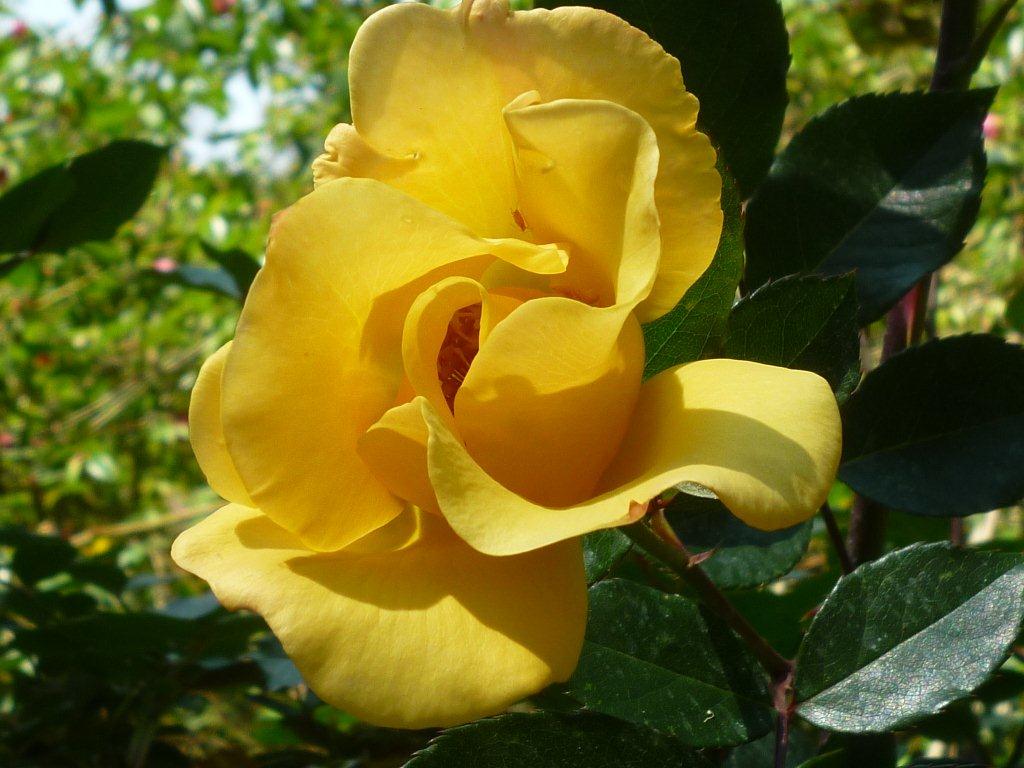
AHIMSA: We gave this name to a golden yellow rose borne on a plant without any thorns (prickles), thinking of the Mahatma’s philosophy of non-violence.
KUSABUE’S GUARDIAN ANGELS: Kusabue is the name of a rose garden in Sakura City, Japan, entirely looked after by volunteers, all very senior citizens. This is our tribute to them.
Golden ThresholdKanyakumariPhoto Courtesy: M.S. Viraraghavan and Girija Viraraghavan
Shantanu Ray Chaudhuriis a film buff, editor, publisher, film critic and writer. Books commissioned and edited by him have won the National Award for Best Book on Cinema twice and the inaugural MAMI (Mumbai Academy of Moving Images) Award for Best Writing on Cinema. In 2017, he was named Editor of the Year by the apex publishing body, Publishing Next. He has contributed to a number of magazines and websites like The Daily Eye, Cinemaazi, Film Companion, The Wire, Outlook, The Taj, and others. He is the author of two books: Whims – A Book of Poems(published by Writers Workshop) and Icons from Bollywood (published by Penguin/Puffin).
.
PLEASE NOTE: ARTICLES CAN ONLY BE REPRODUCED IN OTHER SITES WITH DUE ACKNOWLEDGEMENT TO BORDERLESS JOURNAL
I have been an immigrant to a new country three times: from France to England, England to Canada and then, Canada to America. Being an immigrant is often a highly positive experience. We may have greater opportunities, we seek our dreams, we grow them. On the other hand, immigration for those of us who have gone through the process, is not easy. It is expensive, time-consuming, nail-biting and often lonely. It is said that those who immigrate ‘successfully’ do so because of familial support and/or because their children reap the benefits of their sacrifice.
Whilst there are too many stories to condense any one feature of immigration, we can only talk of our own experiences and somehow in understanding that, perhaps stay open enough to understand others. We can come together through that collective understanding.
As a psychotherapist, I work with many immigrants. I see clients daily who were born elsewhere and sometimes struggle to acculturate in their new-found country. Where I live, near the border between Mexico and America, we have a multitude of immigrants from Mexico, central and south America as well as from around the world, coming through the borders, seeing asylum and a better life.
Consequently, there can be a high degree of racism in rebuke for the startling numbers of immigrants passing through our city. I can drive down a road and see people lined on the street much as you would see in other countries, begging and homeless. Our resources are stretched and one option chosen by the Governor of Texas was to bus immigrants and asylum seekers to other states in the US. Initially this was considered a racist, insensitive act that treated people like cattle. When you look at it closer, you can see it was perhaps these things but also a desperate plea for other states to understand the overwhelming nature of immigration for border states and share in the expense.
It is easy for a non-border state to believe the border should be effectively kept open and all immigrants allowed in. but when it’s on your door step it can be challenging. Most people in Texas care about immigrants but also experience some of the downsides of too many immigrants at once. In El Paso, people froze to death sleeping on the streets, houses were broken into, the situation was dire and extreme and locals didn’t have enough resources to manage. Shipping immigrants who wish to go to other states, to those states, might appear cruel, but also makes sense, if it’s consensual. Whilst many of the Texan Governors decisions have been quite possibly racist and prejudicial, this choice was in part to show other states how dire the situation is.
Why are there so many asylum seekers right now? As President Biden announced the lifting of closed borders to asylum seekers, the numbers attempting to come into America increased exponentially. Under the Trump administration, the Department of Homeland Security (DHS) called the “Remain in Mexico” policy (officially, the Migrant Protection Protocols) caused immigration to be somewhat halted. The original reason countries like America accepted asylum seekers goes back to WW II where the Jews who survived ethnic cleansing had nowhere to live and were essentially stateless. The right to seek asylum was incorporated into international law following the atrocities of World War II. Congress adopted key provisions of the Geneva Refugee Convention (including the international definition of a refugee) into U.S. immigration law when it passed the Refugee Act of 1980.
The laws that exist now were enacted to protect them and ensure stateless people were never again turned away in droves. The creation of Israel was in part the consequence of WW2 and the abuse against the Jews. It could be argued any issues with Israel are directly linked to the ethnic cleansing the Jews experienced and their subsequent statelessness. Laws endeavoring to protect future people from such experiences are what we now use in our handling of asylum seekers. “When Congress finally eliminated the racial provisions in U.S. immigration and nationality law in the 1940s and 1950s, generations of federal practice and procedure did not instantly disappear without a trace. Over the years, other government agencies had developed their own racial classification systems, often partially borrowed from INS experience, and such systems could take on lives of their own.”
The downside to this is, the world has dramatically changed since the 1940s (2,307M versus over 7 million today). the population is growing at a heady rate and thus, even if a small percent of people seek asylum from any one country, it is huge in comparison to previous numbers. Department of Homeland Security statistics show that from Biden’s Inauguration Day through May 2022—just 16 months and change—about 1.05 million migrants were apprehended on the southwestern border and then released into the US. With every year, the worlds population swells and with it, a strain on resources. ‘Affluent’ countries such as America, may literally speaking have the resources to help asylum seekers but the reality for many asylum seekers is quite different once they are in-country. According to Census Bureau statistics, immigrants’ share of the U.S. population rose more from 1990 to 2010 than during any other 20-year period since these figures were first recorded in 1850—from 7.9 percent to 12.9 percent
What constituted poverty in their country of origin may be considerably lower than what money they can earn in America, if indeed such earnings can be made at all. The social welfare system protects asylum seekers by giving them somewhere to live and a stipend until they are able to find work but what of those who do not possess the necessary skills? Not to mention the dearth of certain jobs. Immigrants wishing to live in the cities, may find work is only available in the agricultural parts of America and not earn enough to live on without language and education in a city. Likewise, they must contend with crime, safety issues and making the meager money they receive, stretch to pay for themselves and their families. What might seem initially like a lot of money, in comparison to their home-countries, is quickly devoured by the more expensive living expenses of America.
Immigrants who move to America or other developed countries, on a visa rather than asylum, may fare better. But note how many PhD’s are driving cabs or serving in restaurants. Underemployment is a phenomenon whereby those who are educated, are working at a lower level than that education would typically warrant. For their children there may be greater opportunities but for many first-generation immigrants, the adjustment and opportunities are restricted. Doctors in their own countries, they find American prohibitions on accepting foreign transcripts and learning, despite the low quality of American education in comparison to many other countries. It’s almost if you were being subjective about it, like having to pay the price for immigration.
When I immigrated to Canada, I found many who possessed PhDs and advanced education were unable to find work. There was some push back from locals who resented skilled workers and felt all immigrants should ‘know their place’ and take the dregs work. This is something you really don’t believe will happen to you when you are very educated, and get a skilled worker visa, but it’s a reality, perhaps less spoken about because it makes the host country look unkind. But go beyond the shiny posters about immigration and speak to the people and you will find it’s not uncommon.
Immigration is necessary for many reasons, not least the Western world ageing and requiring new blood because of declining birth rates. But the Western world wants immigrants to do the work they don’t want to do just as much as they may appear to want immigrants to ‘succeed’ and for every Doctor and PhD who was an immigrant, there are plenty who find themselves no better off through immigration. That’s a sacrifice worth making when you have no other choices or you hope your children will inherit the American Dream but if you have no children and you’re sold a false dream, then it can be disheartening if not crushing. There are 11 million recent immigrants in transition, best estimates predict, who labour in American fields, construction and kitchens, as well as American classrooms, detention centers and immigration courts.
What we hear less about, is how many immigrants leave. And how many suffer silently, having fallen between the gaps, into anything but the American Dream. What can be done about this? Should we impose immigration restrictions not out of cruelty but an understanding that a host country is ill equipped to deal with mass influxes and that the original reasons for the laws have evolved/changed as our population has grown? Should we insist other states take some responsibility for asylum seekers? As well as demand other countries pitch in more? And understand that what may look racist, is in fact a more realistic approach than flinging open the border and allowing everyone to come in at once?
It is an interesting dilemma and one that won’t be decided any time soon. The racists and extreme economic conservatives will battle against the diametric opposite liberals who believe all should inherit the opportunity a country like America holds. Both sides are too extreme in that they don’t consider the reality. The reality is racism should not and cannot endure in a country like America where soon ‘brown skin’ will be the majority and old racist ways are being challenged. But equally, being so ‘woke’ that you don’t see the fall out of idealistic policies, isn’t the answer either. In tandem with an identity politics that emphasises the subnational, a too progressive project may place global concerns above national interests. Hence, the oft repeated slogan “global problems require global solutions.”
Speak to the people. Many times, people criticise me for living in Texas. They assume I’m one of the ‘bad guys’ without understanding Texas is made up of a huge diverse population. Within that diversity are many Latinos who don’t want mass unchecked immigration any more than the racists, but for radically different reasons. Things aren’t as simple as they seem in a Twitter comment. There are many complex considerations that must be taken into account to ensure the best outcome not only for asylum seekers but those who already live in-country. There are answers, but they won’t come from knee jerk reactions or entrenched thinking on either side.
What we do know today, is people are literally dying to come into America and with them, perhaps some unchecked terrorists sneak in, just as they did before 9/11. In order to protect everyone and ensure things are done legally and safely, immigration must have some controls and should be funded accordingly, without any one state taking the majority of the strain. Many Texans are quite the reverse from what you’d imagine, if you subscribe to stereotypes. Maybe the problem is we should really get rid of stereotypes and try knowing who people really are before we judge en mass. Houston has one of the highest Indian communities in the world. All cities within Texas have absorbed huge numbers of immigrants from around the world. Let’s think less of ‘them and us’ and more about truly doing what will be best for those seeking to come into a country and begin a new life. Immigration is a conundrum, but if we work together, instead of apart, we can find answers.
.
Candice Louisa Daquin is a Psychotherapist and Editor, having worked in Europe, Canada and the USA. Daquins own work is also published widely, she has written five books of poetry, the last published by Finishing Line Press called Pinch the Lock. Her website is www thefeatheredsleep.com
.
PLEASE NOTE: ARTICLES CAN ONLY BE REPRODUCED IN OTHER SITES WITH DUE ACKNOWLEDGEMENT TO BORDERLESS JOURNAL.





 Borderless