Categories
Tagore Translations

A Trip to the Himalayas by Rabindranath Tagore

‘Himalaya Jatra’ (A trip to the Himalayas) has been excerpted from Jibon Smriti[1] and translated by Somdatta Mandal.

Jibon Smriti by Rabindranath Tagore (1861-1941)

After my head was shaved for the upanayan (sacred thread) ceremony, I was seriously troubled thinking how I would go to school. However serious attraction the European boys had towards the bovine race; they did not have that much respect for the Brahmins. So even if they did not throw anything over the shaven head, they would surely make fun of it.

While I was worried with such thoughts, I got a call one day from the room on the second floor. Father asked me whether I would like to go with him to the Himalayas. If I could shout the words “Yes I do” at a sky-rendering tone, then the feelings of my heart would have been suitably expressed. Where was the Bengal Academy and where the Himalayas!

Before leaving, Father assembled everyone in the house and according to his tradition did the upasana – the traditional prayers. After paying obeisance to all the elders I entered the coach along with Father. At my age, this was the first time that clothes had been tailored for me. Father had personally ordered the colour and the quality of the fabric. A round velvet cap with design in zari [2] was also made for me. I held that in my hand because I felt reluctant to wear it on my shaven head. As soon as I entered the coach, Father ordered, “Wear it on the head.” He did not leave any scope for untidiness and so I had to wear that cap over my shameful head. In the train, I would take it off whenever I got an opportunity to do so but that did not escape Father’s notice. So, I had to keep it in its right place.

Right from youth to maturity, all the ideas and work of my father were always perfect. He could not leave anything hazy in his mind and could not do any work in a haphazard manner. For him his duty towards others and the duty of others towards him were defined very clearly. By nature, we are an easy-going people and not concerned when we deviate a little here and there. So, we were always very scared and alert about our behaviour towards him. Though it did not cause any serious damage, he felt hurt if there was any deviation from his agenda. Before making any resolution, he would mentally visualise everything clearly in all its details. So, for any occasion he would plan where each object should be placed, who would be placed in which position, who would be entrusted with which responsibility and to what extent there would be no deviation from that on any account. After the work was complete, he would gather reports from different people. Then he would compare each description and by putting them together in his mind, tried to see everything clearly. In this respect he did not possess our national character at all. There was no chance for the minutest deviation in his resolutions, thoughts, behaviour and performance. For this reason, for all the days I was with him on this trip to the Himalayas, I had plenty of freedom on the one hand but on the other, all my behaviour was determined in such a manner that it could not be transgressed. When he declared a holiday then he would not prevent one doing anything for any reason whatsoever; when he fixed some rules then he didn’t leave any scope for minute lapses.

Before our journey to the Himalayas commenced, we were supposed to stay for some days at Bolpur. Satya had gone there some time back with his parents. No nineteenth century child from any respectable household would ever believe his travel accounts. But we had not yet learnt to decipher the demarcating line between possible and impossible acts. Even Krittibas or Kashiram Das could not help us in this matter. The colourful children’s books and magazines with pictures in them did not warn us beforehand about the difference between fact and fiction. We had to learn the hard way that there was strict discipline in the world.

Satya[3] had told me that boarding the train was a dangerous act and one could not do it if one did not have special abilities for it. There was no way to save oneself if one slipped and fell. Also, when the train would start moving after that, they would need to assemble all the strength in the body and force themselves to sit down otherwise they would be pushed in such a strong manner that everyone would just get thrown out, scattered, and lost. So, I was quite scared when I reached the station. But when I got onto the train so easily, I started doubting whether the actual part of the boarding was yet to take place. After that when the train started to move very smoothly then I became demoralized that there was no sign of danger.

As the train kept on moving rows of green trees, blue bordered fields and shady villages ran past on both sides like a flood of mirages. We reached Bolpur in the evening. As soon as I got inside the palanquin, I closed my eyes. I wanted to discover all the surprises that Bolpur had in store for me only the next morning when I would open my eyes again. If I got a hint of it in this hazy unclear evening, then I would miss the charm of total happiness the next morning.

Early next morning, I came and stood outside with a tremble in my heart. The erstwhile traveller had told me that Bolpur was different from all other places in the world because though there was no roof over the pathway leading from the main house to the kitchen one would not have to face any rain or sunshine. So, I started looking for that strange path. Readers please do not be surprised to know that I have not found that path to date.

Being a city-bred boy, I had never seen paddy fields before and had painted rosy pictures about shepherd boys in my imagination after reading about them in books. Satya had told me that the fields around Bolpur were full of paddy and playing every day with the shepherd boys was a daily affair. The main aspect of this game was to collect rice from the fields, cook it and sit down with them to share that meal.

I looked desperately on all sides. Where were the paddy fields in this desert land? There might be a few shepherd boys in some field somewhere but there was no way to identify them. It did not take long to regret what I could not see because what I saw was enough for me. There was no control by the servants here. The only line of control was the blue line on the horizon which nature had demarcated and so there was no deterrent for me to roam about freely.

Even though I was quite small, Father did not prevent me from moving about freely on my own. At some places in the meadows of Bolpur the sandy topsoil on the ground had eroded in the monsoon rain and below that level created small caves, rivers, streams, and tiny hillocks full of red gravel and different kinds of stones. It was a complete geographical world for young children. The hillocks and pits here were known as the Khoai. From here I collected different kinds of stones in my pockets and took them to Father. He never made fun of this childish effort even for a single day. He would express interest and say, “How nice! From where did you get them?” I would reply, “There are thousands of stones like this. I can bring them for you every day.” He would then say, “That would be nice. Why don’t you decorate this hill with those stones?”

Earlier an attempt had been made to dig a pond but was left midway because the soil was very hard. Part of the soil from that incomplete hole was heaped up on the southern side like a hill. Father would sit there on a wooden stool early every morning for his upasana. The sun would rise from the eastern horizon in front of him. He would encourage me to decorate that hill with those stones. When I left Bolpur I felt very sad because I could not carry that huge collection of stones along with me. I had not realised then that there was a responsibility and cost for carrying any sort of burden. I could not even claim the ownership and maintain relationship with them just because I had saved them. Even today I sometimes fail to realise it. If God then listened to my sincerest prayers and blessed me with a boon, “From now on you will go on bearing the weight of these stones forever,” I would not be able to laugh and make fun of it as I am doing now.

There was a place in the Khoai where water had seeped through the soil and accumulated in a deep hole. This water would sometimes overflow and trickle very slowly through the sand. Near the mouth of that hole, I found many small fish that dared to swim against the flow of that water. I went and told Father, “I have seen a very beautiful stream, and it would be nice if we could get our drinking and bathing water from there.” He added to the excitement by saying, “Is that so? It will be good then.” and then decided to bring water from there just to award a prize to the discoverer.

I would roam around the hillocks and pits of Khoai at any time of the day and would look for discovering something extraordinary. I was Livingstone in this tiny unknown land. It seemed like land on the opposite side of a binocular. The rivers and the hillocks were so small, the scattered wild berry and wild date palm trees were equally stunted. The fish that I had discovered in that tiny river were equally small and of course there was no need to mention that the discoverer was small as well.

To develop my alertness, Father would give me two or four annas to keep and I had to account for it. He also entrusted me with winding his expensive gold watch regularly. He did not think that there was a possibility of damage; his mission was to teach me a sense of responsibility. When he went out for a walk in the morning he used to take me along. If he met a beggar on the way he would instruct me to give him alms. At the end when it was time to submit the accounts, I could never tally the amount received and spent. One day when my funds extended, he said, “I think I will have to appoint you as cashier; money grows in your hands.” I would take great care to wind his watch regularly. But the amount of care was perhaps a little more than required because very soon the watch had to be sent to Calcutta for repair.

When I grew up later, I remembered those days when I had to submit all accounts to him. At that time, he used to live on Park Street.  I had to read the accounts to him every second or third day of the month. He could not read anything by himself then. I had to compare the accounts of last month and last year and place them in front of him. First, he heard the big figures and calculated them mentally. If he had any doubts in his mind, I would have to read out the smaller expenses. Sometimes it had also happened that I had evaded some sections of the accounts which did not tally so that he would not get annoyed but somehow it could never be suppressed. He would sketch the complete accounts in his mind and could detect wherever there were lapses. For this reason, those two days were full of anxiety for me. I have already mentioned how it was his habit to frame a clear picture in his mind – whether it was accounts or any natural scenery or arranging for any celebration. He had not seen the new mandir (prayer hall) and many other things at Santiniketan, but he got the details from different people who went there and then collated the picture in his mind. He had an extraordinary memory and power of assessment. So, once he had something in his mind it could never be erased.

Father had identified certain slokas[4] he liked from the Bhagavad Gita and asked me to copy them along with their Bengali translations. I was an ordinary boy at home, so I basked in the glory of that very serious task assigned to me. In the meantime, I had done away with that tattered blue exercise book and collected a bound Lett’s Diary. To maintain the prestige of a poet my attention was now focused on keeping proper notebooks and other external manifestations. Apart from writing poetry, in my own imagination I tried to establish myself as a poet. For this reason, whenever I wrote poems in Bolpur I would stretch my legs and sit below the small coconut palm tree at the end of the garden and love to fill up my notebooks. This felt quite poetic. Sitting on that grassless stony bed in the heat of the sun I had composed a heroic poem called ‘Prithvirajer Parajoy’ (The Defeat of Prithviraj). Despite having such heroic rasas, that poem could not be saved from destruction. Like its elder sister, the blue notebook, that bound Lett’s Diary also got lost in oblivion.

 Starting from Bolpur we went to Sahebgunj, Danapur, Allahabad, Kanpur, and other places. After halting at some of them, we finally reached Amritsar. On the way one incident remains clearly etched in my mind. The train had halted at some big station. A ticket checker came to verify our tickets and after looking at me once he suspected something but did not dare to mention it. After some time, another checker arrived, and both stood uneasy for some time near the door and then left. The third time probably the station master himself arrived. He checked my half-ticket and asked Father, “Isn’t this boy above twelve years?” Father replied, “No.” I was eleven years old then but had more intelligence compared to my age. Then the station master said, “You will have to pay full fare for him.” My father’s eyes glowed in rage. He took out some notes from his box and gave them. When they deducted the fare and returned the change, Father took the money and threw it on the platform which made a jingling sound on the stone and was scattered everywhere. The station master was ashamed and left immediately. That Father would be lying for such a petty thing just to save money was something that made him bow his head in shame.

I remember the gurdwara[5] in Amritsar like a dream. On several mornings I would walk along with Father to that Sikh temple in the middle of the lake. There worship would go on throughout the day. My father went and sat among the Sikh worshippers and would suddenly start singing the hymns along with them. Listening to this song of praise being sung by an outsider, they got excited and got up to welcome him. On our way back we were given pieces of sugar candy and halwa.

Once, Father invited one of the singers of the gurdwara to our house just to listen to his bhajans[6]. The singer would probably be happy even with the lesser amount of money that was given to him. As a result, there were so many enthusiasts willing to come and sing at our house that a strict arrangement had to be made to prevent their entry. Unable to enter the house, they started attacking us on the street. Every morning, Father would take me along with him for his morning walk. During that time singers with tambourines on their shoulders would suddenly appear from nowhere. Just as a bird gets startled when it sees someone with a gun on his shoulders and thinks he is a hunter, so we would also get scared whenever we saw the tip of a tambourine at a distance. But the prey had become so clever that the sound of the tambourine was merely an empty one; it would chase us far away and couldn’t capture us.

In the evening Father would sit in the verandah in front of the garden. I was then called to sing Brahmasangeet[7] for him. The moon would rise, and moonlight infiltrated through the leaves of the trees and fell on the verandah while I sang a song in the raga Behag:

Without you Lord who is our saviour
Who is our support in this dark world?

I can still recollect that picture – Father sitting quietly in the evening with his head bent low, listening to the song with his palms folded on his lap.

I had mentioned before how Father had heard from Srikantha babu and laughed at the two spiritual poems which I had composed. I could take revenge for that much later when I grew older. Let me mention it here. Once I had composed several songs to be sung at the Maghotsav celebrations in the morning and evening. One song among them was worded, “I cannot see you, but you are there in all our eyes.” Father was then staying at Chinsurah and Jyoti dada and I were summoned there. He asked Jyoti dada to sit at the harmonium and asked me to sing all the new songs one by one. He even asked me to repeat some songs. After that he said, “If the king of this land knew the language of this country and could appreciate her literature, he would reward the poet. Since there is no such possibility for the king to do so, I will have to perform that duty.” Saying these words, he handed me a cheque for five hundred rupees.

Father wanted to teach me English and had carried with him several volumes of the series called Peter Parley’s Tales. Among them he selected for me the biography of Benjamin Franklin. He had thought that the biography could be read like a story, and I would benefit from it. But he realised his mistake soon. Benjamin Franklin was surely an intelligent man, but his religious worldview pained Father. At times while reading the text, he would become very annoyed with the extremely materialistic knowledge and advice of Franklin and could not stop without protesting it. 

Except for learning Mugdhabodh by heart, I had not learnt any Sanskrit before this. Father started teaching me directly from the second volume of Rijupath and along with it asked me to memorize the word formation from Upakramanika. The way we had been taught Bengali helped us in our learning of Sanskrit. He encouraged me to learn Sanskrit right from the beginning. I would reverse all the words I had learnt and created complex sentences on my own by adding grammatical notes wherever I felt like. In this manner I transformed the language of the gods to the language of the demons. But Father did not make fun of my weird boldness even for a day. Besides that, he would explain to me many things about astronomy verbally from the simplified English text of Proctor. I would write them down in Bengali.

Among the books Father carried with him for his own reading I noticed one book in particular. This was Gibbon’s Rome bound in ten or twelve volumes. From their appearance, they did not seem to have any entertainment value. I used to think that since I was a child I had no choice and was forced to read many things but if Father wished he could easily avoid reading this book. Then why this sorrow?

We stayed in Amritsar for about a month. Towards the end of Chaitra [mid-April], we started our journey from there towards the hills of Dalhousie. In Amritsar, time did not seem to pass, and the call of the Himalayas was making me restless. While we were climbing the mountains in a sort of litter used in the hills, the entire region was full of different kinds of seasonal crops which grew in layers on the mountain slopes and looked very beautiful. We would have milk and bread and then leave early in the morning and take a rest at dak bungalows in the afternoon. My eyes did not rest for the whole day; I feared that I might miss noticing something. When we reached a corner of the mountain at the turn of the road, the bearers would put down our basket carriage and take rest under the dense shade of the trees that bent down with the weight of their leaves; a place where one or two streams leapt down over the mossy black stones that resembled playful daughters of the sages sitting at the feet of old meditating ascetics. I would covetously keep on thinking why they did not leave us there as it would be nice to stay at such a place.

Getting acquainted with something new always has its advantages. Till then the mind does not know that there are many more places like that. Once you get to know it, the mind starts saving its attentive powers but when it sees that everything is very rare then it does away with its stinginess and pays full attention to it. Now on some days when I walk on the streets of Calcutta, I imagine that I am a foreigner. Then I can imagine that there are plenty of things to see, but we don’t see them because we don’t have a mind to value them. That is the reason why people go abroad to satiate their visual hunger.

Father had entrusted me with his small cash box for safekeeping. There was no reason to think that I was the most suitable person for that job. A lot of money was kept there to be spent during our travels. He could have been more assured if he gave it to Kishori Chatterjee, but he had a special reason for handing it over to me. One day after reaching a dak bungalow, I had left that box on the table in the room and Father had chided me for that. After reaching the dak bungalow Father would sit on a bench outside. When it was evening and the stars shone brightly in the clear mountain sky, Father would teach me how to identify the planets and the stars and would discuss astronomy.

Our house in Bakrota was on the highest peak of a mountain. Though it was the month of Baisakh, it was very cold. The snow had not melted at many places on the road, especially where the sunlight did not fall directly. Father did not apprehend any danger here and so did not prevent me from wandering in the mountains at my own free will. There was a big pine forest in the valley near our house. I went alone to that forest quite frequently along with my metal-headed stick. The trees along with their shadows stood like giants and were many hundred years old. But they could not even speak a word when a small human child roamed among them. I would get a special touch from those trees as soon as I entered the shadow of the forest. It seemed to have the coldness of a reptile. The light and shade that fell on the dry leaves seemed like various lines drawn on the body of a huge prehistoric reptile.

Sketch of the house ‘The Snow Dawn’ at Bakrota. Photo provided by Somdatta Mandal

My bedroom was right at the end of the house. Lying on my bed at night I could see the faint light of the planets and the brightness of the snow on the mountain peaks through the windows. I don’t know at what hour of the night it was when I saw Father in a red shawl walking silently with a candle in his hand. He was going to the glass-enclosed verandah outside to sit and pray. After another bout of sleep Father shook me and asked me to wake up. The darkness of the night had not gone away completely. That time was fixed for me to learn by heart the “naroh, narou, narah” grammar from the Upakramanika. Getting out of the warm blankets in that cold weather was indeed a sad beginning.

At sunrise, Father finished drinking a bowl of milk after his morning prayers and then made me sit beside him. He would pray once more by chanting mantras from the Upanishads. After that he took me out for a walk. I could not compete with him. I would stop somewhere in the middle of the path and climb up through a short cut to go back to our house.

After Father came back, I had to study English for about an hour. After that a cold-water bath was scheduled at ten o’clock and there was no respite from this. The servants did not dare to mix some hot water against his orders. Father encouraged me by telling me stories about how he used to bathe in intolerably cold water in his younger days.

Drinking milk was another trial for me. Father drank plenty of milk. I wasn’t sure whether I inherited this strength of drinking milk from him or not, but I have mentioned earlier the reason why my eating and drinking habits went in a completely opposite direction. But I had to drink the milk along with him. I had to beg the servants and they took pity on me by filling up the bowl with less milk and more froth.

After lunch Father sat down once again to teach me but it was impossible to keep my eyes open as the spoilt morning sleep would take its revenge now. I would just doze off to sleep. Seeing my condition, Father would let me go but then the sleep would instantly run away. After that it was the turn of the mountains. On some afternoons I would take my stick and walk alone from one mountain to another. Father never expressed his anxiety over it. Till the end of my life, I have seen that he never wanted to restrain our independence. I did a lot of things that were against his taste or will, and if he so wished he could have scolded and prevented me from doing it. But he never did that. He would wait and see whether I performed all my duties from the core of my heart. He did not accept that we followed truth and beauty only as external manifestations; he knew that if we moved away from truth, we could return to it once again but if we were forced to accept truth through false discipline then it would block the path of our return.

At the beginning of my youth, I had the fancy that I would travel by bullock cart on the Grand Trunk Road and go up to Peshawar. No one approved of my proposal and cited various reasons against it. But when I went and told Father about it, he said, “This is a very good idea. Travelling by train is not real travel at all.” Then he narrated tales of how he travelled to different places on foot or in a horse carriage. He never for once mentioned that it would be difficult or dangerous for me to travel in that way.

On another occasion when I was newly appointed as the secretary of the Adi Samaj, I went to his house at Park Street and told him, “I do not like this idea that only Brahmins can become Acharyas at the Adi Brahmo Samaj and non-Brahmins cannot do so.” He then told me, “All right try and bring a remedy to this if you can.” After I received his permission, I realised that I did not have the power to do so. I could only see the deficiency but was unable to create something wholeheartedly. Where was my strength to do so? Where was the ingredient with which I could break something and rebuild something else? He knew that until the right person came forward, it was better to follow the old rules, but he did not discourage me by mentioning any such problem. Just as he had given me the freedom to roam around in the mountains alone, in a similar way he gave me the freedom to find the right path on my own. He was not scared that I would commit mistakes, did not express his doubts so that I would suffer. He just held the ideals of life in front of us but did not use the rod of discipline.

I would often spend time with Father talking about things at home. As soon as I received any letter from home I would go and show it to him. I am sure he got a lot of information from me about things that he did not have the possibility of getting from anyone else. He would also let me read the letters he received from Baro dada and Mejo dada, my elder brothers. In this manner I also learnt the art of writing letters and he knew that I also needed to learn all these external ways and manners as well.

I still remember that in one of Mejo dada’s letters he had used a phrase which meant that he was slogging at his workplace with a rope tied around his neck. Father repeated a few of those words and asked me the meaning of it. He did not approve of my explanation and offered a different meaning to it. But I had such impertinence that I was unwilling to accept it and argued with him for a long time. If it was anyone else, he would surely have scolded me and asked me to stop, but Father listened to all my protests with patience and then tried to make me understand.

Father even told me many funny stories which included stories about the whims of the rich people in those days. Since the border of the sari or dhoti would hurt their delicate skin, some of these fanciful people would tear the border off and then wear the cloth. Since the milkman used to mix water with the milk, a servant was appointed to look after it. Then another inspector was appointed to keep an eye on that servant. In this way the number of inspectors went on increasing while the colour of the milk turned paler and gradually became as crystal clear as water. When asked for an explanation the milkman replied that if the number of inspectors went on increasing then there would be no other way but to add snails, mussels, and prawns in the milk. I really enjoyed listening to this story when I heard it from him for the first time.

After several months passed by in this manner, Father sent me back to Calcutta along with his assistant Kishori Chatterjee.

.

[1] An early translation of Tagore’s Jibonsmriti (1911, Memories of Life), entitled My Reminiscences, had been done by Surendranath Tagore in 1916 and was reprinted in 1990 by Mitra and Ghosh Publishers, Calcutta. The translation of this particular section has been done by Somdatta Mandal from the original Bengali text.

[2] Gold or silver embroidery

[3] Satyaprasad Gangopadhyay was the son of his eldest sister, Soudamini Devi, and was a sincere student and brilliant in academics.

[4] Chants

[5] A Sikh temple

[6] Hymns

[7] The songs sung by the people of the Brahmo faith and popularised by Tagore’s father, Debendranath Tagore.

Rabindranath Tagore (1861 to 1941) was a brilliant poet, writer, musician, artist, educator – a polymath. He was the first Nobel Laureate from Asia. His writing spanned across genres, across global issues and across the world. His works remains relevant to this day.

Somdatta Mandal is a critic and translator and a former Professor of English at Visva-Bharati, Santiniketan, India.

.

PLEASE NOTE: ARTICLES CAN ONLY BE REPRODUCED IN OTHER SITES WITH DUE ACKNOWLEDGEMENT TO BORDERLESS JOURNAL

Click here to access the Borderless anthology, Monalisa No Longer Smiles

Click here to access Monalisa No Longer Smiles on Amazon International

Categories
Tagore Translations

Phalgun or Spring by Rabindranath Tagore

Phalgun or Spring was published posthumously by Visva Bharati, in a collection of published and unpublished poems by Tagore called Chitra Bichitra (Picturesque Potpouri) in 1954.

Art by Sohana Manzoor
Phalgun* unfolds
Bright blooms,
Branches laden with
mango plumules.
Restless bees
Hum a melody,
Bamboo woods murmur
In harmony.

The vibrant river-water
Glitters and glimmers
In the moon light
As the sandbank shimmers.
The boat is tied to the shore.
The boatman is enticed
By the headiness
Of the full moon night.

From the shores, a song
soars soulfully.
A traveller plays the
Flute spontaneously.
The melody races
To distant fringes,
Crossing lonely
Trails and ridges.

In a distant bed
A dreamy-eyed boy, all alone,
listens to the melody and
Imagines on his own…
Late at night,
He is sailing avast,
Crossing the moonlit seas,
With the moon for a raft.

He travels all night,
On the moon-craft,
The boat touches the
Clouds that waft.
As night passes into dawn,
Birds chirp in the woods,
The moon-craft descends
Into the earth’s nook.

*Month in the Bengali Calendar
(normally from mid-February to mid-March)

This poem has been translated by Mitali Chakravarty with editorial input by Sohana Manzoor 

.

PLEASE NOTE: ARTICLES CAN ONLY BE REPRODUCED IN OTHER SITES WITH DUE ACKNOWLEDGEMENT TO BORDERLESS JOURNAL

Click here to access the Borderless anthology, Monalisa No Longer Smiles

Click here to access Monalisa No Longer Smiles on Kindle Amazon International

Categories
Tagore Translations

Temple of Dust by Rabindranath Tagore

Dhoola Mandir (The Temple of Dust) was written by Tagore in 1910 and can be found in his collection, Sanchayita1. It is a poem that seeks to bridge social gaps.

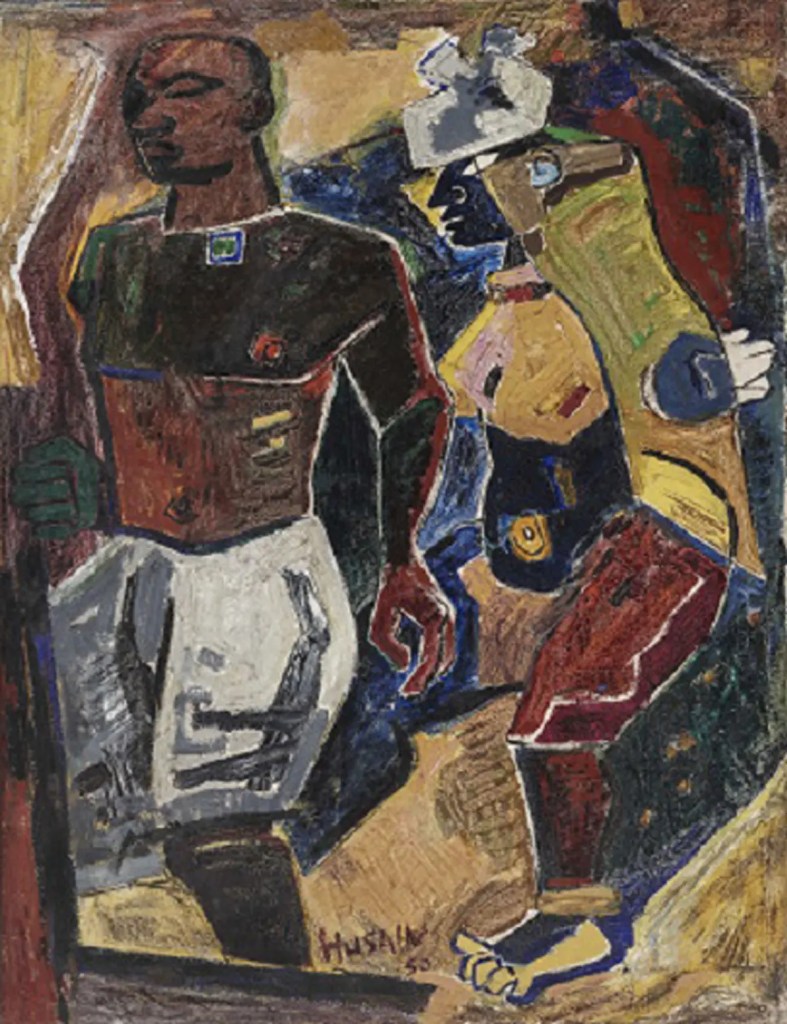
Peasant Couple (1950), painting by MF Husain (1915-2011)
Discard all prayers,
Meditation, hymns and rituals.
Why do you hide behind
Closed doors of temples?
In the darkness of the sanctum,
Who do you worship in secrecy?
Open your eyes and look,
There is no God in this house.

He has gone to visit the
Farmers who plough the hard ground,
The workers who break rocks for paths,
People who slog round the year.
He is there with them under the hot sun,
With dust-smeared hands;
Take off your garb of purity,
Join him in his dusty domain.

Nirvana? Oh! Where will you get it,
Where can you find freedom?
After Creation, our God,
Found himself bound to all of us.
Discard meditation, relinquish floral offerings.
Let your garments tear, your hands get dusty,
Join Him in His endeavours --
Free yourself of the rituals of religions.
  1. Sanchayita (literal meaning: collection) was published by Visva Bharati in 1931 to commemorate Tagore’s seventieth birthday. ↩︎

This poem has been translated by Mitali Chakravarty with editorial input by Sohana Manzoor 

.

PLEASE NOTE: ARTICLES CAN ONLY BE REPRODUCED IN OTHER SITES WITH DUE ACKNOWLEDGEMENT TO BORDERLESS JOURNAL

Click here to access the Borderless anthology, Monalisa No Longer Smiles

Click here to access Monalisa No Longer Smiles on Kindle Amazon International

Categories
Tagore Translations

Prarthona or Prayer by Rabindranath Tagore

Written in August 1906,‘Prarthona or Prayer’, was first published in Tagore’s collection called Kheya (Boat) brought out the same year.

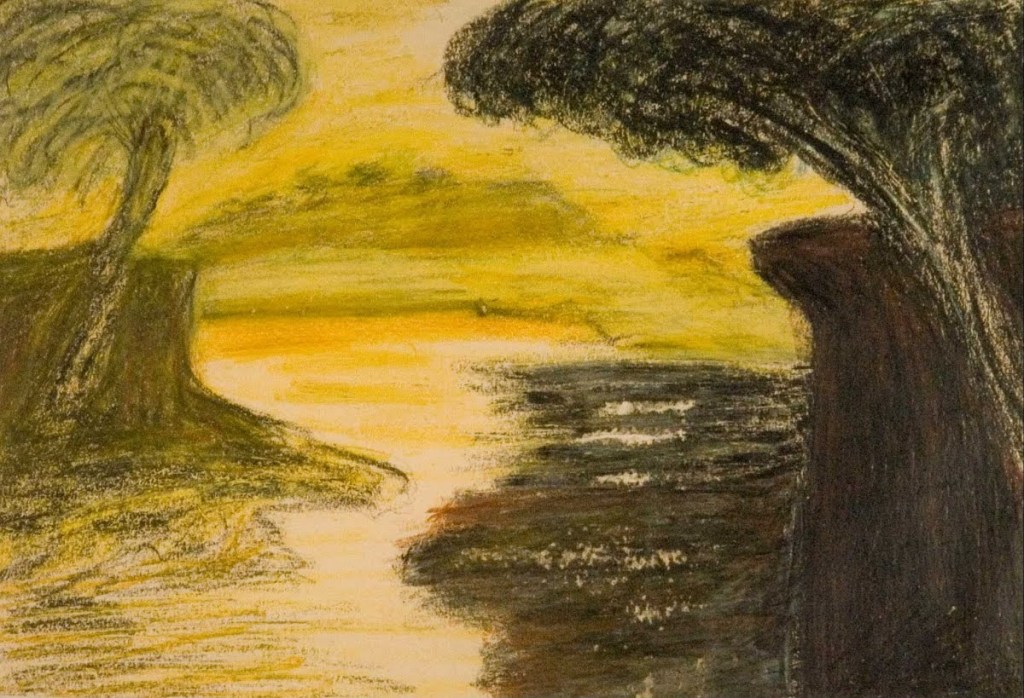
Art by Rabindranath Tagore(1861-1941)


PRARTHONA OR PRAYER

Despite all odds, I will not sell
Myself.
I want to stand with everyone
As a part of a queue.
In the morning light,
Shame should not sully me.
May I be enlightened by the
Permeating radiance.
I will not sell, not sell
Myself.

I will have a clear accord
With the world.
I will breathe in the breeze
That flits in the open skies.
My body will be purified by the
Affectionate touch of the Earth.
The trees will sway with the
Delight I experience.
I will be content with this
Accord with the world.

I will care for others and feel happy
In my heart.
Let no discordant notes sound
from the tunes of my bina*.
Whatever I experience, give me the
Strength to accept, let my
Heart be filled with the joyousness
Of the skies.
May the wellbeing of others fill my heart
With contentment.


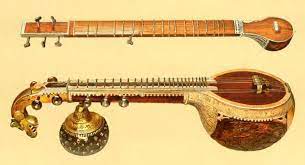
*Veena, a string instrument
Veena by Anurag Mehta

This poem has been translated by Mitali Chakravarty with editorial input by Sohana Manzoor

.

PLEASE NOTE: ARTICLES CAN ONLY BE REPRODUCED IN OTHER SITES WITH DUE ACKNOWLEDGEMENT TO BORDERLESS JOURNAL

Click here to access the Borderless anthology, Monalisa No Longer Smiles

Click here to access Monalisa No Longer Smiles on Kindle Amazon International

Categories
Tagore Translations

A Hundred Years Later by Rabindranath

Just as George Orwell (1903-1950) envisioned a bleak future in his novel, 1984, Tagore left his optimistic vision filled with hope for posterity – a vision which has also been borne true. Written in the Phalgun or spring of the Bengali year 1302 (1895), ‘1400 Saal or ‘The Year 1993’, was first published in Tagore’s collection called Chitra (Picture) in 1895. 

Art by Sohana Manzoor
   1400 SAAL or The YEAR 1993 

A hundred years from today…
Who are you reading my poetry
With eager curiosity?
A hundred years from today.
I won’t be able to give you
Even a small fragment of the
Exuberance of this spring morning —
A blossom or a birdsong,
The passions that
Drench us.
A hundred years from today…

Still, once, open your Southern door,
Sit by the window,
Gaze at the distant horizon,
And imagine —
One day, a hundred years before,
A lively, euphoric cluster wafted from
Heaven into the heart of the universe,
Like a new-born Phalgun day —
Free of ties, ecstatic and restless,
Adrift with the scent of flowers.
The Southern breeze
Rushed to colour the Earth
With a youthful glow,
One hundred years before you.
On that day, the soul of a poet soared
With a song-soaked heart —
To find words which bloom
With an abundance of love,
One hundred years ago.

A hundred years from today
Which new poet will strum
Lyrics in your hearths?
I felicitate the poet with delight
In your joyous spring —
But let my vernal songs,
Find echoes in your hearts for a while,
Like the buzz of bees,
Like the murmur of leaves...
One hundred years from today...

About 32 years down the line, Nazrul responded to this poem of Tagore’s with a rejoinder, which is from the standpoint of a young poet and depicts his adulation for the older one and his poetry. Nazrul’s poem in Bengali is also called 1400 Saal and has been translated by Professor Fakrul Alam. The translation can be read by clicking here.

This poem was also discussed and translations read in 1993, the Gregorian calendar year for 1400 in the Bengali calendar, in a function jointly organised by the Nehru Centre of the High Commission of India in London and the Tagore Centre of London and held in the premises of the Nehru Centre. The translations included a rendition of Tagore’s own rather brief and ‘loosely translated’ version, according to the keynote speaker and scholar, Brian A. Hatcher, published in the poet’s collection called, The Gardener and reprinted in The Collected Poems and Plays of Rabindranath Tagore (New York, 1966).

Tagore’s own vision of his songs being remembered after one hundred years has been not only borne true but also his hope that poets and poetry will continue to impact our lives, stirring hope and love in our hearts. The role of a poet as seen by Tagore, perhaps, is what Uma Dasgupta’s research on Sriniketan reinforces — as that of a visionary and not merely a recorder of events. 

Tagore reciting his ‘1400 Saal‘ in Bangla

This poem has been translated by Mitali Chakravarty with editorial input by Sohana Manzoor and research by Sohana and Mitali on behalf of Borderless Journal

.

PLEASE NOTE: ARTICLES CAN ONLY BE REPRODUCED IN OTHER SITES WITH DUE ACKNOWLEDGEMENT TO BORDERLESS JOURNAL

Click here to access the Borderless anthology, Monalisa No Longer Smiles

Click here to access Monalisa No Longer Smiles on Kindle Amazon International

Categories
Tagore Translations

Rabindranath’s Song about Surviving Conflicts

Tomar Kachhe Shanti Chabo Na (I Will Not Pray to You for Peace) by Tagore is a part Gitimalaya (A Garland of Songs) published in 1914.

           I Will Not Pray to You for Peace

           I will not pray to you for peace.
           Let me stay with my feeling of grief.
Amidst this wave of conflict, 
In the haze of the games you script, 
            I will swing towards my own dream. 

            Let the breeze blow off the lamplight,
            Let storms thunder in the sky —
Every moment in my heart,
I can sense your footfall. 
             In darkness, I strive to find my stream. 

You can listen to the song performed in Bengali by well-known artiste Swagatalakshmi here.

This poem has been translated by Mitali Chakravarty with editorial input by Sohana Manzoor on behalf of Borderless Journal

.

PLEASE NOTE: ARTICLES CAN ONLY BE REPRODUCED IN OTHER SITES WITH DUE ACKNOWLEDGEMENT TO BORDERLESS JOURNAL

Click here to access the Borderless anthology, Monalisa No Longer Smiles

Click here to access Monalisa No Longer Smiles on Kindle Amazon International

Categories
Tagore Translations

Rabindranath’s Hymn to an Autumnal Goddess

Written in 1908, Amra Bedhechhi Kasher Guchho (We have Tied Bunches of Kash) was published as a part of Gitanjali in Bengali in 1910.

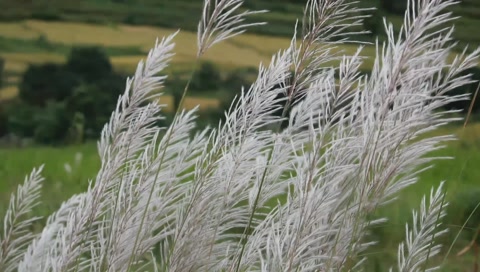
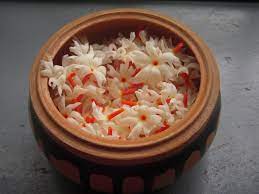
Kaash. Courtesy: Creative Commons
We have Tied Bunches of Kaash

We have tied bunches of kaash* and strung garlands of shefali.
We have decorated the wicker tray with new-sprung paddy. 
Welcome autumnal goddess on your chariot of white clouds! 
Ride on angelic azure paths,
Travel through clean bright glittering forested mountains.
Come wearing a crown of white lotus, sparkling with dewdrops. 
On the banks of Ganges, in a solitary bower
Carpeted with the flowers of fallen malati,
Swans flap their wings as your entourage. 
When you pluck the strings of your golden bina*,
Soft sweet notes, 
Usher laughter amidst transient tears. 
Like the magical parasmani* emanating light,
Stroke the flames of compassion in our hearts—
Brighten our thoughts and replace darkness with light. 

*kaash: Wild grass flowers
*Bina: Musical instrument 
*Parasmani: A magical touchstone

Bina. Courtesy: Creative Commons
A Bengali rendition of the song performed by a contemporary artiste, Rezwana Choudhury Bannya

In 1913, Tagore received a Nobel Prize for his own translation, Gitanjali: Song Offerings, published in England. Only 69 of the original 157 of the Bengali Gitanjali made it into the English translation.

An essay, ‘Publication of Tagore’s song offerings, the Gitanjali : A Study’ by Partha Pratim Ray, a librarian in Vishwa Bharati, contends: “Rabindranath Tagore himself took the task of the translation of Gitanjali (Song Offerings) when he sailed for England on 27 May 1912. There he handed over the poems to William Rothenstein whom he met earlier in Calcutta in the year 1911. Moved by the poems, Rothenstein in turn gave the poems to W.B. Yeats to read. The literary and artistic circle of Yeats decided to publish the poems after Yeats made a selection of them and wished to write an introduction to it. That is how Gitanjali was first published by India Society of London on November 1912.”

The article further elucidates: “The next edition of Gitanjali was published in the next year (March 1913) by Macmillan and Company, London. The number of poems in Bengali and English Gitanjali are not the same. In Bengali there were 157 poems, but in English it was 103. The poems were first published in different Kavyagrantha. At the end of the Indian edition of India Society or Macmillan there was a statement: ‘These translations are of poems contained in three books- Naivedya, Kheya and Gitanjali…’”

Yeats wrote the introduction for Song Offerings.  He wrote, “these prose translations from Rabindranath Tagore have stirred my blood as nothing has for years” and “Mr. Tagore, like the Indian civilization itself, has been content to discover the soul and surrender himself to its spontaneity.”

This poem has been translated by Mitali Chakravarty with editorial input from Sohana Manzoor on behalf of Borderless Journal

.

PLEASE NOTE: ARTICLES CAN ONLY BE REPRODUCED IN OTHER SITES WITH DUE ACKNOWLEDGEMENT TO BORDERLESS JOURNAL

Click here to access the Borderless anthology, Monalisa No Longer Smiles

Click here to access Monalisa No Longer Smiles on Kindle Amazon International

Categories
Tagore Translations

Sharat or Autumn by Rabindranath

Autumn expresses itself in Bengal as Sharat (early autumn) and Hemonto (late autumn). The Tagore pantheon of literature has much of seasons in it.  This poem, Sharat, was part of his poetry collection Kalpana, published in 1900.

Sharat by Sohana Manzoor.
Autumn 

I see your beauteous form
        In this autumnal dawn,
Oh! Mother Bengal, your green figure
          Is resplendent with radiance. 

The river cannot be contained in its bed. 
         The fields are overflowing with paddy. 
Robins chant and koels sing 
        In your graceful gardens.
Amidst this dawn of sharat,
        O Mother, you stand poised. 

Mother, the breeze chimes
       An auspicious onset —
Grains of new rice crops
        Fill homes with festivities.
You have no respite anymore.
        Sheafs of paddy move in bulk
Along rural paths wafting
          Their perfume in the draft. 
Mother, the zephyr sends you
          An intimation of the seasonal onset. 

The skies paint clouds 
      to welcome the season. 
Dewdrops have sprinkled
       Coolness on the green earth. 
The flute seems to play a melody that
        Wafts through the land, water and air.
Boats come crowding to your doorway
          From all directions. 
The sky is clear and blue. 
          The earth, soft and cool. 

The breeze starts to chill
       Refreshing tired bodies.
Every hut is filled with new hope,
         With the advent of new life. 
All over, Mother, abound events
           Organised by joyous faces. 
People grab fistfuls of happiness 
            From your overflowing granaries. 
The breeze rushes with anchals*
           Full of new life. 

Come, come, wherever you are, 
            Come running all of you —
Our Mother has opened her granary.
          Our grains are overflowing. 
Come by boat from the other bank,
           Mothers and daughters come.
Who cries in hunger under maternal care?
           Come running all of you. 
Our mother has opened her granary. 
            Our grains are overflowing. 
 
Our Mother wears a garland of shefali.
      Floral perfumes scent the earth. 
White, creamy cirrus clouds 
         Seem to stud her veil.
Crowned with a golden halo, 
       Sweet, glorious, green and resplendent, 
With feet dressed in blooms, 
        My mother stands poised. 
The whole world smiles at her illuminated
       With dewdrops, flowers and crops.


*Anchal is the loose end of a sari
Shefali or night jasmine. Courtesy: Creative Commons

This poem has been translated by Mitali Chakravarty with editorial input by Sohana Manzoor on behalf of Borderless Journal

PLEASE NOTE: ARTICLES CAN ONLY BE REPRODUCED IN OTHER SITES WITH DUE ACKNOWLEDGEMENT TO BORDERLESS JOURNAL

Click here to access the Borderless anthology, Monalisa No Longer Smiles

Click here to access Monalisa No Longer Smiles on Kindle Amazon International

Categories
Tagore Translations

Proshno or Questions by Rabindranath

Proshno or Question was written by Tagore somewhere between December 1931 and January 1932 and later published in 1932 in a collection called Parishesh[1]. The poem with its poignant overtones continues relevant to this date.

Art by Sohana Manzoor
Almighty, over eons, you sent emissaries
              To this ruthless world, 
They say: “Forgive everyone”, say, “Love only Love — 
               From deep within, toxicity purge.” 
In these cataclysmic times, I turn them away with a shamed bow
 For they now remain only as ideals to be revered, remembered.

I have seen the helpless persecuted by 
            Violence in the shadows of deceitful night. 
I have seen unprotesting truth victimised, 
             Justice weep secretly in plight.
I have seen passionate young men driven wild,
Beat their heads on rocks and tortured, die. 

Today, I am voiceless. My flute is stilled. 
            In the moonless night, who have filled 
 My universe with nightmares? 
            That is why cleanse with tears —
Those that poison the air, extinguish the light. O God, 
Have you forgiven them? Have you given them your love? 

One of the interesting things to note here is the reference to the flute player. Is he the same one who was evoked in his poem Ebar Phirao More (Take me back) written in 1894? That poem[2] starts with:

While the world moves busily
You play the flute, like a truant boy, 
Leaning under a shady tree in a field with 
The fragrance of the forest floating on 
A tired breeze. O, arise — there is a fire!

Is it the same flute player whose flute has been stilled?

.

[1] Translates to — At the End

[2] Our translation of Ebar Pherao More can be read by clicking here.

The poem has been translated by Mitali Chakravarty with editorial input by Sohana Manzoor on behalf of Borderless Journal

A video of Proshno recited by the poet in Bengali with subtitles by the you tuber, Swarup Dutta.

PLEASE NOTE: ARTICLES CAN ONLY BE REPRODUCED IN OTHER SITES WITH DUE ACKNOWLEDGEMENT TO BORDERLESS JOURNAL

Click here to access the Borderless anthology, Monalisa No Longer Smiles

Click here to access Monalisa No Longer Smiles on Kindle Amazon International

Categories
Tagore Translations

A Muslim Woman by Rabindranath Tagore


Translated from Bengali by Aruna Chakravarti, who adds: ‘The story, Musulmani’r Galpa[1], was published posthumously in July 1995 in the journal Ritupatra. In all probability, it was dictated from the writer’s sick bed just before his death in 1941.’

Veiled Woman, Ink on paper, by Tagore, National Gallery of Modern Art, New Delhi. Courtesy: Creative Commons

This is a story of long ago. Of a period in our history when the seeds of evil governance had sprouted thorns all over the land. When fear and anxiety had trapped the soul of the common man in the skeins of such a stifling web that all other emotions had dwindled and died. When imagined assault from demonic forces gripped all minds. When the simple act of living turned into a nightmare and trust could be reposed in neither God nor Man. When the line between good and evil had blurred and tears were the only reality…

In an age such as this, the presence of a girl was deemed a curse in a middle-class family. More so if she was beautiful. Porarmukhi![2]May your fair face burn to ashes! Curses such as these, bitter and stinging, were heaped on the poor girl. “If we could only rid ourselves of this accursed creature,” the women of the family wailed, “we might sleep peacefully in our beds.”

Such a situation, exactly, had arisen in the household of Bangshibadan, the talukdar[3] of Teen Mahala. His niece Kamala was beautiful. Worse, she was an orphan. Had she died along with her parents the family could have breathed easy. But she had lived on as a burden in her uncle’s household and was made aware of it every passing minute. “Just look at my luck sister,” her aunt was often heard complaining to the neighbouring women, “The parents dumped this monumental responsibility on my shoulders and left for the other world. Evil glances are cast at her from all sides. Anything may happen at any time. I have young children of my own and can’t sleep from fear of what will become of them. I live in constant dread…”

Bangshibadan didn’t share his wife’s annoyance at Kamala’s presence in his house. He loved her dearly and had brought her up with great solicitude. He kept her hidden from prying eyes, personally supervising her welfare and taking care of her needs. Life went on somehow but when a marriage proposal came for her, she couldn’t be kept hidden anymore. “I will wed her only into a family which has the means to protect her,” Bangshibadan was in the habit of saying, and now it seemed as though he had found what he was looking for.

The boy was the second son of Paramananda Seth, the zamindar of Mochakhali. People feared Paramananda for his money power but even more for the posse of hefty Bhojpuri lathiyals[4] he kept to guard his house and possessions. “There isn’t one son of a gun in the whole district,” the prospective bridegroom boasted to Bangshibadan, “who’ll have the gall to lay a hand on her.” He was very proud of his father’s wealth and had devised many ways of spending it. Falcon flying, gambling, bird fights…he was a master of all these pursuits. He was, as well, extremely susceptible to feminine charm. Though he had a wife already he was looking for another, younger, one and when reports of Kamala’s beauty reached his ears, he decided that she was the bride for him.

Kamala was appalled when she heard what her uncle had in mind for her. “Where are you sending me Kakamoni?” She burst into tears, “You may as well set me adrift in the river.”

“If I had the power to, protect you,” Bangshibadan replied sadly, “I would have kept you clasped to my breast for all time to come. You know that Ma…”

The arrival of the wedding party at the bride’s house was accompanied by a lot of fanfare. The sound of drums and pipes rent the air. Bangshibadan was alarmed. “Babaji,” he folded his hands before the groom, “It would be better if the noise was toned down a bit. It is unwise to attract too much attention.” But the groom was unfazed. “Let’s see which son of a gun…” he repeated his old line, his chest puffed out with importance.

 “I am a poor man with little clout,” Bangshibadan sighed and said, “I can’t vouch for the safety of everyone under my roof for long. I take responsibility only until the completion of the rituals. After that I will leave it to you to conduct your bride safely to your father’s house.”

“No need to worry. No need to worry,” The bridegroom twirled his moustache arrogantly and, watching him, the lathiyals were emboldened to twirl theirs as well.

It was nearing midnight when the wedding party set off with the bride for Mochakhali. A couple of hours later, while crossing the dreaded tract of land called Taaltarhir Maath, they were waylaid by the notorious dacoit Madhu Mallar and his gang. Bearing down on them with flaring torches and weapons far deadlier than lathis, the dacoits soon made short shrift of the lathiyals. The wedding guests fled in all directions abandoning the palanquin in which Kamala sat trembling with fear. Then, just as she was about to step out and try to hide in the bushes, she heard a man’s voice booming out of the dark. “Halt! Go back from where you came my sons. I am Habir Khan.”

Madhu Mallar and his gang stepped back instantly. They had great reverence for Habir Khan. In their eyes he was no less than a paigambar …a messenger from God.

“We can’t disobey you Khan Saheb,” Madhu Mallar said glumly, “but you’ve certainly ruined my business for the night.”

Habir Khan did not oblige him with a reply. Helping Kamala out of the palanquin he told her, “You are in great danger, child. You must leave this place at once. Come with me. I will take you to my house. It is only a short distance from here.” Seeing her shrink at his suggestion, he added, “I understand your reluctance. You are a Hindu, a brahmin’s daughter. It is natural for you to hesitate before entering a Muslim household. But let me tell you something. A truly devout Muslim respects a truly devout Hindu and won’t dream of harming him in any way. Trust me my child. You and your religion will be totally safe in my house.”

Habir Khan and Kamala walked through the woods till they came to a huge mansion. Leading her into one of its eight wings, he said, “This will be your home from now on. You will live here exactly as you did in your uncle’s house.” Kamala looked around. There was a yard with a temple at one end and a tulsi manch[5]at the other. The place looked no different from an upper-class Hindu abode. Everything she would need for her day-to-day living could be found here.

An elderly Brahmin came forward to greet her. “Come Ma,” he said in a kind voice. “Have no fear. This place is sacred. Your religion will be fully protected.”

Kamala burst into tears. “Please inform my uncle about what has happened. Tell him to come and take me home.”

“You are making a mistake child,” Habir Khan’s voice came to her ears, “After tonight’s incident you won’t find acceptance in any Hindu household. You’ll be thrown out into the streets.” He saw the expression on Kamala’s face and sighed. “Very well. I will take you there and let you see for yourself.”

Habir Khan led her to the door of Bangshibadan’s house and bade her go in. “I’ll be waiting here in case you need me,” he said.

Kamala flung herself on her uncle’s chest and wound her arms around his neck. “I have come back to you Kakamoni. Don’t send me away,” she begged. Bangshibadan’s eyes filled with tears. But before he could utter a word his wife burst into the room. “Throw her out,” she shrieked, “Throw the blighted creature out at once. She’s lived in a Muslim’s house. She’ll pollute us all.” Then turning to the weeping, shivering girl, she cursed and upbraided her in shrill penetrating tones. “Accursed one! How dare you show your face here after what you’ve done? Don’t you have any shame?”

Bangshibadan disengaged Kamala’s arms gently from his neck. “Forgive me Ma,” he said sadly. “I cannot take you back. I’m a Hindu. I’ll lose caste if I accept you. I’ll be ostracised by everyone in the village.” Kamala stood for a while, head bowed, then slowly made her way out of the house to where Habir Khan was waiting. She went away with him. The door of her old world was now shut against her for all time to come.

Kamala settled down in the rooms allotted to her. “All this is yours,” Habir Khan said to her waving his hands across the yard. “Not a single member of my family will set foot in this wing. Feel free to live in it the way you wish.”

This part of the mansion had a history. It even had a name. It was called Rajputani’r Mahal[6]. Many years ago, a nawab of Bengal had brought a Rajputani princess and installed her here. He had kept her with great dignity and made sure that she had no difficulty in practicing her religion. She was a very devout woman and an ardent worshipper of Shiva, so a temple was built for her in her own premises. She loved going on pilgrimages and arrangements for them were made with meticulous care. Over the years she became a role model for other Hindu begums and many of them found sanctuary under her sheltering wings.

Habir Khan was the Rajputani’s son. Though he followed his father’s religion he worshipped his mother like a goddess. He sought her guidance in every matter and it was from her that he had learned to respect the opposite sex. She had been dead these many years, but Habir Khan never forgot the vow he had made to her. To provide shelter to widowed and abandoned Hindu women. Scorned, persecuted, hated and stigmatised for no fault of theirs, many were forced to sell their bodies for a roof above their heads and a handful of rice in their stomachs.

As the days passed a realisation started dawning on Kamala. The freedom and comfort she enjoyed in this Muslim household was of a quality she hadn’t even dreamed of while living with her uncle. He cared for her but was powerless to protect her from ceaseless taunts, curses and abuses. She had grown so used to them… she had begun to think of herself as a blighted creature, a disgrace on the family, fit only to be thrown out on the streets. Here, in her new home, she was showered with luxuries. Every need of hers was taken care of by Hindu serving women. She was overwhelmed with kindness and love.

A few years went by. Slowly a change came over her. The winds of youth started to blow and her mind and body quivered with an unknown emotion. She fell in love with one of Habir Khan’s sons.

One day she opened her heart to her protector. Habir Khan’s face paled at her confession, but she went on calmly, “My love is my religion Baap jaan[7]. I have no other. I have worshipped many gods and goddesses in the past. I have poured out my heart and soul to them in prayer. I have begged for deliverance. Yet not one deity deigned to cast a glance at me or even send a sign that my prayer had been heard. What hope is left to me from a religion that leaves a poor, trusting, suffering girl rotting in a pit of abuse and persecution? I have known what it is to live, truly live, only after I stepped across your threshold. From you I’ve learned that even the lowest of human beings deserve love and protection.” Tears rolled down her cheeks. She wiped them away and continued, “From all the hardships I faced in life I have learned one lesson. The Lover and Protector is the true deity. He is neither Hindu nor Muslim. Baap jaan, I have given my heart to your second son, Karim, and my worship is now tied with his. In embracing Islam, I need not give up the faith I was born to. I can follow both.”

The marriage took place. Kamala’s name was changed to Meherjaan and she became a valued and integral part of Habir Khan’s family.

Now the time came for Bangshibadan to wed his own daughter. And history repeated itself as it is wont to do. While crossing Taaltarhir Maath the groom’s party was waylaid by Madhu Mallar’s men. They had been thwarted once. They were out for revenge. But as soon as they launched their attack a voice came out of the dark. “Khabardar[8]! Step back at once.”

Ore baba re[9]!” the dacoits ran helter skelter, “It’s Habir Khan!” Abandoning the bride to her fate the wedding guests did the same. Suddenly, a figure appeared on the scene holding a banner aloft on a spear. It was Habir Khan’s banner with his emblem, a half- moon, painted on it. But the bearer was a woman. Approaching the palanquin, she helped the trembling girl out of it. “Don’t be afraid Sarala,” she said, “Your elder sister is here to save you. From today you’ll be under the protection of the One who loves and provides sanctuary to all human beings irrespective of caste, creed or religion.”

Turning to her uncle she said, “Pronam kaka[10]. Don’t be alarmed. I shall not pollute you by touching your feet. Take Sarala home. No one has dared to lay a finger on her. She’s as pure today as on the day she was born. And tell kaki [11]that I never thought I could pay back the debt I owe her. The debt of food and shelter so ungraciously doled out while I was her dependent. I am doing so now.” Putting a red silk sari and an asan[12] covered with rich brocade into her uncle’s hands, she added, “I brought these gifts for Sarala. Take them. And remember, if she’s ever in trouble her Muslim sister will be there for her. To give her all the care and protection she requires.”

[1] Literal translation: A Muslim Woman’s Story

[2] An abuse which literally means burnt face

[3] Minor official

[4] Men wielding sticks

[5] Tulsi is Basil, holy for Hindus and manch is dias.

[6] Rajput princess’s palace

[7] Father

[8] Beware

[9] An exclamation of fear — Oh my father!

[10] Salutations uncle

[11] Aunt

[12] A small carpet

Aruna Chakravarti has been the principal of a prestigious women’s college of Delhi University for ten years. She is also a well-known academic, creative writer and translator with fourteen published books on record. Her novels JorasankoDaughters of JorasankoThe InheritorsSuralakshmi Villa have sold widely and received rave reviews. The Mendicant Prince and her short story collection, Through a Looking Glass, are her most recent books. She has also received awards such as the Vaitalik Award, Sahitya Akademi Award and Sarat Puraskar for her translations.

.

PLEASE NOTE: ARTICLES CAN ONLY BE REPRODUCED IN OTHER SITES WITH DUE ACKNOWLEDGEMENT TO BORDERLESS JOURNAL

Click here to access the Borderless anthology, Monalisa No Longer Smiles

Click here to access Monalisa No Longer Smiles on Kindle Amazon International