Categories
Review

A Technocrat Who Tended Many Gardens

Book review by Satya Narayan Misra
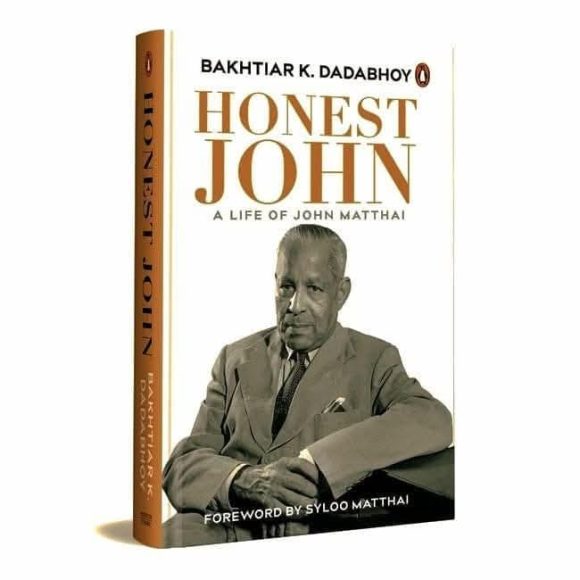
Title: Honest John – A Life of John Matthai

Author: Bakhtiar K Dadabhoy

Publisher: Penguin Random House

John Matthai’s name has little resonance for today’s generation, but he was one of the brightest stars in the firmament of his time, and even in retrospect. He cultivated many gardens, starting his life as a lawyer and later becoming a professor, administrator, banker, corporate leader, and Minister. In this delightful biography of Matthai, whom Nehru called “Honest John”, Bakhtiar K Dadabhoy tells us of the different hats worn by him. For his students in Madras, he was a shy professor who was one of the most lucid exponents of a dry subject like economics. JRD Tata would always turn to him for sagacious advice.

For Nehru, who greatly respected his ability and integrity, Matthai filled two cabinet posts, even though the parting was somewhat unpleasant when Matthai resigned as Finance Minister, as he feared that the newly created Planning Commission would be a ‘parallel cabinet’ and would be in perennial conflict with his department. CD Deshmukh, the redoubtable civil servant who succeeded him as FM in the Matthai Memorial Lecture said: “He was one of the most cultured products of India, having a perceptive and thoughtful mind, a sobriety of judgment of men and affairs, a rare concern for principles, scholarliness, with its flames kept lit by regular reading.”

He was the first Indian to get his DSc from LSE in 1916 and worked under Professor Sidney Webb, a Fabian socialist, who was at the height of his powers and fame. Though Webb was his guide, he was at no time a Leftist or socialist Professor of Economics. He had a thorough understanding of what free enterprise could do. He was one of the principal authors of the Bombay Plan, a memorandum submitted to the government in 1944 led by Tata, Birla and Thakurdas.  

The Bombay Plan represented a search for a new style of capitalism that would chart a middle path between state-led planning and private enterprise. This was in the background of a fierce intellectual debate fought in England between two towering economists, Hayek and Keynes.

While Keynes advocated active state intervention and the desirability of state-funded programs, Hayek favored non-interventionism and free trade. It was to the credit of Matthai that the planners envisaged a mixed economy, in which the state and the private sector would play a complementary role, thus proposing a visionary compromise between two systems, free market and state control.

Ironically, he resigned as Finance Minister after failing to reconcile with Nehru on the setting up of the Planning Commission. According to historian Rakesh Ankit, it was an individual and an institution that made the widening differences unbridgeable. It was Trone, born to Jewish parents and an engineer with General Electric involved in an electrification drive in the USSR, who impressed Nehru with his All India Plan of a ‘managed mixed economy’ that was sufficiently controlled to ensure equity.

While Nehru was taken by Trone’s view that a Planning Commission would reflect regional aspirations and diversity, and his view that Indian capitalists were only out to make profits, Matthai did not share his enthusiasm. In a letter to Nehru, he wrote that the Indian economy was like a “damaged ship and our job is to repair it and not as naval architects but experienced, competent workmen.” Nehru responded by defending planning as ‘a positive active policy’, giving examples of planned progress made by England, Germany, Italy, the Soviet Union, and Japan since the war.

Unlike Patel, who was a hard-headed realist, Nehru loved the abstract argument and delighted in drawing generalised inferences from situations that offered the slightest provocation to his nimble mind. Speaking six years later, after the Planning Commission was formed, Matthai said that “the planning commission has become a body of amateurs, with whom, for all practical purposes, the final decision rests in matters of economic development.” Most of Matthai’s fears about the Planning Commission proved to be well-founded. Critics like Kripalini and Rajagopalachari openly showed their displeasure. Rajaji founded the anti-socialist party.

Dadabhoy also gives a glimpse of how Liaquat Ali Khan, as FM in the interim government, proposed a business profits tax, an increase in corporate tax, a dividend tax, capital gains tax and a high-powered tribunal to deal with tax evasion. Matthai was the only non-league cabinet minister to defend the budget in public. But Patel and Rajgopalchari, who made no secret of being pro-capitalist, saw the budget as a way of harassing businessmen.

Ventilating his frustration with the hegemony planning enjoyed, he wrote to Nehru: “I fear a church is growing around the God of Planning”. However, planning remained the master narrative, and the plans laid the foundation for infrastructure in sectors like steel, fertilizers, cement and chemicals, promoting agricultural self-sufficiency and focusing on inclusive growth and social justice.

 Wavell noted in his diary on 5th March 1947, “Nehru, Patel & Bhabha find that the budget is not popular with their big business supporters and are trying to rat or hedge.”Matthai abolished the capital gains tax and reduced super taxes. Pandit Kunzru doubted, “If such reductions would lead to greater productivity. A time has come if free enterprise is to be given a free hand or the country should opt for a socialist economy.” It was only a decade ago that Prime Minister Modi abolished the Planning Commission without any discussion.

Matthai had an unconventional approach to budget presentation. He is the only railway minister to deliver a budget speech without a prepared text. In 1950, he chose to deliver his Union Budget speech extempore. Dadabhoy also brings out unknown facets of Matthai’s personality. He approached Nehru and Patel to bail out his son, who had run over someone while driving his car in Allahabad. Nehru was reluctant to help, but Patel intervened, and Matthai’s son was bailed out and quietly sent to England to escape the net of law. Matthai was known for his honesty and uprightness, but his fondness for his son blinded him to those values.

Matthai, despite his serious differences with Nehru on the issue of the Planning Commission, was a great admirer of Nehru. He wrote after his first meeting with him, “If he ever asked me to go to prison with him, I should find it difficult to refuse.” Mathai considered his long association with the Tatas to be the happiest period of his life. Sir Homi Mody, a Tata luminary later to become the governor of Uttar Pradesh was known for his wit. Homy contended, “Matthai had all the advantages of face, figure, manner, and voice and invested everything he said with an air of profundity. Matthai was a technocrat of different timber who did not mix personal respect with policy differences.”

Though trained under Fabian socialist, Sydney Webb, whom Nehru adored, he did not jump into the trap of socialism. He was a pragmatist who looked at India’s damaged ship, post-Partition, through the lens of competent workmen. Judging a visionary like Nehru and a pragmatist like Matthai can be a nightmare for any biographer. However, Dadabhoy skirts the issue with skill.       

.

Professor Satya Narayan Misra is a distinguished expert in Public Procurement & Contracts with over three decades of experience in the Indian Economic Service & Indian Defence Accounts Service. He has made significant contributions in drafting a manual for defence procurement and bolstering self-reliance in critical technology. He has authored seven influential books and published 127 research articles, including 18 in prestigious Scopus-indexed journals such as the Economic and Political Weekly (EPW) and Defence Studies (UK). He looks at macroeconomic issues through the lens of Constitutional expectations. He is a Professor Emeritus and a sought-after speaker on public policy, budget, development issues, and Constitutional Cases.

.

PLEASE NOTE: ARTICLES CAN ONLY BE REPRODUCED IN OTHER SITES WITH DUE ACKNOWLEDGEMENT TO BORDERLESS JOURNAL

Click here to access the Borderless anthology, Monalisa No Longer Smiles

Click here to access Monalisa No Longer Smiles on Kindle Amazon International

Categories
Nazrul Translations

The Day of Annihilation: An Essay on Climate Change by Kazi Nazrul Islam

Translated from Bengali by Radha Chakravarty

A very wise, experienced scientist has recently decided that the day our world will be annihilated (we may call it pralay or roz-qayamat) is not really as far away as we think. Let us discuss this, keeping in mind all the discussions on the subject that have been unfolding over the last few years.

In the last half-century, it has been observed that the floating icebergs in the South Polar region are expanding continuously. Edmund Smitharth, captain of The Edmont, first sighted an iceberg 580 feet high. Subsequently, Mr Scott saw an iceberg even higher than 600 feet. But a sailor aboard The Edgenta discovered, even in the ocean, a floating iceberg higher than 1000 feet, and that left the whole world wonderstruck. It was later calculated that this iceberg was 9612 feet thick: in other words, it was more than a mile and three-quarters wide.

In the southern hemisphere, the number of gigantic iceberg-clusters has been steadily increasing. And it is for this reason that the temperatures in the South Polar regions are rising tremendously. The remote floating iceberg-clusters in the North have created extreme cold weather in South Africa and South America. Other places can’t compare with these regions when it comes to freezing temperatures. Buenos Aires has recently experienced a snowfall. The country had never witnessed a snowfall before.

What does all this mean? In the opinion of Professor Lewis and other great scientists, the second Great Flood or Great Destruction of our Earth is imminent. Even if the whole world is not destroyed, there is no doubt that at least part of it will be annihilated.

The vast, sky-high ice-cap that covers the South Pole is 1400 miles in length. There is no knowing how many hundred miles wide it might be! Now, what will be the result of this continuous, unbearable warming of the atmosphere at the South Pole? Everyone knows that ice melts when heated. Hence, on account of the extreme heating of the South Pole, those thousands and thousands of giant iceberg clusters covering immense expanses of space will break and dissolve, and a mass of waves, surging sky-high, like the Himalayas in motion, will spread in all directions, drowning everything in their wake. First of all, the low-lying parts of the world, the southern continents will be afflicted by this great deluge.

In ancient times, our ancestors were terrified of comets, for they did not know what comets are. Our forefathers of subsequent generations had acquired more knowledge on this subject, but they too were very afraid of comets and considered them inauspicious. For they believed that the head of such comets was solid, hence a chance collision when passing so close to Earth might destroy the whole world.

Now we have got to know that the comet is not a solid unit, but vaporous like the mist. Hence, if by chance the odd comet does collide with Earth, it would not smash a deep crater into any part of our planet, nor would it fling us out of Earth’s gravitational field.

But the famous French astrologer Monsieur Camilles Flammarionhas arrived at a dreadful conclusion. It is his belief that the vaporous tail of the comet is full of poisonous gases, and hence, if the comet once comes into contact with Earth, all life on our planet will be extinguished by those toxic gases, in a single instant. The beauty, flavour and fragrance of  planet Earth will be wiped out forever!

The complete chemical explanation for the creation of comets is not yet within our grasp, but everyone can easily apprehend that the comet surely loads its tail with gas. This gas can easily suck the nitrogen from our Earth’s atmosphere, and if that were to happen, it would spell death for us, no matter what! It was not for nothing that our forebears disliked this thing called a comet so intensely! As the saying goes, ‘He appeared on the horizon of my destiny like a comet!’ For the fortunes of Earth, too, the comet is indeed inauspicious and harmful.

Anyway, if the comet sucks nitrogen from the air, then we will receive only oxygen. True, oxygen enhances blood circulation and physical as well as mental efficiency, but then, pure oxygen can be terribly dangerous. Hence, if we receive only volatile oxygen when we breathe, our body temperature will continue to rise, and eventually, we will burn to ashes.

In the Coal Age, the atmosphere of our Earth was heavily loaded with carbonic acid. In those times, humans could not have tolerated that air. Only fish and reptilian creatures survived in flowing waters and still air. Gradually, with the vast, extensive growth of plants, trees and vegetation, that poisonous still air began to disappear, the sky grew clear, and thus did this atmosphere become suitable for warm-blooded creatures.

At present, the human race is terribly busy mining coal and utilizing it. Do you know what age this coal belongs to? It can only be the legacy of that age many hundreds of thousands of eons ago when the atmosphere was full of carbonic acid, and of the trees and vegetation of those times, for even now, it is only the wild trees and vegetation that can absorb that carbonic acid.

Every lump of coal, every matchstick that is lit, depletes, daily, the oxygen that is vital for us. A famous English scientist has recently announced that the world’s supply of oxygen is continuously being dissipated, and therefore the air is also steadily becoming polluted. Hence the day is nigh when everything on earth will be transformed into the life forms of the age of carbonic acid.

Human beings will gradually become smaller and more fragile, until they begin to resemble Lilliputians and ultimately, they will become completely extinct! And then, it will end as it all began! In other words, just as fish and reptiles were the only life forms at the beginning, so also, in the future, the avatars of those humongous giant-fish and giant-reptiles will flourish again here, their health and vigour restored. Even the very thin, long, humble reptilian creatures of the prehistoric age, such as earthworms and snakes, will rule again over our mounds and ant-hills, in very large numbers.

If the human race gives up the harmful over-use of coal that we see today (just burning coal is wasting 1600 million tonnes of oxygen per year), and subsequently, if they manage with electricity as a substitute for coal, then we will again be forced to fall into the abyss of a new threat! In other words, whatever path you take, death is inevitable. We are caught between the devil and the deep blue sea!

The gradual transformation of the environment over time has become noticeable. Thunderbolts—especially, the incidence of thunderbolts in winter—are continually increasing. And the reason is simple: it is the clash between the electricity of the earth and that of the sky that is causing this barrage of thunderbolts! So, what is the way out? That is why, perhaps, Pannamoyi has already sung, as if to predict the future: “moribo moribo sakhi, nischoyei moribo!” (“I will die, I will die, O friend, for sure I will die!”)

Suppose, for instance, if we were to increase the current pressure on the atmospheric electricity a hundredfold or a thousandfold. Would flowers ever bloom again in basanta, the season of spring? Will new green leaves appear? Will the ardent downpour of varsha, the rainy season, ever moisten the earth’s bosom again? No, no, they wouldn’t! Instead, it is the thunderbolts that would become the regular daily occurrences on our Earth.  Struck by hundreds of thunderbolts every day, the earth would be torn apart. An astute meteorological scientist says, “Yes, yes, that is what will happen, ultimately!” How horrifying! What we should do now is, to convince ourselves, collectively, that the gentleman’s words are untrue, and he has misinterpreted the situation. Look at Sujji Mama—Surya the sun, our maternal uncle—our source of life and light! He not only creates light and heat, but is also the progenitor of electric power. And he the only mama we have, who will move circumspectly, to maintain the balance of this mysterious unknown force of nature. Long live Mama!

At present, Sujji Mama’s power is so tremendously forceful, that if all his rays and brilliance were to fall solely upon this poor earth of ours, then in just a minute and a half, the giant ice-mountains I spoke of earlier would all melt down and begin to boil. And if it lasted another eleven seconds, the vast ocean stretches of this world would all dry up, the earth’s surface cracking open to reveal yawning chasms.

But even Sujji Mama is growing diffident, and shrinking day by day. We don’t know yet how much mass his giant bodyloses, little by little, each day. Professor Burns vehemently declares that this shrinking of Sujji Mama is progressing at a very rapid pace. So rapid that we can’t even hazard an approximate guess. In a very short time, observing the reduction in the sun’s heat, we will be able to understand whether it is actually shrinking or not.

Shrinking to a smaller and smaller size in this manner, when Sujji Mama gives up the ghost—in other words, when he ceases to exist— it is terrifying to even imagine what the plight of planet Earth will be. All the water will freeze and become harder than stone, but it will be a fine sight—dazzling as a diamond! This air, which we can’t see at present, will then descend in a shower of giant drops. These will again collect in the cavernous spaces, and turn into lakes clearer than glass, but waveless, indifferent, unruffled! For no breeze will blow then, after all. In the harshness of the merciless cold, the whole Earth will then become frozen, still, immobile. Only fog and a dim mistiness will remain.

The sun will gradually turn red, and remain the same hue of red all day. Just like a half-cooled, burning, molten iron mass! In the daytime itself, the whole sky will fill with even brighter stars! Let us pray to Allah the Great!

[From Selected Essays by Kazi Nazrul Islam. Translated by Radha Chakravarty. New Delhi: Penguin Random House & Nazrul Centre for Social and Cultural Studies, 2024. Published with permission from Penguin Random House India}

Born in united Bengal, long before the Partition, Kazi Nazrul Islam (1899-1976) was known as the  Bidrohi Kobi, or “rebel poet”. Nazrul is now regarded as the national poet of Bangladesh though he continues a revered name in the Indian subcontinent. In addition to his prose and poetry, Nazrul wrote about 4000 songs.

Radha Chakravarty is a writer, critic, and translator. She has published 23 books, including poetry, translations of major Bengali writers, anthologies of South Asian literature, and critical writings on Tagore, translation and contemporary women’s writing. She was nominated for the Crossword Translation Award 2004 and the Pushcart Prize 2020. 

.

PLEASE NOTE: ARTICLES CAN ONLY BE REPRODUCED IN OTHER SITES WITH DUE ACKNOWLEDGEMENT TO BORDERLESS JOURNAL

Click here to access the Borderless anthology, Monalisa No Longer Smiles

Click here to access Monalisa No Longer Smiles on Amazon International

Categories
Interview

Folklore, Fiction, Ghosts and Grammar

Storytelling is central to the life and work of Malaysian author, editor and teacher, Daphne Lee. Keith Lyons finds out what keeps her up at night.

When I1 first met Daphne Lee in person, in a Chinese Buddhist cafe in Christchurch, New Zealand, on a summery day. I was struck by her curiosity. And I came away impressed, not just by how she delights in hearing ghost stories, myths, supernatural tales, and folklore but how she makes connections to the universality of storytelling, and what lies beneath.

Daphne Lee

As well as being a collector and curator of stories, she’s a writer, a creative writing teacher, and an editor—since 2009 she’s been consulting editor at Scholastic Asia.  She’s been active in supporting the work of writers and illustrators of children’s and young adult literature with Asian content. Daphne curated and edited Malaysian Tales: Retold & Remixed (ZI Publications) in 2011 and Remang: An Anthology of Ghostly Tales (Terrer Books) in 2018, while Bright Landscapes, Daphne’s first collection of short stories, was published in 2019. She’s working on a new short story collection, and her first novel, which she is currently revising while in New Zealand on a writing retreat, far from the streets of Kuala Lumpur and her Roman Catholic school upbringing.You can find out more about the multi-talented Daphne at her website https://daphnelee.org/.

Interview with Keith Lyons

What inspired you to create Remang: An Anthology of Ghostly Tales?

Malaysians love ghost stories. We would rather any misfortune or unusual occurrence be caused by a spirit or other supernatural phenomena than try to figure out a logical reason. Having said that, I don’t believe in ghosts, but I do enjoy ghost stories. I thought it would be fun to edit a collection of these, but I was wrong …  

How do you approach writing and curating ghost stories? What elements do you feel make a truly eerie and memorable tale?

I prefer a story to suggest a mood and to be atmospherically or suggestively spooky than to be full of gory and blood-curdling details. I like the sort of ghost stories that are frightening only if you read between the lines or that seem unremarkable at first, but months later, you suddenly realise what it all means.

Your work often draws from Asian folklore and supernatural beliefs. Are there any particular myths or legends that have influenced your storytelling?

Nothing in particular, but I have heard the same stories all my life and with surprisingly few variations and differences. I enjoy retelling the old tales or building on elements in them. Hopefully, I make a completely new story, but with recognisable features because I like reading stories in which there are some familiar details.  

Do you have a personal ghost story or supernatural experience that shaped your interest in this genre?

My family lived in a haunted house in my hometown (Segamat in Johor, the peninsula’s southern-most state) and we experienced things like lights going on and off, footsteps, odd, unexplained sounds, and so on. I can’t remember much, but I don’t think any of us ever felt threatened during the eight years we lived there. If there were spirits, they were not malevolent. My interest in the supernatural was probably more shaped by the films I watched as a child, including The Exorcist and the Hammer House of Horror — Dracula films starring Christopher Lee.

As an editor, what do you look for in a compelling ghost story?

The problem with the ghost stories we tell one another is that they are usually just anecdotal fragments. I look for fully-formed stories with well-developed characters—the ghostly element might even seem merely incidental to the plot yet be significant enough to make an impression. It should haunt you a long time after you’ve stopped reading.

How do you balance creative freedom with maintaining a strong thematic or narrative structure in an anthology?

I’ve curated two anthologies—one of ghost stories and the other of retellings of folktales, myths and legends. For both the brief was quite open and I welcomed a variety of styles and voices.

What are some of the challenges you face when working with authors, particularly in speculative fiction and folklore-based stories?

I find that when it’s an open call, it can be challenging to gather enough suitable stories for an anthology. Once you’ve made the selection, the editing process is usually long and laborious, with more back and forth than the deadline allows. It’s a much more straightforward process when experienced authors are invited to contribute to an anthology. With the authors published by my day-job (at Scholastic Asia), the major challenge is when the author is too precious about what they’ve created and is adamant about retaining something that doesn’t work or refuses to/is unable to develop a half-formed idea. Fortunately, that has rarely been the case. It’s imperative that authors trust their editors and, thankfully, I’ve had a good relationship with most of the writers with whom I’ve worked.

Youve been deeply involved in the Malaysian publishing scene. How has the landscape for local horror and supernatural fiction evolved over the years?

I’m not directly involved in the scene as most of my work as an editor is with an American publishing house, albeit its Asian imprint. However, I am a reader of locally published books and do read some supernatural fiction written in the Malay language. When I was a teenager, I was a fan of a series of books with the series title Bercakap Dengan Jin (Talking with a Jinn)—they were dark tales that featured a witch doctor, set in rural Malaysia, with lurid covers and badly designed interior pages. The production value of horror fiction has improved, but the stories that are most popular are still the ones we are familiar with, especially about the ghosts that haunt every school and hospital in the country. They are hastily written and barely edited, with high print runs—horror sells, second only to romance novels.

How important is it for Malaysian and Asian supernatural stories to be represented in the broader literary world?

The world needs to realise that there is more to Asia than just what the West is showing it. Right now, a handful of houses controls what most of us are exposed to and end up reading. Even if Asian fiction is getting on the shelves, it’s only what these publishing houses have decided is worthy. In Asia, especially those countries that were colonised, readers are still stuck with the idea that books out of the UK and the US are better than those published locally. In Malaysia, we have some authors who have ‘made it’ in the West—people like Tan Twan Eng, Tash Aw, Preeta Samarasan and Zen Cho. They are excellent writers, but I don’t know if many Malaysians would pay attention to their work if they were published by Malaysian houses. Unfortunately, we don’t appear to be very discerning readers. Penguin Random House SEA, which runs out of Singapore and is riding on the Penguin brand, fails to offer sufficient editorial support to its authors and seems to be prioritising marketability and quantity over quality. Readers buy the books because Penguin is supposed to equal quality. Writers sign contracts with the house because they recognise PRH as a popular brand with a great reputation. They complain about the poor editing but choose to stay with the company. This is a kind of horror story too!

Do you think traditional ghost stories still resonate with modern readers? How do you adapt them to contemporary audiences?

I think so. I think part of the attraction of ghost stories is that people like to be scared as long as they can also feel safe while feeling terrified. Traditional ghost stories are the perfect comfort reads. They are thrilling yet familiar. You know what’s coming—all the scary bits, but there’s usually a happy ending too, when the ghosts are put to rest and the humans go back to their boring lives.

Many Western readers are familiar with ghosts like the vengeful spirit or the haunted house trope. What uniquely Malaysian or Asian ghostly elements do you wish more people knew about?

The Asian ghosts most familiar to Western readers are probably the Japanese yokai. Once again, there is a degree of gatekeeping going on. A Malaysian author I know was looking for a lit agent and was told that although her writing was good, her stories were ‘too South-east Asian’. What does that even mean? Western publishers and agents underestimate the ability of readers to relate to subjects unfamiliar, especially when they originate in South-east Asia. Often you hear that a publisher or agent already has a South-east Asian on their list and does not have room for more. Yet, there are officially eleven countries that make up the region. They are not interchangeable, and do not share a common language, history or culture. Malaysia has many types of ghosts and they each reflect the various beliefs and attitudes Malaysians have towards life and all its big and petty questions. To know these spirits is to know the fears and anxieties of the common Malaysian.

Youre planning an online archive of Malaysian folktales. Could you share more about this project and why its important to preserve these stories?

I was recently on a panel about folktales with two other Malaysian authors who write books that draw on folktales for inspiration and one of them said that the folktales that stick around are the ones that mean something to the community. This may have been true in the past when folktales were shared orally. These days, the ones that survive are those that get included in collections or are retold and reimagined into films etc. The same ones get recycled time and time again, probably because they are the most dramatic or sentimental. Collecting as many folktales as possible and storing them online gives them all a fair chance of surviving. What may be insignificant to one generation, may resonate for another. The main thing is to let each generation decide, and for the stories to be available and accessible.

Bright Landscapes was your first personal collection of short stories. How did that experience differ from curating Remang?

For Bright Landscapes I had only myself with whom to argue and disagree. My editor and I were, fortunately, on the same wavelength, but she really helped me improve on the quality of the stories. I wouldn’t undertake another project like Remang unless more time and more resources were available.

Can you share any details about your upcoming novel? What themes or ideas are you exploring?

During the pandemic I completed a novel but on reading it, I realised how rubbish it was. It’s very close to my heart, but I think it’s not quite the right time for a rewrite. It needs to ‘cook’ more, in my subconscious. That novel is set in a world where gods and humans live side-by-side, during a time of religious reform. The protagonists are a priest and a deity, and the story deals with questions of friendship, integrity, religious belief, and faith. I have a second novel that I am currently working on—a coming-of-age story set in a convent school in a small Malaysian town in the 1980s. It also explores questions of friendship and faith. I attended two Convent schools from age five to seventeen, and I was raised Roman Catholic. I did think of becoming a nun when I was in my early teens, like the protagonist of my novel, but I have been an atheist since my early twenties, although I am now probably more agnostic than anything. Religious belief and faith are subjects fascinating to me.

As a creative writing teacher, what advice would you give to aspiring writers interested in supernatural fiction?

The same advice I would give any aspiring writer: Read widely and voraciously. And write every day, about anything and everything.

If you could collaborate with any author—living or deceased—on a ghost story, who would it be and why?

I don’t want to collaborate with anyone, but I would like to have a conversation with Elizabeth Bowen about the handful of ghost stories she published. They are my favourites—quiet, mysterious, melancholy, sardonic. I have questions about them that still keep me up at night, decades after I first read them.

  1. Keith Lyons ↩︎

Keith Lyons (keithlyons.net) is an award-winning writer and creative writing mentor originally from New Zealand who has spent a quarter of his existence living and working in Asia including southwest China, Myanmar and Bali. His Venn diagram of happiness features the aroma of freshly-roasted coffee, the negative ions of the natural world including moving water, and connecting with others in meaningful ways. A Contributing Editor on Borderless Journal’s Editorial Board, his work has appeared in Borderless since its early days, and his writing featured in the anthology Monalisa No Longer Smiles.

.

PLEASE NOTE: ARTICLES CAN ONLY BE REPRODUCED IN OTHER SITES WITH DUE ACKNOWLEDGEMENT TO BORDERLESS JOURNAL. 

Click here to access the Borderless anthology, Monalisa No Longer Smiles

Click here to access Monalisa No Longer Smiles on Kindle Amazon International

Categories
Excerpt

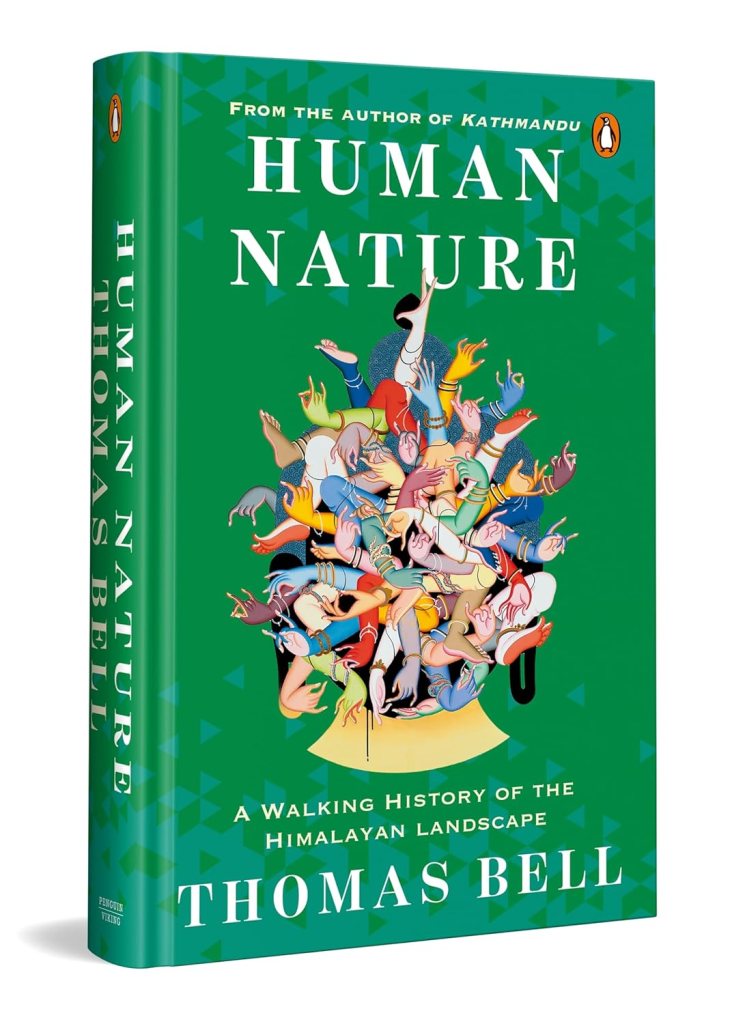
A Walking History of the Himalayan Landscape

Title: Human Nature: A Walking History of the Himalayan Landscape

Author: Thomas Bell

Publisher: Penguin Random House

On the plane from Kathmandu I could see the thunderheads building over the eastern hills, after a month of drought. At the bus park, when I claimed my place in the front of the jeep, the soldier who’d already taken his said, ‘This is going to be awkward.’ He spent the first part of the journey asleep on my shoulder.

The road climbed through the clouds and tea gardens of Ilam. The neat little tea hedges were whorled around the round hills like the ridges on a fingerprint. The air was opaque with condensation, like every time I’ve been there. I was once told that this continually cloudy weather—‘the sun never shines, it’s so depressing!’—accounts for the fact that Ilam has the highest suicide rate in the country. But a woman from here, whom I met in Kathmandu, said, ‘No, it’s because the kids’ parents won’t let them be with whom they want to be; they’re lovesick, then their exams come, they come under even greater pressure, feeling their whole lives are at stake, and they drink poison or jump in a river.’

The music in the jeep was loud, and there wasn’t much conversation until we began descending into Phidim in declining light. Beyond the steamed-up glass we saw a blur of rain, cloud and forest, the lights of the town below, and white flashes of lightning. ‘Mother!’ squealed the young woman in the back, and the passengers began talking about deaths by lightning. In his home district they’re quite common, Rajendra said. ‘The victims are burnt black-black!’ The jeep dropped people off at various places, lastly me and Rajendra at a hotel. He carried most of the bags and fishing rods upstairs.

That evening in the hotel restaurant I was joined by an engineer, who was living there while he worked on a hydropower project. It was stormy outside. We drank whisky and talked about fishing, which he was interested in, and about walking routes. After we’d been talking for a while, and it seemed I knew enough to get around, he asked why I needed a guide, referring to Rajendra, who he’d seen carrying the rods upstairs.

‘I need someone to help me with my stuff,’ I said.

I was planning to walk down the Tamar River, do some fishing, and make our way back through the hills to Kathmandu in two or three weeks. ‘Start your walk from the village of Majhitar,’ the engineer said. ‘It’s on your way, and the fishing will be good where a stream flows into the Tamar.’

In the morning a car from the engineer’s project took me and Rajendra and dropped us a few kilometres away, which was as far as the road stretched then. The map I had was only ten years old, but very out of date, because in a short time the hills have filled with roads. The footpath leading from Phidim towards the Tamar was in the process of becoming the Mid-Hill Highway, a major project that will coil over ridge after ridge across the whole country. We began tramping along the unfinished surface towards Majhitar.

Except for last night’s squalls, the weather had been dry throughout the hills. Forest fires were in the news. Here, the villagers were ploughing in preparation for more rain, whereupon they’d plant maize. Where the immense red slopes were too steep to farm they were thinly forested with sal trees, which had shed their leaves to endure the arid spring. The braided streams of the Tamar came into view beneath us. After last night the water was a dirty, concrete grey. The road descended to Majhitar.

The name of this village means that members of the fishermen’s caste—Majhi—are living on a flat piece of alluvial land called a tar. The first people we reached were rethatching their house ahead of the monsoon. Their nets were hanging in the rafters. Rajendra stopped to talk, and they fried some minnows for us. ‘There are fish in this river as big as ourselves,’ the Majhis said, ‘but there’s no chance of catching them in this black water.’ They showed us the thick lines and 2-inch hooks they use, baited with minnows, to catch the big ones. ‘Fish eat fish?’ Rajendra asked.

For the rest of the day we crossed the slopes high above the black waters of the Tamar. We climbed steeply through a burnt forest, the path levelled out among fragrant pines, then we walked all afternoon in grinding sunshine, through leafless jungle with little to drink. The brightness, heat and thirst, last night’s whisky, the weight of my bag, and the awkward load of fishing rods swinging around my body made the world contract. By the end of the day I’d withdrawn into determination only to reach the village where we’d stay. When we got there the villagers asked us, for some reason, ‘Are you from the land registry department?’ They were also Majhis.

Archaeologists have speculated that fishing villages were the first permanent settlements, because even before agriculture they had a source of food in one place. It seems plausible that a similar principle is relevant here. This village, which only consisted of half a dozen stone huts, was built on a naturally formed terrace about 20 yards above the river. Each hut was a single windowless room, with a wall-less sleeping platform above it under a pitched thatch roof. Drunks were asleep on steps and benches at the end of the afternoon. We put our stuff down and were shown which house would take us. Rajendra and I asked them to prepare daal and rice for us, but they said they had no daal.

‘Vegetables then?’ They had no vegetables.

‘Can I have a cup of tea?’ There was no tea.

‘Then give me a cigarette.’ There were no cigarettes. They rolled the tobacco they grew in strips of fibre from their maize cobs.

About the Book

Human Nature, Thomas Bell embarks on four walks through the Himalaya, each in a different season, to explore the interplay between the land and the people who call it home. This evocative history entwines travelogue with folklore, literature, art and anthropology, offering a nuanced portrait of life over the centuries in one of the world’s most enigmatic regions.

Bell’s decades of living in Nepal give him an unusual perspective that bridges the gap between insider and outsider. The stories told to him touch on themes from religion to ecology and political economy, and from pre-history to the present day. He also deftly examines the impact of British imperialism and the growing external pressures on the environment.

Accompanied by striking photographs, Human Nature is a magnificently written account that spans big ideas and real lives. Erudite, intimate and evocative, this is essential reading for anyone seeking to understand the relationship between communities and their environment.

About the Author

Thomas Bell was born in the north of England. After university, he moved to Nepal to cover the civil war there for the Daily TelegraphThe Economist and other publications. He was the Southeast Asia correspondent of the Daily Telegraph, before returning to Kathmandu where he was a political officer for the United Nations during the peace process. His earlier book, Kathmandu, is a history of Nepal’s capital.

.

PLEASE NOTE: ARTICLES CAN ONLY BE REPRODUCED IN OTHER SITES WITH DUE ACKNOWLEDGEMENT TO BORDERLESS JOURNAL

Categories
Review

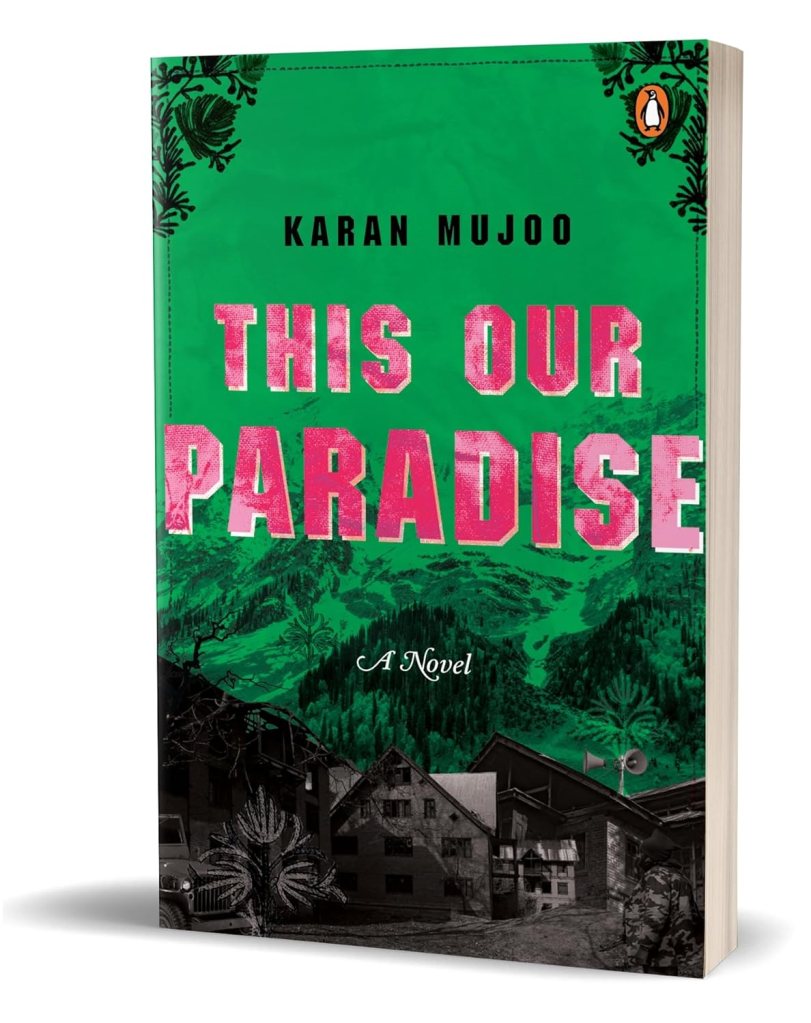
This Our Paradise

Book Review by Somdatta Mandal

Title: This Our Paradise: A Novel

Author: Karan Mujoo

Publisher: Ebury Press (an imprint of Penguin Random House)

A debilitating symptom of exile is unfamiliarity with your homeland” – Karan Mujoo

For ages, Kashmir had been defined as a paradise on earth. However, with the advent of insurgency, political unrest, strife, bloodshed, terrorism and insecurity for the past several decades, this picture of the ideal and beautiful place has been largely shattered. This debut novel by a person of Kashmiri origin, now settled near Delhi, is a moving tale of the ground realities that have been taking place in this region for a long time. Adding the suffix of “A Novel” to the title, the author obviously wants to steer clear of all the controversies that might arise because as he himself states in the “Author’s Note” at the end, “the names and places in this book are a mix of the real and the imaginary… Certain incidents in the novel are based on real events. But their details have been imagined. Hence the names of victims and perpetrators have been changed or tweaked.”

The author was acutely aware of the fact that Kashmir is too large a canvas to be contained in a single book or movie, and so he tells the story of two Kashmiri families, one Hindu and the other Muslim. The stories of both families intertwine tragically in the end. In both cases, the boys are at the mercy of forces much larger than them. Both lose their Kashmir, in different ways. The first story is of a Kashmiri Pandit family who, when the narrative begins, is moving half-heartedly from their house in Bagh-i-Mehtab in Srinagar to their new home in Talab Tillo in Jammu, which was just a dilapidated 12×12 foot hovel with a tin roof and crumbling walls. The patriarch Papaji is a clerk in a food cooperative and his wife Byenji is a homemaker. He is very optimistic that all this is a temporary affair. He still believed in the inherent goodness of people, in ties built over generations and that things would soon turn for the better. The narrator is their eight-year-old grandson who is one of the thousands of children of exile who had nothing to do, nowhere to go. He spent his days playing cricket and climbing the tangkul [1]in the garden. Everything is rosy till 1989. But then, propelled by ISI and the Jamaat, a secessionist movement rises and changes everything. There was gun culture everywhere. For the media, too, Kashmiri Pandits became disposable footnotes in a far greater struggle. Slowly they joined the ranks of the forgotten and became a tragedy that could not be prioritised. At the end of the novel, we find that the idea of exile which harboured within it the hope of return, did not apply to them anymore. They were truly displaced.

Mujoo juxtaposes the earlier story with the story of a Muslim family, set in Zogam, a small village in Lolab Valley. There, after years of prayers, a boy named Shahid is born to Zun and her husband in 1968. Quarantined from everyone else in the village, Sahid’s days passed listening to tales and making them up. As a result, he slowly developed into a shy, quiet boy who found it difficult to mingle with others and liked being with nature. Compared to the slick city dwellers, the people of Zogam seemed like wretched beings with no dreams and ambitions. They were content with their lot because they were not exposed to the luxuries and opportunities life held. Sahid gradually grew up in a society where corruption and unemployment were rife. He made friends with Rashid, who believed that the system had to be dismantled. The trajectory of his life changes when he meets Syed Sahab ― an Islamic theologian and rabble-rouser, who wants to overthrow the Indian state. He brainwashes the young boys into believing that the day they made Sharia their lives, their lives would become Jannat[2]. He preached that Jihad[3] was coming to the Valley soon, and everyone should be ready for it.


The next section takes us back once again to the Pandit protagonists and their life story. The year is 1968 and our young narrator gradually turns worldly-wise when he is taken to different places by his young uncle, Vicky, including the Dal Lake and the Sheikh Colony – a settlement of sweepers, scavengers and tanners who were reviled by all Kashmiris. Believing that education would relieve them of all penury and social ostracisation, Vicky becomes their temporary teacher. Without the knowledge of his parents, he gradually gets enmeshed within other radical ideas and different military groups that had emerged in the city. On the other hand, Shahid realised he could either be a clerk and part-time Jamaat[4]sympathiser or a full-time Jamaat worker. In the end, he opts for the latter and believes that he was no longer a poor farmer’s son from Zogam whose life and death were insignificant.

An interesting section of the narrative told in minute details is how the young jihadis[5] are escorted over the difficult mountain terrain by a Gujjar guide and clandestinely taken across the border to makeshift and rudimentary Pakistani camps in Muzaffarabad. The aim was to indoctrinate the boys in orthodox Islamic ideology and impart basic military training. They were brainwashed into believing that the most important thing was to attack all symbols of India: blow up government banks and offices, kill army and police personnel, murder judges, bureaucrats, teachers, politicians, cripple the state, silence all the voices who oppose the Tehreek[6] and instill the fear of Allah in the hearts of all unbelievers. After they are once again brought back to the Indian side, the boys turn into hardcore terrorists and Sahid is no exception. No matter how hard his parents tried, he had simply become one of the thousands of boys who were ready to fight for the cause.

Without giving out further details of the parallel storylines, we can conclude by stating that through this book Karan Mujoo has tried to ask some fundamental questions. How does a boy become a terrorist? How does society crumble?  What forces a family to go into exile? To serve this need, to create a picture of these chaotic years, he has attempted a certain sort of distillation. He only hopes that the illusion has been marginally successful. Through the vividly drawn characters whose lives intersect with one another, each navigating their own paths through love and life, the author successfully captures the essence of human experience and the eternal yet illusive search for paradise.

We have been reading fictional and non-fictional accounts of the problems in Kashmir for a long time, but the painstaking way in which this debut novelist has tried to give us the entire scenario in a nutshell is praiseworthy. The book is strongly recommended for all readers who would find the universal quest for happiness really moving, and how the author has blended fact and fiction with remarkable ease.

.

[1] A pear tree

[2] Paradise

[3] Holy war

[4] Party, community or assembly

[5] Warriors of Jihad

[6] Cause

Somdatta Mandal, critic and translator, is aa former Professor of English at Visva-Bharati University, Santiniketan, India.

PLEASE NOTE: ARTICLES CAN ONLY BE REPRODUCED IN OTHER SITES WITH DUE ACKNOWLEDGEMENT TO BORDERLESS JOURNAL

Click here to access the Borderless anthology, Monalisa No Longer Smiles

Click here to access Monalisa No Longer Smiles on Amazon International

Categories
Poetry

A Beach Novel with a Difference…

In Conversation with Suzanne Kamata about Cinnamon Beach, published by Wyatt Mackenzie Publishing, and a brief introduction to her new novel.

Cinnamon beach by Suzanne Kamata seems to be ostensibly a normal romantic novel but there is an aspect that makes it unique. It glues all colours of humanity together. Almost all the families in her narrative are of mixed heritage or multiracial. She has stepped beyond the veneer of race and nationality to highlight that all humanity has the same needs— for love, acceptance and kindness, irrespective of colour and creed, a gentle reminder in a world that is moving towards polarisation in terms of constructs made by human laws.

Set against the backdrop of the Cinnamon Beach, the narrative shuttles through two countries that she has called home — Japan and USA. There are autobiographical elements woven into the narrative but perhaps, they halt in becoming lived experiences. The protagonist, upcoming writer, Olivia Hamada, an American married to a Japanese, has lost both her job and finds her marriage in doldrums when she visits her sister-in-law, Parisa. Parisa is a renowned fashion designer, daughter of an immigrant Indian and has lost her husband, Ted, Olivia’s elder brother. It is a poignant story with Olivia and her deaf daughter, Sophie, falling in love with a star, Devon, and his son, Dante respectively — both persons of colour. Devon’s ancestors were brought in from Africa. So how mixed are the races – Sophie is half Japanese-half American and Dante is part African-part American!

The narrative start simply and gains nuances as it progresses. There are comments and conversations that introduce twists and turns to explore attitudes and prejudices.

At a point Kamata tells us: “She’d heard, several years ago, of a revolt at a liberal college cafeteria in protest of its serving sushi. And there was that dust-up over a reality TV star using the name ‘kimono’ for her new line of shapewear. Perhaps she had been wrong to ever go to Japan in the first place. But she had done it and she had gone and written a collection of short stories heavily inspired by events in her real life, and now, here she was.” The bias against Japan that led to the destruction of Hiroshima and Nagasaki are hinted at conversationally – world events that conspired more than eighty years ago. Why do such biases still exist today when we have moved forward so much technologically?

When Olivia asks Devon why he never liked to talk race or indulge in activism, he tells her, “It’s just that I would rather build bridges than burn them.”

And he explains further, “Sometimes taking a stand on issues creates more division.”

Religious observances seem to be unboxed too with Buddhist, Hindu and Christian customs intermingled. All festivals become a celebration of love and acceptance. Her world is idyllic when it comes to interactions between the lead characters. Living in a city like Singapore, that does not seem an impossibility as many are of mixed origins. 

One would hope that the whole world will eventually learn that all these differences are only the colours of the rainbow, as shown in Kamata’s novel. The novel ends on a note of hope — hope for a new beginning and for love and for a multiracial relationship.  

Kamata’s style is fluid. The situations and events are so much a part of the lived reality that you can almost feel and see the characters come to life. Anyone can enjoy the novel, whether as a light read or to find the nuances that explore the need for the redefinition of societal norms. With her smooth and untroubled storytelling, Kamata leaves it to the reader to decide what they want to find in her storytelling. Nothing is coerced or made incomprehensible.

With a number of novels, short stories and poetry collections under her belt, as an award-winning storyteller, Kamata guides us through her world skilfully leaving us with a feeling of having made new friends and gained deeper insight into myriad colours of humanity. In this interview, she talks about her writing, her novel and beyond.

Tell us when you started writing? And how?

I have been writing since I was a child. I loved reading, so perhaps it was natural that I would start to make up my own stories. I got a lot of encouragement from my teachers and parents, which inspired me to continue.

How many novels have you written in all? And which has been your favourite?

I have written seven, including young adult novels and one for middle grade readers. At the moment, Cinnamon Beach is my favourite, maybe because it’s shiny and new.

You do stories for children too and poetry. Tell us a bit about those.

I subscribed to a magazine called Ladybug for my children when they were young. I decided to try writing a story and submitting it to the magazine, and it was accepted. Other stories, inspired by my children, followed. For example, my son requested a baseball story. My middle grade novel, Pop Flies, Robo-pets and Other Disasters is the result of that.

What is your favourite genre to read and to write?

I prefer to read and write realistic fiction. The age level doesn’t really matter. I personally read everything from picture books to middle grade novels to adult novels.

How did Cinnamon Beach come about? How long did it take you to write the novel?

This was my pandemic book. I wrote most of it within a year, which is unusual for me. It usually takes me about four years to finish something. But I had a lot of free time during the pandemic, when I was alone in my office, and I wrote. I was kind of obsessed with what was happening in the United States, where things were much, much worse than where I live in Japan. I actually made a visit to the US at the height of COVID-19 because my father broke his hip. So, my thoughts were turned toward South Carolina, where my parents and sister-in-law live. Also, I had been thinking about writing a multicultural beach novel for some time. I enjoy reading novels set at the beach, but they usually feature only white people. My family is very diverse, so when we go to the beach together there is a very interesting mix of cultures. I wanted the book to reflect that.

 What kind of research went into it?

As I mention above, I did visit South Carolina during the pandemic. I also talked about it with my sister-in-law, who is Indian American. She gave me some ideas and commented on the final draft. Other than that, I went for a lot of walks on a nearby beach here in Japan.

In Cinnamon Beach, you have woven in autobiographical elements. Tell us how much of it is from your lived experiences.

A lot of it starts with something true and then leaps into “what if”? I did lose my brother, but not during the pandemic. He died in 2019, and I attended his funeral, but what if he had died a year later, when travel restrictions were in place? Also, I did have a work experience similar to Olivia’s. I brought my story to a newspaper, but I found a new job before the story was published, and I asked that it not appear in print after all. But what if I had allowed it to be published? My daughter is deaf and she uses an app to communicate with non-Japanese users. As far as I know, she doesn’t have a secret boyfriend, but what if she did?

You have written of nepotism in a Japanese University. Is that based on your experiences, facts or is it fiction?

Olivia’s experiences at a Japanese university are based on mine. People often get jobs through connections in Japan.

Having been married to a Japanese for a number of decades, what are the cultural differences? How do you bridge them? Is that woven into your narrative?

There are so many! There are a lot of little ones, such as my husband’s expectation for homemade soup with every meal (which I find troublesome to prepare), and my expectation for some sort of celebration on my birthday (which is rarely met). And there are many greater differences. For example, I feel that people don’t take gender harassment as seriously in Japan as they do in my native country, or that they are unaware of what it means. Also, Americans are very forthcoming about mental health issues, whereas it seems more secret and shameful to talk about them in Japan. I don’t know that my husband and I have necessarily bridged our cultural differences, but I have accepted that we think differently about many things. Olivia is divorced, so she and her Japanese husband did not bridge them very well.

Are mixed marriages more common in Japan or America? Please elaborate.

Mixed marriages are much more common in the United States than in Japan. Marriages between Japanese men and Western women are quite rare. According to Diane Nagatomo’s Identity, Gender, and Teaching English in Japan, in 2013, less than 2 percent of the 21,488 marriages registered in Japan between a Japanese and foreign national were between Japanese men and American women. I doubt that those numbers have changed much.

Do such families — with Western, Japanese, Indian and black, exist outside your fiction? Please elaborate.

Certainly. The ethnic mix of the family in Cinnamon Beach is based on that of my own family. As another example, Nikki Haley, the former governor of South Carolina, is an Indian American married to a white man. Their daughter married a black man. Many children of my Western friends who are married to Japanese have partners who are of other cultures (neither Japanese, nor Western). I think Third Culture Kids tend to be very open to people from other cultures.

 What books, stories, music impact your writing and how?

In the case of Cinnamon Beach, having read beach novels by authors such as Elin Hilderbrand, Dorothea Benton Frank, Mary Alice Monroe, Patti Callahan Henry, Kristy Woodson Harvey and Sunny Hostin made me want to write my own beach novel. I don’t know that music influences my writing, because I write in silence, but it was fun to come up with a playlist of songs that related to the book.

Having said that, I love music and I have known people in bands. The music world is fascinating to me, and I have created musician or music-adjacent characters in other books as well. The character Devon was inspired by the Black American  Country and Western singer Darius Rucker. I knew him a bit in college, because he and his then-band sometimes practiced in the house next to mine. 

What are your future plans? What other books can we look forward to from you soon?

Next up in a short story collection, River of Dolls and Other Stories, which will be published in November by Penguin Random House SEA. And I also have an essay collection (mostly travel narratives) in the works. Will keep you posted!

Thank you for giving us a lovely novel and your time.

(The online interview has been conducted through emails and the review written by Mitali Chakravarty.)

Click here to read an excerpt from Cinnamon Beach

PLEASE NOTE: ARTICLES CAN ONLY BE REPRODUCED IN OTHER SITES WITH DUE ACKNOWLEDGEMENT TO BORDERLESS JOURNAL. 

Click here to access the Borderless anthology, Monalisa No Longer Smiles

Click here to access Monalisa No Longer Smiles on Kindle Amazon Internation

Categories
Review

The Reclamation of Wilderness

Review by Basudhara Roy

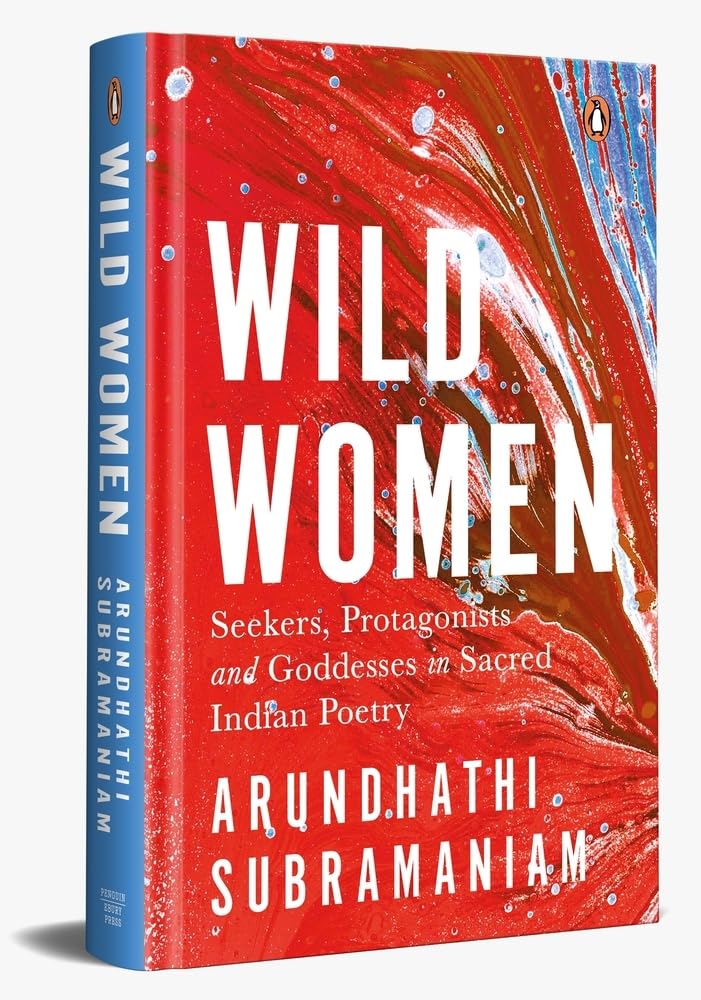
Title: Wild Women: Seekers, Protagonists and Goddesses in Sacred Indian Poetry

Editor: Arundhathi Subramaniam

Publisher: Penguin Random House

“The path of the heart is at times discredited as a soft option. It is seen as a path of neurotic excess and greasy sentimentality. Yet, what we hear in these songs isn’t prissy obedience but open-throated longing. […] Such longing is not born of an infantile need for a divine paterfamilias. Nor is it the resort of those who lack the intellect to craft their own destinies. This is the way of the razor’s edge. The path of those who have nothing left to protect or prove. This is one of the most courageous journeys back home,” writes Arundhathi Subramaniam in some of the most powerful lines of a very evocative Introduction to this book.

Wild Women: Seekers, Protagonists and Goddesses in Sacred Indian Poetry is a comprehensive anthology of sacred poems that brings together three of Subramaniam’s most cherished interests–spirituality, poetry, and women’s creative lives. Seen within the tradition of Arundhathi’s own consistent and remarkable oeuvre as woman, poet and spiritual traveller, this anthology containing poems by women seekers as well as poems by men and women dedicated to women protagonists and goddesses, is a deep historical and existential search for legacy, for connection, for the otherness of selfhood and the self-ness of the other. The cover of the book, richly symbolic as it is, is also highly attractive, and one that readers will not forget in a hurry. Here is a birth, both cosmic and cataclysmic, a falling and a rebounding, calm and turmoil.

As an anthology of poems, Wild Woman attempts an undertaking not envisaged before – the bringing together of the voices of women within the spiritual fold from across the length and breadth of the country’s geography and history. Here are women from varied historical ages, diverse places, languages, social classes, traditions, and religious cults; women who are both well-known and relatively anonymous; women who choose to live within the family as well as those who seek to renounce it altogether; women who speak in their own voices as well as those who are spoken for by male poets, lovers and devotees; women who stand between history, myth, and divinity; in short, women who have been beckoned by and have responded, in various ways, to the persistent call of the wilderness within their wide, vibrant souls.

Given the intensity of its subject and intention, the book is aptly titled. ‘Wild women’, apart from being alliterative, marks distinct metaphorical connections with the cultural terrain of women’s lives. As the poems in this book powerfully assert, ‘wilderness’ is a location these women existentially inhabit. It is a space that is beyond the governance and influence of society, and though women are native to it, this is where they are forever exiled from. To return to the self is to reclaim this wilderness within, to dismiss societal constructs and make an institution out of faith and intuition. This wilderness, as Subramaniam insists, “is not a cosy hearth. It is a place of peril, a smithy of surprises.”

It is also a space that has the potential to envision a new ontological, epistemological, and social order. Every voice in this anthology is, thus, disruptive in its envisioning of a form of existence that militates against the one offered by contemporary society. In ‘Get Ready to Live like a Pauper’, Gangasati [1]whose songs are an important part of the oral tradition of poetry in Gujarati even today, says:

The world of the divine has no place
For caste, gender or race
Shed this phantom chain,
Be cool and take it easy, man.

Similarly, Amuge Rayamma of the twelfth century CE, says:

If you know the self
why have truck with those who gossip?
If you can move in ways unimagined,
why depend on women?

In every poem, the route taken into this wilderness is that of the spiritual, revealing a desire to merge the self with the essential light of the universe—the formless Divine or the God, loved deeply in some human form.  Here is a total rejection of every established commandment, and a faithful obedience only to the experience of the self – the physical and the spiritual. The Lord is conceived as responding to every form of desire and arrives to the woman seeker in plural shapes of parent, lover, mentor or guide. To Kanhopatra of the fifteenth century CE, the Lord appears as “Mother Krishna” while to Vidya who wrote in Sanskrit sometime between the seventh and ninth century CE, he comes as a lover:

Why expose a lone woman
to such pageant
o season of rain
the torment
the sweet bitter need to be
touched

The poems in this anthology evince a strong dissatisfaction with prescribed moulds of identity and an urgency to experience life and thought first-hand. The constant pull between society and the individual, dogma and will, subjection and agency, and incarceration and liberation constitute the essential conflict in these poems, only to be resolved by the fierce choices of the spirit. Dissatisfaction with caste, gender, family, materialism and injustice lead the poets in this book to experiment with a language that legitimises the use of women’s experiences as yardstick and metaphor for the exploration and exposition of new truths. Keeping the feminine body of woman and nature at the centre of experience and discourse, the syntax of these poems is framed by an irresistible desire to overwhelm the old with the new. In every poem, thus, language becomes a sharp and dextrous tool, both argumentative and aesthetic, to establish new knowledges and new points of view. In ‘A Manifesto for New Poetry’, Muddupalani (eighteenth century CE) writes:

Can your poems stand in the field, girl,
alongside all the great poems of all the great
poets? Absolutely.
Doesn’t the bee gorged on honey
from the great lotus still savour
the humble flower’s nectar?

“The journey of a book, not unlike the journey of the heart, has its own logic—precise but not always schematic,” writes Subramaniam. Operating on its own logic, this book vitally performs for our times four extraordinary tasks—historical, activist, poetic, and feminist. Historically, it liberates women from stereotypes of oppression within patriarchy and domesticity, and by reinstating their positions as thinkers, philosophers, agents, leaders, and role-players within active religious and community life, it lays down empowered annals of womanhood for us to contemplate on. In terms of literary activism, such an extensive attempt at documenting and compiling voices of and for women within the spiritual domain, is largely unprecedented. “The essential impetus behind this project was to invoke the names of women. To turn cameos into protagonists. To invite backstage workers into the spotlight,” remarks Subramaniam. By highlighting women’s names and contributions to Indian spiritual traditions, this book will not only protect these names from oblivion and erasure but also encourage further explorations and deliberations in this field.

“A poem can offer us respite from too much meaning,” states Subramaniam. As poetry, this volume is a distilled collection of some of the finest spiritual doubts, agonies, and ecstasies of the human self in its journey towards the divine. Additionally, by bringing poems in translation from a wide corpus of vernacular languages into English, this anthology opens up Indian English poetry to the most intimate linguistic and creative recesses of the Indian mind. Finally, as a feminist work, this book highlights an ontology of the wild which becomes here, a praxis rather than an anomaly, and helps to establish a shared bond of courageous and self-conscious womanhood. Through each of the three sections of the book where women appear as seekers, protagonists and goddesses, Wild Women steadily performs an ecriture feminine, and sculpts a spiritual biography of Indian womanhood.

There is an elemental power that radiates from Subramaniam’s language, the power of words that have been painstakingly lived through before utterance. Subramaniam is, as much, a disciple of language as she is of the spirit. “This is poetry as power—the power of conscious utterance and the raging power of all that must be left unsaid,” she remarks of the poems in this book. Her own words evince that power to create and to procreate an understanding of womanhood that is steadily expanding to include new experiences and worldviews. She writes, “Since these poets lived lives profoundly wedded to mystery, that mystery is an integral part of this project.” Constantly aware of this mystery, Wild Women is a passionate and compelling thesis for reclaiming women’s essential wilderness and the place of wild women within history, spirituality and poetry.

[1] A medieval saint poet of the Bhakti tradition

Basudhara Roy teaches English at Karim City College affiliated to Kolhan University, Chaibasa. Author of three collections of poems, her latest works have been featured in EPW, The Pine Cone Review, Live Wire, Lucy Writers Platform, Setu and The Aleph Review among others. 

.

PLEASE NOTE: ARTICLES CAN ONLY BE REPRODUCED IN OTHER SITES WITH DUE ACKNOWLEDGEMENT TO BORDERLESS JOURNAL

Click here to access the Borderless anthology, Monalisa No Longer Smiles

Click here to access Monalisa No Longer Smiles on Kindle Amazon International

Categories
Review

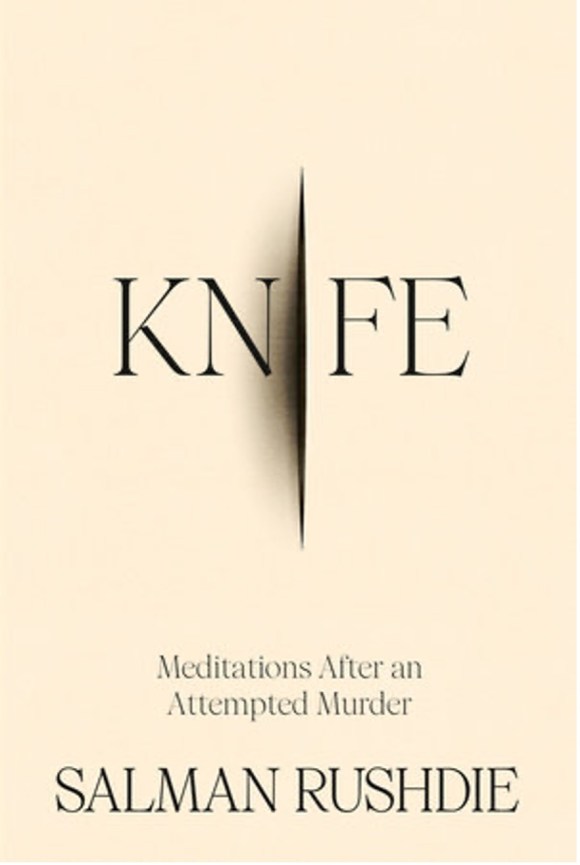
Knife by Salman Rushdie

Book Review by Somdatta Mandal

Title: Knife: Meditations After an Attempted Murder

Author: Salman Rushdie

Publisher: Penguin Random House

More than thirty years ago, a fatwa had been declared by Ayatollah Khomeini on the famous writer Salman Rushdie. The charge of blasphemy was labelled after the publication of The Satanic Verses, and since then the author has been living in asylum at different places because he was not safe in his own country. When it was assumed that the incident had died its natural death, the simmering vendetta and violence upsurged suddenly on 12th of August 2022, when Rushdie had gone to participate in a week of events at the Chautauqua Institution in upstate New York titled “More Than Shelter: Redefining the American Home”, and an unidentified man attempted to murder him on stage with a knife.

This horrific act of violence shook the entire world. No one hoped that they would ever be able to read a single line written by the author once again. He was a totally lost case. Now, one-and-a-half years after the incident, and in unforgettable detail, Rushdie writes this first-person memoir Knife where he relives the traumatic events of that day and its aftermath, as well as his journey towards physical recovery. His healing was made possible by the love and support of his present African American wife Eliza, his family, his army of doctors and physical therapists, and his readers worldwide.

Dedicating the book to the men and women who saved his life, the text is neatly divided into two parts, each containing four sections. The first half of the book titled “The Angel of Death” primarily revolves around ‘despair’, whereas the second part, “The Angel of Life,” narrates a vision of ‘hope’ and optimism and Rushdie’s attempt to return to normalcy once again with his indomitable spirit to fight on against all odds.

The opening chapter called ‘Knife’ begins with the description of a beautiful August morning in detail and how the apparent tranquility was shattered when suddenly violence appeared in the form of an unidentified man who rushed at him on the open stage and stabbed him indiscriminately. Totally flabbergasted, Rushdie obviously didn’t know what to do. So, he narrates the rest of the incidents in the form of a collage, with bits of memory pieced together with other eyewitness and news reports and tells us how that morning he “experienced both the worst and the best of human nature, almost simultaneously.” Though the incident of his attempted murder dragged “that” novel back into the narrative of scandal, Rushdie declares that till date he still felt proud of having written The Satanic Verses.

Apart from the day-by-day narration of how things shaped up after the stabbing incident, three things stand out very clearly in this memoir. First is of course the detailed description of his entire eighteen-day long stay initially at the extreme-trauma ward of the hospital and later at the rehab centre titled ‘Hamot’. Though in extreme pain we are told how doing a few simple everyday things for himself lifted his spirits greatly. So, apart from the rehab of the body, there was also the rehab of the mind and spirit. Spending more than six weeks in two hospitals, he could return to the world and so slowly he started feeling optimistic again.

The chapter called ‘Homecoming’ begins with his leaving the hospital at 3 A.M. as quietly as possible and going back home at that unearthly hour to evade any watching eyes.

Emotionally moved, even though he had lost one eye permanently, he felt “100 percent better and healthier immediately. I was home.”

The incident of homecoming is once again closely related to the second important issue during his convalescence –the love, care and bonding with his present wife Eliza. Dedicating a total chapter titled “Eliza”, Rushdie gives us details of how he met the African American poet Rachel Eliza Griffiths entirely unknown to him, through the eminent American writer, Norman Mailer, and how his friendship grew stronger day by day, leading to a secret marriage based on the realisation that it was a relationship not of competitiveness but of total mutual support. They showed that even in this attention-addicted time, it was still possible for two people to lead, pretty openly, a happily private life till the knife incident changed everything. He tells us how the poetical sensibilities of his wife lent extra support to him in such trying times.

The third most significant aspect of this memoir is the way Rushdie devotes an entire chapter addressed to his assassin –“The A”. And it is really at its imaginative best. In it he has recorded a detailed conversation that never actually occurred between himself and “a man I met for only twenty-seven seconds of my life”. After bringing in several intertextual references about other writers and situations, about other murders being committed in the lives of different personalities, in the fourth and final session of his imaginative conversation, Rushdie states, “You don’t know me. You’ll never know me.” After the imagined conversation is over, he no longer has the energy to imagine the assassin, just as he never had the ability to imagine him. He feels that the purgation is complete, and this chapter of his life is closed once and for all.

Interestingly after half a year of nothingness, Rushdie realises that his writing juices had indeed started to flow again. During his sleepless nights at the rehab, he often thought a lot about The Knife as an idea. Talking about different occasions and purposes when the knife is used, he realized that the knife is basically a tool and acquires meaning from the use we make of it. It is morally neutral, and it is the misuse of knives that is immoral. Then he states that language too was a knife for him, and he would use it to fight back. Here he made a resolution that instead of remaining as a mere victim, he would answer violence with art – “Hello, world, we were saying. We’re back, and after our encounter with hatred, we’re celebrating the survival of love. After the angel of death, the angel of life.” But it was hard for him to write about post-traumatic stress disorder at any time especially when his hand felt like it was “inside a glove” and “the eye… is an absence with an immensely powerful presence.” Returning to New York after a ten-day visit to London, he therefore decided to spend the second chance of his life on just love and work. Since several Muslim entities were still celebrating his pitiable condition, he thought to make it clear to his readers that his worldview about God had not changed a bit and so he declares — “My godlessness remains intact. That isn’t going to change in this second-chance life.”

In the final section ‘Closure?’ Rushdie writes that his own anger faded, and it felt trivial when set beside the anger of the planet. He understood that three things had happened that had helped him on his journey towards coming to terms with what had happened – namely — the passage of time, the therapy, and ultimately the writing of this book. Moving along with time, he felt he was no longer certain that he wanted, or needed, to confront and address his assassin in open court and that the “Samuel Beckett moment” no longer seemed significant at all. This is where art and love overcame all barriers. He has successfully moved on and there was no need to look backwards once again.

Written a few years ago, Rushdie’s Joseph Anton: A Memoir narrated the story of how he was living a disturbed life under the pseudonym of Joseph Anton. But that memoir did not create much impact upon the readers, whereas Knife has brought back the powerful and erudite Rushdie as he has risen phoenix-like from the ashes and revealed his erudition without being parochial. Ordinary readers often shy away from his work as it is full of intertextuality and cross-references. But even those who find his writing to be too high-brow will have no problem in understanding the ‘free-associative way’ in which the mind of this writer works even today. The book is a page-turner no doubt and has brought back the popularity of Salman Rushdie once again. The simplistic yet very appealing cover of the book is an added attraction too.

Somdatta Mandal, critic and translator, is a former Professor of English from Visva-Bharati University, Santiniketan, India.

.

PLEASE NOTE: ARTICLES CAN ONLY BE REPRODUCED IN OTHER SITES WITH DUE ACKNOWLEDGEMENT TO BORDERLESS JOURNAL

Click here to access the Borderless anthology, Monalisa No Longer Smiles

Click here to access Monalisa No Longer Smiles on Kindle Amazon International
Categories
Excerpt

Deposition of a Political Prisoner: A Speech by Nazrul

Title: Kazi Nazrul Islam: Selected Essays 

Author: Kazi Nazrul Islam

Translator: Radha Chakravarty

Publisher: Penguin Random House

Deposition of a Political Prisoner (1923)

[In 1922, Kazi Nazrul Islam, the famous ‘Rebel Poet of Bengal’, aroused the wrath of the British administration for the revolutionary anti-imperialist writings published in his magazine Dhumketu (Comet), published in Kolkata. The Dhumketu office was raided by the police, Nazrul’s anthology Jugabani was banned, and on 23 November 1922, Nazrul was arrested and imprisoned in Presidency Jail. On 16 January 1923, Nazrul delivered his famous speech “Rajbandir Jabandandi” (Deposition of a Political Prisoner), at his trial. Sentenced to a year’s rigorous imprisonment, Nazrul was confined first in Alipore Jail and subsequently in Hooghly Jail. In February, Tagore dedicated his play Basanta to Nazrul, and later sent him a telegram urging him to call off his hunger strike. Nazrul never received the telegram, and was released from jail in November 1923.]

I am accused of treason. Hence, I am a prisoner of the state, as indicted by the state.

On one side stands the royal crown, and on the other, the flame of the comet. One represents the king, holding the sceptre; the other stands for the truth, holding the rod of justice. On the side of the king are the salaried employees of the state. On my side is the King of kings, Judge of all judges, true from the beginning to the end of time—the living divinity.

Nobody has appointed my judge. In the eyes of this Supreme Judge, all are equal—ruler and subject, rich and poor, the happy and the unhappy. At His throne, the ruler’s crown and the beggar’s musical instrument, the ektara, are placed at par. His laws are the laws of nyaya or justice, and dharma. That law has not been created by any victor for any conquered race, but from the true insights of global humanity. It is the law of universal truth, of omnipresent, all-pervading divinity. On the side of the king is a fragment of creation, minute as an atom; and on my side, the Creator Himself, whole and indivisible without beginning and end.

Behind the king are the insignificant, and behind me, stands the divine force of Lord Shiva himself. The one who backs the king has selfish goals; the one who supports me aims for the truth, to gain perfect bliss.

The king’s words are mere bubbles; my words, the boundless ocean. I am a poet, inspired by the Lord to reveal the hidden truth, to give form to formless Creation. Through the voice of the poet, the Lord makes himself heard. My utterance is the medium that publicly announces the truth, the utterance of the Lord. That utterance can appear as treason in the judgement of the state, but in the judgement of nyaya, that utterance is neither a rebellion against nyaya, nor against the truth. That utterance may be punishable in the king’s court, but in the light of dharma, at the court of nyaya, it is guiltless, untainted, unblemished, clear, inextinguishable, like truth itself.

The truth is self-revealing. It cannot be stopped by an angry, red-eyed royal sceptre. I am the veena, the instrument of that unceasing self-revelation, the veena that resonated as the voice of eternal truth. I am the veena in the hands of the Lord. It may break if it must, but who can break the Lord? It is an eternal truth that the truth exists, and so does the Lord—since the beginning of time, and forever. The one who obstructs the voice of truth today, who wishes to silence that voice, is also one of the minutest atoms of the Lord’s creation. It is by Lord’s signs, signals and wishes that such a person exists today, or may not exist tomorrow. There is no end to the hubris of the foolish mortal: he wants to imprison and punish his own Creator! But one day, this hubris is bound to drown in tears!

As I was saying, I am  an instrument for the revelation of truth. There may be heartless powers that imprison that instrument, or destroy it; but the One who plays that instrument, who expresses His fiery message through that veena – what power on earth can confine Him? What power on earth can destroy the vidhata, the supreme arbiter of our destinies? I am mortal, yes, but my vidhata is immortal. I will die, so will the king, for many traitors like me are dying, and so are many kings who summon up such accusations against them, but through the ages, at no point in time, and for no reason, has the manifestation of truth been suppressed – the voice of truth has never perished. Today, too, in the same way, it continues to express itself, and will continue to do so forever. This utterance of mine, stifled by authority, will be heard again, in the voice of another.  If you snatch away my flute you do not kill my music, for I can take up another flute, or create a new one, and bring the music back to life. The music does not belong to the flute, you see, it exists in my soul, and in the art of my fashioning of the flute. Hence the fault lies not with the flute, nor with the tune; the fault lies in me, the player of the flute. Likewise, for the utterance that emerges through my voice, I am not responsible. The fault lies not in me, or in my veena. It lies with the One who plays his veena through my voice. Hence, I am not the traitor against the state; the ultimate traitor is that same Lord, the player of the veena.  There exists no royal authority or second divinity who has the power to punish Him. No police force or prison has yet been created, that has the power to imprison the Lord.

The royal translator deployed by the king is simply translating the language of that utterance, not its soul. His translation projects that utterance as treason, for his aim is to satisfy the king. But my writing expresses the truth, radiance and the very spirit of life, for my aim is to offer my devotion to the Lord. For the tormented, anguished dwellers on this earth, I appear as a shower of truth, the tears that rain from the Lord’s eyes. I have not revolted against the king, but against injustice. …

[From Kazi Nazrul Islam: Selected Essays, translated by Radha Chakravarty. New Delhi: Penguin Random House, 2024.]

About the Book:
Selected Essays reveals to us the extraordinary versatility of Nazrul as an essayist. Addressing subjects as diverse as social reform, politics, communal harmony, environmental concerns, education, aesthetics, ethics, and philosophy, this rich collection showcases Nazrul’s dynamic vision and unique use of language as an instrument of change. The essays chart his evolving consciousness as a thinker, writer and activist, offering vivid glimpses of the ethos of his times, his relationships with leading figures such as Tagore and Gandhi, and his active engagement with social, political and cultural processes. These new translations bring Nazrul’s powerful voice to life, all its vibrant immediacy.

About the Author:

Kazi Nazrul Islam (1899-1976) is widely remembered as the fiery iconoclast who fought against the structures of oppression and orthodoxy. The iconic ‘rebel poet’ of Bengal and the national poet of Bangladesh, Nazrul continues to be loved for his songs and poetry. But he was also a writer of powerful short stories, novels, essays,  journalistic editorials and articles. In his literary career, which lasted from 1919 to 1942, Nazrul achieved both fame and notoriety, for his fiery, forthright, unorthodox approach to life and art.

About the Translator:

Radha Chakravarty is a writer, critic, and translator. She has published 23 books, including poetry, translations of major Bengali writers, anthologies of South Asian literature, and critical writings on Tagore, translation and contemporary women’s writing. She was nominated for the Crossword Translation Award 2004 and the Pushcart Prize 2020. 

CLICK HERE TO READ THE REVIEW

.

PLEASE NOTE: ARTICLES CAN ONLY BE REPRODUCED IN OTHER SITES WITH DUE ACKNOWLEDGEMENT TO BORDERLESS JOURNAL

Categories
Review

Nazrul and His World View

Book Review by Somdatta Mandal

Title: Selected Essays: Kazi Nazrul Islam

Author: Kazi Nazrul Islam

Translator: Radha Chakravarty

Publisher: Penguin Random House

The Bengali poet, Kazi Nazrul Islam (1899-1976), is widely remembered as the fiery iconoclast who fought against the structures of oppression and orthodoxy. The iconic bidrohi or ‘rebel poet’ of Bengal, Nazrul continues to be loved for his songs and poetry that were aimed at arousing the rebellious spirit of both Hindus and Muslims alike. But what of his prose, his journalism, and his politics? Selected Essays reveals to us the extraordinary versatility of Nazrul as a writer, thinker, and activist. Addressing subjects as diverse as social reform, politics, communal harmony, environmental concerns, education, aesthetics, ethics, and philosophy, this rich collection showcases Nazrul’s dynamic vision and unique use of language as an instrument of change. The essays chart his evolving consciousness as a thinker, writer, and activist, offering vivid glimpses of the ethos of his times, his relationships with leading figures such as Tagore and Gandhi, and his active engagement with social, political, and cultural processes.

Of the forty-one essays selected here, (three undated), the first thirteen are all written in different places all in the year 1920. That was the year Nazrul returned to Bengal after serving in Karachi during World War I as a member of the Bengal regiment of the colonial British army. Reacting to the Jallianwallah Bagh massacre he writes, “May the Dyer monument never allow us to forget Dyer’s memory” because on that occasion Hindus and Muslims embraced each other and wept together as brothers. They shared the same agony as children of the same womb. In ‘Strike’, he praises the social awareness that has swept among the ranks of the labouring class and believes that the “protest is not just a rebellion, but the death-bite of the suffering, moribund class”. When some migrants were fired upon after a clash with the armed police at a place called Kanchagarhi, he asked in ‘Who is Responsible for the Killing of Migrants?’, whether anyone can ever tolerate such injustice towards humanity, conscience, self-respect and independence and states that they are no longer going to passively accept such assaults. ‘Awakening Our Neglected Power’ contends that democracy or people’s power cannot be established in our country because of the oppression inflicted by the Bhadra[1] community.

There are several essays in which Nazrul speaks about the state of National Education, he envisages ‘A National University’, and in a very powerful piece that he wrote from Presidency Jail in Kolkata on 7 January 1923, titled ‘Deposition of a Political Prisoner’ he reveals his self-confidence:

“If anything has struck me as unjust, I have described it as injustice, described oppression as oppression, named falsehoods as falsehood. …For that endless mockery, insults, humiliation and assaults have been rained on me, from within my home and beyond. But nothing whatsoever has intimidated me into dishonouring my own truth or my own Lord. No temptation has overpowered me enough to compromise my integrity or to diminish the immense self-satisfaction gleaned through my own endeavours…. I repeat, I have no fear, no sorrow. I am the child of the elixir of immortality.”

Nazrul grew up in a traditional religious environment, yet in his writings he drew upon both Hindu and Islamic sources, and expressed a faith that transcended the limits of any single religion. In several essays, he harps on the problems of Hindu-Muslim amity and enmity and warns us about “this hideous business of purity of touch and untouchability”. He wants only humans to live in India as brothers and wants everyone to be wary of the terrible deceptions created by both the religions.

In the essay ‘Temple and Mosque‘, he states that both parties have the same leader, and his real name is Shaitan, the Devil. Written in response to the communal riots that broke out in Kolkata on 2 April 1926, he feels that those very same places of worship that ought to have been bridges between heaven and earth are instead causing harm to humanity today, and so those temples and mosques should be broken down. In another essay titled ‘Hindu-Muslim’, penned the same year, Nazrul talks about the question of an internal tail in human beings. He says, “There’s no telling what animal excitement lured the human mind to discover a substitute for tails in the beard or tiki[2]!” He further elaborates:

“Both Hindu and Muslim ways of life can be tolerated, but their faith in tikitwa and daritwa, the orthodox ways of tiki and beard, is not to be borne, for both instigate violence and killing. Tikitwa is not Hindutwa, it is perhaps punditwa, the way of the pundit! Likewise, the beard, too, is not Islamic, it is mullatwa, the way of the mullah. These two types of hair tufts, marked with religious dogma, are precisely the reason for all the conflict and hair-splitting we witness today!”

Though it is not possible to discuss all the different editorials, book reviews, and political pieces that are included in this collection, one must mention at least two essays that speak about literary issues as well. In 1932, Nazrul wrote for Patrika (subsequently reprinted in Bulbul the following year), an interesting piece titled ‘World Literature Today’. In it he states that there are two kinds of writers present in the world today and their different tendencies have assumed immense proportions.

“Ranged on both sides are great war heroes, champion charioteers of the battlefield. On one side are the dreamers, such as Noguchi, Yeats and Rabindranath, and on the other, Gorky, Johan Bojer, Bernard Shaw, Benavente and their ilk.”

But Nazrul’s ire in being ostracized comes out clearly in ‘A Great Man’s Love Is a Sandbank’ (1927), where he criticises the high-handedness of Rabindranath Tagore. He begins by telling us how he was a prisoner of state at the Alipore Central Jail when he was informed by the assistant jailor that Tagore had recognised Nazrul’s talent and dedicated his play Basanta to him. The other political prisoners present there had laughed at him not in joy but in incredulity. For him, the blessing turned into a curse. His very close friends and state prisoners also turned away from him. He realised what massive internal damage this outward gain had caused him. Busy with his political agenda, he didn’t have the time to sit and meditate as advised several times by Tagore. So Nazrul writes, “I find that the brighter my countenance shines in this glory, the darker some other famous poets’ faces seem to appear.” He mentions that he had grown accustomed to police torture but when literary personages begin to torment one, their brutality knows no bounds. “Alas, O youthful new literature!” His crime was that young people celebrated his work. He laments further,

“That Kabiguru[3], revered by both parties like the grandsire Bhisma, should assent to this plot of killing Abhimanyu, is the greatest sorrow of our times. …As for me, I have discarded that topi–pyjama—sherwani–beard look[4], only out of fear of being mocked as a ‘Mia Saheb’. But still there is no respite for me…. Now we get the feeling that the Rabindranath of today is not the same Rabindranath we have always known.”

That the trajectories and beliefs of Tagore and Nazrul went in the opposite direction is well- known. In the essay, Nazrul then further continues his complaints against Tagore. He questions whether they have been considered as his enemies, simply because they didn’t go to him frequently. Also, since the goddess of wealth blessed him, Kabiguru did not know what dire poverty the new writers had to struggle against, languishing in conditions of starvation or semi-starvation. So, he humbly requests Kabiguru not to sprinkle salt on their wounds by mocking the impoverishment that is their singular affliction, for that is one form of heartlessness that they cannot tolerate.

Of the last three essays written in 1960, namely, ‘The Science of Life’(where men “are surrounded by all sorts of travails and sufferings, and many of them cannot be alleviated”), ‘A Point to Ponder’(where the nation faces an immense problem regarding the dispute about the instructions and procedure for the worship of the mother, the Bharatmata, our Mother India) and in ‘What We Need Today’, Nazrul speaks of the necessity of a “vast tumult in India”. Making his readers aware of the vast duplicity and trickery in the name of religion, he warns that unless one avoids the baseness of being subjugated by an external power, there is no prospect of heaven for us, only the grotesqueness of hell. He wants the kalboishakhi, the wild summer storm, to “approach in all its fury, rearing his head like a hooded serpent swimming in the unchecked torrents of an ocean of blood” and sweep everything away.

Before concluding one should also make a few comments on the translation. As a veteran translator, Radha Chakravarty, has successfully managed to transcreate some very difficult Bengali idioms, cultural nuances and analogies that Nazrul used in some of his essays. As she admitted in the Introduction, “[T]ranslating Nazrul’s prose proved to be a challenge, as demanding as it was exhilarating. …The endeavour demanded experiment and creativity rather than mechanical lexical ability and involved some difficult choices…Literal translation has been avoided, with greater focus on the sense, emotion, intellectual import, rhetorical features and stylistic particularities of the Bengali source texts.” She further adds that the present translations stemmed from a desire to bring Nazrul’s essays to a contemporary audience in South Asia and the rest of the world, to draw attention to his literary achievement as well as his significance as a writer, thinker, activist, and visionary. Though a lot of research and translation projects on Nazrul has been going on in Bangladesh for quite some time (where he holds the status of National Poet), in India, especially in West Bengal, the response is still rather lukewarm. Hence this volume is strongly recommended as a collector’s item.

[1] Literally decent but here indicates the bourgeoisie.

[2] A tuft of hair at the back of a tonsured head 

[3] Tagore

[4] Cap-pyajama-longcoat – these with a beard were associated with the genteel muslim look – the look of the Mia Saheb

CLICK HERE TO READ THE EXCERPT

Somdatta Mandal, critic and translator, is a former Professor of English at Visva-Bharati, Santiniketan, India.

.

PLEASE NOTE: ARTICLES CAN ONLY BE REPRODUCED IN OTHER SITES WITH DUE ACKNOWLEDGEMENT TO BORDERLESS JOURNAL

Click here to access the Borderless anthology, Monalisa No Longer Smiles

Click here to access Monalisa No Longer Smiles on Kindle Amazon International