Categories
Conversation

‘Home has been a Process of Lifelong Search’

In Conversation with Kirpal Singh

Dr Kirpal Singh

 “Singapore is intimately linked with home and, yet for me, home has always been a process of lifelong search. Partly because of the early months of my birth. The record says I was born in March 1949, but the time was not certain as I do not have a birth certificate. My father forgot to register my birth,” reminisces Dr Kirpal Singh, an internationally recognised scholar. Born in the Straits Settlement of Singapore, before the island emerged as an independent entity, he has lived through much of history. He tells a story of multi-racial, multi-cultural growth that the island afforded him.  

His father, he tells us, was “well known throughout Malaya — Jeswant Singh nicknamed as ‘Just One’ — a boxer who would knock people down with his left hook. In 1954, he left boxing when he killed someone during a match.” His mother, a Jewish Scot who he cannot recollect, he tells us, “ might have been David Marshall’s sister according to my stepsister but no one else has said that.”  Marshall[1] was the first Chief Minister of Singapore from 1955 to 1956 and then Singapore’s Ambassador to France, Portugal, Spain, and Switzerland 1978 to 1993. He is the founder of the Worker’s Party. His parents had emigrated from Baghdad to Singapore in 1908 according to current resources.

How did Singh’s parents come to be in Singapore? Were they immigrants or colonials?

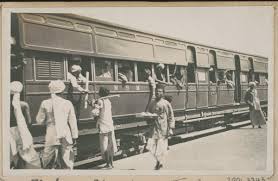
He responds with what he knows: “My grandfather and grandmother came to Singapore on board a ship in 1900. They left Jullunder, Punjab, in 1899. By the time they reached Singapore, it was the end of 1900. They left to seek their fortune. They were from the farming community. My grandfather was only sixteen and my grandmother was about twelve. They were in transit in Penang for six months. They came to Singapore in 1901. Actually, it was all Malaya — Singapore was part of the Straits Settlement. They came to Singapore by train. Trains were just starting out. It was around August 1901.

Trains in Malaya

“My uncle was conceived during this journey. They halted in Singapore for only two or three weeks. My grandfather’s cousin was in Perak[2], in Malaya. So, he wanted to be with his cousin. His cousin had cattle. Most of the Sikhs were cattle farmers. They settled in Pahang[3], an area which eventually became a nuclear dump[4] for Australia. It is closed to public now. There was a stone that proclaimed the land was a nuclear dump when I went with my son a few years ago.

“My father moved to Singapore as his prospects were better here as a boxer. This is where he met my mother. I was born here. He actually met mum because my mother’s two brothers had invited her to come from Glasgow. My mother is Scottish, from an industrial background. Her brothers came to the Far East to make money.  She finished her school leaving exams and came to visit her brothers during her vacation. She would go with her bothers to watch boxing, where she saw my father, the champ. She was only fifteen or sixteen. The next thing the brothers knew was she was pregnant with me.”

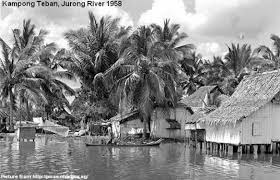
Jeswant Singh was popular with colonials. Kirpal Singh tells us: “Some Europeans saw him box and offered him a job then in the Base Ordinance Depot. This was the British Military camps in the Far East. There were three bases in Singapore: the naval base, Kranji and one in the South. He worked there for thirty years and retired after that. In 1972[5], after the final British withdrawal from Singapore, dad’s formal employment status ended. After that he just did odd jobs, ending up as a security guard, looking after the factories in Jurong, earning about two to three hundred dollars a month.”

Kirpal Singh spent his childhood with his grandmother and uncle. Before he started schooling, his father left him with his grandmother and divorced his mother in favour of a new bride. Dr Singh tells us the story of how he returned to Singapore: “I was basically in Perak with my grandmother. My uncle, who was the first Sikh to become a Christian in Southeast Asia, left home because his father gave him a beating for changing his religion. My uncle was an Anglican. His conversion saved him from the Great Depression as the clergy was very well looked after. From 1929 to 1933, the church looked after him because he was the priest in Seramban. My father was still young. My uncle was born in 1911 and my dad in 1923. My grandmother bore eighteen children. Five of the infants passed away before they were one month old. But thirteen survived. She passed away at 95… I knew when I left for my doctorate programme in Adelaide that that was the last time I would see her. I had a hunch and was crying on the plane. Six weeks later, I got a letter with the news of her death.”

He adds: “Dad was in not in a position to look after me. The responsibility fell on his brother William. His full name was William Massa Singh s/o Deva Singh. He had studied at the Ipoh Chinese school, topped the school, eventually worked as an insurance agent. He was very good in English. The principal of his school, a New Zealander, arranged for my uncle to move to Singapore. Then my father moved there too. Singapore was the metropolis even then. It was the centre of English education. Penang was the other one. In 1956, I was sent to Singapore from Perak on a train — a one-and-a-half-day journey to my uncle.”

His grandmother joined them within a few months as his uncle was, he says, “more interested in aiding Lee Kuan Yew get rid of the colonials. Lee Kuan Yew was a self-made man. He met Goh Keng Swee[6] and Rajaratnam[7] as students in England. They became buddies and wanted to move out of colonial rule and be independent.”

Then, how did a young child survive? Dr Singh tells us: “I used to earn my pocket money from age five six by watering gardens. I have had very interesting experiences. When I was in primary two, I used to give tuition to primary one students. With enough gumption, you can survive in this world.”

“I grew up with my uncle’s wards, who were brought home to be educated. There was even one who was a Chinese-Japanese mix. So, I grew up being familiar cross-cultural marriages and in a multicultural home. I grew up in the kampong with a Chinese boy and we became friends from the age of seven-and-a-half when we were in primary two. His name is Tan Jwee Song — I call him Jwee, ‘my good saint’.  He told me after O-levels he would support me to study further and took to teaching. At that time, you could become a teacher after completing your O level. I joined Raffles late during my time in high school because it was too expensive for me. I taught in night classes started by Lee Kuan Yew and studied. I owed Jwee $80,000 dollars and I wanted to pay his widow back — but she would not accept it. When I graduated in 1973 with an honours’ degree, I was $44 thousand in debt. Then, I was given a scholarship.”

And slowly, Kirpal Singh came to his own. When television came into being, he tells us: “I was often on TV in 1970s — days of early television — debates and interviews as a guest.” Kirpal Singh grew into an intellectual of repute as he worked and studied with the support of the many races and many people who, often like him, were migrants to Singapore.

As time moves forward, these stories — that are almost as natural as the sand, the wind and the sea — ask to be caught in words and stored for posterity, stories from life that show how narrow borders drawn by human constructs cannot come in the way of those with ‘gumption’.

(Written by Mitali Chakravarty based on a face to face conversation with Kirpal Singh. Published with permission of Kirpal Singh)

[1] https://www.roots.gov.sg/stories-landing/stories/david-marshall/story

[2] Now in Malaysia

[3] Now in Malaysia

[4] https://buletinonlines.net/v7/index.php/lynas-radioactive-waste-to-be-dumped-in-pahang-tax-free-while-australia-gets-a18-million-in-taxes-2/

[5] The British armed forces were scheduled to withdraw from Singapore by 1971. https://eresources.nlb.gov.sg/infopedia/articles/SIP_1001_2009-02-10.html#:~:text=On%2018%20July%201967%2C%20Britain,Singapore%27s%20defence%20and%20economic%20security.

[6] Deputy Prime Minister of Singapore, 1973-1980, one of the founding members of the ruling PAP (People’s Action Party) https://www.roots.gov.sg/stories-landing/stories/goh-keng-swee/story

[7] Deputy Prime Minister of Singapore from 1980 to 1985, one of the founding members of the ruling PAP https://www.roots.gov.sg/stories-landing/stories/sinnathamby-rajaratnam/story

PLEASE NOTE: ARTICLES CAN ONLY BE REPRODUCED IN OTHER SITES WITH DUE ACKNOWLEDGEMENT TO BORDERLESS JOURNAL. 

Click here to access the Borderless anthology, Monalisa No Longer Smiles

Click here to access Monalisa No Longer Smiles on Kindle Amazon Internation


Categories
Stories

Wrath of the Goddess?

By Farouk Gulsara

1960s, Malaya

The big day will be here soon, tomorrow, to be exact. School life had been going on, dragging its feet. They say time flies when you are having fun. I do not remember having any fun, but it flew by anyway. Whenever I start thinking of the future, time seems to be ticking like a time bomb. There is so much uncertainty, and so much can happen. So, I tell myself to tread one day at a time. The best thing to do is not to think too far ahead. But then, that would make me no different from my father, would it not? Enjoy today of what is uncertain tomorrow.

Today is Sunday. The restaurant is closed after lunch. I have been helping out at an Indian restaurant near my house to earn some extra cash to pay for my school fees, the fees that my father refuses to pay. In his eyes, I am old enough to earn for the family, not draining from it. Money is always not enough.

I have some free time. As promised, I decide to meet up with Johnny to discuss some matters about the coming examination. I have not been feeling well for the past few days, with constant lethargy, malaise, body itch and muscle aches. I passed it off as the stress of facing one of my biggest challenges in life, the Middle Certificate Examinations.

As I walk towards Johnny’s house, I run my hand over the back of my neck to scratch. I thought I felt a small globule there.

“Oh no, is that something serious?” I ask myself. “Maybe Johnny can examine it for me.”

Johnny runs his hand over the area.

“Thamby, you have many spots like that over the neck and back. It could be smallpox that they are saying on the radio,” he says, “I think we better see our schoolmaster, Mr Peter. I know his house. He stays in the school compound. Let’s go.”

We race to our school master’s house. In no time, we are banging on Mr Peter Tan’s gate. Standing on his balcony, he acknowledges our presence. “Boys, what are you all doing here?” he says. “Johnny, your father isworried about your examinations. You better be at home, studying.”

“Sorry, sir,” I interject. “Mr Tan, I want to tell you something. I think I have smallpox.”

“What? Smallpox?” he implodes. “Thamby, you better go to the hospital and get yourself admitted. You cannot be walking around spreading the illness to every Tom, Dick and Harry that you see on the street!” he starts preaching. “You can sit for the exams next year, not this year, no way.”

“But, sir, I am all ready for the exams.” I object. “It’s not fair.”

The first thing that goes through my mind is working for another whole year all over again to pay another year’s school fees. I had to think of another way to sit for the public examinations I had been waiting for so long.

“I tell you what,” Mr Tan continues, “you check yourself into the General Hospital. I will talk to the Headmaster to get a refund for you. You go now.”

I am not going to throw in the towel so easily.

“Sir, can I sit for the test in the hospital?”

“No way, boy,” he exclaims. “In my ten years of experience, I have never heard of such a thing. If you are sick, especially with pox, nobody would dare come near you. Sorry, I can’t do anything!”

By now, I must be appearing like a nagging pain in the neck to my teacher, but like a rabid dog, I do not seem to let him go.

Upon my insistence, he tells me, “I tell you what. Try the good offices of the Director of Schools of Penang Island, Mr Ingram Bell.”

He, however, quickly adds, “He stays just around the corner, but don’t keep your hopes too high.”

With a heavy heart, I drag my feet to the living quarters of Mr Bell. Johnny and I stood at the gate after ringing the bell hanging in the corner. A thin and tall, moustachioed Indian man, who must be his servant, starts shooing us away from the premises. Our attires and appearances must have been out of character from the government quarters and its whitewashed walls.

In between the shenanigan of the coolie telling his employer that just some uninvited pests had shown up at the premises and his trying to get us just to buzz off, a muscular man with a build of a pugilist appears.

“What is happening here?” he asks as he looks toward us. “Who are you, and why are you here?”

Before the coolie could utter another sentence, I rushed in, “Sir, I am supposed to be sitting for my MCE tomorrow. They tell me I can’t sit for it tomorrow. They say I have to sit for it next year. I am from a poor family. I cannot afford to pay another year’s school fees…” I rattle on without catching a breath.

“Hold, hold on to your horses, young man,” he says. “Come in.”

“Mani, open the gate, let them in. And get some juices.”

He invites us to sit at the verandah. I tell him my whole life story in a single breath and end it with my dire straits of affairs. Mr Bell listens to the saga intently and looks up at the ceiling as I finish my story in a time that appears forever. Then, like looking for a flower to blossom, I waited with bated breath for his words of wisdom. Time stands still. I can hear my heart pounding. I think I heard a gecko chirping.

“Tambi, listen to what I have to say.” he finally vocalises. “You get admitted now. Take the treatment. Come tomorrow, I will make sure that you can sit for the examination. Trust me!”

With a heavy heart, I admit myself to the Penang General Hospital. Luckily, I have chickenpox, not smallpox, as I had dreaded. I have to be hospitalised anyway as per orders of the State Director of Schools. (gulp…!)

The night proves to be a very long one. The uncertainty of events of tomorrow and the febrility of the illness kept me wide awake. I did not want to be the one who slept through the examinations, though.

“Why me? Why now?” I keep asking myself. “Did I incur the wrath of Goddess Mariamman, the guardian of pox illnesses?”

Maybe the Gods are angry with me for not paying my respects to the Divine forces since Ma passed away. I have not gone to the temples for so long. But then, Ma used to be a loyal temple-going devotee who never missed her chance to perform penance, fasts and rituals. See how she turned out — stripped of her lifelong dreams of self-empowerment, entrapped in an awkward, unhappy marriage, afflicted with a deadly disease at a young age, suffering and dying in a gruesome manner, not seeing her offspring blossom to adulthood.

“Shouldn’t the divine powers at the level of a Creator, from the status of a Mother or Father, be protective, not vindictive, not demanding salutations and showing narcissistic tendencies to gloat in the joy of being feted by His parishioners?” I wonder sometimes.

Slowly, I conclude that I decide my fate, not the intergalactic planetary constellations of the stars. The philosophical labyrinth were so exhausting that I doze off eventually.

Dawn comes with the murmur of the hospital attendants and their paraphernalia. I wake up in a daze. I soon remember the events of the day before: the admission, the chicken pox and … Oh no! Today is examination day. My pulse raced. I run my hand over my neck, and I feel scores of fluid-filled blisters, many more than I had felt yesterday.

It had spread downward to my back and my limbs. I have an intense desire to scratch the lesions, but I know I am not supposed to do that. And the body aches and the fever have not subsided. I shower, pop in two Aspro fever tablets, eat the hospital breakfast and wait.

Is the Director of Secondary School going to live up to his words, or

were his words mere rhetorics to get rid of me and my poxed-self from his abode? I glance at the large Smith clock with the Roman numeral on the ward wall. It is 7 am. The first paper is due to start in two hours. What is it going to be? Am I going to sit for the test, or will it be another disappointment, just like the many uncertainties that had plagued my family? Every turn in my life seems to hit a dead end. Is there no future for me?

I decide to have a last-minute glance at my books before the reckoning, but it is only an attempt at futility. The butterflies in my tummy and the pulsatile gush of blood to my head are too disturbing. I keep glancing at the clock. Time ticks slowly. It is fifteen minutes before nine. The background murmur of the ward suddenly comes to a halt. Piercing the silence is the sound, rapid staccato of heels. I rush out of my quarantine.

The scene of neatly dressed shirt-and-tie-donning men walking across the medical ward is a sight for sore-eyes. They must be the education officers that Mr Bell had promised. I give out a sigh of relief. I feel like I have already done and passed the examinations. And guess who is moving in with them? It is none other than the pessimistic Mr Peter Tan who told me, in not so many words, to go back home and sleep off my chicken pox away and kiss my exams bye-bye. What is he doing here? He looks pretty pleased with himself, gleaming from ear to ear like Punch and walking in long strides to keep pace with a Caucasian man, probably an Education Department staff.

As if the wards are devoid of action-packed activities, everyone, the nurses, ancillary workers, and even patients, stop whatever they are doing to give full attention to the visitors who seem to walk in boldly even though it is not visiting hours. They must have been wondering what was about to happen. The Caucasian man stops in my room to ask, “Young man, are Nalla Thamby?”

I tried to vocalise, but my voice seems stuck. I clear my throat to give out a feeble whisper, “Yes, I am, sir.”

“We are from the State Education Department,” he rattled on. “We are here to supervise your MCE examinations in this hospital.”

A trail of busybodies flock around my room to quell their sense of curiosity. They must be wondering who in the devil’s name is this unassuming young boy who gets visits from Government officials! Pretty soon, they understand what is happening with all the desk arrangement, clocks, papers, ‘Exams in progress’ notices and the flashing of cameras by photographers. The tests progress without much fanfare.

The most amusing thing about this fiasco is what is reported in the next day’s newspaper. Mr Tan is pictured patting me on my shoulder, no more the persona of the day previously who shooed me like a bug from his compound. He is seen patting me in the part most visibly infected with pox vesicles, ironically. In his interview, he mentioned that he was instrumental in ensuring that I did not miss my papers, and it is unfortunate that I should be inflicted with this illness at such a wrong time. He boasted that he knew about my true potential and that I would turn out tops in the examinations. I also found out later that my seating of the Senior Cambridge examination in the hospitals was the first of its kind in the history of the state, and Mr Tan took all credit!

I smile to myself. It does not matter who takes the credit. The important thing is that I completed the examinations. Like what Mr Tan had predicted, the examination results proved to be in my favour. I was successful. The vesicles dried up fast enough but not the memory of this whole brouhaha and all. One thing that I learnt through this debacle is that you hold the reign to your future. Nobody owes you a living. What you want, you have to search for it. Perhaps the guardian angels are there to help me to think out the correct things at the fastest of times. Maybe all of Ma’s prayers played a role too.

.

Farouk Gulsara is a daytime healer and a writer by night. After developing his left side of his brain almost half his lifetime, this johnny-come-lately decided to stimulate the non-dominant part of his remaining half. An author of two non-fiction books, Inside the twisted mind of Rifle Range Boy and Real Lessons from Reel Life, he writes regularly in his blog Rifle Range Boy.

.

PLEASE NOTE: ARTICLES CAN ONLY BE REPRODUCED IN OTHER SITES WITH DUE ACKNOWLEDGEMENT TO BORDERLESS JOURNAL

Click here to access the Borderless anthology, Monalisa No Longer Smiles

Click here to access Monalisa No Longer Smiles on Kindle Amazon International

Categories
Stories

Belacan

Migrant stories of yore from Malaysia by Farouk Gulsara

“There she goes again,” thought Saraswati as she cut vegetables she had never seen in her native country. “Here goes Ah Soh cooking her stinky dish again.”

Ah Soh with Nand Lal, Sarawswati’s son.(Photo taken circa the early 2000s).Courtesy: Farouk Gulsara

Saraswati, Ah Soh and the rest of the pack are people commonly called fresh off the boat. They hail from various parts of China and India. 

The loud beating of a metal ladle against a frying pan, accompanied by the shrilling Chinese opera over the radio and her shrieking at her children, need no guessing whose kitchen ‘aroma’ is coming from. Everyone knows Ah Soh is frying belacan, a fermented Malay shrimp paste. 

A house in the New Village (Photo taken circa the early 2000s). Courtesy: Farouk Gulsara

Ah Soh is Saraswati’s immediate neighbour in a New Village in Ipoh. Ah Soh, by default, is the self-appointed leader of the pack. Since she is one of the oldest occupants of New Village, she leads the group of housewives, all living along the same row of single-story wooden houses. These houses were the brainchild of the British when they wanted to keep the communist at bay in the 1950s. More than ten years into its inception, the houses are still strong and are a catch for many newcomers to Malaya.

Ah Soh and her husband, Ah Leong, hail from Canton, China. Escaping poverty and famine, Ah Leong scrapped the bottom of the barrel to buy himself a one-way ticket to Singapore in the early 1950s, then an up-and-coming international port, to try his luck. 

After trying a few odd jobs here and there, Ah Leong heard of an opening in newly opened tin mines in Ipoh. He made a dash for it and found Ipoh and the work he liked. Soon, he saved enough cash and paid an agent to bring over the newly married wife that he left behind in China. Ah Leong, Ah Soh and later, their two young daughters develop roots in the New Village. 

Life was no bed of roses for Saraswati either. Losing most of her family members to famine, a 13-year-old Saraswati was bundled off to a distant relative’s house in Bihar. Saraswati is pretty sure she was sold off to work as a maid, as she scrubbed and cleaned from dawn to dusk.

Lady Luck manifested most peculiarly. Saraswati was labelled bad luck when many mishaps hit her new family soon after joining them. One of the kids died of diarrhoea, and a big branch of a peepal tree growing in the compound fell on the house, destroying the roof. So, when the family heard of an elderly widower looking for a suitable bride, Saraswati was bundled off yet again. 

Hence, Saraswati’s next phase of life started with her boarding a ship, S Rajula, from Calcutta to Penang, Malaya. She spent an entire month suffering from motion sickness, not only from the ship’s motion but by the various smells of people and their cooking. Starting life as a complete vegetarian, by the time she arrived in Malaya, after overexposure to a plethora of aromas and sights, she had garnered enough courage to taste various types of meat. 

So, Ah Soh’s pungent belacan was tolerable to Saraswati’s smell buds, even though she hails from the Hindi heartland where, by design, everybody in her community was vegetarian.

Saraswati’s husband, Lal, had his own tale of melancholy. After losing his family to famine, he became an orphan and a guardian to his 12-year-old sister. With much difficulty, he somehow, doing odd jobs, managed to sustain his little family to adulthood. He was in the marriage market after getting his little sister happily married off. Unfortunately, three months into his marriage, the young bride succumbed to tuberculosis, then a deadly death sentence to anyone. Even the President of Pakistan had died of TB.

Nursing a heartbreak, he heard the news that some people he knew were going to try their luck in Malaya. The talk around town was that Malaya, the land of milk and honey, was the darling was the Empire and had great job opportunities. So that is how he landed in Malaya. 

Again, after doing whatever work that came by, he landed in a more secure job washing the British Army’s dirty laundry in a camp in Ipoh. Cleaning, starching and ironing kept him busy, but he was happy for the first time. With money in his pocket and regular meals to look for, he ventured out for humble accommodation. That is how this New Village house came about.

He returned to his hometown in Bihar, India and got a bride for himself. So, here he is, with his second wife, Saraswati, and two young boys. 

The New Village is a melting potpourri of people escaping from famine and depravity. If in the 1950s, this place protected the country from communist threat, in the 1960s, it was a pillar of hope for displaced people to start life anew.

Ah Soh had her kind, who hailed from China, and Saraswati had hers hail from various parts of India. It is incredible that despite the skirmishes between the two countries, they were bosom buddies here. These economic immigrants soldiered on, straddled in unfamiliar circumstances, struggling towards an uncertain future with zest in their chests and youth in their limbs. They go on to build their camaraderie, work, mingle, and live in harmony. Graduating from convenient sign language, they have now mastered the art of communication. Like how a cat would communicate with a dog in an adverse situation, such as absconding from the animal catcher, they cling to each other desperately as they go on with life. 

Saraswati’s new home gave them, the newcomers, a simple language that contained many Chinese and Indian words to use. Language or no language, they were still able to communicate and fulfil each other’s needs. If one person from one part of China or India could not connect with a fellow compatriot, here they had a motley crew of economic migrants from these countries speaking, eating and looking out for each other. 

Lal’s contract workers took him to various towns and kept him away from the family for months. An illiterate Saraswati with only street smartness skills would go on to manage the children and household on her own. With the convoy of housewives from New Village, Saraswati would do her marketing and grocery. Pointing and making gesticulating would constitute making an order, and hawkers were honest enough to return correct change. Slowly, she began to develop a liking for Chinese food. 

Monthly grocery was by credit, and things were obtained from Ah Meng’s sundry shop, packed to the brim with everything under the sun. Lal would pay the bills at the end of the month as he returned from numerous contract jobs. 

Besides her Chinese neighbours, Saraswati had neighbours from Punjab, Tamil Nadu and Andhra Pradesh. Ajit Singh had a few dairy cows at the back compound of his house. From Ajit, Saraswati and her children had an uninterrupted supply of fresh milk. 

R-L: Shobha(Saraswati‘s daughter) , Ah Soh(by then in her early 70s), Meela (Sarawati’s daughter), Saraswati and Kamala. (Photo taken circa the early 2000s). Courtesy: Farouk Gulsara

Two doors away from Saraswati’s house was Kamala’s. It was always a hive of activities from day to night. Kamala had so many children that Saraswati had lost count. People came and went as if it were the marketplace, and their main door was always open. There were always people singing, dancing or simply yakking there. 

Ah Soh’s house was next to Devi’s house. Her household was loud, too, at the end of the month, but for a different reason. Devi has five children to show for her seven years of marriage. Her husband, a postman, also had something to offer, a mistress. Somewhere along the way, he picked up drinking, and his frequenting at the local liquor shop introduced him to a dancer. It was a routine that at the end of the month, as everyone received their pay, the neighbourhood would be filled with much noise; the clanging of kitchen utensils from Devi’s, music from Kamala’a and shuffling of mahjong tiles from Ah Soh’s front porch. Devi’s family quarrel noise over money got buried over the rest.

Saraswati has been feeling easily lethargic these days. She realises that her monthlies have been delayed. Her husband’s monthly visit has been productive. She now has to get used to the idea that there will be an addition to the family. 

Maybe it is the pregnancy; she is getting a little pensive these days. She sometimes reminisces about the life that she had. Uprooted from her family by the forces of nature, she started a life as a child labour. Because of superstition, she was packed off again into marriage. Driven by economic hardship, she and her husband crossed the dreaded Black Waters to try their luck in a new land. 

From an illiterate teenager, now she has morphed into a woman who could command leadership in her circle of friends and care for her family. From a meek non-adventurous vegetarian, she has savoured all meats and dishes, some of which her ancestors would have never dreamt of tasting. 

She wonders what the future holds for her, her husband and the three kids she will raise to adulthood in this independent young country called Malaya as it crawls into the mid-1960s.

The foreground: Rohan, Saraswati’s grandson. In the background, Kamala’s son, Raja, in deep conversation with Nanda Lal and Shobha (Saraswati’ kids). The same house they all grew up in, albeit the extensions and refurbishments. (Picture taken circa the early 2000s) Courtesy: Farouk Gulsara

.

Farouk Gulsara is a daytime healer and a writer by night. After developing his left side of his brain almost half his lifetime, this johnny-come-lately decided to stimulate the non-dominant part of his remaining half. An author of two non-fiction books, ‘Inside the twisted mind of Rifle Range Boy’ and ‘Real Lessons from Reel Life’, he writes regularly in his blog ‘Rifle Range Boy’.

.

PLEASE NOTE: ARTICLES CAN ONLY BE REPRODUCED IN OTHER SITES WITH DUE ACKNOWLEDGEMENT TO BORDERLESS JOURNAL

Click here to access the Borderless anthology, Monalisa No Longer Smiles

Click here to access Monalisa No Longer Smiles on Kindle Amazon International
Categories
Poetry

Migrant Poems

By Malachi Edwin Vethamani

Courtesy: Creative Commons
A HABITATION OF ONE’S OWN 

(i)

His journey began
with a seed of hope,
an unwavering resolute
to seek new opportunities.

                Tossed on a sea
caught between two land masses,
a small soul
lurching towards a dark land.

Greeted on land by few, familiar faces 
his hungry belly needed feeding
and work to provide a roof,
shelter from sun and rain. 

                     *
Daytime sweat saving dollars
to return home one day
to buy land
build a house, raise a family.

The journey home,
constantly deferred,
soon blurs
familiar family faces.

News from home
arrives with newcomers
few and far between.
Scant and sketchy.

Life takes a new turn
and begins to take root
in the once harsh 
friendless, orphaned land.

               *
The years pass on,
the world encroaches
upon little lives with
deaths and disappearances.

A sudden change of masters
abandoned by the white man 
terrorised by Japanese swords, 
heads on stakes.

Survived to hear shouts of “Merdeka”! 
gave little cause for rejoicing 
received a red identity card,
labelling him a foreigner.

(ii)

His labour,
faith in his God,
hope for his children
remain resolute and unyielding.

The change of masters
has meant little for his lot,
still second-class citizens
meted out meagre morsels. 

The land that had drawn
the father now pushes
his children away, 
to seek new shores.

They now depart
to distant lands,
leaving father and mother
like their father once had.

(iii)

Tirunelveli
Madras
Penang
Kuala Lumpur
Malaya
Malaysia

All the places
my father passed through,
then resolutely remained
refusing to return.

Now he lies in Cheras, 
at final rest, all labours done
in Malaysian soil
with a blue identity card.

(First published in  ‘Life Happens’, Petaling Jaya, Maya Press, 2018)

NEW ARRIVALS 

You now arrive 
on wings of hope
small bands of brothers
leaving behind kinfolk.
Budding youth
soon to be savaged
in this land.

Like you,
my father and uncles
once made that journey.
Different routes, 
not similar conditions.
Same hopes, not of wealth
but to mete out 
a life for themselves.

Decisions made to leave
home and village
on a single-way passage
unclear destinations.

Their long journey
many decades ago
tossed and turned
on unkindly seas.

The sight of land
through sea-sick eyes
gave little comfort,
knowing that another journey
was set to begin
with no preparation
on touching land -
the promised Malaya.

Now, you arrive
over land and by air,
fatigued and clueless.
A piece of paper
in your hand
holding hope and despair
Like so many before you. 


(First published in  ‘Life Happens’, Petaling Jaya, Maya Press, 2018)

THE OTHER CHILD

As the candles on his thirteenth 
birthday cake were blown out,
so ended a dear dream. 

Unlike his freshly minted teenage friends 
he is labelled different. 
Losing the camaraderie of childhood friends,
set aside as a refugee. 
A word he would hear more and more.  

He too was born in this land.
Sang Negaraku* every school week,
the last six years. 
Now those doors he yearned for
are closed to him. 

His parents are silent. 
They have no answers.
They say: Be patient. 
God will answer our prayers. 

I have not changed overnight. 
But they see me different now.
My sun-filled school days now grey.
I now wait for my father 
with news of a new school,
among others sharing a similar fate
born in this land 
but still a refugee. 


*Malaysian national anthem

(First published in Rambutan Kisses, 2022)

Malachi Edwin Vethamani is a poet, writer, editor, critic, bibliographer and Emeritus Professor at University of Nottingham. His publications include: Rambutan Kisses (2022), The Seven O’clock Tree (2022) and Love and Loss (2022), Coitus Interruptus and Other Stories (2018), Life Happens (2017) and Complicated Lives (2016). His individual poems have appeared in several literary journals and anthologies. His edited four volumes of Malaysian poetry in English. The Malaysian Publishers Association awarded Malchin Testament: Malaysian Poems the National Book Award 2020 for the English Language category. His collection of poems Complicated Lives and his edited volume of poems Malaysian Millennial Voices were finalists for the National Book Award 2022 for the English Language category.

PLEASE NOTE: ARTICLES CAN ONLY BE REPRODUCED IN OTHER SITES WITH DUE ACKNOWLEDGEMENT TO BORDERLESS JOURNAL. 

Click here to access the Borderless anthology, Monalisa No Longer Smiles

Click here to access Monalisa No Longer Smiles on Kindle Amazon International

Categories
Nostalgia

Dim Memories of the Festival of Lights

By Farouk Gulsara

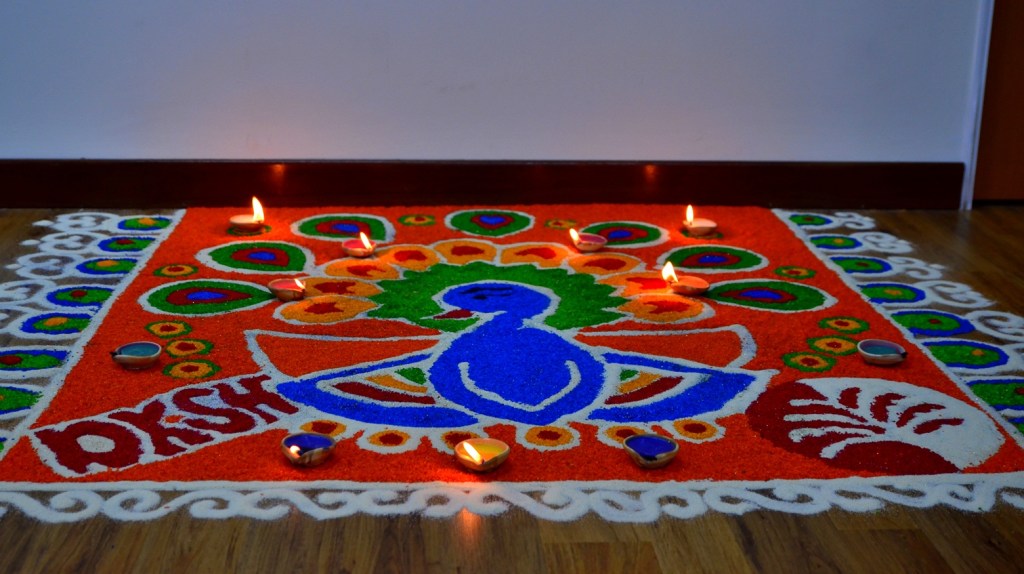
Deepavali Kolam in Penang, Malaysia. Courtesy: Creative Commons

In my naive childhood, I thought that Deepavali was one big celebration all over India and of those of the Indian diaspora the world over, at least of those of the Hindu faith. Bizarrely, I must have thought the whole of India would be up in jubilation anticipating the arrival of the festival of lights. Obviously not: the discussions surrounding the recent UNESCO recognition of Durga Puja as an Intangible Cultural Heritage are anything but unison. Now the Gujaratis want Navaratri[1] as a cultural loom. Interestingly, the people in power in Tamil Nadu want the harvest festival of Pongal as the main Tamil festival.

Indians who were brought in by the British to work in the Malayan rubber estates in the 1930s were mainly from Tamil Nadu. They celebrated Thaipusam[2] and Deepavali with much pomp and fanfare. Both days were soon declared holidays in many states of Malaysia.

I do not particularly remember my childhood memory of Deepavali being particularly joyous. Deepavali was another unnecessary expenditure in my home. We were a lower middle-class Malaysian Indian family of the 1970s. My thrifty Amma looked at this merrymaking as a hindrance. It was also the busiest time of the year for her. She was a kind of Indian Auntie Scrooge. She would drum up upon us at every moment that if one is healthy and wealthy, every day would be Deepavali. Deepavali comes once a year, right. But then, it comes every year.

Amma was a kind of local rock star amongst the flat dwellers when it came to stitching saree blouses. She was the go-to person for the aunties to enhance their assets and anatomy to look good in their sarees, even though most of them were overtly oversized and out of shape, to look trim and alluring, in their eyes, of course. Amma would use her talent to supplement Appa’s meagre take-home after the creditors’ scavenging.

She took in more orders than she could chew in her zeal to make hay while the sun was out. As the days grew nearer, she would become edgier and edgier. She would burn the midnight oil trying to finish the orders, as her customers would trickle in, demanding in desperation for their Deepavali blouses. She would smile apologetically to her clientele, but once they left, all of us, including Appa, would be the brunt of her frustrations. She would go on a monologue about the hopelessness of life, blaming all the people in her life, including God, for her miseries.

My sister, Sheela, grudging, had to help her, cutting loose ends, stitching buttons, edgings, and general tidying the blouses. Occasionally, Amma would cut or sew something wrongly, and that was when all hell would break loose. No one was spared of her screaming tirade. The smacking of children was legal then.

Deepavali was generally not what Malaysian Indian students, that is, those keen to score well in the Malaysian public examinations, looked forward to. Most, if not all, major public examinations were held at the end of the year. It made perfect sense as that was when the rest of the school would have finished their academic year, and there would be peace and quiet to conduct examinations. The trouble is that Deepavali mainly falls in late October or early November. Sometimes, the celebrations fell right smack between papers. The school would also be holding their end-of-year examinations if it was not for the public papers. Hence, we thought Deepavali was just another off-day to cramp up for the tests.

We, the children, could look forward to our annual sort of ‘pilgrimage’ thronging the bargain-hunting haven of Penang’s Campbell Street’s cheap sale’s stores two to three weeks before the auspicious day. We could look forward to the only two sets of new attire they would buy for the next twelve months. Seeing Amma bargain with the shopkeepers for the best price, I sometimes pitied the sellers. Sometimes, I feel like telling Amma to just pay what he asked. No, she would not do that. She would go to another shop, start another boxing match, loose, and return to the first shop smiling sheepishly.

As the days got closer, Amma would get even more and more high-strung. The children would be at the receiving end as the sewing orders piled up, and she could not find the correct thread colours for her blouses. In the midst of all that, some cloth piece or button would go missing, and then there would be a ruckus. Everyone would be roped in to search only to find the missing item right under her nose, where it would have been all the while.

Amma would become more desperate. The children, all preparing for the examinations, would be nagged for not helping enough, unlike other children – as if we were the only children in the world who needed to study! The sewing sessions would go on and on till the morning of Deepavali. On one occasion, probably due to fatigue, she actually cut out the wrong design for the wrong customer, and Amma had to replace the material later. Probably that customer must have ‘celebrated’ Deepavali that year with no saree blouse!  She might have passed it off as another new fad – as an empress in ‘new clothes’, perhaps!

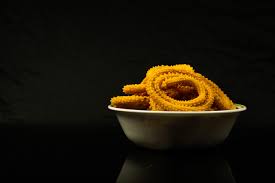
About a week before Deepavali, cookies would have to be prepared in the middle of this entire melee. By tradition, the first to be cooked must be oil based; hence the opening ceremony was done by pressing murukku (a deep-fried snack made from rice flour and spices) and ghee balls (ney orundei). With a traditional and cumbersome murukku squeezing device, I would be assigned to give my muscle power to press down the murukku dough. A few other cookies would be baked in the then-spanking-new electric oven. To add to the local flavour, Amma would stir up sticky glutinous in brown sugar for a delicacy called ‘wajik‘.

One particular Deepavali eve, I remember an incident that triggered a stir in my neighbourhood. We were living on the 15th floor of a 17-storey low-cost flat. Residents were packed into tiny pigeonholes we called home. Privacy was the most diminutive of the priorities as we paved through life. Sheela was left to guard the fortress as my parents went off to the evening market to get groceries for the big day. I had gone off to school. I was in the afternoon session[3] that year.

I returned home to a big commotion outside my flat. Most of the neighbours were standing outside the unit, banging on the door, calling for Sheela and talking loudly amongst themselves. I peeked through the blind panel of the door. I could see Sheela slouched cosily on a sofa with her hands on her right cheek deep in slumberland. The television in front of her was blaring loudly, further drowning all the commotion outside. She was not too far from the door, but she continued snoozing. I guess all the late nights helping Amma must have gotten to her.

 Residents getting locked out was nothing new in our neighbourhood. I suppose it is one of the events that got the neighbours together to mingle and get to know each other. Among us were self-appointed ‘specialists’ who devised their own gadgets to deal with any locked-out situation. The most typical item used by most was a charcoal stirrer. I guess that is how laparoscopic surgeons got the idea of performing keyhole surgery. One with hyper-flexible joints was sometimes sorted after to insert his hand through the door blinds!

Yours truly saved the day when I managed to manoeuvre my hand through the door to flip the lock open. All through the melee, my sister was in total bliss. Finding her snoring, oblivious to all the pandemonium outside, Appa went on to reprimand her in the usual way – KABOOM! (i.e. smack).

With all that build-up, preparation and countdown, Deepavali was actually an anti-climax – except for the new clothes, the food and the angpows (money packets) we received after distributing cookies to our neighbours. Amma would be sleeping after finally finishing her sewing and cooking. Appa would catch his forty winks on his easy chair, and we, the children, would watch all the special programmes on TV. Nobody actually came to visit us, even on Deepavali day. The afternoon would come, and the family would again manifest in front of the idiot box to watch the Deepavali special Tamil movie on TV. When this was over, essentially Deepavali was over and reality bit in. It was time to prepare for school the following day. On Deepavali nights, we would fire up a couple of Chinese sparklers.

All the money collected in the angpows would go straight into our Post Office Savings accounts in the next few days. The grand finale of the Deepavali curtain would fall a few days later with the family outing to the movies, a Tamil movie, packed with cookies that Amma had prepared as viewing snacks. Then, it was the school holidays, and another school year would come.


[1] A Western Indian festival in honour of the Goddess Durga, celebrated around the same time as Durga Puja

[2]  The festival in January- February (called Thai in the Tamil calendar) commemorates the occasion when Durga gave her son, Murugan (or Kartikeya) a divine spear to defeat a demon. It is also commonly believed that Thaipusam marks Murugan’s birthday. It is a national holiday in many countries such as Malaysia, Sri Lanka and Mauritius. In India, in Tamil Nadu, it  is declared as a holiday but not celebrated in other parts of India.

[3] Schools in Malaysia and Singapore often ran two session – morning and afternoon.

Farouk Gulsara is an occasional writer who blogs at riflerangeboy.com. Whenever he gets nostalgic about the time that whisked by, he pens down whatever his grey cells are still able to retrieve.

.

PLEASE NOTE: ARTICLES CAN ONLY BE REPRODUCED IN OTHER SITES WITH DUE ACKNOWLEDGEMENT TO BORDERLESS JOURNAL