Five poems by Rohini K.Mukherjeehave been translated from Odia by Snehaprava Das
Rohini K.Mukherjee
AT THE MYSTICAL SANCHI

An unknown voice beckons
At the early hours of the morning.
Moved by a new surprise
Buddha relapses into meditation.
A crystal dawn, cold as marble,
Is traced
On his hands and feet
And his eyes and forehead.
Some instant, invisible signal prompts him
To turn on his side and sleep.

After Buddha’s Nirvana,
Calm settles in the valley, slowly.
Thousands of
Branches and branchlets
Radiate blissful divine light.
The trees too, in a lavish growth,
Spread out everywhere --
From the earth below to the sky above --
And meditate!


THE EXECUTIONER

No one could predict
The next scene.
But in the one enacted now
The executioner has
A prominent presence.

The executioner stalks the moon,
 His face hidden in the veil of clouds,
Knife in hand, a gleam of smile
On a phony face,
A sharp, keen gaze under the glasses,
Exuding the smell of
An expensive perfume.

The indistinct footfalls may
Prompt one to flick a look back
 But there would be no one behind
Only clouds clad in midnight blue
Sailing in the sky.
From somewhere far floats in the music
Of a mountain stream.
 Slowly, sorrow dissipates and a
 Path opens up for the spring,
 A wonderland of fairies.
In his unguarded moments,
The knife in the executioner’s grip
Glitters in the furtive moonlight.
Any moment that poison-coated knife
Could find the moon’s throat,
The moon knows that well.
But it forgives,
Because it also knows well
That the executioner cannot
Hide for long
And will be trapped in
The moonlit garden of tangled clouds.


THE DEATH OF A HAPPY MAN

One day, the eyes lost sleep
And all the locusts flew away,

Not one spectator had guessed
That one day
The man will sprawl out on
On the sea beach sands
Washed away by the waves
From distant lands.

The eyes lost sleep one day.
The flock of locusts flew away.

But no one could guess
The pains, the sobs
That seared that forlorn soul.

Petals drifted in piles
To make him a delicate shroud.
The smell of sandalwood came wafting
In the sea-breeze from the north.
Seagulls flocked around the body,
Unintimidated by the crowd in the beach,
Drowning the voice of
The living men there
With their loud squawks of dissent.
Ooh! What a long wished-for
Happy death
On a cool and blissful sea beach!

After the flock of locusts flew away
Carrying all the dreams back
On their wicked wings,
The eyes lost sleep!


ANKLETS OF THE NIGHT

There is still time for the nightfall.
But the air tinkles with the sound of
The anklets of the night
 As if someone is retreating from
An ineffectual, moon-washed garden,
 As if someone from the grave
Watching the landscape,
Or someone standing at the riverside
Hums the tune of a departed season,
Or someone hurrying aimlessly away
To escape the approaching dawn.

It is not yet night,
But the night’s anklets ring.
You are probably returning
To your shelter of old times
In search of a new hope.
Just take a look behind to see
The painting of a conflicting wind
Fluttering across the courtyard.

It is not yet night
But its anklets begin to jingle in the air.

How cool you appear in your
Evening chanting of the mantras!
 How calm and steady you are
In the pure fragrance of the descending steps
As you set out on the journey
Holding your heart on your palm
Like a burning clay-lamp.
May be when you arrive there
The dawn around you would be sonorous
With the notations of Raga Bhairavi.

There is still time for the nightfall
But the night’s anklets tinkle in the air!


THEY DID NOT COME

I waited for them, but
They did not come,
I waited all this time in vain, and
Knowingly, let myself fall a victim
To the first rays of the sun.
The sun’s whiplash spurred me on
To the jungle.
It forced me to cut wood
And tie them in bundles.
The hunger of the sunset hour
Prodded me back to where
I had started.
The smell of soaked rice, and the aroma of
Onions and oil
 Drifted thick in the air of my house.

The sun came in, an intruder,
Sat by me and watched.
Then it devoured all the food,
Leaving nothing,
Not even a single dried-up onion-peel.

Because they did not come,
For me the morning was
Meaningless in its futility.
I knew I was never one
In the list of their ultimate interests
When their tenure of life here ended.

The footfall of the light
Trod easy on my skin.
Days rolled on this way
In sun and light.
The sun was everywhere, all the time.
Whenever the door opened,
The sun stood there.
When the meteor came shooting down,
When words rode over
the waves of sleep to float in the air,
The treacherous sun always appeared.

And for me, there was
No hope of their coming back.

But, one day as I leapt up in a hurry
At the Sun’s summon,
I discovered the Sahara Desert
That I believed had
Remained hidden in my
School Geography book,
Lying face down all these days
Under my own hooves!
Rohini Kanta Mukherjee has authored, edited and co-edited several volumes of poetry and short stories in Odia and English. Many of his poems have been translated and published in various Indian languages , broadcast over several stations of All India Radio and Doordarshan . Some of his poems and translations have appeared in Wasafiri, Indian Literature, The Little Magazine , Purvagraha, Samasa among others. He retired as Associate Professor of English, from B.J.B Autonomous College, Bhubaneswar, Odisha.
Dr.Snehaprava Das, is a noted writer and a translator from Bhubaneswar, Odisha. She has five books of poems, three of stories and thirteen collections of translated texts (from Odia to English), to her credit.
PLEASE NOTE: ARTICLES CAN ONLY BE REPRODUCED IN OTHER SITES WITH DUE ACKNOWLEDGEMENT TO BORDERLESS JOURNAL
Five poems by Hrushikesh Mallick have been translated from Odia by Snehaprava Das
AFTER THEY LEAVE

After they leave,
The tree in the midst of a bare field
Stands forlorn.
Not a single bird,
Nor the sound of chirping anywhere
Not a leaf flutters in the breeze,
No one speaks a word
After they leave.

The world is a meaningless void
When they are not there.
Flowers bloom and wither aimlessly.
Festive seasons come and depart.
The privileged and the poor come and go
Without making an impact.
Silence reigns everywhere and around
When they are not there.

Living in a pattern,
Like, in every moth-hour
‘Chhatu bhai’ riding back
From the village market, ringing the bicycle bell,
Or, farmers sitting on a platform in the evenings
And deciding which patch of the land
Would be plowed next morning,
Like, the moon coming up routinely
At measured intervals,
And discussions centering around
How ‘Gaya-bhai’
Escaped the wrath of the village-goddess
Last night by a sheer miracle.
Routine life continues
Like rice cooking tender in the kitchen-hearth
While cow-dung cakes are put
To smoulder in the cowsheds.
The regular pattern of living
Is dull and cheerless
In their absence.
Who are they, then? Who indeed?
They are the fragrance of the paddy-buds
In the farmlands by the hillside,
They are the Siju bushes that
Grow under the eaves in the backyard,
They are the sound of the clearing of throat
That inspires courage in a fearful heart
 On a dark pathway,
They are the drumbeats floating in
In gentle waves from the neighbouring village,
They are the pallbearers that twine ropes
 To make a pyre;
And, after they leave life loses its meaning!

WHEN THERE IS NO GOD

Once you join your palms
sitting on the bed
while going to sleep
or, as you wake up,
worries stop disturbing
your calm.
You are assured of the presence
of someone called God
who might break your fall.
But these are the bleak days
of God’s absence,
these days the headless bodies
saunter down the streets of the night
whispering to one another.
The dogs howl in a chorus.
The sounds of sermons or devotional songs
do not float in from the mandapa,
the air throbs instead with the siren
of ambulances.
As such belief is that
the God that holds
the trident and the mace
is omnipotent.
 Why does that God stand dull
 and lifeless in the temple now?
Does an idol in any temple
have the power now
even to chase away the stray dogs?
Is there a God in any shrine
who can hold open
its closed doors and by some miracle
turn auspicious
all that is ominous?
In these dark days when
God is not there,
if we take a fall,
we have to get up on our own.
We have to lean on our own mettle
and our own merit
in the moments of death or survival.
In the absence of God,
we have to commit ourselves
to the service of the distressed,
to feed the hungry
and nurse the sick,
give shelter to the homeless.
It’s time we repented our indulgences
without religious extravaganza.
It’s time we stopped
pinning blind faith in
the figures of stone.

THE LONE GIRL

The lone girl has nowhere to go,
She sits alone lamenting her loss;
Once upon a time she had
 a country like we all have,
it was called Syria.
Its lofty national flag
soared to the clouds.
It had a national anthem that
sparked the spirit of martyrdom
in its people!

In the evenings,
perched on the shoulders
of her babajaan,
she watched the moon
in the sky of her homeland;
heard stories from her mother
that set her eyes rolling in wonder;
that country, her homeland is now in ruins
a vast, barren expanse,
littered with severed limbs.
Its air is sick with the smell of
tons and tons of explosives
there lay piles of disfigured childhood
in pathetic abandon
to tell the tale of a country that was!

No one had ever warned the girl
that her tomorrows will be spent
in makeshift shelters under the tents,
nor did she know that
her palms would join to make begging bowl,
and there would be merchants
to trade on
the perfumed void in her.
No one predicted that she would grow up
believing in hatred instead of love!
And when she would learn to ask
the whereabouts of her parents
the whole civilized world will
keep mute.

EYES

Just as I believed that all poems
which could have been written on ‘eyes’
are already written
your ‘eyes’ flashed before me
and what an amazing lot of trees
laden with fruits and flowers
 and birds, they held!
I wondered where did you flick
your deep, boundless glance
from the corridors of the hospital
like a handful of floral offerings.
The anguish that glance held
was like the lost look in the eyes of a kid
who was rudely denied a father’s lap,
 like a fresh bloom shying away
from the eyes of a honeybee
or, a streak of lightning flashing
in the overcast noon-sky
like a poor man’s last hope.
Your eyes are like the lines of a poem
that unfold a new meaning
at every other reading.
Your eyes,
like a strange horizon captures
the crimson of the dawn
and the gleam of a red silk sari
in a perfect balance!
Your eyes could transform a waste land
to a paddy field in luxuriant green,
at times they are moist with muffled sobs,
or, like a spear smeared in blood, at others!
What is more beautiful --
the bright loquacity in your eyes
or the rain-washed sunshine,
the mysterious mutter in your eyes
or a village enveloped in a wispy darkness?

THE HONEYBEE DOES NOT KNOW

The son writes poems.
His mother does not know.
‘You are rotting yourself through writing,’
She complains,
‘Did you write them?’
A girl-friend, looks at him in wonder,
‘Can you swear to that?’ she asks.
The boy writes poems
The street where he lives does not know it,
Nor does the village!
His young face does not sport a beard,
Nor have the creases appeared on his forehead.
There was not that distant look
Like the faraway stars in the eyes,
How could then he be a poet?
Who would believe that?
A man who picks up a quarrel with the fisherwoman
Could recite the brajabuli,
Or, the fellow weaving clothes at the loom
Can sing lines from Tapaswini

A poet is not supposed to have a home.
He sits under the trees
Amidst the anthills.
A poet hacks off the branch he sits on.
He does not have that worldly intelligence.
A poet is not pragmatic.
He begins a line at the wrong point
And ends it at a wrong one too.
A good poet forgets the right way of chanting
The mantra that would protect him from dangers
While actually facing them.

The mother does not know that
Her son is a poet; nor does the father.
The owner of the hut where the poet takes shelter
Does not know his tenant to be a poet.
The poet’s voice does not know
It belongs to a poet.
The reflection has no idea it is the poet’s image.
The lizard exploring the shelves
Does not know the ‘Award of Padmashree’
Carefully preserved there,
Was won by the poet.
The honeybee that circles the graves
Does not know that
The lines engraved on the tomb
 Were the epitaph for the poet.
Glossary: Mandapa is a pavilion. Brajabuli is a dialect based on Maithali that was popularised for poetry by the medieval poet Vidyapati. Tapaswini: A famous long poem by the 19th century Odia poet Gangadhar Meher.
.
Dr Hrushikesh Mallick is a reputed Odia poet and writer. He has 13 Poetry collections. His first book in 1987 heralded a new era in Odia poetry. He has received Odisha Sahitya Akademi Award (1988), Sarala Award (2016) and Central Sahitya Akademi Award (2021).He is also an eminent literary critic and fiction writer. He served as President of Odisha Sahitya Akademi (2021-2024). He has been a professor of Odia language and literature from 2012.
Dr.Snehaprava Das, is a noted writer and a translator from Bhubaneswar, Odisha. She has five books of poems, three of stories and thirteen collections of translated texts (from Odia to English), to her credit.
PLEASE NOTE: ARTICLES CAN ONLY BE REPRODUCED IN OTHER SITES WITH DUE ACKNOWLEDGEMENT TO BORDERLESS JOURNAL
Five poems by Ashwini Mishra have been translated from Odia by Snehaprava Das
Ashwini Mishra
RIDING THE EARTH: THE LAST DAY

Farewell!
A final goodbye!
The prologue to an epic of an endless rest
Has to be something
Extra special.

Gathering up all the strength
Of his senses
He strove to know the people
Around him.
He spoke fondly to them
‘Let you all be there in my heart
Forever,
May my world keep shimmering
With the glow of this endearing bond.’
He rode each passing day
That galloped on --
Like a well-fed, robust horse,
He rode on,
His feet securely stuck in the stirrups
His hands gripping the rein hard.
 In an instant he could
 Gallop around the earth
 Cradling time under his arm.
The river, the ponds
And the rainclouds brought water
For his parched throat,

Towards the end of the journey
He called one by one his folks
Whom he held dear to his heart.
 Some of them sounded assuring,
 Some promised to come.
 A few fulfilled their promises too
 And came --
Still, there was a disturbing emptiness
Somewhere within.

Where has disappeared
The knot of love that had held
So strong in the days of past?
It was as though that knot
Had loosened and shredded.
Worn out like a weary page
In the mindscape,
Like someone that had once
Played a major role,
And had moved away from the centerstage,
To stand by the stage-wings
Distanced and dispassionate!

SWORD

 I had never wanted
To wield a sword, a dagger or a goad.
I had always wanted to tuck plumes
into the hair,
To draw a lotus on the palm,
To play the notes of spring breeze
For the ears of the
Blazing summer noon.
I had wanted to be a dreamer,
To let my eyes close
At the touch of the delicate petals
Of exotic blooms!
But you did not let that happen.
My loved ones,
My folk I held close to my heart,
Fell at the merciless blows
Of harsh and hostile words
Your canons shot.
Your anger, your cruelty,
Weighed heavy on me
And a thunderstorm brew inside me.
Unnoticed by others.
In the end,
My compelled hands
Reached out to the scabbard
Lying abandoned under
The smuts of time
To draw the sword out.

THE CLAY LAMP

A clay lamp can always guess
How long the ghee and
The wick in it will last.
It is a living thing
How brief might its lifespan be.
It can, like all living beings,
Battle the wind and the darkness
In its struggle to survive
In an unenclosed space
That is vulnerable to
The assault of hooves of animals
Or the misty spray of the dew.
 It knows that
 The moment the curtain rises,
 Revealing the stage
All set for the entry of light,
The first act of the play will end
And Its role will be over
Even before the makeup is
Rubbed off the face or the artificial tint
On the hair fades.
The hand that had lit it
May turn impassive, too!

  A woman, her heart and hands
  Focused on the act,
  Keeps lighting up the clay lamps,
  Not knowing for sure
  How long their light would last
  Or when the flames would die.
 The idol of the goddess
  That glittered in the light of
  The lamps she lights
   Never steps down to help her
   When the flames char her body.
   There is not a soul in sight
   When her flame dies,
   Except a few burnt insects.

 GAZA
You neither have a chest
Nor arms now
To embrace those who once saw
You as their own
Like you did before.
The natives and the foreigners,
Who trod your soil,
Now take a turn either to your left
Or to your right and move on.
No longer the chirrups of birds
Come sprinkling down
Either from your sky, or your trees.
There are vultures everywhere
Scavenging on the tender human flesh
Getting fat and heavy.
The sun, the moon and the stars
In your sky are
Blown away into thousand pieces now.
You may dig up some of them
Graved under your ground.
The Death in your sea breeze
And in your explosive garb
Haunts living humans
To turn them to corpses.
Like a farmland ladened with crops,
Skeletons are heaped in your streets.
Houses and buildings where life dwelt
Are mounds of shattered concrete.
Wreckage of kitchenware,
 And of home appliances
 Lie on the desolate roads
 In pathetic scatters.
A book satchel slings from the
Severed hand of a dead child.
The thirst for war is not quelled yet,
New strategies are deliberated upon
To pursue newer missions of death.
New weapons must be hoarded
In the arsenal
To launch an attack on the netherworld
After this world is razed to ruins.

WHIP

The whip that once basked proud in
The love of the kings and the feudal lords
And danced in elation on
The defenseless back of the oppressed,
Now lies worn and weary
In a niche in the royal palace or
Behind the glass doors in the shelf
Of a museum,
Coated in dust and dirt.
The obsequious tanners,
Who were far below the
Aristocracy,
Polished this tool of tyranny
 Bright with oil,
 And it jumped crazy
On their haggard backs,
Drawing crooked lines
Of livid blue and red.

How wide is the chasm between
Sage Dadhichi who gave his bones
For forging a thunderbolt
To kill demon Brutrasura*,
And the stingray that gave its tail to
Shape a whip
That performs its brutal dance
On the back of innocent humans?
Even today,
The barges of history and legends
Voyage across the pages
Of text books taught in the classroom,
Their sails fluttering
On their proud masts.

*Brutrasura was killed by Indra with a weapon made with Sage Dadhichi’s bones as per mythology.
Aswini Kumar Mishra has 13 poetry collections to his credit. He has been translated widely into English, Hindi, Bengali, Tamil and other Indian languages. He has authored a fiction in English, Feet in the Valley (Rupa Publications, 2016), His poems and essays have appeared in several literary journals including Indian Literature, Kavya Bharati, Wasafiri, M.P.T, The Little Magazine, Samakaleen, Konark, Rock Pebbles and Vahi etc. A recipient of several awards, he currently lives in Bhubaneswar and can be reached at cell phone +919438615742, +918456953936. His email id is: mishra.aswini53@gmail.com
Dr.Snehaprava Das, is a noted writer and a translator from Bhubaneswar, Odisha. She has five books of poems, three of stories and thirteen collections of translated texts (from Odia to English), to her credit.
PLEASE NOTE: ARTICLES CAN ONLY BE REPRODUCED IN OTHER SITES WITH DUE ACKNOWLEDGEMENT TO BORDERLESS JOURNAL
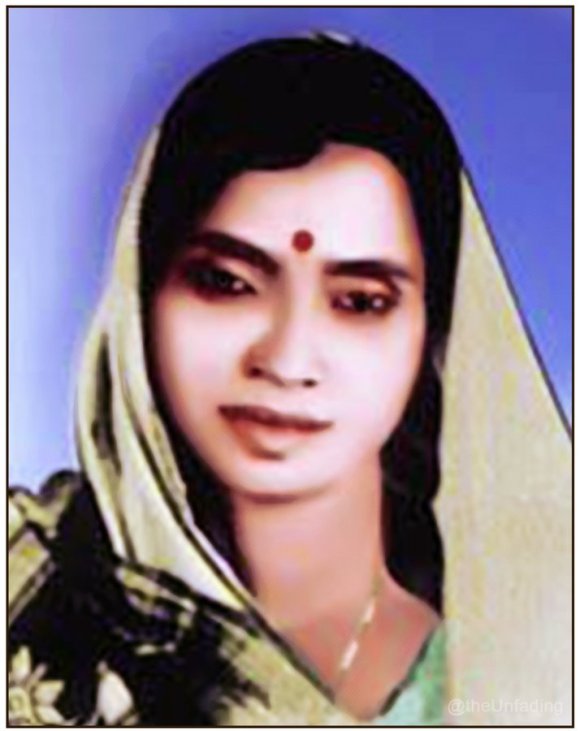
Bidyut Prabha Devi (1926 – 1977) is celebrated as one of the most prominent female poets in Odia literature. Hailing from Natara village in the Kendrapara district, she was the second daughter of the esteemed writer, Nimai Charan Das, and Rekha Devi.
Raised in a traditional family in Bamphisahi, Cuttack, she received most of her education independently, attending Ravenshaw Girls’ School until the ninth grade. Inspired by her father and notable Odia poets like Nanda Kishore Bal and Kunja Bihari Das, she began her journey into poetry in 1940.
Her first collection, released in 1944 when she was merely 18 years old, featured patriotic poems that celebrated the cultural and natural heritage of Odisha. It highlighted her early ability to create vivid imagery and convey emotional depth, drawing from her rural background and the literary traditions of Odia.
Her 1950 collection, Utkal Saraswata[1], was recognised as a significant contribution to education, being included as a poetry textbook at Utkal University. In addition to poetry, she also wrote for children, for which she was awarded by the Government of India in 1955, acknowledging her impactful contributions to children’s literature.
Bidyut Prabha’s poetry explores the challenges faced by women, societal limitations, and the theme of empowerment, weaving together both personal and universal experiences. It embodies her feminist viewpoint, tackling matters such as gender inequality within a conservative framework, all while preserving a lyrical and approachable style.
She authored numerous plays, although specific titles are not extensively recorded. Her theatrical pieces frequently conveyed social messages, resonating with her socialist and feminist principles. Her writings were recognized for their clarity and moral depth, rendering literature accessible to younger audiences. Some of these later works are less documented but showcase her reflective and philosophical nature.
Influenced by socialist principles, her poetry examined social disparities and advocated for the marginalised. Her self-taught approach was characterised by clear and evocative language, rendering her work both relatable and profound.
Bidyut Prabha’s writings were revolutionary for their era, especially in their focus on women’s issues within Odia literature. Her son, Sachidananda Mohanty, a distinguished educationist and litterateur, has translated her works, thereby preserving her legacy.
Writes Sachidananda Mohanty[2]: “In recent decades, feminist historiography in eastern India has paid welcome attention to issues of education, creativity, and sisterhood across linguistic barriers. It has recognised women’s pivotal role in shaping the public space at the intersection between feminist history and literary creativity. Scholars like Judith Walsh, Tanika Sarkar, Malavika Karlekar, and others have brought to our attention forgotten life-narratives of literary women of the region who have created a tradition of their own. Bidyut Prabha Devi, recognised as a major female voice in pre-modern Odia poetry, belongs to a poetic tradition represented by an illustrious sisterhood, comprising Reba Ray, Kuntala Kumari Sabat, Haripriya Devi, Debahuti Devi, Nirmala Devi, Tulasi Das, and Brahmotri Mohanty, among others.
“While Bidyut Prabha may be known in Odisha, her feminist poems, based on her deep understanding of domesticity and patriarchy, have not been sufficiently read outside the state. Even in Odisha, her ‘romantic poems’ are widely anthologised at the cost of the more powerful compositions that address the woman’s position and identity in terms of the entrenched power structures in society.”
According to Mohanty, Bidyut Prabha’s feminist poetry stands out distinctly from the prevalent ‘Advice-for-Women’ genre in the region. She bases her work on her own life experiences and resonates with the growing feminist consciousness in Odisha, which is championed by literary feminists and social reformers like Sarala Devi[3], who played a pivotal role as a mentor to Bidyut Prabha. This journey was marked by its transnational influences. Sarala Devi had a strong connection with poet Annada Shankar Ray, a key figure in the Odia Romantic movement.
Her impact on Odia literature is significant, particularly as one of the earliest notable female poets in a predominantly male literary environment. Her contributions are rooted in her capacity to merge lyrical elegance with social critique, enhancing the inclusivity, reflection, and cultural relevance of Odia literature. Her work continues to serve as a foundational element for feminist and regional narratives in Odisha.
She was married to Panchanan Mohanty. Following health challenges in 1966, her literary output took on a spiritual dimension, shaped by her connection to the Sri Aurobindo Ashram, Pondicherry. Unfortunately, she took her own life.
Bidyut Prabha Devi’s poetry, deeply rooted in feminist and socialist ideals, continues to motivate and inspire, with her centenary of birth being commemorated in 2025 as a representation of women’s empowerment in Odisha.
[3] Sarala Devi (1904-1986) – Odisha’s first Satyagrahi, first female legislator and first feminist writer.
.
Bhaskar Parichha is a journalist and author of Cyclones in Odisha: Landfall, Wreckage and Resilience, Unbiased, No Strings Attached: Writings on Odisha and Biju Patnaik – A Political Biography. He lives in Bhubaneswar and writes bilingually. Besides writing for newspapers, he also reviews books on various media platforms.
PLEASE NOTE: ARTICLES CAN ONLY BE REPRODUCED IN OTHER SITES WITH DUE ACKNOWLEDGEMENT TO BORDERLESS JOURNAL
Five Odia poems by Sangram Jena have been translated by Snehaprava Das
Sangram Jena
 RETURN

Is there ever a return?
Do the years left behind,
Or, water flown away in the river,
Return ever?
Do parents who had quit the world
years before come back?
Or, the erstwhile beloved
married now to another man?
What are the things that return
after having gone?
Doesn’t the sun that depart every evening
return on the next?
Perpetually, endlessly?
Is returning a reality
or, an illusion of one?
And, wrapped in it,
life moves on
from the crib to the crematorium.


                ROCK*

What did he stumble on?
The unobtrusive block of stone
that lay on his way,
the sacred scriptures, the hearsay
all carried the story that
the sinning Ahalya was redeemed
at the touch of his holy feet;
When Indra had touched her that day,
what was that touch?
Was it a pretence? A betrayal?

It matters little whose touch is it
if there is trust in love!
A pretense of love is sometimes
More intimate than a relationship
that has no life in it!
What promises of redemption the world
That labels love a sin, held out for her?
She was neither a wife nor a beloved
after she was transformed
from a rock to a woman;
Hadn’t it been better
to have remained a rock
and lived the rest of the life
holding on to the memory
of a handful of those ecstatic moments!

*Refers to the story of Ahalya in Ramayana

IT IS NOT THERE WHERE YOU LOOK

It is not there where I look!
May be, what appears to be where
is never there in reality,
Like the face that is not there in the mirror,
Or, the pain in the body,
Will the words that need to be said
Ever be there in written letters?
Does the meaning dwell in the words?
Does the sun sit behind the mountains,
Or the sea ends at the skyline?
Actually, what appears where
Is never there!

SEARCH

There is no point in searching.

A river flows while
You keep searching words.
As you look for the right colours,
the painting fades.
The sun drops into night
as you grope for the morning

and a moon comes up while
you chase the dark.

The petals wilt and drop
before the search for fragrance ends.
The poem is lost
before the right images are found.
While you seek the sea,
The horizon shifts further.
The feet are lost
Through the search for a ground underneath.
The thread of the kite snaps
In the quest for a sky.
The clouds dissipate
While craving the rain,
And the body dissolves
While you look for the shadow.

Ther is no point in a search.

Life fritters away quietly
As you keep browsing.

WHAT DO YOU THINK?

Life does not flow
the way you expect.

Do you think morning does not arrive
Till the crows’ caw?
Does the kaash not bloom
after the river recedes?

Do you think butterflies never circle
The flower after the petals drop?
Does no one look up at the sky
After the moon goes into hiding?

Do the frogs stop croaking
When the rain goes away?
Can the night be omnipresent
With its darkness?
Can everyone find the way
When there is light?

Doesn’t your shadow stay back
After you leave?
What do you think?
Sangram Jena (1952), is an eminent poet, translator, critic and editor. He writes both in English and Odia and has published more than 70 books. Translation of his poems have been published in several Indian languages including English, Bengali, Hindi, Tamil, Assamese and Marathi. His poetry in English have been published in many magazines in India and abroad. He has translated Classics of World Poetry into Odia and classical, medieval and contemporary Odia Poetry into English. He has received many awards including Sahitya Akademi Award (National Academy of Letters, New Delhi) for translation, a Senior Fellowship from the Department of Culture, Govt. of India and served as a jury member of National Selection Committee (New Delhi) for award of ‘Saraswati Samman’. He edits two literary journals, Nishant in Odia and Marg Asia in English. He has served as Vice-President, Odisha Sahitya Akademi. He lives in Odisha, India.
Dr.Snehaprava Das, is a noted writer and a translator from Bhubaneswar, Odisha. She has five books of poems, three of stories and thirteen collections of translated texts (from Odia to English), to her credit.
PLEASE NOTE: ARTICLES CAN ONLY BE REPRODUCED IN OTHER SITES WITH DUE ACKNOWLEDGEMENT TO BORDERLESS JOURNAL
Five Odia poems bySoubhagyabanta Maharana have been translated by Snehaprava Das
SUNSET: A SYMBOL

To bridge the agelessly waiting gap
Between an unvoiced luminosity and a vibrant darkness
Sunset is a magic silence,
An indulging over the wispy interlapping
Of light and shadow.

It is an ancient oil-painting
On the old drawing sheet of the sky by a
Bohemian, invisible artist who fills the earth
With a spectrum of the melody of
An unforgettable twilight.

Sunset is the gentle thump of
Disembodied dancers’ feet, tripping
To the rhythm of witch-chanting
On a phantom, ashy-pale stage.

A lifetime that had glowed like a fake sun
In the crimson smile of the earth
Slowly turns black,
And on the black canvas of the sky
Painted in scatters are millions of sparkling stars.

Sunset is a Truth,
A promise of a melodious, bright morning
That the sun dreams of
Slumbering in the palanquin of the night.

SILENCE BETWEEN WORDS

Like a lone, saffron-robed monk
The silence hiding between the words, waits
Keeping awake in secret,
Hoping to get free
from the mysterious chains of mystic incantations.

The bewildering crowd of thoughts stuck between
One word and another,
Before even the mystery of the meaning is unraveled
Confuses the interpreting.

And the silence is left alone,
Weeping, elegizing the loss --
A dumb witness to the unwarranted death of words.

Because the silence does not reveal itself
In happiness,
A sorrow lives permanently in the palpitations
Of the poet’s heart
To bring the un-wilting flowers of poetry
Molded from the poet’s blood into blooming
in their vivid, picturesque charm.

In the unshackled voice of the poet
words and silence seek a nerve center,
in a sensitive, ultimate moment of love
to melt into each other.

Who else other than a poet could gauge
The depth of the silence hidden
In the koel’s song
To bridge the gap between life and death?

A VILLAGE THAT WAS: SKETCHING NOSTALGIA

No one was there waiting eagerly
To meet my shadow,
No one to lament the loss of a village
That was there once.
The smell of love in the wet mud
Has faded with the passage of time.
The melody of spring in the soft breeze,
The shadow of a rainbow on the face of water
Have disappeared too.

The day when I left the village,
A fleeting cloud played hide and seek
In my book-satchel.
The fragrance of the lotus in the village-pond
That wished to caress fondly
The vibrance of childhood on my face
Missed me.
The name of that village lives in me.
A village crowded with forests of Mahula
And throbbing with the song of Adivasis
Dancing in the shadows of the Sal --
The village where rings the rhythm of my birth-cries
in a straw-thatched hut --
the name of that village, has melted into my breath.

A deep sadness pricks me though
That just as I understood the village
I lost my way to it,
 Before I could trace the lotus-pond
And inhale its fragrance.
The smoke the factories emitted
Choked me midway,
As I went on narrating the nostalgia
I was left with just myself.
Alone.
While I searched for dreams
Painted in rural shades,
I lost my own self in the pale horizon
Of a smoky, grey sky.

DECLARATION

I gathered the ardour of that missing warmth
From the ashes of a decadent sun
To charge the cold blood that run in my veins.
I gathered the exotic smell of blinking stars
To add years to my life.

My skeletal frame that resembles
some ancient sculptor has a voice.
It can speak, and it can hide
from the eyes of the world
the pain it writhes under,
lest someone use its vulnerability
and sign a sworn statement for befriending
its invisible blood, flesh and sinews.

In every corner of my body that is caged,
In the prison of the elements,
Love sojourns.
And the intimate voice of my shadow-self
Has reached up to the planets and beyond.

The primeval tale of my century-old wait
Has sheltered in the feeble gaze of my eyes
May be, I am designed to stand as
The enemy of Time.
It was perhaps designed so,
That my victory march, with the bugle blowing
Will be declared a glorious success
Against a different backdrop.

RELATIONSHIP: ANOTHER HORIZON

It feels odd at times
To play the hero in
The brief interlude between
Ignorance and innocence.
There are times when a relationship
Founded on poisoned, defiled trust
Tastes sweet.
In the dark sanctum of bitter animosity,
 A beguiling god assumes a friendly form
 And embraces to overwhelm you
 with his gratifying blessings.

 Only a fake hero would nurture
 The overpowering urge to
 Flaunt himself in vain glory on the
 Dazzling stage of civility.
 It is he who fosters a brazen wish
To draw a line on the water,
And to wish for the moon
In a moonless night-sky.
 True friendship is where
The sapling of love grows
Its green foliage
To reach a lofty height
And brings life to fruition.
It’s like a faint streak of light
That illumines a blind alley at night.

A heart bathed in that love
Becomes more sacred than a shrine,
More craved than the potion of immortality.
It is the comfort an orphan child enjoys,
Sleeping inside a cozy culvert
In the chilly night of the month of the Pausha*.

*December- January
Soubhagyabanta Maharana
Soubhagyabanta Maharana (b.1951) in the Bolangir town, Odisha, is a prominent bilingual poet, critic and translator of Odia and English. He is an awardee of Odisha Sahitya Akademi for poetry in 2010 along with many prestigious literary awards. He has to his credit nineteen poetry collections and six essay collections on modern Odia poetry.
Dr.Snehaprava Das, is a noted writer and a translator from Bhubaneswar, Odisha. She has five books of poems, three of stories and thirteen collections of translated texts (from Odia to English), to her credit.
PLEASE NOTE: ARTICLES CAN ONLY BE REPRODUCED IN OTHER SITES WITH DUE ACKNOWLEDGEMENT TO BORDERLESS JOURNAL
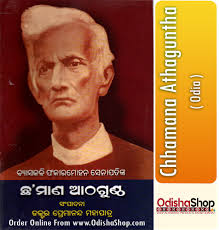
Odia literature is characterised by a profound tradition of classic narratives, with notable examples such as Fakir Mohan Senapati’s timeless Chha Mana Atha Guntha[1]. This literary corpus is further enhanced by an array of mythological and folk narratives that hold significant importance in the cultural legacy of Odisha.
These narratives persist through time because they reflect universal human experiences, encompassing themes such as land, power, family, and morality, all while being intricately linked to the historical context and cultural identity of the region. They serve not only as stories but also as reflections of society, having been shaped and refined over the years.
Readers are consistently attracted to these literary works for reasons similar to those that draw us to the writings of Shakespeare or the epic narrative of the Mahabharata: their themes are enduring, and the insights they provide remain pertinent. Similarly, publishers and curators, even at the national level, often revisit these classic tales, a trend that is entirely justifiable.
However, it is the transition to contemporary matters that strikes a significant chord. Odia literature has been progressing, albeit perhaps not as prominently or visibly as certain other Indian literary landscapes. Modern voices are addressing current issues—urban isolation, the influence of technology, caste relations, and environmental deterioration. The change is evident, yet it remains less pronounced than it has the potential to be.
What accounts for this? There may be multiple reasons.
The literary tradition of Odisha is profoundly embedded in its heritage. Classic literature is not only revered and taught but frequently eclipses modern works. Both publishers and readers exhibit a conservative inclination, preferring established texts. This trend is not unique to Odia literature; for example, Tolstoy remains a central figure in Russian literary discourse. As a result, this inclination obstructs the acknowledgment of new authors.
Modern Odia literature faces considerable challenges in its distribution. In contrast to Bengali or Tamil literature, which benefits from larger urban readerships and established translation networks, Odia books often struggle to reach broader audiences.
While digital platforms are making significant strides in this domain, the overall development is still sluggish. Without a strong market, numerous authors may opt to concentrate on more conventional themes that are viewed as more commercially viable.
The demographic composition of Odisha is primarily rural, where numerous readers find a stronger connection with stories that delve into village life or ethical dilemmas, as opposed to genres like cyberpunk or themes focused on existential angst. Although there are urban Odia authors, their readership is frequently limited in range. As a result, contemporary themes may seem alien to those who maintain a deep bond with traditional cultural settings.
The literary language of Odia typically possesses a formal tone, significantly influenced by its classical roots. This can lead to a conflict with modern terminology and global themes, posing challenges for writers who wish to innovate without jeopardising their connection to the audience. In contrast, languages such as Hindi and Malayalam readily incorporate colloquial expressions, which thrive in contemporary literature.
Nonetheless, modern Odia literature is dynamic and progressing. Short story writers are exploring a variety of topics including religion, science fiction, feminism, leftist ideologies, and climate change. Prominent authors such as Sarojini Sahu, Satya Mishra, Rabi Swain, Sadananda Tripathy, Jyoti Nanda, Bhima Prusty, Janaki Ballabh Mohapatra, Ajaya Swain, Biraja Mohapatra, Sujata Mohapatra and young writers like Debabrata Das are actively investigating these contemporary themes. Publications like Kadambini, Rebati, and Katha are offering platforms for these creative narratives.
Despite this, the main obstacle remains the need to improve visibility. Social media and over-the-top (OTT) platforms have the potential to revolutionise this landscape—just picture an Odia adaptation of Black Mirror[2]!
There is an immediate need for greater investment in Odia storytelling to effectively bridge the gap between traditional and modern narratives.
.
[1] Six acres and a Third, a novel by Fakir Mohan Senapati(1843-1918) published in 1902
[2]Black Mirror is a British dystopian science fiction television anthology series that started in 2011 and is still on the run.
.
Bhaskar Parichha is a journalist and author of Cyclones in Odisha: Landfall, Wreckage and Resilience, Unbiased, No Strings Attached: Writings on Odisha and Biju Patnaik – A Political Biography. He lives in Bhubaneswar and writes bilingually. Besides writing for newspapers, he also reviews books on various media platforms.
.
PLEASE NOTE: ARTICLES CAN ONLY BE REPRODUCED IN OTHER SITES WITH DUE ACKNOWLEDGEMENT TO BORDERLESS JOURNAL
Five Odia poems by Bipin Nayak have been translated by Snehaprava Das
WITHIN

An equestrian within me
Mounts an unbridled horse
And plays a violin.
A boatman inside me
Crosses an imaginary river
Again, and again
In a non-existent boat.

Within me, there is a wayfarer
That refuses to
Travel the trodden road
And takes a turn.

A lake ripples in me,
Waiting futilely
To lose itself in the sea,
And a waterfall
Leaps noisily from above
To wet the rocks.

A cloud floats within me,
All of a sudden,
Flashes a lightning smile
And goes back to sleep.

In me, a cowherd
Returns home in the twilight
Painted in the colours of sunset
And lights a kerosene lamp.

A camel inside me
Sags under a sack-load of salt,
But trudges across the sands
Dreaming of a lush meadow.

A mother in me conceives words,
Bleeds in labour,
Nourishes the vulnerable words
With love and care
And watches them grow…

PAPER BIRD

My woes pull your neck longer.
My beloved words become the air
To stuff your insides.
I forge your wings from
The crumpled paper of my dreams,
And mold your beak with my kisses,
Paint you in the colour
Of my solitary nights….
Trim you with
All my fears and frustrations.
Because I could not
Make a paper-boat of you
To sail in the muddy puddle,
I lift you up
To fly across
The monsoon sky.
When you climb a little higher
Into the air
And are drenched out of shape,
I, a naked child,
Stand here in the rain, look up and cry!

THE MAKING

I pick a few bones of my hardest grief,
Scoop some blood
Oozing red to create.

I fix a face of smoke or a patch of weepy cloud
Mold a nose from the wafting breeze.
I fix a pair of eyes, like day and night,
There in the face.
In one of them, I put a tornado,
A bird in the other.
With flowers of joy and grief,
I shape the lips.
The body I try to make
Out of a river that hides under it,
A fire and a perpetually vain desire
To reach the sea or a desolate jungle.
I design the limbs from a
Lingering surge of green.
All these efforts
Are but only to replicate
What has been made before.
I set afloat
Because it has been set to drift
Much before…
And because it has sprinkled
A cosmic fervour across
A secret sanctum inside me,
To bring a god to life,
I worship it!
I keep trying to create and re-create inside me
Because it has made me much before that!


A SKY AS I AM

I have set out to paint a sky of my own --
A sky that is exactly as I am!
And for that I have picked up
Some nomadic dreams, a sunset,
I have collected the blood of flowers,
The tune of a stream that has flown away,
The chirping of orphan birds,
The layers of moss spread over
A decrepit piece of rock-writing.
I have scooped up
A handful of ash from the debris of
Perished time,
And a wild storm that had retreated
After having blown me away.
I took out the wet melody from a violin and
the primeval music of the insect,
throbbing inside the grass.
From the reminisces stuck in the sinews
I have gathered a few scattered sighs,
 And from the darkness, the mysteries of nights,
 I have got warmth from dreams,
 Sin from pollen grains.
 With these elements beside me
 And a canvas in shreds,
 I sit down to paint a sky of mine
A sky that is exactly as I am!

LET THEM SING

Let them sing a song.
I do not mind
If my wound heals them,
Or my tears make them glow,
And my blood paints them crimson.

My quick breathing flits about, but
I do not mind if someone plays a flute
Blowing into the holes of my bones
And sings through the lips
Borrowed from me.

Let them sing, why must I mind it?
The lips are not mine. Nor is the song!
Bipin Nayak
Bipin Nayak (1950), a bold and engaging voice in the literary scenario of modern Odisha, is a trend setter who explored new possibilities for Odia poetry. One of the most significant postmodernist and minimalist poet in Odia, Nayak is a believer in the artefact of words than the meaning and medium. For him poetry is an aesthetic exploration through the fragile, fluid words which could be liberated from its conventional canons and connotations. There is a distinct undertone of metaphysical too in his poetry that hovers over the slim divide between the real and the surreal. Bipin Nayak is a pioneer in Odia auto-fiction writing. His ‘Jatra ra Ketoti Pada’[1], an unprecedented experimental work, that challenges the conventional style through a blending of prose and poetry and does not conform to any traditional literary genre. Besides being the recipient of the prestigious Odisha Sahitya Akademi award the poet has received several accolades for his contribution to Odia literature. Significant amongst them are the Bishuba Jhankar Purashkar, Akhila Mohan Kabita Sammana, Sachivalaya Lekhaka Parishada Sammana and Sammana from Kalinga Sahitya Samaja. He has been widely published in Hindi, Bengali and also in English and has adorned the pages of Indian Literature, Kavya Bharati and other prestigious journals. His major works include Swarachitra (The Painted voice) that fetched him the Odisha Sahitya Akademi award, Nija Nija Barnabodha Apustaka, Sadaja, Bidagdha Bichara, Band Ghara ra Basna.
[1] Translates to ‘how many steps are there in a journey’
Dr.Snehaprava Das, is a noted writer and a translator from Bhubaneswar, Odisha. She has five books of poems, three of stories and thirteen collections of translated texts (from Odia to English), to her credit.
PLEASE NOTE: ARTICLES CAN ONLY BE REPRODUCED IN OTHER SITES WITH DUE ACKNOWLEDGEMENT TO BORDERLESS JOURNAL
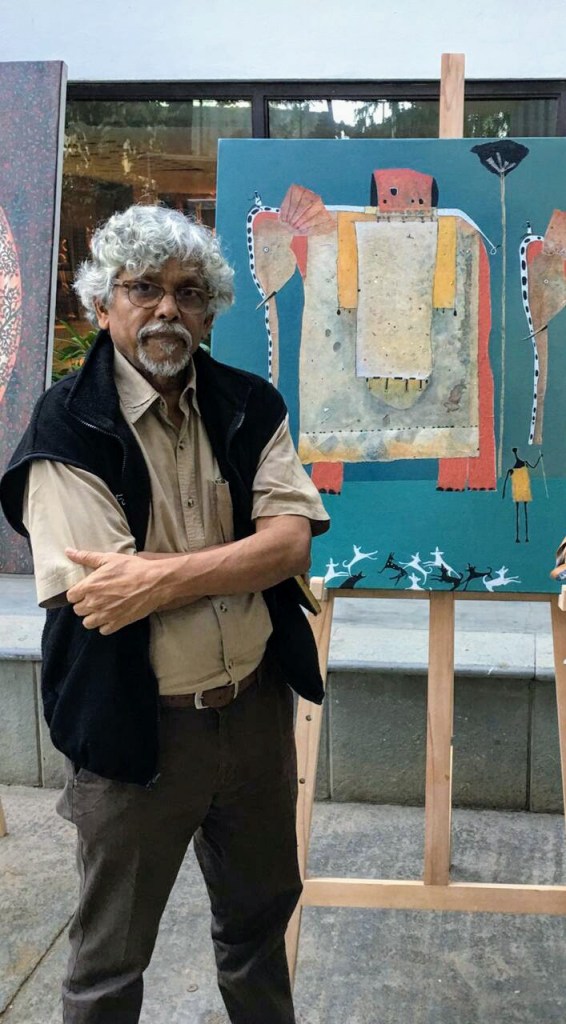
For 50 years now Ratnottama Sengupta has seen Haren Thakur adroitly create art from the humdrum of tribal life. And his stylised abstract of the dark-toned humans still makes her sit up and take note.
Haren Thakur with his painting. Photo provided by Ratnottama Sengupta
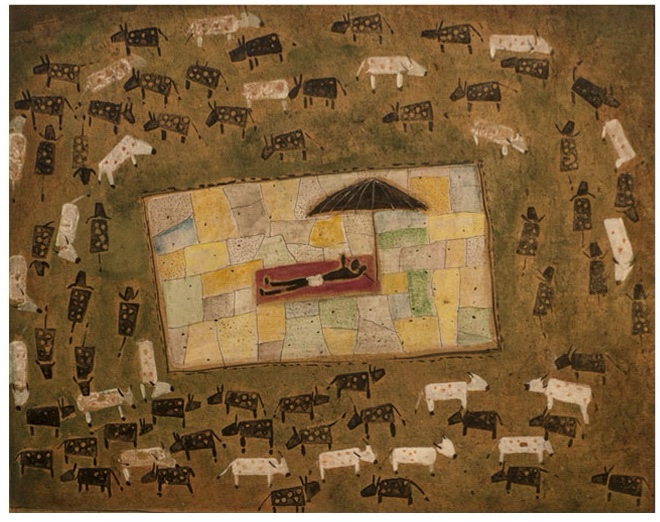
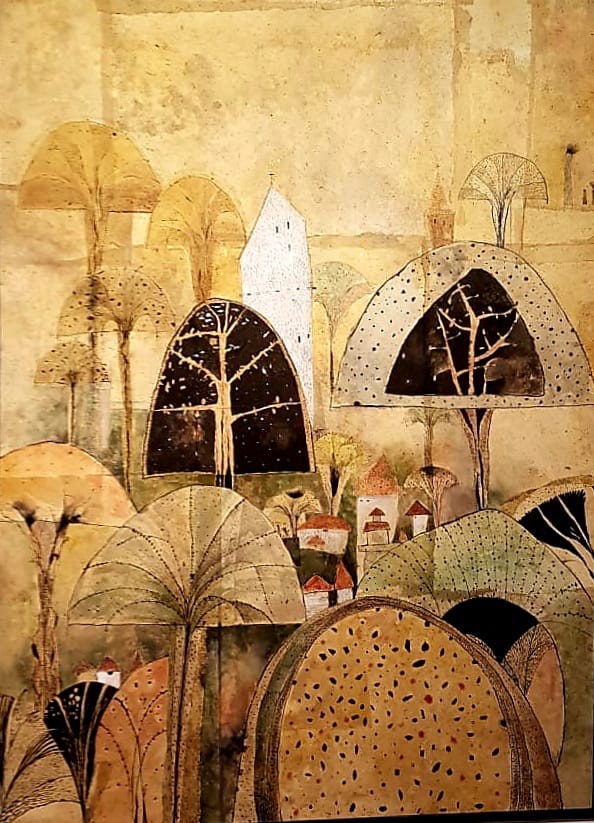
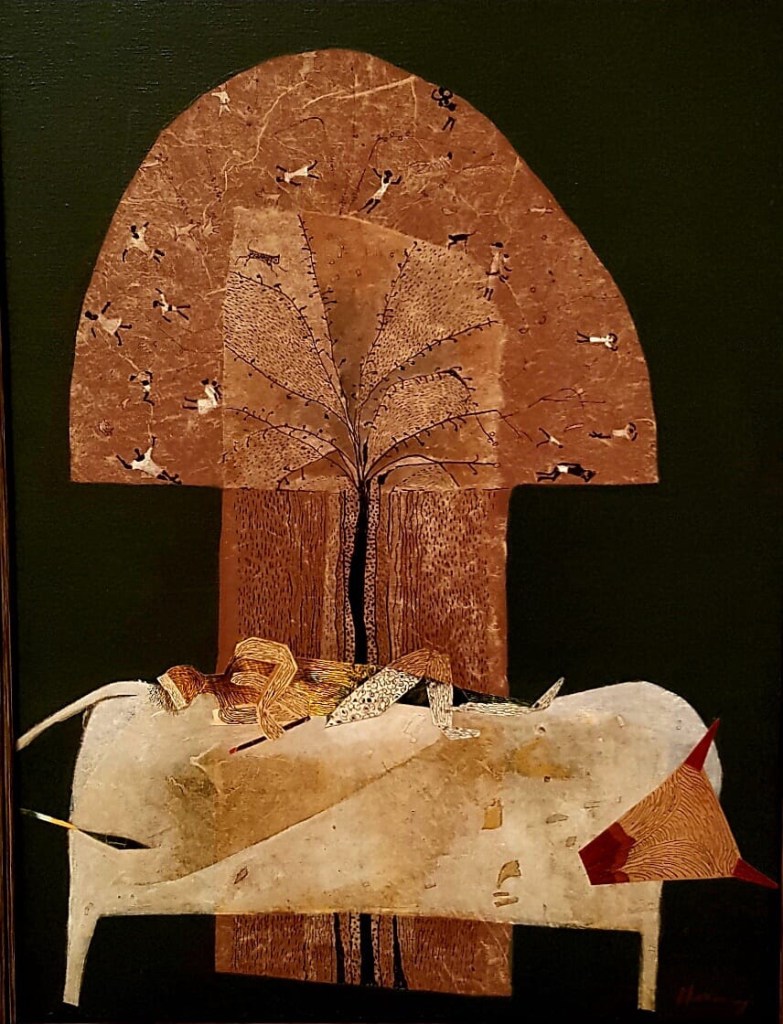
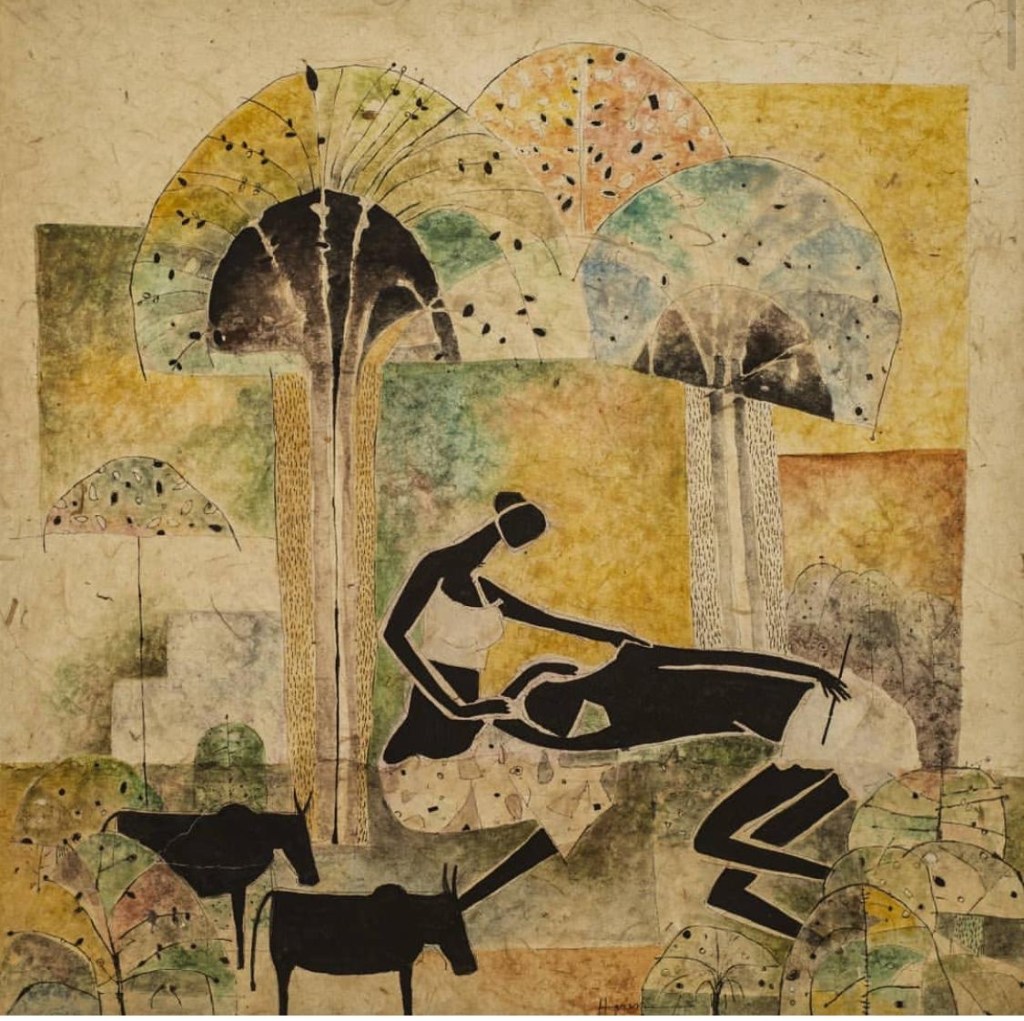
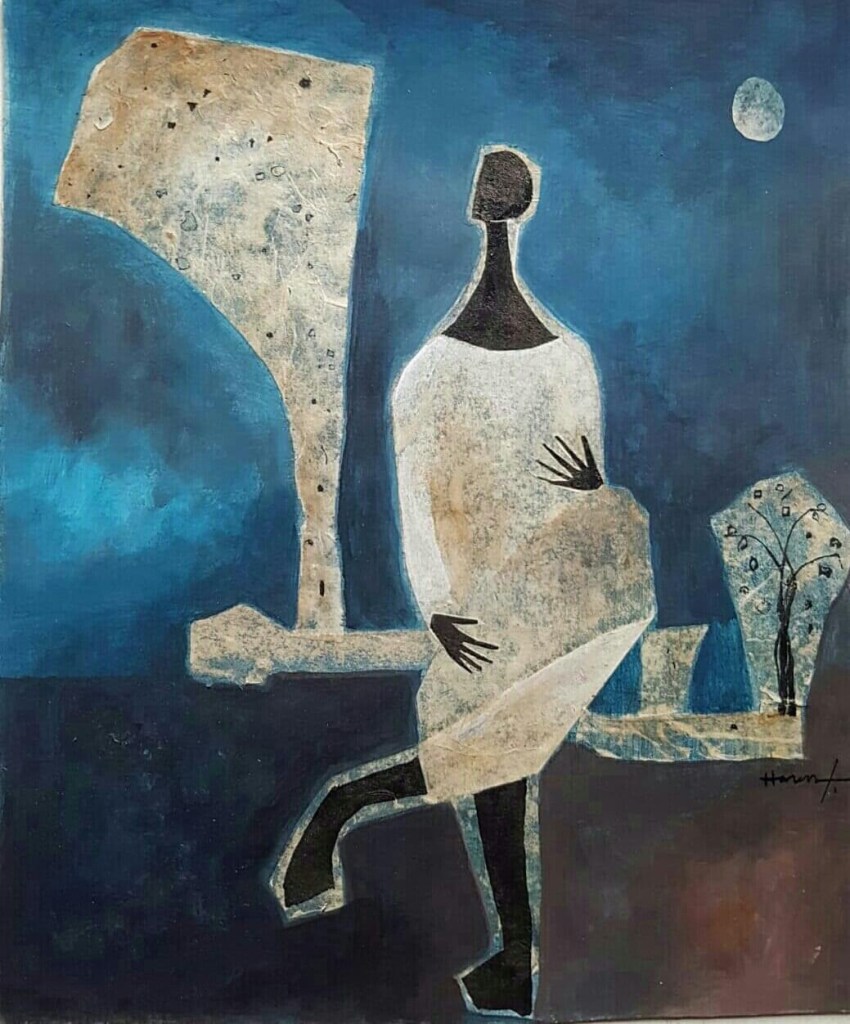
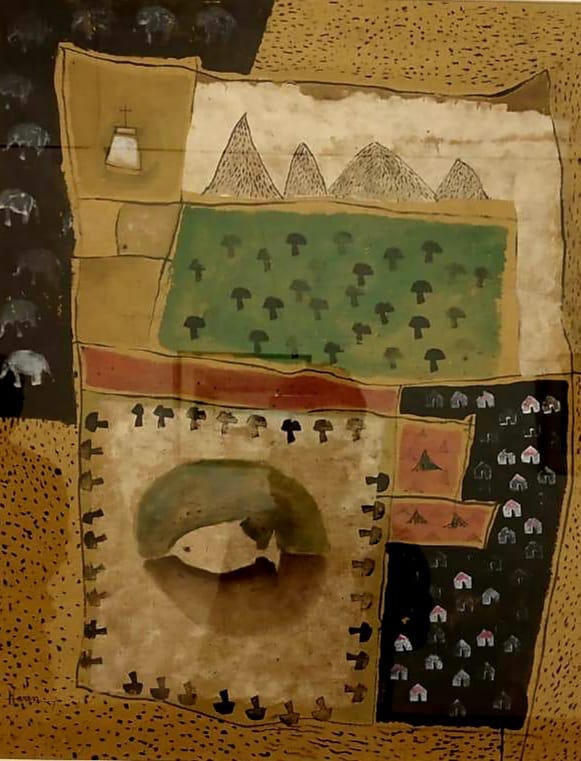
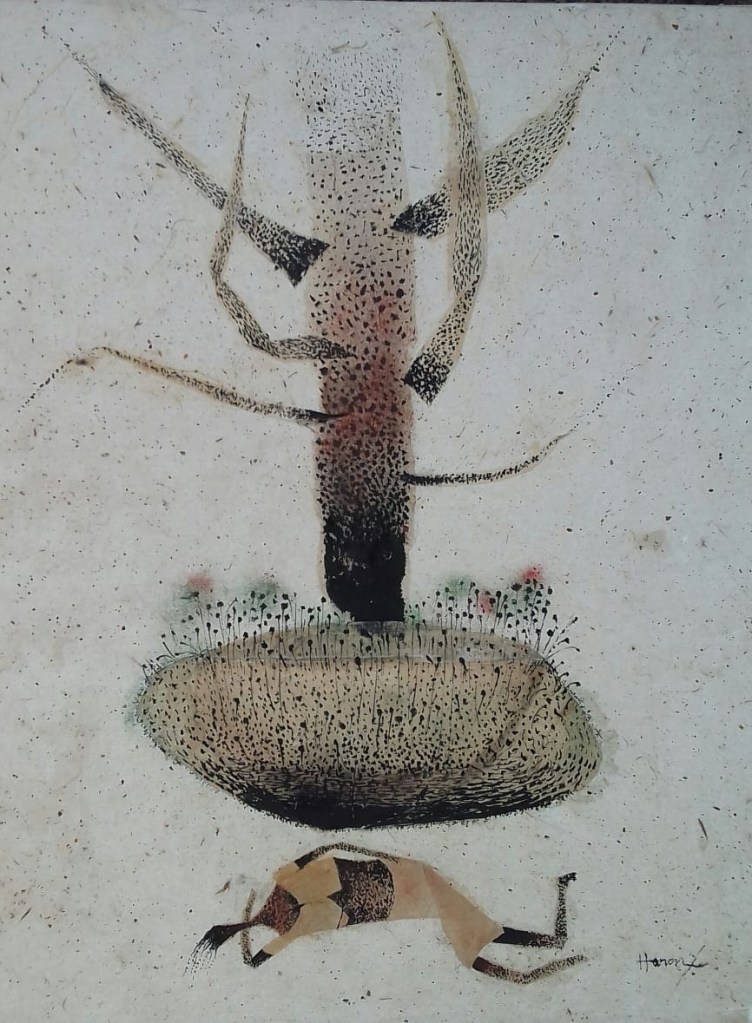
A dark, stick-like outline encompasses a human of the male species. A triangle, an oblong, a rectangle. A white patch in the midst of a sepia-green landscape. A drummer. A mother with a child holding aloft a balloon. Two women bathing in a primitive pond. A quizzical duck. A wriggling worm. Trees hills fish pigs cows fox… And, yes! A train zigzagging its way through a vast expanse of meadows. As we view the watercolours of Haren Thakur from Ranchi, you might think of the rice-white art of the Warli tribals characterised by geometric shapes that depict the rituals of everyday life. I might be inclined to revisit the painted layers on the 100,000-year laterite at the prehistoric rock shelters of Bhimbetka in the foothills of the Vindhyas in Madhya Pradesh. Another viewer might think of the ancient Sauras and the adornment of their walls in their adobe huts in Odisha. The artist himself might have recollections of the animated Santhal pats he saw being created during his student years in Tagore’s Santiniketan. However, none of Haren’s figures are simplistic. They are all stylised. And so adroitly that you are bound to sit up and take note of them no matter how many times you have come across the theme.
Art by Haren Thakur. Photos provided by Ratnottama Sengupta
Form and content come seamlessly together in the paintings that Haren Thakur will exhibit in Delhi’s Habitat Centre from April 15. The artist who mastered Art at Santiniketan — home to Santhals, the native dwellers of Bengal and Odisha — then made his living in Jharkhand, which is home to 32 tribes… Indeed, from his very beginning, the beauty in the dark skin-tone of the men and women going about their chores was the most natural rhythm of life in the bazaars and streets of Bankura Bishnupur, where his family hailed from, or in Purulia, where his father made his home.
Beyond doubt, Rabindranath’s deep affection for the Santhals and the Bauls reinforced this love. Much like Gurudev, Haren finds poetry in their tilling of the earth. In their mono-toned songs and the repetitive steps of their dance. In the fulfilment they find in the primeval life and archetypal love. And when, following in the footsteps of the Universal Poet, Haren finds beauty in a grain of sand, the everyday life ceases to be an essay in deprivation and rises to the level of art.
*
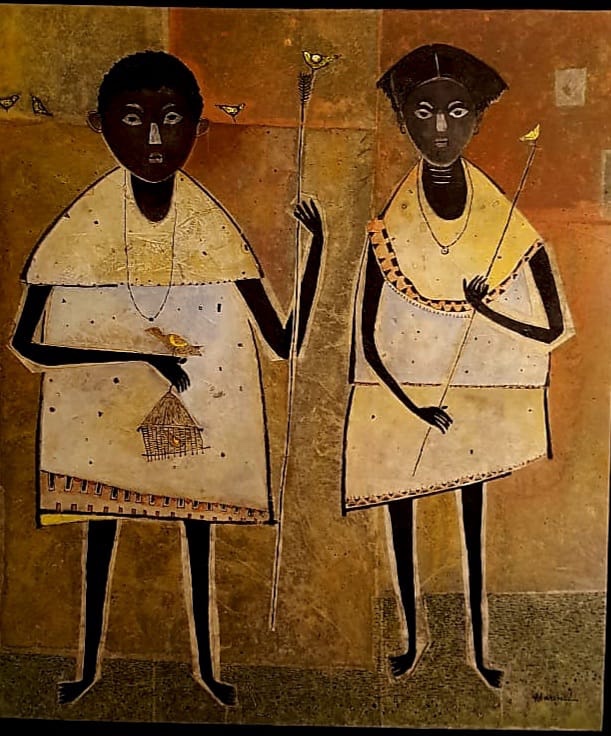
And his colour palette? That too came off the walls of his hostel in Santiniketan, from the frescoes and murals by Binode Behari Mukherjee. From the brick-toned ‘canvas’ that is the prehistoric rock painting of Bhimbetka. The pigment on Haren’s brush and tubes is never loud then, never grating. It is always muted, always mellow. And the impact is heightened by Haren’s utilisation of rice paper, and Chinese ink, on watercolour.
The Nepali rice paper became his signature in 1974. Prior to that he would work the rice paper in the tempera process that was ‘Master Moshai’ Nandalal Bose’s gharana, school – or Indian shaili, style. But in that process of painting layer by layer, the rice paper would lose its original character and serve merely as a background surface.
Then, in his fourth year, for a scholarship test of the Visva Bharati University, Haren experimented by soaking the rice paper in water. It became so pliant that he could spread it out like a piece of cloth. “And its texture!” It won him the scholarship — and immense appreciation from his teachers, Dinkar Kaushik and Somnath Hore. “They said, ‘Go ahead and explore this medium and this process further. It adds a dimension that has immense possibility.”
Art by Haren Thakur. Photos provided by Ratnottama Sengupta
Fifty years have gone by since, but Haren has not given it up. Sometimes, when painting on canvas, he does apply acrylic directly on its surface. But at times, even here, he pastes rice paper on the canvas, primes it with watercolour, then inks in the forms. However he adds, “when I paint on rice paper mounted on board, I do not – cannot – use acrylic. It simply doesn’t have the capacity to be absorbed by the rice paper the way watercolour gets absorbed.” So, in such cases Haren uses transparent watercolour.
Clearly the chemistry between rice paper and watercolour is amazing. Unique.
*
Circling back to the content: Haren’s understated pitch was reinforced by the Zen worldview of a teacher like Somnath Hore. The master minimalist’s use of the white, barely scratched by the red of a wound, spoke volumes — and it made Haren introspect. Once, while exhibiting the Wound series, Somnath Da had said, “I discovered such depth of emotion in the reticence of tones!” This soliloquy got deeply etched in Haren’s unconscious. And eventually it came to express itself in the rusty red of the iron oxide rich Birbhum soil; the roasted brown of Purulia’s rocky earth; the weathered green of the Bauls; the soothing blue of the open sky high above the woolly white of floating clouds.
Art by Haren Thakur. Photos provided by Ratnottama Sengupta
Flattened figures. Non-realistic features. Do you see a hint of Husain – or perhaps Paul Klee – in the abstraction of the human world? I notice a reflection of the figures encountered on Egyptian papyrus. Or the African world. Haren, on his part, reiterates his original inclination: the attraction towards the lack of artifice in Adivasi life. How else would the tribals go about their daily humdrum with a baby knotted to their back? Or float in an open pool under the sun-kissed sky? To the city-bred mind, this would be unthinkable — until Haren captions it ‘Nature’s Bathtub’!
But, notwithstanding my references, the art traditions of the indigenous people over the world have never influenced Haren. “Their art tradition is so rooted in their environment – be it of Jharkhand or of any other.” Even their pigments, brush, and surface are integral to their life. But he certainly derives inspiration from the lifestyle of the original inhabitants, he affirms.
“I have always admired their direct application, the spontaneity of their form,” Haren further explains. “But I am influenced rather by the uncomplicated lives they lead. Since I was in Santiniketan I have admired the way they connect with nature in everything they do. Their intimacy with animals is incredible – they seem to be in dialogue with the animals they domesticate! This became a part of my visual world, especially when I came to live in Ranchi. The same reality imbues the lives of the natives – Oraon, Munda, Ho, Sabar, Bedia, Lohar… They rest under the tree unconcerned about how the ‘civilised’ world looks at them. They speak with the hills, with clouds in the sky, with cattle and kids, trees and waters, rivers and streams!”
Art by Haren Thakur. Photos provided by Ratnottama Sengupta
This they do with no inhibition. Because this routine is a reality they have inherited from their ancients. “That is why I believe there is nothing more ‘Contemporary’ than this,” Haren asserts. This innate natural life, and the Santiniketan grooming, combined to forge his vocabulary, his visual language.
So, in the exhibits, you encounter an abundance of water bodies. Pools and ponds. Rivers and waterfalls. Lotus and lily. Big fish. Many small fish in its tummy. Ducks and kingfishers. Hyacinth and hayfield. All this is a natural part of the countryside that has made Haren theirs.
Interestingly there is also this play with size. In one of the frames an elephant walks down the road – and at every footfall he is greeted by a number of… ants?! Look closely and you will decipher that they are dogs!
Haren is giving you a worm’s eye view. And, in addition to the proportion, he is picturing the Hindi proverb Haathi chaley bazar, kutta bhaukey hazaar/ when an elephant walks to the market, a thousand dogs will bark! Political comment? You said it!
Stay tuned to the song of the Adivasi earth, Haren.
.
Ratnottama Sengupta, formerly Arts Editor of The Times of India, teaches mass communication and film appreciation, curates film festivals and art exhibitions, and translates and writes books. She has been a member of CBFC, served on the National Film Awards jury and has herself won a National Award.
.
PLEASE NOTE: ARTICLES CAN ONLY BE REPRODUCED IN OTHER SITES WITH DUE ACKNOWLEDGEMENT TO BORDERLESS JOURNAL
“If you don’t put it to good use, you will not be allowed to use it at all.” My grandpa said in a stern voice, waving the magnifying glass on top of my eight-year-old head.
I had misused it twice in the past week and had already received a scolding from my grandma. To reprimand me and prevent any further mishaps, my grandpa decided to place it in the most unreachable top corner of the tall cupboard, where my height, even with the help of any furniture, would sadly not land me.
Apparently, my maternal grandpa, an eminent scientist in Odisha, wanted his firstborn granddaughter (me) to become a renowned physics teacher someday, while his grandson, my elder cousin, would become an engineer. After taking the liberty of deciding our careers—much to our discontent, as I wanted to be a lady police officer, influenced by my childhood soap Udaan[1], and my cousin dreamed of becoming a bus conductor (though I’m not sure of the source of his inspiration)— grandpa decided to teach us physics.
Of all the things he demonstrated in his lab, the one that made the strongest impression on me was how the lens of a magnifying glass, when focused on something, can set it on fire. My cousin, however, remained docile and completely uninterested in either the lens or the fire. He would roll the round Marie Gold biscuits on the floor, imagining them to be the tires of a bus, a bus for which he dreamed of being the conductor someday. My curiosity led me to do bizarre experiments with the lens. As long as I smouldered unused items, it went unnoticed, but eventually, I landed myself in trouble.
Mischief was my domain, not Tipu Bhai’s. Though my cousin was named Tipu, like the valiant Tipu Sultan, he would always retreat like a wet cat. His usual line was, “Do whatever you want, but don’t pull me into this, Nitu!”
Once, I asked him, “Tipu bhai, why do you want to be a bus conductor and not a driver?”
He simply said, “Driving is too much work. I don’t think I can drive such a huge bus. It looks like a gigantic beast. I would rather be a bus conductor.”
I knew bhai was that starry-eyed kid who loved watching the bus conductor almost falling out of the door, the wind playing in his hair, and his whistle piercing the air with a shrill sound. That must have seemed thrilling enough to spark bhai’s otherwise sorry imagination.
My grandma didn’t have many stringent parenting rules. Although she occasionally hollered at me when I was being naughty, most of the time, she pampered us with delectable food and gifts. I remember her sparing coins for us to buy chocolates.
Bhai and I would walk to the nearest market and buy lollipops in our favourite colours. People often asked if we were siblings, and I would reply, “We are cousins.” Sometimes, they would smile or say, “You both look so alike,” before resuming their stroll toward the stalls.
Bhai was too shy to even look at them, so I was usually the one to answer their curious questions when they saw two kids wandering around the market late in the afternoon.
*
We spent our school summer vacations at our grandparents’ house in Cuttack, about a fifty-minute bus ride from Bhubaneswar, where we lived with our parents. My grandpa’s house in Cuttack had a courtyard full of mango trees. That afternoon, my grandma and Malati, our seventeen-year-old maid, were busy collecting mangoes from the trees, most of them raw, to make mango pickles and chutney. The garden was covered with dried mango leaves, and my grandma had asked Malati to sweep them all to the far end and set them on fire.
I had two raw mangoes and a magnifying glass in the pockets of my overalls as I followed my grandma and Malati everywhere.
“Wait here, Nitu, while Malati climbs the tree to get more mangoes,” Grandma said, pointing toward the garden’s boundary wall before walking away.
Tipu bhai was fast asleep inside the house, and Grandpa was away at one of his meetings. I watched from a distance as Malati cautiously climbed one branch after another, tossing mangoes down for my grandma to collect. After a few minutes, I got bored standing in one place, watching Malati and Grandma work as a team while I stood feeling abandoned. I noticed a pile of dried leaves beside me and remembered the magnifying glass in my pocket—if I focused it just right, I could set anything on fire. So, I focused the blazing afternoon sun’s rays onto the leaves.
To this day, my grandma insists there wasn’t any kerosene on the leaves, while I still try to convince her that Malati must have spilled some, intending to sweep them to the other corner later. The leaves caught fire, and the flames quickly rose toward the branches of the tree, spreading fast. My grandma let out a scream and ran toward me, while Malati rushed in and together, they pulled me away from the fire. One of the burning branches fell onto the roof of the hut beside our house, setting it ablaze. The hut belonged to a woman named Foola, meaning flower, and it was her kirana[2] store.
Amidst the chaos, we didn’t realise that Grandpa had just arrived. Foola rushed out of the store in panic, and Grandpa quickly ran into the house to call the fire brigade. The fire brigade arrived ten minutes later and began pouring water on the Kirana store. By then, some neighbours, along with Malati, had already thrown buckets of water on the fire. The roof suffered some damage, but the store itself wasn’t affected much, thanks to the timely intervention. All the while, I stood there helplessly, engulfed by guilt.
In the evening, my grandma sat me down and asked if I knew how the fire had started. Her formidable figure loomed over my tiny one, her hands clasped behind her back, the serious green light from her eyes meeting my brown glaze.
“I didn’t do anything, nothing at all!” I blurted out but then grandma is an expert in studying body language and hearing the unspoken words.
“Look I know you had something to do about it. A fire doesn’t start out of the blue. Better confess it and I will not give you any harsh punishment.” Grandma said with her brows raised.
“It must have been completely accidental. I don’t remember much about how. I think there was kerosene in it.”
“There wasn’t any kerosene. I am positive.” This argument about the oil, as I mentioned, never really ended. I did my best to stay defensive without revealing any details.
Then, my grandma brought her right hand in front of my face, holding the magnifying glass. “I found this in your overalls. Any explanations about it? I may not be well educated but I had seen your grandpa demonstrating what it can do.”
That was it—I was caught red-handed. I knew any further argument would only spark more anger and trouble, so I bowed my head and kept my eyes on my toes. Suddenly, the idea of stealing my grandma’s nail polish and painting my toes red crossed my mind, but I quickly brushed it off.
My grandma pointed her index finger at me and said, “No lollipops for a week.”
“That’s too long!” I complained almost teary eyed.
“You argue more, I extend more. Your brother can have them though.”
I felt like Mowgli in The Jungle Book when he was abducted by the monkeys. However, Grandma paid no heed to my misery.
*
Foola came the next morning and stood on the veranda, sobbing. I could hear her telling my grandparents that although the fire brigade had extinguished the fire, the water had seeped into the sacks of rice and pulses, ruining almost a quarter of her grains.
“Babu, please pay for the damage. I am a widow, there is no one to look after me, with all this ruin I will be at a huge loss.” Foola said to my grandpa.
Grandpa knew that the fire had started in our courtyard, though he hadn’t bothered to find out the intricacies involved, and Grandma hadn’t cared to explain. She thought that barring me from eating lollipops for a while would be enough to teach me a lesson. I had felt guilty, then angry, and now I felt very sorry for Foola.
“How much do you think would be enough for managing the damage?” My grandpa asked Foola.
“I won’t quote more, Babu. I swear to God a hundred or two hundred rupees should be enough.” Foola answered with tears rolling down her cheeks.
My grandpa must have known that Foola was being honest. He exchanged a glance with my grandma, and she nodded in approval. I then saw him hand her two hundred-rupee notes. Grandma encouraged her to come again if she needed further help and the matter was somewhat settled.
Four days had passed without lollipops, and there were three more to go. I was craving them—their sweet and tangy taste, the scent that used to fill my nostrils. They always looked like my favourite coloured bulbs, capable of switching my mood to the happiest level every time I licked them. Furthermore, Bhai had committed the heinous crime of eating my favourite cola-flavoured lollipop the day before.
The guilt and desolation that had entangled me slowly began to be replaced by a sense of rage. I waited for my grandma to go to the bathroom, then reached under the mattress on her bed, where she kept the almirah keys. They were still there—two of them, one for the main door and the other for the locker inside.
Beside her jewellery box lay my magnifying glass. Her favourite green saree, the one she wore to the evening pujas, hung neatly on a hanger. When you’re a child and consumed by anger, reason hardly stands a chance. Without thinking, I focused the lens of the magnifying glass on the saree until it burned a hole through the fabric.
That was how, within a single week, I made two miserable mistakes. When Grandma found out, all hell broke loose in the house, followed by Grandpa reprimanding me.
*
When the anger and rage subsided, realisation dawned on me—guilt, more guilt, and an overwhelming sense of remorse, though I still occasionally craved lollipops. Grandma didn’t pamper me, and grandpa buried himself in his books, not once inviting me to his physics lab. Bhai was busy staring at every bus that passed by the house, lost in daydreams. Malati kept herself occupied with household chores and rarely engaged in outdoor activities. The mango trees had started bearing more fruit, some of them beginning to ripen. The sun was less scorching, though a hot loo blew occasionally, and a couple more weeks had passed. Soon, summer vacation would be over, and my father’d take me back home. He wouldn’t really be proud of my behaviour.
One afternoon it was hotter than usual. The sun blazed like a fiery orb, unleashing an army of relentless heat waves upon us. The air was thick with swirling dust. The garden hand pump and the water faucets in the house spewed only hot water. I sat on an armchair on the porch, with a mildly gloomy face, unperturbed by the heat.
Just then, a middle-aged woman in a saree, with a cloth bag slung over her shoulder, arrived at the gate. She looked fragile, as if the sun had drained all her energy. In a weak voice, she called out to me, “Girl, fetch me a glass of water, please.”
I rushed to open the gate and led her in by the arm. After making sure she was seated comfortably in the shade, I gave her the hand fan I wasn’t using and went inside to get some water.
“Grandma, come along. There is a woman at the door,” I said as I headed out with a jug full of water.
The woman gulped down the water, relaxed a bit, and wiped the sweat from her brow with the end of her saree. I sat close, fanning her, and asked, “Are you okay now?”
“I am, girl, I am. You saved my life!” The woman said with her hand on her chest.
“Do you want more water?” Grandma had just come out of the door.
“No sister. I am okay now. Have to get going.” The woman said, and with her hand patting my head, added, “She saved my life.”
She opened her cloth bag and gave my grandma a handful of ripe guavas. When my grandma offered to pay her, she gently refused, insisting they were a gift. She had traveled from a nearby village and often came to Cuttack to sell fruits and vegetables in the market. That afternoon, the ruthless sun had nearly exhausted her as she made her way to the bus stand. Desperate for some shade and water, she had somehow managed to reach our house.
After she left, grandma told me that good deeds bring blessings.
“You were very kind today,” she said with a smile. It had been a long time since she had given me such a radiant smile.
“And when you do wrong, Satan hovers nearby and doesn’t give you many chances to rectify your mistakes. This time, you did good. I will ask your grandpa to give you the magnifying glass back.”
She then handed me a few coins. “You can have lollipops tomorrow, but make sure to share some with Bhai.”
That was the last time grandma had been so strict, and I never got into such mischief again. After all, who would want to risk getting caught by Satan!
Mitra Samal is a writer and IT Consultant with a passion for both Literature and Technology. Her works including poems, stories, essays, and reviews have been published in The Hooghly Review, Muse India, Borderless Journal, Madras Courier, The Chakkar, and Kitaab among others. She is also an avid reader and a Toastmaster.
.
PLEASE NOTE: ARTICLES CAN ONLY BE REPRODUCED IN OTHER SITES WITH DUE ACKNOWLEDGEMENT TO BORDERLESS JOURNAL



 Borderless