Categories
Stories

The Mysterious Murder of Adamov Plut

By Paul Mirabile


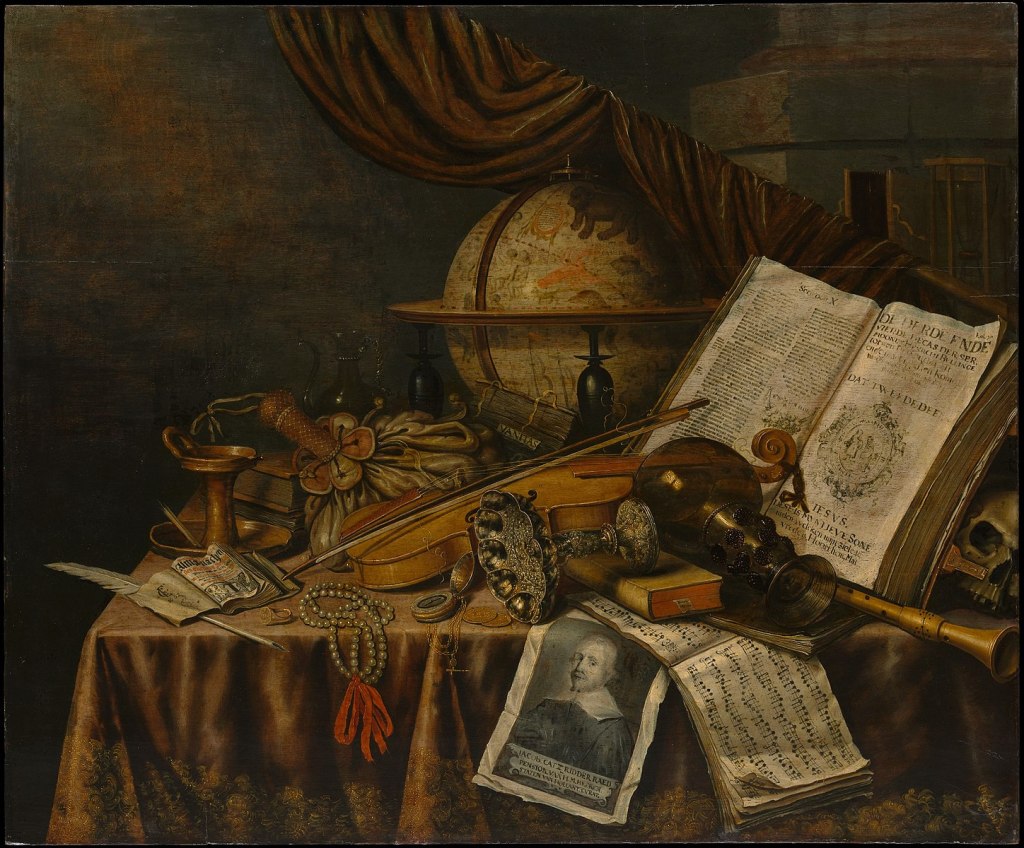
Vanitas Still Life, painting by Evert Collier(1640 –1708). Courtesy: Creative Commons

Back home in Madrid, having abandoned Adamov Plut to his posthumous fate, I was a bit surprised that neither the New York Times nor the Washington Post reported anything about the murder, not even a paragraph, or as the French so imagitively put it, an entre-filet ! I soon realised, due to this journalistic silence, that the time had come for me to give a full account of my relation to Mr Plut ; that the time had come for me to expose, publicly, by way of this revelation, his ‘mysterious murder’.

My information is of the surest sources for the simple reason that it was I who had Mr Plut murdered ! Yes, I ! And for reasons that shall be shortly disclosed. A mysterious man he might have been; however, his methods of acquiring priceless books and other inestimable valuables can hardly be called mysterious: Mr Plut was a vulgar thief, a scoundrel, an ingenious trickster whose singular flair caused much grief to many individuals, enraged those whose trust had been flouted.

It was in Istanbul, where I was invited to sojourn with an Armenian merchant, that I witnessed Mr Plut’s dupery. And if my naive friend fell for his crooked smile, I certainly didn’t swallow his high tale of returning to pay him for the two illuminated manuscripts my friend had graciously offered the blighter on condition that he be held accountable for them. His thick, coarse lips translated a smile that held contempt and disdain towards those who trusted him. So infuriated and insulted did I feel on behalf of my friend that that I reacted on a lightning urge and decided to follow him. I said nothing of this to my disbelieving companion, but left immediately in pursuit of my game — and game it was — for I, to tell the truth, had nothing more substantial to do at the moment and felt disposed for a good hunt.

I said that Mr Plut was a genius. Yes, in his own way. However, genius has its limitations. His arrogance and haughtiness knew no bounds, although he knew that his foul doings had attracted the attention of police and Interpol. Some may surmise that a certain paranoia drove him to invent individuals tracking him down like a wild boar or moose. No, no one was tracking him down except me, and that as subtlety as possible. In Uzbekistan, I actually chatted with him over a cup of coffee on two occasions disguised as a professor of Slavic philology, dressed in a quilted chapan robe and silk embroidered tubeteyka cap. There we sat in Samarkand, sipping our thick beverages in the vaulted bazaar at one of the storied cafés that dot the town. He was all smiles, obsequious and gold-toothed. I had the impression that I was dealing with a child or a mentally-dwarfed man whose sense of reality lacked all discernment or sagacity. I concluded that he had come into quite a bit of money, and never having had to work for a livelihood, traipsed about the world at his leisure, buying or stealing books, cheating people out of their invaluable collections. So self-indulgent and confident was he that he never saw through my masquerade as we conversed in broken Russian.

It was at that café where I learned about his fabulous treasure, as he called his book hoard. Only an idiot would have divulged this information to a perfect stranger, but as I said, Mr Plut’s contemptible demeanour caused him to fall into the most infantile traps. Traps that I began laying out for him, and that would lead to his downfall. For I had begun to design my own plan to relieve the rogue of his fabulous possessions, all the more so since he also let slip that his parents had passed away, and he had inherited the house. How I would make his treasure mine and ‘disinherit’ the  owner  still remained vague in my mind.

We departed as ‘friends’, as two strangers seeking an answer to the mystery of their existence. Or so I made him believe. Mr Plut appeared to me a dying species, a worldly aesthete, in spite of his extreme vulgarity and ponderous gait, whose debonair demeanour masked a loathing for his victims, a bent for the lowest duplicity, a gratification in spinning the most treacherous stratagems in order to allay his desire to prevail.

Mr Plut slipped out of Uzbekistan without my knowing it. He probably used his Russian passport, one of the four of five in his possession. I felt a twinge of misgiving. Had the fat fellow got on to me? After many enquiries, I finally discovered that he had crossed into China at the Xinjiang border, and was hastening towards the Yunnan. Why ? I hadn’t the faintest idea …

His brief sojourn in the town of Lijiang enabled me to catch up with him. My Chinese was fluent enough not only to query his whereabouts in that lovely town, but more important still, to learn of his new ‘purchases’, once I had questioned the director of the Dongba Museum of Culture. Mr Plut had planned to gone there to acquire several Naxi pictographic sacred books, which he did from a rather corrupt priest with whom he had been corresponding for some time, using a special code so as not to be unmasked by the Chinese authorities of the Centre. The director only learned of this a week after the unlawful negotiations had occurred, and three or four very valuable Dongba liturgical books had been stolen. It goes without saying that the rapacious priest was severely punished.

I immediately left Lijiang much to my displeasure for it was indeed a quiet, pleasant place, and set out in hot pursuit of the marauder. I followed his all too familiar scent through Nepal into North-western India to the Zanskar region where he put up for a while at the Phuktal Gompa[1], a strange spot to make a halt. But a perfect hideout to gain time in order for planning his next move, whilst at the same time inveigling in the most repulsive manner his generous hosts.

The monastery is nestled in the most remotest of valleys, ensconced within a cliff of tuft of fairy chimneys, crags and honey-combed spires which bulge black and red against the background of sandy, dazzling ash and cinerous tones of hemp. I had trekked there from Lamayuru in twenty days, and as I was to learn, Mr Plut had arrived there three days ahead of me, but by way of Padum. To gain the main entrance of the gompa, the pilgrim had to climb a steep path, keeping his or her right shoulder to the seventeen chortens[2] that mark the steep climb towards the vaulted entrance. I had shaved my head, grown a long beard and donned a woollen chuba tightened around my waist with a long colourful sash. It kept me warm, for in spite of it being Summer, the nights were very cold, and my cell had only a small wood-burning stove to keep me warm.

I spent three weeks at the monastery, sleeping on a ratten matting, eating skieu, tsampa and chappatti, drinking steaming salt-buttered tea off a chopsey — a low, small table — reading or gazing out of the little window that offered me a full view of the dusty, treeless courtyard below, where monks would mutter their mantras, and beyond into soundless nights whose stars were generally veiled.

Without Mr Plut’s slightest suspicions, I assisted at all the ceremonies, mornings and evenings, even vigils, while in the afternoon, I would venture out into the monastic complex, twisting and turning in the warren of lanes, under the low archways and high ladders, at times pursuing my promenades upon the rather precipitous mountain paths. As to Mr Plut, he hardly left his cell, and when we did cross paths, he most probably took me for a Buddhist pilgrim. Once or twice I sat near him in the prayer hall in the meditation grotto, but he never attempted to communicate with me, albeit he did not seem very deep in prayer or contemplation. He was probably scheming his next miserable move. His face had become terribly pale and flabby. His darting, black eyes seemed to have sunk deeper into their sockets. Unable to sit cross-legged on the low benches at the back of the prayer hall, he sat ‘western style’, staring off into the clusters of chanting monks, tilting his huge, bobbing head every so often to the banging drums, blowing ox-horns and tinkling triangles. Observing him from afar, I sought to sound his soul, to wring out his innermost thoughts, to extract from his evident lassitude and apathy his flight from both his victims and himself. But Mr Plut was a sphinx. Would he rise out of his own ashes when his hour came ?

I left the good monks three days after his departure, a hasty one indeed. And they were furious! The scoundrel had stolen several pustuks[3] and thangkas, and failed to pay for the prayer masks that he ‘purchased’. They implored me to find the culprit, inform the police and recover their stolen property. It was perhaps the beseeching words of the infuriated monks, after having received such incomparable hospitality from them, that my plans to have the thief killed began to germinate ! The theft was not only gratuitous, it exposed the very ugliness of the man’s heart, blackened by greed, cynicism and remorselessness. It would only be a matter of time before he tasted a soupçon of his own medicine.

Meanwhile the cat would play with the mouse, a rather fat mouse at that ! I boarded the cargo ship that took the fugitive from Karachi to Oakland via Japan. On the long, monotonous voyage across the Pacific, my ominous shadow crossed his at the most unsuspecting moments. Attired as a Pashtun merchant, bearded, long-haired and turbaned, Mr Plut sensed an onerous presence whenever he laboriously carried his huge body across the decks. How many times had my eyes penetrated his anguish, his torment, his pangs, not of compunction, but of incomprehension. He scented a sleepless menace pressing him. Fear inflamed his dark, beady, mirthless eyes like the burning incision of the trenchant knife.

Oakland … Sacramento … Reno … Tombstone … Boulder … Santa Fe … Saint Louis … Chicago … New Orleans … Birmingham … Miami … Atlanta and finally New York. Yes, New York, where the curtains would finally fall on this tragic fat figure. Where upon the stage of 8 million walk-ons, and against the backdrop of the grottiest of hotels, the last act of Mr Plut’s abominable performance would be played out.

His infatuation with Louis Wolfson amused me, as well as his grandiose project to write twelve stories in twelve different languages signed by twelve different authors. I found all this quite pompous and pathetic. A real exercise in self-indulgence to say the least. All this information I culled when I ‘accidentally’ met him in the ill-lit corridor of that hotel on Water street in downtown Manhattan. In New York, I played the role of a French researcher in mediaeval literature, a field that he completely ignored, in spite of possessing several manuscripts of Anglo-Norman stamp, apparently purchased (so he said ?) from a London book-seller. I pretended to be interested, taking the opportunity to study him closely. Besides, he was such an inveterate liar how could one believe anything he said ? He lied to curry favour and win confidence, only to swindle and steal from the naive and simple-hearted. Better to observe his eyes, his gestures, his bouncing from one tongue to another. These were all genuine signs of his distorted psychological make-up. To play my part well, I sported an immaculate white suit, orange tie, a pair of silver-rimmed glasses and spanking new alligator shoes. I had shaved my beard and moustache and had my hair cut very short, leaving a few gossamer wisps which touched the tips of my ears and fell bouncily on my forehead.

Every day I followed his Humpty Dumpty gait as he waddled to and from the public library, in and out of Central Park. And it was there, in Central Park, that I noted two blond-haired rough fellows slouching on a bench, eating the remains of fried chips or chicken sandwiches, cursing and making gross signs at the passers-by, drinking beer and spitting. They were seated at the same bench daily — the bench that Mr Plut walked by every day. They seemed to know him because they would hoot at him, call him names and ask for money. Fatso passed by without even a glance at them.

One Saturday, I decided to approach the two ruffians. They sized me up with obvious contempt, and made it perfectly clear that I was intruding on their ‘territory’. I sat down none the less, and exposed my scheme to be rid of Mr Plut once and for all, explaining how the culprit had cheated and robbed so many people. The two burly blokes, former marines in the Green Beret (or so they vaunted!) listened attentively as I unfolded my plan: Three thousand dollars for each if they would simply walk up to his room in the early morning hours, the night porter always being asleep, knock at his door and kill him, however, without any blood shed or theft of his belongings. It must be a murder without reason, without any sign of bestial violence. One of them suggested strangulation. Yes, excellent idea. It would thus be a ‘clean’ murder.

And so it was, very professional at that I must say. They were paid off, as agreed. And I left New York two days later, as planned, a very satisfied man indeed …

This all happened five years ago. Now … well, here is where my account ends and my confession begins. For you see, Mr Plut was never really murdered ! Those two ‘ruffians’ were in fact F.B.I. agents who had been trailing me since disembarking in California. To tell the truth, Interpol and local police had been following me since the Istanbul affair. How and why they began doing so I cannot say. During my trial neither the judge nor the prosecuting attorney afforded any information as how the F.B.I. learnt of my scheme, nor why they had decided, at one point in time, to cooperate with Plut. What was I convicted of ? What was my indictment ? As to my appointed lawyer, a young short-sighted clerk more than a seasoned lawyer, who could be easily cajoled by the ‘evidence’ against me, pliantly manipulated by the prosecutor, after he had taken the floor and had made an absolute fool of himself. He let out a sigh of relief when the judge pronounced a sentence of fifteen years instead of twenty-five! The wigged judge, a grotesque figure studded with huge warts, yawned throughout my lawyer’s deplorable speech for the defense, as well as during my feeble plea. There was no jury either to lament or to applaud his verdict. It was a trial held at ‘huis clos’[4], military style. I buried my face in my hands. As expected, my lawyer made no effort to appeal.

Had Plut sensed my innermost aversion towards him ? Or seen through my many disguises ? He was a clever man, and probably had hired detectives to learn why I was following him. The hotel room murder was staged. Plut lay recumbent on the floor, waiting for me to steal his papers so that I would be indicted for premeditated murder (although there was no murder!), of paying off hoodlums to commit this murder (although they were F.B.I. agents!) and the theft, which indeed it was (but fifteen years for that?) of his household papers, keys, and other official documents concerning his inheritance … and that vile short story of his.

So here I sit in my rancid smelling cell in Madrid, having been arrested at the aeroport on my arrival some five years ago, writing out this confession. I do not to repent mind you, I have no intention of atoning for my doings, nor avowing my sins. These words wrenched from my pen seek to vent the animosity and hatred I harbour towards that fat impostor who had the cheek to write me a letter from the Seychelles revealing how he had got on to me since Uzbekistan, and how our little cat and mouse game had amused him greatly : “You thought me a fool, deary, but I saw through your pusillanimous scheme in Samarkand ; that was some outfit, but you forgot the galoshes ! Not to mention your pilgrim weeds at Phuktal which truly charmed me, and your blazing orange tie in New York. Come, come, what French professor would ever sport an orange tie with a badly tailored, cheap white suit ?” The vicious irony underlining these sentences, along with a soupçon of cynicism caused me to gag. The blighter added in a post-script that he had sold all his books for a fabulous sum of money, and had retired from the world’s wearisome fair. In the envelope I found a photo of him sipping coconut juice, lying on the golden sands of a crescent-shaped beach under groves of swaying palm trees and an indigo blue sky. I laughed bitterly, and yet, in spite of my nettled nerves, pinned up the blasted photo in my lonely cell, a sort of souvenir of our enshrouded relationship …

One day at the prison library, browsing idly through a dull, detective story, I thought of Plut’s or Hilarius Eremita’s story The Enchanted Garden, which I had taken and read to amuse myself on the aeroplane to Buenos Aires. Had anyone ever published such ridiculous trash? To my horror, the answer came three days later whilst I rummaged through a new batch of literary magazines, some of which contained short stories in English, French and German. And there it was — The Enchanted Garden, by Hilarius Eremita, Plut’s pen name. I couldn’t believe my eyes — someone had published that rubbish ! Plut indeed had the last laugh, adding insult to injury, salt to my festering wounds.

I savagely tore out the pages of his story from the magazine, went to the toilet, ripped them into tiny pieces and flushed the filth down the bowl. So much for hiss ‘first of the twelve’ ! I shan’t be punished for it, no inmate in this prison reads any language besides Spanish, and that with a dictionary … I’m sure it was Plut who sent me that magazine to drive the knife deeper into my wounded pride. The miserable rat !

So here I sit at my iron table, staring at Plut’s photo as he sips his coconut drink under the blue skies and swaying palm trees whilst I sip my wretched thin noodle soup with strips of hard, nervy beef under a cracked, peeling, dirty grey prison ceiling …

.

[1]          Monastery in Tibet

[2]          The Tibetan word for stûpa, a Buddist shrine which initially housed the relics of the Buddha.

[3]          Books used for Buddhist ceremonies written in Tibetan.

[4]          Behind closed door without any public participation or observers. It is a French legal term.

Paul Mirabile is a retired professor of philology now living in France. He has published mostly academic works centred on philology, history, pedagogy and religion. He has also published stories of his travels throughout Asia, where he spent thirty years.

.

PLEASE NOTE: ARTICLES CAN ONLY BE REPRODUCED IN OTHER SITES WITH DUE ACKNOWLEDGEMENT TO BORDERLESS JOURNAL

Click here to access the Borderless anthology, Monalisa No Longer Smiles

Click here to access Monalisa No Longer Smiles on Kindle Amazon International

Categories
Notes from Japan

Rabbit Island

Narration and photographs by Suzanne Kamata

I first learned of Okunoshima from a Canadian friend’s Facebook post. She’d shared photos of herself surrounded by rabbits. The island just off the coast of Shikoku and only accessible by ferry, was overrun with these adorable animals. How unusual, I thought. How cute! Surprisingly, few Japanese people that I talked to seem to know about this place. However, when it was featured a few months ago on a TV travel show, my daughter Lilia told me that she wanted to visit.

“It’s really far,” I told her. “At least three hours by car.”

“We can take the bus,” she signed to me. (My daughter is deaf.)

I knew that there were no buses that went from our town in Tokushima, on the eastern part of Shikoku, to Tadanoumi in Ehime Prefecture where we could board the ferry to Okunoshima. My daughter, who has cerebral palsy, uses a wheelchair, and it seemed like too much of a hassle to take the bus to Matsuyama and change buses once or twice to get to that tiny coastal town, but I wanted to visit as much as she did. I was charmed by the idea of an island full of bunnies. When I came across a flyer advertising a one-day bus tour to Okunoshima, I immediately signed us up.

We got up extra early that sunny Sunday and met our tour guide in a gravel parking lot near the town gym. I’d told the tour guide that my daughter was disabled, but it wasn’t a big deal. We climbed into the front seat and the guide handed out tea and packaged rice balls. We gazed out at the lush green terraced fields, yellow roadside wildflowers, and flooded rice paddies as we made our way to Ehime Prefecture. The landscape outside our window might have been lifted from the animated film Tottoro.

Inaka,” Lilia signed.

“Yes.” I agreed that we were deep “in the countryside.”

I was a little worried that once we got to the island my daughter would find the real-life rabbits annoying. I remembered how she had been bothered by the notoriously aggressive deer in Nara on her school trip. One deer had tried to eat her notebook. What if the rabbits tried to nibble on her fingers or cellphone? But as we rolled along the highway, she reminisced about the rabbit she and her classmates had taken care of in kindergarten. When it had died, they had held a little ceremony and buried it on the school grounds.

As we approached the port, finally catching a glimpse of the sea, the tour guide gave us some final instructions. “Don’t give the rabbits snacks,” she said. We could buy rabbit food at the port.

The bus took a turn down a narrow road flanked by brown-tiled houses, many of them with solar panels. Finally, we arrived at a parking lot next to a small cluster of buildings. To my surprise, here we were, seemingly in the back of beyond, but a long line of people already snaked around the corner from the ferry dock. The tour guide seemed a bit nervous. “It’s a small boat,” she said, “and they don’t accept reservations.” She hurried off to buy our tickets. Note to self, regarding future visits: arrive plenty early.

The tour guide returned to the bus and informed us that the passengers were lined up for an earlier ferry and that we would be able to board. Phew! Since we had about half-an-hour before our own departure, we all got off the bus. Lilia and I went to a small building with a big clock to buy packets of rabbit pellets.

When it was time to get on the ferry, we were directed to the lower level, along with several young families with strollers. Most of the other passengers went above deck. We stayed to the side as three rows of cars were directed onto the ferry. It was shaded and cool.

Lilia, who has always been far more social than me, tried to get me to start a conversation with a blonde foreign woman standing nearby with her three kids and husband. From the familiar scent of her sunscreen, I assumed that she was American, but I didn’t really feel like talking. I resisted my daughter’s entreaties, suggesting that we just relax and enjoy the wind on our faces, the sight of the waves. I thought it was remarkable, however, that although most Japanese people I’d mentioned the island to had never heard anything about Okunoshima, there seemed to be several groups of foreigners on this ferry alone bound for the island.

We arrived in about twenty minutes. The tour guide had arranged for a mini bus to transport my daughter and me to a restaurant on the island. Lunch was included in our package tour. The rest of the group would be going on foot. The restaurant was only about a fifteen-minute walk from the port.

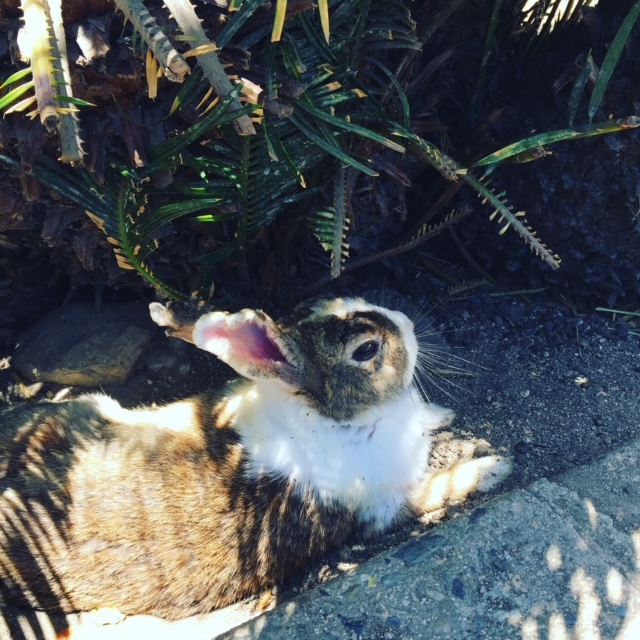
I had half-expected hordes of rabbits to greet us upon disembarking, but it was hot. The first rabbits I spotted were lolling beneath bushes, their energy apparently sapped by the high temperatures and humidity.

My daughter and I boarded the waiting van. I pointed out rabbits to Lilia: there, in a burrow, there, under the picnic table. It occurred to me that this was the first Japanese island that I had been on that wasn’t home to stray cats.

“Are there any predators on this island?” I asked our driver.

He thought for a moment. “Maybe crows.”

The rest of our group was dining in a tatami room. Because of my daughter’s wheelchair, we ate in another room at a table with chairs. Our pre-ordered lunch consisted of slices of sashimi, miso soup, and rice mixed with vegetables, but at the Usagi Lunch Café, you could order pancakes branded with bunnies, white rice molded into rabbit shapes surrounded by curry, and long-eared rice-filled omelettes.

After lunch, we were free to do as we liked until the ferry departed. We set out to explore. Bicycles can be rented, but it’s possible to walk the four kilometres around the entire island in an hour or less. The bunnies are not hard to find.

Lilia and I ventured on to a grassy lawn, which was full of holes dug by rabbits, making it a bumpy ride with the wheelchair. We settled briefly at a shady spot under some trees where some bunnies had gathered, and lured them with pellets. I was worried that they might bite our fingers, but they were docile and friendly, nibbling only on the food that was offered. “Kawaii!” Lilia said. “Cute!”

Although the rabbits are, for all intents and purposes, wild, they are supposedly descendants of pet rabbits kept at a long-ago school. The story goes that in 1971 schoolchildren released eight of these creatures on the island, and then they began to proliferate, as rabbits do, Now the island is designated as a national park and is home to around 700 bunnies.

There is another more sinister theory as to how the rabbits came to be on the island. Unbeknownst to many Japanese, from 1929-1945, the Secondary Tokyo Military Arsenal manufactured chemical weapons for the Japanese Army on Okunoshima. This project was so secret that during that time, the island was excluded from most maps of Japan. The poisonous gases produced here, including mustard gas, tear gas, and phosgene, were used more than 2,000 times exclusively against the Chinese, killing 80,000 people. The effectiveness of the gases was allegedly tested on rabbits. Some say that the ones now living on the island are descendants from test rabbits released after the facility was destroyed in 1945 by U.S. Forces. However, Hatsuichi Murakami, who worked at the poison gas factory as a teenager and later became director of the Poison Gas Museum, told a New York Times reporter that the present-day rabbits are not related to those used for testing.

My daughter wanted to visit the Poison Gas Museum, which she had also learned about from TV. Having visited the Hiroshima Peace Museum and the Holocaust Museum in Washington D.C. on family trips, she was familiar with the horrors of war, and keen to know more about history. We saved a few pellets for later, and made our way to the small building with a red-brick facade. A ramp made it easily accessible, as did the nominal one-hundred-yen entry fee. The exhibits of gas-making materials, clothing owned by factory workers, and photos take up only two rooms, but their impact is strong. They are labeled in both Japanese and English. According to the museum’s English brochure, “Having seen materials made by concerned people, we hereby declare that war is meaningless and the production of poison gas is tragic. We make an appeal for everlasting peace.”

Once again under the hot afternoon sun, we wandered slowly back toward the port, dispensing pellets as we went. Maybe, I thought, these cute little bunny rabbits were released here to live freely as atonement for the ones who had suffered and died. They are now protected from hunters, dogs, and cats (which are prohibited on the island). Signs warn visitors not to feed them on the road, in order to keep them safely out of the way of oncoming cars. From their appearance, they seem mostly healthy and well cared for. The island itself is now a family-friendly place with a campground and a spa, where people from all over the world gather peacefully.

As we lined up for the ferry to return home, my only regret was that we couldn’t stay longer. Then again, now that we knew how to get there, we could always go back.

Suzanne Kamata was born and raised in Grand Haven, Michigan. She now lives in Japan with her husband and two children. Her short stories, essays, articles and book reviews have appeared in over 100 publications. Her work has been nominated for the Pushcart Prize five times, and received a Special Mention in 2006. She is also a two-time winner of the All Nippon Airways/Wingspan Fiction Contest, winner of the Paris Book Festival, and winner of a SCBWI Magazine Merit Award.

PLEASE NOTE: ARTICLES CAN ONLY BE REPRODUCED IN OTHER SITES WITH DUE ACKNOWLEDGEMENT TO BORDERLESS JOURNAL

Categories
The Observant Immigrant

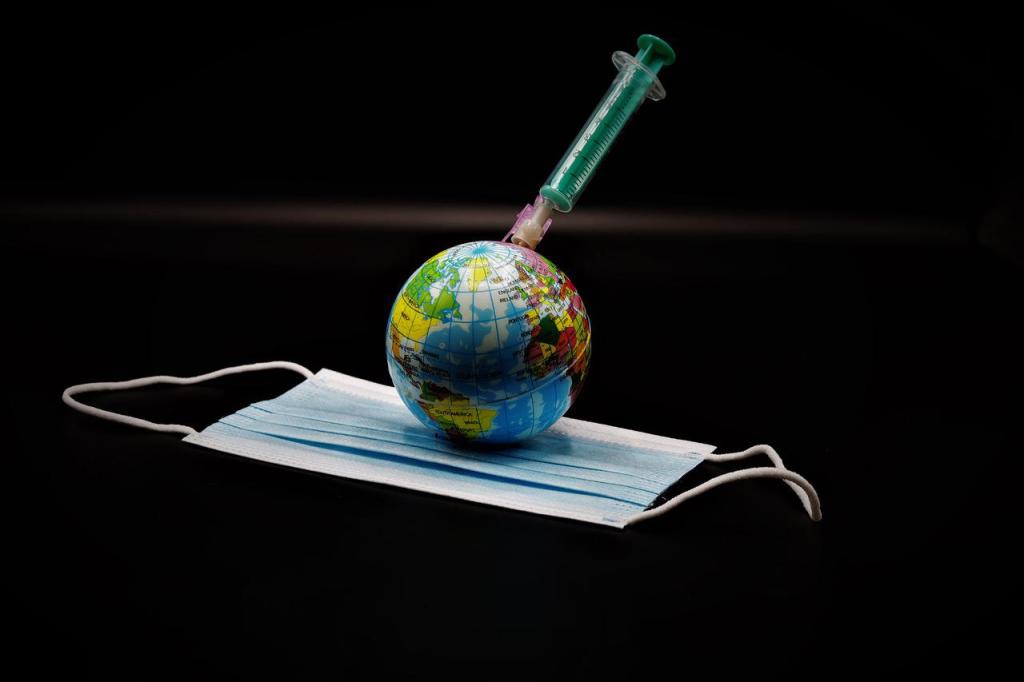
A Post-Pandemic Future …?

By Candice Louisa Daquin

Courtesy: Creative Commons

Having been a reluctant fan of apocalyptic fiction since I read George Orwell’s Nineteen Eighty-four (1949), I had studied virology when the AIDS pandemic struck and read a great number of virus-related books on infectious diseases. Despite this preparedness and the knowledge that it was not a case of IF, but WHEN, the next virus would strike, I think I speak for most of us when I say we were still all unprepared for Covid-19.

What the pandemic has taught us thus far is immeasurable and I believe it will last several generations, or I hope so. That said, it’s our human nature to want to move on. Not because we don’t care, but part of being alive is putting trauma and suffering behind us and ensuring those who survive, truly survive, which means living. Is that insensitive or just the nature of the beast? It can be insensitive, especially to the millions who have lost loved ones, but it’s also how humans generally operate.

Is it possible to move on and live a full life irrespective of this global tragedy without losing our compassion and responsibility to stop this from ever happening again?

The reality is; it will happen again, and for many of us, in our lifetime. What we can do is be better prepared and all that this entails.

What are the steps being taken to move toward the new post pandemic future? What are we doing differently? And why?

The pandemic divided us, it physically kept us apart. Some who were well versed in social skills and true extroverts, struggled when they emerged from the worst of the pandemic. They found it hard to do the things they used to be so skilled at. From lack of practice. I recall sitting at lunch with a friend who used to be the life-and-soul of any social event. She struggled for, as she put it; ‘her words’. Having become so used to speaking less and not being face-to-face, she said it felt ‘overwhelming’, ‘strange’ and she looked forward to going home.

That is a habit we must break. The comfort of the living room and the immediate family is intoxicating. We can rapidly get used to living in a smaller-seemingly safer, changed world where we see less people, go out less, and become accustomed to an intimate circle. For some of us this was always our life, and maybe not as challenging — a shift as it was for those who previously socialised a great deal.

In a way the pandemic was harder on the extrovert than the introvert. Because while introverts aren’t averse to socialising, they can find it exhausting; whereas extroverts gain energy from it. When you put an extrovert in a forced setting without social opportunity, they may struggle more than someone used to their own company.

But it’s not as simple as extrovert and introverts. Many of us are a little of both, depending on the situation. I can go out with a big group one day. But on other days I want to be alone. Few of us are extremes. Most are like ‘ambiverts’ a combination of extroverts and introverts.

For those who do thrive on socialising, the pandemic was particularly challenging, but there are many ways to be affected, not least the tension and anxiety all of us picked up on or directly experienced.

Fortunately, technology became our best friend as we Zoomed more and met via video chats throughout the world. It opened up an international stage more than we’ve ever experienced and gave children a new normal in terms of how they learned online. Learning solely online had deleterious effects on underperformers. This ‘unfinished learning’ [1] particularly impacted youth who might have already been struggling in the educational system.

Having taught Critical Thinking online for years, I genuinely believe online learning cannot replace in-class learning. There are huge draws to learning from the comfort of home, especially for adult learners who do so after work [2]. “In comparisons of online and in-person classes, however, online classes aren’t as effective as in-person classes for most students. Only a little research has assessed the effects of online lessons for elementary and high school students, and even less has used the ‘gold standard’ method of comparing the results for students assigned randomly to online or in-person courses.” [3]The amount of information retained is drastically smaller and the social engagement of a classroom has benefits that are hard to quantify but necessary for social development. When you rob children of the opportunity to socialize with each other you isolate them at a crucial stage in their development.

Some kids with learning disabilities[4] are particularly affected by this, as are those who come from unsafe or impoverished backgrounds, where they may not have equal access to technology or reliable internet. They may not have parents who can help them if they are stuck or be able to work from home or have access to lunch. All those necessary elements to the education system were lost in our need to stay home and protect each other. A generation of children will always remember this time as a result.

On the other hand, they have mastered technology in a way that few older generations can boast of, and they are conversant in all the myriad ways of communicating with a wide range of technologies and devices. They are adaptable, versatile and fearless when it comes to tackling the rigors of online learning. For some who dislike social settings, it may also be a vast improvement[5].

Women left the workforce in droves [6]when the pandemic hit, with 2 million less in the work-force. The inverse of this was men began to return to work having been dropping in numbers whilst women rose. The Pew Research Center found “What accounts for the larger labor force withdrawals among less-educated women than men during the pandemic? It is complex but there seems to be a consensus that it partly reflects how women are overrepresented in certain health care, food preparation and personal service occupations that were sharply curtailed at the start of the pandemic. Although women overall are more likely than men to be able to work remotely, they are disproportionately employed in occupations that require them to work on-site and in close proximity to others.” Jobs men traditionally do like physical labor, were in high demand, whilst many jobs traditionally filled by women, were shut down, often not returning[7].

We can be glad our restaurants are open again; we’re opening borders, we’re flying abroad, we’re living again. But let’s also spare a moment to think of those who lost so much it’s almost impossible to conceive. Covid was the third leading cause of death in America during the height of the pandemic, how did this many deaths become normal? Covid killed an estimated 13% of people over 80. Aside the tragedy of a generation of elderly dying[8] and the loss of grandparents, and parents for so many, we’ve also seen younger people dying from a virus, which has shaken the belief younger people have that they are impervious to viruses similar to the flu, what effect with this have on their sense of safety going forward?

And what of the health consequences of those who technically survived bout of the pademic but developed ‘slow Covid’ or worse, the side-effects and lingering legacy of being seriously ill with the virus?[9] How many lung transplants will occur? How will ‘long haulers’ cope with lingering serious effects? What of those who live in countries where this isn’t an option? How many chronic illnesses will continue for decades as a result of this pandemic? It’s not enough to point to those who have died but also include those who survived but at such a high cost.

Financially we have collectively poured money into research, vaccines, countermeasures and prevention, but where has that money actually come from? And can we feasibly borrow that much money from our coffers without a reckoning? Economist Anton Korinek, an associate professor with a joint appointment in the University of Virginia’s Department of Economics and the Darden School of Business thinks: “People sometimes frame the policy response to COVID-19 as a trade-off between lives and livelihoods, and they ask whether it’s worth killing our economy to save people’s lives. But what they forget is that people won’t go back to a normal life and consumer demand won’t really recover if the virus is spreading through our country and killing people.” But the result of these hard choices and repeat closures, is they now predict an impending worldwide recession of global proportions, which had already been mounting prior to the pandemic, but promises to be far greater in its aftermath. I don’t think we’ve even begun to see the fall out; it begins with massive inflation but that’s just the start[10].

History tells us when we go through challenging times and survive, ‘the near miss experience’ as it’s known as, we want to live more than ever before[11], but economically this will not be possible for so many who are robbed of their financial security because of inflation, redundancy, underemployment and post-covid illness. We should be mindful that none of us are all right if many of us are still suffering and if we can support those who struggle, this battle with covid should have taught us all that we should care more about each other.

Perhaps these are the steps we can take to move toward a new post-pandemic future, where we consider ways, we may be better prepared for an invariable future of emerging viruses. We can try to find ways to avoid spilling into areas with high disease potential. “According to a group of UN biodiversity experts, around 1.7 million unidentified viruses circulate in animal populations, of which 540,000 to 850,000 have the capacity to infect humans.” So, we can avoid wet markets, and sloppy scientific research, both of which are vectors for the spread of viruses. We can pay more emerging virus hunters [12] to seek out those emerging viruses and begin work on treatments before they devastate countries. We can be borderless in our unanimous approach to equity for all, especially access to healthcare.

In America, we learned we were far from unassailable. In a New York Times article about Covid Deaths, the authors wrote: “For all the encouragement that American health leaders drew from other countries’ success in withstanding the Omicron surge, the outcomes in the U.S. have been markedly different. Hospital admissions in the U.S. swelled to much higher rates than in Western Europe, leaving some states struggling to provide care. Americans are now dying from Covid at nearly double the daily rate of Britons and four times the rate of Germans.” Nothing can diminish that fatal statistic or rectify the unnecessary deaths[13]. Our healthcare system, considered superior, proved to be full of holes. Without some type of socialised healthcare our costs and resources are too high and scarce. We don’t value the front-line workers like nurses, porters, assistants and care staff and we do not pay them for the risks they take, and whilst we do pay doctors good wages, we have severe shortages of knowledge and progress. Finding out we didn’t have enough ventilators, masks for medical staff, PCP equipment and beyond, exposed the shame of putting profit over people. [14]

It is no surprise then that the UK and USA were among the top offenders in the rise and spread of the pandemic and their death rates exposed this. No one ethnic group appears to be at greater risker of dying from the virus based on ethnicity alone, but Hispanic, Black, and native Americans or AIAN people are about twice as likely to die from COVID-19 as their White counterparts and that Hispanic and AIAN people are at one and a half times greater risk of COVID-19 infection than White people[15]. This is caused by social reasons (inequality) not ethnicity, as can be proven by Africa and some AIAN countries having some of the lowest Covid mortality rates. In the article ‘Racism not Genetics’ in Scientific American, the authors point out “the genes that influence skin colour are distributed independently of genes that influence the risk for any particular disease. Given the heterogeneity of groups we call “black” or “white,” treating those categories as proxies for genetic variation almost always leads us astray.”[16]

Even if there are increased susceptibilities related to blood type[17] and age (More than 81% of COVID-19 deaths occur in people over age 65. The number of deaths among people over age 65 is 97 times higher than the number of deaths among people ages 18-29 years). The real risk is how healthy the population is and whether they have safe access to healthcare[18]. Both America and the UK failed because they put profit above people and have large populations of sickly people[19]. Going forward this needs to change, which means redesigning what we prioritise. People need to have access to healthcare and make lifestyle changes that will reduce their risks which they cannot do if they cannot afford to see a doctor or in the case of the UK find it hard to see a doctor because of long wait times and reduced staffing. It’s not as simple as socializing healthcare as the UK proved, this alone doesn’t save lives, what saves lives is considering the larger picture.

But politicians gain from older populations dying, consider what happened in Brazil when the President denied the danger of Covid and for a time Brazil had the highest Covid mortality[20]. This is the harsh truism rarely mentioned: It benefits those in control of a society to lose the most fragile members who will suck up precious resources, much like a form of eugenics, it behooves them to let it happen and there are many examples[21]. For a politician who is looking for ways to reduce healthcare costs, what is better than some of the potentially most expensive ‘customers’ dying? This happened in France where number of elderly people died one Summer, shockingly little was said at the time, but all signs pointed to a collective signal of relief from those in power who benefited from less older people making claim on an already taxed medical system[22].

When Italy [23]and Spain [24] and Brazil [25] became epicenters of Covid 19 deaths, they did so because of ill preparedness and it’s a cautionary tale to witness which countries succumbed to the ravages of covid 19 repeatedly, versus those who learned from them. What we have learned is more, not less, needs to be done and if a country keeps its borders open including air-travel and business-travel, then as much as they hope to save their economy, they do so at the expense of their most vulnerable. For some countries this was a conscious choice (economy over lives) whereas for others it was poor communication and slow response times. For some a lack of money, for others a desire to gain at any cost. All this speaks of the tapestry that is the pandemic’s aftermath (and truly, is it really vanquished?)[26].

I’d love to say a new post pandemic future looks rosy, but the only way that happens is if we learn from our mistakes, which history tells us, we rarely do. The most important thing is empathy, when we saw others take their masks off and simply not care if the vulnerable died, we saw how bad we as humans can fall. But we also saw how wonderful humans can be, including the infinite sacrifice and compassion of thousands who sought to help strangers. If there is a way, we can reward the good and not the bad, if we can get our priorities right and stop paying sports figures astronomical sums but perhaps emphasise on compassion, kindness, and diligence, we can all grow together.

I was particularly moved by youth who in the turmoil of the pandemic created inventions or systems to help others[27]. Believing youth are our future, and thus, our hope, it gives me great faith in the future when I see those too young to vote, care for strangers and seek to do their part. We should always encourage this as we should encourage a continued dialogue into how we can create an international rapid response to emerging diseases. It is not if, but when, and now all of us should know this and have no excuse for putting our heads in the sand again. Yes, it hurts to think of it, yes, we’d rather go off and have fun, but what fun is it if we are only postponing the inevitable return of a lethal virus? Part of being responsible for our planet and each other, is not avoiding the harsh truths; of environmental changes and devastation, global poverty, continued inequality and elitism, and of course, the increasing risk of deadly diseases.

We have within us all, the power to effect change. The steps we should take to move toward a post pandemic future must necessarily include keeping our eyes open and not taking the easy road. Sure, governments don’t want to spend the money on research, science, virus hunters, predictions. And preparedness, but I challenge anyone to say this isn’t exactly what they need to do. It is necessary we keep this in mind when we vote and protest. We should be marching about this as much as any other cause, because it affects us all and equally, brings us all together with one cause.

Thinking in terms of one world, we are less divided than ever before and whilst we were separated, I think we also found ways to come together if we choose to. I say, we should. Because, together globally, we learn more than we ever would divided. With the offensive by Russia on Ukraine, we see the lunacy of war, the futility, the devastation and waste. Instead of pouring millions into wars and keeping the rich, rich at the cost of the poor and overworked, we should consider how we can all rise out of the mire and evolve towards a better future. But in order to achieve this we cannot be complacent, and we cannot let our guard down.


[1] https://www.mckinsey.com/industries/education/our-insights/covid-19-and-education-the-lingering-effects-of-unfinished-learning

[2] https://www.forbes.com/sites/dereknewton/2021/03/31/the-worst-of-times-for-online-education/?sh=401d57623a5a

[3] https://www.edweek.org/technology/opinion-how-effective-is-online-learning-what-the-research-does-and-doesnt-tell-us/2020/03

[4] https://www.washingtonpost.com/education/2021/05/20/students-disabilities-virtual-learning-failure/

[5] https://penntoday.upenn.edu/news/how-technology-making-education-more-accessible

[6] https://www.shrm.org/resourcesandtools/hr-topics/behavioral-competencies/global-and-cultural-effectiveness/pages/over-1-million-fewer-women-in-labor-force.aspx

[7] https://www.pewresearch.org/fact-tank/2022/01/14/some-gender-disparities-widened-in-the-u-s-workforce-during-the-pandemic/

[8] https://www.statista.com/statistics/1191568/reported-deaths-from-covid-by-age-us/

[9] https://www.hopkinsmedicine.org/health/conditions-and-diseases/coronavirus/covid-long-haulers-long-term-effects-of-covid19

[10] https://news.virginia.edu/content/economist-societal-costs-covid-19-outweigh-individual-costs

[11] https://www.psychologytoday.com/us/blog/understanding-grief/201803/aftereffects-the-near-death-experience

[12] https://www.france24.com/en/africa/20201218-gabon-s-virus-hunters-in-search-of-the-next-covid-19

[13] https://www.nytimes.com/interactive/2022/02/01/science/covid-deaths-united-states.html

[14] https://www.theguardian.com/us-news/2022/feb/06/us-covid-death-rate-vaccines

[15] https://www.cdc.gov/coronavirus/2019-ncov/community/health-equity/race-ethnicity.html

[16] https://blogs.scientificamerican.com/voices/racism-not-genetics-explains-why-black-americans-are-dying-of-covid-19/

[17] https://www.ncbi.nlm.nih.gov/pmc/articles/PMC8286549/

[18] https://www.bbc.com/news/world-us-canada-52245690

[19] https://theconversation.com/why-has-the-uks-covid-death-toll-been-so-high-inequality-may-have-played-a-role-156331

[20] https://www.thelancet.com/journals/lancet/article/PIIS0140-6736(21)00529-8/fulltext

[21] https://foreignpolicy.com/2021/03/18/china-covid-19-killed-health-care-workers-worldwide/

[22] https://www.nbcnews.com/news/world/hong-kong-covid-outbreak-rcna20033

[23] https://www.france24.com/en/tv-shows/revisited/20210528-covid-19-in-europe-codogno-the-italian-town-where-it-all-began

[24] https://www.nytimes.com/2020/03/13/world/europe/spain-coronavirus-emergency.html

[25] https://www.scielo.br/j/rsbmt/a/8FzbQZY57WRTwYL9MnBKBQp/?lang=en

[26] https://www.nature.com/articles/d41586-021-03003-6

[27] https://circle.tufts.edu/latest-research/deeply-affected-pandemic-youth-are-committed-helping-others

.

Candice Louisa Daquin is a Psychotherapist and Editor, having worked in Europe, Canada and the USA. Daquins own work is also published widely, she has written five books of poetry, the last published by Finishing Line Press called Pinch the Lock. Her website is www thefeatheredsleep.com

.

PLEASE NOTE: ARTICLES CAN ONLY BE REPRODUCED IN OTHER SITES WITH DUE ACKNOWLEDGEMENT TO BORDERLESS JOURNAL.

Categories
Essay

Farewell Keri Hulme

Author Keri Hulme (1947-2021) was the first New Zealander to win the prestigious Booker prize for the bone people*. Keith Lyons recalls times he spent in a remote coastal settlement with the humble writer, who remains a divisive enigma.

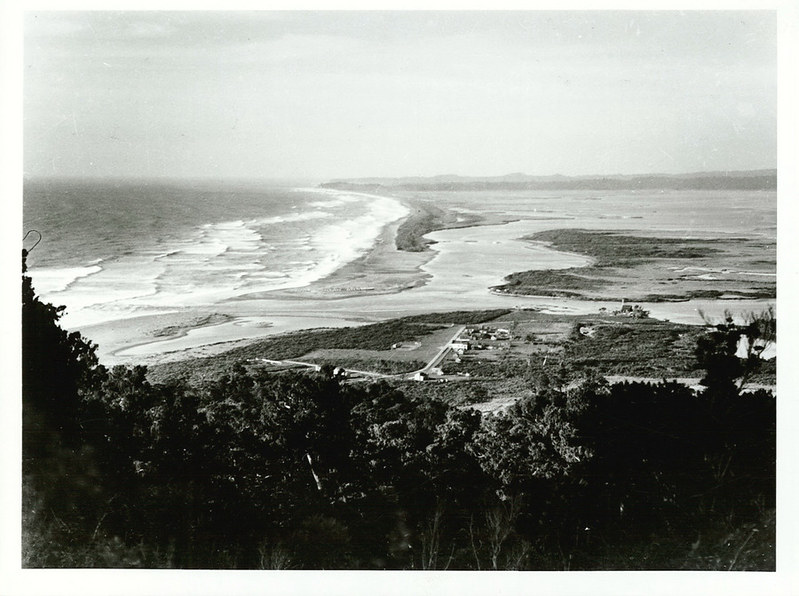
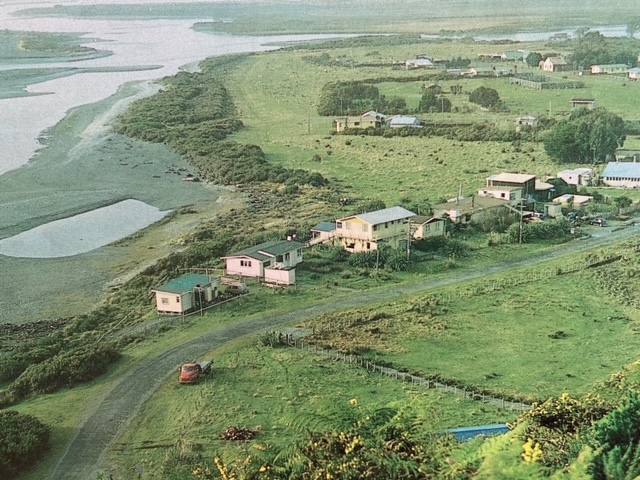
Okarito, home of Keri Hulme. Courtesy: Creative Commons

“You want to know about anybody? See what books they read, and how they’ve been read…” Keri Hulme

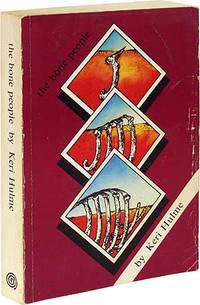
I was in high school when I heard the news that Keri Hulme’s the bone people had won the 1985 Booker Prize, literature’s most prestigious award for a novel in English. At 38 years old, she was the first New Zealander to receive the prize. Hulme became the first author to win with their debut novel. Later, in 2013, Eleanor Catton became the second Kiwi, the youngest winner of the Man Booker Prize, and also holds the record for the longest novel, 832 pages.

The following summer while hitchhiking around the South Island, I visited the small settlement of Okarito on the West Coast, where Keri had built her own house and lived since the 1970s. A converted schoolhouse in the former 1860s gold mining town was the main accommodation available: a youth hostel with bunk beds. I’d been attracted to the area because of the rugged coastline, placid tidal lagoon, mountain views and the elegant white herons which nested in the nearby forest.

Even though I’d struggled through an early edition of the bone people, I wasn’t as enthralled about the book as some of my fellow travellers who occupied bunk beds in the spartan hostel. Several European visitors carried copies of the book, which had been translated into many languages, several with different covers. It seemed that every day I went out walking along the main street of the settlement (population: 13 permanent residents), there would be an earnest woman from Cologne clutching Unter dem Tagmond or a young couple from Aarhus plodding along the road in the hope of finding Keri’s octagonal tower two-story house. Visitors wandered over the sand dunes desiring to encounter the acclaimed pipe-smoking author, beach combing for driftwood or gemstones washed up on the high tide.

There for the scenery and sanctuary of the coast, lagoon and native forest, rather than to spot the world-famous author, I did locate her house further along the settlement’s main road. A sign on the gate read “Unknown cats and dogs will be shot on sight”. The hostel warden Bill Minehan, who lived next door to Keri, told me she didn’t really like the attention or surprise visitors. Some of the other residents, protective of the community’s drawcard, would give wrong directions, so visitors after sightings of the elusive author could be seen pacing up and down the rutted grass airstrip — signposted Okarito International Airport and flying the Okarito Free Republic flag — or sidestepping around sheep grazing on the settlement’s rough golf course.

Often, after rains, Keri’s front yard flooded, creating a moat to protect her from rubberneckers. The Okarito Free Republic flag sometimes fluttered from a flagpole at Keri’s house, along with an alternative New Zealand flag, with a stylised spiral fern frond, made by Austrian painter and artist Friedensreich Hundertwasser. She moved to Okarito after winning a ballot for a section of land in 1973, building the house herself, lining bookcases with some 6,000 books, and setting up her writing desk with views out to the sea.

Keri was increasingly portrayed as reclusive. Rumours were that she’d spent all her Booker Prize thousands on alcohol from the Whataroa Hotel, some 25 km away. She didn’t like meeting strangers. She was reluctant to give interviews, and very rarely did she allow anyone into her house. She preferred solitude. “A large part of my life is the surge of the sea, listen to the sea, the pulse of the sea,” she once said.

I did catch a glimpse of Keri on my last day when returning a key to Bill — she was wielding a hammer, fixing the side of her house. The sweet aromatic scent of pipe tobacco floated in the humid air. Then I realised it was probably her I’d seen surf-cast fishing while on a long coastal walk towards the lagoon’s outlet into the Tasman Sea.

Bill let slip that Keri was formidable, but not unbeatable, at Scrabble. Having told him I had been at a Catholic boys’ school in Christchurch, and that I was also a writer, he asked if I knew any good high-scoring Scrabble words. I gave him ‘exorcise’ and ‘queazy’.

One of Keri’s favourite Scrabble words, I later found out, was ‘syzygy’, meaning the alignment of three celestial bodies. Three main characters make up ‘the bone people’. Keri said the characters for her book first came into her imagination when she was eighteen years old. After dreaming about a mute child with strange green eyes, she mused over the vision, eventually developing it into the character of the shipwrecked boy Simon Peter, whose life is intertwined with what one critic described as ‘his child-battering stepfather and a virgin feminist’.

The eldest daughter of a carpenter, whose parents came from Lancashire, and a mother who came from Orkney Scots and Māoris, she grew up in my hometown Christchurch. Her father died when she was aged eleven. After leaving school she dropped out of university part way through a law degree. She worked as a tobacco picker, in a woollen mill, delivering mail, cooking fish and chips at a takeaway shop, as a pharmacist’s assistant, a proofreader at a local newspaper, and in television production.

It took her almost two decades to finish the novel. She spent a dozen years trying to find a publisher. All New Zealand’s main publishing houses rejected the manuscript outright or insisted on extensive heavy re-writing before they would consider taking on the book.

In the end, it was published by a small obscure three-woman feminist collective (it was only the second book they produced), and typeset by students at a university newspaper, with an initial print run of just 2,000 copies. The book, which contained numerous typographical errors, was launched at an event at a teacher’s training college.

The year after its humble beginnings, the bone people won the Oscars of world literature, against the odds and against such literary heavyweights as Peter Carey, Doris Lessing and Iris Murdoch. The somewhat controversial win showcased writing from New Zealand to an international audience, who would perhaps only be aware of the likes of modernist short story writer Katherine Mansfield or Janet Frame, who explored madness and language.

Hulme’s contribution, blending indigenous myth and Celtic symbology, and set in a distinctly wild coastal New Zealand setting, is described as “an unusual story of love”’  or in the Amazon blurb “a true evocation of loneliness and attempts by deeply flawed people to connect to each other”. The main character of three, part-Māori artist Kerewin is convinced that her solitary life is the only way to face the world. How autobiographical is it, you ask? The more you delve into it, the more you find similarities with the unusual literary star, who increasingly got dubbed “reclusive” by the media because she wished to remain out of the limelight.

Part of the legend around Hulme is about the surprising success of her debut novel. She didn’t fancy her chances of winning the Booker Prize, so was in the US when the awards ceremony was held in London (plumes of cigarette smoke swirled up in the film footage) — she was the only contender not in the audience at London’s Guildhall. When she was called in her Salt Lake City hotel room during the event, she didn’t believe the news down the phone line. “You’re pulling my leg, aren’t you?” she said, “Oh, bloody hell.”

She was full of self-doubt. The literary world had a mixed response to her breakout novel. “Set on the harsh South Island beaches of New Zealand, bound in Māori myth and entwined with Christian symbols, Miss Hulme’s provocative novel summons power with words, as a conjurer’s spell,” wrote one New York Times review. “She casts her magic on three fiercely unique characters, but reminds us that we, like them, are ‘nothing more than people’, and that, in a sense, we are all cannibals, compelled to consume the gift of love with demands for perfection’.

Another review in the same publication was more critical. “It’s not so much that the novel offers ‘a taste passing strange’ as the author notes in the preface — interior monologues, disjointed narratives and vulgar language, after all, are hardly news these days. It’s more that the novel is unevenly written, often portentous, and considerably overlong.” The Guardian described the bone people as “a morass of bad, barely comprehensible prose.”

Even one of the Booker Prize judges, Joanna Lumley, was against it being picked as the winner, saying its subject matter was ‘indefensible’. A recent article described the bone people as one of the most divisive novels in Booker Prize history. The four words to sum up the book were violent, disturbing, poetic and striking.

While dismissed by some as unreadable and pretentious, in New Zealand the novel combining reality with dreams was seen as a masterpiece by others with its vision of a society regenerated by the adoption of Māori values and spirituality. For some, it challenged their worldview and sense of place at home in the world. Author Joy Cowley wrote, “Keri Hulme sat in our skulls while she wrote this work . . . she has given us — us.”

Keri said she wanted the novel to harmonise New Zealand’s two major cultural influences, indigenous Māori and European-descendent settlers (she herself shared both heritages). If you were to discover other authors who have explored in new ways what it means to be Māori, look up works by Patricia Grace and Witi Ihimaera, or for a raw look at the debilitating effect urban life has had on Maori, Alan Duff’s Once Were Warriors.

By the time I returned to Okarito the following August holidays to write a story for the Youth Hostel Association, the secluded hamlet had grown in population with the addition of a few more hardy souls and holiday houses, I only saw Keri a few times. One time, after gutting some snapper, she was off to clear the mailbox and collect the newspaper at the highway junction (there was no shop in the township). Another time she was cleaning a gun, bespectacled, and wearing her trademark red bush shirt. Like Hemingway, Keri liked hunting, (she favoured a .22 Ruger rifle among her collection of guns, swords and knives), and often took to the forest in search of deer.

Another time she was assembling poles, screens, nets, waders and buckets for the official start of the white baiting season. My father had worked in marine administration for decades, which included the monitoring of whitebait jetties and official seasons, so I knew a few things about the obsession. “Are the whitebait running yet?” I asked as she made the finishing touches to repairing nets. “Any day now,” she replied, looking expectedly towards the clouds billowing in the west. The season officially started the following day, and she had already checked her favoured locations for a 5am start. Normally a night owl and late riser, even her writing routine was swept aside for the ten weeks of the season when she was out trying to catch the coveted tiny fish. While throughout the year she might be catching rig or kahawai in the surf, netting for flounders in the lagoon, or trying to land salmon or trout in the rivers, her main springtime preoccupation was catching whitebait, the prized juveniles of migratory Southern Hemisphere fish.

I helped Bill load up driftwood onto the back of his vehicle before the rains set in, for use as firewood at the hostel (with a load for Keri too) and found some fool’s gold in quartz rock. Bill confirmed my folly. I gave him some more Scrabble words: Quartzy and Quickly.

That next summer I returned again to ‘The Big O’, hitching on the dusty corrugated gravel road to the coast with its pounding surf, driftwood sculptures and star-filled nights. Just before Christmas, with Bill away, Keri asked me if I could look after things at the hostel and check her place while she visited relatives on the other side of the South Island. The only other person staying medium-term was a German dwarf actor, who joked with me that he was a big man in European television and movies. Before she left, she dropped off a carton of a dozen beer, and some frozen whitebait, silvery eyes glistening through the plastic bag, with advice on how to make a batter for fritters with beer, flour, salt, and fresh parsley growing outside the hostel. “You could spice it up with some chilli pepper,” she said, pointing to a half-full jar of pepper left behind in the communal pantry by a Chilean backpacker.

Later, as we drank beer and watched the sunset from the old wharf, I mentioned to Manfred that even though Keri showed typical West Coast conviviality, we never once talked about writing. We’d talked about the moods of the weather, birdcalls from creatures seldom seen, what remedies protected vegetable gardens from slugs, and strange things which washed up on remote beaches. Having lived in that place for so long, she had plenty of stories about incidents, characters, or her own eccentric foibles. And I think that seeing her as a three-dimensional person (almost ignoring that she was a Booker Prize winner) rather than a 2-D writer made a difference, because it took away the pretensions and the expectations. She was direct, and also had a dry sense of humour. Manfred liked her rugged independent spirit, and kindly nature, not just because she had given us a box of beer. “She is like a good Kiwi bloke, yah?”

However, in the literary world, there was an expectation that a second novel was due. Her debut novel was on track to sell over a million copies. She’d retained the film rights, as its form couldn’t be easily adapted to the big screen. She believed that some stories work best ‘behind human eyes, not in front of them’. Surely she wasn’t going to be a ‘one-hit wonder’ like the band who sang the Macarena, Harper Lee’s To Kill a Mockingbird or The Catcher in the Rye by J. D. Salinger?

She finally announced her second novel, about fishing and death, she finally announced. And it would be called BAIT. She published a second collection of poems in 1992, and two collections of short stories appeared in 1986 and 2005. As for BAIT, it later would be published along with its twinned novel, On the Shadow Side.

She once declared she didn’t believe in writer’s block. “I know about distractions, laziness, daydreaming, stressful events that push writing to the background, and the sheer enjoyment of doing other things for a change … I am a slow, but very, very persistent writer.”

I can’t exactly recall when the last time it was I saw Keri. I just remember seeing her heading out on a fishing trip, along the windswept beach towards the lagoon and its ever-shifting outlet to the sea. She gave me a nod, and gradually faded into the misty greyness of the day and the distance. That night, after sunset at the beach, I witnessed the rare phenomena sometimes seen when the surf glows neon-blue from a bioluminescent algal bloom or plankton. Above it and beyond, the stars twinkled.

A decade ago, after almost forty years at Okarito, Keri left to move to the other coast, where she felt more at home. She had been dismayed by the development with ‘very ugly McMansions’ holiday homes visited by outsiders who would fly in by helicopter or plane. Her council rates were becoming unaffordable. She was also suffering from arthritis in her hips, back and elbows.

A few years ago, I went back to Okarito with a friend, but it felt different without her being there. We both hold the wish to buy her house, mainly in memory and tribute to Keri’s life and work, and also, to inspire our own writing. Though we both admit that Keri has fished all the best words, and woven the most compelling tales.

The much-anticipated second novel was never published, nor was the promised third. She died in late December last year. A family representative said she wasn’t after fame or fortune. “There were stories of her being this literary giant. It wasn’t really something that she discussed. It was never about fame for her, she’s always been a storyteller. It was never about the glitz and glam, she just had stories to share.”

*Please note ‘the bone people’ all lower case is the correct version of her title

 A view over Okarito and its lagoon and beach. Photo Courtesy: Keith Lyons

Keith Lyons (keithlyons.net) is an award-winning writer who gave up learning to play bagpipes in a Scottish pipe band to focus on early morning slow-lane swimming, the perfect cup of masala chai tea, and after-dark tabs of dark chocolate. Find him@KeithLyonsNZ or blogging at Wandering in the World (http://wanderingintheworld.com).
.

PLEASE NOTE: ARTICLES CAN ONLY BE REPRODUCED IN OTHER SITES WITH DUE ACKNOWLEDGEMENT TO BORDERLESS JOURNAL