Mr. Foley’s sister, Gin Thompson, was somewhat taken aback when the mail person arrived on the Wednesday after New Year’s with a suspicious looking package; suspicious because it was both heavy and oblong; a dimension heretofore not observed by her, at least not pertaining to a package.
“Mercy!” she yelled upon twisting the last bit of brown paper away from its contents.
Mr. Thompson stood beside his wife as she read the note addressed to her from St. Paul, Minnesota. They lived in Sioux City, Iowa.
“This is obviously from your brother Jack,” Harold Thompson said, grinning due to the curiosity aroused because Jack had been out of touch for years.
His wife didn’t find her husband’s big grin amusing. She usually knew what he was thinking. Yet, he was right. Jack hadn’t contacted Gin, his only sibling, in coming on fifteen years.
“It’s not FROM Jack!” Gin screamed. “It IS Jack!”
“What the hell?” was all Harold could find to say. To ask. Whatever.
Gin plopped down in Harold’s usual chair holding the ominous quart jar in both hands. “Gee whiz,” was all she could muster, and then a quieter, “Damn.”
“I had so many things I wanted to ask him,” she said.
“I wanted to pick his brain a little too,” Harold said, trying not to smile. “I guess that opens up a can of worms now,” he continued, still pretending a serious demeanor.
“Shut up, Harold!” Gin insisted.
Still, the couple agreed that what Jack Foley did, sending himself to his sister in such an unadulterated, absurd and impossible form with only a brief note was, in itself, unthinkable, untenable, and even morose.
They didn’t use those exact words, but that’s what they thought and Gin did say: “He’s made a mockery of my life.”
After all, Jack Foley had known that ever since his older sister turned sixteen, she’d adored canning. He was present in the Foley home attending grade school when Gin enthusiastically learned to can and pickle cucumbers, beets, zucchini, radishes, and okra. There were also jars of tomatoes and a host of other vegetables.
This very day in the Thompson basement assorted canned veggies were lined up with care on grease papered shelves.
But what should I do with this jar of mortal remains? Gin wondered.
She suffered, perhaps more than was necessary, over the prospect of Jack’s ashes getting mixed up with the onions which were the same color, though of a coarser texture, of course; dear nostalgic memories mixing with fatigued, cooked vegetables in a pickled sauce.
“What do you make of it?” Harold asked with a ruddy faced naivete that deserved scolding, but she didn’t have the stamina for it at that moment.
His question seemed as rottenly absurd as the jar full of what had been her brother for over 59 years. She pondered over how she was to remember him now. The phrase: Jack the vagabond’s last stop occurred to her but was quickly abandoned.
Jack was once an itinerant deli worker. A pill popper of barbiturates; yet he’d probably saved the life of a little girl named Betsy Sears by taking her to Hobby ’N Crafts every Friday so she could buy supplies and paint her way past the abuse she was dealing with at home until she was old enough to go out on her own. Ten years of going to the craft market, reading the ads while Betsy shopped.
He’d desperately wanted to donate one of his corneas to the Eye Bank but they’d insisted on a pair; something he couldn’t bring himself to sacrifice. Still, it was a sweet thought, their mother always said.
“And what would Mama think of Jack passing this way?” Gin asked, conjuring a gnawing question that Harold certainly couldn’t answer.
“What way?” Harold asked. “We know nothing of how the fellow actually died; if he were ill for a long time or hit by a bus. We just don’t know.”
“I guess I mean, what would she think of him passing himself to me like this?”
Gin confessed that she should have called her brother more often, not understanding the true nature of her failure; yet, realising deep down that there must have been a time when she dropped the ball, when she might have kept it surging in the air until Jack could have caught it, might have returned it, and kept the momentum going. She’d never been one to send birthday cards, or even Christmas cards. She thought of that too.
“You did all you could,” Harold soothed.
Everyone who says that phase knows it’s a lie. Still, as Harold saw it, soothing was a husband’s duty in such a situation, and he was merely doing his duty. He certainly felt no guilt in regard to the strange demise of his brother-in-law — no guilt or remorse whatsoever.
His only hidden concern was that Gin would somehow grow less fond of canning. This might affect his daily menu as it was presently full of pickled relish and mango chutney, condiments he favored almost as much as he loved a good cut of beef.
And Harold was right to worry, for it did take Gin a few weeks to bounce back, but canning was in her nature. Her mother had always told her that, and it was true.
She would store Jack on the bottom shelf, far to the left of the vegetables, and that would be that.
.
Mary Ellen Campagna taught Creative Writing and Essay at Virginia Western Community College after receiving her Master’s in Liberal Arts from Hollins University in Virginia. She now writes full-time from Upstate New York. She was recently published in Wild Sound Festival/Experimental Stories, Half and One Literary Magazine, and the Hudson Valley Writers’ Guild.
.
PLEASE NOTE: ARTICLES CAN ONLY BE REPRODUCED IN OTHER SITES WITH DUE ACKNOWLEDGEMENT TO BORDERLESS JOURNAL
When I was five years old, my father transported our impoverished family from the banks of the Licking River in Eastern Kentucky to Bound Brook, New Jersey, just off a tributary of the Raritan River. My mother had not wanted to leave her beloved Kentucky or depart from her numerous kin there, but she did want to stay married. And my father wanted to find work and get away from anything connected to hollows, moonshine, and that old-time religion. Mother also hoped that she, and especially her four children (with a fifth on the way), would be better off. As it turned out, we children mostly were, while she likely wasn’t.
My father chose Bound Brook, New Jersey, because he planned to work in the trucking business managed by his older brother. In Bound Brook, my father moved us into a place described as “Garden Apartments,” but there weren’t any gardens. It was post WWII housing, mainly for immigrants and working class people who could not afford to buy homes. Since I had been transported from a shack in Appalachia, the two-bedroom apartment in New Jersey, even for parents with five kids, seemed palatial: A bathtub and flush toilet! Hardwood floors! A gas stove and oven! Sidewalks, and even a nearby building for doing laundry. Stupendous, indeed!
Bound Brook, New Jersey, was a town where most people worked in restaurants, retail, construction, trucking, and schools; plus, there were countless employees at a couple of highly polluting chemical plants located just above the west end of town. (Sometimes strange odors and actual particles released from American Cyanamid drifted into our schoolyards, homes and playing fields.) I considered townspeople who were low-level bankers and teachers wealthy. Of course we all knew a few kids whose parents were doctors, high-level bankers, or businessmen. Those were the really rich people who did not live in project-style apartments or in low-income housing in the sections of town populated by immigrant Poles, Italians and Irish, with perhaps a random exotic Cuban or Indian family. It was rare to see a Black person or hear Spanish in Bound Brook in the 1950s.
In Kentucky, my mother was a vibrant woman who worked in the County Courthouse. Living in New Jersey, she devolved into a burdened housewife with no local kin and no capacity to access a new community or social life. When the sixth child was on the way, the apartment management informed my parents that they had to move out because they had too many kids. Our family was given two days to leave or pay an extra month’s rent, and regardless, we were being evicted. It happened that there was some new home construction on our west end, near a brook that occasionally overflowed its banks. I knew about the development because we local children frequented the site to steal plywood, tarpaper, and nails to construct lean-tos down the brook. We also nabbed construction cable, which the big kids affixed to tree limbs to make sturdy “Tarzan” swings for sailing from bank to bank across the brook.
At age eleven, I surreptitiously joined a group tour of the model home in the completed new development, where the available space and the fancy furniture smote me. I raced back to our apartment to tell my mother about the model house, and she sent my father over to take a look. Fortuitously, he ran across a salesperson that informed him that as a veteran of WWII, he qualified for mortgage and down payment assistance. Child number six arrived shortly after we moved into one of the newly constructed homes in the development. Then, deep into the following year, my Mother delivered my youngest brother, child number seven. Our new house afforded a shared bedroom for me and my two younger sisters, and an elongated attic room for the four boys.
Sadly, as the duration of her stay in New Jersey and the number of kids in our family increased, my Mother’s mental state diminished. She went from intimidation and apprehension about her life in Bound Brook to what could have been clinically diagnosed as agoraphobia and paranoia. In Kentucky she had been a proud and self-confident woman; in New Jersey she was increasingly unkempt, unhinged, and functionally disabled. I remember having to fake her signature on my report card and school permission slips because she was too distracted to sign or even look at paperwork; in fact, she opted out of most any activity not related to basic household management and cooking.
Without filtering her outbursts, my mother jabbered with religious fervor about her afflictions and her rage at our father who had brought her to New Jersey. She lamented that she would not live long enough to see us grow up. She sang sad and sometimes-scary gospel tunes like, “The Old Rugged Cross,” with lyrics about suffering and shame. She also warned us about rich “Republican snakes” that didn’t care about poor people, and dangerous immigrants with funny-sounding names who spoke strange languages (Polish, Italian). She denigrated both poor Black people and neighbouring Jewish people who didn’t love Jesus the way that she did. And she did love Jesus, and the church, even though she thought church people up North dressed too fancy, sang without spirit, and passed the collection plate with too many expectations. She loved us kids unconditionally, while often relying upon us for the basics of daily living. She was unhappy in her marriage and with living in New Jersey, but she was proud of her children, despite her disappointment when most of us went hippie and unchurched and, worse, two voted Republican.
Sports events and churches consolidated the people in the town of Bound Brook. Officials and functionaries would save your soul if you let them, and, if you were male, tone your body. My brothers were better than good enough at sports, which won them friends, attracted mentors, and enabled them to acquire college scholarships.
I was an excellent gymnast, runner, fielder, and could handle baseballs, basketballs and footballs as well as many boys. And I could maneuver a cable swing and play ping-pong better than most boys. At an inter-school Sports Field Day, I won all six of the proffered blue ribbons. Nonetheless, I didn’t get scholarships, rewards, or accolades. Instead I was mocked as a tomboy for wearing sports attire, and teased as a “skinny-bones” because I didn’t eat or grow much. After leaving rural Kentucky where I was used to drinking raw milk, the New Jersey pasteurised milk did not taste right, and my mother was reduced to serving canned vegetables and mystery meat from a supermarket. I hated the ground meat, hot dogs, and strange overcooked vegetables she served up. So I mostly didn’t eat. At a time when women were expected to be voluptuous and alluring, I was lean and agile. I hated New Jersey.
In fact, I never embraced living in NJ the way I “owned” my early years in Eastern Kentucky and my adult years in New York City. My best friend Janice said whenever she told people she was born in New Jersey, they laughed. She even wrote a song about that. I wasn’t born in New Jersey, but had enough of it imposed upon me to understand the song. Although there were plenty of kids to play with and make “fun trouble” with in the apartments and in our new housing development, I was bullied by big (literally) girls in the neighbourhood, and spurned at school by stylish girls from the better-heeled households. To survive, I became fleet of foot and quick of tongue, able to either run away from dicey situations or talk my way out of them. I fully realised I had to get out of Bound Brook, New Jersey.
In the interest of fairness, I must report that in the late 1950’s and early 1960’s Bound Brook had excellent schools and recreation facilities. Unfortunately, I had not attended any school in Kentucky, so, upon entering elementary school for the first time, I was both shy and academically lost. I also suffered from undiagnosed dyslexia, so I didn’t learn to read until almost 6th grade and never learned to write script, to the chagrin of teachers charged with improving me. Self-conscious about my “hillbilly” accent, I also did not talk at school, a definite deterrent to making friends and getting teacher approval.
I finally caught up by playing and sparring with the kids on the west end, many of whom had worse family situations than me and had the kind of personal and academic issues that were not going to resolve with time. (Being a west end kid certainly informed me that the required “Dick and Jane” school readers did not represent most families.) By the end of fifth grade I could read slowly, print neatly, and participate orally in classes. Best of all, I learned about the local library where I took refuge and read about places and events beyond what I was exposed to at home or in school. I was determined to find a way out of New Jersey.
By high school I was considered one of the smart students who was also a discipline problem. I understood socio-economic differences and realised (without knowing the specified words) that I was from a home with domestic abuse and child neglect. We kids were essentially on our own because our mother had checked out mentally and our father was irritable, sullen and mostly absent. (His absence was a good thing, considering his PTSD rage disorder from WWII.) Never really fitting in either at school or in the neighborhood, I engaged in bravado and resentment to camouflage my fears and vulnerability.
While most of us west end kids were petty thieves and street combatants, my weapon of choice became wit. I assailed bad teachers with derision, mockery, and scorn, refusing to cave to silly authoritarian directives and relentlessly challenging their biased views or misinformation. In short, I was learning about and exposing racism (then called “prejudice”) and political manipulation (still called “patriotism”).
The good and honest teachers admired my audacity and laughed at my antics, but the bad teachers were threatened and became vindictive. I teamed up with Grace, a classmate from the neighbourhood. She came from a single parent household (rare for Bound Brook in the early 1960’s), and lived in one of those so-called garden apartments with her mother. Suffice it to say, Grace and I created a lot of “smart trouble” at school. Soon we were not allowed to be in the same classroom. Worse, despite my qualifying grades, I was barred from the National Honor Society and kicked out of senior English. I had to report to the guidance office where I befriended the guidance counselor, who arranged for me to graduate despite my not completing the English requirement. This all probably happened because English was my best subject, and I was beginning to nurture my lifetime commitment to human rights and civil rights. I held New Jersey in contempt.
I desperately wanted to get out of Bound Brook and away from my home life, but I had no information, experience, or resources to facilitate those yearnings. I had never even traveled to another town by bus or train.
Toward the end of my senior year, I got work at the local recreation center, where I met a woman who was attending Montclair State College. (At the time, Montclair was the best of the New Jersey State colleges.) My older brother was putting himself through Rutgers State University, where female applicants were relegated to their Douglas College campus, close enough to Bound Brook to have required me to live at home and commute. At the last minute, I mailed an application to Montclair State and got a late acceptance with a State Scholarship that covered the $150 annual tuition, without which I could not have attended. Best of all, I was required to find housing near the college, away from home.
I had managed to escape Bound Brook but not New Jersey. I only had enough savings to live off-campus and attend college for one year, so I was prepared to drop out when President Lyndon Johnson saved me by signing the Economic Opportunity Act. Based on family income, I was part of the first wave of acceptances. Yes, to socialism and good government! I was grateful and shocked to receive money for housing, books and general spending.
Moving onto the 7th floor of a new dormitory with a stunning view of the New York City skyline, I rejoiced. Furthermore, because of Montclair State’s proximity to New York City, I was able to partake of a broad liberal education in the arts and sciences. I could actually envision departing New Jersey, so I vowed never to use Bound Brook as my mailing address again. (As it turned out, my instincts were correct: the two of our seven siblings who remained in Bound Brook eventually voted unabashedly for Donald J. Trump.)
Still, my transition out of New Jersey was a long and winding road. I returned to the State (though not to live in Bound Brook) a couple of times for temporary work or educational opportunities, and I never abandoned my New Jersey family or friends. My escape route led me to explore living in Berkeley, California; Bangkok, Thailand; Hiroshima, Japan; Honolulu, Hawaii, and, finally, to settle permanently in Greenwich Village in New York City. My daughter was raised as a proudly triumphant New Yorker.
It was, therefore, not exactly serendipitous that in my early 70s I returned to the place of my former captivity: the state of New Jersey. My choosing a late-life summer residence in the Garden State just kind of happened. My sister and I had been looking in Cape Cod, Massachusetts for places to rent or buy near the ocean, bay or sound. At the time, I was living alone in New York City and Karla lived in Massachusetts. I wanted a get-away place; she was seeking a year-round home. After a couple of thwarted attempts and some financial reality testing, we conceded we could not afford Cape Cod.
Back in New York, we investigated numerous beach towns, with similar financial results. Then, in the New York Times, I read that Asbury Park, on the north coast of the New Jersey shore, was undergoing massively successful development. With more trepidation than excitement, Karla and I hopped on New Jersey Transit to check out the Asbury Park options. We were in the habit of referring to our old home State as “New F*cking Jersey” and reassured each other that “Down the Shore” is not the same thing as NFJ!
From my youth and during the early days of my marriage, New Jersey towns along the ocean were not unfamiliar to me. In the 1980’s, my husband and I had joined resources with our New York City friends to rent summerhouses in towns close to the ocean. We were emulating our previous summer rentals in the Hamptons, except none of it was like the Hamptons or Amagansett. It was New Jersey.
The Garden State has the shore, not snooty beach towns. You go “down the shore,” not to the beach. The Jersey shore is much cheaper than the Hamptons, but also has far less cache. Thankfully, most of the Jersey Shore is also not like the TV series of that name, at least in the experience of my friends, who were college professors, psychotherapists, artists, or in media-related professions.
In the late 1980’s the shore rentals in New Jersey were affordable, the commute was a dream, and the ocean was fabulous, even if the food and entertainment were not top notch. Of course this was the early days of Bruce Springsteen, so we knew about the Stone Pony, but the town and boardwalk areas of Asbury Park were a wreck. We also knew that next to Asbury Park was an odd little town called Ocean Grove, which was developed and managed by the Methodist Church Camp Meeting Association. The church people did not allow driving on Sunday or the sale of liquor at any time. Entry to the beach was blocked until noon on Sunday mornings. (You were supposed to be in church at that time.) At best, we New Yorkers, many Jewish and all borderline atheists, thought this Ocean Grove place was endearingly bizarre.
We stuck to upscale towns like Spring Lake for our summer rentals. By 1992, when I was 47 years old, we ended our group rentals in New Jersey and eventually most of the friends and their marriages dissipated.
It was not until 2016, when I was 71-years-old, that my sister Karla and I sadly discovered, on a sweltering summer day, that the newly renovated Asbury Park was also not affordable. Dismayed, we crossed an inviting footbridge in Asbury that led to the Ocean Grove side of the Wesley Lake estuary. Meandering around the quiet, spiritually immersed town, we noted the striking contrast to bustling Asbury Park.
Needing a cool down, we spotted an air-conditioned realtor’s office and inquired, without enthusiasm, about properties near the ocean. The prices were considerably cheaper than Asbury and the town was charming, but could we contend with the controlling Methodists? (Certainly our Mother would have approved!) The realtor patiently showed us a couple of listings on the market, but none were very appealing.
As an afterthought, probably because she was kind, it was a slow day, and we were likeable, the agent mentioned that next door to her home was a large Victorian house that had been converted to condos a couple of decades ago. The gaudy blue structure was facing the ocean and included a small 2-bedroom apartment, which had been languishing vacant and unsold for about ten years. We asked to see it, and despite the heat, the realtor agreed to climb over thirty steps in the giant house to show us an unpolished, but fully furnished, top floor unit. A series of convoluted real estate and legal processes that dragged out for a year (plus simple naive luck) enabled us to purchase this condo in the turret (meaning attic) of a magnificent old house, with ocean views throughout. Yes, it was located in Ocean Grove, NEW JERSEY!
Nowadays, I very much enjoy spending my summers down the shore, gazing at the sea from our New Jersey condo and happily catching waves in the buoyant salty water. (Fortunately, my sister lives there year-round to help maintain it.) It is indeed ironic that lacking finances, but having good fortune, delivered me “down the shore” for the summers of my elderhood. Have I come to terms with NFJ? Recently, I had lunch with a nephew visiting me in New York City. When he nonchalantly asked if I ever considered living year-round down the Jersey shore, I let out a resounding, “NOOO!”
.
Karen Beatty’s work appears in over 30 publications, including Chicken Soup for the Soul, Books Ireland, Non Binary Review, and Mud Season Review. Her novel, Dodging Prayers and Bullets, was published in 2023.
.
PLEASE NOTE: ARTICLES CAN ONLY BE REPRODUCED IN OTHER SITES WITH DUE ACKNOWLEDGEMENT TO BORDERLESS JOURNAL
We speak through what goes unspoken like singers between songs. We could move as dancers do, through unrehearsed steps. Let’s speak a language of fluent silences, quiet breaths. When I yearn to sing and dance with you, I rewind our unheard conversations. The tape holds only silence, Yet still, I sing. Still, I dance alone.
From Public Domain
Laila Brahmbhatt, a Kashmiri/Jharkhand-rooted writer and Senior Immigration Consultant in New York, has published haiku and haibun in several international journals, including Cold Moon Journal and Failed Haiku.
PLEASE NOTE: ARTICLES CAN ONLY BE REPRODUCED IN OTHER SITES WITH DUE ACKNOWLEDGEMENT TO BORDERLESS JOURNAL
Let’s exchange our souls like lovers trading glances. We trace the lost walls of our breath in search of one another, cursed by having loved. Our hearts vanish, proof that we were in love.
Laila Brahmbhatt, a Kashmiri/Jharkhand-rooted writer and Senior Immigration Consultant in New York, has published haiku and haibun in several international journals, including Cold Moon Journal and Failed Haiku.
.
PLEASE NOTE: ARTICLES CAN ONLY BE REPRODUCED IN OTHER SITES WITH DUE ACKNOWLEDGEMENT TO BORDERLESS JOURNAL
Sharifa panicked briefly, looked around for Rhys, saw him near a row of tiny trains further inside the shop and waved at him to come to her. He didn’t see her, and the skinny boy wearing black nail polish was now waving the card right in her face. She frowned and said, “Sorry. I’ll get my husband.”
The punk whose name tag said Gee, shrugged and swept aside the scarves and tote bags Sharifa had placed on the counter and picked up the book he’d been reading.
“Rhys!” Sharifa tapped him on the arm, and he turned, smiling. “Something’s wrong with this card. Can I have yours?”
Later, bags tucked under the wrought iron table at the café they found around the corner, they sipped their coffees and tried not to grimace.
Rhys took off his windcheater and dropped it on the empty chair beside him. “Americans are coffee drinkers, right? How come this stuff tastes so horrible?”
“Maybe we don’t know where to find the best coffee in town. We should stalk those snappy office goers and see where they get theirs.”
They laughed and Rhys brought up the declined card again. She knew it bothered him even though her ANZ card was still working. She rarely used it because of the $2000 limit. But they’d used it to pay for the watery coffees and the horse carriage ride through Central Park earlier, and she knew there was enough to cover them for a week, if needed.
“Give us a look at that card.” Rhys put his hand over hers.
She sighed and placed it on the table.
“Shari. Love. This isn’t your card.”
“What do you mean? Of course it’s my card. I’ve been using it in Vegas casinos, for crying out loud.”
“Look.”
He was right. The name on the card said Sabiha Evans, not Sharifa Evans, but the signature was hers. Her writing. It didn’t make sense.
Sharifa withdrew her hand from his. “No, before you ask, I haven’t left it lying around, haven’t picked up someone else’s by mistake. You know me, Rhys. Paranoid from way back. I grew up in a country where you assume you’re going to be robbed, so I never take chances. This is seriously weird.”
“I know love.” Rhys’s hand covered hers again and he shook his head. “It’s the name that worries me. And that signature. It’s yours. How can this happen?’ And who’s this woman? Got a sister you haven’t told me about?”
“Yeah right. Also married to someone called Evans.” Sharifa tried not to sound annoyed. “This isn’t my fault.”
“Never said it was.”
They were meeting friends at a waterfront restaurant in New Rochelle, and arrived ahead of time, barely speaking to each other. An early thunderstorm prevented them from walking around the neighbourhood, and now they checked their phones, avoiding eye contact.
“Please …,” started Sharifa, wondering what she was pleading about, and Rhys looked back, nodding.
“I won’t say anything.”
“Thanks. I mean, maybe we can mention it?”
Mark and Andy were strolling towards them, hand in hand, and they both got up and hugged them, waving towards the table they’d booked.
“It is bizarre.” agreed Andy, looking at the card Sharifa had placed between them. “Spooky, almost. Have you gone to the Embassy? I mean, this could be fraud on a grand scale and you’re just at the start of your holiday. You don’t want to be aiding and abetting crime.”
“Andy.” Mark laughed. “Stop scaring them. Yes, it’s weird and we are in New York, but it doesn’t need to be quite so dramatic. Ring the bank and cancel the card. You have others?”
“Yes,” said Rhys. “Mine is fine. It’s Shari’s that’s gone whacko.”
.
Andy and Mark insisted on driving them to their tiny hotel room in midtown Manhattan, where they’d spend the rest of the week. Promising to update their friends on The Great Card Saga, they fell asleep almost immediately, Sharifa dreaming of kittens walking on windowsills.
The man from the bank was not helpful. Despite Sharifa repeating her name and date of birth and typing her password on the link that was sent, the outcome was the same. There was no record of her ever having an account with them. Yes, they had Rhys, but not her. No, they couldn’t cancel a card that was never issued to her. Cutting up the card into little strips seemed to be the only option until they returned to Australia.
.
A week after they got home, Sharifa stared at the envelope from the bank before ripping it open. Inside, a letter informing her that her replacement card was enclosed and that she should change the password at her nearest branch. A new card, with a blank signature strip, in the name of Sabiha Evans.
Rashida Murphy is a writer living in Perth, Western Australia. She is the author of a novel and a collection of short stories. Her novella titled Old Ghosts is forthcoming next year.
.
PLEASE NOTE: ARTICLES CAN ONLY BE REPRODUCED IN OTHER SITES WITH DUE ACKNOWLEDGEMENT TO BORDERLESS JOURNAL
At home, I was thinking about what it would be like to travel without a suitcase. When I reached my destination, I would lie still, let the water from the hotel faucet run between my fingers, washing off the stains of the journey. I would still carry in my wallet, like forgotten coins, my cat's footsteps on a spiral staircase, unfinished chores, buried secrets, clothes that no longer fit, a dying plant, many conversations pressed between lips like lettuce in sandwiches. My luggage is heavy, like a hangover from cheap wine.
Laila Brahmbhatt, a Kashmiri/Jharkhand-rooted writer and Senior Immigration Consultant in New York, has published haiku and haibun in several international journals, including Cold Moon Journal and Failed Haiku.
.
PLEASE NOTE: ARTICLES CAN ONLY BE REPRODUCED IN OTHER SITES WITH DUE ACKNOWLEDGEMENT TO BORDERLESS JOURNAL
The city hummed in the distance, a restless body of lights and shadows. From the 10th-floor balcony of an aging apartment building, the sound of honking cars, barking dogs, and occasional train whistles formed a chaotic symphony. The night air was thick with the scent of rain-soaked pavement, diesel exhaust, and something else, something old, unspoken, waiting: like the breath of a forgotten tomb.
Flat 10-B faced east. At dawn, sunlight strained through grime-caked windows, pooling weakly on floors that hadn’t seen polish since Madhavi’s husband died. The walls, once eggshell white, had yellowed like ancient newspaper clippings. Cracks branched across the ceiling in fractal patterns, mapping silent histories of monsoons absorbed and endured.
Madhavi Bose had lived in this apartment for twenty-seven years. She had moved in as a young bride, her heart brimming with the quiet satisfaction of middle-class security. Her husband had been a government officer with a voice like a rusted hinge and hands that smelled always of mustard oil and ink. She’d learned to love him through ritual: starching his shirts, packing his tiffin, listening to his stories of petty office politics. Her world contracted to the geometry of his needs, his nap times, his preference for fish on Thursdays, his mother’s backhanded compliments about Madhavi’s rice.
And then, suddenly, he was gone. A heart attack at forty-five, slumped over a stack of tax files. No time for goodbyes, no time for regrets. Just the scent of his hair oil lingering on pillowcases, and the pension that arrived every month like a condolence card.
Left with a sixteen-year-old daughter and a life halved, Madhavi had done what was expected of her. She survived. She woke each morning, brewed tea for one, and scrubbed the balcony tiles until her knuckles bled. She learned to kill cockroaches without flinching. She stopped wearing sindoor.
And then there was Riya.
Riya, now twenty-four, had been a bright, sharp-eyed child, full of questions, full of hunger. At eight, she’d torn maps from schoolbooks to tape above her bed. Patagonia! Istanbul! Marrakech! Places whose names rolled like marbles in her mouth. At fourteen, she wrote stories about women who rode motorcycles through deserts. Too restless for a city like this, too impatient for a life like her mother’s. She devoured novels as if they were contraband, hiding Rushdie under her mattress, scribbling poems in the margins of math notebooks.
University had been a brief reprieve. For three years, she’d rented a hostel bunk near campus, subsisting on muri[1]and the euphoria of all-night literary debates. She fell in love twice, once with a Marxist poet who quoted Faiz, once with a biology student who sketched ferns in her notebooks. Both left for Delhi. Both promised to write. Neither did.
Her first job interview had been at a glossy magazine office where the editor yawned while she spoke. The second, at a publishing house, ended when they asked her to fetch chai for a visiting author. “You’ll start as an intern,” they’d said, though she’d graduated top of her class. Soon, she found herself in a cubicle the colour of wet cement, editing corporate brochures about cement. The future is built on solid foundations. Her colleagues wore polyester saris and discussed baby formulas. At lunch, she hid in stairwells, nibbling canteen samosas gone cold, scrolling through friends’ Instagrams: New York! Berlin! — until her eyes burned.
And so, she returned to Flat 10-B. To her mother. To a house where the only real conversations happened in the spaces between words.
The apartment’s rhythm was metronomic. Madhavi rose at 5:30 AM, the click of her alarm clock splitting the dark like a dry twig. She brewed Assam tea, the pot whistling two precise notes. The newspaper arrived with a thud; she read it front to back, circling typos in red pen. By 6:45, she descended the ten flights (the elevator had died with her husband), her cane tapping each step like a metronome. She walked exactly three laps around the park, nodding at the same widows on the same benches, their saris fading to identical shades of ash.
Riya woke at 8:00 AM to the smell of cumin seeds burning, Madhavi’s eternal attempt at breakfast. She dressed in the dark, avoiding mirrors. The corridor to the front door felt longer every day, lined with family photos fossilized in time: her parents’ wedding portrait, Madhavi’s smile stiff as starched cotton, Riya’s fifth birthday, half the cake uneaten, her father’s garlanded graduation photo gathering dust.
Evenings condensed into separate silences. Madhavi parked herself before the television, absorbing soap operas where women wept over stolen inheritances and switched-at-birth babies. The flickering blue light etched her face into something statue-like, immovable. Riya retreated to her room, headphones blaring punk rock, rereading The Bell Jar[2] for the twelfth time. She’d marked a passage years ago, I saw my life branching out before me like the green fig tree, but now the figs seemed rotted, the tree petrified.
Dinner was a sacrament of avoidance. “There’s dal in the fridge.” “Okay.” They passed each other like shadows, careful not to touch. Once, Madhavi’s fingers brushed Riya’s wrist while handing her a plate. Both recoiled as if scalded.
They never argued. Arguments required collision, and collision required caring enough to crash.
Then the sleepwalking began.
It was Riya who noticed it first. She woke one morning with grit beneath her nails, the taste of soil sharp on her tongue. Her legs ached as if she’d climbed mountains. On a hunch, she checked her shoes, the soles caked with mud.
The next night, she hung her mobile around her neck. The footage, grainy and green-tinged, showed her move out at 2:17 AM. Her movements fluid as that of a marionette. She glided past the cracked full-length mirror, her reflection blurred, as if out of focus, turned the doorknob with eerie precision. Moments later, Madhavi emerged from her room, eyes milky in the dark, nightgown billowing like a sail. Together, they drifted into the hallway, bare feet soundless on cracked tiles.
Riya didn’t speak of it. Words would make it real. Instead, she began stealing glances at her mother, really looking, for the first time in years. Madhavi’s hands fascinated her: long fingers calloused from scrubbing, nails pared to the quick, a silver band still indenting her ring finger. Once, she caught Madhavi humming a Rabindra Sangeet tune while chopping onions, her voice girlish, almost playful. The sound froze Riya mid-step. By the time she exhaled, the humming had stopped.
One rain-heavy evening, Madhavi broke the unspoken rules. “I wanted to be a teacher,” she said abruptly, ladling dal onto Riya’s plate.
Riya’s thumb hovered over her phone screen. “What?”
“At Bethune College, I’d been accepted. History. Your grandfather said educated wives were headaches. So.” She shrugged, a single lift of the shoulder that contained a lifetime of folded dreams. “Your father preferred my fish curry to my opinions anyway.”
The admission hung between them, delicate as a cobweb. Riya thought of her own application to Columbia’s MFA program, buried under a strata of rejection emails. She wanted to ask, Were you angry? Did you ever scream? Instead, she muttered, “The dal’s good.”
Madhavi stared at her, eyes glinting with something that could’ve been pity. Or recognition.
The sleepwalking intensified. Riya began waking in strange tableaus: perched on the fire escape, her toes curled over the edge; kneeling in the building’s puja[3] room, marigold petals stuck to her knees; once, standing in the parking lot, arms outstretched as if awaiting crucifixion. Her phone footage revealed nightly pilgrimages, down ten flights, through the lobby’s broken turnstile, into the skeletal garden behind the building. Always, Madhavi followed.
Then came the monsoon night.
Rain sheeted the balcony grilles, the wind howling through gaps in the window seals. Riya was sleepwalking, mud squelching between her toes, her nightdress plastered to her skin. She stood in the garden’s center, lightning fracturing the sky. To her left, Madhavi hovered, drenched and spectral, her gaze locked on Riya.
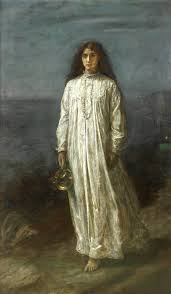
Sleepwalkers: From Public Domain
A current passed between them, not a spark, but a surge.
Madhavi spoke first, her voice unspooling like smoke. “At last. At last, my enemy.”
Riya’s jaw clenched. The words came out involuntarily. “Hateful woman. Selfish and old. You want my life to be your epilogue.”
“You devoured my youth.” Madhavi’s hands flexed. Her eyes had a glassy look, but they were inanimate. Still. “You, who blames me for her cage.”
“You never fought! You just… folded.”
“And you?” Madhavi’s laugh was a dry leaf crushed underfoot. “You run, but only in circles. You think I don’t see your applications? Your hidden bank account?”
Riya’s breath hitched. The garden seemed to pulse, neem leaves trembling, earth exhaling decades of buried words.
“I could’ve left,” Madhavi whispered. “After he died. Gone back to school. But you-”
“Don’t.”
“– you needed stability. Security.”
“I needed a mother, not a martyr!”
Lightning flashed. For an instant, Madhavi’s face was a mask of cracks. Then, a dog barked, the neighbor’s irritating new resident, and the spell snapped.
Madhavi blinked, rain dripping from her lashes. “Is that you, darling?”
Riya hugged herself, shivering. “Yes, Ma.”
And then, as if nothing had happened, they went back inside. They climbed the stairs in silence, leaving wet footprints that evaporated by dawn.
Spandan Upadhyay is a new writer whose work captures the vibrant nuances of everyday life. With a deep appreciation for the human experience, Spandan’s stories weave together subtle emotions and moments of introspection. Each of his stories invite readers into a world where ordinary occurrences reveal profound truths, leaving a lasting impact.
.
PLEASE NOTE: ARTICLES CAN ONLY BE REPRODUCED IN OTHER SITES WITH DUE ACKNOWLEDGEMENT TO BORDERLESS JOURNAL.
Nico hurried off the steamer at Burgaz Island, oblivious of the swarming passengers disembarking and embarking. How long had it been since he had stepped foot on the island of his grandfather’s birth: twelve … thirteen years ? He made a bee-line for the central plaza. There he still stood, Saït Faïk, ever so thoughtful, leaning against that eternal tree. Nico approached the Turkish poet –Grandpa would have been so delighted to be here with us again. I’m sure he would have asked you about the talking seaweed and weeping mussels, Nico mused.
Vasiliki had passed away six years ago, a natural death, probably in his sleep. The old fisherman had asked Nico to have him buried between his wife, Nefeli, and daughter, Myrto, which he dutifully accomplished. Since the adolescent was the sole inheritor, he sold his grandfather’s little house for a good price, which permitted him to live comfortably in Athens while completing his university studies. Indeed, because he was parentless, and because his grades in grammar school were excellent, Nico had qualified for a scholarship. The ambitious student, thus, enjoyed financial ease to continue studying several more years for his doctorate. He excelled in Greek language and literature, French and English philology, in European History. At nights he read and spoke Turkish with several Turkish friends, for the vision of returning to Burgaz stole upon him like those perfumed nights on Burgaz with his grandfather as they contemplated the star-studded sky. That seemed so long ago …
Once his doctoral thesis defended, Nico left Greece and set off for Burgaz, off on an adventure. Poetry had been a major part of his thesis, and he had written quite a few poems, contributing to the university Literary Club’s weekly journal. Some of his poems and short stories caught the eye of an editor in Athens who had them published in a widespread monthly magazine. Soon he was invited to poetry readings and story-telling jousts, and because of these eventful evenings his circle of readers widened like concentric ripples in a pool of water after a rock had been thrown in …
The young poet left Athens not knowing exactly what Destiny held for him … nor what drove him so powerfully to return to the island. Was it because of his love for his grandfather ? His fascination for Saït Faïk? Or both? Saïk’s provided him with inexhaustible inspiration. Perhaps, too, it was the mystery of Burgaz of which his grandfather had so oftentimes spoke. Yes. It might have been that.
The horse-drawn carriage pulled up in front of the long flight of stairs to Zorba’s ‘humble’ home. Nico paid and began to ascend the worn-out mossy steps. Nothing had changed as the fretted gable slowly loomed in front of him. The perfumed scent of azaleas, roses, honeysuckles and pomegranate stirred distant memories. He had written to Zorba about his project to spend some time on Burgaz, and the good merchant, although away for several months in the United States on business, insisted that the young poet stay as long as he wished in his ‘humble’ home. He would be greeted and well-fed by his trusty maid, Zelda.
On hearing carriage bells Zelda rushed out, waiting for the ascending Nico arms akimbo. He dropped his knapsack, shoulder-bag and hugged the good woman. Speaking Greek had been her wont when Nico accompanied his grandfather years ago, but now, since the young man had decided to sojourn in Burgaz, she spoke to him in Turkish. Zelda was pleasantly surprised to hear him reply quite readily in Turkish. In fact, Zelda would prove an excellent tutor for Nico. Her grammar was excellent and her accent easy to understand.
So, after a solid diner, exhausted after a long day of travelling, Nico once again trudged up the steps of the floating stairway, the tinkling sound of the fountain below tickling his ears, opened the door to the room he knew so well with its frescoed ceiling of Greek heroes and large bay window looking out upon the darkened forests and the Marmara Sea. He washed and before drifting off to sleep, read a few chapters from Homer’s Odeyssus, which he always carried with him when ‘on the road’, and several paragraphs from Saït Faïk’s Son Kuşlar (Last Birds), underlining the words he couldn’t understand.
Up early the next morning, Zelda had prepared a breakfast of black olives, goat’s cheese, hard-boiled eggs, bread, butter, rose jam and black tea. She had gone to the local market (it was Tuesday) and would not be back before eleven.
Dressed lightly — the weather was very warm, Nico sauntered down the same long and winding path through the wooded slope that led to the stony beach, hoping Abi Din Bey would still be serving grilled-cheese sandwiches, and spouting poetry for his customers. How the brisk island breeze of the sea swept away the cobs of lingering doubt in Nico’s mind as he descended — doubts that had tortured him because his grandfather would no longer be at his side, physically. Yet, when he stepped upon the beach these doubts evaporated. Vasiliki was there and would always be there. He spotted several fishing boats out at sea. Had Nico built a new boat with the help of his grandfather? Indeed he had. It was the biggest and most beautiful of all his boats! Much bigger than the Nefeli which was still in route towards China. But this wonderful boat would not be launched into the leaden seas: it lay housed in a small museum in Hydra where it can be admired by both the young and the old. In fact, Nico even won an award for that marvellous construction. He had named her Myrto in memory of his grandfather’s daughter. The tombstone engraver, on Nico’s behest, carved the silhouette of his boat on Vasiliki’s gravestone.
Abi Din Bey’s welcoming gate had been sealed! The homely front gardens lay desolate, the trees devoid of fruit, clusters of weed and couch grass grew wild. The poet’s house, albeit perfectly intact, exhaled an odour of negligence. Nico stared at this bleak scene, his heart growing heavy. It had never occurred to him that Abi Din Bey would not come rushing out to greet him. That this solitary man was mortal like all other human beings … like his grandfather. He felt like a child who believes his or her parents immortal out of love for them.
From behind a middle-aged man walked up to him: “Abi Din died about ten or eleven years ago,” he began in a soft voice in broken Turkish. “He has no inheritors, so his house stands derelict and abandoned.”
Nico, snapped out of his despondency, eyed the stranger with mixed emotions. “What of his poetry?”
“Abi Din’s life of a poet held absolutely no interest for most who prefer to live in a cloud of unknowing. Abi Din Bey wrote some excellent poems, but alas no one had ears to listen to them.”
“We listened to them,” remonstrated Nico, though rather lamely.
“I know you did, you and your grandfather, Vasiliki.”
Nico reeled back as if struck by a blow. “How do you know … Who are you?”
“Oh, who I am makes no difference to anyone. But if you insist. I am the pilgrim of the heart, I voyage throughout the world admiring its marvels, an idler preaching the blessings of uselessness. Abi Din was one of those marvels, one of those brilliantly elevated idlers.” With those words, the stranger turned to leave.
Nico caught him by an arm: “Sir, where is the old man who piled up stones on the beach ? I haven’t seen him.”
“Nor will you ever see him again. Gone too, and some say that he recited several passages from Saït Faïk’s Son Kuşlar on his dying breath. Have you read Saït Faïk?”
Overcome by all these converging threads of some hidden or latent fabric beyond his grasp or comprehension, Nico could only stutter: “Well … yes … in fact…”
The other interrupted: “Listen, if you want to pay respects towards Abi Din and Saït, you should buy his house. It’s not very expensive.”
“But you …” The unnamed pilgrim put up a hand.
“I have no possessions. That is my first life principle. I idle my way through countries, people and books like a phantom. You buy it, my friend. Buy it before either Time brings about its ruin or the Burgaz municipality its demolition. For now, there are no plans to do either. It’s a mystery why that quaint house has not caught the eye of some eager artist.” And he gave Nico a wink.
“Mystery?” A sudden bout of remorse paralysed Nico. Had his grandfather not spoken of a mystery on Burgaz?
“Yes, mystery! Isn’t that why you’ve returned?” With that last question left unanswered by a flummoxed Nico, the pilgrim strolled away along the beach, chanting some sea-faring tune.
When Nico came to his senses he literally jumped for joy. he would buy Abi Din’s house, settle on Burgaz and pursue his artistic life simply, wholeheartedly. He could become a resident of Turkey merely by depositing enough money in the Osmanlı Bankası[1]. The anonymous figure of the pilgrim had since vanished into a haze of blue. Nico ran up the winding path to Zorba’s home, where Zelda had been preparing lunch. Excitedly he explained his project. She thought it a smashing idea, and promised to help him with the paper work. They ate, had their coffee, and at two o’clock walked to the crossroads, hailed a carriage and rode to the Town Hall, a majestic, white-washed villa near the centre of town.
On the way, Nico asked Zelda whether or not she knew of a middle-aged man who walked about the island, idling his way here and there. Zelda giggled: “Oh yes, him. The Turks call him Mister başı boş[2]and the Greeks tempelis[3].”
“But he’s far from empty-headed,” remonstrated Nico.
“I’m sure he isn’t, that’s why I call him ‘aylak‘.”
“I don’t know the word.”
“Someone who idles about without any definite destination.” Nico nodded, puzzled none the less at these attributes of a person who seemed quite ‘full-headed’ to him …
The irksome formalities to purchase Abi Din’s house would fill a book. Suffice it to report that in two weeks the house belonged to Nico, once he had deposited enough money in the bank, and of course, bought the house in cash …
Although Nico now spent most of his time in his acquired house, he always ate lunch with Zelda at Zorba’s house, and sometimes dinner. It must be recorded here that Nico was better versed in writing stories than in culinary skills.
Every morning after breakfasting, Nico would roam the hilltops of Burgaz sauntering cheerfully along the dirt paths, jotting down in his little notebook details that caught his eye or thoughts that scudded across his mind. The island air intoxicated him as he conjured up characters and events for future stories or poems.
On Sundays, Nico would attend services at St John’s Greek cathedral, there mingling with the small community members who had taken a liking to this young man, calling him their ‘island writer’! He became a novelty for the islanders, who invited him dine or to read his creations. Meanwhile, several of Nico’s short stories and poems were being published in Athens by his editor and were read by the Greek community in Burgaz. Nico even attempted to write poems and stories in Turkish which Zelda not only corrected, but suggested a more fitting word or subtle syntax structure.
Once a month, Nico took the steamer to Heybeliada, or in Greek, Chalki[4], the third of the four Princess Islands where he was fortunate enough to consult the books at the library of the massive Greek Theological Centre, opened in 1844 for seminarists but closed by the Turkish authorities in 1971. Although prohibited, Nico’s reputation, which had spread to all the islands, allowed him to study at the library, the second largest religious library in the western world, several million tomes behind the Vatican’s. The young artist even managed to work two days a week there. How he managed that remains a mystery.
Once or twice a month, accompanied by Zelda, Nico would go to Büyükada (Big Island) called ‘Prinkipo’ in Greek because it is the largest island of the four, and stroll along a tarred road to contemplate the largest wooden building in Europe, a former Greek orphanage, built by the French in 1898. The Greeks bought it and children who had lost their parents were lodged here until its forced closing in 1964. This eerie-looking structure remained intact. Surrounded by high barb-wire fencing and guarded by savage dogs, no one could enter it. Every time Nico stood before this ominous edifice, he thought of his grandfather who had salvaged him from such a parentless fate. Perhaps, the children here were well taken care of…
One day as Nico sauntered along one of the myriad paths in the wooded hills of Burgaz he came face to face with the idling pilgrim. So delighted was Nico to meet this eccentric character that he began to pour out all the good news that had occurred to him since their last encounter many months ago. The other smiled kindly: “No need to repeat what many have already told me,” he stated indifferently. “Nothing on Burgaz goes unnoticed, especially novelties such as yourself. I wouldn’t want to puff up your pride, but some have considered you as a new Saït Faïk.”
Nico stared at the pilgrim disconcertedly. “I can assure you, my dear friend, that you have made quite a reputation for yourself on Burgaz. And who knows, you may be able to solve the mystery of which your grandfather so often spoke.” Baffled, Nico remained speechless. The other took his arm and they strolled together downwards into the sinking sun.
Nico could not contain his surprise: “How could you know about …”
“About Vasiliki’s mystery? Ah, that would entail hours of explanation, Nico. For now let us discuss your writings, for the intention behind those writings may have given you the key to unlock the mystery.”
The pilgrim paused sniffing the pine- and spruce-scented air. “You know, many writers have lost touch with reality, or have been completely overwhelmed by it. They seem incapable of telling a story, transmitting the joys and sorrows of their characters whose traits lie deep in their own hearts, imprisoned like birds in a cage, fluttering frantically, unable to express the Truth of what lies beneath the masks and costumes. Saït Faïk, Edgar Poe, Dino Buzzati[5], Guy de Maupassant[6], Somerset Maugham, Katherine Mansfield all drew their inspiration from fragments of a separate reality, the glints of a deflected flood of light, the shards of a broken vase to disclose the experiences of their characters, to bestow upon their readers the amalgamated emotions that flew freely from their hearts. Their stories and poems are not talk-of-the-day productions. They were derived from the unlocking of the cage, the flight outwards into the battlefield between joy and sorrow. You would think that their eyes were turned both inwards and outwards at the same time. There is something powerful, even sacred, if I may use that word, in their narrated experiences, which does not necessarily entail the use of I, nor does it insinuate a ‘message’ to be harnassed or brought into line by the opinionated or bigoted. The syntax rhythms and word combinations expose the élan or the coming and going between the inward and the outward regard … I discern in your regard that inward and outward alternating vision, the aura that enhaloes your stories and poems. But mind you, this is only an idler’s perception.”
“What do you mean by aura?” Nico, crimsoning under the weight of so many complex compliments, managed to ask, almost out of breath.
“The halo of tradition that all sincere writing bears,” came the succinct reply. “A poem or a short-story, as in your case, bears an aura familiar to the reader, yet whose tale and expression of this tale transports him or her to strange, unfamiliar places. This is especially noticeable in your Turkish writings, an uncanny concoction of familiarity and eeriness. Perhaps it’s due to Zelda’s mixed origins.”
Nico stopped in his tracks, a blank look on his face. “Yes, Zelda, who, when we cross paths, addresses me as the ‘aylak‘. Her father was a remarkable writer and professor of philosophy in Greece and in Turkey. She inherited much of his wisdom as well as her mother’s strong character.” Nico stood stunned by this revelation.
“Zelda is only …”
“Only what, my friend ? Zorba’s maid or servant ? Ah ! I see you haven’t delved deep enough into the hearts of those who are very close to you. I’ve noted, too, that you have never written one line or verse about your deceased grandfather.”
Nico, stung to the quick by the very truth of that remark, bowed his head. He felt a surging wave of shame, and on this billowing wave rode an undulating image of a squealing seal that he and his grandfather had admired on their fishing adventure — an image gradually over-shadowed by another, more fuzzy, the stiffening body of a seagull on a pebbly shore near the mouth of a cavern.
The mild voice of his companion brought back these troubling scenes: “When all is said and done you will surely open wider the cage and let fly the encaged birds towards brighter poetic heights. Heights that perhaps you have yet to imagine.” With those comforting but enigmatic words the pilgrim turned to leave. He halted and asked: “Tell me, have you been to Granada?”
“Granada, Spain? No I haven’t, why?”
“You look like someone I met there.” The idler disappeared downwards into the crimson glint of sunset.
Nico ran back to Zorba’s house, undecided whether to speak to Zelda about her family. He never dreamed of broaching the subject to her as she herself had never bought up.
When the young writer had lumbered up those mossy steps he found Zelda seated on an armchair in the corner of the dining room, a shadow of gloom etched on her face. Her eyes were red. Wordlessly, she handed him a letter. It was written in faulty Greek, addressed to Zelda from an associate of Zorba’s in New York. A moment later Nico looked at Zelda with deep compassion. Zorba had died of a heart attack. His body would be sent to Burgaz for burial, accompanied by several of his associates who intended to buy his house.
“What will happen to me?” were Zelda’s first strained words. “I refuse to live in the same house with strangers even if they are Zorba’s associates.”
“Have you any family, Zelda? Anywhere to go? Anyone to help you financially?” She nodded in the negative to all these questions.
Nico sat down beside her: “Listen Zelda, come live with me, it’s a bit cramped, but at least you will have a roof over your head, food on the table, and a good friend who will always be at your side.”
Zelda dried her eyes and stared at Nico in embarrassment.
“I’m old enough to be your mother,” she said faintly.
“Exactly!” responded Nico excitedly. “You shall be the mother I hardly ever knew, in the same way that the presence of Abi Din in his house has been the father I hardly ever knew. How my grandfather would rejoice at that family reunion, however surreal, if I may say so.” Zelda smiled.
And with that acquiescing smile the two orphaned destinies appeared to converge into one …
[1] The biggest bank of Turkey at the time of Nico’s arrival specializing in international transactions. (Ottoman Bank).
Paul Mirabile is a retired professor of philology now living in France. He has published mostly academic works centred on philology, history, pedagogy and religion. He has also published stories of his travels throughout Asia, where he spent thirty years.
.
PLEASE NOTE: ARTICLES CAN ONLY BE REPRODUCED IN OTHER SITES WITH DUE ACKNOWLEDGEMENT TO BORDERLESS JOURNAL
I watch you walk the street we once shared. You toss away a paper the one I gave you, scribbled with your silly jokes. It’s been a long day with thoughts about you. I must sleep so I can think some more. When I think of you, I don’t miss you. I miss our laughter. I’m still laughing at those jokes. But you can’t hear me. To hear, one must be awake
Laila Brahmbhatt, a Kashmiri/Jharkhand-rooted writer and Senior Immigration Consultant in New York, has published haiku and haibun in several international journals, including Cold Moon Journal and Failed Haiku.
.
PLEASE NOTE: ARTICLES CAN ONLY BE REPRODUCED IN OTHER SITES WITH DUE ACKNOWLEDGEMENT TO BORDERLESS JOURNAL
Ratnottama Sengupta introduces and converses with a photographer who works at the intersection of art and social issues, Vijay S Jodha
S Vijay JodhaLines, Shapes & Forms – Vijay S. Jodha’s group show is on view at Museo Camera Gurgaon till May 26, 2025Photo Courtesy: Vijay S Jodha
Vijay S Jodha was yet to become one of India’s leading lens-based artists at the intersection of art and social issues. Back then, in the 1990s, he had no inkling that 30 years later he would be the chairperson of UGC-CEC[1] jury for selecting the best educational films made in India. Or that he would be the national selector and trainer in photography for the National Abilympics Association of India.
When I first met him, he was mounting a collaborative exhibition of his work with the elderly, their contribution to society and the care they deserve. Little did I know that the entire bent of this journalist-turned documentary filmmaker-turned photo artist would go on to focus on subjects ranging from mob violence, riot victims, farmers’ suicide, 75 years of Indian constitution to Joys of Christmas and the Bus Art of Tamil Nadu.
Photo Courtesy: Vijay S Jodha
Not surprising that the International Confederation of NGOs has honoured Vijay with the Media Citizen Award for using media to drive social change. And it is only one among hundreds of honours he has received in two dozen countries. These include awards and grants, from Swiss Development Agency to Ford Foundation and Bill & Melinda Gates Foundation. Screening of his films on 75 channels worldwide and in 250 festivals in 60 countries.
These seem tedious details? So, interestingly, two public showings of his work have been vandalised. And a false police case against him took eight years to be thrown out by India’s courts!
Conversation
Vijay how did you come into photography?
I’m a trained filmmaker – I mastered in film production – and have been making films for two decades. My films have shown on 75 stations including Discovery, CNN, BBC. But training in photography I have none. All my photography is non-fiction work. Actually my films are also non-fiction or reality based work. I just find still photography very relaxing because, unlike films where a director is responsible for so many things, here I’m on my own. But there’s no production deadline. No huge budget is needed. I can address any subject that catches my fancy and pursue it over several years, without any worry. Otherwise it’s the same: photos or films, you’re storytelling around substantial issues that interest you, in a manner that does justice to those issues, and — hopefully — engaging to the viewers.
So who was your inspiration?
In photography it is obviously the greats who defined the grammar of the medium itself such as Robert Frank[2] and Cartier Bresson[3]. They’ve inspired us all in some manner. I’m fortunate that, as a part time journalist in New York decades ago, I got to meet and interview top filmmakers and photographers like Gordon Parks and Richard Avedon.
I once did a course at New York’s School of Visual Arts where they honoured Mary Ellen Mark and she had come across. As a journalist, I covered Sebastião Salgado’s launch of his workers’ project that put him on the map (of photography). I met Raghubir Singh while doing a project on Ayodhya in India, and again in New York where we put up the same exhibition. He also photographed some of us – myself, Siddharth Varadarajan, the editor-publisher of The Wire who was then a student at Columbia University, and other Indian students — were protesting some human rights issue.
I’m also fortunate to have our finest photo-journalists and lens-based artists as friends. I can take across my work to get a feedback or pick their brains. This beats the best photo schools in the world. In fact years ago I did a book which had photos from all of them! This was the biggest photo project on the Tiranga[4] as listed in the Limca Book of Records. They have all done many books on their own but this is the only one where all these masters appear in a single volume, their works united thematically. Apart from Raghu Rai, Ram Rahman, Prashant Panjiar, Dayanita Singh, T Narayan, and the late TS Satyan, I’d also interviewed people across India, from the then Prime Minister Vajpayee to those selling flags at traffic lights for a few meagre rupees.
You did not go to any international school to train in the art or the technology aspect. So what prompted your PhD?
Three decades back when I decided to go into mass communication as a career there were few computers, no internet, no private TV channels, or mobile phones. Sorry if that makes me seem Jurassic but it was a world with very few media opportunities. Post college, I had got admissions into a trainee programme with a newspaper as well as in the MA programme in International Relations at India’s premier Jawaharlal Nehru University. My father felt that a masters and exposure at JNU would be a better investment for journalism – probably the single best advice I’ve got in my entire career — and I followed that.
Then for some time I worked in print media: I freelanced for newspapers, edited and published a journal for a business house, scripted for a film and worked on a book with one of my journalism heroes – late Kuldip Nayar. But in the pre-internet era newspaper articles had a very short life, so I felt the need to produce something that would last longer such as film. So I decided to get a degree in Film. It also encompassed all my interests, from writing to art to music, travel and photography.
You’ve not been a photo-journalist working for any journal or newspaper. Yet you felt inclined to do projects on environment, elder care, survivors of riots and mob violence, farmer suicide, art that travels. Was it inevitable, given your father’s background?
Actually I’ve done a bit of photo journalism too. During my film school days at NYU I was a writer-photographer for their student-run newspaper, Washington Square News. I’ve also been a stringer for mainstream dailies including The Economic Times where I shot images parallel to my writing. I did stills for Mira Nair’s Monsoon Wedding and of course stills for my own film projects. So I’ve a lot of published images in papers worldwide though my main gig has been films.
Frankly I don’t see much difference between these mediums. Be it words, stills or moving images; an academic paper, photo books, or films, short or long – all this is story telling. I’m a story teller.
And subjects? I’ve filmed every possible subject except wildlife: I just don’t have the patience for that. Otherwise everything, from artist biopics — on Paritosh Sen and Prokash Karmakar, whose inaugural screening you also attended in Calcutta years ago — to films on environment. My The Weeping Apple Tree (2005) was among the first ones on climate change in India. It won the UK Environment Film Fellowship Award 2005 and had multiple screenings on Discovery, with an introduction by Sir Mark Tully.
At that time, few knew about climate change. So Delhi govt organised a special screening for their MLAs and officers of water, electricity and sanitation departments. It was screened at UNEP headquarters in Nairobi and in various festivals. UNIDO and other grassroots level NGOs used it to create awareness. Some years back an IFS {Indian Forest Service} officer told me that Himachal government uses it to train their forest officers.
My film on gender, Pedalling to Freedom (2007) revisited an old initiative in one of the poorest parts of the world. It traced the life-changing impact of teaching 100,000 women to ride the bicycle. That film is in the US Library of Congress. It was also chosen for archiving at OSA Budapest, world’s premier repository of materials dealing with human rights.
Then there are films that get food on the table. Training films. Corporate films. I once did a ‘funeral film’ on a well-known personality whose passing received a lot of press coverage in India but the NRI son could not come for the funeral.
What motivates you Vijay — money, international honour, or the possibility of social change?
Well, all this is livelihood so the money part is important. But doing work that gets recognised far and wide, that is substantial, to hold good for a long time – that’s a huge motivator.
I have a slightly spiritual take towards this. I feel that regardless of our profession we are all bound by a dharmic or sacred duty. A teacher’s duty is to teach and a doctor’s is to heal. For those in the business of storytelling — including photographers — the sacred duty is to document, bear witness, push things forward. And believe you me, this has little connect with means or accessibility.
To give you an extreme example: After the Nazis lost the war and Berlin fell, soldiers from the victorious allies army raped virtually every woman in Berlin. Few rapists were taken to task and to top it, despite all the extensive coverage of the allies victory by forgotten photographers as well as superstars like Margaret Bourke-White (known to us through her famous Gandhiji with charkha portrait) or Robert Capa (regarded as the greatest war photographer of all time), there was no coverage of this mass outrage in Berlin by anyone be it in photo essays in Life Magazine, or World War photo books. It appears in no Hollywood film or TV series.
Likewise, fifty years ago, when India came under the draconian Emergency, our courts also endorsed the robbing of our Constitutional rights. Nobody documented, then or since, the forced sterilisation of 6,000,000 who were stripped of their reproductive rights. We, as photographers and filmmakers, failed on this front.
The First Witnesses is my project around farmer suicides. It is not an unheard issue nor something hard to get access. But how many have found it worth their while to document the issue? How many are documenting a disappearing art form or livelihood? Or our urban heritage being torn down? Our movie theatres once represented cinema as an inexpensive and readily accessible mass culture. Now they are being torn down even in smaller towns. Each had a unique character. Is anyone documenting that?
I documented Durga Puja in Kolkata 20 years ago when I was working with painters there. Durga astride a tiger, slaying the demonic Mahisasur emerging out of a buffalo: these elements get interpreted in hundreds of ways across the city each year. Each pandal has a different aesthetic interpretation, inside and outside. The religious aspect is no less important. But these are also like site-specific installation art works shaped by the imagination of so many talented people but designed for impermanence. How many books of photos exist around this work now recognised by UNESCO as Intangible Cultural Heritage of Humanity?
How successful have you been in achieving this?
The merit of my work is for others to judge. I’m happy that, though India doesn’t have many foundations or support for non-commercial oriented art, I’ve been able to do at least a few things that are genuinely pathbreaking, substantial and have gone around the world. To be invited to UNESCO headquarters in Paris to screen a film and address delegates from 193 countries, or be honoured by our President for India’s best ever performed at Abilympics — these are certainly my career highlights.
Vijay S Jodha at UNESCO introducing his film. Photo provided by Vijay S Jodha
My work has received over a hundred honours across 24 countries, but what truly motivates me is when people I look up to, my heroes, appreciate what I do. That kind of recognition carries a different weight. For instance, Magsaysay awardee P Sainath, whose ground-breaking reportage has long inspired me, saw my farmers project when it was exhibited alongside his photographic work at the Chennai Photo Biennale 2019. We hadn’t met before, so when he praised my effort, it felt like receiving a medal.
Another moment that has stayed with me was post my time at NYU. My professor, George Stoney, referred to as the father of public access television and mentioned in history books on documentary cinema, mentored Oscar-winning directors like Oliver Stone, Martin Scorsese, Spike Lee, and Ang Lee. When he watched The Weeping Apple Tree, he said, “Vijay, this is better than Al Gore’s An Inconvenient Truth. That was a glorified PowerPoint by comparison.” That one comment meant more to me than most awards ever could.
As a photo artist what is the biggest moment of joy for you — technical hurray or the joy of the subjects?
As I just said, recognition and praise of my heroes gives the maximum joy. There are other honours. Two photo projects listed in Limca Book of Records for being the biggest and path breaking. The first was on ageing that I did over eight years with my brother Samar Jodha – he did the images while I did the concept research, writing and interviews. The other was the aforementioned Tiranga. My film Poop on Poverty (2012) won a Peabody award, the oldest honour for documentary films, and more international honours than any non-fiction film produced out of India.
After landmark exhibitions in Hong Kong and New York I donated two complete sets of The First Witnesses, my farming crisis project, to two farmer unions including our oldest and biggest All India Kisan Sabha (AIKS). They are using it for awareness raising across villages. That’s a real high as a photographer.
Then there’s high coming from those we pass down our expertise to. Among those I’ve taught or mentored is a highly talented though physically challenged youngster from Vijayawada with missing digits and motoring issues. His family runs a Kirana shop. When he started school, they sent him back saying he cannot even hold a pencil. He won a bronze medal in photography for India at the last Abilympics in France. Another student has himself become a photography teacher in a school for hearing impaired. This is the kind of stuff that gets me very excited.
Thirty years ago as a volunteer writer and researcher I helped Sanskriti Foundation set up India’s first international artist retreat. That novel venture raised crores in grants and set up three museums. Today it is being scaled back as its founder O P Jain is in his 90s. But that idea caught on and you have scores of artist retreats across India.
How has digital technology influenced photography as an art form? Has it done more harm? Or widened its spread?
Digital has been a mixed experience. It democratised the process of production and dissemination — be it still images or movies. This is a fantastic thing. But it killed a lot of the processes and livelihoods such as the printing labs, film production and processing facilities. It has also killed an art form like print making. It’s a specialised skill in itself, so a lot of artistry, understanding, appreciation and sustenance of it has got compromised.
The emergence of deep fake images and piracy of work is bad news too. But it has allowed more people to become story tellers. They now bear witness, as filmmakers and photographers, of issues and events that was earlier impossible.
I can cite examples from my work. I’m National Selector and Trainer in photography for National Abilympics Association of India (NAAI) and my students are in different parts of India. Two are hearing impaired, two others have motoring issues and physical challenges. Thanks to digital tools, we’re running long distance classes every week. NAAI provides me sign language interpreter but I can send and receive digital files, use zoom to conduct classes, use google translate to send instructions in Tamil, English and Marathi to my students. Now one student, despite hearing challenge, is running a photo studio. The student who has issues with his leg also works as wedding photographer. Workshops with institutions and festivals, within and outside India, are now easy and inexpensive thanks to these digital tools and communication modes.
Has selfies on mobile camera shortened the life of portraiture?
It has certainly democratised the process while the average person’s patience to study or appreciate any art work — portrait or landscape photo — is shrinking by the minute. Of course, good portraiture requires some skill to make as well as appreciate – that cultural literacy is a challenge everywhere, not just in photo medium. As a seasoned art critic you would have noticed that in the world of painting and sculpture too. Sadly we don’t have that education in our schools.
You have continued with still images even after doing many documentaries. What is the joy in either case?
I’m doing still photography and movies parallel to each other. Last month I had a book on public policy, as I mentioned. Also launched last month – by our defence minister –was my film on our Armed Forces Medical Corps – it’s one of the oldest divisions in the world, going back 260 years. I’m working on a project on the Indian Constitution and a biopic on Amitabh Sen Gupta, the artist whose retrospective exhibition this year is organised by Artworld Chennai. My still photography project on the farmers crisis is also going on for the past 7-8 years.
All projects are joyous and offer their own challenges. It’s like bringing children into the world. You do the best you can, hope they’ll do well and go far, but you don’t know which one will. Regardless of their line of work you feel happy with each of them and what they achieve.
What is the future of Arriflex, Mitchell, Kodak Brownie? And that of Yashica, Nikon, Canon, Leica, Olympus…?
Some old camera brands like Konica and Minolta have merged, or evolved into digital Avatars like Arriflex. Others, like Kodak, have faded into history. Interestingly, a small Indian company has licensed their name to market TVs under Kodak brand name now. For those of us from the analogue generation, it’s a bittersweet feeling. When a beloved brand disappears, it feels like saying goodbye to an old friend. But such is the nature of change.
My friend Aditya Arya, one of India’s eminent photographers and a passionate camera collector, has created a remarkable space to preserve this legacy. He established the Museo Camera in Gurgaon, a non-profit centre promoting photographic art, which has become not only a camera museum but also a leading art and culture hub in the Delhi national capital region. If you’re an old time photographer passing through Delhi, it’s a wonderful place to revisit these “old friends.”
[1]University Grants Commission-Consortium for Educational Communication
[2] Robert Frank (1924-2019) was a photographer and documentary filmmaker.
[3] Henri Cartier-Bresson (1908-2004) was a humanist photographer, a master of candid photography, and an early user of 35mm film. One of the founding members of Magnum Photos in 1947, he pioneered the genre of street photography, and viewed photography as capturing a decisive moment.
Ratnottama Sengupta, formerly Arts Editor of The Times of India, teaches mass communication and film appreciation, curates film festivals and art exhibitions, and translates and writes books. She has been a member of CBFC, served on the National Film Awards jury and has herself won a National Award.
.
PLEASE NOTE: ARTICLES CAN ONLY BE REPRODUCED IN OTHER SITES WITH DUE ACKNOWLEDGEMENT TO BORDERLESS JOURNAL