Categories
Essay

Travels of Debendranath Tagore

Narrative by Debendranath Tagore, translated from Bengali by Somdatta Mandal

Note from the Translator

Debendranath, Father of Rabindranath Tagore

Born to Dwarkanath Tagore in Shelaidah, Debendranath Tagore (15 May 1817 – 19 January 1905) was a Hindu philosopher and religious reformer. One of the founders of the Brahmo religion in 1848, his journey in the role of ‘Maharshi’, the great ascetic, was an attempt to spread the Brahmo faith and he travelled extensively to various places, especially in different parts of the Himalayas like Mussourie, Shimla, Kashmir, and Dalhousie.  He even constructed a house in Bakrota called ‘The Snow Dawn’ where he used to reside for months. Although Debendranath was deeply spiritual, he managed to continue to maintain his worldly affairs — he did not renounce his material possessions, as some Hindu traditions prescribed, but instead continued to enjoy them in a spirit of detachment. His considerable material property included estates spread over several districts in Bengal. Debendranath was a master of the Upanishads and played no small role in the education and cultivation of the faculties of his sons.

In his memoir, Jeevan Smriti [Memories of Life], Rabindranath also narrates in detail about his trip with his father in the Himalayas when he was just eleven years old. Debendranth founded the Tattwabodhini Patrika (1843) as a mouthpiece of the Brahmo Samaj and apart from his autobiography, wrote several other prose pieces which also reveal his wanderlust.

Among the two entries included here, we have ‘Moulmein Bhraman’ which is an interesting travel piece narrating his sojourn in Burma in September/October 1850. In the Chaitra 1817 Saka issue of Tattwabodhini Patrika, a travelogue ‘Mori Bhraman’ narrating Debendranath’s trip to Mori was published. Interestingly, as a prologue to this piece Sri Chintamani Chattopadhyay tells us that he was so enamoured after listening to Debendranath’s oral narration of the trip undertaken 28 years earlier, that he decided to transcribe it for the satisfaction of the readers.

Moulmein Bhraman (Travel to Moulmein)

After a year, the splendour of autumn revealed once again and the desire to travel blossomed in my mind. I could not make up my mind where to go for a trip this time. I thought I would make a trip on the river and so went to the bank of the Ganges to look for a suitable boat. I saw that several khalasis — dockyard workers – of a huge steamer were busy at their work. It seemed that this steamer would soon set sail.

“When would this steamer go to Allahabad?” I asked them.

In reply they said, “Within two or three days this will venture into the sea.”

On hearing that this steamer would go to the sea, I thought that this was the easiest way my desire for a sea journey could be fulfilled. I went to the captain instantly and rented a cabin and in due time boarded that steamer to begin my sea journey.

I had never seen the blue colour of the sea water before. I kept on watching the beautiful sights by day and night amid the continuous bright blue waves and remained immersed in the glory of the eternal spirit. After entering the sea and swaying with the waves for one night, the ship dropped anchor at three o’clock the next afternoon. In front of us, I saw a stretch of white sand and something that looked like human habitation. So, I took a boat and went to see it. As I was wandering about the place, I saw a few Bengali men from Chittagong with charms around their necks coming towards me. I asked them, “How come you are here? What do you do?”

“We do business here. We have procured the idol of Goddess Durga in this month of Ashwin[1],” they replied.

I was really surprised to hear that they celebrate Durga puja here in Khaekfu town of Burma. Durga puja was celebrated even here!

From there, I came back to the ship and started towards Moulmein. When the ship left the sea and entered the Moulmein River, I remembered the scene of leaving Gangasagar Island and going into the Ganges River. But this river did not offer any such good scenery. The water was muddy and full of crocodiles; no one bathed in it. The ship came and dropped anchor at Moulmein. Here a Madrasi resident called Mudeliar came and greeted me[2]. He came on his own and introduced himself. He was a high-level government official and a true gentleman. He took me to his house, and I remained a guest there and accepted his hospitality for the few days I stayed at Moulmein. I stayed very comfortably in his house.

The streets in the city of Moulmein were wide and clean. The shops that lined both sides of the street selling different kinds of things were all manned by women. I bought a box, and some very fine silk clothes from them. Going around the marketplace I went to the fish market at one time. I saw big fish for sale displayed on huge tables.

 “What are these big fish called?”

They replied, “Crocodiles.” So, the Burmese ate crocodiles; they spoke verbally about ahimsa and the Buddhist religion, but their stomachs were filled with crocodiles!

One evening when I was wandering on the wide streets of Moulmein, I saw a man walking towards me. When he came close, I understood that he was a Bengali. I was quite surprised to see a Bengali there. From where did this Bengali arrive across the ocean? It seemed there were no places where Bengalis did not go. I asked him, “From where have you come?”

“I was in trouble and so came here,” he replied.

Instantly I understood his trouble[3]. I asked him further, “How many years of trouble?”

“Seven years,” he replied again.

“What did you do?”

“Nothing much. I just duplicated some papers of a company. Now my term is over, but I cannot go home because I do not have the money.”

I offered to give him the passage money. But how will he go home? He had set up a business, had got married, and was living quite comfortably. Would he ever go back to our country to show his shameful black face there?

Mudeliar told me that there was a mountain cave here which people went to visit[4]. If I wished he would accompany me there. I agreed. On the first moon night[5], he brought a long boat during the high tide. There was a wooden cabin in the centre of that boat. That night, Mudeliar, I, the captain of the ship and seven or eight other people boarded the boat and it left at two o’clock at night. We sat up for the whole night in that boat. The foreigners kept on singing English songs and requested me to sing Bengali songs. So, I kept on singing Brahma-sangeet occasionally. No one understood anything. They did not like them and went on laughing. We travelled for about twenty-seven miles that night and reached our destination at four o’clock in the morning.

Our boat reached the shore. Everything was still dark. On the shore I saw a cottage full of trees and creepers from which light was coming out. I got curious and ventured alone to that unknown place in the darkness. On reaching there I found it was a tiny cottage. Inside several bald-headed priests in yellow ochre robes were placing candles in different parts of the room. I was quite surprised to see people resembling the priests of Kashi[6] here. How did they come here? Later I came to know that they were the leaders of the Buddhist monks and known as Phungis. I hid myself and observed them playing with the lamps but suddenly one of them saw me and took me inside. They gave me a mat to sit on and water to wash my feet. I had come to their house, so this was their way of entertaining guests. According to the Buddhists, serving guests was a sacred act.

I returned to the boat at early dawn. The sun rose. Mudeliar and the other invited guests came and joined us. This made us fifty in number. Mudeliar fed all of us there. He had arranged for several elephants; about two or four people got on each elephant and proceeded towards the dense jungle. There were small hills all around and in between was that dense forest. There was no other way of travelling here except on elephant back. We reached the entrance of the cave in the mountain around three o’clock in the afternoon.

We descended from the back of the elephants and started to walk in the jungle where the undergrowth was waist high. The entrance to the cave was small; we had to crawl in. After crawling in a little we could stand up straight. It was very slippery inside and we kept on slipping and falling. So, we started walking very cautiously. It was pitch dark inside. Though it was three in the afternoon it seemed like three at night. I was scared that if we lost our way in the tunnel, we would not be able to come out. We would then have to wander inside the cave for the whole day. So, wherever I went, I kept an eye on the faint light at the entrance of the cave. All the fifty of us spread ourselves in various parts of the cave and everyone had sulfur powder in their hands. Then each person put a little sulfur powder in the little holes in the cave next to where he was standing.

After everyone’s place was defined, the captain lit his share of the sulfur powder. Instantly each one of us lit matches and ignited our portion. Now the cave was lit simultaneously at fifty different places like fireworks, and we could see the inside clearly. What a huge cave it was! On looking up to the ceiling our vision could not gauge its height. We saw the different natural formations that had been caused by rainwater seepage inside and were really surprised.

Later, we came out and had a picnic in the forest and then came back to Moulmein. On our way back we heard different musical instruments being played together. Locating that sound, we went forward and saw a few Burmese people dancing with all kinds of gestures of their bodies. Our captain and the foreigners also joined them and started to dance in a similar manner. They found great pleasure. A Burmese lady was standing at the entrance of her house. She watched the mimicry of the foreigners and went and whispered something in the men’s ears.  They stopped their singing and dancing immediately, and all of them suddenly left the scene and disappeared somewhere.  The captain went on entreating them to resume their dance, but they did not listen. It was amazing to see how much hold the Burmese women had over their men.

We came back to Moulmein. I went to meet a high-level Burmese official at his house. He received me very politely. There was a huge room and in its four corners sat four young women stitching something.

When I sat down, he said “Ada[7].”

One of the girls instantly came and handed me a round box full of betel leaves. On opening it I found it to contain different condiments. This was the local Buddhist custom of receiving guests. He then gifted me some excellent saplings resembling the Ashok flower. I had brought them home and planted them in my garden, but they did not survive despite great care. The fruit of this tree is very popular with the Burmese. If someone had sixteen rupees then he would spend the entire amount to buy that fruit. We disliked their favourite fruit because of its smell[8].

Mori Bhraman (Travel to Murree)

On the 10th of Pous, 1789 Saka[9], I abandoned all work and ventured in full earnest to go for a tour in the west. I did not decide where I would go. Just as a confined river feels overjoyed when released, I too left home with equal enthusiasm. Two servants accompanied me. One was a Punjabi Sikh called Gour Singh, the other was Kashi Singh, an Odiya Kshatri. At that time the train went only up to Delhi.

Upon arriving at Delhi, I found out that there was no other way to go except by mail coach. So, I booked a seat on it. My destination was Punjab. The horses of the coach in which I travelled up to a place near Sutlej were not steady. Because of them the coach swayed on both sides. I feared that it might topple, and it did tilt on one side and fell down on the ground.

I got out of the coach through its panel and shouted at the driver in the topmost voice – “You made me fall down, the body is hurt in many places and the nose is bleeding.” The driver had assumed that I had already died under the pressure of the carriage. Feeling assured after hearing my voice he replied, “Baancha to – at least you are alive.” My servant brought some water from a nearby well. I washed my nose. It was almost evening by then. Seeing a rest house nearby, I spent the night there.

Early next morning, I boarded the mail carriage again. It crossed the huge bridge upon the river Sutlej. Upon looking down I saw that the water had a tremendous current. I had never seen such a large bridge before. The wind was blowing fiercely. The strange sound of the waves hitting one another created great pleasure in my mind.

After that I reached an inn near the Beas River. Having our lunch there, I boarded the coach again at four in the afternoon. It was almost evening; we hadn’t progressed far when all of a sudden, a heavy storm rose. The road was just along the river. Sand started blowing to form clouds and cover the surroundings. Nothing was visible in front of us. Sand filled our nostrils and the coach could hardly move. I couldn’t decide where to go and take shelter. We found a settlement a little further ahead. Seeing a two-storied house I got off the coach and spent the night there. The storm continued unabated till three o’clock at night. As soon as it stopped, I boarded the coach again.

In this manner, travelling from one inn to another, I ultimately reached Amritsar. Earlier when I had gone to Shimla, I had spent a few days with great pleasure in Amritsar in an old, dilapidated house located next to a narrow sewer line. Immediately upon reaching Amritsar, I went looking for that beloved house.

I came next to the sewage line but saw that the house did not exist anymore. There wasn’t even a sign of it anywhere. This was an example that nothing was permanent in our lives.

I came back from there in a depressed mood. I rented a small single storied hut next to the road. As a traveller on the road, I stayed there amid the dust in that small room quite stoically but with great excitement. I cannot express in words how much I enjoyed living in such seclusion. The room wasn’t much taller than the road. Unknown travellers would stop by and speak to me in a manner as if we had been acquainted before. I was also happy to interact with them. One of them was a devotee of Hafiz and I too became an admirer. He did not want to leave me and became an earnest friend of mine.

Days went by in this manner. One day a Brahmo gentleman called Shibchandra babu came from the Brahmo Samaj at Lahore. He said that he had been sent by the Brahmos there once they heard that I was here, and I had to go to Lahore. Seeing his eagerness I started for Lahore. Babu Nabinchandra Roy had arranged for my accommodation beforehand in a house located next to a wide road at Anarkali. Once I reached there, the Brahmos came and surrounded me with devotion. During my stay in Lahore, I even had to deliver a lecture in Hindi.

From there the Brahmos arranged for my stay inside a garden. Surrounded by lime trees, the dwelling house was in the middle. With only two servants accompanying me, who was going to cook for me? I developed diarrhoea after eating the hard rotis that were served. Soon, I was also attacked by malaria. The Brahmos informed a Muslim doctor, and he came and saw me. I did not take the medicines prescribed by him. My own medicine was powdered Myrobalan and I took that. The next day there was a lot of emission of blood. I became weak; wanting fresh air I went up to the first floor. There I felt the tremendous heat of the sun and my head started reeling. The very next moment I fainted. Upon hearing this news, two Brahmos came and started feeding me sugar cane and I regained my consciousness after their nursing.

The body was in a miserable condition. The next day I sat wondering where I could go in such a state and that too without a cook. How could I return home in the heat of summer? As I was feeling tense thinking about it and could not decide what to do, my heart suddenly said, “Go to Murree.”

Thinking this to be a god-sent instruction I started preparing to go to Murree. The local Brahmos came to meet me at around two in the afternoon. My body was still very weak, and I didn’t have the energy to even talk much. They asked me what I wanted to do now, and I told them that I had decided to go to Murree and would begin my journey that day itself. After they left, Nabin babu and a few other Brahmos came.

I told them, “I want to go to Murree today so please arrange for a coach.”

They sent Gour Singh and arranged a mail carriage for me. Nabin babu asked me what I would eat on the way. He then gave me two bottles of pomegranate juice. After the coach arrived, I had the two big trunks loaded on its roof and got inside with the two bottles of juice as sustenance. Two servants sat on the roof of the coach. Despite my objection, the Brahmos dismantled the horses and started pulling the coach by themselves. I had to persuade them to stop. The coachmen attached the horses again and started moving.

After travelling a little I realised that the coach was swaying too much, and it was also not strong enough. The Sikh Gour Singh who was sitting on top was very strong, and there were two heavy trunks; if the roof collapsed on my head, there would be nothing I could do. I started feeling scared. Travelling in this manner, I reached a dak bungalow. It was a great relief and I felt that my life was saved. After eating there, I boarded the coach again. Gradually I came to the Jhelum. Gour Singh’s house was located there. He stopped the coach and was pleased to call his relatives and introduce me to them.

In this manner I arrived at Rawalpindi, which was situated in the Murree valley. From this point the road went up and down. Many broken wheels lay scattered here and there as proof of this dangerous road. I became scared on seeing them and kept wondering what would happen to me if the wheels of this unstable coach also broke. But by God’s grace, we overcame all these various hurdles and safely reached another dak bungalow[10]. As soon as I arrived there, the local Bengali gentlemen came to meet me. The pain in my body and the strain of travel made it difficult for me to speak. A gentleman called Dwarik babu started taking special care of me. He went here and there looking for a house, and at last went and requested a Parsi gentleman to allow me to stay in his garden.

I stayed in that garden and a Punjabi doctor came to see me. I told him that milk was my only food, but I could not digest that milk very well. I asked him for some medicines that would help me to digest that milk and was slightly relieved with what he gave me. I had become very weak. At night when I went to bed, I felt that I would not be able to get up the next day.

When Dwarik babu came the following day, I told him that I wanted to go to Murree. He told me that there were still no shops and markets at Murree, and I would find it difficult to stay there. But I went on pestering him. So having no other way he arranged for two basket carriages called dulis that would take me to Murree. I went in one duli and my luggage was put in the other one, while the servants went walking. I reached Murree after three days and a lot of hardship.

It was situated at a height of 7,500 feet. The bearers asked me where I wanted to go, and I told them to take me to the place where the sahibs usually landed. They took me to a huge house which was totally deserted and not a single human being was around.

I told them, “Why did you bring me here? Take me to a bungalow where people are staying.”

So, they took me to another bungalow. But the people there told me that it was a club house and not a place for travellers to stay. So, I could not put up there. I told the bearers to take me back to that same uninhabited house where they had taken me at first. They got annoyed and went back there and said that they would not go anywhere else. They placed my duli under a tree in front of that house. Looking up I saw the sky overcast with clouds. Here in the hills, it doesn’t take long for clouds to gather and rain. I was worried and wondered where to go now. I asked the bearers to take me inside and they carried the duli up to the verandah. I got down and inspected the house. There was no one anywhere. I selected a room and again asked the bearers to bring all by bedding from the carriage and spread it out near the wall so that I could sit up and take some rest. They did that and the very next moment quickly disappeared with their dulis.

A little later it started raining. The servants had not reached till then. Through the windowpanes, I could see that a heavy storm was raging outside. The leafless branches of all the big trees were fiercely swaying and big hailstones started hitting the windowpanes as if they would break them, but nothing happened. I kept on thinking that if I arrived here a little late then I would surely have died inside the duli in this severe hailstorm.

After a while the two servants came shivering. With the cold, the rain, and the hailstorm, they were in very bad shape. After wringing their clothes, they came near me. I told Gour Singh to look for a bearer or the caretaker of this hotel and bring him to me.

So he went and got the chowkidar. I asked him to fetch the furniture for the room, but he said he couldn’t do that till he received orders from the master. I threatened him that if he did not bring the furniture out under my orders and if his owner got to know about it, then he would be instantly dismissed from his job. The man got scared and then brought out a charpoi. I spread out my bedding on that cot and lay down. That night Gour Singh brought me a roti and some water. I could neither eat that hard roti nor drink the ice-cold water of Murree. So, I spent the night without any food. In the morning, I sent Gour Singh to fetch some milk and kept on counting the hours until his return.

It was eight o’clock and still there was no sign of Gour Singh. Those eight hours seemed like eight days. At last, he came back at 9 am with some buffalo milk. Upon drinking it, I found it to be diluted with water and tasteless. I could not digest that milk, and nothing remained in my stomach. The milk just passed out as it was. I covered myself with layers of blankets and shawls and went to sleep in the charpoi in that tremendously cold weather.

While I was lying down, I saw a shivering sahib entering my room. I realised how extremely cold it was outside when I found his teeth were chattering. He lit a fire in the next room and because of that I felt a bit comfortable.

The next day Gour Singh brought such diluted buffalo milk once again. I drank it but again the milk went out of my body as it is. Having starved for three nights I felt almost half-dead on the third night. I laid down quite comfortably on the charpoi with all the warm clothes layered upon my body and did not feel any pain. I felt as if someone like my mother was sitting near my head. I was breathing and along with that breath I saw my friend, Sajuja, also looking at me.  Breathing in and out in that manner I spent the whole night doing easy yoga and cannot describe how happy I felt.

Soon the night was over, and it was morning. Once again Gour Singh brought that kind of diluted buffalo milk. I drank it. How strange! I digested the milk that day. Since pure milk was unavailable here, I told Gour Singh that it would be nice if he went looking for a cow.  So, he went to Rawalpindi and bought a small cow for thirty rupees. He said that she gave ten seers of milk per day. Now milk has become my staple diet.

After drinking that milk my body became a little stronger. I had been staying in Bekereya Hotel from the beginning but now I decided that it was not feasible to continue staying there any longer. So, I went to look for a rented house. I went up the hill in that extremely weak condition and found an empty house. But it was so cold there that I did not find it suitable. A little lower from that point I found another house and liked it. I rented it for nine hundred rupees and started staying there. The next day the postal peon brought me a letter from my nephew Gnanendranath. I opened it with excitement, and he had included a Brahma-sangeet which read thus:

Gao rey tahar naam
Rochito jaar visvadhaam.
Dayar jaar nahi biram
Jharey abitito dhaarey.

[Sing His name/He who has created this world/Whose blessings endless/Falls continuously on earth]

I had already received His blessings to get back my life from the verge of death; the same blessings that were referred to in this song made me feel excited and my heart leaped with joy. This sort of a letter, and at such a time! How strange! How strange!

In this new house I managed to get a cook. He prepared green moong dal for me, and I liked its taste. It was sufficient for my lunch. After a long time, I felt satiated after an afternoon meal. As my health started improving, I gradually began to increase the quantity of my milk consumption. Early in the morning after the upasana was over, they brought the cow in front of me, and I would immediately send a bowl for the cow to be milked before my eyes. The bowl of milk was brought to me; I drank it and sent the bowl back. The cow would then be milked again, and I would once again drink from the bowl. This procedure was repeated several times and after drinking four or five bowls of milk, I would go for a walk in the mountains. Walking in the fresh cool breeze and under the direct rays of the morning sun, I wandered here and there and then came home. Instantly I would have tea, chocolate, and milk. During lunch I would drink milk again, and in the evening, and before going to bed. In this manner, I would drink about ten seers of milk each day and whatever was left over was made into butter to be consumed with rotis the next morning.

Within seven days, I regained my strength and, feeling exuberated started travelling in the mountains. I started singing songs praising the grace of our creator and there was no end to those songs. For a long time, I had been cherishing dreams of visiting Kashmir and it seemed that our creator would now fulfill it. So, I started enquiring about how to go to Kashmir. By the beginning of May, Murree became full of people and the place took a new look with the red uniform of the British soldiers and the fanciful clothes of the other British men and women. Deserting its shabby look, even nature filled up the place with varieties of flowers. After staying in Murree for three months, I heartily began my journey to Kashmir on the 4th of September.

 [ Excerpted from Wanderlust: Travels of the Tagore Family. Translated and Edited by Somdatta Mandal. Kolkata: Visva-Bharati, 2014]

[1] Septemmber-October

[2] Sri Murugesam Mudeliar was the then Commissariat contractor of the military outpost at Moulmein.

[3] The fact was that the man had been banished here. Usually, political prisoners were interned in Moulmein prior to 1848.  But after 1848 Port Blair in the Andaman Islands was made the new place for banishment and imprisonment. This narrative is dated 1850.

[4] The local name of this famous cave was Kha-yon-gu, and Farm Cave in English. It was situated in the northeast part of Moulmein town and was approachable through the Ataran River.

[5] This was on the 4th of November, 1850.

[6] Varanasi

[7] In the Burmese language a guest was called ai the(y), which was pronounced like ‘aah’ and which when suddenly heard sounded like ‘ada’.

[8] The Durian looks somewhat like a jackfruit but is leaner and smaller in size.

[9] This would be 1867 CE.

[10] A dak bungalow was a circuit house along the postal route for the administrative officials to spend nights.

Somdatta Mandal, critic and translator, is a former Professor of English from Visva-Bharati University, Santiniketan, India.

.

PLEASE NOTE: ARTICLES CAN ONLY BE REPRODUCED IN OTHER SITES WITH DUE ACKNOWLEDGEMENT TO BORDERLESS JOURNAL

Click here to access the Borderless anthology, Monalisa No Longer Smiles

Click here to access Monalisa No Longer Smiles on Kindle Amazon International
Categories
Essay

Freedom is another word for… Zohra Sehgal

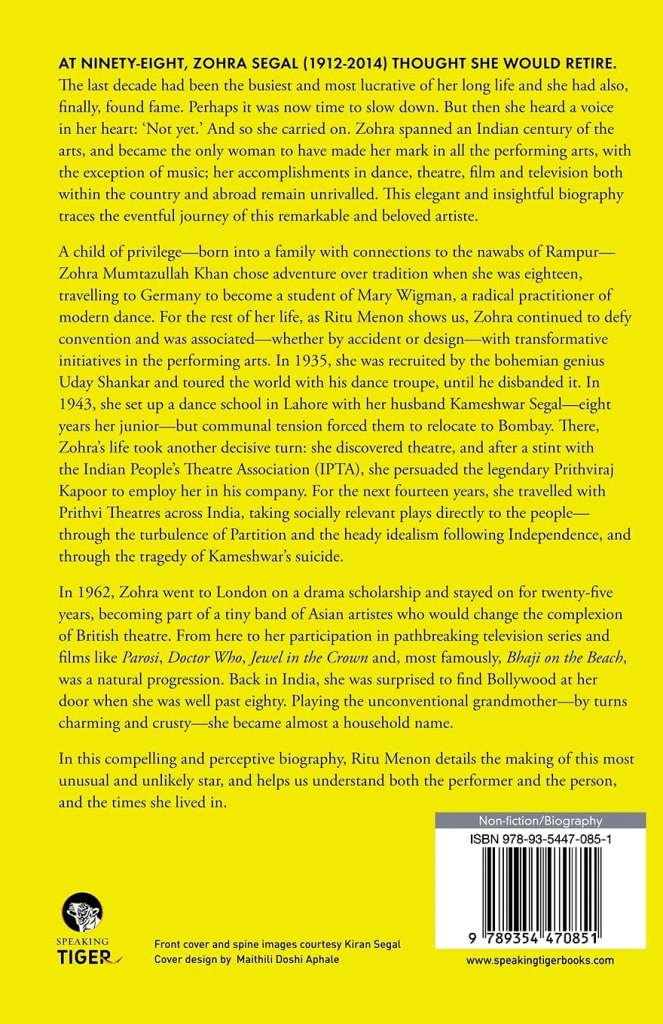
Ratnottama Sengupta gives a glimpse of the life of a woman impacted by the Partition, spirited enough to be a celebrated performer and to have a compelling saga written on her life posthumously, Zohra: A Biography in Four Acts by Ritu Menon, published by Speaking Tiger Books. This feature is based on the book and Sengupta’s own personal interactions with the aging Zohra Sehgal.

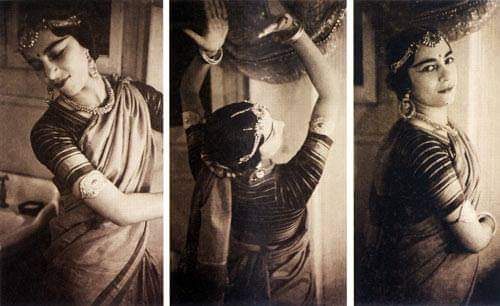
Zohra Sehgal. Photo provided by Ratnottama Sengupta

Zohra Sehgal[1] mirrors, in a strange kind of way, the story of the Indian subcontinent.

Born a Khan in 1912, raised in purdah by the Nawabs of Rampur in palaces and mansions in Lucknow and Dehradun, educated in Queen Mary’s College of Lahore; trained in Western  dance in pre-Hitler Germany; whirling through the globe and basking in limelight as the dancing partner of the phenomenal Uday Shankar; setting up her own dance school with husband Kameshwar Segal in pre-Partition Lahore; rising to carve a niche for herself as a member of Prithvi Theatres; dominating the screen as a nonagenarian cast against the legendary Amitabh Bachchan… Sahibzadi bestowed with an impulse to find her way in the world, made of her life what she would.

So, was it all sunshine and moonlight in the life of the lady who, when she turned 100, had the wit to say, “You are looking at me now, when I am old and ugly… You should have seen me when I was young and ugly…”? No. She had seen the failure of Uday Shankar Cultural Centre in Almora; the closure of her own dance school in Lahore. She’d relocated to Bombay and be a less appreciated ‘side-kick’ to her ‘prettier’ younger sister in Prithvi Theatres. She performed in makeshift stages more often than in the Opera House; traveled in third class compartments with the troupe, slept on trunks, washed her own clothes. She had to worry about providing for her children and their father. She had to cope with the whimsicality, alcoholism, depression and finally, the suicide of her husband… But the caravan of misfortunes never dampened her spirit. “If I were to be reborn, I’ll be back as a blue-eyed, five feet five, 36-24-36,” she could repartee with humorist Khushwant Singh.

But then, much of the tragedy unfolded around the Independence cum Partition at Midnight. And I thank Ritu Menon’s ‘A Biography in Four Acts’ for lifting the curtain on this side of Zohra Segal – the phenomenon I had the good fortune to know through the years we spent in Delhi’s Alaknanda area.

Zohra’s father, Mohammed Mumtazullah Khan had descended from Maulvi Ghulam Jilani Khan, the warrior chieftain of a clan of the Yusufzai tribe[2] and a religious scholar of repute who came to the Mughal court in Delhi possibly in 1754. Along with infantry and cavalry and the title of Khan Saheb he was given Chitargaon Pargana in Bihar, but since the British rulers were taking over Bengal and Bihar, he fled to Rohilkhand and joined the Rohilla chieftains who survived the battle against the Nawab of Awadh and rose to become Nawab of Rampur.

Zohra’s mother, on the other hand, descended from Najibuddaulah, another Rohilla Pathan[3]  in the service of Ahmad Shah Abdali and the Mughals, who founded Najibabad in 1740 and received the hereditary title of Nawab. By 1760, the tract of land he ruled included Dehradun, Najibabad, Meerut, Muzaffarnagar, Badayun, Bijnor and Bulandshahar. After 1887 his descendents, being incharge of the Regency Council that looked after the affairs of the Nawabs, set up schools to teach English, impart western education, encourage education of girls…

So, like many of India’s Muslim royalty and landed gentry, the Mumtazullahs were largely liberal, often westernised, and mostly secular. Their daughters, educated in English medium schools, went on to become hightly qualified professionals, including as ophthalmologist or Montessori teacher. Their sons went abroad for further studies, as did Zohra’s betrothed Mahmud — her maternal uncle’s son who went to school in England, graduated from Oxford, became a Communist, married a comrade and distributed all his inherited land in Moradabad to the peasants. Her elder sister Hajra married Z A Ahmed, an alumni of the London School of Economics who, as a committed communist, organised railway coolies, press workers, farmers and underground members of the then CPI[4].

Yet, even for such a family it was unusual to send the daughter to a boarding school — Queen Mary College, founded in 1908 — in a distant city like the cosmopolitan Lahore. It was a purdah school for girls from aristocratic families from where Zohra matriculated in 1929. By then she had imbibed the secular, broadminded values of her mostly-British teachers, and of an education that placed equal emphasis on physical activities – sports, to be precise. Here Zohra was initiated into both, art and acting – two passions of Uday Shankar who proved providential in her life.

It wasn’t so surprising then, that after matriculating, she set out on an arduous, even hazardous, overland trip across Afghanistan, Iraq, Turkey and Middle East, with a kindred spirit: her strong willed maternal uncle Memphis who, being a maverick much like Zohra herself, endorsed all her unconventional choices. He enrolled her in Mary Wigman Tanz Schule in Dresden; he financed her stay as too her owning a teeny-weeny car so she wouldn’t have to travel by train! None of this, however, ruled out her performing Namaz five times a day or reading the Koran. Years later, it was he who unreservedly stood by her decision to marry Kameshwar Sehgal when her own family was wary of the choice. And they spent their honeymoon in his house ‘Nasreen’ – now well-known as Welham Girls’ School. Built by an Irishman on five acres of land, it had pointed roofs, gables and half-timbering with extensive lawns, gravel pathways and exotic trees…

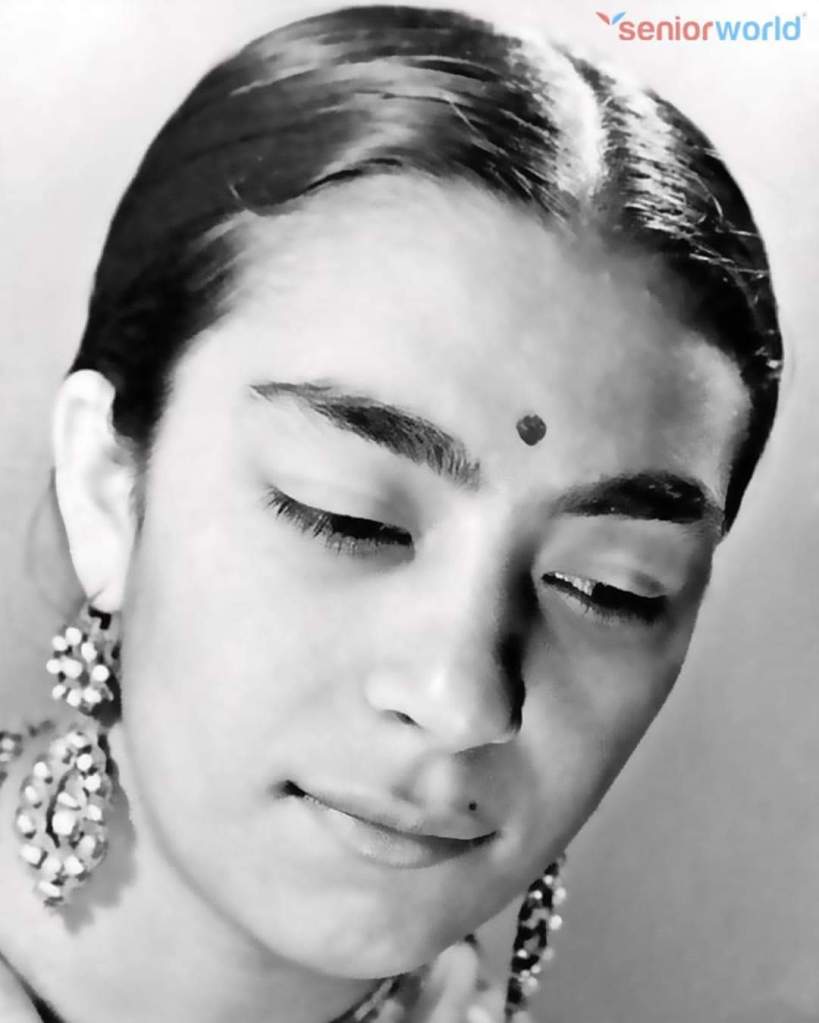
Young Zohra. Photo provided by Ratnottama Sengupta

‘Can you dance?’ Mary Wigman had asked Zohra. It wasn’t to her disadvantage that her sheltered childhood did not have the scope for that. A radical artiste herself, Wigman had rejected formal technique in favour of improvisation although Zohra had to master theories, alongside choreography and dramatic pieces that entailed limbering up exercises for the whole body, from fingertips and wrists to arms and shoulder, neck, head, back, chest, hips, knees, legs, toes… There were no mirrors: the training did not allow them to look at themselves while composing since, Wigman held, “consciousness and awareness should proceed from within rather than from an external image.”

All this was different from the grammar of classical Indian dancing – and by the end of her third year, when Hitler was hovering on the horizon, she was nimble on her toes dancing foxtrot, waltz, polka and tango. When she returned to Dehradun, she enjoyed a newfound freedom that expressed itself in cutting all her silk burqas to make petticoats and blouses!

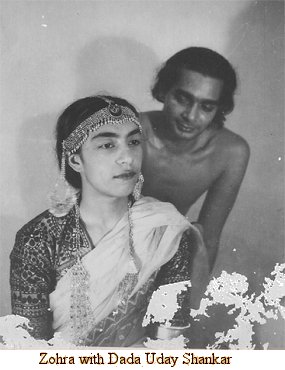
Zohra delighted in the adventure of travel, in discovering new places and people. She sought out travel agents, pored over brochures, spotted packages to travel with groups, by trains or buses, walked with friends, rucksacks on their back and sandwiches in their pocket, to Norway, Austria, Hungary, Switzerland, France. This was the time when Uday Shankar and Simkie – Simone Barbier[5] – were crisscrossing Europe. These stars of the Uday Shankar Dance Company were rapturously received by audiences who were mesmerised by the oriental exotica that had little to do with classical or folk dances of India. Instead, it offered romance and sensuousness wrapped in myth and mysticism. The blithe Adonis and his graceful energy cast a spell with his ‘physical beauty,’ ‘transcendental expression,’ ‘grandness’ and ‘command of muscles’. The ‘deep charm of the indescribable nobility’ of his dance became the face of ‘the rare yet mysterious personality of Modern India.”

When she joined Shankar in Calcutta as he prepared to tour Rangoon, Singapore, Moulmein and Kuala Lumpur, Zohra not only learnt to apply western make-up on an Indian face. She had to adapt if not unlearn her training at Wigman’s, to discipline her body and rehearse, rehearse and rehearse. For, at Shankar’s, there was no rule or theory. Instead, there were parties and dinners, meetings with the Viceroy and the Governor of Bengal, driving fast cars and boating, ballroom dances and cabarets too! If Zohra reveled in this, she also soon imbibed the almost religious atmosphere of Shankar’s performances that required them to travel regardless of the time of day or night and be in the theatre well before the hour in order to shed every thought other than the dance — one in which movements radiated from a concept and merged back into it.  

Most of all, Shankar’s physical beauty and creative iconoclasm proved irresistible, and Zohra happily succumbed to the dancer and his stage lights. She saw how his unorthodox dance imagination reveled in sensuality and she marveled at its potential. None in India then was experimenting with form and movement nor choreographing for an ensemble. And then, Shankar was using a unique orchestra of violin, sitar, piano, sarod, gongs, drums and cymbals. The musicians composed for the dance, the dancers in glittering costumes moved on dazzling sets to their music. This transported audiences to unexplored aesthetic heights and conquered the world.

With Shankar, Zohra performed in Palestine, Syria, Iraq, Egypt, Greece, the Balkans, Czechoslovakia, Italy, Switzerland. Belgium, Holland, Poland, Italy, France. By now, the company included Allauddin Khan[6], Ravi Shankar, Kathakali artiste Madhavan Nair, and Zohra’s younger sister Uzra. Names, all, that would go on to shine long after Shankar set up the Almora Dance Centre – modeled after Dartington Hall, a country estate in Devon, UK that promoted forestry, agriculture and education too, besides the arts. Before that, however, Zohra toured America performing love duets with Shankar, in New York, Chicago, Boston, Philadelphia. Wherever they went, they were greeted by applause and bouquets, photographs, reviews and receptions. Besotted audiences treated them like rockstars and on one occasion Pearl S Buck presented ‘the princess’ an autographed copy of The Good Earth.

On a subsequent visit to Bali with Shankar, she had the heady experience of romance and passionate discovery – of the splendours of dance and music on the island as much as her very being. The magnetic field that was Shankar aroused her senses thrilling awareness of her body. And on her return to India, she met Rabindranath in Santiniketan…

*

When the Uday Shankar Cultural Centre opened in 1940 at Almora, there were only ten students. As its repertoire kept growing, so did its popularity. Soon they were joined by Nehru’s nieces, Nayantara[7] and Chandralekha[8]; Guru Dutt who would one day become a celluloid maestro; Shanta Kirnan — later Gandhi — who’d shine on stage; Sundari Bhavnani who’d become Shridharani, the founder of Delhi’s Triveni Kala Sangam; and Shiela Bharat Ram, of the industrial family, who gained stardom as Baba Allauddin Khan’s disciple. Classes in technique combined with training under gurus of Kathakali, Bharatanatyam and Manipuri — Sankaran Namboodiri, Kandappa Pillai, Amoebi Singh — and to music by Shankar’s brother Ravi, and Baba’s son, Ali Akbar.

Zohra, besides assisting Shankar just like Simkie, also prepared a five-year course for the learners to improvise intricate movements. If theories of Shankar’s art gave form to his dreams, Zohra also learnt the importance of walking elegantly, suppleness of facial expression, and relaxation of mood, prior to dancing. The training evoked in his dancers the consciousness of the body as a whole. A body that moved in space to form patterns of intrinsic beauty.

Kameshwar Segal, a Rossetti-like boy, slim and fair with curly locks, slender hands and feet, fitted right into the scenario. The great grandson of one of the dewans – prime ministers – of the then princely state of Indore, he was well versed in Urdu and Hindustani besides his mother tongue, Punjabi. Soon he was a painter, set designer, light designer, mask-maker, handyman. Though Zohra, being involved with Shankar, had decided never to marry, she admired Kameshwar’s ingenuity, loved his humour and responded to his banter. Soon he proposed to his teacher. Zohra, senior to him by eight years, was aware of the odds against them. Yet she responded, perhaps because by now, the air in Almora was thick with romance and its byproduct, jealousy. Besides Simkie, so far recognised as his prime dance partner, there was Amala Nandi, whom Shankar would garland as his life partner. Simkie herself settled down with Prabhat Ganguly; Rajendra Shankar married Lakshmi Shankar, and Ravi Shankar married Baba’s daughter, Annapurna.

Uzra, who had met Hameed Butt in Calcutta, also married the same year – 1942 – as Zohra. But, unlike Uzra she had to reconcile with a vegetarian, orthodox Hindu family of Radha Soami sect. Surprisingly, her uneducated mother-in-law welcomed the alliance more readily than Zohra’s own father who was used to the interfaith marriages of his own communist sons but didn’t wish for either Zohra or Kameshwar to convert. Jawaharlal Nehru was to attend the civil wedding which took place on 14 August 1942, in Feroze Gandhi[9]’s mother’s house in Allahabad, Zohra had learnt from his secretary. Her brother-in-law being Nehru’s secretary, the future prime minister of India had even shared that he would gift them Persian rugs. But two days before that the Quit India Movement[10] started, and Jawaharlal Nehru was jailed.  Zohra, ever her sprightly self, had revealed her own story to me: “My brother received him on his release, and the first thing he asked was ‘Where is the young couple?’ I asked my brother, ‘Why didn’t you ask him where are the Persian rugs?’”

*

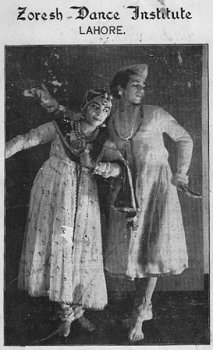
However, the dream wedding may have been the peak moment of happiness in the life of Kameshwar and Zohra. There on the WW2 gained in intensity, transportation became difficult, food and money too got scarce. In a couple of years, Shankar downed the shutters at Almora and went on to film his dream project, Kalpana. Simkie soon left India never to return. Sachin Shankar set up his ballet unit in Bombay. But before that, when Zohra put her all into starting Zoresh Dance School in Lahore of 1943, Kameshwar staked his claim as director.

Photo provided by Ratnottama Sengupta

When the school was inundated with students, she was forced into motherhood. When she returned to the stage, they went on a national tour with boxes and curtains from Lahore to Amritsar, Bareilly, Dehradun, Meerut, Lucknow, Allahabad, Patna, Asansol and Calcutta. Artistically a huge success, the school, however, left the coffers dry. More importantly, at the end of the Big War in 1945, Britain didn’t rule the waves and India was restive. The Muslim League was at loggerheads with the Congress, equations between the Hindus and Muslims had soured, their Muslim friends were looking at them with misgivings. Lahore clearly was not an ideal place for a couple like them. Kameshwar and Zohra relocated to Bombay, where Uzra and Hameed had set up home.

But in the city of celluloid dreams Zohra did not stand a chance in cinema. Not only was she short, somewhat plump, not quite a beauty; in cinema, a nachnewali was merely a nautch girl. In fact, she did not ever dance on stage again. She re-invented her fluidity of movement and expression to make her mark as a choreographer in Prithvi Theatres where her sister was already a leading lady. Eventually, in mid-1950s she choreographed for a few films such as Navketan’s Nau Do Gyarah and Guru Dutt’s CID.

Their bungalow on Pali Hill – a neighbourhood that was home to British, Catholic and Parsi families — was surrounded with Uma and Chetan Anand, his brothers Dev and Goldie, Balraj and Damayanti Sahni, Meena Kumari, Dilip Kumar, the Kapoors… Frequent visitors included Guru Dutt, Raj Khosla, Mohan Segal, Geeta Dutt, Nasir Khan[11], writers Sahir Ludhianvi, Sardar Jafri, Vishwamitra Adil, Amita Malik, composers S D Burman, and Ravi Shankar … Names that would in the next decade become Bollywood royalty.

Cinema was of course the big thing in Bombay of 1940s. Bombay Talkies had already heralded glory days with titles like Achhut Kanya (1936, untouchable maiden), Kangan(1939, Bangles), Bandhan (Ties, 1940), Jhoola(Swing, 1941), Sikandar(Alexander the Great, 1941). Devika Rani, Ashok Kumar, Leela Chitnis, Sohrab Modi, Prithviraj Kapoor were stars who would soon be joined by Punjabis from Lahore such as K L Saigal, Jagdish Sethi, B R Chopra, F C Mehra. Partition wasn’t a certainty yet, in the city of the political beliefs of Right and Left, mixed with industrialists and progressive writers and struggling artistes, the cry for freedom had created a ferment of ideas and the house resounded with scripts, arguments, reading, dancing, painting. K A Abbas, Sajjad Zaheer, Sadat Hasan Manto, Ismat Chughtai, Shahid Lateef[12] – they would associate with Utpal Dutt, Ritwik Ghatak, Salil Chowdhury, Hamid Sayani, Ebrahim Alkazi, Balraj Sahni and Prithviraj Kapoor[13], to pledge that they would present the crisis of the times through the medium of theatre.

*

Prithviraj[14], although a superstar on screen, believed that theatre should proliferate every city, not temples and mosques. Instead, he urged, “spend on theatres that would become centres for cultural education.” After the first election, when he was nominated to the Rajya Sabha in 1952, he’d said, “In that temple called theatre, a Hindu, Muslim, Christian, Jew, Parsi and Sikh all come together. No one cares whether it’s a pandit or a mulla [15]sitting next to them. Communists sit with communalists, to laugh together and cry together. It would be the biggest temple for the benefit of the nation.”

Such a person could not reconcile to the Partition of the subcontinent. It meant, in his own words, that “You will turn me out of Peshawar, and leave my unfortunate Muslim brethren here in the lurch, with their roots uprooted from the soil!” His protest took the shape of four plays that started in 1945 by underscoring the folly of dividing lives on religious basis.

The quartet began with Deewar (Wall), an original play thoroughly contemporary in its politics and communicating its message in a language everyman could follow. The Partition was symbolised by two brothers who, egged on by the foreign wife of one brother – played by Zohra – insist on dividing their ancestral home into two halves by erecting a wall. At a time when Jinnah was raising his pitch for a Muslim nation, the play interpolated the dialogue with speeches by him, Gandhi and Macaulay. So prescient was the message that the British government refused to allow the performance without a green signal from the Muslim League, despite the go-ahead by its CID and the IG Police.

Eventually, despite objection by certain Urdu papers, the play continued to play till 1947 with the peasants pulling down the wall in the climax. In reality, though, the Radcliffe Line concretised the division on the midnight of 14/ 15 August, unleashing bloodshed and misery for millions. On that fateful day, the play was exempted from Entertainment Tax for one full year. Deewar was performed 712 times between 1945 and 1959, until Prithvi Theatres folded up.

The secular credentials of the company is summed up in one practise: The actors began their days with voice production handled by Prithviraj himself, and singing rehearsed by the music director Ram Gangoli. And what did they sing? The base tones were practised by singing Allah Hu! While the high pitches intoned Ram! Ram!

In another expression of his secularism, after the Direct Action Day[16] riots unleashed on August 16th by Jinnah’s demand for Pakistan, leaving 5000 dead and 15000 homeless in Calcutta alone, Prithviraj drove through the city in an open truck with Uzra and Zohra on either side. However, this Hindu-Muslim amity resulted in death threats for them.

And on the eve of Independence, the entire company gathered in the compound of Prithvi Theatres, unfurled the Indian Tricolour, sang Vande Mataram, then took out a procession. Zohra danced with abandon on the streets of Bombay, while Prithviraj’s son Raj Kapoor played the drum. The euphoria did not last: at a personal level Kameshwar was annoyed; on a larger level, death and destruction stalked the streets and the country was engulfed in the horror of untold violence.

Prithviraj’s immediate response was to stage Pathan, the story of two friends – a Muslim Pathan and a Hindu Dewan. When Tarachand dies, Sher Khan promises to look after his son as his own. Local feuds result in a revenge killing where Vazir is implicated. When tribal custom demands an eye for an eye, Khan sacrifices his own son, Bahadur. And when this scene was enacted, there would be no dry eye in the auditorium. Uzra and, in particular, Zohra immersed herself in the play along with Raj and Shammi, the two sons of Prithviraj, who played the two boys. Raj, then only 23, also travelled to Peshawar to design and redesign to perfection the single set of the play. The play was staged 558 times between 1947 and 1960, when curtain fell on Prithvi Theatres.

When rehearsals for the play were on, so was rioting in the cities and towns across India. Prithviraj would, without fail, visit the affected mohallas[17]and hold peace processions. The one dialogue that resonated long after the play ceased to be staged is still pertinent: “Do you want that Hindus should sacrifice their lives for Muslims and the Muslims should not sacrifice their lives for Hindus? Why should they not when they know they belong to one country, eat the same food, drink the same water, and breathe in the same air? Knowing this, you still raise this hateful question of Hindu-Muslim?”

Prithviraj truly believed that religion does not make for conflict, only the abuse of religion, turning it into the handmaiden of vandals, created conflict. “And it is the responsibility of art to present the true aspect of reality.” So, his next production, Ghaddar (Traitor) covered the period from Khilafat Movement to 1947 to deal with the question of the four million Muslims who had remained in India. If they were traitors, who had they betrayed – Islam or Pakistan? Prithviraj as Ashraf and Uzra as his wife join Muslim League but remain staunch nationalists. Shattered by the violence unleashed in Punjab after August 15, he vows to stay back and serve his motherland. He is therefore shot dead by a ‘friend’ Muslim Leaguer.

Zohra loved the cameo she played of a maidservant who refuses to go to Pakistan. Fully identifying with the sentiments of the character — whom she crafted after the family retainers in her mother’s home — she would add extempore dialogue, and these endeared her to the audiences. She was deeply pained that the Partition created personal loss in her family as many of her own people moved across while she, married to a Hindu, never even considered it. But, in covering the thirty-year span of the play she had to enact an old woman – and “feeling old from within” was against the grain of the ever-exuberant lady who, even at 102, would go to bed with a smile on her lips as she whispered to her long dead husband, “Wait just a little longer Kameshwar, I’m on my way to be with you…”

As with Deewar, Ghaddar too faced problems with censor board clearance. The chief minister of Bombay asked Prithviraj to approach the Central government. Sardar Patel introduced him to Nehru, who sent him to Maulana Azad. The Education and Culture minister not only gave him a letter of clearance but also a 50 percent reduction in train fare for all cultural troupes. But the Muslims boycotted the play; Muslim Leaguers in Cochin threatened to burn down the theatre; and some crazy elements wanted to shoot Prithviraj. When he invited people from Bhendi Bazar to watch the play, they concluded that, “People who have been shown as Ghaddar deserve to be shown as traitors.”

Meanwhile the entire population of villages — where their neighbours were their community, their family — were being uprooted in Punjab and Bengal. They were going crazy trying to decide, “To go or to stay?”  People who didn’t know any borders were figuring out if, by crisscrossing the imaginary line, they would remain Indians or become Pakistanis. Would they forego their lifestyle by going or ditch their religion by staying? The questions assumed frightening proportion as two of Zohra’s brother, one of her sisters, and even her dearest Uzra relocated themselves in Lahore and Karachi.

However, the real tragedy in all this for Zohra was that Kameshwar had distanced himself from her. Never having found a foothold for himself in Bombay, he had taken to alcoholism, substance support, and perhaps occult activities. Her touring with the Theatre did not make matters easy. But the need to put food on the table combined with the draw of footlights, and acting became Zohra’s calling and, yes, her second nature.

Ahooti (Sacrifice), Prithvi’s final play in the Partition Quartet, was the story of Janki, who is abducted and raped on the eve of her wedding. She’s rescued by Mohammed Shafi and reconciled with her father in a relief camp. But when the family moves to Bombay, she is subjected to slander, and although her fiancee is willing to marry her, his father forbids that, compelling her to commit suicide. The story mirrored the life of countless ‘Partition widows’ – on either side of the border — who have found place in literature and, much later, in films like Shahid-e-Mohabbat Buta Singh(The Sacrificing Lover, Buta Singh, 1991) and Gadar:Ek Prem katha (Rebellion: A Love Story, 2001)too. The published estimates of the number of women abducted by the governments of both the fledgling countries put the figure at 50,000 Muslim women in India and 33,000 non-Muslim women in Pakistan. The enormity of the problem led the two governments to enter into an agreement to locate, recover and restore all such women to their respective families. But what of the women who had, in the meantime, acquired a new family?

In the original script it was to be the story of a mother and daughter but since Uzra had left the country, Prithviraj rewrote it as the story of a father and his daughter. Zohra did not have her heart in the play: first, becaue Uzra was not there; then, because her original role had been altered. Here too, she discerned Prithviraj’s self-indulgence. The play opened in 1949 to tepid reception and dull reviews that dubbed it ‘boring’. But the Deputy Genral of Bombay Police was moved by the girl’s plight and offered his services to help all such women. Prithviraj introduced him to one refugee whose daughter had been separated in the chaos of fleeing – and within days the daughter was found and restored to him. That is not all: at the end of the play the larger-than-life personality would stand with shawl spread out to collect any donation dropped into it, to help the relief work. Such was the emotional response that women even dropped their jewellery in the shawl – which Prithviraj soon requested them to desist from doing.

The Partition Quartet was to first perhaps to see where the rhetoric of religious difference can lead, the contest over territory can entail, the violence and violations that can result. Whatever the quantum of success or criticism they earned, they certainly provoked debate and affected political discourse that still hasn’t lost its sting. Zohra’s heart would swell with pride when Prithviraj rose to address conventions; call on people to turn his moves into a movement for peace. Through him she found herself performing in Punjab’s Firozpur jail, for prisoners who sat with hands and feet in chain… and she also got to witness the hanging of a man scheduled for the next dawn.

All this changed Zohra in a fundamental way: she shed her arrogance; she learnt to respect the dignity of everyone she worked with; she understood the transformative power of theatre. And perhaps she came to love her country, her people, her roots a little more.


[1] Born Sahibzadi Zohra Mumtaz Khan Begum (1912-2014)

[2] From the Afghanistan-Pakistan region.

[3] Pathans of Afghan origin who migrated to Uttar Pradesh in the 1700-1800CE

[4] Communist Party of India

[5] A famous French dancer in Uday Shankar’s troupe

[6] Allaudin Khan(1862-1972)

[7] Nayantara Sahgal

[8] Chandralekha Mehta

[9] Feroze Gandhi (1912-1960), Prime Minister Indira Gandhi’s husband and son-in-law of Nehru

[10] The Quit India Movement started on 8th August 1942

[11] All film stars

[12] Writers

[13] Film stars, directors, composers

[14] Prithviraj Kapoor(1906-1972)

[15] Hindu or a Muslim priest

[16] 16th August, 1946

[17] Colonies

Ratnottama Sengupta, formerly Arts Editor of The Times of India, teaches mass communication and film appreciation, curates film festivals and art exhibitions, and translates and write books. She has been a member of CBFC, served on the National Film Awards jury and has herself won a National Award. Ratnottama Sengupta has the rights to translate her father, Nabendu Ghosh.

.

PLEASE NOTE: ARTICLES CAN ONLY BE REPRODUCED IN OTHER SITES WITH DUE ACKNOWLEDGEMENT TO BORDERLESS JOURNAL