He was the icicles hanging from winter’s white breath. I was a cactus in a forgotten desert.
He carved his image in frost while I searched for his face in a mirage.
Now I listen to songs that remind me how easily I fall in love.
As he walked through snow dunes, I stood a single grain of sand.
Laila Brahmbhatt, a Kashmiri/Jharkhand-rooted writer and Senior Immigration Consultant in New York, has published haiku and haibun in several international journals, including Cold Moon Journal and Failed Haiku.
.
PLEASE NOTE: ARTICLES CAN ONLY BE REPRODUCED IN OTHER SITES WITH DUE ACKNOWLEDGEMENT TO BORDERLESS JOURNAL
We speak through what goes unspoken like singers between songs. We could move as dancers do, through unrehearsed steps. Let’s speak a language of fluent silences, quiet breaths. When I yearn to sing and dance with you, I rewind our unheard conversations. The tape holds only silence, Yet still, I sing. Still, I dance alone.
From Public Domain
Laila Brahmbhatt, a Kashmiri/Jharkhand-rooted writer and Senior Immigration Consultant in New York, has published haiku and haibun in several international journals, including Cold Moon Journal and Failed Haiku.
PLEASE NOTE: ARTICLES CAN ONLY BE REPRODUCED IN OTHER SITES WITH DUE ACKNOWLEDGEMENT TO BORDERLESS JOURNAL
At home, I was thinking about what it would be like to travel without a suitcase. When I reached my destination, I would lie still, let the water from the hotel faucet run between my fingers, washing off the stains of the journey. I would still carry in my wallet, like forgotten coins, my cat's footsteps on a spiral staircase, unfinished chores, buried secrets, clothes that no longer fit, a dying plant, many conversations pressed between lips like lettuce in sandwiches. My luggage is heavy, like a hangover from cheap wine.
Laila Brahmbhatt, a Kashmiri/Jharkhand-rooted writer and Senior Immigration Consultant in New York, has published haiku and haibun in several international journals, including Cold Moon Journal and Failed Haiku.
.
PLEASE NOTE: ARTICLES CAN ONLY BE REPRODUCED IN OTHER SITES WITH DUE ACKNOWLEDGEMENT TO BORDERLESS JOURNAL
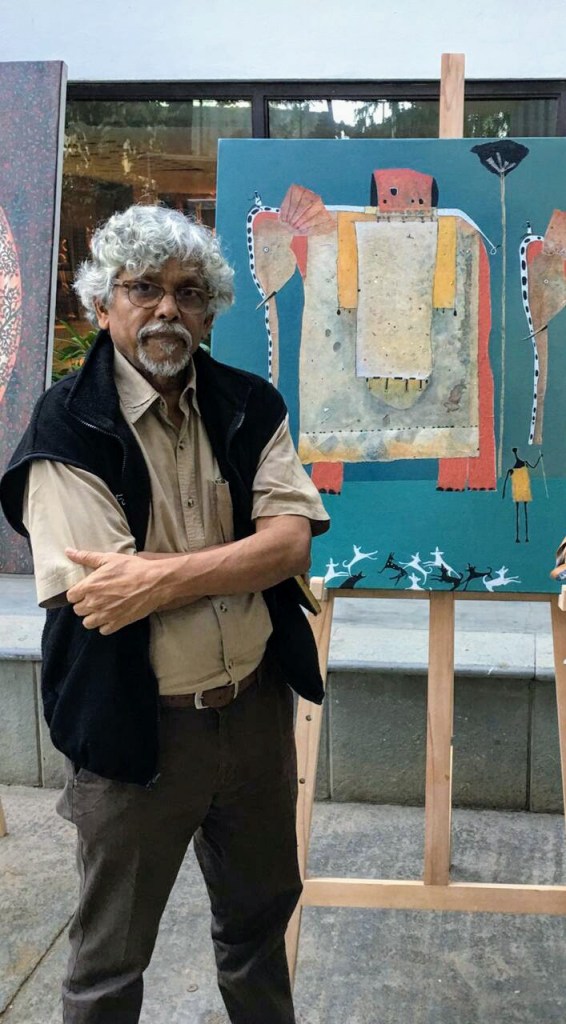
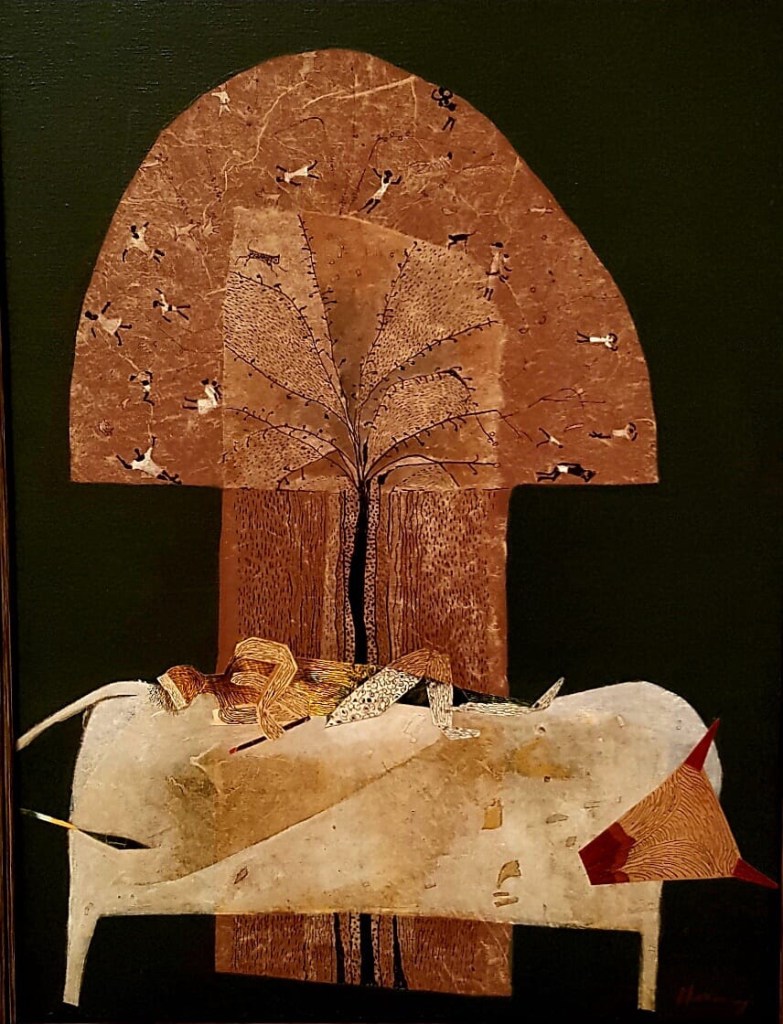
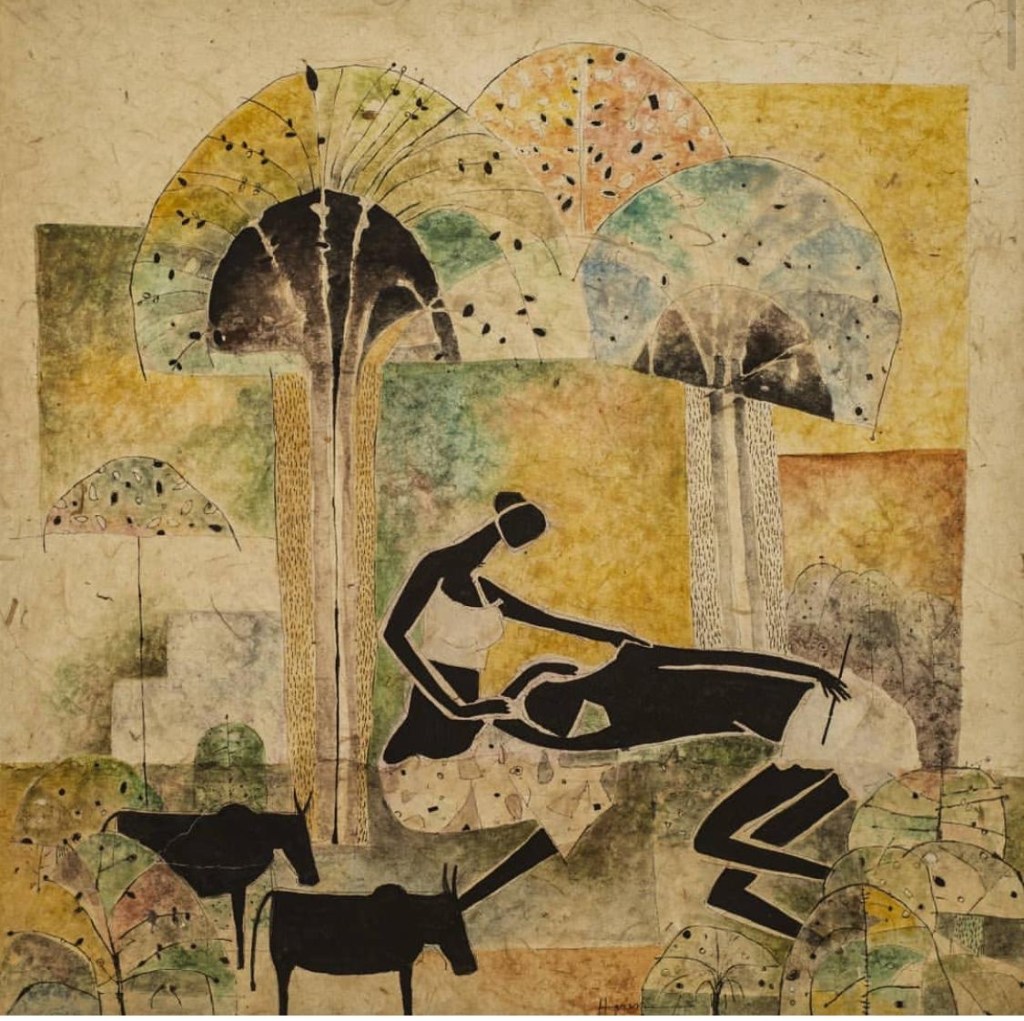
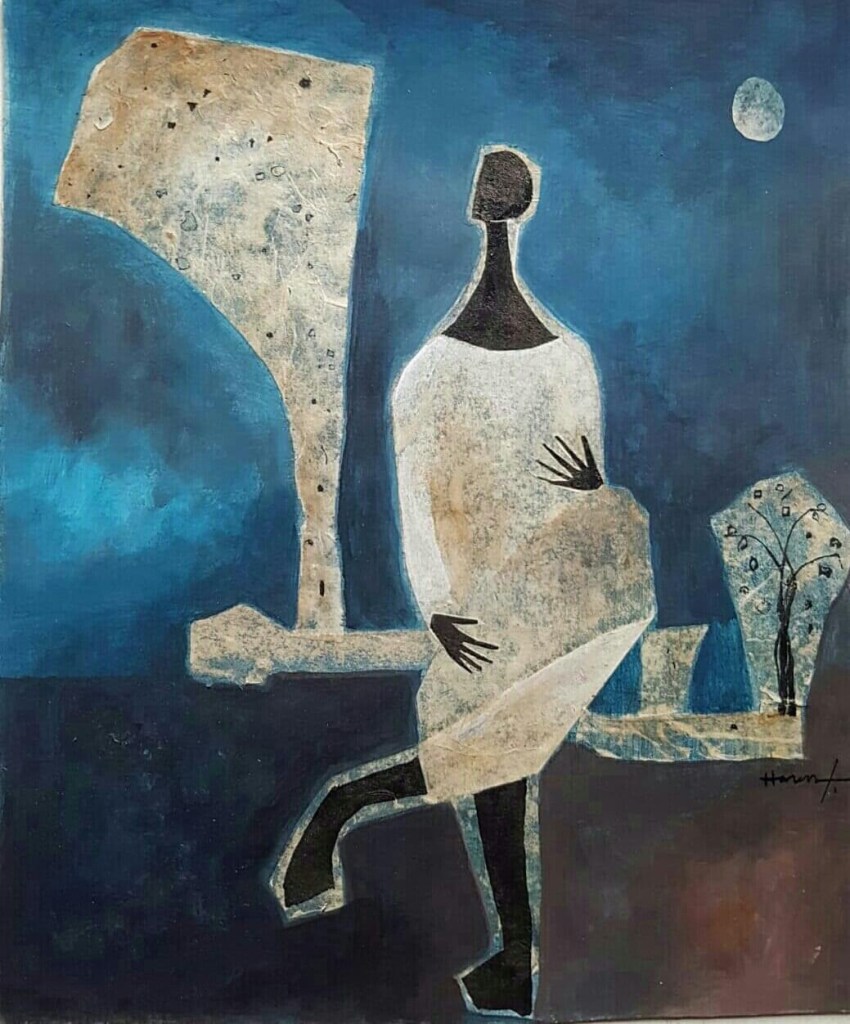
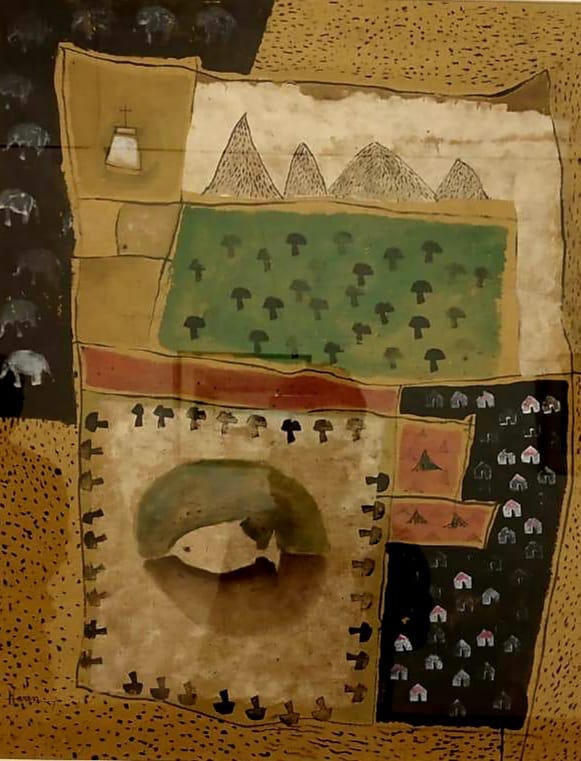
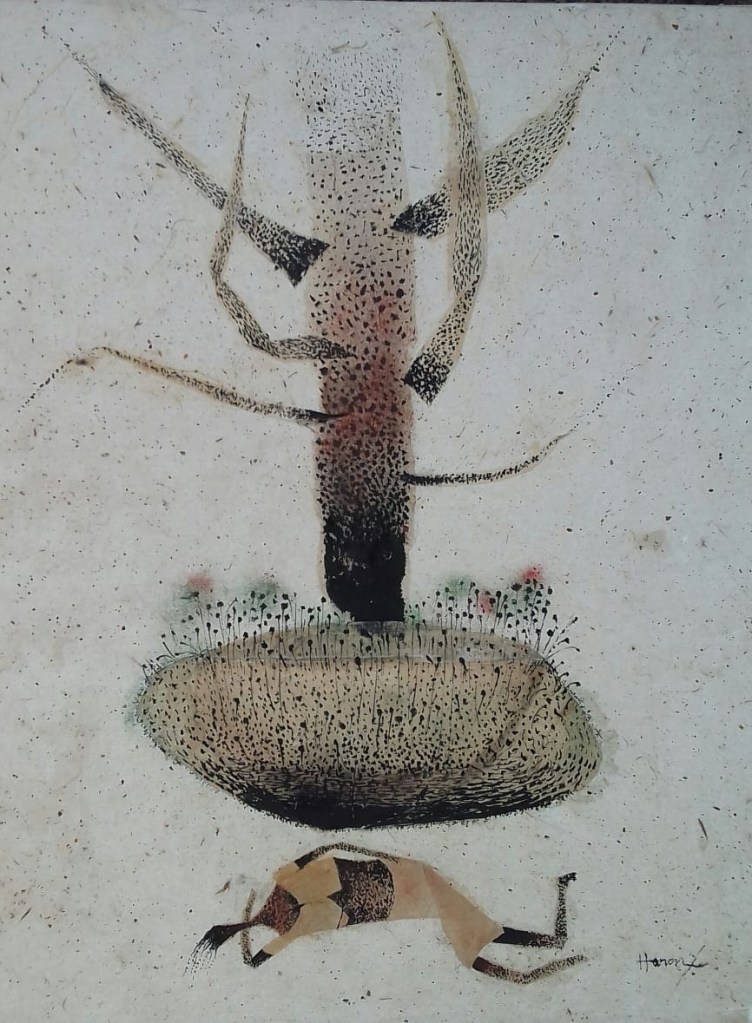
For 50 years now Ratnottama Sengupta has seen Haren Thakur adroitly create art from the humdrum of tribal life. And his stylised abstract of the dark-toned humans still makes her sit up and take note.
Haren Thakur with his painting. Photo provided by Ratnottama Sengupta
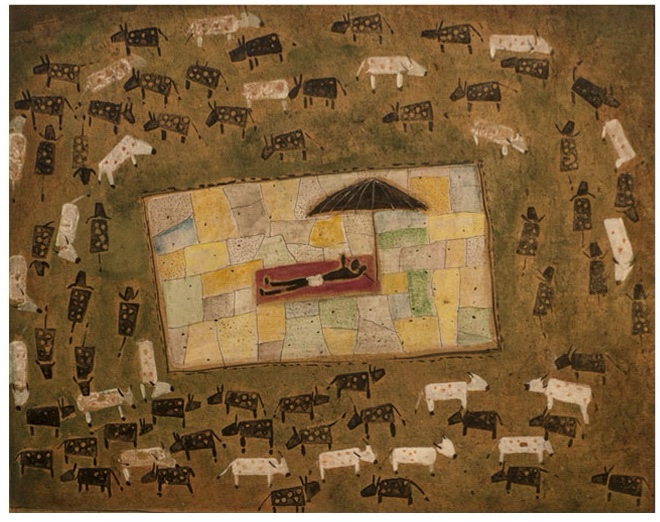
A dark, stick-like outline encompasses a human of the male species. A triangle, an oblong, a rectangle. A white patch in the midst of a sepia-green landscape. A drummer. A mother with a child holding aloft a balloon. Two women bathing in a primitive pond. A quizzical duck. A wriggling worm. Trees hills fish pigs cows fox… And, yes! A train zigzagging its way through a vast expanse of meadows. As we view the watercolours of Haren Thakur from Ranchi, you might think of the rice-white art of the Warli tribals characterised by geometric shapes that depict the rituals of everyday life. I might be inclined to revisit the painted layers on the 100,000-year laterite at the prehistoric rock shelters of Bhimbetka in the foothills of the Vindhyas in Madhya Pradesh. Another viewer might think of the ancient Sauras and the adornment of their walls in their adobe huts in Odisha. The artist himself might have recollections of the animated Santhal pats he saw being created during his student years in Tagore’s Santiniketan. However, none of Haren’s figures are simplistic. They are all stylised. And so adroitly that you are bound to sit up and take note of them no matter how many times you have come across the theme.
Art by Haren Thakur. Photos provided by Ratnottama Sengupta
Form and content come seamlessly together in the paintings that Haren Thakur will exhibit in Delhi’s Habitat Centre from April 15. The artist who mastered Art at Santiniketan — home to Santhals, the native dwellers of Bengal and Odisha — then made his living in Jharkhand, which is home to 32 tribes… Indeed, from his very beginning, the beauty in the dark skin-tone of the men and women going about their chores was the most natural rhythm of life in the bazaars and streets of Bankura Bishnupur, where his family hailed from, or in Purulia, where his father made his home.
Beyond doubt, Rabindranath’s deep affection for the Santhals and the Bauls reinforced this love. Much like Gurudev, Haren finds poetry in their tilling of the earth. In their mono-toned songs and the repetitive steps of their dance. In the fulfilment they find in the primeval life and archetypal love. And when, following in the footsteps of the Universal Poet, Haren finds beauty in a grain of sand, the everyday life ceases to be an essay in deprivation and rises to the level of art.
*
And his colour palette? That too came off the walls of his hostel in Santiniketan, from the frescoes and murals by Binode Behari Mukherjee. From the brick-toned ‘canvas’ that is the prehistoric rock painting of Bhimbetka. The pigment on Haren’s brush and tubes is never loud then, never grating. It is always muted, always mellow. And the impact is heightened by Haren’s utilisation of rice paper, and Chinese ink, on watercolour.
The Nepali rice paper became his signature in 1974. Prior to that he would work the rice paper in the tempera process that was ‘Master Moshai’ Nandalal Bose’s gharana, school – or Indian shaili, style. But in that process of painting layer by layer, the rice paper would lose its original character and serve merely as a background surface.
Then, in his fourth year, for a scholarship test of the Visva Bharati University, Haren experimented by soaking the rice paper in water. It became so pliant that he could spread it out like a piece of cloth. “And its texture!” It won him the scholarship — and immense appreciation from his teachers, Dinkar Kaushik and Somnath Hore. “They said, ‘Go ahead and explore this medium and this process further. It adds a dimension that has immense possibility.”
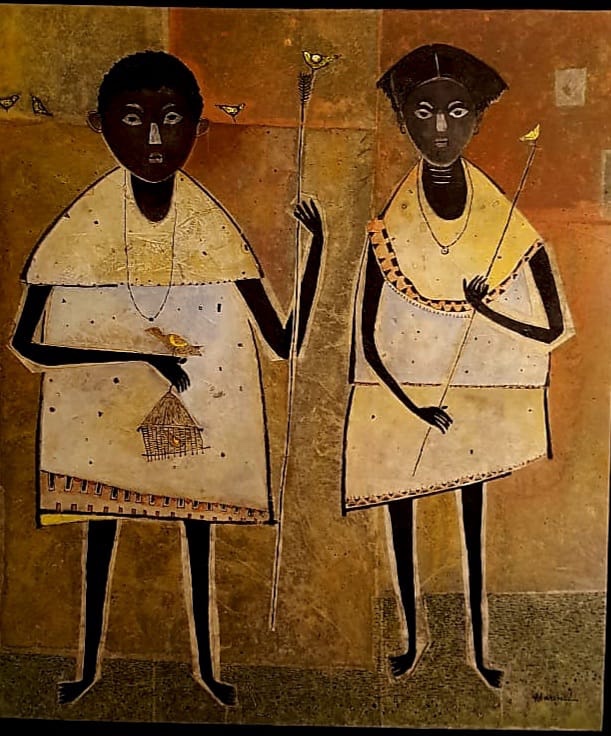
Art by Haren Thakur. Photos provided by Ratnottama Sengupta
Fifty years have gone by since, but Haren has not given it up. Sometimes, when painting on canvas, he does apply acrylic directly on its surface. But at times, even here, he pastes rice paper on the canvas, primes it with watercolour, then inks in the forms. However he adds, “when I paint on rice paper mounted on board, I do not – cannot – use acrylic. It simply doesn’t have the capacity to be absorbed by the rice paper the way watercolour gets absorbed.” So, in such cases Haren uses transparent watercolour.
Clearly the chemistry between rice paper and watercolour is amazing. Unique.
*
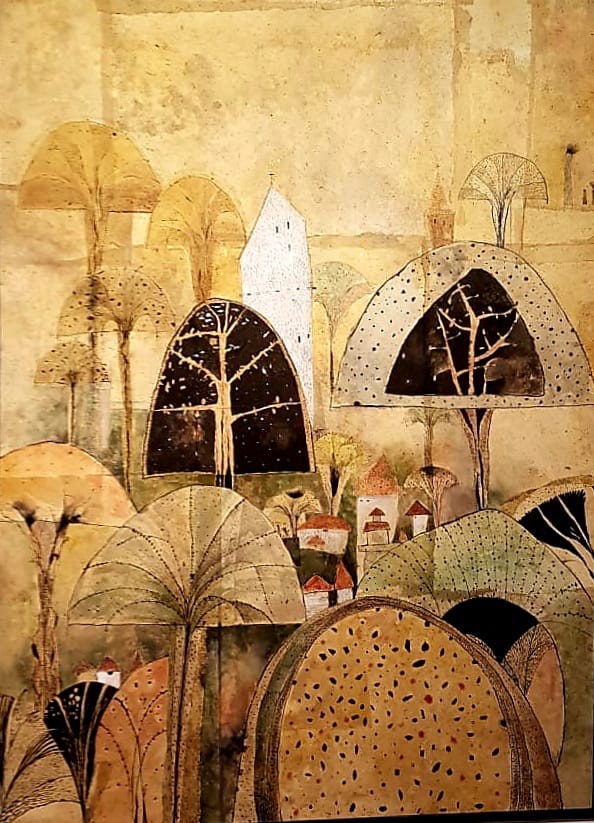
Circling back to the content: Haren’s understated pitch was reinforced by the Zen worldview of a teacher like Somnath Hore. The master minimalist’s use of the white, barely scratched by the red of a wound, spoke volumes — and it made Haren introspect. Once, while exhibiting the Wound series, Somnath Da had said, “I discovered such depth of emotion in the reticence of tones!” This soliloquy got deeply etched in Haren’s unconscious. And eventually it came to express itself in the rusty red of the iron oxide rich Birbhum soil; the roasted brown of Purulia’s rocky earth; the weathered green of the Bauls; the soothing blue of the open sky high above the woolly white of floating clouds.
Art by Haren Thakur. Photos provided by Ratnottama Sengupta
Flattened figures. Non-realistic features. Do you see a hint of Husain – or perhaps Paul Klee – in the abstraction of the human world? I notice a reflection of the figures encountered on Egyptian papyrus. Or the African world. Haren, on his part, reiterates his original inclination: the attraction towards the lack of artifice in Adivasi life. How else would the tribals go about their daily humdrum with a baby knotted to their back? Or float in an open pool under the sun-kissed sky? To the city-bred mind, this would be unthinkable — until Haren captions it ‘Nature’s Bathtub’!
But, notwithstanding my references, the art traditions of the indigenous people over the world have never influenced Haren. “Their art tradition is so rooted in their environment – be it of Jharkhand or of any other.” Even their pigments, brush, and surface are integral to their life. But he certainly derives inspiration from the lifestyle of the original inhabitants, he affirms.
“I have always admired their direct application, the spontaneity of their form,” Haren further explains. “But I am influenced rather by the uncomplicated lives they lead. Since I was in Santiniketan I have admired the way they connect with nature in everything they do. Their intimacy with animals is incredible – they seem to be in dialogue with the animals they domesticate! This became a part of my visual world, especially when I came to live in Ranchi. The same reality imbues the lives of the natives – Oraon, Munda, Ho, Sabar, Bedia, Lohar… They rest under the tree unconcerned about how the ‘civilised’ world looks at them. They speak with the hills, with clouds in the sky, with cattle and kids, trees and waters, rivers and streams!”
Art by Haren Thakur. Photos provided by Ratnottama Sengupta
This they do with no inhibition. Because this routine is a reality they have inherited from their ancients. “That is why I believe there is nothing more ‘Contemporary’ than this,” Haren asserts. This innate natural life, and the Santiniketan grooming, combined to forge his vocabulary, his visual language.
So, in the exhibits, you encounter an abundance of water bodies. Pools and ponds. Rivers and waterfalls. Lotus and lily. Big fish. Many small fish in its tummy. Ducks and kingfishers. Hyacinth and hayfield. All this is a natural part of the countryside that has made Haren theirs.
Interestingly there is also this play with size. In one of the frames an elephant walks down the road – and at every footfall he is greeted by a number of… ants?! Look closely and you will decipher that they are dogs!
Haren is giving you a worm’s eye view. And, in addition to the proportion, he is picturing the Hindi proverb Haathi chaley bazar, kutta bhaukey hazaar/ when an elephant walks to the market, a thousand dogs will bark! Political comment? You said it!
Stay tuned to the song of the Adivasi earth, Haren.
.
Ratnottama Sengupta, formerly Arts Editor of The Times of India, teaches mass communication and film appreciation, curates film festivals and art exhibitions, and translates and writes books. She has been a member of CBFC, served on the National Film Awards jury and has herself won a National Award.
.
PLEASE NOTE: ARTICLES CAN ONLY BE REPRODUCED IN OTHER SITES WITH DUE ACKNOWLEDGEMENT TO BORDERLESS JOURNAL
Once more, Ratnottama Sengupta explores the contemporariness of Tagore ….
In empathy with Kolkata’s heatwave in April 2024
The continuing heatwave in Kolkata that has defied the geographical reality of Kaal Baisakhi — the norwester that brings relief to sun-scorched beings — prompted me to continuously hum this Tagore song in Brindavani Sarang Raag, written in 1922.
Darun Agni Baaney Re...
(Shafts of Fire)

Shafts of fire pour thirst on us --
Sleepless nights, long scorching days,
No respite in sight!
On withered branches,
A listless dove wails
Droopy doleful notes...
No fear, no scare,
My gaze is fixed on the sky,
For you will come in the
Form of a storm,
And shower rain on scorched souls.
And as I kept singing the song first penned in Santiniketan, I marvelled at the creativity of the giant whose words are true to this very day, more than 100 years later!
Kaal Baisakhi, the nor’wester known in Assam as bordoisila, is a localised rainfall and thunderstorm event which occurs in the Indian states of West Bengal, Bihar, Jharkhand, Odisha, Tripura, and Assam as well as in Bangladesh during the summer month of Baisakh (April 15-May 14). This first month of the Bengali calendar also saw the birth of Rabindranath Tagore. These storms generally occur in the afternoon or just before sunset, when thick dark black clouds appear over the sky and then bring gale-speed wind with torrential rain, often with hail, but spanning only a short period of time.
Kalbaisakhi
Tagore’s love for Nature had compelled him to set up in Santiniketan open air classrooms, where students would learn sitting on the ground in the bower, under trees where birds would chirp and gentle breeze would caress their tired brows.
And, his involvement also expressed itself in the 293 songs he wrote in the segment titled Prakriti (nature) Parjaay. There are songs about nature in general. But he himself further classified the songs under subsections — Upa parjaay — that focus on the six seasons: grishma (summer), barsha (Monsoon), sharat( early autumn), hemanta (late autumn or early winter), sheet (winter), basanta (spring).
Tagore clearly was taken up by the wild beauty of monsoon with its dark clouds and thunderous showers. For, he wrote 150 songs on the drops of nectar from the heavens, while summer elicited a tenth of this number! If this is half the number celebrating sharat, the festive season of Durga Puja, it is thrice the number dedicated to hemanta, the confluence of autumn and winter.
I take heart in the fact that Grishma subsection includes Chokkhe aamar trishna, Ogo trishna aamar bakkho jurey… [1]
Thirst fills my eyes, Dear,
Thirsty is my heart too...
I'm a rain-starved day of Baisakh
Burnt by the sun, heat stroked.
There's a storm brewing
In the ovenated air..
It sweeps my mind into the distance.
It rips me of my veil.
The blossom that lit up the garden
Has withered and fallen.
Who has reined in the stream
Imprisoned in heartless stone
At the peak of suffering?
And then, when it rained? The torrents poured balm on the angry burns. The fleet-footed lightning seared the heart of the cloud-covered darkness and extracted the nectar-like flow…
It assured us that no hardship lasts forever. It reiterated faith in the eternal words, “This too shall pass!” And, for me? It confirmed Tagore’s words that “You will come in the form of a storm and shower rain on scorched souls…”
Tagore lives on, 163 years after he came. In his words. In his imagery. In his empathy with every human situation…
[1] Thirst fills my eyes, Dear, /Thirsty is my heart too…
Ratnottama Sengupta, formerly Arts Editor of The Times of India, teaches mass communication and film appreciation, curates film festivals and art exhibitions, and translates and write books. She has been a member of CBFC, served on the National Film Awards jury and has herself won a National Award.
.
PLEASE NOTE: ARTICLES CAN ONLY BE REPRODUCED IN OTHER SITES WITH DUE ACKNOWLEDGEMENT TO BORDERLESS JOURNAL
Mahashweta Devi (1916-2016) was a renowned and much awarded writer-activist-translator who was reputed for her close observation and documentation of tribal life and its marginalisation and willed forgetting by dominant power systems. Among the many awards received by her were the Padma Vibhushan, the Ramon Magsaysay, the Jnanpith and the Sahitya Akademi Award. The stated aim of the present volume — in keeping with the overall objectives of the Writer in Context Series — is to present a more rounded, multidimensional image of Mahasweta Devi. This has been admirably accomplished by Prof Radha Chakravarty who is an eminent translator and academic herself.
In the ‘Introduction’, she unpacks the partial truths that underlie the stereotypical image of Mahasweta Devi as an activist. Highlighting the fact that Mahashweta’s representations of different forms of marginality bring together “the aesthetic and the political in ways that demand a more nuanced reading”, she reinforces the need to read Devi’s oeuvre as literature, and not only as “forms of social documentation or ‘witnessing’”. She interrogates the stereotype of the activist-writer and opens up the possibility of re-reading Mahasweta Devi’s life and work in “newer, more unsettling ways”. Further, Chakravarty highlights how her (Devi’s) creative writings in particular emerge as “ambivalent texts, simultaneously imbued with radical potential and a continued reliance on traditional forms of signification”.
Mahasweta Devi’s writings often demonstrate a tenuous divide between fiction and non-fiction. As a matter of fact, she emphasises on “the historical basis for her creative writings”, which is evident in many of her novels like Mother of 1084 (Hazaar Churashir Maa, 1974), and stories like ‘Draupadi’ and many others, which are based on the Naxalite movement. Simultaneously however, her literary works display a measure of social realism which, Chakravarty contends, is “offset by a visionary quality that enables the imagining of transformative possibilities.” The contents of this volume testify to the varied, diverse and sometimes “contradictory dimensions of her multifaceted genius”.
The book under consideration aims to set the record straight for readers outside Bengal whose views are based on the “tiny fraction of her Mahashweta Devi’s work available in English translation”. She was an extraordinarily prolific and versatile writer who wrote in multiple genres, including fiction, biography, drama, children’s literature, memoirs, travel writing, and literary criticism. She also occasionally translated her own work into English.
Chakravarty’s introduction and compilations in this volume foregrounds the aspect of Mahashweta’s political activism and how her writing itself becomes a form of resistance. Her early induction into Marxism was also partially attributable to her family background. Her family included Ritwik Ghatak (her father’s brother was a famed film maker) on her father’s side and on her mother’s, Sankha Choudhuri and Sachin Choudhuri, one a well-known sculptor and the other, the founder/editor of India’s foremost social science journal, Economic and Political Weekly, respectively.
Her early contact with Tagore and education at Santiniketan sensitised her to values of “inclusiveness, self-reliance, freedom of thought and expression, social responsibility, and environmental issues”. There, she also imbibed some of the spirit of the freedom struggle. Through her marriage to Bijon Bhattacharya, she grew familiar with IPTA[1] and the left ideologies. Later, she was associated with different radical movements in Bengal, Manipur, Jharkhand, Bihar, and Rajasthan, which find expression in many of her writings (Mother of 1084, ‘Draupadi’).
Her political commitment to these movements is evident in her use of language. Local vocabularies become central to the style and subject of Mahasweta’s writings. She wrote in 1983: “Since I remain immersed in indigenous myths, oral legends, local beliefs and religious convictions, I find purely indigenous words very potent and expressive.”
She was critical of writers in the Bangla literary establishment whose experiments with modernist aesthetics led to disengagement with the socio-political context. All the same, her writings evince special “linguistic, textual, and aesthetic strategies that can be compared to the practices of other writers who were experimenting with new approaches”, using non-linear time. Oral traditions fascinated her and she worked closely with Prof G.N.Devy in her later years, to campaign for the recognition of tribal languages.
She also translated and edited volumes on Indian folklore. In her own writings, she includes elements from the oral traditions, as in the snatches of local lore in Jhansir Rani (The Queen of Jhansi) or the lines from an untranslated Santhal song in ‘Draupadi’. As Chakravarty points out, “Heteroglossia, the use of language as an indicator of social hierarchies in multivocal, polyphonic texts, functions as a potent literary feature in her writings.” Alongside, many of her texts incorporate multilingual elements, as if to indicate the heterogeneities in South Asian societies and cultures.
The book is an comprehensive introduction to and reappraisal of Mahasweta Devi’s life and work. It is imaginatively conceptualised and organised into different sections, each highlighting diverse aspects of her work and the criticism thereon. Section 1 of the book called ‘Spectrum: The Writer’s Oeuvre’, offers the reader in English an overview of the full range of her oeuvre through brief samples of her literary writings across diverse genres to highlight her versatility. These include Jhansir Rani (1956), a fictionalised biography of Rani Lakshmibai, Queen of Jhansi, which amalgamates historical sources, folklore, and creative characterisation, to show up the contradictions in different versions of the Rani’s life and Hajar Churashir Ma (The Mother of 1084), her powerful novel about the political awakening of a mother after her son is killed by the police during the Naxalite movement of the 1970s, altered the trajectory of the Bengali novel. The extract from the final pages captures, in a style resembling stream-of-consciousness, the dramatic political power struggles in the outer world and the inner drama of the mother’s psyche.
The short story ‘Giribala’ narrates the plight of a girl married off at 14 to a man who sells their own daughters into the flesh trade to pay for the construction of his dream house. The play Bayen uses modern experimental techniques to present the story of a woman from the caste of Doms (cremation attendants), who becomes the victim of collective superstition and scapegoating and yet, in a final act of heroic self-sacrifice, saves the very community that has ostracised her. In a complete change of tone and style,’Nyadosh the Incredible Cow’, a delightful piece of writing for children, offers a witty anecdotal account of the devastating exploits of a cow in the author’s home. The extract from Tarasankar Bandyopadhyay, Mahasweta Devi’s English monograph on the iconic Bengali writer, reveals her incisiveness as a literary historian and critic and also provides a window to her own literary values.
As Chakravarty clarifies, given the vast body of critical readings on Mahasweta’s writings, a comprehensive compilation is beyond the scope of this book. Instead, the selected essays in Section 2 (‘Kaleidoscope: Critical Reception’) offer the reader (in translation) a sense of the paradigm shifts that mark Devi’s critical reception in Bengal, the rest of India, and in the international domain. Tensions, debates, and contradictions are highlighted, and overview of her critical reception over four decades –1957 to 1997 in Bengal is discussed by Arup Kumar Das. An essay by Dipendu Chakrabarti analyses the debates and controversies around her work. Dilip K. Basu’s account of Hajar Churashir Ma views itas a pathbreaking text that transformed the course of the Bengali novel in the 1970s.
The essays in English by other Indian critics include Sujit Mukherjee’s classic piece on Mahasweta and Spivak, Jaidev’s account of national allegory in Douloti, Arunabh Konwar’s comparative analysis of the creative use of fictionalised biography by Mahasweta and Indira Goswami, Shreya Chakravorty’s study of the politics of translation in the work of Spivak and Samik Bandyopadhyay, Anjum Katyal’s account of Mahasweta as a dramatist, and Benil Biswas’ reading of the transmutations of Mahasweta’s texts via stage and screen adaptations.
International contributions include an important new essay on Pterodactyl by Gayatri Chakravorty Spivak, who interprets the rhetorical pointers in the text to speak of it as an activist mediation for the reader to learn about earning the right to intervene. Shreerekha Subramanian’s essay offers a comparative study of the discourse on motherhood in novels by three women writers across different languages, locations, and literary traditions: Mahasweta Devi, Toni Morrison, and Amrita Pritam.
Section 3 (‘Ablaze With Rage: The Writer as Activist’) includes some of Mahasweta’s activist writings, such as ‘Tribal Language and Literature: The Need for Recognition’, a passionate demand for the inclusion of tribal languages in official discourse; ‘Palamau is a Mirror of India’, where she critiques what she perceives the failures of the state to address the plight of the oppressed people in post-Independence India; and ‘Eucalyptus: Why?’, a scathing critique of the nexus between local powers and global market forces that have led to the replacement of natural forests in Bengal with eucalyptus plantations that have destroyed the local ecology that sustained human and animal life there. Alongside, in ‘The Adivasi Mahasweta’, Ganesh N. Devy reminiscences about his first encounter with Mahasweta Devi and their subsequent collaborations in activist campaigns and projects. ‘Haunted Landscapes: Mahasweta Devi and the Anthropocene’, by Mary Louisa Cappelli, connects Mahasweta’s activist writings and fiction on the subject of the Anthropocene to indicate the need to take a composite view of her writing and activism as twin manifestations of the same vision.
Section 4, ‘Personal Glimpses: A Life in Words’, includes extracts from Mahasweta’s memoir Our Santiniketan (2022), along with interviews (with Naveen Kishore and Radha Chakravarty) and reminiscences by her family members (Nabarun Bhattacharya, Soma Mukhopadhyay, Sari Lahiri, Ina Puri), friends (writers ‘Anand’ and Anita Agnihotri), and associates (Ranjit Kumar Das ‘Lodha’, Dakxin Bajrange), which highlight different facets of Mahasweta’s life and personality, bringing to life the woman behind the public image.
The book offers a comprehensive overview of Mahashweta Devi’s writing and will be of immense use to students, researchers and to general readers. As Chakravarty reiterates , “New trends in Mahasweta studies continue to evolve, including emphasis on her environmental concerns, ethics, planetarity and the Anthropocene, intersectionality, the use of incommensurate realities and registers of writing, comparative readings, and an emerging focus on her life”.
This is an ambitious attempt to give us an idea of the immense range of her work. While a full biography and a full bibliography of Mahasweta’s oeuvre is yet to be published, (encompassing the entire corpus of her work, including letters and other unpublished material) this volume is a vital step in that direction. In her excellent Introduction, Chakravarty charts the long-term impact of Devi’s work which continues to resonate in contemporary forms of activism and theatre. Through the actions of the many groups of people she inspired – the women of Manipur whose public protest imitated her fiction, to the performances of the Budhan theatre, and the rise to fame of the Dalit Bengali writer, Manoranjan Byapari— “Mahasweta’s impact and influence can be felt in many ways. She survives through the people she struggled to support all her life,”
It is an ironical reflection on our times that a prolific and much awarded Indian writer-perhaps deserving of the Nobel prize, should be excised from the university syllabus of a central university. This move has, perhaps paradoxically, elicited even more interest in Mahasweta Devi’s work and has also consolidated her reputation as a mascot, a symbol of resistance to state violence. A timely intervention, this volume proves yet again that a great writer, in responding to local , regional, environmental ethical concerns sensitively, transcends his/her immediate context to acquire global and universal significance.
[1] Indian People’s Theatre Association founded in 1943
.
Dr Meenakshi Malhotra is Associate Professor of English Literature at Hansraj College, University of Delhi, and has been involved in teaching and curriculum development in several universities. She has edited books on Women and Lifewriting, Representing the Self and Claiming the I, in addition to numerous published articles on gender, literature and feminist theory. Recently, she co-edited The Gendered Body: Negotiation, Resistance, Struggle.
.
PLEASE NOTE: ARTICLES CAN ONLY BE REPRODUCED IN OTHER SITES WITH DUE ACKNOWLEDGEMENT TO BORDERLESS JOURNAL
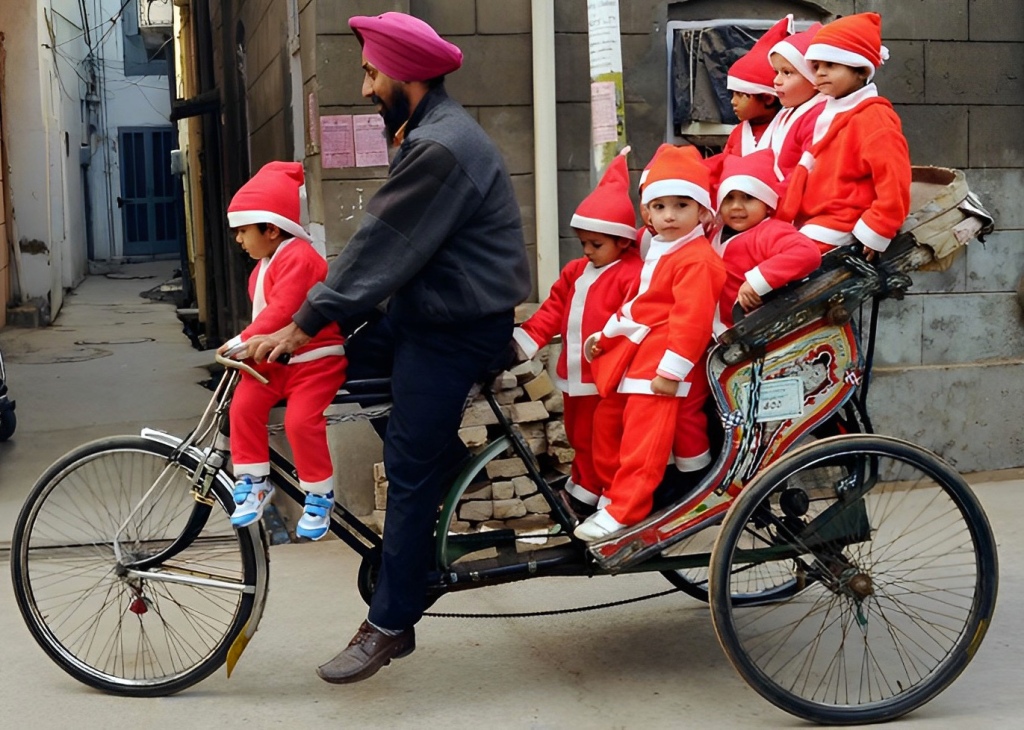
We all know that Christmas Day, the night that Jesus came to earth, bringing with him peace and love for all humanity, is celebrated by Christians all around the world with great enthusiasm and merriment. Interestingly, for a multicultural country like India, Christmas is equally celebrated — not only as a religious festival but also as a cultural one. For a country where less than three percent of the population is Christian, the central celebration is the birth of a child, but it takes on new meaning in different Indian homes. Known in local parlance also as “Burradin”[big day] Indians from all classes and communities look forward to this day when they can at least buy a cake from the local market, shower their children with stars, toys, red Santa caps and other decorative items, and go for a family picnic for lunch, dine at a fancy restaurant or visit the nearby church. This syncretic cult makes this festival unique, and for Jerry Pinto and Madhulika Liddle editing this very interesting anthology comprising of different genres of Indian writing on the topic – essays, images, poems and hymns, both in English and also translated from India’s other languages is indeed unique.
Mary and Jesus’ a painting by Sister Marie Claire. (Picture courtesy: SMMI Provincialate, Bengalaru) ‘Adivasi Madonna’, a painting by Jyoti SahiImages from Indian Christmas: Essays, Memories, Hymns
In his introduction which he titles “Unto All of Us a Child is Born,” Jerry Pinto reminisces how he was surprised when he saw his first live Santa Claus. He was a figure in red that Akbarally’s, Bombay’s first department store, wheeled out around Christmas week. “He was a thin man, not very convincingly padded… seemed to be from my part of the world, someone who would climb up our narrow Mahim stairs and leave something at the door for us at three or four a.m., then take the local back to his regular job as a postman or seller of second-hand comics. The man in the cards and storybooks preferred London and New York. And a lot of snow. … Today, it is almost a cliché to say that Christmas, like every other festival, is hostage to the market.”
The other editor, Madhulika Liddle in her introduction “Christmas in Many Flavours” states, “According to the annals of the Mambally Royal Biscuit Factory bakery in Thalassery, Kerala, its founder Mambally Bapu baked the first Christmas cake in India”. It was way back in 1883, at the instance of an East India Company spice planter he set about trying to create a Christmas cake. Liddle wondered what that first Christmas cake tasted like; how close it was to the many thousands of cakes still baked and consumed at Christmas in Kerala? She also writes about the situation in India, where instead of wholesale and mindless importing of Christmas ideas, the people have been discerning enough to amalgamate all our favourite (and familiar) ideas of what a celebration should be and fit them into a fiesta of our own.
Images from Indian Christmas: Essays, Memories, Hymns: dressed up as Santa Claus leave for school in Punjab. (Picture courtesy: Ecocabs,Fazilka).
There are several other aspects of Christmas celebrations too. The Christmas bazaars are now increasingly fashionable in bigger cities. The choral Christmas concerts and Christmas parties are big community affairs, with dancing, community feasts, Christmas songs, and general bonhomie. Across the Chhota Nagpur area, tribal Christians celebrate with a community picnic lunch, while many coastal villages in Kerala have a tradition of partying on beaches, with the partying spilling over into catamarans going out into the surf. In Kolkata’s predominantly Anglo-Indian enclave of Bow Bazar, Santa Claus traditionally comes to the party in a rickshaw, and in much of northeast India, the entire community may indulge in a pot-luck community feast at Christmas time. Thus Liddle states:
“Missionaries to Indian shores, whether St Thomas or later evangelists from Portugal, France, Britain, or wherever brought us the religion; we adopted the faith, but reserved for ourselves the right to decide how we’d celebrate its festivals.”
Apart from their separate introductions, the editors have collated twenty-seven entries of different kinds, each one more interesting than the other, that showcase the richness and variety of Christmas celebrations across the country. Though Christianity may have come to much of India by way of missionaries from Europe or America, it does not mean that the religion remained a Western construct. Indians adopted Christianity but made it their own. They translated the Bible into different Indian languages, translated their hymns, and composed many of their own. They built churches which they at times decorated in their own much-loved ways. Their feasts comprised of food that was often like the ones consumed during Holi or Diwali.
Thus, Christmas in India turned to a great Indian festival that highlighted the syncretism of our culture. Damodar Mauzo, Nilima Das, Vivek Menezes, Easterine Kire, Hansda Sowvendra Shekhar, Nazes Afroz, Elizabeth Kuruvilla, Jane Borges and Mary Sushma Kindo, among others, write about Christmas in Goa, Nagaland, Kerala, Jharkhand, Delhi, Kolkata, Mumbai, Shillong and Saharanpur. Arul Cellatturai writes tender poems in the Pillaitamil tradition to the moon about Baby Jesus, and Punjabi singers compose tappe-boliyan about Mary and her infant. There are Mughal miniatures depicting the birth of Jesus, paintings by Jyoti Sahi and Sister Claire inspired by folk art, and pictures of Christmas celebrations in Aizawl, Bengaluru, Chennai and Kochi and these visual demonstrations enrich the text further.
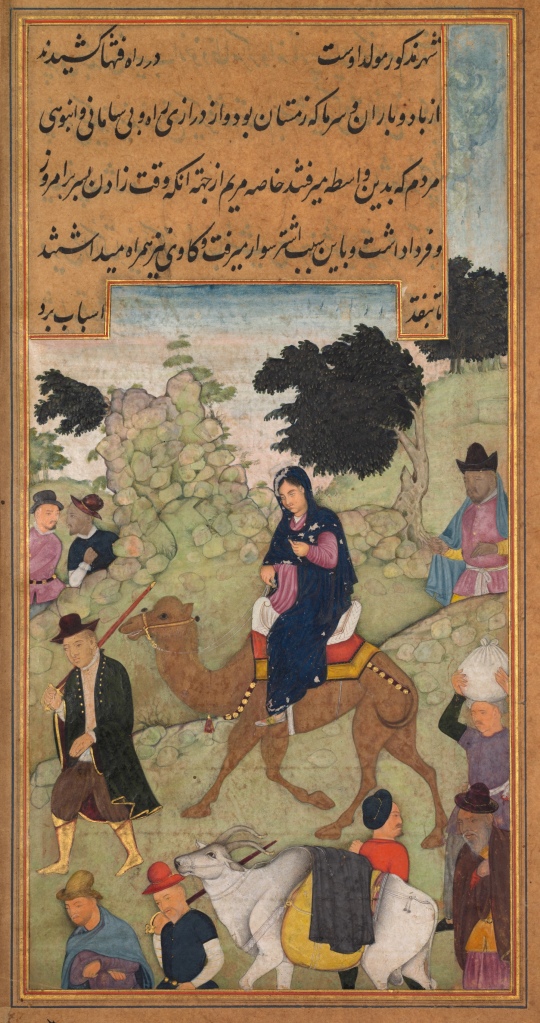
Seventeenth-century painting depicting Mary and Joseph travelling to Bethlehem. From a Mir’at al-quds of Father Jerome, 2005, Cleveland Museum of Art. (Wikimedia Commons) ‘Mother Mary and Child Christ’. Mid-eighteenth century, late Mughal, Muhammad Shah period. National Museum of India, New Delhi (Wikimedia Commons)Images from Indian Christmas: Essays, Memories, Hymns
Interestingly, the very first entry of this anthology is an excerpt from the final two sections of one of Rabindranath Tagore’s finest long poems, inspired by the life of Jesus Christ. Tagore wrote the poem “The Child” in 1930, first in English and translated it himself into Bengali the following year, titling it “Sishutirtha.” But many years even before that, every Christmas in Santiniketan, Tagore would give a talk about Christ’s life and message. Speaking on 25 December 1910, he said:
“The Christians call Jesus Man of Sorrow, for he has taken great suffering on himself. And by this he has made human beings great, has shown that the human beings stand above suffering.”
India celebrates Christmas with its own regional flair, its own flavour. Some elements are the same almost everywhere; others differ widely. What binds them together is that they are all, in their way, a celebration of the most exuberant festival in the Christian calendar.
Apart from the solemnity of the Church services, there is a lot of merrymaking that includes the food and drink, the song and dance. The songs often span everything from the stirring ‘Hallulujah Chorus’ to vibrant paeans sung in every language from Punjabi to Tamil, Hindi to Munda, Khariya and Mizo tawng.
Among the more secular aspects of Christmas celebrations are the decorations, and this is where things get even more eclectic. Whereas cities and towns abound in a good deal of mass decorating, with streets and public places being prettied up weeks in advance, rural India has its own norms, its own traditions. Wreaths and decorated conifers are unknown, for instance, in the villages of the Chhota Nagpur region; instead, mango leaves, marigolds and paper streamers may be used, and the tree to be decorated may well be a sal or a mango tree. Nirupama Dutt tells us how since her city had no firs and pines, she got her brother’s colleague to fetch a small kikar tree as kikars grew aplenty in the wild empty plots all over Chandigarh. In many entries we read about how Christmas decorations were rarely purchased but were cleverly constructed at home.
A very integral part of the Christmas celebrations of course is music. In many Goan Catholic neighbourhoods, Jim Reeves continued to haunt the listeners in his smooth baritone: “I’ll have a blue Christmas without you/ I’ll be so blue thinking about you/ Decorations of red on a green Christmas tree/ Won’t mean a thing, dear, if you’re not here with me.” Simultaneously, the words and music of “A Christmas Prayer” by Alfred J D’Souza are as follows: “Play on your flute/ Bhaiyya, Bhaiyya/ Jesus the saviour has come./ Put on your ghungroos/ Sister, Sister/ Dance to the beat of the drums!/ Light up a deepam in your window/ Doorstep, don with rangoli/ Strings of jasmine, scent your household/ Burn the sandalwood and ghee,/ Call your neighbour in, smear vermillion/ Write on his forehead to show/ A sign that we are one/ Through God’s eternal Son/ In friendship and in love ever more!/ Ah! Ah!” But the most popular Christmas song was of course “Jingle bells, jingle bells, jingle all the way….”
In “Christmas Boots and Carols in Shillong”, Patricia Mukhim tells us how the word ‘Christmas’ triggers a whole host of activities in Meghalaya and other Northeastern states that have a predominantly Christian population. Apart from cleaning and painting the houses, everything looks like fairyland during Christmas, a day for which they have been waiting for an entire year. She particularly mentions the camaraderie that prevails during this time:
“Christmas is a time when invitations are not needed. Friends can land up at each others’ homes any time on Christmas Eve to celebrate. Most friends drop by with a bottle of wine and others pool in the snacks and the party continues until the wee hours of morning. It’s one day in the year when the state laws that noise should end at 10 p.m. is violated with gay abandon. …Shillong [is] a very special place on Planet Earth. Everyone from the chief minister down can strum the guitar and has a voice that could put lesser mortals to shame. And Christmas is also a day when all VIPism and formalities are set aside. You can land up at anyone’s home and be welcomed in. It does not matter whether someone is the chief minister, a top cop, or the terrifying headmistress of your school.”
One very significant common theme in all the multifarious entries is the detail descriptions provided on food, especially the makeshift way Christmas cakes are baked in every home and the Indian way meat and other specialties are being prepared on the special day. There are several entries that give us details about the particular food that was prepared and consumed at the time along with actual recipes about baking cakes. “Christmas Pakwan[1]” by Jaya Bhattcharji Rose, “The Spirit of Christmas Cake” by Priti David, and “Armenian Christmas Food in Calcutta” by Mohona Kanjilal need special mention in this context. Liddle in her introduction wrote:
“Our Christmas cakes are a reflection of how India celebrates Christmas: with its own religious flair, its own flavour. Some elements are the same almost everywhere; others differ widely. What binds them together is that they are all, in their way, a celebration of the most exuberant festival in the Christian calendar.”
Later in her article “Cake Ki Roti at Dua ka Ghar[2],” the house where they lived in Saharanpur, Uttar Pradesh, she wrote how her parents told her that ‘bajre ki tikiyas’, thin patties made of pearl millet flour sweetened with jaggery, used to be a staple at Christmas teatime at Dua ka Ghar[3], though she has no recollection of those. She of course vividly recalls the ‘cake ki roti’. This indigenisation of Christmas is something that’s most vividly seen in the feasting that accompanies Christmas celebrations across the country. While hotels and restaurants in big cities lay out spreads of roast turkey (or chicken, more often), roast potatoes and Christmas puddings, the average Indian Christian household may have a Christmas feast that comprises largely of markedly regional dishes.
In Kerala, for instance, duck curry with appams is likely to be the piece de resistance. In Nagaland, pork curries rich in chillies and bamboo shoots are popular, and a whole roast suckling pig (with spicy chutneys to accompany it) may hold centre stage. A sausage pulao, sorpotel and xacuti would be part of the spread in Goa, and all across a wide swathe of north India, biriyanis, curries, and shami kababs are de rigueur at Christmas.
This beautifully done book, along with several coloured pictures, endorses the idea of religious syncretism that prevails in India. As a coiner of words, Nilima Das came up with the idea that ‘Christianism’ in our churches is after all, a kind of ‘Hinduanity’ (“Made in India and All of That”). This reviewer feels guilty of not being able to mention each of the unique entries separately that this anthology contains, so it is suggested that this is a unique book to enjoy reading, to possess, as well as to gift anyone during the ensuing Christmas season.
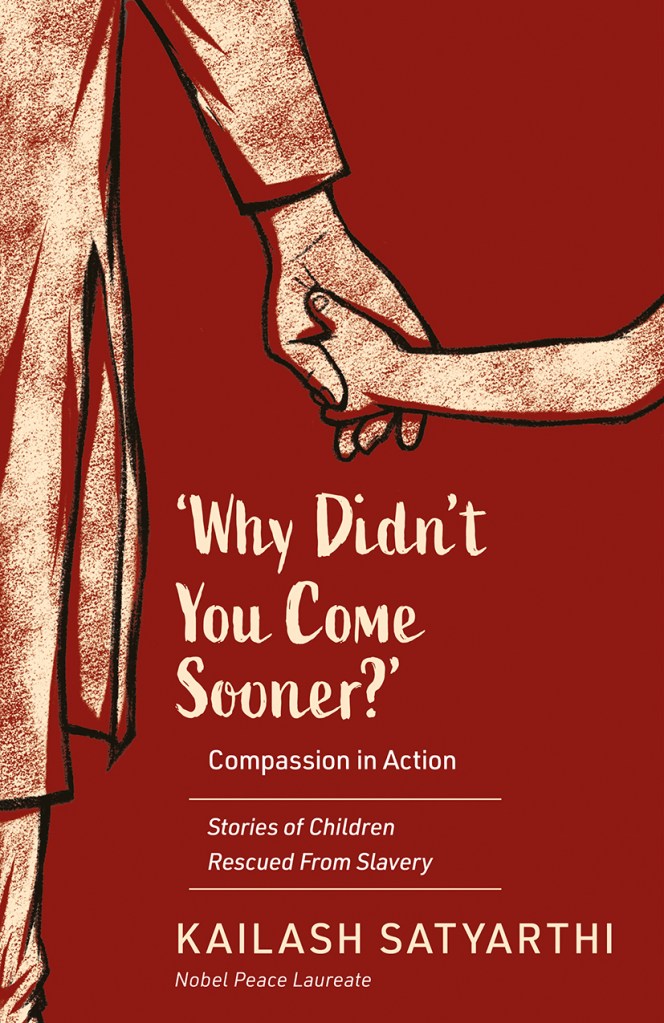
Title: Why Didn’t You Come Sooner? Compassion In Action— Stories of Children Rescued From Slavery
Author: Kailash Satyarthi
Publisher: Speaking Tiger Books
I seated a few of the children in my car, and drove away as fast as I could. The truck with the men and women followed me. The clothes of the children who sat with me in the car were tattered and torn. The wounds on their flesh could be seen through the holes in their clothes. Every such wound is a blot on human civilization. The frightened little girls were trying to hide their bellies and chests by hugging their knees. They simply could not make sense of all that had happened since morning. I made tentative attempts to talk to them. I tried explaining to them that they were now free from bonded labour and were being taken to a secure place. But they had never known freedom, or safety. How could they understand what I was trying to tell them? Maybe they assumed I was their new owner.
Just then, I remembered that there were some bananas lying in the back of the car. I asked the children on the back seat to distribute them among themselves. I thought they must be hungry, and might feel better after eating something. But no one picked up the bananas.
‘Go on, child. Pick up that bunch of bananas and pass it on,’ I gently repeated myself.
One of the children gave it to the child sitting in front. An emaciated girl and a little boy were seated next to me. I told them to pass on the fruit to everyone in the back and keep one each for themselves. The girl looked curiously at the bunch as she turned it around in her hands. Then she looked at the other children.
‘I’ve never seen an onion like this one,’ she said.
Her little companion also touched the fruit gingerly and innocently added, ‘Yes, this is not even a potato.’
I was speechless to say the least. These children had never seen anything apart from onions and potatoes. They had definitely never chanced upon bananas before. Upon further cajoling, some of them started chewing on the bananas. But they were trying to eat the fruit without peeling it. Some tried to swallow it while others were trying to hide it in their palms after having spat it out. My imprudence had for a moment pushed me back a few thousand years. The difference between an unpeeled banana and a peeled one was the distance between slavery and freedom. I quickly tried to rectify my error and taught them how to peel a banana and consume it. Most of them tasted the sweetness of the fruit and probably relished it too.
They began sharing this new experience among themselves in their dialect. I was feeling their joy too. Just then, the little girl sitting next to me tapped me on the shoulder and almost screamed.
‘Why didn’t you come sooner?’
I instantly turned to face her. Her innocent, tear-filled eyes and pained voice laced with anger pierced my heart. I could tell that these words had risen from the depths of her heart, where they lay suffocating for years.
Her younger brother had passed away for lack of availability of medicine. Once, the quarry owners had beaten up her father and uncle and branded them with burning cigarettes. They had raised their voice against the sexual exploitation of the women and tried to escape. Even the tiny hands of the children, when wounded, were never tended. They couldn’t even manage to get bits of cloth to tie around their wounds. This little girl had survived the entirety of hell in the eight years of her life. This was probably the first time that she could bring herself to trust someone enough to mouth the words, ‘Why didn’t you come sooner?’
That challenging question deepened the restlessness and anger that the issue of child slavery aroused in me. The child who posed this question was none other than Devli. She had put it to me, but it is one that needs to be answered by every person who speaks of faith, law, the Constitution, human rights, freedom, childhood, humanity, equality and justice. That question is as pertinent today as it was on that day all those years ago.
According to an estimate, there are around five million labourers employed in stone quarries in India. Hundreds of thousands among them are child labourers. Contractors and their agents pay tiny advances to impoverished families in backward areas and get them to come to the quarries on some false pretext or another. This is the organized crime of human trafficking that is often dressed up as migration or displacement. Usually, there is no record of workers in the quarries. In other words, children like Devli and her parents do not exist anywhere in legal terms.
To break up the stone, deep holes are drilled in it with powerful machines by skilled or semi-skilled workers which are then detonated with the use of gunpowder. The large rocks that are exposed after the explosion are broken down into smaller stones by adult men and women as well as children. The smaller children are engaged in removing the soil before the detonation takes place as well as removing the small stone chips after. Death is far from uncommon among these unskilled labourers who often get buried under the rocks thrown up by the explosions or when a quarry, unsteady from the shock, caves in.
(Excerpted from Why Didn’t You Come Sooner?: Compassion In Action—Stories of Children Rescued From Slavery by Kailash Satyarthi. Published by Speaking Tiger Books, 2023)
About the Book:
The work of rescuing children from slavery is not for the faint of heart, as the twelve gut-wrenching accounts in this book will show. Harder still is to give them their life back, after they’ve been kidnapped, trafficked, sold, abused and made to work in horrific conditions, often for as long as they can remember. Pradeep was offered up for human sacrifice by his family, thought to be a bad omen; Devli was a third-generation slave in a stone quarry in Haryana, who had never seen a banana before her rescue; Ashraf, a domestic child labourer at a senior civil servant’s house, was starved and scalded as punishment; Sahiba was trafficked from Assam to be someone’s wife against her will; Kalu was abducted and made to weave carpets all day long, his injuries cauterized with phosphorus scraped off matchsticks; Bhavna was trapped in a circus, sexually abused for years by her owners; Rakesh was worked in the fields all year round like cattle, and spent the nights locked up with them in the stable; Sabo was born to labourers at a brick kiln, and never knew life outside it; and Manan lived his childhood mining mica in the forests of Jharkhand, barely given time to even mourn his friend who got buried when the mine caved in. Kailash Satyarthi’s own life and mission were entwined with the journeys of these children. Having lived through unspeakable trauma, they had lost faith in humanity. But behind their reticence, behind their scraggy limbs and calloused hands and feet, hope still endured. This book tells the story of their shared struggle for justice and dignity—from the raid and rescue operations of Satyarthi’s Bachpan Bachao Andolan, to international campaigns for child rights. It is a testament both to the courage of the human spirit and to the power of compassion.
About the Author:
Kailash Satyarthi (b. 11 January 1954) is one of the most well-known child rights activists in the world. He has led many national and international campaigns to protect child rights and promote their education over four decades and rescued countless children from slavery. He is a recipient of the Nobel Peace Prize, among many other human rights awards.
.
PLEASE NOTE: ARTICLES CAN ONLY BE REPRODUCED IN OTHER SITES WITH DUE ACKNOWLEDGEMENT TO BORDERLESS JOURNAL
Ratnottama Sengupta recaptures a time when as a teenager she witnessed a war that was fought to retain a culture
At the border of the two Bengals: Photo Courtesy: Ratnottama Sengupta
“Joy Bangla!”
I was startled by the greeting. I was sixteen-going-on-seventeen and — en route to Darjeeling — I was visiting Malda, my ‘Mamabari’ where my mother lived until she was married at sixteen-just-turned-seventeen. I had just finished my school finals in ‘Bombai’ and was enjoying the long summer break with my school friend Swapna, my paternal didi, Tandra, and my maternal didi, Nanda. My Mama’s son, Shyamal, and his friend, Subhash, had graciously taken upon them the onus of taking us around Gaur, Pandua and Adina. All these are relics of the historical capitals that hark back to a glorious Bengal long past and — for most Indians – lost in oblivion. And here, in the 12-gate mosque of Baroduari, they were singing paeans to the Shahs and Sens and Pals of a medieval Bengal!
I was soon to face history-in-the-making. For, the rectangular brick and stone structure with three aisles, eleven arched openings, and so-many-times-that domes, built sometime in the 16th century and now in the care of Archeological Survey of India, was teeming with barely-clad men women and kids who were fleeing on a daily(or hourly?)-basis the gola-barood of the Razakars – the paramilitary force General Tikka Khan had unleashed in the eastern wing of Pakistan. This was May of 1971 and, even in the apolitical clime of the tinsel town in Bombay, we knew that the Pakistani President Yahya Khan was hounding supporters of the Awami League leader, Sheikh Mujibur Rahman.
I was therefore thrilled to hear the boom-boom-boom periodically rupturing the hazy horizon in the distant. Was it the spiteful army goons or was it the guerrillas fighting back? “How wonderful it would be to meet some of them!” the romantic in me spoke aloud to the red-eyed men and women who had greeted me with ‘Joy Bangla!’
“Don’t!” Shyamal Da and Subhash drew me aside. “Don’t get close to them – don’t you see they have all got ‘joy bangla’?”
“So what?!” I retaliated, “They are all infected with the love for their country – that’s why they are saying ‘Joy Bangla’! Isn’t that good!”
“No, they are all infected with conjunctivitis – it is highly infectious and spreading rapidly in the camps. So now, not only in Malda but all through West Bengal, ‘joy bangla’ is the name for conjunctivitis.”
.
Mangoes. Raw, green, going yellow-orange-red. Stretch out your hand, pluck them off the tree, hit hard on them with your fist and bite into the sour-sweet flesh… But we girls failed to emulate what Shyamal and Subhash could do with such ease on our way to Singhabad, the last stop for our trains this side of the border in that part of Bengal. Nevertheless, the fragrances of Amrapali, Moutuski, Kishanbog and Fazli remain fresh in my memory years after Shyamal, Nandadi, Swapna, Tandradi have all followed Bangobandhu to a borderless land beyond the clouds.
Singhabad is where my mother Kanaklata owned some 27 bighas of cultivable land inherited from her father: Chandrakanta Ghosh had, in 1940s, apportioned plots to his city dwelling daughters, Malati and Ranjita too, worried that they might face difficulties if their ‘job-dependent’ husbands lost their all to the Partition! He had reasons to worry. He had exchanged most of his land in Dinajpur but the daughters were married into families that had their base in Dhaka, Munshigunj and Kustia. Before you turn to your Google Guru let me tell you – all these were part of East Bengal and are now in Bangladesh.
Much later, in 2001, I would understand my grandfather’s angst when centurion Bhabesh Chandra Sanyal told me in Delhi: “This part of the subcontinent has seen three partitions – in 1905, 1947 and 1971.” The doyen of modernism in Indian painting, who had moved from Calcutta to Lahore in his youth and from Lahore to Delhi in 1947, had brought alive another chapter of history that most of us in India or Bangladesh don’t often recall. Yes, in 1905 the ‘territorial reorganisation’ of the Bengal Presidency by Lord Curzon was said to be for “better administration” since Bengal, for centuries, was spread right up to Burma in the East and well into Assam and Tripura in the North-East, into Bihar and Jharkhand in the West and in the South to Odissa. Noted: but why did it have to be along religious lines, separating the ‘Muslim-dominated’ areas from the ‘Hindu-majority’ ones? Because together the Hindus and Muslims had taken up arms against the goras in 1857, and starting from Barrackpore the mutiny had spread to Lucknow, Jhansi, Gwalior, Meerut, Delhi… After 1857, the last Mughal Badshah, 82-year-old Bahadur Shah Zafar, had to be exiled in Rangoon while in 1885 the last emperor of Burma, Thibaw Min, was forced to live in exile at Ratnagiri…
If it were not so tragic, it would have been ludicrous, this ‘exchange’ of emperors.
.
Nandadi’s brother, Nirjhar, now 79, vividly recalls crossing the newly defined boundary to come away for good from Meherpur, in Dinajpur of East Bengal, to Malda with his mother — my aunt — Pramila, his three-year-old sister, Nanda, and a just-born brother, Nirmal. “We were coming in three bullock carts: the first one driven by a certain Mongra carried our eldest Mama, his wife Charulata and youngest son Subrata; and the last had our younger Mama’s wife Gayatri, son Suvendu and daughter Maitreyi. Many people were coming just like us, there was no knowledge of the word ‘Passport’ and no concept of ‘Visa’. Since our Dadu – maternal grandfather Chandra Kanta – had to stay back to wind up things after us, he took us to a dear friend of his, a Muslim named Sukardi Chowdhury, in Anarpur and asked him to accompany us since he had a gun.
“He was to reach us to Jagannathpur where Dadu had built a house on the newly exchanged land just six kilometers away from Meherpur. Sukardi Chowdhury lived two kilometers from the border but we had to cross river Punarbhaba on a boat and then we followed the road along the railway line. All of a sudden, we were startled by a piercing cry in a female voice. ‘Who is this? Who goes there?’ demanded Sukardi Chowdhury. He climbed on to the railway track and witnessed some miscreants harassing a woman. He fired his gun in the air and the rascals fled. He walked up to the woman and found that the malefactors had bitten off the nipples of the woman who was bleeding and writhing in pain.
“Sukardi Chowdhury had a gamchha tied around his head like a bandana. He took it off and wound it around the chest of the victim. He advised her companions to go along the railway track straight to Singhabad station, take a train to Malda and seek medical aid there. ‘That will save your life,’ he assured her. I will never forget.” Incidentally Nirjhar’s father, Makhan Chandra Ghosh, did not cross the border until 1980. Along with his ageing mother he had stayed back to care for his widowed sister since their land further inside Dinajpur could not be exchanged.
.
This 27-acre land in Singhabad adjacent to the No-Man’s Land on the Bangladesh border was so dear to Kanaklata that she would not hear a word about selling it off although she lived far away with her husband, Nabendu, who was busy scripting films. “One should never forget one’s roots,” she told me in 1971 when she went around with a donation-book raising chanda for the Bangla refugees. She was delighted when – later – the government of India issued Refugee Relief stamps that had to be affixed to every letter, be it a postcard, an envelope, or an inland letter. Was it because deep within she identified with the uprooted people who were forced by history to cross borders?
Ma’s love for her land had, perhaps, infected us. When she passed on in 1999, we dispersed her ashes in the pond on this land. In 2007, before my son, Devottam, was to depart for higher studies abroad, he visited this innermost corner of his land. In 2017, when Ma would have turned ninety, my husband, Debasis, celebrated by planting mango trees around the pond and released fish, the sales of which now pays for a Durga Puja on the land. Yet, just last December, we severed our formal ties by selling off the ‘two-acre land.’ But no, Kanaklata is not forgotten by the men and women – many of whom studied in the school she helped set up long before government aid came their way. They are setting up a temple in her memory…
.
But hang on friends, that’s not the end of my story, “picture abhi baaki hai!”
On December 13, 1971, Tandra’s elder sister Chhanda got married. She came from Patna where Nabendu’s brother lived; the groom, Animesh, came from Delhi. But Kanaklata had organised everything in Bombay, in the same house in Malad where our family has lived since 1951. This Goan-style bungalow had a garden surrounding it and this tiny ‘lawn’ was to be the wedding venue. However, ten days before the event when the invitations had gone out and the baratis had already booked their tickets, aerial strikes on Indian air stations led to an all-out war with Pakistan.
This was ominous for many reasons. Six years before this, during another war with Pakistan, my grandfather had passed away in August 1965. This time around, the mighty Seventh Fleet of the USA had entered the Bay of Bengal to support Pakistan in the war. Sirens were being sounded at regular intervals and we joked that – since both the bride and the groom were trained musicians – these sirens were ‘replacing’ shehnai by Bismillah and party. Why? Because the police showed up to warn us that no conch shells or ululations that mark traditional revelry at Bengali weddings were to be sounded — and not even a single ray of light should evade the black-cloth-wrapped pandal that had to be erected to cover the house!
Ill omens? Never mind. You can’t stop a wedding because a war was on! All the Bengali families of Bollywood united that evening to celebrate with bated breath. And on December 16, when the bride was being formally inducted into the groom’s family in Delhi over the sumptuous meal of Boubhat, news came that General Niazi of Pakistan had surrendered to General Jagjit Singh Arora of India.
So Vijay Diwas is one day that unites India and Bangladesh in celebrating its actual secession from Pakistan. “Joy Bangla!” – we all said as Chhanda and Animesh led a chorus that sang,
Aamar Sonar Bangla, aami tomay bhalobashi!*
Oh my glittering Bengal, I love you…
Malda: Photo Courtesy: Ratnottama Sengupta
Glossary
Didi – elder sister
Mama – mother’s brother
golaa-barood — ammunition
Amrapali, Moutuski, Kishanbog and Fazli – Varities of mango
bighas – acres
goras – whites
Badshah — Emperor
chanda – donations
picture abhi baaki hai – The movie is still not over
Boubhat – wedding reception, traditionally
*Song by Tagore that became the national anthem of a free Bangladesh
Ratnottama Sengupta, formerly Arts Editor of The Times of India, teaches mass communication and film appreciation, curates film festivals and art exhibitions, and translates and write books. She has been a member of CBFC, served on the National Film Awards jury and has herself won a National Award.
.
PLEASE NOTE: ARTICLES CAN ONLY BE REPRODUCED IN OTHER SITES WITH DUE ACKNOWLEDGEMENT TO BORDERLESS JOURNAL









 Borderless