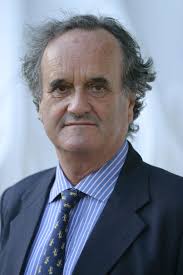
There were very few things that Sir Mark Tully touched which did not turn to gold. In his later years, disenchanted by journalism, he resorted to making documentaries on steam trains. Accompanied solely by a production crew and armed with the knowledge that comes with instinct, Sir Mark established that the locomotives pulling these trains — running on steam — did exist in India, even if he had to crisscross his way to the western peripheries of Kutch to make his point. By then, the BBC, whose outstanding representative he had become, and whose torch he held aloft in times of crises, had become enamoured by the crony capitalism of the centre-right, which we would go on to see in later years.
Born in the southern suburb of Tolluygunge in Calcutta to parents who were Indian in all but name, Sir Mark was sent to study in England at the age of nine before joining the organisation which would, for better or worse, be the making of him. Known essentially for his factual reporting, albeit with the possession of a nuanced eye that made his stories seem humane, Sir Mark’s passion for conversation with his subjects made him highly esteemed in the eyes of his peers. The added benefit of reporting on events that shaped modern India — the Bhopal gas tragedy, Operation Blue Star, Rajiv Gandhi’s assassination, the Babri Masjid demolition, et al — was the ream of concepts he had up his sleeve, and of which he made good use when he started writing books.
Amritsar: Mrs Gandhi’s Last Battle was Sir Mark’s first book, but it was No Full Stops In India that embellished him as a legend who could comfortably balance storytelling with a subtle hint of refinement, and who had the repertoire of knowing his subjects inside. Despite being born in the country, he was only given the privilege of being an Overseas Citizen of India (OCI), but this did not deter Sir Mark from his goal — to tell the stories of real Indians and real India to those who did not know where to look. All his life, he rallied behind the cause of religious pluralism and batted for the inclusion of marginalised communities and minorities into the mainstream, but died a man broken by the scars of battle.
Much like the Ashokan rock edicts that were unknown to the ordinary Indian till James Prinsep deciphered the Brahmi script in the early 19th century, Sir Mark’s work went largely unnoticed in the country until he left the BBC. Harassed and harangued by the Indira Gandhi government, he had also been forced to leave the country when the Emergency was imposed. However, return he did, to his country of birth, and stayed loyal — to its people and to the truth — and continued challenging those in power with constant, if gratifying, attacks.
Telling stories with a precision that most remain unaware of despite the possession of all-seeing eyes, Sir Mark’s work remained a terrifying but ambitious challenge for any aspiring journalist to recreate. He left just the way he had wanted to leave, in the country of his birth, known as an Indian who had struck roots in its soil, blossomed in its spring and withered at its dusk. A man ahead of his times by several generations, Sir Mark Tully was an Indian we did not deserve.
Mohul Bhowmick is a national-level cricketer, sports journalist, poet, essayist and travel writer from Hyderabad, India. He has published five collections of poems and one travelogue so far. His latest book, The Past Is Another Country, came out in 2025. More of his work can be discovered on his website: www.mohulbhowmick.com.
.
PLEASE NOTE: ARTICLES CAN ONLY BE REPRODUCED IN OTHER SITES WITH DUE ACKNOWLEDGEMENT TO BORDERLESS JOURNAL
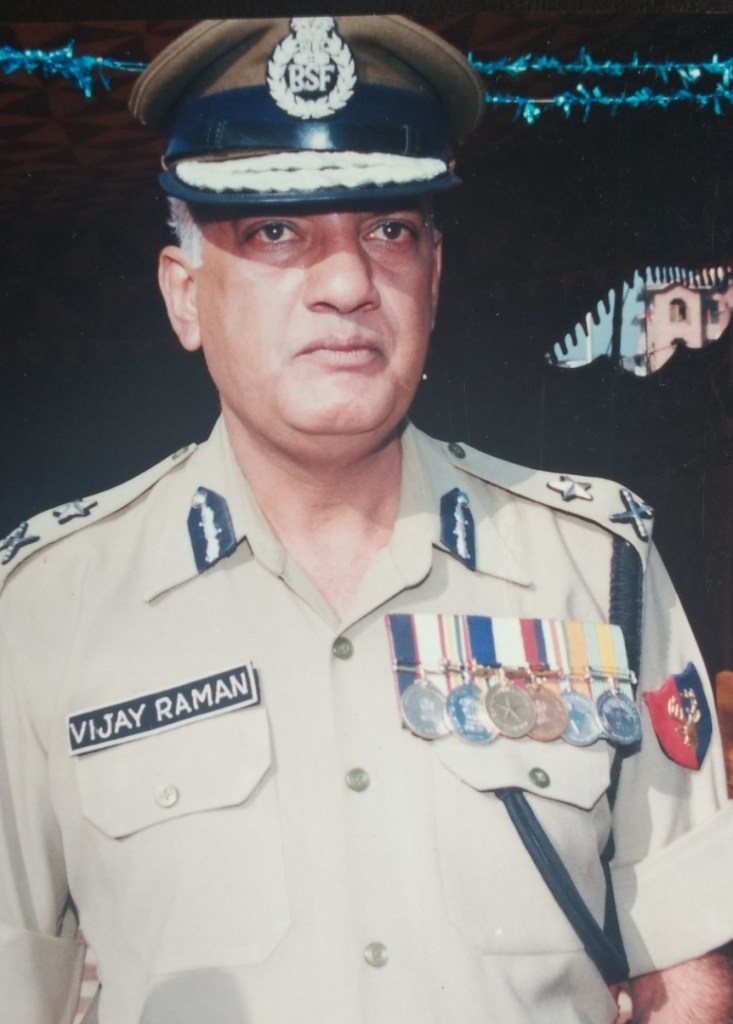
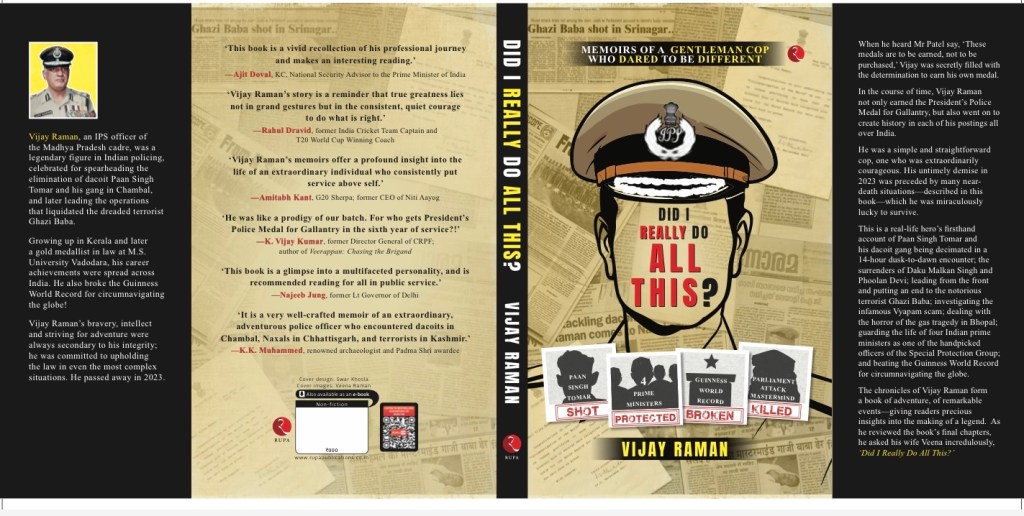
Ratnottama Sengupta, introduces the late Vijay Raman and converses with Veena Raman, the widow of this IPS[1] officer, about his book, Did I Really Do All This: Memoirs of a Gentleman Cop Who Dared to be Different. The memoir was recently launched by Sengupta and brought out posthumously by Rupa Publications.
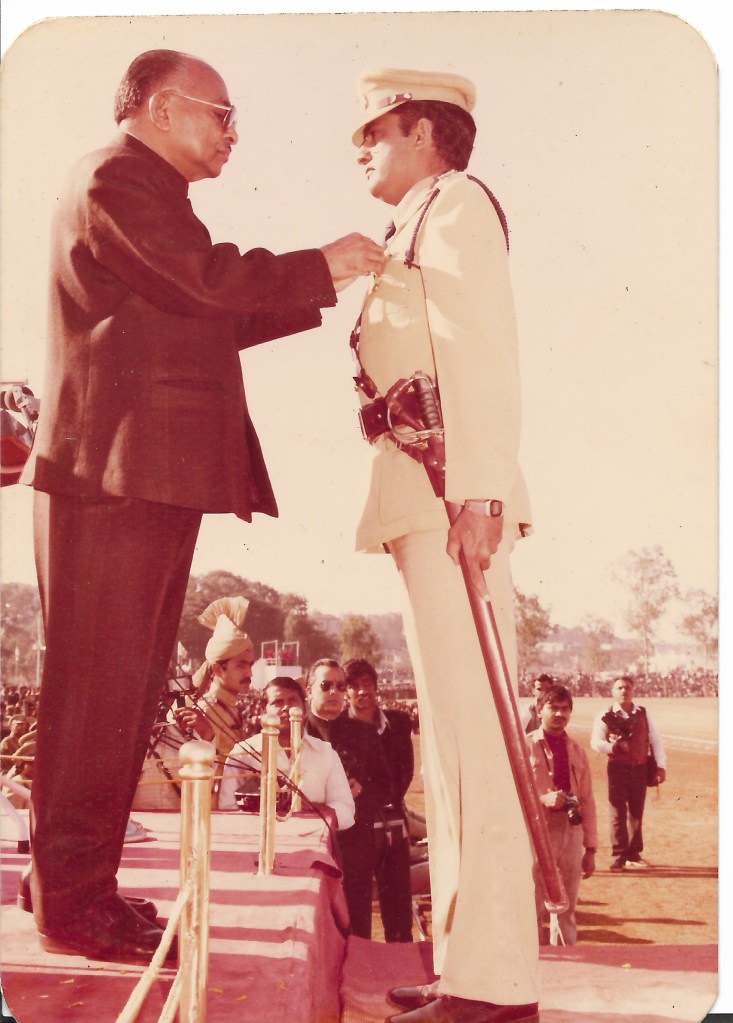
Vijay Raman (1951-2023)Vijay Raman receiving the President’s Police Medal for Gallantary in 1985Photos provided by Veena Raman
Vijay Raman’s success as a police officer was not merely a personal triumph. The career of this IPS officer traced the changes in the history of India’s security measures. India’s police organisation in 1947 — the Intelligence Bureau, Assam Rifles and CRPF[2] — were legacies from the British Raj. The 1962 Indo-China War led to the creation of the ITBP[3]; the 1965 war with Pakistan formed the BSF[4]. Investments in the Public Sector Undertakings led to the establishment of CISF[5]. Indira Gandhi’s assassination in 1985 led to crafting of SPG[6]. The sabotaged crash of Air India’s Kanishka[7] and the Operation Blue Star prompted the formation of NSG[8], and the 2008 terror attack on Mumbai was followed by NIA[9]. Vijay Raman’s life was intertwined with these organisations. He was also responsible for bringing in a number of terrorists and dacoits, including the notorious women dacoit, Phoolan Devi[10] (1963-2001)…He died last year.
In this conversation, Veena Raman[11] reflects on his life and his memoir, Did I Really Do All This: Memoirs of a Gentleman Cop Who Dared to be Different.
Veena this book is a tribute to a police officer who brought honour to his uniform. Having met Vijay Raman I know how wonderful a person he was – deeply loved by not only his family and friends but also many VIPs he interacted with in his professional life. Is this your way of mourning his sudden demise?
When Vijay passed away we — my son Vikram, daughter-in-law Divya, grandson Shaurya and I — were devastated. The cruel illness was swift and relentless: within months he grew weaker before our eyes, and before we were ready to accept the loss. We had no choice but to face it. While we tried to console each other Vikram said, “Mamma we should be grateful that we had him for all these years. After all, Papa was that proverbial cat with nine lives!”
Really?
Absolutely. And why nine? I can give you 19 instances in our years together when his life was in danger and he miraculously escaped.
I am all ears Veena!
At the very outset, in November 1978, when Vijay was in his first posting as assistant superintendent of police (ASP) in Dabra, Madhya Pradesh, a country-made bomb was flung at his jeep by agitating students in Gwalior. It fell and exploded nearby. Fortunately, no one was harmed.
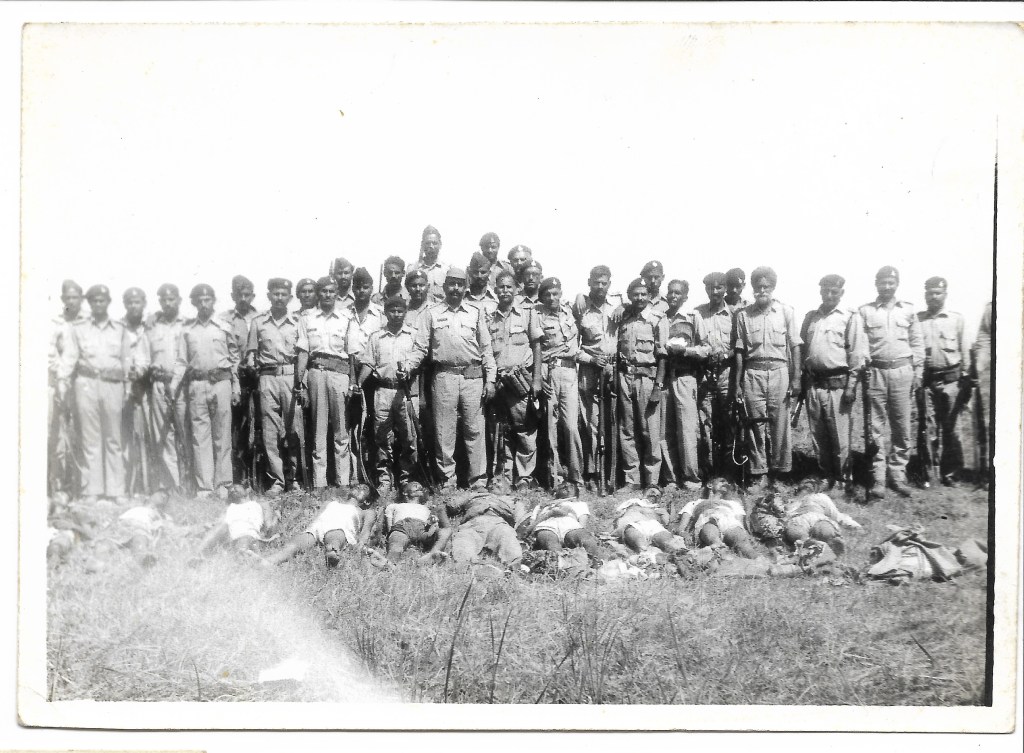
In 1981, based as he was in the Chambal, notorious for dacoits who stalked the nooks and crannies of the ravines, my illustrious husband had already faced dacoit encounters. The most dramatic of these took place in October, when he led the team that wiped out Paan Singh Tomar who, with his gang, had terrorised the region for years. As he describes in the book, bullets had rained on the encounter team from all sides, caught in the crossfire between the dacoits and the police.
The Pan Singh Tomar gang after a dusk to dawn encounter submits to the police: Photo provided by Veena Raman
He was superintendent of police (SP), Special Branch in Bhopal when the world’s worst industrial disaster took place. On the night of 3 December 1984, more than 40 tons of methyl isocyanate (MIC) gas leaked from the Union Carbide pesticide plant. At exactly that time Vijay was driving to the railway station. “Why inconvenience the driver to stay up late when I want to receive my parents myself?” he had argued.
Within minutes the gas had created havoc. He was shocked to see hundreds killed and untold hundreds maimed. Somehow he and his parents, so close to the scene of destruction, were spared.
In 1998, as inspector-general of police (IGP) Security, Jammu and Kashmir, while Vijay was in Srinagar, a bomb blast took place on the route during the hour he routinely travelled to office. He was saved that day because his driver had taken an alternative route!
In 2000, as IG-Border Security Force (BSF), Jammu, Vijay was responsible for erecting a much-needed part of the fence between Pakistan and India under highly adverse conditions. Enemy bullets rained down from across the border throughout the operation. That forced him to take some daring and potentially controversial decisions. How very relieved and thankful we were when he came home safe!
Vijay was appointed IG, BSF, Kashmir, in 2003 with the secret mandate to get Ghazi Baba, the mastermind of the 2001 attack on the Indian Parliament. Along with an informer, he had gone on an undercover exploration of the site where the encounter eventually took place. Most unexpectedly the informer pointed out the man himself! Vijay instinctively tried to open the car door and rush out to apprehend the terrorist. The informer roughly pulled him back and screamed to the driver to step on the accelerator and escape immediately. Later the informer explained that Ghazi Baba never left his lair unless he was strapped with explosives, and an attack would have spelled explosions that would have been the end of everyone in the vicinity.
Did he ever face a situation that he regretted?
One of the most dangerous situations Vijay ever faced in his risk-fraught career was as Special Director General (DG), Anti-Naxal Operations of the Central Reserve Police Force (CRPF). In April of 2010, many of his men were massacred in Dantewada by Naxalites. The loss weighed so heavily on him that his health declined: he neglected his meals and even forgot to take his medicines. He had moved from the headquarters in Chhattisgarh to Kolkata; Vikram and I were in Delhi. We understood the intensity of what he was going through only later, when he suffered a stroke.
Did your angst-ridden years end with his retirement?
Not really. For, four years after he retired, in 2015, Vijay was handpicked to be a member of a special investigation team (SIT) to investigate the Vyapam (Vyavasayik Pariksha Mandal[12]) examination scam. This was a challenging assignment because the entrance examination admission and recruitment had been going on since the 1990s and had come to light only in 2013.
Did he do anything that was not challenging? What got him a place in the Guinness Book of World Records?
Vijay came close to death even in the personal adventure he undertook with a friend. Together they circumnavigated the globe in an Indian-made car in the last 39 days of 1992. Don’t forget, that was an era when Indian manufacturing was just coming of age. Though this tremendous feat earned him a place in the Guinness Book of World Records, he was exposed to danger of a different kind. For 39 days, they drove at very high speeds, in different countries, different terrains, and different political climates. Let alone sleep on a bed, many a night they could not even catch 40 winks. And still they had only one accident! Yes, it left him badly injured, but he found the strength to complete the challenge and beat the record.
Doesn’t every policeman court danger — even death — in the course of duty? What made him stand apart from other men with stripes?
True, every policeman faces bullets in the course of duty. And Vijay, throughout his career, was inviting them, to see what they could do to him. His faith in the divine, in his own destiny, made him fearless. How very fortunate we were that, time and again, they were deflected.
Another thing that made him stand out was his sheer artlessness. In a field of work steeped in the dregs of humanity, he stood unwavering by the principles of human rights and democracy. Again, fortunately, he came out unscathed, retaining faith in humanity all through life.
This dream run surely merited documenting. And Vijay had a flair for writing. So why did he not pick up the pen until the last hours of his life?
It was indeed a dream run. And that was precisely why I urged Vijay for years to write a book. Yes, many people have achievements, but his narrative was different. Winning without challenges is victory, but winning after overcoming challenges is history!
I remember that, when you visited us in Pune in 2019, you had said that the range and scope of what he had done, deserved to be recorded. I myself maintained that the consistently straightforward way in which he had done it, had to be recorded for posterity. But whenever this was suggested Vijay would say, “Who would be interested in such a book!”
None of us agreed with him. We read books by many other police officers which made it clear that Vijay’s experiences were unique. While the others excelled in certain areas of policing, Vijay’s was a whole range of spectacular achievement!
He may be the only police officer in the country who has dealt with all the aspects of policing — and been successful at each. He was at the forefront of dealing with the changing nature of crime in the country and also at the epicentre of varied policing challenges.
Doesn’t he write about how his actions led to change in tackling crime and criminals?
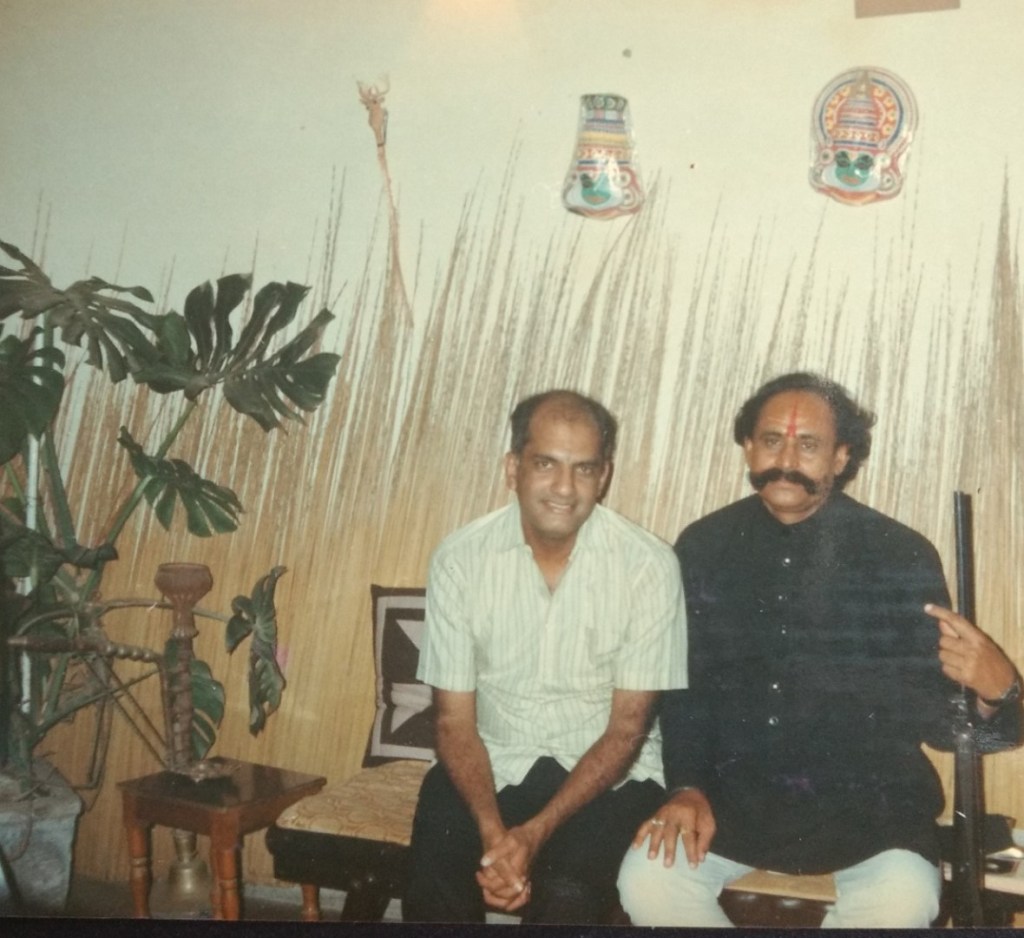
Yes, his successes invariably led to major changes in the law-n-order situation in the region. In Bhind, removing the Paan Singh[13] gang led to the surrender of a large number of dacoits who previously considered themselves invincible. This list includes the most notorious Malkan Singh[14] and the celebrated Phoolan Devi.
Surprise visitor Dacoit Malkhan Singh (right) with Vijay Raman Photo provided by Veena Raman
Similarly, when Vijay initiated the Indo-Pak border fencing, it was a major deterrent because most of the infiltration was from Jammu and there was a marked decline once the fence came up. Ghazi Baba too was seen as invincible, so the encounter destroyed a formidable opponent and also sent a clear message to enemies across the border.
Vijay’s success was not merely personal triumph. His career as an IPS officer traces the changes in the history of India’s security measures, right?
Indeed, his life and career were intertwined with an entire spectrum of events that enhanced the security of Indians. But let me point out that his daily life also contained an extraordinary range of experiences. He grew up in a village in Kerala, and later lived in villages among the most primitive of peoples in other Indian states. But he also lived in the cities, a privileged urban Indian. He had travelled in bullock carts on rutted roads and often walked 30 km in the course of an ordinary day through ravines. And he had also jetted across the world with the prime ministers he protected.
Vijay exemplified the essential truth of India being one, from Kashmir to Kerala!
Without a spec of doubt Vijay was that quintessential Indian who was intimately connected in different ways to the length and breadth of India. He grew up in Kerala, the deepest south, and spent some of the most significant years of his career in Jammu and Kashmir, the farthest north. His higher education took place in Gujarat; when he retired, we came to live in Pune.
The western part of India was his beloved home as an impressionable youngster, and then again in his final years. There were formative experiences in the east when, as a probationer in the Police Academy, he was taken to explore and understand India’s verdant Northeast. And he was in Calcutta for induction training at the ordnance factory, and later during his stint as Special Director General, Anti-Naxal Operations of the CRPF.
With these influences of north, south, east and west, it was only fitting that Vijay should be allotted the Madhya Pradesh cadre, at the very heart of India.
And he met his darling wife – then a hockey champion – in Nagpur! How did you meet? And how did you sustain your enchantment when the miles kept you in different corners of the land?
Vijay was an excellent writer. Of late I’ve been reading his letters to me over the years, from before we were married as well as during the tenures of separation induced by our work and careers. I can only marvel at his intellectual ability. Even at a very young age, he articulated his thoughts and feelings beautifully, and the letters reflect his tendency to introspect often, and be constantly self-critical.
I see a proud wife sitting before me.
I have always been extremely proud to be the wife of such an exceptional human being. But Vijay disliked being praised. At the peak of achievement, when his heroic deeds were earning him medals and he was surrounded by people singing his praises to the sky, when he was achieving success after success, he tried to ignore it all. Specifically he would tell me, “Please Veena, you don’t praise me. It’s all right that so many people are praising me. But if you start doing it, it’ll go to my head.”
Stupidly, I took him at his word. Of course, I boasted to others that the outstanding police officer was also the best husband, and the best father, ever. Even in the 1970s, when so few women had careers, he supported my ambitions. He knew he was marrying a woman who had her own dreams, who wanted to see the world. And yes, he knew that I had not learnt to cook!
I admired many other things about him. His commitment to perfection no matter how inconsequential the task. His commitment to service, to justice, to humanity. His love for reading. His wry sense of humour. His care for his parents and members of both our families. The deep respect he drew from whosoever knew him well — his family, his colleagues, his subordinates, his superiors, and even many criminals he came in contact with in the course of his duties.
But because he stopped me from praising him, I could never convey to him in words how much I admired him. It was only when he grew weaker that we worked fast and furious to get down on paper all that he was telling us. And as we approached the final pages of this book he said to me, with some surprise and wonder, “Veena, did I really do all this?”
So this book is Vijay’s story in his words. When he became too weak to speak, and when we lost him, my memories continued to pour in and I took the liberty to fill a few gaps.
May his legacy live on!
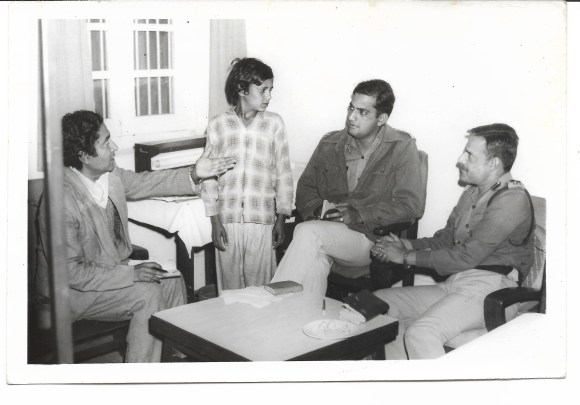
Vijay Raman at work with a kidnap victim. Photo provided by Veena Raman
The A B C of Vijay Raman

Adventure: Awarded citation in Guinness Book of World Records and Limca Book of Records for his around the world tour in an Indian Contessa car in 39 days 7 hrs 55 minutes
Brains: Gold Medals in Law
Courage: Presidents Police Medal for Gallantry

Experience: Over 34 years of rich experience in General Administration, Policing, handled PM Security, CM Security, anti-dacoity operation in Chambal, anti- terrorist operations in Jammu & Kashmir , anti-Naxalite operation, Investigated Vyapam Scam.

Awards
•	Presidents Police Medal for Gallantry.
•	Presidents Police Medal for Distinguished Service
•	Presidents Police Medal for Meritorious Service.
•	Gold medals in Law
[10]Phoolan Devi (1963-2001) was married at the age of eleven and sexually assaulted before she became a dacoit. She was jailed for eleven years and then joined politics till she was assassinated.
[11] Veena Raman retired as General Manager Marketing, Madhya Pradesh Tourism, after serving for 29 years. After retirement, she joined two NGO organisations, University Women’s Association Pune and Pune Women’s Council working towards empowerment of women. She was part of the national hockey team of India in 1975.
[12] Madhya Pradesh Professional Examination Board
[13]Paan Singh Tomar (1932-1981) was an Indian athlete and soldier who became a dacoit due to family feud.
[14]Malkan Singh (born 1943) is a former dacoit who has turned to politics
.
Ratnottama Sengupta, formerly Arts Editor of The Times of India, teaches mass communication and film appreciation, curates film festivals and art exhibitions, and translates and write books. She has been a member of CBFC, served on the National Film Awards jury and has herself won a National Award.
.
PLEASE NOTE: ARTICLES CAN ONLY BE REPRODUCED IN OTHER SITES WITH DUE ACKNOWLEDGEMENT TO BORDERLESS JOURNAL
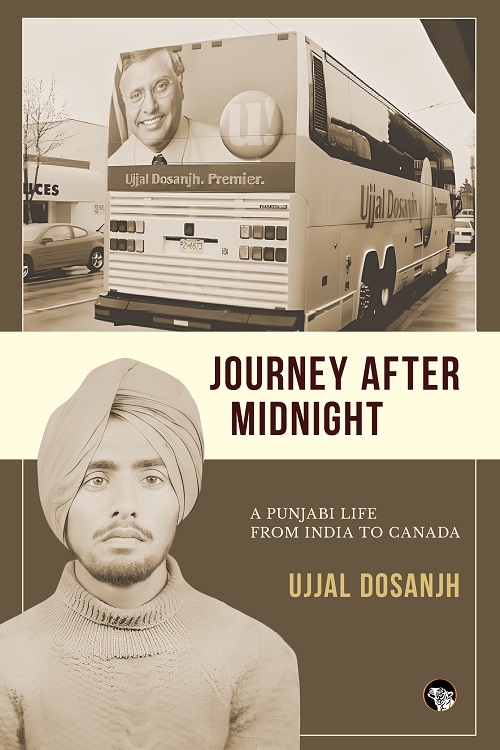
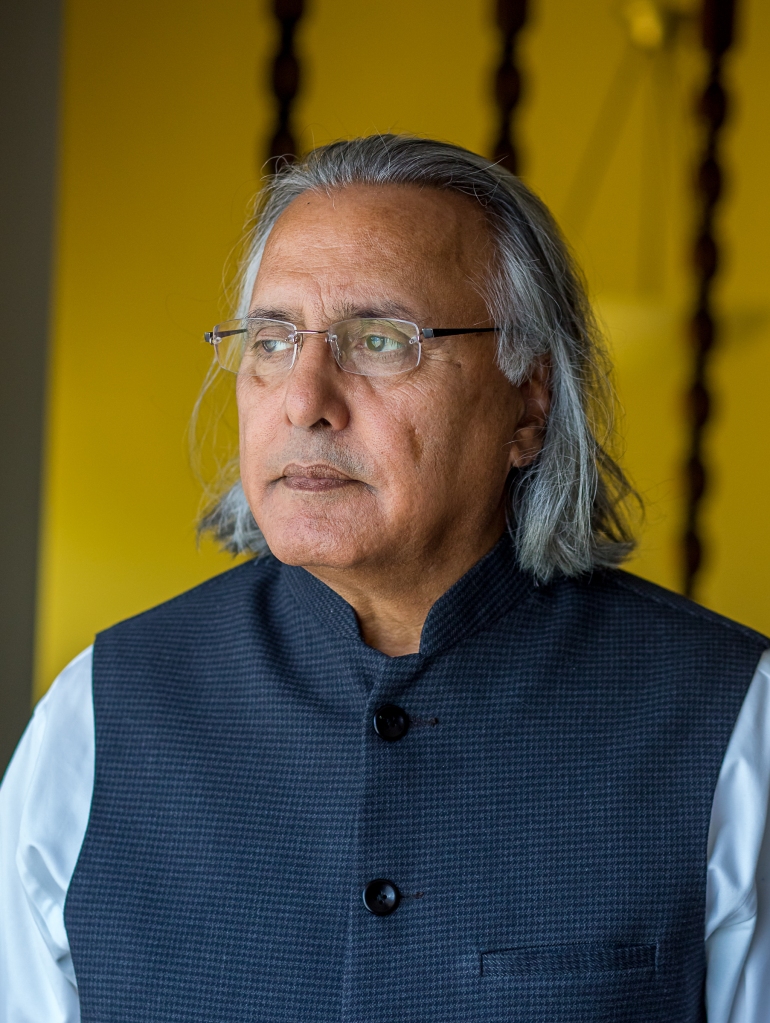
Ujjal Dosanjh left his village in Punjab in quest of a better life. He had a bare smattering of English, very less money and some family overseas when he left his home at Dosanjh Kalan at the age of seventeen. That was in 1964. He spent the first three years in Britain and then, moved to Canada to become a prominent lawyer, activist and political figure.
When he started in the 1960s, to earn a livelihood in England, he shunted trains in the British Railways. He left for Canada in hope of a better future. He had to work initially in sawmills and factories to support himself. Eventually, he could get an education and satisfy his ambitions in British Columbia, which became his home. Coming from a family which contributed to the freedom struggle of India, it was but natural that he would turn towards a public life. His uprightness, courage, tolerance, openness and commitment had roots in his background, where his parents despite different political ideologies, lived together in harmony. His family, despite their diverse beliefs, stood by him as he tried to live by his values.
Dosanjh voiced out against separatist forces that continue to demand an autonomous country for Sikhs to this day. In 1985, he was beaten almost to death by such Khalistani separatists as he boldly opposed the movement that had earlier led to the assassination of the Indian Prime Minister, Indira Gandhi (1917-1984) and to the bombing of an aircraft where all 329 people aboard died. However, undaunted by such attacks, he continues to talk unity, welfare for the underprivileged and upholds Mahatma Gandhi as his ideal. He went into Canadian politics with unfractured belief in the Mahatma. Dosanjh was the Health Minister of Canada and earlier the Premier of British Columbia. He has been honoured by both the Indian and Canadian governments. In 2003, he received the highest award for diaspora living outside India, Pravasi Bharatiya Samman, and, in 2009, he was a recipient of the Top 25 Canadian Immigrant Award.
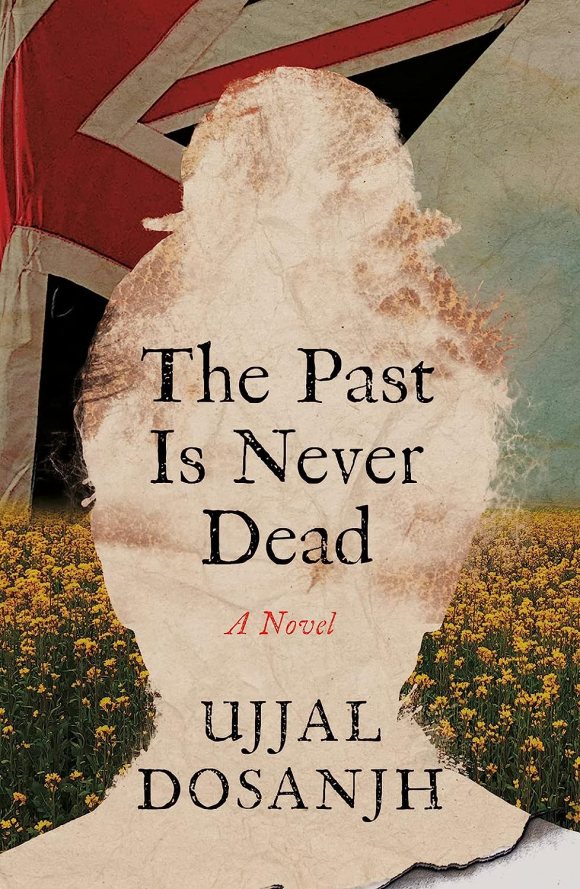
Now, sixty years from the time he left his country of birth, he shares his narratives with the world with his updated autobiography — the first edition had been published in 2016 — and also with fiction. As an immigrant with his life spread over different geographies, he tells us in his non-fiction, Journey After Midnight – A Punjabi Life: From India to Canada:“Canada has been my abode, providing me with physical comforts and the arena for being an active citizen. India has been my spiritual refuge and my sanctuary.”He writes of what he had hoped could be a better future for humankind based on the gleanings from his own experiences and contributions to the world: “If humanity isn’t going to drown in the chaos of its own creation, the leading nations of the world will have to create a new world order, which may involve fewer international boundaries.”
In this interview, he shares his journey and expands further his vision of a world with diminishing borders.
You travelled from a village in Punjab, through UK and ended up in the Canadian cabinet to make changes that impacted humanity in your various public roles as a politician. Would you have been able to make an impact in a similar public role if you had never left India? Was the journey you went through necessary to help you become who you are?
It’s almost next to impossible to imagine what actually would have happened to my life in India had I stayed there. The most complicating element would be the standards that I would apply in such reimagining, the standards I most certainly wouldn’t have known or applied to my Indian life’s journey. I do think though and I have said it often in conversations with friends that had I stayed in India I would have either turned into a saint or devil; nothing in between for one who in 1964, the year I left, already hated the beginnings of the corruption that has now almost completely enslaved the country’s polity and ensnared the society.
Even though what has guided me throughout my life were the lessons I learnt from my freedom fighter maternal grandfather, my activist father and Mahatma Gandhi’s life, I believe the ethics and mores of public life, first in Britain and then in Canada helped shape and sculpt who I became and how I conducted myself. Had I not been to Britain and not lived most of my life in Canada, it’s impossible even to imagine the ‘me’ that would now be walking upon our planet earth.
While within five years of landing in Canada, you were studying in University of British Columbia and driving an Austin, some other immigrants fifteen years down the line continued in abject poverty. What does it take to rise out of endemic poverty? Do you see that happening in the world around us today?
The way you phrased the question conceals the fact that before I resumed full time college in January 1970s and went on to complete my BA and then LL.B. in 1976, I had spent full six years of my life in UK and Canada working jobs including shunting trains with British Rail, making crayons in a factory, being a lab assistant in a secondary school and pulling lumber on the green chain in a saw mill in Canada while often attending night school.
And I must add that my extended family and my spouse were largely responsible for paying my way through my B.A. and LL.B.
While even then it wasn’t easy, I do recognise the union wage then available to students in summer employment enabled them to save enough for the school year; with most summer jobs that’s not the case now. The students now more often than not have to depend on loans or help from the parents.
A significant section of the immigrant diaspora has done reasonably well while for many it’s becoming harder and harder to just make ends meet.
And by the way the Austin, you refer to, was the used Austin 1100, Austin Mini’s sister, I had bought for the then princely sum of six hundred dollars; it took mere six dollars to fill its tank.
That’s truly interesting. At the beginning of your biography, you stated ‘politics is a noble calling’. Later you have written, “I had realized I needed to make a clean break from thepettiness of politics.” Which of these is true? And why the dichotomy — pettiness as opposed to nobleness? And what made you change your perspective?
No, I have not changed my view of politics. It is a noble calling but only if you do it for the right reasons. More and more I found that a significant number of people seeking public office did so for glory that they perceived the elected public office bestowed upon them. Shorn of any lofty ideals and the pursuit of public good politics often degenerates into petty squabbles rather than the giant battles of great and contrasting ideas.
The pettiness is the result of small minds pursuing the mirage of glory in phony battles that barely move the needle on the bar of public good. I often refer to the absence of great leaders in the political landscape of India and the world; Canada has not escaped the current curse of the dearth of great minds in the political arena. Hence my exasperation at the situation I found myself in.
The world over, politics seems to have become the refuge of intellectual dwarfs—no offence intended to our shorter brothers and sisters. The small minds tend not to see too far into the future; they are oblivious to the need to constantly challenge the world to be what it could be.
After a lifetime of activism and close to eighteen years of elected office it was only natural for me to tire of the myopia and pettiness in what otherwise remains a noble endeavour.
You met Indira Gandhi — the second woman to lead a country in a prime ministerial role — and had this to say of her “Indira Gandhi loved India immensely. One can be an imperfect leader and yet a patriot”. Do you think she was an effective leader for India?
My wife and I spent an hour speaking with Indira Gandhi on the afternoon of January 13, 1984. We spent the first few minutes comparing notes about our grandparents and parents as freedom fighters and activists before discussing the issues related to the agitation in Punjab, its growing militancy and increasing violence in and outside the Golden Temple. From what she said it was clear she was extremely troubled about the dangerous situation of the militants holed up in the Temple and the toll it was taking on the peace, politics and the economy of the state. I sensed a certain helplessness in this otherwise quite brave woman when describing the unsuccessful efforts she and her office had made to reach a peaceful settlement of the issues raised by the Sikh agitation. Because I had met both the militant Bhindranwale and the peace loving leader of the agitation, Longowal, and understood the tension between the two men and their followers, I knew she was grappling with a political minefield. All of this and much more that we discussed left me in no doubt about her love for the country and all its people.
But I do believe she allowed the situation at the Golden Temple to linger too long and deteriorate before trying to bring it under control; thus, it and the Operation Bluestar, her ultimate response to the armed militants holed up in the Temple, remains one of her great misjudgements—perhaps as grave as the declaration of the National Emergency in 1975.
Imperfection being part of the human condition, one isn’t surprised that Indira Gandhi who saw all Indians as equally Indian, too, was imperfect; a strong but imperfect leader.
“Sikri was the capital for the new world of unity that Akbar had wanted to create. Ashoka took a similarly bold leap toward peace after a bloody war. Two millennia after Ashoka and four centuries after Akbar, Mahatma Gandhi shared with India a similar vision and a path out of colonialism. India killed him.” Please explain why you feel India killed Gandhi.
One can’t and mustn’t blame an entire country for the actions of one or two persons and yet what I said of Gandhi’s assassination, at least figuratively if not literally, can be said with ample justification; not one but several attempts were made to end Gandhi the mortal. If many Indian hearts and minds—and there were many in his lifetime, perhaps not as many as there are in Modi’s India—wanted Gandhi and his philosophy of nonviolence and love for all dead, then I must say, even without resorting to the writers’ licence, India stands accused and guilty of his January 30th, 1948 assassination; India killed Gandhi.
Even before the advent of Modi on the national scene India’s politicians had substantially diminished and damaged Gandhi’s legacy of Truth, Love and Non-violence. Considering the so few prominent voices in the public domain criticising the Modi regime’s single-minded undermining of Gandhi’s legacy, almost to the point of extinction, it can be said that if it already hasn’t done so, India is close to annihilating Gandhi’s Truth, Love and Non-violence.
“To India’s shame, the rich and ruling classes of today mimic the sahibs of yore. Some of them still head to the hills with their servants, the Indian equivalent of the slaves of the United States.” As Gandhi is seen as one of the architects of modern India, what would have Gandhi’s stand been on this?
When Gandhi lived in England and South Africa, he was part of the diaspora of his time and learnt new things as such. Today with social and digital media one hopes even living in India he would have been aware of the yearning of humanity for equality and economic and social justice. The way most rich and powerful treat the poor and the weak in India is absolutely antithetical to what an egalitarian India would demand of them.
I’m aware of how Gandhi didn’t support the abolition of caste and of his position or lack thereof on the question of equality for the blacks of South Africa at the time. But different times throw up leaders with different and perhaps better approaches to the fundamental issues. Were he alive today, he would have argued for the abolition of caste, equality for all and he wouldn’t have accepted or ignored how India treats its workers, poor and the powerless.
You have told us “India leads the world in the curse of child slavery and labour. Millions of India’s children are trapped in bonded labour, sex trafficking and domestic ‘help’ servitude.” Most people plead poverty and survival when they talk of children working. Do you see a way out? Is there a solution?
Yes, like all problems, this, too, has a solution:
Legislate, legislate and legislate.
Enforce, enforce and enforce the legislation.
I know some laws do exist but we need legislation with more teeth. The laws regarding minimum wage, hours of work, overtime and holiday pay and health regulations must be strengthened and more vigorously enforced, in particular, in the so-called domestic help sector. Better wages and working conditions rigorously enforced would attract adult workers who would be able to send their children to proper schools rather than thrust them in to slavery in exploitative homes, factories and workplaces.
Not much will improve on this front though unless Indians end the endemic corruption in law enforcement. You see corruption confronts and stares us in almost all, if not all, issues Indian; it is the elephant almost in each and every room.
“Violence can never be a tool for change in a modern, democratic nation.” You tried to use Gandhian principles through your life — even in Canada. Do you think non-violence can be a way of life given the current world scenario with wars and dissensions? How do you view Gandhi sanctioning the participation of soldiers in the first and second world wars? Can wars ever be erased or made non-violent?
First let’s deal with Gandhi’s sanction of the soldiers in the two world wars. Whether or not he had sanctioned their participation, the soldiers would have gone to war; most of them fought for wages, not for the love of war or the country except those for whom the Second World War was a war against fascism and hence justified.
I don’t believe Gandhi ever stated that in fighting a violent enemy or a perceived enemy one was not allowed to use violence. All I ever remember him saying was that you throw your unarmed body wrapped in soul force in front of the enemy but if you are too chicken to do so or can’t do so for some other reason but fight an aggressor you must, violence is better than doing nothing.
As for countries fighting each other I don’t believe he ever said that, in an uncertain world where the military of another country could invade at any moment, a country must forego a military of its own.
As for nonviolence being a way of life, it can and must be for a country in its internal life. On the borders however one always has to deal with what one is presented with; you can’t ask Ukraine to not fight; in the face of a suddenly expansionist China or a belligerent Pakistan, Gandhi wouldn’t have urged the Buddha’s meditational pose for India; he didn’t do so in late 1947 when Pakistani fighters invaded Kashmir.
As for wars being non-violent, they can never be if the likes of Russia continue to invade others.
You opposed the Khalistani separatists and stood for a united India. What is your stand on Khalistan, given the recent flare up? Did you do anything this time to allay the situation in Canada?
I have always been opposed to countries being carved out on ethnic, linguistic or religious basis; I am a firm believer in multilingual, multi-ethnic, multi-religious and multi-racial populations living together in peace within the boundaries of peaceful countries; for that to happen, secularism remains a sine qua non[1]. That is why I so passionately continue to support a secular and inclusive India.
As for me doing something in the face of what is happening in Canada today vis a vis the Khalistanis, I didn’t say anything because I don’t believe it would have added to the debate; everyone already knows what I think and believe.
What does concern me though is the weak-kneed response and reaction of the public leaders of Canada; they have not unconditionally condemned the glorification of terrorists, known murderers or those who on the streets of Canada glorify and revere the killers of Air India passengers or of Mrs. Indira Gandhi. For me, someone who immigrated to Canada in 1968 when the elder Trudeau became the Prime Minister of the country, the near silence of our politicians on Khalistani violence and its glorification has been a low point; the older Trudeau knew how to deal with the terrorists; he didn’t and wouldn’t have pussy footed around terrorism or its glorification.
When your autobiography was published the first time in 2016, your column in Indian Express was cancelled. As many of us grew up in India of the past, we believed in secularism and democracy with freedom of expression. How has it changed over a period of time?
After I left India and particularly when I was introduced to the Hyde Park, I reflected on India and it seemed to be one of the freest places in the world; any intersection of a city road or a corner of the village served as a mini Hyde Park; from the millions of speeches made in such Hyde Parks all over India, millions of ideas tumbled forth from the lips of ordinary but engaged Indians.
Of course, I do realise that in the lives of the poor and the powerless, the freedom hadn’t shone as bright. The imprisoning of the Naxalites without charges and Indira Gandhi’s Emergency were the first real jolts of un-democracy and unfreedom I felt India as a whole had suffered. From there it went downhill; that sporadic communal riots continued; that Godhra was done to the Muslims as was done the post Indira assassination violence to the Sikhs; lynchings of Muslims and Dalits continue today.
India’s response to the first major unfreedom, Indira’s Emergency censorship, was encapsulated in the blank front pages of the censored Indian Express, that symbol of the Journalism of Courage. That symbol may still burn today but it is smouldering and clearly less bright enveloped as it and others are in the atmosphere of fear of the likes of ED[2] and CBI[3]; almost none amongst the traditional media homes shines much or at all; the digital media has thrown up some brave examples like The Wire. But the overall scene is dismal. India needs many revolutions; one of them is the reawakening of some semblance of fortitude in India’s Godi[4] media outlets.
Over repeated trips to India, you observed that people did not want to talk of major issues like availability of potable water but wanted to discuss issues like the eroding culture among the diaspora. Why do you think this has happened? Is there a way to change this mindset?
Human mind is an amazing thing; it seeks engagement but when the immediate is painful to observe and feel, it finds solace in contemplating the scenes afar; for sheer survival in its troubled and troubling milieu it develops numbness; such numbness shields it from the immediate while thinking about the distant problems, imagined or real, offer it a sense of engagement. Such is what I thought happened to many in Punjab.
Another troubling thing was that much beyond the essential human pride a sense of chauvinism and superiority, at least among its rich and powerful, has plagued Punjab for a long time which has blinded it to the need for change and progress—one didn’t need to improve what one believed to be perfect and hence superior.
Punjab has significantly slipped in the Human Development Index. That this humbling fact is now quite widely acknowledged in intellectual and political circles gives me some hope that things may improve.
“There are massive water shortages across the country. There’s a crisis in health care…Under the weight of crippling debts and droughts, small and marginal farmers are killing themselves. There aren’t enough jobs being created for the millions of youth joining the job market every year. The human-rights record of the Indian State inKashmir, the Northeast and other parts in the grip of insurgency is horrific and shameful. Dalits and Muslims are lynched with impunity by Hindutva-inspired mobs for skinning dead cows, or being in the vicinity of meat that may or may not be beef.” Do you see a way out? What can India do to step out of the condition you have described so accurately?
I have argued for some time that what India needs is a new freedom struggle, a Values’ Revolution, to rid itself of corruption—rishwat[5], unethicality, religious and cultural fanaticism that impinges on many Indians’ right to life, dignity and liberty. In arguing this I am aided by Gandhi’s dictum—that I have always alluded to in my own writings—that he was engaged in not creating a new India but a new Indian; my reading of what he said has led me to conclude he meant a caring, humane, compassionate, egalitarian and an ethical Indian. To create an India with 1.4 billion ethical and progressive Indians requires a mammoth revolutionary change in our values; hence a Values’ Revolution.
At the moment I see the country’s civil society under constant attack by the forces of social division whereas in fact social solidarity and cohesion are sorely needed. A Values’ Revolution will require giant leaders; I see none on the scene today but I’m not disheartened because once begun the Revolution itself may, as do all revolutions, throw up the necessary giants.
You are an immigrant who has lived out of India for almost half a century. Do you think as part of the diaspora living outside India, we could all act together to heal a region broken by its own inability to live up to the vision created by those who wrote the constitution of the country? What would be your vision of India?
The diaspora coming together to even slightly nudge India forward is an emotionally compelling and noble thought; many of us constantly dream of doing something for the country we have left behind. Some of us do so while others revel in its imaginings only.
A major stumbling block to the diasporic unity on this question has been the ideological divisions amongst the Indians abroad which usually mirror India’s domestic political fault lines and unfortunately those difference have been only rendered sharper by the way elements of the diaspora have recently been employed in aid of India’s domestic political machinations. The old diasporic divisions now seem and feel more rabid; it is as if the political battles of India now rage equally actively in the diaspora itself.
I always dream of India as a caring, compassionate, egalitarian and ethical India. One that values all its citizens equally and brims with social and economic justice.
That is such a wonderful thought with which many of us agree wholeheartedly. You have written: “If humanity isn’t going to drown in the chaos of its own creation, the leading nations of the world will have to create a new world order, which may involve fewer international boundaries.” What is the world order you suggest?
For starter no order can be imposed by the so-called leading nations, no matter how powerful. It may take a significant amount of nudging and cajoling by them to change anything.
When I wrote my autobiography, I was imagining the world moving, at least to begin with, in the direction of regional groupings like the European Union. We saw that as the number of member states of the United Nations trended upwards, Europe witnessed the opposite where many countries dared to create the EU practically erasing borders; granted Britain rebelled – but even within its borders a referendum held today would most likely approve it re-joining the EU.
As a possible beginning for the rest of the world, our best hope lies in grand imaginings such as a South Asian Common Market at once reducing the expense of standing militaries staring angrily at each other across the borders; Southeast Asia, Africa, South America could follow; North American Free Trade Agreement already exists creating at least an economic union.
If to begin with the countries regionally moved toward the free flow of human beings along with the necessary and more convenient local trading, one could foresee the international will and desire developing toward a world populated by fewer borders and more freedom. Hopefully that would move humanity toward more international egalitarianism, prosperity and fewer wars.
Hopefully, the vision materialises. Thank you very much for giving us your time and wonderful books that make us think and emote.
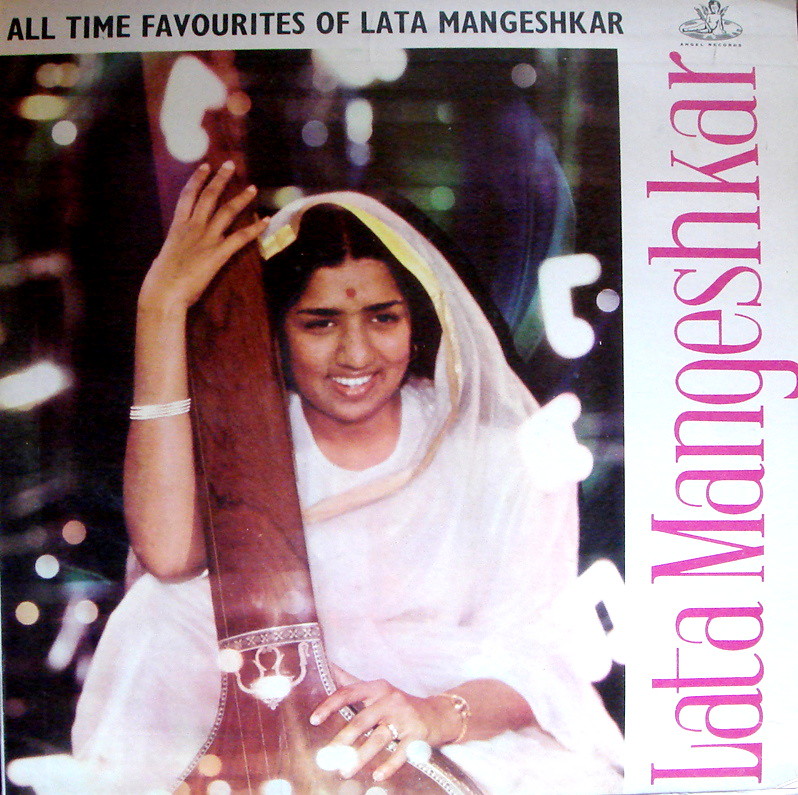
Ratnottama Sengupta sings her own paean in which a chorus of voices across the world join her to pay a tribute to a legend called Lata
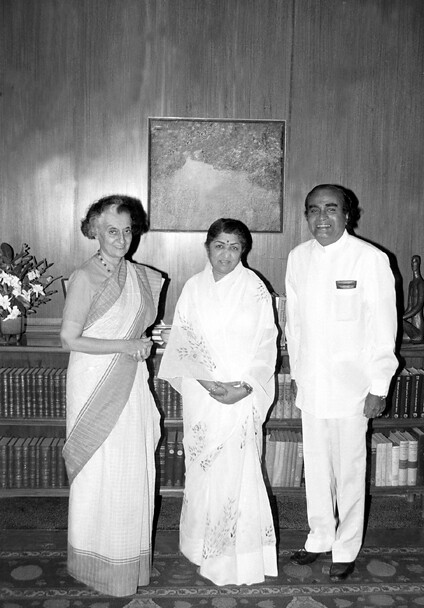
Lata with Prime Minister, Indira Gandhi and minister of state, NKP Salve, 1984Lata Mangeshkar: Courtesy: Creative Commons
She was a “pint-sized bundel of musical genius,” wrote the TIME Magazine. The melody queen of India was, they said, “a singer with moonlight in her throat.”
Dr Javed Iqbal was the former Principal and HOD (Surgery) in Qaid-e-Azam Medical College, Bahawalpur, the 11th biggest city of Pakistan. Until a week ago I knew its name only because of Bahawalpur House, the mansion of the former monarch in Delhi, which is now the National School of Drama in the Capital’s Mandi House area. But on February 6, 2022, I gained acquaintance with this surgeon courtesy Whatsap. I heard in wonder as he paid a personal tribute to the just demised Nightingale of India. And I bowed my head twice in deference to the legendary singer and then, to the doctor who, by his own admission, was no scholar of music, yet provided a unique significance of Lata Mangeshkar.
Let me translate what I heard him say in Urdu. “As you know, I’m a surgeon. And when I came to Bahawalpur, I introduced a number of new procedures which contributed to my popularity as Principal and professor. So, students came to interview me for the college magazine. They asked me, ‘Sir where did you learn such good surgery?’ I don’t know why but instantly I answered, ‘From Lata Mangeshkar.’
“The students were surprised, ‘How can that be? She’s not a surgeon! How can you master surgery from her?’ ‘Have you heard her sing?’ I asked them. ‘The way she clears the dues of each harf, every letter of the alphabet; the way she conveys the nuances of every word without erring on even a fraction of the note or messing with a beat – this is the artistry that should permeate the work of every artist. Just the way a single stroke of a painter’s brush can make the painting a masterpiece or can mar it, in the same way a single movement of the finger holding the surgeon’s scalpel, a single cut, a single stitch, a single dissection through a cautery can transform the entire operation into an exemplary art or spoil it for life.’
“Many years ago, it struck me that the way Lata Mangeshkar does justice to every inflection of her songs, should be the yardstick to measure any art. Every breath should transform your performance into the best of your ability. If you listen to any song by Lata Mangeshkar, you will realise that, if the word is written with a chhoti-ii (pronounced: ‘e’) then you will hear a short vowel; and if it is a badi-ii (pronounced: ee) you will hear a long vowel. If you hear ain you can tell that it is written with ain/ euyin and if it is the Arabic letter qaaf then you will hear the guttural sound. But at the same time not a single demand of the melody will be ignored. I’m not an expert nor a scholar of music – and in the past few years I have not been hearing her often – but I can say that this is one quality that makes her mumtaz – the Best.
“Today when she has passed away, I feel like sharing this: The reason why humans are distinct from other living creatures is that physicality is the dominant need of other animals whereas humans are driven by the combined needs of physicality, intellect, emotion and spirituality. The creature whose life revolves around physicality alone will end when Death comes. But the more a person’s intellect, emotion and spirituality contributes to his/her actions, the greater will be his/her claim on immortality. Death is inevitable, Death is mighty, but Death is only so powerful as to make the 5-feet-something Lata Mangeshkar disappear from the face of the earth. Death is not so powerful as to end her art and erase her voice and make her songs disappear. Because the Lata Mangeshkar who was a khatun, a 5-feet-something lady has passed away. But the Lata Mangeshkar who made her ‘The Lata Mangeshkar’ will never die…”
*
Kumar Gandharva (1924-1992), the late Classical vocalist whose signature style refused to be bound by gharana traditions, once said that “Often people ask about Lata Mangeshkar’s place in the pantheon of Classical music. In my opinion, this question is redundant, because there can be no comparison between classical music and film songs. While serious development of notes is the constant concern of one, fast beat and fickleness or agility is the main trait of the other.”
At the other end is Nitish Bharadwaj who is still revered for his much-loved evocation of Lord Krishna in the phenomenal serial Mahabharat. The actor has been like a brother to me since he debuted on the Hindi screen with Trishagni directed by my father Nabendu Ghosh. In his homage to the legend, he said, “Since her childhood Lata Didi has lived her life in pursuit of her art, as upasana, contemplation. Her career has not been to amass wealth, it has been as upasak, a worshipper or sadhak, devotee. Which is why she has succeeded in leaving behind thousands of songs for us…”
It is a fact that Lata Mangeshkar has more recordings to her name than any singer in the world. But it is not merely the number, it is the impact of the songs that astounds the world. I will quote an unidentified fan with whom my generation can easily identify. For she writes, “As a child you woke me up with Jago Mohan pyare (Rise my child, Krishna) and lulled me to sleep with Aa ja re aa nindiya tu aaa (Come, Sleep to rest in my baby’s eyes). You made me feel good as you sang Bacche man ke sacche (Children are born pure, with heart of gold). When you sing Humko man ki shakti dena, (Give us the strength to win over our mind) you take me back to my classroom. Solah baras ki bali umar (Sixteen going on seventeen), I experienced in your voice the blossoming of my first crush. Ajeeb dastaan hai ye (What a strange story, this!) stirred the deepest chord of my heart. Aaj phir jeene ki tamanna hai you gave voice to the abandonment of a spirit freed from bonding. And the countless times I heard Aye mere watan ke logon (Cry, O people of my land)tears flowed down my cheeks…”
Three days after Lata Mangeshkar bid adieu to sunlight, Rabindra Sarobar – close to my house in Lake Gardens – offered a unique proof of her abiding life. Let me share it in the words of Mudar Patherya, my secularist friend who initiated a revival of the lake by hosting morning concerts and inculcated pride in one’s neighbourhood by painting icons on otherwise defaced walls.
“DEAR LATA AUNTY,” he wrote on his FB wall, “this morning, for a change, we sang for you. Beginning with Allah tero naam, Ishwar (God are your names too) – we feel you are that too. Then, we went on to Naa jeyo naa (Do not go away), Lag jaa gale (Come, hold me in your arms), Rahein na rahein hum (If I’m there or I’m gone), Piya tose (My eyes have met yours, beloved) and others. We ended with Ai mere watan ke logo.
“We were a few. We took kalam, printouts of the lyrics. We read the words. Emphasised the huroof, letters of the alphabet. Sang from deep within.
“‘Singing for you,’ we said.
“Nobody said Wah wah, Well done. Nor kya gaaya, encore.
“But…
“One Sarobar walker stopped and joined us.
“Another doing his press-ups did not rise, easing into restfulness after the fourth.
“Rowers – members of the Rowing Club next door – came close to where we were sitting, lifted their oars and glided lazily for seconds.
“The lady walking purposefully said ‘Wait a sec’ to her husband and stayed till the end.
“A yogi, engaged in the specific type of controlled breathing called anulom-vilom,, dropped his fingers halfway and meditated.
“A lady, who was a part of our audience, closed her eyes and rocked gently.
“The surgeon who played the harmonium for us shook his head in a gentle parabola as if he’d just comprehended something new.
“The lady with a DSLR to shoot birds capped her lens and sat down.
“The stranger who chanced by perched himself on the durrie and asked ‘Gaaitay paari? Can I join in?’
“Schedules were interrupted, agendas disturbed, focus distracted.
“At the end, someone suggested something radical.
“‘Can we have this for the whole day?’ “
*
Don’t worry dear, I would say in reply. We will — for the rest of our lives.
.
Glossary
Khatun: A woman of rank
Aaj phir jeene ki tamanna hai: I want to live again today.
.
Ratnottama Sengupta, formerly Arts Editor of The Times of India, teaches mass communication and film appreciation, curates film festivals and art exhibitions, and translates and write books. She has been a member of CBFC, served on the National Film Awards jury and has herself won a National Award.
.
PLEASE NOTE: ARTICLES CAN ONLY BE REPRODUCED IN OTHER SITES WITH DUE ACKNOWLEDGEMENT TO BORDERLESS JOURNAL
Sometime in 1949 writer-director-actor Manoj Kumar had heard a young man recite these lines in post-Partition Punjab. The simple line had stayed on in his mind and almost two decades later he came up with the film Roti Kapda aur Makaan (food, clothes and housing). By then India had its third prime minister Indira Gandhi who had swept into the office in 1967 winning with a huge popular mandate on the wings of the slogan Garibi Hatao (Do away with poverty). The three tenets of identifying poverty then outlined were – yes, lack of food, clothing, and roof over people’s head.
These, needless to add, were the prime concern of millions who had been uprooted, disowned by the nation they so far knew to be their own, driven out of their ancestral homes with barely a change of clothes, spending days and nights in refugee camp queues for one square meal and perhaps the vaguest hope of some employment.
In 1949 the Constituent Assembly was already meeting but had yet to formally adopt the Bharatiya Samvidhan – the Constitution of India that came into effect on 26th January 1950, the day that is gloriously celebrated every year with a gratifying display of our military might and cultural wealth on the Rajpath of the Capital. Full seven decades ago the Constitution laid down a framework that delineates the fundamental code, the directive principles that would govern the political structure, powers, and duties of the government and its institutions – as much as it set out the fundamental rights and the duties of citizens.
We were perhaps receiving our first lessons in civics when Indira Gandhi stepped into the prime minister’s office. We learnt by rote the Preamble that asserts the solemn resolution of the People of India to Constitute the land into a Sovereign Democratic Republic that would secure every one of its citizens Justice – social, economic and political; Liberty – of thought, expression, belief, faith and worship; Equality – of status and opportunity; and Fraternity which would assure the dignity of individual and unity of the nation.
We were not, however, aware at that age that the two years before India gave itself the Samvidhan, nations of the world had united in declaring that recognition of the inherent dignity and equal and inalienable rights of all members of the human family is the foundation of freedom, justice and peace in the world. By the end of the barbaric World War II they had realised that disregard and contempt for human rights had resulted in the nightmarish acts that continue to outrage the conscience of mankind. By this time, universally, nations were keen to forge a world wherein humans would enjoy “freedom of speech and belief, freedom from fear and want.” These, it was proclaimed by one and all, were “the highest aspiration of the common man,” anywhere on the globe.
By the time the British left India to its destiny, the imperial power too had realised that, if man were not compelled to recourse to the last resort – rebellion against tyranny and oppression – then human rights ought to be protected by the rule of law.
So, in the Charter, the peoples of the United Nations reaffirmed their “faith in fundamental human rights, in the dignity and worth of the human person, and in the equal rights of men and women.” The Human Rights Declaration was, then, meant “to promote social progress and better standards of life for larger freedom.”
By proclaiming the Universal Declaration of Human Rights as “a common standard of achievement for all peoples and all nations,” member States of the United Nations had pledged the promotion of universal respect for and observance of human rights as fundamental to every freedom. Keeping the Declaration constantly in mind, they will “strive by teaching and education to promote respect for these rights and freedoms, and by progressive measures, national and international, to secure their universal and effective recognition and observance.”
*
When I read this, I am astounded that Nabendu Ghosh, writing five years before the Universal Declaration of Human Rights, was almost setting the charter for nations to follow once they lose the harness of imperialism and emerge out of the shadow of colonialism. “When, despite repeated pleas, a man is deprived of his basic needs, what else can he do?” – wonders the leader portrayed in the mould of a Gandhi in Bastrang Dehi (Give Me a Rag, Please). “Millions and zillion years of civilisation has taught him to cover his natural anatomy, today how can he forget that nudity is primitive and accept nudity as normal? How can age-old norms hold sway over dire needs?” the writer poses.
In the swiftly developing crisis that engulfs the entire community which is suffering the aftermath of rationing and subsequent profiteering in clothes, the village Brahmin Bhattachajji is not apologetic for wearing a lungi, the mark of a mullah: bhaagte bhoot ki langot bhali! – one could add the Hindi proverb to imply, when one is running to save one’s skin, even a loincloth is most acceptable (something is better than nothing). Profiteering, we realise before the end draws up, is the worst of crime against mankind, for it fishes in troubled waters.
The writer ends by describing two opposite reactions – one, of a leader; the other, of a common man. Nationalist Manish turns his face away from the howling surrounding the half-naked corpse of Harimati: the sight and sound was ridiculing his leadership, taunting the failure of his processions to procure more than false promises, mocking his manhood, he felt. But Teenkori, Harimati’s husband, does not cry. He is lynched, he is jailed, he becomes a thief in his attempt to procure a sari for his abused wife who eventually commits suicide – but no, he does not shed a drop of tear. He becomes vicious, a savage look descends in his eyes, his fingers tingle just as do soldiers’ when they confront enemies.
To me, representing a generation which has, since it started walking, celebrated Republic Day by singing paeans to the Hindustan better than the rest of the world, Bastrang Dehi brought home truths that no history book has ever taught. Yes, I knew about the Bengal Famine of 1943 that saw millions starved for the want of rice dying on the streets of Calcutta – the erstwhile capital of the jewel in the British crown. Yes, they were uprooted; they were compelled to leave their homes and hearth in the villages and flock to the city in search of a meal. Yes, I knew that they died of cholera and dysentery as they snatched food out of bins from the jaws of snarling dogs too. But did I know that clothes too were rationed, and sold in the black market, sending saris and dhotis beyond the reach of peasants? Once the ‘Quit India!’ slogan rang out, most Indians would not touch the clothes from the English mills while the British were sending everything — food and handloom clothings produced in the Province — to the Theatre of the War in the North East, where American GIs were joining British Tommies to beat back the Japs who were regularly bombing Bengal.
Nabendu Ghosh, a devotee of the Buddha, must have read this gospel. A disciple of the Enlightened One complained that one of his flock was indifferent to his sermons. He was sorely disappointed that Tathagata’s teachings were falling on deaf ears. One day the Buddha accompanied the disciple to the hut from where he had been shooed away. The Buddha offered the man a bowl of rice, then turned to his disciple and calmly said, “Could you see the man was starving? Truth can be served to him only in a bowl of rice.”
Ghosh derived the title of Bastrang Dehi from the popular invocation of Goddess Durga that rings through Bengal year after year after year, at the advent of the Autumnal Festival: Rupang Dehi, Jayang Dehi, Yasho Dehi Disho Jayee! ( grant me Beauty, grant me Victory, grant me Fame!) By adapting the prayer to seek something as mundane as a piece of cloth, the writer underscores that food, clothing and shelter may be basic individual needs, but if humans constitute society these must be enshrined as basic rights even before we enshrine political liberty, rule of law, equality of worship, freedom of expression… Else democracy and justice and other lofty ideals of human life will go for a toss.
Decades after the history books have changed the way we look at the past, why do I still cringe when I read Bastrang Dehi? Because I know that those who do not learn from history are doomed to repeat it.
*
I am certain Anshu Gupta has never read Bastrang Dehi. But ‘Give me cloth’ was the plea that had launched his journey with Goonj – and it has earned him the Magsaysay Award, World Bank’s Development Marketplace award, Mother Teresa award, NASA’S Game Changing Innovation, the prestigious Ashoka fellowship… they are still coming in.
What had spurred the young man and his wife to start Goonj with merely 67 items of clothings? The realisation that clothing was overlooked as a basic human right.Today the NGO registered under Societies Act and for exemption under several sections and for foreign contributions etc, deals with more than 3500 tonnes of material every year.
A real life incidence had prompted Gupta to start this arduous journey. One night, going home in Delhi’s winter, he met a three-wheeler scooter rickshaw driver, Habib. His rickshaw had this inscribed on its side: Laawarish laash uthaane wala (I pick up unclaimed dead bodies). Talking to him Gupta learnt that for every dead body Habib carried to the crematorium, he got twenty rupees and two metres of cloth. That, workload in winter was more than in summer.That, many underprivileged families don’t have enough clothes to stave off the cold. So much so that Habib’s little daughter Bano told Anshu, “When I feel cold, I hug a dead body to sleep. It does not turn around, it does not trouble me…”
Anshu Gupta deserves every single award that has come his way. For, unlike nationalist Manish of Bastrang Dehi, he did not turn his face away. That one meeting ignited in him the impulse to address the sufferings of millions due to shortage of clothing. He started collecting under-utilised used material, to maintain human dignity rather than to give them as charity. In the process he has triggered development with dignity across the land.
*
Saare jahaan se achha... I still sing on Republic Day, and I still sing Sakal desher shera amaar janma bhoomi Independence Day. But when I run into Anshu Gupta at a conference perhaps in Budapest, I hang my head in shame. I am elated that Goonj has clothed millions. But even today, if a Tsunami, an Amphan or a Yaas sweeps the shores of Midnapur or Sundarbans, a Kendrapada or Bhadrak, in Bengal or Odisha – even today, I hear the cries of women and men cry out, ‘Give me a rag, please!”
It is a cry to save their dignity.
.
Glossary:
Saare jahaan se achha… A song written by Iqbal in 1904 and adapted as a song for marching by the Indian army. Literally, translated to mean, the best in the world.
Ratnottama Sengupta, formerly Arts Editor of The Times of India, teaches mass communication and film appreciation, curates film festivals and art exhibitions, and translates and write books. She has been a member of CBFC, served on the National Film Awards jury and has herself won a National Award.
.
PLEASE NOTE: ARTICLES CAN ONLY BE REPRODUCED IN OTHER SITES WITH DUE ACKNOWLEDGEMENT TO BORDERLESS JOURNAL
How do we understand a land and its people? How do we look at its history, at a phase of turbulence which once ravaged the lives of its people? At the social structures rarely talked about? And how do we make sense of it? Can the perception be whole if only selective truths are voiced?
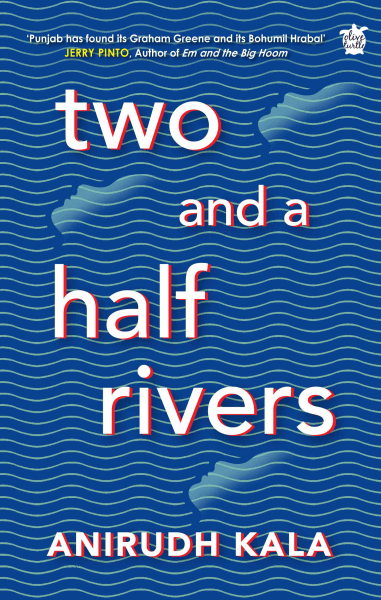
The Partition of India in 1947 had left Punjab with only two and a half rivers out of a total of five. From the early 1980s onwards, a state which had witnessed much violence and bloodshed at the time of Partition, began to be devastated by the spread of militancy again. This period of unrest spanning almost a decade was the time when common people, who had yet not recovered from the trauma of partition, faced the torment of not only terrorism but also counter insurgency. And though there are numerous reports on the violation of Human rights during counter insurgency in Punjab, both the Central and the State Governments have continually refuted such reports.
Two and a Half Rivers is a fictionalised account of those troubled years of Punjab through the lives of three main characters — a clinically depressed doctor, trying to take on life one day at a time, and Shamsie and Bheem, both Dalits, struggling to make their dreams a reality. Writing with keen perception, the author, Anirudh Kala, not only offers a striking account of the many ordeals that people went through that period and the solidarity which helped them keep afloat but also of the less addressed issue of oppression of lower castes and their sufferings.
Kala is a psychiatrist by profession. His aim is to educate people about mental health and mental illness, focusing on eradicating stigma, labels, and prejudice. His debut fiction The Unsafe Asylum: Stories of Partition and Madness was published in 2018. Two and a Half Rivers published by Niyogi Books is his second work of fiction.
In this novel, he juxtaposes the situation of state with that of the mental illness of the doctor who is also the narrator. As the fog of depression descends on his mind, the state is also veiled by the layers of sorrows and anxieties from which no escape seems visible. With the increase in terrorists activities, the rivers start filling with the dead again as if to devour those who had somehow survived the Partition. An increase in extortion, abduction and killing by the terrorists leads to the nabbing of common people on doubt by police. The custody, seldom resulting in the release of those apprehended. Jails become torture centres and those captured subjects of experiments for effective torturing. The unrest that follows compels Shamsie and Bheem to shift to Bombay in search of a peaceful life only to return back few years later in the aftermath of a crackdown on Dance bars.
Following the timeline of those difficult years, the author looks at the tragic events which made the ‘Punjab problem’ worse in succeeding years. He takes into account Operation Bluestar, the assassination of the Prime Minister (who he names as Durga), the pogrom of November 1984 and counter insurgency. The novel offers a commentary upon the inept tackling of the situation by the state including ruling dispensation and police. The narrator minces no words while observing that the State and Army had conveniently forgotten that there were to be a large number of pilgrims in the Golden Temple at the time of that operation as it was the celebration of the martyrdom day of a Sikh guru or that more common people began disappearing after the police chief announced incentives and rewards to curtail terrorism.
While the narrator narrowly escapes the custodial torture after being picked for alleged connection with militants, Bheem isn’t that lucky. His identity becomes the final noose around his neck. Shamsie suffers assault too, a punishment for escaping advances of an upper caste boy in her teenage. Whilst common people die and more disappear, Punjab is steeped in sorrow of losing loved ones from which only the tears of grief bring some respite. We are told that more than eight thousand young people have not come home, and never will.
With the poignant telling of this tale, the author also prompts the reader to ask why the lives of those from lower castes are far more easily dispensable, why are they inconsequential, why this malaise is so deeply ingrained in the minds of upper caste and why is it a normal way of life. In a religion which believes “Awwal allah noor upaya qudrat keh sab banday, aik noor toh sab jag upjaiya kaun bhale ko mande” (All humanity was born from a single divine light, and everybody is born equal. All are the children of nature, and no one is good or bad), how can there really be a discrimination based upon caste?
Sensitive is one word that can be best used to describe Kala’s writing. He writes not only from a place of awareness but perhaps also pain and anguish. His description of the distressed years of Punjab carries a rare sensitivity which warrants a deeper understanding of the place as well as its people. That he chooses to tell it through the lives of two Dalit characters, also bring forward his focus on the otherwise lesser talked about issue of caste discrimination in Punjab. The narrative voice is subtle and sometimes seems distant, which works well for the reason that it gives the narrative a sagacious tenor, making it compelling and very moving.
.
Rakhi Dalal is an educator by profession. When not working, she can usually be found reading books or writing about reading them. She writes at https://rakhidalal.blogspot.com/ .
.
PLEASE NOTE: ARTICLES CAN ONLY BE REPRODUCED IN OTHER SITES WITH DUE ACKNOWLEDGEMENT TO BORDERLESS JOURNAL.
Memoirs of civil servants offer a ringside view of the events that shape up a country. Of late, there have been several memoirs by civil servants of India. But this one is unique.
In the Service of Free India–Memoirs of a Civil servant by BD Pande has some of the best chronicles as India was in the formative years after she got freedom. In reverence to his wishes, the memoir has been published posthumously. It is a fascinating record of Pande’s own life and that of India in the half century after Independence.
Edited by his daughter Ratna M Sudarshan, the autobiography comes more than a decade after Pande’s death in 2009 at 92. The memoirs were penned between 1986 and 1999 and the family was instructed to publish these at least five years after his death.
B.D. Pande was the first person from Kumaon and Garhwal division to pass the Indian Civil Service (ICS) examination in London in 1938. In his thirty-nine years as a civil servant, Pande held many important offices in the state and central governments. He served as finance secretary, development commissioner and food commissioner in Bihar; chairman of LIC at then Bombay; and finally cabinet secretary to the Government of India from 1972 to 1977. The first person from Uttarakhand to be appointed the governor of West Bengal and later Punjab, President K.R. Narayanan conferred on him the Padma Vibhushan for his meritorious service to the nation.
Says the blurb : “In the decades following 1947, as the tallest national leaders were building a new India, they were supported by a band of idealistic civil servants fiercely committed to the country’s Constitution and its people. Among these remarkable officers was Bhairab Dutt Pande, a young man from the Himalayan district of Kumaon, who joined the Indian Civil Service in 1939. Over almost forty years as a civil servant, and later as governor, he played an important role in the country’s administration, and interacted with leaders like Indira Gandhi (as cabinet secretary during the Emergency), Morarji Desai and Jyoti Basu.”
Writes Pande in the preface: “Ever since I retired in 1977, people have been asking me to write my memoirs, even more so after I resigned as governor of Punjab in July 1984. I have also been approached by some publishers. But I always refused on the grounds that I have no talent for writing. I was a student of science and writing was never my forte. During my service, I did not write notes exceeding a page or page-and-a-half, no matter how intricate the subject. And more importantly, I kept no notes during my service or lifetime, kept no copies of important papers, letters or memos and therefore my recollections will tend to be biased. With the passage of years, one’s memory tends to play tricks and might even get facts wrong. Furthermore, I did not possess any means of rechecking what I have written from contemporary accounts or official records. For these reasons I never took up the pen to write.” Honesty at its best!
Pande chronicles several landmark events and initiatives that he either participated in or witnessed. He helped increase food-grain allotment to the state as food commissioner of Bihar in the early 1950s and drew up a new famine code as land reforms commissioner. His work in the Community Development programme some years later still has important lessons for today’s Panchayati Raj institutions. After retirement, he was governor of West Bengal during the resurgence of Naxalism in the early 1980s, and of Punjab in 1983-84—a tragic and turbulent year in the history of the state and the nation. Pande chose to resign as governor rather than carry out unconstitutional orders.
A trumped-up narrative about Punjab’s situation was built in the months leading up to Operation Bluestar in June 1984, leading to disastrous consequences. The five chapters in this memoir on Punjab offers an absorbing narrative of the behind-the-scenes events and negotiations leading up to the Anandpur Sahib Resolution and Operation Blue Star is of great value.
Pande, who had a front-row seat of the events, lauds the Sikhs as a community and is highly critical of the central leadership, especially PM Indira Gandhi, and some “Hindu hardliners and vernacular press for contributing to the false narrative”. He also blames the tussle between President Zail Singh and former Punjab CM Darbara Singh for the unfolding of the events. It is his view that many Sikhs had been the victims of attacks by terrorists, he writes, and whenever an incident occurred, the Punjab Police Intelligence was blamed even though they had supplied advance information.
Mark these dauntless words: “I have known people who, living in Delhi, were even afraid of coming to Chandigarh. Then from Chandigarh, if one went to the real Punjab — Amritsar, Jalandhar, or Ludhiana — one would find similar normalcy. Driving through the countryside, all was peaceful, with farming going on normally. The cities were bustling with activity. Factories were working normally, even schools and colleges. Hindus and Sikhs were walking together, visiting each other’s shops, riding together. The contrast between what one anticipated and what one actually experienced was vivid… I could not help but emphasize on this otherwise peaceful atmosphere.”
On the controversial ‘White Paper’ tabled by the Centre before the Army operation, Pande says he was not even consulted. He notes that Akali leaders of the time were divided. They came to meet him separately while other political parties came to one group. He has also questioned the official figures of casualties in Operation Blue Star. “The number of casualties among the terrorists and civilians was 1,200 (and not 700). Some 200 terrorists still got away. Blue Star did not achieve the desired result.”
For everyone who wants to know the truth behind the Operation Bluestar in Punjab, this is a de-facto account. The machinations by the central government of the time are revealing. The other chapters in this 300-paged memoir make for a fascinating read and give a privileged perspective on issues and their outcome.
Stimulating and exalting in coequal measure, this memoir, with photographs from the author’s personal album, is both a riveting record of an extraordinary life and an important and an informative document. There is also a detailed timeline to refresh one’s memory.
This book is a must-read for anyone who has been, is, or aims to be a civil servant in India and equally, for anyone who is interested in the history of the times. It is a candid memoir of past times, and the events leading up to them. The informal style of the memoir makes it effortless to read and transports the reader to that time period.
.
Bhaskar Parichha is a journalist and author of Unbiased, No Strings Attached: Writings on Odisha and Biju Patnaik – A Political Biography. He lives in Bhubaneswar and writes bilingually. Besides writing for newspapers, he also reviews books on various media platforms.
.
PLEASE NOTE: ARTICLES CAN ONLY BE REPRODUCED IN OTHER SITES WITH DUE ACKNOWLEDGEMENT TO BORDERLESS JOURNAL


 Borderless