Categories
Essay

A Life Well-Lived

By Candice Louisa Daquin

A life well-lived tends to be interpreted by cultural needs. In China, maybe it is portrayed as the accumulation of wealth and taking care of ones’ family; in Africa it may be about survival, integrity, and hard work; in Italy, possibly about how many friends you have, how often you laugh, if you feed stray animals.  No one country shares a defined concept of what a well-lived life looks like, but as we are more homogenized than ever before we’re all cross-influenced by other cultures.

The other day I was watching a travel documentary about The Silk Road. The idea of so many foreign countries we’ve never visited, nor know very much about, can be incredibly humbling. We talk in international terms; we talk as if we alone have the right to proclaim for the rest of the world. Even the most avid traveler hasn’t been steeped in a culture long enough to make those assumptions, nor have they visited every shore, every mountain, every tribe. As that is impossible, no one culture or group should claim to speak for what is a universal truth, there is no such thing. How can meaning being separated from being human, thus subjective?

Growing up I was deeply influenced by my mother. She didn’t live with me, but she wrote me letters from all parts of the globe she visited with amazing letterheads and stamps. Eventually this became more than an expensive hobby, she opened a travel company that published newsletters and books on high end travel. In my teen years, I might not have appreciated what she did from afar because I felt ‘high end’ was exclusionary, and it is. But despite this, I have grown to respect what my mom did, because it wasn’t for a living, it was for passion, and in this, I felt she has always lived her life to the full.

True, who wouldn’t like traveling for a living? In high end hotels? Isn’t she just another example of privilege? But she wasn’t. She created this from scratch, having left a highly successful career in media that she attained on her own merit. I think if it were not for my mom, I would not understand how far people can go if they are determined and hard working. It’s definitely why I work hard. However, my own journey has been vastly different. I found it challenging enough at times, to get through life, let alone to thrive. I recall my mom saying love what you do, feel passion in what you do! I felt I was missing a magical ingredient.

Eventually, health issues seemed to close that door to a passion-driven dimension, and I began to be more pragmatic. My thoughts were more along the lines of: how can I support myself and ensure I will have enough to survive? What can I do to overcome or compensate for my shortcomings in health? I lost the advantage of just being able to dream, because I had to survive, and sometimes for many of us, we simply don’t have the luxury to dream. That led me to understand, a life worth living is necessarily subjective. Unequal life chances versus individual effort play a bigger role in the outcome.

Even so, the question of what a well lived life looks like, is one worthy of examination. In the world there are women who are essentially still indentured to their husbands. There are castes and groups who will never be able to rise above other castes and groups because of their birth. There are those so poor they couldn’t attend school if they wanted to. I think of how the girls of Afghanistan will fare with the UK and US leaving and the Taliban gaining their former foothold. Will girls be safe? It doesn’t seem likely nor permitted their former right to education. I envision a similar outcome to what happened to women in Iran. And then there are the fabulously wealthy and the comfortable middle class. We simply don’t all have the same access to a well-lived life to begin with!

Within all these groups lie many variables, not least, our physical and mental state, our chosen career(s), where we live and how expensive it is to survive there. Then there’s just the fickleness of luck, who gets to live, who does not. To boldly state a life worth living is any one of these options, belies the truth of our differences. A child born with HIV may have a different life than one born healthy; a child born blind might have different outcomes than a child born with athletic prowess. Even then, one advantage may be nothing, we may need more advantages. To proclaim as self-help books and life coaches do, that there is one way, seems redundant and missing out on the diversity of our experiences. You can do everything right and still not succeed.

We get older and we think back and wonder, did I make the right choices, was this the direction I intended? Am I satisfied or disappointed? When we’re very young, these considerations are rarely as important, as such we simply experience. Maybe in youthful hedonism, we miss the very moment we should be thinking of the future. Some cultures do a better job of forcing their young to consider the future, such as Germany, who asks the very young to pick a career before they are even in their teens, to help mold an often vocational direction rather than leaving them to decide many years later when it could be too late?

For example, if you had a child, would you wish for the child to take philosophy or neuroscience in university? Which would be more likely to land them a secure job? This surely is part of our role as parents, to ensure our children will be financially safe when growing up. At the same time, we know the potential value of philosophy, but how translatable is that value in today’s world?

I grew up very aspirant-minded because my mom was very successful. Even as I didn’t live with her, I saw her as a role model and believed naively I could follow in her footsteps. There were many reasons I did not. The locations and cultures had changed. The times had changed as in her day it was easier to walk into jobs. By the time I was looking for work, there were thousands clamouring for fewer positions. Often people cannot understand this change because they only have their experience to refer to, but things change a lot, including what was possible and what is no longer possible. 

One might argue, then you just must be better, to do better. This is true in India, China (a Confucian principle) and many other Asian countries, where an excellent and high achieving work ethic coupled with a huge population, causes young people to be under more pressure than ever to attain those coveted positions. This causes one of the following two things as en masse more people do excellently, the bar gets pushed higher, and people from such countries can often cherry pick jobs in other countries because they excel; or a greater division between those who succeed (the minority) and those who traditionally speaking do not (the majority). It’s about sorting out the reality from the stereotype.

America, a country long thought to possess no caste or class system, perpetuates other countries’ histories by having a quiet class system that is denied by the mainstream but very alive. For many families with money, sending their kids to schools that will guarantee the best universities and thus, the best networking and jobs, there is an obvious bias. We talk of ‘The American Dream’, but for the majority, the advantages they are born into, play an equal if not larger role in determining their outcome.

This is partly why discussions about reparation exist, because if families that were traditionally exploited are now generationally paying the price by not having generational wealth and influence to hand down to their children, they come from a position of inequality and inequity even as the American dream continues to be touted. And if those families are mostly families of colour, even more so, as you must consider the racial injustice of the past, which has been carried into the future by this ongoing inequity. The same is true in other countries, the idea we’re born equal and thus, we all have the same chance at a dream is naïve at best.

But how much does this play into a life well-lived? Is it essential to be conventionally successful to achieve such a goal? I would argue it is not. Whilst there are basic essentials coined by Psychologist Abraham Maslow (Hierarchy of Needs) that must be met to even be in the running. In other words, if you cannot afford the basics such as healthcare, economic security, education etc, you’re still stuck on trying to survive. In that sense, it’s a luxury for most to even consider a life well lived, because they are too busy surviving.

Let’s assume however, some of us reach that position of being economically sound enough to consider beyond the mechanisms of survival. Then let us ask ourselves what is a life well lived? Should it be like that of my mother? Being somewhat hedonistic but, true to myself, by doing exactly what she wanted and traveling the world where she could expand. When she passes, will she have felt her life was well lived? I’m guessing she will.

That’s because of a process called reconciliation. One must reconcile one’s regrets or things we were judged for, and if we are able to do this (many of us fail), then we find inner peace. With peace comes a sense of no matter what, we did the best we could, we gave it all we could, we’re glad for the life we lived. In a sense, this summation of a life well lived, is rooted in our self-perception and then that perception projected into a larger context. It takes a lot to consider more than our immediate circle. Perhaps if we could, we would be less fractured as a planet. Less liable to turn the other cheek when atrocities occur,  or put our head in the sand and not think of future generations.

By coming together, universally, thinking in terms of all of us, not just as an individual, as touted so long by the West, we consider wholeness. Can we be whole if others are not? Should we be? And at the same time, not going so far as to lose a sense of ourselves or be merged into a homogenised, possibly too socialised loss of self? In other words, balance.

As you age you realise what mattered then doesn’t matter as much now. Or maybe, you come to realise that what you have always cared about, still matters. For myself, I am very different from my 15-year-old self, where I lived relatively hedonistically, caring about animals and injustice, but not doing enough about it. I see that at 15 , I thought mostly of having fun and generally being a little unrealistic about life. Some 15-year-olds aren’t that way. Why do some children grow up responsible and mature before their time, whilst others can be 30 and still fail to launch?

We can blame parenting, modern society, all sorts of things, but it’s probably more complicated than that. In Japan, many young people are literally shut-ins, (known as hikikomori) living on the cud of their parents income, rarely leaving their room, immersed in an unrealistic life, mostly online. Why do so few Japanese marry or have relationships comparatively speaking? Did the parents mess up? Or is this a symptom of a bigger sense of futility and despair felt by the young because some do think of the future?

I recall as a child I was unrealistic in my expectations, I truly thought I could do anything, be anything and this just wasn’t an honest evaluation of my situation. For some children, they knew they would be dentists at fifteen. For others, they did drugs and lived lost lives, before reinventing themselves. That’s the luxury of youth. But it’s not a permanent state. When you are older you realise, there isn’t as much time to ‘do anything / be anything’ and maybe that’s why I find some self-help/life coaches a little jarring. How long can we ‘do anything’ for realistically? Especially now, where different types of jobs are less than ever before, we’re being asked to homogenise into ever decreasing employment options. Many graduate law schools, formerly considered the pinnacles for employment, find no openings in an already saturated market, but should we doom a child’s dream if that’s what they want to do? The labour market doesn’t have a skills gap, it has an opportunity gap.

Many young people want to be famous, emulate some truly scary people, be unrealistically rich and have celebrity status. Less people want to heal, they want to make big bucks. Maybe they have it right. After all, when we do altruistic things but remain poor, how good does that feel when we can’t afford a car? With price hikes, standard of living seems to be improving because people have technology, but actually, we’re more in debt, without savings and living on a razor’s edge. Which might work at 25, but at 45 with children ready for college?

Again, I hark back to ‘balance’ and the need to live within one’s means, to have dreams that are capable of being pursued, and to help our kids dream up realistic jobs. The younger generations do not have the inherited wealth of the older, and immigrants often come with nothing to a country, depending upon the charity of that country, which is shrinking as our social services are overwhelmed and underfunded, even as immigration is on the rise.

Is the answer to print money? As has been discussed among Democrats? Or tax the rich and risk them leaving? Or is that a myth? With Covid 19 recently closing everything down, many formerly low wage workers were given monetary Covid compensations due to extended unemployment, which ended up being more than they were making as a badly paid waitress or shop worker. With some of those jobs vanishing forever, those that do return, see no employees willing to work for those wages again, and rightly so. But can we sustain a country if we pay what economists would consider a living wage? When $15 is already too little for someone to live on once tax and benefits are removed.

Increasingly we’re seeing a rise in people who fall through the cracks, they are the invisible workers whom we don’t know about, the underemployed, the fragile self-employed. That micro economy might not even show up on official statistics but look around, it exists. How likely can those people consider retiring in 30 years’ time? Can we blame those generations who are trapped by a system that doesn’t make it very likely to find an American Dream and what of the rest of the world, where survival comes long before the luxury of dreaming?

Where in this do we find concepts of lives well-lived? I think no such thing exists fundamentally but individually as we age, we should consider are we congruent to our concept of what a life well-lived means to us? Can we do anything to get closer to it? If so, what?

Recently I thought about this a lot and realised struggling with my health was my tipping point. For some that’s not their tipping point. A friend of mine said hers was losing her home. For me it was being told I was developing premature Macular Degeneration and with no treatment for Dry MD would lose my sight whilst still young. Facing those kinds of things forces us to consider what matters, what does not, and really think about how we value existence.

When I talk to people today, I recognise the value of clarity of purpose. When we know how best to direct our lives, we can spend more time on being the kind of person we want to be, rather than picking up the pieces from a series of failed impulses. If we remember how lucky we are to even have choices, when so many do not, even reading this on a computer puts us in a position of privilege, so rather than lamenting about what you do not have, consider what you need to live a life worth living and then do your best. Even half-way there might be enough to one day say, I have lived a life well-lived.

 .

Candice Louisa Daquin is a Psychotherapist and Editor, having worked in Europe, Canada and the USA. Daquins own work is also published widely, she has written five books of poetry, the last published by Finishing Line Press called Pinch the Lock. Her website is www thefeatheredsleep.com

.

PLEASE NOTE: ARTICLES CAN ONLY BE REPRODUCED IN OTHER SITES WITH DUE ACKNOWLEDGEMENT TO BORDERLESS JOURNAL.
Categories
Review

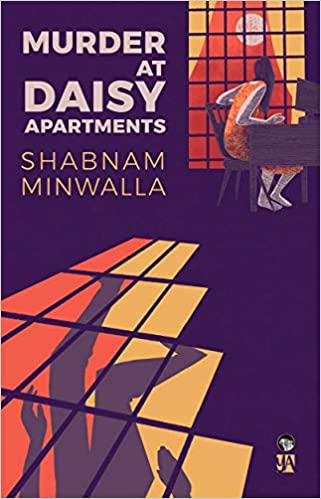
Murder at Daisy Apartments

Book Review by Gracy Samjetsabam

Title: Murder in Daisy Apartments

Author: Shabnam Minwalla

Publisher: Speaking Tiger, 2021

Murder in Daisy Apartments (2021) by Shabnam Minwalla is a young adult murder mystery story set in Colaba, Mumbai, India during the COVID-19 lockdown days.

Shabnam Minwalla has worked as a journalist with the Times of India. Her debut novel, The Six Spellmakers of Dorabji Street (2012) won the Rivokids Parents’ and Kids’ Choice Awards. She writes children’s fiction now. She has written a number of children’s story books including the Nimmi series, and a forward to an edition of Little Women brought out by Speaking Tiger Books.

Murder in Daisy Apartments starts on the forty-third day of the lockdown when 78-years-old Mr. Sevnani a resident of Lily Apartments, who had a bad heart, and an even worse temper was mysteriously hospitalized. The emergency that led him to be rushed to the hospital did not come as a surprise to the residents. Sevnani’s case was one in which a swarm of men wearing masks and sinister blue safety suits took him away in an ambulance.

But it happened again. On the forty-fourth day, a BMC (Brihanmumbai Municipal Corporation) van drove to the housing complex to pick up a dead body. People grew apprehensive. The shock deepened as residents came to know that Raghunath, a long-time resident of these apartments had been evicted by Baman Marker, the Chairperson of the Daisy and Lily Apartments as he had tested corona positive, and the complex had been declared a containment zone. During such severe lockdowns, movements were restricted.

On the forty-sixth day, Mr. Marker was found poisoned in his apartment. Since he was murdered during the pandemic lockdown, the killing could have only been masterminded by a resident of the complex. Nandini Venkat, a 15-year-old murder mysteries enthusiast, who calls herself and her twin brother as “standard issue South Bombay brats” is glued to the details of this “OMG (o my God) moments” in the history of Daisy and Lily Apartments. She joins the dots to detect and solve Marker’s murder mystery. Honing her investigative skills, with keen observation of people and the chronology of events, Nandini turns into a detective on the fiftieth day of the lockdown. Her sunny, social and festival loving brother, Ved, and her best friend, Shanaya, join her to find out more about this mysterious death.

Who could have murdered Baman Marker? Was it the Kurians, the Carvalhos, the Khambatas, the Habibullahs, the Lambas, the Burmans, the Kapadias, Lina Almeida, Maria, Alfonso, Mr. Shetty or Chemmen Saab? Who was the mysterious man that Mrs. Kurain saw early in the morning of the fateful day? Whose were those “black legs” that Nandini spotted climbing up and down the stairs on the night of the murder? More questions assail Nandini and the air gets thicker with thrill, nervousness and excitement all at the same time. Ved sings in a low voice:

"Beware, beware, he’s out and about, 
So be careful ’bout the rumours you monger, the panic you spread. 
The Big Bum’s at the door, revenge cooking in his head."

Ved and Shanaya make the best investigating team with Nandini. Nandini’s “LIST OF SUSPECTS—Means, Motive and Rating” tactfully streamlines the possibilities of finding the murderer. The strong suspects in the list includes Mr. Carvalho, Daniel’s father and a physics teacher who took crazily expensive tuitions and has a shady history; Amrita Aunty, Shanaya’s mother, who had had major disagreements with Marker; old and mean retired principal Lina Almeida, the granny gruesome who makes fabulous immunity boosting juices and detox smoothies; Marker’s chartered accountant Ranjit Burman with whom he had a nasty fight some months back; the secretly courageous Rashida Habibullah; and, the aged and immobile Mr. Alimchandani, who had long-buried secrets.

Amidst the fearful environment of death and pandemic in the Daisy and Lily Apartments, Minwalla beautifully brings out the characters of the young investigators and the residents with many details. The role of internet and social media during the pandemic and in the present day is infused in the narrative. For instance, she has highlighted the unavoidable participation in the Apartment’s WhatsApp groups of adults, where daily updates that thrive with rumours or gossips and the Daisy-Lily kids’ group for the children who discuss school, crushes, movies, people and latest information. Nandini and Shanaya discuss TikTok and Instagram followers, zombie teenagers addicted to social media, FOMO, Zoom call with school friends, Netflix and WiFi connections. Nandini on the verge of solving the mystery says, “My mind will be thinking about nachos or the red boots on sale in H&M, while my fingers pick up my phone, click, swipe, click.”

Minwalla also uses subtle humor to make the story a delightful read. This is evident in the children calling Mr. Sevnani “the Abominable Snowman”, or in imagining Baman Marker, the shrewish Chairperson of Daisy and Lily Apartments as “an arch criminal—a sort of Macavity the Cat” or “SoBo version of Kaa the python” and more. Minwalla’s use of phrases like ‘Work from Home’, disowning someone, sealed apartment, social distancing, stay safe, compulsory registry of visitors, tested corona positive, online meetings, and mental deterioration, instantly connects us and sheds light on the shift in the usage of language for depicting the pandemic. Nostalgia, empathy, magic and mystery mingle as one reads with a sense of enjoyment, revelling in the suspense-filled clandestine moves taking the mystery forward.

Murder in Daisy Apartments is entertaining and organically Indian. It gives a flavour of Mumbaikars to those willing to step into a local residential complex and mingle with the residents.

.

Gracy Samjetsabam teaches English Literature and Communication Skills at Manipal Institute of Technology, MAHE, Manipal. She is also a freelance writer and copy editor. Her interest is in Indian English Writings, Comparative Literature, Gender Studies, Culture Studies, and World Literature. 

.

PLEASE NOTE: ARTICLES CAN ONLY BE REPRODUCED IN OTHER SITES WITH DUE ACKNOWLEDGEMENT TO BORDERLESS JOURNAL

Categories
Essay

A Prison of Our Own Making

The massive impact of a minuscule virus has been felt around the world, but what has it done to our sense of freedom and independence, asks Keith Lyons

Study of Sea and Sky, Isle of Wight by Turner (1775-1851) Courtesy: Creative Commons

The Covid-19 pandemic, which continues to ravage the world, has been like a mass experiment. The shared experience of apprehension, despair, and hope has highlighted the inter-connectedness of everybody and everything. 

Paradoxically, to combat the virus, we’ve had to give up something of our own selfishness and desire for the status quo, to unite and work together with trust that others will do the same. And we’ve had to keep our physical distance, while at the same time forging deeper bonds and more honest communication. It has been both an outer journey through these times — or more of a non-journey in being locked-down – as well as something of an inner journey as we reflect, discover what’s really important, and re-orient our lives. 

The mass experiment has revealed so many different approaches and coping mechanisms, and the reality that there is no escape, for the way out is through. Even the milestone of being personally vaccinated is no longer the endpoint, as the broader consideration is that we human beings are only as strong as the weakest link, and until everyone has trained their immune system to combat the Covid virus, its continued existence threatens us all. 

One lesson from the mass experiment on 7.674 billion people is that things will never be the same again, and that we won’t get back to the normality of pre-2020. The deeper learning from the event is that life means change. And everything is in a state of flux. As the world churns, we must find ourselves again, and realise that amidst disruptions we can still find our centre. 

There is much talk about resilience: the ability to adapt well to any challenges faced. Resilience isn’t just a personal outlook or habit. And it isn’t about being tough, having endurance, going it alone or taking on the mantra ‘think positive’. It is said those who are ‘resilient’ aren’t so despite pain, struggle and failure, but because of it. 

As we move out of stay-at-home lockdowns and into vaccination clinic queues, and then into the new world post-pandemic, towards the politicians’ goal of ‘business as usual’  and the announcement of ‘Freedom Days ’ at long last, perhaps the truth will eventually dawn on us: that we were always free. 

American writer William Faulkner, who lived through the influenza pandemic of 1918, noted in one of his letters, ‘It’s queer how the people one thinks would live forever are the first to go’. 

The novelist wrote, ‘We must be free not because we claim freedom, but because we practice it’.

Keith Lyons (keithlyons.net) is an award-winning writer, author and creative writing mentor, who gave up learning to play bagpipes in a Scottish pipe band to focus on after-dark tabs of dark chocolate, early morning slow-lane swimming, and the perfect cup of masala chai tea. Find him@KeithLyonsNZ or blogging at Wandering in the World (http://wanderingintheworld.com).

.

PLEASE NOTE: ARTICLES CAN ONLY BE REPRODUCED IN OTHER SITES WITH DUE ACKNOWLEDGEMENT TO BORDERLESS JOURNAL

Categories
Review

Transforming Banking Practices

Book Review by Bhaskar Parichha

Title: Transformational Leadership in Banking

Author: Multiple. Edited by Anil K. Khandelwal

Publisher: SAGE Publications/ New Delhi, 2021

India’s banking system, as it has evolved in the past two hundred years, is a mixed bag. It has cooperative banks, domestic financing institutions, scheduled commercial banks, regional rural banks, pre-reform traditional private sector banks, tech-savvy private banks, and foreign banks. One can add to this protracted list are the newer entities — small finance banks, payments banks, and the large number of mobile applications.

Even as India’s banking sector has expanded tremendously in the past few years, there is a lot to be desired from these financial institutions. Banks have, of late, been the government’s whipping boys, and the so-called reforms have only been half-baked. Bank mergers have taken place but they are yet to show up on their balance sheets.

While Non-Banking Financial Companies (NBFCs) have grabbed the space vacated by commercial banks, financial stability of banks is at crossroads. Monitoring and supervision have fallen drastically, reflecting in the persistent growth in Non-Performing Assets (NPAs). Post -Covid, there is an unfathomable shadow on India’s banks. It is in this scary backdrop that this book carries enormous importance. Transformational Leadership in Banking: Challenges of Governance, Leadership and HR in a Digital and Disruptive World by Anil K. Khandelwal comes in handy for the beleaguered leadership of the banking sector.

A thought leader, author, international speaker on leadership and governance, Anil K. Khandelwal is an acclaimed authority on human resource and leadership in the banking sector. He is a rare transformation leader. Transforming Bank of Baroda from a staid Public Sector Banks (PSB) to one of India’s most valuable international banks won him many awards, including the Asian Banker Singapore’s Lifetime Achievement Award. His brand of human resources leadership and its application in business turnaround also won him the Lifetime Achievement Award from the National Human Resource Development Network. He also chaired the government-appointed committee on HR in PSBs and was a member of the first Banks Board Bureau for banking reforms and selection of whole-time directors.

The book, as the blurb says, “offers a roadmap on leadership which is all about converting adversity into an opportunity for transformation. Through an excellent set of articles, case studies and interviews, this book offers a way forward for transformational leadership of the Indian banks.” Despite their many achievements, public sector banks continue to face several challenges, such as increasing non-performing assets, depleting market share and low market capitalization.

The volume is comprehensive because it deals with almost all aspects of Indian banking. With a Foreword by former Comptroller and Auditor General of Inida, Vinod Rai, the book has three parts. In part I there are essays from academics and practitioners. Part II deals with case studies. The last part deliberates on perspectives from experts. With  more than thirty chapters — each chapter contributed by a doyen in the banking sector and the academics — the 500 plus page book is clearly laid out with  sections on governance, leadership, human resources and of course the future of the banking environment

In the introduction, Dr Khandelwal writes: “The book comes at a time when Indian banking is undergoing crisis.” It gives a strong message that banks become robust institutions by addressing governance, leadership, talent and culture. The author’s argument is that the banking sector is likely to remain in a perpetual crisis mode, unless these measures are initiated immediately. 

The book, as the titles suggests, is on leadership in banking. Evidently, it has chapters on changing context of governance and leadership in public sector banks, the digital revolution, future of work in BFSI (Banking, Financial Services, and Insurance) organisations, human capital and ethical bank governance, leadership choices in building better governance in the context of regulation or culture, strategic human capital management and banking governance (unexplored symbiotic relationship in PSBs), honoring legacy while embracing evolution: (the ethics narrative in State Bank of India), leadership experience and fifteen actionable insights from the trenches, organizational transformational and an agenda for Indian banks, coaching and mentoring in the backdrop of the unsung and underutilized warriors of leadership development, grooming leaders in public sector banks, crafting and living in  bank culture et al. 

There are also some illuminating pieces on leadership in times of crisis. For example, lessons from COVID-19. Employer branding to build human capital advantage, trade unions in the digital economy, skilling  a new currency,  a new manifesto for chief human resource officers in the era of digital change, wellness and yoga investment for the bankers,HR as strategic business partner in SBI ,sustainable people processes and leadership development in Bank of Baroda, the human resources story of ICICI Bank, digital transformation of HR at Union Bank of India, fear psychosis in the executives, and  bank directors require training in specific areas of technology are the other chapters which make a value addition to the book.

In the context of competition and digitalization requiring new business models, the book argues for a fundamental shift in the structure and process of governance, including board-level autonomy, CEOs tenure and compensation, people process, talent development and building a leadership pipeline, to make banks resilient and future-proof. 

Transformational Leadership in Banking is both well-timed and edifying. With admirable standpoints on the issues of authority, management and HR in a digital environment, the book is a clear blueprint for makeover and restructuring. The book is, mostly, meant for public sector banks, and will be of immense value to policymakers, regulators, board members, CEOs, researchers and to all those who are  in  the leadership roles and the public on the whole. 

Dr Khandelwal’s book makes an overriding case for crucial and cohesive reforms in India’s banking sector. It offers timely solutions by focusing on several issues. A must-read for anyone interested in the well-being of Indian banking.

.

Bhaskar Parichha is a journalist and author of No Strings Attached: Writings on Odisha and Biju Patnaik – A Political Biography. He lives in Bhubaneswar and writes bilingually. Besides writing for newspapers, he also reviews books on various media platforms.

.

PLEASE NOTE: ARTICLES CAN ONLY BE REPRODUCED IN OTHER SITES WITH DUE ACKNOWLEDGEMENT TO BORDERLESS JOURNAL

Categories
Essay

Here, There, Nowhere, Everywhere

Did life change or did I change from the events of the last year,’ ponders New Zealander Keith Lyons who was in the southern state of Kerala when the first cases of Covid-19 were detected in India last January.

Everything shifted last year. Priorities. Energies. Focus. 

Well, actually, there wasn’t much focus for me last year. For much of 2020, I felt unfocused, scattered, reactive. I was not achieving peak performance or being proactive going forward, if we were to use business language. I doubt if I was being the best version of myself either. I definitely needed to ‘pivot’, whatever that meant. 

What was initially a short holiday ‘back home’ to catch up with family and friends turned into something without a clear ending, as it dawned on me maybe I wouldn’t be travelling again for years perhaps, why, even ever. 

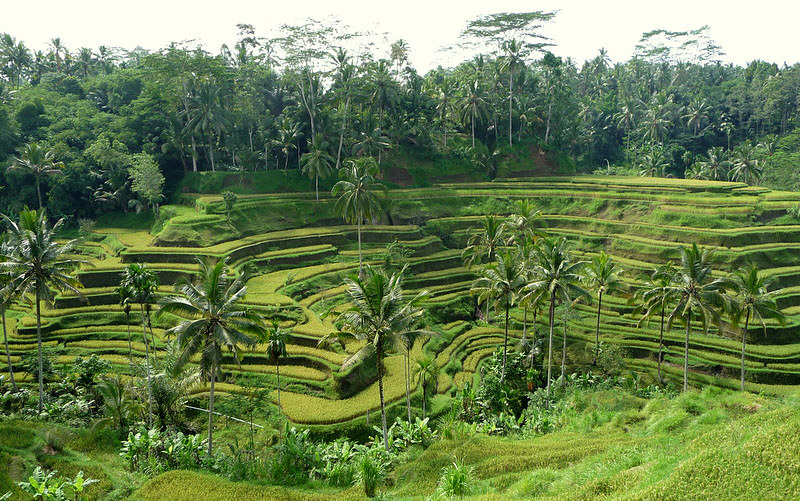
Usually, by May, I would be like the snowbird and migrate to warmer climes. I would head to my base in Bali’s Ubud, and then later in the year to southwest China and Myanmar, the three locations in Asia where I have caches of cotton shirts, swimming goggles, cycle shorts, hot water kettles, tea strainers and rice cookers. 

By November, I would surely be back in the country termed ‘the land of mystery, mysticism, mythology, miracles, multiculturalism and mightiness’ — India. 

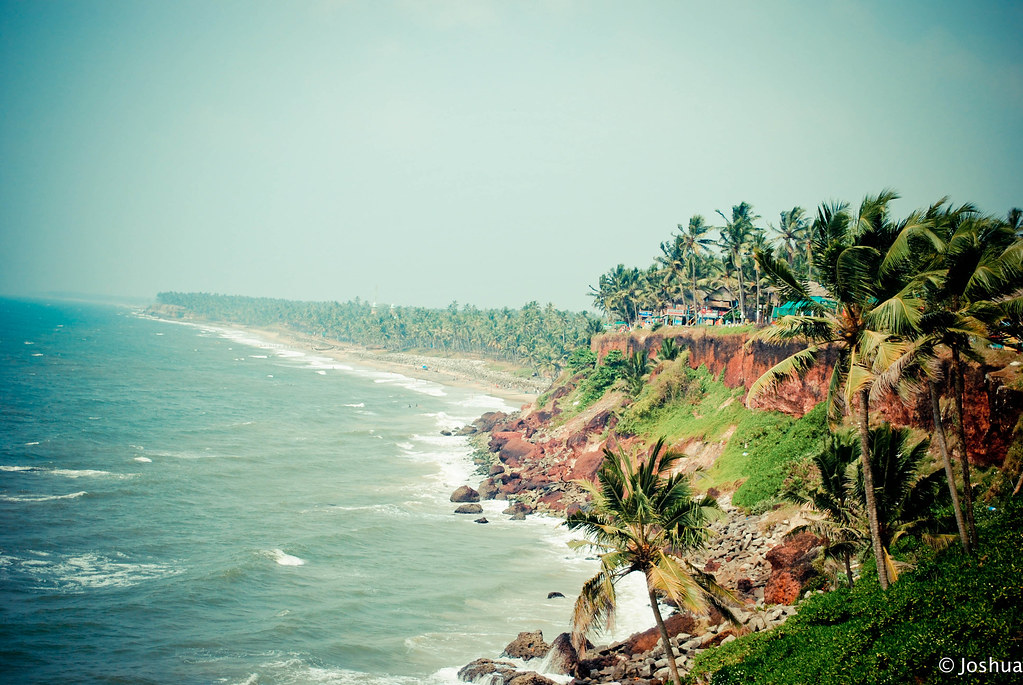
When I left Kerala’s Varkala Beach near Thiruvananthapuram in February last year, after my last dip in the warm breaking waves, I always thought I would be back for chai at one of the cliff top cafes overlooking the gleaming ocean, the lunchtime Rs.90(US$1.25) thali at True Thomas and falling asleep to the whirl of the fan and the shushing of the Arabian Sea. 

But it didn’t happen last Indian winter, and I doubt if it will happen this year or even next. The seasons turn, the tides come and go, the waves roll onto the main Papanasham beach and the less-visited Black Sand beach. True Thomas is ‘temporarily closed’ according to Google. In fact, the Kerala beach destination was already impacted by Covid-19 in March 2020, when an Italian tourist visiting for a fortnight tested positive for the virus. The English boss of Coffee Temple Cafe had got in trouble with authorities for his blackboard offering of ‘Anti-Coronavirus juice’ (150 Rs) made from ginger, lemon, gooseberry. 

I wonder how the Tibetan and Nepalese who work in eateries during the season, November to May, are surviving. 

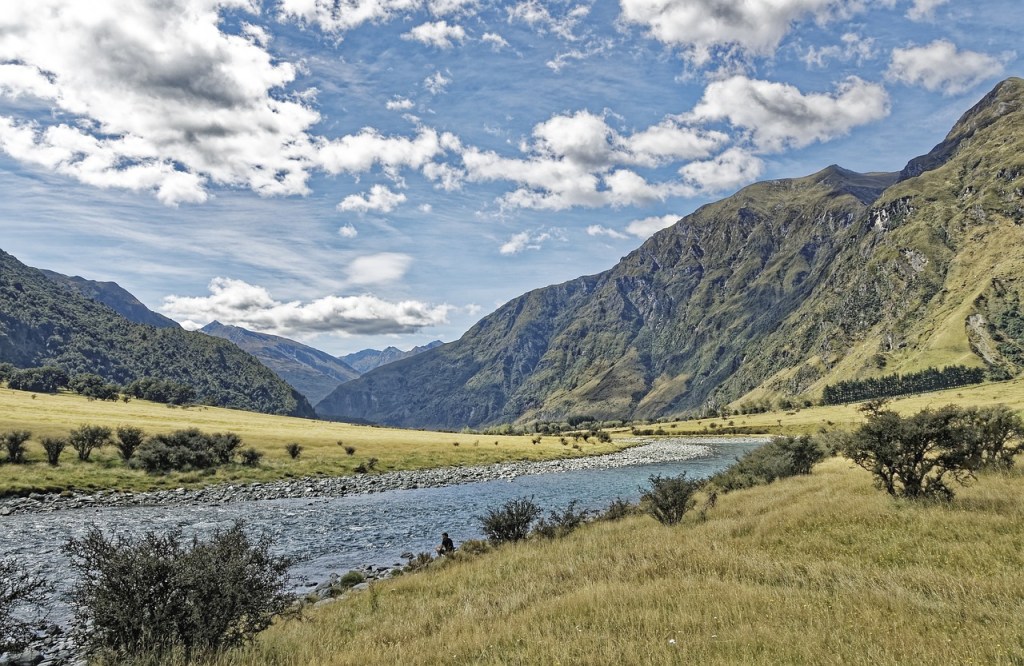
Mid-2020 I found myself unable to continue my digital semi-nomadic existence of following mild weather and hopping on AirAsia flights I’d booked up to a year earlier. Instead, because of travel restrictions during the pandemic, and my own wish to stay safe, I was lock-downed in my hometown in New Zealand, cohabiting with my parents in the house I’d lived in since aged eight years old.

A friend on Facebook sent me a message saying she couldn’t wait to walk down the aisle, with a photo of an aeroplane aisle. Another sent an image showing the perfect Covid-19 sport which requires masks, gloves and 2m distance: fencing. 

In the post from China, I received a couple of full-face snorkelling masks. In between the time of ordering and the arrival of the goods, on YouTube, there was a video on how to convert to meet the N95 respirator standards, or how to modify for use as an emergency interface with a ventilator. Researchers even had a paper in Nature about using Decathalon snorkelling masks. I wouldn’t believe much else on Youtube. What a shame that many do. 

From Bali last year, there were claims that it was one of the safest places in the world as the recovery rate was high, and mortality rate low, compared to other places. This was attributed to a mix of sunshine, high temperatures, and a better (superior) immune system. 

Sound familiar, my friends in India? Later someone posted a graph showing exponential growth, with the caption ‘Bali, what happened?’ 

New Zealand, as it turns out, has been largely protected from the ravages of Covid-19, thanks to closing the borders, a short lockdown, and citizens acting together as a ‘Team of 5 Million’.

This time last year I went on lots of walks, I gazed at cloud formations, and watched sunsets. I cut down scraggly trees, sorted through books, and gave away many of my parent’s possessions as part of downsizing. Of the bounty of childhood books I distributed, one was the beguiling ‘The Owl and the Pussycat’ by Edward Lear, penned 150 years ago, which my father would read to us when we were young:

The Owl and the Pussy-cat went to sea
In a beautiful pea-green boat,
They took some honey, and plenty of money,
Wrapped up in a five-pound note …

I even sold the family silver. 

My parents didn’t get Covid, and just last week, got the first of two Pfizer pricks in the upper arm (so far, only 10% of the population in New Zealand have received their first shot). 

What changed dramatically was their circumstances. An operation in hospital for my 85-year-old father to reverse a previous insertion of a stoma didn’t work out as expected, and in late June last year the one night back home after his surgery proved to be his last night in the house they bought in 1976. He left in the back of an ambulance. He is now in hospital-level care in a rest home, and his wife, my mother, lives nearby in a retirement village. 

Before his surgery, they considered selling the house and moving to the retirement village together, but undetected earthquake damage from 2010-2011 was discovered by the real estate agent, and I had to initiate a claim to have the damage repaired. 

Being back home, many things were familiar, some things had changed, a few things were strange. I had become the parent of my parents. My days revolved around sorting out their problems. Instead of my independent existence and free lifestyle, I found myself taking on family responsibilities. Yet I was glad that in a time of need, I had been there to do the things they couldn’t do easily. 

The year 2020 was unprecedented (and UnPresidented), with so many unknowns, so many surprises. Sharing a birth date with a friend from journalism school, we went for dinner with her family. Little did I anticipate it was the last time I saw her husband, a blood doctor, who died suddenly during a video consult with a patient. 

My side hustle — a small travel agency working with ethnic minorities in southwest China — got its first inquiries in June last year. Several guides urged me to keep it open, as it was their main source of income. Before that, I hadn’t received any inquiries for the first part of 2020.

Several of the publications I usually write for have gone into hibernation, and some projects are on hold indefinitely. Before a job interview last week, I had to reflect on what I have been doing with my life. Or at least, the last 15 years. 

But what do I do these days? I swim most days, some days join a friend at the gym who wants to improve his heart. I drink one cup of coffee a day, recently, made from green coffee beans I’ve roasted in a popcorn machine. At least once I week I go out to have an Indian meal. This week it was a Kerala thali of a dozen delicious parts. Last week my friends ordered a family dosa, which had to be carried to the table by two waiters. 

My parent’s house is now my house, and each day I attend to its restoration and renovation, learning new skills of skim-coating, tiling, and concreting. Each month I get an email reminder that most of my AirAsia BIG Loyalty points are expiring soon.

Spending time with those I love is more important for me these days. We speak more frankly about what really matters. I’ve even started attending Death Cafe events, where anyone can share about their fear of death. 

Through it all, I feel like I am becoming a better friend to myself. I am my own guru. I am my own Jedi Master — it was just that I didn’t realise it before. I’ve learned to better cope with the challenges of life. As Jedi Master Yoda once said: “Named must be your fear before banish it you can”.

All I have to do is breathe. Breathe in. Exhale. Repeat. 

Last year, just a week after traditionally the coldest day of the year (one month after the shortest day), I saw my first golden daffodils, the yellow trumpets signalling that the winter had been mild, and that the warmer days of spring were not far away. 

Today on my way to the swimming pool, weeks before the solstice, I spied a row of daffodils in a neighbour’s garden and had to smile. I don’t know what the future holds, and I acknowledge that things will not return to normal like before. Yet I walk on, carrying in my heart hope, not so much as wishful thinking or expecting a positive outcome, but knowing that whatever the rest of 2021 and beyond throw up, no matter how disruptive, that the only way out is through it. 

Keith Lyons (keithlyons.net) is an award-winning writer, author and creative writing mentor, with a background in psychology and social sciences. Keith was featured as one of the top 10 travel journalists in Roy Stevenson’s ‘Rock Star Travel Writers’ (2018). He has undertaken writer residencies in Antarctica and on an isolated Australian island, and in 2020 plans to finally work out how to add posts to his site Wandering in the World (http://wanderingintheworld.com).

.

PLEASE NOTE: ARTICLES CAN ONLY BE REPRODUCED IN OTHER SITES WITH DUE ACKNOWLEDGEMENT TO BORDERLESS JOURNAL.

Categories
Lockdown Stories

The Arangetram or the Debut

By Sheefa V. Mathews

Pavithra skipped into the apartment wearing a mask of blue denim. Everything about her was quick and she seemed to be float on a restless bubble of energy. 

Amma! The dress rehearsal went very well! I can’t wait for tomorrow.”

Savitri looked at her daughter and could not help but feel a surge of maternal pride. Pavithra had worked so hard. During the lockdown she had continued working on Zoom with her teacher all for the arangetram which was to be the next evening. They had been through a trying two months of lockdown due to the pandemic, but restrictions had eased a month ago and she had resumed classes with social distancing. It was two weeks since all restrictions had been eased, and she had booked a big hall near their home. The tailor had made the beautiful peacock blue and orange costume with shimmering gold borders. All the jewelry had been bought and decorations and food had been arranged. What had seemed impossible two months ago was suddenly possible.

“How many of your friends are returning home with us for dinner?” asked Savitri smiling at her daughter preening in her golden nose ring studded with deep red stones. “Pavi you look ridiculous wearing a nath with your jeans!”

“Only five, Amma,” said Pavithra giggling happily as she removed the nath. “The others have not got permission. With school going at breakneck speed their parents are not happy to send them, but they will all come to the hall.”

“Now go shower and change. I’ve made your favourite roti for dinner.”

“Ma, you are the best!” said Pavithra as she rushed to her room to shower. 

Savitri heard her husband come into the sitting room and sit ponderously on the armchair. The next minute the television came on and the news reader was updating everyone on the latest about the nation.  Pavithra fresh from her shower dressed in light blue pajamas came and perched on the arm of the chair telling him about her day. Vishwanathan partly listened but most of his attention was on the news.

“We interrupt the news bulletin to bring a special announcement from Delhi,” said the news reader. The Prime minister came on the screen and said that as they had seen an unprecedented spike in the number of cases, lockdown has again been instituted barring only essential services.

The moment seemed frozen in time as the reporter took over and droned on reading a list of essential services.  A heartrending sob escaped Pavithra, and she rushed blindly to her room, eyes thick with tears. She lay face down on the bed and hot, angry tears flowed down her cheeks.

“It’s not fair,” she sobbed. “I’ve worked so hard! Just one more day just to do my arangetram that’s all I want. I hate this world!” Her mother and father sat beside her trying to calm her, make her feel better.

“Come and eat your dinner you will feel better,” said her Amma.

Amma, Apu, I need to be alone. I don’t want dinner. Just leave me alone. I’m okay now,” said Pavithra. “Please I need some space. Take that with you please,” she added, pointing to the shimmering peacock blue outfit.

All her friends tried calling but they were met with mechanical recording that the device had been switched off.

In the morning Pavithra came in for breakfast looking pale and a little shamefaced. She hugged her parents and talked a bit too cheerfully and loudly, but she was not fooling anyone. The doorbell rang and the mother went out to find a large packet of fresh jasmine garlands and some roses that had been delivered as arranged by the milkman. She had forgotten to cancel the flowers for Pavithra’s hair. She quickly wrapped them up and took them to the kitchen. She would cut it up and send it to the neighbours after Pavithra went to her room. The fragrance of jasmine hung guiltily in the air around her as she bustled into the kitchen.

The crisp ghee masala dosas were her favourite and Pavithra pretended to enjoy them as she knew that it was her Amma’s way of consoling her. It took all of her courage and strength to swallow down the second. “I’ve got to catch up on some project work,” she said and slipped into her room.

Savithri’s phone rang, and it was Angela, Pavithra’s best friend and neighbor.

“How is Pavi aunty? She won’t pick up her phone!”

“Give her time Angela. She is trying to be good about it, but the poor thing is devastated. Infact the flowers for her hair came just now and I have moved the package to the balcony as the fragrance will surely make her weep again”

“Okay auntie! Take care! Will try calling her again after lunch.”

When Pavithra came in for lunch she seemed better.  She brushed aside her Appu’s question with “I’m a big girl Appu. I got this!”

Her father knew that he could say no more on the subject. His heart was breaking seeing his daughter’s disappointment and pain, but he was also immensely proud that she knew how to pick her battles and accept hurdles and setbacks in her stride. He was dreading 6pm which was the auspicious time they had fixed for her arangetram. He wanted to discuss it with Savitri, but her phone had been ringing nonstop from the morning – all their relatives and well-wishers wanted to know how Pavi was.

While he was dozing in his favourite chair Savitri was busy with her phone. At 4pm, she went to her daughter’s room and knocked on the door. “It’s Amma,” she called out on hearing no response.

“Please leave me alone Amma, I’m alright — just need to be alone.”

“Open the door Pavi I want to ask you something.”

Pavithra opened the door. She looked miserable and was bravely holding back her tears. Savithri felt a rush of love for her brave child.

“Pavi put on the costume and flowers and dance for Appa and me. We will hold your arangetram at the auspicious time.”

Amma our little apartment has no room, and I will be bumping into things. “

“With the curfew there will be no one in the quadrangle stage of our building. You can dance there and Appa and I will watch you.”

“What about the music? I don’t have all of it recorded.”

“Your teacher has agreed to send it all. She will bless you through Zoom and sing the first half herself.”

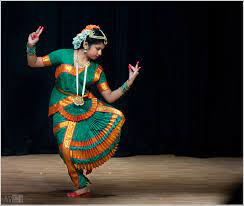
Pavi’s eyes started gleaming. Yes, it could be done even if it was just her parents watching. With a smile her mother started braiding her hair carefully attaching the piece that would make the braid reach her hips. Row upon row of jasmine flowers interspersed with a few roses were carefully attached to her hair. Then the golden ornaments were fixed at regular intervals. Her hair was ready.

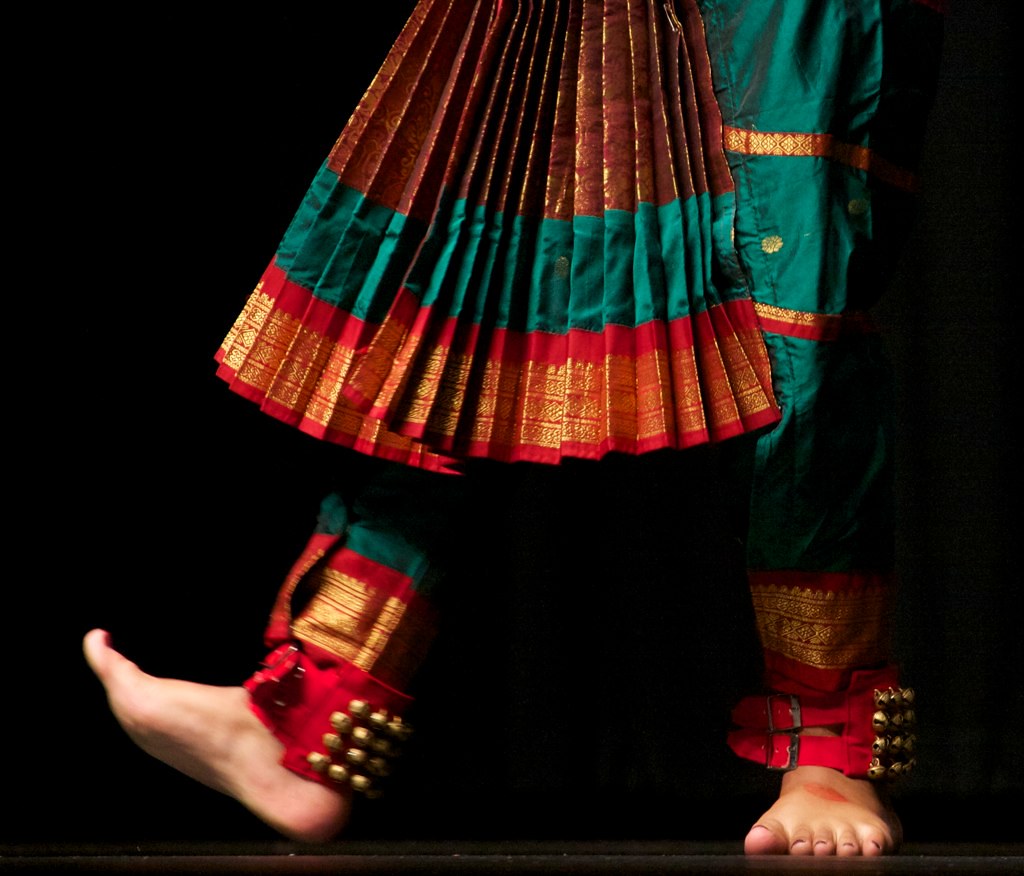
“Love you Amma,” said Pavi as her mother started lining her eyes with black eye liner. After the make-up, she got into her beautiful costume and leant down to tie her ghunghoroos. The time was 5.45 pm. She bent down and touched the feet of her mother and father seeking their blessing. Vishwanathan could not hold back the tears of pride and joy as he looked at his beautiful, brave girl.

From the lift they walked to the quadrangle. Savi set up the cordless speakers and the laptop. Dot on six Pavi’s teacher came on the screen. Pavi received her guru’s blessing with her head bowed low.

Tha, they, thith, they…  her teacher called out the opening notes and Pavi started moving her feet in the dark quadrangle. Suddenly a strobe of white light hit her hand, then another lit her face, yet another followed her feet. All around the residents stood in their balconies and at their windows aiming their bright, white phone torches at the dancing girl.

Pavi danced as she had never danced before. Her mother turned up the volume of the speakers and every pose was received with cheers and claps. When she finished Pavi bowed to her teacher, then her parents and finally did a twirling bow to all the people who were her audience. Plomp something hit her cheek. It was a rose, a zinnia landed near her feet, a Cadbury chocolate hit her ear, it was raining flowers and chocolates. “Love you all,” screamed Pavi as she blew kisses in all directions and collected her gifts. She had her arangetram and it was more special than she ever thought it would be.

Appu, Amma and Pavi walked silently back home, arms laden with gifts only to find many more gifts of food left at their doorstep. It is love that makes everything special said wise little Pavi as she hugged her parents.

Glossary

Amma – mother   

Arangetram – First debut public performance for Bharatnatyam dancers.

Roti — flatbread

Apa/Appu – father

Dosas – South Indian salty pancake with stuffing

Ghungroos – Bells

Guru — teacher

.

Sheefa V. Mathews is a professor of English Literature and enjoys writing. She is currently working on her first novel. 

.

PLEASE NOTE: ARTICLES CAN ONLY BE REPRODUCED IN OTHER SITES WITH DUE ACKNOWLEDGEMENT TO BORDERLESS JOURNAL

Categories
Index

A Tribute to Edward Lear: Humour, Limericks & More…

The Owl & the Pussycat. Courtesy: Creative Commons

Edward Lear, born 209 years ago on 12th May, not only popularised limericks, but wrote fabulous humorous verses to laugh away our fears. Rhys Hughes, on our editorial board, has written an essay to contextualise the poem to our modern day needs and even offered a hilarious conclusion to the poem. Click here to read his tribute to the great humorist, Edward Lear (1812-1888) in Poetry, Poets and Rhys Hughes.

As a tribute to the wonderful world created by Edward Lear, we are also publishing two limericks here, contextualising the humour to our needs and times.

1
Amidst the new wave of coronal graves, 
A secret  was withheld, even waived. 
People who vote 
Will turn into goats
And thus, be from the pandemic saved.

2
It came to pass in the distant land of Tierds, 
Wisdom was measured by the length of beards. 
They let it grow in undeterred ways
Till it became quite the craze
To participate tripping in a hirsute race unsteered.

Humour is the best weapon to battle fear. Click here to read some more limericks we brought out to battle our pandemic fears in Limericks: Of Donkeys & Corona.

.

PLEASE NOTE: ARTICLES CAN ONLY BE REPRODUCED IN OTHER SITES WITH DUE ACKNOWLEDGEMENT TO BORDERLESS JOURNAL

Categories
Covid 19

Have We Moved Forward?

Here are some of the most poignant, amazing and gripping stories around COVID from 2020 on our pages. Some are even tinged with humour or irony. How much have things improved over the past year? Write in your responses and tell us what you think.

Corona in my Teacup by Nidhi Mishra. Click here to read.

God Survives Corona by Devraj Singh Kalsi. Click here to read.

Broken Dreams and Shattered Glass By Sohana Manzoor. Click here to read.

People Matter More than Money by Keith Lyons. Click here to read.

Notes from Maynmar: Humans versus COVID by San Lin Tun. Click here to read

Corona & My Uncle by Archana Mohan. Click here to read

Notes from Balochistan: Volunteers for Humanity by Ali Jan Masood. Click here to read.

New Normal & Corona Puja by Nishi Pulugurtha. Click here to read.

Time & Us by Anasuya Bhar. Click here to read.

COVID-19: Days by the Arabian Sea by Gracy samjetsabam. Click here to read.

The Dawning of a New Era by Mitali Chakravarty. Click here to read.

Pandemic Tales: The Diary of a Hypochondriac by Mayuresh V Belsare. Click here to read.

From A Lockdown Diary to the Lightness of Being by Sunil Sharma. Click here to read.

Return of the Dead by Gita Vishwanathan. Click here to read.

Maya & the Dolphins by Mohin Uddin Mizan. Click here to read.

At Par in the Pandemic by Nabanita Sengupta. Click here to read.

A relook at The Plague by Camus by Rakhi Dalal. Click here to read.

Schumpter, Luddites & the Post-Covid Workforce by Avik Chanda. Click here to read

How the Young And Ms Sara battled Covid: An interview with the founders of Bookosmia to see how they kept people’s spirits up during COVID. Click here to read.

Limericks: Of Donkeys & Corona. Click here to read.

Categories
Musings

Time and Us

Anasuya Bhar takes us through 2020 — what kind of a year has it been?

We take Time for granted; we take our years for granted, dividing them into months and days of work and schedules of various kinds. We get lost in the maze of the small measures of time, the days, hours etcetera being our only counters of the great Hands. We forget the larger cosmic Time, which veers forward, with its own plan. In our break neck haste we, perhaps, only inch forwards to the inevitable end. The year 2020 began with the usual fanfare, banality, uncertainty and some trepidation for what it might bring. Some of my life’s uncertainties, incidences and vagaries usually keep me anxious and restless in an effort to secure some peace of mind. The first month brought in distress due to the misfortunes of a loved one. There were some other losses too, but what really put the fear of death among us, was Death itself, with the looming shadows of the Covid 19 pandemic.

Although I have not lived through any of the political or military wars, I felt I was going through some kind of a war in 2020 – a struggle for survival. I was unable to give a comprehensive shape to any of my thoughts. I could hardly account for anything that was happening and gazed at the rising pile of corpses in Europe and the other parts of the world. Poverty is a greater source of ailment where I live. Many succumb to it. As more of those who have less are out of work, poverty seems to be even more powerful an epidemic in this part of the world. There were many deaths, initially not from COVID19, but other instances of carelessness. But these too were passé for us who live in a country with an overflowing population. Things still happened to others in the remoteness of newspaper print.

That changed, however, and soon there were friends, cousins, and relatives getting infected. Doubt played hide and seek with a possible asymptomatic variety as well. There was always fear — fear that shook even the deepest layers of the consciousness and even allayed the strongest faith. There were children and aged parents. Death came stealthily and claimed its victim leaving no scope of any fuss or fanfare. The personal gave way to the public with invincible heroes succumbing to the virus. The list included many from our former President to actors, performers, sportspersons, poets, artists, and to academics. Even an icon as distinguished as Amitabh Bacchan was infected with virus, but he emerged triumphant. Many others were not as fortunate. We lost legends like Sean Connery and our own Soumitra Chatterjee in this year. In the case of the latter, it was a prolonged fight that the aged actor fought against the pandemic. With him, passed an entire era of Bengali culture that was more or less continuous in the spirit of the Tagores or the Rays.

The loss of both ‘Bond’ and ‘Feluda’ marked too much of a co-incidence in our lives. The lacuna that is left after the going of these stalwarts is not only felt particularly in their trade, but also to the entire global cultural scenario. We had just begun commemorating Satyajit Ray’s birth centenary, and Soumitra, the largest living icon of the former’s films and, perhaps, one of the greatest translators of his intellection, succumbed to the banal virus of Corona. The tiers in the uppermost rung of artistry and professionalism are being vacated; and perhaps, one may say, gradually making way, albeit reluctantly, for a new generation.

The year also had us think much about the dystopic and the apocalyptic in civilization, at large. There were also familiar prognostications of the ‘end of the world’ myth. The year, most definitely, marks the beginning of a whole new consciousness. We had stepped into a new millennium two decades ago, but one really did not feel any change overnight or even within a few days or years. Paradigm shifts happen over a period of time. The fault-lines take time to emerge and there needs to be enough distance, aesthetically and culturally, to perceive the changes with sufficient detachment.

For a particular century to emerge as the past, and the next to emerge as the present, one needs perspective. One also needs a new world view. People also succumb naturally to their deaths, especially those having seen most of the last century. A preliminary survey of each century usually shows drastic changes in the first two, three or four decades. The twentieth century saw most of its global events in the first four decades, after which there was reasonable calm and quietness. Equally interesting is the pattern of pandemics in the last few centuries. There is an uncanny similarity with them all dating in the 20s of each century.

The year 2020 seems to mark a new kind of beginning in various ways. While there is a most dystopic flavour to the times, one must acknowledge and also appreciate the spirit of resilience among humans. Newer modes of educating, connecting globally in the most unique and ingenious manners seems to be in vogue. The world of arts and letters has also perfected newer ways of expressions. The pandemic has, in many ways, proved to be a great leveller – the European, the Asian, the African or the American are going through a common crisis. There is, distinctly, a spirit of human solidarity that underlines the community, at large, keeping in abeyance the cultural, racial and political differences. Just like Picasso, Rabindranath, Einstein, and several others survived the last pandemic, the Great Wars or the holocaust, so did many of our grandparents. Would it be too presumptuous to count on destiny and chance, with the hope that we too would survive this, and have some stories to recount, perhaps, to our own grandchildren?

A philosopher had once said, that life would have lost all its meaning had there not been death; and that, we rush forwards doing what we do, because we know that there is a finite end for us. And Thomas Hardy had taken our minds to the chilling observation that our day of death lies skilfully hidden in the calendar year. We laugh, we cry, we continue through years with the nitty-gritty of life, but one particular year that day claims us, in an eternal embrace. Death is the only inevitable, irrevocable and irreversible truth and end in our lives. This year has taught us, among other things, the value of our lives, the value of relationships, the value of the world of nature, and taught us to value our time, before its ‘winged chariot’ gets hold of us.

Dr. Anasuya Bhar is Associate Professor of English and the Dean of Postgraduate Studies in St. Paul’s Cathedral Mission College Kolkata. Dr. Bhar is the sole Editor of the literary Journal Symposium (ISSN 2320-1452) http://www.spcmc.ac.in/departmental-magazine/symposium/, published by her Department. She has various academic publications to her credit. Her creative pieces have been published in Borderless Journal, Setu Bilingual and Ode to a Poetess. She has her own blog https://anascornernet.wordpress.com/.

.

PLEASE NOTE: ARTICLES CAN ONLY BE REPRODUCED IN OTHER SITES WITH DUE ACKNOWLEDGEMENT TO BORDERLESS JOURNAL.

Categories
Review

In Quest for Peace: The Other Side of the Divide

Book Review by Debraj Mookerjee

Title: The Other Side of the Divide – A Journey into the Heart of Pakistan

Author: Sameer Arshad Khatlani

Publisher: Penguin Random House, 2020

Journalist Sameer Arshad Khatlani’s maiden book, The Other Side of the Divide – A Journey into the Heart of Pakistan, published end February 2020, seemed to, at the outset, suffer the fate that the India- Pakistan relationship has continually suffered – whatever could go wrong, did! COVID19 almost did the distribution of the book in. But like the legendary resilience of the people of the subcontinent, and because of the inherent quality of what his intrepid journey into Pakistan was able to produce, the book made it through alternative channels, and is sure to be talked about for many years to come.

Khatlani, a Kashmiri, is a Delhi based journalist. More than his bio, it is the dedication that caught my eye, “For my son, Orhan Ahmed Khatlani, and kids of his generation. May they grow up to live in a peaceful and prosperous South Asia free of bigotry and conflict.” Wonderful words! Also written with sincerity. As you read deeper into the book you understand one thing about the author: That he is a young journalist cut in the traditional mould, the type that is fast disappearing in an increasingly polarised world. The intrepidity of perusal and perusal, the cultivation of people across political and cultural divides, the search for objectivity and truth, the erasure of one’s own biases, and the courage and resilience of conviction that forces one to take positions when push comes to shove marks out an honest journalist. Khatlani ticks all these boxes. 

To be frank, the book suffers from many editorial glitches and unnecessary typos, like this line by way of example: “Not surprisingly, the country (Pakistan) comes across as a hopelessly dark land because to its (sic) portrayal in the news media …”. The word ‘due’ has been carelessly substituted by the word ‘because’, rendering the sentence nonsensical. Enough to put me off and set a wrong note to the reading experience. But as I entered the heart of the book, even as Khatlani dived deeper into the other side of the divide, I realised nothing, but nothing could take away from the richness of the information it was unearthing, the depth of its historical exploration, the breadth of the issues and the personalities it was reaching out to, and most importantly, the chord of personal reflection and poignancy it was touching. 

The last point is important. Pre-Partition, the author’s grandfather, of limited means, had fled the oppressive feudal rule of the Dogra king to seek a better life in Lahore. Ultimately, due to pressing circumstances the patriarch returned to Kashmir before 1947. Lahore always had a strong Kashmiri presence. These were people who abandoned the oppressive taxes and strong biases of the existing rulers in Kashmir to seek a better life elsewhere. This was a world when the Hindu rules of Kashmir were oppressing its Muslim citizens. Many ‘Punjabis’ settled in and around Lahore were of Kashmiri origin, though they now primarily spoke Punjabi or Urdu and had little of the Kashmiri left in them.

In fact, Nawaz Sharif, Pakistan’s iconic politician traces his roots to Kashmir, though his family settled in Amritsar a long time back, and from there moved to West Punjab. The interlocking of the writer’s personal narrative with that of a general observation about a rather little known socio-cultural reality, and the search for those lanes where his grandfather might have roamed especially in the now drastically altered Anarkali  Bazaar, present a storyline that is extremely catchy. 

The conversational style (after all he is a journalist) comes off easily, as does the South Asian predilection for digressions when names and places are evoked. One name dropped becomes the point of departure to connect events and places from far away. One set of friends introduces him to another. Then the second set introduces new facets to his story, which essentially is to write deep pieces for the Times of India, datelined Lahore, as part of the ‘Aaman ki Aasha’ (the ‘hope for peace’ drive between India and Pakistan, during the last Congress Government) initiative. The excuse for the journey is to cover a Punjabi cultural event. Though to be honest there is enough mention of the Punjabi language and cultural predilections to justify the excuse!

As you read further into the book this particular aspect of the style quite catches you. What earlier might have appeared unnecessarily digressive, grows into you and you begin to realise this story could have been told no other way. The frenetic swamping of emotions, the bitter regret of missed opportunities, the cornucopia of details that mark the stories of both separation and oneness are as fervent as they are insistent – they can only be told breathlessly if they are to be shorn of artfulness. The writer must at times bow before the sentiments of the storyteller. The story is often so powerful that it almost takes over the storytelling. This is said by way of praise. When you have the book in your hands you’ll understand exactly what is meant herein. 

Khatlani’s book is modelled around his discovery of Lahore and its people. Each discovery follows the hub and spokes theory. Every discovery is the hub. And the stories that emanate from these hubs are the spokes. In this he touches all the right chords. There is the Bollywood connection, the history of the army and its ubiquity in Pakistani life, the cricket connection, the stories of shared miseries and standout acts of personal friendship, there is the story of alcohol and conservatism, the liberals of Pakistan and their sentimental pro-India politics, and the special story of minorities, especially the Sikhs.

These stories slip in and out of the ten chapters, and in no particular order. In each of these particulars, Khatlani shapes his narrative with great background stories, provides rich historical accounts, and at times manages searching insights into the intricate sentiments that guide the existing reality between the two nations.  

The Other Side of the Divide is an important intervention at a difficult time. The dateline is 2013 when things were better. Better despite the numerous setbacks, not in the least the attack on Mumbai in 2008 November, or the attack on the Sri Lankan cricketers outside the Gaddafi Stadium in 2009.

In 2020 another world has overtaken us. We inhabit a world that is shriller than ever before, a world in which India is fast giving up its secular and liberal credentials, and instead turning sharply right. As some have observed, new Pakistan looks more like old India, and unfortunately, new India like old Pakistan. Bearing the cross of a fractured history we continue to inherit each other’s loss. Amidst this, Khatlani’s book is an invaluable source of solace and possibilities.

.

Debraj Mookerjee has taught literature at the University of Delhi for close to thirty years. He claims he never gets bored. Ever. And that is his highest skill in life. No moment for him is not worth the while. He embraces life and allows life to embrace him.

.

PLEASE NOTE: ARTICLES CAN ONLY BE REPRODUCED IN OTHER SITES WITH DUE ACKNOWLEDGEMENT TO BORDERLESS JOURNAL.