Categories
Essay

Discovering Rabindranath and My Own Self

Musings by Professor Fakrul Alam
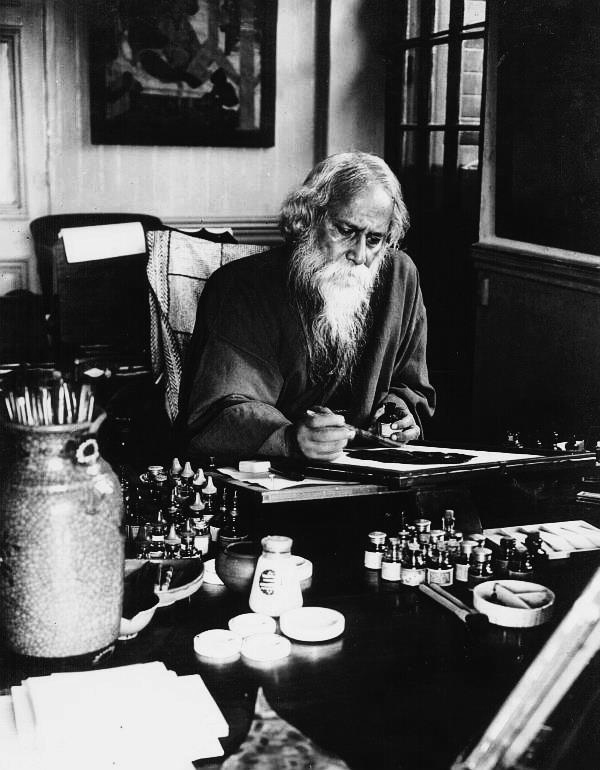
Apnake jana amar phurabe na/Ei Janare shongo tomai chena/

There will be no end to my discovery of myself/And this discovery keeps coming with my discovery of you

On the one hand, Rabindranath Tagore [1861-1941] has been with me almost all my life. On the other, I only began to discover that I had Rabindranath so centrally in me relatively late in my life. In fact, I have now realised that the process of discovering the way he has been embedded in me is part of the process of discovering my own self in the course of the life that I have been leading till now.  Indeed, at this stage of my life, it seems to me that there will be no end to my discovery of the way Rabindranath has become part of my consciousness since I feel that there will be no end to discovering myself till I lose consciousness once and for all. The one thing I can say with certainty, using his words but in my translation is “There will be no end to my discovery of myself.”  For sure, this process of discovering myself endlessly keeps happening with my continuing discovery of Rabindranath.

Surely, the process through which Rabindranath had become embedded in me began in childhood. However, I did not encounter his work in my (English medium) textbooks since I did not learn Bengali in school for a while. How then did I come to remember poems such as “Tal gach ek paye dariye/shob gach chareea/ Uki mare akaashe” (Palmrya tree, Standing on one foot/Exceeding all other trees/Winking at the sky”) or “Amader Choto Nadi chole bnake bnake” (“Our little river keeps winding its way”). How do I remember these opening lines even now? And why do I still associate such palm trees and winding little rivers with these lines even now whenever I am in the Bangladeshi countryside? Surely, it must have been my mother who planted Rabindranath in me in my seed time so that he would become embedded in my unconscious, only to surface in my consciousness decades later. It is surely no coincidence that she taught me Bengali and made me learn Rabindranath’s poems indirectly.

 As a boy growing up at a time when the radio was the main source of entertainment in middle-class Bengali houses, my siblings and I were made to listen to Rabindra Sangeet in our house by my father, who felt that he had to share his favourite songs and singers in the musical genre with us, whether we wanted to listen to them or not. Of course, at that age I would have much rather not listen to those solemn-sounding, soulful songs, and whenever I could put my hands on the radio dials, I would listen to English popular music on Radio Ceylon. My favourite singers were Pat Boone, Elvis Presley, Cliff Richards and—a little later—the Beatles. In school, when we were not playing or talking about sports or girls, we boys would be discussing the pop music we heard on Radio Ceylon. By the end of the 60s, we would be talking about the English thrillers and comedies we saw on Dhaka television. What place could Rabindranath have in one’s life then? If Rabindranath had been placed in my innermost self by my mother through her reading of his poems to us children or my father through his addiction to Rabindra Sangeet, for the moment he was getting occluded deep inside me and, it would now seem, all but forgotten!

But from the middle of the 1960s, our lives in Dhaka began to change as the claims of Pakistan on us East Pakistanis started to loosen, little by little. It was a time when in neighbourhoods and on streets, processions would come out singing gonosangeet—literally songs of the people, but in effect music of protest and patriotism.  First, the Six Points Movement and then the Agartala Conspriacy case were on everyone’s lips and East Pakistanis everywhere were becoming activists in one way or the other. There was no escaping songs like “Shonar Bangla” (“Golden Bengal”) or “Banglar mati, banglar jol, banglar baiuo, banglar phol/Punno houk”” ( “Let the land, the waters, the air and fruits of Bengal be blessed…) and “Bartho Praner Aborjona Purea Phele Agun Jalo” (“Burn the frustrated soul’s detritus and light up a flame”). In my school where we boys now studied “Advanced English” and “Easy Bengali”. There was no way we could have learned enough Bengali to read Rabindranath or Nazrul in the original in any sustained attempt, but how could we escape the call from such songs and poems like Nazrul’s “Bidrohi” (“The Rebel”) or the call from the streets to protest and even burn for our emancipation?  At home, three of my four sisters would be practicing Rabindra Sangeet regularly, since this was what my parents wanted them to do, and so there would be no evading Rabindranath’s songs at home for this reason as well, but I was more interested in friends and sports than staying home and so I would hear the songs only in snatches at this time.

By the end of the decade though, Rabindranath was everywhere in our lives since becoming Bengali became first and being a Pakistani only came later. Even on Dhaka Television, Rabindranath’s songs and dance numbers were being aired fairly regularly then. Outside, one could get to see his plays and dance dramas being performed every now and then in functions and cultural events all over the city. He would soon become an important part of Pohela Boisakh, which itself would become instantly popular amongst us all almost as soon as Chhayanaut[1] organised the first event in Balda Garden as the decade came to a close.  But while Rabindranath was everywhere around me all of a sudden, I was still not reading him at all, preferring English thrillers and westerns initially, and later, when I became a “serious” reader from college onwards, contemporary classics of English and European literature available in English editions.

In the early seventies, however, you could not be in Bangladesh without imbibing Rabindranath at least a little, for there was a process of osmosis at work at this time. Glued as we were to Swadhin Bangla Betar Kendro[2] during our Liberation War[3], we kept listening to his patriotic songs on our radios; the promise of Shonar Bangla seemed alive and possible then. The years after liberation, my generation was exposed to Rabindranath in new ways; we would get to hear and view singers like Kanika, Debobroto and Suchitra Mitra on stage in Dhaka; their songs became freely available in tapes in our shops; and Satyajit Ray’s film version of Rabindranath’s fiction and Ray’s documentary on him became staples of Dhaka’s film societies. I was finally growing up intellectually and was hungry for culture, and so how could I have escaped the poet’s works totally at this time?

But the Rabindranath that I was imbibing thus was almost entirely coming to me aurally and visually. Because he was becoming embedded in my consciousness through songs and the silver screen as well as television, he still inhabited the surface of my consciousness. And I was certainly not making any conscious bid to savor him. The seventies and the eighties were, in fact, decades when I was becoming an even more “serious” student of English literature than before and getting “advanced” degrees in my subject and acquiring expertise for my teaching career; where would I get the time to read Rabindranath then? As an expatriate student for six years in Canada and as a visiting faculty member for two years in the USA, I would be getting small doses of Rabindranath in those countries through the songs I kept hearing in the cassettes I had brought along of my favorite singers and in the occasional film versions of his work that I would get to see because of campus film societies, and I suppose nostalgia played a part in my yearning for him then, but I had no time to spare for him and not enough exposure to his works to let his ideas and his achievement resonate in me in any way.

To sum up my encounters with Rabindranath till then, I was discovering Rabindranath in small doses all the time and experiencing him directly here and there, but my knowledge was all very superficial and my understanding of him too limited. And nothing much had happened that would allow me to tap into the unconscious where all the memories of poems and songs by him I had first come across through my parents’ enthusiasm for his works were hidden.

“Dekha hoi nai chokkhu melia/Ghor hoite shudhu dui pa felia”/

“I haven’t seen with my eyes wide open/what was there only a stride or two away from my house”

In the 1980s, I became smitten by theory, especially the works of Edward Said, and suddenly questions of postcoloniality, ideology, power and location became all-important for my understanding of literature. I was coming around to the belief that I could not be a good and truly advanced student of English literature in Bangladesh, let alone a good teacher of the subject here, unless I sensitised myself to my roots and look at the world around me. And now I remembered some lines I had been hearing since childhood without realising their relevance for me and everyone else around us then: “Dekha hoi nai chokkhu melia/Ghor hoite shudhu dui pa felia” (“I haven’t seen with my eyes wide open/What was there only a stride or two away from my house”). Rabindranath had been all around me and yet I had not opened my eyes wide enough to learn from him. I had not read his works with any kind of sensitised attention at all and I had not been able to arrive at any kind of appreciation of his achievements except the smug sense of self-satisfaction at the thought that this Bengali had once won the Nobel Prize.

Towards the end of the 1990s, for the first time really, I plunged into Rabindranath and found—to quote Dryden on Chaucer— “here was God’s plenty”. Having opened my eyes to him I realized that there was so much to him than one could take in at any one time. He had once said in a song about the infinite contained in the finite and I now thought, “How appropriate of him!” He had said in one of his most famous poems, “Balaka[4]” about how one must not succumb to stasis and how the essence of life is motion and I thought, “how inspirational!” He had written in a song about viewing the Ultimate Truth through music and I thought “Exactly!” He had looked on in amazement in a starry night at how humans have a place in the cosmos (Akaash Bhora Surjo Tara[5]) and I thrilled at the idea now. He made me see the monsoonal kadam flower that I had passed every year without blinking an eye as immensely lovely. Every poem that I read enlightened me, every song lent my soul harmony, every short story or novel took me to eternal truths about human relationships. Who would not learn from a man who had been given some of the highest honors the world has offered any human being, when he says with such unambiguous humility, “Mor nam ei bole khati houk/Aami tomaderi lok…” Let this be my claim to fame/I am all yours/This is how I would like to be introduced.” And so I kept reading him in between teaching and writing, finding him an endless source of inspiration, creativity and wisdom. I strove to learn about nature, the universe, people, relationships, beauty and the dark side of humans through his works.  And soon I felt compelled to translate some of them.  

Rabindranath, then, opened my eyes not only to the world I lived in but also helped me discover my own self as a product of forces that had taken our nation past 1947 to true liberation. He helped root me in Bengali and Bangladesh as never before, making me discover myself not merely as a Bengali but as a citizen of the world, a product of a certain history but also of the history of mankind. My discovery of him and my place in the world was furthered by the work I did in co-authoring The Essential Tagore and authoring a collection of essays on diverse aspects of his work.

But Rabindranath truly contains multitudes. What I now realise is that it is impossible to discover him fully in one life, especially when one embarks on the process of discovery so late in life. By now, therefore, I have despaired of knowing the whole man and feel I will get to know only parts of him. But I also know whatever I read of him will enlighten me and make me know myself better in every way than before. And so I’ll keep reading him and translating him, if only to know him and myself better in the days left for me!  

[1] Centre for promotion of Bengali Culture established in 1961

[2] Free Bengal Radio Centre

[3] 1971 Bangladesh was liberated from Pakistan.

[4] Swans

[5] The Star-Studded Sky

.

Fakrul Alam is an academic, translator and writer from Bangladesh. He has translated works of Jibonananda Das and Rabindranath Tagore into English and is the recipient of Bangla Academy Literary Award (2012) for translation and SAARC Literary Award (2012).

PLEASE NOTE: ARTICLES CAN ONLY BE REPRODUCED IN OTHER SITES WITH DUE ACKNOWLEDGEMENT TO BORDERLESS JOURNAL

Click here to access the Borderless anthology, Monalisa No Longer Smiles

Click here to access Monalisa No Longer Smiles on Amazon International
Categories
Essay

Walking about London Town

By Sohana Manzoor

The first thing I realised while walking around London is that not a single one of all the people I had known who had been to England, told me how charming the city is. The buses with open tops, the red telephone booths, Big Ben, the London Bridge and all those pretty buildings simply fascinated us. So, before heading out for Haworth, we walked around in London and took Duck’s tour and saw some really enchanting stuff.

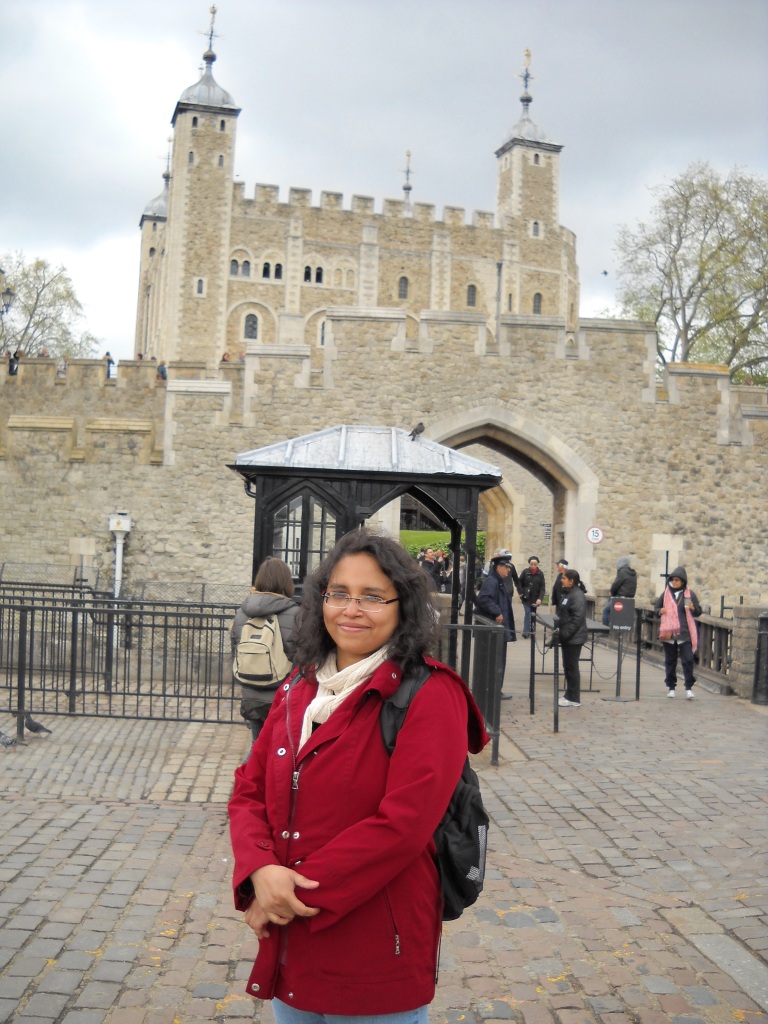
Sohana at the Tower of London

We spent a large part of a day at the famed Tower of London, which is literally a thousand years old, first built by William the Conqueror in the 11th century. Our visit began with a tour by a Beefeater (also known as a Yeoman Warder), who gave us a general overview of the Tower’s history. He had a wicked sense of humor and kept making puns like “Let’s be heading this way.” We saw Tower Hill, the site of public executions on the scaffold, and also Tower Green, where Anne Boleyn and Lady Jane Grey were executed – the spot is now commemorated by a glass sculpture with a pillow on top. The tour ended at the Chapel Royal of St Peter ad Vincula where those executed on Tower Green (including Boleyn and Jane Grey) are buried. Afterwards, we took a picture with the Beefeater outside the chapel.

Next, we went to the building that houses the Crown Jewels. Our eyes were dazzled by the rich display of crowns, scepters, and orbs bejeweled with diamonds, rubies, sapphires, and every kind of precious stone possible in the vault. We also saw the famed Kohinoor diamond, set in the Queen Mother’s crown, as well as the crown worn by the late Queen Elizabeth II. After the crown jewels, there was also a section of gold plates, serving dishes, goblets, wine jugs, etc. that were used for ceremonial occasions by various monarchs. We will probably never again see such a display of wealth, and perhaps there is no other place with so much wealth on display in one place. However, all the gold and perhaps some of the obnoxious histories attached with the splendour on display started to make me feel nauseous, so I was glad to get out into the open air.

We looked around in the White Tower, which stands in the center with a display of military equipment and history. Then we went to the Beauchamp Tower, which is known for the graffiti on the walls left by various prisoners, including some very high-profile ones. At one point, when I saw the graffiti attributed to Robert Dudley, Earl of Leicester, I stood rooted to the spot. It was incredible to think we were standing in the same room where such illustrious prisoners once lived, carving their convictions into the walls.

We walked around the grounds, taking pictures, and then came across some costumed characters, including James Scott, Duke of Monmouth, who posed with me graciously for a picture. The costumed characters put on a dramatic reenactment of James trying to claim the throne. James Scott is the fellow who required several blows of the axe, followed by a butcher knife, during his beheading on Tower Hill by the half-drunk Jack Ketch. The Beefeater told us the story in all its gory detail, though the reenactment, thankfully, included the trial but not the execution.

We took pictures, including one of Nausheen posing with a raven. These birdsare kept and bred on the grounds of the Tower. Apparently, they have kept at least half a dozen ravens since the time of Charles II, who thought the Tower would fall and the empire disintegrate if he did not always keep ravens there. There is even one beefeater whose job it is to feed and take care of the ravens! Finally, we also saw the room where Sir Walter Raleigh was imprisoned for many years, and the place where he used to walk back and forth (now called Raleigh’s Walk), and I got goose bumps.

Our day ended with a brief stop at Tate Modern, which is just across the river from the Tower. I’m not really into modern art, and as I paused in front of a famous painting by Picasso, I had to admit that I understood nothing about its greatness. To me it looked like a misshapen human figure lying on its side. Nausheen kept on dancing around the pieces and went on explaining what she had learnt in conjunction with modern poetry.

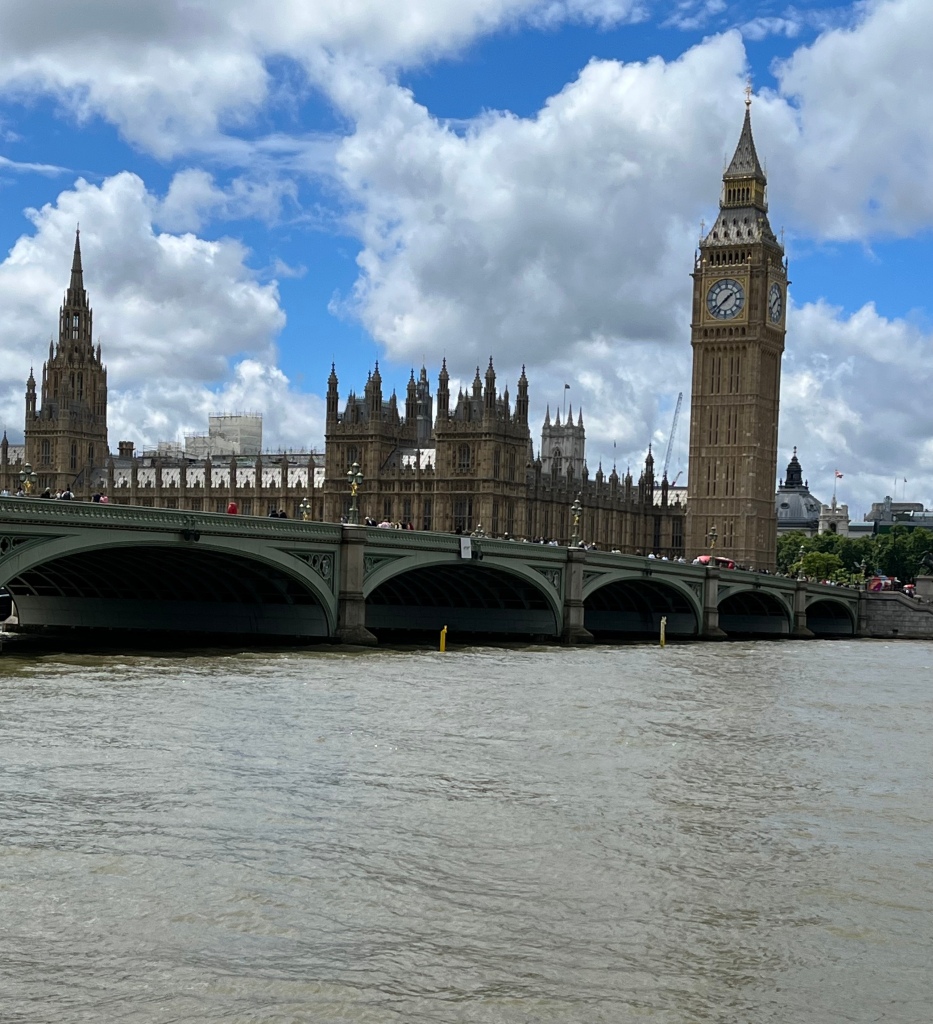
The Parliament & Big Ben

Next morning, we passed Big Ben and the Houses of Parliament on our way to Westminster Abbey where kings and queens are still coronated, and where many notable historical, political, and literary figures are buried. It was very crowded, but also a very solemn kind of place – kind of dark and gloomy, with tombs and effigies all around, and Latin epitaphs everywhere. Many of England’s kings and queens are buried here, and we saw the tombs of Henry VII, Elizabeth I, Bloody Mary, and Mary Queen of Scots. The tomb of Queen Elizabeth felt unreal – almost as if it was part of a dream I had nurtured for long.

Eventually, we made our way to the Poets’ Corner, which Nausheen was especially eager to see. She got excited seeing the tomb of Chaucer, who was the first to be buried in the Poets’ Corner. We both patted the tomb in homage to the great man. We also saw tombs of various other poets and writers, such as Austen and Dickens, and memorials to writers who are buried elsewhere, but commemorated here nonetheless, such as Shakespeare and the Brontës. Finally, we stopped at the museum shop to buy some souvenirs.

The afternoon saw us at the Tate Britain. We took a tour with one of the museum guides, who took us through the Turner wing. It was really great that they have an entire wing devoted to Turner, since his work is familiar to me from my dissertation supervisor, Dr. Collins’s course. There were also paintings by Constable and Gainsborough, but of course, Turner’s are the most dramatic and majestic. There was also a smaller wing dedicated to Blake’s prints, paintings, and engravings. However, the ones that are most familiar to us, from Songs of Innocence and Experience, are mostly elsewhere, such as in the British Museum, so there were only a handful of those.

The next day was cold and gloomy and we decided to stay in. We made plans of visiting Hampstead, the home of the young Romantic poet John Keats the day after. I knew days would be bad as I was developing a fever. But I could surely rest for one day.

Sohana Manzoor is an Associate Professor at the Department of English and Humanities at ULAB, a short story writer, a translator, an essayist and an artist. This essay was previously published in The Daily Star in January 2019.

PLEASE NOTE: ARTICLES CAN ONLY BE REPRODUCED IN OTHER SITES WITH DUE ACKNOWLEDGEMENT TO BORDERLESS JOURNAL

Click here to access the Borderless anthology, Monalisa No Longer Smiles

Click here to access Monalisa No Longer Smiles on Kindle Amazon International

Categories
Interview

Translation as an Act of Possession: Fakrul Alam

Professor Fakrul Alam discusses his new book of Tagore translations, Gitabitan: Selected Song-Lyrics of Rabindranath Tagore, published by Journeyman Books, Dhaka

Professor Fakrul Alam translates Tagore songs with a passion, refers to them as ‘song-lyrics’. In a recent essay, he claimed his favourite book is the Gitabitan, which houses 2232 songs by Tagore. The first edition of the book was published in 1931 and 1932 in three volumes. Over a period of time, Vishwa Bharati combined the three into one single volume.

During the pandemic, Professor Alam — a translator who has been lauded for his translation of Jibananda Das and also something as diverse from poetry as the autobiography of the founding father of Bangladesh, Sheikh Mujibur Rahman — took to translating Tagore songs to make a 300 strong collection, which has been published recently. When asked what was the basis for his selection of the songs, he responded: “What was the basis of my selections? Most important was my love for them. I listen to Rabindra Sangeet, that is to say, the songs of Rabindranath Tagore, every day without fail, unless I am travelling outside Bangladesh. Over the years, some songs by a few singers became so much a part of me that I began translating them. As was the case with my Jibanananda Das translations, you could say that translation was an act of homage as well as a way of coming really close to what you love. It strikes me also that many of the songs I ended up translating are by my favourite Tagore song singers — artistes like Debabrata Biswas and Kanika Bandhopadhyay for instance.  Once again, translation as an act of possession!”

Professor Alam has been the recipient of  both the Bangla Academy Literary Award for translation and the SAARC Literary Award. He has published around a hundred translations of Tagore songs and poems, edited and translated The Essential Tagore with Radha Chakravarty and lectured in a number of countries about Tagore. In his recently published translation, Gitabitan: Selected Song-Lyrics of Rabindranath Tagore, he brings to us a wide variety of songs which he has grouped into different sections. In this interview, he discusses his translated works, especially his new book.

You have translated Sheikh Mujibur Rahman, and Jibanananda Das, Nazrul and Tagore. What turned you towards translating poetry from prose?

Actually, I translated poetry first and then switched to translating prose. The first literary pieces I translated were poems by Jibanananda Das—surely the greatest Bengali poet of the twentieth century, if we leave aside Rabindranath Tagore who, of course, began writing poems towards the end of the nineteenth century and stood out among Bengali poets till his death in 1941. I then turned to translating some Tagore poems and songs for The Essential Tagore (2011) that I co-edited with Radha Chakravarty.

Also, from the time my book of translations of Das’s poems came out I either ventured into translating some poems by contemporary Bangladeshi poets from time to time either because I felt like doing so, or as responses to requests of a few poets to translate their verse. An example is Masud Khan, some of whose poems you have published in my translations in Borderless.    

What moved you into translating?

I have to begin answering this question by once again naming the person I mentioned at the beginning of my answer to your previous question—Jibanananda Das. It was when I came across his works in Abdul Mannan Syed’s selection of his poems in the mid-1990s, and was so swept away by them, that I felt like translating Das’s verse. This was translation as an act consequent to being possessed—or if you like—gripped. Poems like “Banalata Sen” or “Abar Ashibo Pheere[1] or “Bodh[2]” or “Aat Bachor Age Ek Deen[3]” seemed to want me to translate them. In fact, my translation of the word “Bodh” for the English poem is “Overwhelming Sensation” and that is how I would say I was taken by these works. And once I started with these poems I felt like translating a whole lot more.   

You have a book of Das’s poetry and many poems of Tagore in various anthologies and sites. What made you decide to do a book of Tagore translations?

Rabindranath, of course, is the summit as far as Bengali poetry and song-lyrics are concerned. Because I grew up in a house where his songs were either being performed on the radio or on television, or sung by one of my sisters, in retrospect it appears to me that I was destined to translate them sooner or later. Once I had published Jibanananda Das: Selected Poems in 1999, I began to translate a poem or song by Rabindranath every once in a while. When I heard some of Rabindranath’s songs being sung by a singer like Debabrata Biswas or Kanika Badopadhyay, I felt I had to translate them. And that is how I ended up with the nearly 300 songs that constitute Gitabitan: Selected Song-Lyrics.  

Is translating Tagore different from translating other poets?

Of course, and inevitably! Almost every great poet writes differently from his predecessor or contemporary poets and composes uniquely. As the great American critic, Harold Bloom, has put it in talking about Western canonical poets, they suffer from “the anxiety of influence” and must destroy all vestiges of their predecessor poets in them. They may begin conventionally but will soon find their distinctive voice or voices. They will as well move away from their earlier works all the time and not get stuck with one style. Thus, Tagore kept experimenting and, so to speak, shifting gears and taking new routes in versifying all the time. This is also true of Jibanananda. That makes the early Tagore or Das different from the later versions of these poets. In Tagore’s case, let me stress that he was particularly polymathic and kept opting for distinct poetic directions all the time. But as far as I can tell what makes him truly different is the musician in him. In particular, the songs have melodic components that take them away from established poetic forms. In fact, I would be happier with the term “song-lyrics” for his songs. Only in his later verses, did he move away from a melodic base towards relatively free verse or prose-poems. And so a translator of Tagore must strive to capture the music in his poetry, especially the songs, which makes the task of translating him quite a distinct as well as challenging task.         

Tell us about this new book of Tagore translations. Are the translations a collection of your earlier publications or do you have new songs?

My new book is the result of years and years of translating the song-lyrics, something I do mostly during weekends. A few of them I published in Bangladeshi English language newspapers and a few came out in periodicals like Six Season Review, which I co-edited.

A few in have come out in Borderless. But all these years, I translated not with a definite plan but unsystematically. It was during the enforced period of home confinement during the pandemic years, however, that my translations of the songs gained momentum. I began at around this time to post my translations on FB regularly, hoping that the comments I receive would include constructive ones that would enable me to revise my work, if and when necessary. Nabila Murshed, an ex-student now living in the United States, then came up with the idea of forming a FB group called “Gitabitan in Translation” for not only my translations of the songs but also those of others who might be interested in contributing their own translations, or sharing their responses to the translated songs posted. She also decided to complement the translations with recorded versions of the songs that she collected from YouTube. All these things eventually led me to the idea of publishing a full book of translations.

I then hired an ex-student as a kind of assistant to sort out the songs I had been translating, according to the divisions and sequencing Tagore imposed on them in his collection. There are thus 13 divisions in my book, one of which, “Prokriti” or “Nature”, is itself divided into six sections following the six seasons of the Bengali calendar. But to sum up my answer to your question, the majority of the song-lyrics are going to see in print for the first time. I would say no more than 100 of them have been printed before.

Sometimes, your republications change from the earlier publications. The words change. Have you done that in this anthology too?

Occasionally. As I said previously, I translate a song when I hear it on YouTube. I might listen to the same song a couple of years later and feel like translating it again, forgetting at times that I had translated it before. This led occasionally to 2 or 3 versions of the same songs. Inevitably, while these versions would be close to each other, they would never end up being exactly similar. For the final round of selections for my book, however, I have chosen only one version of what I did, that is to say, the one I think was definitive. And, of course, I revised what I had done for the final print version.

Would you consider translating Tagore’ prose?

Of course. And I have translated a few already. For The Essential Tagore I translated “Hindus and Muslims” and “The Tenant Farmer”. And for Shades of Difference: Selected Writings of Rabindranath Tagore, I translated “The Co-operative Principle” and “The Divinity of the Forest.” As these titles indicate, Rabindranath is a writer whose works you can mine for topics that have continuing thematic relevance. That is why all translators will go back to him every now and then for essays and prose extracts relevant for our time.

Would you like to bring out a book of Nazrul translations too?

Who knows? I have translated about 12 of his poems and a short story by this great Bengali writer, who is also Bangladesh’s national poet. But at present I feel more inclined towards going back to Jibanananda Das and will continue to translate more of Rabindranath’s song-lyrics. This is because around the time I published my translations of his poems at the turn of the century, a trunk full of new poems by Das were discovered. Most of them have been published by now. If and when I can, I would like to bring out a new edition of my Das poems, incorporating some of these newly discovered ones. This is because I have already come across some that are truly memorable and deserve to be translated. Certainly, he is a poet the best of whose unpublished as well as published works need to be introduced everywhere.    

Tagore is unique in as much he was socially committed to improving the lot of the villagers in Bengal. He practically created Santiniketan and Sriniketan. At a point, he wrote: “My path, as you know, lies in the domain of quiet integral action and thought, my units must be few and small, and I can but face human problems in relation to some basic village or cultural area. So, in the midst of worldwide anguish, and with the problems of over three hundred millions staring us in the face, I stick to my work in Santiniketan and Sriniketan hoping that my efforts will touch the heart of our village neighbors and help them in reasserting themselves in a new social order. If we can give a start to a few villages, they would perhaps be an inspiration to some others—and my life work will have been done.” This was in a letter in 1939 to Leonard Elmhirst, an agricultural scientist who helped him set up Sriniketan. Has any other poet done work of this kind in Bengal? What do you see as his greatest contribution —poetry or his ideals of human excellence and the work he did to realise his ideals?

Very few writers can come close to Tagore as far as the variety of his works are concerned. Such a polymath dedicated to the world of the spirit and the mind as well as human welfare is surely rarely to be found anywhere in any period of world history. Once he took charge of his father’s estates in what was then East Bengal and is now Bangladesh, Tagore plunged into work for the betterment of the people there and the surrounding areas. But he kept writing poems, fictional and nonfictional prose, plays and wrote all sorts of things for the amelioration of his people as well as his own need to articulate beauty and depict the Sublime in all its manifestations. And he would combine theory with practice, carrying out experiments and introducing new ideas for his tenants and others to implement in their farms and lives. His greatest contribution, however, was not only his poetry and prose but also his contribution to Bengali language and literature. I remember Dryden on Chaucer at this point: “He [Chaucer] found it [English writing] brick and left it marble.”

Thank you for giving us your time.

(The online interview has been conducted by emails by Mitali Chakravarty)

Tagore articles & Translations by Professor Fakrul Alam

My Favourite Book by Fakrul Alam

The essay is a journey into Fakrul Alam’s fascination with Tagore’s Gitabitan. Click here to read.

Rabindranath’s Monsoonal Music 

Fakrul Alam brings to us Tagore songs in translation and in discussion on the season that follows the scorching heat of summer months. Click here to read.  

Songs of Seasons: Translated by Fakrul Alam: Fakrul Alam, translates seven seasonal songs of Tagore. Click here to read.

Endless Love: Tagore Translated by Fakrul AlamAnanto Prem (Endless Love) by Tagore, translated from Bengali by Professor Fakrul Alam. Click here to read.

Monomor Megher Songi (or The Cloud, My friend) has been translated by Professor Fakrul Alam. Click here to read.

Giraffe’s Dad by TagoreGiraffer Baba (Giraffe’s Dad), a short humorous poem by Tagore, has been translated from Bengali by Professor Fakrul Alam. Click here to read. 

Oikotan (Harmonising) has been translated by Professor Fakrul Alam and published specially to commemorate Tagore’s Birth Anniversary. Click here to read.

.

[1] Fakrul Alam translates this as ‘Beautiful Bengal’, but lietrally, it means I will return again

[2]  Fakrul Alam translates this as ‘An Overwhelming Sensation’, but literally, it means sensation.

[3] Translates to — eight years ago, this day

PLEASE NOTE: ARTICLES CAN ONLY BE REPRODUCED IN OTHER SITES WITH DUE ACKNOWLEDGEMENT TO BORDERLESS JOURNAL. 

Click here to access the Borderless anthology, Monalisa No Longer Smiles

Click here to access Monalisa No Longer Smiles on Kindle Amazon International

Categories
Interview

 When a Hobo in a Fedora Hat Breathes Tolkien…

In Conversation with Strider Marcus Jones

Strider Marcus Jones
i'm come home again
in your Lothlorien

Strider Marcus Jones wrote these lines about an idyllic utopia that was named Lothlorien by JRR Tolkien in Lord of the Rings. Jones writes beautiful poetry that touches the heart with its music and lyricality and recreates a world that hums with peace, beauty, acceptance and tolerance – values that have become more precious than gems in the current world of war, strife and distress. He has created his own Lothlorien in the form of a journal which he has named after the elfin utopia of Tolkien. An avid reader and connoisseur of arts, for him all his appreciation congeals in the form of poetry which draws from music, art and he says, perhaps even his legal training! Let us stride into his poetic universe to uncover more about a man who seems to be reclusive and shy about facing fame and says he learns from not just greats but every poet he publishes.

What started you out as a writer? What got your muse going and when?

In my childhood, I sought ways to escape the poverty of the slums in Salford. My escape, while gathering floorboards from condemned houses every winter and carrying them through back entries in crunching snow to our flat, above two shops for my dad to chop up and burn on the fire was to live in my imagination. I was an explorer and archaeologist discovering lost civilisations and portals to new dimensions our mind’s had lost the ability to see and travel between since the time of the druids. Indoors I devoured books on ancient history, artists, and poetry from the library. I was fascinated by the works of Picasso, Gauguin, Bruegel and many others and sketched some of their paintings. Then one day, my pencil stopped sketching and started to compose words into lines that became “raw” poems.  My first mentor was Anne Ryan, who taught me English Literature at High School when I was fourteen. Before this, I had never told anyone I was writing poetry. My parents, siblings and friends only found out when I was in my twenties and comfortable in myself with being a ranger, a maverick in reality and imagination.

When I read your poetry, I am left wondering… Do you see yourself in the tradition of a gypsy/mendicant singing verses or more as a courtly troubadour or something else?

I don’t have the legs to be a courtly troubadour in tights and my voice sounds like a blacksmith pounding a lump of metal on his anvil.

I feel and relate to being gypsy and am proud of my Celtic roots passed down to me from my Irish Gypsy grandmother on my Father’s side who read the tea leaves, keys, rings, and other items telling people’s fortunes for years with scary accuracy. I seem to have inherited some of her seer abilities for premonition.

Like my evening single malt whiskey, age has matured the idealism of my youth and hardened my resolve to give something back to the world and society for giving me this longevity in it. The knocks from the rough and tumble of life have hardened my edges, but my inner core still glows like Aragorn’s calm courage and determination in the quest to bring about a more just and fairer world that protects its innocent people and polluted environment. Since Woody Guthrie, Tom Waits and Bukowski are influences I identify with deeply, I suppose I am a mendicant in some of my poetry but a romantic and revolutionary too, influenced by Neruda, Rumi, Byron, and Shelley shielded by The Tree of Life in Tolkien’s Lothlorien:

THE HEAD IN HIS FEDORA HAT

a lonely man,
cigarette,
rain
and music
in a strange wind blowing

moving,
not knowing,
a gypsy caravan
whose journey doesn't expect
to go back
and explain
why everyone's ruts have the same
blood and vein.

the head in his fedora hat
bows to no one's grip
brim tilted inwards
concealing his vineyards
of lyrical prose
in a chaos composed
to be exposed,
go, git
awed
and jawed
perfect and flawed,
songs from the borderless
plain
where no one has domain
and his outlaw wit
must confess
to remain

a storyteller
that hobo fella

a listening barfly
for a while,
the word-winged butterfly
whose style
they can't close the shutters on
or stop talking about
when he walks out
and is gone.

whiskey and tequila
with a woman who can feel ya
inside her, and know she's not Ophelia
as ya move as one,
to a closer and simplistic,
unmaterialistic
tribal Babylon,

becomes so,
when she stands, spread
all arms and legs
in her Eskimo
Galadriel glow,
sharing mithril breath,
no more suburban settlements
and tortured tenements
of death,
just a fenceless forest
and mountain quests
with a place to rest
on her suckled breasts,
hanging high, swinging slow.

war clouds HARP
through stripped leaves and bark,
where bodies sleeping in houseboat bones
reflect and creak in cobbled stones:
smokey sparks from smoked cigars
drop like meteorites from streetlight stars,
as cordons crush civil rights
under Faust's fascist Fahrenheit’s.
 
one more whiskey for the road.
another story lived and told

under that
fedora hat
inhaling smoke
as he sang and spoke
stranger fella
storyteller.

You seem to have a fascination for JRR Tolkien. You have a poem and a journal by the name of Lothlorien. Why this fascination? Do you think that JRR Tolkien is relevant in the current context? We are after all, reverting to a situation similar to a hundred years ago.

Yes, on all counts. Tolkien and his Lord of The Rings trilogy have been part of my life since I first read one summer when I was twelve years old.  My young mind, starved of adventure and elevenses in Salford’s slums, willingly absorbed the myths and magic, lore’s and legends beguiling me to enter the ‘Age of Man’. This living in a time of relative peace alongside other, more ancient races with musical-poetic languages reflected part of my own reality in living through the Cold War decades under the impending doom of nuclear annihilation where daily life often felt the shadows cast by the Cuban Missile Crisis, war in Vietnam, Pol Pot’s Cambodia, and famine in Biafra.

Sauron’s evil eye and invading armies echo an outgoing President Eisenhower’s ominous warning to curtail the influence and corruption of the banking-military-industrial-complex. Instead, Martin Luther King and President John F Kennedy were assassinated and a surveillance state and gilded slavery ideology is being imposed globally using artificial intelligence. Ancient civilisations in Iraq and Libya have been destroyed for control of oil and to maintain global Petro dollar power. Tolkien and The Lord of the Rings is just as relevant today in Ukraine, Yemen, and Syria and as it was through the slaughters of Verdun, the Somme and Flanders Fields. It is a warning that good must prevail over evil and this burden is borne by those with courage and conviction who cannot be corrupted.  

What is your Lothlorien? What does poetry mean to you and your existence?

My Lothlorien is a more peaceful world, with more tolerance of other individuals and cultures. Not perfect by any stretch but a place where people laugh, have their neighbours back and work with each other. A place of social justice and equality, music, poetry and art. It is no place for racism, sexism, ageism, corruption, or war. A kind of homestead with birdsong, forest, mountains and rivers, preferably in the French Pyrenees or Alaskan Bush. A place of words composed into poems and stories read and spoken, passed down and added to by each inspired generation in the Native American tradition. Poetry is all about communication and community in my existence. We are caretakers of our words and the world.

You have used Orwell, Gaugin and many more references in your poetry. Which are the writers and artists that influence you the most? What do you find fascinating about them?

Individuality of expression through fiction, poetry, art and music fascinates me. Now, at 62 years of age so many have influenced my poetry with or without me knowing or realising it. These include:

From the past – Chaucer, Tennyson, Shelley, Keats, Blake, W.B. Yeats, Auden, Langston Hughes, Hart Crane, Sexton, Plath, Kerouac, Heaney, Lorca, Orwell, Dickens, Dylan Thomas, Tolkien, Steinbeck, Heller, Donaldson, P.D. James, Ian Rankin, Vonnegut, Dostoyevsky, Rilke, Rumi, E.E.Cummings, Neruda, Leadbelly, Robert Johnson, Miles Davis, Thelonious  Monk, John Coltrane, Dylan, Tom Waits. So many.

From now – They know who they are. I have published their work in Lothlorien Poetry Journal.

You play instruments — saxophone and clarinet? Does that impact your poetry?

Saying I play instruments is a huge stretch of the imagination. I get strange notes out of my saxophone and clarinet that must sound like a hurricane blowing in anyone’s ears. My black Labrador, Mysty, covers her ears with her paws but I enjoy trying to play. I love jazz music, anything from the 1920s to early 70s, but Miles Davis, Monk, Coltrane, Mingus, and Ornette Coleman took jazz music to a level that transcends mortality.

Jazz music continues to be a profound influence in my poetry. I will explain how.     

Does any kind of music impact your writing?

In some way, unbeknown to me, jazz music, particularly that of Davis, Monk and Coltrane runs parallel to and interweaves with the rhythms of how I think when I write poetry. It closes my mind to the distractions of the outside world. The sound of those perfect and imperfect notes opens a door in my mind, I close my eyes, float into this dark room and my senses fill with images and words, which hover in the air like musical notes where I conduct them into rhythms and phrases bonded to a theme. Some become poems, others disintegrate into specks of dust, the moment gone. Sometimes, the idea and train of thought sleeps in my subconscious for years. This happened with my poems “Visigoth Rover” and “Life is Flamenco” which come from   my sojourns randomly wandering through Spain but were born years later listening to Paco playing Spanish guitar and Flamenco music which is another key influence in my poetry.

VISIGOTH ROVER

i went on the bus to Cordoba,
and tried to find the Moor's
left over
in their excavated floors
and mosaic courtyards,
with hanging flowers brightly chameleon
against whitewashed walls
carrying calls
behind gated iron bars-
but they were gone
leaving mosque arches
and carved stories
to God's doors.

in those ancient streets
where everybody meets-
i saw the old successful men
with their younger women again,
sat in chrome slat chairs,
drinking coffee to cover
their vain love affairs-
and every breast,
was like the crest
of a soft ridge
as i peeped over
the castle wall and Roman bridge
like a Visigoth rover.

soft hand tapping on shoulder,
heavy hair
and beauty older,
the gypsy lady gave her clover
to borrowed breath, 
embroidering it for death,
adding more to less
like the colours fading in her dress.
time and tune are too planned
to understand
her Trevi fountain of prediction,
or the dirty Bernini hand
shaping its description.

LIFE IS FLAMENCO

why can't i walk as far
and smoke more tobacco,
or play my Spanish guitar
like Paco,
putting rhythms and feelings
without old ceilings
you've never heard
before in a word.

life is flamenco,
to come and go
high and low
fast and slow-

she loves him,
he loves her
and their shades within
caress and spur
in a ride and dance
of tempestuous romance.

outback, in Andalucian ease,
i embrace you, like melted breeze
amongst ripe olive trees-
dark and different,
all manly scent
and mind unkempt.

like i do,
Picasso knew
everything about you
when he drew
your elongated arms and legs
around me, in this perpetual bed
of emotion
and motion
for these soft geometric angles
in my finger strokes
and exhaled smokes 
of rhythmic bangles
to circle colour your Celtic skin
with primitive phthalo blue
pigment in wiccan tattoo
before entering
vibrating wings
through thrumming strings
of wild lucid moments
in eternal components.

i can walk as far
and smoke more tobacco,
and play my Spanish guitar
like Paco.

Tell us about how music and language weaves into your poetry — “i’m come home again” — there is no effort at punctuation — and yet the poem is clear and lyrical. I really love this poem – Lothlorien. Can you tell me how you handle the basic tool of words and grammar in your poetry?

In my mind, music is poetry through sound instead of words. Like words, the combinations of notes and pauses have intricate rhythms and phrases. In many of my poems like “Lothlorien” and those above, I weave the rhythms and phrases of jazz music or Spanish guitar and words together with run on lines so there is no need for punctuation. This gives these poems, and many others a spontaneity and energy which feels more natural and real and has a potent, more immediate impact on the senses and emotions when combined with images and happenings. This whole process feels natural to me. It began in my early twenties, when I was listening to old Blues and the likes of Leadbelly and Robert Johnson alongside Dylan, Led Zeppelin, Tom Waits and Neil Young. These are the raw underbelly notes of my pain and anger at the world. Jazz is the mellow top notes. I hope this makes sense. It is hard to explain something that is natural to and part of who I am, so forgive any lack of clarity.

Sometimes, I just like to add a moment of mischievous fun to a serious poem as in these two:

REJECTING OVID

the fabulous beauty of your face-
so esoteric,
not always in this place-
beguiles me.

it's late, mesmeric
smile is but a base,
a film to interface
with the movements of the mind behind it.

my smile, me-
like Thomas O'Malley
the alley
cat reclining on a tin bin lid
with fishy whiskers-

turns the ink in the valley
of your quills
into script,
while i sit
and sip

your syllables
with fresh red sepals of hibiscus,
rejecting Ovid
and his Amores
for your stories.


OLD CAFE

a rest, from swinging bar
and animals in the abattoir-
to smoke in mental thinks
spoken holding cooling drinks.

counting out old coppers to be fed
in the set squares of blue and red
plastic tablecloth-
just enough to break up bread in thick barley broth.

Jesus is late
after saying he was coming
back to share the wealth and real estate
of capitalist cunning.

maybe. just maybe.
put another song on the jukebox baby:
no more heroes anymore.
what are we fighting for --

he's hiding in hymns and chants,
in those Monty Python underpants,
from this coalition of new McCarthy's
and it's institutions of Moriarty's.

some shepherds’ sheep will do this dance
in hypothermic trance,
for one pound an hour
like a shamed flower,

watched by sinister sentinels-
while scratched tubular bells,
summon all to Sunday service
where invisible myths exist-

to a shamed flower
with supernatural power
come the hour.  

How do you compose a poem? Is it spontaneous or is it something you do? Do you hear the lines or voices or is it in some other way?

Most poems come from life’s experiences and observations of people, places, nature, and events. These can be from the past, or present and sometimes premonitions of the future which often overlap depending on the theme/s and where I want it to go.

When it comes to composing a poem, I am not robotic, and neither is my Muse. I have no set time and never write for the sake of writing something each day which I find disrupts my subconscious process. A poem can begin at any time of day or night, but my preferred time to think and write is mid-evening going through to witching hour and beyond. I put some music on low, pour myself a slow whiskey and sit down in my favourite chair with pen and folded paper. I never try to force a poem. The urge to write just occurs. I don’t know how, or why. It just happens. My subconscious finds the thread, thinks it through and the poem begins to unravel on the page. I care about the poems since they care about the world and the people in it. So, I often agonise for days and in some cases years, over lines and words and structure, crossing out words and whole lines until they feel right. Editing, and redrafting is a crucial part of the writing process and requires courage and discipline. Butchering your own work feels barbaric in the moment but enhances your poetic voice and strengthens the impact of a poem on the reader.

You are a lawyer and in the Civil Service in UK. How does law blend with poetry?

I am a law graduate and retired legal adviser to the magistrates’ courts/civil servant who retired early. I have never practiced as a lawyer.

I never think about law when I write, but I am sure the discipline brings organisation to the orderly chaos of Spinoza’s universe that resembles the space inside my head.

Tell us about your journal. When and how did you start it?

I started Lothlorien Poetry Journal in January 2021. I publish the online rolling blog of poetry and fiction and printed book volumes — currently standing at eight issues featuring established and emerging poets and fiction writers published on the LPJ blog.

We are a friendly literary journal featuring free verse/rhyming/experimental poetry, short stories, flash fiction, and occasional interviews with poets.

We love poems about enchantment, fantasy, fairy tale, folklore, dreams, dystopian, flora and fauna, magical realism, romance, and anything hiding deep in-between the cracks.

I publish Lothlorien Poetry Journal periodically, 4-6 issues every year. Contributors to each issue (selected from the best work published on the Journal’s Blog) are notified prior to publication and receive a free PDF copy of the issue that features their work.

We nominate for the Pushcart Prize and Best of the Net.

 What do you look for in a poet as a publisher?

I look for a poet or writer’s distinct voice, that spark of originality in their theme/s, the rhythm and musicality in their language and phrasing.  I have no boundaries as to style, form, or subject – prose, rhyming, free verse, sonnets, haiku, experimental or mavericks who break the rules and write about the darker underbelly of society – if it is good and not offensive, racist or sexist Lothlorien Poetry Journal could be the natural home for your work. The best way to find out is to come to Lothlorien, have a read, and decide to submit.

LOTHLORIEN

i'm come home again
in your Lothlorien
to marinate my mind
in your words,
and stand behind
good tribes grown blind,
trapped in old absurd
regressive reasons
and selfish treasons.

in this cast of strife
the Tree of Life
embraces innocent ghosts,
slain by Sauron's hosts-
and their falling cries
make us wise
enough to rise
up in a fellowship of friends
to oppose Mordor's ends
and smote this evil stronger
and longer
for each one of us that dies.

i'm come home again
in your Lothlorien,
persuading
yellow snapdragons
to take wing
and un-fang serpent krakens-
while i bring
all the races
to resume
their bloom
as equals in equal spaces
by removing
and muting
the chorus of crickets
who cheat them from chambered thickets,
hiding corruptions older than long grass
that still fag for favours asked.

i'm come home again
in your Lothlorien
where corporate warfare
and workfare
on health
and welfare
infests our tribal bodies
and separate self
in political lobbies
so conscience can't care
or share
worth and wealth-

to rally drones
of walking bones,
too tired
and uninspired
to think things through
and the powerless who see it true.
red unites, blue divides,
which one are you
and what will you do
when reason decides.


IN THE TALK OF MY TOBACCO SMOKE

i have disconnected self
from the wire of the world
retreated to this unmade croft
of wild grass and savage stone
moored mountains
set in sea
blue black green grey
dyed all the colours of my mood
and liquid language-
to climb rocks
instead of rungs
living with them
moving around their settlements
of revolutionary random place
for simple solitary glory.
i am reduced again
to elements and matter
that barter her body for food
teasing and turning
her flesh to take words and plough.
rapid rain
slaps the skin
on honest hands
strongly gentle
while sowing seeds
the way i touch my lover
in the talk of my tobacco smoke:
now she knows
she tastes
like all the drops
of my dreams
falling on the forest
of our Lothlorien.

Thanks for your lovely poetry and time.

(This is an online interview conducted by Mitali Chakravarty.)

PLEASE NOTE: ARTICLES CAN ONLY BE REPRODUCED IN OTHER SITES WITH DUE ACKNOWLEDGEMENT TO BORDERLESS JOURNAL