Aruna Chakravarti writes of the Bauls (wandering minstrels) of Bengal and the impact their syncretic thought, music and life had on Tagore
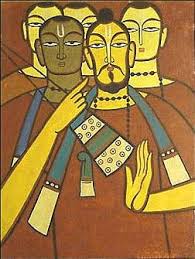
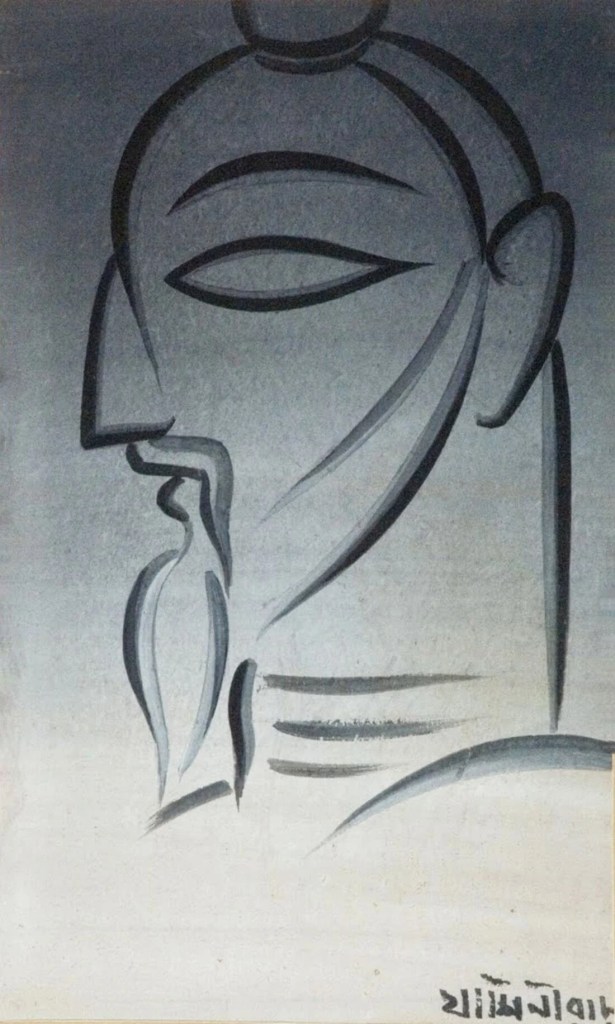
Bauls by Jamini RoyBaul Singer by Jamini Roy Paintings by Jamini Roy (1887-1972). From Public Domain
Religious movements such as Bhakti and Sufi have spanned time and territory and entered Bengal, in successive waves, creating a syncretic culture in which music and poetry are amalgamated. One of the forms in which these movements find creative expression is Baul Gaan —the singing of itinerant minstrels.
Universally recognised as foremost among the oralities of Bengal, the Baul Sampradai is a community for whom singing is synonymous with worship. The Baul expounds a philosophy of humanism which rejects religious orthodoxies and stresses human equality irrespective of caste, class, religion and gender. The Baul sets himself on a spiritual journey, lasting a lifetime, towards discovering his moner manush (man within the heart) thereby alienating the notion of seeking the Divine in external forms such as mosques, temples, images and sculptures. Since God is believed to reside within man, the human body is viewed as the site of the ultimate truth –that which encompasses the entire universe. This tenet of Baul philosophy is known as deha tatwabad—the belief that the soul being pure the body that houses it, together with all its functions, is pure and holy.
Concentrated mostly in Kushthia, Shilaidaha and Sajadpur in East Bengal (now Bangladesh) and Murshidabad and Birbhum in West Bengal, the Baul tradition, though drawing elements from Tantra, Shakta and Sahajiya[1], stems from two main sources — Muslim Sufi and Hindu Vaishnav. Hence the simultaneous presence of Hindu and Muslim bauls in the villages of Bengal and great composers from both streams—Lalon Fakir, Duddu Shah, Madan Baul, Gagan Harkara and Fakirchand. Rejecting religious codes such as Shariat and Shastras, caste differences, social conventions and taboos, which they see as barriers to a true union with God, they sing of harmony between man and man. “Temples and mosques obstruct my path,” the Baul sings, “and I can’t hear your voice when teachers and priests crowd around me.”
Refusing to conform to the conventions of religion and caste ridden Bengali society, Bauls (the word is sourced from the middle eastern bawal meaning mad or possessed) are wandering minstrels who sing and dance on their way to an inner vision. Essentially nomadic in nature walking, for them, is a way of life. “No baul should live under the same tree for more than three days” — the saying seems to stem from the Sufi doctrine of walking an endless path (manzil) in quest of the land where the Beloved (the Divine) might be glimpsed. Bauls live on alms which people give readily. In return the Baul sings strumming his ektara[2] with dancing movements. The songs are rich with symbolism, on the one hand, and full of ready wit and rustic humour on the other. The Baul rails against the hypocrisy of religion and caste and takes sharp digs at the clergy but totally without rancour.
Many of the composite forms found in an older culture of Bengal have become sadly obscured in the present scenario of identity politics. But the one that has not only survived but is gaining in recognition day by day, is the Baul tradition. This is, in no small measure, owing to the intervention and interest taken by Rabindranath Tagore. In his Religion of Man Rabindranath tells us that, being the son of the founder of the Adi Brahmo Samaj, he had followed a monotheistic ideal from childhood but, on gaining maturity, had sensed within himself a disconnect from the organised belief he had inherited. Gradually the feeling that he was using a mask to hide the fact that he had mentally severed his connection with the Brahmo Samaj began tormenting him. And while in this frame of mind, travelling through the family estates in rural Bengal, he heard a Baul sing. The singer was a postal runner by the name of Gagan Harkara and the song was “Ami kothai paabo tare/ amaar moner manush je re[3].”
“What struck me in this simple song,” Rabindranath goes on to say, “was a religious expression that was neither grossly concrete, full of crude details, nor metaphysical in its rarefied transcendentalism… Since then, I’ve often tried to meet these people and sought to understand them through their songs which are their only form of worship.” In his Preface to Haramoni[4], Rabindranath makes another reference to this song. Quoting some lines from the Upanishads— Know him whom you need to know/ else suffer the pangs of death— he goes on to say, “What I heard from the mouth of a peasant in rustic language and a primary tune was the same. I heard, in his voice, the loss and bewilderment of a child separated from its mother. The Upanishads speak of the one who dwells deep within the heart antartama hridayatma[5]and the Baul sings of the moner manush. They seem to me to be one and the same and the thought fills me with wonder.”
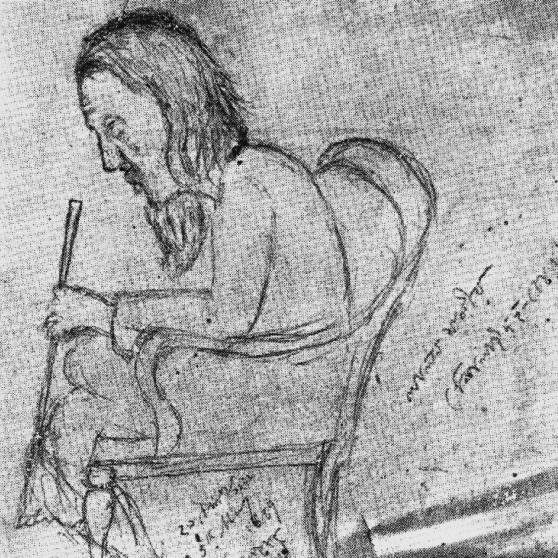
A Portrait of Lalon Fakir sketched by Jyotindranath Tagore(1849-1925)
Lalon Fakir’s commune was located in the village of Chheurhia which fell within Rabindranath’s father’s estates. Though there is no authentic record of a meeting between the two, it is a fact that the poet was the first to recognise Lalon’s merit which had the quality of a rough diamond. His inspiration was powerful and spontaneous but, lacking in clarity of expression, lay buried in obscurity till Rabindranath brought it out into the open. Publishing some of the songs in some of the major journals of the time, Rabindranath took them to the doors of the educated elite. Not only that. They gained in popularity from the fact that he, himself, often used Baul thought and melody in his own work. “In some songs,” he tells us in his Manush er Dharma[6], “the primary tunes got mixed up with other raags – raaginis which prove that the Baul idiom entered my sub conscious fairly early in life. The man of my heart, moner manush, is the true Devata[7]. To the extent that I’m honest and true to my knowledge, action and thought — to that extent will I find the man of my heart. When there is distortion within, I lose sight of him. Man’s tendency is to look two ways — within and without. When we seek him without — in wealth, fame and self- gratification — we lose him within.”
But it wasn’t only in his compositions that Rabindranath disseminated Baul ideology. It went deeper than that. The primitive simplicity and freedom of Baul thought and living charmed him so completely that he started imbibing them in his own lifestyle. He grew his hair long, kept a flowing beard and wore loose robes. He created Baul like characters in his plays and dance dramas and enacted the roles himself. And, as he grew older, a restlessness; an inability to stay in one place took hold of him. Leaving the ancestral mansion of Jorasanko he relocated to Santiniketan but even there he could not stay in the same house for more than two months. In the last two and half decades of his life, a tremendous wanderlust seized him. He travelled extensively both within the country and without, earning for himself the sobriquet of ‘roving ambassador for India’.
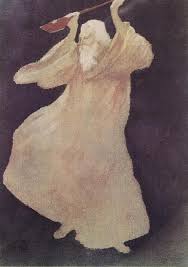
Perhaps, the most powerful testimony of the evolution of Rabindranath from a princely scion of the Tagores of Jorasanko to the man he finally became is found in Abanindranath’s portrait of his uncle. It depicts an old man with flowing white locks and beard, wearing a loose robe and holding an ektara high above his head. The limbs are fluid in an ecstatic dance movement. It is a significant fact that the painting is titled Robi Baul.
Robi Baul (1916): Painting by Abanindranath Tagore (1871-1951). From Public Domain
[1] Different schools of philosophy and religion. The Sahajiya is a philosophy that embrace nature and the natural way of life.
[3] Translates from Bengali to: “Where will I find Him — He who dwells within my heart”
[4] The Haramoni (Lost Jewels) is 13-volume collection of Baul songs compiled by Mansooruddin to which Tagore wrote the preface for the first volume published in 1931
[5] Translates to ‘innermost part of the heart and soul’
[6] Collection of Lectures by Tagore in Bengali, published in 1932
Aruna Chakravarti has been the principal of a prestigious women’s college of Delhi University for ten years. She is also a well-known academic, creative writer and translator. Her novels, Jorasanko, Daughters of Jorasanko, The Inheritors, Suralakshmi Villa and The Mendicant Prince have sold widely and received rave reviews. She has two collections of short stories and many translations, the latest being Rising from the Dust. She has also received awards such as the Vaitalik Award, Sahitya Akademi Award and Sarat Puraskar for her translations.
.
PLEASE NOTE: ARTICLES CAN ONLY BE REPRODUCED IN OTHER SITES WITH DUE ACKNOWLEDGEMENT TO BORDERLESS JOURNAL
Narrative by Debendranath Tagore, translated from Bengali by Somdatta Mandal
Note from the Translator
Debendranath, Father of Rabindranath Tagore
Born to Dwarkanath Tagore in Shelaidah, Debendranath Tagore (15 May 1817 – 19 January 1905) was a Hindu philosopher and religious reformer. One of the founders of the Brahmo religion in 1848, his journey in the role of ‘Maharshi’, the great ascetic, was an attempt to spread the Brahmo faith and he travelled extensively to various places, especially in different parts of the Himalayas like Mussourie, Shimla, Kashmir, and Dalhousie. He even constructed a house in Bakrota called ‘The Snow Dawn’ where he used to reside for months. Although Debendranath was deeply spiritual, he managed to continue to maintain his worldly affairs — he did not renounce his material possessions, as some Hindu traditions prescribed, but instead continued to enjoy them in a spirit of detachment. His considerable material property included estates spread over several districts in Bengal. Debendranath was a master of the Upanishads and played no small role in the education and cultivation of the faculties of his sons.
In his memoir, Jeevan Smriti [Memories of Life], Rabindranath also narrates in detail about his trip with his father in the Himalayas when he was just eleven years old. Debendranth founded the Tattwabodhini Patrika (1843) as a mouthpiece of the Brahmo Samaj and apart from his autobiography, wrote several other prose pieces which also reveal his wanderlust.
Among the two entries included here, we have ‘Moulmein Bhraman’ which is an interesting travel piece narrating his sojourn in Burma in September/October 1850. In the Chaitra 1817 Saka issue of Tattwabodhini Patrika, a travelogue ‘Mori Bhraman’ narrating Debendranath’s trip to Mori was published. Interestingly, as a prologue to this piece Sri Chintamani Chattopadhyay tells us that he was so enamoured after listening to Debendranath’s oral narration of the trip undertaken 28 years earlier, that he decided to transcribe it for the satisfaction of the readers.
Moulmein Bhraman (Travel to Moulmein)
After a year, the splendour of autumn revealed once again and the desire to travel blossomed in my mind. I could not make up my mind where to go for a trip this time. I thought I would make a trip on the river and so went to the bank of the Ganges to look for a suitable boat. I saw that several khalasis — dockyard workers – of a huge steamer were busy at their work. It seemed that this steamer would soon set sail.
“When would this steamer go to Allahabad?” I asked them.
In reply they said, “Within two or three days this will venture into the sea.”
On hearing that this steamer would go to the sea, I thought that this was the easiest way my desire for a sea journey could be fulfilled. I went to the captain instantly and rented a cabin and in due time boarded that steamer to begin my sea journey.
I had never seen the blue colour of the sea water before. I kept on watching the beautiful sights by day and night amid the continuous bright blue waves and remained immersed in the glory of the eternal spirit. After entering the sea and swaying with the waves for one night, the ship dropped anchor at three o’clock the next afternoon. In front of us, I saw a stretch of white sand and something that looked like human habitation. So, I took a boat and went to see it. As I was wandering about the place, I saw a few Bengali men from Chittagong with charms around their necks coming towards me. I asked them, “How come you are here? What do you do?”
“We do business here. We have procured the idol of Goddess Durga in this month of Ashwin[1],” they replied.
I was really surprised to hear that they celebrate Durga puja here in Khaekfu town of Burma. Durga puja was celebrated even here!
From there, I came back to the ship and started towards Moulmein. When the ship left the sea and entered the Moulmein River, I remembered the scene of leaving Gangasagar Island and going into the Ganges River. But this river did not offer any such good scenery. The water was muddy and full of crocodiles; no one bathed in it. The ship came and dropped anchor at Moulmein. Here a Madrasi resident called Mudeliar came and greeted me[2]. He came on his own and introduced himself. He was a high-level government official and a true gentleman. He took me to his house, and I remained a guest there and accepted his hospitality for the few days I stayed at Moulmein. I stayed very comfortably in his house.
The streets in the city of Moulmein were wide and clean. The shops that lined both sides of the street selling different kinds of things were all manned by women. I bought a box, and some very fine silk clothes from them. Going around the marketplace I went to the fish market at one time. I saw big fish for sale displayed on huge tables.
“What are these big fish called?”
They replied, “Crocodiles.” So, the Burmese ate crocodiles; they spoke verbally about ahimsa and the Buddhist religion, but their stomachs were filled with crocodiles!
One evening when I was wandering on the wide streets of Moulmein, I saw a man walking towards me. When he came close, I understood that he was a Bengali. I was quite surprised to see a Bengali there. From where did this Bengali arrive across the ocean? It seemed there were no places where Bengalis did not go. I asked him, “From where have you come?”
“I was in trouble and so came here,” he replied.
Instantly I understood his trouble[3]. I asked him further, “How many years of trouble?”
“Seven years,” he replied again.
“What did you do?”
“Nothing much. I just duplicated some papers of a company. Now my term is over, but I cannot go home because I do not have the money.”
I offered to give him the passage money. But how will he go home? He had set up a business, had got married, and was living quite comfortably. Would he ever go back to our country to show his shameful black face there?
Mudeliar told me that there was a mountain cave here which people went to visit[4]. If I wished he would accompany me there. I agreed. On the first moon night[5], he brought a long boat during the high tide. There was a wooden cabin in the centre of that boat. That night, Mudeliar, I, the captain of the ship and seven or eight other people boarded the boat and it left at two o’clock at night. We sat up for the whole night in that boat. The foreigners kept on singing English songs and requested me to sing Bengali songs. So, I kept on singing Brahma-sangeet occasionally. No one understood anything. They did not like them and went on laughing. We travelled for about twenty-seven miles that night and reached our destination at four o’clock in the morning.
Our boat reached the shore. Everything was still dark. On the shore I saw a cottage full of trees and creepers from which light was coming out. I got curious and ventured alone to that unknown place in the darkness. On reaching there I found it was a tiny cottage. Inside several bald-headed priests in yellow ochre robes were placing candles in different parts of the room. I was quite surprised to see people resembling the priests of Kashi[6] here. How did they come here? Later I came to know that they were the leaders of the Buddhist monks and known as Phungis. I hid myself and observed them playing with the lamps but suddenly one of them saw me and took me inside. They gave me a mat to sit on and water to wash my feet. I had come to their house, so this was their way of entertaining guests. According to the Buddhists, serving guests was a sacred act.
I returned to the boat at early dawn. The sun rose. Mudeliar and the other invited guests came and joined us. This made us fifty in number. Mudeliar fed all of us there. He had arranged for several elephants; about two or four people got on each elephant and proceeded towards the dense jungle. There were small hills all around and in between was that dense forest. There was no other way of travelling here except on elephant back. We reached the entrance of the cave in the mountain around three o’clock in the afternoon.
We descended from the back of the elephants and started to walk in the jungle where the undergrowth was waist high. The entrance to the cave was small; we had to crawl in. After crawling in a little we could stand up straight. It was very slippery inside and we kept on slipping and falling. So, we started walking very cautiously. It was pitch dark inside. Though it was three in the afternoon it seemed like three at night. I was scared that if we lost our way in the tunnel, we would not be able to come out. We would then have to wander inside the cave for the whole day. So, wherever I went, I kept an eye on the faint light at the entrance of the cave. All the fifty of us spread ourselves in various parts of the cave and everyone had sulfur powder in their hands. Then each person put a little sulfur powder in the little holes in the cave next to where he was standing.
After everyone’s place was defined, the captain lit his share of the sulfur powder. Instantly each one of us lit matches and ignited our portion. Now the cave was lit simultaneously at fifty different places like fireworks, and we could see the inside clearly. What a huge cave it was! On looking up to the ceiling our vision could not gauge its height. We saw the different natural formations that had been caused by rainwater seepage inside and were really surprised.
Later, we came out and had a picnic in the forest and then came back to Moulmein. On our way back we heard different musical instruments being played together. Locating that sound, we went forward and saw a few Burmese people dancing with all kinds of gestures of their bodies. Our captain and the foreigners also joined them and started to dance in a similar manner. They found great pleasure. A Burmese lady was standing at the entrance of her house. She watched the mimicry of the foreigners and went and whispered something in the men’s ears. They stopped their singing and dancing immediately, and all of them suddenly left the scene and disappeared somewhere. The captain went on entreating them to resume their dance, but they did not listen. It was amazing to see how much hold the Burmese women had over their men.
We came back to Moulmein. I went to meet a high-level Burmese official at his house. He received me very politely. There was a huge room and in its four corners sat four young women stitching something.
One of the girls instantly came and handed me a round box full of betel leaves. On opening it I found it to contain different condiments. This was the local Buddhist custom of receiving guests. He then gifted me some excellent saplings resembling the Ashok flower. I had brought them home and planted them in my garden, but they did not survive despite great care. The fruit of this tree is very popular with the Burmese. If someone had sixteen rupees then he would spend the entire amount to buy that fruit. We disliked their favourite fruit because of its smell[8].
Mori Bhraman (Travel to Murree)
On the 10th of Pous, 1789 Saka[9], I abandoned all work and ventured in full earnest to go for a tour in the west. I did not decide where I would go. Just as a confined river feels overjoyed when released, I too left home with equal enthusiasm. Two servants accompanied me. One was a Punjabi Sikh called Gour Singh, the other was Kashi Singh, an Odiya Kshatri. At that time the train went only up to Delhi.
Upon arriving at Delhi, I found out that there was no other way to go except by mail coach. So, I booked a seat on it. My destination was Punjab. The horses of the coach in which I travelled up to a place near Sutlej were not steady. Because of them the coach swayed on both sides. I feared that it might topple, and it did tilt on one side and fell down on the ground.
I got out of the coach through its panel and shouted at the driver in the topmost voice – “You made me fall down, the body is hurt in many places and the nose is bleeding.” The driver had assumed that I had already died under the pressure of the carriage. Feeling assured after hearing my voice he replied, “Baancha to – at least you are alive.” My servant brought some water from a nearby well. I washed my nose. It was almost evening by then. Seeing a rest house nearby, I spent the night there.
Early next morning, I boarded the mail carriage again. It crossed the huge bridge upon the river Sutlej. Upon looking down I saw that the water had a tremendous current. I had never seen such a large bridge before. The wind was blowing fiercely. The strange sound of the waves hitting one another created great pleasure in my mind.
After that I reached an inn near the Beas River. Having our lunch there, I boarded the coach again at four in the afternoon. It was almost evening; we hadn’t progressed far when all of a sudden, a heavy storm rose. The road was just along the river. Sand started blowing to form clouds and cover the surroundings. Nothing was visible in front of us. Sand filled our nostrils and the coach could hardly move. I couldn’t decide where to go and take shelter. We found a settlement a little further ahead. Seeing a two-storied house I got off the coach and spent the night there. The storm continued unabated till three o’clock at night. As soon as it stopped, I boarded the coach again.
In this manner, travelling from one inn to another, I ultimately reached Amritsar. Earlier when I had gone to Shimla, I had spent a few days with great pleasure in Amritsar in an old, dilapidated house located next to a narrow sewer line. Immediately upon reaching Amritsar, I went looking for that beloved house.
I came next to the sewage line but saw that the house did not exist anymore. There wasn’t even a sign of it anywhere. This was an example that nothing was permanent in our lives.
I came back from there in a depressed mood. I rented a small single storied hut next to the road. As a traveller on the road, I stayed there amid the dust in that small room quite stoically but with great excitement. I cannot express in words how much I enjoyed living in such seclusion. The room wasn’t much taller than the road. Unknown travellers would stop by and speak to me in a manner as if we had been acquainted before. I was also happy to interact with them. One of them was a devotee of Hafiz and I too became an admirer. He did not want to leave me and became an earnest friend of mine.
Days went by in this manner. One day a Brahmo gentleman called Shibchandra babu came from the Brahmo Samaj at Lahore. He said that he had been sent by the Brahmos there once they heard that I was here, and I had to go to Lahore. Seeing his eagerness I started for Lahore. Babu Nabinchandra Roy had arranged for my accommodation beforehand in a house located next to a wide road at Anarkali. Once I reached there, the Brahmos came and surrounded me with devotion. During my stay in Lahore, I even had to deliver a lecture in Hindi.
From there the Brahmos arranged for my stay inside a garden. Surrounded by lime trees, the dwelling house was in the middle. With only two servants accompanying me, who was going to cook for me? I developed diarrhoea after eating the hard rotis that were served. Soon, I was also attacked by malaria. The Brahmos informed a Muslim doctor, and he came and saw me. I did not take the medicines prescribed by him. My own medicine was powdered Myrobalan and I took that. The next day there was a lot of emission of blood. I became weak; wanting fresh air I went up to the first floor. There I felt the tremendous heat of the sun and my head started reeling. The very next moment I fainted. Upon hearing this news, two Brahmos came and started feeding me sugar cane and I regained my consciousness after their nursing.
The body was in a miserable condition. The next day I sat wondering where I could go in such a state and that too without a cook. How could I return home in the heat of summer? As I was feeling tense thinking about it and could not decide what to do, my heart suddenly said, “Go to Murree.”
Thinking this to be a god-sent instruction I started preparing to go to Murree. The local Brahmos came to meet me at around two in the afternoon. My body was still very weak, and I didn’t have the energy to even talk much. They asked me what I wanted to do now, and I told them that I had decided to go to Murree and would begin my journey that day itself. After they left, Nabin babu and a few other Brahmos came.
I told them, “I want to go to Murree today so please arrange for a coach.”
They sent Gour Singh and arranged a mail carriage for me. Nabin babu asked me what I would eat on the way. He then gave me two bottles of pomegranate juice. After the coach arrived, I had the two big trunks loaded on its roof and got inside with the two bottles of juice as sustenance. Two servants sat on the roof of the coach. Despite my objection, the Brahmos dismantled the horses and started pulling the coach by themselves. I had to persuade them to stop. The coachmen attached the horses again and started moving.
After travelling a little I realised that the coach was swaying too much, and it was also not strong enough. The Sikh Gour Singh who was sitting on top was very strong, and there were two heavy trunks; if the roof collapsed on my head, there would be nothing I could do. I started feeling scared. Travelling in this manner, I reached a dak bungalow. It was a great relief and I felt that my life was saved. After eating there, I boarded the coach again. Gradually I came to the Jhelum. Gour Singh’s house was located there. He stopped the coach and was pleased to call his relatives and introduce me to them.
In this manner I arrived at Rawalpindi, which was situated in the Murree valley. From this point the road went up and down. Many broken wheels lay scattered here and there as proof of this dangerous road. I became scared on seeing them and kept wondering what would happen to me if the wheels of this unstable coach also broke. But by God’s grace, we overcame all these various hurdles and safely reached another dak bungalow[10]. As soon as I arrived there, the local Bengali gentlemen came to meet me. The pain in my body and the strain of travel made it difficult for me to speak. A gentleman called Dwarik babu started taking special care of me. He went here and there looking for a house, and at last went and requested a Parsi gentleman to allow me to stay in his garden.
I stayed in that garden and a Punjabi doctor came to see me. I told him that milk was my only food, but I could not digest that milk very well. I asked him for some medicines that would help me to digest that milk and was slightly relieved with what he gave me. I had become very weak. At night when I went to bed, I felt that I would not be able to get up the next day.
When Dwarik babu came the following day, I told him that I wanted to go to Murree. He told me that there were still no shops and markets at Murree, and I would find it difficult to stay there. But I went on pestering him. So having no other way he arranged for two basket carriages called dulis that would take me to Murree. I went in one duli and my luggage was put in the other one, while the servants went walking. I reached Murree after three days and a lot of hardship.
It was situated at a height of 7,500 feet. The bearers asked me where I wanted to go, and I told them to take me to the place where the sahibs usually landed. They took me to a huge house which was totally deserted and not a single human being was around.
I told them, “Why did you bring me here? Take me to a bungalow where people are staying.”
So, they took me to another bungalow. But the people there told me that it was a club house and not a place for travellers to stay. So, I could not put up there. I told the bearers to take me back to that same uninhabited house where they had taken me at first. They got annoyed and went back there and said that they would not go anywhere else. They placed my duli under a tree in front of that house. Looking up I saw the sky overcast with clouds. Here in the hills, it doesn’t take long for clouds to gather and rain. I was worried and wondered where to go now. I asked the bearers to take me inside and they carried the duli up to the verandah. I got down and inspected the house. There was no one anywhere. I selected a room and again asked the bearers to bring all by bedding from the carriage and spread it out near the wall so that I could sit up and take some rest. They did that and the very next moment quickly disappeared with their dulis.
A little later it started raining. The servants had not reached till then. Through the windowpanes, I could see that a heavy storm was raging outside. The leafless branches of all the big trees were fiercely swaying and big hailstones started hitting the windowpanes as if they would break them, but nothing happened. I kept on thinking that if I arrived here a little late then I would surely have died inside the duli in this severe hailstorm.
After a while the two servants came shivering. With the cold, the rain, and the hailstorm, they were in very bad shape. After wringing their clothes, they came near me. I told Gour Singh to look for a bearer or the caretaker of this hotel and bring him to me.
So he went and got the chowkidar. I asked him to fetch the furniture for the room, but he said he couldn’t do that till he received orders from the master. I threatened him that if he did not bring the furniture out under my orders and if his owner got to know about it, then he would be instantly dismissed from his job. The man got scared and then brought out a charpoi. I spread out my bedding on that cot and lay down. That night Gour Singh brought me a roti and some water. I could neither eat that hard roti nor drink the ice-cold water of Murree. So, I spent the night without any food. In the morning, I sent Gour Singh to fetch some milk and kept on counting the hours until his return.
It was eight o’clock and still there was no sign of Gour Singh. Those eight hours seemed like eight days. At last, he came back at 9 am with some buffalo milk. Upon drinking it, I found it to be diluted with water and tasteless. I could not digest that milk, and nothing remained in my stomach. The milk just passed out as it was. I covered myself with layers of blankets and shawls and went to sleep in the charpoi in that tremendously cold weather.
While I was lying down, I saw a shivering sahib entering my room. I realised how extremely cold it was outside when I found his teeth were chattering. He lit a fire in the next room and because of that I felt a bit comfortable.
The next day Gour Singh brought such diluted buffalo milk once again. I drank it but again the milk went out of my body as it is. Having starved for three nights I felt almost half-dead on the third night. I laid down quite comfortably on the charpoi with all the warm clothes layered upon my body and did not feel any pain. I felt as if someone like my mother was sitting near my head. I was breathing and along with that breath I saw my friend, Sajuja, also looking at me. Breathing in and out in that manner I spent the whole night doing easy yoga and cannot describe how happy I felt.
Soon the night was over, and it was morning. Once again Gour Singh brought that kind of diluted buffalo milk. I drank it. How strange! I digested the milk that day. Since pure milk was unavailable here, I told Gour Singh that it would be nice if he went looking for a cow. So, he went to Rawalpindi and bought a small cow for thirty rupees. He said that she gave ten seers of milk per day. Now milk has become my staple diet.
After drinking that milk my body became a little stronger. I had been staying in Bekereya Hotel from the beginning but now I decided that it was not feasible to continue staying there any longer. So, I went to look for a rented house. I went up the hill in that extremely weak condition and found an empty house. But it was so cold there that I did not find it suitable. A little lower from that point I found another house and liked it. I rented it for nine hundred rupees and started staying there. The next day the postal peon brought me a letter from my nephew Gnanendranath. I opened it with excitement, and he had included a Brahma-sangeet which read thus:
Gao rey tahar naam
Rochito jaar visvadhaam.
Dayar jaar nahi biram
Jharey abitito dhaarey.

[Sing His name/He who has created this world/Whose blessings endless/Falls continuously on earth]
I had already received His blessings to get back my life from the verge of death; the same blessings that were referred to in this song made me feel excited and my heart leaped with joy. This sort of a letter, and at such a time! How strange! How strange!
In this new house I managed to get a cook. He prepared green moong dal for me, and I liked its taste. It was sufficient for my lunch. After a long time, I felt satiated after an afternoon meal. As my health started improving, I gradually began to increase the quantity of my milk consumption. Early in the morning after the upasana was over, they brought the cow in front of me, and I would immediately send a bowl for the cow to be milked before my eyes. The bowl of milk was brought to me; I drank it and sent the bowl back. The cow would then be milked again, and I would once again drink from the bowl. This procedure was repeated several times and after drinking four or five bowls of milk, I would go for a walk in the mountains. Walking in the fresh cool breeze and under the direct rays of the morning sun, I wandered here and there and then came home. Instantly I would have tea, chocolate, and milk. During lunch I would drink milk again, and in the evening, and before going to bed. In this manner, I would drink about ten seers of milk each day and whatever was left over was made into butter to be consumed with rotis the next morning.
Within seven days, I regained my strength and, feeling exuberated started travelling in the mountains. I started singing songs praising the grace of our creator and there was no end to those songs. For a long time, I had been cherishing dreams of visiting Kashmir and it seemed that our creator would now fulfill it. So, I started enquiring about how to go to Kashmir. By the beginning of May, Murree became full of people and the place took a new look with the red uniform of the British soldiers and the fanciful clothes of the other British men and women. Deserting its shabby look, even nature filled up the place with varieties of flowers. After staying in Murree for three months, I heartily began my journey to Kashmir on the 4th of September.
[ Excerpted from Wanderlust: Travels of the Tagore Family. Translated and Edited by Somdatta Mandal. Kolkata: Visva-Bharati, 2014]
[2] Sri Murugesam Mudeliar was the then Commissariat contractor of the military outpost at Moulmein.
[3] The fact was that the man had been banished here. Usually, political prisoners were interned in Moulmein prior to 1848. But after 1848 Port Blair in the Andaman Islands was made the new place for banishment and imprisonment. This narrative is dated 1850.
[4] The local name of this famous cave was Kha-yon-gu, and Farm Cave in English. It was situated in the northeast part of Moulmein town and was approachable through the Ataran River.
A Bengali Rendition of the song by Debabrata Biswas
ON THIS AUSPICIOUS DAY

On this auspicious day, let us go to our
Father’s heavenly abode.
Let us go. Let us go, you and I.

The level of contentment in His blissful
Home is unfathomable to us.

The three worlds are in ecstasy with
Festivities that spill over with joy.

Let us join the celestials singing in praise of him
Let us go there. Let us go, you and I.
Tagore like his father and grandfather was a Brahmo. The Brahmo festival, Maghotsav, is celebrated at the end of January, by the Bengali calendar on the 11th of Magh. Brahmo Samaj grew out of Brahmo Sabha. These were attempts at a reform movement on Hinduism initiated in the early part of the nineteenth century Calcutta by Raja Ram Mohan Roy and Dwarakanath Tagore, the poet’s grandfather.
Anasuya Bhar explores the history of the National Anthem of India, composed by Tagore in Bengali and translated only by the poet himself and by Aruna Chakravarti. Both the translations are featured here.
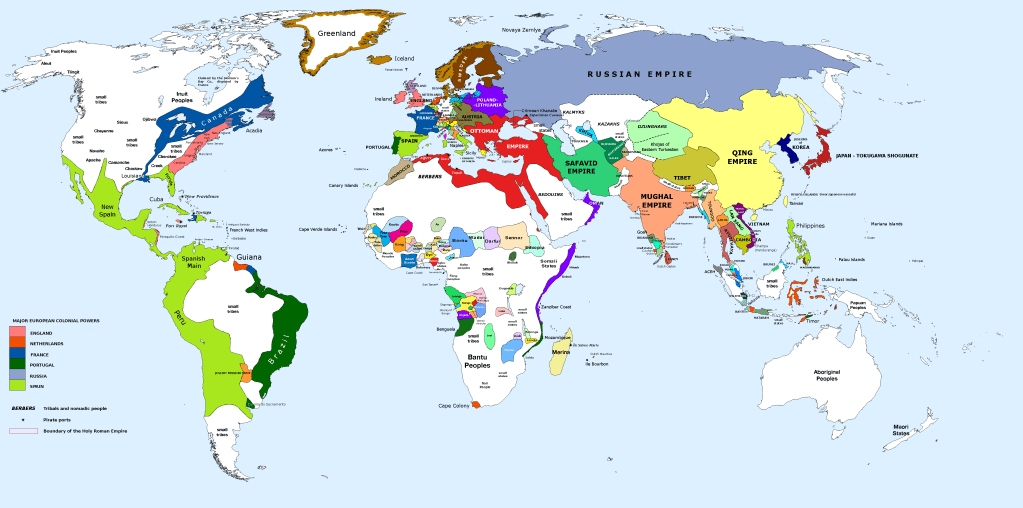
1700 AD: An illustrative map of the world in the early colonial period. The Mughal Empire in India was at its greatest territorial extent. Courtesy: Creative Commons
The national anthem and the national song of India are both parts of a post-colonial narrative and did not originate prior to the British colonisation of the country, which happened effectively, from the middle of the eighteenth century. India has been broadly classified as a civilisation and a cultural phenomenon, rather than a race or a territorial presence prior to the British colonisation.
India has remained an idea ever since the ancient times, perhaps even prior to the advent of the Classical Graeco-Roman civilisation of the west. The historicisation of India’s past has been a much debatable issue, with European historians representing India from their perspective. Much damage was done, for instance, by James Mill’s The History of British India (1817), which rubbished the country as thoroughly debased and wanting the civilisational touch of the European west. The reality of India, or more correctly Bharat, inhered in the local and regional historical specificities, its literature, culture, myths and legends. The historical perspective of our inhabitants was that of the Puranic history whose chronology, order and narrativity depended on a time scale different from the idea of time in the western rationale for chronology. In other words, the European west’s rationale consequent of the enlightenment, and the enlightened concept of history, was a later addition to the Indian consciousness.
The concept of a distinct nation, and as an individual entity in the consciousness of a socio-political presence in the history of the world, was also, a comparatively belated concept in our country. In fact, it was not earlier than the Mughals that the country was conceptualised as a unified entity from the North to the South, from the East to the West. The Indian sub-continent is strategically guarded by the geographical presence of the Himalayan range, the Indian ocean, the Bay of Bengal and the Arabian Sea. Hence, the territorial boundaries which become crucial in determining the political borders of the European or the American west are not of much consequence over here. The borders that are present in the former continents are a result of political aggression and imperialism. The borders that ensued in the Indian subcontinent and eventually created Afghanistan, Pakistan, India, Nepal, Burma, Bangladesh and also Sri Lanka, are, however, a result of the European and, particularly, British intervention.
The consciousness of India’s nationalism was, as mentioned in the beginning, a later one and quite clearly a colonial aftermath. Among the first to mention the lack of an indigenous history was Bankimchandra Chattopadhyay (1838 – 94), the celebrated novelist and intellectual of nineteenth century Bengal, who himself attempted to write, through his various essays, a historical consciousness for his country. The writer of our national song ‘Bande Mataram’ (in Anandamath, 1882), Bankimchandra was also the first to think of a ‘jatiyo’ or a nationalist consciousness, and attempted to take a fresh look at the puranic history based on myths and legends. He rewrote the narrative of Krishna, and also looked afresh at the fundamentals of the Hindu religion.
The nationalist consciousness was given a fresh lease through the several attempts for promoting indigenous products and enterprises by the Tagores of Jorasanko in Kolkata. The Hindu Mela (Hindu fair), begun since the mid-1860s by Dwijendranath Tagore (1840 – 1926) was among the first to strike concepts of an indigenous nationhood, by giving impetus through homespun fabrics, cultivation of rural handicrafts and traditional food items like pickles or ‘bori’, such that a space could be created independent of the parameters used by the colonial masters. Rabindranath (1861 – 1941) also refers to several attempts of his elder brother Jyotirindranath (1849 – 1925), in creating the matchstick factory or even striking a competition in the ship trade with their English counterparts in the waters of Bengal in his autobiographical Jibansmriti (My Reminiscences, 1911). He also mentions the latter’s attempt at designing a national dress for the country, trying to fuse various drapes of traditional clothing. This is again very interesting because, a distinctive sartorial appearance would help in identifying the Indian from the European, even externally. The sari as we wear it now, was first conceptualised by Jnanadanandini Devi (1850 – 1941) of the Tagore household. She gave the Indian women a dignified attire by fusing the styles of Parsis and Gujaratis, and also by improvising on the styles of the European gown to give us the blouse-jacket. The unification of various styles automatically veered towards a oneness in the same territorial boundaries and the nationalistic consciousness came first through cultural means.
The Tagores of Bengal were also among the first, after Rammohan Roy (1772 – 1833), to venture beyond their homes. Dwarakanath (1794 -1846), grandfather of Rabindranath, not only stayed in England for a substantial period of time, but also endeared himself to Queen Victoria as the ‘Prince’. Debendranath (1817 – 1905), his son, was in the habit of touring the Himalayas extensively, and even took his youngest son Rabi along with him. Satyendranath (1842 – 1923), another of his sons, was the first Indian to qualify in the Indian Civil Service; he too, extensively toured several parts of India and abroad. Rabindranath was a frequent traveller from a very early age. The women of the Tagore household, beginning with Jnanadanandini Devi also moved out of their antarmahal (inner quarters) and into the other parts of their country and even the world. Indira, Mrinalini, Sarala, Pratima along with Jnanada were frequent travellers both within and outside the country. Hence, the country and the ideology of India as a nation were familiar concepts to the members of this remarkable family from Bengal. Of course, there were other influential households in nineteenth century Bengal, but none so extensively influential.
The formation of the Indian National Congress (INC) in 1885, marked the culmination of several isolated and scattered attempts at nurturing a nationalist consciousness. I have, however, given a few instances from Bengal. I am sure similar attempts were made in other states as well. Even in the formation of the INC, we see the pivotal role played by Janakinath Ghosal (1840 – 1913), husband of the well-known litterateur Swarnakumari Devi (1855 – 1932), elder sister of Rabindranath. According to the memoirs of his elder daughter Hiranmayee, Janakinath was a key presence at the time of the formation of the Congress. Later, Sarala (1872 – 1945), their younger daughter, not only became a part of the Congress, but was also among the foremost figures in Bengal to enthuse young men into the national struggle through cultivation of physical fitness programs. Sarala also worked closely with Swami Vivekananda and Sister Nivedita in some of their philanthropic programs.
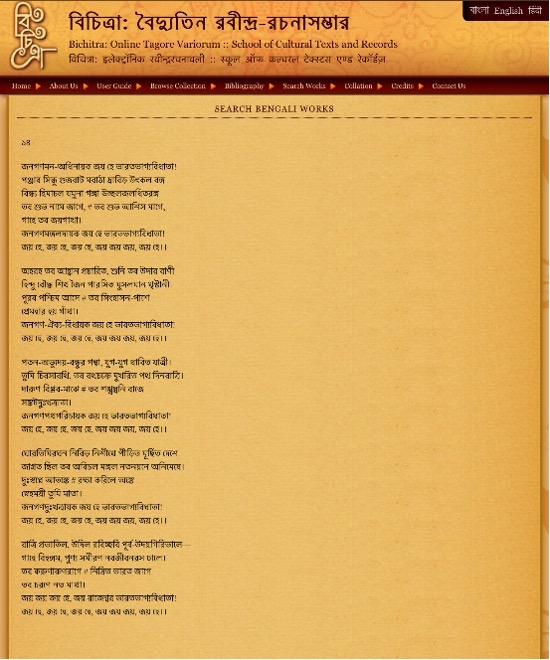
Jana Gana Mana, now venerated as our National Anthem, was most possibly first composed as a hymn, by Rabindranath Tagore. This hymn was first recited on the second day of the annual session of the Indian National Congress on 27th December 1911, by none other than Rabindranath himself. This was followed by a second performance of it in January 1912, in the annual event of the ‘Adi Brahmo Samaj’ or the Brahmo Congregation, and then it was published, for the first time in the January edition of the Tattwabodhini Patrika, which was the official journal of the ‘Adi Brahmo Samaj’, with the title ‘Bharata Bhagya Bidhata’ or ‘the determinant of Bharat’s destiny’. The journal was, at that time, edited by Rabindranath himself. The original song, composed in Bengali, has five stanzas. The Anthem makes use of only the first of the five and usually covers an average time of 52 seconds when sung. The original language has been retained, although its intonation is Devanagiri.
The Song in Bengali. Photo courtesy: Anasuya Bhar
The song is a hymn to the all-pervasive, almighty, and the maker of the country’s destiny, the power of whom presides over her natural boundaries of the Himalayas and other mountains and the rivers, and where resides individuals of all races, cultures and religions. It has been the benefactor, through thick and thin, assimilating the good with the bad, and when the country has been lying destitute in trouble and pain, has extended its hand in empathetic wonder. The sun of Bharat’s destiny will rise again and the pall of darkness shall be drowned in the light of a new dawn – a new beginning and a new hope. Rabindranath did not live to see this dawn, but his visions were realised and honoured by the makers of the Constitution of the Republic of India.
The hymn that originated in the poet’s fiftieth year, perhaps had its germs planted in him through his entire life as the beginning of this essay tries to elaborate. It was only time and the political needs of the country that expedited its utterance in the year 1911. The poet’s vision found embodiment in other and similar creations as well. His Gitanjali (1912) contains the well-known poem, ‘Where the mind is without fear’ (XXXV) –
Where the mind is without fear and the head is held high
Where knowledge is free
Where the world has not been broken up into fragments by narrow domestic walls
Where words come out from the depth of truth
Where tireless striving stretches its arms towards perfection
Where the clear stream of reason has not lost its way into the dreary desert sand of dead habit
Where the mind is led forward by thee into ever-widening thought and action —
Into that heaven of freedom, my Father let my country awake.
The year in which he composed and first presented Jana Gana Mana, that is 1911, was in many ways a very crucial year in his personal history. As mentioned earlier it was his fiftieth birth-year, and he was gradually beginning to be acknowledged for his poetic greatness in his own land. The following year, that is 1912, he would go to England, with some of his own translations into English, and which would, introduce him to the world as a major poet, among other poets. 1911, was also the year which marked the coronation of King George V and the transfer of the British capital from Calcutta to Delhi. In fact, Rabindranath’s hymn was initially mistaken to be sung in honour of the new Emperor of the British dominions, but was later clarified to be otherwise, and was acknowledged to be a ‘prayer’ for his own native land and independent of such intentions.
The period that we are considering is also a very significant one in Rabindranath’s own consciousness of the nation and his concept of nationalism. In 1910, he published his novel Gora where he underlined the irony inherent in religious exclusivity and bigotry. His protagonist, a staunch votary of Hindu values and virtues, ironically emerges to be an Irish foundling reared in a Hindu home. Through him Rabindranath proves the efficacy of such conservative religious bigotry. His song ‘Bharata Bhagya Bidhata’ pledges to go beyond external divisions of religion and politics, and endorses the value of humanity; nor does it discount the importance of the west, but believes in the fruitful coming together of the best of all worlds. His school at Santiniketan, later to be identified as Visva-Bharati, exemplifies this coming together of the best of all the worlds. In 1919, he delivered a series of lectures on nationalism, which came together in a single volume called Nationalism, and further endorsed his beliefs in finding the nation through culture, history and habits rather than through and in territorial, narrow parochial walls. In Ghare Baire (The Home and the World, 1916), published around the same time, he offers us a critique of the Swadeshi Movement that dominated colonial politics in the first decade of the twentieth century in Bengal. He subtly interweaves a tale of the ‘personal’ with the ‘political’ in the triangular narrative structure of Bimala, Nikhil and Sandip, only to expose the petty hypocrisies that inhere within the grand narratives of ‘nationalism’, ‘patriotism’ and even ‘swadeshi’ at the cost of the common good and humanity at large.
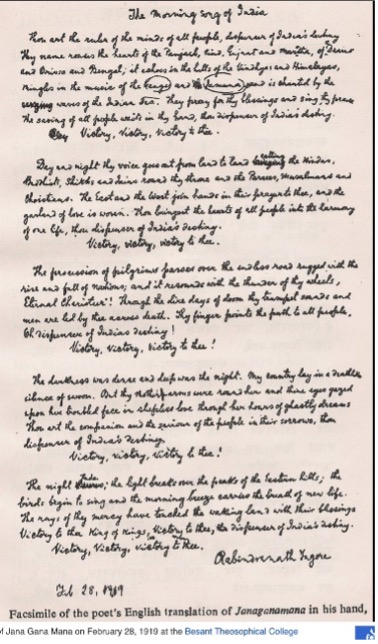
Jana Gana Mana was sung by Sarala Devi Chaudhuri, Rabindranath’s niece and daughter of Janakinath, in 1912, and who had distinguished herself as one of the earliest women nationalists of the country. The song was, then, performed in front of veteran Congress leaders. Outside Bengal, the song was perhaps performed for the first time by Rabindranath in the annual session of Besant Theosophical College in Madanapalle, Andhra Pradesh, on 28th February 1919. The Vice-Principal of the college, Margaret Cousins, was so enthralled by the song that she asked the poet to translate it for her. This Tagore did, and the translation is called ‘The Morning Song of India’. A facsimile image of the same is shown here.
The Morning Song of India in Rabindranath’s handwriting. Photo courtesy: Anasuya Bhar
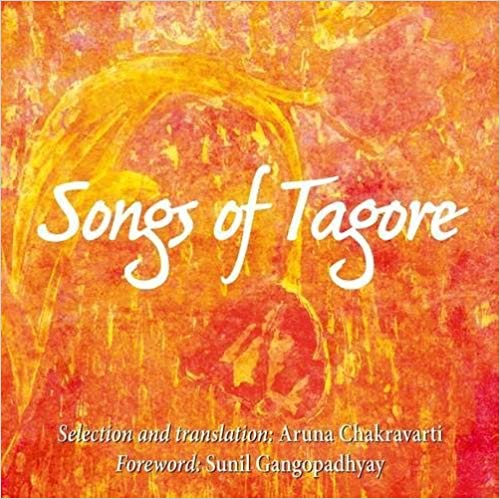
‘Jana Gana Mana’ has been translated into English by noted writer, academic and translator, Aruna Chakravarti. She is perhaps the only person to accomplish this beside the poet himself. The following is the translation made by her, along with the English transliteration of the Bengali original (Songs of Tagore, Niyogi Books):
Leader of the masses.
Lord of the minds of men.
Arbiter of India’s destiny.
Hail to you! All hail!

Your name resounds through her sea and land
waking countless sleeping souls
from Punjab, Sindh, Gurarat, Maratha
to Dravid, Utkal, Banga.
Her mighty mountains—Himachal, Vindhya,
her rivers—Yamuna, Ganga,
the blue green sea with which she is girdled;
her waves, her peaks, her rippling air
seek your blessing, carry your echoes.
Oh boundless good! Oh merciful!
Hail to you! All hail!

At the sound of your call the people assemble
from myriad streams of life.
Hindu, Muslim, Buddhist, Jain.
Christian, Parsee and Sikh.
East and West stand by your throne
hands held in amity,
weaving a wreath of fraternal love;
of empathy, unity.
Oh you who bring us all together!
Hail to you! All hail!

Nations rise and nations fall
on the perilous path of history.
And you Eternal Charioteer
guide the world’s destiny.
Through day, through night, your wheels are heard
renting the air with sound,
dispelling terror, banishing pain;
blowing the conch of peace.
Oh true arbiter of India’s fate!
Hail to you! All hail!

In the deep dark of a turbulent night,
when our swooning, suffering land
lifted her eyes to your face in hope,
she saw your unwavering gaze
raining blessings, alight with love,
banishing evil dreams.
Like a loving mother you held out your arms
and changed her destiny.
Oh you who wipe out the pain of the masses!
Hail to you! All hail!

A new day dawns; a new sun rises
from the mountains of the east.
Song birds trill; new sap of life
is borne on the holy breeze.
India awakes from aeons of slumber
to the strains of your lofty song.
Head bowed to your feet oh King of kings!
Hail to you! All hail!

(Republished with permission from Songs of Tagore, Niyogi Books)
Outside of the country, the song was also performed as the ‘national anthem’ of independent India, under the leadership of Subhas Chandra Bose on the occasion of the founding meeting of the German Indian Society on the 11th of September 1942, in Hamburg, Germany. The Indian Constituent Assembly allowed the performance of Jana Gana Mana on the midnight of 14th August 1947, marking the close of the historical session in the Parliament. It was on the 24th of January, 1950 that only the first stanza of the song was accepted as the National Anthem of independent India. The paeans of a land millennia old, perhaps heading the dawn of all human civilisation alone, is sung through glory to the world over, till date, bearing the torch of an all tolerant, enduring land, by the name of Bharat. Perhaps we still need to be in quest of its philosophy of oneness.
A full rendition of Jana Gana Mana by Swagatalakshmi Dasgupta
Dr. Anasuya Bhar is Associate Professor of English and Dean of Postgraduate Studies, at St. Paul’s Cathedral Mission College Kolkata, India. She has many publications, both academic and creative, to her credit.
.
PLEASE NOTE: ARTICLES CAN ONLY BE REPRODUCED IN OTHER SITES WITH DUE ACKNOWLEDGEMENT TO BORDERLESS JOURNAL


 Borderless