I had died seven years earlier,
and she played Chopin's Nocturnes each night,
danced under that great gushing Monet,
so that I was with her and not without,
the pulling Joy behind that sudden knowing smile
bathed in candlelight.
Ryan Quinn Flanagan is a Canadian-born author residing in Elliot Lake, Ontario, Canada with his wife and many bears that rifle through his garbage. His work can be found both in print and online in such places as: Evergreen Review, The New York Quarterly, Borderless Journal, GloMag, Red Fez, and Lothlorien Poetry Journal.
PLEASE NOTE: ARTICLES CAN ONLY BE REPRODUCED IN OTHER SITES WITH DUE ACKNOWLEDGEMENT TO BORDERLESS JOURNAL
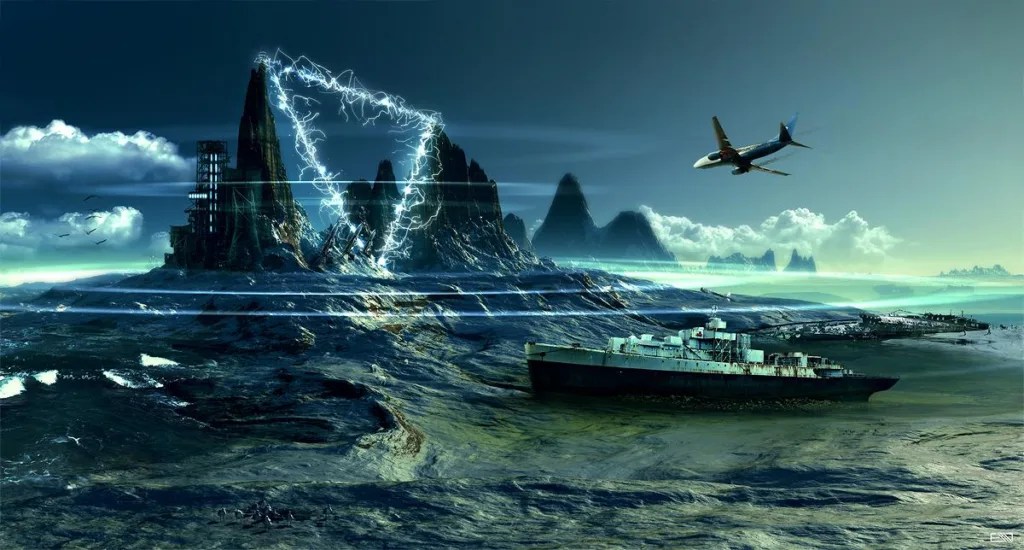
Our aeroplane
vanished one day into the void
without an explanation.
We were flying towards Bermuda
to attend a birthday celebration
but we never arrived.
Your ship disappeared
one afternoon while sailing slowly
north of Puerto Rico.
You were afeared it had sunk
to the bottom of the sea
in some unholy catastrophe
but it hadn’t.
And as for the submarine
cruising east from the Bahamas:
the crew were wearing pyjamas
when it mysteriously
passed out of this world
and entered a realm like a dream.
In a higher dimension
these three vehicles materialised.
Without our consent
they fell in love and began an affair:
an aeroplane snatched from the air
in a relationship
with a sailing ship
and a submarine involved with both.
What a complicated situation!
So many emotions entangled…
I almost feel strangled
by the melodrama
of the Bermuda love triangle.
THE FROTHIEST COFFEE
The frothiest coffee that ever there was
swung from a tether, for certain
because
it was the frothiest coffee
that ever could be
in history
apart from the brew
made frothy by you
for the numberless Counts of Ballyhoo,
all of whom despise tea.
But why did it swing from a tether?
I sigh when I’m asked
that question
and not for the reason
that it’s the
wrong season for asking it. Oh no!
I sigh because
sighs are wise and I’m
a kind of owl
with a reputation to uphold.
What kind of owl exactly?
A coffee loving owl.
I spoon the ground beans into a barrel
with a trowel
and then I add the boiling milk
and I whisk it
vigorously until my soul seems to sink
and cavort among
the bubbles of the wondrous foam
that turns this hovel
into a proper home, as only the frothiest
coffee can.
I hope you understand?
And now I ought
to say something more about
the Counts of Ballyhoo, who as you know
were enemies of tea,
and the youngest scion of that House
was Freddy Fiddledee
and he once decided to embark
on an epic journey in a wooden ark
because ‘motorcycle’
doesn’t rhyme with ‘embark’
at least not at this particular time.
And his mission was
to find out for certain if there really was no
blend of tea he might enjoy,
black or milky or lemony,
in cups or mugs on the decks of tugs despite
his renowned family’s
aversion to that brew: he wondered if there
might be something new
that the world could offer him:
a change from the inevitable coffees he knew
too well, hot as hell,
but there wasn’t.
Too bad! His voyage was a waste.
Let’s not be hasty
and think the poem is at an end.
There are two more lines to go:
this one and
the next one.
Rhys Hughes has lived in many countries. He graduated as an engineer but currently works as a tutor of mathematics. Since his first book was published in 1995 he has had fifty other books published and his work has been translated into ten languages.
.
PLEASE NOTE: ARTICLES CAN ONLY BE REPRODUCED IN OTHER SITES WITH DUE ACKNOWLEDGEMENT TO BORDERLESS JOURNAL
I sat in the railway station leaning on a chair.
The evening was pleasant with orange-violet cotton clouds.
The chairs were meant for the passengers waiting for the 5.45 pm shuttle.
The passengers carried veggies and sweetmeats in yellow bags to take home.
Most of the passengers were old and capable of coughing the phlegm of life.
One or two well-to-do walked up the refreshment stall and slurped the hot brew.
I never went to that side because it reeked of sour milk.
Aroma of guavas rented the air where I was seated. It is the season, though late.
The bill advertising the tabloid press said,
‘An engineer from the public works department was found dead in the reservoir.’
I have seen only fishes in those turbid waters, big and small ones snapping their tails.
Sometimes pachyderms appeared from the thick groove on the banks for a drink.
Doubts were raised if the engineer committed suicide, or was it a murder?
A crow wearing a grey collar flew under the roof. It pecked at crumbs fallen off
The potato wafers people bought, ate from polythene bags to kill hunger
While the wait pounded blue vessels and produced dreariness.
The fritters would be swept away before sunset
By the station cleaning staff enveloped in bellow-like overalls.
These particles would soon be part and parcel of the purple carboys in which garbage collects.
The crow has to make a quick dash for its supper. It did not pause to read the bill.
The news of the engineer’s death did worry the crow or anyone. We were not like the crow with the grey collar.
We sat craning our necks and knitting brows, not knowing what to do with what is left.
One of us returned and said the post-mortem is done. The pyre is lit without a trace.
Saranyan BV is poet and short-story writer, now based out of Bangalore. He came into the realm of literature by mistake, but he loves being there. His works have been published in many Indian and Asian journals. He loves the works of Raymond Carver.
.
PLEASE NOTE: ARTICLES CAN ONLY BE REPRODUCED IN OTHER SITES WITH DUE ACKNOWLEDGEMENT TO BORDERLESS JOURNAL
The sparrow I saw under the roof of a border checkpoint

crossing from the USA to Canada,

heading to the Mahatma Gandhi Memorial in New Delhi,

coming out with a bottle of drink from an alleyway

encountered a sparrow in front of a small shop.


Both the sparrows – the one seen at the border checkpoint

and the other in front of the small shop,

belong to the same species as those

that live under the eaves of my hometown houses.

Next to the KBS* New York correspondent’s mike,

the sparrow hopping on the street, nibbling on crumbs,

and the sparrow living in a salt warehouse in Sorae*, Incheon,

are both sparrows from the same species.


Like a quiet Korean restaurant sign by the road on the way to Las Vegas,

or like the little six-year-old Korean-American kid I met

at a small snack bar in an LA alleyway,

lonely yet welcoming fellow countrymen sparrows from afar.


*KBS: Korea Broadcasting System

*Sorae: small creek in Incheon City, Korea
Ihlwha Choi is a South Korean poet. He has published multiple poetry collections, such as Until the Time When Our Love will Flourish, The Color of Time, His Song and The Last Rehearsal.
.
PLEASE NOTE: ARTICLES CAN ONLY BE REPRODUCED IN OTHER SITES WITH DUE ACKNOWLEDGEMENT TO BORDERLESS JOURNAL.
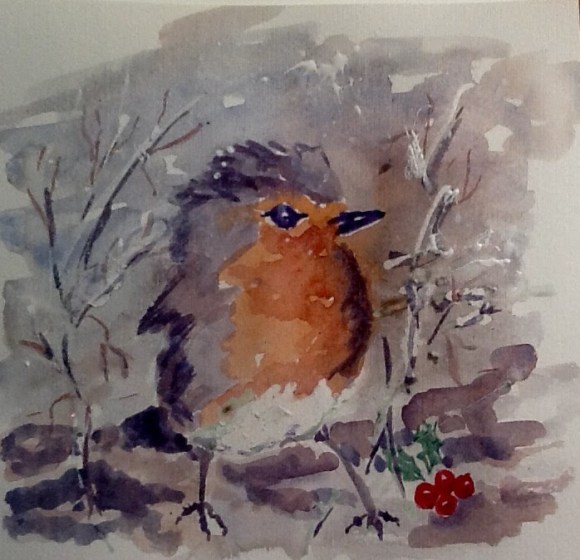
Ecstasy fills your morning sermons,

And words flow from your beak

Like bullets from a machine gun

At a frightful cadence that belies

Your tiny size with two tender eyes.


Your freewheeling words tear asunder

My early morning sleep ritual

That allows me to soak in the miseries

Of our planet and its inhabitants,

Elevating me like an icon.


Yet I dream to see the world

From your perspective by undoing

Your uncombed melodious flow

To understand why you speed up,

Alas, to slow down all too hastily.


Your escapades are legendary.

You fly from one end of the globe

To the other, noting in detail

Different colours of human misery

Which you store in your memory.


Even if I do not understand your sermons,

There is no divergence in our positions,

And that's such an enlightened feeling.

Coming from the tree next to my house

The tonalities in your chirps heal me.
Pramod Rastogi is an Emeritus Professor at the EPFL, Switzerland. He is a poet, academician, researcher, author of nine scientific books, and a former Editor-in-chief (1999-2019) of the international scientific journal Optics and Lasers in Engineering. He has published over ninety poems in international literary journals.
PLEASE NOTE: ARTICLES CAN ONLY BE REPRODUCED IN OTHER SITES WITH DUE ACKNOWLEDGEMENT TO BORDERLESS JOURNAL
Chez le Père Lathuille (1879) by Édouard Manet (1832-1883)
BECKONING


Yesterday

the wind whispered my name

while the blazing locks

of her rampant mane

lay heavy on mine.


And yesterday

I saw the way

the wind caressed tall pines

in forests laced by glinting streams

and thick with tangled vines.


And though she reached

for me in her sleep,

the touch I felt was Time’s.


CAMEO


Breathe upon me the breath of life;

gaze upon me with sardonyx eyes.

Here, where times flies

in the absence of light,

all ecstasies are intimations of night.


Hold me tonight in the spell I have cast;

promise what cannot be given.

Show me the stairway to heaven.

Jacob’s ladder grows all around us;

Jacob’s ladder was fashioned of onyx.


So breathe upon me the breath of life;

gaze upon me with sardonic eyes . . .

and, if in the morning I am not wise,

at least then I’ll know if this dream we call life

was worth the surmise.
Michael R. Burch’s poems have been published by hundreds of literary journals, taught in high schools and colleges, translated into fourteen languages, incorporated into three plays and two operas, and set to music by seventeen composers.
PLEASE NOTE: ARTICLES CAN ONLY BE REPRODUCED IN OTHER SITES WITH DUE ACKNOWLEDGEMENT TO BORDERLESS JOURNAL
One hundred and four years ago you were
composing your words like a violinist was
composing musical sounds. Your words are
alive still, quivering with beauty, delirium,
and the sobs of time, as the violin strings
reach a crescendo of the loudest order.
I see your words on the page bleeding. I
feel the sharp sea breeze as if I was out
at shore. I look up at the cluster of stars,
which are your words, soft and compact
one moment, and loud and exploding
the next. Your instrument cries out loud
as if death is on your trail. You lived only
for twenty-six years. Yet, you are still alive
with these words I am reading now. Perhaps
in a hundred and four years I should be
so lucky, for someone to find mine.
WHO MOVES TIME
Who or what moves
time like the sky
moves clouds? We
cannot move time
as it inhales and
exhales its evil.
Time has no heart
or arms to lift
our burdens. Mute as
a field of weeds,
time is hard to gauge.
Like air it will not
stay in one place.
It follows its own
rules -- slow when
you are rushed, fast
when you need it
to last longer.
THIS HOUSE
This house I live in
is made of air.
If you look up at
any time of day
you will see stars,
the moon, the sun,
and clouds. It is
all windows all
around and no
walls. If you look
down, there is grass,
dirt, and cement.
I do not need doors,
plumbing, or a stove.
I keep it real
simple with a soft
pillow and thick
blankets. People
give me stuff like
food and water, a
dollar or enough
change for a hot
meal. I do not pay
rent or utility bills.
I move a lot, not
always willingly.
You know the grass
could be greener,
but I settle for
what I can get.
NOTHING BUT EMPTINESS
I left nothing
but emptiness
and useless
meanderings
for you to digest,
sparse ideas
and drunken
diatribes to
moist your
appetite.
There is more
of nothingness
I could offer,
but I do not
have the heart
to do that.
Born in Mexico, Luis Cuauhtémoc Berriozábal lives in California and works in the mental health field in Los Angeles, CA.His poetry has been published by Blue Collar Review, Borderless Journal, Escape Into Life, Kendra Steiner Editions, Mad Swirl, SETU, and Unlikely Stories.
PLEASE NOTE: ARTICLES CAN ONLY BE REPRODUCED IN OTHER SITES WITH DUE ACKNOWLEDGEMENT TO BORDERLESS JOURNAL
O, White Lady!

Your alluring figure,

With seductive gestures

And sway of your gentle gait,

Sets lamps aquiver

In shame and discomfiture.


O, White Lady!

Your flower-adorned hair,

At times, gleams red,

At times, shines black,

At times, turns grey.

The morning and evening breeze

Tousle them in shameful disarray.

Women, sneer at you

As with comely grace

Their exquisite clothes they array.
Atta Shad(1939-1997) is the most revered and cherished modern Balochi poet. He instilled a new spirit in the moribund body of modern Balochi poetry in the early 1950s when the latter was drastically paralysed by the influence of Persian and Urdu poetry. Atta Shad gave a new orientation to modern Balochi poetry by giving a formidable ground to the free verse, which also brought in its wake a chain of new themes and mode of expression hitherto untouched by Balochi poets. Apart from the popular motifs of love and romance, subjugation and suffering, freedom and liberty, life and its absurdities are a few recurrent themes which appear in Shad’s poetry. What sets Shad apart from the rest of Balochi poets is his subtle, metaphoric and symbolic approach while versifying socio-political themes. He seemed more concerned about the aesthetic sense of art than anything else.
Shad’s poetry anthologies include Roch Ger and Shap Sahaar Andem, which were later collected in a single anthology under the title Gulzameen, posthumously published by the Balochi Academy Quetta in 2015.
Fazal Baloch is a Balochi writer and translator. He has translated many Balochi poems and short stories into English. His translations have been featured in Pakistani Literature published by Pakistan Academy of Letters and in the form of books and anthologies. Fazal Baloch has the translation rights of Atta Shad from the publisher.
PLEASE NOTE: ARTICLES CAN ONLY BE REPRODUCED IN OTHER SITES WITH DUE ACKNOWLEDGEMENT TO BORDERLESS JOURNAL
“We are all indigenous to some place.” Randy Woodley
Like buttercups and daisies
my roots sprawl and spread
but don’t belong
anywhere particular.
I have tried being part of a garden
but scorn and scolding have discouraged me
from flaunting my yellow bit
of the day’s praise.
Nobody plants me.
I find my tribe in blue-weed and chicory
and the weeds
that turn the roadside
into a sanctuary.
My roots are seasonal
and ephemeral.
Like all time.
Like all space.
They belong everywhere
and nowhere.
ORION FOUND MY NAME
Orion found my name on a genealogy site
and wrote to let me know
that our grandfathers were siblings.
I've seen him shining a million times
and never knew
we were so closely related.
Just a few generations separate us,
that, and a few billion years
of distance, across the universe.
We look for family traits.
Astonishing similarities
confirm our connection.
I ask him about the arthritis in my shoulders--
the same as my mom's and my brother's.
"Congenital," he says, "We all have it.
Being part of a spiral galaxy takes its toll
on a body, but just look
at how we shine."
Wendy Jean MacLean is an award-winning poet with three books, several collaborations with Canadian composers. Published in Presence, Streetlight, Crosswinds, Gathering, Green Spirit, she is a spiritual director and minister.
.
PLEASE NOTE: ARTICLES CAN ONLY BE REPRODUCED IN OTHER SITES WITH DUE ACKNOWLEDGEMENT TO BORDERLESS JOURNAL
A cup of Darjeeling
Just brewed, dark, steaming
Sat on the high table
That at first seemed stable
It wasn’t. I’m sullen.
Look! How my tea has fallen!
DEATH OF THE AUTHOR
The author is a scripter who no longer bears
Passions, feelings, impressions
He simply sits on chairs
He hands over the keys to the meaning of his words
To a reader who lacks history
And biography – what a nerd!
Forlorn for want of importance he takes to eating much
Cakes, biscuits and puddings
Custards, pies and fudge
He eats and eats and mopes over the sordidness of writing
And the ingrate world that takes away
One’s claim over one’s citing
His blood sugar shoots up like a star he’d hoped to be
He swears aloud at Roland Barthes
And dies of diabetes
MEN BELONG IN THE WOODSHED
Men belong in the woodshed
Swinging axe, chopping kindling
It’s as sweet mother nature intended
Boys raised well will always tread
The right path – which isn’t writing and reading
For men belong in the woodshed
Buffing brawn is their daily bread
And not knitting or pee sitting
Just as sweet mother nature intended
Let no state be by man led
They would take wars for playthings
As men belong in the woodshed
Men must be to women wed
Who push them to fulfil their calling
Where they belong – in the woodshed
As sweet mother nature intended
LETTING IN THE DRAUGHT
Topple a tipple
We’re lager than life
Never an outsider in cider
But all ale pales
Before pale ale
A draught as smooth as eider
THIRD WORLD LITERATURE AS NATIONAL ALLERGY*
Our pulp fiction is pulped too fine
Rising up it irritates the sine-
-uses, giving headaches and fevers
In Fahrenheit of ninety nine
Every hero in lit prose
Makes the nation preen and pose
Blowing pollen on the west
Giving it a runny nose
Stories of the global south
Of reddened eyes and cottonmouth
Will try to claim postcolonial angst
But in fact they are mouldy growths
Our novels are but spicy stews
With peanuts slipped in for the chews
We try to match the great canon
But all we write is achoo achoo!
*Fredric Jameson’s essay ‘Third-World Literature in the Era of Multinational Capitalism’ that claims all third world literature is a ‘national allegory’.
Maithreyi Karnoor is the author of the novel Sylviaand the translator of Kannada novels A Handful of Sesame and Tejo Tungabhadra. She is a two-time finalist of The Montreal International Poetry Prize and the recipient of the CWIT fellowship at LAF and UWTSD.
.
PLEASE NOTE: ARTICLES CAN ONLY BE REPRODUCED IN OTHER SITES WITH DUE ACKNOWLEDGEMENT TO BORDERLESS JOURNAL









 Borderless