Categories
Musings

The Elusive Utopia?

By Farouk Gulsara

When I was growing up, the radio was the musical score constantly playing in the background. Blaring between Tamil movie songs and radio dramas were news of the hour and current issue discussions. The things that got imprinted on my impressionable mind as I was transforming from a teenager to a young adult were about violence, wars and bombings. I remember about the war in Vietnam as it was close to home. For every peace talk and the end of war announcement, there would pop up another bombing and a barrage of casualties. My simple mind wondered when the war would end, but it never did. It went on for so long that they had a Tamil film in 1970 named Vietnam Veedu (House of Vietnam), referring to a household forever in family feuds and turmoil. 

Along with the war in Vietnam, people came by boat to the shores of Malaysia. The then leaders, in the late 1970s, dealing with a poor economic climate as they were reeling from a devastating racial riot, were not so cordial with their arrival. Malaysia went into the bad books of the international arena when the Marines were issued a ‘shoot-at-sight’ order on Vietnamese boat people by the then Deputy Prime Minister, Mahathir Muhammad. The refugees were eventually placed in barb-wired concentration camps-like holding centres. The last of the boat people left Malaysia in 2005. Even today, many former refugees who had started life anew elsewhere return to Pulau Bidong to perform ancestral worship or to remind themselves and their descendants of the hell they escaped.

Just as I thought Malaysia had seen the last of the people displaced from their homes gracing their shores, Malaysia had to play host to economic refugees from Myanmar, the ethnic Myanmarese and the Rohingyas. And the cycle of not wanting to spend the country’s precious resources and accepting them on humanitarian grounds continues to date.  

My ever optimist friend is dreaming of a utopia on Earth. Her idea of utopia is one where people are kind to each other, not hurling grenades or aiming intercontinental missiles at each other and accepting each other’s citizens with open arms. In fact, in her world, there would be borders. She dreams of a world where people are happy, able to enjoy the fruit of their existence, a world where there is no destruction of Mother Earth and none of the species of plants and animals go extinct. She envisages a space where everyone communicates with one another with kindness without hurting their psyche. The search is still on, where people do not look at each other with scorn and suspicion and are willing to accept another as a fellow sibling from a common mother. She dreams of a borderless world where heart, mind and territories are a continual flow of ideas and messages for the betterment of humankind. Unfortunately, despite all the strides the world has seemingly made, she remains unhappy and is getting more discontent by the day. 

“Why is there so much hate? Why is there war after all the wisdom we have supposedly learnt as evidenced by our scientific advancements?” she asks. “Are we just developing creative ways to annihilate each other until the whole race reaches the point of no return?” 

I see our newspapers and digital media. I became convinced that humans are evil and anthropocentric. They do not bother about other living beings. They are only interested in fending for themselves, fattening themselves, usurping treasures and fattening their coffers, and rapaciously wanting to leave a legacy for their descendants to savour to eternity. In typical situations, the world can accommodate all of Man’s needs, but not their greed. 

Innately, I reminisce about the times when I was young, trees were tall, the air was clean, and adults were trustworthy. We long to go back to those innocent days. 

Upon closer scrutiny, we realise we were presented with a false image of serenity. Beneath the surface of sobriety, even then, trenches were built to gun down brothers and chemical factories to neutralise them biologically. We think we are in the worst of times, but historians differ. Our current era is the most peaceful and safest throughout our existence. The chance of an average man in the current time, unlike his ancestors, to be directly involved or affected physically by wars is quite remote. 

Our ancestors did not need the media to know the world’s plight because it often happened at their doorstep. The swords carved out people’s fate line, not consensus or democracy. 

Life is cyclical. Peace and chaos have alternated all through our history. Like a phoenix, we keep rising from the rubble of destruction only to be broken to smithereens. Torrents of events around us bear testimony to this fact. It has been like this since time immemorial.

There was a time when Angkor Wat was the talk of travellers who could not stop praising man’s colossal achievement. With mind-binding engineering marvels, it testified to what the human mind could think next. Then, it got lost in the folly of human activities, only to be discovered as an ancient relic by passing foreigners. 

Isfahan, an essential stop along the Silk Road, was once hailed as heaven on Earth with the highest level of culture. People with exquisite taste for art, literature, music and architecture made it their second home. Babur, who established the Mughal Dynasty, never synced with India as he felt the Indians were less cultured than the Persians because of what he was exposed to in the Safavid capital. Isfahan’s own glory brought its destruction. 

All through Man’s sojourn on Earth, it has been anything but peaceful. The funny thing is that, amid all the destruction, we still managed to bring up our humanity and the science that would save us from extinction. In spite and amidst all the mayhem, we kept famine at bay, found cures for many infectious diseases and sent rockets to the moon and beyond. Paradoxically, the science that saved us becomes a thorn in our progress. From muskets to rifles to intercontinental missiles to the press of a red button, it is becoming easier to plan out our destruction. 

So, the world has never been peaceful, and humans have not been kind. What can we do about it? Do you brood at our shortsightedness, or are we like Sisyphus? Knowing pretty well that, Sisyphus destined for life with the punishment of pushing a boulder up a hill only to see it roll down and for him to repeat the whole exercise again and again, he can take two paths. He can perform the task without thinking, like an automaton, go mad and die, or the alternative is finding simple pleasures in the seemingly mundane task. He could challenge himself to do it faster, explore newer routes to roll the boulder or experiment with various tools to aid in his task. 

We continue doing our bit for humanity, knowing very well that it is just a drop in the ocean. Our efforts to promote peace and brotherhood will trigger small pockets of change and hopefully snowball into something earth-shattering for a good reason.

War, hardship and tragedy are bound to continue. It is too intertwined in our DNA. Many are even convinced that for seismic changes to occur, we need jolts and uncertainties. All these wars may be part of our search for a perfect system to pave Earth’s peace. A war to end all wars? Now, where have we heard that one before?

All through its existence, the Universe has seen it all before. If one were to believe Graham Hancock, the documentary maker or a pseudo-historian as some may call him, then one would be convinced that the world has experienced all these and even greater things before, only to lose everything because of human greed. Some other belief systems are confident that time does not go in a linear fashion but rather in a cyclical fashion. All that is happening today gives the Universe a deja vu.

.

Farouk Gulsara is a daytime healer and a writer by night. After developing his left side of his brain almost half his lifetime, this johnny-come-lately decided to stimulate the non-dominant part of his remaining half. An author of two non-fiction books, Inside the twisted mind of Rifle Range Boy and Real Lessons from Reel Life, he writes regularly in his blog, Rifle Range Boy.

.

PLEASE NOTE: ARTICLES CAN ONLY BE REPRODUCED IN OTHER SITES WITH DUE ACKNOWLEDGEMENT TO BORDERLESS JOURNAL

Click here to access the Borderless anthology, Monalisa No Longer Smiles

Click here to access Monalisa No Longer Smiles on Kindle Amazon International

Categories
Musings

Ratnottama Sengupta Reminisces on Filmmaker Mrinal Sen

Mrinal Da, his Nabendu Da, and I …[1]

My aunt Ranjita and uncle Praphulla Ghosh were tenants of a barsati [2] at 4A Motilal Nehru Road. Next door lived Padma Khastagir, who would become the first woman chief justice of West Bengal. And if you walked through the gate separating the two houses, you would walk into the house owned by Purabi Chakladar — Khokondi to us.

One day, while we were visiting from Bombay, Baba abruptly stopped in his track. “Mrinal Babu!!” he called out. The gentleman in white kurta and Aligarhi churidar spun around, and responded at the same pitch, “Nabendu da[3]!!”

I was taken aback. I did not know Mrinal Sen then. Instead, I knew his lanky young lad, Kunal, though only by sight. I knew him because, as my friend Haabu — ‘good name’ Tapan — told me, he used to call his dad ‘bandhu[4]‘. In return, his father too calls him bandhu, Haabu had added, to my amusement and intrigue. Leapfrogging through time, I am now reading with a smile on my lips that Bandhu is the title of the biography of Mrinal Sen penned by his worthy son Kunal…

I also knew that Kunal’s mama[5], Anup Kumar, lived with them in that house. So was the actor famous as ‘the’ Palatak[6] really his maternal uncle? Naah! But I wasn’t intrigued. After all, Dulal mama and Amal kaku[7] and Sudhir mama too lived with us, in our tiny house in Bombay…

Soon I got to know Mrinal Sen. The director. Because I got to watch Bhuvan Shome[8]in a private screening at Indrapuri Studios. I had tagged along with baba[9] for the screening where the only other viewers were the Hrishi kaku — the famous Hrishikesh Mukherjee — and the lights wizard, Tapas Sen, and the man who had played the eponymous role of Bhuvan Shome. Yes, Utpal Dutt. And let me excerpt from my piece in Sillhouette and my piece in Blue Pencil’s Tribute to Mrinal Sen and provide a glimpse of that evening.

*

It was the summer of 1968. Hrishikesh Mukherjee, Nabendu Ghosh, Utpal Dutt, Tapas Sen and Mrinal Sen had gathered in Indrapuri Studios. A special preview had been organised for a film Mrinal — an associate of the other four from those IPTA [Indian People’s Theatre Association] days at Paradise Cafe — had just completed for Film Finance Corporation [FFC]. A 12-year-old – me – had tagged on. They watched in complete silence as the strict bureaucrat [Bhuvan Shome] from a metropolis took a break from his Rail Board office in the Kutch Backwaters, went on a wild duck shoot, was charmed by an innocent village belle and pardoned her husband, a corrupt ticket collector. The viewers were engrossed in the pristine landscape, the unspoilt villager, the incorrigible bribe-seeker. And they laughed when the quirky disciplinarian stood before a mirror, stripped, made faces, yelled and danced in joy, feeling liberated from the harness of doing the ‘right’ thing.

The scene was straight out of Mrinal’s own life: he’d enacted it in 1951, when he quit as a medical rep in Jhansi. All through the evening at Indrapuri, Mrinal was tense, wondering how the viewers would respond to the Bonophul story he’d wanted to make since 1959. The seasoned group of writers, directors, actors and theatre persons were a barometer the director trusted completely. Although he had eight films behind him, Mrinal was starting from a ‘zero point’. It was a radical departure for even him — and Indian viewers had certainly not seen such idyllic outdoors, such visual poetry, such disregard for romantic conventions. No sets, no stars, no songs, no happy endings, the dark comedy thumbed its nose at morality. FFC had agreed to fund it only because the amount was so low. But after the failure of the Oriya Matira Manisha (1966), Mrinal was sitting idle, with no Bengali producer willing to back him. He simply had to prove himself with this Hindi film.

Little did the man with salt-n-pepper hair, silver sideburns, rumpled kurta and Aligarhi churidar know that the evening’s youngest viewer — who had been completely ignored by the grey heads — could indicate the popular response to Bhuvan Shome. Here was a movie that had thrown traditional narrative to the winds and replaced it with a sweeping vision! It would sweep off its feet an entire generation of filmgoers who had no affection for mainstream affectation, social tragicomedies, or action drama. Unwittingly, Mrinal had ushered the New Wave in Indian cinema.

*

Wind the clock and set it forward by a few years. Mrinal da‘s biography was being launched at Kolkata’s Park Hotel. Baba arrived at the venue accompanied by me. Mrinal da got off the stage and headed straight for him. On his own he signed a book and placed it in Baba’s hand.

On the 90th birthday of Nabendu Ghosh, 27 March 2007, Mrinal Sen wrote:

“As a writer and a creative individual, Nabendu Ghosh has never believed evil is man’s natural state. Along with his characters, he has been confronting, fighting, and surviving on tension and hope.”

That same year, on 15 December 2007, Baba passed away. The minute he got the news, Mrinal da called me up. “Where are you people going (to take him)? Keoratala? I will be there.”

Without waiting for anybody — from the family or the press — he rushed to the cremation ground. 

When we reached there, that presence was a balm for us in our bereavement.

[1] These musings are occasioned by the ongoing Birth Centenary of Mrinal Sen, which has seen the publication of two books on the cine maestro this month. These are Blue Pencil’s ‘Tribute to Mrinal Sen’ in English, and Bally Cine Guild’s Prasanga Mrinal Sen in Bengali. It is a matter of great joy for me that my writing is part of both the books. 

Of equal joy to cineastes is that three films have been made in the Centenary year – by contemporary masters. Palan is Kaushik Ganguly’s sequel to Sen’s Kharij (1982). Padatik is Srijit Mukherjee’s biopic of the master featuring Chanchal Chowdhury of Bangladesh. And Chalchitra Ekhon traces Anjan Dutta’s journey with his mentor that started with Chalchitra/ The Kaleidoscope (1981). 

But let me circle back to the very beginning – the story of Mrinal Sen and Nabendu Ghosh…Click here to read an excerpt from Nabendu Ghosh’s autobiography where he describes his interactions with Mrinal Sen.

[2] Rooftop housing, literal translation, a shelter from rain

[3] A respectful honorific for someone older – elder brother.

[4] Friend

[5] Mother’s brother

[6] Translates to Runaway, 1963 Bengali movie is the title of a Bengali movie by Jatrik, remade by Tarun Majumdar in Hindi as Raahgir/ The Traveler (1969)

[7] Father’s younger brother

[8] Hindi movie from 1969, directed by Mrinal Sen

[9] The late screenwriter and director, Nabendu Ghosh, is Ratnottama Sengupta’s father

Ratnottama Sengupta, formerly Arts Editor of  The Times of India, teaches mass communication and film appreciation, curates film festivals and art exhibitions, and translates and write books. She has been a member of CBFC, served on the National Film Awards jury and has herself won a National Award. 

.

PLEASE NOTE: ARTICLES CAN ONLY BE REPRODUCED IN OTHER SITES WITH DUE ACKNOWLEDGEMENT TO BORDERLESS JOURNAL

Click here to access the Borderless anthology, Monalisa No Longer Smiles

Click here to access Monalisa No Longer Smiles on Amazon International

Categories
Musings

Corner

By Anita Sudhakaran

BOOM! Another big BOOM! And here, my scared Kittu runs to find a peaceful and tranquil corner in our usually quiet home. The cracker ban was only on paper; Kittu will attest to that vehemently. While she was frantically searching for a corner, I was lost in her movements. Sitting and staring at her took me away from her, and I found myself sculpted as le penseur and was thrown into a deep ocean of thoughts, where just one question popped out loud, clear, and flashing; Am I too looking for a corner? A Peaceful, tranquil, no fetters, no concept of pain and gain corner?

Usually on breaks, I visit my home, pushing aside the flash and pomp of Delhi, and I step into another world. Adulting has been a breath of fresh air and yet bizarre to me, realising and answering many unanswered questions hovering in my head. Nonetheless, there are few which will I think remain unanswered forever and some will not have very satisfactory answers. Sometimes, I don’t fully know the question and the answers I look for, and I remain in a perpetual state of being hopelessly muddled. 

To my mind, one thing I came to terms with beautifully, is the concept of uncertainty; impermanence is permanence. Often when I switch something, change places or things, or when people come and go in my life, I am learning to enjoy the changing process and that’s exactly what life is. Change. Even when I am sad about the process, I see the silver lining and cheer up to the fact, that I will be one day equally comfortable and content with what will come to me in my here and now. 

We have often heard the phrase ‘this too shall pass’, but how many of us have thought through it and made it a tool to cope with the future? I have realised, that we humans are extremely convenience-oriented beings. Convenience is everything to us. Just like using this phrase at a time of grief and despair and not when we are brimming with positivity, success, and abundance. 

The ability to be calm amidst the storm, to be present in each moment and not pile up thoughts; good or bad, is the one I need to learn because there is no way I will find my corner where I will be free of societal shackles, rewriting norms and notions. Living in the present doesn’t invoke the action of inactivity. Rather, it promotes being actively present with graceful focus on what is there right now and shuns the act of what I call ‘conveniently everywhere’. Finally, Kittu found her corner, just at the centre of the main entrance hall where the BOOM is loud and clear. She fell into deep sleep as I woke up from the dream.

.

Anita Sudhakaran comes from two states, Kerala and Rajasthan and currently residing in Delhi. She is an avid reader and a lost thinker. 

.

PLEASE NOTE: ARTICLES CAN ONLY BE REPRODUCED IN OTHER SITES WITH DUE ACKNOWLEDGEMENT TO BORDERLESS JOURNAL. 

Click here to access the Borderless anthology, Monalisa No Longer Smiles

Click here to access Monalisa No Longer Smiles on Amazon International

Categories
Musings

Trojan Island

By Nitya Amalean

It was the year 2020. When most of the world was lacking connection and normalcy, I had the privilege of being in Sri Lanka, an island that I had referred to as ‘home’ but hadn’t truly been my home since I left at the age of eighteen. Being here gave me connection with a sugary coat of ‘normalcy’. I had my affectionate family, who made lockdowns entertaining with the purchase of a ping pong table, the nightly binge of true crime documentaries and the occasional games night, including a terrible decision to play ‘Cards Against Humanity’. I had a relationship with my boyfriend in all the physical sense of the word after two years of long-distance phone calls. I had my friends who were all a 15-minute drive away. I had a flexible job where I could interact with smart and passionate coworkers, something I ignorantly thought I wouldn’t find in Sri Lanka. Add to that, countless long weekends and public holidays, mostly spent in the beach towns down south, a region brimming with excellent food options, tasty cocktail bars and magnificent sea swims – truly this was an island that brought comfort, safety and security.

But I wanted more.

This romanticised version of the pandemic years spent in Sri Lanka, while all true, evoked such strong feelings of being lost, purposeless, and devoid of self-worth. This most comfortable of comfort zones made me feel completely out of sorts and yearning for something different. Long, sleepless nights of overthinking, questioning and wondering, “What on earth am I doing here?” Did I spend four years in an exceedingly difficult academic environment and four years working in the most ambitious, individualistic, enlightening city to land up here? Did my parents really spend thousands of dollars on American college tuition for me to end up back home feeling like a failure?

The initial move back home in May 2020 was going to be temporary. I was placed on furlough from my job in London and I believed it was best to wait it out back home. I thought that once the pandemic was all well and done, which would obviously be in a few months, I’d return to London, like nothing had changed.

As I fell in deeper with the aesthetically pleasing confines of beautiful beaches in Trincomalee, the delicious home-cooked meals, the hugs from my parents, the kisses from my boyfriend, the cuddles with my little nieces and nephews, and the long weekend trips with friends, it would be an outright lie to say I wasn’t relieved when the furlough continued and ultimately, ended with the expiration of my work visa. That seemed to seal the decision. I had no way back to the United Kingdom. Sri Lanka was to be my home now.

Looking back at that time, it was like being given this Trojan horse of a cozy, tender, warm embrace, disguising claws that pierced slowly, leaking poison and disillusionment. The surrounding Indian Ocean was as confining as it was endless, as isolating as it was welcoming, as suffocating as it was refreshing.

*

Scrolling through social media, I compared myself to others. And no, it wasn’t the mindless glazing-of-the-eyes watching Tik Tok or Reels but the reading-every-post-with-anxiety on LinkedIn. I compared myself to my friends in New York City, progressively moving up the ladder with impressive promotions and new six figure salaries. I compared myself to my best friends, living their lives independently, powering through their work passionately. I compared myself to peers in my graduating class who seemed to be smashing it in whatever life path they were on. And I felt thoroughly sorry for myself.

While pleased to be working with smart individuals at my WFH startup job in Sri Lanka, the lack of growth and opportunity for professional development made me itch. There were too many moments in the middle of workdays, where I laid sprawled across my bed, staring up at the fan and berating myself down a black hole. I switched between two toxic mindsets, one telling myself that I was no longer worthy of doing exciting, cutting-edge, fulfilling work and the other questioning why I couldn’t be content with all the positives that I had around me? Why did I always want more? Why did I always have this “grass will be greener” frame of mind? Why couldn’t I just ‘be’? This second mindset would set in when I heard my mum’s call to come for her home-cooked lunch of rice and curry. Wasn’t I begging for all these luxuries when I was living abroad?

While work was a huge factor contributing to my discontent, lifestyle was a secondary, significant reason. Disclaimer, disclaimer, disclaimer that everyone has different priorities and are in different stages of life and I spent a lot of time (over)thinking about my priorities. I wanted new experiences. I wanted to be pushed outside my comfort zone to do things that terrified my introverted self. I wanted to work remotely from a Greek island. I wanted to pick up Spanish again and stay in Barcelona for the summer. I wanted to take a creative writing course in Paris. I wanted to hop on a flight and visit my best friend in Munich, where she was living on a farm. I wanted the luxury of having a multiple-year multiple-entry Schengen visa which would be stamped every few months. I wanted a different passport. I wanted to go for an innumerable amount of plays, whether they were in small, 30-seater spaces with no set design or in beautiful, historic theatres where the lead actor is naked almost the entire run time (for artistic purposes apparently). I wanted to watch Jodie Comer in Prima Facie. I wanted to laugh hysterically at a live interview with the legendary Phoebe Waller-Bridge. I wanted to listen to the beautiful minds of Konkona Sen Sharma, Nandita Das and Aparna Sen discussing the perils of censorship in their films in India; watch a match at Wimbledon; find a way to go to the Berlinnale Film Festival. Enjoy the Edinburgh Fringe Festival.

I wanted to do so many things.

Could I find these things while living in Sri Lanka? I convinced myself that I couldn’t.

*

Recently, at my one-year work anniversary in my current job, my manager thoughtfully said, “Thank you for always striving for excellence.” While very kind words, they made me understand something I perhaps always knew about myself, without ever being explicitly told. Always striving for excellence even as a type-A young person, pushing for excellent grades, in order to go to an excellent college in the United States, and ultimately, secure an excellent job. (I’m exhausted just typing out this sentence.) And after being extremely fortunate to work with intelligent and supportive people and have challenging, exciting projects, my own benchmark for excellence kept rising.

I wanted to really enjoy my work but also be challenged by it. I wanted to learn from diverse, brilliant colleagues. I wanted to learn new technical skills. I wanted to have workshops with Product teams on developing new AI functionalities and how best to position them in the marketplace. I wanted to brainstorm with the Content team on how to best partner with a certain Tamil British-Indian actress and not feel like the token voice of diversity. I wanted the promotion and the salary bump and the senior title and the recognition and the reputation. And if not now, then it was in the five-year plan. I can say that this is what New York City does to you, but that would be a lie. It’s me. Hi. I’m the problem, it’s me.

All this ambition drove me straight into a brick wall, dissolving my confidence in my own capabilities. I blamed Sri Lanka. I blamed a whole country for making me feel like this.

Soon, the island was facing its worst economic crisis since independence and to watch the destruction of possibility, willpower and any minute form of political stability in real time was heartbreaking. I won’t even attempt to put into words the plight of Sri Lankans who lost almost everything, unable to access the most basic essentials of fuel, electricity, cooking oil, milk powder and medicines. By early 2022, ‘home’, an island that had nurtured me, that gave me the most special roots, that offered me safety and security, was broken. In my siloed social bubble of international school kids, foreign-educated graduates and Colombo’s upper-middle class families, I desperately wanted to get out. And so did thousands of others who did not want to waste their potential in a nation that was falling apart at the seams.

After years of only regarding Sri Lanka with fondness, I found that bitterness, resentment, and animosity towards my island nation magnified to a point where I couldn’t even hold a conversation with friends who could leave but were choosing to stay. Give me a work permit, give me a Western passport, give me a student visa, give me anything that will allow me to leave this place.

A family meeting was called when my black mood permeated through the home, along with wine, cheese, and a whiteboard to discuss my future plans — the pleasures of coming from a business family — efficient but with alcohol. My family, the ever-loving, supportive, encouraging guiding lights in my life, told me point-black, “You need to leave.” In an atypical South Asian, fashion, they said, “Do what makes you happy. Get a job or do your Masters. Travel everywhere.” My sweet parents, knowing that they would once again be empty nesters with my brother and me elsewhere, knowing that they fully enjoyed having the house full again, also recognised that their kids would be their happiest selves outside of Sri Lanka. 

To have diametrically opposing emotions about the right path forward is confusing to say the very least. If I chose to remain in Sri Lanka, it would have been because three people lived there. My parents were not getting any younger and more substantially, we treasured each other. My partner and I were finally living in the same city after years of distance and savouring every moment of togetherness. And to have all three people only having words of encouragement further deepened the guilt.

But I wanted to be selfish. I didn’t want to stay because I’m a patriotic citizen contributing to the brain drain. I didn’t want to stay because I’m a good daughter or girlfriend. I wanted to leverage my resources, my experiences and most importantly, my LinkedIn, to do the impossible. A broken island meant I had to put together the pieces. For myself.   

To leave or not to leave? And to which part of the world? To return back to the country where I have the privilege of residency but do I want to live in the land of mass shootings and a work-till-you-die mentality? Or to pursue an entry into the U.K. through a student visa by doing an unwanted MBA? Or to strive for the most idealistic, unrealistic scenario — a job in London?

But in that snug, tightly wrapped, a-little-too-hot Anokhi[1] blanket of a comfort zone, the decision was always clear. Maybe one day, I’ll make my peace with my ‘home’. Maybe one day, my blood won’t boil with frustration when I’m on Sri Lankan soil for more than a fortnight. Maybe one day, I will feel the affection again. Maybe one day.

Fast forward two years to the present day, sitting in my cozy flat in London, having just spent a few electrifying weeks in Greece, riding on a high from a successful partnership with a certain tech juggernaut, and preparing for next week’s launch of a new AI product, I appreciate my new ‘home’. It might not be the island I once thought I would spend the rest of my life in, and it’s a little colder and gloomier than the tropics. But the possibilities are endless once again, my dreams are daring once again, and life is feeling full once again

[1] Anokhi Quilt

Nitya Amalean is an emerging writer and storyteller. She was born and nurtured in Sri Lanka, college-educated in the United States and currently, lives in London where she works for an audio media company.

.

PLEASE NOTE: ARTICLES CAN ONLY BE REPRODUCED IN OTHER SITES WITH DUE ACKNOWLEDGEMENT TO BORDERLESS JOURNAL. 

Click here to access the Borderless anthology, Monalisa No Longer Smiles

Click here to access Monalisa No Longer Smiles on Kindle Amazon International

Categories
Musings

Beyond Horizons: A Love Story

Narrative and Photographs by Sai Abhinay Penna

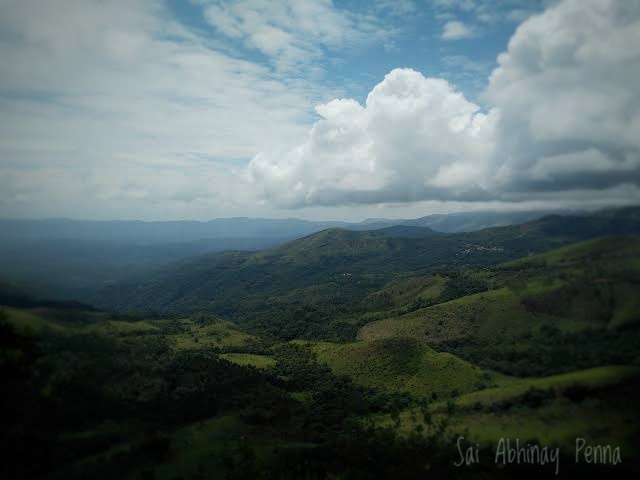
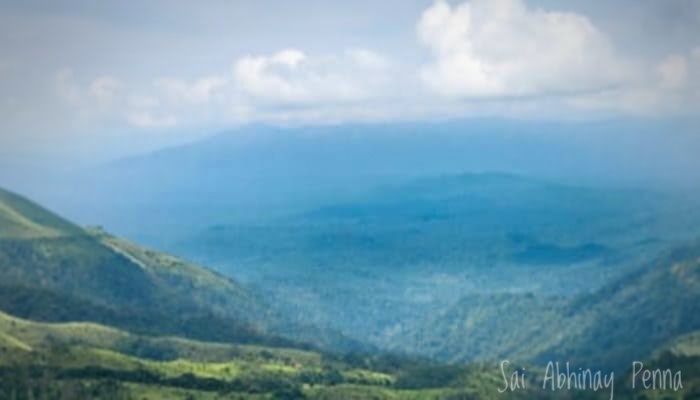
 As the first rays of the morning sun arose from beyond the distant hills, their gentle touch painted the sky with hues of warm gold, igniting a symphony of colours that kissed the vast canvas of the mist-laden valleys of Chikmagalur.

Mist laden valleys of Shishila

Veiled within the ever-shifting embrace of the drifting clouds, the resolute peaks of the Kudremukh Mountains played a tantalising game of hide-and-seek with the heavens. Each passing moment held the promise of a fleeting revelation as I embraced nature’s games.

Shishila Valley

All at once, like an artist’s brushstroke on nature’s canvas, the Shishila Valley appeared from its shroud — a spectacle sending a shiver of awe through my being.

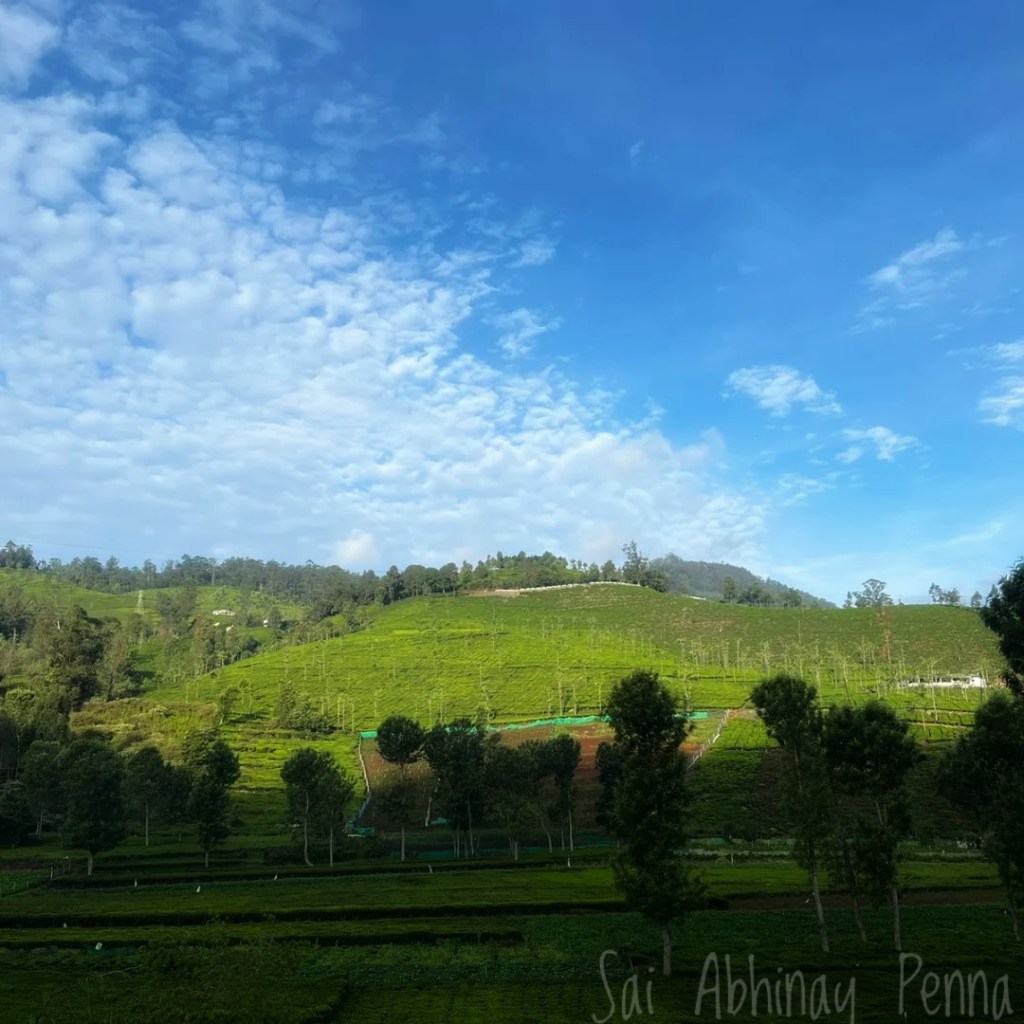
As I walked through the winding paths lined with coffee plantations, the rich aroma of the beans seemed to be woven into the very fabric of the place and filled the air to the brim. The scent, as I stepped through the intricate trails of the estate, thrilled the heart of a coffee maven like me.

Coffee plantations with varied shades of green

The emerald leaves of the coffee plants glistened with dewdrops that captured the sun’s rays, resembling precious gemstones. Each step was an immersion into a world where nature’s palette had painted every hue imaginable.

From the coffee plantations, I trekked through the unexplored trails of the long-lost Ballalarayana Fort built in the twelfth century. In the heart of the wilderness — I found myself surrounded by the rhythmic symphony of the forest.

Ballalarayana Fort trail

The dense vegetation enveloped me like a shroud of mystery, and the air carried the earthy scent of history as if the very soil held the secrets of generations. The crumbling stones and weathered walls of the fort emerged from the undergrowth, standing as silent witnesses to the passage of time. Here history seemed to come alive, the stones carrying the burden of stories now carved into every crack and crevice.

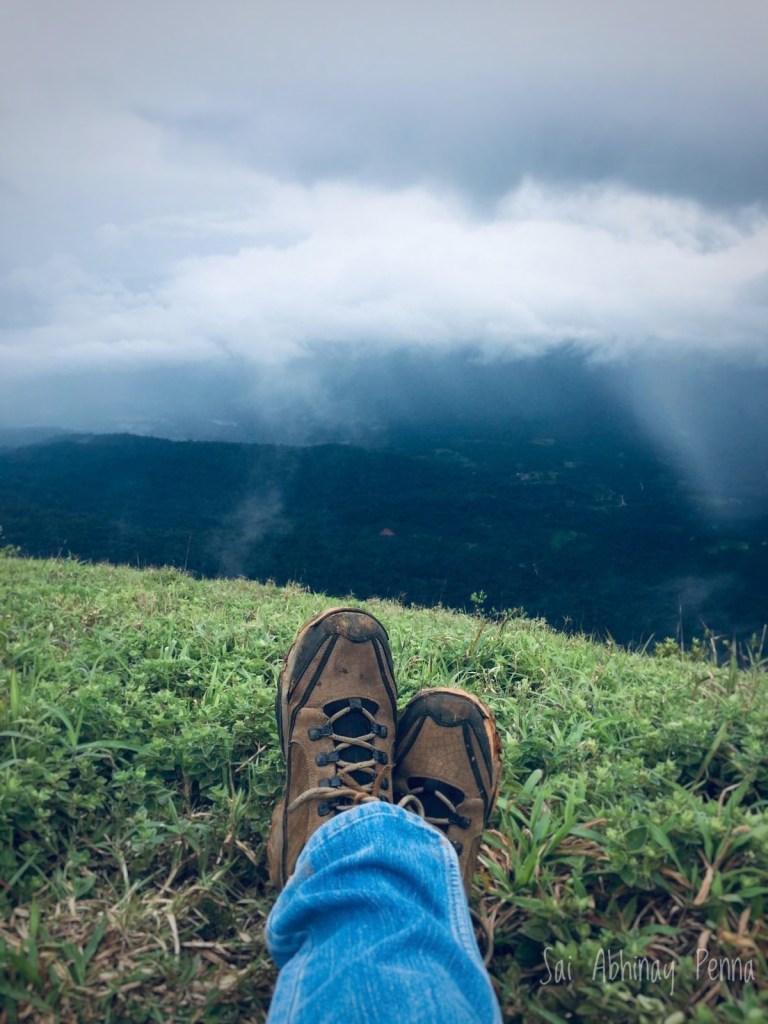
As I ascended the rugged trail, the panorama that unfolded in front of my eyes was breath-taking. Rolling hills, verdant valleys, and mist-shrouded peaks stretched out in every direction — the lines between earth and sky were thin. I felt like I was one among the clouds.

The feeling of being suspended in this vast expanse was humbling and revitalizing.

Descending from the highest peak of Karnataka, I ventured into Baba Budangiri, the sacred mountain with its mystical aura that captivated me to surrender myself to its embrace.

The shrine of Dattagiri, nestled atop the hills, stood as the tangible proof of the spiritual sanctity of the place. A small conversation with the priest from the Dattagiri shrine opened my eyes to the history behind this place. The shrine has been made to resemble a meeting place between Sufism and the Hindu Avudutha tradition.

As I humbly paid my respects, the echoes of devotees’ chants intertwined with the tranquil symphony of nature, weaving an ambience of enlightenment that seemed to touch the very soul of the surroundings.

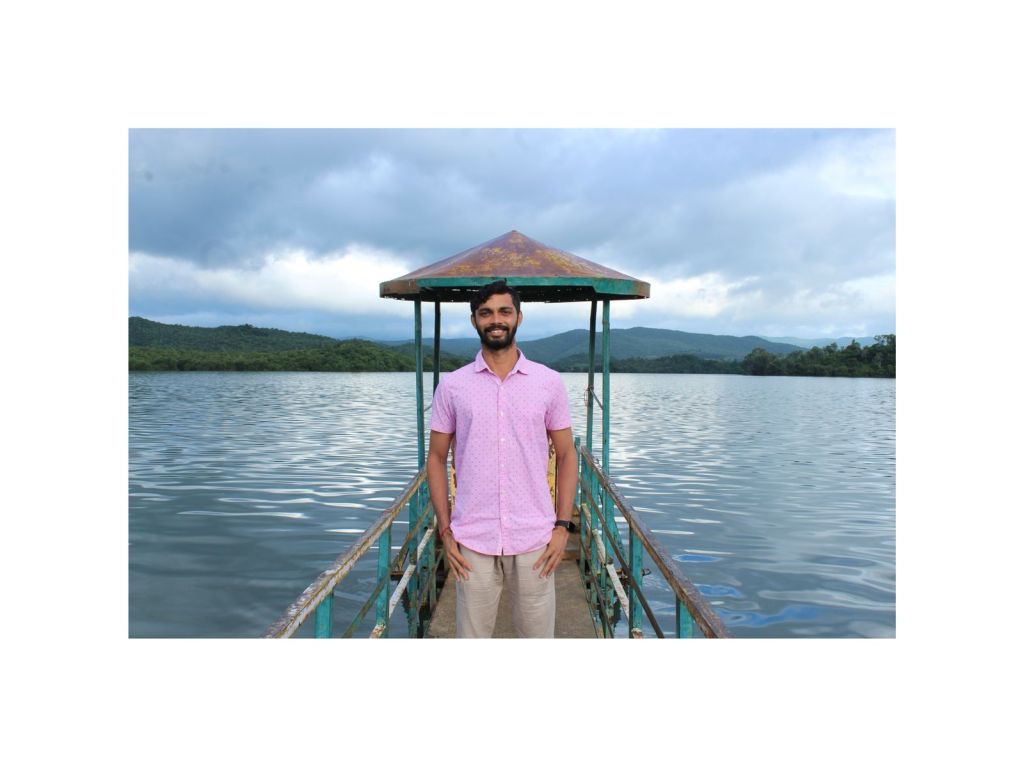
The lake’s surface transformed into a canvas of reflection, capturing the heavens above as if they had found their home in its depths. Hirekole Lake in the evenings was a sanctuary of tranquility, a haven; where the world seemed to hold its breath, inviting me to step away from the rush of life and savour the sheer magic of the present moment.

The author at the lake. Photo provided by the author

The ambience was one of unhurried contentment as if time had chosen this place to slow its pace, allowing all the on-goers to submerge into that beautiful moment.

As I navigated the winding pathways through the dense woods, my anticipation grew with every passing curve. The whispering leaves and dappling sunlight seemed to guide me toward the elusive waterfall, the Hebbe Falls.

As I walked towards the waterfall, the distant murmur of cascading water gradually intensified, and it felt like a symphony of nature’s melody in my journey. Nature’s music, I must say.

Finally, as the foliage parted, I beheld the spectacle: a magnificent cascade of glistening white that descended like a celestial curtain. The mist kissed my skin, carrying the essence of the falls, and I couldn’t help but marvel at the timeless masterpiece sculpted by nature’s patient hand.

Hebbe Falls

In a final blaze of glory, the sun slips beneath the edge of the Shishila Valley, leaving behind a trail of stars, a full moon, and a sky that glows with the memory of its fiery embrace.

 As the star-studded canopy, a symphony of crickets and the soft murmur of rustling leaves painted the air with an orchestration of nature’s melodies. It was as if the very fabric of the night had come alive, crafting a captivating masterpiece for my senses.

A myriad of stars shimmered like diamonds carelessly strewn across the inky canvas. The mountains stood as solemn sentinels, their peaks silhouetted against the night sky, seemingly whispering secrets to the heavens. A gentle breeze carried whispers of pine and earth, infusing the air with an invigorating freshness, and the faint fragrance of wildflowers lingered, an exquisite freshness that filled my lungs.

In the embrace of Chikmagalur’s undulating hills, veiled valleys, calming lakes, and tranquil panoramas, I uncovered a profound truth: the odyssey that stretches beyond familiar vistas is not merely a voyage of the body but a stirring expedition of the soul.

.

Sai Abhinay Penna is a professional cricketeer and writer based in Chennai.

.

PLEASE NOTE: ARTICLES CAN ONLY BE REPRODUCED IN OTHER SITES WITH DUE ACKNOWLEDGEMENT TO BORDERLESS JOURNAL

Click here to access the Borderless anthology, Monalisa No Longer Smiles

Click here to access Monalisa No Longer Smiles on Kindle Amazon International
Categories
Musings

Ghosts, Witches and My New Homeland

By Tulip Chowdhury

Around the early ’70s, in my village home in Bangladesh, we kept ourselves far away from anything spelled “ghost or jinn.” I grew up hearing my Grandma saying, “Shh. Don’t even utter the word ‘bhut (ghosts) or jinn’ because words have power, and they might feel the vibe as an invite.” However, every Halloween is a culture shock for me after coming to Massachusetts, USA, when the celebrations of haunted houses, witches, ghosts, and spirits occur. My late Grandma might turn in her final resting place if I could message her, “Ghosts and witches are subjects of colorful celebrations, Grandma.”

Thoughts rewind to life with the villagers in Bongaon, when the fan-palm trees — taal gach — were supposed to be favourite places for ghosts and jinn. Myths held that ghosts and spirits lived as invisible souls among visible humans but liked to live on the trees. The trees they wanted to inhabit were trees standing beautiful and tall. Yet the beautiful sight was pregnant with danger. The long fonds looked like fingers beckoning passersby. The fan palm had delicious fruits called taal. The trees sent alarming vibes to the villagers. But getting the fruits from the tree was challenging and had to be done during broad daylight when ghosts were supposed to be non-active. The fan palm was not the only tree that welcomed them. The tamarind tree was also avoided, especially after sunset. Not just the trees, but their shadows spelled trouble too, and people avoided stepping in the shadows. The advice to weary souls was, “Don’t let the bhut get on your shoulders.” It seemed that the chosen place was the shoulder. It was different for the ghosts; they didn’t get into the victim’s head like other spooks.

Whenever I passed near our tamarind tree, I imagined a possessive spirit jumping down from the tree and landing on my shoulder. I would run for life faster than a deer when I passed one of them. Ghosts were known to haunt their victims for the rest of their lives if they got a chance to get on the shoulder. I ran home; I did not want to be possessed for the rest of my life.

According to the people in Bongaon, nighttime was the favourite time for ghosts and evil spirits. Starting from the late evening to the descent of darkness, no one walked without a flaming torch made from kerosene-drenched cloth on a thick stick. Much as darkness spelled fear and mystery, fire was the force to power the evil over to burn and destroy—similar to fantasy stories of modern times. In life, it seems we are connected like a spider’s web. A person suspected to be possessed by a spirit sought help from special prayers and charms. Some of the healers had harsh methods and had the victims smell burning dried chilli — supposed to clear the mind. And others sprinkled holy water around the person and the house.

Theories on haunting spilled beyond the trees and dipped below the waters surrounding my village. The water lilies in the rainy season bloomed in abundance in the swamps — haor, ponds, and the water-clogged areas around the town. The seeds and stems of the water were gastronomical delicacies for us. The stems cooked as curries and the grains got toasted over the fire. However, evil spirits and jinns were said to roam around swamps at night, and no one tried to pick these up in the dark. Growing up, I wondered if the whole thing around the evil supernatural was to keep people safe because plenty of water snakes coiled around the lily stems, and people were likely to get bitten. Often, people invented ghost stories when logical explanations failed or, perhaps, to safeguard without having to give lengthy answers.

The sweet shops and their connections to supernatural beings baffled me then and to this day. Few charming shops sold traditional deserts, like rosogolla, cholchom and kalojam; the display trays were usually well stocked. It was well known among people that if you entered the shops after the Muslim evening prayer, the Maghrib, the sweets would be gone from the trays. The good jinn were supposed to like the sweets and, on their way back from the mosque, feasted on them. Our village did not have electricity, and there was no refrigerators to preserve these. So, when fresh sweets were replaced on trays the next day, there was no explanation given for the disappearing trayful until the maghrib prayer. No customers came because they wanted to avoid jinn altogether since they could change from good to bad ones. The disappearance of the sweets at a particular time remains a mystery added to many others in my lifetime.

The people in Bongaon believed there were two kinds of jinn: good and evil. Good jinn were with the steady and truthful people who prayed regularly. If the good people, especially women, happened to walk with loose hair in the evening or night, they were exposed to danger of being possessed by the evil jinn. There were dos and don’ts, right and left, for women to keep themselves safe from evil jinn and ghosts. As far as I remember, men were almost excluded from the “wanted list” of the feared beings. How was that possible? The male-dominated society of the early 70s seemed to set boundaries for the ghosts and jinns. In the modern digital world, men and women have found some common ground, and even spirits no longer come only for female humans. Now that we have electricity, in the village scenario, women are smarter with computer skills; in reality, male dominance gets veiled. I am pretty sure the tamarind or the fan palm trees have their versions of the surreal world. However, the deep-rooted world of the spirit world still chains many, especially around the nighttime.

Nighttime and darkness seem to hold endless mysteries, and most are shrouded with danger in many cultures as they did in Bangladesh society. But was the dark so scary? Sleep at night came with dreams and nightmares. To be fair to the darkness, I would often sit on the porch and take in the night sky with its unique, moving life. The sky was never the same, moonlit or with the new moon. Clouds played hide and seek over the moon on rainy days. And the stars, their endless games of winking at me made me as happy as a child every time I looked up at them.Some nights, an owl would greet me with the “Twoo, twoo,” and I would whisper my hello back. I was sure the night bird heard me loud and clear; if it could see at night, why not hear at night, too? Whenever the owl called, thoughts winded to village childhood days, days when village myths held beliefs captive. Whenever we listened to owls’ hoot, we were urged to say, “good”, because if there were something ominous, the power of our words would take that away.

Halloween in Massachusetts digs into memories of my childhood’s haunted and ghost-ridden world in a Bangladeshi village. I was scared then, but now it’s more about exploring life. Life balances fears and hopes, sorrow and joy; between it all, ghosts, jinns, fairies, and angels hold me spellbound in real life. I relish every magical moment of it. I am not scared of witches, black cats, or ghosts that roam around my hometown during Halloween. The ghosts on the tamarind tree and the fan palm were kind to me, and I guess the evil spirits here will also be.

 In my present, the black cat on the shop window, the witch on the broom, or the masked stranger are said to spell danger. There are clubs and social groups that share experiences and do not avoid them like we did back home in Bangladesh. I stand in between cultures, wondering at the reality that connects the spooks I grew up with and the ones I grew into in my adopted world.

.

Tulip Chowdhury is a long-time educator and writer. She has authored multiple books, including Visible, Invisible and Beyond, Soul Inside Out, and a collection of poetries titled Red, Blue, and Purple. The books are available on Amazon, Kindle, and Barnes and Noble. Tulip currently resides in Massachusetts, USA.

.

PLEASE NOTE: ARTICLES CAN ONLY BE REPRODUCED IN OTHER SITES WITH DUE ACKNOWLEDGEMENT TO BORDERLESS JOURNAL

Click here to access the Borderless anthology, Monalisa No Longer Smiles

Click here to access Monalisa No Longer Smiles on Kindle Amazon International

Categories
Musings

Where is Your Home?

By Madhulika Vajjhala

Going into work after almost a week of absence feels rather peculiar, I feel like an outsider in the city where I grew up — a city that is often referred to as my hometown. It greets me with a polite nod as a stranger would. This is the city where I spent over two decades growing up and yet today my sense of belonging seems to have dissipated in the dusty morning traffic, leaving me confused as to what makes a home. Is home the physical space that we exist in or is it the people who make a place a home?

If the definition of home is about a place I reside in, why can’t it be the dusky lonely evening that I got lost in the Tallahassee Park only to find company in the countless stars that helped me find my way back?

Or the Welsh mountains that I struggled to hike up with Chittappa — almost giving up for the steepness of the trek, constantly reminded by my aching body that I was lazy and good for nothing. Yet, the endless green hills glistening in the golden rays smiled at me and greeted me with a cool welcome hug, urging me to be hopeful for my future. Isn’t that a home for making me believe in myself once again?

Or can it be the bone chilling cold shores of the lake in the Algonquin State Park, where Anna and I greeted the new year alongside the wolves howling at the moon who seemed to be lost that night like us. We hid from the countless years that stretch before us, not knowing if there would be an end to all the craziness that we had to deal with. Is it home when you are lost and confused, yet at peace knowing that not all answers are to be found, some questions are endless quests, but the journey teaches us more than the answer itself?

Or maybe it is in the sunrise on the Vizag beach with my cousins, where we laughed and played while the cool water soothed our battle scars of rivaling parents and vengeful family feuds. Is it home where all my fears and insecurities are treated with a cooling balm and my soul is healed so I find courage to love again amidst the raging darkness that overwhelms me?

Or is it the apartment I found on the hot afternoon, walking in despair along the Whitefields road with Amma after our family banished us from living in their home? The balcony with the wise eucalyptus trees that reminded me that parents are human too. While love is not perfect, setting my boundaries and building my life independent of family can strengthen our bonds more.

Or is it home when my girlfriend opens the door with the brightest smile after a long stressful day at work, asking me how my day went? Even if we had both just spent the past eight hours getting yelled at and defeated by corporate patriarchy, she gives me the warmest hug assuring me that I am safe and with her. I don’t have to battle to be seen or heard. Isn’t it home where you always matter and your contributions are recognised, irrespective of where you live or how far apart you are from each other?

Or can it be home in the arms of my boyfriend as he cuddles me to sleep, gently calming my mind, easing away the stress. Reminding me to stay smart and channel my ever-bubbling anger, raging beneath my surface into something useful instead of drowning myself in it and getting lost. Isn’t it home where you learn to channel your strengths but there is space for your weakness and failure to co-exist, so that you learn to not get overwhelmed in the face of adversity?

Perhaps home is in the delicious fragrance of my mother’s coffee as she greets me with her loving good morning and a freshly baked pumpkin muffin, a reminder that today is a new day and ripe with unexplored opportunities. Isn’t it home where you feel supported and encouraged even when you are lost and unsure of what to do next?

Maybe I am someone who will always find a home wherever I go with the people I love. Home is not static nor confined to a physical space set in a particular time. To me it is all those experiences (and people) that help me find joy, love, courage, and strength to greet another day with a smile.

Madhulika Vajjhala has a passion for literature and exploration. She loves reading and globetrotting.

PLEASE NOTE: ARTICLES CAN ONLY BE REPRODUCED IN OTHER SITES WITH DUE ACKNOWLEDGEMENT TO BORDERLESS JOURNAL

Click here to access the Borderless anthology, Monalisa No Longer Smiles

Click here to access Monalisa No Longer Smiles on Kindle Amazon International
Categories
Musings

Migrating to Myself from Kolkata to Singapore

By Asad Latif

Sir Stamford Raffles (1781-1826). Courtesy: Creative Commons

May I be so bold as to claim that I travelled in the footsteps of Sir Stamford Raffles? That agent of the East Indian Company’s visit to Calcutta (as it was known then, and for much later, till it resumed the phonetic spelling of its original name), led him to set up Singapore as an English trading settlement in 1819. “Footsteps” would be the wrong metaphor, of course. “Seasteps” would have been accurate, since Raffles travelled to Calcutta by sea and arrived water-borne to Singapura (as it was known then). In my case, however, I arrived in Singapore sky-borne, in an aircraft that conveyed me from what was then home to what would become home. Footsteps, seasteps or airsteps, I arrived in Singapore. The year was 1984. I was 27.

Today, at 65, I remember my passage from back home to this home as if it occurred yesterday. I had worked in Hong Kong briefly in 1984 and had been exposed to life in a successful British colony that was in the throes of its return to Chinese rule. Singapore was different. It had merged with the Malaysian Federation in 1963, had separated from it in 1965, and had gone on to carve out an extremely successful space for itself in the international sphere.

Prime Minister Lee Kuan Yew was a household word in Singapore. Not everyone loved him, but no one could deny his singular agency in having created a magnificent city-state that could sustain its independence in spite of its lack of natural resources. To arrive in Singapore was to embrace the possibilities of time.

Calcutta, too, was a historical city par excellence, but its rundown buildings and potholed streets, to say nothing of its potbellied children living on homeless streets, belied the promise of the future. To arrive in Singapore, it appeared, was to have exchanged failure for success.

That was an illusion, of course. All expatriates suffer from a global disease: They latch on to what they love in their countries of arrival by trying to erase what had loved them in their countries of departure. Take the potholed streets of Calcutta, for example. They had conveyed me to College Street on that glad day in 1974 when I joined the English Department of Presidency College. Without that first footfall in the corridors of the greats, I might never have come to Singapore, never got my Chevening Scholarship to Cambridge, my father’s university, and never won the Fulbright to Harvard. The potholes of Calcutta are not as numerous as the culturally blind allege them to be. Nevertheless, they led me on the way to be myself, wherever on earth I would ultimately be.

The way I see it, no matter how far or close wanderings might lead, one migrates ultimately to oneself. Hence, when I left my Calcutta for what would become my Singapore, I did no more than search for a version of my selfhood that would extend my material and imaginative boundaries. In the course of my journey, I discovered that the only borders lie within, borders between being and becoming. In the process of becoming by winnowing the unwanted aspects of being, one returns to a renewed if only autumnal sense of being. Time passes. One passes with it, letting go of the distant past as much as one does the receding immediate past. To live is to gather the passage of time within oneself, hoping that all borders will merge into a lasting apprehension of oneself in the expanding fullness of a single world.  

Calcutta and Singapore are two sides of me. These two great imperial cities have outlived their provenance. Calcutta was once the capital city of colonial India: Today it remains the nation’s cultural capital but political power resides in Delhi (naturally) and there are at least two economic capitals, Mumbai and Chennai. This is why I, along with many of my hapless fellow-Bengalis, suffer from an incurable cultural fetish for the past. That was when the Almighty spoke Bengali – He appears to be switching increasingly to Hindi – and was busy creating top-class poets and formidable social reformers in Bengal. The divine supply of poets and composers has not ebbed but the demand-side having moved to Mumbai, many of the best composers have shifted there and to make a name for themselves. Never mind. Their names remain Bengali, and their fame spreads the vintage mystique of Calcutta like a lingering perfume in India and beyond. I feel happy for the Calcutta part of me.

Singapore, a great trading post, is a now a city-state. Statehood has allowed the nascent nationalism of the colonial era to flourish and grow into a genuine sense of political self. Sovereign Singapore was not expected to survive, but it has done so with a definitiveness that makes the prognoses of the 1960s laughable today.  The national self-confidence of Singapore gives me confidence in my decision to take up Singapore citizenship in 1999. It had not been an easy decision, but I took it when I realised that I would be giving up my Indian citizenship but not my Indian-ness. My Singapore Identity Card records my race as Indian. I could keep the Calcutta part of me intact while adding to it a new Singaporean me.

So, yes, I am grateful that Raffles travelled to Calcutta to set up Singapore. Obviously, he did not do so with my fortunes in mind, but the umbilical connection that he created between the two great port cities has made it easier for me to migrate from India to Singapore. Ultimately, I have done nothing more than migrate to me.  

    .


 Asad Latif is a Singapore-based journalist. He can be contacted at badiarghat@borderlesssg1

PLEASE NOTE: ARTICLES CAN ONLY BE REPRODUCED IN OTHER SITES WITH DUE ACKNOWLEDGEMENT TO BORDERLESS JOURNAL. 

Click here to access the Borderless anthology, Monalisa No Longer Smiles

Click here to access Monalisa No Longer Smiles on Kindle Amazon International
Categories
Musings

Islands that Belong to the Seas

By Paul Mirabile

Islands belong to oceans and seas and lakes. They are born within the deepest depths of the marine underworld like infants in the depths of their mothers’ wombs. Born often from surging volcanic eruptions, the molten lava hardens into rock. The rock is smoothed by ocean-swept sands that turn fecund over time. They are gradually populated by migrating birds who rest their weary wings and deposit seeds from which sprout rich and luxuriant vegetation. To these shingled or sandy shores, little by little, pirates, buccaneers, conquistadors, renegades, the exiled or self-exiled, slaves, missionaries and migrant workers come to explore and eventually settle.

They all come flocking to this primordial land floating in the waters of the world, birds and humans, animals too follow. Bees buzz their contentment, donkeys hee-haw, goats baa and mosquitoes whine. And yet the islands do not belong to any one of these creatures. They belong to the oceans and seas and lakes — their creators and benefactors.

Ah! The birth of an island! The centre of which rises high above those shingled or sandy shores, the dense jungles or arid scrub, where Vulcan in rampant rage had spat out smouldering rock and tongues of lava. There they now waft as if levitating from their aqueous-bed, home to a new Humanity …

Since my childhood, whenever I poured over maps my eyes would invariably fall on the islands that dotted the oceans or seas or lakes of our world. They held a more significant, a more imaginative, a stronger attraction for me, ones with which I could empathise. For Sicily was my genealogical point of attachment on those maps, a legacy of thirteen civilisations or so which had landed, settled or departed, leaving their immemorial traces both on the land, in the architecture, in our very mixed genes. Sicily is a perfect ‘officina[1] which I translate as the ‘melding of Humanity’ !

I day-dreamed while pouring over those frazzled maps and islands, whilst reading Jules Vernes’ Mysterious Island and Daniel Defoe’s Robinson Crusoe. Actually, I don’t believe that I love islands because of those novels (or any other), but they did arouse in me a sense of friendship, affection and human compassion towards islands because of the extraordinary diversity of their errant or settled communities, their many languages and customs, their manifold landscapes. Languages that have forged the hybrid compositions of Creole, forged inter-marriages, forged populations whose quotidian merges into the hybrid species of fauna and flora.

I read and read again and again the fabulous tale of Hayy Ibn Yaqzān[2] who lived on his uninhabited island amongst the plants, trees and animals, all alone in wondrous solitude, learning from them: his human qualities, his religion, his love of humanity and sympathy for every quintessential being or object that came into contact with him — be it mineral, vegetal, animal or eventually human …

Islands are bursting with nature and nature is a friend of humanity, thus islands are bursting with friendship — bursting with hybrid species … like their ethnicities and their languages. Even when Nature can become an enemy, this enmity offers islanders the possibility of strength and force through trial and error. When storms arise, they build sturdier homes. When dangerous interlopers reach their shores, they offer hospitality and eventual integration. Perilous sea creatures and beating waves against boulders demand of islanders to muster their ingenuity and imagination. To cultivate friendship, virtue ; to draw closer to one another ; to be able to live only in a way that conforms to Nature … to an island’s generous and bountiful treasures ; to befriend Nature and Humanity, for they are equal in diversity and disinterestedness.

I suddenly stopped dreaming of islands as they pinched with patriotism, narrow nationalism, circumscribed communitarianism. I stopped dreaming of islands and with my fingers touched Sicily, Cuba, Cyprus, Malta, Madeira, and the Princess Islands stringing out in the Marmara Sea. I slid them upon the island of Olkhon on Lake Baikal in Russia, the oldest and deepest in the world; an island where Shamanism, the oldest religion of the world, and Orthodox Christianity vie in relative peacefulness. There my fingers brushed against layers of civilisation, of ethnic blending, of howling winds and raging white-crested waves off boulders and high cliffs and laughing seagulls on the wing. There I heard a myriad of languages spoken by the communities of Humanity both in the public and the private domains: Greek, Turkish, Sicilian, Spanish, Italian, Maltese, Russian, Arabic, Jewish-Spanish, Norman, Armenian and so on. There swelled dark secrets of mythical creatures, of legendary figures whose wild wisdom infused a shroud of enigma that piqued my curiosity towards the universal sympathy that exudes from those aforesaid islands: the fragrance of bougainvillaea, wisteria, honeysuckle and jasmine, of ossified forests laden with the ice of deep winter, of the briny sea spray of stoic rocks, of cries of fishermen at the docks and those of traders at the markets. When I lift my finger that sacred moment, that spell which has been cast upon me vanishes from my waking state …

To Sicily, Cuba, Malta, Madeira Cyprus, Olkhon and to the Princess Islands I weighed anchor and set sail on various shaped vessels — ships that cleaved the high seas or navigated the coasts. At dawn upon disembarking, the colours of the skies drip from violet to orange to red to blue. The fishermen at the harbours or docks always asked me: “How do you like it ?”

“What, the island ?”

“Yes.”

“There is no point on Earth that rivals an island,” I would always repeat in sympathetic earnest.

On shore, wherever that shore be, we would drink coffee or tea in one of the wooden cooperatives for fishermen, traders and sailors. Chickens cackled, dogs barked, seagulls laughed whilst glasses and conversation chimed out the tunes of the islanders’ community spirit: tunes chanted in many tongues, gesticulated in many forms. I broke bread and filled my glass, observing the leathern faces of these hard-working tradesmen mending their nets, fitting their poles, scraping or painting their sea vessels … accomplishing their livelihood together as a whole.

“The wind is blowing from the southeast,” a rough-looking chap declared for all to ponder upon.

“That’s rain !” shouted another with a slight nod of his head.

And then I fell asleep in my bungalow and dreamt of dancing boats and throngs of fishermen talking about their fortunes or misfortunes. Villagers living near the rising waves filled my sleep with their colourful robes or coiffeurs, their daily gestures of sympathy to both nature and humanity.

Pouring over maps filled my childhood. Fingering the points that we call islands submerged me in oceanic rhapsody. Entire archipelagos coiling from North to South and West to East pervaded my soul with the rhythmic cadence of their tides. And as the tides beat out cosmological tunes, my dreams ended. I woke and embarked on many an island adventure in Sicily, Madeira, Cuba, Cyprus, Olkhon, Malta and on the Princess Islands. Points on the map became the unchartered lands of my great middle age sympathetic adventure. I had returned to the lands of my ancestors ! Ships had bore me to those points of human sympathy, exploring fantastic landscapes, communicating in innumerable tongues. There I breathed the air of island sovereignty, simplicity, silence and solitude.

I lived happily on all those islands. And in spite of certain prejudices and intolerances, I rejoiced living with the islanders who are good, heroic, honest and fair in their daily commerce. Who earn their daily living by the sweat of their brow and by the devotion to one another, whoever be that one or other. Inside the cafés faces furrowed by wind and sun concentrated on their drink or their cards or dominoes, whilst outside, hands hardened by generations of toil and moil, mended nets, built boats, cut fish, rowed boats. I rejoiced at all those acts of universal friendship.

I lived happily, intermingling with the melded species of plants, birds and humanity — not only as a spectator, but as an actor: the spectator who observes himself acting, and the actor who perceives his observations. Like in a dream … day and night !

It seemed to me like paradise. Paradise, a word derived from the Old Persian ‘pairidaëza‘ which meant ‘enclosure, a place walled in’: walled in or enclosed by its creator — the water ! But its meaning shifted when read by the Hebrews and became ‘pardēs‘ ‘a garden’. The Garden of Eden ? Yes, a garden so pristine and divine, yet possessing that infamous apple tree of the forbidden fruit. All paradises can descend into the bowels of Hell if tempted by a slithering, sly, snaky and insidious interloper … As we shall soon see !

At present the tides of time have consumed my youth, so I have decided to write a humble meditation about my mingling amongst the islanders of so many islands, of so many archipelagoes. I see them all from the porch of my bungalow, stretching out like a necklace of pearls. A pearly necklace cast in its oceanic casket. So I write and wander upon the silent, deserted roads of the many islands that I have treaded; that I have seen, touched, smelt and tasted. The time has hence come to render homage to those islands, to the nature of those islands, to the nature of those populations.

At this point, I expect readers will retort and point out that not all islands should benefit from such a distinguished homage: How about Cyprus, and the Turkish-Greek conflict ? And Sri Lanka and the terrible war that raged between 1983 and 2010 ? Japan and England, too, big islands indeed but islands, nevertheless. Was the subjugation of Welsh, Scot and Irish not enough? No, those English islanders set out on the high seas to subjugate other ethnic communities … other islands! The first being Ireland, invaded in the XIVth century and conquered uninterruptedly by Henry the Eighth and Oliver Cromwell. The ‘de-Irelandising’ of the island, or more appropriately formulated, the genocidal ‘civilising mission’ produced exile, persecution, misery and death until the founding of the Irish Free State in 1921 and finally the Republic of Ireland in 1949![3]

Were the Japanese not content to eliminate any foreign intrusion on their precious island ? No, they set out to decimate and enslave the ethnic communities that thrived on the islands of the Pacific: Guam, Wake Island, the Philippines, the Solomon Islands, the Aleutian Islands, etc. Japan’s violent and bloody imperialism during WW II, and England’s century’s long brutal colonisation have marked all our History books and memories of their so called ‘civilising missions’. Be it the imperialistic brutality in the lands of the rising sun or that of the setting, as the French say: c’est bonnet blanc et blanc bonnet ![4]

Yes, these counter examples are, alas, historically documented. Are they then accidents of history or sorrowful exceptions? I will answer that in the case of Cyprus, the Cypriots, a fine blend of Greek and Turkish ethnic commingling since the Middle Ages, with a sprinkling of English since King Richard the Lion Heart (1191), became the unfortunate victim of Britain’s ‘civilising mission’. One needs only to read Lawrence Durrell’s Bitter Lemons of Cyprus[5]to understand the sad and tragic events that erupted in the 1950s and their never-ending aftermath and continuity. Cyprus belongs neither to Greece nor to Turkey (and certainly not to Great Britain), but to the Cypriot Greek and Turk, who in turn know perfectly well that their grand island for centuries has always belonged and will always belong to the brilliant whiteness of the Mediterranean Sea! The tragedy that befell this island sprang from the combined effort of British cynicism, Greek nationalism and Turkish overweening military reaction.

As to Sri Lanka, Sinhalese and Tamils had been living together since the twelfth century, assuredly not under the most perfect idyllic neighbourly conduct, yet the intermingling populations, be they Hindu, Christian or Budddhist, carried out their daily lives without too many eruptive disturbances. It was only with the full British conquest in 1815, and their fancied game of pitting one community against another, there, favouring the Tamil populations of the island, that a slow but steady bitterness, rancour and animosity grew within the Sinhalese population. The pent-up enmity exploded as soon as the British abandoned their ‘mission’, leaving both communities in a sort of political vacuum: Who was to govern? Who was to replace the ‘civilisers’ once they decamped without preparing Sinhalese and Tamil for self-rule, as the British had always done in the benignity and magnanimity of their decolonisation? The vacant legacy they left behind was rapidly filled with ethnic rivalry, exposed to Sinhalese vindictiveness and Tamil claims to share power and land in spite of their minority status. Each community claimed their rights as the deprived community at the expense of one another, a situation so similar to the void left behind by the British in Cyprus. The dramatic events that followed became the final act in the history of Britain’s ‘civilising mission’ performance …

In these two cases, the two communities, forsaken victims of the British colonial mindset, instead of achieving ethnic unity, wallowed in the abysmal chasm of oblivion. Islands that could be paradises plunged into the throes of Hell !

To conclude, an island belongs to the vast waters that enshrine it, as its etymology translates: a ‘land’ in ‘water’. Islands do not belong to imperialists or colonialist powers ; they belong to the oceans or seas or lakes that give birth to them, to the nature that stretches its silken carpet over them, to the ethnic groups or communities that gradually settle upon them, intermingling, trading, marrying, creating together a hybrid or Creole culture worthy of any ‘continental’ civilisation. For this very reason, there should not be any dominate power on an island, or official boundaries which sever communities from one another save the natural one that has nurtured and provided for its very existence: the surging billows and silent tides of their eternal creator …  

.

[1]‘Factory’ or ‘workshop’ of production. It is of Latin origin

[2] An allegory written by Alī Ibn Sinā or Avicenna (950-1037) Hayy Iby Yazqān, the Bird Salāmān and Absāl interpreted and adapted by Ibn Tufayl with the same title, born in Muslim Spain in the XIIth century. See Lenn Evan Goodman, Ibn Tufayl’s Hayy Ibn Yaqzān, gee tee bee, Los Angelos, CA, 2003.

[3]The slaughter of all Irish aristocrats, the prohibition of inter-marriage between Anglo-Normand and Irish and the prohibition of the Gaelic written language in 1592 were part of the English ‘civilising mission’ in Ireland.

[4]‘It all amounts to the same thing’ or ‘It’s six of one and half a dozen of the other’.

[5] Lawrence Durrell, Bitter Lemons of Cyprus, 1957.

Paul Mirabile is a retired professor of philology now living in France. He has published mostly academic works centred on philology, history, pedagogy and religion. He has also published stories of his travels throughout Asia, where he spent thirty years.

.

PLEASE NOTE: ARTICLES CAN ONLY BE REPRODUCED IN OTHER SITES WITH DUE ACKNOWLEDGEMENT TO BORDERLESS JOURNAL

Click here to access the Borderless anthology, Monalisa No Longer Smiles

Click here to access Monalisa No Longer Smiles on Kindle Amazon International
Categories
Musings

Of Dreams, Eagles and Lost Children

By Aysha Baqir

Conceived in the twilight dreams of poets, philosophers, and political activists, you blazed in the dulled and drugged minds of millions caged and enslaved in the divided and ruled subcontinent. Inspired by the Divine word, Iqbal sought your freedom in his poetry and prose, and likened you to the Shaheen— the king of birds– and exhorted you to soar to freedom. He died nine years before your birth, but his figurative verses, by design or fate, fashioned you into the shape of the sublime and magnificent eagle.

Today, perched on the peak of the Arabian Ocean, you struggle to soar. Designed to defend and fortify your power, your predatory hand claws fetter and numb your mind and movement. You stretch your neck towards the east and tilt your hooked head. Your forward-pointing eyes boasting of binocular vision are fixed towards the rising sun for a glorious future, but you are blinded by fear and greed. Your blood vessels pulses with power and rhythm but you hunch, clench your long spiked wings, unable to spread them, stroke the wind, and take your place in the skies. Immobile and unable to nurture, you attack your own — the most vulnerable and the weakest.

Agreed that your birth, doctored by a misguided and designated cartographer, was both cruel and chaotic[1] The impatient foreigner, recklessly ignoring centuries of daily human connection, the age-old water ways, and land markings, fleshed you out from outdated maps and census reports. Fearing a dangerous rebellion that brewed in the burning summer and desperate to flee the threatening chaos, the imported white-man culled and cut the eight hundred thousand square kilometres of you in thirty-six days. You burst on the world map in the muggy, sweat-drenched August of 1947, soaked in blood and roughly clumped in the likeness of Iqbal’s eagle.

But with creation, there is demise – and your birth slit a wound that festered a carnage. Within days, unprecedented violence tore neighbourhoods and communities apart. Friends-turned-foes, looted, plundered, burnt down villages and raped and hacked thousands of innocent women and children to death. Lit by the hope to reach their new homeland, fifteen million Hindus, Muslims, and Sikhs, fled across the jagged border, but two million succumbed to death. Traumatised by your birth, you continue to kill and slaughter. Seventy-six years later, you deceive and double cross your ‘wajood ki wajah,’ your reason for existence, and with it, the spirit of your independence, idealism, and self-actualization.

Trapped in mnemophobia of suppression, you deny and desecrate the creed that your founder, Mohammad Ali Jinnah gifted you, i.e., the land and its freedom. “You are free to go to your temples, you are free to go to your mosques or any other place of worship in this State of Pakistan. You may belong to any religion or caste or creed, that has nothing to do with the business of State.”[2] Did Jinnah fight for your independence to lose you to your fanatical oppression of others? Did God gift you the cradle of fertile plains, the vast web of waterways, fortress-like mountains, havens of harbours, and mines of minerals so you could abuse your own?

In the wild, your namesake, the king of birds, knows better than to turn on its young. Driven by an intrinsic parental instinct, it patches a nest high in the branches and cliffs, secure from the sight of predators. Both parents, in turn, incubate the eggs until they hatch, nest their eaglets, spread their wings to protect them from cold and heat, and tear off the hunted meat to hold it close to the beaks of their young. In face of approaching danger, the male and female defend their young aggressively. They nurture their eaglets for weeks, teaching them to hunt and survive until the little ones can fly off to seek their food and future.

A parent to over ninety-five million children, how do you compare? Millions of your young ones live and work on the streets every day. They feed off garbage dumps and stray barefoot and in rags, unprotected from the onslaught of the harsh climate and the criminals, while you guard your pastures of livestock, fields of crops, and fruit-filled orchards. Yet, you choose not to feed your children – and only a chilling low of 3.6 per cent, aged six to twenty-three months, consume a minimum acceptable diet[3]

Abused and violated every day, the children are forced into selling drugs, prostitution, and trafficking, and many succumb to accidents or fatal diseases. More than half a million of your children are raped, assaulted and killed in one year – not by anyone else, but by you[4]. Over half of the little ones do not have access to health, hygiene, clean water, food, and more than forty million minds wither out of school[5]. When they turn into criminals you blame them for their condition. You hoard your wealth inside mansions, factories, banks and vaults outside the country and shackle millions of your children to hard, gruelling and unpaid labour. There are no laws enforced to protect the children, and according to leading experts an “eighty-eight per cent are subjected to violence and physical abuse within their homes regularly”[6]. After the catastrophic floods that ravaged your lands last year, more than four million of your children continue to drink the contaminated and stagnant waters[7].

You make laws to break them, sign treaties, pacts, and MOUs to betray them, print signs, banners, and pamphlets to tear them, and host meetings, dialogues and conferences to applaud your resounding lies while a frightening number of your children perish every day[8]. Is your independence a construct of borders and boundaries to keep others out, while you molest your own? Is your independence a construct to suppress, violate, and annihilate the weakest? Is your independence a construct to kill your children? If independence profits and feeds off the flesh of others, it is only a fool’s fabrication. Like a chain, a nation is only as strong as its weakest link. When you celebrate your independence, remember that you are only as strong as your weakest – the  malnourished and uneducated — forty-five percent of you. Thousands of your children will sleep shivering and starving tonight and some will not open their eyes tomorrow. One day you might not too. 

[1] https://www.telegraphindia.com/culture/a-sloppy-surgery-how-cyril-radcliffe-carved-the-indian-subcontinent/cid/1697854

[2] Presidential Address to the Constituent Assembly of Pakistan 11 August 1947. https://pakistan.gov.pk/Quaid/quotes_page2.html

[3] https://www.unicef.org/media/136311/file/Pakistan-2022-COAR.pdf

[4] https://www.thenews.com.pk/print/1005427-over-half-a-million-children-raped-in-pakistan-annually-but-most-cases-go-unnoticed-experts

[5] https://www.unicef.org/media/136311/file/Pakistan-2022-COAR.pdf

[6] https://www.thenews.com.pk/print/1005427-over-half-a-million-children-raped-in-pakistan-annually-but-most-cases-go-unnoticed-experts

[7] https://reliefweb.int/report/pakistan/4-million-children-pakistan-still-living-next-stagnant-and-contaminated-floodwater

[8] https://tribune.com.pk/story/2407303/child-sexual-abuse-up-by-33-in-2022-report

Aysha Baqir is an author and activist on a mission. She founded a pioneering not for profit economic development organization, Kaarvan Crafts Foundation, in 2004 to alleviate poverty.  Her novel Beyond the Fields was published in January 2019 in Singapore and 2022 in Pakistan and shortlisted for best-Debut English at the 9th UBL Literary Awards. She is an Ashoka Fellow and recipient of Vice Chancellor’s Alumni Achievement Award from LUMS. She is working on her second project.

www.ayshabaqir.com

.

PLEASE NOTE: ARTICLES CAN ONLY BE REPRODUCED IN OTHER SITES WITH DUE ACKNOWLEDGEMENT TO BORDERLESS JOURNAL

Click here to access the Borderless anthology, Monalisa No Longer Smiles

Click here to access Monalisa No Longer Smiles on Kindle Amazon International