Categories
Poetry

Reminiscing in Verses

By Mitra Samal

Reminiscence

The wind blows bringing in the 
redolence of my land
I bow my head and pay my homage

When the Siberian cranes flutter 
their wings in winter 
I reminisce the sultry smell of our lakes

When I stretch my eyes to the 
epitaph of the ocean
I feel my country’s sands slither 
away from my fingers

When I hear the cuckoo’s enchanting song
I float dreamily to our mango gardens 
with fresh blossoms

The sweet aroma of the baked cookies in cafes
Reminds me of my mother’s petite kitchen

Oh! How it feels to be disparate from one’s native land
To be lost in a sea of strangers for what duty demands
The lakes, the trees, the sea and my share of sky
Something that was to live for and will be always to die

 
If I don’t live to grow old

If I don’t live to grow old
You will still have my verses
to trace back to the days,
we smiled despite the
summer tempest that
showered on our egos

You will still find yourself
in my words and remember
our carefree laughter from
another time that set our
moods ablaze with zest 

If I don’t live to grow old
You will still have my pages
that speak of the time we spent
together, the contentment
that is timeless, and shall
last for now and ever

You will still read between
my lines and be our dream
catcher, feel what I lived
to create and saved for
you to pursue later

If I don’t live to grow old
You will still grow old
in some corner of my book,
in the lines of my page,
in the stanzas of my poetry
and in the words of my verse

Mitra Samal mostly writes poems and occasionally pens down stories or memoirs. She is a software professional with a passion for both technology and literature. She often participates in poetry open mics. Her works have been published in various online and print media. She is also an avid reader and a Toastmaster who loves to speak her heart out.

.

PLEASE NOTE: ARTICLES CAN ONLY BE REPRODUCED IN OTHER SITES WITH DUE ACKNOWLEDGEMENT TO BORDERLESS JOURNAL

Categories
Slices from Life Travel

How I Transitioned from a Desk Worker to a Rugged Trail Hiker at Age Sixty

Meredith Stephens shares how the pandemic impacted her life choices, with photographs and narration of her adventures

When I worked in Japan I prided myself on my routine of only exercising when incorporating physical movement into my daily routine. I would cycle to and from work, and between buildings on the university campus. This was easy unless there was a storm. Then I would cycle attempting to hold my umbrella, but to no avail. It wasn’t just that cycling with an umbrella was illegal. It was also that my umbrella would turn inside out in the gale and the spokes would break.

When there was a typhoon we were forbidden to go to campus, but I took no notice. Rather than cycling to work I walked. I would run between each building block hoping not to be swept into the air, and when I left the campus to walk home along the riverbank, I would hope that the wind would not pick me up and fling me into the river.

Every day at work I would walk up and down the stairs instead of taking the lift. This was natural given that university policy frowned upon using the lift unless you had to go beyond the third floor. I developed strong calf muscles from climbing the stairs, and strong biceps from carrying books up and down the stairs. I secretly looked down on those who drove to work and then spent their evenings at the gym.

I returned to Australia to visit family just before the pandemic started. Soon after my arrival the Australian government warned its citizens, ‘Do not travel’. I followed this advice and continued working remotely. My return coincided with that of my friend Alex who resided as an expat in the UK. He too decided to follow the advice of the government travel ban. Every now and then Alex invited me to go hiking with him and his daughter Verity. I keenly accepted, since I was so proud of my fitness and strength.

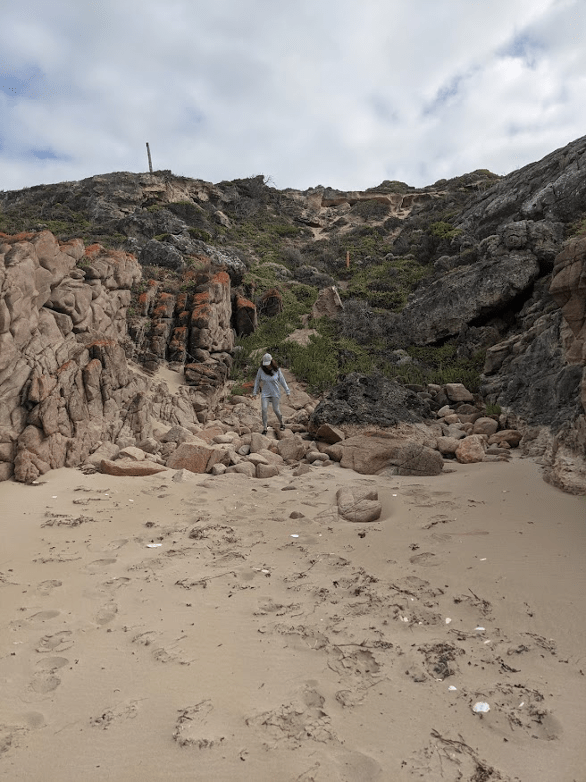
Alex and I began with regular seven kilometre beach walks. The terrain was flat, and I proudly maintained the same pace as him. Then Alex invited me to hike with him in the Innes National Park on the tip of the boot-shaped Yorke Peninsula in South Australia.

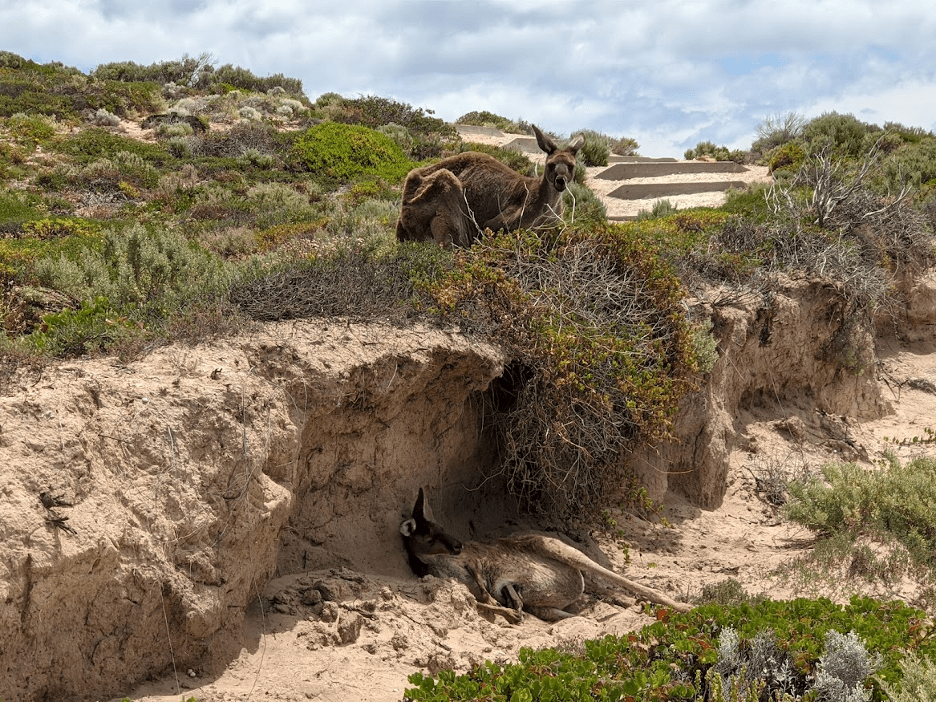
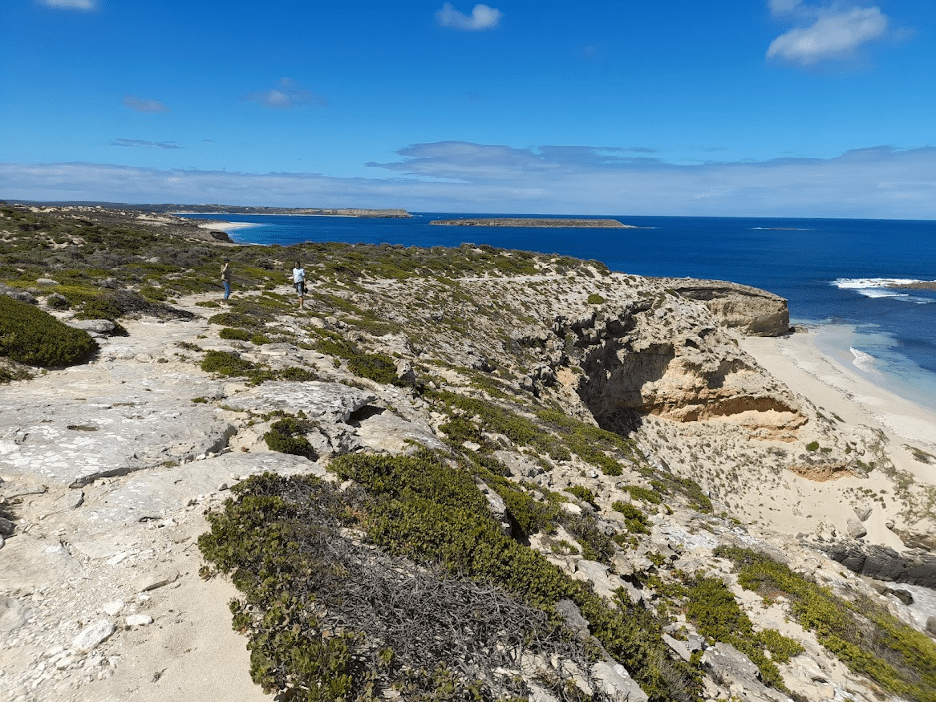
I had as much stamina as Alex and I was determined not to lag behind, but there were numerous distractions. We were walking along rugged coastline on the south of the peninsula overlooking Wedge Island when a pair of roos caught my attention. The buck was overlooking the cliff, and the doe, who was beneath, was bathing herself in the warm sand, with her joey’s legs poking out of her pouch. In the glare, I fumbled to see the image on my phone’s camera in order to snap a photograph.

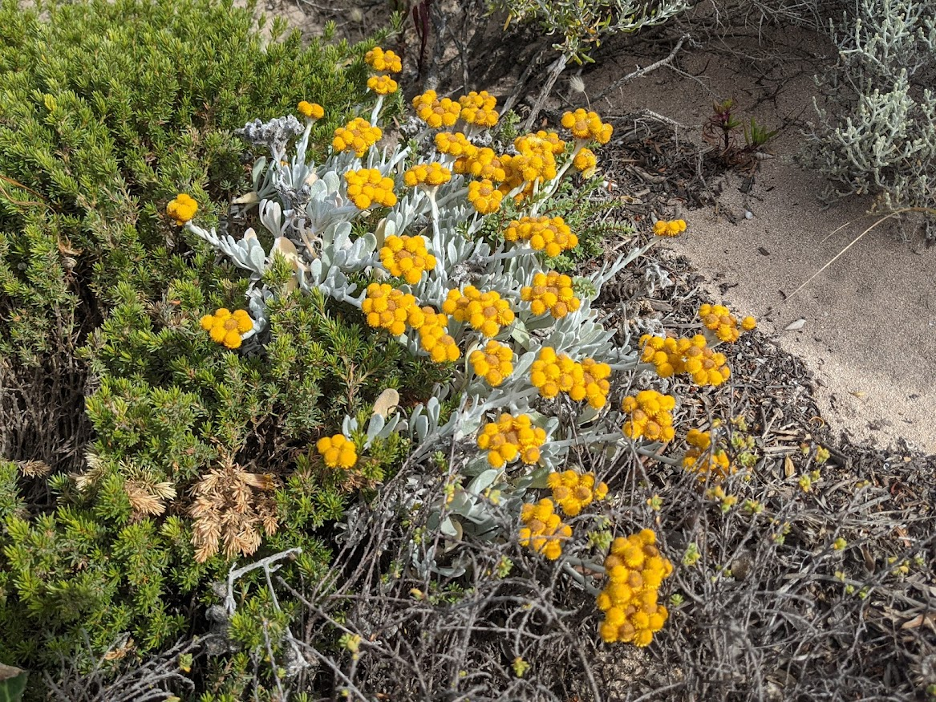
Next the bright yellow wildflowers rising from the succulents demanded my attention as I gazed at the grainy sand and rocks before me.

When I looked up I noticed a gap widening between Alex, Verity, and me.

“Why are you so far behind? Goodness Gracious!” Alex exclaimed.

I tried to explain myself but my voice was carried away in the wind.

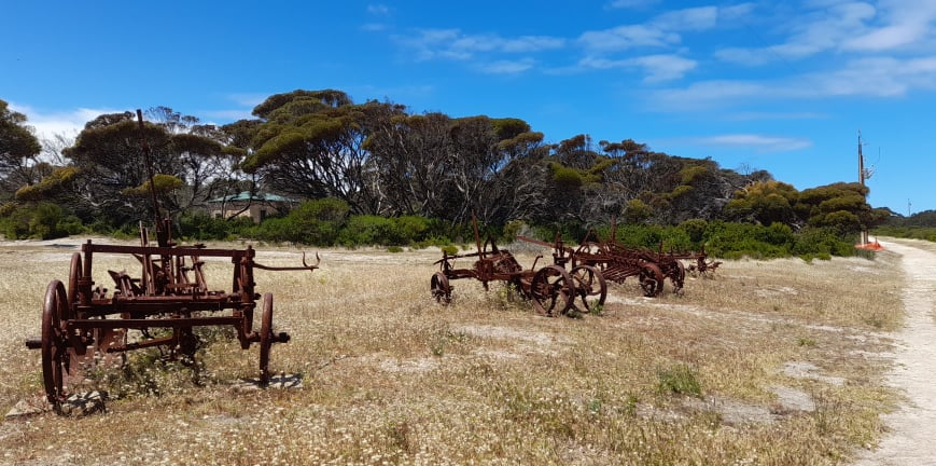
I hastily caught up with Alex and Verity, and we completed the walk. Alex announced that our next walk would be along a trail of ruins in the deserted township of Inneston, a few kilometres inland. Now part of a National Park, Inneston had formerly been a gypsum mining town. The township featured a long-abandoned cricket ground, restored houses, and ruins of houses and a bakery. Abandoned farm machinery and mining equipment, long since left to rust, dotted the trail.

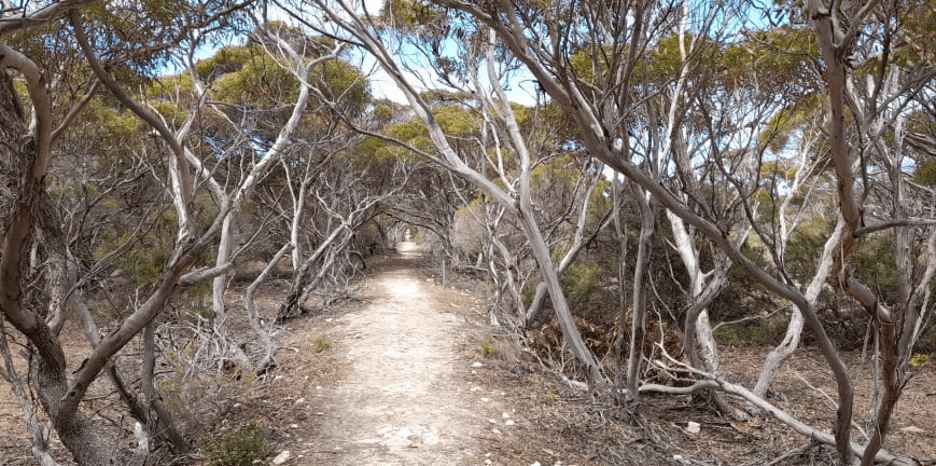
Alex informed me that the Inneston hike was seven kilometres and I bravely assured him that I could take it in my stride. The former railway track where gypsum had been transported had been transformed into a hiking trail.

Because I had lagged so far behind on the coastline walk, Alex now insisted I walk in front. I continued to stride confidently, safe in my position as trail leader. Alex monitored the number of kilometres we had covered on My Tracks on his phone. I felt like we had covered five kilometres but when I asked him he said that we had only covered three. Then when I felt we had covered ten kilometres we had only covered seven. On the return journey I could sense Alex’s strides growing closer behind me, and then Verity’s strides growing closer behind him.

“Hurry up!” insisted Alex.

I couldn’t reply. I was so proud of my stamina and endurance. Alex sensed my silence,

“Are you okay? I guess if you combine all of today’s walks we would have walked seventeen kilometres in total.”

I could feel my face burning and eyes swelling. I took a deep breath to calm myself, but couldn’t help blurting out.

“You go ahead. I don’t mind taking the rear.”

As we covered the remaining few kilometres to the carpark I started lagging further and further behind. I took less interest in the ruins and restored houses. When we arrived back at the car I gratefully heaved myself into the passenger seat and let Alex drive us back to our lodgings. On the way Alex stopped to look at the historic jetty in Stenhouse Bay but I did not budge from the passenger seat when invited to join him.

The next morning we resumed our hiking, and I was back in form, climbing up and down sandy dunes to the beach. It’s not so much that I was shorter than Alex or Verity, or even slower, but rather that I got distracted by the purple, yellow and white wildflowers, and the families of roos. Admittedly, I did start to lose stamina after hiking the first few kilometres while trying to hide from the intense Australian sunshine and stopping the legions of flies from entering my mouth.

After the Yorke Peninsula trip, Alex announced that our next hike would be on Kangaroo Island, which lies between the South Australian mainland and the Southern Ocean. No doubt, I will continue to be mesmerised by nature, not least because the kangaroos are smaller over there and have thick chocolate fur, with darker colouring on the tips of their ears, limbs and tails. I might even spot an endangered glossy-black cockatoo, or a seal. Despite these distractions, I am confident that I will keep up. Unless, of course, I stop to take some photographs along the way.

Meredith Stephens is an applied linguist in Japan. Her work has appeared in Transnational Literature, The Blue Nib, The Font – A Literary Journal for Language Teachers, The Journal of Literature in Language Teaching, The Writers’ and Readers’ MagazineReading in a Foreign Languageand in chapters in anthologies published by Demeter Press, Canada.

.

PLEASE NOTE: ARTICLES CAN ONLY BE REPRODUCED IN OTHER SITES WITH DUE ACKNOWLEDGEMENT TO BORDERLESS JOURNAL

Categories
Essay

What’s Novel in a Genre?


By Indrasish Banerjee                             

  I mostly read commercial fiction and novels the first eight to ten years after I started reading. At that time, I was not familiar with the concept of genres and didn’t know – much less cared – about them. I was taking my first steps into the world of books and reading a new novel and finishing it was all that mattered. A decade or so later, now much more comfortable in the bibliographic world, I started experimenting with other types of books. Freakonomics (2005) by Steven Levitt was my first foray into non- fiction.  Then I experimented with a few more history non-fiction books (history was one of subjects in graduation) mainly by William Dalrymple and Jawaharlal Nehru but also by other writers. Keen on territorial conquests of another kind, I experimented with Khushwant Singh, Anita Desai, RK Narayan and a few works by a few more Indian writers. Further from home, I tried out Charles Dickens (had read some abridged versions of his novels in school), Thomas Hardy, EM Forster and more. I read their novels, short stories and essays whatever I found.

 I had travelled very far from where I had started many years ago, crisscrossing genres. But my idea of what makes a good read had hardly changed. Whether it came to fiction or non-fiction, contemporary or classic, it still revolved around ‘a story well told’. Of course, some characteristics had changed. I had become more patient with slower narratives, more adept at handling complex narratives, more comfortable with narrative calisthenics and more at ease with diverse types of writing. I had also developed an understanding about the basic differences between literary and commercial works. Even so, my idea of a good read had remained resistant to transformative changes, engendering the question in my mind: “Do genres really matter?”

 The answer is both yes and no. Genres help categorise books based on what the reader can expect of them. There are millions and millions of books in the world and just imagine there being no basis to separate one book from another. The reader would have to go from the beginning to end of a book to understand what it was all about or start a journey without knowing what lay ahead. As much as it could be a delightful experience, it would bring in its own challenges. One of them would be to market the book.

Even if we don’t want to overlook the importance of commerce to art, let’s admit that no two things in the world treat each other with as much suspicion. Be that as it may, writers have, from to time, expressed their derision for genre. Kazuo Ishiguro, who has written many genre benders, once said in an interview that genres have no profound literary purpose or any substantial contribution to literature. They are creations of book marketers and their purpose is solely to sell books.

  But is literary genre’s relevance to literature only archival and commercial? Maybe a minor digression will bring in a new perspective.

 In Hindustani music, genre plays a vital role: it adds variety and richness. There are multiple gharanas (schools) in Hindustani music. Their identity is based on their geographical regions (Lucknow gharana, Carnatic gharana) they come from, the distinct musical heritage and ancestry they represent and the musical form they practice. However, the uniqueness of each gharana is determined by the raga it engineers by combining several suras (pitches). There are seven suras (notes) in Hindustani music.

 Film genres contribute to films, of course, in terms of variety but also by creating slots based on audience preferences, social anxieties, aspirations and various other factors which allow filmmakers to address the associated emotions by placing their films in the predefined categories which helps to find a ready audience. Film genres are more fluid than Hindustani music genres. They come and go and also get clubbed creating a hybrid genre where different genres are built into one narrative to appeal to a wider audience.

On the other hand, traditionally, book genres have had rigid boundaries with very minimal or no cross-genre exchanges. In fact, the boundaries have been so rigid that authors of one genre have never shied away from expressing their disdain for their counterparts in another genre. Broadly speaking, the two warring factions have been literary and commercial fiction.  

In The Naive And The Sentimental Novelist (2011), Orhan Pamuk says commercial novels (detective, crime, romance, sci fi novels) lack a ‘centre’ – a profound reflection on the meaning of life – which is integral to literary novels. This absence of a centre in commercial novels makes almost all of them same with nothing substantial separating one genre novel from another except their characters, plot twists and the murderer. This lack of substance makes it important for genre novels to always provide excitement to their readers, he alleges. On the contrary, according to Pamuk, a literary novel is a constant quest for the centre not just for the reader but also for the writer.

 Some writers may not know the centre to start with discovering it while writing the novel as an act of serendipity. Some may structure their plots such as to illuminate the centre.  Tolstoy had to change War and Peace (written in 1869, Translated in 1899) many times to discover its centre. Pamuk informs that Dostoyevsky had suffered epileptic attacks, after writing The Devils (1871-72, translated 1916), when he had realised that he had made a mistake leading to the sudden appearance of a new plan. And he had changed everything radically, Dostoyevsky had claimed.

 Howevee, in The Miraculous Years, Joseph Frank, Dostoevsky’s biographer had said Dostoyevsky was exaggerating. The new plan had indeed changed the novel from a mediocre novel with one dimensional characters to a brilliant political one, but Dostoyevsky hadn’t changed more than forty pages of the 250 pages he had written the previous year. Apparently, it’s the ‘centre’ of the novel the great writer had referred to when he had said he had radically changed it, Pamuk concludes.

  In The Great Derangement: Climate Change and the Unthinkable, Amitav Ghosh blames this obsession of serious literature with daily humdrum, or the ordinariness of life has traditionally kept it away from dealing with subjects which are not considered ‘serious’ leaving them for the humbler genre fiction. Climactic events like a gale flattening a town or massive rains drowning it were considered too incredulous, not making the cut for nineteenth century literary gravitas.

 Until 19th century the division between fiction and non-fiction was fuzzy. In the 19th century, thanks to Industrial Revolution, there was a profusion of factories – moving workforces from unorganised, ruralized setups to more disciplined and controlled environments.  What followed was people constructing their lives around their workplaces. This transformed rural and agricultural societies into orderly and urbanised ones bringing about a new kind of society which was far more cloistered, sober and unexciting than earlier societies which, being agricultural and rural, were far rougher and exposed to vagaries of life and nature. The colourful stories of pre 19th century couldn’t adequately capture this new reality; it needed a new kind of literary tool. In came the serious fiction or what we call today the literary novel.   

Pamela by Samuel Richardson (1740), Shamela by Henry Fielding (1741) and Tristram Shandy by Laurence Sterne (1760) were the first attempts at literary novel dealing with such solemn themes as social differences, inner conflicts and women’s sexual autonomy. This style of writing travelled far and wide. Among others, it was adopted by Bankim Chandra Chatterjee, among the earliest practitioners of the novel in India, digressing from the earlier traditions of storytelling in India, the Jataka tales and so on, informs Amitav Ghosh in The Great Derangement: Climate Change and the Unthinkable.

 Over a period of time, puritanism around contours of literary fiction set in, and it’s difficult to say when the wall between serious and literary fiction collapsed – in fact one can say it never did. But just as literary novels had emerged to accommodate a new kind of reality in 19th century, breaking away from genre fiction, genre benders have accounted for another kind of changing reality which is presenting challenges hitherto unimagined within the conventional boundaries of human life, like the effects of climate change and technological advances like artificial intelligence and machine learning.

  To capture the idiosyncrasies of modern life, many literary writers have flouted the boundary between literary and genre novels by setting their plots in the genre format while retaining the treatment of literary fiction. In Kazuo Ishiguro’s When We Were Orphans (2000), Christopher Banks, now a private detective in London, sets out to investigate how his parents disappeared from Shanghai during the Second Sino-Japanese War.  The novel is about life’s profundities like memory, nostalgia at its heart, although it’s written like a detective novel. The plot constantly moves from one incident to another keeping the reader waiting for the end, even as it draws a detailed picture of Shanghai society during the war. In Ishiguro’s recent book – Klara And The Sun (published in 2021) – he explores what separates human from robot even after the robot has acquired human-like intelligence. The book has a children’s book like element to it which is its main charm.

  Many writers have experimented with multiplicity of forms, but among the notable books are Kobo Abe’s 1950s novel, Inter Ice Age 4, which starts as a hardwired sci fi but slowly evolves into a political thriller and Italo Calvino’s If on a Winter’s Night a Traveller (1979) whose plot bifurcates into two in the middle of the novel. There on, in some chapters, the reader is solving literary mysteries while the other chapters are the first chapters from other novels of varied styles.

 The novel like any other art form has survived and moved ahead through adoption from within its various forms or external influences. When a new form arrives as a reaction to a social change or occurrence or an enterprising writer pushing back the boundaries, puritanism sets in to preserve the form in its purest state if it achieves literary acceptance and fame. Novels with magic realism and migration are some examples. When the form outlives its utility or is made obsolete by emerging trends or excessive repetition, it gets subsumed by another form and survives as part of it or slowly dies out. And thus, a new form, a mix of the two or many more, emerges. And the novel lives to fight another day.

.

Indrasish Banerjee has been writing and publishing his works for quite some time. He has published in Indian dailies like Hindustan Times and Pioneer, and Café Dissensus, a literary magazine. Indrasish is also a book reviewer with Readsy Discovery. Indrasish stays and works in Bangalore, India. 

.

PLEASE NOTE: ARTICLES CAN ONLY BE REPRODUCED IN OTHER SITES WITH DUE ACKNOWLEDGEMENT TO BORDERLESS JOURNAL

Categories
Poetry

Imprints from New Orleans

By William Miller

Form Rejection Letter

                                                                    In this star chamber, three men
                                                                    with cowls read endless poems,
                                                                    the paper offerings of souls   
                                                                    mailed with a return envelope.          

                                                                    A pair of ancient scales weigh
                                                                    and measure the worth 
                                                                    of uncommon pain squeezed
                                                                    into verse -- metered, rhymed

                                                                    or free.  Hearts break, beauty
                                                                    dies, but there is only space 
                                                                    enough for poems that fit
                                                                    current editorial needs.

                                                                    Once human, poets themselves,
                                                                    they must coldly judge the most
                                                                    awful confessions, maps
                                                                    of despair, personal grief.

                                                                    And on that scale, your best words
                                                                    almost tip the golden bowl,
                                                                    a pound, just half-pound,
                                                                    an ounce found wanting.


Coyotes

                                                                 In her Irish Channel kitchen,
                                                                 she drinks imported herbal tea.
                                                                 Her backyard is safe for two

                                                                 thriving little kids.  All is well
                                                                 until night—she sees the leanest,
                                                                 meanest dog lying with 

                                                                 her pups as if she owned 
                                                                 the grass.  This is no park breed
                                                                 with sleek brushed fur,

                                                                 fed Ethiopian grain by hand.
                                                                 Her husband calls the police,
                                                                 who call Fish and Game,

                                                                 who never call back.  
                                                                 All the moms, all the children
                                                                 are asleep except for two

                                                                 mothers who know men 
                                                                 protect no one, not really,
                                                                 not even their own families.

                                                                 They breed quickly, run off 
                                                                 to the batture* or fall on
                                                                 the couch, watch the replay

                                                                 of the Saints last home game.
                                                                 Their wives would kill, rip
                                                                 and tear flesh from female bones

                                                                 if it came to that.  A truce
                                                                 is made, eye to eye understanding,
                                                                 a secret woman’s pact.  

                                                                 Grown pups wander off—
                                                                 their mothers too in dreams,
                                                                still young enough to mate for fun.


*Batture: Bar in New Orleans


Women’s Shelter, York, PA

All that summer, I did Christ’s chores—
Meals on Wheels, the only man
at the clothing drive, penance
for leaving my wife, the woman
I left my wife for.
Past red brick facades, colonial
slave porches, I followed a wet
cobblestone street to a door
with a barred window,
rang the buzzer.
That face in the window turned
me to stone, the pale woman’s
hard brown eyes, her only
request simple and blunt—
“Put it down, leave.”
I wanted credit, time served—
my mother abandoned me
when I was twelve. I still
saw her in every dyed blonde
with fake breasts.
No other choice, retreat inevitable,
I put down two plastic bags
filled with toothbrushes,
toothpaste, candy bars
and soap bricks.
These walls were made
of more than fired clay
troweled by slave hands--
they were two-feet thick
like the fear between us.


Ruth’s Garden

                                                              Latex gloves, surgical green,
                                                              protect her hands from thistles, 
                                                              sticky thorns, opioid needles.

                                                              The homeless are the children
                                                              she never had, never wanted, 
                                                              not even since Katrina

                                                              made her homeless as the next
                                                              pale survivor in long line for 
                                                              a FEMA trailer.  

                                                              These ferns and flowers redeem
                                                              her spotted hands, watered
                                                              with a swan-neck spout

                                                              twice a day.  Like a turtle’s,
                                                              her shell is thick enough
                                                              to repel the insults of gutterpunks
                               
                                                              on the broken sidewalk,
                                                              their contempt for an old lady                                                                        
                                                              who believes in growing

                                                              green things. Survival 
                                                              of the unfit is the unhealthy norm
                                                              in a Quarter that once

                                                              was a neighbourhood, 
                                                              beer drunk from tin buckets
                                                              on the banquette, a light

                                                              in every dormer window.
                                                              She alone is the reptile,
                                                              the mud creature who 

                                                              reminds us a rose is still 
                                                              a rose, nothing blooms
                                                              without a few drops of love.

William Miller’s eighth collection of poetry, Lee Circle, was published by Shanti Arts Press in 2019.  His poems have appeared in many journals, including, The Penn Review, The Southern Review, Shenandoah, Prairie Schooner and West Branch.  He lives and writes in the French Quarter of New Orleans.

.

PLEASE NOTE: ARTICLES CAN ONLY BE REPRODUCED IN OTHER SITES WITH DUE ACKNOWLEDGEMENT TO BORDERLESS JOURNAL
Categories
Poetry

We Consider Faith

By Dibyajyoti Sarma

We consider faith


Of course, you believe in gods, 
not your own, you have none, 
but your mother’s, she has numerous. 

You talk to them when you are in trouble, 
or want something and know you cannot get it.
It’s easy to blame them, but the conversations, 
always one-sided, seem pointless. 
You want to know if they can hear you.  

You like to think He or She, or They, 
(there are so many, you tend to lose track) 
listen to you, at least often, if not always.  
They must — your mother’s devotion demands it. 
All her life she had but one prayer — 
‘Make my sons happy’. 
Now, you demand, 
‘Fulfil my mother’s wish, make me happy.’
 
This, of course, they cannot do, you know, 
but at least, they should hear you out. 
You talk to them under the sky, 
not in front of an idol, 
where they are distracted by their very beauty, 
imagined by a poor sculptor in his filthy slum, 
or in a temple, where they are disquieted by 
the multitude of sycophants with their bribes 
of sweets and cash and piteous prayers. 

It’s easier in the open, though 
you tend to forget who’s who. 
There are so many of them, 
with so many departments —

you are never sure if you are 
talking to the right god 
at the right time, 
for the right obstacle, 
in the right manner. 

Of course, you believe in gods, and you know, 
they are as helpless as you are. 
With so many interpreters to relay their causes, 
they must be as wary as you are.

They, the gods, nice fellows, they went 
on an exile and now they cannot return. 
The door is barred in this world of frigid science 
and dazzling machines, where men took over 
and became divine, and you know, it’s a selfish 
nightmare, which now, we all must dream.

(First published in Book of Prayers for the Nonbeliever, Red River, 2018)

Dibyajyoti Sarma, is a writer, editor, poet and translator based in Delhi. His latest, a translation of Assamese author Indira Goswami, Five Novellas about Women, came out in July. He also runs the independent publishing venture, Red River.

Categories
The Observant Immigrant

When is a mental illness not a mental illness?

By Candice Louisa Daquin

Shakespeare’s King Lear: Was he mad or grief stricken? Courtesy: Creative commons

Depending upon the country you live in, you may have to think back a long time or not so long, to imagine a time when talking of mental illness wasn’t mainstream. For many countries mental illness is still a taboo, but the internet has made knowledge of mental illness more wide-spread. You could be forgiven for thinking most people suffer from some form of mental illness. In reality, statistically, the majority do not. Most of us however, go through hard times where we may exhibit behaviour shared with those suffering from mental illness.

Having just finished co editing a large book on mental illness, I began to think about how we swung from one extreme (never acknowledging mental illness) to another (talking about it all the time). As a psychotherapist this isn’t perhaps surprising but the extent to which we label and evoke mental illness as explanation, might be.

Sometimes atypical behavior isn’t mental illness.

Teens, the elderly, the dispossessed, so many groups may suffer what seems like a mental illness but it really a natural response to a challenging situation. The adjustment of growing up. The challenges of getting older. Losing partners. Losing parents. Hormone changes. Trauma. Treating these events, the same way you would someone with a long-term mental illness like schizophrenia is ignoring the difference between an illness and a causative episode. With health insurance companies demanding categorisation in order to approve insurance, there has been a gradual shift toward ever-increasing terminology and labels. The problem with this is someone going through depression because they lost a parent can be seen as mentally ill — just like someone suffering from severe schizophrenia. But the two are not the same. We must be careful not to confuse malaise and regular responses to trauma and challenges, with a deep-rooted illness that might not be as curable. Why? Because we’re no longer understanding crucial differences in what we deem mental illness.

Therapists and medical professionals can be far too quick to state unequivocally that someone is mentally ill. This matters because just as ignoring mental illness and not talking about it, is wrong, so is over diagnosing it. The reason being, when you label someone, you set into motion years sometimes of inaccurate diagnosis and treatment which can do more harm than good.

Before you dismiss this as a rare event, think again.

Here are some case studies (real names not used) I have come across in my work:

John was told he was bipolar and was sent to an outpatient ‘group’ in a local residential center for mentally ill people. This was on the basis of his arguing repeatedly at his place of work and finally being fired. He also had several car accidents that he put down to ‘feeling angry’ and he attacked his wife during an argument. He was prescribed high dose psychotropic medication and his insurance was charged for the expensive therapy he received daily.

His family were horrified to find out their father was ‘suddenly’ mentally ill with bipolar disorder ll in his late sixties. They didn’t question the authority of the doctors until it became obvious something else was going on. At that time, he had sunk into a deep depression and seemed to be losing his ability to drive. The family asked the psychiatrists whether he could have dementia, to which they were repeatedly told — no he’s mentally ill. Firstly, this is an erroneous way of describing a condition as blanket-diagnosing mental illness, and second, they were wrong. John had the beginning of Alzheimer’s and his delayed diagnosis caused great heartache for everyone involved.

The question of how any competent psychiatrist could have diagnosed John with Bipolar ll which rarely if ever ‘suddenly happens’ late in life, is but one example of how a system will fit a diagnosis to its dominant perspective, in this case an assumption that certain behaviours are always congruent with a mental illness. John like many with Alzheimer’s did share some symptomology but nobody bothered to consider an alternative diagnosis and thus, the incorrect medication, expense and uncertainty caused a sad diagnosis of Alzheimer’s to become even more protracted and painful. Equally it should be mentioned for the sake of fairness, that there is an over-abundance of dementia-related diagnosis of older people where other causes are not considered and this is the same shortsightedness.

Liza, was diagnosed with schizophrenia based on muted affect, spells of catatonia and trauma response as well as insomnia, severe anxiety and depression. She exhibited paranoia and fearfulness as well as despondency and out bursts of anger. Even if those symptoms could fit the diagnosis for schizophrenia, they are too generalized to be assumed as such. Nevertheless, Liza was given EST (Electric Shock Treatment) and institutionalised for years, without another diagnosis being considered. It turned out Liza had never had schizophrenia but after years of medication it was hard to tell what was causing her behaviour. It wasn’t until years later when she began to open up to a therapist who cared, that Liza found out her symptoms were the reactions of severe childhood abuse and sexual abuse. These had never been considered because she was not asked about sexual abuse, and did not volunteer about it (most sexual abuse survivors don’t). It was easier to medicate her and inflict EST on her, than really understand what was going on. Liza went on to live a full life, but with the scars of her experiences and a deep mistrust of the psychiatric field (rightfully!).

These are two of many, many stories I could share of clients with misdiagnosis histories that caused them and their families a great deal of suffering. Of course, there is the flipside of people not being diagnosed with a mental illness and equally suffering and I acknowledge that happens too. The purpose of this essay is to consider the epidemic of over-diagnosis and how, maybe with good intention, we’ve swung from one extreme (nobody is mentally ill) to another (if in doubt, it’s a mental illness).

Whilst I am the first person to say accurate diagnosis and treatment can save lives when it comes to the mental health field. I have seen how doctors and practitioners can be subject to the undue influence of social trends in diagnosis and medication and how this can influence the accuracy of their diagnosis. Psychotropic drugs can have life-long effects which if that’s your only choice compared to the misery of a mental illness, you will accept, but what of those who didn’t need them in the first place? My concern is the over-medication and over-diagnosis of certain kinds of mental illness set a cascading storm into motion.

A colleague of mine who works as a psychiatrist had her own experience of being on the ‘other side’ when she developed a sudden onset illness. The illness included heart palpitations. My colleague went to the ER with chest pains thinking she might be having a heart attack. The physicians on call determined she wasn’t and their next recourse was to suggest it was an anxiety related issue. They prescribed anxiety medication and recommended she saw a therapist. My colleague went another appointment only to find out she was sitting in front of a psychiatric nurse. Despite her own qualifications as a psychiatrist, she said at the time she felt vulnerable, unsure of what was happening and very afraid. She explained her feelings of fear to the nurse, alongside her concern that she had no definitive diagnosis. The nurse did not refer her to another medical doctor for further tests. She recommended heavy duty anti-anxiety medications.

Because my colleague is a psychiatrist, she had the presence of mind to decline but it got her wondering what would have happened had she not been clued into the failings of the system? She could easily have been taking strong medications for a ‘suspected’ case of anxiety, without really finding out what was wrong and caused her heart palpitations. It took my colleague a long time to finally get an answer. A rare disease. With treatment she recovered. The lesson she learned however, terrified her. She now understood how at the mercy of doctors most patients were and how often diagnosis wasn’t a precise science or even an educated guess, but more of a ‘by rote’ method that was deeply flawed.

She showed me the thirty something bottles of medications she was given with every appointment and explained that had she been truly suffering from a serious mental illness, she would have had more than enough to overdose with, even given the safety protocols of modern medicine. She also explained the ease with which she was given extremely powerful drugs, without a documented diagnosis and how many side-effects those medicines potentially had. She is now an advocate for change, hoping the medical industry and the pharmaceutical industries can be cautioned against rash diagnosis and over-medicating. It worries me that it takes an expert in the field to raise a red flag and I remain pessimistic about her success in changing a well-oiled system that earns billions in kick-backs and profit from the perpetuation of an illness rather than a cure.

Getting into hospital unless you have a heart attack or amputated limb isn’t easy any more. The model is more about treating patients and sending them home. This works for many, and expands on the ‘care in the community’ concept with mental health (which has floundered since inception, creating huge groups of homeless mentally ill) but does not work for everyone, especially those with harder diagnosis. Consequently, many of us have learned what it feels like to be a patient going through a broken system, what you had to do to get what you needed and how hard that would be if say, you were in the throes of a serious illness (be it mental or physical). Some doctors are responsive, caring and compassionate, whilst others merely check a box. The inadequacy of systems set up to help both the physically and mentally ill is underfunded and the level of treatment often fractured, in favour of cost-saving protocols that were often unapplicable to those they served. How challenging must it be for patients to seek good help during some of the hardest times of their lives?

I have sympathy for the over-worked/under-paid GP/family doctor who is restricted by insurance protocols and limited in what they’re able to offer their patients. I understand how it may seem easier to offer an anxiety medication or label someone bipolar, than spend weeks trying to get to the real cause. But you don’t heal anyone with a wrong diagnosis, and you mar the field of psychiatry by misdiagnosis. It’s no wonder I’m often mistrusted as a mental health worker, because so many of my patients have had negative experiences of being judged, marginalised and labeled, by previous psychotherapists and doctor. It only takes one person to assume you’re not coping and must be clinically depressed, to set into motion a whole chain of events. What if that practitioner had looked beyond the obvious and considered the evidence more closely? But sometimes it’s easier to reach for the prescription pad. You are doing someone a disservice if you medicate a vulnerable person on the basis of basic symptoms rather than looking at the whole picture. It’s a catch-22 situation with such short appointment times and a burgeoning patient load.

In prisons, where a high number of inmates have mental illness that are not treated through accessible programmes, drugs have become the surrogate for competent therapy. It is simply cheaper to drug a patient than offer 1-1 therapy. Whilst it may not be fiscally possible to offer low-cost or free therapy to everyone who needs it, we shouldn’t use drugs as a substitute if they’re not the answer. Most psychotropic drugs were designed to be used short-term but many people take them for years. If you imagine some of those people could be misdiagnosed or not really suffering from a mental illness so much as a hard time that will resolve, then you’re responsible for drugging people who shouldn’t have ever been drugged. How is this an answer to anything?

In nursing homes, patients with dementia and other diseases often take over ten medications that ultimately won’t cure anything but will make the pharmaceutical industries rich. The reason? To keep them compliant and calm. So they won’t bite, make a fuss or tax the underpaid staff. Again, I can sympathise with wanting to medicate a troublesome patient, but in shrugging everything off to mental illness we lose touch with the real cause and effect and shirk our responsibility to accurately treat people. Maybe with fewer doctors and ever-increasing medical costs this is no longer possible, in which case as more of us age and get dementia or alzheimer’s, expect to see a steady increase in the use of psychotropic medication as a means of management.

I have met many who have had similar sudden onset, long lasting catastrophic illnesses. Many of them were told by doctors that these illnesses were psychosomatic or psychiatric in origin when it turned out to be a hundred percent physical. Whilst I don’t deny that some illnesses can be psychiatric in origin, many are not and women are far more likely to be told their illness is ‘in their head’ or ‘an issue of nerves’ – and this not just from the medical industry, but their families and friends. Like anything, when you’re in a dark place it’s very easy to convince yourself, the doctor is right, which can further exacerbate misdiagnosis and unnecessary suffering and stigma.

For the seriously physically ill, this is as bad as having a heart attack and being told ‘you are anxious you need to calm down’. It is counterproductive and often causes people who need help not to seek it. The blurring between the physical and the mental is unacceptable. Whilst there is clearly a mind-body link, assuming everyone with anxiety must be mentally ill (rather than anxious for a good reason) is short-sighted and potentially damaging. Likewise, labeling every woman histrionic because she’s panicking about something, is using mental illness categories as a weapon.

The gender divide between how doctors treat female versus male patients is a long-standing inequality, based upon the old concepts of hysteria (a female term applied toward women only) and the link between mental instability and the female body. Whilst it is true that menstruation, hormones and menopause can definitely change a person’s mood, this is not the same as true mental illness and it is high time we understand the difference between feeling anxious or depressed and suffering from clinical depression or anxiety. The only way we achieve this is by quitting our tendency to label certain groups without further enquiry. This includes women, people of colour and lower-income persons — all of whom are more often assumed to be mentally ill than other groups.  

The harm of a misdiagnosis is, as I said earlier, as bad as no diagnosis. The rush to come to a conclusion is something that turns into a scarlet letter for the bearer. Despite our best attempts, mental illness is still stigmatised, and as such, once diagnosed, this can affect everything from future job prospects, marriage, friendships to even housing. In the information age, medical privacy is constantly under assault, and even future employers are able to find out about people’s private lives. Should they discover that person has a mental illness that they stereotype as being negative, this could reduce a person’s equal chances. The old adage, ‘crying wolf’ also applies because we over-diagnose and popularise in unhealthy ways. That causes people to shirk when someone really does need help.

Why do we stigmatize the mentally ill? I often hear from clients who are overmedicated and some who are undermedicated, both extremes existing because one provokes the other. A lot of psychotropic medication is not effective and placebo at best, leaving the medical industry with a big question mark as to how to help the mentally ill. Whilst I don’t have all the answers either, I would say, ensuring someone is really mentally ill before acting on it, is one positive step toward reforming a broken system. Currently so much money is spent on mental illness but people are not getting better, they are getting sicker. That means something really isn’t working. I’m not convinced the recent move to online psychiatry is the answer either, given the danger of powerful medications. I’m also not convinced strong medications like Ketamine and Ecstasy should be given without close monitoring. I’m all for creative thinking in medicine, but not without caution.

Finally … when is a mental illness not a mental illness? We should be open to alternative diagnosis rather than the category of mental illness as a catch all for when we’ve no better answer. Just because something isn’t apparent, doesn’t mean it’s a mental illness. There is so much the medical industry doesn’t know and often it takes patience and commitment to discover a rare disease. If we didn’t spit people out and try hard to see as many people as we could, we might have time to discover the real cause and not send people home with incorrect medication. It’s damaging and it further stigmatises those who really need mental health treatment. On the other hand, sometimes feeling anxious is just feeling anxious, and not something to pathologise. We will all feel depressed or anxious at times, it doesn’t mean we need a category and our current system doesn’t seem to have another option. How about we start with asking the patient – what do you think is going on? Often, we learn the most from our patients, and they will help us know whether they have a mental illness or are just going through a hard time. The difference between providing short-term supportive care and getting someone on a life-time of strong medication is huge and we need to have our eyes wide open.

Candice Louisa Daquin is a Psychotherapist and Editor, having worked in Europe, Canada and the USA. Daquins own work is also published widely, she has written five books of poetry, the last published by Finishing Line Press called Pinch the Lock. Her website is www thefeatheredsleep.com

.

PLEASE NOTE: ARTICLES CAN ONLY BE REPRODUCED IN OTHER SITES WITH DUE ACKNOWLEDGEMENT TO BORDERLESS JOURNAL.

Categories
Review

Beyond the Veil: A Book Review by Aruna Chakravarti


Title: Beyond the Veil

Author: Devika Khanna Narula

An important task for those committed to tracking the path of women’s Issues, past and present, is to embark on a study of the academic discourses on gender sparked off by feminist scholars and activists — an area that is fast gaining ground all over the world. Yet there is another dimension to the effort. It also involves an exploration of creative writing generated by sensitive, imaginative feminism. It is important to understand that concepts such as Patriarchy, Agency and Resistance are not limited to feminist debate and discourse. They are equally and dynamically present in poetry and fiction. In India, the field of feminist creative writing is growing rich with promise every day.

One such endeavour is Devika Khanna Narula’s novel Beyond the Veil.  A work of epical dimensions it operates on a vast canvas. Vast both in terms of space and time, it spans half a century, between 1900 and 1950. It offers interesting insights into life as lived by upper class and middle-class women during a momentous period of Indian history. A time when a mass resistance against British rule was spreading all over the country culminating in the independence of India. A movement in which some women also participated.

Spatially the narrative shuttles between two families from two different parts of India linked by marriage. They belong to different cultures though they come from a common stock. They are the Punjabis of Lahore and the Punjabi Khatris of Bandhugarh, a fictional name for Bardhaman, in West Bengal. The founder of the Kapoor family in Bandhugarh, came from Punjab in the sixteenth century and, by sheer dint of merit and hard work, amassed lands and wealth. His progeny followed in his footsteps, established themselves as zamindars and, at some point, were dignified by the title of Rajah by the British.

The Khannas of Punjab and the Kapoors of Bandhugarh seem very different in externals. The first belongs to the ‘small business’ class. The other is related to royalty. One is of pure Punjabi extraction. The other, though from the same genetic type, is highly Bengalised having lived in Bengal over many generations. They speak Bengali, eat Bengali food, dress like Bengalis, worship in Bengali temples and use idioms and expressions that serve to accentuate the effects of defamiliarization and alienness among the daughters-in-law who, in an effort to keep the bloodline pure, are brought from the old pristine stock.

These women face the challenges their upheaval brings in its wake. They are required to come to terms with another kind of life, learn to adapt to a new environment, cope with taunts about their dissimilarities and conquer their fears and insecurities. It works both ways. Roopmati, coming from Punjab has to turn herself into a Bengali in her marital home. Her daughter, brought up as a Bengali in Bandhugarh, is wed to a young man in Lahore and has to adapt to a different set of priorities and values for which she is totally unprepared.

Yet, scratch the surface and the fates of women, whether in Punjab or Bengal, are identical. Denial of education, economic dependence on the male, social conditioning over generations and the suppression of individual identity by an oppressive ‘joint family’ ideology are present across the spectrum. Humiliation and desertion by husbands, violence—physical and mental, molestation and rape both marital and by other males of the family are normalized and hidden from view. Adherence to tradition have rendered other horrors acceptable and inevitable. The custom of Sati and Purdah, female infanticide and neglect of the girl child are part of a patriarchal system that exists in both communities.

The strange thing is that the women who suffer these indignities, day in and day out, are the very ones who are entrusted with perpetuating the system. Males set the rules but females are expected to implement them. And many do. Mindlessly like automatons. Some even enjoy the process. Because this is the only area of dominance men have relegated to women. Women like Bebe of Bandhugarh and Rukmini of Lahore enjoy power through a determined subjugation of the younger women of the family, particularly the daughters-in-law. They also see it is as their duty to break the clay of the other and force it into the patriarchal family mould. 

The world in which the young women of Beyond the Veil live is cold and dark. But occasionally a shaft of sunlight pierces through the clouds. Some women upset the status quo from time to time. These are rebels who expect consideration and fair play. They demand change. The mother and daughter duo Roopmati and Maina are two such women. It is heartening to see that, under their influence, their husbands too develop sensitivity and compassion for the women in their households. Other males follow suit. The curtain falls on a world slowly waking from slumber.

The ambience of both worlds is created with great sensitivity and detail. Descriptions of food eaten, clothes worn, journeys undertaken and the joys and sorrows of day-to-day living are totally credible. The narrative flows smoothly unmarred by jolts and jars. The topography of Lahore, Karachi and Bandhugarh of those days is authentic and accurate. Life as it is lived in, whether it is the Khanna family or the Kapoor, the cultural differences come through with clarity and precision. Events and locales are rooted in history and dates are adhered to. Names of streets, restaurants, railway stations, cinema halls… even the films that were shown in them a century ago… can be put to the test and will not fail. Best of all are the local legends and myths that have grown around communities and families, rivers and lakes, temples and mansions. The book is a storehouse of information of a bye gone era.

.

Aruna Chakravarti has been the principal of a prestigious women’s college of Delhi University for ten years. She is also a well-known academic, creative writer and translator with fourteen published books on record. Her novels JorasankoDaughters of JorasankoThe Inheritors have sold widely and received rave reviews. Suralakshmi Villa is her fifteenth book. She has also received awards such as the Vaitalik Award, Sahitya Akademi Award and Sarat Puraskar for her translations.

.

PLEASE NOTE: ARTICLES CAN ONLY BE REPRODUCED IN OTHER SITES WITH DUE ACKNOWLEDGEMENT TO BORDERLESS JOURNAL
Categories
Poetry

Shorter Poems of Akbar Barakzai

Translated from Balochi by Fazal Baloch

Unfinished Song

Mankind is a beautiful song,
A song unfinished as of yet

Heart and soul of the sacred earth
to conscience it gives voice 

It’s each word and each rhyme
like flowers soft and sublime

A heavenly wine in Nature's cup
like morning breeze it does chime

Someday 'twill touch its finest note
‘twill survive the tides of time

Bestowed by the Mother Nature
A blossom that lasts forever


Not Forever

The rule of chains and fetters
Will last only for today not forever
The age of tyranny and oppression
Will last only for today not forever
All these wealth and riches will liquidate soon
This loot, pillage and plunder
Will last only for today not forever


Motherland

Even if like a wasteland
it’s all burnt and blazed,
Motherland is but motherland.
I crave not for the land of the sun
and its flowing rivers of light,
Even if it's dark like a dungeon
Motherland is but motherland.

The Anguished Sigh 

The restless sigh! 
Lay trapped in my collapsed chest 
May you become a little songbird 
And in every sad heart find yourself a nest 


Distracted Youth

O, you, the distracted youth!
Why you lament on the shore
Go ahead and embrace the tides
Wherein lies life’s lore

Akbar Barakzai was born in Shikarpur, Sindh in 1939. He is ranked amongst the proponents of modern Balochi literature. His poetry reflects the objective realities of life. Love for motherland, peace and prosperity and dignity of a man are the recurrent themes of his poetry. His love for human dignity transcends all geographical and cultural frontiers. Barakzai is not a prolific poet. In a literary career which spans over half a century, Barakzai has brought out just two anthologies of poetry, Who can Kill the Sun and The Lamps of Heads, but his poetry has depth and reaches out to human hearts with its profundity. Last year, Barakzai rejected the Pakistan Academy of Letters (PAL) award, quoting  the oppressive policies meted out to his region by the government as the reason.

Fazal Baloch is a Balochi writer and translator. He has translated many Balochi poems and short stories into English. His translations have been featured in Pakistani Literature published by Pakistan Academy of Letters and in the form of books and anthologies. Fazal Baloch has the translation rights to Barakzai’s works and is in the process of bringing them out as a book.

.

PLEASE NOTE: ARTICLES CAN ONLY BE REPRODUCED IN OTHER SITES WITH DUE ACKNOWLEDGEMENT TO BORDERLESS JOURNAL
Categories
Stories

Driving with Murad

By Sohana Manzoor

“Go, go, go, go, go! What are you waiting for?” yelled the man sitting in the passenger’s seat. I was at the wheel wondering if it was my turn, or if I should allow the car coming from my left to go forward. At his urging, I plunged forward and turned left. Murad shook his head in frustration and spoke with his thick Russian accent, “You are thoo afraid. Why are you so afraid? What dho you think will happen, huh? If you dhrive like that, you will never go anywhere.”

Murad was my driving instructor. He was a great fellow, full of fun and humour. He was quite motivating and without a doubt, an excellent driver too. Unfortunately, I am an awful learner and possibly also the worst pupil he had ever had to teach driving. I busted one of the front tires of my best friend’s car the very first day I dared to be out in the streets. I sat behind the wheel for the first time in my life in August 2015. I was as nervous and frisky as a kitten and the instructor from the Driving School in Newton made me drive around a parking lot. He suggested that I practice at the parking lot with a friend, and preferably in some streets with less traffic before signing up for my next session.

I did as he had suggested, but only in the parking lot. My best friend and housemate, Nausheen, was terrified of my driving skills, and naturally, did not dare to accompany me in the streets!

My second session was with Murad. He was a little late, and came cursing under his breath. Apparently, he got the wrong address from the driving school, and realised the mistake only after calling me. I still remember him not only as a great instructor, but a great entertainer as well. He was in his mid-fifties, good looking and in very good shape. He also talked incessantly. Every time I made some blunder, he yelled in a good-natured way.

“Next time, I will bring my shoth gun,” he told me once, after I made a frantic turn ignoring all other drivers on the road amidst a jumble of hooting and honking. “I can shoot all those people down, and you won’t have to worry about running them down, you know,” he said grinning.

“You have a shot gun!” I gasped. “What do you do with a shot gun?”

He was nonchalant. “I’m a licensed fire arms instructor.”

“Fire arms instructor?” I blanched and stepped on the gas paddle instead of the brake. Murad quickly pressed on his safety brake and tsked, “Don’t do that. Take it easy. You have to learn to converse while driving.”

He guided me to a rather quiet area in West Newton. I was driving very slowly, and cautiously. Murad suddenly coughed and asked, “What’s the speed limit?”

“Er…thirty-five.”

“What’s your speed?”

“Twenty,” I replied sheepishly.

“It’s like riding a donkey, you know,” he held out both his hands in front of him as if he held the reins of a donkey. Something told me that he had ridden on donkeys too.

*

After two successive sessions with Murad, I found myself with Arthur, a veteran from the Vietnam War. Retired and in his early sixties, he had the airs of a consummate playboy. He was not bad, I suppose. I would probably have fallen for him if I was a teenager. Arthur would flirt and praise how pretty I was. So, at one point I said a little too sweetly, “But I’m an awful driver, don’t you think?”

Poor Arthur looked flabbergasted. He belched, and then admitted that I was not the best driver in the world. Satisfied, I switched the topic to Murad, saying that I really liked his techniques. As you can probably guess, Arthur immediately turned around in his seat. “Yeah?” he peered over his sunglasses and asked, “And why is that? What’s so great about Murad? He’s shell shocked; I hope you knew that?”

“Is that so?” I glanced sideways, as I was driving through an intricate intersection. The drivers of Massachusetts are awful; little wonder that the people of the neighboring states were terrified of them. Perhaps, just because of that reason I would get my driving license in the long run, I tried to convince myself.

“Murad had worked with the Talibans at one point of his career,” said Arthur.

 I gulped and exclaimed, “Talibans! You are not serious, are you?”

“I wouldn’t joke about something like that,” replied Arthur very casually. “He used to work as a spy for the American Government. He is originally from Turkmenistan, you know. And he is fluent in six languages. So, yes, he was the perfect man to be recruited.” He paused dramatically and added, “I guess at some point they suspected his secret and hence tried to cut his throat and left him for dead.”

I gulped again.

*

When I told Nausheen and the rest of our housemates about Murad, they were all shaking uncontrollably. Nausheen was noncommittal, “No! This is unheard of! He was really with the Taliban? I have to see this guy!”

So, there she was standing with me the next day as I waited for Murad to show up. He looked at Nausheen carefully and he asked, “Have you seen her drive? Do you trust her with your life?”

Nausheen laughed, “I don’t trust her. But I trust you! Surely you won’t let her do anything so drastic?”

Nausheen can be absolutely adorable, and Murad melted. “Hop in,” he yelled. “It will be fun.”

After passing through the busy traffic of Newton I asked him, “Hey, I heard that you worked with the Taliban. Is it true?”

He turned his bright eyes on me and lifted his left hand drawing my attention to his middle finger.

“You see this moonstone?” he asked, displaying a ring with a yellowish stone. “The Taliban gave it to me. I stayed and prayed with them for three entire years. Crazy fanatics. I almost died.”

“It’s true then, that they tried to slit your throat?” I asked horrified.

Murad shrugged. “Nah, I was not referring to that. I almost died because there was no woman.” And then he shouted, “Look where you’re going. Eeks, you’re something out of this world! But yes, if I have you driving with me, I won’t need to go for parachute jumping any more. I have already given up my morning coffee!”

“You go for parachute jumping?” I asked wide-eyed. What an interesting fellow indeed! Nausheen exclaimed “Wow!” And we both asked at once, “Why do you go for parachute jumping?”

He nodded. “Life has become so boring! I need adrenaline rush. But yes, with you, it almost seems like I am in the middle of a battle field. God knows when and where you’ll turn next. . .  Look where you’re going! That’s a grandmamma! She will kill you if you scratch her car.”

I blushed. And at the back seat I could hear Nausheen laughing her head off. He was so blunt, and yet he was great company. He kept on shaking his head, “Please don’t make that kind of a turn. I’m not so young any more. I might break my neck. My wife is 25 years younger than me. Do you know what will happen, if I break my neck?”

I just stared at him. Why in the world would he have a wife who is 25 years younger than him?

“I will have to divorce her,” Murad confided. I wondered why. Then I hit the brakes again. Hell, this man was outrageous!

*

In the evening, Elizabeth, our favorite housemate asked, “So, this Murad—is he as amazing as Sohana made him sound?”

We were all in the kitchen and I had tilapia and asparagus baking in the oven. Nausheen said gleefully, “One hundred percent and more. I think I will go with them on the next session too. I have never met anyone like him. My driving instructor was great, but this guy is just CRAZY! All Sohana’s karma,” she winked at me. “I don’t know how she comes to meet all the crazy and entertaining people.”

Elizabeth shook her head and smiled, “So what did Murad do today?”

I listened half-smiling as Nausheen went on regaling our friends with Murad and his outrageous comments.

“You know, now I know why Gary never listens to us,” she said laughing. Gary was another housemate, loud and raucous. During our house meetings his behavior was irritating and sometimes disruptive.

“And why is that?” Asked Lizzy.

“Because he is an arborist. He works with those noisy instruments, and has lost his hearing. His ear-pipes are jammed and he can’t hear anybody else.”

By now my tilapia fillets were ready. I pulled the baked fish and veggies out and announced, “Dinner is ready. And yes, that’s what Murad said: ‘keep away from those guys with big machines in hand. They never listen to your honking because they are making too much noise themselves.’” I paused and added with a mischievous wink, “He also advised to keep away from grandmamas. Apparently, they are the worst drivers.”

Donna, another sweet lady who lived on the second floor, was chopping her root vegetables on a table at one corner of the kitchen. Both Elizabeth and Donna were in their mid to late sixties. Both replied hastily, “well, we are not grandmas yet.”

Nausheen and I grinned. It seemed everybody wanted to be in Murad’s good books.

*

The day of the road-test was approaching. I was nervous. To make things worse, Murad was gone. He had left for home in Turkmenistan to visit his elderly mother and children from a previous marriage. I was working with another instructor. To be honest, he was not bad at all; did the usual drilling and practices. But as I got down from the car one day, I felt sad and down. I realized that I missed Murad. Being away from home and country was taking its toll. He was supposed to be back two days before the test. But he wasn’t.

On the morning of the driving test, I suddenly realised that even if I failed the test, it did not matter. Murad had taught me something vital, much more important than driving a car. He has actually shown me how to go on with life, to enjoy it to the fullest, regardless of all that is negative. Driving an automobile is only one little particle in this vast line called life.

I looked at the mirror, at the surprised face staring back at me. I smiled. Finally, I was ready.

.

Sohana Manzoor teaches English in the Department of English, ULAB. She is also the literary editor at The Daily Star. This is a revised version of another publication in the Dhaka Tribune in 2017.

.

PLEASE NOTE: ARTICLES CAN ONLY BE REPRODUCED IN OTHER SITES WITH DUE ACKNOWLEDGEMENT TO BORDERLESS JOURNAL

Categories
Poetry

Indulgence in Silence

By Anasuya Bhar

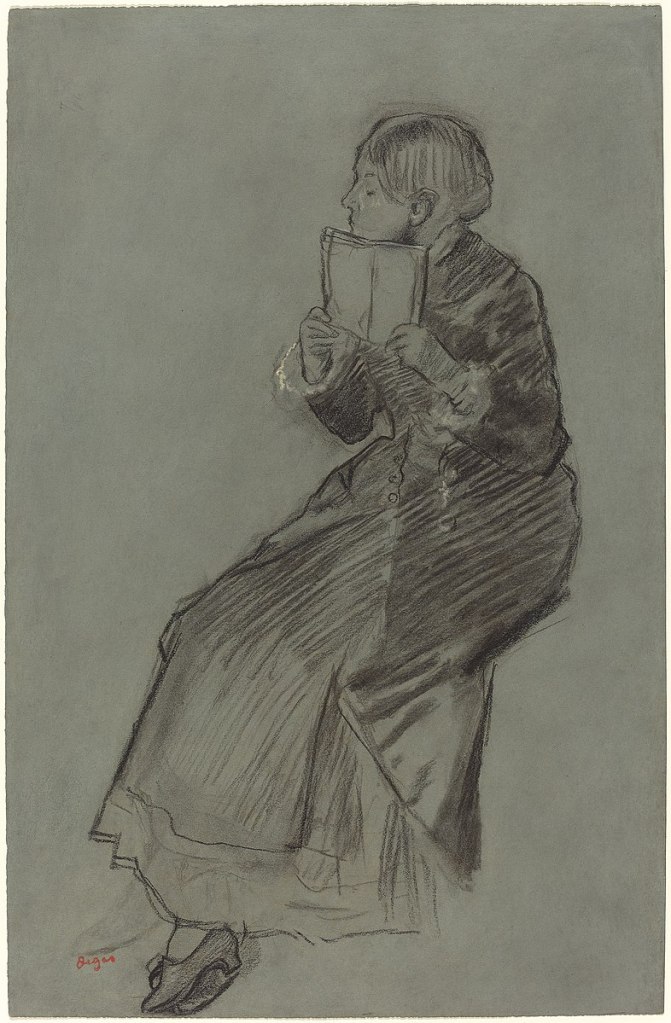
Woman Reading a Book by Edgar Degas circa 1879. Courtesy: Creative commons
Indulgence 

Confidences, quiet whisperings
My books talk to me
I talk to myself
In endearing tones
Pampering my desires
My little secrets.
My small pleasures
Crowd around me
My sorrows nestle close
There is a smell of togetherness
That could, perhaps, be equalled
To a fond embrace, familiar
Now stowed away into the 
Deeper channels of my mind.
There are places, which 
Give me warmth
There are colours, which
Remind me of moods
There are fragrances, which
Remind me of moments that are memorable. 

     
In Silence

Poetry speaks to her in silence
In absolute silence,
When, even the noises, 
That clutter and clog 
Her senses, and her mind, 
Are all quiet, and ready to listen 
Like the faithful student, all obedient.
Poetry then, speaks to her --
Unburdening, one by one, 
All her disquiet.
Its music, the starkness of plain truth 
Appeal to her, in solitude. 
Poetry speaks to her in silence. 

  Dr. Anasuya Bhar is an academic teaching English literature in St. Paul’s Cathedral Mission College, Kolkata, India. She would also want to be known as a poet.

.

PLEASE NOTE: ARTICLES CAN ONLY BE REPRODUCED IN OTHER SITES WITH DUE ACKNOWLEDGEMENT TO BORDERLESS JOURNAL