Categories
Review

Growing up Jewish in India

Book review by Bhaskar Parichha

Title: Growing up Jewish in India: Synagogues, Customs, and Communities from the Bene Israel to the Art of Siona Benjamin

Editor: Ori Z. Soltes 

Publisher: Niyogi Books

This is a wonderful anthology of non-fiction on Jews in India. The gorgeously produced book offers a historical account of the primary Jewish communities, their synagogues, and unique customs. It traces how Jews arrived in the vast subcontinent at different times from different places, both inhabiting diverse locations within the larger Indian community, and ultimately creating a diaspora within the larger Jewish diaspora by relocating to other countries, particularly Israel and the United States.

Edited by Ori Z. Soltes, who teaches art history, theology, philosophy and political history at Georgetown University and who is also a former Director of the B’nai B’rith Klutznick National Jewish Museum having curated more than 85 exhibitions on history, ethnography and modern and contemporary art, this book gives a veritable account of the Indian Jews who have retained their distinctive physiognomies. He shows Jews have been integrated into the larger Indian diaspora because of their receptive, flexible and inimitable traits.

The text and its rich complement of more than 150 images explore how Indian Jews retained their unique characteristics despite being well-integrated into the larger diaspora of Indians and have continued to offer a synthesis of cultural qualities wherever they reside. Understandably, the editor Ori Z. Soltes, contends not many communities feel a sense of belonging with two countries they view as their own — the Jews call India their motherland, and Israel, their fatherland.

The Bene Israel Jews are the largest Jewish Indian community and there are a number of theories regarding the timing of their arrival on the western coast, some dating back to the reign of King Solomon, 3,000 years ago. Another theory is that they were part of the lost 10 tribes that disappeared from north Israel and from history in the aftermath of the conquest of the Israelite kingdom by the Neo-Assyrian Empire. And there are other theories too on which Soltes elaborates to bring clarity to the matter.

The book has an elaborate discussion on the unique art of Siona Benjamin, who grew up in the Bene Israel community of Mumbai and then moved to the US. Her work reflects Indian and Jewish influences as well as concepts like tikkun olam (Hebrew for ‘repairing the world’).

In a sense, the book is a memoir on growing up Jewish in India with essays on Siona’s Fulbright work in India and Israel, plus her other series of works. It offers a portrait of a unique slice of the Indian world for readers interested in history, art, religion, and culture, worldwide.

In combining discussions of the Indian Jewish communities with Benjamin’s own story and an analysis of her artistic output, this volume offers a unique verbal and visual portrait of a significant slice of Indian and Jewish culture and tradition.

The book begins on an existent note: “Indian Jews have historically lived across diverse parts of the Indian subcontinent over the centuries without experiencing the sort of anti-Semitism that has been so common in many other parts of the world, particularly Christian Europe, which exported its anti-Jewish sensibilities into the Muslim world eventually, particularly in the context of European colonialism and post-colonialism in the Middle East, culminating with World War I and its aftermath. Indeed, the most obvious exception to the rule of Jewish experience in India arrived with the control of Goa in the early 16th century by the Portuguese, who brought with them not only anti-Jewish feelings, but the specifics associated with the development of the Spanish and Portuguese Inquisition that would affect New Christians suspected of secretly continuing to practice Judaism-and continue until the formal abolition of the Inquisition authority in 1812.”

The introductory chapter throws light on the non-violence Hindu culture in India which allowed Jews to live in harmony with other communities as opposed to European countries: “The general lack of hostility and persecution may be understood in part as a cultural phenomenon, but also as a function of the nature of Hinduism, by far the dominant religion across India, and its embrace of diverse perspectives regarding how, specifically, one might understand and address divinity. Within the singularity of Brahman-Being-what we term ‘Hinduism’ recognises a nearly infinite possibility for divine manifestations: Brahma, Vishnu, Shiva, Devi, Krishna (and many other more minor figures) are both separate from each other and all understood to be part of each other and subsumed into a singularity that is Brahman.”

It further contends that India is as diverse with religions as it is linguistically. It is, as most people are aware, the country in which Hinduism was born, in fact the word ‘Hindu’ refers to the place, India, not to the form of faith. According to the author, “Hinduism’ is also a misnomer in being used as if there is a monolithic form of faith that goes by that name, just as it is often misunderstood to be polytheistic: there are, after all, any number of gods and goddesses, it would seem, that occupy its pantheon. In truth, (to repeat), an Indian who is part of this spiritual tradition understands all of these ‘gods’ and ‘goddesses’ to be particularised manifestations of a single god of Being.”

What is Hinduism? Soltes argues: “Hinduism’ may be understood by Westerners as a more complex version, in a sense, of Christianity in its understanding of God as triune, for instead of a threefold, Father/Son/Holy Spirit Godhead, ‘Hinduism’ offers a poly-une Brahman (Being) expressed as Brahma, Vishnu, Siva, Devi, and others. So, one is typically a Saivite, say, or a Vaishnavite, believing that Siva or Vishnu represents the consummate expression of God, but embracing the legitimacy of other expressions, as well. Moreover, among the 10 avatars assumed by Vishnu over history, one of them is as a dark-skinned (blue or black) anthropomorphic, Krishna, and over time, a growing community of Krishna’s followers or Krishnaites views him as the consummate manifestation of God-not as an avatar of Vishnu: on the contrary, Vishnu is viewed as a manifestation of Krishna.”

The book has in all six chapters with a foreword by Ralphy Jhirad. There’s a chapter on Kerala synagogues by Orna Eliyahu-Oron and Barbara C. Johnson; another on the synagogues of Calcutta Baghdadi Jews by Jael Silliman. Silliman weaves her narrative around the three synagogues of Baghdadi Jews of Calcutta, giving deep insights into the lives of the city’s Jewish community whose numbers have dwindled from 4,500-odd in the mid-20th century to 700 or so in the 1970s and about 20 now. Benjamin writes a memoir, ‘How I Turned Blue and Other Stories I Remember Growing up Jewish in India’.

 Benjamin’s piece gives a snapshot of the life of a diasporic Jew. She writes about her grandmother Elizabeth’s long and interesting life journey. Born in Quetta in Pakistan, Elizabeth’s family later migrated to India’s west coast. Her children dispersed to Asia, Africa and North America, perpetuating the idea of the diasporic Jew. The distance between the families seemed to widen with her parents in India, most of the family in Israel, a few relatives in the U.S. and Canada, and some in Africa. Soltes writes on ‘Refocus and Return’. Benjamin’s multi-layered art dots the book. Soltes also pens the epilogue on the community’s past.

The book is a must read for all as it addresses a complex issue in a rich scholarly way while making it eminently readable. It would be of interest to Jews and non-Jews, Indian and non-Indian alike, as well as to history enthusiasts and the general reader interested in art and culture.

.

Bhaskar Parichha is a journalist and author of UnbiasedNo Strings Attached: Writings on Odisha and Biju Patnaik – A Political Biography. He lives in Bhubaneswar and writes bilingually. Besides writing for newspapers, he also reviews books on various media platforms.

.

PLEASE NOTE: ARTICLES CAN ONLY BE REPRODUCED IN OTHER SITES WITH DUE ACKNOWLEDGEMENT TO BORDERLESS JOURNAL

Categories
Musings

Breaking the Fast

By P Ravi Shankar

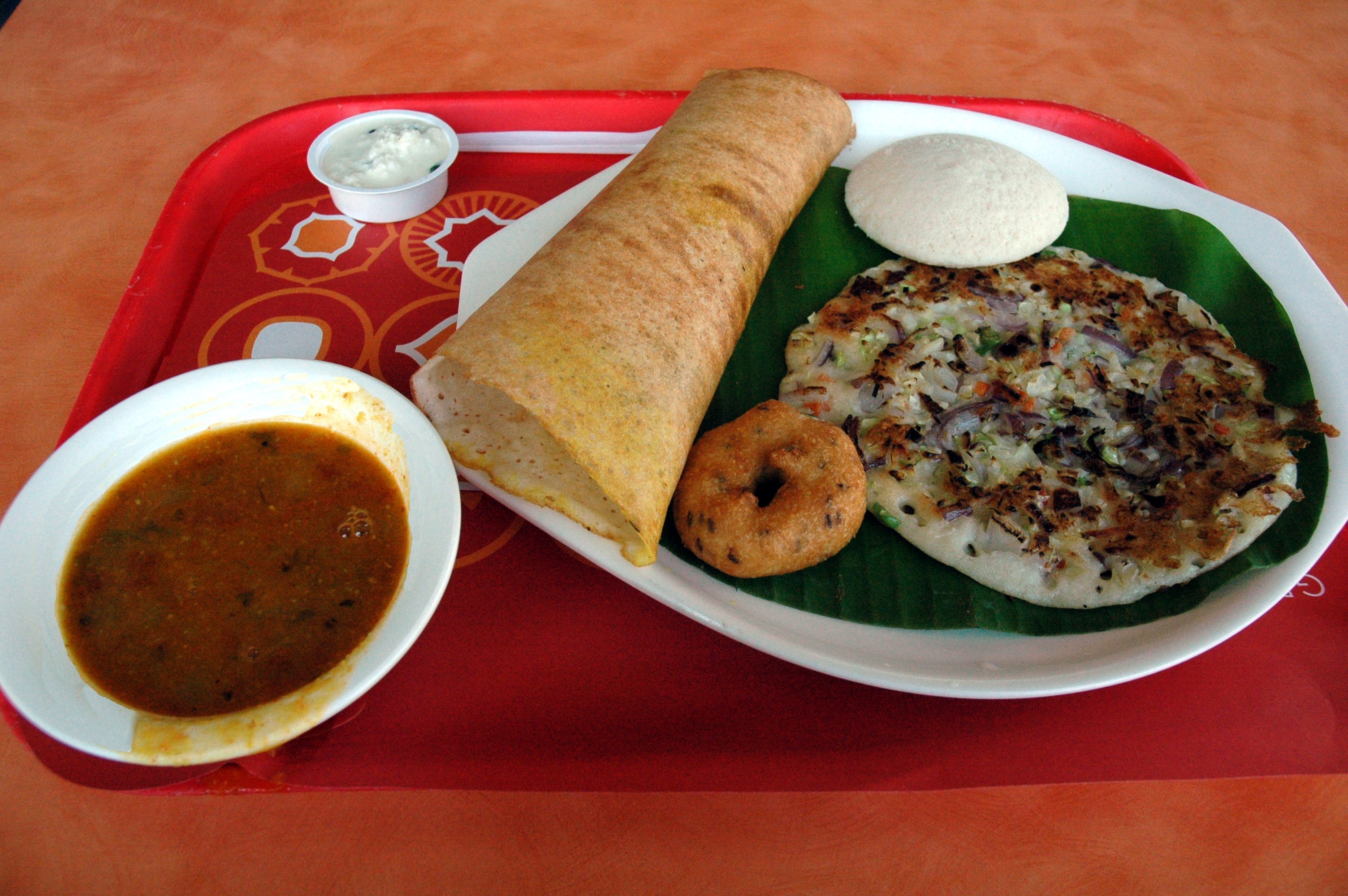
The dosa was perfect! Crisp, thin and a rich golden brown. A beautiful symphony of flavours with the green chilli and the red chilli chutneys and the spicy, aromatic sambar. I was enjoying the breakfast buffet at a hotel in Coimbatore, known as the Manchester of South India. A major manufacturing centre located at the foothills of the Western ghats, Coimbatore (also known as Kovai) is the second biggest city in the southern Indian state of Tamil Nadu.  

I enjoy a hearty breakfast. I admit I am partial toward South Indian fare. I absolutely love dosais, and upma. I enjoy crispy medu vadas. Appam and coconut stew is a duet made in heaven. Panizhayaram is Tamil delicacy along with Pongal. I am not very fond of idlis, however. The breakfast buffets in Kovai are superb. I believe and many agree that Kovai combines the best of Tamil Nadu and Kerala. I also enjoy the wide variety of dishes in an American breakfast ranging from toast, eggs in different forms, porridge, cereal, hash browns, bacon, and sausage. All washed down with juices and coffee and tea. A variety of breads are available, especially in Europe. Pancakes are also delicious, especially with maple syrup. Many hotels in the United States do not serve a continental breakfast, however. A few hotels in Kovai offer you both South Indian and western breakfast choices.

As with most other beliefs created in today’s information overload, the role and status ofbreakfast has become confusing. The traditional advice was to never skip breakfast as it was the most important meal of the day. In today’s world, as prolonged periods of fasting and the requirement to have stretches of time with low blood sugar levels have gained footage, some began skipping breakfast and moved directly to lunch. Traditionally humans had their last meal of the day at sundown. A long period of fasting till breakfast, the next morning, was a natural outcome. With the advent of artificial lighting, the time of dinner was steadily pushed back.

In Nepal most people do not have a big breakfast. They usually have tea and biscuits and sit down for a big lunch at ten or even earlier in the morning. Different breakfast snacks are available in the Kathmandu valley. The trekking lodges in Nepal do offer breakfast on their menu to cater to western trekkers. The hotels in Kathmandu and other tourist towns also offer a variety of choices. In the plains bordering northern India, breakfast is usually north Indian fare. When I trek, my breakfast of choice is usually muesli with milk. This is filling and provides both instant and slow-release energy and keeps me going for a few hours. It is said to have been developed around 1900 by a Swiss physician, Maximilian Bircher-Benner for patients in his hospital. The major problem with muesli is that it is dry and requires effort and copious amounts of milk to wash down. Cornbread and toast sometimes find their way into the menu. Nepalese cooks are ingenious and dishes like Swiss rosti are also available. In the Everest region, potato pancakes are dominant though they may not be available for breakfast as they take long to prepare.  

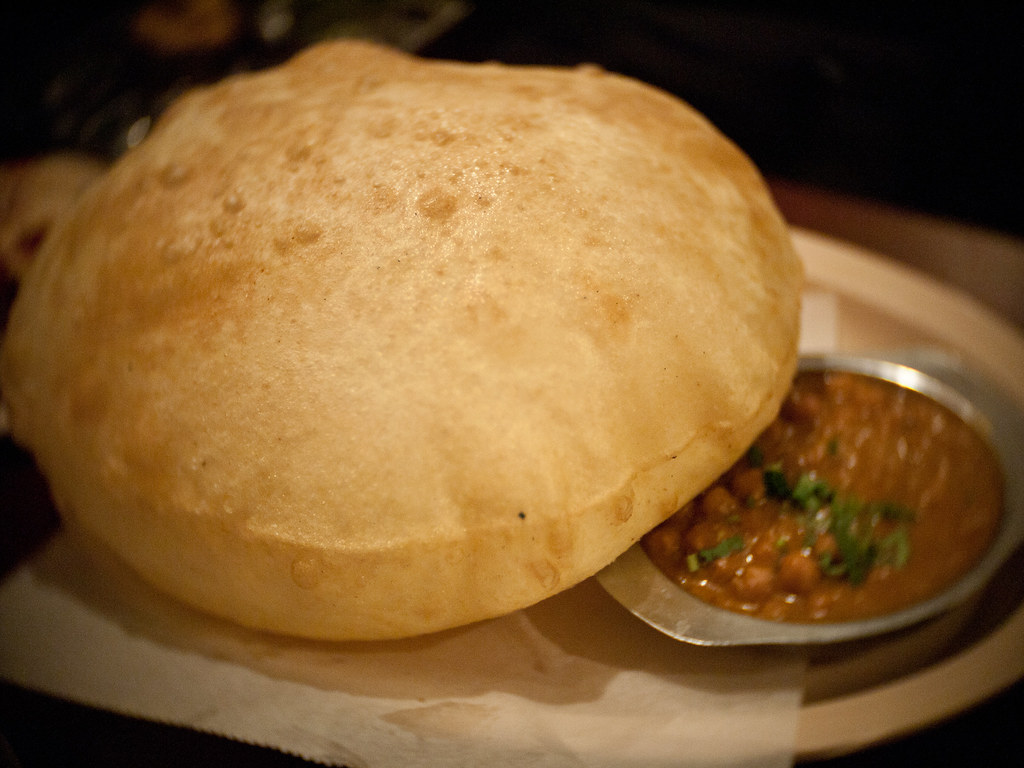
North India has a variety of filling breakfasts. Chana bhatura is filling though oily and most bus stations and train stations in the north will have breakfast stalls with such fare. Piping hot pooris are a perennial favorite. When I was working in Nepal, I sometimes used to travel through the eastern Uttar Pradesh town of Gorakhpur. The stuffed parathas are a delight to the palate and are filling. They can be made with aloo (potatoes), radish, cauliflower and even with finely minced meat. Having these piping hot with a dollop of clarified butter on a chilly winter morning is a pure joy. The lower canteen at PGI (Post Graduate Institute), Chandigarh, serves delicious aloo parathas. Kachoris are also eaten for breakfast along with jalebis. Samosas could make a hearty breakfast along with chole. Punjabi samosas are huge and filling and the stalls in the market at Punjab University in Sector 11 in Chandigarh has some of the best samosas I have eaten.

Many cultures may have independently discovered the nutritional benefits of combining cereals and pulses. Considering the lack of knowledge about nutrients and nutrient quality in those days, this was a significant achievement. The combination can be samosas and chickpeas, idlis/dosas and sambar, baked beans and bread, and so forth. Breakfast should provide immediate energy to get you going and slowly release sugars to continue to provide energy. Eggs provide high quality proteins and are an important part of the western breakfast. Meats are also eaten in many parts of the globe.

In Malaysia, noodles of different varieties are eaten for breakfast. Nasi lemak (rice cooked in coconut milk) is also a perennial favourite though I do struggle to eat rice early in the morning. Our breakfast habits are an acquired taste heavily influenced by our childhood. South Indian foods like thosai, idlis, upma, vada and Pongal are also available attesting to the multicultural diversity of the country. Breakfast can be creative in Kerala, God’s own country at the southern tip of India and considered one of the best breakfasts in the world. Among the highlights are appam with different vegetarian and non-vegetarian curries, puttu with black gram curry or puttu with small bananas. Puttu is made of steamed rice flour and grated coconut and can be dry hence requiring curry or bananas for lubrication.

Cultures globally have created a variety of rich and delicious foods for breakfast. There are similarities in the use of leavened or unleavened bread (in different forms and shapes), a combination of grains and pulses, eggs, fruits and tea or coffee. Many have fruit juices for breakfast. After the long overnight fast, getting your sugar levels up again and providing you with the energy resources to get through a long and challenging day is important. At Kuala Lumpur, I usually have my breakfast at the Shirdi Sai canteen at the university. I usually have dosas or upma and sometimes I have uthappams. They also make delicious pooris in the great Tamil tradition served with hot and filling yellow potato curry. Starting your day on a full stomach will surely make you happy, healthy, and wise and if you are lucky, even wealthy.            

.

Dr. P Ravi Shankar is a faculty member at the IMU Centre for Education (ICE), International Medical University, Kuala Lumpur, Malaysia. He enjoys traveling and is a creative writer and photographer.

.

PLEASE NOTE: ARTICLES CAN ONLY BE REPRODUCED IN OTHER SITES WITH DUE ACKNOWLEDGEMENT TO BORDERLESS JOURNAL
Categories
Poetry

Stuck

By Moonmoon Chowdhury

STUCK

For eons, I’ve been shrinking in this chamber, 
Buried under the putrid odor of mothballs.
Memories with forty tentacles and a thousand paws
Gnaw at my flaccid heart as the dirge crescendos.
The sedatives don’t palliate my elephantine pain no more.

The yesteryears trickle in  through the translucent drapery,
And hover over the crinkled bed that houses the threadbare me.
The potpourri of corroded dreams, lost friends, winding paths, 
Whirr and scatter even as my splintered spirit craves 
A break from the begrimed monochrome.

I’ve tried opening the window to trap the rays of the Sun, 
But there’s been a total eclipse, for days on end.
They prescribe self-help books, and cultivating hobbies,
And chide me for my perfect inability to invoke beauty.  
Alas! they don’t see the multiplying moulds and the dead end,
And how I circle back to square one, again and again.
  

Moonmoon Chowdhury is an aspiring poetess and writer. Her poems and stories have been published in twelve anthologies, available on Amazon. She is currently based in Amsterdam, Netherlands.

Categories
Poetry

Parlour Room Gossip

By Ryan Quinn Flanagan

THE SKY AND THE NO SKY SPILLING STARS LIKE PARLOUR ROOM GOSSIP

Had this dream where they lined those powdered doughnut horses up
for general inspection.  Whipped a few of the more wilful into snorting 
sidestep position.  Then I stepped away and found myself on some old 
train tarmac looking for my luggage.  The conductor with a whistle 
all the dogs could hear seemed eager to leave.  The sky threatening to rain 
while distant muggers threatened everything else, I was sure of it.  My luggage
lost as I was.  The neighing man beside me pretending to be some horse
in evening dress.  That way I stared would have made anyone else
most uncomfortable.  Fingering that punched ticket hole in my pocket.
The sky and the no sky spilling stars like parlour room gossip.  Some coal 
in the stocking woman running for a one puff train eternally in the black
and looking to make its well-teased bustier run for the hills.

Ryan Quinn Flanagan is a Canadian-born author residing in Elliot Lake, Ontario, Canada with his wife and many bears that rifle through his garbage.  His work can be found both in print and online in such places as: Evergreen Review, The New York Quarterly, Borderless Journal, GloMag, Red Fez, and The Oklahoma Review

.

.

PLEASE NOTE: ARTICLES CAN ONLY BE REPRODUCED IN OTHER SITES WITH DUE ACKNOWLEDGEMENT TO BORDERLESS JOURNAL

Categories
Notes from Japan

Bridging Cultures Through Music

Suzanne Kamata brings to us people, experiences and cultures from Japan

Masaki Nakagawa. Photo provided by Suzanne Kamata

For Kobe native and YouTube sensation, Masaki Nakagawa, a university trip to Latvia turned out to be a life-changing experience.

Nakagawa was a student of international culture in the Integrated Arts and Sciences Department at Tokushima University. By his own admission, he wasn’t a great student – his TOEIC (Test of English for International Communication) score was around 200 – but he had an avid interest in other cultures. He first studied abroad in Korea, where he improved his English language skills, and later, in 2014, went with a Tokushima University professor to Riga for a summer seminar. He felt an immediate connection with the small, European country.

“I felt like this is the country I will live in in my future,” he says via webcam. From the very beginning, he loved the people, the language, the atmosphere, the many historical buildings, the food, and the drinks.

“Someone told me that maybe I was Latvian in a past life,” he jokes.

Although the university did not have an official exchange program with any Latvian university at that time, he decided that he would go there for foreign study. During his seven months abroad as a student at the University of Latvia, he discovered that while most Latvians knew quite a bit about Japan, few Japanese people had any idea about them. He made it his goal to create more links between the two countries. Kobe is already the sister city of Riga, but he created a project to promote a sister city relationship between Tokushima and Jelgava, which is ongoing.

From a young age, Nakagawa has also been a musician. His mother was a piano teacher, so naturally he began playing the piano at the age of three. However, when he was fourteen-years-old, he bought his first guitar. “I still have it,” he says. “It is my important thing.” In high school, he played guitar and sang vocals in a band.

During his visit to Latvia, he discovered the importance of music in that country. “Latvia is a musical country,” he says. “They love dancing with music, eating with nice music. The Latvian language is quite beautiful, and Latvian songs are very, very beautiful.” He also found that singing in Latvian was an effective way to study.

After graduating from university, he got a job at Mercedes, where he continues to work as a store manager, however his passion for Latvia remained. He decided to combine his loves for Latvia and music. “As a musician, I can connect countries,” he says.

In 2017, he learned “Mana dziesma” (“My song”), which was originally performed by Brainstorm, one Latvia’s most famous bands, and made a recording of himself singing it while playing the guitar. Then, he uploaded it to YouTube. The video received an astonishing 150,000 views. Nakagawa realized that he was onto something, and he continued to record and upload videos.

In some videos, he sings in Latvian against a Japanese background, such as along a river in Kyoto. In others, he sings in a combination of Latvian and Japanese in a Latvian setting. Recently, he has begun to add Japanese subtitles. While he continues to record Latvian favorites, he has also written and recorded original songs in both languages.

His popularity has continued to grow, leading to interviews in magazines, on the radio, and on Latvian television. By his estimate, he has appeared on television in that country “twenty or thirty times.”

When asked if he is perhaps the most famous Japanese person in Latvia, he laughs. “Maybe.”

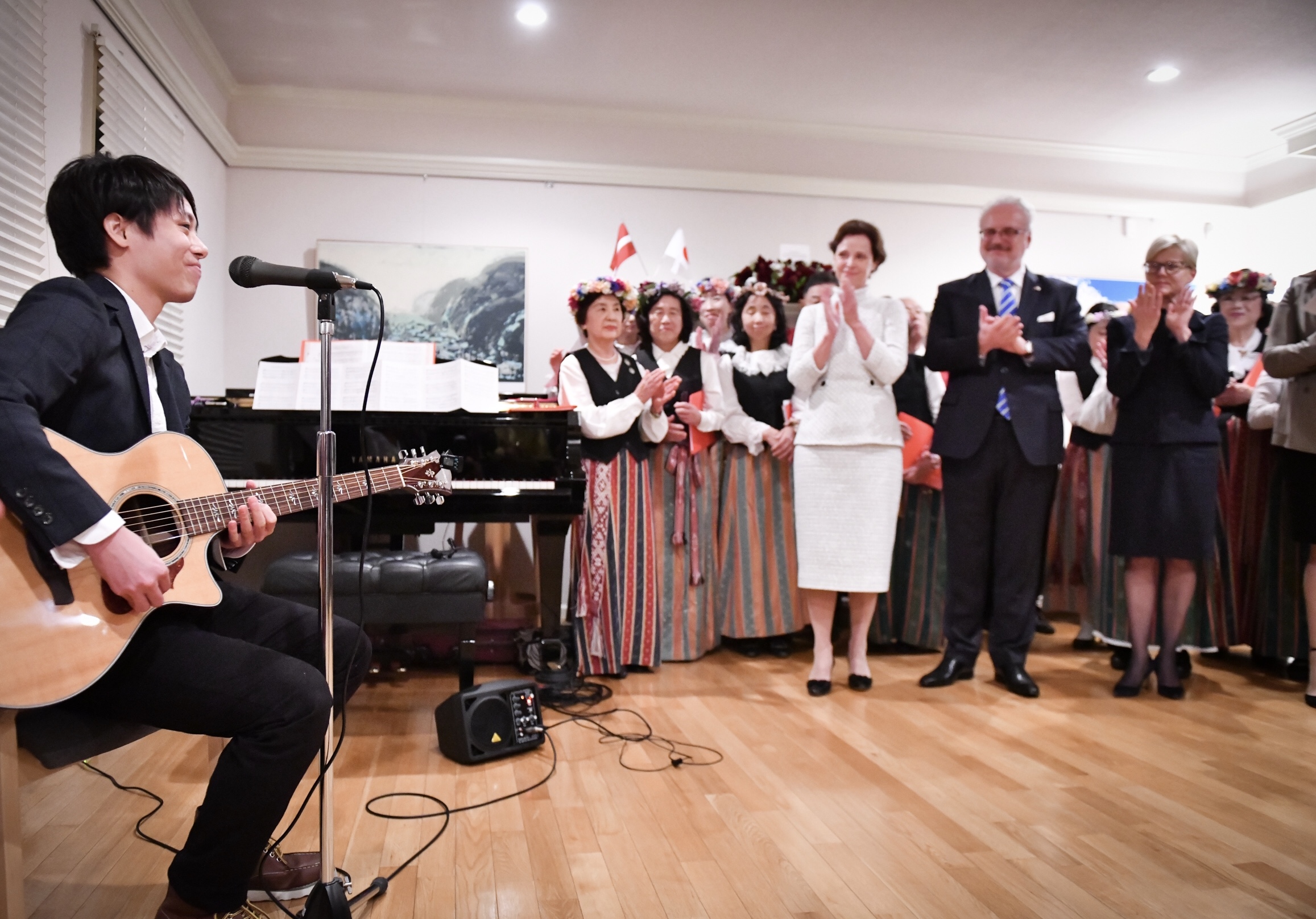
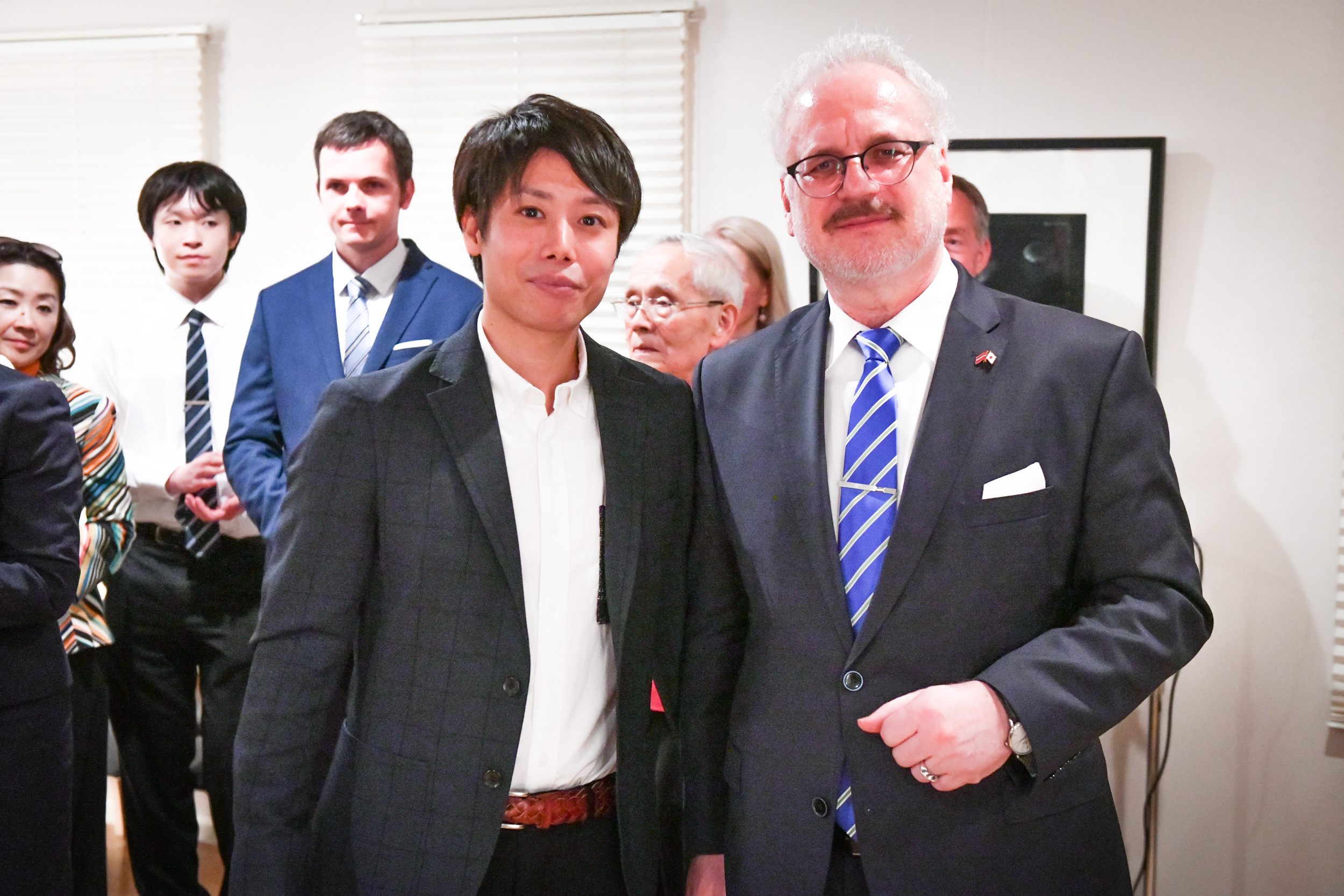
When the president of Latvia visited Japan for the coronation of the new emperor, Nakagawa was invited to perform at a closed reception at the Latvian Embassy in Tokyo. He had a chance to talk to the president and the first lady, who, as it turned out, was a big fan.

His most recent TV appearance, via Zoom, marked the occasion of his one millionth view on YouTube, the 100th year of Latvian-Japanese friendship, and of his latest single, “Es Lepojos Ar Tevi,” recorded with German musician Joran Steinhauer, another lover of Latvia. A few years ago, the two friends collaborated on a YouTube series called “Masaki Learns Latvian” in which Steinhauer taught Nakagawa two or three phrases per episode. “Es lepojos ar tevi”, which means “I’m proud of you,” is the first phrase that Nakagawa learned. This song in Latvian, uniquely created by two foreigners, premiered on the TV show “900 Seconds” in April of this year.

Nakagawa has been branching out a bit in his musical career, writing songs for aspiring idol groups in Japan, and singing on Japanese anime soundtracks. His vocals can be heard in the theme song for the anime “Dark Hero Yoshitsune” which will be released nationwide in Japan in fall 2021. Fans can follow his activities via Instagram at https://www.instagram.com/masaki.lv/.

He maintains, however, that developing relations between Latvia and Japan is his main priority. “As a musician, I really would love for people to know about Latvian culture.”


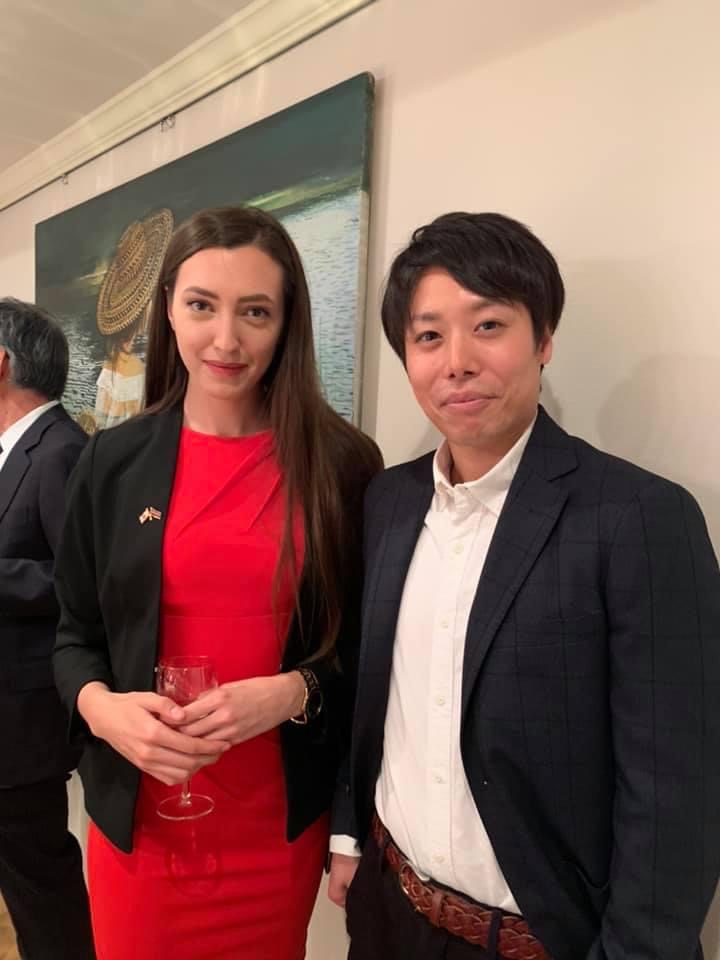
Nakagawa with his girlfriend Arta Voicehovska, who works as Coordinator for International Relations Latvia-Japan at Higashikawa Town Hall in Hokkaido

Suzanne Kamata was born and raised in Grand Haven, Michigan. She now lives in Japan with her husband and two children. Her short stories, essays, articles and book reviews have appeared in over 100 publications. Her work has been nominated for the Pushcart Prize five times, and received a Special Mention in 2006. She is also a two-time winner of the All Nippon Airways/Wingspan Fiction Contest, winner of the Paris Book Festival, and winner of a SCBWI Magazine Merit Award.

.

PLEASE NOTE: ARTICLES CAN ONLY BE REPRODUCED IN OTHER SITES WITH DUE ACKNOWLEDGEMENT TO BORDERLESS JOURNAL
Categories
Stories

Dear Dr Chilli…

By Maliha Iqbal

Courtesy: Creative Commons

Although she could say her madness had begun when she first wrote to Dr. Chilli, but somewhere deep inside her, in a tiny dark crevice, sparked an unintelligible force. This force melted the hard glitter of her eyes till they were like luminous ponds in the heart of a wild forest where all was quiet; ponds in which autumn leaves floated without causing even a shadow of a ripple. Tears flowed down her cheeks.  Now the pond had become like a river that refused to stop even as it tore through rocks and Earth. This force had always existed in her, it existed in everyone but remained dormant in most.

She knew she had to stop. Angrily, she beat her forehead with her sweaty, hot palms. Blows that dulled her, as though each was a hypodermic injecting an exhausted numbness in her. The sound of her own crying came from far away like the soundtrack of a movie in slow motion, like distant bombs exploding, like the ringing of an alarm clock heard through the haze of a dream. That’s what it probably was– a dream. It couldn’t be real. In her world, reality was harsher.

She heard the groaning of her school bus and decided that she was awake after all. The day had just begun. It would get harsher.

*

Ankita got into the bus and sat down in a corner. Her face had faint streaks where tears had flown not so long ago, like the snowy white path left behind by a flying airplane. As they reached the next stop, she stared out of the window. A girl came running out the house and into the bus. She was grinning. A grin that was confident. Perhaps cheerful too but that was difficult to say. It was as though happiness spread everywhere but shied away just when it reached the eye.

She sat down next to Ankita.
“Hi, all prepared?”

Ankita stared at her best friend, Nita and a thought flashed through her. My best friend is Mona Lisa. She made herself smile, stretching her skin so it became plasticky and the somewhat synthetic glitter returned to her eyes.

“Yes, hope today’s class test goes well.”

The girls chatted until the gates of the school appeared.

*

After school Ankita and Nita returned home. They had a quick lunch and then went off to their coaching center. They went to the same coaching institute, travelling together.

On the way, Ankita kept staring at Nita. Something she had said earlier in school had amazed her. Not shocked her or angered her, not even disgusted her but made her wonder. Curious. Something that she never was nowadays. Nita had airily remarked that she had imagined tenth grade would be very difficult and yet it was easier than her expectations. Was it now? Really? She thought about her routine. Wake up at six in the morning, get ready for school and study till seven thirty. Then school and back home at one in the afternoon, lunch and then get ready for coaching. She went to coaching to prepare for NTSE (National Talent Search Exam), her upcoming board exams as well as for various entrance exams. Returning home at seven in the evening, she completed all her homework by nine and was free to enjoy herself until twelve when she went to bed. 

She hadn’t ever complained but lately something had happened to her. All because of Dr. Chilli.

When she had walked into class this morning, two of her classmates had remarked cheerfully that she wouldn’t be worried about the class test of course since she was the topper. Ankita had said nothing. Yes, her class test had gone well. Yes, she loved being the topper but no, she had worried! Right up to the last minute.

This thing about being the topper worried her too. No doubt she loved it, but she knew that it was more difficult to stay at the top than to reach it. She had seen so many toppers deteriorate. Her own best friend was her main competition right now. If only her percentage was higher than Nita in the upcoming boards. Even 0.5 percent higher than Nita would make her feel elated.

She knew Nita must be studying more than her. Why had God made her, Ankita, so dumb? She couldn’t really be good. Not ever.

“Why are you looking so worried?”

Nita was staring anxiously at her.

“Oh no, nothing. I am okay.”

“Look! There’s a new poster for our coaching institute.” Nita pointed at a huge billboard. Ankita stared at a dazzling new poster with the pictures of grim faced, God-like toppers of earlier years staring down. Below was written, “You could be the next one! Excellence in Learning. Experienced Educators. Join now.”

She repeated Nita’s words in her mind. ‘Our coaching’, Nita had said it in a way that meant naturally, not even unusually, that they and the coaching institute went hand in hand. Where there was coaching, there was Ankita and Nita. It was something essential in their life, like the heart or the brain. It had always been ‘ourcoaching’, said in a single quick breath with no space in between the words and she had never really noticed it. 

She thought about what was written. Yes, the teachers were very experienced in her institute. Take Mr Sharma who taught physics. He had a formidable experience of eight years in Kota, and he kept complaining about the low quality of things in Delhi. The students worked harder there, put in more hours, slept lesser. When he talked about his Kota days Ankita stared at the faces of her classmates, their eyes shone, and she could clearly read the desire in them. The desire to be hung up on a billboard, staring down on the world. At those times, she had felt that desire too but now she only felt like laughing at them.

The poster was too small. They were crazy if they thought they could all ever fit in it.

*

“Are you okay?”
“Yes, yes. I am fine.”
“Ankita, you talk so little nowadays, and you look worried.”

Ankita stared at Nita’s concerned face. She smiled synthetically, feeling her palms sweat.

“Trust me. It’s just that the board exams are only a month away. It’s the stress.”

“Don’t be worried! Remember what our principal said — just think of it as a class test.”

Ankita thought what it would be like if this was really a class test. Well, she might worry a little less but she would still worry. Every mark mattered. Somehow, she could not think of a board exam as a class test, but it was easy enough to think of a class test as a board exam. That made her wince.

“What’s wrong?”

Ankita straightened her face quickly and said nothing.

Nita frowned and murmured, “You keep making faces… I don’t think you are well.”

“Oh, don’t keep saying that!”

Nita looked surprised and with a touch of hurt said, “I only care about you. I won’t ask you anymore.”

They were both silent for a while. Then Ankita said quickly, in a low voice,

“You don’t understand. There are too many Sharma sirs in this world, and I am so afraid of him.  I afraid of going out into that world.”

*

Ankita was at home, and it was nine-thirty in the evening. She had just finished her dinner. She lay back on the bed, the back of her neck throbbing with pain. It always ached when she studied with her head bent. She thought back to her coaching class, trying to feel inspired by Sharma sir’s words like she used to feel once upon a time but there was no rush of adrenaline through her body. She held her head in her hands, hating Dr. Chilli.

Her mind went to when she had first started all this. When she was preparing for her ninth-grade final exams, her heart had often felt crushed by a heavy weight like an iron fist squeezing the life out of her. She had not only worried about her upcoming exams but also about her tenth grade for those were the real tests. The Boards. Nita had been concerned even then. She had told her that exams were nothing to be scared about. Sometimes even she, Nita worried, but did not let that worry make a wreck of herself. Ankita had listened to Nita but shook her head slightly. Nita had then laughed and joked, “Well, then go see a psychiatrist!”

That had made both of them laugh.

“What makes you think I have enough saved to go to a high-class psychiatrist?”

“Okay then, just take a page, invent a doctor and write to him!”

They had laughed again but that night when Ankita couldn’t sleep (it was getting more difficult to sleep as the days passed), she had slipped out of bed and opened a notebook. She thought for several moments then wrote,


“Dear Doctor Sheikh Chilli,”

She smiled. Sometimes she imagined if she had just been a fool, no topper. What would life be like? She would never know but at least she could consult a psychiatrist who was a fool, one of the most famous simpletons!

That was how it had started. She now went to that notebook and picked it up flicking to the first entry. It read–

“Dear Doctor Sheikh Chilli,


I feel like I am going mad. I am angry all the time. Angry on my father, my mother, even a glass of water (I threw one down and broke it yesterday). I have always been so calm, but I don’t know what has happened… What’s really weird is that I don’t feel afraid of my results or even the exams, but I am always more afraid of what comes in between- the preparation. What kind of preparation is this? I have to mug up every word of my books, be word-perfect. I hate it. I mug up something at night and forget it in the morning. It’s all very well to say that the key to scoring good marks is reading the chapters thoroughly. Sounds intelligent. Of course, it’s not true. The text in the book should be branded in your brain to get anywhere at all.

In all my life, whenever I have had problems, I have talked to my parents. Take the time when I lost my most cherished fountain pen and cried all day. My father at once bought me a new one next day but now I really don’t know whom to confide in. My father can do nothing. My mother can do nothing. I am fighting a losing battle against a system that I haven’t yet understood clearly. Perhaps that’s why I am angry because I don’t know whom to beg for help, whom to be angry on. Perhaps that’s why I am going mad.

Sometimes when I am studying, my brain goes out of control, and it becomes so difficult to memorise even one paragraph. I feel so mad, so angry that I slap myself. It’s morbid but it is so out of my control! It seems I have to beat the words into my brain. I remember when my grandfather passed away, my grandma became hysterical with grief when she came to know of it.  She screamed and sobbed, slapping her forehead. Whom am I crying for? Is it because I know I am dying or is it because I know everyone like me is dying?

Yours,

Ankita

She read it once and with sweaty hands picked up her headphones. She listened to songs till ten when her mother came into the room.
“Ankita, I just came to remind you. Have you finished your homework?”

“Yes! Is there anything you want me to help you with?!”
“Don’t shout! This is a bad habit of yours. Whenever you have your headphones on, you think that just because you can’t hear clearly, others cannot either and you have to shout to make yourself heard.”
“Sorry.”

She smiled sheepishly. Her mother went away, and she relaxed in her bed.

She thought back to what she had read not long back. Then she had been afraid of the mugging. Now she was afraid because she wasn’t afraid. She no longer feared the mugging because she knew it was nonsense, stupid, illogical– and that’s what really frightened her. When she had finally realised the brain-deadening stupidity of it all, would she ever be able to continue as before? Now that she realised that this crazy competition was not healthy, but maddening, would she still remain the topper? Could she ever put her heart into all this and truly believe in it?

*

Ankita woke up gasping. She had a nightmare, but she couldn’t really remember what it was. Did she even have a nightmare? She wasn’t sure any longer. She sat on her bed for a long time. It was strange. She was sure something horrible had caused her to wake up. If only she could at least remember the nightmare. She was sweating badly.

Dr. Chilli would never hear from her again. She had promised herself this because if she continued writing she knew either of two things could happen- she would deteriorate or she would go mad but right now she had to do something to pass the time because she just couldn’t sleep. She opened the notebook and decided that she would write something positive, something that had been on her mind ever since the exams started to loom on the horizon.

“Dear Dr. Chilli,

‘When the Exams are Over.’  Sounds so magical, doesn’t it? I have so often thought and thought of what I would do when the exams are finally over. Finally, I am penning it down. Firstly, I would definitely take a look at those flowers by the river that I always see whenever I pass by in the school bus. They look beautiful from so far away. Imagine how nice they would be up close!

I also want to devote some time and try learning swimming. It always looks so exciting. Another important thing I would do would be to convince my parents to take me to a beach. Andaman? Kerala? Odisha? Or some foreign country? I haven’t decided but I would definitely see a beach someday. I would go to a theatre to watch a movie. I haven’t ever seen a movie in a theatre, but I hope it will be fun! There are so many other things. I could fill this notebook!”

She paused, suddenly excited by all the planning. When could she do this? Most likely after Board exams in March. No, she had her senior secondary entrance tests pretty soon after that and then the scholarship exams. There was NTSE also.

Then she also had to join coaching classes for eleventh grade. She would have free time too (she could do some of the things then), of course but what had she been thinking? Imagining everything would be over after this exam. Oh no, life was an exam. There would always be the next one. For one moment she had imagined living in the world where she had beat the system. It was fun.

She sighed and wrote the same lines several times in her notebook until she fell asleep, her face calm, no doubt thinking about the one line she had written so many times.

When the exams are over...

.

Maliha Iqbal is a student and writer based in Aligarh, India. Many of her short stories, write-ups, letters and poems have been published in magazines like Livewire (The Wire), Creativity Webzine, Histolit, Countercurrents, Freedom Review, Cafe Dissensus, Times of India, Good Morning Kashmir, Borderless Journal and Indian Periodical. 

PLEASE NOTE: ARTICLES CAN ONLY BE REPRODUCED IN OTHER SITES WITH DUE ACKNOWLEDGEMENT TO BORDERLESS JOURNAL

Categories
Poetry

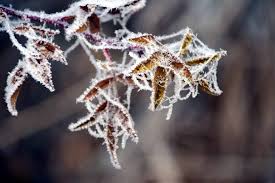
A Falling Frost at Bank House Garden

By Mike Smith

Winter has arrived. I’ve found starved robins
on the path, as pale as old barolo.
 
Hard frost has told the trees, time to let go.
Leaves fall like dead birds from the sycamores.
 
Dew-drips drop from spider threads.
We’re draped with mist,
like garden chairs out of their season.
 
From each bud’s tip as it begins to freeze,
leaf edge and pine needle, pearled globules squeeze.
 
I motionless, while winter breathes me in
and settling air around my shoulders slips.

Mike Smith lives on the edge of England where he writes occasional plays, poetry, and essays, usually on the short story form in which he writes as Brindley Hallam Dennis. His writing has been published and performed. He blogs at www.Bhdandme.wordpress.com . This poem was part of the Crichton Writers’ (Dumfries) anthology (2007).

.

PLEASE NOTE: ARTICLES CAN ONLY BE REPRODUCED IN OTHER SITES WITH DUE ACKNOWLEDGEMENT TO BORDERLESS JOURNAL

Categories
Review

Masala and Murder: Sugar & Spice & Not Everything Nice

Book review by Gracy Samjetsabam

Title: Masala and Murder

Author: Patrick Lyons

Publisher: Niyogi Books

Masala and Murder is a tantalising detective novel by Patrick Lyons, who is an Anglo-Indian writer based in Melbourne, Australia. He has had an interest in crime stories since childhood and has been writing from a very young age. His writing reflects his experience as an Anglo-Indian growing up in Australia during the 1970s and 1980s, which paves the way for Lyons to explore broader concepts of exclusiveness, racism, identity, and duality. These notions subtly sprout in his work and fortify the plot and characters in his story.

The whodunit comes in a well-packed set of 40 chapters with a prologue and an epilogue. The opening of the murder mystery is at a place called Uluru, or Ayers Rock, a scenic, sacred place for the aboriginal Australians which houses a massive sandstone monolith in the heart of the country’s arid “Red Centre”. On the fateful day, a mix of noise and silence, natural and artificial at the foot of the Uluru after sunrise await the tourists along with the Bollywood crew as they prepare to scale the famous rock. The Bollywood celebrity, Subhani Mehta, is all set to shoot a dance number on the top of the Uluru. As they reach the summit, amidst the heat and dust, the lead lady readies herself. High-pitched music plays. The camera rolls. They all move in unison. All of a sudden, Subhani Mehta gasps for air and falls. She dies in a matter of seconds.      

This makes headlines in India although it was just another crime news in Australia. Aamir Mehta, a well-to-do industrialist, and father of the dead actress, suspects foul play and approaches Samson Ryder, a private investigator in Melbourne to investigate the incident. Ryder, who was not a private investigator by choice, accepts the case for easy money. Ryder also empathises with the helplessness of Subhani’s father as he had lost his only sister and had seen his parents suffer similarly. He still carries the pangs of guilt for not having done enough to save his sibling.

An initial inquiry to Subhani’s case is dismissed as her demise is listed as a “natural death”. What had actually led to her death continues to be a puzzle as the incident was wrapped up in a hurry. Widespread corruption made way to create an easy exit for the case. Little did Ryder know that the task would lead him to unknown territories that would not only give a fair share of closure for the case but also, add to a better understanding of his messed-up work and life.   

Lyons manoeuvres the crime novel with a set of interesting characters that harmonise to make an intriguing tale. Besides the fee, Ryder’s own past and his relationship with his family make him want to bring solace to the torments of the loss of a child to a family. Cross-cultural exchanges on the aspects of beliefs, rituals, taboos, faith, and spiritualism, black magic, talisman, spirits, tantric, curses, exorcism, Kali worship, etc. in the story are ingredients of the masalas that spice the scrumptious murder mystery. Traversing inner lanes of glamour and darkness, the narrative excitingly reveals the rawness of humans in Bollywood. Lyon presents the Anglo-Indian communities in Australia and Mumbai, with more focus on food and lifestyle to create a feeling of universal belonging. Additionally, his experience as a citizen and as an NRI, ultimately shares a greater awareness of stereotypes and realities of identity.

Lyons beautifully brings up the idea of dreams in relation to our state of mind through Ryder. Themes of minority, infidelity, jealousy, ego, vengeance, depression, grieving, trauma, death threats, abuse – physical and drugs — are touched upon as the story meanders to figure out who murdered Subhani.

Was it the Singhs, Nair, Nadar or Ms. Khan, or was it just a natural death? The suspense interestingly lingers till the end. There is a tussle of love and hate, good and bad, atheism and faith, fear and strength, an exploration of identities bringing to life the duality in characters and unraveling stories within the story. That people cope with personal loss in different ways is subtly shown. Ryder’s father and his godmother, Mabel, resort to faith and worship and his mother keeps herself busier with cooking.

Lyons brings in timely wit and humour. The romantic grids with Rebecca, Ryder’s love interest, and conversations on the unfolding of the crime with Mabel are the lighter shades in the story. Through the descriptions of  traffic, lanes, scent and sights of the cities of Melbourne and Mumbai, Lyons also captivates  with  glimpses of  relatable beauty and distasteful sides of the cityscape. Throughout Ryder’s investigation that unravels as he takes taxi rides, walks, runs, making smart moves, breaking laws or flying across cities, there is not a dull moment in the novel.  

The mystery behind the murder trickles from one circumstance to another making a string of unbelievable coincidences. The protagonist advances to the core of the investigation to be stuck with the question — was it all mere coincidence or planned? With every turn of the page, suspense is in the air right from the start to the end. The plot mingles the mysteries of murder with masalas that throw light on love and loss, blatant racism, complexities of identity and belonging, tradition and beliefs across cultures, and the constant battle of good and evil that we play out as human beings. Patrick Lyons’ Masala and Murder (2021) published by Niyogi Books is a crime novel that is refreshingly told and is a compelling read with content that is contemporary and relatable. A beautiful cover design complements the thrill of the narrative.  

.

Gracy Samjetsabam is a freelance writer and copy editor. Her interest is in Indian English Writings, Comparative Literature, Gender Studies, Culture Studies, and World Literature. 

.

PLEASE NOTE: ARTICLES CAN ONLY BE REPRODUCED IN OTHER SITES WITH DUE ACKNOWLEDGEMENT TO BORDERLESS JOURNAL

Categories
Poetry

A Superpower in the Pandemic

Poem written in Korean and translated to English by Ihlwha Choi

A SUPERPOWER IN THE PANDEMIC

Looking at the colourful petals,
I walked along the road of sweet briers.

One man passing by on bike
stopped suddenly beside me and called my name.
Surprisingly, he was one of my friends from boyhood.

He  could recognise me 
despite my mask and cap!
He had an amazing ability of penetration.

I walked along the seaside near Sore fish market.
A few children were throwing cookies to seagulls.
There were full loads of fishing boats returning.

One young man passed by, came back to me
saying ,"Excuse me are you not a teacher?"
Removing masks, we confirmed each other.
He was one of my students from a decade ago.

Marvellous power of discernment!
In this severe pandemic era, people developed
Superpowers to use in real life.

Ihlwha Choi is a South Korean poet. He has published multiple poetry collections, such as Until the Time, When Our Love will Flourish, The Colour of Time, His Song and The Last Rehearsal.

.

PLEASE NOTE: ARTICLES CAN ONLY BE REPRODUCED IN OTHER SITES WITH DUE ACKNOWLEDGEMENT TO BORDERLESS JOURNAL

Categories
Stories

Eyes of the Python


Written in Tamil by S.Ramakrishnan, translated by Dr.B.Chandramouli

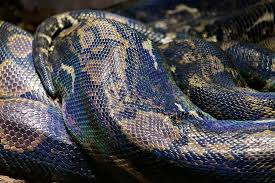
Raghav dreamed of a python again. He had never dreamed of a snake till he was thirty. But ever since he married seven months ago, the python had recurred several times in his dreams. Mirudhula was to blame.

She was fond of pythons. When she admired one, her eyes would widen as if she were swishing her tongue at a delicious gulab jamun. In confusion, he used to wonder: “What kind of woman is she?”

In the city zoo, there was a cage with an artificial tree containing a twelve-foot python. They did not know where they got it; it was the first thing they went to see as newlyweds.

“Ragav, look at its eyes. They flash with a secret. Its texture, the style of its coils, the small movements, all of it are amazing. I like it; I want to hold it in my lap,” said Mirudhula.

Ragav hid his fear and asked, “Should we go?”

“We just arrived. Why are you rushing?” she said, standing near the barrier, watching it with interest.

He could not understand what interested her.

“You know it is non-poisonous. Even at school, I got a prize for drawing a python,” said Mirudhula.

“It is still a snake,” said Ragav. She was snapping pictures with her mobile. A boy who came there hid behind his mother with closed eyes. His mother was pulling him forward, urging him to look.

Ragav left her alone and went to see the white tiger. When he returned, she was still admiring the python. He felt irritated to see her slowly licking an ice cream cone and watching the motionless python.

Young newlyweds go to the movies only. Mirudhula was not interested in the movies; in all of her 26 years, she had seen only less than ten.

“I fall asleep at the cinema,” she said. He could never fall asleep in a movie theater.

In his college days, he would watch all three new releases for Diwali and Pongal non-stop. The three movie theatres in his town changed movies twice a week. In a week he saw six movies, mostly second shows. If it was too late to go home, he would sleep on friend’s open terrace and in the morning, go to the college from straight from there.

Why did he marry a girl who disliked movies – he wondered.

 Mirudhula was a salesperson for a multinational company. She was the single daughter of a dentist. She graduated from Manipal University after attending an Ooty convent. Having worked in Italy for two years, she was fluent in four or five languages. She made 1.5 lakhs per month.

They connected on a matrimonial site. When they first met in Amethyst’s coffee shop, her perfume intoxicated him. He couldn’t take his eyes off of her black and yellow salwar-kameez.

She spoke fluently and naturally with a fake smile on her face, as if speaking to a customer. She ordered an orange ice-tea, which Ragav had never tasted.

Twice, she repeated the same question: “Are you the only offspring?”

“Yes. My father is a college professor and my mom a schoolteacher,” he replied.

“Thank God you aren’t a teacher too,” she said. He didn’t get what was funny about it but laughed politely. Her charming beauty seduced him, as one might desire decorated pineapple pieces in a five-star hotel.

She seemed to be purposefully using a seductive voice.

“May I know how much you weigh?” she asked.

No girl has ever asked him that. Feeling shy, he said, “Sixty-eight”.

“You must lose 5kg, ” she said, smiling.

While opposite her, he felt as if it was drizzling on his face.

She winked, “Do you have any other questions?”

“You are very beautiful,” said Ragav. 

“I am aware of it.”

“I am lucky,” he laughed lightly.

“I’m still deciding – have to think more. I rush nothing.” Mirudhula said, “I am different and difficult to understand.”

“Different how?”

“I don’t want to scare you off yet, but I am like that only.”

She licked her small lips as she spoke. Her lips were sexy; the upper one was slightly smaller.

‘I think I am an inch taller than you,” she said.

“Is that so?” he exclaimed. “It is not a problem.” 

“It would be a problem for me. You should wear platform shoes,” she said.

“Sure. I can do that.”

“Do you drive?” she asked.

“No, I only ride a bike.”

“I got a car as soon as I got the job and drive to work daily. I love driving.”

“That is really cool. We don’t have to use ola then,” he said.

She disliked that comment. Slowly combing her distressed hair, she munched on the orange wedge.

“Aren’t you curious about my car?”

“Sorry. I know nothing about cars.”

She teased him, “Do you walk on the road with your eyes closed?”

“I wear a helmet. I hardly notice anything else.”

While she ate a sugar cube, she regarded him quietly. Her eyes seemed to seek something in him. What was she looking for? He could not stand her scrutiny.  

She smiled. “We will meet again.”

 Her perfume lingered long after she left. Ragav picked up and tasted a sugar cube just like her.

It was the first of their three dates. After that, their families got together and arranged the wedding. Unlike traditional marriage hall weddings, theirs was a lavish affair at a beach resort. Mirudhula’s father spared no expense. They honeymooned in Hawaii. She enjoyed varied foods, including fish. Raghav craved rice.

Even when she was kissing him in bed, Mirudhula was slow and deliberate. Her kiss was emphatic. Her embrace was slow and long. Their lovemaking was urgent and refreshing, like eating ice cream in the summer.

They temporarily stayed at Mirudhula’s apartment upon returning to Chennai. Mirudhula was serious about renting a new home. She rented a flat on the top floor of a newly built apartment building with 34 floors.

Ragav said, “A first-floor flat would have been nice.”

“One must live in the highest location possible. It is nice to see the city beneath my feet,” she said.

He felt uncomfortable living so far up.  What if the lift failed? What if the balcony glass barrier cracked? Why was there so much glare in the morning? His mind bubbled with doubts, questions, and fears. But her morning routine was to stand on the balcony with the morning brew in the hand and admire the sprawling city below. The fast wind blew her hair in waves. He disliked standing on the balcony.

Mirudhula was a great cook, but she only cooked when she liked it. The other times, they catered from the hotel only. She was never late for work. Even at home, she never seemed to rest and kept moving. Ragav, however, liked to relax on the sofa after work. On Sundays, he slept until noon. Not her.  She exercised every morning. She took great care of her figure and health.

Leaving together by car, she dropped him off at the metro station and proceeded to her workplace. She never drove him to work. She often got home by 9 p.m., whereas he was back by 6 p.m.

While waiting for her, he watched television. Occasionally, he cooked for himself. All his dreams of married life were dashed in a few weeks. He felt that his life was like a book read and finished in a hurry.

One day Mirudhula fought, saying he lacked toilet etiquette. He yelled at her another day for storing Chinese food in the fridge that smelled foul. Despite the petty fights, she often surprised him with gifts. He too took her shopping every week without fail. To appease her, he ate in some restaurants that he disliked. Her poise was evident in her every action.

She had the habit of buying strange things online. She bought wall mounted blue lights for the bedroom. The rotating blue light made the room look like a pool. When she moved around in the room, it was as if in a dream.

Another time, he was busy at work when she sent him a video and texted him to watch it right away. It was a revolting scene that showed a python swallowing a baby monkey.

Angrily, he called her and demanded to know why she sent him that video.

“Did you see? The python swallows the monkey and turns, looking eerily silent…something strange…”

“Isn’t the baby monkey unfortunate?”

“Snakes eat when they’re hungry–anything wrong in that?”

“Don’t send such videos anymore. Why would I look at them?”

“I liked the video so much I watched it 30 times today. You are my better half, so I shared it with you.”

 He cut the call with “Stupid”

It was two days before they spoke again. He became more enraged when she ignored his anger.

That Sunday, she made many of his favorite dishes. She deliberately wore a silk sari. Showered him with kisses; his anger melted away.

A few days later, she told him while leaving for work, “I’ll get a package; accept it but don’t open it. I’ll open it.”

“What package?” he asked.

“Surprise” she laughed.

A guy delivered a big box, just as she said. It came from Taiwan.

Despite being curious, he did not open it, not wanting to anger her.

Unusually, she called before coming home that day: “Did the package arrive?””

“They delivered it in the afternoon itself,” he said.

“Can I get you something from McDonalds?” she asked.

Knowing she wasn’t planning to cook, he replied, “Pick it up yourself.”

She asked, “What sweet would you like?”.

“I’ve given up sweets,” he said flatly.

She cut the line by saying, “Well, we’re eating today.”

Mirudhula came home carrying two bags. One package contained food and the other sweets. Was it her birthday today? He wondered. Then he remembered her birthday was on May 8th. He could not figure out what was special about that day.

 The package she carefully unwrapped contained a rubber python folded six times. She caressed it lovingly.

“Touch it and see how soft it is”

“What is this for, Mirudhula?” he asked.

“They have included a hand pump to inflate it; please help me,” she said

He took the hand pump and inflated the rubber python through a port. He watched it slowly expand. The snake unraveled to over ten feet of smooth coils. She wore it on her shoulders and smiled.

“Come close… let us wear it together,” she said.

As he grudgingly consented, she wrapped the inflated python around his shoulder as well.

“How is it? Can you feel the silky touch?” she asked.

“It feels strangely slimy, “he said as he tried shaking it off.

“I searched online and ordered it from Taiwan for 300 dollars,” she said.

“It’s not worth it. What made you buy it? I don’t like it,” said Ragav.

“I will spend my money as I wish. You like nothing.” She said, reclining on the sofa, hugging the python. He was a bit scared to look at her. As she stroked the python’s head, she stroked it with her cheek; only its tail was dangling outside the sofa.

“Ragav, I am thrilled today. Let us celebrate.”

“What is there to celebrate?”

“You won’t understand. Even before we were married, I said I was different. You even nodded your head.”

“That doesn’t mean you should have a Python at home… who would do that?”

“This is not a true snake, just a toy.”

“Why do you need a toy?”

“Then why do you have a fish tank? You like watching fish, right? Did I question it?”

“It is not the same.”

“It is all the same. Look Ragav. Whether you like it or not — us living together means compromising on some things I like.”

“There is no such rule.”

“No problem.  I don’t need your permission, anyway.” She laughed and sat down on the couch to watch an Italian channel. When she was angry, she would speak in a foreign language and watch foreign language channels.

Ragav locked himself in his room. His anger took a long time to subside. She might even bring the rubber python to the bedroom, he thought. Luckily, she left it on the sofa. She ate alone and came to bed as if nothing had happened.

She took the python to the bathroom the next day. She rubbed soap suds on it as she played with it in the shower. The wet python dried on the balcony.

He suppressed his rage and left for the office.

In the car, Mirudhula said, “You are overreacting, it’s just a toy.” This is like you playing video games; try to understand.”

He did not reply. That day, she drove him to his office on purpose. He came home to find the dried python in the hall, left there by the maid. He was furious.

When he touched its body, it felt like a snake but with motionless eyes. The plastic tongue twitched when he pressed its head. In the mirror, his visage looked strange as he wore the snake, like she did. It was such an expensive costume. What would someone from his hometown think? What is so special about this python?

 He deflated the python. Folding the rubber shell, he cast it in the kitchen corner. It was the first thing she looked for when Mirudhula got home at 9.30 pm. Not finding it, she shouted, “What did you do with the python?”

“It is in the kitchen”

“You would have deflated it, I know.” She said, walking to the kitchen.

“Yes. It is disgusting to look at.”

“The problem is yours. What you did is inevitable; you’re a pervert.”

“I’m not perverted. Does anyone else keep a python at home?”

“I don’t care if others keep it or not. I’m not like others.”

“You are adamant.”

“Yes. I am like that only.” She said, deliberately inflating the python with the hand pump. It grew much larger than its usual size. She walked to the bedroom, lovingly hugging the python. Loud music blared. Maybe she was dancing with the python.

Ragav slept on the sofa that night. The python accompanied her to work in the morning. In the lift, an old man asked her, “Is that a rubber toy? Where do they sell it?”

“Taiwan” she said, laughing.

“I’ve seen a python in the Assamese forests,” said the old man.

She put the python in the back seat. She did not drive him to work that day. He rode to work on his bike. He could not concentrate at work. When he spoke to his mother, he told her what had transpired.  His mother asked incredulously, “A rubber snake? Why did she buy it?”

“Who knows? She is a strange type.”

His mother was shocked. “Thank goodness she did not buy a live snake”

“She might even do that. I don’t know what to do.”

He heard his mother cursing in anger. Perhaps she spoke to Mirudhula’s father. Mirudhula’s mom called her the next day.

“Why did you talk to others about our problems?” Mirudhula demanded.

“I told my mother only.”

“Are you a schoolboy to run to your mother? What do you have in your mind? Am I crazy?”

“Yes.”

“I can’t live up to your expectations, Ragav.”

“I understood it very well long ago.”

“Then you better close your eyes and ears.  If you complain again like this to my folks, I do not know what I will do.”

“Why do you torture me? You can leave if you don’t like to live with me.”

“Why should I leave? I will stay here.”

“Well, I will leave then.”

Walking to the balcony with the python, she said, “It’s your choice.”. Leaning on the barrier, she held the snake up, and it wave in the air. To express his anger, he left for work early in the morning.

He arrived home late that night. The home was empty. He didn’t bother to look for her. She did not return the next day as well. He rang her father, but his father did not pick up the phone. After three days, Mirudhula called him one afternoon. “I have decided Ragav. I am leaving”              

“It is your choice.”

“The house cost me over two lakhs. You must return it. I have informed the owner that I will vacate the home, since I have paid for the advance. You better find a new place. Our marriage was a bad dream. That is all I can say.” She hung up.

Ragav thought she’d return after her anger subsided. He couldn’t stand her stubborn behavior. He wanted to call her back and give a piece of his mind. When he called again, she did not pick up the phone.

Upon returning home that night, he discovered she had emptied the house of her clothes and belongings. But she had left behind the rubber python, which lay alone in the middle of the hall.

Why did she leave it behind? It was the root of all their problems. What was she seeking? Her wants were so weird.

He kicked the rubber snake with his foot, but even then, his rage did not fade.

To vent his anger, he trampled the snake with his feet. After deflating it, he took it to the balcony and cast it into the wind.

 Flying in the air, the snake looked beautiful indeed. 

Glossary

Gulab jamun: Indian sweets

Diwali, Pongal: Festivals

S. Ramakrishnan is an eminent Tamil writer who has won the Sahitya Akademi Award in the Tamil Language category in 2018. He has published 10 novels, 20 collections of short stories, 75 collections of essays, 15 books for children, 3 books of translation and 9 plays. He also has a collection of interviews to his credit. His short stories are noted for their modern story-telling style in Tamil and have been translated and published in English, Malayalam, Hindi, Bengali, Telugu, Kannada and French.  

Dr.Chandramouli is a retired physician.. He is fluent in English and Tamil. He has done several English to Tamil, and Tami to English. He has published some of them.

.

PLEASE NOTE: ARTICLES CAN ONLY BE REPRODUCED IN OTHER SITES WITH DUE ACKNOWLEDGEMENT TO BORDERLESS JOURNAL