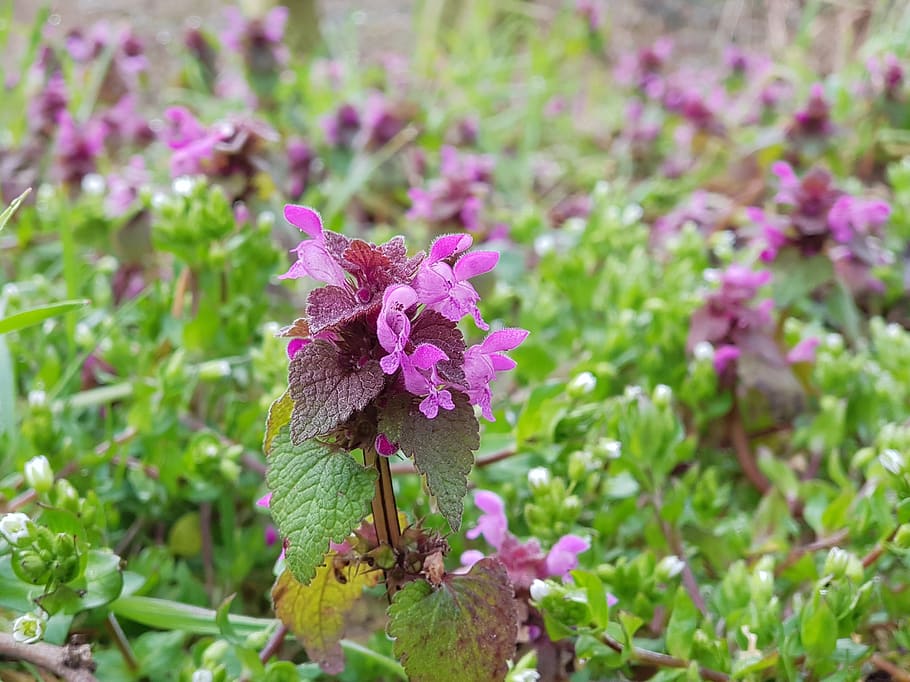
Purple Deadnettle, at the Foot of a Failing Rockface

I turn that corner, towards the galloping glue factory homestretch,
stumble upon this wild patch of purple deadnettle,
at the foot of a failing rockface, run calloused sweat fingers
down the side of fresh barber craft, hair off the neck like the oily
gallivanting gallows given a stay in the bottom of the slimy
eleventh and the UV warnings are out in numbers
like idiot storm troopers so that agoraphobia
is the new 30 –
the bugs don't bite any more than the relentless taxman
and everything leaves its mark if we are honest,
which of course we are not, so that the lie is fed and grows
large as some less than panicked Godzilla-stomped city
taken right out of the movies and given some sorry phonebook
name that anyone could call by mistake, so that fear is the crutch
of the dreaming bed head Man brought to wake.
Ryan Quinn Flanagan is a Canadian-born author residing in Elliot Lake, Ontario, Canada with his wife and many bears that rifle through his garbage. His work can be found both in print and online in such places as: Evergreen Review, The New York Quarterly, Borderless Journal, GloMag, Red Fez, and Lothlorien Poetry Journal.
PLEASE NOTE: ARTICLES CAN ONLY BE REPRODUCED IN OTHER SITES WITH DUE ACKNOWLEDGEMENT TO BORDERLESS JOURNAL
Nonsense poems consist of nonsense without choice. You may choose to read or not read them, true enough, but once you have embarked on the journey you are helpless in the rushing of the raging word-torrent. Your reading mind becomes a canoe, sturdy enough but lacking a rudder or paddle. There are no alternatives to the direction in which you are rushing. You are committed, at least as much as the writer of the poem was, and the act of abandoning the work is equivalent to throwing yourself out of the canoe, immersing yourself in the foaming liquid, scraping your soul on the submerged rocks of the dangerous passage. Your inner being will experience this, even if it appears on the surface that you have simply ceased reading a few bewildering verses.
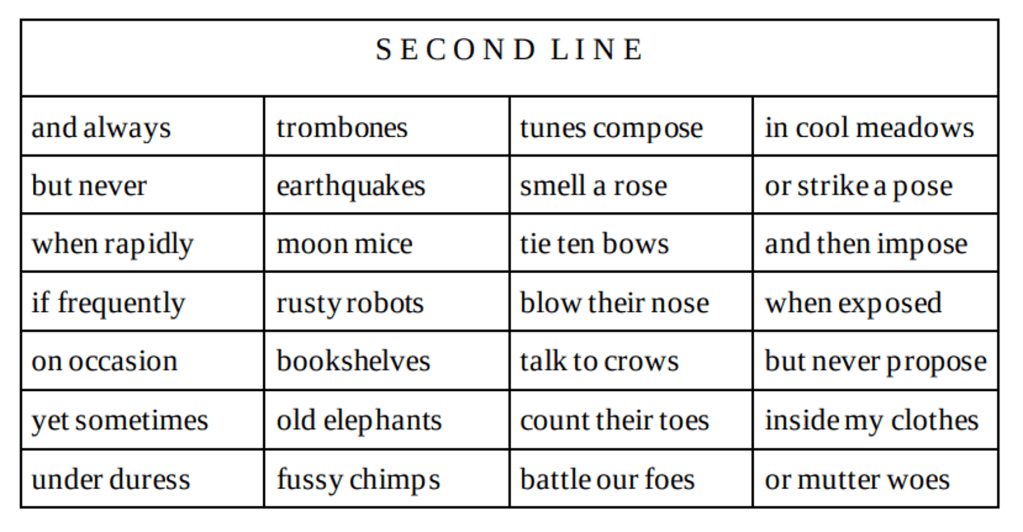
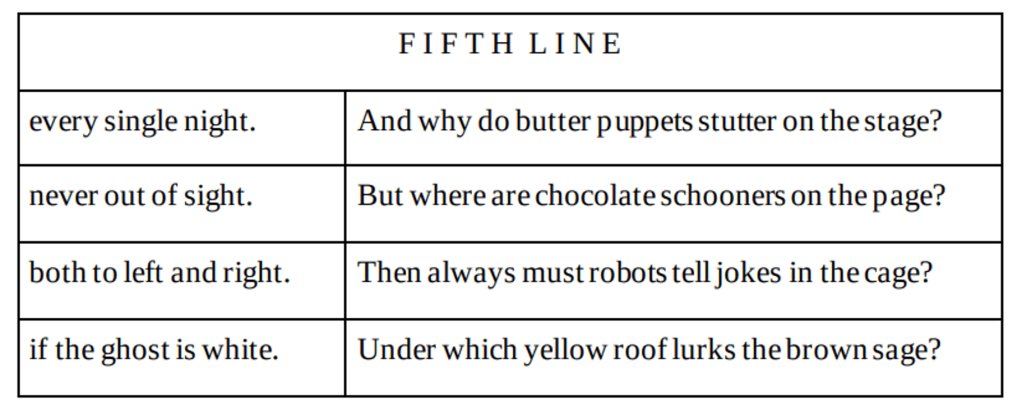
Therefore, I have decided, with some rhymes and a little reason, to create a nonsense poem that gives the reader rather more latitude in the way it develops. As an absurdist piece, the freedom of choice is limited to different meaningless outcomes, but my hope is that some of the permutations will be musical enough and sufficiently evocative to make the procedure worthwhile. The total number of combinations of lines is astronomical. This means that a reader who chooses a particular path through the poem will probably be the first to have done so. It is also likely he or she will be the last. The chances of someone else choosing the same route are vanishingly small. It can therefore be said that the poem was written entirely for you and nobody else. To navigate this ‘Do It Yourself Nonsense Poem’ simply choose a first line from the first grid, followed by a second line from the second grid, then a third line from the third grid, a fourth line from the fourth grid, and so on. There are twelve grids. The end result, if you persist, will be a twelve-line nonsense poem. It might be the case that a poem produced using this method makes some sort of sense. If this happens, I will be happy to offer you my condolences. But I think it is very unlikely a sensible poem will be found from this exercise, even if one really is hiding within the combined grids.
Among the multitude of poems that can be generated using these grids, one of them will be the best of all, and another one must be the worst, but it is simply unfeasible to work out which those are. The number of combinations is so high that the best will surely remain secret forever, and the same is true of the worst. This does not logically mean that the best is magnificent and the worst terrible. The difference between the best and worst might be very minor. But the grids are finished and I am the first reader of the work as well as its writer, so I felt entitled to find my own way through the grids. My random path led me to the following. After reading it through, my mind wanted to add the words ‘Well, wouldn’t you?’ to the end of the poem, but that is cheating. Attempts to twist nonsense into sense must be discouraged.
After cooking beans on the green platform the yeti mends a net
but never moon mice smell a rose inside my clothes
if singing a duet. The fanciest dress was bought new
thanks to rubber bones yet bedsteads gleam in smug dry streams
both to left and right. And why do butter puppets stutter on the stage?
The tangent was once unexplained, I guess, in situational anxiety
and so, aghast, four wise moons break a chair cogitating fruit.
The scholarly fruit trees rhyme badly, every day, or chatter with bees
greedily, noisily, sadly. And what of the butler? He loves all the clutter
under duress, he wonders while hissing, beautifully nonetheless.
And so the man blundered badly near a cockatoo but crystallised
and broke the cloud in the dusk to shun the vanilla fruit flies.
Rhys Hughes has lived in many countries. He graduated as an engineer but currently works as a tutor of mathematics. Since his first book was published in 1995 he has had fifty other books published and his work has been translated into ten languages.
.
PLEASE NOTE: ARTICLES CAN ONLY BE REPRODUCED IN OTHER SITES WITH DUE ACKNOWLEDGEMENT TO BORDERLESS JOURNAL
LETTER

The postman has passed by my house.
The news is out, and joy is in the air.
The letter is from my beloved mother
Who lives on the other side of the globe.

People, curious, wait outside my house,
Waiting for me to unveil the letter’s content.
Winged with cheer, I run around the house,
Ecstatic to have a letter from my mother.

Age seems to have overtaken my mother,
She cannot travel nimbly so far by a flight.
Rain is unsubdued and the wind crackles,
Yet people wait to know how she is.

Loving bonds are what connect us at heart.
Trees have lost most of their golden leaves.
Autumnal wind makes me think of heaven.
Words afloat tell me she lives no more.
Pramod Rastogi is an Emeritus Professor at the EPFL, Switzerland. He is a poet, academician, researcher, author of nine scientific books, and a former Editor-in-chief (1999-2019) of the international scientific journal “Optics and Lasers in Engineering”. He has published over ninety poems in international literary journals.
PLEASE NOTE: ARTICLES CAN ONLY BE REPRODUCED IN OTHER SITES WITH DUE ACKNOWLEDGEMENT TO BORDERLESS JOURNAL
I sipped on my cup of piping hot, sugary tea at Kardang monastery, twelve thousand feet above sea level. The chomo who prepared it chatted away the details of the snow festival that happened a few months ago. The edges of her maroon robes fluttered in the wind. ‘Chomo’ — I learned a new word that day – in Tibetan, it means a female Buddhist monk.
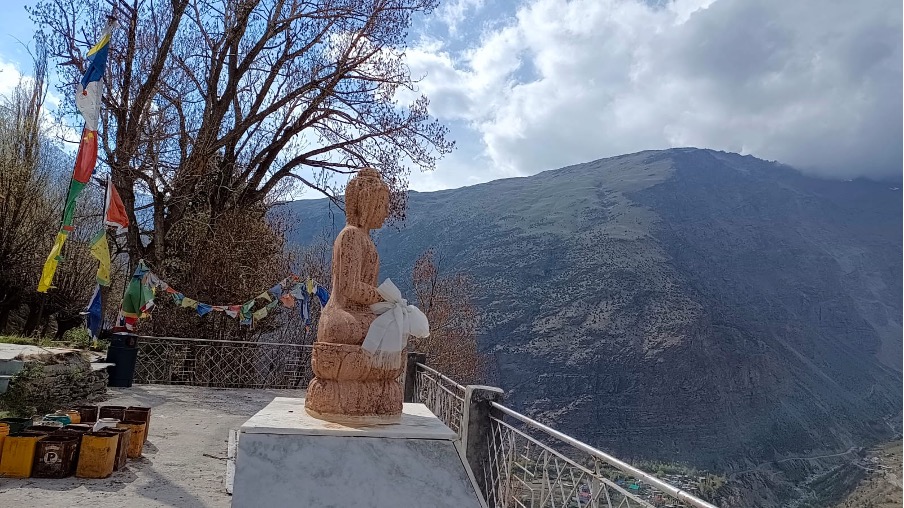
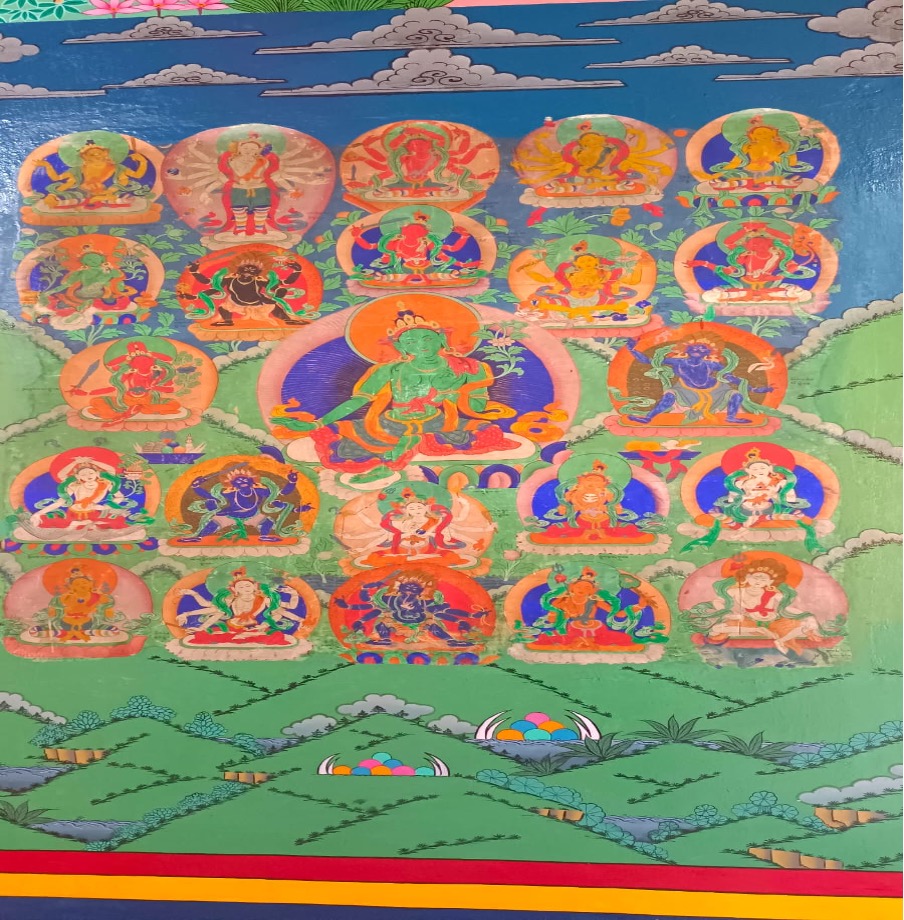
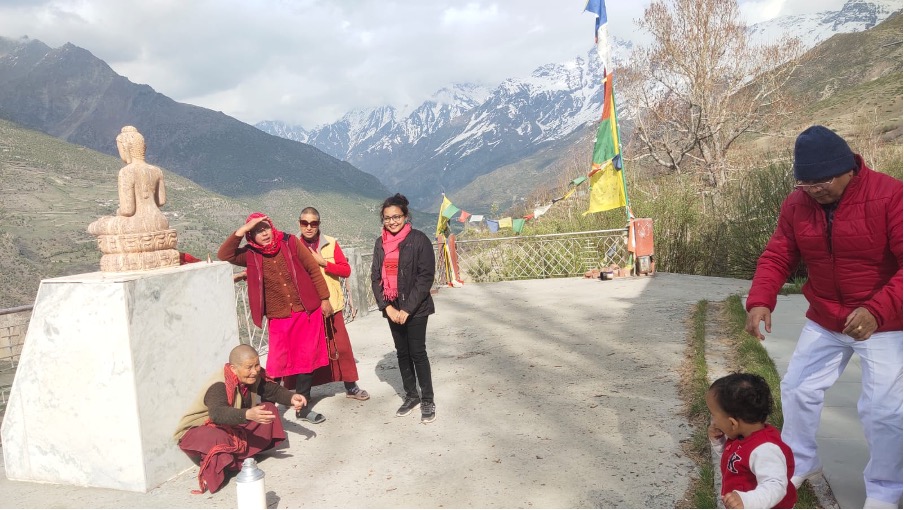
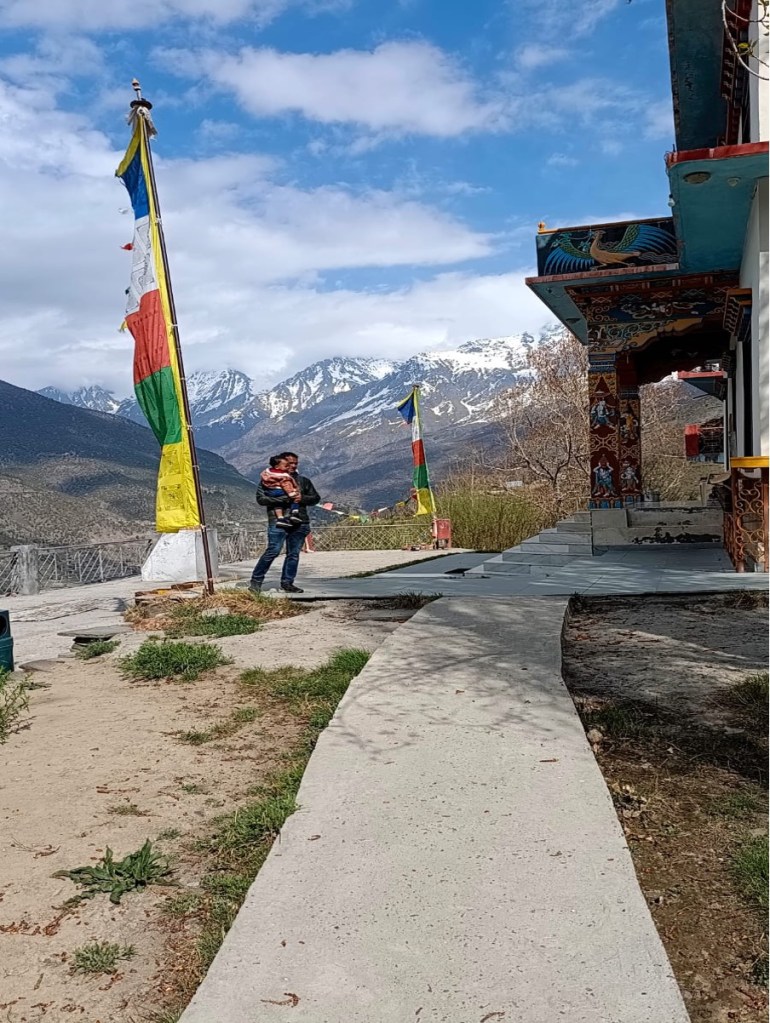
The monastery is an important one of Drukpa lineage[1] built in the twelfth century. The beautiful white facade with gold details gleamed in the sunlight. Intricate thangka paintings adorned the walls and ceiling of the monastery. It was perched on the barren mountain of Lahaul with multi-coloured Buddhist flags swaying in the wind. An imposing statue of Lord Buddha sat in the courtyard, looking over the whole valley. There was still some snow on the mountain tops, spring had just set in.
The chanting of the lamas filled the air. It was part of the evening ritual. Gentle drum beats punctuated the chanting. I felt fortunate to be in such a tranquil space. It was a happy concoction of the high altitude, the rhythmic rituals, and the lack of human habitation around the monastery that left me in a self-contained peace bubble.
A thangka painting
“How did you know about this place? Not a lot of tourists come here,” the chomo asked me with a twinkle in her eyes. My mind browsed through the incidents that led me here.
It all started two years ago. My penchant for zoning out to Tibetan chanting mantras on YouTube, and love for off-beat places in the Himalayas led me to some serious research. Lahaul district in Himachal seemed to fit the bill perfectly to get a taste of both. It was easily approachable from Manali, where my family could stay with all creature comforts. Our travel group included our one-year-old son and elderly parents.
The beautiful monasteries in dramatic mountainous settings were as much a reason to visit Lahaul as the adventure to travel to such harsh terrains. We based ourselves in Manali and acclimatised ourselves for a few days before climbing to twelve thousand feet. We hired a local car and driver to visit the Lahaul district. When we told our local driver that we wanted to go to the Kardang monastery, he looked at us blankly. It dawned upon me that it was even more remote than I had realised.
We started from Manali towards the Atal tunnel, a nine-kilometre-long highway underpass in the Pir Panjal range of Himalayas, on the Manali- Leh highway that connects two districts of Himachal. The Atal tunnel was opened in October 2020 after several years of work and today connects the remote Lahaul district with the rest of Himachal.
We left the verdant coniferous forests and mountains with gushing streams on one side of the tunnel and gaped at the dry snowy mountains with freshly sowed fields at the base of the mountains of Lahaul on the other side. It was a dry desert with farming done in little patches at the base of the mountains. The difference was stark.
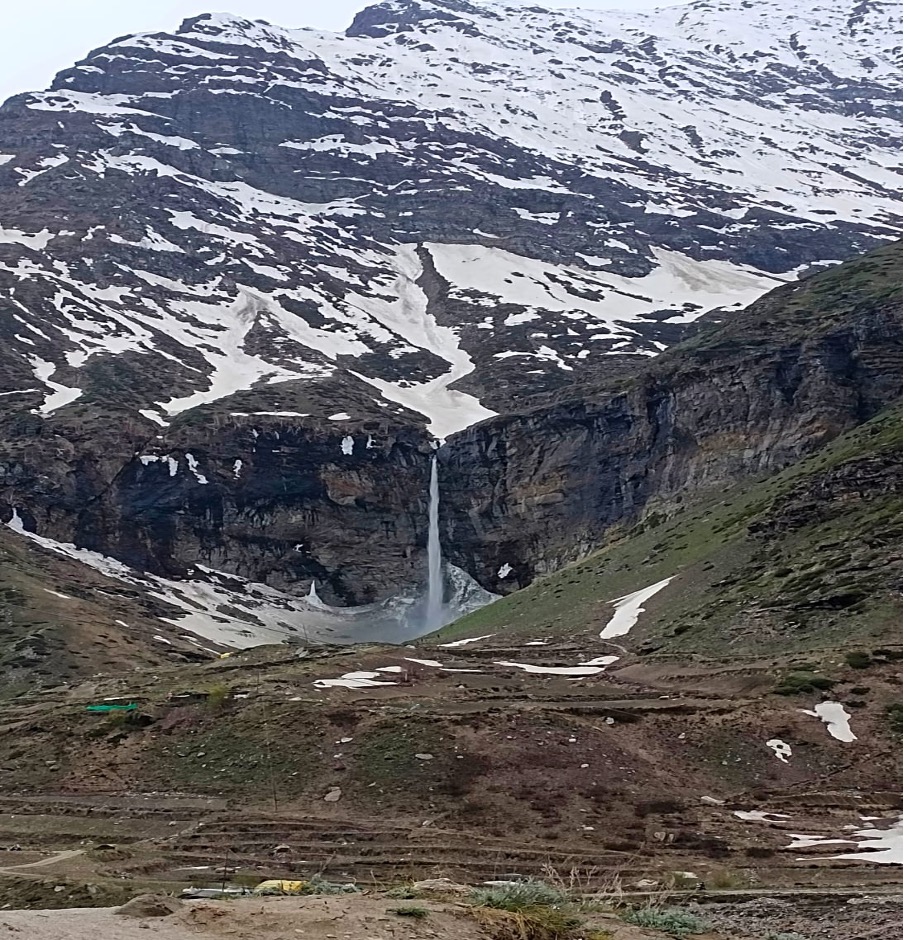
We stopped at the helipad by the Sissu waterfall in Lahaul district, to recharge ourselves with tea and steaming momos. I saw my father-in-law skip around like a little boy, his jaws dropping every time he looked at the waterfall coming straight out of the glacier that cradled it. It was his first time being in such a terrain. All of us, including my one-year-old son, seemed to be breathing fine and enjoying ourselves, in spite of the sudden gain of altitude to eleven thousand feet. I sighed in relief; no acute mountain sickness (AMS) for us.
We set out to the monastery following google maps and stopped for lunch on the way. After some conversation, the restaurant folks told us that we were going in the wrong direction. Apparently, google maps didn’t work very well in this region beyond the well-travelled tourist circuit. They told us how to reach and from the sound of it would involve off-roading. After losing our way twice, we finally discovered a bumpy path that led to the monastery. We found out later that the best option was to take the mud road on the right after the lone petrol pump in Sissu.
The bumpy mud road that we took instead was devoid of human habitation or road signs till the Kardang village. On each serpentine turn, I could see my travel companions digging their fingers deep into the seat in anxiety. On some stretches, there were walls of ice on the mountain side and the car had to cross the several streams that these walls caused. Later, we all laughed about how each of us was praying for dear life during that treacherous journey.
After a good thirty-minute climb we finally reached the Kardang village and the metalled road was in sight. The Kardang village had a few homestay signposts but none were open in spring. Soon we crossed the signs of the pilgrimage trek of Mt. Drilbu Ri and we were at the gate of the monastery. The short walk to the monastery was nice but we did it slowly as the lack of oxygen was palpable. Kardang monastery is nestled in the ridge below the fifteen thousand feet Rangcha peak. Kardang is the starting point for the Buddhist pilgrimage of Mt. Drilbu Ri.
Upon reaching, we found the door of the monastery closed. Soon we were greeted with the Tibetan greeting ‘Juley Juley’ by a smiling monk who opened the door for us. His name was Sonam Dawa. He was happy to show us around and answer our questions about the prolific thangka paintings on the walls and ceiling of the monastery, on Buddha’s life, dakinis [woman spiritualists], and other important figures of Tibetan Buddhism. Tibetan Buddhism with its characteristic animism and symbolism of Bon culture is a hallmark of this Lahauli monastery. A few lamas and chomos joined us and offered us tea. We were touched by their warmth. They played with my son, told us a lot about the snow festival that happens every February and asked us to come back during the celebration.
To this day I am not sure if it was the high altitude, the aromatic incense, or the space itself that made it feel so special. I remembered the chant on Youtube that started this journey for me and am glad I followed that instinct.
.
[1] The Drupka lineage of Tibetan Buddhism dates back to the twelfth century.
.
Sayani De is a bibliophile, compulsive traveller and sustainability enthusiast. Her work has been featured on Women’s Web and been selected for publication at Muse India for its May-June issue.
.
PLEASE NOTE: ARTICLES CAN ONLY BE REPRODUCED IN OTHER SITES WITH DUE ACKNOWLEDGEMENT TO BORDERLESS JOURNAL
as the city sleeps

Four months from today
I’ll be 34, my hands have
been trembling for some
time. Sleep hasn’t been too
good these days, exhaustion
and boredom overwhelm me.
I fiddle with death thoughts
while microwaving leftover
food and wonder why I am
the way that I am. Long gone
are the days where uncertainty
meant absolute freedom. These,
days, every day is predetermined
by responsibilities to myself, my
job, and my children. Going
through life afraid of shadows
once had its appeal, but now,
as the city sleeps, I dwell in
shadows, I am a shadow.
Tohm Bakelas is a social worker in a psychiatric hospital. He was born in New Jersey, resides there, and will die there. He is the author of twenty-five chapbooks and several collections of poetry, including “Cleaningthe Gutters of Hell” (Zeitgeist Press, 2023).
.
PLEASE NOTE: ARTICLES CAN ONLY BE REPRODUCED IN OTHER SITES WITH DUE ACKNOWLEDGEMENT TO BORDERLESS JOURNAL
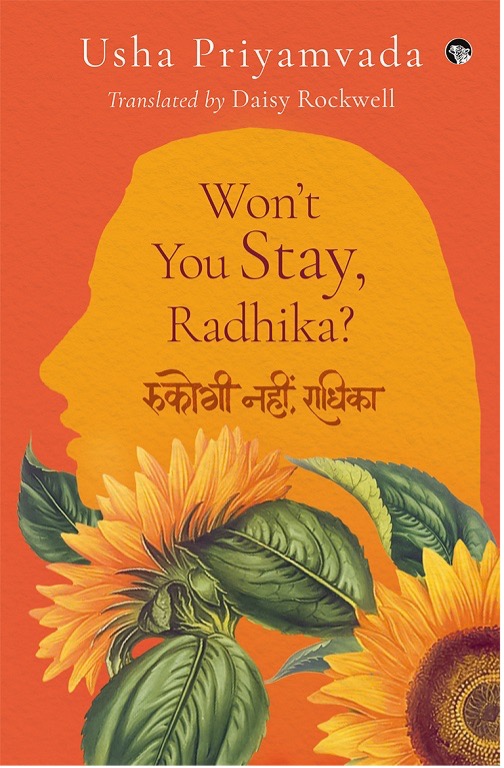
In an essay written several years ago, the India-born Canadian author Uma Parameswaran had defined the plight of diasporic people by using the mythic metaphor of ‘Trishanku’ borrowed from the Ramayana where this character wanted to go to heaven alive but denied entry there, he was sent back and since then resided neither on earth nor in heaven but was suspended forever in an illusory middle space in-between. The state of diasporic individuals is somewhat similar; they are neither here nor there, and the present novel under review, published way back in 1967, brings out the angst of one such individual who, like the author Usha Priyamvada, herself went for higher studies to the United States and became the usual victim of culture shock. The only difference is that in real life Priyamvada stayed back in America and spent her long teaching career in universities there, whereas the protagonist of her novel Won’t You Stay, Radhika? went there only for a couple of years.
The storyline of the novel, originally written in Hindi, is rather simple. After her widowed father marries a younger woman called Vidya, Radhika’s world falls apart. She feels betrayed—the emotional and intellectual bond that she had forged with her father since the early death of her mother breaks with that sudden marriage. This is because their bond was not just emotional, but intellectual, as Radhika helped her father with his art history writing. To escape the unbearable situation at home—the growing rift between her and her father—Radhika fought for her personal freedom. Finding a simple way to avenge her father, she moved to Chicago along with an American teacher called Dan to pursue her master’s in fine arts. By leaving her father and going to live with Dan, Radhika had acquired several years of experience and matured quickly. But her living with Dan had only been a means to an end.
She returned to India two years later, burdened by a sense of alienation and homesickness, only to realise that while nothing had changed in her country, everything had. A growing sense of despair engulfed her. She started wondering whether she had a home anywhere. The family that she had longed to be reunited with barely acknowledged her arrival. The sense of belonging was missing, leaving her in ‘an emotional state of in-between-ness, of universal unbelonging’. As days pass, Radhika is paralysed with ennui, which is not just boredom. She avoids people, romance, family, as she lies still, or wanders listlessly through her neighbourhood. This sense of unbelonging tinges all her relationships—romantic or filial. So, she lies listlessly on her takht[1], bored, immobile, and uninspired.
This is not to say that Radhika is without love interests in the novel; after all there are three men in her life. She does not always feel detached from these men; there are many situations in the novel when we as readers feel that she has overcome her ambivalence or boredom or ennui, that she will start living a more meaningful life, but nothing positive takes place in the end. She seems to jell well with Akshay for a while and thinks probably she might marry him as there is no room in her life for a playboy. She wants a partner, someone steady, generous, someone who will accept her with all her flaws. But though she has great respect for him, she finally decides not to fall into the traditional trap of marriage. Akshay, like a traditional Indian male, also cannot subconsciously stop thinking about Radhika’s past. He feels confused as the more he wants to steer clear of Radhika, the more he feels she looms over his life. He also keeps on thinking about her past affairs with other men.
The other gentleman with whom Radhika had developed a relationship was Manish, who was diametrically opposite in nature to Akshay. They knew each other for a long time in many different contexts. Manish had also desired her, but Radhika had kept him at a distance. After several indecisive moments, she openly turned down his marriage proposal too, stating that she didn’t want to get involved again. Though she felt warmed by Manish’s touch, she did not turn to look at him. But Manish decided to wait till such time she changed her mind and voluntarily went to him. This ambivalence continues till the end of the novel, which Priyamvada leaves rather open-ended.
Though the title of the novel refers to a particular scene in the end when Radhika goes to meet her father once again and he wants his daughter to stay with him like before, that question mark hovers over the entire work: What will you do Radhika? Will you get up off the takht? Will this ennui ever come to an end? She was surprised at how her emotions had become so dull that she felt very little at all.
An extraordinary chronicler of the inner lives of the urban Indian woman, Usha Priyamvada is a pioneering figure in modern Hindi literature. Won’t You Stay, Radhika? written so many years ago, expertly explores the stifling and narrow-minded social ideals that continue to trap so many Indian women in the complex web of individual freedom, and social and familial obligation. A sense of alienation is also famous not only as a hallmark of Hindi literature of the 1960s, where it is usually traced to urbanization and the breakdown of traditional family structures, but also finds representation in Indian English novels too. Here one is reminded of Anita Desai’s famous novel Cry, the Peacock, published in 1963, that also delves deep into human emotion by focusing on topics like existential depression, psychological discontent, and the fragility of sanity as expressed through the female protagonist Maya. Though the theme of incompatibility and lack of understanding in marital life is one of the main themes of Desai’s novel, one notices a similarity of dealing with trapped feminine psyche in both the novels. Of course, reading the story of Priyamvada so many decades later, it seems nothing has changed in the Indian context and the situation in which the characters find themselves is equally true even today.
Before concluding, one must specifically put in a word of appreciation for the translation as well as the translator. On the first impression one is surely bound to think whether an American writer is the appropriate choice for translating a novel in Hindi. Apart from holding a PhD in South Asian literature from the University of Chicago and writing her doctoral dissertation on the Hindi author Upendranath Ashk, Daisy Rockwell has over the years to her credit translations of several Hindi authors including Usha Priyamvada’s debut novel Fifty-five Pillars, Red Walls (2021). But what brought her into limelight was her translation of Geetanjali Shree’s Tomb of Sand (2018) which became the first novel translated from an Indian language to win the International Booker Prize in 2022. Thus, apart from bringing this poignant Hindi novel to a new set of readers fifty-five years later, Rockwell’s expertise in translation makes one feel that this is not translated text at all. Though not a mystery thriller, her narrative skill makes the novel a definite page-turner and one will surely be tempted to finish reading it as fast as possible.
CELEBRATION

This morning there is a celebration in the prettiest world.
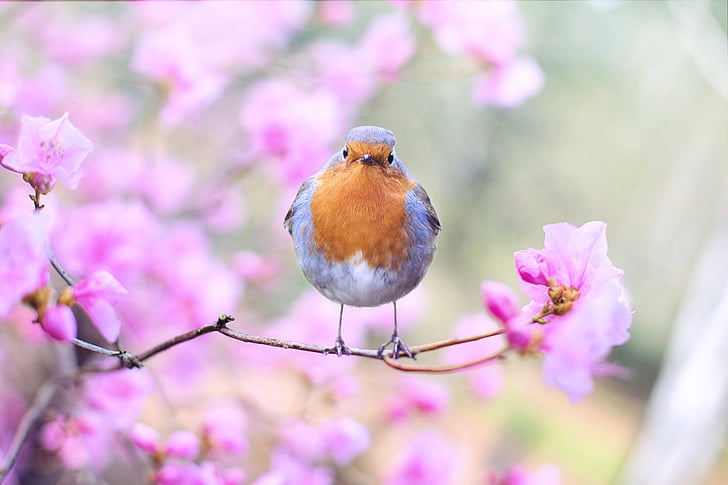
A tiny bird starts singing and then swings over the lake.

Imagine lifting the water jug and finding it empty
in the monsoon; it’s only dry winds blowing all seasons.

Fairy lights dance on the yellow grass, the avian world
knows there is less rain, roots die deep within.

Somewhere at the corner of the sky, grey clouds build up
and now other birds join singing in the curtains of leaves.

How important it is to stay together, looking at everything,
then fly away drawing a great circle over and above!

They whistle and show how happy they are in unison,
their small ecstatic faces shine under the moist sky.

The trees, the oak leaves on the water’s edge and
those yellow reeds clap as the birds’ rest on the pine top.

RESISTANCE

You can’t tell a nest from a tangle of jasmines,
can’t tell a snake shedding its skin.

At times rocks meet, strike, roll together
to the first obstacle or the end of the slope.

You can’t tell hands from ivy choking in a fence.
beyond the split windows of the room,

can’t recognise a man who lives in my very own clothes,
my mirror notes only the geranium and growing pains.

You take steps to the place where you begin to vanish
until you go back and wait under the shadow,

like an inheritance, like land surfacing
a morning halved by grey and white clouds.

Some space to breathe, but just enough --
I must find myself in the wind’s swelling lung.

WONDROUS THING

Perhaps they are mother and daughter
still together from last year’s final clutch.
I keep waiting for one of them to start a nest
out in the marshy woods, the great blue
robin rookery is in full swing --
building four nests in the still leafless sycamore
each in full view of the bold eagles.

The forest is cooler and shadier than my yard.
Spring ephemerals are just emerging --
little strands of stalkless flowers
and pepper root toothwort that I look for.
Happy still to see that spring
seems a bit slower to arrive at the woods.
In their eyes, it remains a wondrous thing.
Gopal Lahiri is a bilingual poet, critic, editor, writer and translator with 29 books published, including eight solo/jointly edited books. His poetry and prose in Bengali and English are published across various anthologies globally. His poems has been translated into 16 languages.
.
PLEASE NOTE: ARTICLES CAN ONLY BE REPRODUCED IN OTHER SITES WITH DUE ACKNOWLEDGEMENT TO BORDERLESS JOURNAL.
The street lay wet and shimmering after the afternoon rains. I stood at the window sipping tea, enjoying the cool breeze for a moment entranced by the glitter of the raindrops falling off the potted plants, on window sills and ledges, down electric poles and wires by the street crossings where crows and pigeons preened and shivered like musical notes. In the sudden burst of sun warmed air, the rainbow hued petrol drips trembled in the puddles. It was a single moment of evanescence and peace, as in Robert Browning’s poem,‘Pippa Passes’ in ‘God’s in his Heaven/All’s right with the world!’
The mood gave way when I suddenly noticed the gait of a woman on the street. She turned into the street bent down with the weight of the bags on her shoulders and trudged slowly with the open black umbrella even though the rains had stopped. I could not see her face but I recognised her.
Staring at her, my heart thumped with sudden anxiety as I turned away and tried to quell the panic inside me. I knew her. I had seen her since my childhood following the same set routine as a young woman. Now as an old lady without changing her daily habit for more than fifty years, she continued doing the same thing, a creature of habit.
I felt the need to sit down. On the way to the sofa the ornamental mirror on the wall caught my reflection.
I could not stop staring at it in fear and fascination. That person was me now. Where had I gone? Alone with myself ! Age! Time! The sinuous whisper of crawling fear made me tremble. Age is just a number! I am as young as I feel — love is ageless.
All those self-assertions were hopeless. I could feel the sweat break out of my pores.
I sat down and gripped the poetry book I had been reading. He had insisted I read it when he gave it as a surprise gift — a good friend and colleague who had kept in touch. Why did he still remain kind and nice. Was he like or unlike others with whom I had been on good terms? Did he expect anything from me. Have I missed the signals all my life?
I was now a middle-aged single woman and fear gripped me as the thought that sprung to my mind was, I would also end up like her. My calm was tattered to pieces, fluttering away in confusion. I was caught in a whirl of emotions and thoughts. Why did she disturb me so much?
I had definitely traversed a very different path from her. There were no parallels in our lives. But now at this moment, suddenly when I was enjoying my ‘me’ time, the splintering truth struck out of the blue. I am alone. The sprawling apartment spoke of comfort, care and luxury with a live-in maid, with all the gizmos and art and cultural ambience of a successful life and career, a single woman could achieve; I suddenly felt like a cipher. Raw, exposed and empty. Why did I feel like that?
The demon called loneliness mocked my aloneness. It had no shape or size or smell. It was like a vapour, like air that sometimes crept silently or jumped up terrorising my very breath. Those moments of sheer emptiness and choking sensations that I had thought were over, seized me again.
Who are you.? What have you achieved. Have you made any one happy? Does anyone wait for you, ask about you ? Such were the dark numbing thoughts that gathered inside me and gave way to spontaneous outflow of tears. My sighs cradled unknown sorrows I could not fathom. Melancholy and depressed, moody and restless all the shine was tarnished and lost meaning. I thought I was beyond it and a very stable person. But I knew now that I was deluding myself.
My eyes fell on the page I had been reading, Andrew Marvell’s poem ‘To His Coy Mistress’.
Had we but world enough and time,
This coyness, lady, were no crime.
We would sit down, and think which way
To walk, and pass our long love’s day.
Thou by the Indian Ganges’ side
Shouldst rubies find; I by the tide
Of Humber would complain. I would
Love you ten years before the flood,
And you should, if you please, refuse
Till the conversion of the Jews.
My vegetable love should grow
Vaster than empires and more slow;
An hundred years should go to praise
Thine eyes, and on thy forehead gaze;
Two hundred to adore each breast,
But thirty thousand to the rest;
An age at least to every part,
And the last age should show your heart.
Am I lonely? Am I old ? Why am I still single? The looping thoughts suffocated me in its coils.
The naked bulbs of truth has a harsh way to call attention in the most make-believe moment of tranquillity. The mirror held me in its snare but it did not crack my image — vanity, pride, self-delusions shatter inside me.
I look at the degrees framed on the wall; the decorative pieces brought from the different countries during my world-wide travels, and wander into a mental fog .
What use are these papers to me now? In my loneliness, do I crave aloneness? However high I go, I must come down to earth among people, to get applause; hear it, share it to have meaning.
My mind was filled with her image. I knew without looking she would stop under the old banyan tree, pause for breath and turn into the narrow lane where the cluster of chawls[1] with the rows of common toilets and bathrooms existed since I could remember. They were all built more than eighty years ago and opened into the central courtyard. The multi-storied building and high-end gated communities I occupied came later and had gates, gardens and lifts with bathrooms and toilets inside our homes.
Her name was Kokilaben. All knew her as she was well known in the locality called Gaiwadi, for singing and dancing during the nine day garba festival[2] during Navaratri. She would decorate others homes with beautiful rangoli designs if requested. Whether it was her nickname or her real one, whether her dark complexion contributed to her remaining single, no one knew and no one confirmed. Since I could remember, she was a slim young woman who wore her saree in the traditional Gujarati style, taught in the primary Muncipal school and looked after her ailing mother after her father passed away.
I remember the ladies in our old building talking about her in whispers sometimes, and at other times, praise her spirit and dedication to her mother for taking care of her.
Growing up, the difference I perceived in my teenage mind, was that she was single, unmarried and had a job unlike the married women who looked after their husbands, children and ran a budgeted households. They cooked, cleaned, argued with the vegetable and fruit vendors, hung clothes and gossiped across their balconies and windows . They fought with other women for water and at the ration shop, women who looked dishevelled and pulled up their sarees tight, and knotted its end as if ready to fight and take on the world. After 4 O’clock they became ladies and dressed up in the evening to await their husbands return.
Kokilaben was a permanent subject of gossip ; no one spoke to her but about her. Her immediate neighbours kept watch on who visited her. They watched out to see if she spoke to men of the locality – whether strange men visited her. They wondered why she showed no interest in marriage.
Everyone kept an eye on her while they gossiped about the new couples, which boy made eyes at which girl. Inquisitiveness and curiosity was a virtue here. They spoke of not giving dowries and cursed the burden of daughters, but secretly took it for their sons on the pretext of marrying their daughters. They gossiped about , mothers-in-law, sisters-in-law and good husbands, saintly husbands and philandering ones, of shame and cruelty and all that happened in their lives, but the worst was kept for the working single girl and she was suspected of committing the worst crimes. They praised their children, told lied about them too. Behind the closed doors, they beat them and abused them and took out their frustrations in secret silence. All wore masks.
One common topic for a long time I remember was the marriage of Kokilaben, as she was the one who chose to live alone after her mother passed away. She used to go missing for a week every three months and no one knew where she went . After some years, she did not disappear. Once her hair turned grey she ceased to exist.
Realisation struck me when I passed my civil service exams, from the security of my loving family how she must have craved the sense of freedom after carrying the burden of a home and her parents. I understood she was a rarity in the conservative middle class of 1960s.
Now I too stay alone. Kokilaben had no one and she had still lived the way she wanted. People spread stories about her. She was a transgender. She was a witch. She brought bad luck if you met her on the way. She ate children. She was not the pleasing friendly auntie but did not disturb any one and gave money for the annual Holi, Ganesh Chathurthi, and Navaratri festivals when the colony held mass celebrations. She lived quietly and asked no body’s help as she grew old. She paid her bills and fed the street dogs during the monsoons. She gave shelter in her chawl verandah to dogs during downpours and then drove them away when the rains ceased.
So today why was my calm broken by this familiar figure.?
She had not existed in my daily frame. She had merged with my memories even though she was alive like part of the furniture in the background. Living a full animated, varied life, only the present and exciting future mattered. On a certain day called retirement, all that ceased with the strike of a government rule. We all had to retire at the age of sixty. I suddenly became a senior, a retired officer, a suffix, a past tense, a marginalised peripheral person brought down from the tabletop, kept in a corner sometimes consulted. My importance diminished. I was an afterthought, with no fresh shoots , only roots.
It was not loss or failure in love; A spinster missed the bus for not making efforts to find a mate. It was not a voluntary decision to be single. It was not even a decision to be self-sufficient and complete. It was not out of vanity waiting for the best catch or being rejected. I had security, love, care and many relatives and friends looking out for me .
Still I stayed unmarried. I did not have an affair or secret liaisons. I felt I was not ready. I did not know how to handle that particular relationship while I could handle anything else. I feared domination or giving in to being used or abused, being beholden to someone, losing independence, feared not sharing common values and ideas on what I cared or despaired about, feared of the other not being empathetic or sympathetic with me on all issues. Would I be mentally free without commitments?
In my case, it was because of a personality trait of fear, anxiety or disorder as you may call it. Externally, I seemed like a perfect apple but the insides was not perfect. It was flawed with delusional mental problems and phobias. Seeing the woman today, the realisation was stunning. There was no difference between me and her. Both lived but at the end of day, I was alone and lonely and she was not. She lived within herself content with her difficulties.
I lived in my mental cocoon, a moth, and did not struggle to come out as a butterfly. She did emerge out of her pupa. I hid all the broken glass pieces of my mind well and succeeded by external calibration to become a versatile achievement-oriented woman. Kokilaben lived and lives while I now search for the shades and shadows with regret. I fooled myself for I never learnt to depend on myself for my happiness.
Why did he give this book to me, I wondered? The suspicions started gathering like thundered clouds before a storm. The old pain of not believing in my own capacity and struggling to get appreciation and achieve heights of fame and praise imploded inside me. I could not form a trusty relationship; commitment phobic for the fear of failure as anxiety eroded my fragile feelings and left me feeling numb. I was convinced that it was safer to hide behind my own self, not sharing my life with anyone.
But at my back I always hear
Time’s wingèd chariot hurrying near;
And yonder all before us lie
Deserts of vast eternity.
Thy beauty shall no more be found;
Nor, in thy marble vault, shall sound
My echoing song; then worms shall try
That long-preserved virginity,
And your quaint honour turn to dust,
And into ashes all my lust;
The grave’s a fine and private place,
But none, I think, do there embrace.

(Andrew Marvell’s poem ‘To His Coy Mistress’, published posthumously in 1681)
My single hood was surely inferior to Kokilaben’s life. I took the cup to wash in the sink and did not know where the detergent and wipe was kept. I had to wait for the maid to return from the market. I felt my illusions of grandeur turn to mundane sniggers of self-pity.
Kokilaben opened up my deep seated fears and the truth sprang punching my face.
Life is for living. I dreamt my life away. Yes, with luck and some help I slid through life, but at some point or moment, like now my face smashed on that reflection on the mirror. I will taste the salt of blood and tears of reality, feel the self-demeaning regret and pain of not having experienced the love, the hurts and happiness of having a partner.
Kokilaben had self-respect I did not , for I lived in others words and mind .
Why did he still remain my friend or was he trying to say something? Was it too late? I must call him. Talk to him now! Can I live a life time in the time I have? Time was dripping drop by drop, but now I felt life gushing by in my tears .
The panic attack when it came was bad. I struggled up panting to swallow the tablet that was kept handy as an ‘sos’ , but at that moment the telephone rang and I trembled as I took the call, in hope, in fear, in desperation.
Now therefore, while the youthful hue
Sits on thy skin like morning dew,
And while thy willing soul transpires
At every pore with instant fires,
Now let us sport us while we may,
And now, like amorous birds of prey,
Rather at once our time devour
Than languish in his slow-chapped power.
Let us roll all our strength and all
Our sweetness up into one ball,
And tear our pleasures with rough strife
Through the iron gates of life:
Thus, though we cannot make our sun
Stand still, yet we will make him run.

(Andrew Marvell’s poem ‘To His Coy Mistress’, published posthumously in 1681)
[2] Traditionally, garba is performed during the nine-day Indian festival, Navarātrī, that is held around September-October.
Nirmala Pillai is a writer, painter, and an Ex-Civil Service Officer, who has published three collections of poems and one of short stories. Her published works have appeared in PEN, The Asian Age, Indian Literature, Bare Root review from Minnesota University, Poetry Can, UK [Poetry Southwest], The Telegraph, The Little Magazine, Cha; An Asian literary journal.
PLEASE NOTE: ARTICLES CAN ONLY BE REPRODUCED IN OTHER SITES WITH DUE ACKNOWLEDGEMENT TO BORDERLESS JOURNAL
Reeti Jamil is an avid reader and lover of books, arts and humanity. She writes with the hope of inspiring people to move towards a world larger than themselves.
PLEASE NOTE: ARTICLES CAN ONLY BE REPRODUCED IN OTHER SITES WITH DUE ACKNOWLEDGEMENT TO BORDERLESS JOURNAL.
Can anyone say for sure, when Japan and Kerala or, for that matter, Japanese and Malayalam languages, came into contact for the first time? No, it is all buried in the chronicles of yore! This is so, in spite of the legendary Bodhidharma travelling from somewhere in the South-West part of India (Kerala?) to China on its way to Japan in AD 520, albeit still disputed!
With the arrival of the Portuguese in Southern Japan from Cochin(?) during AD 1543, there was obviously a possibility of Malayalee priests or laymen including ‘horse trainers’ and cooks, reaching Japan along with Portuguese navigators. But records of such visits are yet to be made public, being either in Portuguese, Chinese or Japanese archives.
However, according to Takako Mulloor, a daughter-in-law from Japan living in Kerala for the past half a century, such obscurities need not always be the case. She remembers the story of four Japanese youths who happened to visit Quilon and from there to North Kerala, sometime during the reign of Ōtomo Sōrin (1530-1587).
Sorin was one of the few feudal lords of Japan (Daimyo), to embrace Catholicism under the influence of Portuguese missionaries. Originally known as ‘Fujiwara-no-Yoshishige’, he was very powerful at the time, ruling most of Japan. Apparently, he thought it apt to ascertain the ‘truth’ behind the new religion that was spreading fast in his domain. Thus, he is said to have deputed four Japanese youths to Rome and Europe – a new world — to meet the Holy Pope and report back to him.
These youths, after completing their mission successfully, landed in Quilon, on their return voyage. Quilon was a flourishing port of that period. Due to some unknown reasons, they proceeded further north towards Cochin by local crafts, called ‘Kettuvalloms’. Unfortunately, one of them caught malaria and died somewhere on the way and was buried.
According to personal communication from Takako, such records are available with the NHK ( Nippon Hōsō Kyōkai) Brodcasting Corporation of Japan. She remembered that a TV team from NHK had visited Kerala sometime in 1979-80, to make a documentary on these youths and to locate the grave of the one who had lost his life. Takako was their interpreter on this mission, being fluent in Malayalam, Japanese and English.
While I was in Japan from 1965 to 1969, very little information was available in Kerala about Japan. Prior to leaving India, except for some writings by the renowned author MT Vasudevan Nair, the knowledge of Japanese language or culture was scanty.
On joining Osaka University of Foreign Languages (Ōsaka Gaidai), I was fascinated by the general manners of people in and out of the university. They were always kind, polite and willing to help especially students and others from abroad.
Despite having an advanced ‘Language Laboratory’ and excellent faculty, my language proficiency was mostly strengthened by the people on the street or in the villages of the Osaka suburbs. From the very beginning, I was also struck with an inexplicable quality in their language, with its unaccented delivery and melodious intonations that always reminded me nostalgically, of Malayalam!
Amazingly, both these languages were similar in several respects such as the order of alphabets, vowels and structure of sentences that usually didn’t end in a consonant.
We foreign students had to learn some special topics namely ‘Things Japanese’ that included Flower arrangement (Ikebana); Japanese theatre traditions Kabuki, Bunraku and the oral Rakugo and so on. In general, most of them including folk arts, proverbs, and day to day practices, reminded me of the village life in Kerala.
For instance, ‘banishing’ evil spirits from home was just the same as practiced in villages here. Above all, I could also recognise a few Japanese words more or less similar in meaning and pronunciation, synonymous with Malayalam!
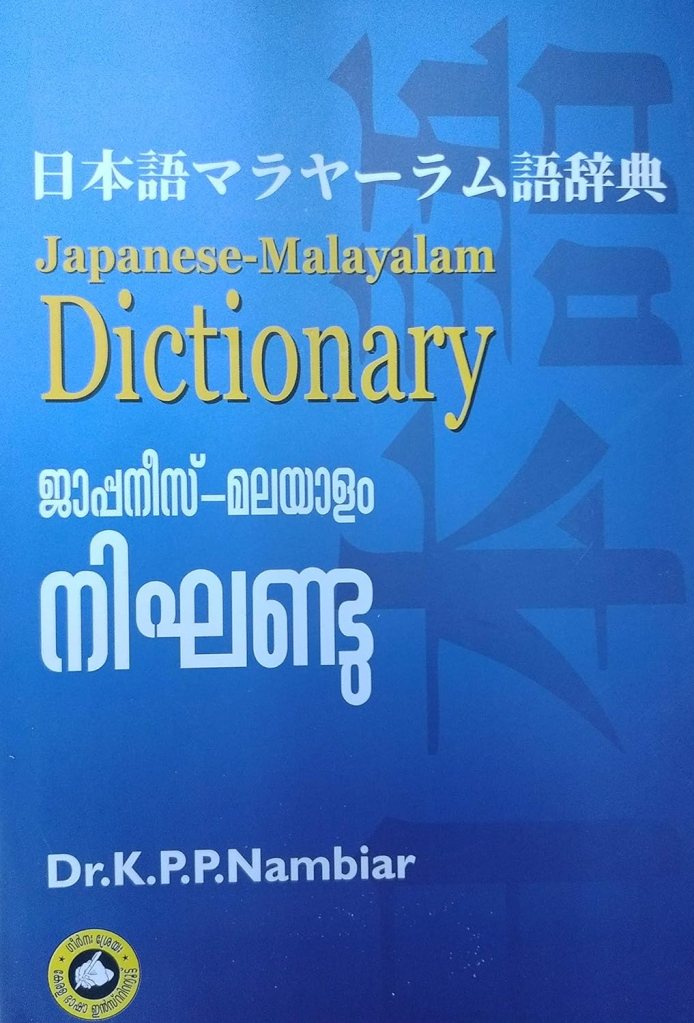
That was when the idea of a Japanese-Malayalam Dictionary germinated in me. But, back in Tokyo University after completing six months’ language course, my attention was mainly focused on research, to earn a doctorate. Still, I was able to hone my Japanese speaking skills by constant interaction with the local people who were always enthusiastic about teaching foreigners, their language.
During the second year in Tokyo, unexpectedly one day, the Indian Embassy in Tokyo called me to enquire if I could teach a few senior Japanese government officials, Malayalam.
Didactic skill being not my forte with Malayalam, my first response was a polite ‘no’, despite the attractive remuneration offered. But the potential pupils would not be dissuaded. Thus started my part-time job as ‘Malayalam Teacher’, in Tokyo. Nearly three years of teaching came to an end on my completing my doctoral research, so as to return home.
Contacts with my erstwhile students were soon reduced to almost nil. One exception was an exchange of communication with a Shyoichi Itoh, who retained his interest in Malayalam as also Kerala. Occasionally, he used to write to me in Malayalam to my great delight, for comments and correction. He had also written some articles on Kerala in Japanese journals, on topics of interest to Japanese readers, based on his experience.
The unique Writers’ Co-operative of Kerala (SPCS) was one of such topics covered. Similarly, at my request and as suggested by the editor M T Vasudevan Nair, he wrote an article for the Malayalam weekly, Mathrubhoomi, focusing on the ritual suicide of the famous Japanese writer Yukio Mishima, in 1970. He had also written a guide book for Japanese students interested in learning Malayalam entitled ‘Malayalam for Beginners’.
Subsequently in 1974, Itoh made a surprise visit to me in Poona where I was working at the time. In fact, he came with the happy news of joining The Tokyo University of Foreign Studies (TUFS) as Professor and Head of the Department of Malayalam. That was a deserving recognition of his dedication to the study of Malayalam. His Malayalam for Beginners is still in use in the University and elsewhere.
My last meeting with Prof. Itoh was during early 1982, when he visited my official residence in Tokyo, with his dear daughter. At that time, I was on a government of India assignment (1981-’85), renewing old contacts as well.
Sadly, Prof. Itoh passed away rather prematurely, in 1998.
After taking superannuation from my employer — an international organisation at that time – at the beginning of the current millennium, I settled down in Cochin, India. Still, the dictionary dream was alive and efforts for bringing Japanese and Malayalam closer, was always a passion!
During the early nineties, despite being immersed in professional activities, I had undertaken the translation of Nobel Laureate Yasunari Kawabata’s [1]novel, Yama no Oto or ‘Sound of the Mountain’ (1971) directly from Japanese to Malayalam as Malayute Shabdam.
Published by Current Books (Trissur) in 1994, the translation was well received by Malayalee readers, resulting in more editions. Considering the fact that such translations are usually based on the English version due to language constrains, my work, directly from the original Japanese, is thought to be the first of its kind, in Malayalam.
However, the dictionary project could not be taken up immediately even after retirement, due to personal preoccupations. Ultimately, work on this long-awaited project was started in 2002, two years after retirement, in right earnest.
An old dictionary of Japanese-English-Japanese format, brought along from my ‘student’ days in Osaka was used as the first reference source. Published in 1950 by the Obunsha Company of Tokyo, it was the only one available for me at that juncture.
Following untiring work, the first draft was ready in two years. It was prepared in the Japanese-English-Malayalam format covering some 2000 foolscap pages and nearly a hundred thousand head-words. The meaning of each word and phrase was given in English and Malayalam with Japanese pronunciation in Malayalam fonts. The entire manuscript was compiled in long hand, without using a typewriter or computer!
Thereafter, attempts to get a competent publisher in Kerala was futile mainly due to the non-availability of Japanese fonts for printing. As a final solution, it was felt necessary to obtain fonts from Japan. However, the impasse was broken finally when my old friend and great historian Prof (Dr.) M.G.S. Narayanan introduced Toshie Awaya, a faculty member of the TUFS, as a conduit for assistance from that university.
While discussing various possibilities with Awaya, it was a pleasant surprise to know that late Prof. Itoh, my ‘old student’, used to be her Malayalam Professor!
Subsequently, on visiting Japan with my wife, a meeting was arranged with the late Indologist and renowned historian, Prof. Noboru Karashima, whom I knew during Tokyo University days. He was living in Kamakura, and Awaye took us to his very impressive residence for discussion.
On that occasion, as he suggested, it was decided we meet Prof. Jun Takashima and Prof. Makoto Minegishi engaged in dictionary-related research, in TUFS. They were attached to the Institute of Languages and Cultures of Asia and Africa (ILCAA). Established in 1964 within TUFS, this institute was engaged in promoting academic exchanges between Japan and other Asian-African nations, having been recognised as competent to carry out that task.
The two Professors during a meeting that ensued in the Institute, were amazed to see the sample manuscript of the dictionary that was shown to them. Firstly, use of ‘long hand’ instead of typing or computer printing, seemed out of this world to them.
Another fact, of more importance, was that the dictionary used as reference source material was outdated. It was pointed out that in view of the fast-evolving nature of languages with the addition of new words incessantly, the earlier work had become redundant.
While agreeing to discard the manuscript, we decided to start afresh using a latest dictionary as source to digitalise the new version with the help of a software developed by Prof. Takashima! It was also agreed that the manuscript thus produced with my data would be arranged in a ‘camera-ready’ copy at the ILCAA, that could be suitably published in Kerala.
After several exchanges of visits from India to Japan and Japan to India followed by umpteen number of corrections and revisions, the promised ‘final’ product was ready by the end of 2018.
Then, it was a matter of finding a qualified publisher. The Kerala State Institute of Languages, Thiruvananthapuram, that readily agreed, was found to be the most appropriate one to accomplish that task, in an excellent manner.
The formal release of the beautifully printed and bound Japanese-Malayalam Dictionary of some 1500 pages was formally carried out in the presence of the ILCAA Professors, by Kerala State Cultural Minister A.K. Balan. Hideki Asari, Minister and Dy. Chief of Mission, Japanese Embassy, New Delhi and several other dignitaries were present on the occasion in Thiruvananthapuram on March 8, 2019.
With such a happy finale of a hard work put in during some sixteen years of my post-retirement years, the dictionary may represent a milestone in the annals of Japanese-Malayalam affinities.
During the half a century that elapsed from the time of my first landing in Japan and the release of the dictionary, major changes are manifested in the ethos of Japan-Kerala interactions. Exchange of visits by artists, academics, writers and common people, resulted in the publication of several travelogues, translations, studies, and so forth enabling people of these two parts of the world to come closer, as I dreamt in the 1960s.
Several literary works from Japanese were translated into Malayalam by eminent writers from Kerala including M.K. Menon (Vilasini), K. Kunhikrishnan and others! General studies were also published about Japan, in Malayalam. An in-depth study of Kerala-Japan cultural relations is available in the remarkable book, ‘The Throne of Chrysanthemums’ by the gifted writer and artist, K. Asok Kumar.
In addition to such developments, many professionals from Kerala are now finding gainful employment in Japan, something unheard of a few years back.
In conclusion, it has to be emphasised that the age-old affinity between Japanese and Malayalam needs to be studied afresh by our linguists and historians, in the light of significant evidence emerging from various new studies.
When Rev.(Dr.) Robert Caldwell (1814-1891) postulated the theory of possible origin of Japanese and Tamil languages from the same root, there was no mention of Malayalam, in particular. So also Japanese professors – Akira Fujiwara (1981) and Susumu Ohno (2007) — who revived that hypothesis recently, were also not referring to the Malayalam connection.
Meanwhile, some of our erudite linguists such as Prof. Naduvattom Gopala Krishnan, were able to prove the ancient origin of Malayalam, from the same root as modern Tamil, proving eligibility of both these languages to be included in the ‘Classical Languages’ category, already accepted officially.
According to Prof Gopala Krishnan, the very fact that some ‘Malayalam only’ words were identified in ‘Sangam Literature’ of 300 BCE- 300 ACE, reaffirms its classical position. Even epigraphical evidence from the Edakkal Caves of Wayanad (Malabar), that go back to 6000 BCE, are said to be supportive of ancient origin of Malayalam, together with Tamil.
As such, there is an urgent need for a relook into our perspective of the gamut of Japanese-Malayalam affinities!
[1] Yasunari Kawabata (1899-1972) was the first Japanese to win a Nobel prize in 1968
Dr. KPP Nambiar, formerly a Consultant/Technocrat at the UN Food and Agriculture Organisation, is the author of many scientific papers and books, including a 1500-page Japanese-Malayalam dictionary.
PLEASE NOTE: ARTICLES CAN ONLY BE REPRODUCED IN OTHER SITES WITH DUE ACKNOWLEDGEMENT TO BORDERLESS JOURNAL.










 Borderless