Sundaram and Sumathi lived in Nagur. They had only one son named Shiva. They raised him with love and care. At that time, Shiva was studying in sixth grade. Every day, he went to school obediently and studied attentively. In his free time, he would play with other kids on the school ground.
When Shiva came home from school each day, his mother Sumathi would prepare some snacks for him. He liked to take the plate and sit on the stone bench outside their house, enjoying his snacks.
As he ate, he liked watching the puppies running around the courtyard, the birds perched on the tree in front of the neighbour’s house, the chickens pecking at grains, and the cows chewing fresh grass in the shed next door.
One day, when Shiva came home from school, Sumathi gave him sesame seed balls made with jaggery. As usual, he sat outside on the stone bench and began eating them.
Just then, Shankar, a boy from the same street, came by.
Standing in front of Shiva, he asked, “Hey! Will you give me one?”
Shankar’s father worked as a laborer in an onion shop, and his mother worked in the fields.
“Nope… I won’t give you one,” replied Shiva.
“Come on… just one! Next time I get some, I’ll share with you,” pleaded Shankar.
“I won’t give. Go ask your mom,” Shiva said.
Sumathi, who was inside, overheard their conversation.
She immediately came to the doorstep and said, “Shiva, give one to Shankar.”
“Why should I give? Tell him to ask his mom!” replied Shiva.
“You shouldn’t eat without sharing with others. Give one to Shankar,” insisted Sumathi.
“Instead of telling me, you could just take one from the jar and give it to him,” grumbled Shiva.
“I told you to give it to him so that you learn the joy of sharing. If you give one to Shankar, I’ll give you two more,” she promised.
Hearing that, Shiva cheerfully said, “Here, take this,” and handed one sesame ball to Shankar.
Sumathi smiled with satisfaction, seeing the sparkle on Shankar’s face when he received the treat.
After Shankar left, Sumathi brought two more sesame balls and gave them to Shiva.
Sitting beside him and gently patting his head, she said, “We’re human beings, so we should help others. Shankar’s family doesn’t have much money. His parents can’t always afford treats like we can. That’s why you should share what you have with children like Shankar. If your friends ask for help, you should always be willing to help.”
Just by looking at his face, Sumathi understood that Shiva wasn’t entirely convinced by her words.
“Why should I do what you say? Their parents will buy for them, won’t they?” he asked.
Sumathi believed that good habits and values must be taught from a young age. She paused for a moment, wondering how best to make her son understand.
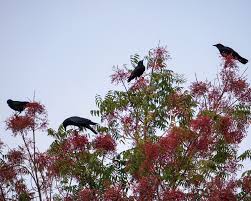
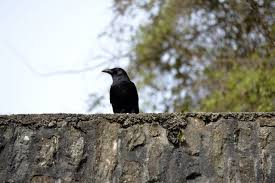
Just then, she noticed a crow sitting on the wall of the house across the street.
She went inside, brought a chapati, and, while watching the crow, tore it into pieces and threw them into the courtyard.
“Shiva, watch what happens now,” she said.
The crow flew down, picked up one piece of chapati, then flew back to the wall and loudly cawed. Hearing its call, other crows from around the area came and picked up the remaining pieces and flew away.
From Public Domain
“Did you see how united the crows are? The first crow took only one piece. It didn’t try to hide or hoard more just because there were leftovers. It called its fellow crows and shared the food so that their hunger could be satisfied too. When even birds can think in such a noble way, we, as humans, should do even better. That’s why you must also share with the kids around you and help in whatever way you can,” explained Sumathi.
Shiva nodded, showing he had understood.
“I’ll do what you said,” he replied happily.
Sumathi’s words made a deep impression on Shiva’s mind. From that day on, whatever food his mother gave him, he made it a habit to share some with his friends. Sumathi was overjoyed to see this change in her son.
Naramsetti Umamaheswararao has written more than a thousand stories, songs, and novels for children over 42 years. he has published 32 books. His novel, Anandalokam, received the Central Sahitya Akademi Award for children’s literature. He has received numerous awards and honours, including the Andhra Pradesh Government’s Distinguished Telugu Language Award and the Pratibha Award from Potti Sreeramulu Telugu University. He established the Naramshetty Children’s Literature Foundation and has been actively promoting children’s literature as its president.
.
PLEASE NOTE: ARTICLES CAN ONLY BE REPRODUCED IN OTHER SITES WITH DUE ACKNOWLEDGEMENT TO BORDERLESS JOURNAL
All day long, I live among strangers.
I sit side by side with a stranger on the bus, rattling along,
Choose tomatoes at the market with someone I don’t know.
My elementary school friends live far away,
And I’ve lost touch with my comrades from the army.
Childhood friends I flew kites with,
Neighbours I once shared raw sweet potatoes with —I’ve lost track of them.
Every day, I meet people, eat lunch together,
Chat like old acquaintances for a moment,
But soon, we become strangers again.
I exchange words with the dry cleaner,
Grumble about the world with the local barber,
But soon, we become strangers again.
For a while, I’m familiar with the doctor as a patient,
Live like family with the nurses,
But as soon as I’m discharged,
we become strangers again.
Those who were once close become distant,
Drinking buddies who once felt like brothers turn into strangers before I know it.
A strange world gradually becomes familiar,
And the familiar world, once again, turns strange.
Ihlwha Choi is a South Korean poet. He has published multiple poetry collections, such as Until the Time When Our Love will Flourish, The Color of Time, His Song and The Last Rehearsal.
.
PLEASE NOTE: ARTICLES CAN ONLY BE REPRODUCED IN OTHER SITES WITH DUE ACKNOWLEDGEMENT TO BORDERLESS JOURNAL.
Title:One More Story About Climbing a Hill: Stories from Assam
Author: Devabrata Das (translated from Assamese by multiple translators)
Publisher: Speaking Tiger Books
1. A Night with Arpita
(‘Arpitar Erati’ translated by Meenaxi Barkotoki)
The side berth was created by lowering the back rests of the two single seats along the aisle of the compartment. Crouching in one corner of that berth, chin in her hands, eyes looking out of the window, could the expression on her face be called disinterest, or was it heartache? On the other hand, she had not the slightest curiosity about what was going on inside the compartment. Drawing the free end of her sari tightly around the upper half of her body, she had withdrawn even her feet into the cavity created by her sari. Her presence in the compartment seemed more like an absence. She seemed completely oblivious and unaware of her surroundings; her look betrayed a sense of resignation. Or perhaps of surrender.
Having positioned myself in the compartment, the sense of resignation that was evident in her demeanour attracted me to her the very first time that I looked at her attentively. I told myself that if I wrote a story someday on the girl, I would name her Arpita (the one who offers herself). Arpita what? Ganguly or Acharya, Roy or Majumdar? Because on hearing the Hindi strewn with Bengali words spoken by the girl’s father, (who had complained animatedly to the waiter about the stale fish served for the meal) I was certain that the girl was not an Assamese disguised in a sari, she was actually Bengali. Regardless of whether she was Assamese or Bengali, she was just a girl, a more or less pretty girl, and she was presently in another world, completely oblivious to her surroundings. Her entire being was concentrated on a point in the darkness of the world outside the compartment, a point that could easily be defined as infinity. Her absentminded beauty aroused my curiosity. Puffing at my Charminar cigarette I kept staring at her from my middle berth in the three-tiered compartment. Just then Kiran returned from the bathroom and broke my reverie. ‘What is this? Why are you already in bed? You don’t mean to go to bed so early, do you?’
This story is actually the story of Arpita and me. I am the protagonist, Arpita the heroine. Apart from the two of us, there is no need for anyone else in this story. The problem, however, is that in order to be able to describe the chain of events, the inclusion of some redundant characters becomes necessary; their presence in the story is not essential but without them it is difficult to narrate what happened. Among those extras, unnecessary characters actually, one is my friend Kiran Debnath. We work in the same office and it is on official work that both of us are travelling by train to another city. We had to travel at very short notice, so we had no reserved train seats; hence the second unnecessary character, Krishna, became necessary. Krishna lives in our neighbourhood. A young man barely out of his teens, he had recently joined the NF Railway as Travelling Ticket Inspector, in short TTI. The moment I saw him at the train station, I was relieved; we wouldn’t have to travel in the crowded, unreserved compartment after all. Since Krishna was there, with his help we would get at least two sitting seats for ourselves. But luckily there was not a huge rush that day and after doing the rounds, Krishna arranged two sleeping berths in a three-tier compartment for us. The sleeper charges for a night are five rupees fifty paise each, so eleven rupees in all. I gave him three five-rupee notes. He forgot to return the change. A little while after the train started, another uniformed ticket checker came and wrote out our reservation slips. The fourth unnecessary character in this story is Arpita’s father, who, after finishing the long and animated argument with the waiter about the stale fish served for dinner, turned his attention to his daughter. She was still staring out of the window. He told her to lie down and go to sleep, and gave her other sundry bits of advice, all of which were met with monosyllabic answers. He then climbed onto the upper berth, above his daughter. In a little while, his snoring proved that he was fast asleep. This is the last time I will mention these unnecessary characters, except for Kiran.
I told Kiran that we had a lot to do the next day. We would have to go through all the documents and records of our branch office in the town we were travelling to. It was not clear whether we would have any free time at all. So instead of sitting up chatting till late in the night, since we had secured two sleeping berths, it might be wiser to go to sleep. Like a good boy, Kiran agreed immediately and went to sleep in the berth below me. To tell the truth, I was not at all sleepy. If I had wanted to or if we were somewhere else, I would have easily chatted with Kiran for an hour or two. But at that moment, in that situation, the single-minded desire to enjoy the distracted attractiveness of a beautiful girl made me give up the wish to chat with Kiran.
Arpita sat immersed in herself on the rattling train, on that otherwise still night, ignoring the silent presence of the many other passengers sleeping in the compartment. No exam results had been declared recently. Then why was Arpita so unwaveringly distracted and sad? Was her pain intensely personal? For instance, had some sly lover cheated her and gone away, after having made a thousand promises of many-hued rainbows and eternal love? Or was there some complication in her recent wedding proposal? Had the partner that her parents chose for her, seen and approved of her but demanded a huge dowry, which made it completely impossible for her to leave her parents’ home? What could it be? What was her real story?
(Extracted from One More Story About Climbing a Hill: Stories from Assam by Devabrata Das, Published by Speaking Tiger Books, 2025.)
About the Book:
In ‘A Night with Arpita’, a beautiful young girl in a train compartment captures the imagination of the writer—but he is unable to fathom the reason for her melancholy until it is too late. In ‘Ananta with His Seema’, three apparently disconnected incidents take place on a railway platform. Descriptions of the incidents are interspersed with passages from a letter written by Ananta’s friend, that lays bare his helplessness in the face of injustice and the loss of his youthful ideals.
In the eponymous story, life imitates art with a disastrous twist. A young couple treks up a hillside to recreate for themselves the experience of two characters in a love story set in idyllic Shillong. But the beauty of the pine shrouded hills is marred by extremist violence and their climb to the top of the hill has an unforeseen, macabre end.
Each of the eighteen stories, translated by multiple translators, in this collection provides an insight into life in an area of conflict, told with irony and ingenuity. Regarded as a torchbearer of post-modernism in Assamese literature, Das is often a character in his stories, blurring the distinction between writer and narrator and, often, between fiction and reality, leaving readers to construct their own endings. This first English translation of his work is a valuable addition to the pantheon of India’s regional literature.
About the Author
Devabrata Das is considered to be a torchbearer of post-modernism in Assamese literature, following in the footsteps of other great Assamese writers such as Saurav Kumar Chaliha and Bhabendra Nath Saikia. With more than twenty-five bestselling books to his credit in a career spanning more than four decades, his repertoire ranges from fiction to non-fiction, and from screenplays to reviews and critical essays. He received the Sahityarathi Lakshminath Bezbarua Award in 2018, the Sahitya Sanskriti Award of the literary organization Eka Ebong Koekjan in 2010, and the Tagore Literature Award of the Sahitya Akademi in 2011.
About the Translator
Meenaxi Barkotoki is a mathematician turned anthropologist by profession. An avid translator from Assamese into English, her most recent work includes a couple of novels, notably a children’s novel by Arupa Patangia Kalita titled Taniya (Puffin Classics, 2022). Her translations have appeared in newspapers and periodicals as well as in prestigious compilations like The Oxford Anthology of Writings from North-East India (OUP, 2011) and in Asomiya Handpicked Fictions (Katha, 2003). She also writes short stories, travel pieces and current interest articles, and her work has been published in newspapers, journals and magazines. She is a Founding Member of the North East Writers’ Forum.
.
PLEASE NOTE: ARTICLES CAN ONLY BE REPRODUCED IN OTHER SITES WITH DUE ACKNOWLEDGEMENT TO BORDERLESS JOURNAL.
Art by Edward Okuń (1872–1945). From Public Domain
GRATITUDE

Some days it’s easy.
Being grateful.
There are so many reasons.
Rain and sunshine.
Clear skies and fog
Breakfast dishes in the sink.
Some days I have to work at it – gratitude.
Perhaps that’s good,
When I do that, search,
I always find something new and wonderful.
A WOW factor.
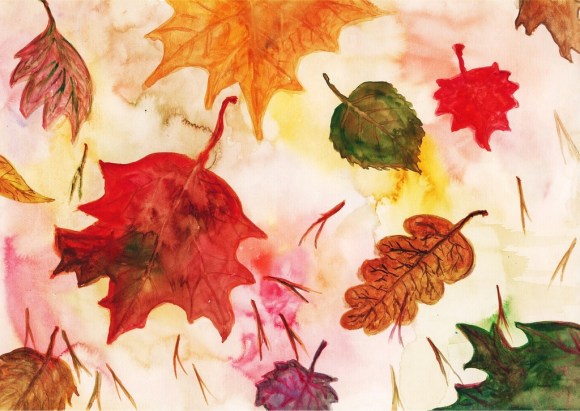
Today it was the swirl of leaves in the gutter,
Thanks to the wind and the rain.
A casual glance – it’s trash, refuse.
A job for someone and I don’t know who.
Then, my better angels look more deeply – closer,
I see the leaves as an integral part of my environment.
They’ve done a lot the leaves, growth, shade, seeds.
Now an even bigger contribution.
They will help the next generation to sprout and grow and produce seeds.
Next year there will be more leaves in the gutter,
More reasons for gratitude.
Thank you!
From Public Domain
Ron Pickett is a retired naval aviator with over 250 combat missions and 500 carrier landings. His 90-plus articles have appeared in numerous publications. He enjoys writing fiction and has published five books: Perfect Crimes – I Got Away with It, Discovering Roots, Getting Published, EMPATHS, and Sixty Odd Short Stories.
.
PLEASE NOTE: ARTICLES CAN ONLY BE REPRODUCED IN OTHER SITES WITH DUE ACKNOWLEDGEMENT TO BORDERLESS JOURNAL
What if I tell you that History is my neighbour? It would sound like hyperbole to a lay person. But if you are a resident of the historic and expansively beautiful urban area of Hazratganj that is the heart of the city, it will seem a shorthand for reflections in time.
Hazratganj is a state of mind, not only a piece of land stretching across kilometres and hosting the best that humanity has to offer, whether natural or man-made, including the Imambaras, gardens and riverfronts and gateways that define Lucknow as also the mass of commercial institutions, cultural centres and culinary establishments elevating its profile as a diverse area of activity.
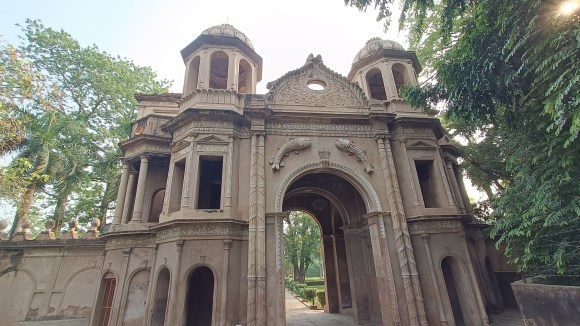
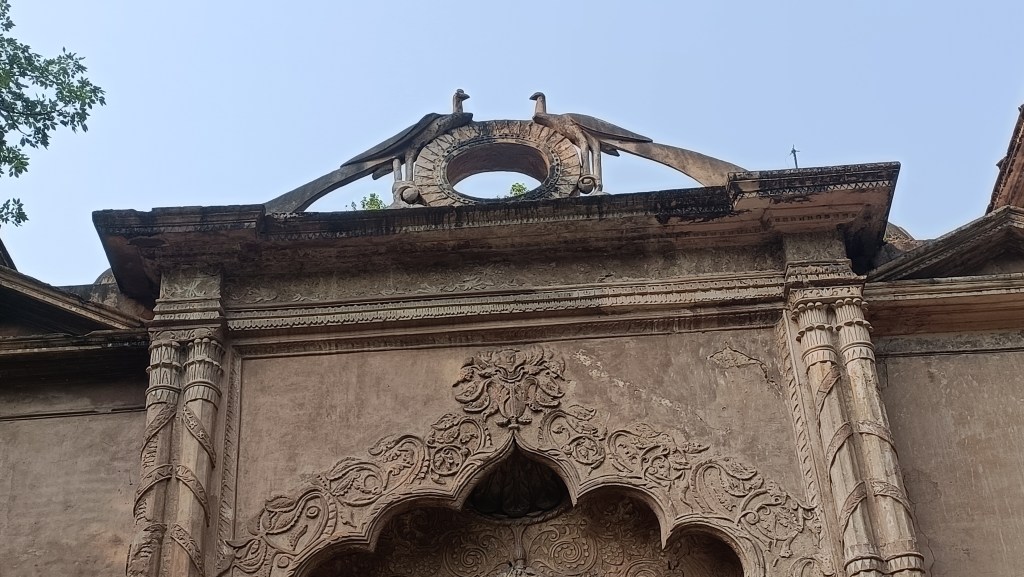
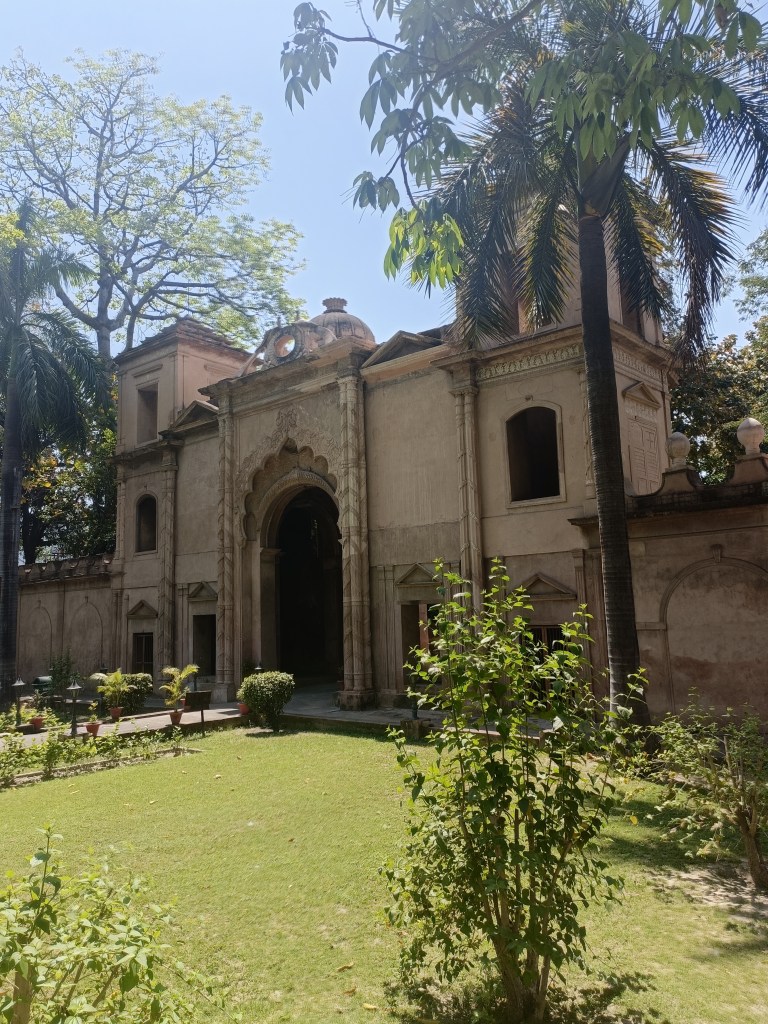
In this beautiful centre of a glorious city lives yours truly and one of the most evocative of the historic gardens dotting Hazratganj also happens to be a mere five-minute walk from his home. I’m talking about Sikandar Bagh, a garden complex that is a sight for sore eyes and retains history in its structure, with lime yellow walls of lakhauri[1], a beautiful gateway bearing the city’s fabled fish symbol and a pagoda style arch signifying the melange of influences in its multidimensional whole.
The domes and ramparts retain the haunting afterglow of history but also the dark days that led to its tragic unraveling.
Built around the mid 1840s by Nawab Wajid Ali Shah[2], the great aesthete and ruler of Lucknow, Sikandar Bagh was a private residence, a garden of elegance and a performance art venue made to honour his love for Sikandar Begum, his beloved wife. The intimacy of this saga of love and mutual respect shared between two life-partners is reflected in the way the place comes alive for any visitor. There’s nothing grand here. Yet there’s the gift of verdure, the protection of huge, dome-like trees and remnants of the original structure that reminds us of a place preserved in its handsome inception and prevalence down the ages.
But Sikandar Bagh is a cultural outlier because apart from its blessed beginnings and present serene state, it had also been scarred by the First War of Independence in 1857[3]. This was the site that was used by sepoys of Awadh (a hallowed title for the region comprising Lucknow and its neighbouring districts that continues to this date) to mount their rebellion against British supremacy. This was a private garrison and hiding place in those erstwhile days of November 1857 where the plotting of a historic rebellion took place. History was not kind to the rebels, and nearly all were slain by the colonial establishment. Knowing that the serenity here could hold so much ballast in its open space makes one ponder. To know about this is to understand that we are progeny of these brave and the remains of the walls facing this garden and continuing up till the Shahnajaf Imambara seem to take the toll of all that bloodshed and hurt that lies embedded within these bricks.
Of course, knowing the background is imperative but so is being inured to its beauty. I am an eternal walker, a flaneur, so for me Sikandar Bagh has been a favourite place to revel in the humbling and aesthetic aspects of Lucknow. Sikandar Bagh befits my desire to saunter and take in the bouquet of nature.
*
It’s been my morning ritual to be comforted by the breeze, swayed and lulled to satisfaction with the lullaby of the trees within its compound and behold a distant beehive in the tallest Goliath among these ancient trees, looking at nestling birds and squirrels in the lower branches of their trunks.
As I write this after a brief stroll in this garden on a pleasant Sunday afternoon, the summer seems to have been evoked to spread its sunny yellow carpet with mellow repose instead of scorching us with humid darts and blows.
The thing with Sikandar Bagh is that history is alive here but also a natural companion. Always the silent, sturdy type, an occasional morning walker or casual passers-by make for rare sights inside its premises in the early hours. It always makes me feel like the chosen one, allowed to roam its length and breadth, making it a regular haunt.
*
A lot of times while going from one place to another, I see young people seated on its green benches, relieving themselves of their pressures and sometimes enjoying a quiet meal here. I also look at people who, besotted by its unique beauty and structure, walk leisurely and photograph its stretches. Their eyes register the special place it holds for them.
Today, Sikandar Bagh is overseen by the Archeological Survey of India. Around early 2022, it commissioned a refurbishment that restored its walls, ramparts with the lakhauri , a far cry from the concrete jungle that is an urban reality in the modern era.
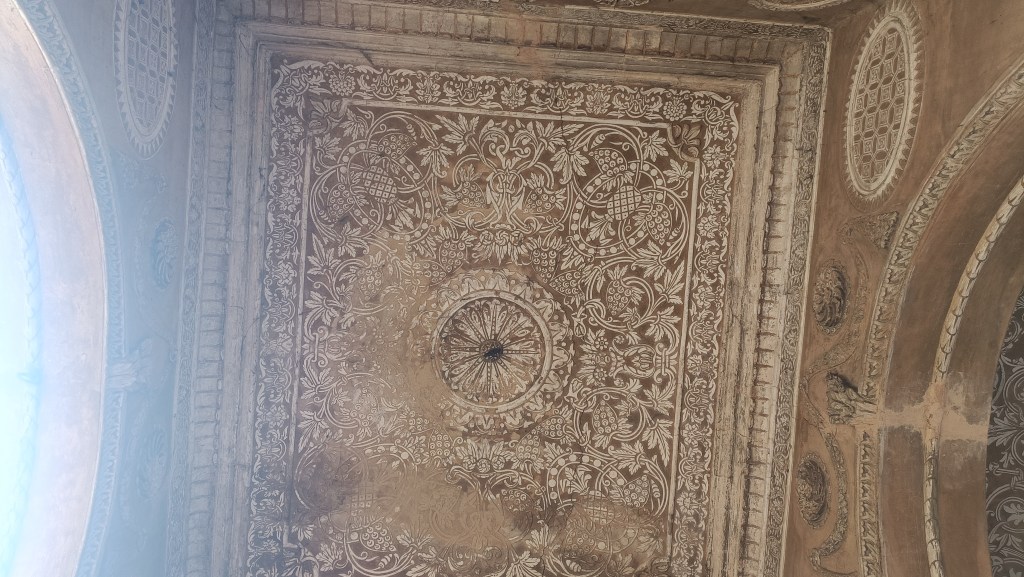
It always comes down to these columns, frescoes, ramparts, a humble mosque within this secular compound, the pavilion signifying what once was an open theatre and the palatial remains, all blended in the unique textures and colours of centuries; worn out by time but never denuded of glory, a stark yet humbling reminder that Sikandar Bagh is a labour of love. Writing this, I am enchanted by its gateway’s peacock iconography, how they seem to call out to the actual birds who visit from the neighbouring Botanical Gardens premises facing this little slice of verdure and architectural wonder.
I inhale the sights, simultaneously rattled by the annoyance of traffic outside its main gate intruding upon its peculiar, unique position within the heart of the city. Yet I know it’s sealed by a dignified reserve, as if these domes and the gateway spell quietude and ubiquity like the red eyes of the pigeons flying near the roof and peering down its height.
*
Honeybees on the tallest trees here go from the nectar of one season to the next and the sun shades this compound in moods invoking the spirit of a poet in me. It’s so easy to be wrapped in the peace and calm of this open space and its historical representation, so easy to know that creative inspiration fed by such a pleasant source is far from just a fictional device. It is a living, breathing ally to diurnal times.
Being in the lap of nature within cities can be a novel intervention. But my love affair with Sikandar Bagh – my own paradise — never waits for a distinct memento. It came to be from a place of love. It is my composite love for it that makes it stand out.
[2] Nawab Wajid Ali Shah was the eleventh and last nawab of Awadh. His kingdom was annexed by the East India Company in 1856 and he was exiled to Kolkata.
[3] Revolt of 1857: The sepoys – Hindus and Muslims – rose united in rebellion against the British Raj. As a result, the British adopted the weapon of Divide and Rule successfully, and the subcontinent continues to be scarred by the fanning of the same flame to this day.
Prithvijeet Sinha is an MPhil from the University of Lucknow, having launched his prolific writing career by self-publishing on the worldwide community Wattpad since 2015 and on his WordPress blog An Awadh Boy’s Panorama. Besides that, his works have been published in several journals and anthologies.
PLEASE NOTE: ARTICLES CAN ONLY BE REPRODUCED IN OTHER SITES WITH DUE ACKNOWLEDGEMENT TO BORDERLESS JOURNAL
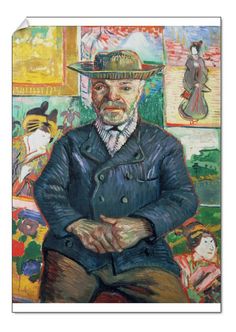
Painting by Vincent Van Gogh (1853-1890). From Public Domain
MY DAD; HE LIKED A WHISKY

My dad; he liked a whisky.
A single malt would do.
Not too much; but sufficient.
Maybe a glass or two.

'Just ample,' he'd always say,
'to see the evening through.'
It was, he would maintain,
a nice pastime to pursue.

'Conversation freely flows
once you've had a few.'
And sometimes I'd introduce
a bottle of something new.

'It's not unappealing,' he'd opine;
as appreciation grew.
He liked a double negative;
enjoyed a double Cardhu.

A touch of water, new flavours
did magically imbue.
He was watchful of my intake.
'Do not think I don't know you!'

Right, of course, as next day
a hangover would ensue.
Finally, that knowing glance.
'Don't say I didn't warn you!'

As the drams, they added up,
so the years they did accrue.
I miss your conversation.
I miss your point of view.

I recall the pipe, of course;
the measured voice I knew.
Now only an empty glass;
an empty bottle too.
Stuart McFarlane is now semi-retired. He taught English for many years to asylum seekers in London. He has had poems published in a few online journals.
.
PLEASE NOTE: ARTICLES CAN ONLY BE REPRODUCED IN OTHER SITES WITH DUE ACKNOWLEDGEMENT TO BORDERLESS JOURNAL
Vasiliki and Nico boarded the passenger steamer for Burgaz Island at Sirkeçi pier at Istanbul. As the steamer moved out slowly from the crowded port, Nico gazed at the dreamy silhouette of this storiedcity where for four days they had woven in and out of lanes and alleys, gardens and markets, prayed in the Greek churches.
They had left Hydra six days ago by boat and bus, arriving in Istanbul after a night spent in Thessaloniki. Now they were off to Vasiliki’s island of birth. He had never been back since his departure at the age of twelve, and the thought of returning excited him. “Look grandpa at the setting sun over Topkapı Palace,” shouted an elated Nico. And indeed Nico’s elation was not feigned.
The cypress trees and domes of the mosques and minarets were outlined against a sky alive with streaks of reddish flames whose reflections could be discerned in the unruffled waters of the Marmara Sea. The crenelated walls of Topkapı Palace undulated eerily in the ruddy, pastel twilight as did the silhouettes of the many domed mosques that embossed the mighty palace with a pinkish tinge. Nico stood hypnotized at the stern imagining himself as part of one of the yarns of A Thousand and One Nights. A sensation of estrangement, of magical transport had arrested his movements. Suddenly a flock of seagulls descended screaming into the wake of the steamer, snatched as many fish as possible and flew off towards Galata Tower, which they circled and circled until vanishing in the evening shadows beyond the hilly banks of the Bosphorus Strait, the yalıs[1], Dolmabahçe[2] and Berlerbeyi Palace.
“A fairytale city, Nico.” Vasiliki said, interrupting his grandson’s spellbound state.
“Yes, grandpa. It looks like one of the coloured pages of my A Thousand and One Nights.”
Vasiliki chuckled. “Perhaps it is, my boy.” And they both contemplated that marvellous city until it, too, disappeared under the orb of the sea …
They disembarked two hours later …
“Burgaz ,” sighed Vasiliki, stepping foot on to the soil of his birth. He took Nico’s hand and hurried him from the throngs of the port into the quiet of the main plaza where the statue of Saït Faïk greeted them. “There he is, Nico, one of the finest poets and short-story writers of the Turkish language.” Nico moved closer :
“He looks very thoughtful, grandpa. What do you think he’s thinking about?”
“That’s a good question. But for now we have to get a horse-drawn carriage to Zorba’s home before nightfall.”
For some unknown reason Nico’s thoughts roamed back to his Nefteli. “Do you think the Nefteli lay anchor at this island on her voyage to China, grandpa?” Vasiliki knitted his brows.
“I’m not so sure. She would have taken a more westerly route.” Nico nodded, unable, however, to imagine his beautiful Nefteli never having moored at this beautiful island with such a famous poet standing so thoughtful in the middle of the plaza. Whilst the boy ruminated these thoughts, Vasiliki hailed a horse-drawn carriage, and in broken Turkish directed the driver to take them to Soknar Sokak [3]located on the western side of the island.
“You speak good Turkish, grandpa,” Nico commented.
“My parents spoke it at home, but when we left Burgaz to settle in Greece, they chose to speak more Greek than Turkish. The Greeks never took a liking to us Greeks who lived in Turkey.”
“Why?”
“Oh, that’s a long and sad story. I’m too happy to be here on Burgaz to tell you now.” So Nico was left unsatisfied. “My brother’s friend’s name is Zorba,” Vasiliki continued. “He’s in the textile business in Istanbul. He comes to Greece often. His wife died two years ago and now lives alone in a big villa on a hillside overlooking the sea. He’s very wealthy and in his spare time writes poetry.”
“Like Saït Faïk?” Vasiliki puckered his lips.
“No one can write poetry like someone else, Nico. If that happens, it’s like imitating a poet’s poems and you shouldn’t do that. Anyway, you’ll soon meet him. And you’ll also meet my father’s friend Abi Din Bey, a Turkish Alevite who lives down on the beach. He knew Saït very well. He writes poetry, too. I remember one of his verses: ‘I wished to smell a rose./It feigned reluctance./No, it said, bring my scent …’ Oh, I forgot the rest.”
“But why did the rose not want to be smelt?” asked Nico curiously.
“I have no idea, my boy. It’s only poetry. Besides, I’m a fisherman, I haven’t had much instruction on those things.” And on that unscented note, Nico espied a flock of seagulls chasing the early evening cloudlets galloping far off towards the East.
They arrived. Vasiliki paid the driver and up they climbed a long flight of wooden stairs through a well-kept garden of intoxicating scents. Above them loomed a massive sun-bleached white, wooden pillared portico, above which rose three-balconed stories, surmounted by two towering turrets in the middle of which spiralled even higher a fretted gable. Nico stood awestruck as if he had come upon one of Zeus’s palaces. A minute later a huge, flabby-faced, moustachioed man burst through the front portico door to greet them in broken Greek.
“Welcome! Welcome! Come into my humble home, please,” Zorba gesticulated theatrically, dragging both guests into his home, which in the eyes of his two guests was far from humble …
Dragged I say through the lofty portico whose colonnade must have counted over twenty Doric-like pillars, then into a vestibule at the end of which a floating double staircase wound breezily above a bubbling marble fountain then on to a cambered, U-shaped landing bedecked with azaleas, wisteria and dwarfish palm plants. Hanging on the walls of the vestibule and the cambered landing were landscape paintings and several stately portraits. Zorba immediately escorted them into a brightly lit drawing-room whose frescoed ceiling teemed with Greek heroes and from which a shone a gigantic chandelier. Deep velvet-red draperies afforded a nineteenth century posh atmosphere, an atmosphere of opulent repose. They were seated on a plush, baize-covered ottoman. Refreshments were hurried into the room by a maid, set delicately on a superb pearl-inlaid coffee-table.
“Welcome to Burgaz, Vasiliki and Nico,” Zorba beamed, delicately seeping a large glass of mango juice. “Where will be your first visit if I may ask?” Vasiliki set his mango juice down, licking his lips.
“To Abi Din Bey’s beach home,” replied Vasiliki.
Zorba frowned. “Rather a shabby place his cabin on the beach,” he retorted gruffly.
“Perhaps, but I must see him. You know, he was a very good friend to my father.”
“Yes … yes, of course,” grumbled Zorba, ostensibly displeased at the mention of the beach comber. “Whatever ! You are my guests here and may stay as long as you please.” He looked at Nico affectionately: “What a wonderful adventure for your grandson. To relive his grandfather’s and father’s past …”
“And who knows, Zorba … perhaps his future …”
Zorba, a bit puzzled by that remark, smiled a gold-toothed smile, nevertheless. The smile seemed to set his well-fed, pasty face aquiver.
“Excellent, Vasiliki. But now we must dine.” Zorba ushered his guests into the tapestry-hung adjoining dining room where a long table had been set with all the delicacies that Burgaz Island could offer : sumptuous mezes[4]: stuffed vine leaves, eggplant caviar, marinated red peppers, homus[5], followed by lentil soup, fish and köfte[6]. This gargantuan meal terminated with strawberry sorbet and künefe[7].Two hours laterVasiliki and Nico sat back in their red upholstered chairs utterly exhausted.
Refusing any liquor, Zorba showed his guests their enormous room on the first floor whose bay-window overlooked a dark stretch of forest which gradually merged with the slow-moving lights of the steamers and cargoes on the Marmara Sea. Vasiliki and Nico, after unpacking, fell asleep as soon as their heads touched the pillows.
They awoke at nine o’clock, washed and rushed down the elegant, floating staircase for a quick breakfast. They ate alone, Zorba having breakfasted very early in order to meet customers in Istanbul, so said the maid. They set out for Abi Din Bey’s beach home, a half-hour’s walk down a winding path through the wooded hillside.
The sound and smell of the sea below, the laughing seagulls above thrilled Nico with an unequivocal joy. He felt drawn into an adventure. Once on the beach, they veered to the right and in two or three minutes stood at the Alevite’s welcoming gate, open to all and sundry. Charging out of the front door of a flat-roofed, one-storey little house, a handsome, stalwart, balding man greeted them with so many handshakes and kisses on the cheeks. He led them inside his three-room home, built under an arching rock shelf, overhung with a thick network of running vines and bougainvillaea which dangled over the front walls of the house.
Nico was astonished at all the books strewn on the rug-covered floor or lying open on the arms of a worn-out sofa. A low, wooden table, where a tea-pot and glasses had been set, comprised the rest of Abi Din’s ‘drawing-room’ furniture. The walls lay bare of pictures and the two front pane less windows bore no curtains. One naked lightbulb hung limply from a rafter. Nico, seated on the sofa, stared at the bareness of Abi Din’s abode. He could not decide whether the poet lived in poverty or simplicity.
As if reading his thoughts, Abi Din Bey, who had since served them black tea, said in his deep, authoritative voice: “Simplicity remains the poet’s true companion. All he needs is the whistling of the wind, the lapping of the waves, the rustling of the leaves. The true poet touches reality with his or her ears more than the eyes before voicing that reality, poetically. But I will acknowledge that the poet opens his or her senses to the moon at night and to the horizon-filled fishermen tossing their nets at the edge of the briny sea in the day.”
“You have been afflicted with Saït Faïk’s poetic madness,” laughed Vasiliki, translating his friend’s words for Nico.
“Anyone who came into contact with Saït became a poet … good or bad I am not to judge ! Who else listened to the talking seaweed or the weeping mussels?” Vasiliki agreed with a nod then translated for his grandson.
“Grandpa, how can seaweed talk and mussels weep?”
“Well, poets can hear things that we cannot, Nico.”
After tea, Abi Din Bey led them out to his front garden where the fragrances of oleander and honeysuckle muddled Nico’s imagination, already running amok due to all this talk of weeping mussels and talking seaweed. Out beyond the wooden fence the glint of Marmara glowed turquoise.
Vasiliki and Abi Din Bey spoke of Vasiliki’s father and grandfather, of a time when Burgaz bathed in a mellow light of unruffled peace and perfumed tranquillity. “And now look — Istanbul’s ‘hippies’ camp on weekends in the forests and on the beaches littering, smoking and drinking. Tourists swarm the island as if it were la Côte d’Azure. If Saïk or your father were alive … “ Abi Din Bey would repeat … but would never finish …
Towards late afternoon after a pleasant nap in their host’s hammocks, Vasiliki and Nico left Abi Din Bey to his domestic chores to stroll along the beach, avoiding the vast wracks of seaweed. “Let’s walk up to the Monastery of the Transfiguration on Bayrak Tepe,” Vasiliki suggested. “It’s the highest spot on the island. The monastery was built in the XIXth century and has never changed, so my father told me. We can talk to the Pope and his wife, they’re Greek … well, Turkish Greek.”
“You said there’s a difference, grandpa.”
“You see, the Greeks who came from Turkey to settle in Greece were never really liked by the Greeks because of their way of speaking Greek and their Turkish customs.”
“Why?” the boy insisted. But at that moment they halted in their tracks. A shirtless and shoeless man was busy erecting little pyramidal piles of stones here and there on the beach. Before Nico could enquire about this curious occupation the man turned towards the sea, opened his muscular arms wide, and in an eerie, sing-song voice chanted:
“Women light the lamps of spirit with a blue light as they warm up coffee.
During the nights, in the darkness, on the peak of a mountain
a miller, his eyes closed,
sleeps, face down.
Villagers would come
To sell their copperware at the market,
To sell yogurt.
A naked child, begging in the street, was knee-deep in snow.
The man turned his back to the sea and resumed his Sisyphean labour …
“What did the man chant, grandpa?”
“A poem by Saït, I think. A sad poem. You know, the life of a fisherman is not easy, but the life of a poet is not to be romanticised. Outwardly life may seem merry and bright. But deep inside, Nico, a poet’s lot is not to be envied. Saït’s short stories and poetry are filled with solemnity. Zorba thinks he understands this solemnity. Abi Din Bey is less pretentious; he leads a simple, lonely life and reads Saït for comfort. This solemnity has offered him a gratifying livelihood. He liked Saït so much and sought his companionship. But Saïk chose alcohol for a companion. Abi Din is a religious man, he doesn’t drink alcohol. Alcohol should never be a poet’s companion.”
Nico said nothing as they trudged up Bayrak Tepe to the Greek monastery, where after tea and honey cakes with the pope and his wife, they hurriedly trekked down the opposite side of the island, keeping the sea to the right. Two hours later they reached Zorba’s hillside home before nightfall. The sky blazed a crimson red as the sun set under the waveless Marmara.
Dinner having finished, Zorba and Vasiliki were served wine in the drawing-room and Nico a glass of lemonade. Zorba, exceptionally cheerful after a fruitful day in Istanbul, stood, poured himself another glass of wine and recited a few verses of his poetry :
“Honey is certainly a special nourishment;
Is truly medicinal.
He who eats honey thinks soundly;
He who does not, thinks ignorantly.”
Zorba sat down absorbed in the silence of his guests. “How I try to imitate Saïk,” he sighed at length.
Zorba placed a pudgy hand to his heart: “Poets live to write and not write to live.”
Vasiliki agreed, heard the grandfather clock strike midnight, yawned and sleepily suggested that they be off to bed. Zorba acquiesced, promising a few more strophes the following night. A weary Vasiliki smiled perfunctorily …
Waking up with the larks, Vasiliki and Nico were served breakfast. Zorba had again left for Istanbul very early. The two tourists walked to the centre of town to visit Saint John the Baptist’s[9] church, then Saïk Faïk’s house-musuem and gardens. Saït’s former two-storey, balconeyed home rose into the blue island sky, the gable rising even higher than the palm trees that served as sentinels. The gardens were similar to Zorba’s — exceptionally well-kept. Inside, Nico was taken aback by the refined taste of the poet’s family: the exquisite, velvet cushioned chairs and sofas, the poet’s private library where many bookshelves contained poetry magazines, dictionaries and novels in Turkish, French and Greek. Nico surmised that the poet was a studious man.
“A very well-educated man,” whispered Vasiliki. “He translated too. His knowledge of languages inspired his short story and poetry writing.”
“Do you speak French, grandpa?”
“I’m afraid I don’t, my boy. You know, I’ve had little instruction. But you, Nico, look at those leather-bound volumes ; you may become a boat-building poet someday if you work hard at school.”
Nico’s little round eyes glowed a brilliant glow. How he loved to read, to touch the crispy pages of a book, to smell the print and paper. Spellbound by all this literature, he suddenly heard a fey voice :
The mysterious voice trailed off. Nico searched the room frantically for his grandfather. There he stood in front of a hanging portrait of Saït Faïk.
“Grandpa.”
“Yes, my boy.”
“I would like to be a poet.,” Nico asserted.
“A boat-building poet?”
“Yes, write poems and short stories like that man hanging on the wall. He has such a handsome face … a kind, smiling face. He must have been a gentleman.”
Vasiliki nodded. “I’ve no doubt he was. Those eyes speak the tremors of his soul, a soul filled with the love of life, all life : mineral, animal, vegetable, human.”
Nico screwed up his eyes which met those of Saït’s, a deep blue like the sea. Laughing eyes, like the seagulls’ … Five minutes later they stepped into the blazing Burgaz sun, white white …
The rest of the morning and afternoon was spent in Abi Din’s front garden, drinking tea, chatting about Burgaz fishermen. They ate grilled-cheese sandwiches and sardines for lunch.
The loquacious Abe Din turned to Nico: “A poet’s life has its highs and lows. It’s best to keep to the middle, no jealous rivals to spread scandal, no avaricious publishers to milk you like a cow. Thieves, all of them ! Just write poems, Nico. Don’t waste your energy on market reception, critic’s reviews or what publishers expect from you. Your poems speak for themselves. And do you know why ?”
Nico did not know why for two reasons: he couldn’t understand Turkish and he never wrote a poem. The animated man continued, nevertheless: “Because you organise the movement of the poem with your own voice, a poem is an activity not a product. Poems make poetry; poetry does not make poems. A poet has no regards for schools of poetry, for modes of poetry, for signs-of-the-time poetry. Writers of poetry express the signs of their times; writers of poems suggest images of untimely inspiration. Writers of poetry idolize poetic forms ; writers of poems organise their poems subjectively, free from poetic occult pedantry and cryptic complexity. Listen ! Listen to those outer and inner inspirations.”
Vasiliki translated his friend’s fiery tirade as best he could and when Nico had understood the ‘Listen! Listen!’ The obedient boy listened even harder. Abi Din Bey’s voice rose higher: “A poem is first heard in the heart then expressed by word of mouth or on paper. Open your ears wide, Nico, open them wide!” When those last words of wisdom were translated, Nico attempted to open his ears as wide as he could. It was not an easy task, much harder than opening his eyes wide …
When the sun began to set Vasiliki and Nico bid farewell to the poet, promising to return the following year. Little did they know that the solitary poet would pass from this world in the near future …
They spent four more nights as Zorba’s guests eating like kings, listening to their host’s business conquests and after-dinner poetry over a glass of wine or lemonade. They left Zorba on the long flight of steps, he waving good-bye with a pudgy hand as the horse-drawn carriage bounced his guests up and down towards Burgaz pier.
“Grandpa, I’m going to work hard at school and read Saït Faïk’s short-stories and poems.”
“We’ll find translations of them, Nico. I told you that Burgaz Island plays strange things on people who come here. Her soil inspires us. Her energy rises from the core of the earth into our hearts and spirits. Burgaz possesses a mystery that no one has ever solved.”
“Not even Saït Faïk, grandpa?” Vasiliki scratched his white beard.
“I have no answer to that one, my boy. Maybe he did solve it. Poems and stories were his livelihood, like my fishing, a daily labour of love and effort. Perhaps someday you’ll solve the mystery of Burgaz.”
“By boat-building and writing poems?” Vasiliki gazed up at the circling seagulls.
Nico was not sure. Meanwhile, ahead lay the pier and the steamer now steaming into port, smoke bellowing from her stack. Ropes had been thrown down to moor her as passengers straggled off and on. Grandfather and grandson rushed into the vortex of that rolling movement and disappeared within the bustling throngs …
[1] Wooden mansions or villas along the Bosphoros Strait.
[7] A sweet dessert made of angel hair, (kadaif), cheese, butter and topped off with honey sirop and crushed pistachios.
[8] Losely translated from ‘Bir Zamanlar’ ‘One Time’.
[9] Iohannas Prodromos in Greek. It was built in 1899.
[10] From Sait Faik’s poem ‘Masa’ ‘Table’, partially translated.
Paul Mirabile is a retired professor of philology now living in France. He has published mostly academic works centred on philology, history, pedagogy and religion. He has also published stories of his travels throughout Asia, where he spent thirty years.
.
PLEASE NOTE: ARTICLES CAN ONLY BE REPRODUCED IN OTHER SITES WITH DUE ACKNOWLEDGEMENT TO BORDERLESS JOURNAL
The spin of a shuttlecock The thwack and strum as it is slung Across the court, across the air Sieving light, writes moments in the eyes Of those at the right place, the right time The next time you are there See it spin, see its arc
Arthur Neong hails from Malaysia and taught for eleven years before doing his MA in Creative Writing. He finds poetry and short prose capture essence like nothing else.
.
PLEASE NOTE: ARTICLES CAN ONLY BE REPRODUCED IN OTHER SITES WITH DUE ACKNOWLEDGEMENT TO BORDERLESS JOURNAL
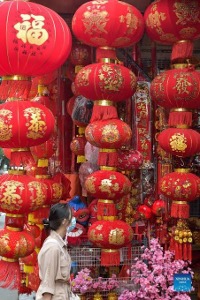
The moment the calendar flips to January, Jakarta undergoes a transformation, almost as if it’s washed anew, like one’s gazing at the city through rose-coloured glasses. Although Chinese New Year normally falls in February, the city wastes no time in dressing itself at its festive best, akin to a newly wed bride right from the beginnings of the year itself. The streets glow with the soft, warm hues of red lanterns swaying gently in the tropical breeze, intricate golden motifs adorning shop windows shaped in Chinese characters signifying good health and luck, ah! and of course the unmistakable notes of celebratory music drifting through the air. For a few short weeks, Jakarta doesn’t just celebrate Chinese New Year—it embodies it.
Growing up in Jakarta, yet hailing from Indian descent, I was always fascinated by how this festival seemed to take over the city, outshining even the likes of Christmas in its grandeur. To an outsider, Jakarta in February might feel more like Shanghai at its prime than the capital of the world’s largest Muslim-majority country, however the fabric of Chinese New Year is woven into the hearts of people across the country.
Photos provided by Eshana Sarah Singh
Jakarta’s shopping malls—already known for their extravagance and avant-garde ambiance —take it up a notch during this season, pull the notch all the way up really. Grand Indonesia, Pacific Place, and Central Park become galleries down the streets of metropolitan Beijing, displays of Chinese artistry adorn the walls, with colossal dragon sculptures wrapping around pillars, cherry blossom trees dotting atriums, and enormous red envelopes symbolising prosperity displayed in elaborate installations. At Pantai Indah Kapuk, a neighbourhood known for its Chinese-Indonesian roots, the neighbourhood where I grew up, restaurants overflow with families indulging in yu sheng (a prosperity toss salad) and steaming platters of shumai (dumplings) wafting their aromas into the air.
Photo provided by Eshana Sarah Singh
In Jakarta’s very own Chinatown, Glodok, the roads are chock-filled with movement, cacophonous and chaotic but so vibrant. Red flags with auspicious messages printed in gold are hawked by vendors, temple incense wafts by getting ever-stronger with murmurs of chanted prayers for prosperity and riches along the roads.
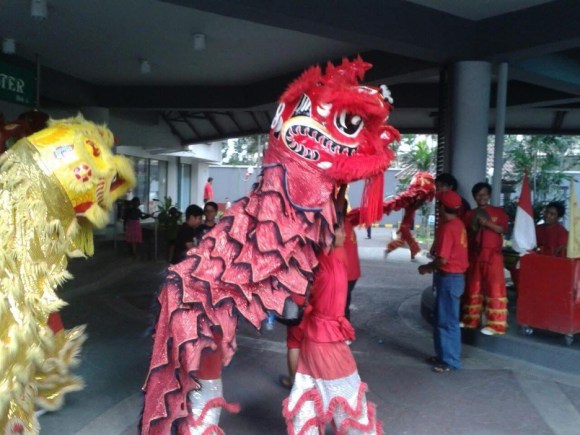
The sound of drums boom so loud that the ribs vibrate, that the very ground trembles beneath one’s feet, proclaiming the onset of the Barong Sai—an ancient lion dance with movements so fluid and gracious that they can’t help but draw eyes passing by. Their beauty, yet further enhanced by the resonant clashing of cymbals, is in theory supposed to ward off evil spirits and usher in prosperity; this tradition infact predates the existence of most civilizations.
Lion Dance. Photo provided by Eshana Sarah Singh
Amidst all this festivity, I am reminded of the countless Chinese New Year’s I’ve spent in school growing up and lessons from my Mandarin teacher, whom we affectionately called Laoshi or teacher.
Tha author and her Chinese teacher. Photo provided by Eshana Sarah Singh
“Laoshi, I remember you used to tell us about all the dos and don’ts of Chinese New Year,” I chuckled, eager to hear her insights once again.
She chuckled. “Ah, yes! There are many, and each family follows different ones, some only specific to them. But some are universal. For example, never sweep the floor on the first day!”
I laughed, “Why is that again?”
“Because you will sweep away all the good luck for the year of course! The same goes for washing your hair—avoid it, or you will wash away your fortune. And of course, you should wear red. It brings happiness and wards off the Nian monster.” It seemed a lot of the superstitions absurdly revolved around washing, but then again they’re superstitions so perhaps logical reasoning wasn’t the best path forward.
“What about food? Are there any specific dishes that must be eaten?” I asked.
“There are actually, eating fish is a must because the word for fish in Mandarin sounds like ‘surplus,’ which is meant to bring in abundance for the coming year. And you can’t forget about tangerines as well, have you ever noticed how they’re only ever sold during the Chinese New Year? Their name sounds like ‘luck’ in Mandarin, so people always exchange them with family and friends. I think by now you can guess why,” Laoshi chuckled.
She paused slightly, her voice wavering and tone turning nostalgic. “You know, in Indonesia, many Chinese-Indonesian families have developed their own unique traditions, which are understandable; traditions are never truly the same in a place that’s not their own. But this way at least there’s something for everyone. For example, we still hand out angpao, the red envelopes filled with money, but nowadays, some people send them digitally! Would you believe it?”
Wading through the bustling streets of Jakarta in the days leading up to the New Year, the tension, the excitement, the wait was palpable in the air. I noticed how the celebration was not confined to Chinese-Indonesian families alone, it was a time for all of us. Malls showcased extravagant public performances, offices hosted small celebrations, every building was decked out in red from head to toe and even my non-Chinese friends, including me of course, joined in by donning red and sharing greetings of “Xin Nian Kuai Le1.”
Indonesia’s long history with its Chinese diaspora has not always been smooth or friendly for that matter, but in these moments of collective celebration, one realised how some moments were made better when shared with everyone. Chinese New Year in Jakarta is not just a cultural event—it is a national one really.
As traditions evolve, so does the way Jakarta celebrates. Some things remain timeless, temple visits, family reunions, and Barong Sai performances, however that does not mean new customs are not emerging. Metropolitan city dwellers now send digital angpao via apps, families opt for lavish dinners at high-end restaurants instead of a table chock full of home-cooked feasts, and social media becomes a hub for sharing well-wishes and festive experiences, because the wishes of luck and prosperity transcend the miles that separate us. Taking in the sea of red around me, the rhythmic drumbeats, and the air filled with the scent of incense and festive feasts, the very grandeur of Chinese New Year in Jakarta, I know that no matter where life takes me, this festival in this city will always feel like home.
Eshana Sarah Singh is a media and journalism student with a passion for storytelling, blending authentic personal experiences with rose coloured lenses to ultimately explore diverse and untold narratives that chart off the beaten path.
.
PLEASE NOTE: ARTICLES CAN ONLY BE REPRODUCED IN OTHER SITES WITH DUE ACKNOWLEDGEMENT TO BORDERLESS JOURNAL.
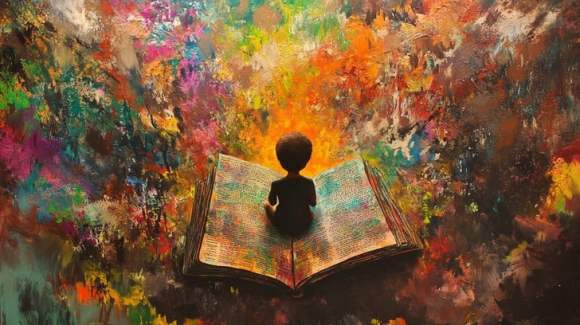
Look how elegantly I have been made, Like a polished gem. My pages contain a story, An inspiring life, a historical fact, A theory, a discovery, and so on. At least, this is how I am marketed. The world chases me whenever they need Validation, wisdom, or reference. Is it because the monks and wise men Are nowhere to be seen? Is it because there is an overload of opinions And false information everywhere? Am I relevant because people are Always confused about what's right? Despite there being many of my kind, We stay unread on the bookshelf, Waiting to be discovered.
A HOUSEMAID
I leave my home to clean others’ houses. An angry and restless man, my homeowner wants me To clean every corner of his house—the grime on the floor, The kitchen, the windows, the shelves, and so on. The unhappy homeowner forces me to work late. But there’s one place that I fail to clean: his mind.
THE DUSTBIN
My purpose is to live in a corner, eating garbage, Without friends, family, or relatives near me. Unlike the vase or the showpiece, no one Bothers to dust me or keep me clean. Sometimes, humans stuff my mouth with leftovers Until I feel choked. What can I do, other than swallow my destiny?
Niranjan Aditya is a student from Bangalore. His work has appeared in Kala Magazine, UK and the anthology, Rain and Laughter.
.
PLEASE NOTE: ARTICLES CAN ONLY BE REPRODUCED IN OTHER SITES WITH DUE ACKNOWLEDGEMENT TO BORDERLESS JOURNAL.






 Borderless