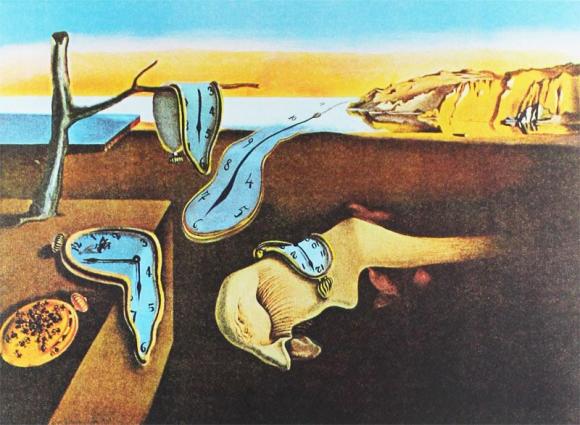
Art by Salvador Dali (1904-1989) From Public Domain
Soon, there will be nothing left to see.
One drop in the ocean - my imagination -
Walking past shards of disjointed memory
May kindle a profane, unkindly creation.
You meant more to me than I ever said;
Approving lesser still of what lay ahead.

Since you never asked for black and white,
Our paths may have crossed to some extent.
Well, you seem unobsessed. If you ever fight
My memories, unjaded and thus unspent,
Your voice will not crack. You'll choose to see
All my flaws for loving you unconditionally.

Seeing you then, I broke down in tears.
Opportunity knocked, as if in a dream.
What could I do? Despite the safety of years,
My mind still aches when rushing upstream.
Your memories come back to me, unasked.
And I find myself traversing to the past.
Mohul Bhowmick is a national-level cricketer, sports journalist, poet, essayist and travel writer from Hyderabad, India. He has published five collections of poems and one travelogue so far. His latest book, The Past Is Another Country, came out in 2025. More of his work can be discovered on his website: www.mohulbhowmick.com.
.
PLEASE NOTE: ARTICLES CAN ONLY BE REPRODUCED IN OTHER SITES WITH DUE ACKNOWLEDGEMENT TO BORDERLESS JOURNAL
Samridh had always dreamt of standing atop the mound of Moosa Bagh for the last four years. His good friend Kabir had so animatedly filled his head with its haunting, almost transcendent images that Sam was engrossed by its structure, its history and the sheer fact that it was located in the most “silent parts of the city’s outer realm”. This made the place seem unattainable but also something to hold close to memory.
Kabir filled Samridh with the essence of Lucknow’s quintessential wonders and took him to a few of these “outposts”, sturdy sentinels who had seen decay and ruin and could even possibly be forgotten by the city’s dazzling archive that only focused on the centre. Sam now wanted to visit Moosa Bagh at any cost. He even expressed the desire to explore it all alone. Something about a mostly ruined but still beautiful archeological anamoly was deeply attractive to him.
It was the first week of August. It was an inclement day. Kabir was accompanying Sam. As soon as they took the left turn from Hussainabad ahead of the Bara Imambara and Rumi Darwaza, the sea of classically constructed mansions as old as Time’s curves and twitches, shops spanning the panorama of generations, mosques, temples and commotion that could be intercepted from the flanks of the new flyover made him giddy. If this was a quiet expanse, it wouldn’t be the same. The mass of humanity was the bloodline of the old city and nobody could truly fall prey to anodyne loneliness within these streets and lanes, not one angle bereft of sound and sights. No other place could make him inhale the aroma of sheermaals, kababs and biryani from the sea of eateries. No foreword could prepare him for the colours and shapes of the vegetables being hauled and taken out of the Dubagga Sabzi Mandi[1]— not one crackle of feet and wheels on the road or the cacophony of voices seemed to bother him. He was looking at it all for the first time, taking in the splendour of an area he had never set foot in before. Most impressive was the electrical tower which was almost shaped like an ubiquitous monument in Paris.
But soon the commotion cleared and the roads became more accommodative. They breathed in fragrance of the fresh air. The disappearing outline of buildings suggested that Moosa Bagh was near. Sam saw the open land in front of him as the car slowly made its way towards the mound. There was no human presence here except a young man on a bicycle. The land was mostly barren but little growths of plants and grass were still everywhere. It was the monsoon that kept its promise of verdure. Sam took a deep breath because as soon as he shifted his gaze to his left, he saw a dark red, earthy brown texture. Moosa Bagh was a beauty, a theatre of visuals that truly unveiled itself under the hazy sky so that the black stilts on its remaining mossy walls with overgrowth narrated its own saga, not of pain or destruction but something enduring, like Dali’s melting clocks or the moors in Wuthering Heights, or the solitary hills in Anita Desai’s Fire on the Mountain.
Sam gasped, beholding its outer ramparts that had holes like eyes; they could look into a visitor’s soul and read the signs of storm that had been delayed. It was just Samridh and Kabir looking over an ancient well in the compound, feeling the strength in the bricks that had seen glorious times when this was a haven. A spiritual poem seemed to grow out of the structure.
This was exactly how Kabir had come to accept it as the unheralded silent sentinel that perhaps allowed true believers to visit the place, finding in the process that it was not a ghost of the past or an architectural aberration. It was once a palace disseminating pleasure and leisurely journeys. On that day, two men deeply in love with Lucknow touched the tangle of leaves and the heft of twains, their appearance like an elderly person’s head full of grey river currents.
Kabir nodded. Samridh looked at the field of freedom that surrounded this mound, a place up there under inclement skies and reaching the upper realms of open reality with the shapes and contours of an unusual reprieve.
We discard secrets at the end of the line. We keep grinding on whetstones of popular appeal. But there are places and the feelings they evoke that don’t surrender to overestimated beauty or courting excitable crowds. In our world, a city can be oblivious to one sight and can still have the maganimity to send two introverts to its most treasured corners so that they salvage the essence of its history anew. Moosa Bagh is a beneficiary of these second chances. It is a place of charm and exquisite freedom to sensitive young men like Kabir and Samridh. Visits at the end of every month here have solidified their friendship into something greater than the sum of their parts.
At nights, Sam comes to his senses and initiates the same wondrous raptures that came to him on a gusty August afternoon. He is thankful for a storyteller like Lucknow. He feels it in his bones how Moosa Bagh is a symbol of the depths that he had never charted within his little lifetime, so far finding places close to his feet and repeating the same cycle of familiarity. But now going to an outer realm is no longer about being a traveller out of breath or time. He still dreams of Moosa Bagh almost every night, asleep on its mound, kissed by the moon and keeping its eyes in its walls open, telepathically conveying its deepest mysteries to him. Moosa Bagh is a sentinel taking him towards the perpetual road to his beloved city’s inner soul.
Then…Now…Moosa or Musa Bagh is an eighteenth century garden and monument also known as Monsieur Bagh. From Public Domain
*Note: Sam and Kabir are persona taken on by the author and his friend.
Prithvijeet Sinha is an MPhil from the University of Lucknow, having launched his prolific writing career by self-publishing on the worldwide community Wattpad since 2015 and on his WordPress blog An Awadh Boy’s Panorama. Besides that, his works have been published in several journals and anthologies.
.
PLEASE NOTE: ARTICLES CAN ONLY BE REPRODUCED IN OTHER SITES WITH DUE ACKNOWLEDGEMENT TO BORDERLESS JOURNAL
Little fish are transparent in their felicity, darts Rippling over gullies and flat stones, shadows On the sand, flashes of lightning as they hide themselves, My big feet stirring grit and making such a din They cannot hear the gulls’ songs.
And thou art dancing in the shallows, all heart, All joyousness as the afternoon sun follows, Looping over the cliffs at Port Stanvac to dwell Like Neptune in the depths of Gulf St. Vincent, Hymning to the marine throng.
We had swum out to the reef, and were startled By the passage of a shark, no, a dolphin, ogling To know if we were some kind of fish as well: O Nereid! Would that the moment return again, Neither knowing of right nor wrong.
Edward Reilly is a retired teacher and lecturer. His poetry has been published in Australia and overseas, as well as a travelogue, First Snow (2004).
.
PLEASE NOTE: ARTICLES CAN ONLY BE REPRODUCED IN OTHER SITES WITH DUE ACKNOWLEDGEMENT TO BORDERLESS JOURNAL
“We’ll need to do more tests to determine what stage it’s in, but … yes, we’re sure.”
Megan sat motionless, her eyes fixed on the framed photograph of a colorful hot air balloon hanging on the office wall behind the oncologist. She wished it were her who clutched the balloon’s basket rail and drifted away toward the far hills and the sea beyond. But her husband’s grip on her left hand had tightened so much that it crushed her fingers and destroyed her ability to escape.
“I know this is a hard thing to be told,” Dr. Marcum said. “But we can fight this and, with luck, you can beat it.”
Megan managed a weak smile. “I’ve never been very lucky … except maybe marrying Ted and having Kaylee.”
“Maybe we can change your luck.”
“How much … how much time do I have?”
“That’ll depend on the severity of your disease and how it responds to treatment. If it’s localised, with surgery to remove part or all of the pancreas, the one-year survival rate is over 70%.”
“And if it has spread?”
“Well … that’s not good … 10% or less.”
The silence built. Megan let out a deep breath and continued to stare at the balloon photograph.
Ted cleared his throat. “So … so what’s next, doctor?”
“We’ll do PET and CT scans to get a good picture of what’s going on, check the liver and lymph nodes to see if the cancer has spread, do blood tests, and biopsy the tissue. Hopefully, we’ve caught it early; more testing will tell us. But … but you should know that most patients don’t report problems until the cancer has metastasized, which limits treatment options.”
Megan sighed. “Great, more tests and poking around just to narrow down how soon I will die.”
“We’ll do everything we can,” Dr. Marcum said.
“Thank you for that,” Ted whispered.
Afterward, the couple sat without speaking in their Subaru, the early September heat baking them slowly. Finally, Ted started the car and they drove home, taking the long way that skirted the coastline, the Pacific’s green waves breaking hard against the rocky shore.
“So what should I tell Kaylee?” Megan asked.
Ted chuckled. “She’s thirteen going on twenty-five. I think she can handle the truth.”
Megan sighed. “Yeah, she puts on a good act. But she’s still a little girl.”
“If you want, I can talk with her,” Ted offered.
“No, no. I’ll do it. She’s going to know that something’s wrong, especially if they recommend surgery. And then there’s the chemo and maybe even radiation.”
Ted ran his hands through his thinning hair and shivered. “I think we should wait until we know what we’re up against. After the tests we can tell Kaylee the whole truth.”
“Okay. But we can’t wait too long.”
*
The afternoon sun burned golden on the surface of the creek, just above the weir with its steelhead fish ladder. In the distance, the onslaught of Pacific breakers kept up a steady rumble. Megan and Kaylee sat on a bench shaded by a huge oak, taking a Saturday afternoon together, a break from schoolwork for the over-achieving girl, and a secret break from cancer for her mother.
Megan had grown thinner with dark circles under her eyes, testing finished and her first round of chemo scheduled for the following week. She stared at the three elegant male mallards that glided across the creek’s mirrored surface, chasing a lone female.
“I’ve something to tell you, Kaylee. But I don’t want to scare you.”
The girl turned to face her mother. “I think I already know.”
Megan’s eyes widened. “What do you know?”
“I found the test results of your scans and biopsy. You left them on the dining room table last week. I can read, you know. What I didn’t understand, I Googled.”
The two stared at each other. Kaylee’s lips trembled and tears filled her eyes.
“I’m sorry you had to find out that way. We were going to tell you but I wanted to make sure we had all the facts.”
“It’s not good, is it Mom?”
Megan sighed, admiring and at the same time resenting her daughter’s directness. “No, it’s not good.”
Kaylee came into her arms and they sat together in the warm shade, weeping silently. Megan remembered how, when Kaylee was a baby, she would strap her to her front and carry her everywhere, enjoying the warmth and pressure of the child’s body against her own.
“So what happens now?” Kaylee asked.
“Chemotherapy.”
“No … no surgery?”
“You know about surgery?”
Finally, they separated.
Kaylee frowned. “Yeah, people have a better chance of … of surviving it they remove the …”
Megan laid a hand on Kaylee’s arm. “It’s too late for surgery. The cancer has spread. The chemo might slow it down … but not stop it.”
“It’ll make you sick, right?”
“Yes … and I’ll probably lose my hair.” Megan grinned.
Kaylee seemed to ignore her mother’s last comment. She crossed her arms and rocked back and forth. “So … so you’re going to die?”
Damn, there’s that directness, probably gets it from me … and she seems angry, resentful. “Yes, Kaylee, I’m going to die.”
The words seemed to float out across the water into the dappled sunlight. The female mallard madly flapped her wings and flew upstream and out of sight, leaving the drakes alone and probably frustrated.
“But … but you can help me and your father. You will probably grow up faster than normal … and I’m sorry for that.”
“Mom, I’m 13 and I’ve already grown, you know.”
“Yes, yes, I can see that.” Megan chuckled and clutched Kaylee to her.
“I’ll help, Mom. Just tell me what you want.”
“Well for one thing, I want you to study hard in school, make friends, and don’t become some crazy teenager like I was.”
“Sure, Mom.” Kaylee rolled her eyes, paused, and then managed a quiet smile.
*
Their dust-covered SUV bounced along the farm road toward the line of sycamores, oaks, and willows that bordered the creek. Megan winced with every bounce of the car but kept smiling. Over the past six weeks she and Kaylee had developed a bond stronger than before cancer. It took her daughter that long to shed her anger and sadness and come to accept her mother’s condition, well, almost.
“Mom, just what the heck were you thinking with that wig?” Kaylee reached over and tugged on a long curl of blonde hair. “Are you trying to look like Dove Cameron?”
“Who the heck is Dove Cameron?”
“Come on, Mom. Don’t you know anything?”
“Evidently not. I was actually going for Dolly Parton. Always wanted to try being a blonde with big hair. But your father likes … liked my dark hair.”
“My turn. Who the heck is Dolly Parton? Is she that old lady singer?”
“Yes, I suppose she is. But she still looks great.”
Megan pulled the car onto the road’s fringe and parked. A patch of waist-high fennel bordered a drainage ditch.
She turned toward Kaylee. “I think this is a good spot to check. Didn’t you say that the swallowtails like to lay their eggs on fennel plants?”
“Yeah, this place looks cool.”
“Let’s see if we can find some of their eggs, or better yet, the caterpillars.”
Kaylee grinned. “Sounds good. I’ll get the jars and the clippers.”
The two scrambled from the car, both eager to do something that had nothing to do with cancer.
Kaylee moved quickly through the fennel, checking each plant. “I found some, I found some,” she called.
Megan joined her and they stared at two plants where green caterpillars, with black, orange and light blue markings vigorously munched away on leaves, stalks, and fronds. The duo had struck butterfly gold.
Kaylee unscrewed the tops of two quart-sized Mason jars. Megan carefully harvested parts of the fennel plants that held four caterpillars, placed them in the jars and closed the lids that were perforated with holes to let in air.
“That was quick,” Megan said, breathing in deeply, the black licorice smell of the fennel strong in the afternoon heat.
“Yeah. We could take more. But four should be enough for my science project. Miss Jasperson doesn’t want us to disturb nature any more than we have to.”
Kaylee had come to her mother complaining about having no idea for what to do for her eighth-grade project. With coaching from Megan, Kaylee had chosen the raising of butterflies because, “The swallowtails are so beautiful and I won’t have to kill anything to complete it.”
Megan had nodded, feeling that enough death had stared down their family and that maybe studying butterflies could bring them some joy.
“You know, Mom, my friend Tiffany has a butterfly tattooed on her shoulder. It looks really cool.”
Megan scowled. “Did her parents let her do that? Don’t you even think about doing such a thing. Tattoos are forever and you don’t want to mess up your body so early, then regret it.”
“Like you did with that Chinese symbol on your butt.”
Megan chuckled. “Yes, just like that. Time and body changes can be cruel to tattoos.” For a moment she thought that it might be fun to get her own butterfly tattoo, to carry that experience with her daughter to the grave, and maybe beyond.
Before they left, Kaylee took multiple photographs of the fennel plants, some with swallowtail eggs, some with caterpillars. As a freelance graphic artist, Megan had agreed to help prepare display boards and a slide show for her daughter’s class presentation, with close-up photos of all stages of anise swallowtail development.
Returning home, Kaylee set the Mason jars on her partially-shaded bedroom windowsill. The caterpillars proved to be voracious and every few days mother and daughter harvested more fennel for the fattening wigglies to eat. Finally, the caterpillars formed hard chrysalises and began the internal change process of becoming butterflies. Megan felt like she too should curl up and form a shell around herself, pray for change that would allow her to fly, to leave this life as something beautiful.
*
Within a couple of days, all four of the caterpillars had pupated, forming camouflaged green and brown chrysalises.
“How long before they emerge as butterflies?” Megan asked Kaylee.
“I’m not sure … I think just a few days. And some might not make it.”
“That would be sad … to go to all that trouble and never live to fly.”
“Yeah. We just have to keep watch and hope.”
The mother and daughter went quiet and Megan knew that her daughter was preparing herself for a poor outcome. So was Megan.
After about ten days, Megan grabbed Kaylee the minute she returned home from school and hauled her to her bedroom. The two stared at the butterfly jars, grinning. Three yellow and black swallowtails had emerged from their chrysalises and slowly beat their wings to dry them.
“Come on. Grab your cell phone for photos,” Megan said. “We need to release them.”
They returned to the fennel patch and carefully removed the new butterflies from their jars. The insects worked their wings slowly in the Indian summer sunlight before taking off and flitting toward the trees.
“What happens now?” Megan asked.
“They will search for a mate and the females will then lay eggs on the fennel plants. Then everything starts over.”
“You’ve read all about the mating part?”
Kaylee grinned. “Oh yeah. Some male butterflies go through quite a courtship dance, and the actual mating act can last for hours.”
“Sounds something like humans, although I’m not sure about that ‘lasting hours’ part.”
“Mom!”
“Sorry, didn’t mean to embarrass you. So, how long do swallowtails live after mating?”
“Maybe a couple of weeks.”
Megan sucked in a deep breath and turned away from her daughter.
“You okay, Mom?”
“Yes … yes,” she said and dabbed at her eyes. “I’m just glad I’ve had thirteen years with you and more with your father.”
“So am I.”
The duo returned to the car. “So what should we do with the last chrysalis?” Megan asked.
“We’ll keep it. A butterfly could come out in a few days.”
“Oh I hope so, honey. I love to see them flying away.”
*
Days passed, and then weeks. Megan started a second round of chemo that weakened her even further. She spent her time sitting on the front porch trying to read, but mostly just staring at the hills that surrounded the town, hills that turned magically from gold to green after the first autumn rain.
Every day, while Kaylee was at school Megan checked the butterfly jar. Nothing changed and she had the sinking feeling that it never would. Finally, she and Kaylee decided to get rid of the chrysalis to avoid the daily reminder of its fate. After Kaylee left for school, Megan grabbed the jar and shuffled onto the front porch, heading for the car. But she couldn’t think of killing or ditching it, at least not then, the idea was too painful. She opened Keylee’s old toy box, slid the jar inside, and closed the lid, out of sight and hopefully out of her dreams.
The late fall and winter rains settled in, a cheerless time for Megan, with Keylee away at school and Ted at work. She tried contacting her commercial art clients to see if they had any jobs that might distract her from the pain and dark thoughts of the future. But the economy seemed to be stagnant and many of her clients were doing their own artwork using a variety of software tools.
The second round of chemo ended, leaving Megan mostly bedridden. Dr. Marcum didn’t recommend radiation. Ted had hired a home healthcare worker to help Megan take her medications, and to do light housework and provide transportation. Kaylee spent her after-school time doing the same. Winter came and went, the air warmed, the hills glowed greenly, almost like those in photographs of Ireland. The apple tree in their front yard started leafing out. Confined to bed or a wheelchair, Megan spent most of the day watching TV or sitting on the front porch and gazing at nothing in particular.
One afternoon, as she meditated, knowing her passing was near, Kaylee climbed the porch steps and sat on the bench next to her.
“How are you, Mom? You look … lost in some kind of dream.”
“I’m good. I’m good. Just glad to have time with you and your father.”
Kaylee gazed at the surrounding hills then down at the dust-covered toy box resting next to Megan.
“Mom, why’s this old thing still here? I haven’t played with toys since I was little.”
“It wasn’t that long ago,” Megan cracked.
“Hey, I’m fourteen and I was six of seven then.”
“You’re right, that’s half your lifetime ago.”
Kaylee bent down to open the box. At that moment Megan remembered the discarded Mason jar and its unborn butterfly.
But Kaylee was too quick and had the box open and let out a squeal. “What’s this?”
The girl reached down and retrieved the butterfly jar. Inside it, a beautiful black and yellow anise swallowtail beat its wings slowly, trying to dry them before flight.
Megan sat forward in her wheelchair and stared, wide-eyed. “I … I put it there last October, couldn’t bring myself to kill it or just throw it away.”
“Well, I’m glad you didn’t. I can’t believe it lasted that long. Come on, let’s get the healthcare worker to drive us to the fennel patch and let it go.”
When they returned from their last butterfly release, Megan lay smiling in her room, gazing at the walls where Ted and Kaylee had pasted a cluster of swallowtails, cut from prints of digital photos taken for her daughter’s science project.
Kaylee entered and sat on the edge of the bed, excited. “I did some Internet research,” she began. “It seems that a change in light or maybe temperature can make some butterfly pupa go into hibernation, sort of like bears do in winter.”
“Really?”
“I think that’s what happened. It got cold or the light went away when you put the jar in the toy box … and it went to sleep.”
Megan sighed. “We were just lucky that we opened the box when we did.”
“I know, I know.” I’m going to tell my science teacher what happened. It’s so weird and really cool that they can hang out that long in their little shells.”
That evening, Megan lay in her hospital bed next to a snoring and exhausted Ted on his portable rollaway. She thought that her own hibernation of sorts was ending, that it was time to fly. The healthcare worker had given her a full dose of morphine to dull the sharp pain in her abdomen and back. In the dim glow of the nightlight, she stared at the swallowtails on the walls. They seemed to flutter and move in some sort of dance. She felt like she was one of them, having dried her wings, ready for the next stage as the royal purple night closed softly in.
*
“When were you going to tell me about those tattoos?” Erick asked, propping himself up in bed.
“Oh, during our honeymoon,” Kaylee said and laughed. “But neither of us could wait for that. Do you like them?”
“A whole flutter of butterflies across your beautiful shoulders … what’s not to like?”
“My mom got me interested in swallowtails when I was a young girl, got me interested in entomology and how strange and magical the lives of insects can be. And now, here I am with a PhD in Ent and teaching at the university, down the hall from you.”
“And here you are with me.”
“My mom would be happy.”
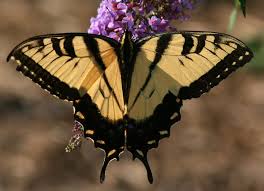
Swallow Tail Butterfly. From Public Domain
Terry Sanville lives in San Luis Obispo, California with his artist-poet wife (his in-house editor) and two plump cats (his in-house critics). He writes full time, producing stories, essays, and novels. His stories have been published by more than 480 different journals, magazines, and anthologies including Folio, Bryant Literary Review, and Shenandoah. Terry is a retired urban planner and an accomplished jazz and blues guitarist – who once played with a symphony orchestra backing up jazz legend George Shearing.
.
PLEASE NOTE: ARTICLES CAN ONLY BE REPRODUCED IN OTHER SITES WITH DUE ACKNOWLEDGEMENT TO BORDERLESS JOURNAL
Nazrul’s lyrics of Mor Priya Hobe Eso Rani (My Sweetheart, Be My Queen) has been translated from Bengali by Professor Fakrul Alam
From Public Domain
MY SWEETHEART, BE MY QUEEN

My sweetheart, be my queen!
Let me make a garland of stars for your chignon.
Dear girl, your ears I’ll adorn
With the spring moon’s third visitation.
Your throat, dear girl, I’ll deck with a pair of dangling swans.
I’ll make a ribbon too to tie your cloud-coloured disheveled hair
Out of the lightening in the spring moon’s third visitation!
A paste blended from moonlight and sandalwood
Will be your body’s balm. The red of the rainbow
Will be the lac-dye used to color your feet
The seven notes of my song will compose
Your bridal chamber’s decor
While my muse’s bulbul bird will sing a song for you—
in full-throated ease!
Born in united Bengal, long before the Partition, Kazi Nazrul Islam(1899-1976) was known as the Bidrohi Kobi, or “rebel poet”. Nazrul is now regarded as the national poet of Bangladesh though he continues a revered name in the Indian subcontinent. In addition to his prose and poetry, Nazrul wrote about 4000 songs.
Mirza Asadullah Khan Ghalib (1797-1869), often considered a difficult poet by critics, offers both nuggets of philosophical wisdom and sparkling wit in his poetry. He wrote in both Persian and Urdu, but it is his Urdu poetry which has bestowed iconic status on the poet. Presenting a blend of classicism and modernism, a deceptive lucidity and a visible obscurity, playful naughtiness and transcendental raptures and above all an endearing humanism, Ghalib has a range which remains unsurpassed in Urdu poetry. His ghazals always open new possibilities of meaning and interpretation. An important poet in the court of Bahadur Shah Zafar and a mentor of Sir Syed Ahmad Khan, Ghalib has inspired and influenced almost all later Urdu poets.
Anisur Rahman’s The Essential Ghalib is a welcome addition to many already existing translations and selections of Ghalib’s poetry. But such is the appeal of Ghalib’s verse that he continues to be read, loved and celebrated and there remains a scope for new books on his poetry, especially in English for a wider readership. In this regard Surinder Deol’s arduous task of translating Gopichand Narang’s book as Ghalib: InnovativeMeanings and the Ingenious Mind, a study using insights of Indian aesthetics, and Maaz Bin Bilal’s excellent English translation of Ghalib’s famous masnavi Chiragh-e-Dair as Temple Lamp: Verses onBanaras, the best possible paean to the holy city,are admirable efforts. Other better- known academics like Khurshidul Islam and Ralph Russell, translators and editors, Frances W. Pritchett, to whom Rahman dedicates his book, Mehr Afshan Farooqi, who endorses Rahman’s book, have devoted a lifetime to present Ghalib before Anglophone readers.
Anisur Rahman knows that translating all of Ghalib’s ghazals can be daunting, a task which was attempted recently by Najib Jung. However, as Rahman has not only made a selection of 200 shers[1] of Ghalib, but has also written an insightful commentary on each of them. Admitting that making a selection is always a subjective choice, Rahman has tried to represent Ghalib “in all his thematic and stylistic varieties” by developing his individual methodology, “a linguistic register and a pattern of rhyme and rhythm… that could represent Ghalib”. He also needed his “own diction with a certain echo, deciding on my number of syllables with certain weight and volume, determining the line breaks and their length to ensure their readability in translation, and finally approximating Ghalib’s tone and voice which differed from verse to verse”. Another criterion that he has followed is to select verses which were “translatable ones”, implying that a lot of Ghalib presents an insurmountable challenges for translators.
A short Introduction presenting important facts of Ghalib’s life and times, which of course have been documented in a number of books, provides a context to appreciate fully the selection and elucidation of verses that follow. A brief timeline of Ghalib’s life and works presents information in a capsule form helping the reader further.
A distinctive aspect of The Essential Ghalib is its neat and precise organization of verses and their interpretation. A two-line verse extract from a ghazal of Ghalib, which obviously can have an independent existence because of the very nature of the ghazal form, appears in Urdu and Devanagari script on the left side of the page. The page also carries a glossary of the difficult Urdu words and the English translation of the verse. On the right side of the book, the commentary of the verse explains its most obvious meaning as well as the philosophical and figurative layers hidden in the two lines. In other words, like a couplet of a ghazal, each page of the book also stands independently in the book. With his long experience as a university teacher of English poetry, Rahman has seen to it that his commentary of the couplet also does not go beyond a single page and yet it remains complete. A sequential reading of the book is not required, and the reader can open the book on any page, or savour it back and forth.
Rahman’s selection and translation includes the variety of emotions, tones and themes that Ghalib’s poetry offers. Ghalib’s wit can be seen in the following verse:
Maine chaaha thaa ke andoh-e vafaa se chhuuTuu.
nvo sitamgarmire marne pe bhi raazii na huaa

I had wished to get rid of love’s grief and pain
But that tyrant didn’t even let me die in bane
Ghalib had the rare talent to turn an often-thought idea into a fine poem:
Bas-ke dushvaar hai har kaam kaa aasaa.n honaa
aadmi ko bhi mayassar nahii.n insaa.n honaa

It’s hard to make it easy; past man’s acumen
Just as it is for a man to be a human
Rahman’s short commentary on each couplet is undoubtedly the most important feature of the book. He brings out many layers of meaning of the couplet in a clear and precise prose. Rahman knows that one way of reading poems is to read them in relation to other poems treating the same idea. In his commentary, Rahman often cites a verse from another poet not only to stress Ghalib’s influence on other poets but also to suggest the intertextual nature of poetic imagination. In the following verse Ghalib talks about the oppressive nature of the beloved:
ki mire qatl ke b’aad us ne jafaa se tauba
haai us zuud-pashemaa.n kaa pashemaa.n honaa

She vowed not to be oppressive,
after ravaging me
Ah! Her repentance too soon!
Ah! Her idiosyncrasy!
While explaining this verse, Rahman quotes Shahryar’s verse:
Ham ne to koii baat nikaalii nahinn.n Gham kii/vo zuud pashemaan pashemaan sa kyu.n hai.

(I didn’t utter anything sad/ Why does she look repentant {my translation])
At other places in the book, Rahman quotes the relevant verses of Sheikh Ibrahin Zauq, Siraj Aurangabadi, Firaq Gorakhpuri, Faiz Ahmad Faiz, Munir Niyazi and Parveen Shakir to show the resonance of Ghalib’s poetry.
Such is the beauty of Urdu poetry, of Ghalib’s in particular, that it never loses its relevance and can be cited to refer to many contemporary issues and controversies while Ghalib’s irreverence and “note of impudence” in referring to angels is beautifully captured by the following verse:
pakre jaate hai.n farishto.n ke likhe per naahaq
aadmi koii hamaaraa dam-e tahrir bhi thaa

I am unjustly caught for what the angels
Recorded of me
Was there someone for me to see
What they reported of me
Very proud of his poetry, Ghalib was never known for his modesty. Paradoxically, he can sound both vain and self-deprecating:
Ye masaail e tasavvuf ye tiara bayaan ghali
tujhe ham valii samajhte jo na baada khvaar hotaa

There mystical matters, these sparkles
 You bring me, Ghalib
If not a boozer, I would take you
For a saint, Saahib
Simple but not simplistic, scholarly but interesting, The Essential Ghalib is a good introduction to Ghalib’s poetry especially for a beginner.
Mohammad Asim Siddiqui, a professor of English at Aligarh Muslim University, is the author of Muslim Identity in Hindi Cinema: Poetics and Politics of Genre and Representation (Routledge 2025).
PLEASE NOTE: ARTICLES CAN ONLY BE REPRODUCED IN OTHER SITES WITH DUE ACKNOWLEDGEMENT TO BORDERLESS JOURNAL
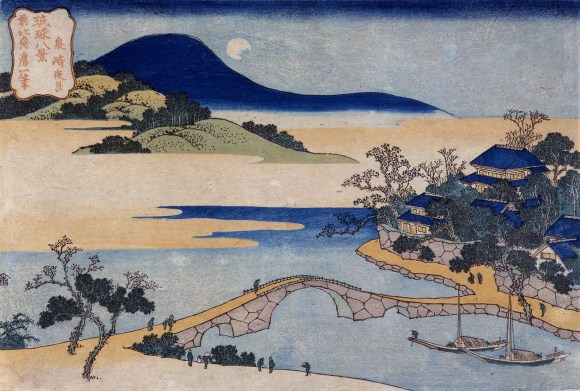
Art by Katsushika Hokusai (1760-1849). From Public Domain
A PARTING

You’ve now departed.
Tonight it’s a sickle moon.
Do we share it, although
you’re far away?
Unable to rest
on this mournful night,
I walk into my garden.
I try, but I can’t hold
in my hands
the moon’s pale light,
and my pajama bottoms
become wet with dew.
So I return to my room
to think of our reunion.
But I wonder, is it
the same question with you?


EMPTY THOUGHTS

After I eat my dinner,
I walk into November.
Leaves squirm as they die.
They have no choice.
Nature is their grim god.
Their lives are now over.
The stars look small,
but why they’re here at all,
remains a mystery.
As the moon rises
in funereal guise,
an icy wind blows.
Where does it come from?
where does it go?
I don’t really care to know,
and I hurry home
before I freeze,
no wiser than those dead leaves.


TINY DEATHS

I walk past a small.
twisting stream. Tonight
it’s quiet, almost serene,
but time rolls like thunder
through the dark night.
It echoes off the trees,
sick with a mortal disease.
Insects crawl about
in my uncut grass
Their life is brief.
 If they die beneath my feet,
who would feel grief?
The stars might mourn
for billions of years.
What would they feel?
They wouldn’t shed a tear.
George Freek’s poetry has recently appeared in The Ottawa Arts Review, Acumen, The Lake, The Whimsical Poet, Triggerfish and Torrid Literature.
PLEASE NOTE: ARTICLES CAN ONLY BE REPRODUCED IN OTHER SITES WITH DUE ACKNOWLEDGEMENT TO BORDERLESS JOURNAL
It was a sombre occasion. The only sounds audible were the occasional sniffles and a quiet hum of a mantra in the background. The crowd arrived in an orderly manner, circled the casket, paused at her feet, touched them, and raised their hands in reverence. They stopped near the son; some offered a consolatory handshake while others embraced. Afterwards, they found a safe corner to watch the world go on, lost in thought. They wonder if they should slow down, take a step back, and smell the roses. They understand that every passing day brings them closer to the day when they will be the main focus at such an event.
Many who knew her well will remember her 87 years of life and the challenges she faced. Coming to Malaysia as a young, match-made bride from India, she must have encountered difficulties adapting to her new country. Widowed for more than half her life, her children were her constant companions. The recent sudden death of her eldest son took a heavy toll on this octogenarian. It said that the biggest burden that a parent carries is to bury their own child.
The mourners who were there at the funeral were there to pay respect to the soul that had endured all the challenges that life threw at her. Amid those hurdles, she managed to bring forth offspring who helped make the world a better place. The kids, in their own ways, contributed to society and the nation. It is like a 21-gun salute to a fallen hero, minus the military regalia. That is all.
It was an act of gratitude. The rituals symbolised the completion of a book; an immersive one. The covers were closed, but the memory of its contents would linger in readers’ minds for a long time, especially if it was well written. What is a good book in the story of life? That would start the debate about the purpose of life. Why are we here? Is it a reward to be born into a species with higher senses, after enduring millions of births before which were not so glamorous? Is it a test bed for other births to come?
Are we here just to engage in the dizzyingly indulgent experience of being alive? Are we sent here to make some indelible change or leave a legacy?
These questions popped up again after his funeral as I was watching a reel sent to me on social media.
It was one of those rare, civilised discourses on Tamil Nadu TV about the younger generation and their outlook on marriage and having kids. On one side of the auditorium, Baby Boomers and Gen-X’ers[1] were complaining that Gen-Zs were delaying their marriages and even postponing the time they embarked on having children. Their bone of contention was that this was bad for society at large. Society’s in a constant flux, needing new innovations and people with unabashed energy to stay afloat. Only young minds can do this. Delaying this process could be a disservice to mankind, they say.
In defence, the Gen-Zs asserted that we are given just one life. Within that span of a lifetime, we are expected to learn, save, serve, experience and enjoy. There isn’t much time. Bringing a child into the world is a big commitment and a strain on their time and finances. There is no guarantee that they would do as good a job as the generation before them. They went on to say that the world is a dangerous place with predators and with global degradation on the rise, every living day draws earthlings a day closer to annihilation. The fear of passing on harmful genes was also mentioned.
In rebuttal, they were told that no one comes with a cookbook for surviving. Everyone tends to learn on the job, savouring every moment of it, the ups and downs, and leaves the world with nothing but memories. If that is our purpose in life in the first place, this was it.
Then again, the same thought came into my conscience around the time when Renée Good was shot dead by ICE (Immigration and Customs Enforcement) officers in Minnesota. If Renée were not shot, the world would probably not be reading her award-winning poem, ‘On Learning to Dissect Fetal Pigs‘. As if by a stroke of serendipitous and synergistic coincidence, her poem also explores the interplay of faith and scientific reason in our day-to-day lives. The logical mind tells us something is either white or black. Further exploration may reveal various shades of white, off-white, beige, ivory, and more. There is a confusing line that separates the analytical mind, which complicates understanding, from the spiritual awe that prompts one into submission. In that poem, Renée probably conceives of life as a chance meeting of an ovum and a sperm. Is there a higher meaning for this chance meeting?
To quote George Orwell, “The trouble is every generation imagines itself to be more intelligent than the one that went before it, and wiser than the one that comes after it.” In the late 18th century, economist Thomas Malthus postulated that population would outstrip food production, leading the world to starve into oblivion. Subsequent generations, through science, proved him utterly wrong, and we are now afflicted with malnutrition of abundance.
We should not underestimate the next generation to find answers to questions we cannot answer.
Every generation is still searching for the ultimate secret of life. What we are given instead are the red pill of the sciences and the blue pill of unquestionable social traditions[2].
Propagating the race with our progeny may not be the only reason for existence. If such is the case, the world would not remember literary doyens like Jane Austen and Virginia Woolf. Neither would spiritual figures, like Swami Vivekananda and Adi Shankara, who left without children, remain in people’s minds. They left us with chests full of wisdom to help us think.
A perfect life need not be complemented with children. Legacies may be handed down by other means, through passing of wisdom, art or impact.
[2] The Red Pill / Blue Pill concept was introduced in the 1999 movie, ‘The Matrix’. The Red Pill reveals the harsh truth about the world, and the Blue Pill lets him stay in comfortable ignorance.
Farouk Gulsara is a daytime healer and a writer by night. After developing his left side of his brain almost half his lifetime, this johnny-come-lately decided to stimulate the non-dominant part of his remaining half. An author of two non-fiction books, Inside the twisted mind of Rifle Range Boy and Real Lessons from Reel Life, he writes regularly in his blog, Rifle Range Boy.
PLEASE NOTE: ARTICLES CAN ONLY BE REPRODUCED IN OTHER SITES WITH DUE ACKNOWLEDGEMENT TO BORDERLESS JOURNAL
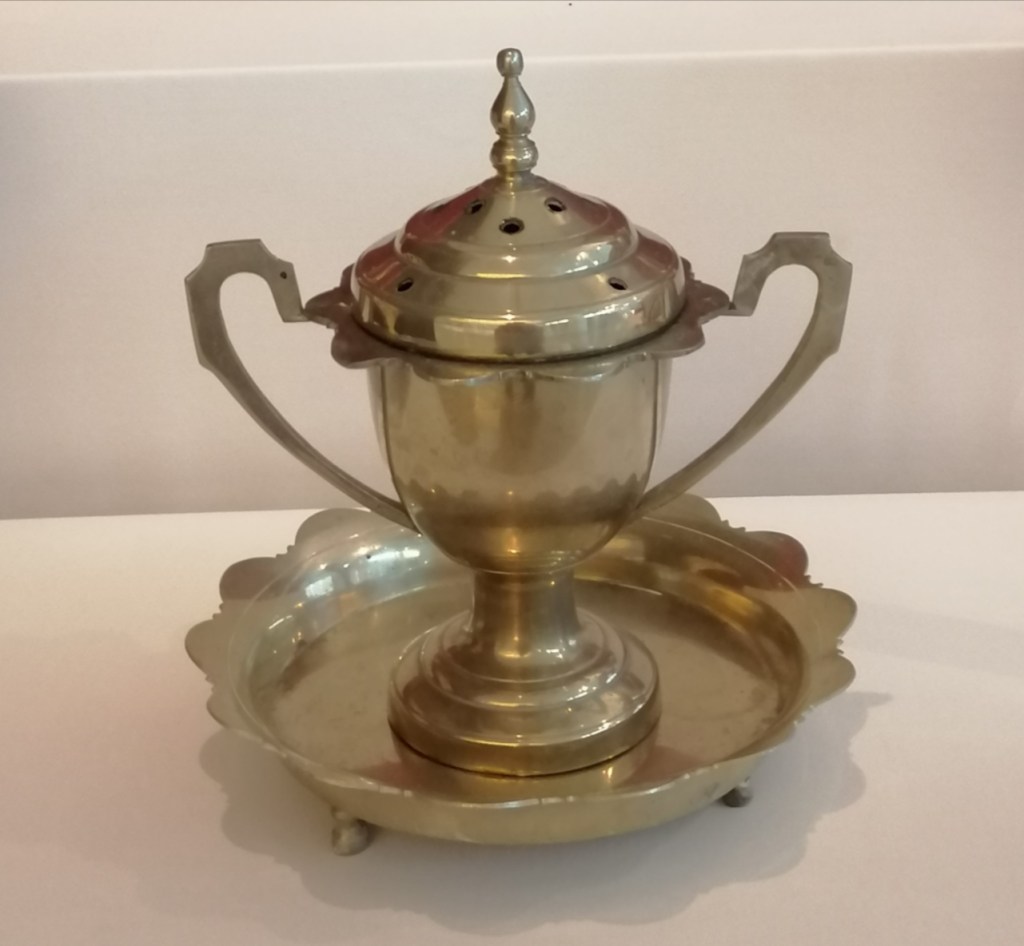
O, incense from rock and root! In the name of God and salutations to the Prophet, I sprinkle you onto the charcoal ember in the incense burner inherited from Elders. Ssseesshh! Ssseesshh! Ssseesshh! Billow across the span of humanity. Sharpen our senses, elevate our spirits, as an adornment of prayers for peace, as an accompaniment of the dead. Send blessings to the world of jinns and humans. The doors of servitude open, the purpose both are created. You are the balm for tormented souls. You welcome the mind into the realm of remembrance. Focus the soul on complete devotion to the One, the only One. Those with vague knowledge only see smoke of superstition, stupefied as rose water is sprinkled.
Ssseesshh! Ssseesshh! Ssseesshh!
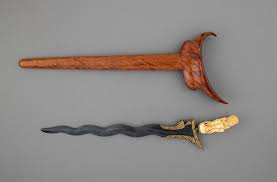
O, this servitude is indeed fragrant! O, this worship is indeed mystical and intimate to the One, the Only One. When the kris blade is smouldered by smoke, after washed with lime juice, in the name of God and salutations to the Prophet, the blade is dried and withstands rust, preserving inheritance and the calling. Culture and religion are intertwined, knowledge and understanding of the sacred realm that bless the worlds of jinns and humans. The doors of servitude open, creatures of the One, servants of the only One. O, this servitude is indeed fragrant! O, this worship is indeed mystical and intimate! Ssseesshh! Ssseesshh! Ssseesshh! Allah! Allah! Allah! My Lord!
DEBT
Hey, bestower of pleasure! Hey, the saving hand! I think I have been to hell: My soul is charred by sins, My mind is bombarded by doubt. I have rebelled against Me for fulfilling my desire. I think I have been to heaven: My soul is at peace with gratitude. My mind is still in acceptance. Everything has its place. Everything is measured. I am accepted by Me, mutual and pure. But return my will, return my future, return my entire me to the world and reality, from mere illusion, from every expectation. I want to live. I want to live. I want to live in a bit of doubt, in a pinch of rebellion, to learn by myself, to be in place and measured. Hey, bestower of pleasure! Hey, the saving hand! Let me pay my debt in feelings unsatiated.
THE MOUNTAIN God, smash the mountain in my soul. Obliterate the entire me with your Grace and Love. I could no longer bear the sufferings of alienation.
FIRASAT (Spiritual Intuition)
People nowadays do not know firasat. People nowadays do not use firasat. Purity brought down from Elders— the first intuition without veil, the stirrings and effects of unity of experience: Nature, knowledge, and actions unified, moved by the eye of the soul, nurtured by the discipline of the mind, based on strings of reiterative knowledge, demonstrated by signs from layers of Nature, validated by proofs in actions and breaths. The mind, soul, and spirit moulded in the self and surroundings. Ever since it is compartmentalised by thoughts that distinguish object from subject, dissecting issues to the atom, limiting conclusions and acceptance, denying possibilities and visions, veiling light by separation of knowledge. Is not this world a mirror? Is not this universe a sign? Is not this life a labyrinth? Is not a problem interlinked? Science, philosophy, psychology, history, and religion are only points of view that need to be reunified, that need to be rejuvenated as a whole with stirrings and effects of firasat that will pierce layers of existence, that will open secret doors of the manifest, symbolic, transcendent, and immanent worlds. Are not all that fall from the sky, grow on the surface of the earth, and return to the sky a belief in the unity of everything? So, the dust that floats in the air remembers the moment of attesting of the spirit that is gently blown at the boundaries of seven worlds. "Am I not your Lord?" The Malay testifies in firasat: "Yes, we affirm!"
Isa Kamari has written 12 novels, 3 collections of poetry, a collection of short stories, a book of essays on Singapore Malay poetry, a collection of theatre scripts and lyrics of 3 music albums, all in Malay. His novels have been translated into English, Turkish, Urdu, Arabic, Indonesian, Jawi, Russian, French, Spanish, Korean, Azerbaijan and Mandarin. Several of his essays and selected poems have been translated into English. Isa was conferred the S.E.A Write Award from Thailand (2006), the Singapore Cultural Medallion (2007), the Anugerah Tun Seri Lanang (2009) from the Singapore Malay Language Council, and the Mastera Literary Award (2018) from Brunei Darussalam.
He obtained a BArch (Hons) from the National University of Singapore in 1989, an MPhil (Malay Letters) from Universiti Kebangsaan Malaysia in 2008 and is currently pursuing a PhD programme at the Academy of Islamic Studies, Univeristi Malaya. His area of research is on the problem of alienation and the practice of firasat (spiritual intuition) in selected Singapore Malay novels.
The Lost Mantras is a collection that blends spirituality, Malay cultural heritage, and universal human experience. First published as part of Menyap Cinta (Love Greetings, 2022, Nuha Books KL), these poems are like a bridge between mysticism and everyday life, where traditional images (betel, jasmine, kris[1], oil lamps, setanjak[2]) are woven with Qur’anic echoes, prayers, and existential questioning. The collection carries a Sufi resonance—always circling back to longing, humility, surrender, and beauty as signs of God. The poems are not only lyrical but also function as cultural memory: they preserve Malay traditions, communal practices, and village life, while situating them in a cosmic framework of faith, sin, and redemption. The use of Malay customs, rituals, and objects is powerful: it asserts that spirituality is not abstract but embedded in heritage. This makes the collection uniquely Southeast Asian despite its universal in appeal.
Ameya was studying in the eighth grade. She was not only good at games but also a topper in her studies. However, she had one weakness — she had a squint in her eyes. Two girls in her class, Swapna and Sarasa, used to tease her every day by calling her names like “Squinty Beauty” and “Twisted Eyes”.
One day, during the lunch break, Ameya was eating her food. Swapna came near her and said loudly, “You have squint eyes, right? When you eat, does the food go into your mouth or into your ears?” Everyone laughed at her. Feeling deeply hurt and ashamed, Ameya stopped eating, went to the washroom, and cried.
From that day onwards, she started coming to school wearing dark glasses. Whenever she removed her glasses, she covered her eyes with her hand while talking.
Seeing this, Swapna mocked her again and asked, “Did you get an operation for your squint? Is that why you are wearing dark glasses?” Ameya did not reply and simply turned her face away.
After a few days, the school organised an exhibition. All the students prepared colorful charts. Ameya also prepared a wonderful presentation on Environmental Protection.
The District Collector came to visit the exhibition. Just as he reached Ameya’s desk, Swapna deliberately pushed her from behind. Ameya lost her balance and almost fell down. Her charts got slightly damaged.
Seeing this, Swapna whispered mockingly, “Look, the squinty beauty is about to fall. She can’t see properly, you know.” The Collector heard this. He immediately helped Ameya stand up and carefully looked at her charts.
Praising her work, he said, “You have prepared this very well. Why are you speaking so fearfully? Why are you covering your eyes with your hand?”
With tears in her eyes, Ameya said, “Sir, I have a squint. Everyone makes fun of me and calls me bad names.”
The Collector then spoke to the children standing there: “Children! In nature, no two flowers are the same. A tree may be bent, but the shade it gives is cool and comforting. Ameya’s intelligence and her concern for the environment are truly great. Making fun of someone’s physical weakness only shows poor character. Calling others by insulting names does not make you great. It makes you guilty of hurting someone’s heart.”
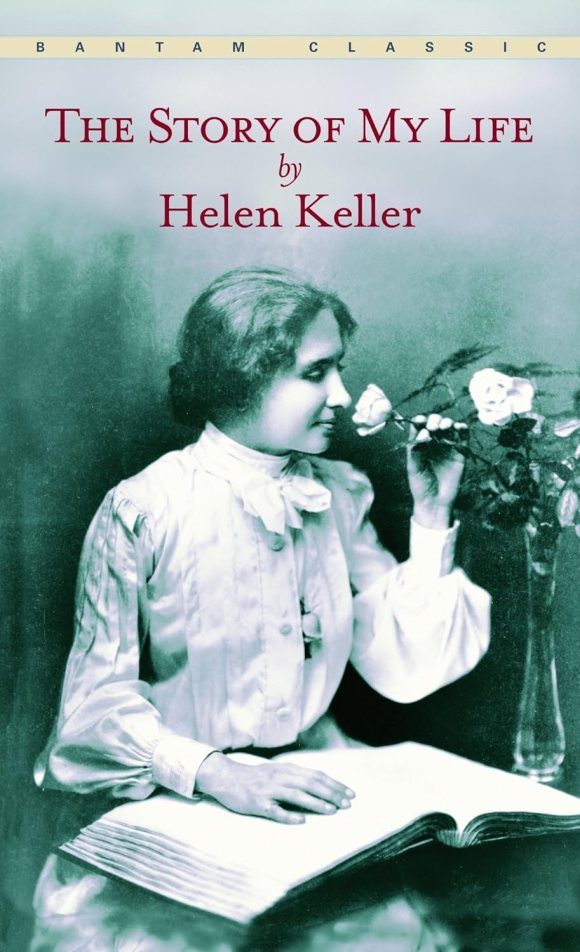
First published in 1902
Turning towards Ameya, he said gently: “Your intelligence is your strength. A squint is only a small physical condition. Don’t feel sad about it. Have you heard of Helen Keller? She was not only blind but also deaf and unable to speak. Still, her extraordinary qualities made her an inspiration to the world. She learned to read and write using Braille, mastered many languages, and became the first deaf-blind woman to earn a university degree. Through books like The Story of My Life, she shared her thoughts with the world. She fought for the rights of the disabled, women’s rights, and social justice. People with disabilities should take her as an inspiration. Never hide your beautiful eyes for anyone.”
Inspired by the Collector’s words, the school principal immediately introduced a new rule:
“Anyone who calls others by insulting names will face strict action.”
After this incident, Swapna and Sarasa realised their mistake. They went to Ameya and said, “Please forgive us. We now understand that knowledge and values are more important than appearance.”
Ameya smiled freely at last. From then on, no one in that school teased anyone by calling bad names. Everyone lived together like one happy family.
Naramsetti Umamaheswararao has written more than a thousand stories, songs, and novels for children over 42 years. he has published 32 books. His novel, Anandalokam, received the Central Sahitya Akademi Award for children’s literature. He has received numerous awards and honours, including the Andhra Pradesh Government’s Distinguished Telugu Language Award and the Pratibha Award from Potti Sreeramulu Telugu University. He established the Naramshetty Children’s Literature Foundation and has been actively promoting children’s literature as its president.
.
PLEASE NOTE: ARTICLES CAN ONLY BE REPRODUCED IN OTHER SITES WITH DUE ACKNOWLEDGEMENT TO BORDERLESS JOURNAL




 Borderless