Categories
Tagore Translations

Travels & Holidays: Humour from Rabindranath

Translated from the original Bengali by Somdatta Mandal

Translator’s Note

The earliest journeys of Rabindranath Tagore (1861 – 1941) were in his mind and he has left us accounts of these as well as of the later physical journeys in various travel writings – letters, diaries, poems, songs, and essays. Right from his childhood he made innumerable trips both within India and abroad. Apart from his regular full-fledged travelogues, we find many lesser known but interesting experiences of his travel. Included below are four such entries. The first essay is a trip to Hazaribagh with his nephew and niece. The second entry is a hilarious letter about his second visit to Darjeeling. The third a letter that narrates his trip to Satara in Maharashtra State, one of the towns where his elder brother Satyendranath Tagore served in the Civil Service. The last one is from Balia in Uttar Pradesh where Rabindranath complains that he is tired of travelling and wants to settle down peacefully as a bird in its nest.
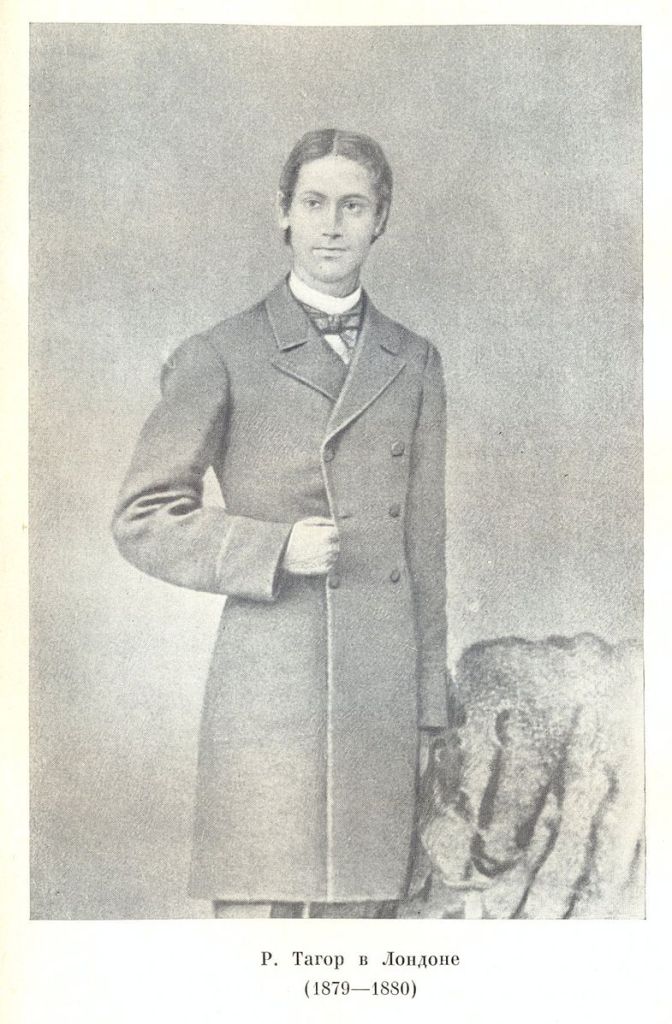
Tagore in London, 1879. Courtesy: Creative Commons

In 1885, under his sister-in-law Jnanadanandini’s editorial venture, a children’s magazine called Balak was published from the Tagore household in Calcutta. Though the life-span of this magazine was less than a year and only eleven issues were totally published, it contained different writings of the young Rabindranath, who would handle a lot of things for the publication. This magazine was later merged with Bharati and edited by his elder sister Swarnakumari Devi. Among the different entries that Rabindranath contributed for Balak and published in Vol. 3, Ashar 1292 B.S. (July-August 1885) was an essay called “Dus Diner Chhuti” (Ten Days’ Holiday) that narrates his trip to Hazaribagh that year during the school holidays. The two children referred to in this article were Surendranath and Indira, son and daughter of his elder brother Satyendranath and Jnadadanandini Devi. The sketch of the bungalow below is also done by him.
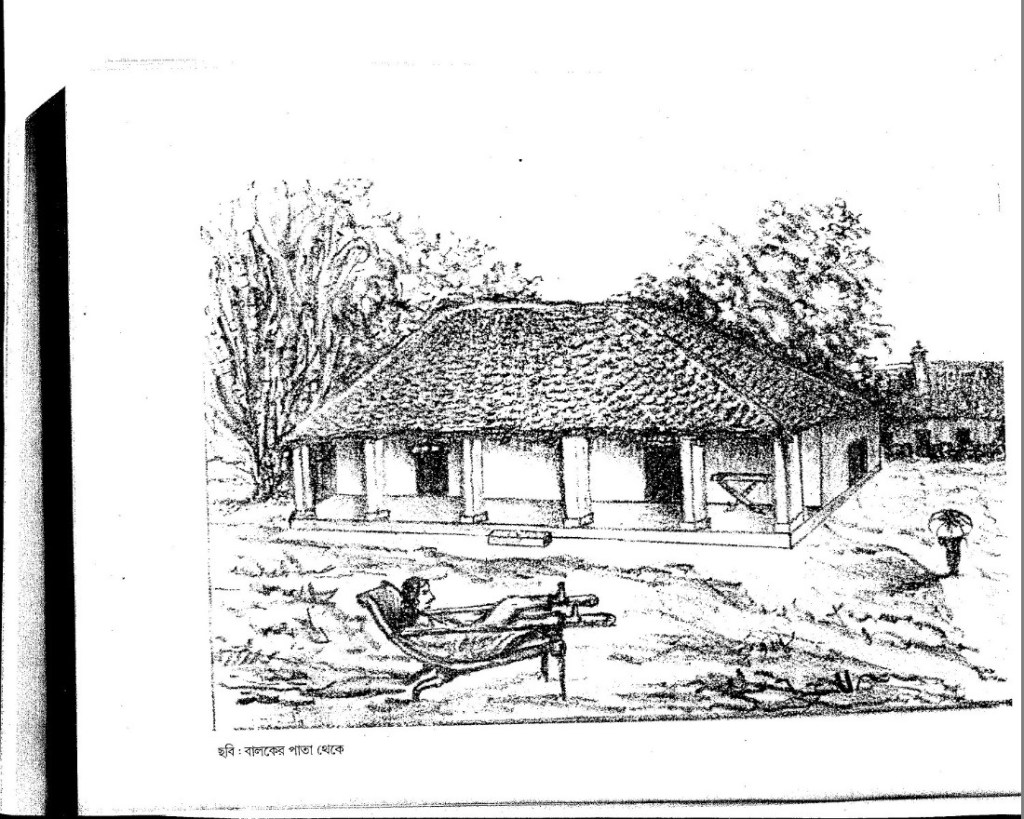
An illustration accompanying the essay ‘Dus Diner Chhuti’ (Ten Days’ Holiday). First published in Balak magazine. Somdatta Mandal suggests it could be the handiwork of the Kobiguru.

Trip to Hazaribagh – First published in Balak Magazine

Two children have made me homeless in this summer heat! Their school has been closed for ten days but that’s not just the reason. There would not be so much chaos in the house even if twelve suns appeared on the horizon. The older brother blunted the tips of all the pens he found within his reach, drew pictures on whatever paper he found; tried out the sharpness of a knife on his existing thigh; took out the machine from the watch he found and tried to rectify it; undid the bindings of all the books within his reach; climbed up on my shoulders if he found the opportunity – and so on! He moved on parapet walls in places where there were stairs for climbing; though everyone in the whole world believed in getting out of a car only when it stopped, he thought it was his only duty to jump out of a running car.

Everyone accepted the fact that the sun was too hot during the summer but the human child that I am talking about probably did not differentiate much between sunshine and moonlight. So during the school vacation, the difference in belief and behaviour between him and other ordinary people created a sort of revolution in the neighbourhood. The news that recently the elder brother has got leave for ten days spread everywhere. People were not so overwhelmed even when they received the news of the English-Russian war.

In the meantime, his younger sister came to me off and on and demanded – “Uncle–.” It would be nice if he called me ‘Uncle’ but I would receive new names at least three times in a day – names which were not heard in any civilized country. These naughty children also scattered and turned my own possessions upside down. My own name also did not have a proper address. I could not make them understand that my own name was my personal possession. Anyhow, the small girl (not that she was too small) came and pleaded, “Uncle, come with us to Hazaribagh.” After a lot of thought I did not say anything else and ventured out on this summer day.

One cannot see much in a vacation of eight or ten days but at least we can peek at nature outside. At least one can stand beneath the open expanse of the blue sky and the vast open green fields for a few seconds and feel free. We live in the city and occasionally it becomes essential to prove that the world is not built entirely with bricks, wood and mortar. So, four of us began our journey. I have already acquainted you with the boy and the girl. I need to introduce the other person. He was a fat, round and simple man. He was older than all of us but even younger than these children. His fair and stout figure was full of humour and he seemed like a ripe and juicy fruit. Just like the bubbles in a huge pot of rice being cooked, his humour came out from his nose and eyes. There are some people who resembled the ‘sandesh’ – the sweetmeat without a covering, without anything hard inside, without thorns – just a smooth, juicy blend of cottage cheese and sugar. Our innocent and harmless companion was that kind of a very edible man.

We boarded the train at Howrah at night. The swaying of the train confused one’s sleep – the sleeping conscience and the dream and waking up all got mixed up. There were occasional series of lights, sound of gongs, shouting, and calling the name of a station in a strange intonation. Again after three strikes of a gong all the sounds would subside within a few seconds and everything would become dark and quiet except for the continuous sound of the train wheels moving in the dark. Keeping in tune with that sound all the strange dreams would keep on dancing in my head all night. We had to change trains at Madhupur Station at four o’clock in the morning. As the darkness faded away, I sat at the train window and looked outside at the early morning light. This was a new country! It seemed that due to some disturbance our flat land had cracked and was torn apart. It was rough, broken and full of big and small sal trees and there were high and low undulations everywhere. There were plenty of sal trees but they did not endear each other as they did in Bengal. Each tree stood independently on its own soil. In Bengal all the trees, plants and creepers entwined each other in a familial bonding, but I did not notice that in this hard soil here. Maybe the people here were also like that. We did not notice much habitation. Only occasionally one or two huts stood friendless here and there. In the wet and salubrious climate of Bengal, trees and plants, men and men, houses and houses all stick to each other, but here in this rough and dry place everything seemed to be standing independently on their own.

The train moved on continuously. In the cracked fields one could sometimes see the sand of dry river beds and in those river beds huge black rocks and stones lay like skeletons of the earth. Sometimes a few hills stood up like severed heads. The hills in the distance were dark blue in colour. The blue clouds in the sky that came to play with the earth seemed to get caught up here. They had raised their wings to fly back to the sky but could not do so because they were tied up. The maidens from the sky came and embraced them. I saw one dark man with a broad face, with his wild hair tied up in a knot, standing there with a stick in his hand. The plough was attached to the back of two buffaloes; they had not begun tilling yet, and they stood still looking at the train. Occasionally there were some clear plots of land encircled with fencing made of ghritakumari plants and with a brick well that was constructed in the centre. The whole region looked very dry. The thin, tall and white dry grass looked like grey hair. The short leafless berry plants were shriveled, dry, and dark. In the distance a few palm trees stood with their small heads and one long leg. Occasionally a peepul or a mango tree was also visible. A lone old roofless cottage with its broken frame stood in the middle of the dry land and looked at its own shadow. Nearby there was a stump of a huge burnt tree.

We reached Giridih station at six o’clock in the morning. There were no more train lines after that and so we had to take carriage drawn by human beings from here. Could we call this a car? It was a small cage over four wheels. As we began our journey in the morning, the four of us started chirping inside it like four fledglings. The young brother and sister began to talk about many things and also pester me with joy. Our stout companion mingled with the children and turned into such a child that by just looking at them my own age was reduced by fourteen years and eight months. At first we went to the Giridih Dak Bungalow and refreshed ourselves. There was no sign of grass anywhere as far as we could see. There were a few trees in between and waves of red earth everywhere. A lean pony was tied under the tree; after looking all around it didn’t know what to eat. Having nothing to do it stood scratching its back on the wooden post. A goat was tied to another tree with a long rope and after a lot of research it stood breaking a sort of green plant with ease.

We resumed our journey from here. There were coal mines in Giridih but we could not see it due to lack of time. The road was hilly. We could see a great distance both in front and behind us. The long and winding road lay on the dry and empty terrain like a serpent basking in the sun. The car was pushed on the uphill road with a lot of effort and then it would slide smoothly downhill. As we went along we saw hills on the way. There were tall and thin sal trees, termite heaps, stumps of trees that had been cut down. At certain places some hills were covered with only tall, thin and leafless trees. The starving trees seemed to spread their lean dry fingers towards the sky and the mountains seemed as if they had been pierced by hundreds of arrows like the bed of arrows on which Bhisma rested on the battlefield of Kurukshetra. The sky was overcast and it began to drizzle. The coolies were letting out loud shouts while pulling the carriage and when their steps occasionally hit pebbles on the road, the carriage would suddenly shake up. Somewhere on the way the road ended and we saw a huge bed of sand with a narrow river in the distance. On asking the coolies we were told that it was the Barakar River. The carriage was pulled across the river and taken to the road on the other side. There were shallow ponds on both sides of the road and four or five buffalos leaning their heads on one another, dipped half their bodies in the water to relaxed themselves and gave us very casual glances.

When evening descended we got down from the carriage and went walking for the rest of the way. We saw two hills in the distance and the road went up and down through them. Whichever way we looked, there were no people, no human habitation, no grains, no tilled land. On all sides the undulated earth stood silent and barren like a hard ocean. The golden hue of dusk in the horizon cast dark shadows on us. Though there were no human beings or animals around us, there was a feeling that this huge earth was preparing for a huge person to come and sleep on its bosom. Like a sentinel someone was guarding the place with fingers on his lips and so everyone felt scared to breathe. The shadow of a traveller with luggage on his horseback came along from a distance and gradually crossed our path.

The night somehow passed between sleep and waking and tossing and turning sides. Upon waking up we saw a thick forest on the left hand side. There were creepers on the trees and the ground was covered with different kinds of shrubs. Above the forest we could see the blue peaks of distant hills. There were huge rocks and among their crevices were a few trees, their hungry roots growing long and spreading out on all sides. It seemed as if they wanted to break the rock in search of food and grasp it with their strong grip. Where did the forest on the left disappear all on a sudden?

There were fields stretching at a distance. Cows were grazing. They looked as small as goats. Farmers were tilling their land with the plough attached to bovine shoulders. Sometimes, they twisted the cows’ and buffaloes’ tails. The tilled lands rose like steps on the hills. We had come close to Hazaribagh. One or two of the hills stood as relics of some great natural revolution.

We reached the dak bungalow at Hazaribagh at three o’clock in the afternoon. The town of Hazaribagh looked very clean amidst the wide landscape. There was no city-centric ambience here – no narrow lanes, dirt, drains, jostling, commotion, traffic, dust, mud, flies or mosquitoes. Amid the fields, trees and hills the town was absolutely clean. The giant houses in Kolkata are proud as stone – they stand treading the earth below, but here it was different. Here the clean and small thatched roof houses stand quietly in friendship with nature; they do not have glamour, they don’t exert might. The town seemed to be like a nest in the trees. There was deep silence and peace everywhere. We hear that even the Bengalis who live here do not quarrel among themselves. If this was true, then there would be no enmity between the crow and the eagle or between the cat and the dog.

One day was gone. It was afternoon now. I sat alone quietly in a couch on the verandah of the dak bungalow. The sky was blue. Two thin pieces of clouds sailed by. A mild breeze blew an earthy, grassy smell. There was a squirrel on the roof of the verandah. Two shalik birds (mynahs) were hopping about on the verandah and shaking their tails. I could hear the sound of cow bells as they from the adjacent road. People were moving in different ways. Some carried luggage on their shoulders and walked with open umbrellas on their heads; some were chasing a couple of cows, and some moved slowly riding on the back of a pony. There was no commotion, no hurry, and no sign of worry on their faces. It seemed that human life here did not pant rapidly like a fast railway engine or move with screeching noises emanating from the wheels of a heavily laden bullock cart. Life here moved in the manner of a gentle breeze blowing beneath the shade of trees.

The courthouse was in front of us. But even the court was not that rigid here. While the two lawyers in their black coats fought with each other inside, two papaya birds sat outside on the peepul tree and conversed among themselves constantly. The people who came here seeking justice sat in a group in the shade of the mango tree and laughed loudly among themselves. I could hear them. Sometimes, the midday gong started ringing in the courthouse. Its sound seemed very serious in this leisurely ambience and slow rhythm of life. The occasional sound of the gong was a reminder that time did not flow by in the casual slow cadence of life here. Standing in between it seemed to pronounce in its iron tone, “I am awake, even if others are not.” But the writer’s condition was not exactly the same. I felt sleepy. It was not a deep sleep. I realised that though the all-pervading stillness of nature and beauty encircled me with great care, my senses were failing to capture the details.

I spoke whatever I had to say about Hazaribagh (some might be thinking that I could have spoken much less) except that I did not mention that we became newly acquainted with the children of one of my friends. Upen Babu read the Akshanmanjari so we had to treat him with respect. I had mistakenly confused the alphabet sequence and he had instantly corrected it. That is why I was grateful to him. But in spite of many entreaties his sweet-looking naughty sister did not speak to us. I threatened to write an article and take revenge on her, so according to that promise I am spreading the word today letting the whole world know about her shy and coy words, and how she would run away whenever guests came to her house.  I also cannot keep it a secret how we had received sweet sandesh and even sweeter welcome from our friend.

In order to save time on our return journey we came down in a two-wheeled small carriage. If nothing else happened, at least it reduced our longevity as the whole body got shaken up with the bones and the joints fighting against each other. As the body went on jerking and dancing like mad, the five elements with which it was composed gave us a tough time. I could hold it together somehow but nothing much beyond that. With so much of revolution in the whole body, I could not hold books in my hands, the cap on my head, the spectacles on my nose, food in my stomach.  To add to all that was the scorching heat of the sun. I had left home with the full sixteen annas of my body intact but when I returned, I could not even account for twelve annas of it. The ten days’ holiday is over. Ah!!

More Humour: Letters from Tagore

I

Darjeeling

September 1887

Here we have reached Darjeeling. On the way Be_____ behaved very well. Didn’t cry much. Shouted a lot, created commotion, made various noises with her mouth, turned her wrists and even called birds, though we couldn’t see birds anywhere. There was a lot of trouble in boarding the steamer at Sara_____ Ghat. It was ten o’clock at night – hundreds of pieces of luggage, a few coolies, five women and only one man[1]. After crossing the river, we boarded a small train – in it there were four berths and we were six people. The ladies along with their luggage were put up in the ladies’ compartment. Though it sounds pretty simple, the actual process wasn’t so. There was a lot of calling, shouting, and running around but even then Na___ said that I did nothing. That means that the image of a terribly annoyed grown up human being was the only one suitable for a man. But no gentleman of twenty-six years has done what I have done in the last two days – opened so many boxes and closed them, pushed them under the benches, again pulled them out from there, run here and there behind so many boxes and bundles, so many boxes and bundles have chased me like a curse, so many have been lost, so many regained, so many not found and so much attempt made to recover the lost ones. I am surely suffering from box-phobia – my teeth start chattering whenever I see boxes.

When I look all around me, I see boxes, just boxes – small, big, medium, light and heavy, made of wood, tin, leather, and cloth—one below me, one above me, one next to me and one behind me – then all my natural strength to call, shout and run around totally disappears. And then my blank look, dry face and poor countenance makes me seem like a mere coward; so whatever Na____r have said about me is correct. Anyhow, let it be. After that I went and slept in another coach.

Two other Bengalis were there in that coach. They were coming from Dhaka; one of them was almost totally bald and his language was very different. He asked me whether my father was in Darjeeling. If Lakshmi was around she would have replied to him in his incorrect Bangla but I did not have such an instantaneous answer.

The way from Siliguri to Darjeeling was filled with continuous exciting comments from S_____: “Oh my god!”, “How strange,” “How wonderful!” – She kept on nudging me and saying: “R_____ look, look.” What to do, I had to look at whatever she pointed out – sometimes trees, sometimes clouds, sometimes an indomitable flat-nosed girl from the hills, sometimes such things which passed by because the train was moving forward and S______ lamenting that R_____ could not see them. The train kept on moving. Gradually there was cold, then clouds, then running noses, then sneezing, then shawls, blankets, quilts, thick socks, chilly feet, cold hands, blue faces, sore throats and just after that Darjeeling. Again those boxes, those bags, those beddings, and those bundles! Luggage upon luggage, coolies after coolies! It took me about two hours to retrieve our luggage from the brake-van, identify them, put them upon the heads of coolies, show the receipts to the sahib, have arguments with him, unable to find some things and then make necessary arrangements to retrieve them.

II

Calcutta

June 1889

As soon as the train departed Be___ looked all around and sat seriously thinking from where we arrive in this world, where we move, what the intention of life was. Thinking about all these issues I saw her yawning frequently and after a little while she put her head on the ayah’s lap, spread out her legs and went to sleep. I too kept on thinking both about pleasant as well as unpleasant ideas about life but could not sleep. So I started humming the Bhairavi raga on my own. Once you hear the melody of the Bhairavi raga, you develop a strange attitude towards life. It seems as if a routine mechanical hand is constantly winding the organ and from that pain of friction a deep and sad raga emerges from the centre of the whole world. The light of the early morning sun seems to fade. the trees listen quietly as the sky seems to be engulfed by a world full of tears. In other words, if one looks at the distant sky, it seems as if a pair of tearful blue eyes are staring at you.

Near the backyard of the station we saw our sugarcane fields, lines of trees, the tennis field, houses with glass windows; for a few moments my heart felt sad. This was really strange! When I lived here, I did not have much sympathy for this house – I cannot even say that I was very emotional when I left it. But when I saw it for a split second from the window of the running train, the way the lonely house was standing with its playground and empty rooms, then my entire heart went and pounced upon that house – a sound inside my chest from left to right – the train passed by quickly, the sugarcane field disappeared, everything ended, only the strings of the heart got fixed on a lower scale. But the engine of the train didn’t bother much about these things; it went on moving at the same speed over the rails; it doesn’t have the time to notice who was going where. It only drank water, belched smoke, gave loud shouts and went on rolling. Its movement could be beautifully compared to the motion of life, but it was so old and hackneyed that I just mentioned it and stopped. Once we came near Khandala the sky was full of clouds and rain. The mountain tops looked blurred because of the clouds – as if someone had drawn some mountains and then later rubbed them with an eraser – a few outlines were visible and in some places the pencil marks had got smudged.

At last, the bell rang for the train to leave. From a distance one could see its sleepless red eyes; the earth started quivering, the people working at the station emerged with their shoes and sandals from different rooms — their decorative jackets and round caps with metallic labels on their heads; the huge lantern in their hands radiated light in all directions; the servants stood alert taking care of all their belongings. Be____ went on sleeping. We boarded the train. Be____ started being restless for no reason. Though there was no sunshine, we started feeling hot as the day advanced. But time didn’t seem to move. It seemed that we had to touch every minute and push it forward. Fortunately, after travelling for some time it started raining heavily. Shutting the windows all around us, it was a pleasant experience to watch the clouds and the rain through the glass panes. At one place I was amazed to see the activities of the river in this monsoon season. It had swelled up and ran at full speed, digging its head on the stones, encircling them, then flowing over them and creating a sort of commotion. I hadn’t seen such wildness anywhere else. In the afternoon when we came and had our food at Sohagpur, the rain had stopped by then. When the train started again, the sun with its bright redness was setting among the clouds. I thought that all the other passengers were spending their time quite comfortably by eating, gossiping playing or reading and therefore were not bothered about the existence of time at all; whereas I was swimming upon time, its entire expanse was hitting me on my face and body … The train reached Howrah in due time. One by one we saw different people – first the sweeper of our house, the Jo___, after that Sa___. After that we dumped the rolled up luggage, my dented tin suitcase and a big basket (which contained milk bottle, different utensils, tin pot, bundles etc.) on the roof of the second class carriage, we reached home.

A commotion, gathering of people, salute of the durwans, obeisance of the servants, the greetings of the clerks, all the contradictory opinions about who had reduced and who had gained weight among us, the exuberance that S___ and company had with Be___, people surrounding the table during tea, bath, food, etc.

III

Balia

Tuesday, February 1893

I do not feel like travelling any more. I really wish to sit down in one quiet corner in a relaxed mood of adda. India has two parts – one part is domestic, and the other ascetic; some do not move out from the corner of their house at all, and some are totally homeless. I have both these parts of India within me. The nook at home pulls, and the outside world also beckons me. I wish to travel a lot and see everything and again my perturbed and tired mind gets lured by a nest. The feelings are like that of a bird. It has a small nest to live in and the huge open sky to fly. I love the nook only to pacify my mind. Within my mind I feel a desire to work untiringly and I am perturbed when it gets deterred at every step in such a way when I am among people — it keeps on constantly hurting me from within a cage. It can think freely in solitude, it can look all around, and express all its feelings in a satisfactory manner. It wants eternal rest day and night. Just as the creator is alone within his own creation, it also wants to live alone in its world of emotions.


[1] The people in this trip included Rabindranath, Mrinalini Devi, Madhurilata, Soudamini Devi, Swarnakumari Devi, Hironmoyee Devi, Sarala Devi and a maidservant. This was his second trip to Darjeeling.  He had started for Darjeeling for the first time on 19th October 1882. The details of this travel are found in Swarnakumari Devi’s article “Darjeeling Patra” published in Bharati and Balak.

Rabindranath Tagore (1861 to 1941) was a brilliant poet, writer, musician, artist, educator – a polymath. He was the first Nobel Laureate from Asia. His writing spanned across genres, across global issues and across the world. His works remains relevant to this day.

Somdatta Mandal is a critic and translator and a former Professor of English at Visva-Bharati, Santiniketan, India.

.

PLEASE NOTE: ARTICLES CAN ONLY BE REPRODUCED IN OTHER SITES WITH DUE ACKNOWLEDGEMENT TO BORDERLESS JOURNAL

Categories
Excerpt Tagore Translations

Kobi & Rani: Letters from Japan, Europe and America

Rabindranath Tagore’s selected letters to Nirmalkumari Mahalanobis had been published in 1938 under the title Pathe-O-Pather Prante. The sixty letters included in this volume had been personally selected by him from among the five hundred plus letters he had written to her. This volume was translated by Somdatta Mandal and included in the book ‘Kobi’ and ‘Rani’: Memoirs and Correspondences of Nirmalkumari Mahalanobis and Rabindranath Tagore (Bolpur: Birutjatio Sahitya Sammilani, 2020). Selections from some of these letters had been included in borderless journal in its September 2021 issue. A few more letters have been selected here for the benefit of the readers.

Letter 33

Yesterday I reached the Japanese port named Moji. Tomorrow I will reach Kobe. A bird builds its nest with straw and twigs; it does not take long for it to leave that nest and go away. We build our nests mainly with things of the mind, with work, studies and thoughts and an invisible shelter starts growing around us. Just as the seat of the plane moulds itself according to the pressure and shape of the body, the mind while moving along also creates differently shaped holes, and when it sits in that hole it gets stuck there. Later when it has to leave it does not like that at all. Something like that happened to me on this ship. In this cabin there is a writing desk on one side, and a bed on the other. Apart from this, there is a chest of drawers with a mirror, a cupboard to hang clothes and an attached bathroom. After crossing these, there is another cabin where my boxes, trunks etc. are kept. Within this my mind has arranged its own furniture. Because there is little space, my shelter is very intense and every necessary item is within my reach. After getting down from here, I was in Hsu’s house[1] in Shanghai for two days; I did not like it, it made me very tired. The main reason was that the mind did not get the measurements of the body in a new place; it was being hit on all sides and to add to that there was hospitality, welcome and chaos day in and out.

There is newness of thought and imagination everyday but the external newness tries to prevent them. We have imbibed new substances of life in their entirety and have understood that the newness exists within them. I have known for a long time that we do not have to leave them to look for something new. Like other valuable things one has to mediate to seek the new.  This means you have to make it old and then attain it. If you think that you have suddenly found something, then that is not true because within a few days its actual emaciated state is revealed. Nowadays man is engrossed in securing this cheap newness and that is why he wants change at every moment. Science is helping him in this obsession for change, so he does not get the time to sink deep and search for the forever new. This is why a base knowledge from text-books has spread everywhere in the education system. No one has the time to seek the ultimate truth in its real form. This is why obscenities that affect the mind in a strong way are being found in literature. Those who lack the time and have less power find this to be a cheap means of getting quick entertainment. The mind that has grown inert and has had its life strength reduced requires strong stimulation – its roots are starving.

                                                                                    Yours,

                                                                                    9 Chaitra, 1335( B.S.)

You will be surprised to know that when I was writing this letter I was feeling very sleepy. I was warding it off and progressing with my writing. Even now I have not overcome that drowsiness. But it is morning now, it is eleven o’clock – let me go and take my bath.

Letter 34

I have come to Tokyo last night and have put up in a famous hotel. It is not that less famous hotels are cheap or unsuitable for relaxation, but since it is my misfortune that I am also famous, I have to tolerate an equal amount of oppression. It is easy to hide in a small place, but the places to hide in this world are closed for me. Once upon a time I could not even imagine that it would be essential for me to hide from the public for self-defence. Those were the days when I was alone in the boat on the shoals of the Padma. So I haven’t developed the habit of warding off people and anyone can come and keep on pulling me. This morning when I was tired and was sitting down someone came and convinced me with a lot of words. He made me sit in a car and took me to their house inside the lane. In the end I realized that all this excitement was because they wanted to be photographed with me.

In our house we were first born amidst a simple lifestyle and were encircled by love and care from our own people. Then I was a totally private person and there was a very personal thing called a barrier. Gradually with age the relationship with the outside world started to increase. But however much it increased it had a simple measure and there was a balance between the private and the public self. Ultimately through the hands of fate my fame as an exceptional person began to grow and I became more public than I was private. The barrier which I was entitled to became insufficient now. Like an extremely ripe fruit the hard upper shell of my body has split up into seven pieces, and now any kind of bird with any sort of motive can come and peck at me and there is no one to prevent them. There is no harm if they really benefit from it. If they want to satiate their own greed through me, let them do it; but if you think about it, this creates a serious harm not only for me but also for their own selves. My heart is upset by the little demands, and I waste my strength available for doing sufficient work. Moreover, when I realize that I have become the vehicle of other people’s interests, and that those interests are trivial, then I feel reproached. I keep on wishing to return to my traditional and non-famous small house and take shelter among people who are willing to pay a price just for my existence. But at the same time I often meet people who are unknown to me, but who have accepted me within their heart even from a distance. They do not ask anything from me, do not judge me according to my fame, but accept me out of their own happiness. There is nothing more fortunate than this. This time when I was being tortured by my fellow countrymen with a cheap reception in the city of Kobe, then the wife of the English consul here came to meet me. After speaking to her a lot of my sorrow disappeared. I realized that for some people my work has been deeply successful and they do not want anything more than whatever they have received from me without my knowledge.

Today I have three invitations in Tokyo and it will extend from one o’clock in the afternoon till dinner at night. I will then travel to Yokohama by car. After that tomorrow I will have lunch with the Indians who invited me and then leave for Canada at three o’clock. After that I don’t know.

                                                                                                              Yours,

27 March, 1929.

Letter 43

Throughout my life I had to inwardly keep hold of a pursuit. That pursuit is to remove the veil, to keep myself far away from everything. It is the pursuit of releasing me from myself as a person. Stationing myself at one place, I often try to realize that each day this person is troubled with both sad and happy thoughts of work, which is equivalent to letting myself drift within an uncountable flow into another sphere without any fixed destination. This can be seen clearly when it is identified as an independent object, but if we try to associate and become one with it then that knowledge becomes false. I desperately need this realization and that is why I desire it so much. My mind is situated at the crossroads and all its doors are open, so all kinds of winds reach it and all kinds of guests enter the inner chambers. There is a place within man’s life which is that of pain, and all the feelings are located there. That is why only intimacy can enter it. Part of our domestic existence is to spend life with them both in pleasure and pain. Everything has to be tolerated within its limits. But my God, my jeevandebata, decided to make me a poet and that is why has kept my inner chambers unguarded. I don’t have a back door and there are main entrances on all sides. That is why both invited and uninvited people keep coming and going within my inner chambers. Therefore, the chords of the instrument of pain are always tuned to the highest pitch. If the music stops, then my own work would be left undone. I have to know the world through painful experiences; otherwise, what should I express? Unlike scientists and philosophers I do not have vast knowledge and my expression is that of my heart. Though these feelings are the tools of expression for a writer, it is necessary to leave them behind and move away. This is because if we don’t move to a distance, we are unable to perceive the whole at once and reveal it. Being too much engrossed in the world gives rise to blindness and guards the object that is to be seen. Besides this, the small object becomes large and the large one is lost. The great advantage of the domestic world is that it carries its own weight, but the small objects do become a burden. They are the most meaningless things but they create the greatest pressure. The main reason is that their weight rests upon falsehood. When the mind seems to be overwhelmed by bad dreams, it is also an illusion. If we encircle the world with that little ‘me’, then in that small world the small wears the mask of the great and creates anxiety in the mind. If whatever is really great, meaning that its boundaries cross that little ‘me’, is brought in front of the small, then the smaller one’s false intensity is dismissed and shrinks into littleness. Then one feels like laughing at what causes one to cry. That is why removing the big ‘me’ from my life becomes the greatest thing to pursue; and if that is done, the greatest insult to our existence is lost. The humiliation of existence is to live in a small cage that befits birds and animals. In this cage called ‘myself’ we are tied and beaten up, and that becomes a useless burden. That is why it is essential for Rabindranath to seat Rabindranath Tagore at least at a distance: otherwise, he gets to be humiliated by himself at every step. The sorrow of death brings in stoicism, and I have felt the freedom of stoicism several times, but the real stoicism is brought about by accepting the great truth. There is greatness within me and he is the observer; what is small within me is the consumer.  If both of them are combined, then the pleasure of vision is destroyed and the happiness of consummation is spoilt. If you keep pushing your work externally like a pushcart then it moves smoothly, but if you carry that pushcart on your shoulders then you get exhausted. I have taken up a work called Visva-Bharati, and it becomes simpler if I don’t bear the burden and dissociate it from myself. A work is either a success or a failure depending upon the circumstances but if it does not touch ‘myself’ then that work brings in freedom for itself and also for me. Our greatest prayer to the one who is the greatest is asato ma sadgamayo (take me away from whatever is false and lead me towards eternal truth). How will this prayer be successful? If His arrival within me is complete, if I see Him truly within me, then the torture of that ‘me’ can also be pacified.

I don’t know when you will receive this letter. I will be happy if you receive it on your birthday. If you don’t get it there will not be much harm in stretching your birthday by another day. It is not possible always to express all the innermost thoughts but they have to be spoken for the sake of myself.  That is why I wrote this letter on the occasion of your birthday; because freedom is the main mantra of every birth, and it is freedom from darkness to light.

                                                                                                                Yours,

                                           6 Kartick, 1336 (B.S.) 

Letter 48

I am writing this letter to you from Copenhagen, after having fallen into a whirlwind that does not let me pause even for a while. I am moving along garnering knowledge about strangers, but there is no time to store that knowledge. Moreover, I have a forgetful mind, and there is no lock and key in the storehouse of my memory. As soon as something accumulates, instantly something else comes and replaces it. Some just sink in, some get distorted and become hazy. I do not of course consider this to be a complete loss – if you cannot discard then you cannot earn; if you have to store it then you will have to sit firmly without any movement. For a long time, I have constantly ridden the chariot of my mind from one road to another and did not have the time to lock it up in the garage. Instead of fame, I would have found a lot of things if I had gone and sat firmly at the entrance of the museum. Just think of this simple fact: If I had the intelligence to remember everything then at least I would have passed all my examinations and could have left with pride by saluting the world and by gathering accolades. If I want to speak about something, I cannot quote references and so in intellectual gatherings I try to overcome the deficiencies of my education by covering them up naively with my own talk. Since I cannot think of paraphrases and parallel passages in seminars where poetry is being discussed, I try to retain my prestige by composing poems myself. I can clearly visualize that you are reading this and laughing out loudly both physically and also in your mind. You are saying that it is just empty politeness, a bundle of pride. There is no way out. Due to societal norms one can truly praise others but not oneself. So one has to praise oneself in the mind and instead of reduction it leads to more sin. The fact is that once you come abroad from your homeland your self-glorification becomes enhanced a great deal. Someone who doesn’t even have the fortune of having cold water is suddenly given champagne. Then I feel like calling your professors and telling them, ‘O, you masters! Don’t make the sudden mistake of considering me as your student. Don’t mark the papers that I have written in the same way as you mark your examination scripts, because they are demanded by the professors here.’ You know that by nature I am very polite but my tutors at home have beaten me to make me feel proud. This is why I often feel ashamed in my mind. But let me tell you the truth. I have received a lot of fame and respect, but even then my mind always looks across the Indian Ocean. Khuku[2] has written from Santiniketan, “Yesterday there were heavy showers and this morning the sunshine is like liquid gold.” These words were like the sudden touch of a golden wand. My mind became agitated; it said, all right, this is acceptable. I will go to those teachers again. If they make me stand up on the bench, then at least that ray of sunlight like liquid gold will come in through the open window and fall upon my brow and that will be my prize. In the meantime the letters of Bhanusingha[3] have been published once again and I have received them. The letters are full of the monsoon clouds and autumn sunshine of Santiniketan. Reading the letters in such a far off country makes them even clearer. For a brief while I forgot where I was. What a vast difference! The difference between what is good here and what is good there is like the difference between the music here and there. European music is big and strong and varied. It emanates from the victory of men; its sound resonates from all sides and creates a great impact on the heart. We have to congratulate it. But the raga that comes out from the flute of the shepherd in our country, it calls my lone mind to accompany him on the path which is full of shadows from bamboo groves, where the village belle walks with a pitcher full of water at her waist, the doves call from the branches of the mango trees and from a distance the special song of the boatman can be heard. All these excite the mind and blur the vision with a few unnecessary teardrops. They are extremely ordinary and that is why they can easily find a place in our minds. The letter which I wrote on that day seems to be written for today. But there is no way for me to revoke my reply. That day’s post office is closed. So let me end this letter with a deep sigh. I have several engagements and many other things before me.

                                                                                                            Yours,

8 August, 1930.

Letter 49

There is a word prevalent in Bengali called ‘Samoyik Patra’ that means periodicals. But there is no way by which we can hold back time and send them through letters. I do not know when the news of my painting exhibition in Germany reached you and now I got to know from your letter that all of you did not get the news at all. So probably the time for receiving the news is also over. On the other hand, my trip to Germany will be over today and I will go to Geneva tomorrow. Even before you receive this letter you must have already heard the news that my paintings have been received quite well in Germany. The National Gallery in Berlin has taken five of my paintings. I hope you understand the impact of this news. If Lord Indra suddenly sent his horse Ucchaishraba to take me to heaven, then I could compete with my own pictures. But I don’t know why I am not excited about discussing these things. Maybe there is some hidden hostility in my mind, and so there is almost no relation between my country and my paintings. When I write poems then an emotional link is automatically created with the message of Bengal. But when I paint the lines or the colours, they do not come with the identity of any particular state. So they belong to those who like them. Just because I am a Bengali does not automatically turn it into a Bengali thing. This is why I have eagerly donated these pictures to the West. The people of my country probably have come to know that I am not a special category of a human being and so in their mind they have been antagonized towards me. They do not feel any qualms of conscience about saying bad things about me. Let my paintings prove that I am not a hundred percent Bengali but belong equally to Europe as well.

I visited many places which I had known earlier and also delivered lectures there. But unlike my last trip, this time I have entered the inner spirit of Germany. I have come closer to them. Not that they have sufficient love for nationalism in the world, but by being rejected by other races of Europe, they have become strong nationalists in their hearts. Of course I cannot understand why they have a special liking for me. Whatever it might be, they have extraordinary strength, great intelligence and also the capacity to make all things equal. I feel that no other European race has so much strength in all aspects. I understand why France cannot get over the terror of Germany. These people are extremely irascible. After the nudge of poverty their strength has increased many-fold.

The enthusiasm for world nationalism has been brought forward in Geneva. The right tune has not been played in the League of Nations – it may not be played at all – but on its own that city has become the epicentre of the whole world. Those who believe in the unity of the world will automatically come and get united here. In that case I believe that a great power for the welfare of the world has been inaugurated here.

                                                                                                          Yours,

                                                                                           18August, 1930.

Letter 50

After planning to leave for quite some time, the day of my departure has ultimately come near. It has been almost one year. I liked it as long as I was in Europe. After reaching America my mind got suppressed and my health was also affected. The external world in America is too bold, aggressive and restless and so after being continuously shaken up, a sort of stoicism creeps in. I am in that condition now, and for quite some time have become eager to get some shelter within my inner self. After many incidents my mind had become outward-oriented, and the truth of the self was growing rusty without use. It was during this period that I came to America and saw how man has tried to develop his society with unnecessary failures. They have decorated rubbish with the glamour of wealth and spend their days and night behind them, thus creating an indecent burden upon the world. Within all this crass materialism, when the mind becomes restless the eternal longings within man express themselves. Just as cows are herded together to be taken back to their shelter in the evening, in a similar way I am calling my scattered self to return to the deep recesses of the mind. Maybe a shadow of the evening has descended on the late afternoon of my life and the strength of my mind, which had disseminated my endeavours in different kinds of work to the outside world, is also coming to an end. The guard at the entrance of the mansion has already rung the bell signalling that the main door will be closed, and so we cannot do without lighting a lamp in the andarmahal – the inner chambers.

         I haven’t written anything for a long time and I don’t feel the urge to do so. This means that the power of expression has also reached the end; it doesn’t have any extra portion in its coffers and therefore easily stop all dues from the outside world. I am not feeling bad about it. If the fruit starts growing inside, then there is no loss if the petals of the flower fall down.

         I shall begin my journey on the 9th of January in the ship called Narkanda (P&O) and will reach home at the end of the month.

                                                                                                           Yours,

                                                                                 29 December, 1930.


[1] Hsu-Tse Mu, Professor of Literature at the National University, Peking. In 1924 he had accompanied the poet during his China tour as an interpreter. [Mukhopadhyay, Rabindrajiboni, Vol.III, p. 166].

[2] Khuku was the nickname of Amita Sen, a noted Rabindrasangeet singer; Rabindranath adored her. She joined Sangeet Bhavan as a teacher but died very young.

[3] Rabindranath wrote a series of letters to a young girl called Ranu Adhikari. He signed the letters as ‘Robi Dada’ or sometimes as ‘Bhanu Dada’ which was the penname of the poet as Bhanusingha.

About the book:   Pathe O Pather Prante (On the Road and Beyond It) included in ‘Kobi’ and ‘Rani’: Memoirs and Correspondences of Nirmalkumari Mahalanobis and Rabindranath Tagore.

Rabindranath Tagore was a prolific letter writer and Rani Mahalanobis is the only person to whom he wrote more than five hundred letters, the maximum number written to any individual person. In 1938, in the third volume of the series entitled “Patradhara”[5], Rabindranath selected sixty letters written at different periods of time to her. This he titled Pathe O Pather Prante and it was published from Visva-Bharati Publications Department in Kolkata.

Incidentally, we find the first ten letters of this series as a supplement to the narrative where Rani’s memoir Kobir Shonge Europey ends in 1926. Since it was published much later, Rani has also included some of these letters in her memoir. The rest of the letters selected from those written up to 1938 describe various moods of the Poet for a period of twelve years. They include philosophical musings, his observations on the changing of seasons, news about the incidents and functions taking place in Santiniketan during Rani’s absence, and especially his views on his new-found interest in sketching and painting. In other words, unlike those written to Indira Devi and Ranu Adhikari, these letters are interesting because they cover multifarious topics and issues and reveal the Poet’s tone of intimacy with Rani. As per Prashantakumar Pal’s biography,

Rani Mahalanobis used to suffer from a sort of non-infectious tuberculosis, so for her fever was almost a regular affair. Naturally Rabindranath would get worried – he would suggest different medicines – and write innumerable long letters, which according to him would help Rani forget some of her physical ailments. (Rabijibani, vol.IX, p.297. Translation mine)

The sixty letters included in this volume also vary in length. Some are quite short, while others are lengthy. Again some of the letters are dated with the Bengali month and year, whereas others are dated according to the English calendar. A few of the letters do not have any dates at all. Also some of them seem quite sketchy, and do not have the usual beginning, middle or end. The reason for this becomes clear when we get to know that Tagore had drastically edited several sections of these letters, especially places which revealed his innermost self.

About the author:

Rabindranath Tagore (1861 to 1941) was a brilliant poet, writer, musician, artist, educator – a polymath. He was the first Nobel Laureate from Asia. His writing spanned across genres, across global issues and across the world. His works remains relevant to this day.

About the translator:

Somdatta Mandal is Former Professor of English at Visva-Bharati University, Santiniketan, India. A recipient of several prestigious fellowships and awards, her areas of interest are American Literature, contemporary fiction, film and culture studies, Diaspora studies and translation. She has edited three volumes of travel writing —Indian Travel Narratives(2010), Journeys: Indian Travel Writing (2013), and Indian Travel Narratives: New Perspectives (2021) and has translated from Bengali to English different kinds of Indian travelogues, with special focus on men and women in colonial times. Among them are: The Westward Traveller by Durgabati Ghose (2010), Wanderlust: Travels of the Tagore Family (2014), which records vignettes of travel by nineteen members of the Tagore family spanning more than 150 years, A Bengali Lady in England by Krishnabhabini Das, which is the first woman’s travel narrative from Bengal published in 1885(2015), Crossing Many Seas(2018) by Chitrita Devi, Gleanings of the Road (2018) by Rabindranath Tagore, and The Journey of a Bengali Woman to Japan and Other Essays (2019) by Hariprabha Takeda. Two other translated volumes on Rabindranath Tagore have been published recently, ‘Kobi’ and ‘Rani’: Memoirs and Correspondences of Nirmalkumari Mahalanobis and Rabindranath Tagore (2020) and The Last Days of Rabindranath Tagore in Memoirs (2021).

Categories
Review

Golden Bangladesh at 50: Book Review by Aruna Chakravarti


Title: Golden Bangladesh at 50, Contemporary Poems & Stories

Editor: Shazia Omar

 Publisher: The University Press Ltd, 2021

The title of the collection of poems and short stories under review is apt for two reasons. First, that it derives from Rabindranath Tagore’s lyric Amaar Shonar Bangla … the national anthem of the country. Second, that the book has been published in 2021, the Golden Jubilee year of the formation of Bangladesh.

The political partition of Pakistan in 1971 caused one of the greatest convulsions in the history of the subcontinent. The Bengalis of Pakistan suffered barbaric violence and bloodshed because they valued their distinctive identity above everything else and refused to submit to a harsh regime’s determination to quell and subdue it. Civil wars have been fought before but never, in the history of mankind, over a language and culture.

Interestingly, Rabindranath’s poem, too, was written as part of movement led by him against Lord Curzon’s infamous Partition of Bengal bill in 1905. The intention of the government was clear. Bengalis were waking up to a sense of nationhood and coming together through the growth and spread of the Bengali language and literature. A blow had to be struck to curb it. And what could be more effective than division based on ethnicity and religion?

The editor Shazia Omar deserves our congratulations for bringing together a vast range of voices. Some are new and unknown, some old and established and some culled from across a wide diaspora. From New York, Chicago and San Francisco. From London, Rome, Toronto and Hongkong. This anthology, to use her own words is, “a way of honouring all that we have learned, yearned for, found and let go. To give our readers a sense of who we are now.” Accordingly, itencapsulates the joys and sorrows, hopes and aspirations, losses and anxieties of two generations of Bangladeshis both from home and abroad.

That partition trauma continues to shape the literature of Bangladesh is apparent from this volume. But the new enquiry has moved away from a nationalistic obsession with the horror of the event to a closer probe into people’s history through recollections of lived experience. Social, familial and personal attempts at restoration of identity seems to be the primary concern in these stories.

The contributions are all in English. The last few decades have been marked by a great deal of discourse about the decolonization of the language. In the past, much colonial creativity has felt throttled by the dominance of English as written and spoken by the ruling class. Today the fragmented pieces of the old empire are striking back with a vengeance. Each erstwhile colony has come up with its own brand of English. This book is a triumphant vindication of Binglish… tried and tested in the literature of West Bengal and Bangladesh. The volume is replete with cultural nuances. Phrases like eta ki, amaar kukoor, or naam, madhur hanshi and names of seasons and festivals phagun, boishakh, agrahayan, eid, nabanno are used freely without footnotes or glossary. The writers have felt no compulsion to translate kinship terms, exclamations and natural phenomena. English has triumphantly broken its original grammatical and syntactical mode and become a hybrid — both a native and a foreign language.

The issues examined in this collection are varied. Class struggle, patriarchy, dogma, superstition, displacement, loss and reclamation of identity. The characters are culled from a wide spectrum of society. From the very rich to the very poor; from the shamelessly privileged to the shockingly deprived. Such yawning gaps, some of the writers seem to imply, are a reality in Bangladesh even in its 50th year of Independence.

 Some stories depict a polarisation of power along the lines of gender. Women are victims of exclusion and varied forms of subjugation. Some are seen as trapped in the iron fist of a feudal order. A few others, westernized and seemingly empowered, share the same fate though the mode of suppression is refined and sophisticated.

Yet, that is not always true. Many of the stories are set in the bustling metropolis of Dhaka where women from all religions, classes and persuasions roam freely. The city is seen as a place of pluralism and diversity. One senses freedom of thought and action as well as a strong sense of belonging to larger whole.

The book is a rich multi-site ethnography that spans continents and traces personal histories and movements of Bangladeshis. It is a notable addition to the literature of the diaspora in that the stories present sensitively nuanced accounts of the East West encounter. In ‘Neighbours’, Nadeem Zaman explores the dilemma of a Bangladeshi woman trying to make a life in Canada during the Liberation war. Struggling against a harsh climate and what she considers an unloving culture, she is forced to pause and reflect when she becomes friendly with her next-door neighbour. She finds his identity troubling, since he seems to combine a sensitive, warm and compassionate outlook with a violent relationship with his wife and indifference to his daughters. The Other seems embodied in paradox.

 Neeman Sobhan’s ‘Bengali Lessons’ is a poignant diaspora story stretching across space and time. Employing a seamless mix of three languages, English, Bengali and Italian, she moves her story between two worlds and timeframes. Two eras run parallel. War ridden Bangladesh of 1971 and Covid afflicted Rome of 2020. The central character, a professor teaching Bengali to a group of Italian girls on Zoom, remembers her traumatic childhood, trapped in her grandfather’s house in 1971, and finds it astonishingly similar to her present-day situation in another country and another time. It is a severed world she remembers but one in which a Muslim child saves a Hindu soldier from an excruciatingly painful death.

Another excellent examination of child psychology is contained in Fatma Ahmad’s ‘Phultokka’ . Childhood is often considered to be the happiest phase of a person’s life. That the notion is far from the truth is seen in the mental struggles, failed aspirations, jealousies and misunderstandings suffered by the intelligent and sensitive teller of the story. She is called Taalgaach (palm tree)a derogatory reference to her height and complexion, by the school bullies. Why do bullies bully? Why can’t some children, especially exceptional ones, cope with the real world and retreat into an inner one, while others have no difficulty in merging and being part of a larger whole? These are some of the questions raised in the story.

 ‘Charaiveti’ and ‘Kalpanta Sthayina’ by Lubna Mariam, derive from the ancient Hindu texts Rigveda and Hitopadesha. The first describes an undefined urge to go on a journey without a destination. Man’s existential freedom drives him towards an imagined Utopia. Keep going,” the sages say, “because life itself is the journey; an inner journey from darkness to light, from ignorance to knowledge”.

Kalpanta Sthaniyah is a Sanskrit phrase meaning enduring till the end of the Universe. A grandfather’s replies to his grandchild’s innocent question about where the river comes from and where it goes, encompass deep philosophical concepts. He speaks of beginnings and ends, past and present, old and new…flowing in an unbroken stream. A glorious merging in the free flow of time. An unending celebration of life.

I conclude with a few words on the poetry section. From the whimsical effusions of ‘Ode to a sari’ to evocations of sights, sounds, smells, taste and feel of their beloved country in ‘Daydream’ ‘Midnight blues’ and ‘For you’, the writers offer a carpet rich with colour and design, light and life. Capricious and fanciful at times, a glimpse of truth is invariably offered at the end of each poem.

 Zeesham Khan’s ‘Banglar desh’, one of the best of the collection, portrays the generosity and compassion of nature as against the callous brutality of the human race. Here is a personification of nature that is amazingly poignant, graceful and symmetrical. The world pulsates with life. Trees have flesh and blood. All organisms speak; feel pain and pleasure. An achingly immediate, hauntingly sensuous, world! The all too real river under a canopy of moon and stars. Paddy fields, bamboo shoots, wild flowers, butterflies and moths. Should not all meld together with humans to make a complete whole? But does such a whole exist in the universe? The writer thinks not. He deplores…

I have seen blissful harmony pause
To give way to aggressive survival
And humans being homo sapiens
Unencumbered by unnecessary compassion.

Glossary:

Amaar Shonar Bangla –My Golden Bengal.

eta ki, amaar kukoor, or naam, madhur hanshi – what is this, my dog, or name, sweet smile

Phultokka — A game played by children. Phool means flower and tokka, touch. One child is blindfolded while others touch the youngster lightly. The blindfolded child has to guess who the person is.

Aruna Chakravarti has been the principal of a prestigious women’s college of Delhi University for ten years. She is also a well-known academic, creative writer and translator with fourteen published books on record. Her novels JorasankoDaughters of JorasankoThe Inheritors have sold widely and received rave reviews. Suralakshmi Villa is her fifteenth book. She has also received awards such as the Vaitalik Award, Sahitya Akademi Award and Sarat Puraskar for her translations.

.

PLEASE NOTE: ARTICLES CAN ONLY BE REPRODUCED IN OTHER SITES WITH DUE ACKNOWLEDGEMENT TO BORDERLESS JOURNAL
Categories
Essay

A Season of Magical Mellow Wistfulness

Meenakshi Malhotra demystifies the autumnal celebration of Durga Puja as a time of homecoming for married daughters through folk songs that are associated with the festival

It is that time of the year again… a time of magic and enchantment when the air comes wafting with the fragrance of shiuli flowers, a species of night-flowering coral jasmine also known as the parijat. Legend has it that this flower is from a heavenly tree  that was brought to Earth  by Lord Krishna, one of the central gods in the Hindu pantheon. Interestingly, in a somewhat unusual twist, this tree is considered so sacred that its flowers picked up from the ground are also deemed appropriate for worship, to make sacred offerings. This is rare, given that flowers offered for worship are usually to be plucked from the tree and not picked up from the ground.

In Hindu mythology, the parijat tree is the tree of the universe which is owned by Indrani, the consort of Indra or the king of the Gods in Hindu mythology. Apparently Krishna stole it from Indra’s consort, Indrani and planted it in a region located between heaven and earth. The tree, also known as “kalpa-taru” or wishing tree, is one which grants all objects of desire.

From the sacred texts like Bhagawat Purana, the Vishnu Purana and the Mahabharata, we  learn that the elaborate process of samudra manthan (churning of the ocean of milk) yielded the  parijat tree as one of the three valuables.  This tree is said to have blossomed atop Mount Meru, the garden of paradise. It was claimed by Indra when  it rose to the surface and emitted its fragrance.

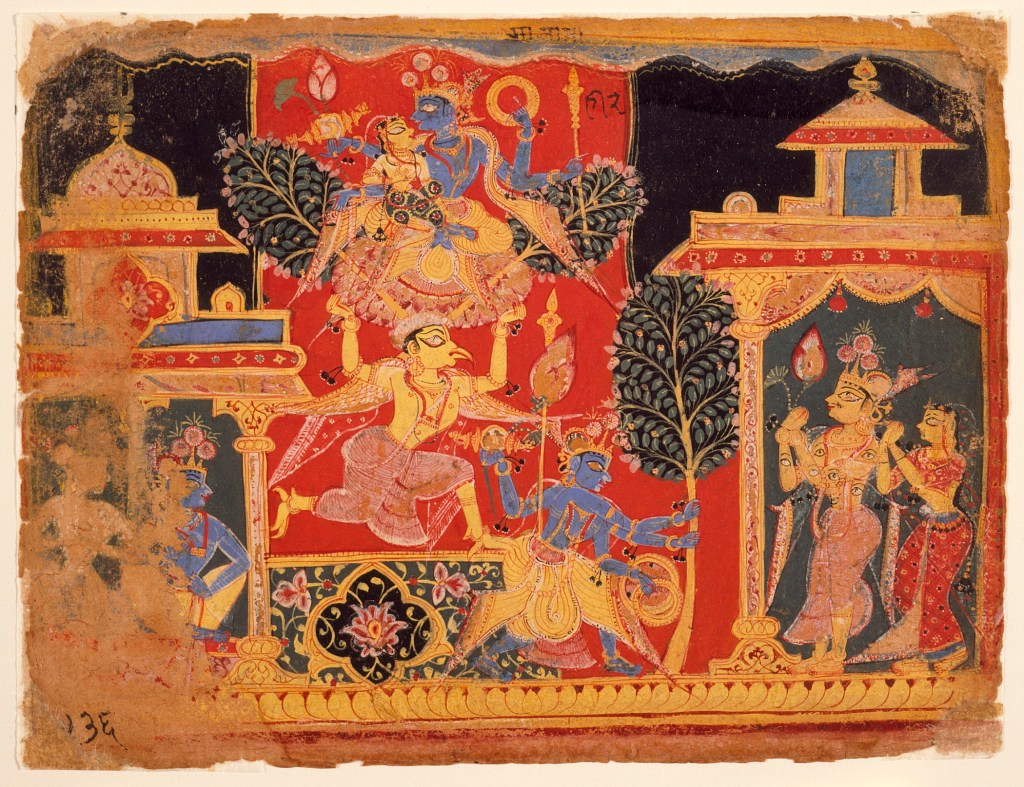
Krishna steals the Parijat tree from Mount Meru. Water colour India, app 1525-1550 CE. Courtesy: Creative commons

This is only one of the many gifts of nature, the exquisitely fragrant flowering tree which sheds blossoms and carpets the Earth  around it. Autumn, that season so famously invoked as the time of “mellow fruitfulness”, carries hints of ripening and a mature fecundity. For many sections of Indians, it is the time of the goddess, a time that a lot of us associate with the advent of the goddess Durga, who signifies the triumph of good over evil. In Durga, we have the divine represented both in terms of mythic abstractions and the material everyday, as power and poetry, as divine and human, as mother and daughter. Similarly the goddess Durga’s descent on Earth for the days of the festival, is also the advent of the daughter to the house of the mother, a moment which overflows with affection, feelings and emotions.

The event happens at a certain time in the Hindu calendar and participates in linear time, as well as being a part of time imagined as part of a larger ongoing cycle of temporality. Similarly, it  participates in mythic and magical time or eternity as it were. For the daughter, longing to be enfolded in the mother’s arms, who counts  the days till she can go back to her natal home, albeit for a few days, this is also a special time indeed.

It is this note of longing, dispossession and exile that is captured in the folk songs in the Bengali or Bangla language, which were documented in the 18th century. These songs are called Aagamoni which translates into advent, here referring to one who arrives. Why this gains a certain poignancy is that girlhood in Indian and many traditional cultures was viewed as a fleeting and fugitive time, haunted by transience. Female children were in the past often regarded as temporary occupants in their natal homes and were  characterised as ones who do not belong or belong to someone else, whose real home is with their in-laws.

Durga Puja celebrations
Courtesy: Creative Commons

In the Hindu pantheon, Durga, Uma or Parvati is a prominent mother goddess, the consort of Shiva. Her names refer to split roles of the feminine imaginary. As Durga she is the fiery slayer of demons. But– and this is the central theme here– she is also the gentle daughter Uma. It is in her form of the daughter who is separated from her parents, that the songs of Aagomoni and Bijoya emphasise. Bijoya translates as victory and starts with the return of the Goddess to her spouse, Shiva. Aagomoni and Bijoya are genres of Bengali folk songs celebrating the return of the Goddess Durga/Parvati to the home of her parents on the eve of the autumn festival of Durga Puja. The Aagomani songs describe the return of Parvati to her home in rural Bengal, not as Goddess but as daughter, and are followed by Bijoya songs which describe the sorrow of parting three days later as Parvati returns to her husband ShivaAagomoni songs can be interpreted as an expression of collective feelings, experiences and aspirations, another way of rethinking or reimagining the self-inscription of a collectivity.

In one of the best known and common Aagomoni songs, ‘Ogo amar agomoni’ (‘The Advent of Durga’):

The Advent of Durga

I herald the advent of the Goddess 
With the lighting of my lamps 
During the autumn whirlwinds.
At the end of night, the sun bursts forth.

In the swirling storm, 
At the end of the night,
The light in my path is turned off.
The beacon of my life has turned off. 
I herald the advent of my Goddess.

The lamp that reveals my path,
Brightens my life by pouring 
The nectar of your presence. 
I am lost in the blackness of fear. 
When you come in your radiant chariot, 
Your refulgence will shatter the 
Deep darkness in all directions.

Play the aubade of aurora.
It will all be divine. 
I herald the advent of my Goddess 
With the lighting of my lamps.
I herald the advent of our Goddess. 

(Translated by Mitali Chakravarty)

The song is full of the imagery of light and refulgence. My goddess “light of my life’’ could be both a reference to the divine mother, as well as to a daughter, who was very often  referred to as ‘Ma’ as a term of affection. While this song maps the emotional link between the mother and the daughter and can be seen in terms of affect, the focus is on her refulgence and divinity. The reference to the goddess in terms of the mother/ daughter trope is much more evident in other songs, which narrates the saga of dispossession — the fair  princess who has to live in disorderliness and poverty.

Go Get Gouri

Go, go Giriraj
To fetch your daughter Gouri
Uma is in deep sorrow
Uma has cried for her mother
Living in misery

Bhang consuming Shiv
Ash-smeared and wild
Sold off her finery
All her jewellery
To fund his addiction 

Bhola revels in intoxication 
He has collected hashish from 
The three realms….heaven, hell and earth.

Bhola put the intoxicant, bhang
Made with crushed
Datura seed on my Uma’s face.

Go lord of the mountains go
Go to fetch Gouri
Uma has cried herself hoarse.

(Translated by Mitali Chakravarty)

In another evocative song, the mother cries –“Ebaar Uma ele/Aar pathabo naa ( This time when Uma comes/ I will not send her back)”.

When My Uma Returns…

This time when my Uma comes,
I will not send her back. 
If people call me bad, let them. 
I will not listen to anyone. 
This time when my Uma returns,
I will not send her back, 
This time when my Uma comes.

If the conqueror of death comes
To talk of taking Uma back, 
If Mritunjaya comes
To talk of taking her back, 
We, mother and daughter, 
together will quarrel with him.
I will not agree because 
he is my son-in -law       
 
This time when my Uma returns,
I will not send her back, 
This time when my Uma comes...

The poet says 
Can life tolerate such wounds?
Shiva roams the cremation grounds,
And does not think of his own home. 

This time when my Uma comes,
I will not send her back. 
If people call me bad, let them. 
I will not listen to anyone. 
This time when my Uma returns,
I will not send her back, 
This time when my Uma comes...

(Translated by Mitali Chakravarty)

Here, the mother vows not to send Uma back to her wild and undomesticated husband when she comes visiting. This articulates a resolve uttered by the mother not to jeopardize or endanger her daughter by ‘giving’ her to an undeserving husband. The anxiety, insecurity and fear for the daughter’s safety is clearly evident in these lines. Maternity and maternality is here described as a tortuous and beleaguered  state. In all these lines, we see a shift from the narrative account of arming and empowerment of the goddess to a more human and humble register. Begging, cajoling, importuning-the mother’s pain and anxiety for the daughter, married to that strange and alien  figure, the untamed and undomesticated God Shiva, is evident in every line.

The narrative of mother and daughter pining for each other, appears to have similarities with  the Greek myth of Demeter and Persephone. In some,  the daughter is imagined as asking her husband for permission to visit her mother: “It has been so many days since I went home and saw my mother face to face ceaselessly… she weeps for me…” (Bhattacharya, in Mc Dermott 2001:132). The men ( both father  Giriraj and husband Shiva ) emerge as emotionally unreceptive. (Kaul 2022:9) We hear Menaka bemoaning an emotionally unresponsive husband who won’t fetch the daughter:

“Whom can I tell
the way I feel for Uma?"

Thus the story of the festival of Durga embraces not only the radiant, refulgent and resplendent image of the goddess; behind it lurks the secret sorrows of generations of mothers and daughters caught in the inevitable dance of life as they play out sagas of dispossession. As autumn is the season of liminality poised between summer and on the cusp of winter, the goddess visiting her natal home, is poised between humanity and divinity, both as a daughter in exile and as a slayer of demons. From this paradox, this spectacle that hovers between the majestic and the everyday, a sublime beauty is born.   

.

  Dr Meenakshi Malhotra is Associate Professor of English Literature at Hansraj College, University of Delhi, and has been involved in teaching and curriculum development in several universities. She has edited two books on Women and Lifewriting, Representing the Self and Claiming the I, in addition  to numerous published articles on gender, literature and feminist theory.       

.

PLEASE NOTE: ARTICLES CAN ONLY BE REPRODUCED IN OTHER SITES WITH DUE ACKNOWLEDGEMENT TO BORDERLESS JOURNAL

Categories
Review

A Taste of Time

Book Review by Bhaskar Parichha

 Title: A Taste of Time: A Food History of Calcutta
Author: Mohona Kanjilal
Publisher: Speaking Tiger, 2021

To say that this is a rattling book on the food culture of Kolkata will be an understatement. Indeed, there couldn’t have been a better book than this on the food history of the City of Joy. In the thriving universe of Indian food books, this clearly stands out.

A Taste of Time–A Food History of Calcutta by Mohona Kanjilal goes the whole hog in digging out the culinary history of Kolkata with every minute detail. The book is massive and gorgeous.

An alumnus of Loreto College, Kanjilal spent most of her childhood in Bengaluru. From a freelance journalist to a full-time writer, newspapers have been her invariable guidance. She dabbles in short stories, too.

Says the blurb: “Calcutta, once the nucleus of the Raj, was at the heart of a thriving economy and unparalleled administration. Over the centuries, this teeming, cosmopolitan metropolis has become home to people from various communities who have lent its food and culture their distinctive tastes and culinary rituals. The heady romance of palates and flavours in the ‘Royal Capital’ has fostered diversity in food and culture all the while adhering to the city’s Bengali roots.”

Divided into four sections and about a dozen chapters, Kanjilal brings to the platter a full account of the food culture of Kolkata and it, surely, is an intellectual nourishment.

The book is a perceptive journey through the ever-changing landscape of Calcutta’s food and cultural environment, from its decades-old cutlet, jhal muri,and puchka stalls to its iconic continental restaurants like Firpo’s and Flurys. Whether it is the oldest tea shop, Favourite Cabin, set up in 1924, to the 21st-century fine-dining restaurant “threesixtythree”, Mohona dexterously captures the stories behind the city’s adorable culture of ‘bikel chaar-ter cha’ (tea at 4 p.m.).

What makes the volume fascinating is her authentic research. From Calcutta’s renowned bakeries like Nahoum’s to the invention of rasgullas and samosas (or shingara), Kanjilal does a 360-degree exploration. Diving into Calcutta’s blazing history, she shows how the food habits of early European settlers, Jewish, Armenian, Chinese, Parsi and other communities, and the city’s next-door neighbours like Odisha, have made the culinary fabric of Calcutta immensely flush and stratified.

Food, Kanjilal says, “has always been an integral part of the lifestyle of the residents of Calcutta… whether it is… the phuchka wallah… the jhal muri wallah, selling the spicy puffed rice preparation… or the ghugni wallah, serving… the semi-dry and spicy preparation of whole yellow peas…”

In close to 500 pages, she weaves scholarly accounts of historians and food writers with the everyday fables one hears from a famous paanwallah or an old-timer of a club. In the introductory part; she deals with the founding of Calcutta — from the Mughal empire to the coming of the British and latter part of the twentieth century when Calcutta became a bursting metropolis.

Writes Kanjilal: “As the capital of British India (1858-1911), Calcutta became a culinary melting pot of Armenians and Parsis from Iran, Jews from Syria and Baghdad, the Chinese fleeing their revolution, and local migrants such as Gujaratis, Punjabis, Marwaris, Sindhis, Oriyas, Biharis and South Indians. Her book explores this culinary evolution across a variety of cuisines and time periods. She structures the book according to when these migrants figured into the city’s consciousness. It is divided into four sections, with each section taking up the culinary influence of a particular set of migrants and the dishes they influenced in a Bengali household’s repertoire.

“The British were responsible for introducing certain food habits that have, over the years, become pillars of Calcutta’s culinary culture. One of their major contributions was the introduction of beverages to the Bengali table. Tea, coffee and fresh fruit juices are a fixed part of the average Bengali’s breakfast spread today because of the British influence. This nation strongly influenced the foods Bengalis ate for breakfast as well, introducing typical preparations of egg, sausage, bacon and bread to the local palate. Chops and cutlets, which are today as essential to a Bengali as rice and fish curry, also owe their popularity to the role played by the British in Bengali culinary history. Today, kiosks in every nook and corner of the city make and sell these fried foods, usually as accompaniments to what many perceive as a quintessentially British meal: afternoon tea. Finally, egg-based puddings, now a fixture on Calcutta’s dessert menus, were introduced to the city by the British.”

Her investigation is truly fascinating. From the British influence to the Portuguese influence; from the Anglo-Indian to the Armenian; from the Jews to the Nawabi influence; from Chinese to Parsi cuisine, she digs out hundreds of recipes. Then, there is a whole chapter on Bengali cuisine itself. She also deals with Pan-Indian cuisine and the influence of nearby Darjeeling district.

If one ever wants to read a book about Calcutta that takes to the vignettes and the history surrounding the favourite dishes and eateries, this is the book. If you want to hear stories about which famous personality (e.g. Subhas Chandra Bose) ate what and where, and if you want to repeat those experiences for yourself, then this is the suitable guide.

This delicious and all-embracing history of food in Calcutta, peppered with mouth-watering nuggets, recipes and incendiary accounts is a boon for the bon vivant.

Glossary:

* Puchka, jhaal muri and ghughni are savoury snacks.

Paanwallah is the seller of paan or betel leaf.

Bhaskar Parichha is a journalist and author of No Strings Attached: Writings on Odisha and Biju Patnaik – A Political Biography. He lives in Bhubaneswar and writes bilingually. Besides writing for newspapers, he also reviews books on various media platforms.

.

PLEASE NOTE: ARTICLES CAN ONLY BE REPRODUCED IN OTHER SITES WITH DUE ACKNOWLEDGEMENT TO BORDERLESS JOURNAL

Categories
Nazrul Translations

The Quest for Home

Professor Fakrul Alam translates Kazi Nazrul Islam’s Kon Kule Aaj Bhirlo Tori, a song which explores homecoming from a spiritual perspective

Kazi Nazrul Islam. Courtesy: Creative Commons

Born in united Bengal, long before the Partition, Kazi Nazrul Islam (1899-1976) was known as the  Bidrohi Kobi, or “rebel poet”. Nazrul is now regarded as the national poet of Bangladesh though he continues a revered name in the Indian subcontinent. In addition to his prose and poetry, Nazrul wrote about 4000 songs.

In Which Shore


In which shore has my boat moored today?
What golden village lies ahead? 
Why does my boat, on a downstream-drift, 
Yearn to move upstream again?

Making Sorrow my helmsman
I had set adrift my broken boat.
Who are you, nymph of my dreams,
Beckoning me on with your eyes?

Snuffing out my room’s lamp
You called me out that stormy night.
Who could you be, my tune’s companion,
Waiting at the gateway of my song?

Oh golden girl of a golden land
Will you be my boat’s pilot?
Row my broken boat onwards
To the Promised Land! 

(This poem was first published in Daily Star)

Nazrul’s songs are sung by artistes of renown across the subcontinent. Here we celebrate his lyrics, with a rendition by a well-known Indian singer, Manabendra Mukhopadhyay (1929-1992).

Fakrul Alam is an academic, translator and writer from Bangladesh. He has translated works of Jibonananda Das and Rabindranath Tagore into English and is the recipient of Bangla Academy Literary Award (2012) for translation and SAARC Literary Award (2012).

.

PLEASE NOTE: ARTICLES CAN ONLY BE REPRODUCED IN OTHER SITES WITH DUE ACKNOWLEDGEMENT TO BORDERLESS JOURNAL

Categories
A Special Tribute

Gandhi & Our Future

Bapu or Gandhi (2 October 1869 – 30 January 1948) on India’s currency. Courtesy: Creative commons

Gandhi with his call to combat violence and hatred with non- violence and truth is perhaps a voice that needs to be  recalled out of history books on dusty shelves. His ideals cry out to be retrieved beyond the reach of currency notes, statues, buildings, names of parks and roads. Like Tagore, we may not agree with all his ideas but he put together an ideology which, perhaps, could be realised and implemented to make a better world across borders. If peace is forced by nuclear warheads and the ruthless are allowed a field day to govern any country because they have the might, perhaps it is time to question the efficacy of manmade constructs created through history, especially after the Second World War. Do we want bloodshed, chaos and the pandemic to be part of our daily news? Or, can we explore the philosophy of a man who mingled the best from the East and the West to create a system which has impacted many across the world? Leaders and great statesmen learnt from him — Martin Luther King Junior, Nelson Mandela, Al Gore, Barack Obama, John Lennon and Albert Einstein to name a few — just as he had learnt from greats across the world. 

Today, in an attempt to recall the best in Gandhi’s philosophy, we wanted to present to you a selection that tries to connect us with his ideals — give a glimpse of his dreams that might have led to a better world if we only had listened and acted. Of the pieces we are showcasing here, some have painted a world that needs a Gandhi while others have written what they imbibed from his ideals into their own lives. Can we ride on the crescendo with these voices to achieve a better future for our children by embedding and internalising his values?

Interview

Santosh Bakaya interviews Tushar Gandhi, great-grandson of Mahatma Gandhi. Click here to read.

Poetry

Gandhi & the Robot

A poem relooking at Gandhi’s ideology in the present context, written in Manipuri by Thangjam Ibopishak and translated by Robin S Ngangom. Click here to read.

A Poem for Dreamers

Michael R Burch wrote this poem under the spell of the famed “I Have a Dream” speech by Martin Luther King Junior, an ardent practitioner of  Gandhi’s ideology, a student and disciple of the Mahatma. Click here to read.

Fiction

In Bapu, Denied, Sunil Sharma pulls Gandhi down from a pedestal and explores his ideals in the current world. Click here to read.

Non-Fiction

What Gandhi Teaches Me

Candice Louisa Daquin applies Gandhiism to her own lived experiences. Click here to read.

When West meets East, Greatness Blooms

From our treasury, Debraj Mookerjee reflects on how syncretism impacts greats like Gandhi, Tagore, Tolstoy, Emerson, Martin Luther King Jr and many more. Click here to read.

Categories
Essay

What Gandhi Teaches Me

By Candice Louisa Daquin

Generally, a Westerner shouldn’t try to dabble in writing about Indian great men because it’s that kind of appropriate-ism that caused so much misunderstanding and damage to begin with. The idea the West had all the answers, which clearly it does not. The idea someone whose country used to be a colonialist-force, had the right anymore to discuss countries that were colonized, can smack deeply of appropriate-ism or worse.  However, there are also ways we can appreciate what we know and transmit that without being patronizing or culturally insensitive.

I choose to consider Gandhi and his impact on the world, to remain in the middle ground. Neither applauding Gandhi without reservation, nor ignoring his incredible impact and influence on India and beyond. I don’t always do this, in the case of someone like Woody Allen or Charles Bukowski (hardly comparable) I cut them off immediately because despite being talented, their talent simply doesn’t measure against the harm they caused. With someone like Friedrich Nietzsche I would say, he has some brilliant perspectives, but his over-all views were too harmful for me to support him. Revisionist thinking is necessary, but sometimes like anything else, it can go too far and condemn significant people based on modern thinking that doesn’t take into account the mores of the time.

One of the hardest things in the world is when your heroes appear to fall. But in this case, there is so much positive about Gandhi I believe (and this is a personal belief), that his goodness encourages us to retain his relevance and enduring impact.

Firstly, Satyagraha – belief in using truth to resist evils with non-violence. Not the same as simply ‘truth’ or ‘verité’ as I would say in French. But more the ideal of believing in truth rather than being deceived or unable to believe. This is not just valuing truth, but believing in truth and thus, through that belief, knowing what is true (and reasonably, what is not).

I find this very interesting because whilst we all ‘think’ we know truth, obviously most of us do not. When does opinion and truth come together? Really holding an opinion has nothing to do with truth but with multiple versions of truth, how do we ever know which one is right? This is a discussion I have had many times in my life with friends of differing views. For a time, I wanted to be a Christian because I needed to believe in something and so many whom I knew were Christian would try to persuade me that was the ‘right’ (true) path. I was not convinced, despite my own attempts to be and it did not strike me as ‘truthful’ or ‘the truth.’ But the question is if people ‘doubt’ another’s truth then where does that end up?

I think of what Gandhi might have said; that truth is beyond conjecture, difference and trying to be ‘right’ the truth is there all along, it is immutable, transformative and fluid at the same time. And by truth he is not speaking purely of a particular faith, or a particular creed, but a universal truth. That is pretty esoteric for Westerners, I think overall Western thinking is prescribed, it feels comfortable having absolutes to follow and only demurs when it’s considered socially ‘trendy’ to disagree. While there may appear to be diverse thinking in the West, I would say it’s no more diverse than closed societies like China, the propaganda is just less obvious. After all, it’s not a societal dictate that has people unquestioning, it’s the mandate of the individual which links with the concept of  Swaraj – self-rule which ultimately led to home rule, the idea that led to an independent India.

If I think of his ideals today, how many of us believe in truth by considering how this lies within us and then without us. Isn’t it more common for us to be spoon fed a ‘truism’ from our respective societies, and even if we question that truth, we do so with groupthink, subscribing to a ‘truth’ without considering what believing in truth means in relation to ultimate truth? Thus, without individual self-policing (or by proxy, the questioning of something outside ourselves) and perhaps by being so busy, we take the easy road because to question everything can be an exhausting enterprise, and as Marx would say, we’re distracted by how busy we are in the machine of work. Leading to at times, mass delusion, or mass indifference, but definitely not an understanding or questioning of how to cultivate a belief in truth.

In fact, how important is truth to us? We bandy around the words, paying lip service to the idea, but without going further to consider the idea at a more personal and then social level. Truly believing in truth would be almost like letting go of everything and beginning over (as one could say Gandhi did) and as you rebuild, doing so with belief in truth in a pure sense of the word. I believe in truth and therefore reject attempts of subterfuge in favour of increasing my belief in the existence of truth. In many ways this is like believing in God without it becoming all about the details (scripture, deity, icons etc). It seems to have a lot in common with the pure heart of Buddhism too,

This leads to another principal of Gandhi’s — simplicity. Simplicity of an idea clears the clutter to reach at the truth. That simple. Practice simplicity and you will see more clearly. How many of us truly practice simplicity? I may try, but I fail, as most of us do, with this increasingly complicated pull and push of modern society, where I might rail against absurdities because I’ve been sucked into thinking they matter. Maybe some of us don’t have the luxury of opting out and going back to basics, maybe our lives are too interwoven with an unnecessarily complicated society that ‘demands’ we brush our hair, shine our shoes, iron our clothes, wipe our faces and face the world a certain way.

The perennial question has always been: is this the only way to live? And as we lose more and more of our simplicity, we may no longer care about other options, in favour of following the status quo. Furthermore, we may believe a complicated life with stress and demands, is the only way we can live, the only way things can work. I would think Gandhi could see, by giving things up, you gain more than by taking on more, and whilst his message may seem inapplicable to many, we can all learn something by doing less, wanting less, needing less.

After all, we cannot take what we accumulate with us, so the ideals of physical wealth seem less important than spiritual health. Many of us may brag about the car we drive, the house or neighborhood we live in, where our kids go to school or university, what they do for a living and so it goes on. Even in India, this is true, as the upper and middle classes seek to emulate what they have seen dominate the rest of the world and define themselves by those status markers that mean so much (and conversely, may mean so little). It is easy to get caught up in it.

I was never an acolyte of the materialistic world, but like most people, I had my insecurities and wanted to jump through  few hoops that I felt defined you as a success in society. When I became sick, it really showed me in a shocking way, how little those things mattered. I recall one day in hospital, my hair matted from throwing up, I just reached for my ponytail and cut half of it off. I had always been vain of my hair as it was thick and long and yet, it felt absurd to hold onto something for vanities sake when I was so sick and bereft of any normalcy. Likewise, when I went out into the common area of the hospital, I saw people sicker than me, and as we talked, I saw they were friendly irrespective of my not wearing make-up, or shoes (!) and in a gown with a green face. They saw ‘me’ and it felt like being a child again, liked for being ‘me’ instead of the ‘me’ I had become used to showing the world which was a counterfeit version. This principle then applies also to the notion of truth, and self-policing. Without an inflexible doctrine like religions, Gandhi’s philosophy was free to consider the whole rather than the individual steps toward being whole.

9/11 has just passed here in America my adopted country, and at its 20-year anniversary there has been much made of our withdrawal from Afghanistan, the country America invaded after 9/11 for sheltering the terrorists who were involved in the murder of so many people. Whether you are a Democrat, or Republican, many Americans believed someone had to pay for the atrocities committed on American soil. I recall at the time understanding both perspectives: the felt need for revenge or justice, and also, the need to lean towards understanding the how and the why of the incident to prevent it from recurring again.

When America withdrew from its longest and unsuccessful war against the Taliban, only to find the Taliban and Isis took over Afghanistan as if America had never been there, it did strike many as being a truly futile war (and we can argue, all wars are futile to some degree). How blatant was the takeover of a country America had wrongly thought was tamed from its former ‘enemies’.  Over time, it had just felt a lot like other wars (Vietnam etc.) where so much death, destruction and expense wrought no change, certainly not as Americans had visualised. Furthermore, did the taxpayer really want to leave behind US$ 2.26 trillion of their hard-earned money to equip Afghanistan? Yet that is exactly what happened along with the providing a free access to the very latest technology in the abandoned US embassy.

Why doesn’t America learn this lesson? That going to war doesn’t really change the ideology of an invaded country, that small bandit terror cells continue to thrive and even increase, because the promotion of American ideals isn’t always universal or accepted, and promoting them whilst invading a country, breeds as much resentment as it does thankfulness. By this I am not suggesting everything America did was negative, they truly tried to help the Afghani people, but at what cost? And did it work? I would say it did not. That’s perhaps because it is not the role of any one nation to police another or dictate to another.

But what do you do if you are a military person, and your country is attacked? It’s hard to imagine sitting there and debating how to have a non-violent discussion with the enemy. Yet that is exactly what Gandhi is most famous for. Satyagraha may seem a very outdated term, or it may appeal as a modern notion, either way it’s so laden with symbolism we hardly understand its core anymore. On the one hand, there is the Old-Testament idea of ‘an eye for an eye’ and then as Gandhi followed ‘An eye for an eye leaves the whole world blind’.

Personally, I find truth in both, maybe truth can have a duality or not be as black and white as we often want it to be, but either way, non-violence is erasing the option for any kind of vengeance or payback, not an easy thing to accomplish when your enemy is being deeply unfair, as was the case with Gandhi watching the treatment of Indians in South Africa and then again with the colonial invading forces of the British in India. Gandhi founded the Natal Indian Congress in 1894, where he campaigned for the rights of indentured labourers in South Africa and protested against the system of requiring passes for Indians. Gandhi went on to organise the local Indian community, of all income brackets, into a passive resistance against this inequality. With these early eye-openers, Gandhi began his first experiences of community building into protest, utilizing peaceful means, against entrenched inequality and racism.

But every situation is different and 9/11 did not happen out of the blue, it came about as a result of decades of fighting between Christian and Muslim extremists on both sides. It also came about because the West wanted the Muslim world to accept some things, they found unacceptable. When asked why he caused the 9/11 attacks, Osama Bin Laden said because Saudi Arabia, his homeland, was in bed with America in going after Saddam Husain and others in Iraq. Why did he find this so offensive? In part because he didn’t like American military in his country, especially women soldiers. His brand of extremist Islam did not believe women equal to men and found that an abomination.

What is ironic about this extremist thinking, which can be found in all faiths, is how hypocritical those who believe it seem to be. All the terrorists who came to America to attack on 9/11 visited brothels and took full advantage of the Western ‘evils’ they preached against. They would argue that they had no respect for those people because they were ‘evil’ – in essence justifying their behavior based on a greater sin. But who are we to dictate who is more ‘sinful’ than another, and surely, if we believe in truth, we don’t break it when tempted by the very thing we condemn? Going back to Gandhi’s ideal of belief in truth, one who does, would not be hypocritical.

Yet so many humans are. Some people who condemn homosexuals have secretly practiced homosexuality. People who condemn women might be profiting from their exploitation. Those kinds of hypocrites negate the truth of their original argument. If we simplify the argument, we have no legs to stand on. Oppression of others goes against all religions but is practiced by all religions. I think Gandhi saw this palpably and was trying to redirect us to see how absurd this was. And what greater way than to practice non-violence against a violent oppressor? It literally was an act of faith, and incorporated belief in truth, and political self-policing. Is this not the ultimate reality? ‘Ahimsa’ isn’t just ‘non-violence’ because no one principle exists in isolation from ‘other’ in this case, love. Without love there is no mercy, there is no wish for non-violence. It is the connection between the intension and the outcome that produces Gandhi’s ‘Ahimsa’ (non-violence).

If all life is one, then all violence perpetrated against self or other is experienced as a whole, the welfare of human beings at the core. The very opposite of the competitive consumerism of Capitalism, which America is known for. And with this, Gandhi predicted the future, a practical need to eat less meat, (vegetarianism) or to respect life (by not consuming animals or exposing animals to suffering) relating back to the idea all living things are connected. I recall as a child being deeply impressed with this concept and it was one reason I myself became a vegetarian at a very young age. To many in the West, vegetarianism is considered the purview of the privileged, and I now understand that, because if you live a very simple life, it’s often very hard to be vegetarian and consume enough calories. To an extent, being vegetarian is abstinence. Many people with eating disorders become vegetarian or vegan as a form of orthorexia. Many middle-class kids have the ‘fad’ of vegetarianism. But the core behind Gandhi’s form vegetarianism or veganism is more in line with Hindu/Buddhist perspectives of respecting living things and causing no suffering.

The hardest principle of Gandhism I have encountered is faith. For some, this is the easiest as they already possess faith, as Gandhi did. He said: “I must confess that the observance of the law of continence is impossible without a living faith in God, which is living Truth. It is the fashion nowadays to dismiss God altogether and insist on the possibility of reaching the highest kind of life without the necessity of a living faith in a living God. I must confess my inability to drive the truth of the law home to those who have no faith in and no need for a Power infinitely higher than themselves. My own experience has led me to the knowledge that fullest life is impossible without an immovable belief in a living law in obedience to which the whole universe moves.” But unlike the shaming faith separating gender and men and women, Gandhi didn’t impose those divisions: “It is not woman whose touch defiles man, but he is often himself too impure to touch her ……” As a woman who disliked the inferior status given women in most mainstream religions, I found Gandhi’s perspective on this, refreshing and egalitarian. I cannot speak on faith as I do not possess it adequately, but I can see its place in Gandhi’s principles and understand it didn’t come to him all at once, but through the experience in part of the other values he lived with. They built into on one another and are interconnected.

Gandhi’s belief included celibacy. “Brahmacharya … means control in thought, word and action, of all the senses at all times and in all places.” The conclusion in some ways to the fulfilment of all the other principles. Those who find ways to condemn Gandhi, point to the potential for scandal by Gandhi’s relationship with Sarla Devi Chaudharani, daughter of Rabindranath Tagore’s elder sister owing to materials where Gandhi called Sarla Devi his ‘spiritual wife’. Yet in Gandhi’s letters to his friends, Gandhi explained that he called Sarla Devi his ‘spiritual wife’ because theirs’ was a ‘wedding based on knowledge.’ Why this matters, is Brahmacharya is related to celibacy and people often question whether any man is capable of celibacy or whether it was just the outward appearance of.

Personally, I’m not sure it’s as important as others feel it is, to discern whether Gandhi remained celibate, because I do not place importance on celibacy, but I understand if you are literally reading Gandhi, you would hope he did what he said he did. I wonder why this matters so much and why sex with a woman (or man) would be such an issue for those who love Gandhi (or for that matter Jesus, because many thought, he had a wife and this idea alone, scandalized others). Perhaps when it doesn’t matter if a spiritual leader has sex or not, we’ll really be free of all shame attached to sexual relations. Although for Gandhi it was more about control over impulses that could sway him from his path. Gandhi wrote in a letter on the subject; “I have reached a definition of a spiritual marriage. It is the partnership between two people of the opposite sex where the physical is wholly absent. It is therefore possible between brother and sister, father and daughter. It is possible only between two brahmacharis in thought, word and deed.”

I understand for him, perhaps passion was an inflammation of sense and morality, and this would distract him. Gandhi was thought to have developed his perspectives on carnal passions by concluding a person cannot selflessly serve humanity without accepting poverty and chastity. This seems an enduring theme among many holy men and I’m not one to dispute it, although I think it’s different for a woman. When Gandhi said: “physical union for the sake of carnal satisfaction is reversion to animality,” he may have set himself up to be perceived as unrealistically idealist and unrealistically puritanical.

On the other hand, like anything, we have to take the influences of the time-period into account; what Gandhi was responding to, what he witnessed, what he saw occur, how those played into his striving for inner-strength. I see it like trying to translate what a great painter meant by their painting, hundreds of years later. Ultimately, we do, but that painter if alive today, may say; ‘oh no you got it all wrong.’ So, when people point to the strange things Gandhi did in his Brahmacharya experiments, they could be very right, or it could be one piece of a much larger puzzle. We are all twisted by our life experiences, but we expect Gandhi to be free of this, even as he said he wasn’t. Perhaps the shame of not being with his father during his last moments as he went to his bedroom to have sex with his wife, was among some of the reasons he embraced Brahmacharya, Gandhi was after-all, human.

Trying to understand the motives of someone born in another era involves taking into account their worldview as influenced by that era. Gandhi was from a middle-class family, and we know those born into higher classes are often received differently to those from other classes. This isn’t right, but it’s the way the world has operated and blaming the person born into that family is blaming the wrong person. It is the system that perpetuates this, just as now, most ‘notable’ people come from some degree of privilege than obscurity (with significant exceptions). Gandhi was a product of that privilege but that’s not quite the same as being privileged in thought. Likewise, it’s easy to say, he got married at 13 and had 4 kids, so it was relatively easy to become celibate, but without experiencing that personally, that’s an assumption based on reaction, not fact.

I can understand the unease of revisiting historically important figures, the desire to applaud them but also the need to criticize their failings. I think if Gandhi were alive today, he would say ‘have at it’ and be open to criticism, although possibly he would find today’s world untenable, for who really knows how a historical figure would greet the future? We become the future by evolving. Only 20 years ago, the idea of gay-marriage would be abhorrent to most, so much transforms with acceptance and shifting of ideas. Some of that actually comes from thinkers like Gandhi who perhaps paved the way in some form, for the future, even if that future is quick to criticize him. But just as we must respect our grandparents view things differently from us, often through no fault or hate on their part but their upbringing, we cannot always realistically expect people, however smart, to transform on par with our own insights; that’s just not realistic or how we work as humans.

Either way, whether you are successful in incorporating the principles of Gandhi-ism in your life, or not, value lies in taking a leaf out of some of his philosophies. I don’t agree with everything I have read of Gandhi’s beliefs, but he was the first one to say, we contradict ourselves, as we grow, and nothing we do is set in stone. He was continually questioning and evolving, and that to me seems far more realistic than to be a static deity demanding fealty without question.

I remember buying my Goddaughter the kids book; The Lion The Witch and The Wardrobe and worrying that her generation may not find it as bewitching as mine did. Some things don’t age well. Others endure. But on average, there are always parts that last the test of time. Instead of being precious about Gandhi, we should be open to questioning his perspectives without rancor, because he would have wanted us to. At the same time, dismissing him because he held some views that at the time were considered normal but are now unfashionable, is to dismiss the value he brought to the table when we discuss faith and philosophy. If we demand perfection, we’ll not find anyone to be inspired by, at the same time it is not wrong to want to redefine norms as we evolve as a society, just the way Gandhi hoped we would.

Candice Louisa Daquin is a Psychotherapist and Editor, having worked in Europe, Canada and the USA. Daquins own work is also published widely, she has written five books of poetry, the last published by Finishing Line Press called Pinch the Lock. Her website is www thefeatheredsleep.com

.

PLEASE NOTE: ARTICLES CAN ONLY BE REPRODUCED IN OTHER SITES WITH DUE ACKNOWLEDGEMENT TO BORDERLESS JOURNAL.

Categories
The Literary Fictionist

Bapu, Denied

By Sunil Sharma

The City of Concrete (CC) was all excited and discussing the new viral video of a man claiming to be the “Real Gandhi”.

The middle class hardly cared for surnames but anything viral got them talking. And this real vs. fake debate always made them social– quick WhatsApp exchanges of videos and messages, that is all of it, then moved on for other limited conversations, mainly digital.

In fact, the City did not care about history and heritage and trifles got them interested– who is eating what, how and where? Or wearing what and where? Or dating whom or where?

The CC grew inward-looking and obsessed with tech gadgets.

Smart phones were their portals to instant nirvana.

And viral videos, their mainstay of an urban narrow existence cramped in few hundreds of square meters in the vertical cages!

So, on a crisp morning of a holiday, the City got jolted by the new sensation of a man claiming to be authentic Gandhi left them intrigued.

But who is Gandhi, dude?

Here was this video of a somber old man with a magnetic persona– yes, you could feel the electrifying currents across the small mobile-phone- screens that affected you directly– the high-energy field, halo around the man that left you in thrall.

Incredible!

Within an hour, it was the top trending topic.

As per the recording, the man in round glasses and loin cloth, told some slum children that he was India’s Bapu.

The folks were initially dismissive and some die-hard skeptics openly cynical of this grandfatherly, scantily clad man, and told him rudely to go some other place and let them enjoy the off day.

The man was quite understanding and patient and asked them, “What day is this?”

An out-of-job guy replied gruffly, “October 2nd.”

The visitor persisted, “Why is it declared a national holiday?”

The folks, gathered under the bronze statue of a man with round glasses and walking stick, had no answer.

Then a child finally replied, “Wait! It is the birthday of the ‘Father of the Nation’.”

The stranger smiled, “Yes, son, you are right! It is my birthday.”

Thereupon, the wide-eyed child asked, “Are you that iconic Mohandas Karamchand Gandhi who delivered us from slavery to the wily British through your philosophy of non-violence and satyagrah ?”

The old man smiled and said, “Yes, I am that Mohandas, an ordinary son of motherland, who was lucky enough to serve my country in most humble manner, with the loving support of my country.”

The child beamed and shouted, “Lucky me! Meeting the Apostle in person! My dream has come true!”

The child raised voice: “Mahatma Gandhi zindabad !”

Children of the poor neighbourhood repeated it as a feisty slogan.

The old man smiled and kept on walking fast across the broken city.

The children followed — and soon others joined the long procession.

It was huge!

People clicked the man who seemed to be walking on another fresh mission.

Soon the news spread.

Citizens came out of their customary slumber and started following the kind old man who, a bit pale, still retained a strange luminosity and a hypnotic pull over his simple beholders. The moment he had stepped into their middle from nowhere, the whole space was lit in a strange way. There was a certain spring in his gait and his walking stick shone like some royal emblem. His watch had an unearthly chime—mesmerizing!

His voice was strong, eyes steady, gait firm.

This dimension collapsing into the other dimension; this reality fused into that reality– that kind of thing!

History was coming alive — in an unpredictable way! A professor wrote.

A sole surviving freedom fighter remarked, the visitor reminded them of the aura of Mahatma Gandhi, in an odd way.

This Gandhi looked other worldly, ethereal but inspired confidence—and faith!

Bapu’s smile was pure and eyes and tone, gentle.

The CC got enthralled by the heavenly presence of Gandhi and the residents went wherever this person went.

The fever spread further.

The WhatsApp exchanges galvanized the sleepy city, and it turned into a mass event.

There were the loud and regular chants of “Bapu! Bapu! Bapu is back for his country—again! We love you, Bapu!”

People got hysterical at the sight of the frail man. Many openly wept and said, “We need you Bapu, in our empty lives as mere consumers. You have made us whole!”

The freedom fighter cried, “Bapu! Nobody cares for us here!”

Bapu smiled: “They will. Follow the moral compass. The world will listen.”

The freedom fighter said, “Yes, Bapu. I will teach students your philosophy.”

.

The City of Concrete was on fire.

A real hero had emerged from the darkness.

Everybody talked of Mahatma Gandhi only.

An antidote to the global doctrine of hate.

.

The municipal corporation was busy celebrating the birthday of the ‘Father of the Nation’ via sterile speeches and garlanding.

Initially the corporators thought that he was another look-alike walking the narrow streets this morning, an annual practice for few models but when apprised of his increasing popularity, the bunch of the city fathers grew apprehensive of a new threat to their base.

By mid-morning, the national media grew aware of a new sensation. A man who called himself the original Gandhi and was visiting the CC for a reality check.

.

Of course, the new-millennial young crowd had never bothered about history or India, and they were least interested in searching for a name and legacy that no longer resonated within a geography being redone for the malls and foreign outlets of food, clothes and entertainment. Plugged into their iPhones, the cool set ate burgers and pizza and sang Western songs, wearing baseball caps turned around, dressed up in sneakers and cotton-Ts and cargo pants, tattooed up and ears, pierced.

What hooked them was the unusual sight of a bare-chested man radiating terrific energy and calmness, kind of raw star power unseen so far in a media culture and thinking of the possibility of the 5-second fame in the clutter, the teens and young adults raced to the spot where Bapu was talking to the masses. They wanted to join the trending hash tag: #Seen with our Beloved Bapu! The crowds from outside CC kept on joining that famous historical frail figure full of steely resolve and power.

Meanwhile, media arrived in big numbers and the circus started. The loud reporters asked questions about this phenomenon, without a match. One teen said he saw the statue of Gandhi in the garden coming alive; another claimed he saw the statue walking down the street in animated condition, while other versions spoke of witnessing Gandhi floating on a cloud or descending from the air! The viral videos flooded the cyber space, and the world began reacting to another trend: #Bapu, Alive!

#New Messiah of Love! Another trended.

Love Triumphs Finally! Wrote another on her blog: Young Nation.

.

The local leaders got unduly alarmed: Who is this pop figure? His minute-by-minute-increasing fandom and heavenly persona posed a problem. The cops were dispatched.

Bapu was brought before the Wise Council.

One of the senior leaders asked: “How can you be Bapu?”

Bapu asked calmly: “And why can’t be I?”

Leader: “Because you died many years ago…”

Bapu: “When did I die? I never did. Hatred can never win. I live on…”

The leader fumbled: “But, we are told you died, years ago. How can you be re-born?”

“Ideas never die. They live on. Faith revived me.”

The leader nodded.

Bapu smiled: “Do you really know me?”

“Yes, Bapu.”

“Any idea about the incident at Pietermaritzburg station? The year 1893? June 7?”

The leader did not know anything. He looked like an idiot.

Bapu said calmly: “A leader must know the history of their nation. Lead by example. By honesty. Simplicity. Ethically. Remain connected to the fellow citizens. Create a legacy of love and ahimsa! Understand?”

The leader nodded again, crestfallen before this luminous being, beyond the pale of death.

Bapu left smiling. Huge crowds waited outside.

“Gandhi is alive!” They shouted. “He has come back for his children!”

.

The Great Leader was woken up.

The media in-charge, a seasoned man handling information technology cell of the party, reported the developments that could cast a shadow on the Tall Leader.

The Great Leader replied: “Do not worry!”

“But Saab!” croaked the sycophant.

“Listen!” commanded the Tall Leader.

“Yes, sir!”

“The surest way to neutralize is to institutionalize them.”

“Sir!”

“Ritualize their memory!”

“Sir!”

“And re-write history.”

“Sir.”

“And…”

“And? Sir?”

“The best way is to erase history by making it ugly, unreadable and unproductive!”

The Tall Leader chuckled and disconnected.

.

Glossary:
Satyagrah — Using truth to non-violently resist abuse

Zindabad — Long live

Ahimsa — Non-violence

Sunil Sharma is an academic and writer with 22 books published—some solo and joint. Edits the online monthly journal Setu.

.

PLEASE NOTE: ARTICLES CAN ONLY BE REPRODUCED IN OTHER SITES WITH DUE ACKNOWLEDGEMENT TO BORDERLESS JOURNAL. 

In Conversation with Tushar Gandhi

Santosh Bakaya interviews Tushar Gandhi, the great grandson of Bapu, after paying a brief tribute to the Mahatma

Gandhi (1869-1948) was assassinated on January 30th 1948. This was one of the last photos of him – sometime in 1947 when both, Gandhi and Nehru, apparently were appalled and concerned about the carnage resulting from the separation of India and Pakistan. This photo was published in Newsweek, Aug. 4, 1997. Courtesy: Creative Commons

Before I begin the interview, I would like to pay a small tribute to the great Bapu, the unarmed fighter, the environmentalist, the vibrant economic philosopher, who talked of Swadeshi and self- dependence long before the modern world is slowly waking up to its benefits, who emphasized a people -centered economy rather than a technology centred one, where we find individuals stripped off their dignity, becoming insignificant cogs in the machine. The plight of the migrant labourers during the current pandemic is branded on our collective consciousness, all because of a flawed-topsy- turvy model of development. Only if we had heeded Bapu’s call of making the villages self- sufficient and self- reliant.

Right from the time he refused to ‘cheat’ to correct the spelling of kettle in a class test during the visit of the school inspector, to the time he abruptly called off the Non-cooperation movement, due to violence at Chauri Chaura, well-aware of the repercussions that would follow, he shunned mendacity and violence. Belying his physical fragility, he managed to emerge as a strong moral icon. In a world torn asunder by war and violence, he succeeded in teaching many a world leader lessons in the powerful weapon of non- violence and truth, pitting soul force against brute force. The vulnerable Mohan, full of complexes, foibles, fears and phobias, a boy who was afraid of snakes, ghosts, multiplication tables, metamorphosed into the valiant, venerable   Mahatma, [a sobriquet he did not feel comfortable   with]. Under the seemingly frail façade, was a man who could flex his moral muscles and shake a comatose nation out of its languor. This unarmed warrior, went on to exemplify self- introspection, self -analysis, self- mastery, and a humongous moral power. Denigrated as the half-naked fakir by Winston Churchill, he was the very epitome of minimalism, but well- clothed in the raiment of love, compassion, fearlessness and forgiveness.

During the Dandi March, women from all sections of society- women who had never been part of public gatherings, women who had not stepped out of the four walls of the house, unlettered village women, poured out on the streets because he had very intelligently linked salt, a common kitchen ingredient to an uncommon call for freedom. Kamladevi Chattopadhyay valiantly stalked into the High Court premises, and while a stunned magistrate gaped, hurled a question at him whether he would like to buy “the salt of freedom”, she had prepared.  Songs of freedom rang in the streets, women metamorphosed into human shields blocking the paths of policemen, facing lathi blows and even landing in jails.  What do you call such a man – an intelligent strategist?  Quixotic? Charismatic?   A maverick?  Was this not a coup of sorts?

Bapu’s strategy paid off and the Indians realized that throwing off the foreign yoke was not difficult, if heads are held high and spines, straightened.  Gurudev Tagore told the Manchester Guardian of 17 May, 1930, “Europe has completely lost her former moral prestige in Asia.” Louis Fischer wrote in the chapter, ‘Drama at the Seashore’, in his biography of Gandhi, The Life of Mahatma Gandhi, “The British beat the Indians with batons and rifle butts. The Indians neither cringed, nor complained, nor retreated. That made England powerless and   India invincible”– all because of a seemingly weak, five-foot five man, who sent quivers down the rulers’ backs by a handful of salt.

Tushar Gandhi with his book

In this interview with his great grandson, Tushar Gandhi , author of a book called Let’s Kill Gandhi (2007), chronicling the last days of his great grandfather, we hear more on Bapu and Gandhi-ism in the current world.

It is with a feeling of immense awe for the descendant of a great moral icon that I am here with my questions for you, Tusharji.  If you remember, this is not the first time I am talking to you.  It was in the year 2015 that I not just met you, but presented you my poetic biography of Bapu, Ballad of Bapu, for which you had graciously written the foreword.  I remember being awe-struck by your unassuming demeanour coupled with a self-derogatory sense of humour, which your great-grandfather was also known to have had. Please tell us something about yourself, which we don’t know already.

I am an ordinary, simple person of limited abilities who is very lucky to be born a descendant of very illustrious ancestors. Life has taught me that greatness is not an inheritable quality it must be earned. I remember when a celebrity TV presenter Richard Quest was doing a series for CNN called ‘Quest for Greatness‘, he shot the concluding episode at Sabarmati Ashram and invited me to talk to him. His precept was whether places associated with greatness were the source of that greatness. He talked about the greatness of Bapu and about how the place attracted so many leaders of the world to visit it and be inspired by the place and the legacy of the person with whom the place was associated. He asked me if the fountain of greatness was at Sabarmati Ashram and was that the reason leaders visited it to partake of that greatness. My answer was yes, absolutely, sometimes the place inspires great actions and sometimes the aura of the great person associated with the place lingers on to inspire future generations. That draws them to the place.

Tushar Gandhi with his father at Hriday Kunj Sabarmati Ashram

Yes, that is absolutely right. The lingering aura of a particular place cannot be shrugged off, and if it is a place associated with our beloved Bapu, it will always keep inspiring people. The fragrance that I inhaled on my visit to the Sabarmati Ashram, is something I can never forget. Its aura and extraordinary energy seems to cling to ordinary visitors.

Richard’s concluding question for the show was directed at me, he asked, “There is no doubt that Gandhi was great. Scientists believe that our nature and what we become is also hot-wired in one’s DNA, genes. Did Gandhi have the greatness gene? As his direct descendant have you, Tushar inherited that greatness gene?”

My answer was immediate and short, I told Richard, “Greatness cannot be inherited, it has to be earned.”

I am overweight, the result of an indulgent lifestyle. I am lazy, when you sent me these questions my first question was how long would you be willing to wait for my responses! I haven’t, as yet developed the courage to be absolutely truthful. I succumb to anger and passion. I am enslaved by the sense of taste, to delicious food. I am unable to reduce my requirements in life. I know Bapu would have disapproved of me.

So, I live within my limitations, aware of my short comings.

 No one is perfect. We all have our fads, foibles, idiosyncrasies and shortcomings. Yes, I remember, seeing some pictures, of your early teens, in one of which you are even holding on to your pet dog.  What were your dreams then?  Were you aware of your monumental legacy? Were you curious to know more and more about your great grandfather?

Yes, Zendy was more of a brother than a pet. I loved him, poor chap was a bit of a cripple, he had very limited abilities in his hind legs and so he would drag himself around or we carried him around.
As a child I was inspired by my mother’s brother. He was a pilot in the Indian Air Force. So, from very early childhood I wanted to become a pilot. As I grew older, I wanted to join the Indian Air Force and become a fighter pilot. I even sat for the NDA entrance exam, unfortunately I could not qualify and so abandoned those plans. But my desire to become a pilot was obsessive and so I never considered doing anything else and when that dream crumbled, I was left adrift, not knowing what to do. Finally at my father’s suggestion I joined the Printing Institute to do a diploma in printing, I qualified as a printer, but my heart was never in that work and so after several halfhearted attempts, I gave it up as a career.

I don’t have any recollection of a moment or age in my life when I became aware of the legacy I had inherited. I feel I was always aware of the greatness of my ancestor, as I grew older, and my understanding increased the awareness about the greatness of Ba (Kasturba, Gandhi’s wife)and Bapu and my grandparents has grown and along with it my pride in the legacy they have bequeathed to me and with it the awareness of my limitations too.

Kasturba Gandhi. Courtesy: Creative Commons

I never had to request my elders about information about Bapu, I remember as a child my bedtime stories as told by my grandmother or by her sisters and cousins were almost always about their recollections of Ba and Bapu. As a child sometimes I would get fed up and throw a tantrum demanding to be told stories of kings and princes, fairies and princesses. But all I got were stories of Ashram experiences and anecdotes with Ba and Bapu. As I grew older, and my abilities of understanding evolved, I realised and understood the profound lessons those stories taught and the reason why my elders insisted on instilling those stories into my psyche.

My study of the ideals and the methods of Bapu continues. That is a lifelong never-ending quest.

We would love to know about your early life — your idols and heroes. Was Bapu also one of them? Are you also known for your candid, straightforward, hard-hitting words like your great- granddad?

My childhood, like me was very ordinary and unremarkable. I was a very average student someone who would have been diagnosed as being dyslexic, I am still spelling-challenged in all the languages I can write. If it wasn’t for the word processor software with their built-in spell checks I would never have been accepted as a writer, let alone a published author.

Were you a mischievous boy in school?

I was known to be a mischief maker and spent a record amount of time in detention. But it turned out to be a boon. In detention we were made to sit on a bench outside our principal’s office. The door of his curtain-less office always remained open, so he kept an eagle eye on all the benched ones.

The rule was that after we told him why we were on the detention bench, we had to go to the library, get a book and read it while sitting on the bench. I was so often on the bench that I got hooked to reading to such an extent that our school librarian when asked, why he was spending more than what was budgeted for library purchase, complained to our principal about how he had to keep buying new books because I had read all the books in the library. 

This is hilarious! Your punishments turned you into a bibliophile!

The reading addiction grew so much that by my teenage years I was black listed by four libraries in our neighbourhood, because I had read through their collections of books!

In my childhood, shopkeepers used to keep paper bags made from pages of magazines and newspapers.  I remember back home after the purchases had been put away, I would open up the bags and read whatever was printed on them, even though it was incomplete. My obsession with reading continues even today, now on laptops and smart phones, but I still prefer to read stuff printed on paper.

I had many idols during my childhood many still are, my ancestors, naturally. Revolutionaries too. Heroes from the folklore and history, sports icons, armed forces legends and martyrs.  Those associates of my great grandfather I was fortunate to meet, Pandit Jawaharlal Nehru, C. Rajagopalachary, Maniben Patel, Khan Abdul Gaffar Khan, once and several others. They all left an indelible impression on my mind.

Since I am well- aware of my limitations I am not as honestly outspoken or frank as Bapu, but I am not known to mince words.  Brash, is how I am more often described.  But, as we live in a world of increasing hypocrisy, I have realized the need for plain speaking, so I too am becoming more and more outspoken.

To suit myself I have reinterpreted Bapu’s favourite three Monkeys from ancient Japanese and Buddhist lore who were actually four, Mizaru, who covers his eyes and sees no evil, Kikazaru who covers his ears and hears no evil, Iwazaru who covers his mouth and speaks no evil and the obscure fourth Sezaru who covers his lower abdomen and does no evil.

In today’s times I have reinterpreted them, feeling that they more appropriately convey the message: “Don’t shut your eyes and block out evil acts or crimes. Don’t close your ears so as not to hear a cry for help or to the bitter truth. Don’t shut your mouth and remain silent while evil is done, and hate is preached around you. And don’t remain indifferent against injustice, act against it decisively.”

I strongly believe Bapu would have adopted the fourth monkey too and reinterpreted all of them.  It is no longer the time for polite and diplomatic talk, we need strong but honest words, not necessarily angry ones and most importantly, actions.   

Very rightly said. In his very first public speech, on 4 February 1916, at the inaugural ceremony of Banaras Hindu University, because of his forthright words, Annie Besant had to plead, “Sit down Gandhi”, when he had ridiculed the highly bejeweled princes who were glibly talking about poverty. “Our salvation can only come through the farmer”. Don’t you think these words of Gandhi resonate today with a renewed vigour?

Yes, Bapu did fall foul of the organisers at the foundation stone laying ceremony of the Banaras Hindu University where he was invited to speak, as the hero of South Africa. When he criticised the bejeweled and pompously attired princes and the elite gathered there, Annie Besant who presided over the function, requested him to stop on several occasions. 

When he started talking about swaraj (self-rule), the dignitaries on the dais staged a walk out and Ms. Besant called the meeting to a halt, but the student body gathered, insisted on listening to Bapu and trooped out of the venue and held an impromptu meeting on the open ground where Bapu continued his very ‘hard hitting’ and what was then dismissed as, impertinent ravings.

Yes, the students had applauded his candid utterances, saying Hear Hear! much to the discomfiture of the organizers and the princes. 

The students were very fascinated by Bapu’s thoughts. It was after this that Bapu forayed into the Champaran Satyagraha, registering a decisive triumph over the colonial power, and gradually taking hold of the reins of the freedom movement.

There is a lot of dissatisfaction and frustration in our country and much that needs to be set right. To begin the process, we need a leader with Bapu’s ability of calling a spade a spade and yet not speaking in an offensive, insulting manner. India today suffers from a very dangerous epidemic of hate, it mustn’t and can’t be countered by counter hate. We must revert to Bapu’s method, honest, truthful words, yet not the language of hate and abuse.

India is witnessing an ongoing protest by farmers from northern states now almost a year old, there is discontent and despair in the entire farm sector, but it is being compromised by a general apathy towards their plight, today it is the farmers, tomorrow it will be another group of us, we must wake up and fight together, united.

Indeed, we need to yank away our comatose stupor, before it is too late. Bapu is said to have had a great sense of humour.  Do you recall having heard any incident of Bapu which had tickled your funny bone immensely, as a child?

Bapu is reported to have said that ‘If it wasn’t for his sense of humour he would have gone mad.’ and also that ‘ If he did not have a sense of humour, the ability to enjoy the funny side of everything he would have been driven to despair and committed suicide.’ This is how much Bapu appreciated and valued humour. His humor used to be laced with sarcasm. When an American journalist asked Bapu what he thought about Western Civilisation, Bapu replied “It is a good idea!”

Yes, that witticism by Bapu never fails to bring a smile to my lips.

I recall a personal anecdote told by my grandmother. This happened in Sevagram, Wardha. Bapu received a request from a group of women village sevaks (workers), who wished to greet him on his birthday and spend 2nd October at the Ashram. Bapu welcomed them but said that he was a poor man and so they would have to bring their own meals and not burden the Ashram.

On 2nd October, they came to the Ashram early morning and participated in the activities of the Ashram. At lunch time when everyone at the ashram assembled at the dining hall, Kasturba noticed that the visitors were sitting under a tree, opening the cloth bundles they were carrying. She called my father and asked him why the visitors were not eating along with all the other residents of the Ashram? My father told her of the condition Bapu had laid down to permit the visitors to spend the day at the ashram.

When Ba heard the story, she was very angry, she told my father to call the visitors to assemble in her kutir (hut), she would cook a meal and feed the guests. Unlike her husband, she refused to forget her dharma (duty) as a host. Ba hurriedly cooked Khichadi and fed them. This defiance of his order by Ba was reported to Bapu, everyone expected him to get annoyed and reprimand her. But he smiled, quipping, ‘At one time the British Queen listens to me, but my words hold no authority over Ba.’

A typical Bapu witticism! We have mutated into rodents, running the rodent derby in helter-skelter haste.  How would Bapu have reacted to this rodent derby?  Would he still have continued to walk alone – taking long strides towards self- discovery, advising\ rebuking people along the way?

Bapu would have warned us about our devolution into rodents. But he would not have just warned us about the evil, danger and unsuitability of our way of life, he would have presented humankind with an evolving alternative way of life and lived it himself. Walking alone was second nature to Bapu, he was so far ahead of his times that he had no option but walk alone, not intimidated by the unknown. Having said that, his belief in the omnipresence of God was so deeply entrenched that he never considered himself to ever be alone.
 
Please tell us something about yourself as a student, were you obedient and disciplined?  How did your peers and teachers treat you?  Did you have a rebellious streak in you?

I was a very average student. In our times we were expected to be obedient, and we too believed that we should be obedient, so I also obeyed my elders and teachers.  I was only nominally disciplined, there was a rebellious streak in me, muted most of the time, but it did manifest itself from time to time. 

Please tell us something about Bapu’s walking habits. He shunned physical classes in school, but later did a lot of physical labour, becoming a very agile walker.  “The modern generation is delicate, weak and much pampered.” He said during the Dandi March and walking less than twelve miles a day, he considered, “child’s play”. How did he become such a sturdy walker?

Bapu acquired the habit of walking far and fast in South Africa. He used to compete with his friend Herman Kallenbach to see who walked the longer distance and who was faster than the other. This became a daily lifelong habit and when at the age of 61 he lead the Dandi March, others much younger than him had to run to keep pace with him. There is a very iconic photograph of a child holding on to Bapu’s walking stick and seemingly pulling Bapu along. 

Yes, I have seen that iconic photograph. 

The child is Bapu’s grandson Kanha, who lived with him when Bapu was briefly staying at Juhu in Bombay.  Every evening Bapu would insist that Kanha accompany him on his walks on the beach. Kanha walked very slowly, so, to make him walk faster, Bapu used to push him ahead of him with his walking stick. Over the years some dexterous photo retouching artists touched up the photo to appear as if the child was pulling Bapu along. Bapu had a very long stride which also added to his speed of walking.

Bapu was a staunch supporter of women empowerment, but in the Dandi March, if I am not mistaken, among the 78 handpicked volunteers, who accompanied Bapu on the 240-mile march which lasted 24 days [12 March to 6 April 1930], only a few women joined the retinue from the Sabarmati Ashram to Dandi, other women only joined him later. Did this issue not become a bone of contention among the women? I recall having read that powerful women like Kamladevi Chattopadhyay, Sarojini Naidu and Perin Captain (the granddaughter of Dada Bhai Naoroji) were displeased that they were not part of the handpicked retinue, strongly venting their ire, saying that they would not be satisfied merely by picketing shops. But yes, I remember Sarojini Naidu becoming a part of the March during the last stretch to Dandi, and raising a fistful of salt on 6 April,1930, and saying, “Hail Deliverer”.

There was a reason why Bapu refused to allow women to accompany him on the Dandi March. His objective was to provoke the Colonial Government to deal harshly with him. Threats were also made against the Satyagrahis, news was leaked that the Government would unleash a regiment of Pathan Sepoys to beat them and disrupt the march, not even sparing Bapu. Sardar Patel was arrested a week before the March was to begin and locked up in Sabarmati Prison. This was a warning to Bapu. Bapu wanted such harsh responses. He knew that if women accompanied him the Colonial Government would claim that Gandhi had taken women along as protection.

Gandhi leading the Dandi March, 1930. Courtesy: Creative Commons

He knew that the ‘gentlemanly’ colonial government would not harm women and so he had insulated himself from reprisals by hiding behind a protective shield of women. So Bapu decided that women would not accompany the marchers, hence they were not allowed to accompany him and his handpicked companions on the March from Sabarmati to Dandi.

There was a lot of discontent among the leading women Satyagrahis of that time, and they protested against Bapu, but they obeyed him too.

After he picked up salt at Dandi and broke the law on 6th April 1930 they demanded that now they must be allowed an equal opportunity to participate in Satyagraha in the front lines of Satyagrahis. Sarojini Naidu and Mithuben Petiet welcomed Bapu at Dandi. Eventually a Women’s Conference was held at Dandi and addressing the attendees, Bapu ordered the women to participate in the Satyagraha from then on.

Bapu used symbols very powerfully. Symbols such as minimal clothes, charkha(spinning wheel), salt, khadi were very effectively used by him for mass mobilisation.   We would like to know something from you about his strategic use of symbols.

Bapu was a master communicator throughout his campaigns, first in South Africa and later in India, he utilised the power of symbolism to a great advantage. Bapu’s use of symbols and gestures was unlike the very artificial and dramatic use of symbolism, by the ‘leaders’ of today.  He used them in a much more honest, sincere and believable manner. After deciding to embrace poverty when he was one of the most prosperous Indian lawyers in South Africa, Bapu chose to live simply to identify with the poor Indians he was leading and living amongst at the Phoenix Settlement. Yet he continued to wear the western attire of a gentleman.

It was only towards the end of his struggle in South Africa after a few Satyagrahis died during the Satyagraha and as a result of the brutal incarceration they were subjected to, that Bapu discarded the western attire and appeared in public dressed as what was then contemptuously described as the dress of a ‘Coolie’. When he arrived in India in 1915, he had started dressing in an elaborate costume of a Kathiyavadi gent. The dress of his home region in India.

In Champaran and before that during his year and half long travels to discover India, Bapu came face to face with the abject poverty of its populace and it was then that he began dressing less. Finally, it was when he saw the farmers of Madurai toiling in the fields, dressed merely in a brief loin cloth, that he discarded the kurti that he wore and adopted the attire of a mere loincloth to identify with the people he wanted to lead.

Yes, that is what riled Winston Churchill and he commented adversely on his attire.

Yes, it was this that bugged Winston Churchill and when Bapu visited Buckingham Palace to have tea with the royalty dressed similarly, Churchill called him ‘the half-naked Faqeer’. When Bapu was questioned by a reporter as to whether he would be dressed as he always did if he was invited to meet the Emperor he had replied that if he dressed up in any other manner he would be dishonest and disrespectful towards the Emperor.

The charkha to him was not just a symbol but a tool for the rejuvenation of India’s traditional crafts and village industries, he used it as a symbol of his idea of the ideal ‘industrial’ revolution in India’s villages he wished to usher in.

Salt was one of his most brilliant and evocative symbolisms, which he turned into a symbol of the British oppression of the masses of India. Their suffering and their aspirations for freedom, dignity and existence. It caught the fancy of the people of India and the attention of the entire humanity.

It goes without saying that through the powerful use of symbols and symbolic language, he was able to drive many a point home. Could you throw some light on his relationship with Kasturba? Both were married at the age of thirteen, and both grew together, and all of us know that Ba’s death devastated him completely. Obviously, with his obstinate ways, he was definitely not an easy man to carry along with. Yet, she was the moral strength behind him.

Gandhi & Kasturba. Courtesy: Creative Commons

Ba was Bapu’s anchor. Throughout his evolution he has acknowledged her as his teacher of several important lessons, one of them being Passive Resistance.

Ba had the unenviable task of living with him as he transformed and surviving each of his catharsis. She not only survived but carried the family with her- immediate family initially, her growing sons and then the extended ashram family as she learnt to accept all of them and started feeling responsible for them.

Initially tumultuous, at times it was difficult to believe that their relationship would survive. But what Bapu wrote to the Viceroy and Lady Wavell replying to their message of condolences on Ba’s death, illustrates the depth of their relationship, showing how much Bapu relied on Ba.  I quote:

‘I send you and Lady Wavell my thanks for your kind condolences on the death of my wife. Though for her sake I have welcomed her death as bringing freedom from living agony, I feel the loss more than I thought I should.

Gandhi at Kasturba’s Memorial. Courtesy: Creative Commons

‘We were a couple outside the ordinary. It was in 1906 that after mutual consent and after unconscious trials we definitely adopted self-restrain as a rule of life. To my great joy this knit us together as never before. We ceased to be two different entities. Without me wishing it, she chose to lose herself in me. The result was she became truly my better half. She was a woman always of very strong will which, in our early days, I used to mistake for obstinacy. But that strong will enabled her to become quite unwittingly my teacher in the art and practice of nonviolent non-co-operation.’

One does not require to say any more.

Do you not find it a daunting task to carry forward the legacy of Bapu?

It is daunting but I have always lived within my limitations, and I don’t bother to live up to the expectations of others, this has made it easier to live with such a ‘heavy’ legacy. I have always considered the legacy I have inherited as a boon and so I have never felt it a burden.

It was Martin Luther King Jr who had said, “Gandhi was perhaps the first person in history to lift the love ethic of Jesus above mere interaction between individuals to a powerful and effective social force on a large scale”, which is indeed the truth. There is no denying the fact that it is a dystopian world that we are living in, where all are caught between the harsh tones of hatred and the insidious currents of revenge and rancor. How can non-violence again be revived as an effective social force?

Even in the past, we have lived in the age of hate, prejudice and strife; family relationships too have become fragile due to this but it’s not entirely a new phenomenon. When Bapu arrived in India, one of the first things he realised was the disunity between Hindus and Muslims due to distrust and hostility.  He concluded that to effectively fight the colonial power he had to unite the two religious groups, and he set about working diligently towards it by igniting the passion for freedom in every heart.

He achieved his objective, but the glue was tenuous, and as independence became a reality, it rapidly deteriorated and the traditional distrust and hostility resurfaced. Hate and violence took center stage in 1946. Bapu realised that he had lost his dream in his hour of triumph. In 1946-47 and the first month of 1948 , insanity prevailed in India and the newly-created Pakistan.

It was only Bapu’s murder which shocked Indians and restored sanity for the time being. That sanity lasted for the first fifty years of its existence because of compassionate leadership and the memory of the sacrifice of Bapu.  But then opportunist ‘leaders’ stepped into the forefront and unleashed a campaign of untruths and communal hate. The venom has now permeated to our cells and altered our very DNA, and we see its manifestation in every aspect of our existence. Unfortunately, now there is no Gandhi to jolt us back to sanity by sacrificing himself. Even if one was to emerge, I don’t think we collectively deserve such a deliverer.

Yes, we indeed need Bapu to remerge, and pull us back to sanity. Tell me, can walks for peace change mindsets?  What triggered the idea of the re-enactment of the Dandi March? I remember, it was the year 2005, the 75th anniversary of the March I was in my MPhil class, and the news of the reenactment of Dandi March was very much in the air, and my students were hurling questions after questions at me – most of them laced with cynicism.  Can you tell us something about your experience during these marches?  I remember seeing pics of the March where one man was dressed like Bapu. How did this image of Gandhi impact the people?

My reenactment of the Dandi March in 2005, in its 75th anniversary year, was a personal challenge and a token gesture of response to the violence of 2002 the state had endured. That is why I went out of my way to invite the participation of a group of Pakhtoon Khudai Khidmatgaar, descendants of the legacy of Khan Abdul Gaffar Khan. It was a privilege to walk alongside the almost 100 Red Shirts from Pukhtoon Khwa in Pakistan and watch the people of Gujarat warmly embrace them and invite them into their homes.

The personal challenge was that three of my ancestors had walked the entire route in 1930: my great grandfather, Bapu, my grandfather, Manilal and my uncle, Kantilal. It always felt challenging to me. I wanted to test if I had it in me to walk the distance. I was always the proverbial ‘Couch Potato’, so, it was an intimidating task. After putting it off several times, I decided to take the plunge. None who knew me, believed I would complete the journey. On several occasions during the March, I wanted to give up mid-stride, the agony too excruciating.  Then I visualized walking with Bapu, imagining his walking stick pushing me along and it gave me the strength to complete the walk-first that day’s walk and then the entire 241 miles.

There were several people who dressed as Bapu during the March, but one had a remarkable resemblance to Bapu, and it was very inspiring, walking the entire distance, barefeet!

That was indeed a commendable feat. Gurudev Tagore, who was deeply revered by Bapu, happened to be in the vicinity of Sabarmati Ashram on 18 January, 1930, and paid him a visit. When asked what plans he had for his country in 1930, Bapu remarked, “I am furiously thinking night and day, and I do not see any light coming out of the surrounding darkness.” But then the Inner Voice spoke to him, and light came in the form of the iniquities of the Salt Tax, and he decided to embark on the path of Civil Disobedience. What exactly was the nature of this Inner voice, for him?

For Bapu his inner voice was his conscience keeper. He acquired the ability to hear it after much effort. Once he began hearing the ‘still faint voice’ it became his search light, it guided him, showed him the direction and illuminated his objective.

Bapu was not against technology as such, but he was staunchly convinced that our education system bred mediocrity. What would he say about the education system of today?

Bapu had rejected the western education system outright as unsuitable for Indian needs. He believed it till his end, begging with his sons in South Africa and then in his Ashrams in South Africa and India he developed a new system of basic education that he believed would cater to the varied needs of India. It was based on the principle of Enlightening the mind, Awakening the heart and Empowering the hands. He named his model of Basic Education Buniyadi Talim and then Naee Talim.

True to his brutally honest utterances, he would have termed the education system in India today as a curse on India and Indians and would have crusaded to destroy it completely, at the same time, offering a more suitable sustainable alternative.

We are witnessing that our basic education model has completely failed and only churns out substandard students, worth next to nothing. Same is the case with the higher University education system. Upon graduation, students realise that their ‘qualifications’ are worthless, they are not able to get jobs which their parents were able to secure upon graduation. Even with professional degrees, it is the same. Engineers acquire a degree in Management even after specialising in a field of engineering, even after a masters. Doctors study for super specialisation after specializing to enhance their earning ability. Education from being a medium of enlightenment has been reduced to merely being a means of earning. That is the resounding failure of education system the world over, but starkly so in India.

Yes, it is indeed pathetic. If you happen to meet him again, what would your first question to him be?  Any niggling doubt that you would want to clarify?

If I were to have an opportunity to meet Bapu now, my question to him, even though I know what his answer would be is, “Bapu, how may I seek revenge for your murder?” My biggest regret is that I did not get to learn from him and so the rest of the time I would sit patiently and absorb whatever he thought I needed to learn. I would not waste my time in asking questions.

In this era of Instant gratification, truth and honesty have become outdated. How would Bapu react to the WhatsApp forwards, short cuts, cutting corners, passing the buck and the inhumane behaviour of the human beings that have become so much a part of the present socio- political- psychological ethos?

Bapu would have rejected it all and made a bonfire of all of it.

Do you think Bapu was a disillusioned man in the last days of his life?  On 14\ 15 August 1947 midnight, when the thrilling words of Nehru’s epochal “Tryst with Destiny” speech rang through a free India, sheathed in a celebratory fervor, a frail but morally strong man, lay on a frayed mat in Beliaghata in Calcutta praying, fasting and relentlessly spinning, considering the partition ‘a spiritual tragedy’, ruing the vacuity of such a freedom, but still not losing faith in humanity.  Mulling over many things– if he had erred somewhere, maybe he could set it right, somehow? What do you think were the issues that were going on in his mind that day?

The last years of his life were tragic for Bapu, as he had faced betrayal, he felt abandoned, cast away by those he had trusted. He saw the true nature of his people, his countrymen and women, whom he had assumed he had transformed. But his personal grief would have been enhanced because for all the things he saw going wrong with his people and in the nation, he had helped liberate, he would have blamed some weakness of his own character some flaw in his actions and he would have been harsh on himself. That was the greatest agony he had to endure.

On the first Independence Day, he pondered over his anxieties but continued to work to set things right and guide his people back on the right path and to do penance for everything wrong, that he blamed himself for.

After India won freedom, in a message to the cabinet of ministers of West Bengal, he wrote, “From today, you have to wear the crown of thorns.  Strive ceaselessly to cultivate truth and non-violence. Be humble. Be forbearing…   Do not let yourself be entrapped by its pomp and pageantry. Remember, you are in office to serve poor in India’s villages.”  Humility is needed like never before.  Is the India that we see today the India of his dreams? Are the poor in India’s villages being served?

India became Independent on August 15, 1947. But it never achieved ‘Purna Swaraj’ that Bapu had aspired for, 75 years later it still hasn’t.

I quote Bapu to show what he believed ‘Purna Swaraj’ was. In 1925, in the issue of Young India of 29th January he wrote. ‘Real Swaraj will come not by the acquisition –of authority by the few but by the acquisition of the capacity by all to resist authority when it is abused. In other words, Swaraj is to be obtained by educating the masses to a sense of their capacity to regulate and control authority.’

Then again writing in the April 16, 1931 issue of Young India, Bapu said, ‘ Let there be no mistake what Purna Swaraj means. It is full economic freedom for all the toiling millions it means no unholy alliance with any interest for their exploitation. Any alliance must mean their deliverance.’

One does not need to illustrate how far India has diverged from Bapu’s concept of Purna Swaraj for his people. Today those he commanded to become servants of the people have become their Overlords.

Martin Luther King Jr. had pointed out, “He lived, thought and acted, inspired by the vision of humanity evolving toward a world of peace and harmony. We may ignore Gandhi at our own risk.” Ever thought of recreating a New India based on Bapu’s principles, with you heading it?

I am not capable of the task. I have admitted my short comings right in the beginning and once again let me remind you ‘Greatness cannot be inherited it has to be earned’.

It was an absolute honour interacting with you and getting to know a lot more about you and Bapu. Immensely grateful for this enriching and enlightening discussion.
Thanks for your precious time.

The pleasure and privilege are mine. Thank you.

.

Dr. Santosh Bakaya is an academician, poet, essayist, novelist, biographer, Ted Speaker and creative writing mentor. She has been critically acclaimed for her poetic biography of Mahatma Gandhi [Ballad of Bapu]. She has more than ten books to her credit , her latest books are a biography of Martin Luther King Jr. (Only in Darkness can you see the Stars) and Songs of Belligerence (poetry). She runs a very popular column Morning meanderings in Learning And Creativity.com.

.

PLEASE NOTE: ARTICLES CAN ONLY BE REPRODUCED IN OTHER SITES WITH DUE ACKNOWLEDGEMENT TO BORDERLESS JOURNAL