Categories
Poetry

Products of War

By Mini Babu

PRODUCTS OF WAR

We walked to 
the other land,
holding unseen baggages,
lost in one country,
to the unwarm
edges of the other.

We held the
soil of memories,
inadequate to nourish
till 
homeland 
turns to
a distant tear.

Many of us
were born on the move.
Our women gave birth,
picked themselves up,
nurtured the children
in their arms
and walked on.
There was no leisure
for pain and labour.

What place will  
those born
during the move
claim as their 
homeland?

We are the products of war.
You find us everywhere.

Mini Babu is working as Associate Professor of English with the Dept. of Collegiate Education,Govt. of Kerala. Her poems have been featured in anthologies, journals and magazines. Her collections of poems are Kaleidoscope (2020), Shorelines (2021) and Memory Cells (2022).

.

PLEASE NOTE: ARTICLES CAN ONLY BE REPRODUCED IN OTHER SITES WITH DUE ACKNOWLEDGEMENT TO BORDERLESS JOURNAL
Categories
Excerpt

Half-Blood

Title: Half-Blood

Author: Pronoti Datta

Publisher: Speaking Tiger Books

And so, I entered a household trembling with various emotional currents. Shivaji, incredulous that acquiescent Mini had actually contravened his order and brought a stranger’s child home, infuriated that there was nothing he could do about it short of leaving Mini or depositing me back from where I’d come (but where had this kid really come from?). Ratna, ecstatic over the drama, dancing on her toes in anticipation of phoning her masters in Calcutta to report that the child was indeed here and that they could hop into the Howrah Mail for Bombay as they had been waiting to do ever since the news of my adoption was broken to them. But also in Ratna, an incipient feeling of something when she saw my swaddled frame. Was it maternal instinct radiating from her dormant womb? Mini, awash with love for the child of a man she had been passionate about, thrilled at her own audacity and at finally having something in this relationship that she could control.

“You had two things in your favour,” Mini said. “As the offspring of a Parsi couple, there was no question of caste. Secondly, you’re fair. If you were dark-skinned, your dadu-thamma would’ve had an issue.”

In the two days it took the senior Debs to arrive from Calcutta, I had won Ratna over fully. She was prepared to mutiny against her masters if they tried to banish me, aligning with Mini for the first and only time. At last, Ratna could practice her vast knowledge of natal care lying untapped, and Mini let her, out of (a brief period of) gratitude. When I was constipated, which was often as an infant, Ratna would oil a betel leaf and lightly brush my disobedient sphincter with the suppository. When I had the runs, she would feed me a buttery mash of boiled potato and rice, the most effective jammer for a mischievous colon, rolled into spheres with fingers and palm and lined up like soldiers on my plate. She massaged my little body with mustard oil to get my circulation going and for a couple of years every day planted a black dot of kohl on my temple to ward off lurking evil eyes.

The Debs tried to persuade Mini to return me. How could she thrust a stranger’s child on their son, especially since she was the one with a bad uterus? At this point, Ratna, who had overheard the fights between Mini and Shivaji, privately told Shivaji’s mother that the problem was not with Mini but with Shivaji’s plumbing. The doctor had suggested the issue could have something to do with his weight. But Shivaji had accepted defeat immediately, refusing to exercise or diet. Her tactic had the desired effect. The Debs, feeling responsible for their son’s deleterious eating habits, backed off, going as far as to gently suggest to Shivaji that the child might repair his strained marriage. Back in Calcutta, when they told the rest of the family and friends about their adopted grandchild, they made themselves out to be progressive folk.

“Everyone there thinks you were their idea,” Mini said.

They stayed for three months. Initially, they viewed me with suspicion, the way you look at a bag that has been abandoned in the train, worried it might detonate. This was partly because I was obviously not a Deb. I was too good looking, with the milky skin, fleshy features and golden-brown ringlets of a cherub gambolling in the skies of an Italian fresco. But it didn’t take very long for them to warm to me and pitch in with their own ideas of child-rearing. They insisted my head be shaved at the age of two months as was customary. Mini was opposed but gave in since the Debs had accepted me. In place of my Botticellian curls, there grew limp, black hair.

“I cried when your head was shaved,” Mini said. “But those two were relieved to see your new hair because it made you look less foreign.”

What Mini hid from everyone, even prying Ratna, was a box of objects that came along with me. Burjor had wanted Mini to pass it on to me at an appropriate age. She gave it to me when I was eighteen, the day after my naïve confession about Danish Khan. Mini insisted I open the carton in her presence.

“I’d like some privacy,” I said.

“You’re such a coward you’ll put it away at the back

of your cupboard without looking if I leave you alone,”

she said.

“I might not be ready.”

“You’re eighteen, you’re ready.”

Excerpted from Half-Blood by Pronoti Datta. Published by Speaking Tiger Books, 2022.

ABOUT THE BOOK

 ‘You see, Moonie, I did a terrible thing for which I had to leave Bombay. I don’t want to burden you, in this letter, with the details of my deed—or my life. It’s a long story and I’m not a man of words.’

It is 2009, more than a decade after Maya read this intriguing letter addressed to her. The awkward, adopted child of an odd Bengali couple, she’s now a 34-year-old journalist in an existential mess that she alleviates by smoking pot and going on long walks with her latest boyfriend. But in order to find the meaning she craves, Maya must confront her past, and open a box of objects she inherited. When she finally does, she’s led on a startling, sparkling journey of discovery.

At the centre of this journey is Burjor Elavia, a ‘fifty-fifty’, an ‘Adhkachru’— the illegitimate child of a Parsi man and a tribal woman—born in a nondescript village in Gujarat. In 1952, not yet eighteen, he made his way to Bombay, where he lived a colourful life—promiscuous, reckless, involved in a string of shady businesses, but also compassionate and a charmer. His greatest achievement was an audacious venture for fifty-fifty Parsis like himself, many of them strugglers, some of them on the make and all of them eccentric. In their tangled, mixed-up, funny life stories, Maya tries to find her beginnings—and maybe her future.

Set in the teeming, varied universe that is Bombay, Half-Blood is an entertaining, full-blooded novel about dysfunctional families, plucky survivors, chancers, mavericks and good-hearted rogues. A celebration of vitality, impurity and other true virtues of life, it is a marvellous debut.

ABOUT THE AUTHOR

 Pronoti Datta was a journalist for over thirteen years, covering culture and society in Bombay. This is her first novel and she draws much inspiration from the city. She lives in Bombay (minus cats or children) and works as an editor of digital content.

.

PLEASE NOTE: ARTICLES CAN ONLY BE REPRODUCED IN OTHER SITES WITH DUE ACKNOWLEDGEMENT TO BORDERLESS JOURNAL

Categories
Musings

Great Work…Keep Going!

By G Venkatesh

It has been so since my boyhood days. Quite instinctively, I have had to learn to look for silver linings in dark clouds. By a mixture of choice and compulsion, more of the latter though. I missed the bus often. When this happened literally, the silver linings were the kilometres I aggregated on foot, and in retrospect, considered that a blessing in disguise – a predilection to walking became an obsession and stayed with me.

Metaphorically, the missed bus would make me think and convince myself that what passed me by was not destined for me…it forced me to think laterally and imagine a divine purpose in the delay, which often would fester into a denial and necessitate numbing introspection. I thought of myself as a batsman at the crease being peppered with bouncers and beamers all the time, and having to invent new ways of scoring runs off these…quite like someone once decided to move away and hook and nullify the potency of bouncers. Just when I thought I had fought away the worse, deadly toe-crushers were being hurled at me, and I had to learn not only to block them but also dexterously play them on the leg-side and score runs. Bouncers, beamers and toe-crushers kept coming and I had to counter them. I felt exhausted. Tired. Were the rewards just the runs I was scoring, during these testing times?

‘Great work, bro…keep going. You are an inspiration.’ Every non-striker who would come in to partner me would say. The same compliment. Repeatedly. ‘Okay, but I am tired of setting examples, which I really do not wish to,’ I would think to myself.

I would wait patiently for the calm after the storm. Perhaps, the captain of the fielding side would bring on a gentler seam-bowler who would just bowl a good length on or outside the off-stump and enable me to relax into my orthodoxy.

Perhaps, there would be slow spinners who would give me a little bit of respite…Perhaps…Perhaps… But what if I become so exhausted by having to deal with these bouncers and yorkers and beamers for the sake of my team, that I get out? Of course, my teammates coming in at the right time, and facing the right bowlers would reap the rewards. Good for the team, they say. Is that how it will always be?

‘No, bro. There will be other teams with bowlers who are not so hostile as these ones. And there, you will be able to bat without a care, in fact.’ A friend counselled me, and wanted me to pat myself on the back for doing what many others may not be able to. I wonder. Time is fleeting past. Where are these other teams?

If I am wont to just facing the metaphorical bouncers all the while, I may well end up forgetting everything else. And yes, most importantly, age catches up, while one waits and expects something well-deserved – rather richly deserved and long overdue sense of being divinely protected – to just appear out of thin air, you realise you have to bid adieu.

What is right, I think to myself? Is it just being at the right place at the right time interacting with the right person? But how do I make it happen? It happens, they say. If destined to, they add. It is this addition that I did not want to hear. ‘You have to trust and have faith, only then it will happen,’ a smart alec chips in. And then, I think, what if this faith is shaken momentarily, and the trust is eroded by merciless winds of ill-luck and misfortune? Do I then lose, and does all the faith I nursed in my heart till that moment of crisis, just evaporate into nothingness? Just as getting out on 99 is not equivalent to having scored a century?

The more bitter the struggle, much better is the reward, says a holy man. ‘Much better’. Now, that is a comparative form of the adjective ‘good’, right? Much better than what? What is the reference point? Much better than the reward obtained by one who did not have to go through as bitter a struggle as I did? And does God really know what would make me feel vindicated? For when I look around, ponder the past and introspect, nothing that comes to mind seems to have the ability to provide me with that vindication which will at once make all the pain and trauma, all the sleepless nights and nagging doubts go away. So, is there something which my mind is not in a position to imagine, that may be found in God’s Santa-sack of Christmas gifts?  

I make myself a cup of coffee, and pad up to face the bouncers of the day that has dawned. I am out there at the crease, waiting for my batting partner and the fielding side. The sun is smiling at me, sarcastically. There is a crow on the pitch…perhaps, a dear departed one has sent some message. It stays for a while, then flies away. 

.

G Venkatesh (50) is a Chennai-born, Mumbai-bred ‘global citizen’ who currently serves as Associate Professor at Karlstad University in Sweden. He has published 4 volumes of poetry and 4 e-textbooks, inter alia. 

.

PLEASE NOTE: ARTICLES CAN ONLY BE REPRODUCED IN OTHER SITES WITH DUE ACKNOWLEDGEMENT TO BORDERLESS JOURNAL
Categories
Poetry

Catch

By Apphia Ruth D’souza

CATCH
(For my elder brother, who passed on four years ago)

How disappointed I was
by the speed at which you caught me
at a game of catch and cook

How long it took, until my finger would
just about graze the back of your sweaty t-shirt 
when it was my turn to catch

Panting, I would say, "you're cheating" 
when I really wanted to say, 
"you're winning.I want to run as fast as you"

As I watch two children run on the sand today,
I'm reminded of my panting, your winning 
and my disappointment without you here

to catch me. 


*Catch and cook is a name used for tag by the poet

Apphia Ruth D’souza is a Counselling Psychologist and the Vice Chairperson of the International Attachment Network, India. She has published articles in TarshiGaysi Family and Kalnirnay. Her blog is http://lemonadegirl.blogspot.com/

.

PLEASE NOTE: ARTICLES CAN ONLY BE REPRODUCED IN OTHER SITES WITH DUE ACKNOWLEDGEMENT TO BORDERLESS JOURNAL

Categories
Poetry

The Way of the Fallen Leaves

Poetry & translation from Korean by Ihlwha Choi

LEAFLESS TREES

The fallen leaves did not become
colourful by themselves.
Green leaves through the summer
do not turn red in one magical day,
without the help of the sun and the wind.
The fresh green buds in spring,
the flowers that blossom to bear fruits
can't be made by the trees alone.
Likewise, the falling leaves do not fly dancing
to fall by themselves.
Wild cats often wet the feet of trees,
birds fly away leaving traces of songs on boughs
that receive sunshine and share water
with the neighbouring trees in the dry seasons.
The fallen leaves have walked for a long time
following the way of the fallen leaves.
The trees have raised the flowers and fruits
by the orbits of the sun and the moon.
But they are letting the flowers and fruits
go their own way.
Now the trees are letting even the leaves
return to their original places.
Finally, the trees will stand as leafless trees.

Ihlwha Choi is a South Korean poet. He has published multiple poetry collections, such as Until the Time, When Our Love will Flourish, The Colour of Time, His Song and The Last Rehearsal.

.

PLEASE NOTE: ARTICLES CAN ONLY BE REPRODUCED IN OTHER SITES WITH DUE ACKNOWLEDGEMENT TO BORDERLESS JOURNAL
Categories
Notes from Japan

Owls in the Ginza

Suzanne Kamata visits an ‘owl café’ in Tokyo

The last time I had found myself in Tokyo with some free time and the freedom to move about, I had tried to drop in at an owl café. However, after making my way to such an establishment on the heels of a couple of Chinese tourists, I discovered that a reservation was necessary. The place was booked weeks in advance.

A few weeks ago, I again had some business in Tokyo, so I contacted an old friend and suggested we do a bit of sightseeing together.

“What do you want to do?” she asked me.

I replied that I wanted to visit an owl café. She messaged back that she didn’t like birds.

We had lunch in a sushi restaurant that normally had a queue as early as seven a.m. Due to the coronavirus, we waltzed right in and had a leisurely lunch. After that, we went to a museum that normally required reservations, or at least a long wait. And since there had been so little time wasted standing in line, my friend agreed to take me to an owl café. She found one by using her phone and called the place up. Sure, we could visit, the owner said. No reservations were needed.

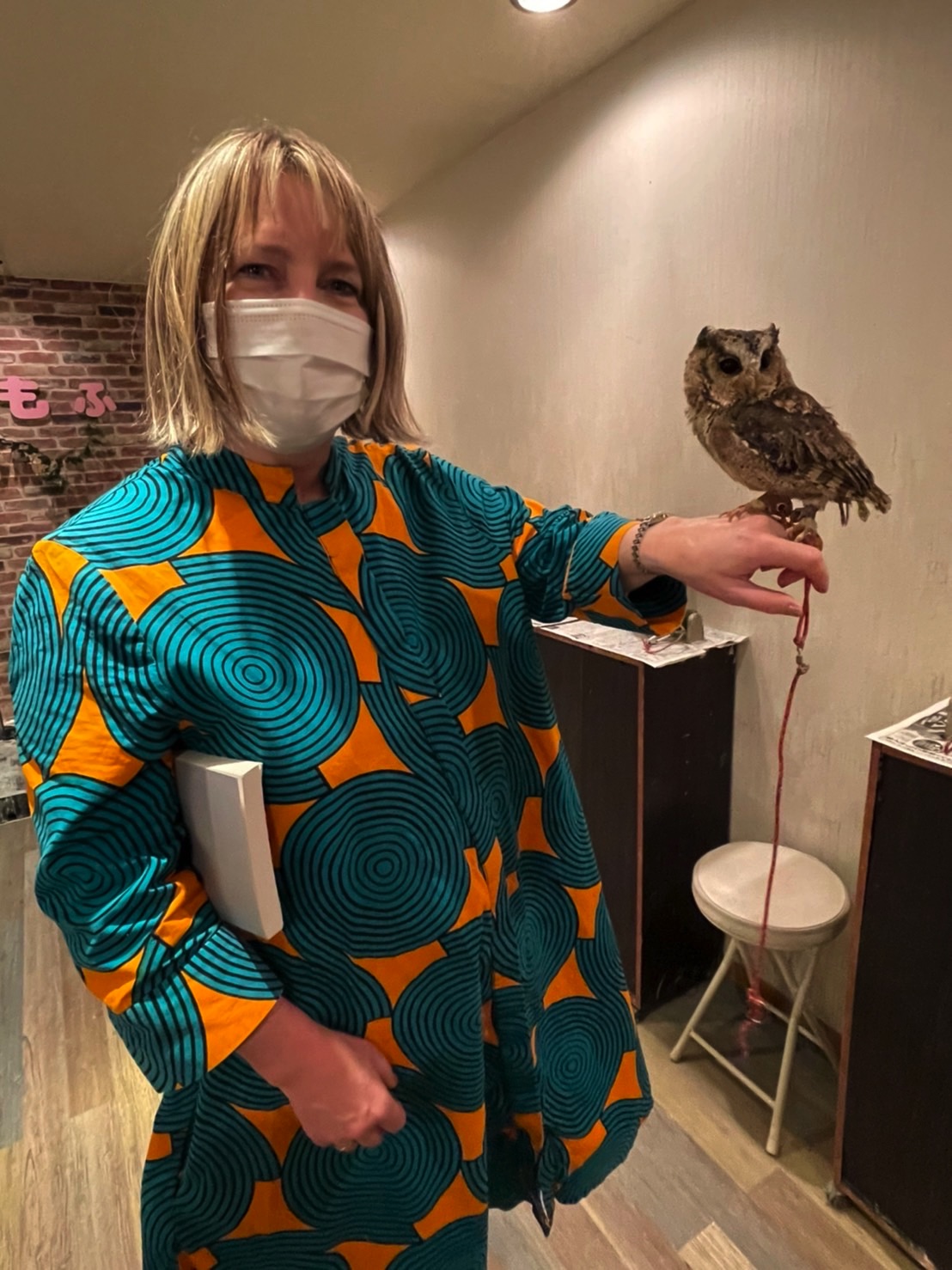
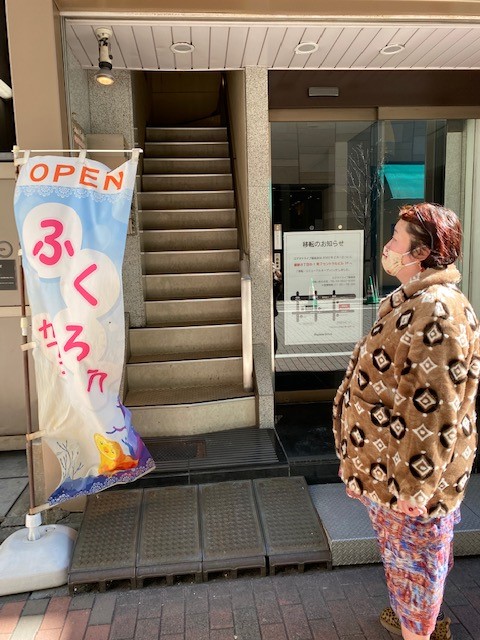
The Mofu Mofu Owl Café Ginza was down a side street in Tokyo’s tony shopping district, steps away from the likes of Louis Vuitton and Chanel. As we climbed the three flights of narrow stairs, I wondered what it would be like inside. It would be dark, I imagined, because owls are nocturnal. But no, when we pushed open the door, we were met with light.

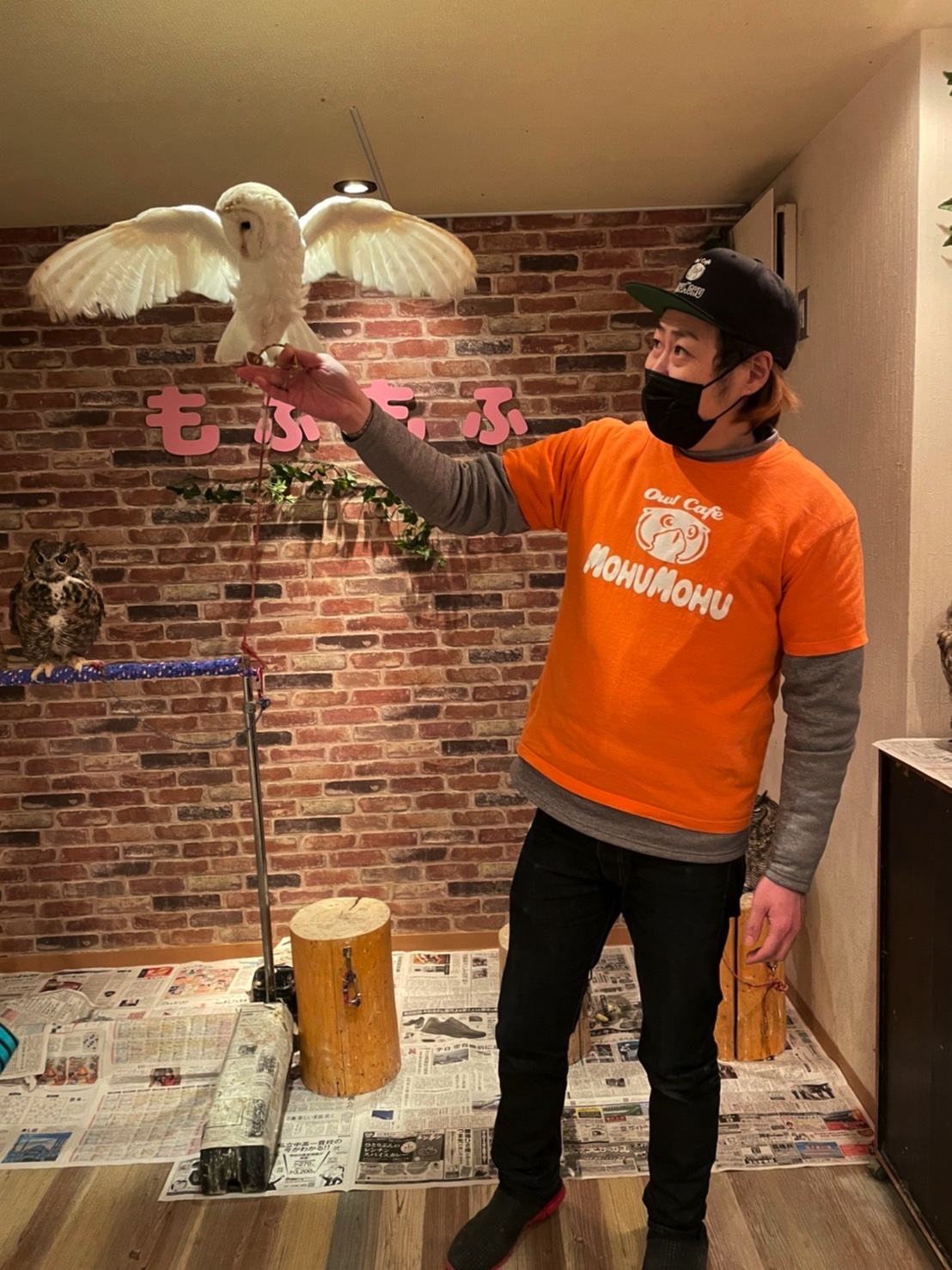
It’s a bit of a misnomer to call the place, and others like it, a café. Coffee is not served, nor is there cake or any other kind of food. There were no tables, no young women with aprons or maid costumes, just a guy wearing a T-shirt in a roomful of owls tethered to perches.

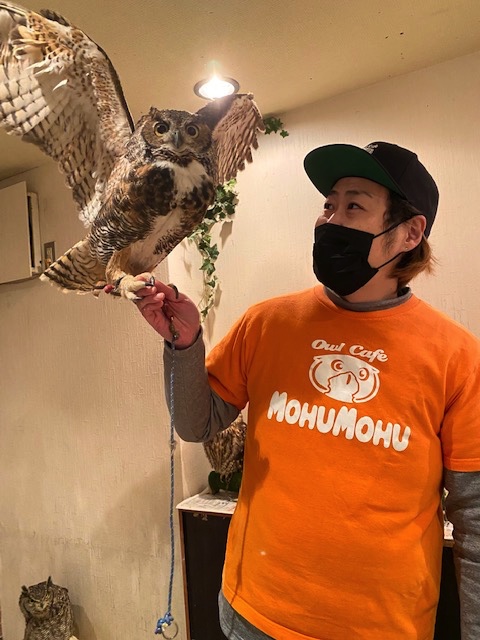
The owner seemed happy to see us. We were the only customers. He instructed us to disinfect our hands, and then showed us how to touch the owls – a gentle rub on the top of their heads, much in the way that my cat liked to be caressed. The owls were big and fluffy, like cats, and I wanted to hug them, but I figured they would probably try to bite me if I did.

My friend, the bird-hater, hung back while I went around looking at each owl. They were of various species from around the world. I wondered if they were bored, sitting on their perches all day, with nothing to do. Maybe our being there was their entertainment.

“They wouldn’t survive in the wild,” the owner said. “They have been raised from eggs by humans.”

He told us that they might live for thirty years in captivity, but only half that in nature. What was worse, I wondered? Thirty years of boredom, or fifteen years of being stressed out about their next meal, and where they would build a nest? Was keeping owls in this room any worse that keeping a parakeet in a cage? Or not allowing my restless cats to go outside, even when they meowed pleadingly at the door? (Actually, I sometimes did allow them to go out, knowing full well that they might be dodging cars, picking up fleas, and murdering songbirds and mice.)

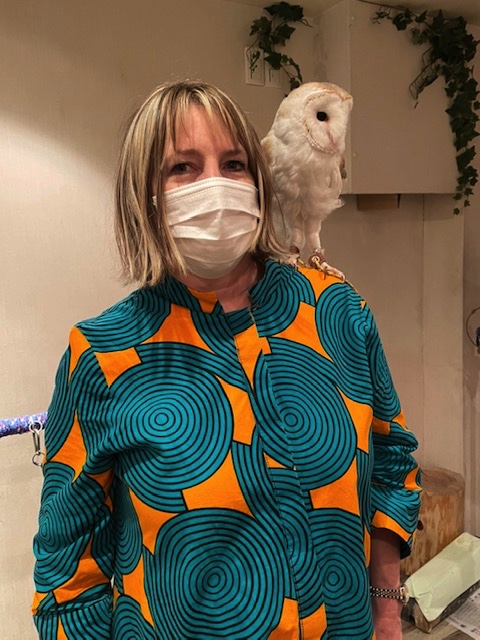
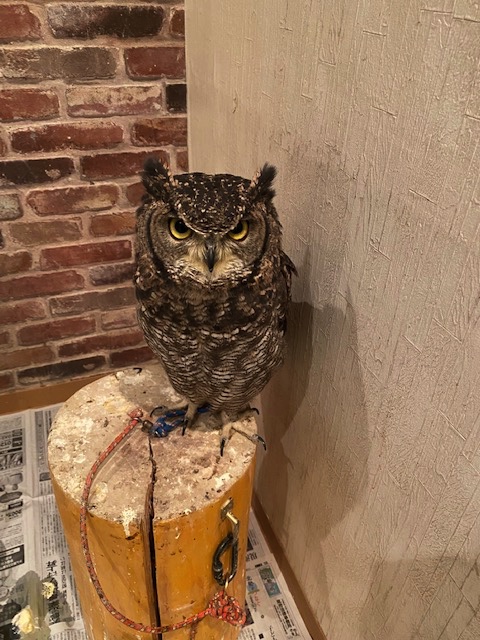
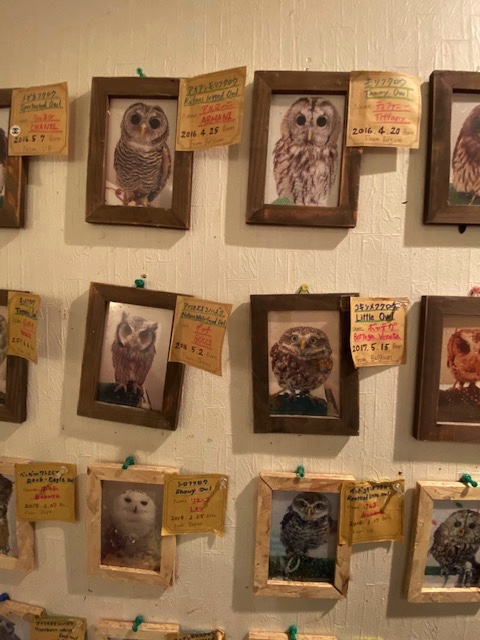
The owner explained that before the pandemic, he’d operated two cafes – this one, and another in Roppongi — but due to the travel restrictions which prevented tourists from overseas from visiting, he’d had to close that one. All the owls were now gathered here. They’d been given names of nearby shops. Gucci was a Japanese Northern White-faced Owl, while the Little Owl from Belgium was named Bottega Veneta. There was also a Tawny Owl, born in 2016, named Tiffany.

“Before the pandemic, a lot of foreigners came here,” the owner said. Some famous people, too. He showed us a photo of the singer Akiko Yano, ex-wife of internationally renowned musician Ryuichi Sakamoto, with one of the owls. Yano lives in New York City and had heard about the café while abroad. I looked around at the empty space. Apparently, Tokyoites didn’t have an urge to commune with owls. I worried about what would happen to them if the tourists weren’t welcomed back to Japan soon.

The owner let me pick out an owl and settled it on my hand. My friend finally got up the courage to stroke one of the owls between its eyes. The phone rang, and the owner went to answer it. I heard him booking another customer, and I felt a bit relieved. Apparently, this one would come at mealtime and watch the owls consume dead mice. That was probably an exciting part of the owls’ day.

Part of me thought that the birds might be happier in an atrium somewhere. But while they were here, I hoped they would be well looked after. I wanted to contribute as best as I could, so I loaded up on souvenirs – a pen encasing an owl feather, made by the owner’s wife; a handful of chopsticks with owl motifs; and a bottle of Hitachino Nest beer, which had an owl on the label. And I promised to post some photos on Instagram so that more tourists would come.

An owl in chains

Suzanne Kamata was born and raised in Grand Haven, Michigan. She now lives in Japan with her husband and two children. Her short stories, essays, articles and book reviews have appeared in over 100 publications. Her work has been nominated for the Pushcart Prize five times, and received a Special Mention in 2006. She is also a two-time winner of the All Nippon Airways/Wingspan Fiction Contest, winner of the Paris Book Festival, and winner of a SCBWI Magazine Merit Award.

Thanks to the columnist Suzanne Kamata for the photographs. 

PLEASE NOTE: ARTICLES CAN ONLY BE REPRODUCED IN OTHER SITES WITH DUE ACKNOWLEDGEMENT TO BORDERLESS JOURNAL
Categories
Poetry

Yellow Dahlias

By Anjali V Raj

Photo Courtesy: Anjali V Raj
YELLOW DAHLIAS

The dauntless rain is pouring outside
Like a clingy outstaying guest, reluctant to leave
Ignoring all the complaints, curses and abhorrence.
I can feel the decaying wetness in the weather
And it’s beginning to dig deep into my veins
I can feel the lethargy and disgust spreading
Looking through my window into the gloomy exterior
I spot something yellow within the shameless greedy weeds
Yes, I see bright yellow dahlias fighting for space
Reminded me of a florist’s words “only Dahlias grow in heavy rains”
I never planted them, but the Dahlias found their way somehow
Challenging the torrential rain with a radiant smile
I wish to be a yellow Dahlia, at least once in my lifetime.

Anjali V Raj is a natural science researcher from Kerala, India. She has recently published a few of her works on online platforms like Down to Earth, Café Dissensus Everyday, Borderless Journal and Times of India Reader’s Blog. Most of her poems are published on her WordPress blog (Outburst of Thoughts).

.

PLEASE NOTE: ARTICLES CAN ONLY BE REPRODUCED IN OTHER SITES WITH DUE ACKNOWLEDGEMENT TO BORDERLESS JOURNAL
Categories
Stories

Before the Sun Goes Down

By Amjad Ali Malik

“It sucks, man”, he muttered and took a deep breath. His hands were folded on the back of his head as he reclined in the chair.

“And then count the age gap. Here I am barely twenty; just trying to acclimatise to the Varsity culture. And she? Well, I guess, not short of her mid-thirties”, he frowned.

Between the two of them they shared the rented flat.

He was from a remote small town and had arrived in the metropolis one year ago. After joining the University, he found that the hostel was already occupied to its total lodging capacity. So, his parents reluctantly chose to let him stay in a private accommodation, and this had landed him in the flat.

She was already a renter there. Initially, they had kept their newfound acquaintance restricted to a tacit exchange of casual glances. Then ensued the short verbal greetings, which eventually led to intimacy. She told him that she was from another big city and had been transferred to this city by her employers.

Earlier, he had been going to a small restaurant in the neighbourhood for his meals. Then she told him that she would make meals for both of them, and they could split the expenses. He readily agreed. 

Every evening she would walk over, carrying two cups of tea to his partially furnished room. Sitting across the oblong table, sipping the tepid tea, they often made small talk.  During one such session, she said she had got a Masters in Political Science. However, she hardly ever commented on national or international politics. Once or twice, he tried to plumb her political leanings, but she disappointed him. She exhibited the same stolidity in religious matters. 

“Why are you so cold on the topics which intrigue almost everyone these days?” he asked her once again.

“Is it necessary to toe the line of others?” she retorted with a discomfiting smirk.

“Um-no, not at all.  I only asked it out of curiosity,” he sounded flustered.

In physical terms, she was sensuous. But her personal aura did not encourage much passion in the opposite gender.  He had to admit that she had something about her, which stirred awe rather than evoked salacious thoughts.

As their relationship became more frank, he began to cherish some private longings for her. When she was away, he would often try to conjure her tall, lithe figure to indulge in a mock act of dalliance, but could never get much further with it. Thus frustrated time and again, he ultimately came to weigh the possibility of marrying her, but in her presence, could not breathe a single syllable on the topic.

“What is she? Why is she so courageous and confident, while I am neither?” he used to wonder.

One day, he felt touched on the raw. “Do you have any girl friend?” she looked him straight in the face.

“M, me. No, no, not at all”, he jerked out.

“Hmm” she took a deep breath, and smiled coquettishly.

“Would you like to have one?”

“Well, am not sure what to say”, he replied meekly.

 She burst into a guffaw.  “Looks that you have yet to be weaned, boy!”

Her sudden vivacity flummoxed him, as he sat there gazing at her.

“Is she trying to flirt or is it a serious attempt to seduce?” he asked himself.

Meanwhile, she got up, collected the crockery and came near him. She stood beside his chair. Her intent gaze and the intoxicating fragrance of her perfume rattled his assumed composure.

“Let’s spend this time together and have fun. Who knows how the sun goes down tomorrow?” she whispered and made for her room.

The next day, as he entered the flat at the usual hour, he felt quite weird. She had not yet come back from her work. His patience began to run thin when after making several attempts to catch a glimpse of her, on the chance that she might have tiptoed onto the premises to give him a surprise.

He waited and waited until dusk set in. Still there was no sign of her.

“Where could have she gone? Over these past several months, she has never got late even for a short while. Has she met with some accident?” lost in such thoughts, he got up to go and dine at the restaurant. While dining, he cast a quick glance all around the hall, and then forgot that he had been hungry. The breaking news that flashed on the television screen rendered him insensible to his surroundings. The police had arrested a woman on the charge of first-degree murder of an aged prayer leader. The camera was constantly zooming in on her face. He gulped incredulously still glued to the screen. No further details of the case came in.

He hurried to the flat, collected all his effects and made for the

wagon-stand.

“Who knows how the sun goes down tomorrow?” her passionate words echoed in his ears, as he bade a tearful adieu to the city for good.

.

Amjad Ali Malik is a Pakistan–based writer. By profession, he is an Assistant Professor of English. The story “Before The Sun Goes Down” is his debut work.

PLEASE NOTE: ARTICLES CAN ONLY BE REPRODUCED IN OTHER SITES WITH DUE ACKNOWLEDGEMENT TO BORDERLESS JOURNAL
Categories
Musings of a Copywriter

When Books have Wings

By Devraj Singh Kalsi

Courtesy: Creative Commons

Book thieves are essentially good people who restore a modicum of respect to the business of stealing. When there are so many valuable items to filch, from cows to jewellery to cash, this is a minuscule coterie of genteel, sophisticated thieves who have realised that the most valuable item worth pilfering in the world is books.

While knowledge acquired from stolen books carries the same value, it shows the passion and obsession for seeking knowledge ranks high in book thieves. They are enterprising and adventurous to risk everything including their dignity, without harbouring any fear of getting caught or facing any discomfiting situation for the sake of acquiring knowledge by hook or by crook. Perhaps a stolen book holds special charm and becomes more gripping as the ‘borrower’ would not like to lose it after putting in such hard work to acquire it. Desperate readers who steal and read make it a habit to read stolen books alone.

There are smart operators who politely seek books from your collection even though they have ample opportunity to pick up the titles and drop the stuff in their shopping bags. These people have no compunction, no intention of returning the borrowed titles despite a litany of reminders. Although these books cannot be dubbed stolen as prior permission is sought, the promise of returning them within a week or a month is never honoured. These books become a permanent member of their prized collection. Such collectors have built large bookshelves with borrowed books and stolen titles.

During school days, my English tutor borrowed the complete works of Shakespeare from my father’s collection, promising to return it soon. But the tome did not stage a comeback. Three years later, when we went to his house, we saw the book displayed prominently in a glass showcase. I was thrilled to find it there but before I could utter a word, his wife thanked my mother for gifting them the big, fat book on their silver jubilee wedding anniversary.

His clever spouse handled it smartly and we did not contest it. My mother perhaps hoped he would read the text thoroughly and explain Shakespeare properly to me.  When he started teaching me Shakespeare, I found him fumbling and referring to a paraphrase guide to explain the content.

There were several other instances of borrowing from the collection on the pretext of reading. Another English tutor took novels from my collection for his wife who was fond of reading. He took many books at the same time and returned most of them on time. But one title always went missing — perhaps the one book his wife desperately wanted to have in her collection.

Some friends in college and university also wanted to read the books that I was reading.  They borrowed the titles just before the vacation started. After the holidays they said they had lost it on the train or left it behind in the lodge they stayed in. But the sad truth was waiting to be discovered if you went to their apartment.

When guests with the habit of reading arrive at your place, you need to exercise caution and stay alert. They will not gaze at the aquarium with colourful fish but swim deeper with malicious intent: gape at the spine of books, checking out the new arrivals. They pose innocent questions about your choices and recommendations. It is always better to say a bland no. Your confirmation would mean the sudden departure of some books from the collection as the guest would definitely seek those tomes.  Once they are gone, the guest does not come back to return it ever. Maybe he shifts to another city and takes it with him, forgetting it was his duty to return it to you.  Ever since the habit of gifting books has lost appeal, the art of stealing and usurping books has gathered momentum.

These guests are not hardcore book thieves you encounter in book fairs or bookstores, but they have a similar mindset of reading books acquired through dubious means. When they do not return what is not theirs, they are indulging in an unfair practice but there is no sign of regret or remorse. Since they get original titles at zero cost, they do not need to visit second-hand books market for a big haul of books or seek low-priced pirated editions.

The same tricks are played by so many people over the years and half their collection comprises books acquired through shady means – that is, books they have not paid for. The true believers in the saying that knowledge is free for all!

In case you ask them to return the books, you will be shown the book with the flamboyant signature of another person as the page with your initials has probably already been ripped off, leaving no scope of return to the original owner. Like wealth acquired through shady means is never discriminated, books acquired through dubious means are also most welcome in the bookshelves.

visited the book fair to buy everything except books.

.

Devraj Singh Kalsi works as a senior copywriter in Kolkata. His short stories and essays have been published in Deccan Herald, Tehelka, Kitaab, Earthen Lamp Journal, Assam Tribune, and The Statesman. Pal Motors is his first novel.  


PLEASE NOTE: ARTICLES CAN ONLY BE REPRODUCED IN OTHER SITES WITH DUE ACKNOWLEDGEMENT TO BORDERLESS JOURNAL. 

Categories
Excerpt

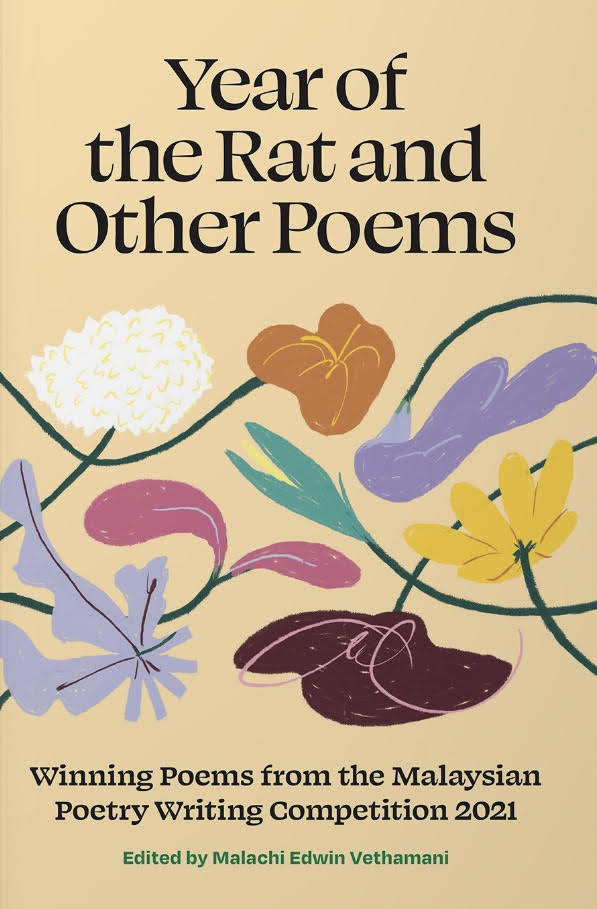
The Year of the Rat & Other Poems

Title: The Year of the Rat and Other Poems

Editor: Malachi Edwin Vethamani

Publisher: Maya Press, Petaling Jaya, Selangor, Malaysia

Year of the Rat
Lim Jack Kin

A cell-phone camera on the overpass watched
the fleet of black cars devour the highway below;
Roads were closed today for the minister's entourage.
The city smiled, red cheeks bulging with police sirens.

That night, a shoebox sailed along a storm drain.
Inside it was a shopping receipt with “I’m sorry, I’m sorry,”
scrawled on the blank side, and something that mewled
while scratching at the cardboard.

By morning, it was hot again.
A grey committee gathered at the palace,
and a burst rat saw them walk inside
as it blistered in the parking lot.

Don’t ask me what they talked about.
I’ve never been invited to these things.


A UI/UX Review of You
Allison Jong Chia Ning

If you are a product designed for me 
I wish to highlight the touchpoints of our interaction
As this extraction of data is key to conclude
This user’s interface & experience. 

I now land on the homepage of your lap 
Hold you in my hands and 
Scroll through your eyes 
As I load the imprint of your lips 
On mine

Then I click on the bridge of your nose 
Stream the sound of your laughter
And pause at the scent of your skin 
Wondering where in the world I’ve been

Your search bar eases me to explore
And before I could finish what I was here for 
You took the words right out of my _______
Autofill my thoughts as if they are yours 
Never knew I could be known like this
Never like ever before

Now in discovery mode 
Leaving a cache worth of me 
All over the landing page of your spine 
Bet the codes are running through your mind
You got me hooked
Now I be spending more time 

I’m not sure how many A/B tests you’ve gone through 
But I think I’ve got the best version of you 
I would click to visit again and you would know
For the data don’t lie, even if I try. 

About the Book: Year of the Rat and Other Poems presents the winning poems from the Malaysian Poetry Writing Competition 2021. This collection of poems is made possible by the many submissions that were received; a total of 1,904 poems from 860 poets. From this pool of poems, Year of the Rat and Other Poems contains a total of thirty-one winning poems from twenty-six poets. The majority of the writers in the volume are young and emerging writers. The poems in the anthology touch on various concerns in contemporary Malaysia like identity, home, belonging and political issues. A fine example of Malaysian English is reflected in this collection of poems.

About the Editor: Malachi Edwin Vethamani  is a poet, writer, editor, critic, bibliographer and Emeritus Professor.  His publications include: Coitus Interruptus and Other Stories (2018) and two collections of poems, Life Happens (2017) and Complicated Lives (2016).  His stories and poems have been published in many literary journals. The Year of the Rat and Other Poems is his latest publication. He has previously edited four volumes of Malaysian writings in English. The first volume, In-Sights: Malaysian Poems in 2004, the second and third anthologiescover a period of over 60 years of Malaysian writings in English, Malchin Testament: Malaysian Poems (2018) and Ronggeng-Ronggeng: Malaysian Short Stories (Maya Press, 2020). The Malaysian Publishers Association awarded Malchin Testament: Malaysian Poems the Anugerah Buku Malaysia 2020, best book award for the English Language category. In 2021, he published Malaysian Millennial Voices (2021), a collection of poems from Malaysian poets under 35 years of age.

.

PLEASE NOTE: ARTICLES CAN ONLY BE REPRODUCED IN OTHER SITES WITH DUE ACKNOWLEDGEMENT TO BORDERLESS JOURNAL