The sound of raindrops
Made sweeter through night
By the tin shade outside my window,
The chill in the air has stories of
The days we were lost in the woods,
In the wattle forest fighting for cover
Watching lake-waves in subtle throes.

Dreams come like flush of meadows
I roll back and watch shadows and lights
Bouncing in equal proportions
Through maple leaf drapes.
In the dark, curtains have no colours.

The green carpet tells of the spilled drops of tea,
Fallen crumbs of the vanilla cake and more,
Mere illusions of having been too long
In that lonesome lodge.

Dreams come with crows in rainbow feathers,
Petite beaks, not longer than what eyes could see,
Heads crested with crowns dipped in chrysanthemum pollen;
The pillow reeks of the perfume
Of the woman who slept last, or of her jasmine.
I roll again as if to end the dream.

Dreams have a way of haunting
Like Gods who have limited shelf life
Gods who rise and die with us.
Saranyan BV is poet and short-story writer, now based out of Bangalore. He came into the realm of literature by mistake, but he loves being there. His works have been published in many Indian and Asian journals. He loves the works of Raymond Carver.
.
PLEASE NOTE: ARTICLES CAN ONLY BE REPRODUCED IN OTHER SITES WITH DUE ACKNOWLEDGEMENT TO BORDERLESS JOURNAL.
Meredith Stephens visits an island that opted to adopt the ways of foreign settlers with her camera and narrates her experiences…
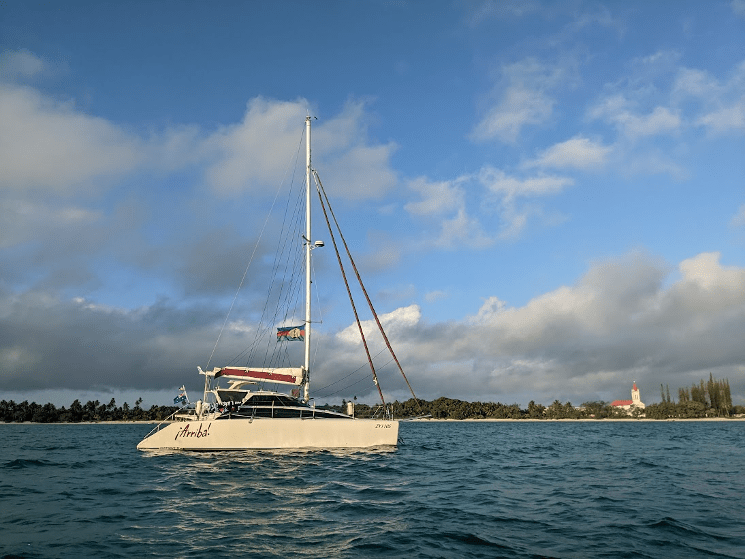
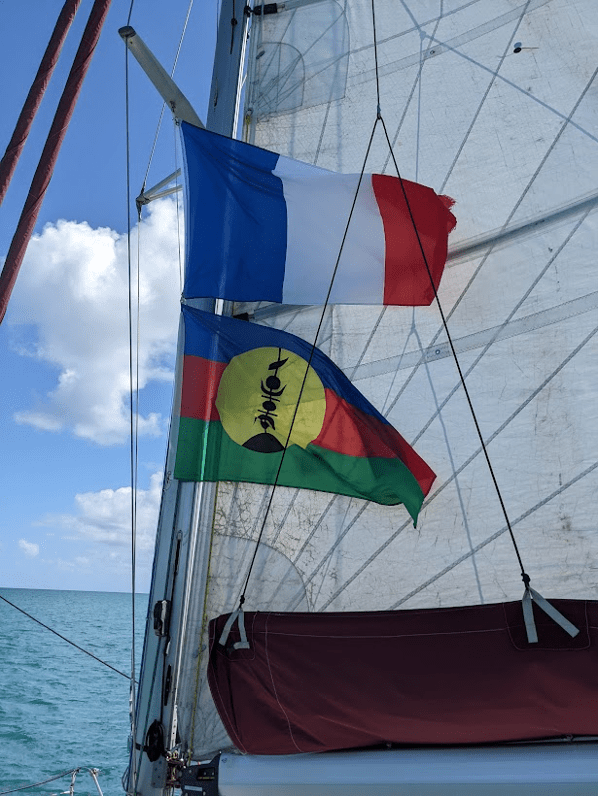
It was the fifth week of our New Caledonia sailing trip from Australia. We had just returned to the Noumea marina from the Loyalty Islands and were flying one of the flags of our host country, the indigenous Kanak flag. We were sitting down to a boat lunch of a baguette with delectable French cheeses, when we heard a gentle knock, so gentle that we thought it must have been for someone else. Then we heard the knock again. Alex went out onto the pontoon to see an immaculately dressed Caledoche[1]. He had something urgent to tell us.
“It’s absolutely fine to fly the Kanak flag, but we have had three referenda about independence from France, and we have decided to remain with France,” he said in impeccable English. “There was an American here recently who was flying a Kanak flag. I told him that was fine, but then I asked him why he didn’t fly the flags of native Americans as his home flag. As for you, you should consider flying the First Nations Australian flag on your boat,” he continued. “But as I said, it’s absolutely fine. It’s your choice.”
I could see that it was not fine. As they walked away back along the pontoon I called out.
“We love France!”
It was true. As guests in New Caledonia the last thing we wanted to do was to make political commentary. We had no idea how high feelings were running on this issue. Alex immediately restored a large French flag above the Kanak one.
The visitor didn’t appear to be from the marina so he must have found his way through the locked gates and walked along the pontoon, especially to speak to us. Only then did we realise how prominent our flag had been. We were berthed at the end of the pontoon and were visible from any point in the busy harbour.
The next morning a Caledoche skipper greeted me as they walked along the pontoon. Then they said to me in English, “It looks better with the French flag on top, doesn’t it?” Not wanting to draw attention to ourselves again, I clapped my hands in applause in their direction as they retreated down the pontoon. “You’ve won!” was my intended meaning, but they looked at me quizzically.
On our last day before the long voyage back to the east coast of Australia we provisioned the boat. Before going to the supermarket, I persuaded Alex to take me to my favorite boulangerie. I looked at the breakfast menu and ordered two cappuccinos and two pain au chocolat. This would be one of the last conversations I would have in French, and I was happy not to have attracted any strange looks in response to my accented French. I was also happy to start the long week of sailing with a pain au chocolat.
Once back at the marina, my final duty was to empty our rubbish in the bins beyond the gates to the pontoon. As I was emptying the last of the rubbish, I noticed two Kanak gentlemen outside the gates, calling to one of the boaties inside the gates in French.
“Do you speak English? I want to get a message to the boaties at the end of the pontoon.”
The boatie shrugged his shoulders and retreated to his boat.
I realised he was referring to us. Our flying of the flags must have identified us as outsiders. I addressed the Kanak gentlemen in French.
“I’m on that boat.”
One of them put his hand on his heart.
“We are so touched that you are flying our flag. Can we exchange contact details?”
I looked at them, silently taking in what had happened. They were not boaties. They must have seen the flag flying from the harbour and sought us out.
I saw Alex heading towards me along the pontoon. He must have been wondering what had become of me because we were about to depart. I hastily introduced the Kanak gentlemen to him, and we received their email address. I asked Alex to retrieve some of our coutume[2] gifts from the boat.
“We received wonderful hospitality in the Loyalty Islands. We enjoyed drinking fresh coconut juice, cakes, and yams.”
“Did you stay in one of the traditional homes?”
“No. Some locals invited us to share their picnic rugs and we enjoyed their local specialties.”
Alex returned with the coutume gift, and then we parted ways.
We left our berth and headed for the fuel dock. We needed diesel because we could not necessarily rely on wind to get us all the way back to Australia. Once at the fuel dock we threw out the fenders and tied the cleats to the dock. A young man put the diesel in for us.
“Why don’t you ask him about the flag?” urged Alex.
I explained our predicament, “We are foreigners. We had no idea that our flag would elicit such strong reactions. We came here not for the politics but rather because Alex loves the sea.”
He nodded enthusiastically.
In fact, Alex had come here because the coral is world heritage.
“He loves the sea, and I love the language and culture.”
Of course, Alex likes speaking the language too, even if not exactly fluently. He settled the bill and was chuffed that the attendant had spoken to him in French, unlike most others, who switched to English as soon as they detected our accent.
Then we noticed that the Kanak gentlemen had walked over to join us at the fuel dock. They asked if they could take a photo with us. We stood on the boat, and they stood on the dock. A passerby took the photo for us. Then they took their leave.
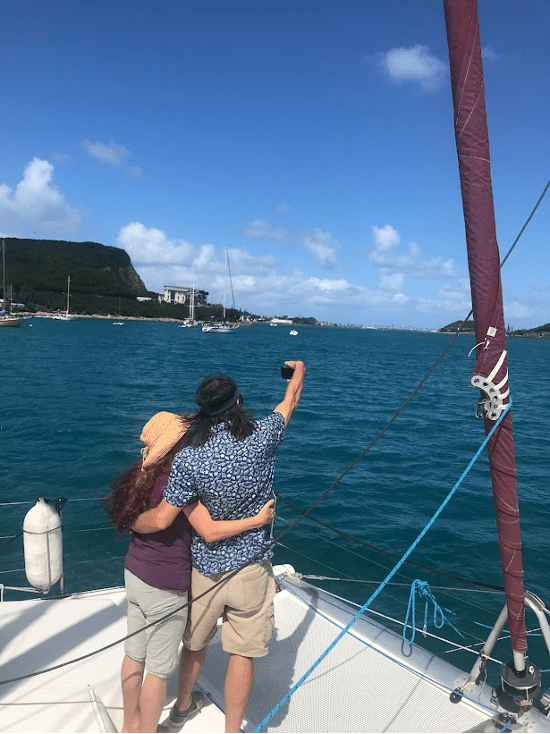
We started to exit the marina. I stood at the stern, as always when leaving a harbour, taking in the unique scenery as it receded. The attendant gave us a hearty wave, which we returned. As we rounded the seawall, we looked back we noticed the Kanak gentlemen positioned at the end of the breakwater. They waved at us with their arms extended above their heads, and we did the same, until the marina faded into the distance, and we could no longer see them.
Meredith Stephens is an applied linguist from South Australia. Her work has appeared in Transnational Literature, The Muse, The Font – A Literary Journal for Language Teachers, The Journal of Literature in Language Teaching, The Writers’ and Readers’ Magazine, Reading in a Foreign Language, and in chapters in anthologies published by Demeter Press, Canada.
PLEASE NOTE: ARTICLES CAN ONLY BE REPRODUCED IN OTHER SITES WITH DUE ACKNOWLEDGEMENT TO BORDERLESS JOURNAL
WE CANNOT HEAR THE SLEEP OF WORDS

We cannot hear the sleep of words
Under the seas, under the flowers, under the tides of out lots
And the bustling over sheets in skies depleting
Or our infinite whispers unheard. How
Inevitable silence whisks us is the tune
That, like the spires of monks, grows tired with the trends
And, dreaming about the text,
Shies into the fire. Words
Are as remote as the stars and their staring dawn,
As perceived as God. Does
This quiet sleep of words hide schemes, hide fears?
Does the last lash of the wind and the failing wing
Outwardly spiel an end? Let us listen,

Open the mind and listen
For a sigh, a sign
Of speaking unadorned. There is
No cry, there is only
The one weathered night whose wakefulness stings and
Hoots the Word over and over
Until the speaking dies.

A KIND OF DECALOGUE

Item, an animal, and how it changes shape,
Now a slick leopard, then a white air
Of tigress, ape or lemur. The forms won’t take
One simple pattern for long. Item, the crow
And then the simple blackbird, gathering up
Hunted petals. Item, a demesne of guns
Hotly presented to a potted face,
A shaft of holly leaves, darkness begun

And flapped astray. Item, motors without grace,
Churning the fair aside. Item, the bones
Of reservations, now Plot One, Plot Two
Purveyed by engineers.
The hunters are half-conscious of their Deeds
And cackle. Signs are made, sometimes honed,
And then the silent Blue
Jim Bellamy was born in a storm in 1972. He studied hard and sat entrance exams for Oxford University. Jim has a fine frenzy for poetry and has written in excess of 22,000 poems. Jim adores the art of poetry. He lives for prosody.
.
PLEASE NOTE: ARTICLES CAN ONLY BE REPRODUCED IN OTHER SITES WITH DUE ACKNOWLEDGEMENT TO BORDERLESS JOURNAL
By Haneef Sharif, translated from Balochi by Mashreen Hameed
From the world,
coldness,
autumn,
silence… intense silence.
My lord!
Fair wishes…
I am somewhere between the better and the best in this world. Safe and sound. Breathing. Every morning, I had walked to my job and the evening breeze had wafted me back home. Drifting like this, many times I pondered over penning down a letter to you but was held back…. lack of address ….my own fears…. dread of time…. Therefore, I never quite made up my mind to complete the task.
My Lord! Today I am feeling very dispirited. I have been expelled by the head of the post office from my job. He said, I happen to deliver the letters, orders, registry and parcels on wrong addresses. The recipients receive the wrong mail. He states, for three months I kept reiterating these mistakes.
I had never envisioned this situation.
Giving it some thought, I concluded that this is all because I did not write a letter to you. Thus, today, I am writing to you.
I apologise in advance for any errors in my penning.
The crucial thing is — My Lord! Tonight, is curtained by stillness, the fire is inhaling its final breath. After the fire dies, I remain with taciturnity alone at home. Whosoever obtains more power than others, will press them down, and you know well who is more powerful than me and who….
God Almighty! To say worthily, I love you a lot and very much —
like toys kept on carts,
like whirlwinds on mosques,
like ash that clings tired on jammed wheels,
like wandering cows on streets,
like the daughters of neighbours…
Almighty God! I love you limitlessly. I don’t know how to convince your ears about my profound affections. I love everything about you, I stoop to your every word, and your every creation is beyond examples, wordless and irreplaceable.
But my Lord! This is also true that you left nothing but confusion in this world, everywhere inconclusiveness, lack of fulfilment, no ins and outs but all the edges of incompletion.
My Lord, who are you? What are you?
The pouring light of lamp igniting before the home of Khuda Baksh[1], I wonder are you
the tyre-prints of police cars,
the pay-day for teachers,
the rock on the pavement of road,
or the first daily paper each morning?
Who are you? Where are you? In the skies…
No, I cannot admit this, how come my friend, my companion is so far? My Lord is not cruel. He is alone, childfree, poor, miserable like me… stricken by hunger, and knows that the most powerful thing in the world is hunger… hunger… ufff…. I cannot explain. But My Lord, what do you think, is the most powerful among your creations —
drug filled cigarettes,
leftovers of bread,
a cold, collapsed lonely road,
sunsets in summers,
or relics of autumn leaves?
As per my heart, these all are powerful, frightening, but tempting.
What do you say my lord?
What is your point of view?
Do you know one more thing Almighty God, you made abundant useless things in your world; they are meaningless, unimportant, but absurdly you are accountable for creating them.
Lord Almighty! Don’t you realise some surplus things remain unnoticed when you look at the world, like —
school going children in the morning,
busloads of travelers to cities,
‘wedlocks’ in marriages,
ventilators of bathrooms,
and traffic police on roads.
My lord!! These all are complaints, all protests. These are our grievances echoing before you.
We are wretched, distressed, dead hearted. Other people are engulfing us. We are being thrown out of the world. Lord, my heart has become the residence of hatred, enmity and envy; I feel jealous of everyone. I suffer in anguish. I am changing into a devil, converting to wickedness. In spite of all these, I am amazed to discover that, My Lord, I love you a lot, in fact, very, very much –
like a healthy fish,
like the last drop of wine,
like a full plate of curry,
like a room filled with water,
like… like…
God Almighty! There is nothing more vital to pen down except, the fire is dead now. My stomach is screaming, hunger creeps, cold extends, surfeits, magnifies and I am…
My best regards to all.
Your son,
And… actually…. I am handing over this letter to the breeze; I hope you will receive it.
Everything is pretty well.
.
(This story was first published in Balochi in Teeran Dask, a collection of stories by Haneef Sharif and is being published in translation with permission from the author and the Balochistan Academy of Literature and Research, Turbat.)
Haneef Sharif, born on December 25, 1976, is a well-recognised author, filmmaker, YouTuber, photographer and script writer. He completed his basic education in Turbat, Balochistan, and received his MBBS degree from Bolan Medical College, Quetta, in 2003. He currently lives in Germany. He has published a novel, Chegerd Poll enth ( The Chegerd Tree is blossoming), and a number of short stories in Balochi. Some of his short stories have been published in 3 collections: Shapa ke Hour Gwareth ( The Night When It Rains), Teeran Dask ( Teeran Dask) and Haneefnaam ( Hey you Haneef). He has also directed four films in Balochi. He also runs a YouTube channel Radio Balochistan where he publishes videos, short stories, interviews and lectures on miscellaneous subjects.
Mashreen Hameed is a fresh graduate of University of Turbat with a Masters’ degree in English literature. She is a writes fiction, poetry and translates from Balochi and English.
.
PLEASE NOTE: ARTICLES CAN ONLY BE REPRODUCED IN OTHER SITES WITH DUE ACKNOWLEDGEMENT TO BORDERLESS JOURNAL
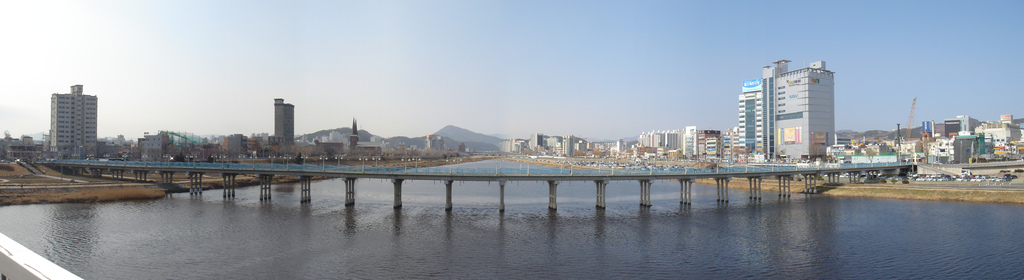
This was long ago. In the summer of 2013. Destiny brought me to South Korea for a week-long conference, the International Society of Industrial Ecology conference. I reached Ulsan, a city south of Seoul. Not having time to convert my USD to South Korean Won, before stepping onto the bus which would take me to the conference venue, and assuming that I could pay for my ticket on the bus, using my credit card, I proferred the latter to the bus driver. He shook his head. I then pulled out some USD notes and looked at him, hoping that I could pay the required amount of money in USD equivalents. He shook his head again. I said, “Okay, sorry,” and was about to turn and alight, when he turned his head and said something in Korean to the passengers on the bus. A young schoolgirl ran down the aisle towards me and said in fluent English, “You do not have to alight. I will but your ticket.”
I looked at the driver, and he smiled and nodded and beckoned me to take a seat. I looked at the girl, thanked her and asked, “Can I repay you in dollars?”
She smiled sweetly and said, “You are our guest. It is our duty to make sure that your stay in South Korea is comfortable. You do not have to repay me. You enjoy your stay here.”
I was lost in thought for the remainder of my journey, not having experienced anything similar to that before.
The next day, I was guided to a restaurant about 200 metres from the conference venue, where I could eat some good-quality Bibimbap (Korean rice+vegetable dish). Being a non-experimental eater (one from whom gourmands would most certainly wish to stay away), I visited the same place for the very same meal at the very same time every evening for the next four days. Every time the elderly Korean lady who manned the counter, saw me walking in, she would intuitively know what I would be eating, and shout out ‘Bibimbap’ to the cook inside. On the 4th day, she asked me, in her broken English, ‘You here tomorrow also?’
I said, ‘No. I am going to Seoul tomorrow and then I fly to Mumbai.’
‘Oh, so last day dinner here. Then, you no pay today. Today free Bibimbap for you.’
‘But I would like to pay. I cannot eat without paying for it.’
‘No, no, free. I say free! You liked Ulsan?’
‘Okay, thank you so much. I liked the city a lot.’
I noted down the postal address of the restaurant and would send a postcard from Trondheim (Norway) – where I worked at that time in my career.
The next day, I had to take a train from Ulsan to Incheon. Time was at a premium when I reached the station. For some strange reason, my credit card ‘malfunctioned’. I had run out of Won and had foolishly forgotten to equip myself with some, as I assumed that the credit card would surely work at the ticket-vending machine at the station. I was a bit tense and started sweating profusely. I turned back and asked the young Korean boy who was next in the queue if the machine would accept USD or if there was some place nearby where I could quickly trade in my USD for some Won. He smiled, and said, “Do not bother. Where are you headed?”
When I said, Incheon, he stepped up and purchased my ticket for me. I read the price askance, did a quick mental conversion to USD and requested him to let me repay him in that currency. He smiled again and said, ‘‘You are our guest. It is our duty to make sure that your stay in South Korea is comfortable. You do not have to repay me. Hope you enjoyed your stay here and will visit our country again.” So saying, he hastened towards the escalator on the right of the ticketing machine.
The very same words I had heard on the first day on the bus from the young girl. Perhaps this boy was her brother. Do-gooder siblings. Or perhaps they just represented the South Koreans – hospitable and helpful, doing God’s bidding on earth, smilingly and gallantly, without expecting anything in return…
.
G Venkatesh (50) is a Chennai-born, Mumbai-bred ‘global citizen’ who currently serves as Associate Professor at Karlstad University in Sweden. He has published 4 volumes of poetry and 4 e-textbooks, inter alia.
.
PLEASE NOTE: ARTICLES CAN ONLY BE REPRODUCED IN OTHER SITES WITH DUE ACKNOWLEDGEMENT TO BORDERLESS JOURNAL
RAIN AND TEARS

Can the tears be wiped off in a day
like this, or hidden behind my dark
glasses, when the sun doesn’t shine,
when the dark gray clouds invade
the sky, brewing the storm within?

Can the tears be wiped off on a day
like this, or can they be disguised?
The rain descends from the heavy
clouds, hitting my hair and glasses;
hard to distinguish rain from tears.


AMID THE PAINS

When you smile amid the pains,
Father, it is not like a ray of sun
in a cloudy sky, nor a rainbow in
the tempest, nor a happiness or a
joy that enlightens my heart.

When you smile amid the pains
that don’t leave your weak body,
I see the portrait of this life filled
with beauty and pain, light and
shade, joy and despair, and then,
my fragility turns into strength.


THE NECKLACE

Don’t shed tears in front of people
who consider them raindrops that
flood their road—people that can’t
feel your sorrow, the ones that go
away not to sadden themselves.

Tears now roll down your cheeks,
and slowly, they reach your neck,
form the most beautiful necklace,
so clear, limpid, and transparent.
Irma Kurti is an Albanian poetess, writer, lyricist, journalist, and translator. She is a naturalised Italian. She has won numerous literary prizes and awards in Italy and Italian Switzerland. Irma Kurti has published 26 books in Albanian, 17 in Italian, 8 in English and two in French. She is also the translator of 11 books of different authors and of all her books in Italian and English.
.
PLEASE NOTE: ARTICLES CAN ONLY BE REPRODUCED IN OTHER SITES WITH DUE ACKNOWLEDGEMENT TO BORDERLESS JOURNAL
They say home is where the heart is.
I ask what if the heart is shattered
Into so many pieces that I know not where they went
Scattered in different directions.
Even if I find them
And put them together
They will always show the cracks.
Where is Home now?

They say home is where love is.
I ask what if love has fled,
Hiding from reproach,
Hurt and embittered,
Not knowing where to turn,
Afraid of blind alleys
Where is Home now?

They say home is where you are Whole.
I ask will I ever then be One,
Being pulled in so many directions,
Unable to do anything but simply flow
Along with whatever current guides my life.
I have lost all bearings.
Where is Home now?

Home oh home!
Is it in the eyes of strangers,
In the gently falling rain on my head,
In the sun-dappled hills of a faraway town,
In the rays of the setting sun,
Or right here,
Next to You?
Shivani Shrivastav is a a UK CGI Chartered Secretary and a Governance Professional/CS. She loves meditation, photography, writing, French and creating.
PLEASE NOTE: ARTICLES CAN ONLY BE REPRODUCED IN OTHER SITES WITH DUE ACKNOWLEDGEMENT TO BORDERLESS JOURNAL
He who was King in the land of Booshooba ordered his most trusted messenger to deliver a sealed envelope to another ruler, the King of far distant Zazkhaban. The messenger set off on the dangerous journey and was never tempted to open the envelope and read the message within. He knew he would face terrible dangers on the path, diversions, bandits, doom pits. One diversion might lead him into a dimension of woe. Another might not. As for bandits, there were a great many of those. For countless ages they had been terrorising the lonely passes of the mountain ranges that lie between Booshooba and Zazkhaban. The messenger had to be agile and astute to avoid their clubs, spears and nets. He crawled past their sentries and soon was up and hastening again. He never tired, this most trusted messenger. Little wonder that the King of Booshooba had favoured him!
But the doom pits are worse than the bandits. No one who has fallen into them has returned, nor have even their screams risen out of those grim holes in the gruesome ground. Will the messenger be fit enough and light enough to leap them all in mighty bounds? They fall still, those unfortunates who fell into them, and now they are loose bones tumbling like jugglers’ clubs down and down through phosphorescent infinity.
But the messenger is safe beyond them. After months of hard travelling, he finally reaches the palace of the King of Zazkhaban, who takes the envelope from him and opens it. The King reads the letter with a frown that grows deeper. Finally he reaches for a loaded musket and points it at the messenger‟s head.
“Clearly you have received some bad news,” the messenger says, “but I am not responsible for what has happened. Don’t shoot the messenger! For I have simply completed my assigned task.”
Silently, but with a stern expression, the King of Zazkhaban offers the letter to the messenger. It says simply, “My dear brother, I have one favour to ask of you. Please shoot the messenger who delivers this letter.” The king pulls the trigger of the musket. There is noise and smoke and the most trusted messenger slumps to the ground and his blood flows quickly.
BALDNESS
Baldness in men is not natural but a result of civilization. It probably comes from wearing tight hats or eating processed foods. In our original condition evolution would never choose baldness because the moonlight reflecting off the shiny scalp would give away our position to predators in the jungle. Men with thick heads of hair are less likely to be pounced on by tigers. They are more likely to be used as a paintbrush by gorillas, yes, but pounced on by tigers, no! And yet, maybe we need more light at night. Could it be that bald men are necessary? The reflections of the male heads of an entire tribe might provide sufficient illumination for late sessions of applied mathematics to take place. Or for the continuance of guitar lessons.
WHEN I DISCOVERED LAZINESS
When I was young I was full of energy. I read in a book that if every man, woman and child in China jumped up and down at the same time, a tidal wave would be created by the vibrations that would engulf the United States of America. I remember thinking: so why don‟t they do that? If it’s possible, why not make the attempt? Later, I read in a different book that every man, woman and child could fit onto the Isle of Wight standing up straight like skittles, tightly packed together, and that the island would sink. Once again I asked myself: so why don’t we do it?
Even later I was told by a teacher at my school that if every man, woman and child in the world stood on the equator facing east in a long line and took one step forwards, pushing back with their foot, the globe would stop spinning. So why aren’t we lining up and stepping forward, I demanded to know? Then the answer occurred to me. Laziness! That was why there were no human-generated tidal waves, sinking islands or planetary brakes. It was because people were too lazy to make them happen. That was the precise moment when I discovered laziness and what it really meant and its importance to the daily workings and evolving history of the human race.
IDENTITY
Our identities can never survive death because they barely even exist while we are alive. They are not constants but variables. Our identities are constantly changing but so gradually that we do not perceive the changes and thus assume we are a single entity all our lives. In fact we are so far removed from the way we were, and the way we will be, that if our past or future selves were suddenly killed, we (the present “we‟) would feel nothing at all. And we do die sometime in the future without feeling a thing now, which would hardly be the case if all our selves through time were connected and merged into one unit. This is what I think and I thought it.
About the Book:
Many rascals are too tense to be comfortable. Real life rascals have much to worry about. But rascals in fiction can afford to relax a little in the waves of prose that surround them, gently swirling on the wit and wisdom, bobbing on the contrivance, floating on the syntax. It is nice to be a comfy rascal. The language and its ambiguity are the territory where Rhys produces his best in fiction. In the flash fiction format, the stories by Rhys at Comfy gets a full language ambiguity game, in the words of the superb author Brian Evenson:
“Each of these stories is a shimmering whimsical fleck which not only satisfies in and of itself but, taken with its compatriots, builds an image of life and language that is pure play and discovery. Like Kafka’s parables, if Kafka’s sense of humour was less dark and had more puns.”
About the Author:
Rhys Hughes has been writing fiction from an early age. His first book was published in 1995 and since that time he has published fifty other books, nine hundred short stories and many articles and poems, and his work has been translated into ten languages. He graduated as an engineer but currently works as a tutor of mathematics. Having lived in Britain, Spain and Kenya, he is now planning to move to India. His poetry tends to be humorous light verse and offbeat lyrical fantasy, influenced mainly by Don Marquis, Ogden Nash, Edward Lear, Richard Brautigan, Ivor Cutler and Spike Milligan.
.
PLEASE NOTE: ARTICLES CAN ONLY BE REPRODUCED IN OTHER SITES WITH DUE ACKNOWLEDGEMENT TO BORDERLESS JOURNAL
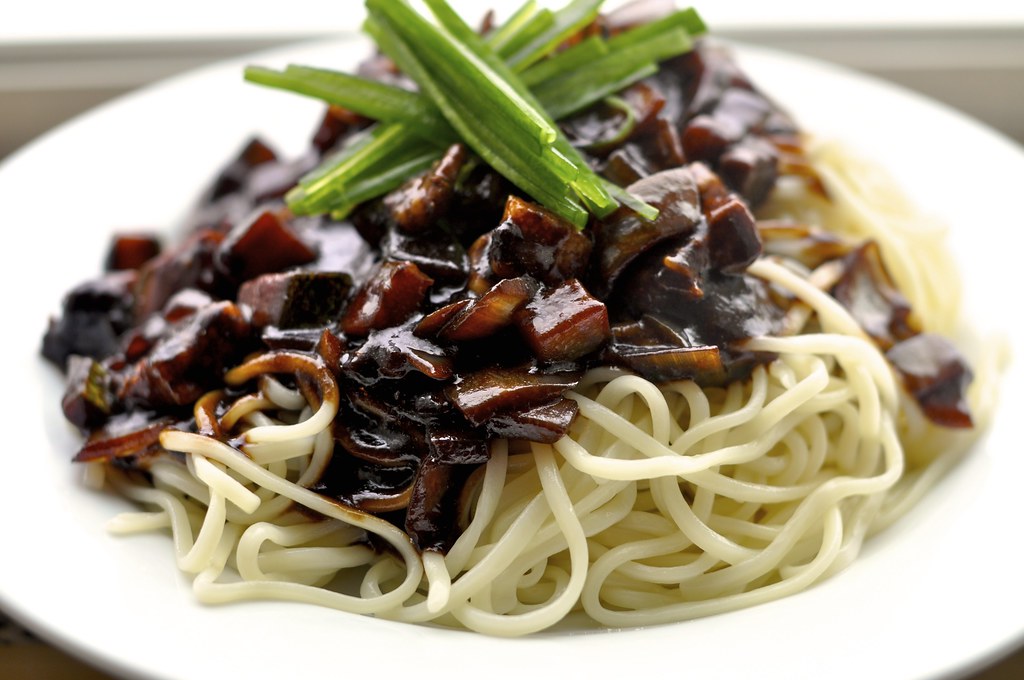
JAJANGMYEON LOVE

After so long I have found myself at the campus where
She would walk alongside that simple good-for-nothing boy
With a smile on her face.

I had set my sights on her.
She, who would always be next to that beastly boy.
Anyhow I was attracted to her and even if it was only once
I wanted to eat jajangmyeon* with her.

I found out her mother suffered from polio,
I found out her father had remarried.
Would she want to hide her limping mother?
As I thought these limping thoughts
I wanted to eat jajangmyeon with her.

I was a young single man.
She was like a bird fluttering here and there.
I gazed up to the sky where she soared.

After so long I am sitting on the bench I sat on
When I was in love with her.
Looking upwards and backwards into the sky from the past.
In that car park, there are more cars than I remember,
As I watch the students walking by, I think to myself
Are they junior colleagues of mine?

Unable to find part-time jobs they walk hurriedly,
Only their footsteps are quick.
Could there be among these boys one who holds someone
Close to his heart,
Without a word, someone he would like to eat jajangmyeon with?

Her steps-- they come and go -- have after all this time
Reached a crossroad.
The traffic lights from the past flicker.
Was she the only one I have ever lost?
The cars they keep coming the traffic lights are red.

*Black bean sauce noodles.
Ihlwha Choi is a South Korean poet. He has published multiple poetry collections, such as Until the Time, When Our Love will Flourish, The Color of Time, His Song and The Last Rehearsal.
.
PLEASE NOTE: ARTICLES CAN ONLY BE REPRODUCED IN OTHER SITES WITH DUE ACKNOWLEDGEMENT TO BORDERLESS JOURNAL
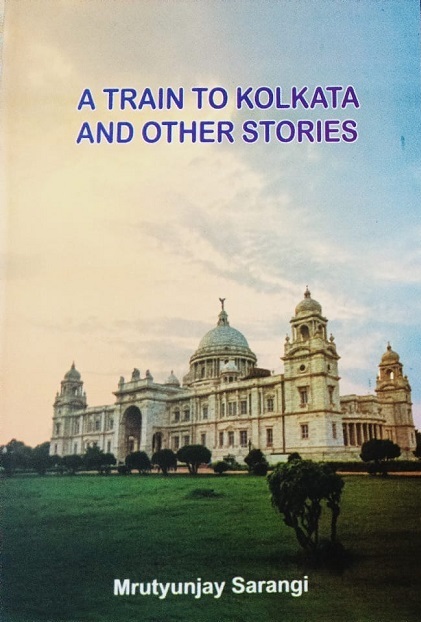
Dr. Mrutyunjay Sarangi, a former judge and recipient of the Fakir Mohan Senapati Award for Short Stories from the Utkal Sahitya Samaj in 2018, edits the Literary Vibes, an online literary journal hosted by him. A bilingual writer with number of Odiya stories under his belt, A Train to Kolkata And Other Stories is his second book of short stories. In his ‘Preface’, Dr Sarangi tells us from where the stories are drawn: “[T]hanks to my professional assignments, I have come in close contact with people from varied walks and experienced the joys, the wonders of life through a fulfilling journey. Some of these experiences have spilled into the characters and situations I have created in my stories.”
The fifteen stories that make this collection have the right mix of humour, suspense, love, sarcasm, imagery, vocabulary and more. A blurb by a pre-launch reviewer has very justifiably contended that the stories are “measured, controlled, balanced, jolly or courageous, sad or tear-jerking, from the start his stories hide a surprising climax”.
The climax in ‘Nepali Baba’ is both dramatic and unbelievable. The author’s thought resonates with a rational mind: “Somehow, I am always uncomfortable with the idea of Babas. I neither believe nor disbelieve them.” ‘A Small Lie’ is the poignant tale of two passionate hearts, whose world is smashed to smithereens in the baatyaa[1]. It goes on to narrate the struggles of the female protagonist who lives with the memory of the “night of intense passion and immense tragedy”. Stormy nights evoke pictures of menacing, disruptive clouds, dark lanes bring along ghastly images of skimpily clad women, men chewing paan, smoking and indulging in garrulous conversations. In ‘The Dark Lane’, the author has deftly portrayed varied images: “long tunnel of horror, infested with anti-social elements, school dropouts and vagabonds”. The reader heaves a sigh of relief “when at the end of lane, there was light, the crowded street welcomed them likes its long-lost friends” — a nail-biting finish to the narrative!
‘Ananyaa’ is the story of a shy girl from a middle-class family who gets trapped into marriage with a tall, handsome man who proves to be immoral, and unscrupulous, all because she did not have the courage to reveal her special love, fearing the family members would misunderstand her as a “girl of loose morals”. How many hapless Ananyaas still live in such prisons, I wonder. Each little act of kindness goes a long way, at times, and comes full circle is the quintessential truth which the reader gathers in ‘A Touch of Love’. At times, truth can be stranger than fiction.
‘Subashini Didi’is definite to leave the emotional reader teary-eyed. The vicissitude of human behaviour is revealed when certain unseen truths or “analysis of fatal errors”occur. “I am sure one day you will realise what it is and see your subject in a new light,”the author proffers a cryptic message to people who are judgmental and prejudiced without investigating what the eye sees and what the ear hears! The story of ‘Khusi’, an abandoned baby reunited with her biological mother after several incidents, is like one out of Bollywood. Often romantic comedies are fun filled, they do not illustrate “real life”. Some films, however, can resonate and inspire, and I believe this story was born after watching one such portrayal.
The title story ‘A Train to Kolkata’ — a tale that many of us can relate to, has a melancholic start. The somber mood and “heavy heart”of the protagonist Anjali is pitted against the “damp weather”. Dr. Sarangi has dextrously depicted human behaviour, familial love, bonding between an invalid husband and devoted wife; more importantly, has described how a callous and insensitive friend can be a pesky intruder, inflict deep wounds and shatter another’s peace. The story ends with lines that are both awe-inspiring and hard- hitting: “She looked up at heaven, at the infinitely merciful Supreme Power who was beyond all joys and all sorrows…”
The central theme running through the assortment of stories is ‘love’ in its varied hues. After all, love is a way of life, and the most important facet of human life – its mention brings along a feeling of warmth and security; yes, it also brings a lot of pain. While discussing the relationship dynamics, psychologist Frank Conner talks about the “essence of why we seek love in all relationships”. Using Sternberg’s Triangular Theory of Love, Conner reveals the “elements of this triangle are passion, intimacy, and commitment”. Interestingly, Dr. Sarangi has touched upon these facets in his stories. His protagonists are strong individuals with a never say die attitude; this includes the fragile Sushant in ‘The Procession’, who walks back with renewed vigour to his “home in a solemn procession, awaiting a starry night looming over the horizon.”
In the ‘Looney of the Town’,the author narrates the conversation between two generations with great élan and sharp twinge – the pre-Boomers, with the earlier twentieth century freedom fighters and the Generation Z, who have little knowledge about the patriots of the freedom struggle, their contributions and sacrifices. “Things had changed rapidly in free India, as if freedom was a license to perpetrate all kinds of irregularities. Promotions, transfers in jobs were bought by paying bribes red tape killed initiative for academic excellence and students were more interested in passing exams than acquiring knowledge…” Any reader can surmise that only one who has experienced these can vehemently come up with such potent expressions.
Setting aside his scholarly prowess, Dr. Sarangi has penned his stories in a language that is lucid and flowing. The choice of words, the vivid descriptions, and the realistic portrayals are sure to rouse creative minds. The stories in this collection will attract a multitude of readers as the protagonists and allied characters bear semblance to people whom one may have come across somewhere, at some point of time in their lives.
Hema Ravi is a part-time IELTS and Communicative English Trainer, writer by passion. independent researcher, and resource person for language development courses. She is a recognised poet, author, reviewer, editor (Efflorescence), secretary and event organiser of CPC (Chennai Poets’ Circle) and CAB (Connecting Across Borders)
.
PLEASE NOTE: ARTICLES CAN ONLY BE REPRODUCED IN OTHER SITES WITH DUE ACKNOWLEDGEMENT TO BORDERLESS JOURNAL










 Borderless