ALONE ON THE LAKE
(After Su Dongpo)


Night falls like a curtain,
as a cold wind rustles the reeds
along the shore.
Dark clouds threaten rain.
The dying stars
barely light my way.
Like a guttering candle,
the moon flickers above me.
There’s no sign of birds
or of men.
When I fished this lake
with my father I felt secure.
At sixty, cold and alone,
I think of my wife.
I steer my boat
in the direction
I hope will take me home.
George Freek’s poetry has recently appeared in The Ottawa Arts Review, Acumen, The Lake, The Whimsical Poet, Triggerfish and Torrid Literature.
.
PLEASE NOTE: ARTICLES CAN ONLY BE REPRODUCED IN OTHER SITES WITH DUE ACKNOWLEDGEMENT TO BORDERLESS JOURNAL
COME DOWN

Come down, O, come down
from your high mountain tower.
How coldly the wind blows,
how late this chill hour ...

and I cannot wait
for a meteor shower
to show you the time
must be now, or not ever.

Come down, O, come down
from the high mountain heather
blown far to the lees
as fierce northern gales sever.

Come down, or your hearts will grow cold as the weather
when winter devours and spring returns never.


MAYFLIES

These standing stones have stood the test of time
but who are you
               and what are you
                                and why?
As brief as mist, as transient, as pale ...
Inconsequential mayfly!

Perhaps the thought of love inspired hope?
Do midges love? Do stars bend down to see?
Do gods commend the kindnesses of ants
to aphids? Does one eel impress the sea?

Are mayflies missed by mountains? Do the stars
regret the glow worm’s stellar mimicry
the day it dies? Does not the world grind on
as if it’s no great matter, not to be?

Life, to be sure, is nothing much to lose.
And yet somehow you’re everything to me.

(Originally published by Clementine Unbound)

MY FORTY-NINTH YEAR

My forty-ninth year
and the dew remembers
how brightly it glistened
encrusting September:
one frozen September
when hawks ruled the sky
and death fell on wings
with a shrill, keening cry.

My forty-ninth year,
and still I recall
the weavings and windings
of childhood, of fall:
of fall enigmatic,
resplendent, yet sere*...
though vibrant the herald
of death drawing near.

My forty-ninth year
and now often I've thought on
the course of a lifetime,
the meaning of autumn:
the cycle of autumn
with winter to come,
of aging and death
and rebirth ... on and on.

* Dry or withered
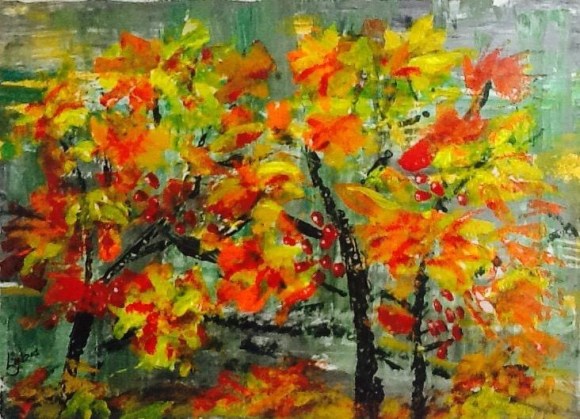
Autumn: Painting in Acrylic by Sybil Pretious
Michael R. Burch’s poems have been published by hundreds of literary journals, taught in high schools and colleges, translated into fourteen languages, incorporated into three plays and two operas, and set to music by seventeen composers.
.
PLEASE NOTE: ARTICLES CAN ONLY BE REPRODUCED IN OTHER SITES WITH DUE ACKNOWLEDGEMENT TO BORDERLESS JOURNAL
THE MAN

he stands like shield as the bullets hit
his body, he jumps inside the house
to save the children stuck in the fire
he climbs the pole to fix the wires
for the bulbs to glow at night
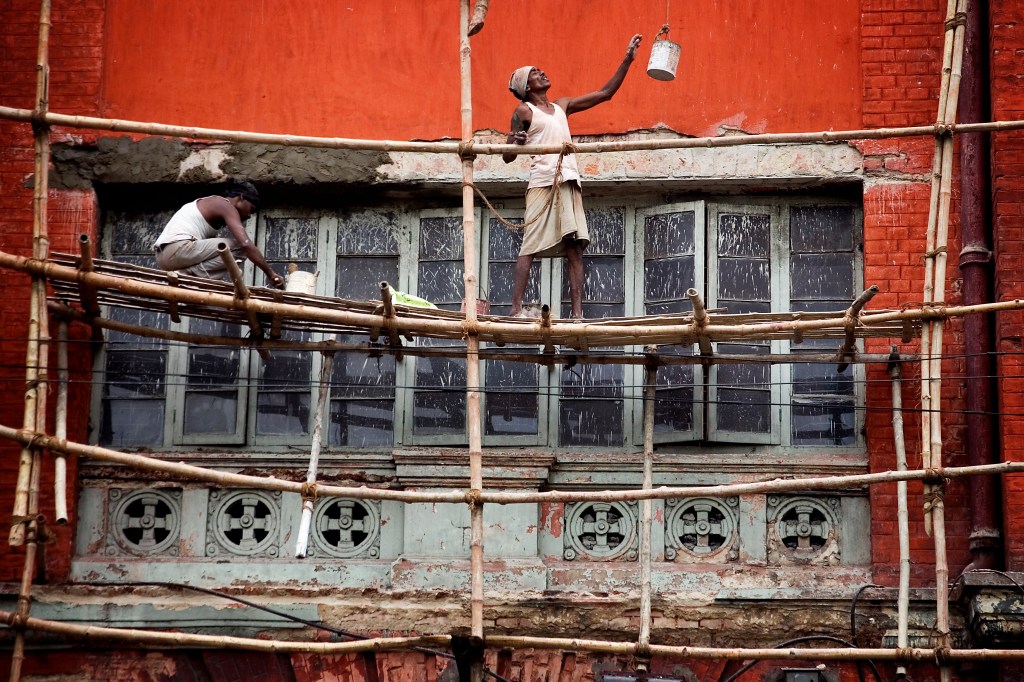
he cleans the drains for the cities
to prevent flooding, he carries the bricks
and builds the house, he farms the land
and commits suicide when he can’t repay
the loan, he drives your motors around
the world, he who is not a millionaire
or a minister, he who struggles everyday
to feed his family, to provide
he is the man no one talks about.


16 AUGUST, 2022

on the request of the government
indians bought flags
to celebrate seventy-five years
of independence

they put it on their gates
bikes, cars, buses and trucks
some wore tricolour pagris*
while some badges

the next day was different
as those flags were being dumped
on the streets, on the banks
and beaches, polluting the india
they worshiped a day before

*Turbans in Hindi
Sutputra Radheyeis a young poet from India. He has published two poetry collections — Worshipping Bodies(Notion Press) and Inqalaab on the Walls (Delhi Poetry Slam). His works are reflective of the society he lives in and tries to capture the marginalised side of the story.
.
PLEASE NOTE: ARTICLES CAN ONLY BE REPRODUCED IN OTHER SITES WITH DUE ACKNOWLEDGEMENT TO BORDERLESS JOURNAL.
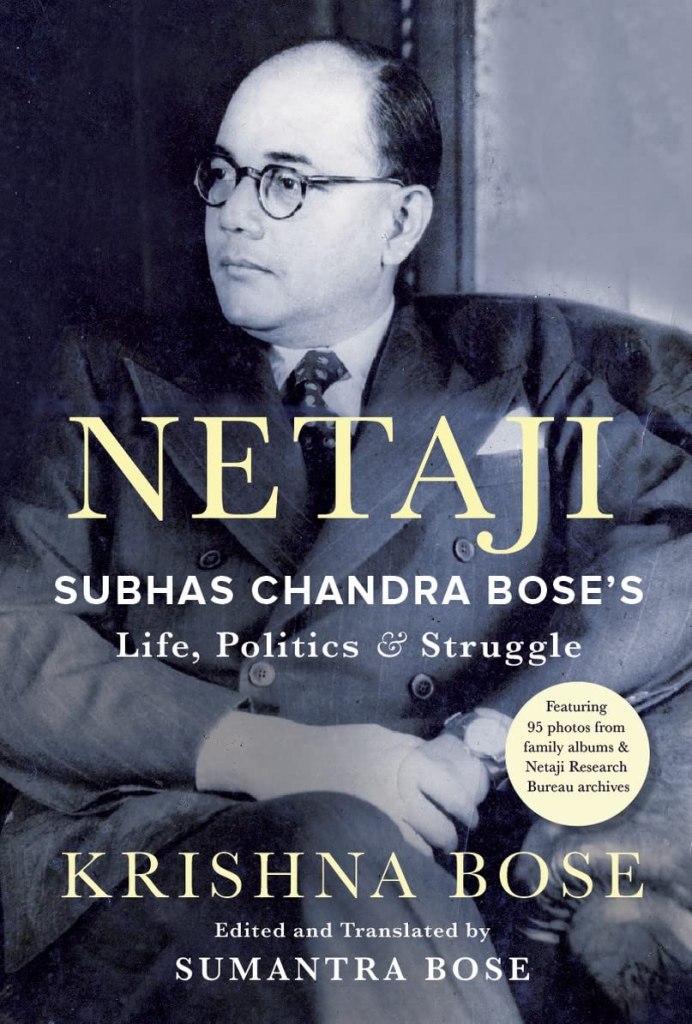
Bhaskar Parichha reviews a non-fiction written on Netaji by his family.
Title: Netaji Subhas Chandra Bose’s Life, Struggle and Politics
Author: Krishna Bose
Editor and Translator: Sumantra Bose
Publisher: Picador India
Books on Netaji Subhas Bose are plentiful and readers are unvaryingly fascinated by every book that hits the bookshelves. The enigma and the ecstasy of Netaji’s short yet eventful life continue to enthrall people worldwide even after decades since his death in a plane crash.
This new book Netaji Subhas Chandra Bose’s Life, Struggle and Politics by the late Krishna Bose is a refreshingly new account of the great leader’s life. Three aspects of his life stand out prominently in the book: Subhas Chandra Bose’s political motivations, personal relationships, and the daring military campaigns he undertook to secure India’s independence.
Krishna Bose (1930-2020) was a Member of Parliament thrice. A professor of English Literature, Krishna (nee Chaudhuri) married Dr. Sisir Kumar Bose — son of Netaji’s elder brother Sarat Chandra Bose. Sisir was Netaji’s chief aide in his daring escape from India in 1941 and drove the escape car from the family’s mansion on Kolkata’s Elgin Road. After Netaji’s death, Krishna helped Sisir build the Netaji Research Bureau at Netaji Bhawan. She served as NRB chairperson after Sisir’s death.
The book offers a rare in-depth account of the Netaji’s meaningful life by one of Bose’s close family members. That makes the book authentic and stimulating. Originally written in Bengali, the writings reveal the “human being alongside the revolutionary and freedom fighter”. It traverses Bose’s life from childhood to his death in August 1945. With important chapters about his youth, political career, and the power equation with Mahatma Gandhi and Jawaharlal Nehru, the book subtly brings out different shades of Netaji’s personality.
Drawing on Netaji Research Bureau’s archives and decades of fieldwork and interviews, this book offers an unmatched portrait of Subhas Chandra Bose – the man, his politics, and his epic struggle for India’s freedom. Krishna Bose’s writings were compiled, edited, and translated from Bengali by her son Sumantra Bose.
Krishna Bose traveled the world and extensively to the subcontinent in order to find out more about Netaji’s life. She strung together her findings, giving new insights into Subhas Chandra Bose’s political motivations, his personal relationships, his epic journeys, and the daring military campaigns he undertook to secure India’s independence. Written over six decades the book vividly reveals Netaji as a human being alongside his radical views.
The book has a detailed account of the women who influenced Netaji (his mother, adoptive mother, wife, and close friends as well as the soldiers of the all-women Rani of Jhansi regiment that was trained in Singapore), an eyewitness account of Netaji’s epic struggle in Europe and Asia, his secret submarine journey and escape from his Calcutta home and the Andamans where Netaji raised the national tricolour.
Divided into seven chapters (‘The Women who Influenced Netaji’; ‘Netaji’s relationships with Indian and World Leaders’; ‘Azad Hind Fauj’: ‘Netaji’s Epic Struggle in Europe and Asia’, ‘Netaji’s Soldiers: Remembering the Brave’; ‘The Liberated Lands’: ‘Visiting Manipur and the Andamans’; ‘Netaji and Women’: ‘In War and Friendship and Requiem’), the book is a truthful chronicle of Netaji.
The book contends: “[W]e visit the Manipur battlefields where the Indian National Army waged its valiant war, the Andamans where Netaji raised the national tricolor; Singapore, where the INA took shape; Vienna and Prague, his favorite European cities; and Taipei, where his life was tragically cut short. We meet Netaji’s key political contemporaries – from Nehru and Gandhi to Tojo and Hitler. And we learn in gripping detail about the Azad Hind Fauj’s spirit of unity and the bravery in the war of its men – as well as the women who fought as the Rani of Jhansi Regiment.”
In fact, Krishna Bose closely knew many personalities who feature in this book – Basanti Debi, Subhas’s adopted mother; Emilie Schenkl, his spouse; Lakshmi Sahgal, Abid Hasan, and many other leading soldiers of the Azad Hind movement – who all shared vital memories that helped complete Netaji’s life story.
Rabindranath Tagore and Subhas Chandra Bose are the two most iconic figures late modern Bengal has produced. The nature of their relationship is, however, not very well known. We are told: “Tagore and Bose first met at sea, in July 1921. Subhas, aged twenty-four was returning by ship from England to India after resigning from the Indian Civil Service to join the national struggle for freedom taking shape under Mahatma Gandhi’s leadership. Tagore, aged sixty, happened to be a co-passenger on the ship. In his book, The Indian Struggle, 1920-1934, published in London in January 1935, Netaji recalled that journey and wrote that he and Tagore had extensive discussions during the voyage.”
Aiming to bring an end to the controversies and conspiracy theories surrounding the freedom fighter, the over 300-page book gives a detailed and evidence-based account of his death in one of its chapters. Notwithstanding the mystery surrounding his demise, Netaji is widely believed to have died in a plane crash in Taiwan.
Featuring 95 images and letters from family albums and Netaji Research Bureau archives, this compilation by Krishna Bose on Netaji and his struggle for India’s freedom will enlighten readers, and especially the younger generation, about Subhas Chandra Bose’s ideals and his vision about the development of a free India.
.
Bhaskar Parichha is a journalist and author of Unbiased, No Strings Attached: Writings on Odisha and Biju Patnaik – A Political Biography. He lives in Bhubaneswar and writes bilingually. Besides writing for newspapers, he also reviews books on various media platforms.
.
PLEASE NOTE: ARTICLES CAN ONLY BE REPRODUCED IN OTHER SITES WITH DUE ACKNOWLEDGEMENT TO BORDERLESS JOURNAL
A tribute from Ravi Shankar to a fellow trekker& a recap of their adventures in the Himalayas
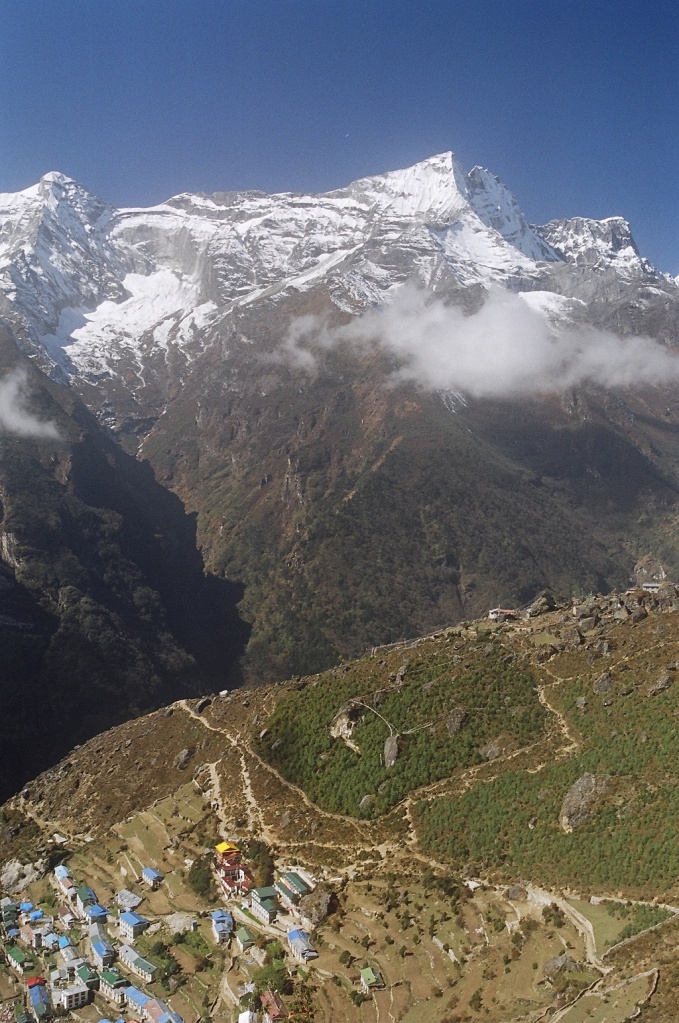
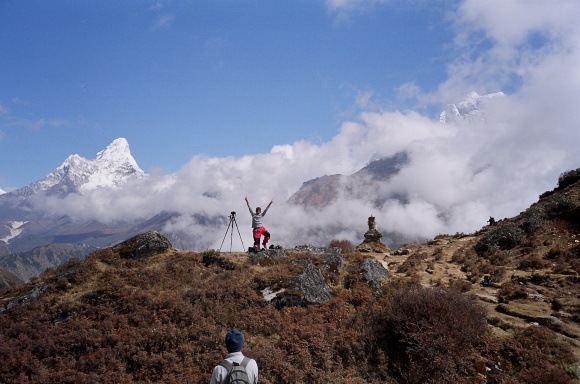
Ama Dulam and Lohtse peaks on the way to Everest. Photo courtesy: Ravi Shankar
A very fit and energetic person strode into my office. My good friend, Varun, accompanied and introduced him as a newly joined faculty member in the Physiology department at the Manipal College of Medical Sciences (MCOMS), Pokhara. My friend always called himself Ashutosh though he quickly became famous at MCOMS by his surname Bodhe.
Bodhe was always in perpetual motion. During our five years of close interactions, I rarely saw him sitting quietly in one place. He was a member of the college mess but rarely ate from there. I sometimes saw him around 2 or 3 pm having noodles and eggs from the private food stall located within the mess. He was fond of repairing things. He could put back together nearly everything — except maybe, broken hearts. His tool kit consisted of a soldering iron, screwdriver, screws, insulation tape, clamps, and a multimeter; rather strange appurtenances for a doctor.
During my conversations with him, I came to know that he had always wanted to be an engineer and had secured admission into a premier engineering college in Mumbai, India. He also later qualified for admission to the medical course and his family insisted that he switch over to medicine. He would walk around the city of Pokhara, Nepal at strange times of the day and night. He would walk from the lakeside to the college campus after 10 pm. This seemed strange in a city that usually goes to sleep by nine.
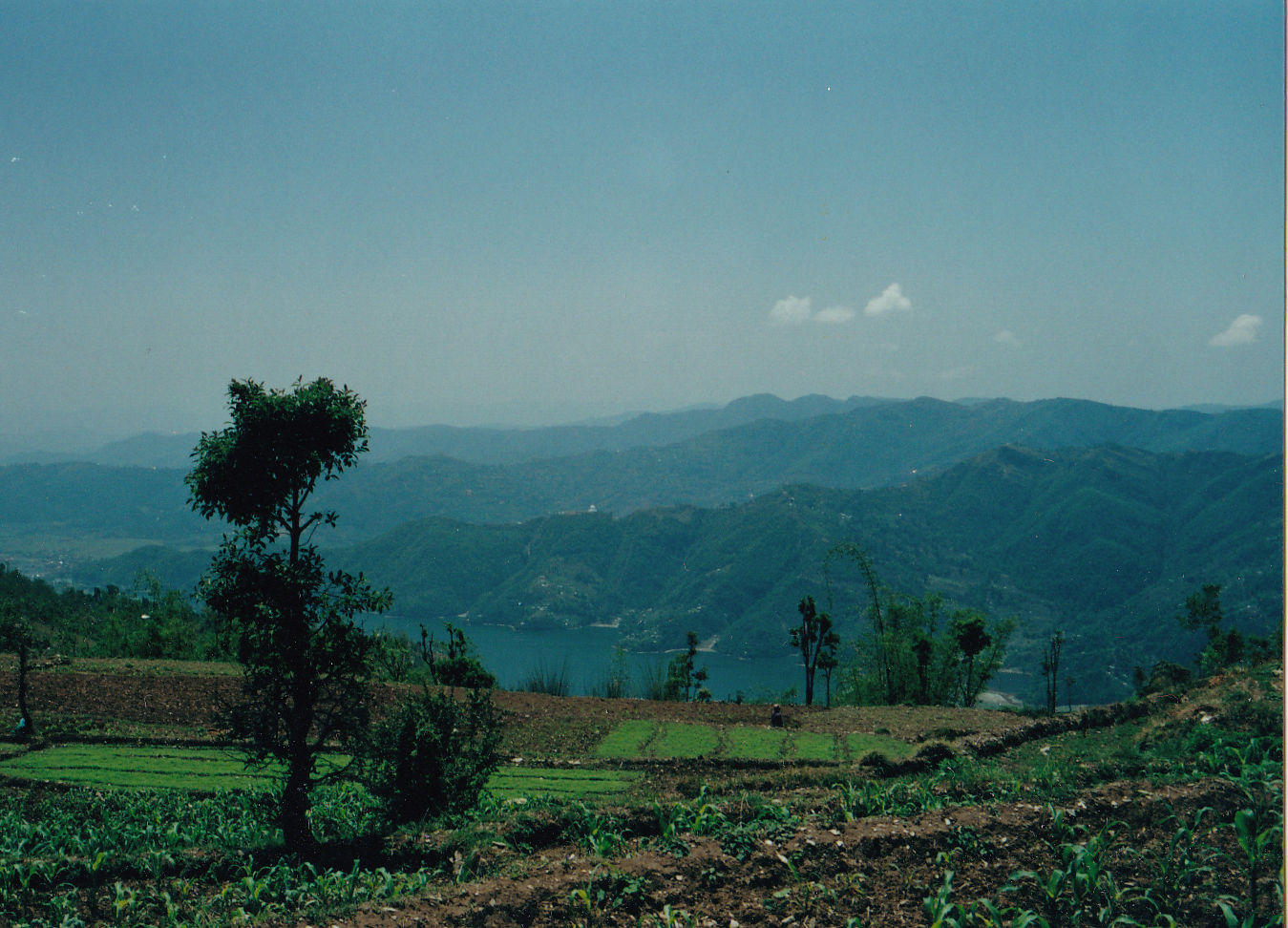
The hill overlooking the Fewa Lake. Photo Courtesy: Ravi Shankar
Bodhe, on occasions, also joined us on day hikes in the Pokhara valley. Pokhara is a trekker’s paradise. The walk up to the Shanti Stupa on the hill slopes overlooking the Fewa lake can be a good Saturday morning activity. Rowboats are available on the shore of Fewa Lake and are mainly used to visit the Tal Barahi temple located on an island in the middle of the lake. The stupa was built by a Japanese monk with the help of locals in the early 1970s. The stupa stands on Anadu hill in the onomatopoeic village of Pumdi Bhumdi and is a good hour’s climb. After the visit, you can climb down to Damside, continue to Lakeside, and return after a delicious lunch.
Boats on the shore of the Fewa Lake. Photo Courtesy: Ravi Shankar
Occasionally, Bodhe would join us on our Saturday walks to Lakeside. The walk would take about 90 minutes. We continued along the lake to a ‘Korean[1]’ restaurant. The restaurant constituted of small huts by the side of the lake with tables and chairs. It was a magnificent location for a feast! We used to have Nepali daal bhaat tarkari maasu (lentil curry, rice, vegetables and meat, usually chicken). In many Nepalese restaurants, food is usually prepared fresh after you order. The food takes around an hour to be prepared. This leaves plenty of time for conversation. The food by the lake was always fresh and piping hot. The country chicken was beautifully spiced, and the green leafy vegetables were perfect.
Our other go-to place for lunch on Saturdays (the weekly off in Nepal) was the Pokhara Thakali Kitchen. Thakalis are originally from the Thak Khola (the upper Kali Gandaki River) around the Nigiri Himals to the north of Pokhara. They are successful businessmen and run some of the best hotels and restaurants in the country. I simply loved their rich, thick green daal and their potatoes fried in ghiu (clarified butter). The other specialty was dhido (a thick paste) made from either corn or buckwheat flour.
Bodhe, me, and a group of students hiked to the Everest Base Camp and Kala Pathar. We flew to Lukla (from Kathmandu) and the Tenzing Hillary airport at around 2800 m. This is one of the most dangerous airports in the world and accidents were not uncommon. The runway was only around 600 m and then it is a steep drop to the river below. We had lunch at a lodge in Lukla while we waited for our porters. Most hikers spent the first night on the trail at the settlement of Phakding. The first thing we noticed was that the Everest region was much colder than the Annapurna trekking region just north of Pokhara. A large portion of the hike is at heights of over 3000 m.
The peak autumn trekking season was underway and there were large groups of hikers on the trail. We were racing against each other to find a place for the night. Those were the days before online booking and land telephone and internet access were still not available in Khumbu.
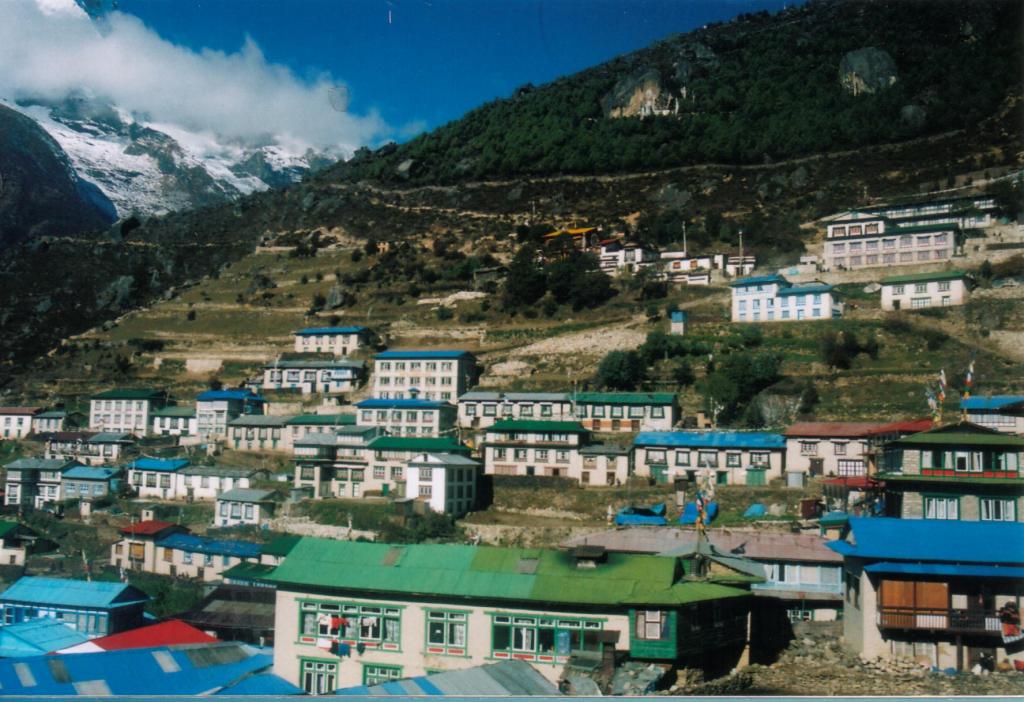
Namche BazaarView of the Himals from Namche BazaarPhoto Courtesy: Ravi Shankar
Namche Bazaar, the ‘Sherpa Capital’[2] was packed with tourists, and we were lucky to find rooms at a small lodge. The next morning dawned clear and frosty and the views of the Himals were spectacular. Bodhe, while chewing tobacco, was busy clicking photos and we were dancing vigorously to various songs. He really liked the song Kaanta laga[3]. He would reminisce about the wild morning and mention the ruckus we had created, chewing his usual wad of tobacco for he seemed addicted to the stuff.
Bodhe was a man with tremendous energy and a useful person to have on a long trek. He was impulsive and a practical joker but a kind soul with the energy to get going when the going becomes tough. He sprinted uphill on hikes and then climbed a tree or went off sprinting into the bushes. He did not reach a lodge or a settlement early as he was easily diverted by wayside attractions. He was fascinated by the term boche which stands for a flat land seen from a hilltop. In a very rugged and mountainous landscape, flat land is a coveted commodity. There are many boches in the Everest region – Pangboche, Deboche, Dingboche, Pheriche Tengboche among others.
We eventually reached the settlement of Gorak Shep at 5300 m. The weather was cloudy and freezing. The temperature was well below zero. We were shivering under our quilts in the lodge. It was the eve of Kojagiri Purnima[4], and the moon was beginning to rise. Bodhe motivated a group of students to carry and pitch a tent on the slopes of Kala Pathar (Black Stone) in the freezing cold. They donned all the winter clothing they had and spent the night on the rock photographing the world’s highest mountains in moonlight. The cold chilled their marrows and sleep was out of the question. They arrived around eight the next morning with wild stories of their hair-raising night.
We eventually returned to Lukla and reconfirmed our flight tickets for the following morning. Our flight was scheduled for eleven am and the last night at the lodge was a wild one. Bodhe was in full form and we were all relieved that the trek was over, and we were flying back to Pokhara. It was raining heavily the next morning and our flight was repeatedly delayed. Flights to and from Lukla are notoriously fickle. We were the last flight to take off as rainy weather closed in.
It was a long drive in the rain from Kathmandu to Pokhara. Clouds and mist draped the hills. Soon after reaching the hostel, one of the students who had joined us on the trek mentioned that the next day was a holiday as the roof of the Manipal Teaching Hospital had collapsed. We chided him for his fertile imagination but slowly realised that he was telling the truth. The hospital roof had collapsed that afternoon killing a few patients in the waiting area and seriously injuring a few others.
We hiked with Bodhe, some other faculty, and a few postgraduate students to the village of Ghandruk. Ghandruk (also called Ghandrung) is the second largest Gurung[5] village in Nepal. The hike was along a rocky riverbank and then through stone staircases. The sun was up full force and our trek to the village was hot. Mule trains raised dust clouds as they move up and down the trail. The village is the headquarters of the Annapurna Conservation Area Project (ACAP). There are several excellent lodges in the village and the Annapurna South and Hiunchuli Himals can be viewed from there. One of the finest lodges in the village was the Himalaya lodge, a Kerr and Downey resort located at the top of the village. The lodge was an additional twenty-minute hike, but it is well worth the effort. The views are stupendous and the rooms beautiful. They provide down jackets and slippers for the comfort of their guests. There was a good porch and a magnificent lawn in front. Bodhe absolutely loved this place.
Sadly, Bodhe never stayed in touch after he left Pokhara. There were rumours of him working in the Caribbean, in Mauritius, and in different places in India. In a circuitous fashion, I came to know about his death last year. We do not know the details yet. Looking back on his life, I am reminded of so many unfulfilled promises. The man had a first-rate intellect and boundless energy. He could have achieved much only if he had been able to focus and channel his God-given gifts. But, he lived his life in his own terms. Dear friend, I sincerely hope you are finally at peace. Ashutosh Bodhe – tujhe salaam[6]!
Bodhe
[1] The restaurant mainly catered to Korean tourists and used to serve primarily Korean food but also cooked Nepalese dal bhaat
Dr. P Ravi Shankar is a faculty member at the IMU Centre for Education (ICE), International Medical University, Kuala Lumpur, Malaysia. He enjoys traveling and is a creative writer and photographer.
.
PLEASE NOTE: ARTICLES CAN ONLY BE REPRODUCED IN OTHER SITES WITH DUE ACKNOWLEDGEMENT TO BORDERLESS JOURNAL
THE FLAVOUR

There was a bird
who pecked a cake
and scattered crumbs
around the lake.
There was a monkey
with sore thumbs
who took a rake and cleaned them up.
There was a ship
out on the water
that had lost its fleet
just as a calf might stray from a herd
and close to shore
it observed the details of this feeding
and all other proceedings
between itself and the distant chateau
and rather wondered
at the flavour
of the shattered gateau
that had despoiled a lakeside that
looks nicer neat
and concluded it tasted
quite like an unwashed yeti’s feet.


OH NOAH

I have been
thinking
about Noah’s Ark
and wondering
where
Noah put
the woodpeckers.

Including them
seems wrong.

Then it occurred
to me that
they made
the portholes
as the boat
went floating along.
Rhys Hughes has lived in many countries. He graduated as an engineer but currently works as a tutor of mathematics. Since his first book was published in 1995 he has had fifty other books published and his work has been translated into ten languages.
.
PLEASE NOTE: ARTICLES CAN ONLY BE REPRODUCED IN OTHER SITES WITH DUE ACKNOWLEDGEMENT TO BORDERLESS JOURNAL
Narrative by Paul Mirabile with photographs by Françoise Mirabile.
The Treewood sculpture by Çağdaş Ercelik of Sait Faik greets the visitor at the Burgaz docks on his or her arrival.
To have sojourned on Burgaz Island was such a marvellous experience. This experience resulted from the fact that I worked twelve years in Istanbul and had rented a small flat on the island from an Armenian woman whose daughter had been a student of mine at University.
I rented the small, rooftop flat for about five or six years. Then I met one of the protagonists of my story, Abi Din Bey, a Turkish Alevite[1] who had been living on Burgaz since the 1940s in his two room wooden dwelling on the beach, opposite Yassi (Flat) Island and Sivri ( Pointed ) Island in the Marmara Sea, which he and his brother had built. He sold coffee or tea with little cakes or grilled cheese sandwiches to infrequent visitors, hikers or swimmers who happened to stumble across his home on the beachhead. That was in fact how he made his living. We got to know one another well, and soon he offered to rent me the smaller room of his lodgings whenever I arrived on the island for week-ends or for the longer holidays at a much more advantageous price than my flat in the village. I took him up on it without a second thought …
Abi Din Bey’s front gardens, peppered with shady fruit trees, under which he had placed long or square tables with benches or chairs for the occasional visitors, touched the stony beach. From those gardens one had a wide open view of the Sea of Marmara. It was truly a place of magic ! In the mornings we would take our coffee or tea in the gardens and contemplate those placid waters lapping the pebbly strand, a slight breeze coming in from the North, the sky and the sea, enamel blue. Hikers or visitors would stop in after eleven, and he would serve them cold beverages and grilled cheese toast, which he prepared in his kitchenette. I would help him on the week-ends when students arrived with their tents to stay on for a day or two on in the wooded areas.
Marmara Sea seen from Abi Din Bey’s front gardens. Pointed (Sivri) and Flat (Yassi) Islands can be seen in the background
Burgaz, the second of the four Princes’ Islands of the Sea of Marmara, known to the Greeks as Antigone, was as popular if not more than the first island Kınalada (Prōtē), the third, Heybeliada (Halki) and the largest Büyükada (Prinkēpos). Their Greek names fell out of use after the Greek-Turkish War in 1921, and following the founding of the Turkish Republic in 1923. Burgaz was a world of poetry, in rhythm wth the movements of steamers coming and going, lapping waves and rough winds … screaming seagulls, the long solitary walks up into the hilly woods and along the sandless beaches, by the evening strolls amongst the white-washed nineteenth century wooden Ottoman-era mansions of Burgaz village, whose fretted pitches mounted from the cornice to the high gabled roofs of the façade. Bougainvillaea and wisteria of bright blues, purples and whites overflowed from the cast-iron balconied façades. Neatly kept gardens hugged the quiet lanes and streets fringed with mimosas and pomegranate trees, pricked here and there with aging trees, one of which near the House of the Alevites, was said to be over six-hundred years of age.
Indeed, life on Burgaz contrasts so starkly with that of Istanbul: no vehicles, no mass movements of people rushing to and from work, no tram, metro or train ; a world of enchantment and marvels, of monasteries, churches and cathedrals, of dancing boats at the piers, of leather-faced fisherman casting nets or having tea; of forested hills, rocky cliffs, of bougainvillea sagging in great clusters and copses of cypress … of crimson sunsets dipping into the Marmara. Truly, Burgaz is ideal for the painter’s palette …
How I inhaled and exhaled those wonderful visions as I made my way down upon the winding path towards Abidin Bey’s home — splashes of roses, honeysuckles and oleanders blazing orange and crimson through the deep forest greens. And as I did, the voice of my foremost protagonist, the hero of this story, Sait Faik Abasıyanık[2], would implore me to reanimate his presence on this island paradise, to hearken to and bring forth, as if snatched up in some dreamy reminiscence of poetic éclat, that forlorn, melancholic voice:
Yes, that Sait Faik voice, elliptic, forlorn and melancholic, as if he solicited an unaffected sincere souvenir of his masterful art: the Art of Poetics … of the short-story, a palatable keepsake of his short-lived grandeur :
The wind that bears the salt to the shore,
I hear the swimming of the fish
I listen to the seaweed talking amongst themselves,
So many journeys into the past borne by that doleful voice of the solitary poet and story-teller of fishermen, wood-choppers, street vendors, birds, steamers, cafés; of motley dressed street children, long, starry nights meditating the brushing waves of the Marmara Sea along the indented coasts of Burgaz … of insular Freedom …
What exactly is insular Freedom? A land free of noisome noise; the islanders hear only the laughing seagull in flight, the chants of fishermen repairing their nets, the brays of donkeys, the wheedling of jays and the coarse hawking of merchants on market days, the neighs and snorts of work-horses, the cock-a’doodle doos of roosters at the break of dawn.
A land where the naked eye embraces gold-gilded sunrises and dragon-red sunsets at the not so distant point where the azures of the sky touch those of the briny sea.
A land of a myriad flowery perfumed fragrances, free from the toxic fumes of vehicle emission, from chemical discharge and human waste. A land of powerful telluric forces where the islanders’ footfalls tread dirt tracks, sandy or stony beachheads, soft, leafy trails; where he or she communes with the trees, the sea, tastes the salty air free of pollution. Even the taste of Burgaz coffee smacks of that island brew, a nice commingling of robust richness and timeless tincture! Freedom which releases all the senses from their ensnared urban uniformity, their artificial, conventional urbanity of foot-shuffling routine and tiresome ennui …
So I descended and descended towards Abi Din Bey’s strand home, winding steeply in zig-zag fashion, alive to that distant but clear, impelling voice:
When reading or listening to these verses I experienced a veil of despondency, a dash of fury that underscores a struggle of consciousness, of surpassing vanity as the principal motivation of solitude within an island envelope. The consciousness may be called nostalgia; that is, suffering of and from a past, familiar lieu, a stead-sickness of some remote time within the fantastic unfolding of a man’s former existences. And yet, these former existences may not be as remote as I believed. So I continued to lend an ear as I approached the beachcomber’s humble abode:
Ah, Sait, you have been my faithful road companion ; the herald of the short story, of the furtive glimpse, of the snap-shot of possible realities which have been the ardent desire of our existential Way … the Flame of Life …
Here, at long last, Abi Din Bey has come to greet me at his welcoming gate — a hearty greeting indeed. Abi Din Bey towers over me in all his nobleness; he is a descendent of the great Ali, fourth Caliph of the Sunna, first Imam of the Shia.[7] He took great pleasure and pride in showing me his genealogical tree finely printed out on vellum in triptych form as he had done in the past every time I visited him. He had it done by specialists at the Vatican for a meagre fee. He never fully explained why he had it done at the Vatican.
Noble, humble, ascetic and combative like his distant descendant, he stands erect for his advanced age (perhaps eighty), and remarkably lucid when discussing religious matters and Sufi poets. He was well versed in Ali’s conquests as well as Sait Faik Abasıyanık’s life and personality, whom he knew personally in his younger days. How many nights under a speckless sky did my friend and host narrate Saik’s life to me, abridged of course, and oftentimes modified to enfold the atmosphere of that night’s solicitude, the turbulence of the waves pounding the jutting rocks, the scrapings of the pines against the rising cliffs that arched over his diminutive home.
It was the month of May in the year 2006. The mimosas were in full bloom as we sat in his front gardens, breathing in the fresh balmy air of the calm, morning sea. The fragrance of rose attar mounted from the morning dew which clung to the garden trees like hoarfrost. The tea, too, had a fresh taste to it. Abi Din Bey looked out upon the cool blues of the late morning sky and waters :
“Sait was a rebel !” he began abruptly in his deep, coarse voice. “You know, he didn’t look to transform the world like some revolutionary, he wanted to be as useless as possible to the whims and caprices of our political and economic decision-makers, to the ideological escapades of social redeemers or misfits so as to accomplish his own destiny for the benefit of all Humanity.”
“Is that why he wrote ‘The Useless Man’?” I ventured, a lovely short story that I had translated several years back.
“Yes, for the whole of Humanity,” he continued excitedly as if not hearing my rhetorical question. “That may sound strange because he lived such a hermit’s life, a socially useless life, especially here on Burgaz. However, if you’ve noticed, and I’m sure you have noticed, he always wrote ‘on the road’ : at the docks waiting for the steamers, on the steamers, in cafés, whilst strolling about the island plunged in his world of creative imagination … even when fishing or rowing. He loved to stroll up the dirt tracks into the forested hills and visit the Greek priest on Hristo’s Hill in his chapel.
“Nothing revolutionary. No message to peddle or to plead, only the solemn and sober cheerfulness of his flamboyant and oftentimes eccentric character which he consciously or unconsciously weaved into his short stories and poetry. His voice was not the authoritative, pompous voice booming from above, but the unfettered voice of pure simplicity, describing simple gestures, simple acts, simple conversations, freed from conventional social and literary shackles. A rebel is neither serf nor master: he is absolutely free from social rank and class …”
Abi Din Bey paused to take a sip of tea. This man, too, lived an unfettered, unconventional life in his two-room cabin on the pebbly strand of Burgaz, alone, besides the occasional visitor. But he was no rebel ; his parents had long since been deceased, and since he had never married had no children. His only brother died many years ago of alcohol in middle age. And so there we sat, alone, the sun rising high on the wooded hills of the Kalpazankaya peninsula bay, Abi Din Bey spinning his own tale of Sait, a timeless reminiscence where story-telling reveals not only the pleasures of listening, of sharing, but more important still, the essence of identification with the Other of that story …
“You know, he hadn’t always lived on Burgaz; he had his schooling in Bursa, where he lodged at a boarding school for boys. His father wished him to be a merchant or a diplomat, but this lifestyle suited him not. Deep in his heart, Sait yearned to be a wandering, carefree writer who observes the details of life that wheel and whirl around him. It was in High School where he wrote his first story ‘The Silken Handkerchief‘ (Ipekli Mendil). It aroused much interest from his literature teacher who encouraged him to work harder to flesh out his ideas, rear in his galloping imagination. His father, on the other hand, disliked the route his son was taking, so he promptly sent him to Switzerland in 1931, I think, to study economics. Unstable as he was, the agitated student dropped his studies and left for France, exploring its towns and literature, especially those short stories of Maupassant, the finest of the French short-story writers, which he read in the original, as he developed a solid base in that language. Finally in 1935, he returned to Istanbul via Marseilles by ship, and there took up different employments, ignoring his father’s growing obsessions about lumber merchant opportunities. He even taught Turkish at an Armenian School for orphans …He translated, too. Since he excelled in French, he translated André Gide’s books for the literary journal Varlık (Existence). Translation served as an exercise in style and intellectual perspicacity for his own writings, which by the way, were gaining more and more attention within the small literary cliques of Istanbul.”
Abi Din Bey stopped for a moment to gather his thoughts. This was not the first time he was narrating Sait Faik’s story to me (and assuredly to others), with of course the usual modifications. I noted, however, that his memory seemed to wane and to compensate for its loses and lapses, he filled in the gaps with judgemental remarks. Oddly enough, his attitude towards Sait became more and more distant, almost academic, as if Sait’s person, long since passed, betrayed Abi Din Bey’s own anguish of passing … His relation to Sait had been casual, not intimate ; yet, there were moments when recounting the events of Sait’s life that Abi Din Bey gave the impression that he was reliving his own past, concomitantly with Sait’s ! This might have explained the urgency in his voice, often broken, the lapses and chronological errors. Did he already know that he would be expropriated in the not so distant future? I cannot say …
“He never earned a great deal of money from his stories, although they were quickly catching the eye of important literary critics and publishing firms. It was his father’s money that provided his bread, tea … and alcohol. More and more collections of his narratives poured out from his energetic pen, written in every possible place on every possible situation that he experienced. How many I cannot say or remember … I haven’t read them all …”
I interrupted to refresh his memory, “Semaver (The Sarmovar), Lüzsüz Adam (The Useless Man), Alemdağ’da Var Bir Yılan (There’s a Snake on Alemdağ), Son Kuşlar (The Last Birds), Az Şekerli (A Wee bit of Sugar), Havuz Başı (At the Poolside), Mahalle Kahvesi (The Neighbourhood Café), Şahmedan (The Pile Driver).”
“Yes! Yes, so many stories in those collections!”
“There are twenty or so in each collection,” I added quickly.
“Have you read them all?”
The question posed so bluntly caught me off guard. I shook my head : “No, perhaps twenty or thirty. I’ve only translated seven or eight of them.”
“Yes, seven or eight,” he echoed in a flat voice, gazing dreamily out to sea beyond his front garden fence. A few young people were strolling amongst the smooth rocks jutting into the sea.
“You know, Abi Din Bey, his stories are not easy to translate,” I rejoined, observing that my loquacious host remained unusually silent. “His vocabulary jumps from Ottoman word-hoards to Burgaz jargon ; from street talk to poetic solipsism. His syntax, so elliptic at times, coils like a snake on the branch of a tree on others ; to follow this coiling I had to slither like a snake.” Abi Din Bey broke into a wide grin : he enjoyed simile and metaphor. “Saik Fait’s reasoning defies Cartesian logic with his uncanny sounding rhythms and odd visual associations ; he had such an eye for details.” I pursued after Abi Din Bey had withdrawn into his cabin to procure a few cakes and returned to our table. “I’m sure I have done violence to the English language with my translations. Then again, my approach to translation has always been a Poetics one ; that is, a unique adventure by which Sait’s enonciations and utterances, his ‘style’ of writing if you like, are ‘transferred’ to my poetic expression in English. Poetics in translation is not one of language to language, but discourse to discourse …” Abi Din Bey nodded kindly in my direction. He knew nothing about translation, but had been grateful to me for having translated his deceased brother’s poems, a marginal poet amongst the plethora of Turkish poetic writers[8]. Yet, Abi Din Bey refused that I seek out a publisher for them; his brother’s tragic death would not be flaunted and besmirched publicly by the blood-thirsty horde of scandalmongers who called themselves literary critics. His poetry, whatever its worth, translated or not, would remain a ‘family affair’ … which it did … Abi Din Bey poured out some more tea, then resumed his reminiscing. He was drifting into his favourite souvenirs, those to which, I am sure, he identified himself: “Many so-called critics despised Sait. Not his stories but his way of living ! They trumped up intrigues against him, accused him of political incorrectness, of social disorder. But this man never advocated any political ideology, nor did he mingle with criminals, as some imbeciles claimed. How the mediocre can conjure up calamitous falsehoods through jealousy, malice and hate. He reacted badly to these accusations and insinuations, withdrawing from the world’s fair ; it was also then that he began to drink very heavily and lead a very unproductive life.
“His father died, and Sait, fed up with all that puerile scandal-mongering, left for Burgaz, where he inherited his mother’s lovely two-storey house near the Greek Cathedral of Saint John. A whole new existential vista opened up for him on his island retreat, far from vanity and pseudo-intellectualism. On Burgaz, he regained that the freedom of the beachcomber, that artful notion of being humane to all living creatures, confronting Nature’s formidable forces, interlacing his childhood dreams and fantasies with natural surroundings. He explored the psychic of individuals of meagre living and of strenuous trades. Sait Faik’s daily existence transpired on the pages of his stories : modest or tragic family events, streets filled with vendors or motley children, fishing expeditions, prawn catching at midnight, flocks of seagulls on the wing and shoals of fish frolicking in gay abandon. He recorded the voices that echoed off the walls of cafés filled with fisherman, spoons tinkling in their glasses, the crisp sounds of cards shuffled or dominoes tumbling. His was an unaffected world of banal circumstances acted out in harmony or disharmony with roaming wildlife, teeming vegetation or simple, working people.
“Sometimes I met him at his favourite café, which no longer exists. There we chatted and chatted for hours; I know he was using me as his first reader, narrating details of his day’s activities, and those of the islanders.
Sait Faik’s house and Gardens on Burgaz facing the façade of Saint John’s Cathedral
“You know at that time very little Turkish was spoken on Burgaz ; many of the inhabitants spoke Greek, Armenian or Jewish-Spanish. Sait savoured these foreign sounds, so exotic to his ears since he none of these languages. But he listened as if he understood them perfectly. Anyway, we would meet every now and then, stroll about or just have tea or coffee in the village. He led a simple, hermit’s life.”
“Like yours?” I put in slyly.
He turned a bit red, the limpidity of his eyes losing their usual sunset softness. He rubbed his arching nose: “Perhaps. But I never wrote a sentence or verse in my life ; that was my brother’s destiny. And please, don’t publish those poems of his that you translated,” he admonished me in a colourless voice.
I promised not to do so for the hundredth time. Abi Din Bey, relieved for the hundredth time, resumed rather pedantically: “Sait rubbed shoulders with people of whom he had ignored the very existence, whether in Bursa or in Istanbul, and by all this rubbing, however awkward or uncouth, he came to realise that his Destiny was one of Freedom, a philosophy of Life, an Art of Existence that he gradually cultivated here on Burgaz, and which blossomed out into the most beautiful bouquet of literary flowers.”
“Yes, Abi Din Bey,” I began slowly, pleased at my host’s sudden poetic élan. “A Destiny of a sovereign being who regards each and every being as equal in value. An equality of value that can be gauged not particularly by choice of theme, but rather in the glimpses of detail that strikes the ear and eye: a miaowing cat, a reduplicated adjective or noun, the howling wind or soft breeze, a bright scarf on a darkening day, a bird hopping among the trees or on the wing ; details that play not a major role in the setting of his stories but should not be regarded as mere rhetorical artifice. They produce not a ‘local atmosphere’ but generate an intensity to his oftentimes plotless narratives or actionless plots. In fact, they rhythm the levels of narrative threads that weave the dramaless narrations no matter how insignificant or banal. I have never experienced a climax or a ‘dénouement‘ in any of his stories.”
Abi Din Bey agreed, then added: “Unlike most Turkish writing, Saik’s stories are written in plain language, they carry no overweening pomposity.” (Here I refrained from objecting : Orhan Pamuk[9] does not write in any overweening, bombastic language !). “They are unburdened by bloated images. His choice of vocabulary captures the accents of Greek, Armenian, Jew and Turk of Burgaz and Istanbul at that time. You noticed, of course, that there are no proverbs in his writings, so salient in Turkish literature ?” I of course had noted. And it is true that Sait shied away from the Persian and Arabic influences in Turkish literature, still read in modern or contemporary Turkish writers. “You know why?” I did, but shrugged my shoulders ; I preferred to hear his opinion on the subject. “Because proverbs are associated now with the Ottoman aristocratic literati, the çelebi we call them, now with the folk sayings of the Anatolian Turkish villagers. Sait created a new form of writing in Turkish …”
“On the road writing or insular writing?” I chanced. He took out a handkerchief and wiped the perspiration from his large forehead. I wasn’t sure whether he subscribed to my viewpoint or simply ignored it. “Sait was not a writer who sought desperately to compose a great œuvre, but one who arranged movement by movement the myriad glimpses of human reality. There lies his universality!”
There followed a profound silence between us. The waves broke against the rocks. The pines scraped against the flat roof of his abode. The seagulls screamed. Abi Din Bey scratched the remaining white bristles on his round head then spoke in a half whisper:“He was such a mild-mannered man, so gentle, so attentive to others, never intrusive, only curious of life’s gifts to mankind.” He shook his big head sadly: “Can you imagine, the literati of Istanbul dared call him a tramp and a vagrant!”
“They were devoured by jealousy, Abi Din Bey. The majority of those critics hardly ever wrote one sentence that could rival with Sait’s whimsical seizing of gestures and conversations, his alacrity and precision in story-plot and transition. Had any one of them ever traced a vision of the world where animals commingle with humans, children with adults, elders with youngsters? Ostriches and seagulls are compared to human beings; he even compares himself to an ostrich! Had any one of them ever composed homespun characters who express their inner world of trials and tribulations without the narrator meddling in their affairs, however tragic or exuberant? Had any one of them ever experienced the insular life as a source of narrative inspiration, then externalise it, touching the sensitive notes on the scale of universality? His was the open, horizonless, borderless life, in spite of an existence as a ‘recluse’. Instead of sentences written at a desk and smelling of the oil lamp, his literary creations exude the aroma of cypress and spruce, the fragrance of the salty sea, of the fisherman’s catch and the common man’s labouring moils. The rusticity of his new life on Burgaz was in no way condescending, nor the parenthetical plunge of a dilettante.” I concluded.
“Sait never caroused with the literary lackeys and scribblers during his short life.” Abi Din Bey stated emphatically with a bit of harshness in his tone. “He told me that he had found comfort and inspiration here on Burgaz, and that we were all children of a timeless present … of a past fallen into oblivion.”
“So true,” I rejoined immediately. “The writer explores the many levels of reality which diverge and converge as silently and indiscreetly as dreams, phantasies and musings cohere with daily mundane events. Does this not mark the novelty of the modern short story, of which Sait was one of the initiators, artisans and masters ?”
“I shall not object to that!” he laughed. “He even won a prize for his stories, but I have forgotten the name.”
“The Mark Twain Prize,” I reminded him. “In 1953. I remember it because it was the year of my birth.”
“Mark Twain … an American short-story writer, I think? Yes. How tragic, he died a year later of cirrohis, like my brother … They both drank too much rakı[10]… Horrible stuff ! It has killed off many excellent Turkish poets. His doctor, the good Selahatin Hanın, warned him about his heavy drinking, but the doctor, too, would indulge in bouts of boozing with Sait! What a shame … You know, we would sometimes meet. He would chat about the events of the island, his writing, or this or that. Then he would just get up and leave, stroll slowly along the beach, stop to converse with a visitor or an islander. He was not a man who impressed you by his stature or knowledge or personality; he would just carry on a conversation whilst dreamily looking out to sea, or follow the flight of the seagulls. He never invited me to his home, although I visited it when it became a museum. What a shame …”
With those words said in a broken voice lacking in resonance, Abi Din Bey stood and with a half smile trudged languidly into his lodging to retire for an afternoon nap ; the heat was becoming unbearable. I observed him disappear into his room. I noted that his footfalls had lost that former blithe spring to them, and his hunched back seemed more and more enshrouded in a halo of solitude … of quiet resignation. I turned my attention to the sheen of the sea growing bluer and bluer, the seagulls plunging downwards to fetch their silvery prey. Tonight would be my last night on Burgaz. The next afternoon I had classes at the university …
In fact, it would be my last night spent with Abi Din Bey. For little did I know that in a few months I would begin a three-year teaching sojourn in Siberia. And when I did return to Istanbul, take the boat to Burgaz and amble down that old and winding path to my friend’s humble home nothing appeared to have changed : the steep path, the dense, leafy vegetation, the briny fragrance of the sea, the laughing seagulls. Yet upon reaching the welcoming gate it had been sealed shut by order of the municipality! The shutters of his home were closed. The tables and chairs in his garden overturned and strewn about. The plants and trees unattended … lifeless. The barefoot islander who, for some unknown reason, would pile up the stones on the beachhead every day into huge cairns here and there, strolled over and informed me that the authorities had expropriated the ‘old man’s’ property, which forced him to leave Burgaz. Apparently he died of loneliness and of a broken heart. So said the bare-footed stone cairn piler of Burgaz …
Abi Din Bey was the last descendant of the great Ali ibn Abi Talib, and the last person to have personally known Sait Faik Abasıyanık, one of the finest short story writers of the twentieth century …
Portrait of Sait Faik Abasıyanık by Sabri Erat Siyavuşgil hung in Sait’s Burgaz museum-home
[1] Alevites are a branch of Muslim Shias who settled in Anatolia Turkey during the Middle Ages.
[2] Turkish writer, 18 November 1906 – 11 May 1954
[7] Ali ibn Abi Talib was Mohammad’s son-in-law, having married Fatima, the Prophet’s only daughter.
[8] Ali Ekbar Aksu, and his collection of poems ‘Bir Göz Orda Bir Göz Burda‘ (A Glance There A Glance Here) and ‘YaArif Kul Ya BoşÇul‘ ( Ether a Wise Servant Or an Empty Moneybags).
[9] Turkish novel writer who won the Nobel Price for literature in 2006.
[10] A strong alcoholic beverage commonly referred to as arrack in English.
Paul Mirabile is a retired professor of philology now living in France. He has published mostly academic works centred on philology, history, pedagogy and religion. He has also published stories of his travels throughout Asia, where he spent thirty years.
.
PLEASE NOTE: ARTICLES CAN ONLY BE REPRODUCED IN OTHER SITES WITH DUE ACKNOWLEDGEMENT TO BORDERLESS JOURNAL
SENTIMENTAL PAST


She has a sentimental past
of old friends, of an ideal love
of friends she misses dearly,
of shared laughter that leaves an ache
that no one new can now ease,
no one else can ever fill,
you can never take
their place: nor should;
they remain, but are far away…
but when her face looks sick, or dead
and she thinks of him instead
of a passion still-smouldering
if only for a full instant
like a toppling revelation
of a colossal mistake
the realisation
of being on the wrong highway
that is to say: with you --

She has a sentimental life
of homesickness and heartbrokenness

I know
because the tears start to flow


WHAT IS THE WAY?


A compliment is the way to your heart
but your heart perversely seeks its pleasure
and, latching onto him, would rather smart
than be its boring admirer’s treasure.

Intimacy, pure and undemanding,
falls into your lap and graces your day --
how have you merited understanding
and now with indifference throw it away?

“How” is the question one wishes one knew.
Meanwhile, apathy makes all hopes shatter.
When you said “You don’t know me” was the clue
and the rest, all the rest doesn’t matter.

For now you’re left with him and I with me
as sun rays glance opaquely off the sea.
David Francis has produced seven music albums, Always/Far: a chapbook of lyrics and drawings, and Poems from Argentina (Kelsay Books). He has written and directed the films, Village Folksinger (2013) and Memory Journey (2018). He lives in New York City.
.
PLEASE NOTE: ARTICLES CAN ONLY BE REPRODUCED IN OTHER SITES WITH DUE ACKNOWLEDGEMENT TO BORDERLESS JOURNAL
SURRENDER
Tiny fish shift the fluorescence of your eye,
the red, yellow, fuchsia gaze of flowers
remain the same.

You would think tonight the moon
would chase a random supernova
exploding your heart

With a sky lowered spooned by a sea,
butterflies leave patterns marbling time
yellow, black and moss

Your hair falls into the eye of an impending storm
shifting about mauve lily leaves to the edge of sleep,
Pothos giants scaling the green fever of silence –
sometimes too much can be said.

Now then beside the chipped bricks of last millennia’s debris
against myths and homes of owls, parrots, geckos, baby squirrels

Inevitably jump-start
                           from light portals around leaves and deep hurts
to lost causes and terracotta bells.

With great difficulty the bees on your grey-striped shirt, escape –
tonight they plan to make nectar

And this red staircase – damaged, broken – climbs nowhere

Stuck in forever

Which is now cupped in the palms of your heart
held out to pray.

Water-green dragonflies force the lilies coming out
as the night’s Indian lilacs, rusty leaves crackling
carpet this page white – their fragrance rhapsodic –
how will this inebriated night end

Spinning as it is with make-believes, fights over territories,
creepy crawly things?
Gayatri Majumdar, the founder of The Brown Critique (1995–2015), has authored six books. She co-founded ‘Pondicherry Poets’ and curates numerous poetry/music events. Gayatri is associated with Sri Aurobindo Society in Pondicherry
.
PLEASE NOTE: ARTICLES CAN ONLY BE REPRODUCED IN OTHER SITES WITH DUE ACKNOWLEDGEMENT TO BORDERLESS JOURNAL
The City Mall assistant walked behind Vikas up to the exit door and handed over a small pack of apples. Vikas climbed down the broad steps at a gingerly pace, walked through the parking area waiting for his cab to arrive. His cane vibrated and a cyclist brushed past him. The bag he was holding got entangled in the rear rack of the cycle, and Vikas loosened his grip and let it go. As he was regaining his balance, someone rushed towards him.
“Are you all right? It is a narrow escape.”
“No worries, I am fine, thank you.”
After five minutes, Vikas heard the same voice. “Wow, believe it or not. This is great. The cyclist, the poor boy, was frightened. He handed over your bag and rode off.”
Vikas thanked him and moved on.
At home, to beat loneliness, Vikas listened to the audio book, Anne Frank’s The Diary of a Young Girl. At 5 P.M he opened the bag, and took out one apple, and noticed that the apples were not the ones he bought. The stickers were intact. At the mall, every time he bought fruits, the mall assistants removed the stickers before packing. They knew that removing stickers would be a cumbersome affair to him.
So, my bag was lost. Out of pity, the man gave the apples he bought. He lost control over his thoughts and he felt depressed and angry. He wanted to tell everyone that at 25, he was the most accomplished singer of theme songs on TV commercials and he made a fortune, and was not living on charity.
The doorbell rang. When Vikas opened the door, Suresh started humming a tune. It was always how he announced his visit. “Yesterday I worked late in the night… Installed new music system in our studio.”
“Did the company send its audio engineer to help you?”
“No, just their electrical engineer and his assistants. I was the only audio engineer responsible for checking the sound quality. It was hectic.” Suresh went into the dining hall and brought two glasses of water and plates. “I brought snacks from our favourite restaurant. Guess what.?” When he opened the pack, Vikas could smell samosas.
“Today, I want to try The Bird’s Opening.” Vikas nodded his head. After 20 moves, Suresh said, “BXE5.” He waited for a few seconds. “I called out my move. It seems that you are not your usual self today. What happened?”
Vikas told him the trick played by a stranger at the City Mall, and societal categorisation made him feel humiliated.
“Weird! He tried to play smart. He may even post the incident on social media. Question of attitude. Don’t give it the colour of humiliation. That is nothing but your imagination. Cheer up boy.”
I shouldn’t blame him for ignoring my feelings. He didn’t face any serious challenge in life. I should never broach this subject again with Suresh. Vikas had a disturbed sleep that night.
.
In the studio, while singing a theme song, Vikas missed a beat, for the first time in his career. The time signature was set to a slow waltz. In his second attempt, the sliding from one pitch to the other was not smooth. His third attempt too was not satisfactory. The creative director, Sankar had remained with the sole option of rescheduling the recording.
That evening while Vikas was pacing the patio up and down restlessly, Suresh called him. “Geetha and I will be at your house at 7.30.”
“Did she sing her lines this morning?”
“No, some re jigging.”
“Oh!” Vikas paused. “7.30 dinner time. I’ll order dinner for three.”
“Not this time, Geetha will bring home made food, just for a change.”
While dining, Vikas’ phone started singing. “It is from Educational Trust for the Blind,” Suresh handed over the phone to Vikas.
“Oh my god, I was supposed to address the students this afternoon.” Vikas apologised. His voice was shaky.
After they settled in the living room, Suresh said, “Sankar sir was a bit upset this morning.”
“But that was not because of you, Vikas,” Geetha quickly added. “Multiple takes…natural in the music world. There is lot of pressure from our customer, in-charge of the political campaign.”
“Yes, Vikas,” said Suresh. The fight between political parties resulted in a tough competition between ad agencies.”
“This morning you were a bit distracted,” Geetha smiled.
“Sankar sir gave me a good break in my career. I won’t trouble him. If it is required, I’ll opt out of the campaign.”
“Cheer up, boy. The same team will be retained for the entire campaign. I’m sure about it.” Suresh tapped on the centre table. “We all had a very long association with Bhavana Ad Agency.”
“Just relax, things will fall in line soon,” Geetha gently touched his hand.
After they left, Vikas sat in the patio switching from one audio book to another till midnight.
Two days later, Vikas received a call from Sankar. “Tomorrow evening there will be a small party at my house at 5.30. My daughter’s birthday. please do come.”
Did he invite Suresh and Geetha too? Who else would be in the party other than his daughter’s friends? Would there be a music performance? Would he ask me to sing? Will he tell me I am out of the campaign?
On the way to Sankar’s house, Vikas bought a branded pen set. Sankar led him into his house. His wife Jyothi and their daughter Vani thanked him for sparing time and Vani introduced him to her friends. Vikas noticed that it was a small gathering and all the guests were Vani’s school mates. Sankar guided him to a corner table and said, “My childhood friend Dr. Pravin will join you soon.”
A couple of minutes later, Vikas heard footsteps. “I’m Dr Pravin.”
“Pleasure to meet you, doctor.”
“The pleasure is all mine. You know, I was caught in a traffic jam… a procession… some political party. Pravin lowered his voice and said, “I believe that the world will be a better place without most of these politicians.”
“Yeah, they whip up regional feelings simply to gain support from a section of the people.”
“Exactly, every day some kind of unrest somewhere. I feel that every morning before venturing out, we should check whether it is safe to go out or not,”
“The way people check in some regions whether it is snowing or not.” Vikas laughed.
“Snowing. It reminds me of beautiful places in Kashmir… You know there is a village in the eastern ghat of Andhra Pradesh, Lambasingi, the Kashmir of AP.”
“Lambasingi? I visited that place when I was in school. Those images are still fresh in my mind. Thajangi reservoir… Susan Garden…. Amber coloured flowers.”
“I understand you are not blind by birth.”
“How do you…”
Cutting in Dr Pravin said, “You told me just now.”
“Did I? …Yeah… I was normal till I finished my bachelor’s degree in music. One day I had some discomfort in my eyes. I was treated for macular degeneration but there was no improvement and after a few months I lost sight.”
“Visual impairment… Things changed. There were times when it was tough to handle even day to day activities like crossing busy roads or making a phone call. Those days have gone. Technology is of immense help now.”
“Yeah. The phone I use is voice activated, it has programmed buttons in Braille. Routine activities are not at all challenging to me. My real challenge is…” Vikas crossed his legs, uncrossed them, and leaned back.
“Go ahead Vikas.”
“I mean… I believe there is a mismatch between my self-image and social identity. Except my colleagues in the agency, others often times, in the name of helping me, place me in embarrassing situations.” His voice choked. “They give a fancy name to their behaviour… social etiquette.”
“I understand the lowered expectations offend you. You feel disturbed, agitated and you lost focus on your work. An issue, considered trivial sometime back, has grown into a serious problem now. Am I right?”
“I try to divert my thoughts but…” Vikas leaned forward. My colleague Suresh says it is in my head… cognitive dissonance. Is it not real?”
“There are several planes of consciousness. At one plane, it is real.”
“You mean?”
“Identity– psychological or social is a complex experience. It involves a host of things influenced by family values, beliefs, media and social interaction. The question, what is my identity, led many from physical to metaphysical…”
“Dr, I’m not bothered about…”
“Interact with people more and more. Socialise.”
“Will it solve my problem?”
“Certainly. Perceptions will change.”
The next morning Vikas went to the neighbourhood park and sat on a bench. He heard noises- children playing, adults jogging, some discussing politics. No one came to share the bench with him. After one hour, he noticed that the park was almost deserted. While returning home, he could exchange greetings with his immediate neighbour, but there was no more interaction. After four days, he stopped his morning visits to the park.
The park was a nice place to meet people, but in his case, Vikas had to find better ways to socialise. He thought of running chess classes for children… I could take Suresh’s help without disclosing the motive.Or, he will again come up with his imaginative theories…
On that Sunday, while playing chess, Vikas shared his idea with Suresh.
“Really!”
“Yeah, Sunday mornings.”
“Interesting. The patio is just enough for a small group. We’ll insist on nominal entry fee. You know, free coaching doesn’t carry any value.”
In the first session, Vikas explained to the boys the nuances of opening, middle and end games and about classical, rapid and blindfold formats. Suresh analysed the different strategies and tactics followed by world class chess players and asked them to start with foot soldiers. Despite their attempts to make the session interesting, none of the five boys turned up for the second session.
“Street cricket is popular here. The boys don’t want to miss it. We should have thought of it,” Suresh said.
.
Vikas woke up at 5.a. m to the devotional music that invaded his bed room from the new temple, about 100 feet to the north of the park.
I should tell the priest to lower the noise.
He had a bath and then waited till he felt the warmth of the sun. Then he went to the temple. When he entered, he noticed it was crowded. He heard adults guiding children, breaking coconuts and ringing the temple bell. Some devotees were chanting Durga ashtottram[1]. Puja was going on.
While he was wondering which way he to go, one devotee approached him. “For darshan[2], turn to your right and move on.”
“I’d like to wait for some time.”
“Come with me. I’ll show you a place where you can sit comfortably.”
Vikas was in a dilemma whether to lodge a complaint with the priest or not. After half-an-hour, Vikas noticed that except for the footsteps of an occasional visitor, there was silence.
“Did you have darshan? Are you waiting for anyone?” Vikas was startled. The voice continued, “I am the temple priest. Do you need any help in getting back home?”
“No, thank you. My house is close bye, the other side of the park.”
“Oh, you stay nearby. There will be a veena recital this evening. Please do come, sir.”
Veena recital! I can think of giving a musical performance in the temple. Festive season. Almost everyone in the neighbourhood visits the temple. Can there be a better place for socialising. Not the usual devotional songs? Must be different and fit into the festive theme and mood. How about folk songs?
When he shared his idea with Geetha and Suresh, they were not enthusiastic. “Folk music. I am not sure that the trustees of the temple and the priest will encourage the idea,” Geetha said.
“It is not easy to convince the devotees too,” Suresh said.
“Don’t feel disappointed Vikas. We are not giving up the idea. You know my brother Ravi. He is in event management. I’ll speak to him,” Geetha assured.
.
“It is possible if we can find a sponsor and a suitable venue. Temple premises are not ideal. Sponsors can’t erect banners and they don’t come forward if you tell them, you are invisible.” Ravi patted Vikas on the shoulder. “Any other venue? Not the expensive conference halls.”
“Park?”
“Park, yeah, brilliant idea. Now, I can look for a sponsor, and even cosponsors like ice cream stalls, coffee stalls. How about Bhavana Ad. Agency?”
Geetha laughed. “You are asking us about our own agency!”
“Why not? Your director will inaugurate. The local MLA[3] will be the chief guest. No doubt, we will get good media coverage.”
When Ravi raised the subject with ad agency, Sankar said, “I’m not convinced that the agency gets lot of publicity by just placing a few banners. The finance Dept. will object. The agency must be able to show case its achievements… an audio- visual show may be ideal. I’d like to involve local people by organising a slogan writing contest for the school children. Can we open a stall there?”
Ravi was taken aback. He asked for two days to look into the feasibilities. He and Vikas met the colony welfare association president and secretary and shared their idea with them. When Vikas and Ravi proposed to contribute generously to the association welfare fund, the president and secretary gave their consent.
“Now, we have to reschedule our plan. We should make the event more attractive to the business community. A few more stalls should come up. Otherwise, we just can’t organise it,” said Ravi.
Ravi contacted several business establishments and Vikas, Suresh and Geetha accompanied him for personal interaction with the heads of firms who showed some interest in the event. At the end of the third day, there was some clarity. Dealers of hand-loom sarees, handicrafts, children’s
books and confections agreed to open stalls. It turned out to be a mini exhibition that would run for three days with music performances in the evenings.
Suresh said, “Now I am confident. Yes, we can make it happen. I’ll take care of the sound system.”
“Ravi, please see that everyone gets due recognition,” Vikas said.
“Recognition… monetary benefit… we can discuss later.”
.
Geetha and Vikas selected a few folk songs highlighting Sankranthi[4] theme and practised. They added commentary to every song explaining the significance of the cultural traditions of India. One TV channel signed an agreement with Vikas and Geetha for telecasting one song a day for one month.
Though there were frequent references to his blindness in the media coverage, Vikas didn’t get irritated.
One morning, to gauge the mood of the people in the neighbourhood, Vikas went to the park and sat on a bench. Children surrounded him asking for autograph. Adults were eager to shake hands with him. One of them said, “I enjoyed the programme a lot. It was unique and memorable. Adding commentaries highlighting the profundity of the traditions is a wonderful idea. Most of us follow the traditions casually without paying attention to the message they carry.”
Vikas heard a faint and distant voice. “Do you know, he is blind. He lives around here; we didn’t even notice it. The other day, in the general body meeting, some questioned the colony welfare association president for granting permission for holding a commercial event like this. The president said he thought the residents would appreciate his decision for being sympathetic towards a blind man.”
.
Vikas remained cool and confident. The doctor said perceptions would change… But… but whose perception? Planes of consciousness…. Physical…. Metaphysical? I should delve deep into my inner being to know my reality, my true identity.
[4] An Indian festival to highlight different phases of solar transmigration
Chaturvedi Divi’s short stories and poems have appeared in the anthology of Only Men Please, Reading Hour, America the Catholic magazine, Twist & Twain, Spillwords and elsewhere. He has an MA in creative writing from The University of Wales. His doctoral thesis is on diasporic literature.
.
PLEASE NOTE: ARTICLES CAN ONLY BE REPRODUCED IN OTHER SITES WITH DUE ACKNOWLEDGEMENT TO BORDERLESS JOURNAL






 Borderless