Categories
Poetry

1914 by Amit Parmessur

Amit Parmessur
1914

A foot kicks a ball out of a mortal trench.
It hangs like a mud-coated bomb in the air
and lands before the approaching enemy.

After the silence, men of both hues rally
and embrace and rush to No Man’s Land for an
overdue chitchat and kickabout. Wishes

traded and gay carols hummed, they soon let loose,
following the leathery sphere as it glides
over the frozen mud. And if a player

fires it into the forlorn barbed wire, they go
to bring it back together. Caked in wet clay,
they cover, tackle, attack—all in fair play.

And when the goalies fly like horizontal
rockets to deny deadly shots, the crowd goes
wild. During the little break, merry jokes on

meeting under the mistletoe are cracked. The
game is done when the moon spills the holy clouds
to have a peek. Everyone forgets the score.

Under the chilly stars further down the line,
wine and sausages are swapped for chocolate
and cigarettes. Christmas trees are lit, looking

like fat rondel daggers full of bliss, of peace.
But the talkative tongues of War soon fan the
fiery ears of the superiors with news

of this rash, monstrous fraternity; orders
are given to forget (Instantly!) this lull
and gun the old foes down at the crack of dawn.

Extra time: Heinrich, Herbert, Harald, Helmutt
versus Oliver, Oscar, Ollie, Owen...

Amit Parmessur is from Quatre-Bornes, Mauritius. He spent his adolescence hating poetry before falling in love with its beauty. His poems have appeared in several online magazines, namely The Rye Whiskey Review, Night Garden Journal, Hobo Camp Review, Ann Arbor Review and Ethos Literary Journal.

PLEASE NOTE: ARTICLES CAN ONLY BE REPRODUCED IN OTHER SITES WITH DUE ACKNOWLEDGEMENT TO BORDERLESS JOURNAL. 

Click here to access the Borderless anthology, Monalisa No Longer Smiles

Categories
Poetry

My friend, Maria Kirichenko by Vineetha Mekkoth

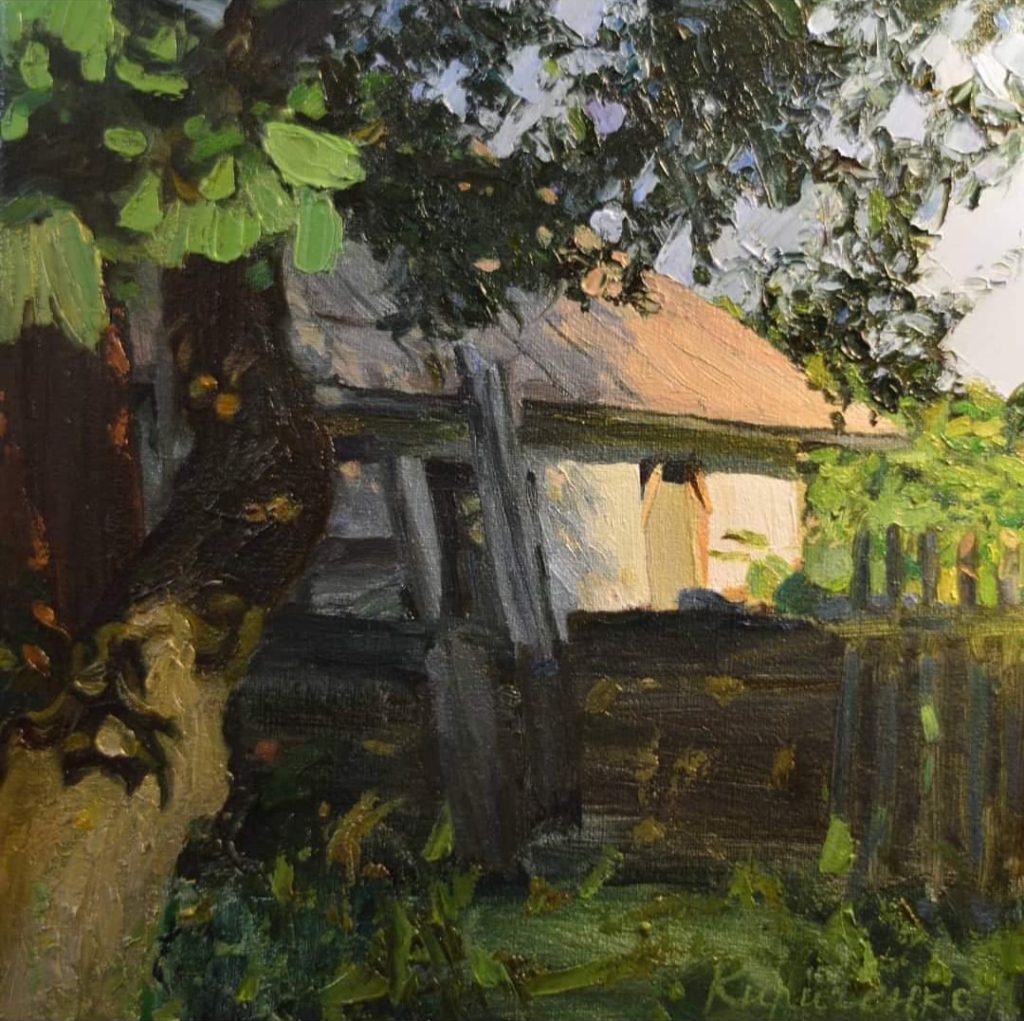
Painting by Ukranian artist, Maria Kirichinko, as mentioned in the poem
My friend, Maria Kirichenko, is an artist
Her paintings are so real
I love the way she captures the light
That falls on the side of a house
In the woods by the fields
There's a brilliance there
There's life in those paintings
She draws people too
Some smiling, some serious
She lives in Ukraine
She shares pictures of the war
Her country under siege
I worry
I worry about her, her art, her life
I worry about the life, lives around her
I message her to stay safe for that's all that I can do
I, like many others, am a silent witness
I do not want to know the nitty-gritty
Of what is politically right
Or left or centre
Politics of war are men's creation
My thoughts are from the human angle
All I care for is that my friend is happy and safe
I want the attacks to stop. Childish me.
Or are these just the normal thoughts of a woman?
Women go to war only if attacked.
Not for material needs. Not out of greed.
Not for power. Never out of ambition.
Maybe countries should be run by women
There would be less aggression
And as my thoughts go round in circles
I think of Maria Kirichenko
I think of her beautiful paintings
I think of the once pristine land of Ukraine
And hope that light dawns with the coming year
In the minds of men

Vineetha Mekkoth is a poet, writer, translator, editor and reviewer. She has translated for the Kerala Sahitya Akademi and has also contributed articles for the Malayalam Literary Survey, a quarterly brought out by the Akademi. Her poems and short stories have been included in various anthologies.

PLEASE NOTE: ARTICLES CAN ONLY BE REPRODUCED IN OTHER SITES WITH DUE ACKNOWLEDGEMENT TO BORDERLESS JOURNAL

Click here to access the Borderless anthology, Monalisa No Longer Smiles

Categories
Review

Ashoka and the Maurya Dynasty

Book review by Bhaskar Parichha

Title: Ashoka and the Maurya Dynasty: The History and Legacy of Ancient India’s Greatest Empire

 Author: Colleen Taylor Sen

Publisher: Speaking Tiger Books

In The Outline of History, H. G. Wells wrote of Ashoka: “In the history of the world, there have been thousands of kings and emperors who called themselves their highnesses, their majesties their exalted majesties and so on. They shone for a brief moment, and as quickly disappeared. But Ashoka shines and shines brightly like a bright star, even unto this day.”

Ashoka and The Maurya Dynasty: The History and Legacy of Ancient India’s Greatest Empire by Colleen Taylor Sen is a refreshingly ravishing account of the Mauryan empire. Two things stand out prominently in the book: flawless and wide-ranging. Sen has done something extraordinary in dealing with the most powerful empire in India – the amount of material she has used to write the book.

Says the blurb: “At its peak in 250 BCE the Maurya Empire was the wealthiest and largest empire in the world, extending across much of modern India, except a small area in the far south, Pakistan, and parts of Afghanistan up to the Iranian border. The Maurya capital, Pataliputra, was one of the largest cities of antiquity. India (although it was not yet called by that name) was a global power that traded and maintained peaceful diplomatic relations with its neighbors, as far afield as Greece and Egypt.”

Chicago-based, Dr. Colleen Taylor Sen is a culinary historian – having authored several books on food from across continents. A widely translated author, this book does full justice to the subject.

Says the book: “[O]f the seven or eight Maurya emperors, two are remembered today as among India’s greatest leaders: Chandragupta Maurya and his grandson Ashoka. Chandragupta, the founder of the Maurya dynasty, created his empire through both war and peaceful means. He was the first Indian leader known to have signed an international treaty (with the Greeks in the northwest). His grandson Ashoka, after conquering Kalinga in a bloody war in 261 BCE, renounced violence. He then spent the rest of his life advocating and propagating a policy of religious tolerance, kindness to all creatures, and peaceful coexistence in a multicultural society—a policy he called Dhamma.”

Sen discusses Emperor Ashoka’s life, achievements, and his legacy in her book. It also explores the legacy and influence of the Mauryas in politics throughout Southeast Asia, China, and India, as well as in contemporary popular culture. That makes the book broad-based.

An anecdotal reference to the book is in order. While searching for food histories in India, Sen found herself intrigued by Ashoka and began exploring more about him. After conquering Kalinga in a bloody war in 261 BCE, Ashoka renounced violence. He spent the rest of his life propagating religious tolerance and peaceful coexistence in a multicultural society.

In a book of about two hundred sixty adrenaline-charged pages, Sen deals with the rise, the highest point it reached, and the fall of the dynasty. She focuses on the accomplishments of Ashoka. In addition to a truthful account, she discusses Buddhist legends, the legacy of the Mauryas, and colonial South Asia. A captivating add-on tells the story of the rediscovery of the long-forgotten historical Mauryas in the 19th and 20th centuries. The intricacies of Mauryan historiography do not take her away from storytelling and she tells it rather profoundly. The result is a glowing record of one of the world’s most remarkable political eras.

The appendix to the book is as fascinating as it is inquisitive. She does a thorough analysis of how several historians unearthed the Mauryas and what led to those explorations. In her view, the post-Independent Indian historians took a ‘patriotic line’ and presented Ashoka as a ruler free of foreign influences. India’s first Prime Minister, Jawaharlal Nehru, saw in Ashoka the embodiment of a secular role. The Marxist historian, DD Kosambi, wrote that the Ashoka edicts were the first bill of rights for citizens. Then she says, despite extensive scholarship, many questions about the Mauryan empire remain unanswered. For example, what did the city of Pataliputra look like, and will it ever be excavated?

The book is a brilliant addition to the existing literature on Ashoka and the Mauryan Empire. A must-read for history professionals and general book lovers.

.

Bhaskar Parichha is a journalist and author of UnbiasedNo Strings Attached: Writings on Odisha and Biju Patnaik – A Political Biography. He lives in Bhubaneswar and writes bilingually. Besides writing for newspapers, he also reviews books on various media platforms.

PLEASE NOTE: ARTICLES CAN ONLY BE REPRODUCED IN OTHER SITES WITH DUE ACKNOWLEDGEMENT TO BORDERLESS JOURNAL

Click here to access the Borderless anthology, Monalisa No Longer Smiles

Categories
Poetry

History by Masud Khan

Translated by Professor Fakrul Alam from the Bengali poem, Itihas (History)

Masud Khan
How then can an authentic history of the world be written? The one who writes— who is he and where is he writing from? When is he writing? From which vantage point is he writing and for what reason? All these factors will decide the truth of the history. And in any case the subject itself is bound by its own conventions and is inevitably subjective.

Is it then impossible to write an authentic history of the world?

No! In the light already reflected from the surface of the world till now is impressed the history of the world— chronologically! Which is to say, the history of the world is in the light dispersed from the world. And that must be authentic version of the history of the world since it’s being written naturally. Perhaps in kingdom after kingdom of the cosmos someone or the other is sighting that history through telescopes, unknown to us all.

But will such a history be absolutely authentic? What about the chapters of history that are dark and depressing? Of episodes that have been denuded of light and have become shrouded in darkness and decadence? Of episodes that have never exuded light and will never reflect any radiance anywhere? What about them?

And what about the history of people who are dark or tan-brown?

Perhaps their evolution has become blurred in the lenses of telescopes; perhaps their histories have become obscure in the telling— since they are dark and tan-brown; perhaps because they are able to transmit only a feeble light they are deemed to be totally incapable of reflecting any light at all!

Does this mean that the history of dark and tan-brown people will remain obscure forever in the history of mankind? And in nature? Bereft of light and therefore of history too?

Masud Khan (b. 1959) is a Bengali poet and writer. He has, authored nine volumes of poetry and three volumes of prose and fiction. His poems and fictions (in translation) have appeared in journals including Asiatic, Contemporary Literary Horizon, Six Seasons Review, Kaurab, 3c World Fiction, Ragazine.cc, Nebo: A literary Journal, Last Bench, Urhalpul, Tower Journal, Muse Poetry, Word Machine, and anthologies including Language for a New Century: Contemporary Poetry from the Middle East, Asia, and Beyond (W.W. Norton & Co., NY/London); Contemporary Literary Horizon Anthology, Bucharest; Intercontinental Anthology of Poetry on Universal Peace (Global Fraternity of Poets); and Padma Meghna Jamuna: Modern Poetry from Bangladesh (Foundation of SAARC Writers and Literature, New Delhi). Two volumes of his poems have been published as translations, Poems of Masud Khan (English), Antivirus Publications, UK, and Carnival Time and Other Poems (English and Spanish), Bibliotheca Universalis, Romania.  Born and brought up in Bangladesh, Masud Khan lives in Canada and teaches at a college in Toronto.

Fakrul Alam is an academic, translator and writer from Bangladesh. He has translated works of Jibonananda Das and Rabindranath Tagore into English and is the recipient of Bangla Academy Literary Award (2012) for translation and SAARC Literary Award (2012).

PLEASE NOTE: ARTICLES CAN ONLY BE REPRODUCED IN OTHER SITES WITH DUE ACKNOWLEDGEMENT TO BORDERLESS JOURNAL

Click here to access the Borderless anthology, Monalisa No Longer Smiles

Categories
Excerpt

Anthill by Vinoy Thomas 

Title: Anthill

Author: Vinoy Thomas

Translator: Nandakumar K

Publisher: Penguin India

Diverse Marriages

The sight of his brother-in-law and his own son toiling in the teashop warmed the cockles of Prasannan’s heart. Whenever Ranjit handed over a cup of tea to anyone, they would say, ‘Oh, Prasannan’s tea was far better.’

He was gladdened not because his son caused people to compare him favourably but because the level of tea and sugar in the containers remained undiminished and one bottle of milk delivered over forty to forty-five cups of tea. Since Perumpadi was devoid of other shops at that time, the public decided to accept— with the same stoicism they accepted fate—the son’s atrocities as he followed in his father’s footsteps.

Suni excelled in tossing parottas and thinning them like cloth; wet grinding the batter to such a fine froth that dosas became gossamers; slicing the bananas paper-thin to make fritters; pouring wheat flour, baking soda and sugar mixtures from such heights that undakkaya made out of it had more air bubbles than substance. His only fault was that he had to watch at least two movies a week. That was taken care of by the complimentary pass he received for pasting the movie poster on the shop wall.

The day after the vehicle of black magic was delivered, work was started on a kuzhikalari* in a plot that belonged to Chandrappura Mani to the west of Prasannan’s land. Whirlwind Manoharan was the kalari gurukkal. There were two versions on the provenance of this nickname—some said that it was because from the time he was a child, at the least provocation he would swirl like a typhoon and hit people; others said it was because he was epileptic. Epilepsy and whirlwind share the same homonym in the vernacular.

Whirlwind Manoharan had a trait of becoming an instant admirer of practitioners of traditional skills and arts—especially the ones he could not master—and then trailing those practitioners to learn from them. Although an ardent admirer, when he started to learn the skill or art, he would pick fights with his gurus. He, therefore, ended up not mastering any of the skills.

Although he tried to learn many such skills, he gave literacy a wide berth. In his view, this world needed nothing that required one to be literate. Before he started the kuzhikalari, he was attached as a helper to a stonemason.

At the house at Koothuparamba where he was working, a kalari asan had come to do therapeutic massage for the karanavar of the house. The way he carried himself and his physique turned Manoharan into a devotee. He started to believe that whatever the asan did was superhuman. One day, after the massage, when the asan was leaving, it started to rain heavily.

‘Asan, how can you leave without an umbrella?’

‘Why do I need an umbrella? I will twirl this stick and walk,’ asan bragged for a lark.

After he said that, when he stepped into the rain, asan did open the umbrella in his hand. However, Manoharan’s mind was not willing to process that sight. All he saw was asan walking under a stick spinning overhead, without a single droplet hitting his body. The apprenticeship with the stonemason ended on the same day.

Manoharan was unable to follow the vocal syllables used by the guru for guiding his disciples’ steps and movements. Though Manoharan had suggested that he slow down the recitation, asans have their own pace of doing such things. Even the small children were stepping up to that tempo. Eventually, asan separated Manoharan from other disciples and let him set his own pace. After about six months, Manoharan made an announcement that shocked asan—he was going to start his own kalari in Perumpadi. Asan asked him, ‘Eda, do you know all the movements?’

‘Oh yeah, I learnt before joining here.’

‘Let’s hear a couple of vocal syllables of the move sequences.’ ‘Eyy, gurukkal, what do you need all these vocal syllables for?

Feet forward, feet back, bend, twist, turn   isn’t it enough to say

these? I know enough.’

‘You little prick, upon all the gods of kalari, I shall not allow you to start the kalari.’ The gurukkal was adamant.

‘Gurukkal, for Perumpadi even I am too good. Shouldn’t they all learn kalari? Shouldn’t I earn my livelihood?’

Considering that any further conversation would be possible only if he lowered his own station as a gurukkal, he said nothing further.

Since Whirlwind was the owner, there was no cutting corners. The ground was excavated and sunk by four feet; the kalari training arena was laid out as per the traditional dimensions of forty-two feet by twenty-one feet; one-and-a-half-feet high mud walls bordering the kalari were built and on that, using bamboos and coconut thatches, the superstructure six-feet high; and in the south-west corner, a seven-level poothara, a platform for the kalari deities.

A few knives, swords, ottas,* and canes were procured and placed on the poothara. These arrangements left Whirlwind’s detractors in awe, and in spite of themselves they started to call him gurukkal. The kalari normally starts during the monsoon season. However, the location being Perumpadi and the gurukkal being Manoharan, it started in April. He managed to enrol about fifteen children as disciples.

With the opening of the kalari, Prasannan started to stock gingelly oil—until then it had no demand—in large quantities. He started to offer ready credit to Manoharan gurukkal. Receiving unwonted respect, gurukkal became a regular at Prasannan’s shop.

Two months after the inauguration of the kalari, a man came to Prasannan’s shop claiming he could stick together anything that was splintered. He was carrying a glue in a spiral, wound up like aluminium wire.

When Prasannan dismissed him with ‘Sticking, my ass, as if there is nothing else to do, scram,’ Manoharan, seated on the plank drinking tea, was immediately interested in the new gimmick and said, ‘Don’t go without showing how you stick things together,’ and made the glue-man sit beside him.

That made Prasannan recall the broken cooking pot lying behind the shop. Happy that at least one loss could be redeemed, he offered, ‘I’ll give a pot to be glued.’ He went to the rear of the shop and lifted the pot. The sight of something wrapped in the torn pall shocked him. Without showing any alarm, he took the bundle, shoved it between the banana plant stem and leaf stalk, and handed over the pot to the glue-man. By that time, using charcoal, the glue man had started an ersatz furnace in a small biscuit tin.

He ground the broken edges and made them smooth and even. Using the rod heated in the ersatz furnace, he applied the aluminium coloured glue on the broken edges and stuck them together. After that, he poured water into the pot; there were no leaks, not even seepage. The man instructed them that the pot should be used on the stove only after three hours. Prasannan paid Rs 25 for a sliver of the glue—the size of a matchstick—planning to use it in future.

After five hours, Radhamani boiled water in that pot to make fish curry. As she added Malabar tamarind and stirred the pot, it started to leak like an incontinent elder onto the stove.

When the fire in the stove was extinguished, Prasannan suddenly recalled the bundle he had found under the pot. He felt no animus towards the glue-man; nor did he believe he had been duped. All he could think was that the black magic was so malevolent that not even a breach in his pot could be repaired.

The next day, Radhamani got a low-grade fever. Before taking Radhamani to the doctor, Prasannan chose to go to a karmi* in Manathana. As he struggled to undo the knots, the karmi said, ‘This is no tyro, it’s done by an expert.’

When he opened and read the palmyra leaves, he understood it was a horoscope. However, the text added by Pittankanishan foxed him. Nevertheless, in order to vindicate his previous opinion, he said, ‘It’s a malefic thing done by including a rakshass’s† horoscope in it. Remedying it will not be easy. But we are lucky that it is not impossible.’

‘Are you able to divine who did it?’

‘They don’t belong to your place. Your enemies are from outside.’

‘Could be true. I don’t have many enemies in our place.

Whatever it maybe, please get rid of the jinx.’

On the prescribed date, for hours after midnight, all the rituals and poojas were conducted. Gritting his teeth, Prasannan had loosened his purse strings.

‘You have nothing to fear any more. Not only have I nullified it, I have built a fence of protection that none can breach,’ the karmi said with overweening self-confidence.

The next day, Prasannan observed all his customers closely; apparently, the tale of the midnight exorcism rituals had not reached them. If it had, there would have been searching questions. However, after he had swept the teashop, he was stunned by a question asked and statement made by Whirlwind, who had come in for a morning tea, ‘Prasanetta, has Radhamani chechi’s fever subsided? Be careful, she could have AIDS. We don’t know what diseases people bring into the shop. She interacts with them closely, doesn’t she?’

Whirlwind had no idea what AIDS was. He thought that it spread like common cold. However, since everyone else present there knew what it was and how it was transmitted, they laughed.

‘Your mother has AIDS.’

Prasannan had regained his confidence from the knowledge that the jinx had been neutralized. That courage made him unleash a roundhouse slap on Manoharan’s face, forgetting for the nonce that he was a kalari gurukkal. Mortified, Manoharan turned and ran into the kalari.

Getting into the lotus position with much difficulty, he sat in front of the poothura for a while, pondering which weapon to use on Prasannan. Finally, he decided that it had to be the otta—not because he was an expert user, but because none of the Perumpadi residents had seen it used before. In order to give them a taste of this weapon shaped like an elephant tusk, he took it up in his hand.

As Prasannan watched Whirlwind run towards him twirling the otta overhead furiously, he felt scared. To temper his fear, he stepped out of the shop and took up a large stone. That sight scared Manoharan too.

Manoharan thought it prudent to remind him the rules of engagement, ‘Prasannetta, you should not fling stones at someone wielding the otta. You may take up an otta yourself.’ However, since Prasannan had not been trained in kalari, he was not bound by such rules.

‘Run, …, I will break your single tusk with this stone,’ said Prasannan, and aimed the stone at Manoharan’s knees. Although Manoharan tried to stop it with the otta, it did hit his leg. Manoharan did not pause for further reflection; he flung the otta towards Prasannan’s head. It hit his right leg, instead.

With the words ‘Prasannetta, didn’t I warn you not to fling stones at an otta-expert?’ Manoharan walked back to the kalari.

Prasannan, whose femur had a complete, transverse fracture, was taken to the hospital by the people who had gathered there by then. After putting the leg in the cast, the doctor informed him that he would not be able to walk for three months.

‘President, he slapped me and also flung a stone at me. Yet I did nothing. However, as a weapon with integrity, the otta did find its target. Hadn’t I warned him enough not to tangle with the otta?’ At Reformation House, standing in front of Jeremias, Manoharan mounted a spirited defence.

Nevertheless, Jeremias decreed that since Manoharan had ignited the fight by slandering Prasannan’s wife and Prasannan’s hospital expenses had stacked up to a princely sum, he should pay Prasannan some compensation. Prasannan not only rejected Manoharan’s appeal for a remission in the compensation—in consideration of his readiness to massage Prasannan’s leg, after the cast was removed, with the kalari’s traditional liniment for such injuries—but also demanded that the outstanding dues, towards teas consumed by him, be settled forthwith.

Normally, when he saw that both parties were digging in their heels or that circumstances could not be ameliorated through dialogues, Jeremias quickly wound up the mediation talks.

The Manoharan-Prasannan dispute was one such. When he was trying to think of a way to end it, Puliyelil Clara reached Reformation House. Jeremias named a figure as compensation that was mutually acceptable to the parties, asked Prasannan to give Manoharan sufficient time to pay him, and brought down the curtain on the issue.

After drinking the tea and eating the jackfruit fries that Kathrina had served, Clara presented her problem.

‘You are aware, President, that my son Robin was working in a gold jewellery shop in Kannur.’

‘Oh yeah, you said that he was paid well and all that.’

‘True, he was paid well. They cared for him too; he was well regarded. He was managing everything in the shop. They are some kind of brahmins, yet, he was invited to every function at their home. I too have been to their house a couple of times. His boss has two daughters. He has fallen in love with the older one, a college student. I swear upon the Holy Mother, I had no inkling of this. I wouldn’t allow him to marry from another religion. What to say, president, last Saturday night he turned up with that girl in tow. I asked him what kind of idiotic act he had done and scolded him harshly.

‘The girl then started to cry saying she can’t live without him. To be honest, when I saw her cry like that, I too felt bad. So, I decided to let them stay with me that night. Robin said they would sleep together. I put my foot down. After she had been baptised and they were married they could sleep together or wake up together or whatever. President, shouldn’t we abide by the Church’s dictates? The same night, I went up the valley and made the girl stay in my sister’s home there.

‘The next morning, I found her father and relatives standing in my front yard. I started to tremble with fear. My son was also nervous. However, her father only asked him where his daughter was, and nothing else. I went and fetched the girl. The moment she saw her father, she started to weep. After asking her not to cry, her father spoke to us. Everyone already knew she had eloped. She was not going to find another alliance. They were agreeable to them getting married. I said, it’s true that we are surviving because of his salary. However, that doesn’t mean I am going to let him marry out of religion. She has to accept all our sacraments and get married in the church. He said all conditions were acceptable. It’s the first wedding in the family, he said, and that they wanted it conducted with pomp in a wedding hall. And the mangalasutra ceremony could be in some nearby church. I agreed to all that.

‘Then they said, there should be some assurance from our side. At least rings should be exchanged, then and there. We had no stock of rings at home, I said. They said that was of no matter, they’d brought the rings, and that could be deducted from the dowry. A solid ring, at least one-and-a-half sovereigns, she slipped onto Robin’s finger. He slipped another one on to her finger too. After fixing a tentative date for the wedding, they went away, taking her with them. Yesterday, Monday, when Robin went for work, the manager said he should meet the owner first. He says when he met the owner, he was not the same person he was on Sunday. The man abused him roundly and threatened that if showed up again, he would file a complaint that he had stolen the ring. He’s back home and in tears. What should I do, president?’

Jeremias kept looking at Clara as he turned things over in his mind. He then spoke, while pondering over the loss Robin had suffered.

‘Clara, every man is fated to get a particular woman. That’s whom he’ll get. Now you think about it. If this marriage had happened, what would have been your state? Would she have been a help to you? Do you think she would have stayed in this place, especially in your home? Whatever you might say, whether you consider our faith, economic status, domestic circumstances, place, or culture, only alliances that are suitable for us will sustain. If you can get Robin to meet me, I shall try to talk to him. Money, prestige, nothing matters; compatibility is the foundation of family life. We shall find such a girl for him.’

As he was ending his words, Jeremias’s mind was filled with another thought. Robin and his son Arun were of the same age. Now he too was of marriageable age; Jeremias had not been thinking of it only because Arun was away. Kathrina was concerned; she used to voice it occasionally.

‘Son, you should take care. You care for the people here; but no one will be there for you. Ours is a truncated family. A cursed family, as your father used to say. It’s been said that it will affect seven generations. We can only pray that nothing of that sort happens. However, you need to take care of Arun. He is living alone, far away from all of us, in an alien land. He has not seen a settled, happy family life. All my prayers to God are for him to have a happy family life.’

Only when his mother used to say such things would Jeremias think of his son. Was there really the curse that his father used to talk about? If indeed it were there, would prayers alone nullify it? Living as a family unit has to be learnt from doing so. Arun never had the opportunity. He should not have been sent away for his studies. Nevertheless, Jeremias could not have insisted that Arun should spend his life in this accursed Perumpadi like his previous generations. Jeremias was aware that he himself did not have an ideal family life to exemplify for Arun’s benefit. There was no point in agonizing over it. If it was in his fate to be married, he would find a bride too, as any other young man.

While returning after discussing the case of Charapadam Monichan’s daughter, Jeremias told Velu what had occurred to him, ‘Velu, kalyanam, that is wedding, means good or happy times. But, is it really that way? What have we seen in the majority of the houses in Perumpadi—complaints, disunity, tears, laments and suffering, right? If we search for the root cause, in most cases, we end up at incompatible marriages. Did Monichanchettan really have to get his mentally disturbed daughter married?’

Mental illness ran in the Charapadam family. It made finding her a suitable alliance difficult. Monichan tried his best to get her into a convent. However, the nuns in charge rejected her candidacy when they came to know of her mental illness. At that time, a proposal came from a family in Edathotty who had recently migrated to Malabar. No one knew of their provenance. Not that the Charapadam family were keen to find out about their roots.

The wedding did go through. On the first night, the girl bit off the groom’s ear. The issue eventually reached Jeremias. During the compromise talks, Jeremias said, ‘Return the gold and the almirah that you had received as dowry and drop her back home. And file a divorce petition.’

This statement put the boy’s parish priest’s back up. ‘How can that be? Whom God has joined, let no man put asunder. You should let the girl live with you. We can send her for some divine retreat. We have now retreat centres that cure things worse than this.’

After she returned from the retreat, the next organ that she chose to chew up was dearer and more useful to the husband than his ear. When the boy’s party reached Monichan’s house, Monichan told Jeremias, ‘I shall handle this now, president. You had given him a way out, hadn’t you?’

Jeremias remained silent. Taking his silence for acquiescence, Monichan filed a case against the boy, his sister and his father, alleging sexual assault. The complaint stated that the boy had affairs with other women and had attempted to murder Monichan’s daughter so that he could marry another woman. The police arrested the whole family and bundled them into the lock-up.

On that occasion, the vicar said, ‘That is not God’s law; it’s the land’s law. Render to Caesar the things that are Caesar’s, and to God the things that are God’s.’

As soon as the boy’s family was released from the jail, at the first opportunity, they sold their property in Edathotty and left for some unknown destination.

‘We call that most disastrous event of that boy’s life also kalyanam. God’s laws and man’s laws are together screwing our lives.’ Jeremias concluded the topic he had opened with Velu.

Months later, an example substantiating Jeremias’s view that marriages happen unplanned did show up in Perumpadi. Following Prasannan’s leg fracture, Suni had assumed part control of the teashop. That pleased Ranjit too. Prasannan had said he would maintain the cashbox. However, insisting that his brother-in-law should take complete rest, Suni arranged all amenities for him in the bedroom behind the teashop. Every evening he showed him the account books too.

‘He’s smart. He’ll manage everything well.’ Radhamani gave her testimonial on behalf of her brother. Suni started the practice of closing the shop on Sunday afternoons. Every Sunday, as soon as they closed the shop, Ranjit and Suni headed for the movie theatre. They would return late in the night. One Sunday, they left for the movies and were not back even the next morning. Radhamani had to open the shop and serve tea. Prasannan let out a string of invectives and, aided by a stick, limped his way to the table that served as the cash counter. In the afternoon, Suni and Ranjit arrived in a taxi. A girl was with them.

‘Aiyyo, isn’t this Appam Mary’s daughter?’ The words of a customer seated inside the shop could be heard outside.

‘Yes, it is, sonny, do you have any doubts?’ the girl turned on him.

‘A slight one. That’s now removed.’ He retreated.

‘What’s all this shouting in front of the shop?’ Leaning on the stick, as soon as Prasannan stood up with these words, the girl bowed down towards his broken leg saying, ‘Acha, bless me.’

‘You misbegotten…, what is all this?’ Prasannan directed his query at his son.

‘Father, I was suckered.’

Those few words from an overwrought Ranjit were the précis of the story that spread through Perumpadi thereafter. After the advent of Suni at the shop, uncle and son used to sleep on the same mat, and uncle used to narrate titillating stories to his nephew to put him to sleep.

Stories such as squeezing lemon juice over a woman’s private parts to check if she had sexually transmitted disease when she was his and his friends’ co-passenger on a truck on their hitchhiking trip to Bangalore; gifting a piece of jaggery to suck on and a children’s magazine to read to seduce young girls in the slums; during visits to a relative’s house in the Wayanad hills, since the neighbourhood’s only wet-grinding stone was in that home, how he took the friendly neighbourhood women who were using the grinding stone from behind, and with his rhythmic thrusts helped them grind everything to a fine paste. Inspired by those stories, Ranjit requested for an opportunity to be the character in such a story so that he could gloat among his friends. Suni said that if there was money such stories wrote themselves.

All Ranjit had to do was dip his sticky fingers in the shop’s cash-box. The rest—finding the girl, vehicle, place, everything— fell on Suni. Every Sunday their purported visits to the cinema were to create stories for Ranjit to narrate in his old age.

Suni was late in realizing that Appam Mary’s daughter, Preetha, had started earning independently. In Suni’s opinion, it was all for the good, for in the initial days her rates would be sky-high. That Sunday with her in the car, they had used the Periya Pass to enter Wayanad. At the twenty-eighth milestone, they were stopped for a police check.

‘They’re my nephew and niece. We are going to Thirunelli temple to worship.’

Preetha, seated in the rear of the car with Ranjit, did some quick thinking. She had started to hate her present life. She thought of her mother, who with no one to help her, was forced to push her too into the profession. Why should she not have a family life? To have that one needs to marry a loaded guy. In her present circumstances, that was a distant dream. This was a do-or- die situation, where the right decision could make her life.

‘Sir, that’s not true. Ranjitettan took me from my home promising to marry me. I came because he assured me this uncle seated in front too was aware of it. We are Christians, sir. I won’t be allowed into my home now.’

‘Aiyyo, I never promised to marry her, sir,’ Ranjit blurted out. ‘Then what did you promise to do, man?’ the policeman pulled open the door and demanded.

The police accompanied them to Thirunelli. The brilliant idea that there was no need to inform his folks and that later they could get rid of her by offering her some money was that of Suni. With his uncle as witness, Ranjit signed an undertaking in the police station that he would marry Preetha and take care of her. The police, on their part, gave their word to Preetha that if it did not happen, they would file charges against Ranjit for sexual harassment.

After mouthing a volley of the choicest abuses at his daughter- in-law prostrated now at his feet, Prasannan hobbled into his house. When he pondered over it at leisure, he realized no one among them was to be blamed for all that had happened. It was the black magic at its malevolent best. Who is a more powerful shaman than the one in Manathana? Or perhaps, what was happening in his family was beyond the powers of any shaman.

The next morning, Prasannan woke up at 3 a.m., as was his wont. Everyone else was asleep. Leaning on the stick, he walked around the shop that his father had started and he himself had nurtured without rest for four decades.

From an open sack, rice grains were on the verge of falling down. He rolled up the hem of the sack and turned it into a ridge to hedge in the grains. He picked up a potato that had rolled off another sack and put it back. He selected chillies that had started to rot and threw them into the bin meant for cattle feed. He closed firmly the sliding door of the almirah in which savouries were kept. He looked towards the room in which his son and his bride were sleeping. He then went out and started to walk as fast as his broken leg could carry him to a destination he himself did not know.

About the Book

Anthill centres around the people of Perumpadi, a remote village that has hidden itself from the world. Bounded by dense Kodagu forests on the south and west, and rivers on the north and east, and situated at the border between Kerala and Karnataka, Perumpadi’s very isolation attracted varied settlers from south Kerala over the years. The first settler on this land, Kunjuvarkey, was fleeing the opprobrium of getting his own daughter pregnant. Those who followed had similar shameful secrets. In a land of sinners, where no one pried into the other’s past, they were able to live and build a community without being tied down by society’s interdictions. Anthill, the exquisite translation of the Kerala Sahitya Akademi-winning novel Puttu, tells the story of a people who have tried to shed the shackles of family, religion and other restraining institutions, but eventually also struggle to conform to the needs of a cultured society. .

About the Author and Translator

Vinoy Thomas hails from Nellikkampoyil, Iritty, in north Kerala. A school teacher by profession, he is one of the most promising young writers in Malayalam. His short story collections include Ramachi, Mullaranjanam and Adiyormisiha Enna Novel. His maiden novel, Karikkottakkary (English translation soon to be published by Penguin Random House), was selected as one of the best five novels in the DC Books competition. His second novel, Puttu (Anthill), won the Kerala Sahitya Akademi award for the Best Malayalam Novel of 2021. In 2019, Ramachi had won the same award for short stories. Vinoy has also authored a children’s book, Anatham Piriyatham. His short stories have been made into movies. He is also a gifted scriptwriter and has to his credit a few acclaimed movies.

Nandakumar K is a Dubai based translator.His co-translation of M. Mukundan’s  Delhi Ghadaka(Delhi: A Soliloquy) won the 2021 JCB Prize for literature. His other translations include A Thousand Cuts, the autobiography of T.J. Joseph, which won the Kerala Sahitya Akademi Award; The Lesbian Cow and other Stories by Indu Menon; and In the Name of the Lord, the autobiography of  Sr Lucy Kalapura. Nandakumar is the grandson of Mahakavi Vallathol Narayana Menon.

* Where kalaripayattu, Kerala’s martial arts, is taught in the traditional manner.

* A thick, curved truncheon made of wood used in kalaripayattu.

* Shaman.

† A rakshass (short for Brahmarakshass) is an evil spirit that is born when a brahmin is murdered.

PLEASE NOTE: ARTICLES CAN ONLY BE REPRODUCED IN OTHER SITES WITH DUE ACKNOWLEDGEMENT TO BORDERLESS JOURNAL. 

Click here to access the Borderless anthology, Monalisa No Longer Smiles
Categories
Poetry

In the Coldest Desert

By Swati Mazta

Waking up at dawn, raise the curtains,
Gaze at the snow-capped mountains
From the Arctic room window.
It seems a true treat for your eyes and your soul.
 
Scan the mountain through plastic-insulated windows
For Himalayan brown bears, snow leopards or ibex goats.
May luck be with you next time!
Till then, enjoy your love with fur on four paws.
 
Relish lip-smacking hot black coffee
In a beautiful ceramic blue cup!
Munch on some coconut cookies
All the time, think of the glee club.
 
Hear the chirping of pigeons and magpies.
As the breeze flows, the wind chimes tinkle.
It feels pretty comfortable and soothing,
Like someone pouring honey into the ears.
 
As the day begins,
Flush the body of toxins,
Dry clean your body with warm water-soaked muslin
Apply a little oil massage to rejuvenate your skin.
 
Put on insulated, comfortable clothing --
A woollen cap, socks, fur boots.
Keep yourself warm on this day --
A new day, a new beginning.
 
Let go of tomorrow...
Today is your day to shine.
Oh, my dear, the little things keep you going.
These little longings are tinkling!

Swati Mazta is an Assistant Professor in the department of English at the University of Ladakh, Kargil Campus, Khumbathang, Kargil, UT Ladakh, India.

PLEASE NOTE: ARTICLES CAN ONLY BE REPRODUCED IN OTHER SITES WITH DUE ACKNOWLEDGEMENT TO BORDERLESS JOURNAL

Click here to access the Borderless anthology, Monalisa No Longer Smiles

Categories
Nostalgia

The Roy Senguptas

Ratnottama Sengupta continues her narrative about her family’s journey from the past to the present

Bengal Volunteers with young Netaji Subhash Chandra Bose, where young Kshiti Prasanna Sengupta volunteered. Photo sourced by Ratnottama Sengupta

Upendra Mohan Roy opened the telegram and stood still. He was on his way to London, to study at the Royal College of Art. But could he leave knowing that his mother was on her deathbed? No question. He turned around and returned from Bombay to Cachar in Assam, then East Bengal. Only to see that his mother, hale and hearty, had fixed his marriage! 

Angry and dejected, he stormed out of home and headed for the tea gardens where his father worked. Soon he set up a ‘business’ there. He would go from one tea estate to another with a hand operated projector and a generator in an ‘Army reject’ jeep and show silent films on  a makeshift screen in these remote pockets of India. That was the beginning of his life as an exhibitor which culminated in his setting up a cinema hall, Annapurna, in Silchar after the movies started speaking… This was one of the many businesses he eventually set up, in Tinsukia, Dibrugarh and Margarita. The prime of his ventures was in manufacturing — armatures and generators — and it led to setting up Surama Electrical Store in Silchar.

Labanya, the young lady his mother had chosen to be his wife, was a homemaker. As per the custom of the times, she channelised her spare hours in stitching clothes for the children, in knitting and embroidering. But far more importantly, she excelled at cooking. Not only the homely ‘Bangal’ cuisine of labda[1] and maricher jhol[2] but also pulau and chop, cutlets and kebabs – the latter pretty fancy, and even forbidden dishes in most Bengali kitchens of her times. That is probably how Minoo/ Aparna, the youngest born after the daughters Amiya Bala, Renu Bala, Smriti Kana and son Birendra Mohan, developed her culinary skills. But more of that later…

*

Upen Roy’s enterprise was probably not unique: the Baidyas of Bengal are known for their business acumen. But Satish Chandra Sengupta of Gaopara village in Dhaka Bikrampur district was the copy book Baidya: He was a country doctor who carried on the family trade of administering ayurvedic medicine to the ailing villagers. His son Kshiti Prasanna was just four and Rama, the baby daughter, was barely born when his first wife died. So the two siblings were sent to the care of his eldest brother Ambika Prasanna, a hugely successful lawyer practising in Midnapore.

This is where Kshiti grew up, going to school and tending to the needs of the large extended joint family that made up the household. The members included not only Ambika Prasanna’s sons Guru Prasanna, Satya Prasanna, Jyoti Prasanna and daughter Shanti — there were also those of his other brothers. Among them was Kusum Rani, who was married to Jyotish Chandra Gupta, whose brother Dinesh Gupta had to seek home with them when he had to flee Dhaka after he participated in an action against the British authorities. 

This is how Kshiti came to join Bengal Volunteers, the revolutionary group that took action — with the blessings of Netaji Subhas Chandra Bose — against three successive British District Magistrates: ICS James Peddy in 1931, ICS Robert Douglas 1932, and ICS Bernard Burge in 1933. Consequently, a few day after his Matriculation exams, Kshiti was arrested and forced to live in incarceration for 13 years 8 months — going from Hijlee to Buxar to Alipore Central Jail and more. But he put the years to gainful use and completed his IA, BA, MA and M.Com exams creditably. That is why, when he was set free as India prepared for its immanent independence from the British yoke, he could join Ashutosh College as a Professor of Economics.

*

Kshiti Prasanna with his wife, Aparna

By then Kshiti Prasanna was 31 years old, which was considered pretty old to marry in 1948. But he was adamant: he would not marry anyone younger to him by more than 10 years. So the matchmaker advised Upen Roy to present his darling daughter Aparna as 21 years of age,  when in reality she was only 18! Thankfully the subterfuge did not come in  the way of their happiness together. Nor did the fact that Kshiti took responsibility of getting his step sisters — Bharati, Putul, Madhabi and Golapi — married and support his successive brothers Shankar, Bhaskar, Runu, Haru, Naru — until they settled in jobs. For, the only thing Aparna made her husband promise was that he should get the best of education for their son Debasis and best of life for Bubun, their darling daughter Madhumanti…

This was after his heart too, for if there was anything Kshiti Prasanna regretted in life, it was that he himself could not go for a Ph D as guides were not allowed inside jails. So he ensured his son got the best of schooling at St Xavier’s School; the best of higher education at IIT Kharagpur, and then proceeded for his doctorate to Texas, at the A&M University, USA. “My nameplate reads ‘Adhyapak Kshiti Prasanna Sengupta,’ yours will read ‘Dr Debasis Sengupta,'” he dreamt. 

The father’s dream came true in 1977 when his Bappa completed his Doctor of Engineering in Biotechnology. Only,  KPS saw his convocation from the Heavens…

From that perch, he also saw his daughter – a consummate Odissi dancer – complete her graduation in Economics, take to the then new subject of Computer Science, finish a course in Law, peak in a corporate career, then retire to write the story of his stormy years with the Bengal Volunteers…

Aparna with Debasis

[1] A vegetables

[2] Fish curry

Ratnottama Sengupta, formerly Arts Editor of The Times of India, teaches mass communication and film appreciation, curates film festivals and art exhibitions, and translates and write books. She has been a member of CBFC, served on the National Film Awards jury and has herself won a National Award. 

.

PLEASE NOTE: ARTICLES CAN ONLY BE REPRODUCED IN OTHER SITES WITH DUE ACKNOWLEDGEMENT TO BORDERLESS JOURNAL

Click here to access the Borderless anthology, Monalisa No Longer Smiles

Categories
Poetry

Poetry by Chad Norman

Chad Norman
PRIVILEGE IN TWO MOMENTS

1
To witness
the end of
so many
leaves' lives.

2

Along with
notification
being a tap
on the shoulder
from just one
with a farewell.

THE MORNING ACTIVIST
(In honour of the mothers in Ukraine)

Peace is
a female cardinal
eating snow
left by high-winds
between the needles
of a back-yard fir.

Chad Norman lives and writes in Truro, Nova Scotia. In 1992, he was awarded the Gwendolyn MacEwen Memorial Award For Poetry. The judges were Margaret Atwood, Barry Callaghan, and Al Purdy. His poems appear in journals, magazines, anthologies around the world. A new book, A Matter Of Inclusion is out now.

PLEASE NOTE: ARTICLES CAN ONLY BE REPRODUCED IN OTHER SITES WITH DUE ACKNOWLEDGEMENT TO BORDERLESS JOURNAL. 

Click here to access the Borderless anthology, Monalisa No Longer Smiles

Categories
Stories

Between Light and Darkness

By Sreelekha Chatterjee

The atmosphere was stiflingly hot. A sense of infinite void prevailed amongst impenetrable darkness; its strange tranquillity was disturbed by a sudden intrusion of a speeding car’s headlight. I was blindfolded, struggling hard to keep my eyes open. The deafening sound of the accelerating engine kept increasing as the car drew nearer and nearer, escalating my wild heartbeat and an uninviting dread. There was no escape. I needed to react, but my limbs wouldn’t move; a sense of fatality gripped me as my reflexes resigned. An instant of acute tension and then there was quiet. I opened my eyes to the brilliance of the table lamp spreading over my desk. It was the usual vision—which kept haunting me for the past six months—all over again while at work.

I concentrated on the sheets of papers that lay before me. The edits marked on them seemed like worms wriggling about. My nerves were screaming in my head. I looked up. The chairs of the office hall were empty. It was always the same every single day. The whole day I would dig my head into work partly due to the necessity to cope with the work pressure and partly to hide my embarrassment. I only looked up when everyone left. After hours was the time for me to finish any pending work along with my search.

It all started about six months ago when the only copy of the manuscript of a book being edited by me had disappeared from my desk—lost forever and never to be found. I couldn’t forget the harsh words that my supervisor uttered for me, questioning my loyalty and emphasising on how irresponsible I’d been. The edited papers vanished a day before it had to be sent for typesetting. Being a fast-track project, the book had to be published within a month’s time. It wasn’t a feasible proposition for me to re-edit the entire book within a day’s time. To save our publishing firm’s reputation, the work was outsourced to freelance editors on urgent basis so that we could still be on track.

Who had stolen it from my table? What was the motive for the theft? During the past six months I had searched every table, every drawer, every cupboard, except the ones that were in our senior managers’ cabins on the first floor, but the manuscript was nowhere to be found. It could be possible that the culprit had removed the manuscript from office. Wearied and assailed by hopelessness of my never-ending search, I surveyed the semi-dark hall. My eyes stuck at the glow of light coming from the farthest corner. I checked my watch. It was almost 8 o’clock. Who could be there at this time? I felt my hair rise with alarm. Someone was working late or spying on me.

On reaching the end of the hall, I found a young lady with spectacles concentrating on something that was open on her computer. I felt a pang of anger, a sting of possessiveness on seeing her use my computer. But I had stopped working on it for the past six months and had no reason to entertain jealousy. After the manuscript theft, there was a significant change in my job pattern, and I had been assigned the role of quality checking instead of editing. I had myself volunteered for that, as I was losing my eyesight due to long work hours without any break in front of the computer—an unacceptable professional hazard in late-twenties.

I leaned forward, peering closely at her file that was displayed on the computer. I coughed aloud but she didn’t stir a bit, oblivious of my presence. She seemed to be unusually engrossed in chatting with a friend on a social networking site open on her system.

Perhaps she was a new employee as I hadn’t seen her before. She seemed to ignore me. Being reticent by nature, I didn’t have the courage to ask her name or to initiate a conversation. Just as I turned to go away, her mobile rang.

“I’m working late… nothing urgent, just needed to impress my boss…after all the appraisal time is drawing near…” I heard snippets of a brief conversation before she hung up.  

There was some movement outside and a human shadow appeared on the frosted glass door. I quickly concealed myself behind a nearby table, as I didn’t want anybody to know that I was there. Someone moved inside. As the light from the computer lit the man, I could recognise him. It was the security guard.

“Will you be late, ma’am?”

“Ah…probably by an hour or so.”

“In that case, inform the duty officer at the watch room as I’ll be leaving now.”

“Okay.”

He sauntered away and the lady once again concentrated on the computer.

Those who worked till late hours had to enter their names in the register at the watch room outside office. I could go and check her name there. I followed the security guard outside. The night watchman was already there. While the two men were chatting, I quickly turned the pages of the register and to my utter disbelief, no name had been entered. Had the rules changed?

As I was going inside, I found the security guard loading something in his car.

“You might get caught.” I heard the night watchman say.

“Don’t worry. Nobody cares to notice what happens to an old computer.”

Bewildered at the contrast between their outward pretension of duty-bound appearance and the reality, I moved inside the office. I needed to get away from the web of bitterness and keep focused. As I approached the coffeemaker which lay at a distance, the machine started automatically all of a sudden startling me. I found a cup placed near the pipe from which coffee poured out. Suddenly the lady whom I had seen earlier came from nowhere. I heard the sound of the printer working somewhere. The lady turned towards me, shook violently with a start as she huddled together. She shot a terrifying glance at me and then averted her eyes as if I didn’t exist. Some people exhibited arrogance to an extent that was disgusting.

I walked unmindfully and reached the printer. Pages were coming out like a fountain, flying in all directions. Some of the pages fell on the floor and the rest inside the wastepaper bin that was kept beside the printer. I bent down to pick up the papers when the lady reappeared. The very thought that the lady was following me everywhere scared me. A few days ago, I heard people saying that our office was haunted, and the mysterious lady triggered my suspicion about her possible supernatural connection.

*

I strolled randomly from one desk to another. Something inside me felt strongly that the stolen manuscript was somewhere in the office, and I had to look for it. But the lady in the office was a big hindrance to my mission. I tampered with the main telephone operating box, removing all the cables. I checked the phones kept at the reception—all of them were dead. Next, I locked the hall door from outside to make sure that the lady couldn’t come out. I’d already stolen her mobile phone from her desk. Satisfied with the initial execution of my plan, I went tiptoed to the first floor.  

The entire office seemed like a graveyard of computers. It felt as if I was walking on a dark, lonely road faintly lit by streetlights. Suddenly a car came from nowhere, its dazzling headlights blinding my eyesight, my ability to search. A momentary loud explosion followed by suffocating silence. I opened my eyes to the stillness of the dark office corridor where I had ventured to find a closure to my search. A strange numbness overpowered me, and I feared betraying the purpose of my visit. I had to continue with my search even if it went on forever. Although aware of the consequences if I got caught while checking the senior managers’ cabins, I couldn’t rest until and unless I figured out what was haunting me.

As I collected myself and groped my way through the impenetrable darkness of the corridor, I heard footsteps coming from behind accompanied by a faint, persistent knock on the floor, perhaps with a stick. Was it the night watchman? What if it was the CEO? I heard on innumerable occasions that the CEO visited our office late at night to work on important projects. I had hardly seen the middle-aged guy once or twice during my 6-year-long service and vaguely remembered his face. To my surprise, I found myself outside his cabin door. A faint suspicion about his involvement in the theft lurked in my mind. My body trembled with nervous agitation and the burden of wrong doings as I tried the door handle.

It opened. The large, spacious room had a single closed window with blinds raised, allowing a faint light to penetrate from outside. I switched on the lady’s mobile torch to discern my way as I progressed from one cupboard to another. A subconscious uneasiness loomed as I checked all the drawers except one which was locked. I looked for the keys and found a bunch of them in a side table drawer. In spite of all my efforts, none of them worked. Suddenly, I recalled having seen a key inside one of the drawers of the computer table placed at the centre of the room. I went back to fetch it. The drawer opened as I turned the key which fitted perfectly. A foul smell of old papers wafted in the air. I checked the papers inside but none of them were related to the manuscript.

After locking the drawer, I was about to leave, relieved of the guilt that I had wrongly accused a respectable man, when slow footsteps were audible outside the room. I hid behind the computer table and waited with bated breath. The shadow of a man fell on the floor near the open door. It seemed to be that of a tall man. My faint recollections hinted that our CEO was a tall man. Was it him? The shadow gradually became elongated and moved towards the wall indicating that he was walking away. Perhaps there were dead souls other than me looking for something or the other—our missions were different but our search had become closely intertwined. Suddenly the shadow stopped as if it had become a statue and the sound of footsteps ceased. I glanced at the glass window visible from my hiding place. The sky seemed to brighten up with a faint glow of light trickling down. My search had to be stalled, as there wasn’t much time to look into other senior managers’ cabins. I had to leave before the next security guard came in at 4 o’clock in the morning.      

I heard footsteps all of a sudden and this time those were quick and faster than before. I could hardly comprehend further, as a tall fellow with scarcely perceptible features and hunched back entered hurriedly. Positioning a torch with his right hand and a file beneath his left elbow, he cautiously unlocked the same cupboard drawer which I had opened earlier. He slid a file and locked it. In the middle of the room near the computer table, he paused to respond to a phone that vibrated in his pocket. He answered it while turning his back towards the door. It was the perfect instance when I could easily slip out of the door. Endeavouring to leave, I crawled up to the door but my curiosity about the hidden object in the drawer got the better of me. I couldn’t afford to get caught, and the dull blue sky outside was brightening up bit by bit.

“Yes. I’ve removed the manuscript. Now they’ll have no other option but to give it to the freelancers.” His words drew my attention while I shifted behind the open door.

He kept quiet for a while as if listening to the person at the other end and then blurted out angrily, “Yes, yes, have faith in me.”

“Do remember my commission.” He disconnected the phone and turned towards the side where I was hiding. Heedless of the fear that paralysed my faculties, I looked up to find that he was staring at me—his eyes gleaming with unearthly lustre, focused on mine; his expression changing from triumph to that of horror. A few seconds elapsed before he stooped to pick up something from the floor.

Was there a chance of survival? Did he see me? Random thoughts kept crowding in my head. Realising the need for instant action, I attempted to plan out my next move. I wished that he left the room without seeing me. I observed him carefully as he walked towards the door. I knew that time was running out but suppressed the urge to check my watch. I took a deep breath and started counting in reverse under my breath. “Ten, nine, eight, seven…” I closed my eyes and after what seemed like a second. When I looked up, there was nobody around. Was it a dream that I was witnessing all the while? I had actually seen the man enter the room…

I walked up to the drawer where the man had concealed something. I unlocked the drawer once again but couldn’t open as it had got stuck. On pulling the drawer with all my strength, it came off, throwing me off my balance, I fell with arms flailing wildly and landed on the ground with it. As I dusted myself, I found my lost manuscript lying among the heap of papers that had fallen off the drawer. I didn’t experience any pleasure on finding my culprit at last. Nauseated by an oppressed dread mingled with disgust, I decided to quit that life and moving out.

I managed to reach the front door where I observed the CEO, the lady and the security guard talking amongst themselves.

“How come you were in office the entire night?” CEO asked the lady.

“Someone had locked me from outside. The whole evening, I experienced such weird things. My phone was stolen, and I couldn’t contact anybody outside as the landline wasn’t working.”

“Is this your mobile phone?” CEO asked while taking out something from his pocket.

“Yes! Where did you find it?”

“In my cabin… why did you go there?”

“I swear! I’ve never been to your cabin…”

The security guard interrupted with an impatient eye roll, “This place is haunted. Strange things have been happening ever since the senior editor’s accident…”

I sensed freedom as the truth finally unfolded before me. I walked past the trio while they were trying to figure out a logical explanation to what had happened with them. I knew that they wouldn’t notice me anymore, after all I didn’t belong to their world.

.

Sreelekha Chatterjee lives in New Delhi. Her short stories have been published in various national, international magazines, journals, and have been included in numerous print and online anthologies.

PLEASE NOTE: ARTICLES CAN ONLY BE REPRODUCED IN OTHER SITES WITH DUE ACKNOWLEDGEMENT TO BORDERLESS JOURNAL

Click here to access the Borderless anthology, Monalisa No Longer Smiles
Categories
Poetry

‘Dreams are Like Stars’

Poetry by Mitra Samal

GLOW OF DARKNESS

Dreams are like stars, each one
has them on their share of the sky
Glistening and in its light
spreading an ocean of hope
They come only in the shades
of the night and in the shadow
of our thoughts
In a state that isn’t real but
has a tiny connection with
the dimensions of life
It twinkles its way into a path
that lies hidden from the conscious
mind, only to show the possibilities
shielded by the blinding light
The glaze of aristocracy 
doesn’t shine on a plebeian
An unknown path is where all 
the known paths must lead
It is what the open eyes always
fail to comprehend
The eternal glow of darkness
waiting to be discovered 


CANDLE

It’s a candle fighting against
the darkness, for the ill-fated
electric bulb that failed to glow
It’s a candle that burns every
atom in it for the mood lifting
aroma and the flicker of light
It isn’t enough to keep you warm
in the chill of winter but
glows enough to ignite your mind
in the haunting absence of light
A candle that dies with the night
Giving way to more candles that
must keep burning till the breaking
dawn, for the moon isn’t enough
and the light bulb isn’t reliable
A candle that is rumoured to
raise the dead from their grave
I write with the glowing candle
in the faint moonlight
I pray with the candle to
strengthen my devotion
A candle that made a pledge to
sacrifice till the last whit of its life

Mitra Samal writes poems and stories or memoirs. Her recent poetry book called Beginning was published in 2018. Her poems have been published in Poetry Society India, Muse India, Borderless Journal, Madras Courier, Setu, The Punch Magazine, Dissident Voice and FemAsia among others.

PLEASE NOTE: ARTICLES CAN ONLY BE REPRODUCED IN OTHER SITES WITH DUE ACKNOWLEDGEMENT TO BORDERLESS JOURNAL

Click here to access the Borderless anthology, Monalisa No Longer Smiles