Here is my son, as a toddler, an ice cream cone in one hand, the other signing “peace.” Here is my daughter at five, posing in front of the Inland Sea, two fingers held up in the air. Here is my son, aged ten, sitting on a park bench in Charleston, South Carolina. Peace!
From pretty much the time that my Japanese-born children learned to say “cheese,” whenever they’ve found themselves in the presence of a camera, they stuck up two fingers in a “V.” Pick up any family photo from our children’s first ten years, and you’ll find someone making this gesture.
It drove my American parents crazy. “Be natural,” they’d say. “Don’t do that!” Candid shots were nearly impossible because as soon as my kids realised they were about to be photographed, those two fingers went up in the air.
My children were not exceptions, of course. I first noticed this practice when I arrived in Japan over thirty years ago. I have a drawer full of photos of myself and various Japanese kids making the sign. Me, I sometimes did it ironically. For Japanese youth, it seemed to be a Pavlovian response.
It hadn’t always been this way. An older Japanese woman friend told me that when she was a child, no one made a “V” when having their picture taken. She lamented that her own children had picked up the same habit, that her daughter signed “peace” even in her wedding photos. When I asked her how it all got started, she couldn’t tell me. However, theories abound.
According to one source, the trend originated in a baseball manga. A character made the “V” for Victory sign in imitation of Winston Churchill. The gesture caught on, and remains.
One of my foreign friends, hoping to break her kids of the tendency, refused to take their picture if they were making the sign. I was not quite so strict. The peace sign may, in fact, be the Japanese equivalent of the smile. In the United States, whenever someone has their picture taken, the photographer tries to get a grin out of them. I’m sure that many of us have faked a smile in order to comply with custom. I certainly have.
Here in Japan, however, smiling for the camera is relatively new. Back in the day, only the very vulgar would show their teeth. In school and other formal photos, gravitas is seemingly required. Thus, in the group portrait taken at my own wedding, the Japanese guests wear poker faces, better suited to a court date. My American relatives are all smiles, though their posed grins may be frozen in place. No one, I might add, is making the peace sign. My husband and I got married in Hawaii, so everyone’s hands are raised with pinkie and thumb extended, a gesture that means “hang loose” in the islands. Shaka shaka.
These days, thanks to the influence of K-pop artists in Japan, people posing for photos are likely to use another gesture. At a recent party celebrating graduating students at the university where I teach, we all got into formation.
“What should we do?” one professor asked. “Peace signs?”
“How about K-pop hearts?” I suggested. The others agreed. We touched our thumbs and index fingers, forming hearts. The picture was taken.
Suzanne Kamatawas born and raised in Grand Haven, Michigan. She now lives in Japan with her husband and two children. Her short stories, essays, articles and book reviews have appeared in over 100 publications. Her work has been nominated for the Pushcart Prize five times, and received a Special Mention in 2006. She is also a two-time winner of the All Nippon Airways/Wingspan Fiction Contest, winner of the Paris Book Festival, and winner of a SCBWI Magazine Merit Award.
PLEASE NOTE: ARTICLES CAN ONLY BE REPRODUCED IN OTHER SITES WITH DUE ACKNOWLEDGEMENT TO BORDERLESS JOURNAL
They delight through their insistence Like some ill found friend, Who doesn’t know lines drawn, Keeping deeper knowing at bay.
These spastic breaths do worry Many, whose heartbeats are dire, Torn between duty and desire Lingering in-between in sadness.
Thus, do I thrust through my days, Keeping both vigil and dreams, Determined to preserve sanctity Of faith and resilience and Truth.
Someday, it’ll all make sense Especially to those who keep mum Fearing repercussions, hiding away Guilt and shame and sorrow.
Such intimate knowing is rare A precious gift to those chosen To know and bear the cross Burying in their end the Truth.
Kirpal Singh is a poet and a literary critic from Singapore. An internationally recognised scholar, Singh has won research awards and grants from local and foreign universities. He was one of the founding members of the Centre for Research in New Literatures, Flinders University, Australia in 1977; the first Asian director for the Commonwealth Writers’ Prize in 1993 and 1994, and chairman of the Singapore Writers’ Festival in the 1990s. He retired the Director of the Wee Kim Wee Centre.
PLEASE NOTE: ARTICLES CAN ONLY BE REPRODUCED IN OTHER SITES WITH DUE ACKNOWLEDGEMENT TO BORDERLESS JOURNAL
The studio room was ill ventilated. The bright lights were making things hotter! We were at a photo studio in Bhandup, Mumbai, trying to take a family photograph. The photographer was trying his best to arrange us in a pleasing and photogenic composition. The process was however, taking longer than expected and my youngest brother was getting scared. He was beginning to cry and soon was bawling his head off. My mother has a knack of soothing and calming crying children, but this time even her efforts were not successful.
I was reminiscing on this episode recently and was thinking on how easy it has now become to capture photographs and video. For a long time, you had to use film to capture photographs. Photography was an expensive proposition then. Initially, you only had black and white films. Later colour films became widely available. The cost of films, of processing and printing photographs all added up.
Films were also only invented in only 1889, but they were highly flammable. ‘Safety films’ were introduces only in the last century in 1908. Before 1889, photographers had to lug around heavy glass photographic plates. The process of capturing images on film also took a long time. When taking portraits people had to stay still for minutes at a time. The older generation of cameras were bulky and heavy and difficult to carry around. Photography was a significant advance in human history. Before 1802, we had to depend on painters and portraitures to depict everyday scenes and special occasions.
The Eastman Kodak company invented flexible film to capture photographs and for several decades the company was a world leader in photography. Unfortunately, they were not able to fully adapt to the change to a digital format and after filing for bankruptcy the company is now back with commercial printing, film stills and movie production. The Japanese were the world leaders in cameras for several decades. Yashica, Minolta, Nikon, Canon, Pentax, Olympus are legendary names. For a long time during my student days and early medical career photography was an expensive hobby to indulge in. My first purchase was an Olympus. A small and compact camera that captured great images. The camera came with a remote and a timer. Olympus made great cameras and usually the lens was integrated into the body and could not be removed and changed.
My good friend, Sanjay Mhatre in Mumbai, is an architect with wide-ranging interests. He was the one who informed me about large format cameras and the Hasselblad series. Large format is especially important in architecture. Another major German brand was Leica. These were very expensive. Dr Unnikrishnan PS was my batch mate and hostel mate during the MBBS course. He had a keen interest in painting and has now switched to photography. Recently he has opened a museum dedicated to photography, Photomuse (https://photomuse.in/) in Thrissur district in Kerala. This is India’s first museum dedicated to photography.
My first single lens reflex (SLR) camera was a Pentax. I had purchased this from New Road in Kathmandu in 2000. A SLR is a camera that has a mirror in front of the film and when the shutter is clicked the mirror moves up and the film is exposed. The mirror otherwise helps photographers see what they are about to click through the view finder. The view finder was very important as you did not have screens that showed you what you were about to click. These came much later. With the advent of screens showing the scene in front of you, view finders began becoming less common.
Himalayas — shot using the Pentax, Photo courtesy: Ravi Shankar
Kathmandu is a very photogenic city with ancient monuments and temples, and I tested out my new buy under a variety of conditions. I had to wait to get the film developed before I could see how my photos turned out. One had to be creative and resourceful as immediate feedback was lacking. I also invested in a polarizing filter, and this was very useful in highlighting the contrast between the snow-clad mountains and the deep blue sky.
The camera was heavy and weighed around 1.2 kg but came with its own bag making it easier to carry. The camera accompanied me on most of my treks in Nepal. I was able to capture great images of the spectacular country. While hiking the hills, you had to stop, take the camera out of the bag, focus it, adjust the polarizer, compose the scene, and then click. Someone said that photography provided the sahibs with an excuse to rest and catch their breath during steep hikes. Karna Shakya is a famous Nepalese traveller and photographer who later he founded the Kathmandu Guest House in Thamel, Kathmandu. He has written about photography during his treks (in his books and articles) and the difficulty he faced while looking for colour films and developing the same in the 1970s in Kathmandu.
The cameras on mobile phones started becoming better from 2010 onwards. I had a Samsung mobile phone with me in Aruba that took good pictures. Aruba is a picturesque place with nice beaches and turquoise blue waters.
Aruba Coastline — shot using a Samsung Mobile. Photo courtesy: Ravi Shankar
I eventually graduated to an Oppo smart phone with a better camera. This smart phone accompanied me on my travels in Peru. In late 2019, Realme introduced a new smart phone with a 64 Megapixel sensor.
Cusco Peru – Shot using an Oppo. Photo courtesy: Ravi Shankar
Mobile phone manufacturers are constantly upgrading their cameras. The mobile camera war is hotting up. The image sensors started getting larger and cheaper. Samsung and Sony started investing in sensor research and development. Some mobile manufacturers collaborated with camera makers like Hasselblad and Leica to bring these cameras to mobiles. Around late 2023, I was looking to upgrade my smart phone and wanted a more powerful camera. There was a wide choice available. 200 MP sensors were available on some phones while others had 120 and 100 MP cameras. I did some research and found that most phones only shoot images of around 32 MP at the maximum. Usual photos are taken at a much lower resolution.
I eventually purchased an Honor phone with a 100 MP camera. I have used this widely during my travels and gives excellent results especially in good lighting conditions. Mobile phones are lighter and less obtrusive compared to a SLR. Most SLRs have also now shifted to digital sensors rather than film. With a mobile phone it may be easier to capture people in their natural situations. The trend today is to have one device that can do it all. Play videos, check emails, make online bookings, call, chat, capture images and video.
Capturing video has also become easier and many phones have image stabilisation and allow you to shoot in HD and 4K formats. There are a variety of software that integrate images from different sources and can edit and polish a video. Taking a photograph is no longer regarded as something special. Taking a video and posting it on social media is also very common. Many people earn their livelihoods through creating and posting videos on platforms like YouTube and TikTok. We have come a long way from dressing up in our best formals and going to a studio to get our photographs taken to capturing images, selfies and videos using our mobile phones. Only a very brave person can predict what the next hundred years will bring!
Dr. P Ravi Shankar is a faculty member at the IMU Centre for Education (ICE), International Medical University, Kuala Lumpur, Malaysia. He enjoys traveling and is a creative writer and photographer.
.
PLEASE NOTE: ARTICLES CAN ONLY BE REPRODUCED IN OTHER SITES WITH DUE ACKNOWLEDGEMENT TO BORDERLESS JOURNAL
The morning paper is held together
by my neck. Each spine piece is
something new, something sad.
Our children would be surprised
to learn of these sad fragments
sculpting their world.

We saturate pages 5 and 6 with
hair spray and hold them over the
stovetop. Only the edges burn.
The main points are still visible,
which is more sad news.

I hold a rally in my mind. I summon
crowds to promote equality, peace,
a new world order. The unified masses
wait expectantly, but I haven’t thought
through the next steps. I am saved by police,
drenching the fevered parties with tall firehoses.
Lisa Sultani earned her MA in Library and Information Studies from the University of Wisconsin- Madison, USA. She now lives in Atlanta, a place both inspiring and barren, as most cities tend to be. Her poems are included or forthcoming in CERASUS, Delta Poetry Review, J Journal and The Racket, among others.
.
PLEASE NOTE: ARTICLES CAN ONLY BE REPRODUCED IN OTHER SITES WITH DUE ACKNOWLEDGEMENT TO BORDERLESS JOURNAL.
There is a large grey wave painted in the middle of the canvas. It is falling over a large group of people standing on the edge of a seashore. Many men wear skullcaps. The women have black burkas. The group has widened eyes and open mouths. Some have turned their backs to flee. Others have raised their arms and clenched their fists, as if they are about to break into a run.
At the bottom of the canvas, on the left, there is another group of people. They are also standing on another seashore, with windswept hair. There is a woman with a large sindoor in the middle parting of her hair. A young man, in jeans, has a necklace with a gold crucifix. A boy stands with a placard showing a dove with a leaf in its beak. The words, ‘Let’s all live in peace,’ are written in bold, red letters. Others raise placards with slogans like ‘Say No to communalism’, ‘Syncretism is in our DNA’, and ‘We are all brothers and sisters in this great nation’.
Painter Ashraf Mahmood steps back and stares at the image. A slight smile plays on his lips. He had woken up that morning and this image had come floating into his mental screen. Ashraf kept staring at it, eyes closed, lying on his back. His wife had got up and gone to the kitchen. Alia liked to make her tea using Tata Gold. He preferred Brooke Bond Red Label. So they made separate cups.
When he entered his studio on Mira Road, in Mumbai, at 9 am, he got down to work, using an easel and grey paint.
He worked steadily. It was silent inside. But Ashraf did register the outside sounds of a typical Mumbai street. The horns blowing. Tendrils of smoke from exhaust pipes floated in through the window. His nose twitched as he noticed a foul smell. It seemed as if somebody had thrown garbage on the street. Ashraf closed his nose with the tip of his fingers for a few seconds. “The crazy smells of Mumbai,” he thought.
He grew up near Mandvi Beach in Ratnagiri (343 kms from Mumbai). The air was fresh, and the wind blew constantly. The only sound was the roar of the waves and the beautiful sight of seagulls making circles as they flew above the sea. Ashraf’s father, Mohammed, was a government school teacher. His mother was a homemaker. He had two elder brothers and three sisters. Ashraf was the youngest. He displayed artistic talent from his school days.
Unlike most fathers, Mohammed encouraged his son. His father took him to an art teacher, who taught him how to draw and paint. Ashraf’s major breakthrough happened when he got admitted to the JJ School of Art in Mumbai. After that, there was no looking back…
It was evening when he finished the work. His soles ached. Ashraf had been standing for hours.
This image reflected all that he felt. The grey resembled the growing intolerance towards Muslims. This seemed to be overwhelming especially in places like Uttar Pradesh and Madhya Pradesh. There was the rise of majoritarianism. And the fracturing of relations between people of different communities. And yet, Ashraf felt that the DNA of the people over centuries was syncretic. A ready acceptance of people of all faiths.
It was only the hate campaigns, through speeches, social media, and songs, that had swayed the people. He was sure the fever would die one day. Syncretism would rise again. “After all,” he thought, “throughout human history, love always conquered hate. But it took time.”
Ashraf wanted to tell the viewers of his work not to lose hope. And hence the pigeon and the symbol of peace. For the title, he used a quote by the Greek philosopher, Aristotle, “Hope is the dream of a waking man.”
Ashraf rubbed his chin a few times and walked to a table on one side. A packet of fresh buns lay on the table. Ashraf opened a fridge. He took out a container which contained butter and a bottle of strawberry jam. He sliced the bun into half with a stainless steel knife, placed butter and jam in between, and began eating it. These were fresh buns from a nearby bakery. Ashraf had bought them when he had stepped out for lunch. He made tea on the gas stove. Then he sat on a stool near the table and sipped it.
This was his 35th year as a painter. Now, at 55, he could look back with reasonable pride. He took part in regular exhibitions and won a few awards and grants. Profiles of him appeared in the newspapers and on social media. His paintings sold, thanks to his realistic and simple style. An art sensibility was only gradually building up among the people. Ashraf knew that images drawn from his unconscious mind had a pulling power. Why this was so, he did not know. He remembered how one art critic described a David Hockney painting as having a ‘psychological charge’. Hockney was a renowned English painter. Ashraf realised that art needed to have a psychological charge if it had to have an impact.
But Alia had already made an impact on him. He met her when she came to view his exhibition one day at the Jehangir Art Gallery. She was slim and tall, with curves that were accentuated by the chiffon saree she wore. Like Ashraf, she came from a small town. Through grit and perseverance, she passed competitive exams and got a government job. They went for dates. Ashraf was smitten. Within a year, he proposed and they got married.
Alia was a superintendent in the sales tax department. She would earn a pension once her career got over. She had another ten years to go. Their two daughters had married and settled down in Aligarh and Delhi. Both had two children each, a boy and a girl.
Alia wanted Ashraf to earn more money. But he was not a hustler or a man who liked to build a network. If a buyer came and offered a decent price, he sold it. Most of the time, he remained isolated. Sometimes, he met other artists at exhibitions and art seminars. He would chat with them. But that was all.
He was not keen on extramarital flings or experimenting with drugs or drinking too much. Ashraf led a steady life. In many ways, he was happy with the way his life had turned out.
He washed the cup and the pans. Ashraf placed the cup on a hook which hung on a wall. He had yet to finish the bun.
He made his way back to the painting. It was 5.30 p.m. In half an hour, he would close his studio and walk back to his house, fifteen minutes away. The couple owned their apartment. Alia, with help from Ashraf, had cleared the bank loan over 15 years.
At this moment, he heard a murmur of voices from outside the door. Ashraf wondered what it was. The sound arose. “Was there an emergency?” he thought. “Is the building on fire?”
He came to the door. Ashraf saw that the lock was coming under strain. It seemed to be bulging backwards towards him. Somebody gave a violent kick and the door sprang open. Ashraf moved to one side.
A group of young men rushed in. Some wore red bandanas. Many were in T-shirts and trousers. Some had thick, muscular arms. They were shouting. It seemed like slogans. In his shocked state, Ashraf could not register the words. They rushed to the canvas on the easel. One man, using a long knife, sliced the canvas into two. He pushed the easel. It fell with a clattering sound to the floor.
There were a bunch of finished canvases placed on one side. Ashraf had been doing work to showcase in an upcoming solo exhibition. The group spotted it. They rushed there, pushed the canvases to the floor, and began ripping them one by one with their knives. Within a few minutes, the work of several months lay ripped out. Ashraf remained by the side of the door. He had not moved.
“Hey you Muslim kutta (dog),” one of them said. “We will come again if you carry on working. No art for Muslims. Clean the sewers. That’s the only job you are good at.”
Ashraf half-expected one of them to stab him. But they didn’t. They left as quickly as they came.
Ashraf felt as if a large, round ball had settled at the base of his throat. He could not swallow it nor could he spit it out.
He blinked many times. Ashraf wasn’t sure whether this event had actually happened. It took place so fast. But there was no doubt about the ripped canvases lying all over the floor.
He felt a pain in his heart. Ashraf rubbed the area. “I hope I am not having a heart attack,” he thought to himself, as he took in lungfuls of air to calm himself down. Employees from other offices on the same floor came to the door. They entered. Most had goggle-eyes.
“Sir, what happened?” one young man said.
Ashraf shook his head.
“I don’t know,” he said.
“Who were these people?” a woman said.
“No idea,” Ashraf said, as he surveyed the damage.
“Sir, you will have to call the police,” another man said.
“Yes, I will,” said Ashraf.
A couple of men shook his hand.
All of them surveyed the damage silently. Work was calling them. “All chained to their desks,” thought Ashraf. “At least, that way, I am free. No boss on top of me. No attendance marking every day. No targets to meet. No one shouting at me. But then, no steady income. And no camaraderie. Large amounts of time spent alone.”
Then he returned to the stool, returned to the present, and placed his head in his hands.
‘What’s happening to this country?’ he thought. ‘‘There seems to be a collective madness. Indians attacking Indians. And these young people were ruining their lives by working for political leaders. They will be used and discarded.”
He had not seen them before in the locality. They might have come from some other area. Was it a deliberate ploy to send a shock wave through him and the community? Who knew how they thought?
What should he do now?
Ashraf realised he had to think rationally. He stood up and went to the door. He realised immediately, he could not do anything immediately. A carpenter would have to be called tomorrow.
He called Alia and informed her about what had happened. She said she would come directly to the studio from the office. Ashraf called up his media contacts, both in the print and visual media. They said they would arrive with their photographers and cameramen. Ashraf took several photos and videos on his mobile phone, documenting the damage.
He would have to report the attack at the police station and file an FIR.
Ashraf realised his work had been ruined, but he would recreate it. He had photos of all the canvases.
To prove to himself, he had returned to normality, he went back to the table and finished the rest of the bun. He put the butter and the jam back into the fridge. He washed the plate and the knife.
Fifteen minutes later, Alia arrived.
In silence, she stared at the canvases lying on the floor. Ashraf saw her press her hand against her open mouth. He realised it was a silent scream.
In the end, she came up to Ashraf and said, “They have tried to violate your dignity as an artist and a person.”
The couple hugged.
After a while they broke away.
“Don’t keep the canvases here anymore,” she said.
Ashraf rubbed his chin with his fingers.
Finally, he nodded.
“There was something strange about the attack,” he said. “They didn’t overturn the table or the fridge. And for some reason, they did not assault me. It seemed to me they had to leave in a hurry. So I got saved.”
Alia said, “They are keeping a watch on everybody.”
“Yes, I read online there is a pervasive deep state,” said Ashraf. “In every neighbourhood there are spies who report about all that is happening.”
“What is the next step?” she said.
“I am waiting for the media to come. After that, I will file the FIR,” he said.
At that moment, a few print and TV journalists arrived.
Ashraf spoke to the reporters. The photographers and cameramen began recording all that had happened.
They left after half an hour.
The couple then shut the door, as best as they could. But there was a small gap at one side. They went to the police station. The police allowed an FIR to be filed against ‘unknown persons’. He faced no hindrances because, as Ashraf surmised, the police were aware of his reputation as an artist.
The couple took an autorickshaw and returned to their apartment.
Alia changed into a nightgown. She washed her face, and informed their daughters about what had happened on her mobile phone.
Ashraf changed into a T-shirt and shorts. He made a glass of whisky mixed with water for himself. Every night he had one peg.
As he sat on the sofa, nursing his drink and staring at the TV screen, he felt the pain arise in him. It was an ache in the middle of the chest. To see his work treated in such a callous manner was a calamity. He wondered whether he would ever overcome this fear that had come into him. Work on a piece the whole day and in the evening, somebody could come in and rip it up.
Closed doors did not offer any protection. It was a time of lawlessness. People with criminal behaviour could operate with impunity. Leaders wanted to instil fear in people.
And would he be able to recreate these ripped-up paintings with the same intensity? He was not sure.
On the screen, some leader was having his say. His eyes enlarged, he made violent movements with his hand, and spoke with a loud voice. “Horrific,” thought Ashraf. “How do you create art in this environment?”
Yes, indeed, how do you?
But it did not take long for him to tell himself, “But we must, whatever be the cost. Art is the candle that brings light to the darkness.”
.
Shevlin Sebastian has worked for magazines like Sportsworld, belonging to the Ananda Bazar Patrika Group in Kolkata, The Week, belonging to the Malayala Manorama Group, in Kochi, the Hindustan Times in Mumbai, and the New Indian Express in Kochi. He has also briefly worked in DC Books at Kottayam. He has published about 4500 articles on subjects as varied as films, crime, humour, art, human interest, psychology, literature, politics, sports and personalities. Shevlin has also published four novels for children.
.
PLEASE NOTE: ARTICLES CAN ONLY BE REPRODUCED IN OTHER SITES WITH DUE ACKNOWLEDGEMENT TO BORDERLESS JOURNAL.
Jenny Middleton is a working mum and writes whenever she can amid the fun and chaos of family life. Her poetry is published in several printed anthologies, magazines and online poetry sites. Jenny lives in London with her husband, two children and two very lovely, crazy cats. You can read more of her poems at her website https://www.jmiddletonpoems.com.
.
PLEASE NOTE: ARTICLES CAN ONLY BE REPRODUCED IN OTHER SITES WITH DUE ACKNOWLEDGEMENT TO BORDERLESS JOURNAL
Story by Ilma Khan, translated from Hindustani by Janees
Songs of Freedom bring stories from women — certainly not victims, not even survivors but fighters against the patriarchal status quo with support from the organisation Shaktishalini
Dr.Ilma Khan is 24 years old, was born and brought up in Rampur, Uttar Pradesh, India. She is studying BUMS (Bachelor of Unani Medicine & Surgery) and currently practising in the same field. Ilma loves to describe herself as ambitious, flawless and fearless, believing in ‘good vibes’, big dreams, and self-love always.
Dear Me . . .
2023
This year I met the most broken version of me, but also the strongest…
24 years ago…
Wednesday, 11 November 1998,
I was born into a family where when a woman is pregnant, she was expected to deliver a baby boy, but I was born…
I do not remember my childhood, but I do remember my family always wanting a boy. And so here we are with seven sisters now and one brother. I always wonder why they always wanted a son? What would have changed in their lives if they had a male child?
This greatly impacted my life and I decided to take matters in hand. I decided to do all the work which a boy could do. That didn’t seem to help much because I was constantly reminded of my ‘disabilities’, that ‘physically I was a girl and I should know my limits’, that I ‘should remember that one day when I would turn eighteen and I would get married. My parents’ house was just another impermanent motel’.
So, I started believing that this is my parents’ house and after marriage I would go to my husband’s house. But what if … they tell me someday that, ‘this is NOT YOUR home!’.
THEN WHERE EXACTLY IS MY HOME?
— LETTER TO MYSELF —

Dear Ilma,
I am meeting you after so long. You know it's been six years since we talked…
Just wanted to tell you that you were so genuine and innocent. I remember you always worried about little things, but you know this time it's different -- as in a ‘good different’. The Ilma I know now is strong enough to face her own journey. She has faith that she can always stand up for herself. The only things that haven't changed are the fact that she still likes to chill like you, she loves the rain, she does everything which is full of madness and enjoys every little moment of her life, she loves snow too…Though you were quieter than her you know. This Ilma -- she is aggressive, bold -- unlike your shy and scared self…
Oh yes and her nails have finally grown. She doesn't gnaw her nails like you. She loves to put paint on these. Can you imagine that?
Since that time, I started dreaming of having my home, a life full of adventures and freedom. But as I grew older, my family and relatives started asking about marriage. I was studying in college at that time.
I was completely shattered that I was very close to my career goals, but all this will stop me from achieving my dreams. Religion of course played a very important role in my life, as I was allowed to do things under ‘some limits’ because my family believed so.
I was just sixteen years old when my engagement was fixed with one of my cousins while my heart cried out in loud protest. But I was not able to express this to anyone. I decided that I would do something for myself — so that I could respond to all that was happening to me in which family members were complicit.
I had studied hard. When I completed school. I gave entrance exams and got selected for the medical profession. Since that time, I have been trying to tell my family members that I do not want to marry the person they choose.
Everything was going fine. I was living my life, but one call changed everything.
— LETTER TO MYSELF —

Dear Ilma,

I know you always wonder how you will pursue your career, how you will live your life if allowed to live on your own terms, about how smooth things will go if a person or your family will let you go or just abandon you or not want you to live by their rules.
But don't worry now because time has changed things, she is doing every single thing step by step, the way you thought it would be in future.
She is here to fulfill your dreams. I know you love to help the one in need. You know she has got a platform where she learns these things and is helping other ‘survivors’.
I promise when you will see this Ilma, you will be amazed because she is exactly the way you wanted her to be.
My mother called me, and said, “We are coming to pick you up after 3 days. You are getting married. Resign and come back with us. We have to do the preparations.”
I was silent. I could not utter a single word during the call. A feeling of hopelessness and helplessness mauled at me.
Somehow, I managed to muster the courage, assemble my shattered self together and called my mother –
“I don’t want to resign. I want to work. I want to be financially independent. I can’t marry now. This is not the right time.”
“No! You are 23 now and this is the right age. We have made the decision!”
“I don’t want to marry that person. He is annoying and this is final! I am not coming home!”
“How dare you talk like this? We are coming now to get you and you have to come with us. There’s nothing you can do about it.”
I was thinking about my next step. I took help from an NGO2 and they helped me. When my parents came, they promised that they would not ask me to marry any person and they would allow me to study. Somehow, they managed to convince me emotionally, and I decided to go back home with them to celebrate the festival of Eid.
When we were home, suddenly the behaviour of my mother changed, she snatched my phone and said, “Now do whatever you can? We will see how you will say no to marriage. There, we were helpless because of that NGO but now it’s all our say.”
REMEMBER THAT HEIGHT OF FEAR WHEN…

Her parents abused her physically with a belt, blood was coming out from her nose and head.
After all those arguments her parents finally decided to take her life and locked her in a room.
She was locked up in a room, with no hope of light in the darkest time. She was afraid, they were talking outside the room – planning and plotting. Her uncle was fighting with her family members to let her live. He was asking them not to kill her – to spare her. She lost all hope. Every second she was breathing, thinking this could be the last, this could be the last… this could… be the… last.
It was difficult to control her emotions. Her nose was bleeding, her tears were not coming out, her lips were dry with fear, she was shivering that this could be her last day and she could do nothing to save herself.
You’re alive today, Ilma. You lived through that time. The peak of fear.
But somehow, I was saved… and then I was screaming, crying… I wanted to disappear.
The next day I decided to do anything and everything to save myself, my life. I contacted many NGOs and left my home…and never looked back. How did it all happen? I am yet to make sense of it. One moment, I was trapped and hopeless, and the next moment, I was running for life.
Since then, I have been independently living on my own. I am currently studying, and at some point, I think that everything needs to be left alone – your past, even your pain.
But, yes, I remember when I was young, I thought that I would be helping poor people and I would do something through which I could be the person who would make others happy…
I decided to be a doctor and today it gives me hope and happiness which I cannot define in words. The very first time when I went to the gynaecology department and my duty was in the labour room. When I went there regularly for one month, I used to practice how to deliver a baby. After a few months, I learnt to do that on my own and when I helped one of my patients in delivering her baby, that was the best thing that ever happened to me in life…
The smiles on their faces were precious. Her mother-in-law gave me her blessings and all of them were just so happy.
So many times, I have tried to save the lives of people, pushing through to give them hope even if the situations are not in their favour.
Today when I go to the hospital and my patients, who are very ill and are in pain, give their blessings placing their trust in me, I realise what I’m living for.
YOU SHOULD KNOW --

You were in a toxic relationship, you know, you should know about red flags now. Why do you chase such people who don't value you, who don't care about the efforts you put into everything? You know she wants to be valued and respected by every individual she has in her life.
Things are very different now, but those memories of you with your family, she misses that.
Tell everyone in the past that she has moved on from things and no one can make her feel inferior.
And at last, I just want to say that I am so proud of everything you’ve done. Because of you, she discovered that she is fierce, and strong, and full of fire, and that not even she could hold herself back because her passion burned brighter than her fears.
Will meet you soon. Love and only love.
ME. YOU. US.
I faced a lot of hardships in life – mentally, physically, verbally, and socially. Despite being triggered by those memories I chose to live… I chose to live freely, I chose to love myself, I chose to owe myself a life which I dreamt of from an early age.
I was scared, but I realised that I am my own power. On certain days, when self-doubts creep in, I tell myself that I am worth every great thing. All that I have done till now. I am capable of reaching my dreams even if they’re beyond the stars. It’s only a matter of time. You look back and thank yourself for not giving up and for treating yourself with respect and kindness.
Now I am manifesting my life, my dream and everything I have wanted. I am becoming the best version of myself, and I deserve good things. This moment is always precious to me, the most satisfying moment of my life.
And I think once you choose HOPE, everything is possible in life…
“Establishing itself as a premier women’s organisation in India from 1987, Shaktishalini has spread out and deals with all kinds of gender based violence. A shelter home, a helpline and more than that a stunning activist passion are the hallmarks of this organisation. “pandies and Shaktishalini – different in terms of the work they do but firmly aligned in terms of ideological beliefs and where they stand and speak from. It goes back to 1996 when members of the theatre group went to the Shaktishalini office to research on (Dayan Hatya) witch burning for a production and got the chance to learn from the iconic leaders of Shaktishalini, Apa Shahjahan and Satya Rani Chadha. And collaborative theatre and theatre therapy goes back there. It is a mutual learning space that has survived over 25 years. Collaborative and interactive, this space creates anti-patriarchal and anti-communal street and proscenium performances and provides engaging workshop theatre with survivors of domestic and societal patriarchal violence. Many times we have sat together till late night, in small or large groups debating what constitutes violence? Or what would be gender equality in practical, real terms? These and many such questions will be raised in the stories that follow.” — Sanjay Kumar↩︎
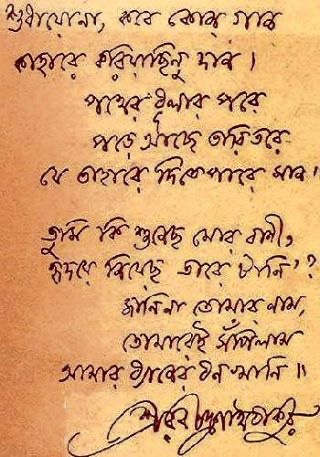
Lyrics by Tagore, translation from Bengali by Ratnottama Sengupta
‘Bhumika or Introduction’ is the first song of Tagore’s collection called Mahua, published in 1929.
The lyrics written in Bengali by Tagore
Ask me not, which song
I have gifted to whom, when...
It's lying on the wayside
For the one who can
Own it with love.

Have you heard my words?
Have you pressed them to your heart?
I know not your name…
I offer you these
Musings of mine.
Painting by Tagore
Rabindranath Tagore (1861-1941) was a brilliant poet, writer, musician, artist, educator – a polymath. He was the first Nobel Laureate from Asia. His writing spanned across genres, across global issues and across the world. His works remains relevant to this day.
Ratnottama Sengupta, formerly Arts Editor of The Times of India, teaches mass communication and film appreciation, curates film festivals and art exhibitions, and translates and write books. She has been a member of CBFC (Certified Board of Film Certification), served on the National Film Awards jury and has herself won a National Award.
.
PLEASE NOTE: ARTICLES CAN ONLY BE REPRODUCED IN OTHER SITES WITH DUE ACKNOWLEDGEMENT TO BORDERLESS JOURNAL
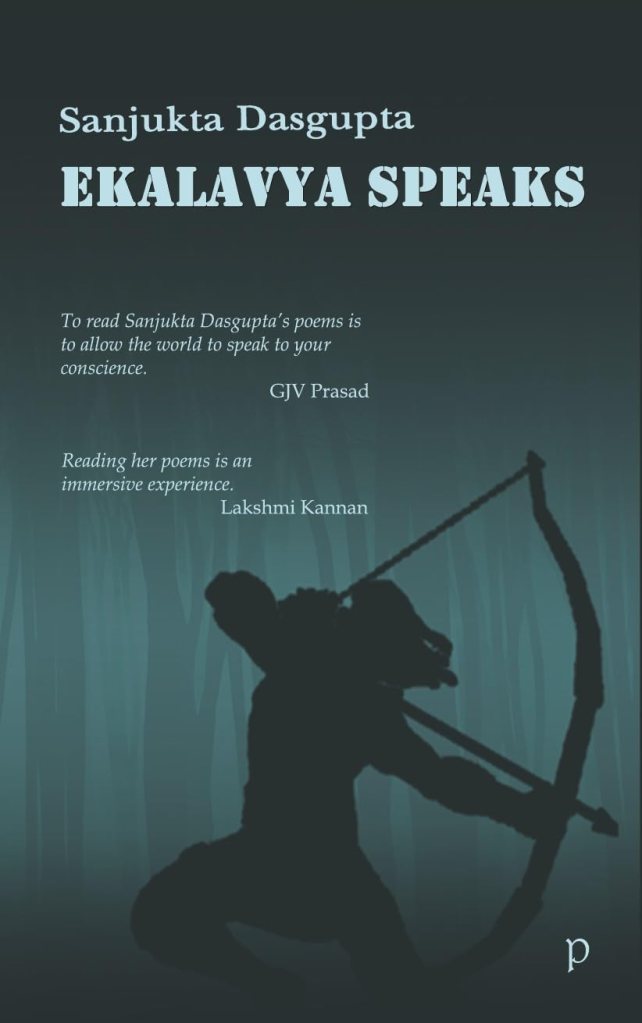
Poetry which goes beyond the boundaries of words and speaks for a greater cause calls for a captivating read. The lines become more significant when the verses address multiple socio-politico-cultural issues, aesthetically and without didacticism. Poet and academician Sanjukta Dasgupta’s latest book of poems Ekalavya Speaks is not merely a gathering of words, they rather, “[…] spread out their wings untiring/ And never rest in their flight” (Yeats) and attempt to hark at deaf ears and represent unheard voices. She is a strong voice for the otherized, marginalised sections raising issues from multiple spheres of life. Caste, gender, myth, history, pre-history, and technology all find space in her chosen selection of poems. The very last lines of the first poem, ‘Accident of Birth’ says,
“No accident could be
More catastrophic than
The accident of birth, alas.”
This sets the tone of the whole collection, bringing out the angst of not one voice or one poet but an entire nation. The poet is a strong voice, at times ironic as she says in her titular poem ‘Ekalavya Speaks’-
“The Sun also Rises for us
 I may claim your thumb some day.”
These lines are from Dronacharya, the tutor of the royal princes who asks his disciple to gift him his thumb after lopping it off as a fee to maintain his allegiance to the throne. Ekalavya, the tribal prince could not question the ‘guru’ in the Mahabharata, whereas the poet in the surreal space gives him the voice to speak for the treachery of the great guru. The guru reappears in the poem ‘Dronacharya: The Teacher of Princes’ where questions are thrown at the intentions of a biased guru who was “The glamourised bonded labour/ Leashed to the regal court.”
Her poem, ‘Kurukshetra-The Killing Field’, goes beyond the boundaries of territories and is akin to any war where lives are lost. At once Kurukshetra becomes the battleground of Ukraine or Gaza where humanity is killed every day. The crying mothers and wailing children are the same everywhere and they are representatives of the universal sorrow of pain and loss and how peace is a mere myth as “Peace was restored at the price/ of rivers of blood […]”. In fact, ‘In the Holy Land’, she talks of dying children and the toxic air of war-trodden Gaza; of the grief-ridden Bethlehem and Jerusalem.
In her greater narrative, Ekalavya and Karna unite to quest for justice, for a space in the mainstream, and for a better liberated world. In Dasgupta’s poetry, Ekalavya, Shambuka or Shikhandi are not figures from the great epics, they represent the backwards sections of society who perhaps after eons of silence they have now found the time to come out of death, saying– “ I rise from my ashes/ Resurrected!”
With Shikhandi, Draupadi’s brother in the Mahabharata, who was born a female and exchanged gender with a yaksha (nature spirit) for that of a male, Dasgupta brings in the suffering caused by gender identity. She sensitively writes about Oscar Wilde’s homosexuality in her poem ‘The Poet In Reading Gaol’. One’s sexual orientation can ironically be treated as a heinous crime. Heterogeny is also a kind of capitalism as the poet strongly urges and questions progressiveness and maligning of human rights.
In her earlier books Lakshmi Unbound, Sita’s Sisters, and Indomitable Draupadi. Dasgupta has primarily addressed the feminist question. Her latest includes poems like ‘Bapu’ and ’Manipur’. In ‘Bapu’, she talks about the rape of a 12-year-old child in the name of religion in India with sensitivity.
‘The Coffee Shop’ is an interesting and ironic poem. Dead leaders meet in a surreal space where neither murderer nor violence can touch them. They are ‘immortals’ and ‘martyrs’ and, now, are even invincible. It is utopian when Gandhi, Jesus, Martin Luther, and Julius Caesar meet each other. Religion and politics, peacemakers and warriors, all blend in a higher realm of understanding. The flavour of this poem is unique and different from the rest of the poems in the collection and yet thematically it stands out as a statement against violence and death. Death cannot bring an end to the ones whose deeds and ideals are immortal. The same can be said about another visionary poem, ‘Shakespeare and Kalidasa’.
In all the poems, the poet comes across as a strong, sensitive voice whose pen cuts across dogmas, blind faiths, violence and otherization. At the same time, she speaks for the cause of humanity. There are personal poems, like ‘I can’t breathe’; a brilliant poem describing psychological claustrophobia in a world where no peace or no prayers can end the suffering of souls. ‘The Exit’ or ‘Loss’ add richer gravity .
As a poet Dasgupta’s language is lucid and she draws her allusions and examples from the myths, from the past and the projected the future. She strongly voices her opinion. As an educator and as a responsible human being she becomes the voice of the many. Each poem unfolds a story to guides our way through obstructions, which are not physical but mental barriers from which one must liberate oneself. As I read her, I am reminded of a few lines by the great Urdu poet, Faiz Ahmad Faiz, who wrote:
Speak, your lips are free.
Speak, it is your own tongue.
Speak, it is your own body.
Speak, your life is still yours.
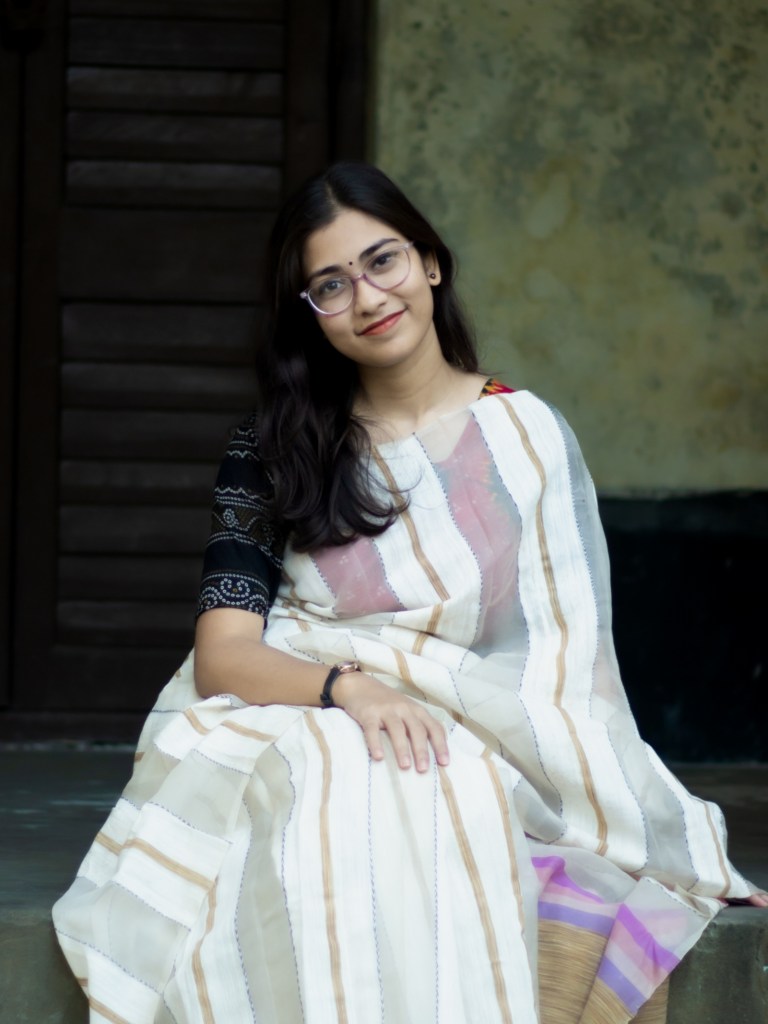
Swagata Chatterjee is an Assistant Professor of English at a state-aided college under Vidyasagar University. She is an academician and a keen reader.
.
PLEASE NOTE: ARTICLES CAN ONLY BE REPRODUCED IN OTHER SITES WITH DUE ACKNOWLEDGEMENT TO BORDERLESS JOURNAL
And it was Spring in the dream... As the petals started to shed their horns, I saw a blue flower blooming at night, and it was you! I wandered around you, but you are a fleeting sight. I wanted to know about you, my love. What did you want to become? Whom did you seek?
I could see that the hues of the wings of butterflies, Held a strong resemblance to my happiness. So I wished it extracted your blue.
Suddenly, one day, I sought you out, but there's no you. I wondered. You were but the fragments of my own mind, I tried to glue all the puzzles together. Now I know it was all my delusion. Because I tried hard to depart from the shadows. But now again, where am I? And where are you?
You were actually me, and my shades of blue. So, For none but my love, A letter, to you, to me where you will find the key to happiness.
The dream is over. Summer's now heating the ground up, Let me pluck the flower and put it in my hair.
Nusrat Jahan Esa is a BA English Literature student at the University of Liberal Arts Bangladesh (ULAB). Writing Poetry is her way of expressing herself and embracing her inner child.
.
PLEASE NOTE: ARTICLES CAN ONLY BE REPRODUCED IN OTHER SITES WITH DUE ACKNOWLEDGEMENT TO BORDERLESS JOURNAL




 Borderless