Categories
Poetry

Poetry by Allan Lake

Allan Lake
ON EARTH

Such a nice, perhaps one-of-a-kind, planet.
Spacious. Water, oxygen, fertile earth.
Let’s simply name it after what it is.
Look at that waterfall, taste it, take a cold
shower. You wouldn’t want to be anyone
or anywhere else. Build shelter, pick fruit,
grow food then share it with neighbours,
invent language so you can compete with
birds that make poems and songs to express
the wonder of it all and praise Mother Nature
and their luck for having survived arrival.
You have never seen anywhere else except
this generous plain but, surely, this must be
a paradise without one flaw.

Allan Lake, originally from Canada, has lived in Saskatoon, Cape Breton Island, Ibiza, Tasmania, and Melbourne, Australia. His latest chapbook of poems, My Photos of Sicily, was published by Ginninderra Press. Such journals as The Hong Kong Review, Tokyo Poetry Journal, New Philosopher and The Fabians Review have published his poems.  

.

PLEASE NOTE: ARTICLES CAN ONLY BE REPRODUCED IN OTHER SITES WITH DUE ACKNOWLEDGEMENT TO BORDERLESS JOURNAL

Click here to access the Borderless anthology, Monalisa No Longer Smiles

Click here to access Monalisa No Longer Smiles on Kindle Amazon International
Categories
Stories

Hotel du Commerce

By Paul Mirabile

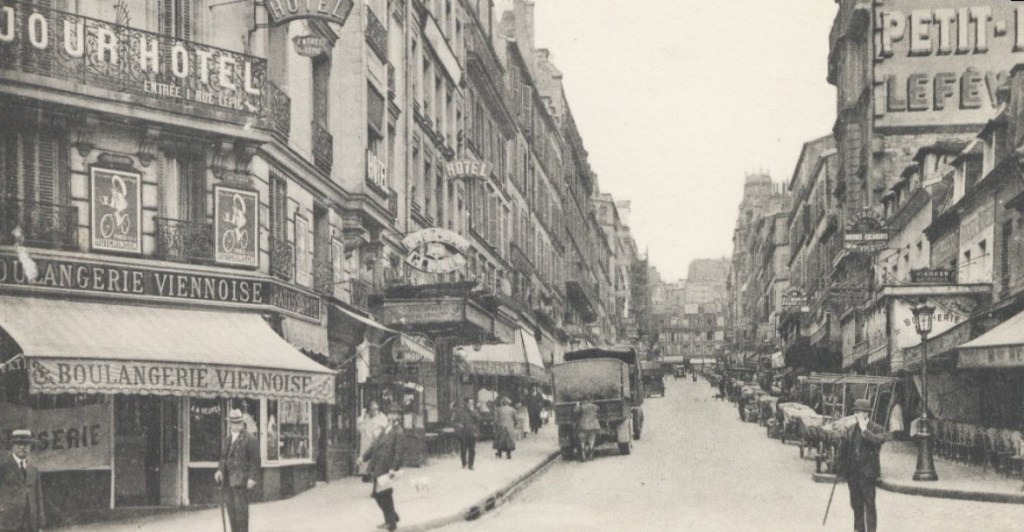
Paris 1970s. From Public Domain

In 1974, the modest, starless Hotel du Commerce, at 14, Rue[1] Sainte Geneviève, in Paris became my home for over six months, and its owner, Madame Marie, my adopted mother.

A young, aspiring journalist, I was sent to Paris by the editor of a worthless monthly magazine in Palermo, Sicily, to write an article on the monuments of Paris. I took up my long residence at the Hotel du Commerce for two reasons: it was very cheap — that is, ten francs a day — and conveniently located in the centre of the city, only a ten minute walk to the Notre-Dame Cathedral. Madame Marie, ninety kilos of joy and laughter, rented me a room on the fifth floor (without a lift) with two other residents: Caban across from me and Paco at the end of the corridor. The rooms had neither attached toilets – there was one for each floor — nor showers (none). Like all residents and tourists, we washed from the washbasin in our rooms. My little window looked out on to the red-tiled rooftop of a Russian bookshop.

To tell the truth I never wrote that article on the monuments of Paris. What a boring subject! On the other hand, my stay at Madame Marie’s hotel afforded me enough material to write a book — a sketch of her and her residents, their trades, joys and sorrows … their  uncelebrated destinies. My editor would have probably sacked me for this ‘breach of contract’, but as luck would have it, his magazine went out of business before my return to Palermo.

I shall never know why Madame Marie took such a liking to me. Everyday, she would invite me for coffee and a chat. We would even watch television in the evenings in her sitting-room which separated the tiny kitchen from the reception. From there she kept an alert eye on the comings and goings of everyone. She was a jolly old woman, and this, despite the loss of her husband at an early age, and the terrible events that occurred in her hotel during the Algerian war in the fifties and sixties[2]. She was indeed fat, but quick-witted with plenty of pluck. She had rolls of flesh rumbling under her eye-catching flower-dotted red robe.

“You know, I was a young girl during the Second World War. I hid some French Resistance fighters in my parents’ house in the Alps. The Germans who hunted down the French fighters couldn’t scare me with their rifles and threats. I sent them packing whenever they pounded at our door!” she would repeat proudly when I was alone with her. When her husband died, she was left on her own to manage the hotel, and in the 50’s that was no asset. Deserters, police informers, merciless OAS members[3] and their equally ruthless adversaries, the FNL[4]  all came and went causing rows, arrests, even murders. The plucky Madame Marie handled it all with her sang-froid and flair for compromise.

“My sixth-sense got me through that lot,” she would laugh, her jowls shaking. By the 1970’s, however, things had calmed down in Paris. The lodgers were mostly Japanese and American tourists with a sprinkling of North Europeans. No more brawls, police raids or murders. Madame Marie spoke no foreign language but she understood everything that she needed to understand. She had hired an old woman to clean the rooms. The sprightly widow had learned how to say in English, after having knocked on the lodger’s door at eight in the morning: “You stay or you go?” It was enough to get her point across.

Madame Marie disliked the police. She flared at their scent even before they stepped through the front door in incognito on the trail of someone except on one occasion. I shall let her narrate that exceptional episode: “How that flic[5] fooled me I’ll never forget. Dressed like a hippy, long hair, a torn knapsack, he took a room in the courtyard. He spent two weeks here and never said a word. He got in no later than eight o’clock at night. I thought he played the guitar on the metro[6] for money. Then one day, dozens of police stormed through the front door into the courtyard. I was in the sitting-room and rushed out the back door of the kitchen to see what all the hullabaloo was about. The door of one of my clients was wide open, a young bloke who used to play the guitar on the metro; he had been handcuffed by the ‘hippy’ and was being walked out. I couldn’t believe it. It was like a film. When everything settled down, a police officer came over to me and politely explained that my lodger was a notorious drug-dealer and had been under surveillance for weeks by the ‘hippy’. He apologised for the inconvenience and paid the rent for both the dealer (who hadn’t paid me) and the hippy-policeman.” Madame Marie sighed. “He’s the only flic who ever fooled me.” And she laughed her usual jolly laugh.

She got up to make some more coffee for at that moment Caban and Bebert came in for a chat, both a bit tipsy from their usual drinking bouts before, during and after work. Then Bebette made her appearance, the prostitute to whom Madame Marie ‘lent’ one of the courtyard rooms every now and then to exercise her profession. Madame Marie had no moral qualms about such professions. Everyone had to earn a living … Close behind sailed in an elderly woman whose name I no longer recall. Madame Marie considered the woman to be her best friend. She would sit in front of the television and shout insults at the politicians whom she disliked, much to the displeasure of the others, especially Bebert, who would shower her with mocking abuse. When things got too rowdy Madame Marie would shout them all down or threaten to turn them out if they didn’t settle down.

Madame Marie was at times brusque but fair. She liked Caban, the former butcher and now factory worker hailing from southern France, shy and lonely, drunk by mid-morning. He had been living in Hotel du Commerce since the late sixties. She was fond too, of Bebert, the chimney-sweep, a small, taciturn, melancholic chap straight out of Dicken’s David Copperfield, drunk before ten in the morning. He constantly coughed. His clothes were impregnated with soot and cigarette smoke. Bebert hardly spoke at the table, smoking like a chimney, drinking his coffee whilst Caban smiled and winced at the others’ ridiculous jokes and jibes. Day after day and night after night that sitting-room typified for me – and for the others, I suppose — a sanctuary of friendship and convivial exchange. Oftentimes, I read myself into a page of Balzac’s novel Le Père Goriot [7].

The other two residents rarely joined at that cheery table. One of them, Bolot, stayed in a room in the courtyard. He was a former German soldier who joined the French Foreign Legion after his capture during World War II. The other was called Paco, a Republican Spaniard, who escaped Franco’s persecutions after the Spanish Civil War[8].

I got to know them all, save Bebert. We had no time to get really acquainted. “Poor Bebert,” Madame Marie would sigh. One evening as we sat watching a film Bebert knocked at her kitchen door, then staggered in towards us, blood streaming from his mouth, drenching his night-shirt. His face was ghost white. He kept murmuring, “Madame Marie … Madame Marie,” through clenched, blood-filled teeth. The chimney-sweep appeared lost in a daze. Madame Marie quickly took him by the shoulders, laid him on the sofa then trotted off to get the police. They arrived quickly (the station was two doors away). An ambulance shortly followed. Bebert was placed carefully on a stretcher and carried out.

We never saw Bebert again nor had any news of him. Madame Marie presumed that he had died of a haemorrhage from too much smoking, drinking and chimney soot. She had his room cleaned and fumigated. His belongings amounted to a pair of torn slippers, two shirts and trousers and two used razor blades. On the other hand, she gasped at the hundreds of empty packs of cigarettes. Bebert’s world had been compressed into a nebulous routine of cigarette and alcohol fumes and chimney soot. A bleak, Dickensian world to say the least.

Poor Bebert. He had been living at Hotel du Commerce for eleven years. A fellow without a family, friends … known to no one. He practiced a trade that was gradually dying out. No one ever asked for him at the reception — never a phone call. He was the unknown toiler whose burial stone carries no name because he had no money for a headstone. He was probably buried in the fosse commune[9].

Caban, whom I knew much better than Bebert, fared no better. His salary flowed away upon the torrent of fumes of cigarettes and drink, or as Madame Marie put it coarsely: “He pissed it all against a wall!” Too much gambling, too. So his wife left him, after that, his sixteen-year-old daughter. They were never to be heard from again. Caban was soft-spoken, very shy. Quite frankly, I never saw Caban sober, except at six in the morning before catching the bus to work at the wine-bottling factory. He had asked the foreman, Mister Tomas, to have me hired on for the summer since many of the workers had gone off on holiday. In the café whilst waiting for the morning bus, he began his inglorious day with coffee and a few shots of cognac. He continued his indulging all through the working day on the first floor of the factory where he drank the last dregs of wine from the bottles that were to be washed. By five o’clock he was completely sloshed! Mister Tomas kept him on out of pity. Besides, Caban was inoffensive. Madame Marie even told me he had saved a girl from drowning in the Seine River in Paris. But let Madame Marie tell this very true tale: “He was walking along the banks of the Seine after work when he heard the screams and splashings below him. Caban was a strong swimmer at that time, so he took off his shoes, dived in and grabbed the girl in the water. In a few minutes he had brought her back to the banks safe and sound where a crowd of people had gathered, applauding him. The young girl cried and cried but was unhurt. And you know, her father was the owner of the France-Soir daily newspaper. So, to thank Caban, he gave him a certain sum of money and offered him the France-Soir freeeveryday for the rest of his life. All he had to do was give his name at the news-stands.”

“Does Caban read the France-Soir? I never see him reading a newspaper,” I asked naively.

She laughed. “No, Caban never reads. He never had much instruction.”

I became quite friendly with Caban since we worked together at the factory, although he would constantly upbraid me for not joining him in his ritualised morning concoction. I insisted that I never drink. He would snicker and shrug his bony shoulders. “All men drink!” he slurred. That of course was a subject of conjecture which, and this goes without saying, I never pursued with him.

One day whilst I translated for Madame Marie at the reception, I mentioned that I hadn’t seen Caban for more than a week. Neither had she. Mister Tomas had telephoned, too. Caban never missed a day at work … never. She told me to go upstairs and knock at his door. Which I did for several minutes. Silence. When I returned without news of him she immediately dawdled out to the police station. She was back in no time with two policemen. I accompanied them upstairs. They pounded at the door then kicked it open. There knelt Caban over his bed, his face black as coal. The stench in his room made us gag. I hurried down to tell Madame Marie. And as we stood in the reception, the ambulance arrived and four men, escorted by the police, placed Caban’s frail, limp body into a plastic bag and dragged it down the steps, one by one : thump … thump … thump …  Madame Marie started to cry. I covered my ears …

Poor Caban had been dead for over a week, due no doubt to a blood clot of the brain. Madame Marie never forgot those thumps on the flight of stairs. Nothing was said of his death in the newspapers, even in the tabloids. Like Bebert, he succumbed to a companionless death, without flowers or prayers. Without sorrow or tears … He too was probably buried in a fosse commune. He had no bank account. The police found six Francs in his pocket … Six more than in Bebert’s …

Paco, the Spanish refugee, had been living in Hotel du Commerce for seven years. His lack of good French isolated him from the Paris scene, so he took refuge in the clusters of Hispanic scenes that peppered the Parisian streets, especially the taverns where flamenco music could be heard on Rue Moufftard, only a fifteen-minute walk from our hotel.

Since I speak Spanish quite well, I had on many occasions accompanied Paco to these musical haunts of his, where the paella was copious, the sangria flowed like water, the music, if not excellent, loud enough to forget one’s trials and tribulations of the day. Above all, it was cheap …

Paco drank heavily, rum and coke or sangria, but never behaved uncivilly. His deep, black eyes bore into mine whenever he spoke of his luckless past: “My older brother was killed in the war against Franco. I escaped via the Pyrenees leaving behind my parents. Since 1940, I’ve been living in France, working in factories or in the fields. And you know, I still don’t have my French papers. I have no identity! I can’t go back to Spain because of Franco[10], so I must stay here unloading lorries at the Halle Market or washing dishes in grotty gargotes [11].” Paco clapped to the sound of tapping feet and to the rhythmic chords of a furious guitar. “Every now and then I repair the toilets at the hotel which are constantly clogged up.” He snapped his fingers, ordered tapas[12], spoke to his friends in the language of his parents.

The fiery Spaniard would introduce me to his Spanish artist friends, all of them sullen, sad figures whose love of Spain had evaporated into hazy fumes of sangria, nostalgia, gaudy flamenco music, tasteless tapas and brief love affairs. As to Paco, he appeared to be a loner, an ill-starred chap lost in a huge city of lost souls, of crowds so busy that their business took no heed of such a shadowy figure, fugitive and fleeting, drifting from tapas to tapas, sangria to sangria.

Paco hated Paris, but it proved the only place for a stateless refugee to avoid police roundups. For Paco, Hotel du Commerce symbolised a haven for marginals, the homeless and stateless. “Madame Marie is my guardian angel,” he would croak. “My very fat guardian angel” as he clapped and stamped to the riotous music. “The police will never find me … never!” he boasted raising his glass to Madame Marie’s health.

He was wrong. One hot September week, Paco couldn’t be found in the hotel. Madame Marie suspected foul play. Two days later the police arrived, informing her that a certain Paco Fuentes had been apprehended without papers. He had been extradited to his country of origin. His belongings? He had none, like Bebert and Caban. The little he did possess were thrown into a bag and out into a rubbish bin. Poor Paco — would he ever find his parents?

On my many jaunts through Spain, after Franco’s death, I tried to locate Paco Fuentes, but it was like finding a needle in a haystack as the expression goes. Here, however, I must thank the excellent Spaniard, for it was he who introduced me to the world of flamenco.

Bolot kept very much to himself. Unlike the other residents he never drank nor smoked. You didn’t want to muck about with Bolot — a massive fellow, indeed. But then again who would muck about with a former French Foreign Legion soldier?

Yet, Bolot’s aloofness and reserved demeanour attracted many people to him. He had that sort of winning smile, and since he spoke very good French, albeit with a heavy German accent, he befriended those who came into contact with him. Moreover, he shared a passion for stamp-collecting. That was Bolot’s raison d’être[13]! His collection had become very well known to both specialists and amateurs. I would accompany him to the Flea Market on Sundays and there he would trade stamps with the best of stamp-collectors. Stamps from the Soviet Union, China, India, Cuba, several African states, Turkey and Libya. Bolot didn’t need the money, his pension as a soldier was comfortable enough. He simply enjoyed the thrills.

One day as we strolled back to the metro as he towered above me, Bolot acknowledged his good luck: “I volunteered for the army at seventeen, an enthusiastic patriot. Was captured by the French after two days of combat and given a choice: prison or the Foreign Legion. I chose the second, changed my nationality and name.”

“What was your German name?” He smiled but left the question unanswered.

“So I fought for the French. A traitor to my homeland. Call me what you like, I couldn’t sit out the war in a prison for years and years. You know, I never went back to Germany. When I quit the Legion I received my pension and came straight to Paris, the City of Lights.”

“To do what?”

“To sell stamps!” Bolot laughed. “No, I worked as a mechanic in factories until retiring.”

I got to know Bolot as well as Caban since all three of us worked at the same wine-bottling factory in the summer of 1974. He left earlier than me because of a fight between him and an obnoxious individual who abhorred Germans, even though Bolot had acquired French nationality long ago. Bolot refused to fight him, despite the other’s punches, which the former Legionnaire dodged or blocked with considerable ease. If Bolot had really fought, he would have killed him. Mister Tomas broke up the squabble, sacked the young rowdy on the spot and apologised to Bolot. Bolot exercised the noble art of self-restraint.

When I left for grape-picking at the end of September, then on to Italy and Sicily, it was Bolot who helped me repair the broken spokes of my bicycle. Outside Hotel du Commerce, Madame Marie and Bolot wished me the best of luck, inviting me back whenever it suited me. There would always be a spare room for me she insisted. I cycled out of Paris in the direction of Burgundy. I had spent six months at Hotel du Commerce

After a month of grape-picking I returned to Palermo only to discover that the magazine had failed due to lack of interest … and funds. Relieved, I went to Madrid to begin a career as a flamenco guitarist. Time passed quickly. Or as Madame Marie would philosophically say: “It’s not time that passes but us!”  Exhausted from so much playing in studios and taverns, I decided to take a break and travel to France and visit Hotel du Commerce.

It was under new ownership. The manager, an Italian, informed me that Madame Marie had died years ago from dementia after a spell in a nursing home. How everything had changed: the reception room had been refurbished and Madame Marie’s Balzacian sitting-room had become a dining-room for guests. The once starless hotel had become a three-star hotel.

I stayed two nights and paid sixty euros a night! In the seventies, I paid the equivalent of one and a half euros! True, all the rooms had been painted in bright, cheery colours, fitted out with toilets and showers. But sixty euros? Besides, I like a hotel that is lived in, not just slept in …

With the death of Madame Marie, a whole era had come to a close. Hotel du Commerce had decidedly conformed to the standards of kitsch. There were no more residents, only tourists. All the single rooms on the fifth floor had become large rooms suitable for modern travelling couples. Gone were the days and nights round Madame Marie’s convivial table, her coffees and conversation. Those colourful figures who had imprinted their existence there, whose joys and sorrows had been shared by Madame Marie and myself, no longer painted those refurbished walls simply because the epoch ignored the very existence of such figures.

Indeed, who during those two nights reminisced the glittering epoch of Madame Marie’s Hotel du Commerce? Who even imagined her singular story and those of her likeable, touching residents? No one. No one, perhaps, except me, who vouched to safeguard those memories. Memories of the anonymous whose faces will never be seen on photos, nor names ever printed in books.

[1]        ‘Street’.

[2]        1954-1962.

[3]        ‘Secret Army Organisation’ founded in 1954 that fought against those forces who wished to prevent the independance of Algeria.

[4]        ‘The National Liberation Front’, also founded in 1954 whose militants fought for the independance of Algeria.

[5]        Jargon in French for ‘policeman.

[6]        ‘Underground’ or ‘subway’.

[7]        ‘Father Goriot’ written in 1834. Translated into English by Ellen Marriage.

[8]        1936-1939.

[9]        ‘Communal grave’.

[10]      General Francesco Franco died in 1975, and with his death, King Juan Carlos proclamed Spain a democratic nation.

[11]      French jargon for ‘cheap, unsavoury restaurants’.

[12]      Spanish appetisers.

[13] French: Reason for being

.

Paul Mirabile is a retired professor of philology now living in France. He has published mostly academic works centred on philology, history, pedagogy and religion. He has also published stories of his travels throughout Asia, where he spent thirty years.

.

PLEASE NOTE: ARTICLES CAN ONLY BE REPRODUCED IN OTHER SITES WITH DUE ACKNOWLEDGEMENT TO BORDERLESS JOURNAL

Click here to access the Borderless anthology, Monalisa No Longer Smiles

Click here to access Monalisa No Longer Smiles on Kindle Amazon International
Categories
Stories

Pier Paolo’s Idyll

By Paul Mirabile

In order to build a new low-cost residential complex twenty kilometres to the West of Rome, hundreds of hectares of low-lying hills, orchards, several depopulated hamlets and unplanted vineyards had been cleared by an army of bulldozers, cranes and cheap labour with picks and shovels. In the 1960s, housing construction in Italy had mushroomed out in an erratic, rampaging spectacle beyond any public or private circumspection.

Pier Paolo and his middle-aged mother benefitted from one of these new, but hastily built residential flats on the tenth floor of a fifteen-storey tower. His father had abandoned the family four or five years ago, forcing the boy’s mother to work as a seamstress for the hundreds of residents of their tower. He himself had dropped out of school to work at a nearby wine factory in the industrial zone. Their meagre incomes paid the rent, permitted them to eat two or three meals a day and dress decently.

Everyday, Pier Paolo shuffled lazily to the factory at eight o’clock. To reach the small factory, he crossed an immense horizonless, treeless esplanade paved in the most banal ugly grey paving stones. What caught his attention, however, was a low rising stretch of grassy dirt mounds which ran for a lengthy distance along a high, barbed wire metal barrier which separated the dirt mounds from a rocky embankment leading downwards to a newly build avenue. These low dirt knolls, according to the season, blushed a poppy spring red, a leafy, autumnal brown, a wintry white then a lush, verdant green in the summer. On his off days, he would walk through the low hillocks from one point to the other. They covered an area of about twenty-five metres by ten metres. His constant crossings in this forgotten pile of dirt had traced footpaths in and around the knolls, the low bushes and over broken roots.

Pier Paolo enjoyed these pleasant promenades. Below, on one side, buzzed speeding vehicles. On the other, lay the empty, treeless esplanade where hardly a soul appeared, save a few workers, housewives pushing carts of food, flowers or trinkets to be sold in the neighbourhood market, one or two old school comrades and stray dogs. It was at that particular movement of contemplation that Pier Paolo experienced a tinge of excitement, a mounting commotion that would endorse and embolden his existence, would prompt his escape from the boring walls of a suffocating flat, the ugly concrete and metal of their block residence …

Returning from the factory one afternoon at the beginning of June, Pier Paolo walked briskly over the range of shaggy mounds of piled up dirt for an hour or so before finally deciding  upon a spot that would suit his adventure nicely. Hidden from the eyes of those who crossed the esplanade, a small concavity in the rim of a grassy hillock would afford him a place to sleep. He only needed to erect a make-shift lean-to, not to protect him from the rain — during the spring and summer months it never rained — but from the scorching heat. Yes, Pier Paolo resolved to live with nature on this diminutive tract of earth that had miraculously survived the building contractors’ bulldozers and cranes.

He hastened home to his mother who was busy sowing a marriage dress for her second storey neighbour. Pier Paolo excitedly explained his adventure. It would last through not only for the summer months, but also through autumn before the heavy rains set in. She listened passively, her mouth agape. Had her son gone completely daft? No, he appeared quite normal, even serious. He would rise with the rising sun, have his breakfast at the café near the factory, lunch at the factory canteen, and as to diner he would buy deli meats, olives, cheese and bread at the grocer’s.

“Why not eat diner here with me?” his mother suggested in her soft, meek voice.

“Of course I’ll eat with you mummy, but only on weekends. I must live permanently in my new environment. I’m eighteen year’s old, and it will be an adventure to sleep out in such primitive and natural surroundings without neighbours’ screaming and shouting, loud parties until four in the morning, lifts breaking down all the time. I want to breathe fresh air, if that is all possible in this godforsaken dump.”

His mother flushed at these last words, but held her tongue, astonished at her son’s resolution. “You see mummy, I want to look up at the stars and not at the cracks in the ceiling of my room.” His mother nodded her head, thimble on her thumb, needle and thread between her index and middle finger. He was right, there were many cracks and fissures in the ceilings and walls of their ‘new’ flat ! Well, he did show ingenuity and imagination. He wouldn’t take no for an answer, and besides, he wouldn’t be far from home …

So Pier Paolo packed a few belongings in his back-pack, rolled up his sleeping bag, kissed his mother on her wrinkled forehead and strolled to his ‘earthy paradise’ as he facetiously called his up-coming ‘residence’.

The first two weeks Pier Paolo did eat with his mother on Sundays and also gave her his clothes to be washed, cleaned and dried, made ready for work on the morrow. However, the following weekends he did his own washing at the launderette for a few lira, and ate sandwiches at his hilly home instead of with his mother. It certainly was not out of anything against her. He loved her very much. But Pier Paolo wished to be on his very own, especially on his off days and at night, lying on his sleeping bag outside the lean-to, observing the stars and the moon as they moved slowly across the universe. Up till then, no one had disturbed him. A stray dog did sniff about his installation on several occasions, but the animal seemed friendly, and Pier Paolo threw it some slices of salami and pepperoni. The only other ‘visitors’ to his comfortable solitude were the sparrows who gayly pecked at the crumbs of bread that he scattered for them just below his shelter.

Oh how after a hard day’s work at the factory he relished those calm, starry evenings, the light whir of vehicles below beyond the barbed-wire barrier, the absolute silence of the esplanade behind him! He really felt quite at home amongst the natural elements; the ants building their ant-hills, the bees doing their dance amidst the honeysuckles, the birds chirping in and out of the bushes. The poppies and daisies were in bloom, too. Alas, many of the grassy knolls and thorny footways had been littered with coke bottles and caps, beer cans or liquor bottles, yellowed magazine and newspaper pages, cigarette studs, all thrown there by returning workers from the industrial area or gangs of drunken adolescents. Pier Paolo, struggling through the prickly weeds, would clean the mess the best he could, but invariably the same lot or other litter-louts would fling whatever trash they had into his ‘paradise’ as if it were a huge rubbish bin. Did these individuals know that Pier Paolo had taken up residence in those piles of grassy mounds? Even if they did, nothing would have prevented them from tossing whatever they had into it, accompanied by drunken guffaws and mindless giggles.

The sea must not have been far off, or so he imagined. For at times he heard the whir of a winged seagull. He stood to catch sight of it, but only the blurry orange glow of the high rising tower lights far off at the end of the esplanade marked the sky. The towers resembled so many indistinct parapets of flickering light-bulbs which loomed ominously at the end of the soundless esplanade. That vastness of ugly emptiness had always frightened him, and at those times he would turn his back to this sinister, featureless urban landscape and dwell upon the images of faraway scenes that crossed his imagination. No, those electric lights would not chase away his stars …

One star-filled night, he envisaged pink and amber sands of a horizonless desert whose barkans[1] and chots[2] left him breathless; the heat of the sands made him sweat under the blazing hot sun in an azure sky of pure, unpolluted, untainted opal. In another vision, he pictured himself deep in a chain of snow-clad crested mountains, trekking with difficulty over ribbed glaciers and ice-laden passes, the blues of the mountains inviting him to penetrate ever deeper so as to discover the arcane entrance to the subterranean kingdom of the King of the World.

Pier Paolo’s imagination soared to new heights night after night following a hard day’s work. It were as if he had mounted a magic carpet which floated under rainbows, over wide forests and turquoise seas. These fantastic images slid him slowly into a deep, healthy sleep. He awoke refreshed and vigorous, ready for a hearty breakfast at the café and work. In fact, he had never worked as hard as he did now, loading the train cars with heavy cartons of wine, working rapidly at the conveyor belt packaging wine bottles.

Many of the workers admired the young Pier Paolo for his renewed energy, his replenished stamina and spirit. At the sound of the whistle, he showered, bought some prosciutto, pepperoni, provolone, olives, pistachios and bread from the grocer’s, then returned merrily to his shaggy-mounded home. His muscles ached, but gradually relaxed when the stars began to pop out forming clusters of scintillating comfort …

He saw himself on the Niger River somewhere in Mali, drifting in a canoe on the slow moving current, wild geese cackling on the wing, hippopotami bellowing and rumbling in the deep waters, camels grunting from the arid sand-filled shores. He drifted and drifted as the heat bore heavily upon him, lying upon sacks of corn, munching on dates, tomatoes and boiled fish …

A sudden barking! It was the stray dog. Pier Paolo shook himself out of his dreamy stupor, threw the poor scraggy creature a slice of pepperoni, then closed his weary eyes and slept soundly. Darkness crept over the hilly mounds, mantling their denizen in another tranquil night of peaceful repose.

Oddly enough, after having devoured the slice of pepperoni, the dog never returned to visit our grassy-mounded denizen. He had other visitors, however — a motley lot of out-of-schoolers who seemingly scented the presence of someone living amidst the abandoned lot, and who endeavoured to confirm it. It was a Saturday afternoon. Pier Paolo was busy reading an interesting detective story when suddenly he found himself encircled by three ragamuffin boys and two very buxom girls! They all sized him up, noses in the air as if sniffing the warm breeze of a July day.

“Who are you mate?” a skinny boy questioned with overt contempt. He appeared to be the ‘chief’ of the pack. Pier Paolo stood up. He was much taller than any of them and more broad-shouldered. The others held their ground, but one or two scraped the dirt with their worn-out shoes, biting their lips.

“I’m the king of these mounds. What of it?”

“The king?” guffawed the skinny chap out of the corner of his distorted mouth.

“Yea, the king,” repeated Pier Paolo, heightening his voice with an added tinge of condescension.

“Very well, king. Then what if we were to dethrone you and turn your monarchy into a democratic state?” The others sniggered at this show of rhetoric, albeit hesitantly.

“Go ahead, Mister Democrat!” responded the monarch, tightening his fists, smiling through clenched teeth. No one moved. The warm breeze made the democrats sway in their fixed positions like a herd of paper tigers.

“Ah, let it go,” interrupted one of the girls. “Let him rule over his trash-filled kingdom.” And she turned to leave, followed shortly by the other girl then the three boys, who exchanged menacing glances with Pier Paolo. The ‘chief’ bowed in affected reverence to the ‘king’ and mumbled something unintelligible. When they had reached the esplanade, Pier Paolo scoffed at this unexpected intrusion, crawled under his lean-to and went back to his afternoon reading …

The August heat dried all the perfumed poppies and dainty daisies that Pier Paolo had planted around his lean-to. The heat had become unbearable, driving through the palm-leaf roof of his make-shift shelter. It was holiday for most of the workers at the wine factory, but Pier Paolo volunteered to work the whole month, not only for higher wages, but for showering and the afternoon hot meals. He did visit his mom every now and then, but was living mostly on deli meats, olives, cheese, fruit and bread. Because of the heat, he showered every day and took his clothes to the launderette every two days. It’s true that this kind of a diet began to bore him, however, his solitary refuge had really become his royal paradise!

Every Saturday and Sunday, he roamed through his ‘kingdom’ searching the nooks and crannies for unusual objects: a broken tombstone dating from the seventeenth century judging from the Latin inscription, a yellow-paged book of verses by a poet unknown to him, several of which he managed to read but hardly understood. He discovered a rusted compass and magnifying-glass, half-buried in one of the weedy mounds. In a riot of dead roots he rummaged out a photo of a young girl dressed as if to go to church, all in white with a huge black crêpe de chine hat. He collected these treasures and put them in a box for safe-keeping. They represented objects reminiscent of some by-gone era.

One day he stumbled upon a huge footprint, much bigger than any print he had ever seen.

“A dinosaur?” he thought excitedly.

He scoured the knolls for any dinosaur bones but found none. Where did that enormous footprint come from? Pier Paolo grew somewhat apprehensive. His kingdom indeed enclosed a myriad mysteries. And this one drew him further before the advent of humankind …or so he thought.

One fine sunny morning, the black dog he had fed, suddenly appeared with a huge bone in its mouth. Pier Paolo threw it a few slices of salami he had been munching on but the dog shook its shaggy head and plodded off behind a knoll. He raised a quizzical eyebrow. Did the dog not like salami? Perhaps that bone was a dinosaur bone. He shrugged his shoulders sniffing the hot air.

During the month of August he hardly visited his mother. He hardly spoke to his colleagues at the factory. They eyed him nervously. The boy seemed so estranged, aloof with a distant look in his eyes. He would look straight through you and beyond, somewhere far, far away. His gait too had slackened. This being said, he carried out his tasks as usual.

He let his hair grow long, dishevelled. He grew a wispy beard, uncombed. His clothes, although clean, hung on him like a bag, and a bit bedraggled to boot as if he had slept in them. Which he always did, needless to say. All he yearned for was to return to his solitary retreat in the evening, lie down and stare at the emerging stars. They drew him upwards and outwards. The sun having set, the heat ceased to vex him. The crickets discontinued their August chorus. Other sounds, alien, rose to a high pitch in his head…the tinkling of camel bells across the sandy wavelets of the Gobi or the Sahara deserts. There he was again, riding atop a camel, a white, gleaming, silken turban wound about his head, his body protected by a satin djellaba. He had sailed the high seas for many moons before disembarking in this ocean of ergs[3] whose vibrant colours made his eyes squint. The cleanliness of such an expanse delighted him, such a contrast to the concrete ugliness and filth of all those horrid towers! As the ship disappeared over the rim of the watery horizon, he stood between the vastness of the desert and the sea, the first in front of him, the second behind, ready to penetrate unknown territories. Above, a translucent blue sky. The camels plodded onwards; a sudden crispy sound alerted him to a change in the landscape, the camels’ hooves now trudged over stetches of slaty black sands that the dried lava of a volcano eruption had deposited thousands and thousands of years ago. The camels trudged and trudged ; the crusty slaty sands crunched and crunched until Pier Paolo fell asleep …

Pier Paolo, after five weeks of not visiting his mother, spent a Sunday with her. So happy was she to see her son that the cheerful woman cooked him his favourite dish: eggplant parmigiana. She bought him the best provolone and caciocavallocheeses that she could afford, and served him a vintage Chianti wine. As a special treat for dessert, she fried him Sicilian sfince[4]. How he wolfed those delicious delicacies down! Pier Paolo hadn’t eaten such sweets for over three months. He had become so thin, his long hair and beard framed an emaciated face, whose bulging eyes bore a wild look. Yet he remained very polite, mild-mannered, even tender towards his loving mother throughout the afternoon. When he closed the door behind him, she held back her tears. Would she hold them back when his final hour came?

It was a warm September afternoon, 1975. Next to his lean-to, Pier Paolo sat reading a novel by Alberto Moravia, ‘Gli Indifferenti’[5], the 1929 edition. He sniffed the cool autumn air, admired the pleasant scents of the poppies and honeysuckles around which the bees were busily buzzing. From behind the mounds, he heard a few vehicles screech to a halt, followed by many coarse voices. The boy stood, walked over the mounds and noticed five or six men in ties and two policemen staring up at him. A big fat man, probably a building contractor by the look of his clothes, waved to him to come down. With overt disdain, he turned and returned to his novel. Shortly after, though, he found himself surrounded by these intruders to his privacy. He stood, miffed to the marrow!

“You’re trespassing, sirs. And encroaching on my afternoon reading.” This was stated with calm but obvious scorn. All the men laughed so loud that it brought a series of yowls from the stray dog, who had been observing the scene from atop the knoll where Pier Paolo had built his lean-to. It was showing its teeth, yet uttered not a growl.

“Clear out boy, you’ve had your fun for the summer. The neighbours are complaining about you. Anyway the city is about to level all this and pave it clean.” The fat man certainly gave himself airs, puffing out his chest.

Pier Paolo, with a thin smile, replied wearily: “What neighbours? No neighbour has ever said anything about my being here. They don’t even know I’m here.”

“Listen, don’t muck about with us. I’m telling you to push off or we’ll be forced to drag you off,” the other said in a offensive tone, his face turning a beet-red.

Pier Paolo clenched his fists: “This is my kingdom, fatty. I and only I decide when to leave!”

The dog yowled again. The fat contractor kicked down the lean-to in a spate of anger. Pier Paolo, taken aback by this display of uncalled for violence, lashed out at him with two or three well-placed blows to the face. ‘Fatty’ fell backwards to the ground, spitting out a tooth and much blood.

One of the policemen grasped Pier Paolo by the shoulder ; the young boy showing unusual strength knocked his arm away and struck the policeman’s jaw with his elbow, then continued to strike him in the ribs with a volley of punches. Just then from above, the dog leapt into the crowd barking hysterically. It fell onto one of the men biting into the neck. The dog had gone mad. The other policeman took out his pistol and shot it dead.

Pier Paolo, stunned by the gunshot and the dog lying limp next to his broken lean-to, flew into a rage and attacked the policeman, seething like an animal, gnashing his teeth. He struck blow after blow, uncontrollably. Now the rest of the men pounced on the boy beating him mercilessly to the ground, kicking him in the head. The policeman broke up the beating, handcuffed the half-unconscious Pier Paolo and dragged him off to the police car …

The badly beaten boy was taken to hospital. Upon his release, he was immediately arrested and charged for assault and battery on the two policemen and on two municipal civil servants. At the trial the accused, who had no defence, was sentenced to two years imprisonment and a 50.000 lira fine, which he refused to pay on the grounds that neither he nor his mother could afford such a sum. The judge slapped on another year of imprisonment.

Confined to stare at four concrete walls many hours a day, Pier Paolo gradually slipped out of the reality of his circumstances. He took no food nor spoke to anyone. He merely lay prostrate on his little cell bed like one awaiting death. No more wonderful images of deserts, mountains and seas crossed his benumbed mind.

Death stole upon Pier Paolo in violent spasms on the evening of the second of November, 1975. Apparently, he had starved himself to death.

His lonely mother sewed and sewed, no longer able to retain her tears. No neighbour came to comfort her; no religious authority to commiserate with her grief.

As to Pier Paolo’s kingdom or paradise, on one dreary November day, several bulldozers levelled the shaggy mounds. The area that had been his home now became an extension of the paved esplanade up to the barrier of the embankment.

[1] Crescent-shaped sand dunes.

[2] Large lake-like salt deposits.

[3] Large wavy dunes.

[4] Made of ricotta, unbleached flour and unsalted butter, rolled into balls and fried. When cooled, sugar powder is sprinkled on them. They are generally eaten on Saint Joseph’s day in Sicily.

[5] Translated in English as ‘The Indifferent Ones’ or ‘The Time of Indifference’ by Alberto Moravia(1907-1990)

.

Paul Mirabile is a retired professor of philology now living in France. He has published mostly academic works centred on philology, history, pedagogy and religion. He has also published stories of his travels throughout Asia, where he spent thirty years.

.

PLEASE NOTE: ARTICLES CAN ONLY BE REPRODUCED IN OTHER SITES WITH DUE ACKNOWLEDGEMENT TO BORDERLESS JOURNAL

Click here to access the Borderless anthology, Monalisa No Longer Smiles

Click here to access Monalisa No Longer Smiles on Kindle Amazon International
Categories
Musings

Islands that Belong to the Seas

By Paul Mirabile

Islands belong to oceans and seas and lakes. They are born within the deepest depths of the marine underworld like infants in the depths of their mothers’ wombs. Born often from surging volcanic eruptions, the molten lava hardens into rock. The rock is smoothed by ocean-swept sands that turn fecund over time. They are gradually populated by migrating birds who rest their weary wings and deposit seeds from which sprout rich and luxuriant vegetation. To these shingled or sandy shores, little by little, pirates, buccaneers, conquistadors, renegades, the exiled or self-exiled, slaves, missionaries and migrant workers come to explore and eventually settle.

They all come flocking to this primordial land floating in the waters of the world, birds and humans, animals too follow. Bees buzz their contentment, donkeys hee-haw, goats baa and mosquitoes whine. And yet the islands do not belong to any one of these creatures. They belong to the oceans and seas and lakes — their creators and benefactors.

Ah! The birth of an island! The centre of which rises high above those shingled or sandy shores, the dense jungles or arid scrub, where Vulcan in rampant rage had spat out smouldering rock and tongues of lava. There they now waft as if levitating from their aqueous-bed, home to a new Humanity …

Since my childhood, whenever I poured over maps my eyes would invariably fall on the islands that dotted the oceans or seas or lakes of our world. They held a more significant, a more imaginative, a stronger attraction for me, ones with which I could empathise. For Sicily was my genealogical point of attachment on those maps, a legacy of thirteen civilisations or so which had landed, settled or departed, leaving their immemorial traces both on the land, in the architecture, in our very mixed genes. Sicily is a perfect ‘officina[1] which I translate as the ‘melding of Humanity’ !

I day-dreamed while pouring over those frazzled maps and islands, whilst reading Jules Vernes’ Mysterious Island and Daniel Defoe’s Robinson Crusoe. Actually, I don’t believe that I love islands because of those novels (or any other), but they did arouse in me a sense of friendship, affection and human compassion towards islands because of the extraordinary diversity of their errant or settled communities, their many languages and customs, their manifold landscapes. Languages that have forged the hybrid compositions of Creole, forged inter-marriages, forged populations whose quotidian merges into the hybrid species of fauna and flora.

I read and read again and again the fabulous tale of Hayy Ibn Yaqzān[2] who lived on his uninhabited island amongst the plants, trees and animals, all alone in wondrous solitude, learning from them: his human qualities, his religion, his love of humanity and sympathy for every quintessential being or object that came into contact with him — be it mineral, vegetal, animal or eventually human …

Islands are bursting with nature and nature is a friend of humanity, thus islands are bursting with friendship — bursting with hybrid species … like their ethnicities and their languages. Even when Nature can become an enemy, this enmity offers islanders the possibility of strength and force through trial and error. When storms arise, they build sturdier homes. When dangerous interlopers reach their shores, they offer hospitality and eventual integration. Perilous sea creatures and beating waves against boulders demand of islanders to muster their ingenuity and imagination. To cultivate friendship, virtue ; to draw closer to one another ; to be able to live only in a way that conforms to Nature … to an island’s generous and bountiful treasures ; to befriend Nature and Humanity, for they are equal in diversity and disinterestedness.

I suddenly stopped dreaming of islands as they pinched with patriotism, narrow nationalism, circumscribed communitarianism. I stopped dreaming of islands and with my fingers touched Sicily, Cuba, Cyprus, Malta, Madeira, and the Princess Islands stringing out in the Marmara Sea. I slid them upon the island of Olkhon on Lake Baikal in Russia, the oldest and deepest in the world; an island where Shamanism, the oldest religion of the world, and Orthodox Christianity vie in relative peacefulness. There my fingers brushed against layers of civilisation, of ethnic blending, of howling winds and raging white-crested waves off boulders and high cliffs and laughing seagulls on the wing. There I heard a myriad of languages spoken by the communities of Humanity both in the public and the private domains: Greek, Turkish, Sicilian, Spanish, Italian, Maltese, Russian, Arabic, Jewish-Spanish, Norman, Armenian and so on. There swelled dark secrets of mythical creatures, of legendary figures whose wild wisdom infused a shroud of enigma that piqued my curiosity towards the universal sympathy that exudes from those aforesaid islands: the fragrance of bougainvillaea, wisteria, honeysuckle and jasmine, of ossified forests laden with the ice of deep winter, of the briny sea spray of stoic rocks, of cries of fishermen at the docks and those of traders at the markets. When I lift my finger that sacred moment, that spell which has been cast upon me vanishes from my waking state …

To Sicily, Cuba, Malta, Madeira Cyprus, Olkhon and to the Princess Islands I weighed anchor and set sail on various shaped vessels — ships that cleaved the high seas or navigated the coasts. At dawn upon disembarking, the colours of the skies drip from violet to orange to red to blue. The fishermen at the harbours or docks always asked me: “How do you like it ?”

“What, the island ?”

“Yes.”

“There is no point on Earth that rivals an island,” I would always repeat in sympathetic earnest.

On shore, wherever that shore be, we would drink coffee or tea in one of the wooden cooperatives for fishermen, traders and sailors. Chickens cackled, dogs barked, seagulls laughed whilst glasses and conversation chimed out the tunes of the islanders’ community spirit: tunes chanted in many tongues, gesticulated in many forms. I broke bread and filled my glass, observing the leathern faces of these hard-working tradesmen mending their nets, fitting their poles, scraping or painting their sea vessels … accomplishing their livelihood together as a whole.

“The wind is blowing from the southeast,” a rough-looking chap declared for all to ponder upon.

“That’s rain !” shouted another with a slight nod of his head.

And then I fell asleep in my bungalow and dreamt of dancing boats and throngs of fishermen talking about their fortunes or misfortunes. Villagers living near the rising waves filled my sleep with their colourful robes or coiffeurs, their daily gestures of sympathy to both nature and humanity.

Pouring over maps filled my childhood. Fingering the points that we call islands submerged me in oceanic rhapsody. Entire archipelagos coiling from North to South and West to East pervaded my soul with the rhythmic cadence of their tides. And as the tides beat out cosmological tunes, my dreams ended. I woke and embarked on many an island adventure in Sicily, Madeira, Cuba, Cyprus, Olkhon, Malta and on the Princess Islands. Points on the map became the unchartered lands of my great middle age sympathetic adventure. I had returned to the lands of my ancestors ! Ships had bore me to those points of human sympathy, exploring fantastic landscapes, communicating in innumerable tongues. There I breathed the air of island sovereignty, simplicity, silence and solitude.

I lived happily on all those islands. And in spite of certain prejudices and intolerances, I rejoiced living with the islanders who are good, heroic, honest and fair in their daily commerce. Who earn their daily living by the sweat of their brow and by the devotion to one another, whoever be that one or other. Inside the cafés faces furrowed by wind and sun concentrated on their drink or their cards or dominoes, whilst outside, hands hardened by generations of toil and moil, mended nets, built boats, cut fish, rowed boats. I rejoiced at all those acts of universal friendship.

I lived happily, intermingling with the melded species of plants, birds and humanity — not only as a spectator, but as an actor: the spectator who observes himself acting, and the actor who perceives his observations. Like in a dream … day and night !

It seemed to me like paradise. Paradise, a word derived from the Old Persian ‘pairidaëza‘ which meant ‘enclosure, a place walled in’: walled in or enclosed by its creator — the water ! But its meaning shifted when read by the Hebrews and became ‘pardēs‘ ‘a garden’. The Garden of Eden ? Yes, a garden so pristine and divine, yet possessing that infamous apple tree of the forbidden fruit. All paradises can descend into the bowels of Hell if tempted by a slithering, sly, snaky and insidious interloper … As we shall soon see !

At present the tides of time have consumed my youth, so I have decided to write a humble meditation about my mingling amongst the islanders of so many islands, of so many archipelagoes. I see them all from the porch of my bungalow, stretching out like a necklace of pearls. A pearly necklace cast in its oceanic casket. So I write and wander upon the silent, deserted roads of the many islands that I have treaded; that I have seen, touched, smelt and tasted. The time has hence come to render homage to those islands, to the nature of those islands, to the nature of those populations.

At this point, I expect readers will retort and point out that not all islands should benefit from such a distinguished homage: How about Cyprus, and the Turkish-Greek conflict ? And Sri Lanka and the terrible war that raged between 1983 and 2010 ? Japan and England, too, big islands indeed but islands, nevertheless. Was the subjugation of Welsh, Scot and Irish not enough? No, those English islanders set out on the high seas to subjugate other ethnic communities … other islands! The first being Ireland, invaded in the XIVth century and conquered uninterruptedly by Henry the Eighth and Oliver Cromwell. The ‘de-Irelandising’ of the island, or more appropriately formulated, the genocidal ‘civilising mission’ produced exile, persecution, misery and death until the founding of the Irish Free State in 1921 and finally the Republic of Ireland in 1949![3]

Were the Japanese not content to eliminate any foreign intrusion on their precious island ? No, they set out to decimate and enslave the ethnic communities that thrived on the islands of the Pacific: Guam, Wake Island, the Philippines, the Solomon Islands, the Aleutian Islands, etc. Japan’s violent and bloody imperialism during WW II, and England’s century’s long brutal colonisation have marked all our History books and memories of their so called ‘civilising missions’. Be it the imperialistic brutality in the lands of the rising sun or that of the setting, as the French say: c’est bonnet blanc et blanc bonnet ![4]

Yes, these counter examples are, alas, historically documented. Are they then accidents of history or sorrowful exceptions? I will answer that in the case of Cyprus, the Cypriots, a fine blend of Greek and Turkish ethnic commingling since the Middle Ages, with a sprinkling of English since King Richard the Lion Heart (1191), became the unfortunate victim of Britain’s ‘civilising mission’. One needs only to read Lawrence Durrell’s Bitter Lemons of Cyprus[5]to understand the sad and tragic events that erupted in the 1950s and their never-ending aftermath and continuity. Cyprus belongs neither to Greece nor to Turkey (and certainly not to Great Britain), but to the Cypriot Greek and Turk, who in turn know perfectly well that their grand island for centuries has always belonged and will always belong to the brilliant whiteness of the Mediterranean Sea! The tragedy that befell this island sprang from the combined effort of British cynicism, Greek nationalism and Turkish overweening military reaction.

As to Sri Lanka, Sinhalese and Tamils had been living together since the twelfth century, assuredly not under the most perfect idyllic neighbourly conduct, yet the intermingling populations, be they Hindu, Christian or Budddhist, carried out their daily lives without too many eruptive disturbances. It was only with the full British conquest in 1815, and their fancied game of pitting one community against another, there, favouring the Tamil populations of the island, that a slow but steady bitterness, rancour and animosity grew within the Sinhalese population. The pent-up enmity exploded as soon as the British abandoned their ‘mission’, leaving both communities in a sort of political vacuum: Who was to govern? Who was to replace the ‘civilisers’ once they decamped without preparing Sinhalese and Tamil for self-rule, as the British had always done in the benignity and magnanimity of their decolonisation? The vacant legacy they left behind was rapidly filled with ethnic rivalry, exposed to Sinhalese vindictiveness and Tamil claims to share power and land in spite of their minority status. Each community claimed their rights as the deprived community at the expense of one another, a situation so similar to the void left behind by the British in Cyprus. The dramatic events that followed became the final act in the history of Britain’s ‘civilising mission’ performance …

In these two cases, the two communities, forsaken victims of the British colonial mindset, instead of achieving ethnic unity, wallowed in the abysmal chasm of oblivion. Islands that could be paradises plunged into the throes of Hell !

To conclude, an island belongs to the vast waters that enshrine it, as its etymology translates: a ‘land’ in ‘water’. Islands do not belong to imperialists or colonialist powers ; they belong to the oceans or seas or lakes that give birth to them, to the nature that stretches its silken carpet over them, to the ethnic groups or communities that gradually settle upon them, intermingling, trading, marrying, creating together a hybrid or Creole culture worthy of any ‘continental’ civilisation. For this very reason, there should not be any dominate power on an island, or official boundaries which sever communities from one another save the natural one that has nurtured and provided for its very existence: the surging billows and silent tides of their eternal creator …  

.

[1]‘Factory’ or ‘workshop’ of production. It is of Latin origin

[2] An allegory written by Alī Ibn Sinā or Avicenna (950-1037) Hayy Iby Yazqān, the Bird Salāmān and Absāl interpreted and adapted by Ibn Tufayl with the same title, born in Muslim Spain in the XIIth century. See Lenn Evan Goodman, Ibn Tufayl’s Hayy Ibn Yaqzān, gee tee bee, Los Angelos, CA, 2003.

[3]The slaughter of all Irish aristocrats, the prohibition of inter-marriage between Anglo-Normand and Irish and the prohibition of the Gaelic written language in 1592 were part of the English ‘civilising mission’ in Ireland.

[4]‘It all amounts to the same thing’ or ‘It’s six of one and half a dozen of the other’.

[5] Lawrence Durrell, Bitter Lemons of Cyprus, 1957.

Paul Mirabile is a retired professor of philology now living in France. He has published mostly academic works centred on philology, history, pedagogy and religion. He has also published stories of his travels throughout Asia, where he spent thirty years.

.

PLEASE NOTE: ARTICLES CAN ONLY BE REPRODUCED IN OTHER SITES WITH DUE ACKNOWLEDGEMENT TO BORDERLESS JOURNAL

Click here to access the Borderless anthology, Monalisa No Longer Smiles

Click here to access Monalisa No Longer Smiles on Kindle Amazon International