Categories
Essay

Anadi: A Continuum in Art

Ratnottma Sengupta revisits an exhibition full 25 years later

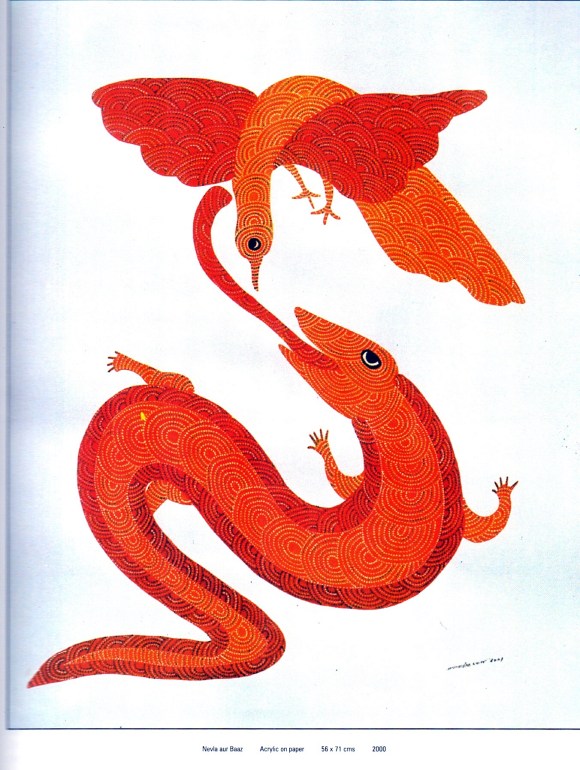
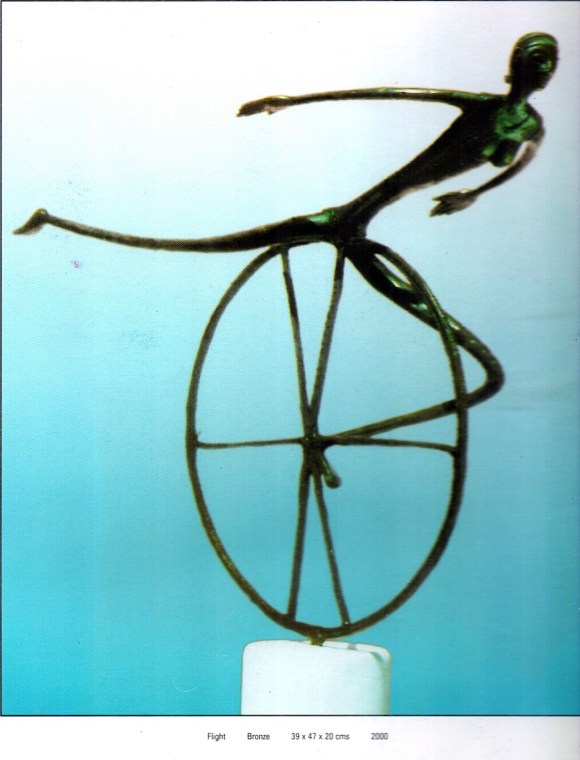
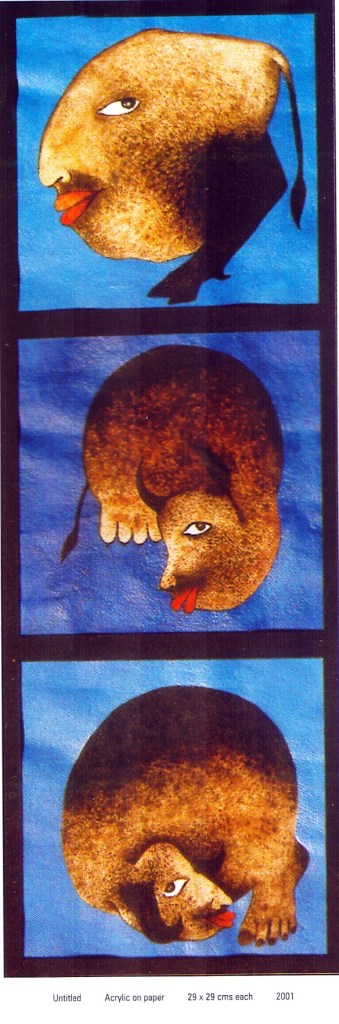
Images from exhibits at Anadi . Provided by Ratnottama Sengupta

On November 1 of 1956 was born a state in Central India called Madhya Pradesh. And 44 years later, on exactly the same day of November 1, in the year 2000 it was remapped. A new state — Chhattisgarh — was carved out of the land that had been home to the oldest Indians: the men and women who had peopled the caves at Bagh and Bhimbetka. 

Standing at the threshold of that new beginning, I had curated an exhibition titled Anadi – that which has no beginning and, therefore, no end. The exhibition card was designed by M F Husain who came on the inaugural day in Delhi. The next day was graced by the presence of Madhavrao Scindia, scion of the royal family that continues to throw up political leaders. I was fortunate to have friends like collectors Anand Agarwal and H K Kejriwal, bureaucrats Bhaskar Ghose and Sarayu Doshi, art lovers like poet Gulzar and artists like Yusuf Arakkal. Happily, then, the exhibition travelled to Birla Academy in Kolkata to Chitrakala Parishath in Bangalore to the National Gallery of Modern Art in Mumbai. And with it travelled a batch of youngsters who were soon to be among the most sought after names in Indian Contemporary Art.

What made that exhibition so special? The card? The multi-venue display? The star viewers? The exhilarating combination of tribal paintings, figurative sculpture, and abstract images? Twenty five years later, I will look back to find an answer.

Images from exhibits at Anadi . Provided by Ratnottama Sengupta

At the intersection of two millennia I was amazed to note there was no rupture in continuity. Anadi offered a fresh look at a continuum that lives on beyond the geopolitical redefinition, because it began at a time when Chhattisgarh was not Madhya Pradesh, nor the Central Province of the Raj. Bhopal, Indore, Raipur, Jagdalpur, Sanchi, Vidisha, Malwa… these cities had no chief minister back then, nor a Prime Minister. Why, there were no Begums nor a Buddha. No Baj Bahadur loved a Roopmati nor did Kalidasa send a Cloud as Messenger. It was a time when the intrepid fingers that harnessed stones and hunted hides also painted rocks to sing of life. In the process – around 10,000 BCE – they crafted the rockbed of Indian Art at Bhimbetka, the UNESCO World Heritage Site mere miles away from Bhopal.

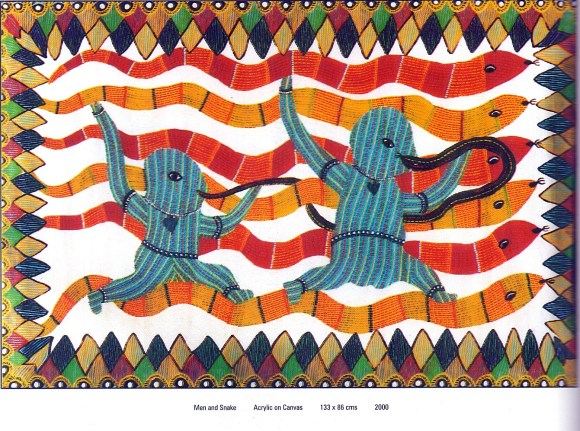
Bare lines that captured with only a twist and a turn the vigor of hunting and the verve of dancing, rock art is that elusive genre which is narrative, figurative and abstract – all at one go. And that is a characteristic common to the tribal stream of art which flourishes in the state from a forgotten past. There is a story in every figure painted by Bhuri Bai or Sukho Korwa. She paints a cart and tells you of the festival day when on its wheels it goes round habitats, collecting all the bimari and driving illness out of the village. He paints a bird that pounces on a snake which devours a rat, recounting the lifecycle that sustains ecological balance. But where is the third dimension? Where’s the likeness to the world of five senses? We see no effort here to evoke either. Instead, there is a stylization which is unique to the region that is home to the Bhil, Gond, Sahariya, Baiga, Saur and other tribes. A stylisation that abstracts the essence of the physical reality they celebrate through colour and line.

Images from exhibits at Anadi . Provided by Ratnottama Sengupta

Dots and crosses, circles and squares all come into play as the vivacious blues and reds, yellows and greens acquire life. A line is not simply a straight line or curve: that would be an unappetising repetition. The quest for variety and individuality finds Kala Bai, Lado, Sumaru break up the lines into an intricate arrangement of countless motifs. When the subject is the same, as too the colour, it’s the dots and crosses, dashes and stars that give the work the imprint of individuality. In the process, these artists who work in a community and send off their creations to markets in distant cities, have worked out a way of ‘patenting’ artistic property. Tradition did not require them to ever sign off a work with their names. In the age of copyright awareness and intellectual property rights, they might put their signatures on the canvas – but the unmistakable imprint of the artists lie in the manner of their assembling the familiar patterns.

That, make no mistake, is the sign of a master, be he in the tribal mould or a modernist. For corroboration, we have only to look at a painting by Maqbool Fida Hussain, N S Bendre or Syed Haider Raza. Madhuri or Mahabharat, Gandhi or Indira, M F Husain constantly painted figures. Eminent and easily recognised ones at that.  And yet, they lived not in the details of their features but in the lines and colours that spelt ‘Husain’ to seasoned viewers. Likewise Bendre’s forms had little concern for photographic realism. In Raza’s case, it is the arrangement of colourful geometrical bindus (circles) and squares alone that speaks of the artist. So, regardless of whether or not there is a ‘McBull’ or ‘Bendre’ inked on the canvas, we readily identify these masters who, incidentally, all came from this same state of Madhya Pradesh.

Images from exhibits at Anadi . Provided by Ratnottama Sengupta

Note one more thing about these names. Each of them had set new watersheds for Indian contemporary art. All of them had opened up new avenues for artists who came after them.  Bendre, the first to head the art education at the Maharaja Sayajirao University of Baroda, gave not just one more centre for mastering the brush. He gave shape to an institution which still assimilates the best of the home and the universe, giving the MSU artists a rare acceptability in India and in the West. Raza, who lived in Paris for years and years, did not sever his umbilical cord with this soil, yet carved a niche for Indianness in the Mecca of contemporary art. And Husain? The life as too the art of this ‘Picasso from Indore’ had become a legend in his own lifetime.  Who else but MF could raise the high water mark at auctions, again at again, at home and abroad? Who but him could open up the markets for Indian artists, including those who preceded him like Jamini Roy?

Images from exhibits at Anadi . Provided by Ratnottama Sengupta

Talking of the masters who opened vistas, especially in the context of Madhya Pradesh, one comes to J Swaminanthan who facilitated a two-way transaction. While holding the reins of Roopankar Museum in Bhopal, he assimilated tribal art to such an extent that he could understand it, explain it, talk about it, write about it and paint after them, using their earth colours, and the bareness of their lines. At the same time, the outsider who became an insider gave, through Bharat Bhavan, all of Madhya Pradesh a new standing in the realm of contemporary art. Artists from all over the country would congregate in Bhopal with their art, exhibit it, discuss it threadbare in seminars, impart it to those keen to learn. Small wonder, the state boasts a host of artists like Akhilesh and Anwar, Seema Ghuraiya and Manish Pushkale, Yogendra and Vivek Tembe, Jaya Vivek and Jangarh Shyam. Artists who steal the attention of the world today.  

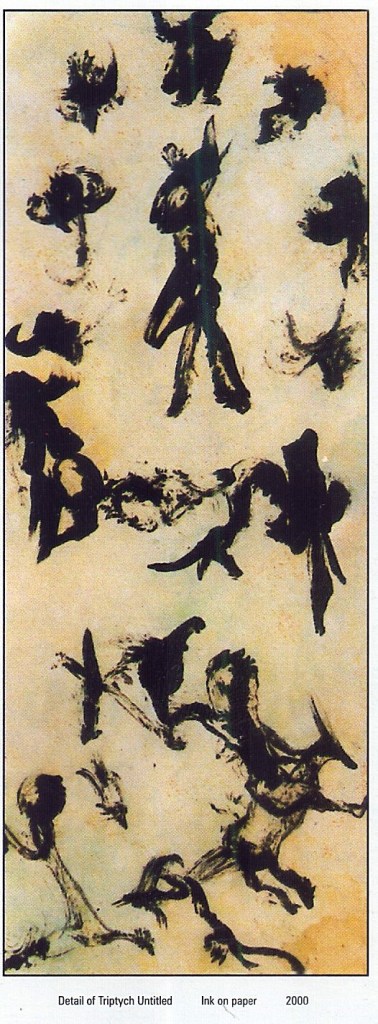
This breed, which was born with the emergence of the state, came of age in artistic terms as the province consolidated its presence on the marquee. And an overwhelming number of them express themselves in just lines and colours. They care not for things like market – which seems to have an insatiable appetite for figurative art. Nor for the narrative tradition of the forefathers who painted on rocks. These neo-masters are all distilling forms, extracting experiences, working out their own equations with abstraction.

But, come to think of it, isn’t this exactly what the original artists of this land – and every other land on earth – set out to do when they picked up the sharpened tool that was millennia away from the paint brush? 

Ratnottama Sengupta, formerly Arts Editor of  The Times of India, teaches mass communication and film appreciation, curates film festivals and art exhibitions, and translates and writes books. She has been a member of CBFC, served on the National Film Awards jury and has herself won a National Award. 

.

PLEASE NOTE: ARTICLES CAN ONLY BE REPRODUCED IN OTHER SITES WITH DUE ACKNOWLEDGEMENT TO BORDERLESS JOURNAL
Click here to access the Borderless anthology, Monalisa No Longer Smiles

Click here to access Monalisa No Longer Smiles on Amazon International

Categories
Poetry

Poetry by Joseph C. Ogbonna


SHE GOT MY HEART SADDENED


It’s a rainy day and it’s wet!

There’s a deluge!

A deluge from my almond-shaped glands.

My piercing love notes to you are all drenched

From this flash flood.

It’s torrential and it moves in sweeping proportions.

Proportions that clear everything in sight that

Characterizes the landscape of my own world.

It first took an insidious dimension with your

Disapproving body language, before it deluged

My entire being with your lack of consent to

My persistent advances and pleas for access

To the Mecca of your halcyon heart.
From Public Domain

Joseph C. Ogbonna is a widely published poet from Nigeria. Some of his works are published in magazines, journals, anthologies and in online blogs. He lives in Enugu, Nigeria.

PLEASE NOTE: ARTICLES CAN ONLY BE REPRODUCED IN OTHER SITES WITH DUE ACKNOWLEDGEMENT TO BORDERLESS JOURNAL
Click here to access the Borderless anthology, Monalisa No Longer Smiles

Click here to access Monalisa No Longer Smiles on Kindle Amazon International

Categories
Review

Heart Lamp by Banu Mushtaq

Book Review by Somdatta Mandal

Title: Heart Lamp: Selected Stories

Author: Banu Mushtaq

Translated from Kannada by Deepa Bhasthi

Publisher: Penguin Random House India

After Geetanjali Shree’s Tomb of Sand, the first novel to receive the International Man Booker Prize in 2022 for a work of fiction written in an Indian language and translated into English, history repeated itself once again when this year in 2025, Banu Mushtaq’s book of selected short stories Heart Lamp, written originally in Kannada and translated into English by Deepa Bhasthi, was recipient of the same coveted prize. It proved that translating from Indian bhasha languages to compete worldwide with other canonical literatures has gained maturity to impress the jury who finally evaluate the prize.

In the twelve stories of Heart Lamp, published originally in Kannada between 1990 and 2023, Banu Mushtaq exquisitely captures the everyday lives of women and girls in Muslim communities in southern India. As a journalist and lawyer, most of the stories are women-centric and in all of them she tirelessly champions women’s rights and protests all forms of caste and religious oppression. As a believer in the highly influential literary movement in Kannada during the 1970s and ‘80s – the Bandaya Sahitya tradition – that started as an act of protest against the hegemony of upper caste and mostly male-led writing that was then being published and celebrated, Banu Mushtaq’s literary career therefore gave importance to dissent, rebellion, protest, resistance to authority, revolution and its adjacent areas at par with the movement that urged women, Dalits and other social and religious minorities to tell stories from their own lived experiences.

The author goes on to highlight several harmful social practices that are still prevalent in the Muslim community and even supported by law, which impede girls including women of all ages, from having freedom to make positive choices, thus hampering them from realizing their full potential. In story after story, the deeply patriarchal structure of Muslim society is depicted in such a manner that it is not only applicable to the Muslims living in villages and town in south India but can be applicable elsewhere too. She shows how child marriage is still in practice and mentions the suffering and trauma women experience because of legally sanctioned polygamy which causes social and financial insecurity and hardship for women and their offspring. The curse of teen talaq[1]and the practice of issuing multiple fatwas[2] which are deliberately aimed at constricting women are urgently in need of being addressed legally.

In the very first story, ‘Stone Slabs for Shaista Mahal’, we find Iftikar’s too much effusive declarations of love for his wife Shaista vanish into thin air immediately after her death and he soon marries a young girl leaving all his children to be looked after by his eldest daughter. The ‘Fire Rain’ has mutawalli[3] Usman Saheb heading the community and making hundreds of decisions for others, but when her sister comes begging he refuses to give her the legitimate share of his ancestral house. Whereas the ‘Black Cobras’ has the mutawalli saheb refuse to help a woman whose husband has deserted her for giving birth to three daughters and provide any support for her youngest sick daughter who dies without any treatment. The story ends with a focus on female revolt when his own wife decides to go and have an operation to stop childbirth. In an interesting story ‘A Decision of the Heart’ the author narrates the plight of a man called Yusuf who is unable to balance the love between his wife and his mother and finally decides to arrange a nikah for his mother Mehaboob Bi.

One story that delves deep into Muslim customs that we generally are not aware of, is entitled ‘Red Lungi’. It tells us about a mass circumcision programme at the mosque for the poor where a young boy Arif undergoes the procedure and is cured in due course. His plight is then contrasted with Samad, the son of a rich man who remains weak and unfit despite the elaborate festivities for his circumcision and the gifts.

The titular story ‘Heart Lamp’ centres around Mehrun who is left to fend for herself as her husband falls for another woman. When she goes to her parents’ house for support, her brothers send her back. Leaving the responsibility of her children upon her eldest daughter Salma, she attempts to burn herself to death. The scene where her daughter begs her to stop and so finally, she aborts her suicide attempt, is extremely moving. The depiction of rural Karnataka comes out very clearly in ‘Soft Whispers’. The story narrates in detail the childhood antics of an eight-year-old girl visting her grandparent’s house in Mabenahalli village. Her young playmate, Abid, who would join her to play tricks, turns into the supervisor of a dargah[4]. When he comes to invite her to join the festival, he keeps his head lowered and does not even meet her eye.

Despite mentioning serious social issues pertaining to the average middle and lower-middle class Muslim families, Mushtaq’s stories are laced with a sense of wry humour and pathos. For instance, in ‘High-Heeled Shoes’, Niaz Khan envies his sister-in-law who comes from Saudi Arabia wearing gorgeous high-heeleded shoes and, in the end, manages to buy a pair for his pregnant wife Arifa which does not fit her at all. The difficulty in walking with those shoes on, and the interaction she has with her unborn child in her womb takes this story to a different level altogether. ‘A Taste of Heaven’ has Bi Dadi, who turns into stone after her ja-namaz [5]is soiled, gaining solace by drinking Pepsi and thinking it to be aab-e-kausar, the nectar from heaven, and starts living in a delusory world of her own in the company of her long-lost husband. In ‘The Arabic Teacher and Gobi Manchuri’, the young Maulvi Hazrat’s penchant for eating “gobi manchuri[6]” is the comic fulcrum on which the story turns. Again, Shazia’s desperate attempts in ‘The Shroud’ to locally procure a kafan[7] and sprinkle it with the holy zamzam water from Mecca after having callously forgotten to bring one for poor Yaseen Bua from her Hajj pilgrimage, makes her grief and being conscience-stricken rather ludicrous.  

In the 2025 International Booker Acceptance Speech Mushtaq said: “This book is my love letter to the idea that no story is ‘local’ – that a tale born under a banyan tree in my village can cast shadows as this stage tonight…. [It] was born from the belief that no story is ever ‘small’ – that in the tapestry of human experience, every thread holds the weight of the whole.”

Her observation power is indeed very strong. Muslim women have been victims of deprivation and discrimination in various matters owing to a dearth in education and awareness. To bring a change in the family, a change in mentality is very crucial. The last story of this collection, ‘Be A Woman Once, Oh Lord!’ is a typical tale of male chauvinism, where deprived a dowry, a man throws out his sick wife and children to get married again.

A woman must construct her own identity besides being someone’s daughter, somebody’s wife or someone’s mother. Only education and self-dependence can establish a woman as a human being beyond her religious and family identities. But as her translator rightly points out, it would be a disservice to reduce Mushtaq’s work to her religious identity, for stories transcend the confines of a faith and its cultural traditions. So, she should not be seen as writing only about a certain kind of woman belonging to a certain community, that women everywhere face similar, if not the exact same problems, and those are the issues that she writes about.

Before concluding, a few words need to be written about the translator and the translation too. In the Translator’s Note, titled ‘Against Italics’, Deepa Bhashti reiterates that the “translation of a text is never merely an act of replacing words in one language with equivalent words in another: every language, with its idioms and speech conventions, brings with it a lot of cultural knowledge that often needs translating too.” She mentions that she was very deliberate in her choice to not use italics for the Kannada, Urdu and Arabic words that remain untranslated in English. She believes that italics serve to not only distract visually, but more importantly, they announce words as imported from another language, exoticizing them and keeping them alien to English. She also mentions that there are no footnotes used at all.  

In her separate International Booker Prize Acceptance Speech, Bhasthi also tells us how through the work they could bring out what would otherwise be unread, uncelebrated texts to a new and very different sets of readers. She stated how the story of the world was really a history of erasures. It was “characterized by the effacement of women’s triumphs and the furtive rubbing away from collective memory of how women and those on the many margins of this world live and love.” Therefore, the stories in this collection are recommended for reading not by reducing Mushtaq’s work to her religious identity, but by transcending the confines of a faith and its cultural traditions.

[1] It’s an Islamic practice in which a Muslim man could divorce his wife by uttering the word “talaq” (divorce) three times.

[2] An Islamic law

[3] Manager of a Muslim charity organization

[4] Tomb or shrine of a Muslim saint

[5] A Muslim prayer mat

[6] Manchurian cauliflower

[7] Shroud

Somdatta Mandal, critic and translator, is a former Professor of English at Visva-Bharati, Santiniketan.

PLEASE NOTE: ARTICLES CAN ONLY BE REPRODUCED IN OTHER SITES WITH DUE ACKNOWLEDGEMENT TO BORDERLESS JOURNAL
Click here to access the Borderless anthology, Monalisa No Longer Smiles

Click here to access Monalisa No Longer Smiles on Amazon International

Categories
Essay

Where the Rice is Blue and Dinosaurs Roar…

By Ravi Shankar

The Kuala Terengganu Skyline. Photo courtesy: Ravi Shankar

The lighting was subtle but magnificent. The transparent minarets glowed red, green, pink, and blue in turn. We were at the Masjid Kristal on the island of Wan Man at Kuala Terengganu in the state of the same name in northern Malaysia.

The mosque is among the most photographed monuments in the Islamic Heritage Park, and we could easily guess why. This is the first intelligent mosque in the country with an IT infrastructure and wi-fi connection. We were glad we came. The reflection of the mosque lights on water was enchanting. Getting around KT — as Kuala Terengganu is lovingly called by the locals — could sometimes be tricky without your own vehicle. Ride hailing services may not work optimally in the peak hours of the evening. We were informed by one of the cab drivers that Maxim is the most popular e-hailing app in the city.  

The population in KT loves to eat out and in the evenings the restaurants are usually crowded. We were staying at the Intan Beach Resort at Pantai Batu Burok and the eating places by the beach were always crowded. The beach is popular with locals with several attractions and rides during the evenings. There is a three-kilometre walking path by the side of the beach. As we stayed right by the beach, we could enjoy early morning strolls on the soft sand.

Panti Batu Burok: Photo Courtesy: Ravi Shankar

The Kuala Terengganu state museum was huge and is located on over 23 acres of land. The museum was officially opened in 1996 and was designed by a well-known Malaysian architect, YM Raja Dato’ Kamarul Bahrin Shah, who also happens to be related to the royal family of Terengganu. The building is designed in traditionally Malay style and the outer façade was left undecorated. There are nine different galleries, and these include the Royal gallery, the historical gallery, the textiles gallery, the Islamic gallery, the handicrafts, the natural resources, the shipping and trading and the marine resources galleries.

Tha Batu Bersurat. Photo Courtesy: Ravi Shankar

The ‘Batu Bersurat’ (lettered stone) is the museum centrepiece and of great significance to the state. The stone is estimated to be 700 years old and mentions the position of Islam and the application of Islamic laws in the state. The stone is written in the Jawi script using Arabic characters. Jawi script is still used in Terengganu though in many areas Malay is written mostly in the Roman script. In the museum grounds, there is a good collection of different old cars and other vehicles used by the King and Chief Ministers of the state.  

The Islamic Heritage Park is a major attraction located on the island of Wan Man. The park has small scale replicas of famous global Islamic monuments. Among the monuments represented are the mosques at Medina and Mecca in Saudi Arabia, Dome of the rock in Jerusalem, the Taj Mahal in India, and a mosque in Aleppo, Syria. The national mosque of Malaysia and mosques in Singapore, Indonesia, Pakistan, Iran, China, Tatarstan, Uzbekistan, and Iraq are also on display. Replicas of these famous monuments were displayed in the vast gardens of the monument. I liked this concept, and the monuments were well maintained except one or two that may require more attention.

The sun was hot, and I had to drink copious amounts of water.  In the evening, my friend, Binaya, and I went to the floating mosque situated in Kuala Ibai Lagoon near the estuary of Kuala Ibai River, 4 km from Kuala Terengganu Town. The mosque combines modern and Moorish architecture, and is a white structure situated in five acres of land. There is also a floating mosque in Penang.

The next morning, we went to the Science and Creativity Centre. The centre is housed in a huge, modern building. There are multiple galleries to explore. I was fascinated by the stainless-steel exhibit showing the structure of DNA, the blueprint of life. The encounter with the dinosaurs was the highlight of the trip. The dinosaurs were colour coded in red (dangerous), yellow (exercise caution) and green (safe). Tyrannosaurus Rex was the highlight. Raptors, allosaurus and other dinos filled the hall with their cries and screams. The Stegosaurus had scales on the back. When I was young, I was a big fan of Phantom comics created by Lee Falk and Phantom had a stegosaurus as a pet. The inflatable dome on the top floor had a delightful cosmic show and you can see the universe projected above your head. The museum had plenty of things to see and do and is a big hit with children.

The Masjid Sultan Ismail Chendering has delicate artwork and is built entirely in white. The simple design and the beautiful artwork had me mesmerised. The mosque has a long history. The small Lebai Zainal Mosque which could accomodate150 people was first built near the current location of the mosque before being replaced by the Raja Chendering Mosque and then replaced again by a new mosque which is the Sultan Ismail Mosque.

Soon it was time for lunch. There are plenty of food options near our hotel. I enjoyed nasi kerabu, a Malaysian rice dish, in which blue-coloured rice is eaten with dried fish or fried chicken, crackers, pickles and other salads. The blue colour of the rice comes from the petals of Clitoria ternatea flowers, which are used as a natural food colouring.

In the evening, we went to see the Abidin Mosque which is Terengganu’s old state royal mosque built by Sultan Zainal Abidin II between 1793 and 1808. The Royal mausoleum is located next to the mosque. Istana Maziah, the official palace of the Sultan of Terengganu is located close to the mosque at the foot of the mountain, Bukit Puteri. The palace is the official venue for important functions such as royal birthdays, weddings, conferment of titles and receptions for local and foreign dignitaries. We wanted to climb Bukit Puteri, but the place was under renovation and closed.

We continued along the waterfront to the Shah Bandar jetty. A cool breeze was blowing, and many people were strolling along the promenade. We were moving toward the Kuala Terengganu drawbridge constructed in 2019 inspired by the London drawbridge. We waited for the sky to darken so that we could see the lights on the bridge.

Photo Courtesy: Ravi Shankar

Buses from KL take the highway to Kuantan and then bypass the town. The journey continues to the town of Paka and then takes the coastal highway through Dungun. Some parts of this state reminded me of my home state of Kerala in South India. Plenty of coconut trees were seen. Coconut trees grow so well in Kerala and in many areas along the west coast of India.

The expressways in Malaysia are well-designed and maintained. Traveling on these are usually a smooth experience though they get very crowded during major holidays when people leave Kuala Lumpur for their hometowns and villages. KT is about 400 km from KL and takes around eight hours by bus. Malaysia’s northern state on the East Coast can be a good getaway. The town and the state has culture, history, natural beauty, delicious food, and serene beaches. The islands off the coast were still closed. Redang island was mentioned to be one of the most beautiful islands in the world. Hopefully, we will visit these during our next trip. God willing, we shall!  

.

Dr. P Ravi Shankar is a faculty member at the IMU Centre for Education (ICE), International Medical University, Kuala Lumpur, Malaysia. He enjoys traveling and is a creative writer and photographer.

.

PLEASE NOTE: ARTICLES CAN ONLY BE REPRODUCED IN OTHER SITES WITH DUE ACKNOWLEDGEMENT TO BORDERLESS JOURNAL
Click here to access the Borderless anthology, Monalisa No Longer Smiles

Click here to access Monalisa No Longer Smiles on Kindle Amazon International

Categories
Slices from Life

Moonland

Photographs and text by Rupali Gupta Mukherjee

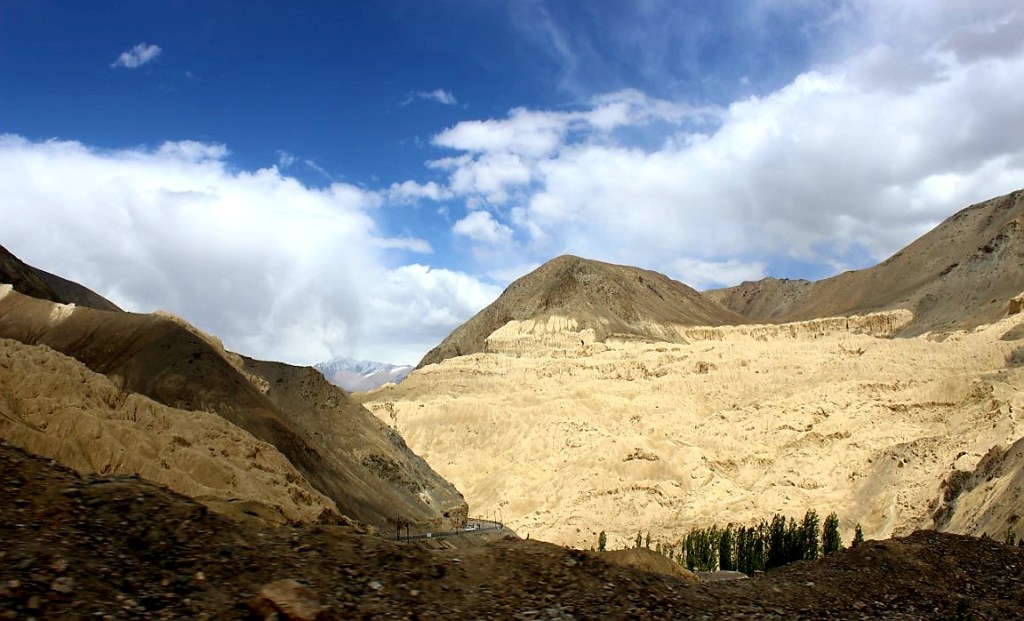
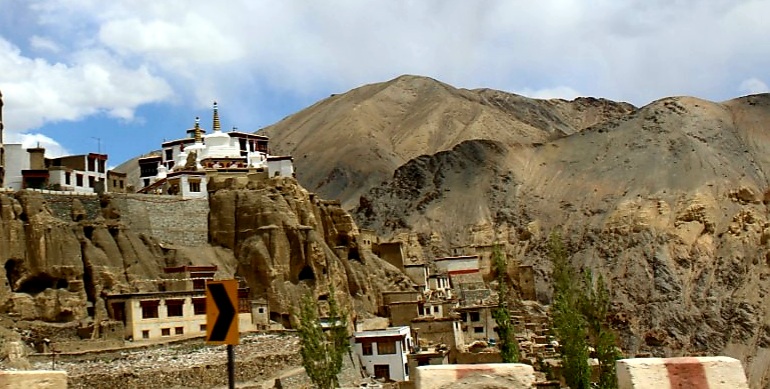
‘The journey matters more than the destination’, this quote came to my mind innumerable times, as our creamy white Xylo sped up from Kargil, crossed the majestic Fotu La pass on the Srinagar Leh highway. My eyes were glued to the splendour that Mother Nature had bestowed copiously all around us. Our driver, a calm, composed friendly person was fairly careful during the sharp turns, twists and terrifying bends. We were headed towards Leh, capital of Ladakh. On our way, roughly hundred kilometres before Leh, we found ourselves in the land of what seemed like strange, supernatural mountains made of rocks that shimmered and changed hues. 

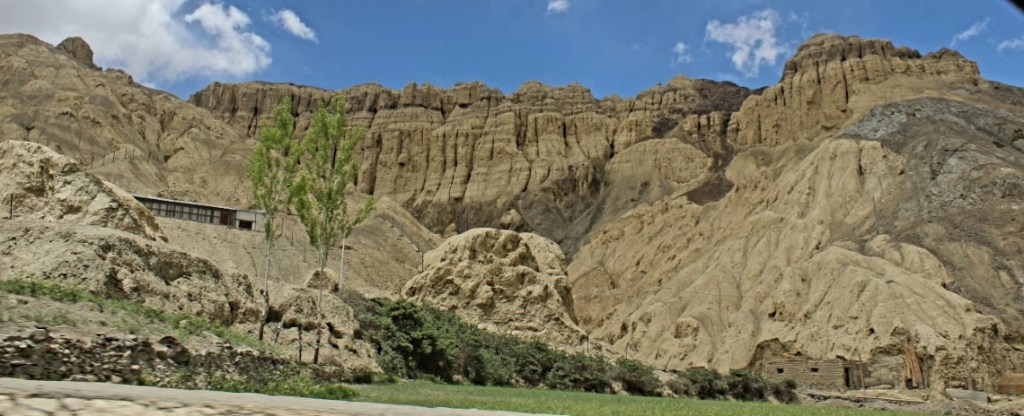
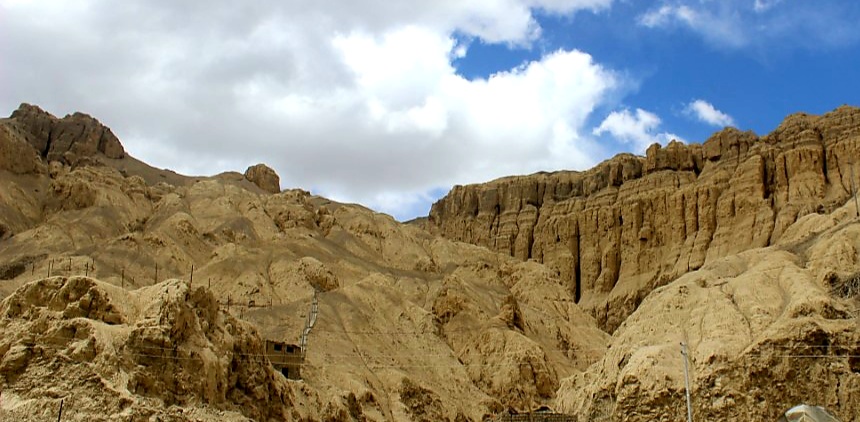
The colours shifted from grey to chocolate brown, crimson to mauve and azure. It was divine. I sat with my camera, filled with awe and wonder of the breathtaking peaks that lay before me and left me mystified.  I was totally smitten. More surprise along the way held me spellbound.  

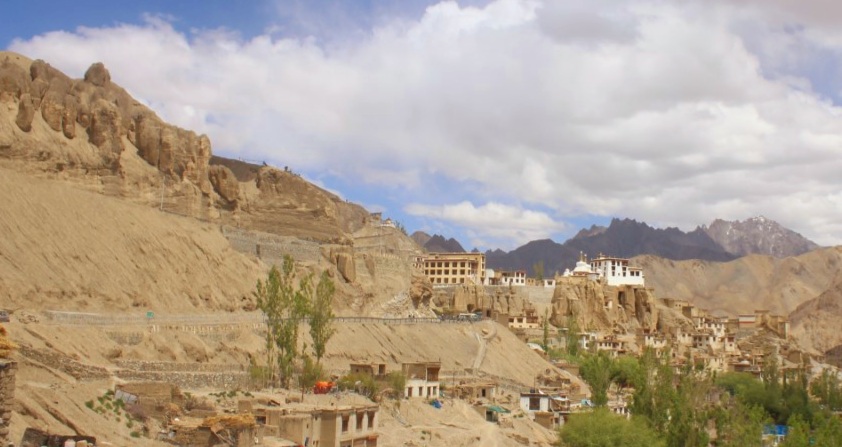
After the barren desert that stretched before us, at the next hairpin bend, was an amazing ancient Tibetan Buddhist Monastery peeping out from the hideout of the world’s most imposing mountain ranges. It was a dreamland, a land of fantasy. I pinched and asked myself, ‘Is this a reverie?’ But no. It was real.

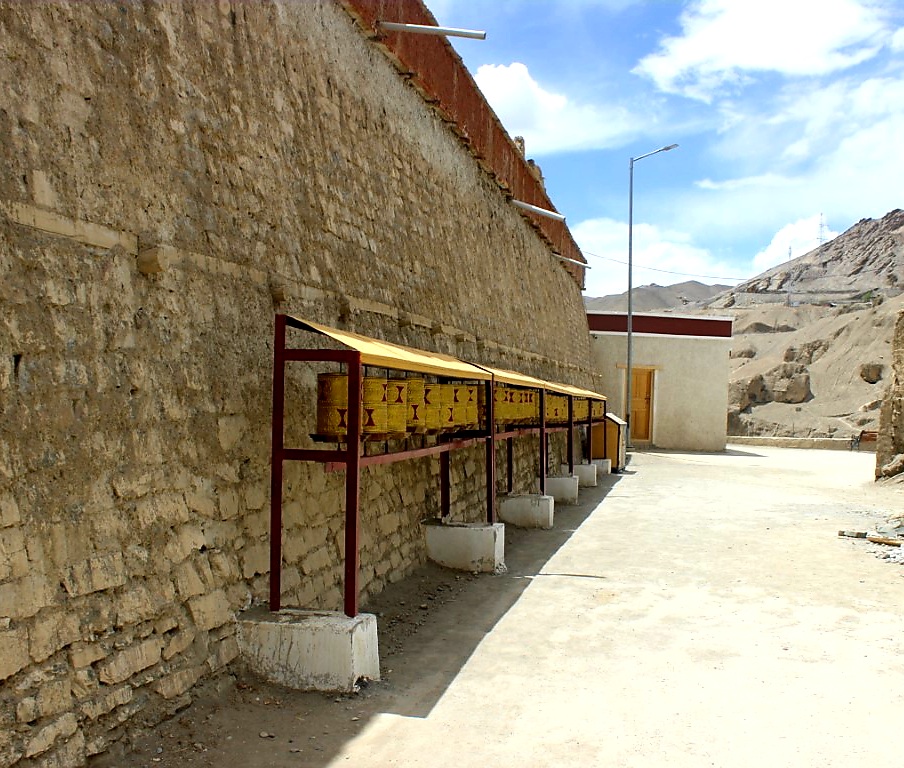
The lunar landscape that greeted my camera on this Earth was synonymous to the legendary ‘Moonland’.  The primeval Lamayuru monastery towered in the unreal moonscape. It dates back to the 11th century. According to myths, a scholar named, Mahasiddhacharya Naropa, had laid the keystone of this mesmeric building. It was said due to his mantras the water in this region retreated and the vicinity took the shape of moonlike alcove and craters.

The setting bears a semblance to the lunar highlands. The profound darker part of the mighty hills is said to be the replica of ‘Maria’, a common panorama found on the surface of the gorgeous silver disc, the shiny crescent in the cobalt diamond studded night sky.

I found the landscape hypnotic and ethereal; its exceptionally outlandish ecological structure made Lamayuru monastery unique and idiosyncratic. 

A drive through this moonscape imprints an incredible chronicle in the mindscape of the traveller. This journey stretched like an implausible odyssey beyond my imagination. It was as if I was watching a documentary on National Geographic.

Almost a month after returning from the trip, I still feel mesmerised by the ghostly ‘gompas[1]’, the atypical topography, unknown terrain, unfamiliar cold weather. They beckon me to go back and explore further. No wonder, several voyagers fondly portray Lamayuru’s ‘lunar’ landscape as the ‘Mecca of an adventurous soul’. I promised myself to be back in this magnetic landscape once again, this time on a full-moon night, when the silvery ribbon of moon beams scatter over the baffling purple structures of Lamayuru, bathing the compelling peaks in shimmering platinum dust. Undeniably its startling tinge would be the marvel of art if some artists managed to capture the hues.


[1] Buddhist structures

Rupali Gupta Mukherjee has a passion for reading, writing and reciting poetry.   She is a nature enthusiast, loves to travel and has a zeal for photography.

.

PLEASE NOTE: ARTICLES CAN ONLY BE REPRODUCED IN OTHER SITES WITH DUE ACKNOWLEDGEMENT TO BORDERLESS JOURNAL
Categories
Essay

Kabir & His Impact on Tagore

By Mozid Mahmud

Kabir. Courtesy: Creative Commons

Kabir’s life still holds importance in a society in pursuit of the one true Lord, steeped in religiosity and caste. He was born at a time when the Hindu-Muslim strife was raging across the subcontinent. Divided into various sects, Hindu society was already engaged in conflict and the arrival of the Muslims and the expansion of Islam intensified the conflict of the time. The two camps – followers of foreign and indigenous religions – could not find a way to come together. Arbitrary rituals and sacrifices were damaging their dignity and short-selling God’s glory. In such a time, Kabir was the most significant of intellectual sages who bridged gaps through his clarity of thought, unwavering devotion to the Lord, and humanist reading of all belief systems. In simple, clear and logical language he pointed out the irrationalities of men, without outright attacking any faith. His teachings were not only effective to his devotees but were helpful to adherents of other doctrines as well. One did not have to be part of his sect to receive his teachings and capture the meaning behind his words. Anyone free from the shackles of self-interest were able to accept it.

Though there is little to deny in Kabir’s words, there is much debate among the experts regarding the period of his birth and death. The historical facts contain many contradictory components as well. Evidently, one sees that there are two versions of Kabir’s life visible. One has been constructed through analysing historical data, the other through beliefs and commentary provided over the ages by his followers and devotees, though all such projection by his disciples cannot be understood in the same light. Yet it should be noted that the accuracies regarding some of Kabir’s facts of his life do not pose any doubt to his teachings and appreciation for beauty. Still, in light of the contemporary commentary, a brief biography of the poet is outlined here.

According to Kshitimohan Sen (1880-1960), a scholar and acting chancellor of Visva-Bharati, Kabir was born on 1398 in Varanasi and died on 1518 in Maghar village. While specifics are understandably hard to gather, most experts agree that he was of the time when Sikander Lodi (1458-1517) ruled over Delhi’s throne. Kabir had met the man, too. Lodi had arrived at Varanasi in 1498. Rabindranath had talked of this in his translation of Kabir’s One Hundred Poems, which was published from Macmillan. There, it is said he was born in 1440. Though Kabir’s Hindu devotees liken him as a devotee of the Vaishnava poet-saint Ramananda, it is still a matter of debate, for Ramananda was born in 1298 and most texts that refer to their connection can only be traced a hundred years after Kabir.  

In his writings, mentions of the poets Jayadeva (1170-1245) and Namdev (1270-1350) are found. Though one was active in the 12th century and the other in the 14th. Moreover, one can find references to Kabir in the works of Raydas, Garib Das, Dharma Das, Pipa and Tukaram. Some of Kabir’s verses can be found in the Sikh religious text Guru Granth Sahib too.

There is much debate over his parentage and religion too.  However, it is taken as fact today that he was born in a Muslim family or was raised in one. It is hypothesised that he had come from a family of Muslim weavers, who had a trade in cloth. Another legend had him as the virgin son of a Brahmin woman, born through seedless conception and then he was abandoned and found floating in a basket. The fact that he was born in a Muslim family is mostly evidenced by the fact that he had an Arabic name, which meant “Great”. There is further doubt on his race and caste. According to Hazari Prasad Dwivedi, Kabir belonged to a Yogi community, for he would refer to his father as Gosai, meaning Guru. They were principally disciples of Nath-Panthis – worshippers of Shiva. While they had accepted Islam as their religion, they continued in their old ways as of yore. But Kabir did not proclaim himself as either a Hindu or a Muslim. As a result, many surmised that he probably wanted to be known as someone from the lower caste, who remained out of these two binaries.

The issue of caste might have irked him as well. It might have had no importance to him. This reticence had led to most communities intending to co-opt him for them, constructing all sorts of imaginary relationships. A Muslim guru of the time, Sheikh Taqi, had complained to Lodi that Kabir saw himself as a deity. His low-born caste led him to a path of constant discrimination. There are accounts of this discrimination in texts. He had been humiliated for proposing the idea of a formless God. Many a time he had been tied behind his back and beaten up. Let me account some of the accounts of his torture here.

The Emperor of Delhi, Sikander Lodi, had demanded Kabir be arrested and brought to his court. When he was somehow brought over, he stood there in silence.[i] The Emperor grew angry and asked, “Why don’t your curse at the Emperor, Kaffir?”
Kabir answered, “Those who understand the other’s torment are called Pir, and those who don’t are termed Kaffirs.

When the Emperor asked him why it took him so long to get to his court, he replied that he had seen such a scene on the way that he could not but be late. A line of camels was entering a gully as narrow as a needle’s eye. The Emperor thought he was being ridiculed and grew angrier. But Kabir said, “Oh Emperor! Can you feel the distance between the heavens and the Earth? The distance between the Sun and the Moon can be filled with innumerable elephants and camels, yet we can see these stars through a drop in our eyes.” The Emperor was so moved by the statement that he let him go.[ii]

Once, after a few Brahmin priests had complained, the Emperor ordered his death by tying him to a stone and throwing him off a boat. But while the boat itself drowned, Kabir was said to have been found unharmed and floating. When they tried to burn him, the fire wouldn’t take to his skin. They even accused him of being a witch and tried getting a mad elephant to stamp on him. But the animal got scared seeing Kabir and ran away – there are numerous myths of these nature surrounding Kabir.

Kabir did not receive a formal education. He did not know how to read and write. There is no evidence of him attending a school to learn of language and philosophy. Moreover, he had barely any experience with his weaving. Many are of the opinion that the “guru” he talks about in his texts refer to God or the Creator and that he did not have any mentors. However, researchers at times hold the opinion that he was a devotee of the Sufi mystic Sheikh Taqi. It is evident he was influenced by Sufism.  He had similarities with the Persian poets Attar, Hafez, Khayyam and Rumi. Besides, he was considered a key disciple of the Hindu monotheist mystic Ramananda. Kabir hadn’t mentioned anyone directly in his texts. But through his songs, various interpretations are made by the public. Kabir’s best teacher seems to have been just life. The hypocrisy, short-sightedness, superiority regarding one’s beliefs and inconsistencies of men and society around him angered him, it made him anxious. This torment had put him to the path of sage hood. Kabir characteristically expressed his perceptions through simple and irrefutable arguments devoid of any personal animosity toward anyone.

Kabir was not an ascetic who abandoned his family to attain higher forms of consciousness. He lived with his wife and son and daughter. In his writings, he showed contempt against the sages who left their families. His wife was called Loi and his son and daughter were Kamal and Kamali. His second wife was Ramjania. According to Dr Ramkumar Verma, the second wife was possibly a prostitute. However, Kabir was not quite happy in his marriages. His devotion to his poetry and philosophy made him less attentive to the task of earning a livelihood through weaving.  Some days, his family found themselves short of food after feeding his visiting devotees. He was thin, meditative and enthusiastic, and hated to beg for alms to survive.

We know from his works that he visited many places. It is believed he had gone on pilgrimage to Mecca. But it isn’t clear if he really physically visited the place or had a transcendental experience. Similarly, there isn’t any evidence of his visiting Baghdad, Bukhara and Samarkand. But it has been proved that he had visited many of the local pilgrimage sites around him.

Like his birth, the date of his death is cloaked in controversy. Some say he lived till the age of eighty. Others maintain that he was alive when he was 120. There’re broadly four dates that could refer to his passing. 1447, 1511, 1517, and 1518 AD.[iii] There is doubt, too, about his resting place. Some say he died in Ayodhya, some claim in Puri. The latter place is mentioned in the Mughal Emperor Akbar’s book Ain-i-Akbari.

Kabir’s literature and philosophy

The divisions and discriminations of religion had a profound effect on him. The communal conflict and the blatant ownership of God deeply tormented Kabir. He realised that God did not exist for any particular religion or people. He wasn’t a single entity either, but omnipresent. His realisations were a result of the overarching philosophical conflicts of his time. The clash and assimilation of various cultures into the Indian way of living had given way to myriads of philosophies and religions in the region. Among them, the radical ones, which professed to one sect’s superiority over the other were beginning to widen separatism in society. The first of these great conflicts were between the Aryans and Non-Aryans. It took many years for the two to assimilate.

Kabir and Rabindranath

Rabindranath had a prominent role in spreading Kabir’s words in Bengal. About a hundred years ago in 1910, he had written a preface to a book of translations of Kabir’s poetry. Kabir was among the few poets whose works were preserved at Santiniketan. Kshitimohan Sen had grown up in Varanasi, among the saints there, nursing a love for Kabir from a young age. A few months before his translations had come out from Santinektan’s press, Rabindranath had published Gitanjali. It was not possible to avoid drawing comparisons, with some claiming Rabindranath was inspired by the sage’s poetry. In Prasanta Kumar Pal’s biography of Tagore, the matter is discussed at length. He had written that in the original manuscript of Gitanjali, there were poems of various poets of such ages written over. Dr. Rameshor Mishra thought they were written by Rabindranath, but Pal could not agree with him. He had maintained that Kabir had been well-known as a poet over the years. Even before Kshitimohan’s translation, it would not have been unlikely for the young poet to have been aware of Kabir. Kshitimohan himself had dwelled on the matter saying that he had introduced Kabir’s poetry to Rabindranath after reading Gitanjali and finding the similarities in the balance of tone.

Whatever the case was, the fact that Rabindranath and Kabir wrote in a similar spirit cannot be denied. Rabindranath was heavily influenced by the Persian Sufis. One could clearly see the presence of both Sufism and Vaishnavism in Gitanjali. Rabindranath’s father was a devotee of the Persian poet Hafez. Hafez impacted Rabindranath as well. He had talked about this when visiting Iran at the end of his life. “My father was an admirer of Hafez,” he had said, “I have listened to his recitations and translations many a time. It is that beauty of Iran that has entered my heart during my travels here.”[iv] Around this time, he was studying Sufi theory as well. Therefore, one cannot claim it was solely Kabir who had an influence on Tagore’s Gitanjali. But Kabir did have an effect on Rabindranath, if for a little while.

Rabindranath began to work on Gitanjali in the early 1900s. He had written to Kshitimohan around then, saying, “I have been expecting Kabir. Do not delay.” The next year he wrote back to say, “Give my respects to him.”[v] From these letters we can see that Rabindranath had a good deal of interest in reviving Kabir. In one of those letters, he had maintained, “I have told you. One should not deviate from the principle aspect. If there is ambiguity regarding the literalness, then be it. Some of it is needed, or else the poetry loses some of its meaning.

“It is better to use the next most literal word when there is no direct translation possible. Kabir uses ‘word’ to express his songs and it seems that particular word does not work in all instances. There is a historicity to ‘word’ – one thinks of a child’s first cry, the first chants of creation. It is quite simpler and more complex than a song.”

Published as part of Santiniketan’s book series, Kshitimohan wrote in the preface of his translation that without the encouragement and help of Rabindranath he would not have been able to publish a work like this, that he was quite grateful to him. Rabindranath had a hands-on approach to Kabir’s translated poetry. That this happened around the time the poet was working on Gitanjali was a thing of co-incidence. Kshitimohan himself had talked of how he had brought Kabir to the poet’s attention after hearing about Gitanjali.

However, the matter has refused to die down. In books on Kabir, there have often been calls for Rabindranath to recognise the debt of Kabir in his texts, that Tagore’s mysticism had arrived solely from Kabir, which was merely given an occidental polish to accommodate the Poet’s international audience and that Rabindranath’s fame came from a decoration of mysticism for the pleasure of Europeans. Even as one notices the ludicrousness of such claims, it is understandable that much of Rabindranath’s spiritualism is a product of Sufi mysticism. Moreover, there was always a strain of India’s old traditions that included Kalidasa and the worship of beauty. He had discovered the bauls (minstrels) when looking for folk literature in his youth. He was fascinated with Lalon. However, Kshitimohan Sen had claimed that Rabindranath was not one to be heavily influences by these mystics. “The era of Gitanjali came head-to-head with the revival of these mystics. No one is indebted to anyone here.”

But how much of Kabir was on Rabindranath’s mind? Many would go ahead and say a great deal. That he had devoted to Kabir more so than Gitanjali in this period. Perhaps the indulgence toward both texts was a united effort in the pursuit of true worship. Two events around this time are noteworthy. One is Ajit Kumar Chakravarty’s translation of Kabir under Rabindranath’s guidance and the other is his own translations of Kabir. This was when Ezra Pound, too, was interested in Kabir’s poetry. There is no doubt that it was Tagore who had got Pound into it during their discussions on mysticism. Helped by his encouragement, Pound, who had little knowledge of Hindi or Kabir, made ten translations of Kabir’s poetry with the help of Kalimohan Ghosh. They were published in the 1913 January issue of Modern Review under the title, “Certain Poems of Kabir/ Translated by Kali Mohan Ghosh and Ezra Pound/ From the edition of Mr. Kshitimohan Sen.”

Rabindranath could have had the biggest scandal in his life regarding Kabir due to Ajit Kumar’s English translation. Ajit Kumar had decided to translate about 114 poems from the 4-volume work of Kshitimohan Sen while enjoying his summer vacation in Orissa. He was helped by Pearson. Rabindranath had to face quite a lot of criticism after winning the Nobel, both at home and abroad.

In his travels to America and Britain, he had to explain the mysticism apparent in Gitanjali. Moreover, when the text was published there, many Christian preachers had taken to saying that Christ had said it way before already. That Rabindranath had written these inspired by Christ’s sayings. This was a reason why Rabindranath felt it was important for the West to be acquainted with medieval poets and mystics such as Kabir, so that the long Indian tradition of spiritualism wasn’t co-opted by the West as one of their own. He even wanted to take Kshitimohan there and get to translating some of this poetry himself. He wished to show that the sages in India were preaching these truths long before the Europeans had arrived in their shores. If there is a sliver of debt that Rabindranath should recognise it is in this context. Gitanjali is not a deviation from Indian poetry; rather it is part of the land’s grand tradition. However, Rabindranath’s own translations did not seem to have gone far enough. He relied on Ajit Kumar’s.

Before leaving for America, Rabindranath was introduced to Evelyn Underhill, a Catholic writer and pacifist. She was a great admirer of both Jesus and Indian mysticism, authoring a book on the subject in 1911 called Mysticism. Rabindranath had referred to her as quite highly educated and influential in his letters. Tagore had even told Kshitimohan that with her help it would be possible to publish Kabir’s biography and poetry from Harvard University, urging him to take all necessary equipment with him. He had told Ajit Kumar that with the help of Ms. Underhill they would polish their translations and make it worth publishing. A review of the correspondence is enough to see that this translation project would come out under Ajit Kumar’s name. But that did not happen in the end. It came out as One Hundred Poems of Kabir, as translated by Rabindranath Tagore with a preface by Underhill.

Both Ajit Kumar and Kshitimohan were upset with this. How this had happened no one could know clearly. Whether it was Underhill’s doing or of Rabindranath himself, one could not know. From reading Rabindranath’s letters, it was quite evident that he had also thought the manuscript would come out under Ajit Kumar’s name. He had assured him as such in more than one letters. That Underhill might cut him out bothered Ajit and Rabindranath had written to him saying, “You have misunderstood. Evelyn does not wish to take your name off the Kabir Manuscript. Secondly, it is not my wish to leave you and Kshitimohan out financially.” In another letter he had said, “I don’t know how your book would do financially. Of course, there won’t be any lack of trying, but it is better to not hope much. Be content with what they give you.” [vi]

All we have in this case are conjecture. No concrete facts. Underhill in her preface had merely thanked Ajit and Kshitimohan and nothing more.

This had sparked a bit of controversy then and Rabindranath was accused of depriving Ajit Kumar of his credit. Rabindranath’s explanations regarding this matter was that it wasn’t intentional. That he did not even know this had happened until it was too late. It was Macmillan house that did this to bring more sales to the book. Rabindranath claimed to have sent in Ajit’s name under the title, but the publishers had disregarded it. It was the West’s commercialism at play, he said.

“Getting into the literary scene here is quite difficult. One is hard-pressed to enter if they don’t possess any reputation beforehand,” he said. But whatever Tagore’s excuse was, many did not see it sympathetically. Referring to his letters to Ajit, many pointed out his growing fascination with the manuscript. In one of the letters Rabindranath had said, “I finished the Kabir book after all this while. It seems that if I had done these translations it would’ve taken me far less an effort to read them through. I’ve had to write many poems but yours does make one clap.”[vii] There is no doubt that Rabindranath got most of the credit for the Kabir book that Macmillan had published. But many found the omission of Ajit had left a bad taste. Many felt his name should have at least been part of the conversation.

Bibliography

  1. Rabindra Kokkhopothe Khitimohan Sen By Pranati Mukhopadhyay
  2. Gurudeb O Shantiniketon  By Syed Mujtaba Ali
  3. RabiJiboni By Prasanta Kumar Paul
  4. 100 poems of Kabir By Rabindranath Tagore

[i] Who Invented Hinduism: Essays on Religion in History. David N. Lorenzen

[ii] The Bijak of Kabir. Kabir. Oxford University Press.

[iii] Bharatiya Madhyauge Sadhanar Dhara. Kshitimohon Sen. Pg.61

[iv] “Rabindranath Tagore’s Syncretistic Philosophy and the Persian Sufi Tradition”. Lewisohn, L

[v] Rabijibani Vol. VI, Prasanta Kumar Paul, Ananda Publishers, Kolkata. Pg.414

[vi] Rabijibani Vol. VI, Prasanta Kumar Paul, Ananda Publishers, Kolkata. Pg. 416

[vii] Rabijibani Vol. VI, Prasanta Kumar Paul, Ananda Publishers, Kolkata. Pg. 370-371

Mozid Mahmud is a poet, novelist, and essayist based in Bangladesh. Some of his notable works include In Praise of Mahfuza (1989), Nazrul – Spokesman of the Third World (1996), and Rabindranath’s Travelogues (2010). He has been awarded the Rabindra-Nazrul Literary Prize and the country’s National Press Club Award, among others.

.

PLEASE NOTE: ARTICLES CAN ONLY BE REPRODUCED IN OTHER SITES WITH DUE ACKNOWLEDGEMENT TO BORDERLESS JOURNAL