One hundred and four years ago you were
composing your words like a violinist was
composing musical sounds. Your words are
alive still, quivering with beauty, delirium,
and the sobs of time, as the violin strings
reach a crescendo of the loudest order.
I see your words on the page bleeding. I
feel the sharp sea breeze as if I was out
at shore. I look up at the cluster of stars,
which are your words, soft and compact
one moment, and loud and exploding
the next. Your instrument cries out loud
as if death is on your trail. You lived only
for twenty-six years. Yet, you are still alive
with these words I am reading now. Perhaps
in a hundred and four years I should be
so lucky, for someone to find mine.
WHO MOVES TIME
Who or what moves
time like the sky
moves clouds? We
cannot move time
as it inhales and
exhales its evil.
Time has no heart
or arms to lift
our burdens. Mute as
a field of weeds,
time is hard to gauge.
Like air it will not
stay in one place.
It follows its own
rules -- slow when
you are rushed, fast
when you need it
to last longer.
THIS HOUSE
This house I live in
is made of air.
If you look up at
any time of day
you will see stars,
the moon, the sun,
and clouds. It is
all windows all
around and no
walls. If you look
down, there is grass,
dirt, and cement.
I do not need doors,
plumbing, or a stove.
I keep it real
simple with a soft
pillow and thick
blankets. People
give me stuff like
food and water, a
dollar or enough
change for a hot
meal. I do not pay
rent or utility bills.
I move a lot, not
always willingly.
You know the grass
could be greener,
but I settle for
what I can get.
NOTHING BUT EMPTINESS
I left nothing
but emptiness
and useless
meanderings
for you to digest,
sparse ideas
and drunken
diatribes to
moist your
appetite.
There is more
of nothingness
I could offer,
but I do not
have the heart
to do that.
Born in Mexico, Luis Cuauhtémoc Berriozábal lives in California and works in the mental health field in Los Angeles, CA.His poetry has been published by Blue Collar Review, Borderless Journal, Escape Into Life, Kendra Steiner Editions, Mad Swirl, SETU, and Unlikely Stories.
PLEASE NOTE: ARTICLES CAN ONLY BE REPRODUCED IN OTHER SITES WITH DUE ACKNOWLEDGEMENT TO BORDERLESS JOURNAL
How can anybody comprehend Beijing, one of the largest and most ancient cities on Earth? Its origins date back three millennia, but Keith Lyons tries to get a sense of the real Beijing in just full three days.
Photos provided by Keith Lyons
Day Three*
After a series of false starts on the previous day, when I’d thought I would be ticking off Beijing’s main iconic sights, for my third and final day in the city I took a different approach. Instead of heading into the heart of the capital, I sought out enclaves that were more on the periphery of the megacity, both literally and figuratively.
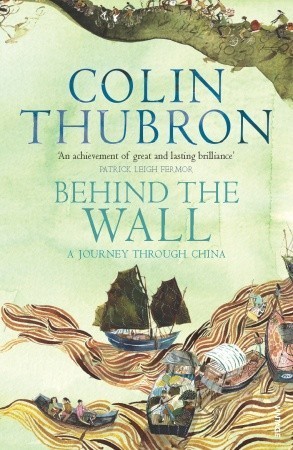
I’d been reading the accounts of Colin Thubron’s visits to China, including his 1987 book Behind the Wall which started in Beijing. Feeling displaced in the impersonal capital, his impression of Beijing was more of a building site than a city. “I tramped its streets in disorientation, looking for a core which was not there.” He found Tiananmen Square arid and couldn’t wait to get out of the city. “The fission of solitary travel — travel in a boyish euphoria of self-sufficiency — tingles in my stomach as I march across Beijing’s railway station,” he writes as he sets off on his travels around the Middle Kingdom as it emerged from decades of Mao and Cultural Revolution oppression.
Looking back on the previous day’s ‘failures’, I tried to reframe the disappointing experiences as learning, rather than ruminating on the rejection I felt after not getting inside the Forbidden City.
One turning point in my journey was coming across a quote from Robin Sharma while thumbing through a bilingual personal growth book that sat among the artsy and anime library at my new accommodation, the hipster co-working space and ‘serviced apartment boutique hotel, ’ Stey 798. Initially when I saw the pull quote in English and Mandarin, I thought to myself, “What a douchebag; it’s fine for the business guru to say, having made millions spouting his stuff to the likes of Microsoft, IBM, General Motors and FedEx.” But then I reflected on the words and realised the truth in them: “There are no mistakes in life, only lessons. There is no such thing as a negative experience, only opportunities to grow, learn and advance along the road of self-mastery.”
I wasn’t exactly on the road to self-mastery when I found myself lost, tired, bothered and despondent on an unnamed minor road on the outskirts of Beijing. However, I realised that some of my preconceptions had been limiting.
For example, the fixed idea that because Beijing was big and busy that it would be dangerous to hire a bike and cycle around. There were rows and rows of identical-looking bicycles for hire at every street corner, wide separate cycle lanes, and lots of visitors navigating successfully around Beijing by bike. If I’d been on a bike the previous day, I could have cycled right through Tiananmen Square rather than circle wide around the massive open space (though security personnel will still make sure you don’t stop to take photos at the best spots).
So, note to self (and to others), try exploring Beijing on bike rather than just using the subway, taxis, or buses. To make bike hire possible, get a Chinese SIM card, install Mobike, and set up payments via WeChat and Alipay, so you can use the lockless sharing bikes provided by Meituan (yellow bikes), Didi Bike (green) and Hello Bike (blue) simply by scanning QR codes, or unlocking bikes with Bluetooth.
I’ve since learnt some bike hire operators can loan high-quality bikes, with English-speaking staff who deliver bikes to your hotel. So even without a smartphone connected with a local SIM and data, you could arrange to discover the city formerly known as Peking by bike.
Beijing was once capital of the ‘kingdom of bicycles’, with the uptake of bikes trebling in the 1980s across China, as the rationing was cut for locally made bikes such as the prestigious Flying Pigeon brand. Cycle lanes were first incorporated into main roads throughout much of Beijing when car ownership was limited to government officials, with more than 3/4 of Beijing’s road space taken by cyclists in 1988. According to one study, some busy intersections saw 20,000 bicycles an hour, and 8 out of 10 Beijing’s used a bike as their primary transport.
While China is the leading exporter of bicycles, bikes dropped from 62% of vehicles on the road in the late 1980s Beijing to just 16% by 2010. However, in the last decade, there has been a boom in bike use, not so much by the proletariat but by middle-class Chinese with an environmental and health consciousness embracing a post-materialist sharing society. Bike schemes featuring special locks, non-deflating tyres, rust-resistant bodies and GPS tracking have proliferated across Beijing and in most cities and towns, though following the boom there was also a bust for some players unable to cope with aggressive competition practices copied from the Uber monopoly playbook.
In tandem with the return of the bike have been some other initiatives to address the problem Beijing was once synonymous with: air pollution. Much has been made of just how bad air pollution is in China, with 16 of the 20 worst air quality cities up to recently located in China. For the nation’s capital, vehicle emissions and burning coal to produce electricity have been the main causes of smog, but a wide range of measures have seen air pollution in Beijing decline by 50%. The air pollution in Beijing is still three times as bad as that in the US’s most polluted city Los Angeles, and some daily measures still exceed the World Health Organisation’s guidelines, but the initiatives which include better urban planning, switching away from coal, extensive public transport, and Low Emission Zones where only e-vehicles are allowed seem to be working.
As an aside, a recent comparison of air pollution readings found Delhi was five times as polluted as Beijing, though the sources, composition and frequency of air pollutants are different for the two cities, with Delhi’s woes from biomass burning, road dust and the burning of agricultural waste. Delhi has been judged the world’s most polluted capital for four years in a row, according to IQAir.
There’s another thing too. Much has been made about how polluted the air is in Beijing, but on the three full days I visited, only one day seemed to be overly hazy with smoggy, dirty air. Admittedly, particles in the air don’t have to be visible to be harmful, as the world is learning with more research into fine particles, but from a check of several air monitoring sites, including the US Embassy’s real-time monitoring which started in 2008, the readings were not too high. Probably no worse than smoking half a packet of cigarettes. Maybe that’s why many people in China wear face masks, not just because of illness or to stop the spread of germs.
So next time — if there is one — I will definitely brave it on a bike. But that’s for next time.
If Colin Thubron’s stomach was tingling with excitement in anticipation of travel, my stomach that morning was rumbling with anticipation of food to enable me to experience different parts of Beijing. Eating local is one of the best ways to experience a new place.
I retraced my steps to the window-in-the-wall vendor I’d got a snack from the previous night, who made one of the specialties of Beijing, a thin savoury crisp-friend crepe stuffed with a selection of fillings. The man recognised me from the previous day, and we went through the process of assembling the ingredients to my liking to go on and in the pancake, which is eventually folded and wrapped like an American breakfast burrito. Unlike other jianbing I’d seen being made by small eateries, roaming food carts, or on the back of tricycles, my man’s crepes were made with buckwheat rather than wheat or mung bean flour, giving them a speckled purple appearance which I said to myself was like choosing a healthy option at McDonalds.
To keep things fresh, jianbing are always made-to-order and cooked under the watchful attention of the mouth-drawling customer. Once the batter has formed small bubbles on the large round hotplate, a series of interventions are enacted, from cracking eggs over the pancake, to flipping it with long chopsticks. With brushes, the chef would smear on spicy and sweet fermented bean pastes (like miso), hoisin and chilli sauces, sprinkle on chopped coriander leaf, scallions and tangy pickled vegetables, and then add crunchy crispy-friend wonton dough strips and lettuce before cutting it in half and folding it into a rectangle.
The pancake is Beijing’s favourite breakfast, but the staple food is little known outside China compared to steamed buns, dumplings and Yum cha dim sum.
Also not well known outside China is the fact that Beijing has a sizeable Muslim population. At least a quarter of a million people who identify as Muslim reside in the capital, with a Muslim presence in the city dating back to the 8th century. As you may know from following the news, China has some issues in its north-western province of Xinjiang where Turkic-speaking Uyghur Muslims account for 12 million of its inhabitants, along with some ethnic Kazakhs. Less well-known and visible are the Hui Muslims, classified as an ethnic group and religious affiliation, who are found all across China. The Huis have adapted to the dominant Han Chinese culture, while maintaining their beliefs and customs.
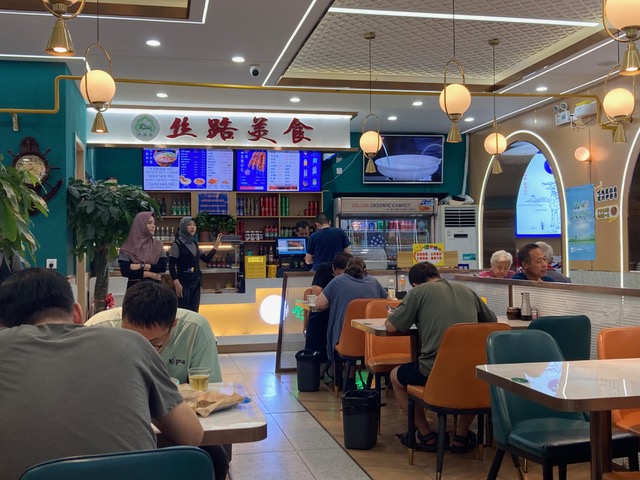
There’s one feature of Muslim life that is at odds with Chinese living, and that’s the eating of pork. Pork is China’s favourite and default meat, accounting for up to 70% of all meat eaten. With Muslims not eating pork, deemed unclean, impure and forbidden, instead the preferred Islamic meat is beef, with lamb/goat also featuring. This food divide meant that Muslims often lived together in neighbourhoods with not only a mosque, but also Muslim food processing and services. Across China, Muslim beef noodle restaurants are ubiquitous, and considered cheap and cheerful as well as clean, a godsend in a land of food hygiene concerns and stomach upsets.
In Beijing Niujie and Madian are the two main Muslim enclaves, though the latter in the north has declined. Niujie, south of the centre, even has its nearby subway station, and while there is still a mosque (with Chinese-style architectural characteristics) the main attraction for most visitors is the distinctly Muslim food available, with snacks and delicacies on offer.
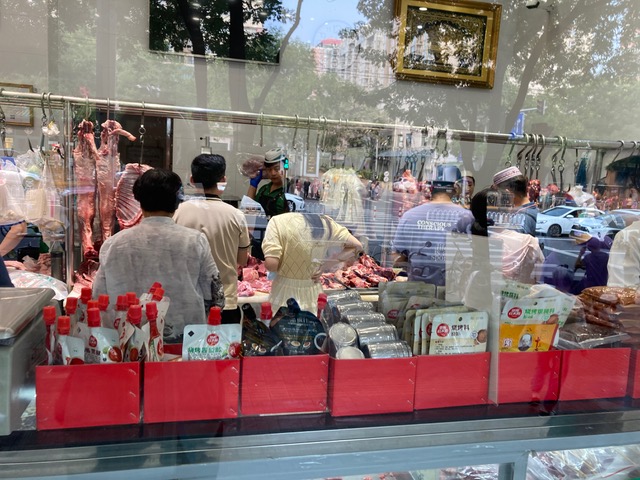
Of the quarter of a million Muslims who officially reside in Beijing, perhaps half live in the neighbourhood of Niujie. There are halal supermarkets, butchers selling mutton and beef, a Hui hospital and a kindergarten.
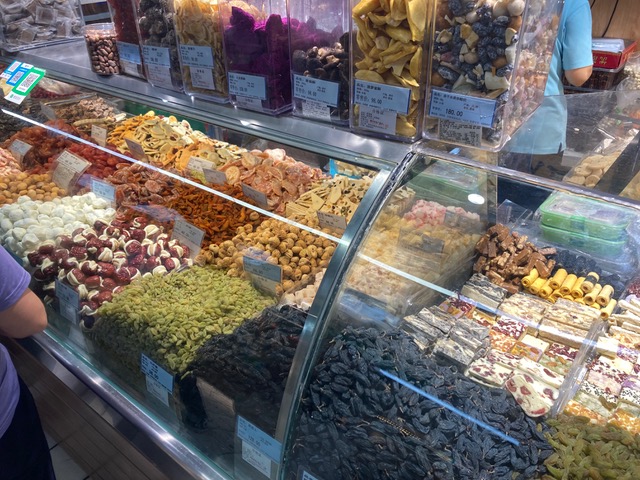
For a block, on both sides of the wide street, are stalls and restaurants, and queues. The smoke from sizzling charcoal grills serving fatty lamb skewer kebabs and the aromatic cumin-scented air probably push Niujie’s air pollution readings beyond acceptable World Health Organisation levels, but no one is complaining. Uyghur vendors, wearing round white hats, call out over the grill to whip up even more business, or shout out to younger men to fetch more of the freshly-baked sesame-studded flatbreads that are stacked high beside tandoor ovens, like round naan, but with a thick edge, like a deep dish Pizza Hut crust.
Steam rises from the large bowls of beef noodle soups slurped by families sitting on low stools around a square table, and visitors line up to order from a selection of fruit pastries. The largest amount of tripe you may ever see is cooked in a huge pot, while a rich cake made with dried fruit, nuts, seeds and sugar is sold by weight.
One of the quests for the self-labelled traveller, as opposed to the unaware tourist, is to be less an outsider and a consumer of tourism products. But underlying all this is the enigma of travel. That we go to experience things that are different from back home. And occasionally we wish to be less visible as an outsider, and more like an insider.
I think you can do this to a certain degree, depending on where you are and the acceptance of diversity of that place. But for me, as a visitor of European heritage, to the reasonably homogeneous and definitely differentness of China, I stand out. Not just because of my height at 6 feet. Or that my hair isn’t the standard black.
So what I seek is more of an authentic experience. Which for me often involves shopping local, eating local, random exploration of neighbourhoods rather than ticking off sights, preferring places without tickets or queues.
It is travel with some risks, not mentioned in the insurance fine print. It is travel which is self-deprecating, acutely aware of my ‘otherness’ and awkwardness, and of how I might connect with others. Some of that is transactional. I buy fruit from an old lady at a local market. I hop on a bus. I go to a place, but it is not the place recommended by the receptionist or concierge.
In Niujie, I am both an outsider and the ‘other’. Yet I have more empathy for and connection with the Muslim street vendors than I do with the Han Chinese who have come that afternoon to eat delicious food that is different to their normal diet.
After rubbing shoulders with fellow diners at a cramped eatery in Niujie, having finally located the area that doesn’t feature in most Beijing guidebooks, I still had one mission to complete.
Photo provided by Keith Lyons
So, as you are probably aware, Beijing hosted the Olympics back in 2008, with much fanfare and pomp. It was China showing off to the world just how modern and developed it was. It awed us not just with its impressive pageantry but also its buildings and facilities, many created just for the International sporting event. The Olympics provided the impetus for numerous infrastructure projects, particularly transport networks which were state-of-the-art.
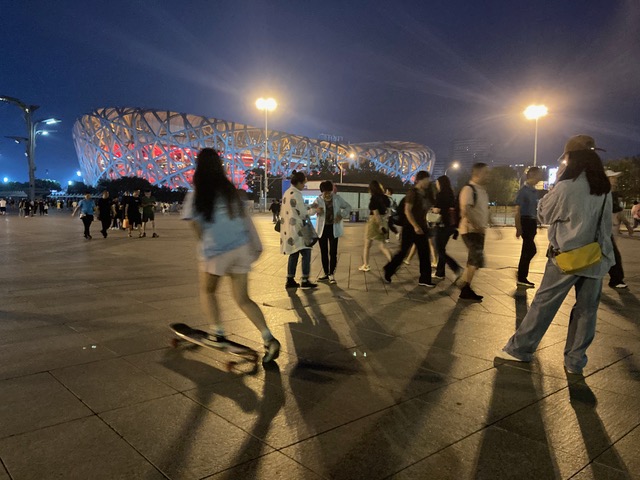
Some facilities remain, and the Bird’s Nest is still an attraction in itself, despite its lack of use following the 16 years. You probably remember the Water Cube, the swimming pool.
Bird’s Nest: Photo provided by Keith Lyons
Often when I travel, I check to see if there are swimming pools near my accommodation, or even inside my hotel (if someone else is picking up the tab). So when I found out that Water Cube is open for casual swimming, I set my sights on swimming a lap or two in the famous pool.
It turns out the pool for public use isn’t the actual one for Olympic races — that’s reserved for competition — but the training pool where swimmers warmed up and down has been open to anyone for more than a decade. But there’s a catch.
First, you have to know that you can swim there. And there’s another level of safeguard. Because the pool is several metres deep, and there’s the danger of non-swimmers drowning, the pool is partitioned into two halves. The accessible half has a raised floor so it is only around a metre deep. You can stand up in it. Kids can stand up.
But the other half, where the depth darkens the water to deep blue, is strictly controlled entry. You need a swipe card to access it. And to get that, as an American working in Beijing described to me, involved a medical test as well as completing various swimming feats, which included swimming two lengths without pausing.
Without the time in the city to complete the rigorous entry requirements, I had to contend myself with the learner’s side, where parents walked alongside their children like chaperons, adults swam on both sides of the lanes, and there were frequent close calls or collisions.
Inside the Water Cube: Photo provided by Keith Lyons
I’m a reasonably tolerant person, and having lived in China for more than a dozen years had got used to behaviours I initially found, to my mind and upbringing, a little disgusting. But when I swam my first length, only having to stop a couple of times to negotiate around erratic swimmers, the first sound I heard was from a fellow swimmer rising up from his lane to loudly clear his throat and spit onto the floor edge. I made a mental note not to rest my goggles up there.
While I had the passive-aggressive stance towards those spitters, during rests at the end of the lane other swimmers struck up conversations. A middle-aged women confided how she had lessons to swim in her 40s, and now tried to swim at the Water Cube a few days each week, even if she could not go a few metres without gasping for air. “Can you give me any tips to improve my swimming,” she asked as she returned to my end. I replied in Chinese the word my blind masseur used to give me when he hit a sore point on my feet. “Fang song” — relax. It was probably the worst word to say, like shouting ‘keep calm’ out repeatedly when something has gone disastrously wrong.
I probably should have taken on board my own words, as I swam into a father shepherding his daughter along. He was blocking my way. I saw him do the same to others. Deliberately blocking the way of oncoming swimmers. You are the symbol of modern China, I thought. Selfish, entitled, arrogant. Because I am a man of peace and goodwill to all, when he next blocked my way, I just carried on swimming, exaggerating my kicking to churn up the water and splash his rotund belly and smug grin.
I switched to another lane, and after a few more lengths, as I waited for a slow swimmer to get a head start, a boy of 12 years decided to strike up a conversation with me. “My mother says I should practice my English, so that’s why I like to come here,” he said, pointing up to the viewing window where a dragon mom waved and then proceeded to turn her phone camera towards us. After exchanging the usual questions about himself and me, he then abruptly turned the conversation around to China and the world. “China is the biggest country in the world. We are the leader.”
Unable to find the right words to express himself, he asked another swimmer, a man who had just moved to Beijing from the north, to articulate.
I wanted to ask him if China was such a great country, why did so many of its people want to escape to a better life in the US, Canada, Australia and New Zealand. But conscious that swimming at the Water Cube gives just two hours in the facility I escaped myself and tried to complete a length unimpeded or uninterrupted.
When I got back, the boy, who was rather overweight, was still there, waiting with another claim about China’s might.
Maybe I’m being nostalgic, about the good old days, but in the 1990s and 2000s, being a foreigner in China meant automatic adulation and attention from Chinese. Foreigners were feted and admired regardless of their behaviour and personality.
Now, in the mid-2020s, things have changed. They started changing a decade ago, when China realised that foreigners were not so great after all. When stories from the government claimed that most of the foreigners were economic spies. When Chinese TV had footage of young Americans drunk and predatory on the Shanghai subway. When my friends said how they’d heard that many foreigners teaching in China were losers in their own country. The tide had turned. The golden days were over. China has regained its swagger. The sleeping giant was waking up. The dragon was turning. And I was getting tired.
Before my number got called and I got requested to leave the pool, I got out, and used my token in the shower, wishing I’d brought my flip-flops to protect my feet from contact with the floor.
Not just being in the water, but being underground, it always takes a little to adjust to being back above ground and at maximum gravity, weightless. One of the things I like about swimming is that afterwards, some of that fluidity, ease of movement, body perception and gentle feeling remains, like a reminder of how you could be in the world. My senses feel renewed, my mind a little lighter, my awareness more centred.
Near the Bird’s Nest, they were having a skateboard class, with over 50 participants, many of them young women. And as I strode along the wide boulevard, groups of newly initiated skaters wove in and out of the family groups and sightseers, a sign to the world of new ways of being, new freedoms, and new leisure. Was this a victory for American culture? Or was China taking this recreation and adding Chinese characteristics to it?
My last swim was both a relaxation exercise at the end of the day, and a future — proofing myself for a long-haul flight home.
The faint linger of chlorine on the webbing of my hands and fingers. The sensation of lying face down and being held by the water. The realisation that the more I know the less I understand about China. These are the things I took with me as I sat in the aisle seat, stretched out my legs, and reminded myself, that I was 30,000 feet above the earth, going from the ancient capital to one of the youngest nations on earth (New Zealand). Much is lost, falling away, lost in time, the memories not so much fade as slip away imperceptibly. I scroll through the photos on my iPhone. So long Beijing.
Keith Lyons (keithlyons.net) is an award-winning writer and creative writing mentor originally from New Zealand who has spent a quarter of his existence living and working in Asia including southwest China, Myanmar and Bali. His Venn diagram of happiness features the aroma of freshly-roasted coffee, the negative ions of the natural world including moving water, and connecting with others in meaningful ways. A Contributing Editor on Borderless journal’sEditorial Board, his work has appeared in Borderless since its early days, and his writing featured in the anthology Monalisa No Longer Smiles.
.
PLEASE NOTE: ARTICLES CAN ONLY BE REPRODUCED IN OTHER SITES WITH DUE ACKNOWLEDGEMENT TO BORDERLESS JOURNAL.
Title: Permacrisis: A Plan to Fix a Fractured World
Authors: Gordon Brown, Mohamed El-Erian, Michael Spence, Reid Lidow
Publisher: Simon & Schuster UK
A nation or region’s success depends on three things: growth, economic management, and governance. The three dimensions are interconnected and affect each other. Growing an economy is a fundamental part of economic development. Factors like productivity, technological innovation, and sector expansion are all part of it. Infrastructure, education, and research and development are key to sustainable growth. Strong growth can create jobs, raise incomes, and improve living standards.
Governments and institutions take policies and decisions to maintain the economy’s stability and effectiveness. Setting fiscal policies, regulating financial markets, and overseeing trade and investment are tasks involved. The goal of effective economic management is to promote stability, increase competitiveness, and grow the economy. For macroeconomic stability and progress, it takes inflation, budget deficits, and exchange rates into account.
Countries and regions are governed by rules and structures. It includes political institutions, legal systems, and decision-making processes. By promoting transparency, accountability, and participation, sound governance ensures power is exercised fairly and justly. Decisions are made keeping in view society’s most beneficial interests, and citizens’ rights are protected. Maintaining stability, attracting investment, and promoting economic development requires strong governance.
Growth, economic management, and governance reinforce each other. Sustainable economic growth requires effective economic management, ensuring resources are allocated efficiently and policies support it. Effective governance promotes stability and attracts foreign investment through efficient economic management. A well-functioning governance system ensures that economic growth benefits are distributed equitably. After the recent pandemic, economists are worried about a prolonged crisis. Could we be experiencing a permacrisis? It is likely that the current state of the world will lead to anxiety, and that is what this book tells us in splendid detail.
Permacrisis: A Plan to Fix a Fractured World by Gordon Brown, Reid Low, Mohamed A. El-Erian and Michael Spence looks at the economic downturn the world is struggling through right now.
After holding the office of Chancellor of the Exchequer for over a decade, Gordon Brown became Prime Minister. During the 2009 London G20 summit, he mobilised global leaders to walk the world back from the brink of a second Great Depression. He is currently serving as the UN Special Envoy for Global Education, spearheading efforts to ensure quality, inclusive education for all children. He is also a Global Health Finance Ambassador for the World Health Organization. Brown holds a PhD in history from Edinburgh University.
Mohamed A. El-Erian is President of Queens’ College Cambridge. As Chief Economic Advisor at Allianz, he formerly served as Co-Chief Investment Officer and Chief Executive of PIMCO. Besides columnising for Bloomberg Opinion, he’s also a Financial Times contributor. He is a Senior Global Fellow at the Lauder Institute and Rene M. Kern Practice Professor at Wharton School. Before joining Harvard Management Company, he was a managing director at Solomon Smith Barney/Citigroup. His books When Markets Collide and The Only Game in Town were New York Times bestsellers.
Michael Spence is Emeritus Professor of Management at Stanford University. He is a Senior Fellow at Stanford’s Hoover Institution, and a Council on Foreign Relations Distinguished Visiting Fellow. He is an adjunct professor at Bocconi University and an honorary fellow at Magdalen College. He authored The Future of Economic Growth in a Multispeed World. He was Dean of the Stanford Business School from 1990 to 1999, and Dean of the Harvard Faculty of Arts and Sciences from 1984 to 1990. His awards include the John Kenneth Galbraith Prize for teaching excellence and the John Bates Clark Medal. He won the Nobel Prize in Economic Sciences for his work in information economics in 2001.
Reid Lidow served as Los Angeles Mayor’s Executive Officer. Reid worked on Gordon Brown’s campaigns before. During his undergraduate studies at USC, Reid double majored in International Relations and Political Science. He received a Gates Cambridge Scholarship and an MPhil in Development Studies from Queens’ College, Cambridge.
As some of the most highly respected and experienced thinkers of our time, these friends found that their pandemic zooms increasingly focused on a cascade of crises: sputtering growth, surging inflation, poor policy responses, an escalating climate emergency, increasing inequality, a rise in nationalism, and a decline in international cooperation. They shared their fears and frustrations with each other. The more they talked, the more they realised that, despite past mistakes that set the world on this bumpy path, there is a better path to a brighter future. Their varied perspectives contributed to their pursuit of a common goal: attainable solutions to the world’s fractures. Those thoughts are reflected in this book.
According to the authors, our current permacrisis is a result of broken approaches to growth, economic management, and governance. Even though these approaches are flawed, they can be repaired. A provocative, inspiring plan to change the world is the need of the hour. The book illustrates how we can prevent crises and improve the future for the benefit of the many and the few. According to the book, problems that remain unresolved for a prolonged period of time will only worsen; this is what happens in a permacrisis, which is why we must act quickly.
This instructive book provides a sensible plan of reform that can be used to create a world that is fairer and more equitable.
.
Bhaskar Parichha is a journalist and author of Unbiased, No Strings Attached: Writings on Odisha and Biju Patnaik – A Political Biography. He lives in Bhubaneswar and writes bilingually. Besides writing for newspapers, he also reviews books on various media platforms.
.
PLEASE NOTE: ARTICLES CAN ONLY BE REPRODUCED IN OTHER SITES WITH DUE ACKNOWLEDGEMENT TO BORDERLESS JOURNAL
Title:The Wizard of Festival Lighting – The Incredible Story of Srid
Author: Samragngi Roy
Publisher: Speaking Tiger Books
There are two things that make this book interesting. Firstly, it is the story of a man who decorated lights during festivals and got worldwide fame for what he did. Secondly, the author of the biography is a young writer. The Wizard of Festival Lighting: The Incredible Story of Srid is written by the protagonist’s granddaughter, Samragngi Roy, who published her debut novel, a young adult fiction in 2017.
Nevertheless, what makes this book stand out most is its unconventional theme. History is presented innovatively in this 352-page book, and folklore is at the center. Just like Durga puja can’t be mentioned without Kolkata, Jagatdhatri puja can’t be mentioned without lighting. This isn’t just West Bengal’s festival history, but India’s. Here’s how one man conquered the world through his vision. Documents like this are historical.
The blurb reads: “Eleven year old Sridhar was fascinated by light. Growing up among a dozen siblings in a mud cottage in Chandannagar in West Bengal, he longed to create something beautiful. A school dropout who never studied beyond Class Eight, he taught himself about lights and electricity by doing odd jobs at an electrician’s shop—an act that earned him a severe beating from his father. In spite of his family’s opposition, he grew up to become a celebrated light artist and inventor, setting new standards for festival lighting and pioneering new techniques.”
Recalls Sridhar “In 1968, when I was hired by the Bidyalankar Puja Committee for the purpose of providing street lighting, I had volunteered to additionally decorate the banks of our old pond too for three primary reasons. Number one, I had grown up next to it. Number two, it had been the source of some of our most sumptuous meals in childhood. And number three, it had been the setting for several of my childish shenanigans.
“However, when the lights glowed around the pond after sundown, the space enclosed by the banks of the pond looked extremely empty. But of course, I couldn’t have done anything about it because the enclosed space contained nothing but neck-deep water. That’s when I first contemplated the possibility of making lights glow under water and laughed at myself for being so impractical.”
The narrative continues: “So, I closed my eyes, muttered a quick prayer and used my stick to smash a glowing lamp. Then I waited for the impact. There was none that I could feel. My muscles, which had been tense and stiff all along, slowly relaxed. Parashuram and I looked at each other, and my gentle nod was met with a happy little jig that he performed on the steps of the ghat, bursting with excitement. But then the idea stuck with me for a while and what had seemed impossible in the evening had started to seem like an idea worth giving a shot by the night. I wasn’t even sure if the idea was feasible since it was unprecedented.”
Sridhar Das’s work received great acclaim throughout the world. His work has been exhibited in the Festival of India in Russia, Ireland, Los Angeles and Malaysia. The cover of the book is based on his exhibit in the Thames Festival in London — his famous illuminated peacock boat in three dimensions.
As a result of his fame and commitment to work, Sridhar, along with those closest to him, suffered from a variety of issues. His wife had to combat illness and loneliness to care for the family, leaving her husband free to forge his own path. His daughter grew up with her famous father largely absent. The telling encapsulates the true story of his meteoric rise, as well as his family with an unflinching exploration of what his meteoric rise cost him.
The story, poignantly related by his granddaughter, is both a subtle portrait of a complex individual and an affectionate tribute to a grandfather loved by his grandchildren. It takes readers back to vanished times, and introduces them to a man who pursued his dreams and created his own field through sheer determination.
.
Bhaskar Parichha is a journalist and author of Unbiased, No Strings Attached: Writings on Odisha and Biju Patnaik – A Political Biography. He lives in Bhubaneswar and writes bilingually. Besides writing for newspapers, he also reviews books on various media platforms.
.
PLEASE NOTE: ARTICLES CAN ONLY BE REPRODUCED IN OTHER SITES WITH DUE ACKNOWLEDGEMENT TO BORDERLESS JOURNAL
ENTERING THE EXIT

Let’s not waste our time
anymore.
We are not going anywhere
in this life.
I am entering the exit soon.
There are green doors
that lead me to the sun.

There are lights that blind me,
like a candle magnified
and a fire that dances in my retinas,
like a flashlight and
flashing signals
slinging lightning bolts.
It is O.K. to say goodbye.
After all
you know nothing lasts.
The lightning bolts
are no rainbow.

Being alone is not so bad.
There is always music.
Soon we will be gone.


SMILE MORE

He was just a little hungry.
This is what he told me.
Gary said he was a little lonely.
He seemed happy when he talked.

I listened to him as he asked
for a dollar. I handed him two
which is all I had in my pocket.
He told me to smile more and

he was speaking the truth.
I do need to smile a little more.
I prefer to live in silence most days.
Gary had a kind but anxious voice.

We will speak again soon he said.
It has been year since I’ve seen him.


THE SMOOTH LIFE

One time only
was my life smooth.
If my memory
was not so fickle,
the smooth life would
return and make
things easy. Sleeping
here, under the bed,
with the cats and
the shades blocking
the light away from us,
there is a certain intimacy
born in this room.
Our sonorous hearts
race with urgency.
Life is not clear or smooth.
The light frightens me.
Life is bizarre
like an escaped madman.
His filthy mind would
make anyone blush.
I remain hidden
like a secret.
The poor cats are
here with me. They
scratch my face.
My selfishness is
far from lovely.
The day goes on.
Light fades away.
This makes me smile.
Our sonorous hearts
are bound to break.
Oblivion sets in.
Eternity awaits.
The moon shines on
like the glittering stars.
I lack the confidence
my heart requires.
Born in Mexico, Luis Cuauhtémoc Berriozábal lives in California and works in the mental health field in Los Angeles, CA.His poetry has been published by Blue Collar Review, Borderless Journal, Escape Into Life, Kendra Steiner Editions, Mad Swirl, SETU, and Unlikely Stories.
PLEASE NOTE: ARTICLES CAN ONLY BE REPRODUCED IN OTHER SITES WITH DUE ACKNOWLEDGEMENT TO BORDERLESS JOURNAL
The change whose start no one observed
Continues. Just above the roofs
What was sky becomes dark water.
Trees convert to flame and throw
Their orange light up at the waves.
Now the earth rolls out from under
And takes its new place overhead,
Soaked black with authority
That will not entertain appeals.
Everything depends on it.
Come, it’s time to hold our hands
Out to how it’s going to be
And accept with gratitude
The beggar’s share that’s spared for us.
Peter Cashorali is a psychotherapist, previously working in community mental health and HIV/AIDS, now in private practice in Portland and Los Angeles. He is the author of two books, Gay Fairy Tales (HarperSanFranciso 1995) and Gay Folk and Fairy Tales (Faber and Faber, 1997). He has lived through addiction, multiple bereavements and the transitions from youth to midlife and midlife to old age and believes you can too.
PLEASE NOTE: ARTICLES CAN ONLY BE REPRODUCED IN OTHER SITES WITH DUE ACKNOWLEDGEMENT TO BORDERLESS JOURNAL
LONG NIGHTS

In their speaking,
long nights
can’t stop weeping,
their sorrow transforms
into song
no man could hum.

The white moon can
hear it
and weeps as well.
The stars shine on in
clear skies
with unseen tears.

Snow falls gently
at night
and in the day.
Time cries and cries.

In their speaking
long nights
can’t stop weeping.


WHEN MY DESIRES BEGIN TO FADE

When my desires begin to fade,
that is when my senses will return.
I will take a small breath, a sigh,
and let the darkness come. I will
listen to the melody of night birds,
and hope my desires do not return.

THE DEAD LIVE IN MY DREAMS

The dead live in my dreams.
They wait for me to fall asleep.
Some are dear to me and
some are diabolical.

Decomposed and frail, they
walk like children taking their first
steps. Some walk with a limp.
I find it disconcerting.

I talk to those I love
again. I ask them to pray for
me. They are always waiting
for my body to tire out.

I listen to their complaints.
I wake up and remember what
they said. Some talk without breath.
Others do not utter a word.
Born in Mexico, Luis Cuauhtémoc Berriozáballives in California and works in the mental health field in Los Angeles, CA.His poetry has been published by Blue Collar Review, Borderless Journal, Escape Into Life, Kendra Steiner Editions, Mad Swirl, SETU, and Unlikely Stories.
PLEASE NOTE: ARTICLES CAN ONLY BE REPRODUCED IN OTHER SITES WITH DUE ACKNOWLEDGEMENT TO BORDERLESS JOURNAL
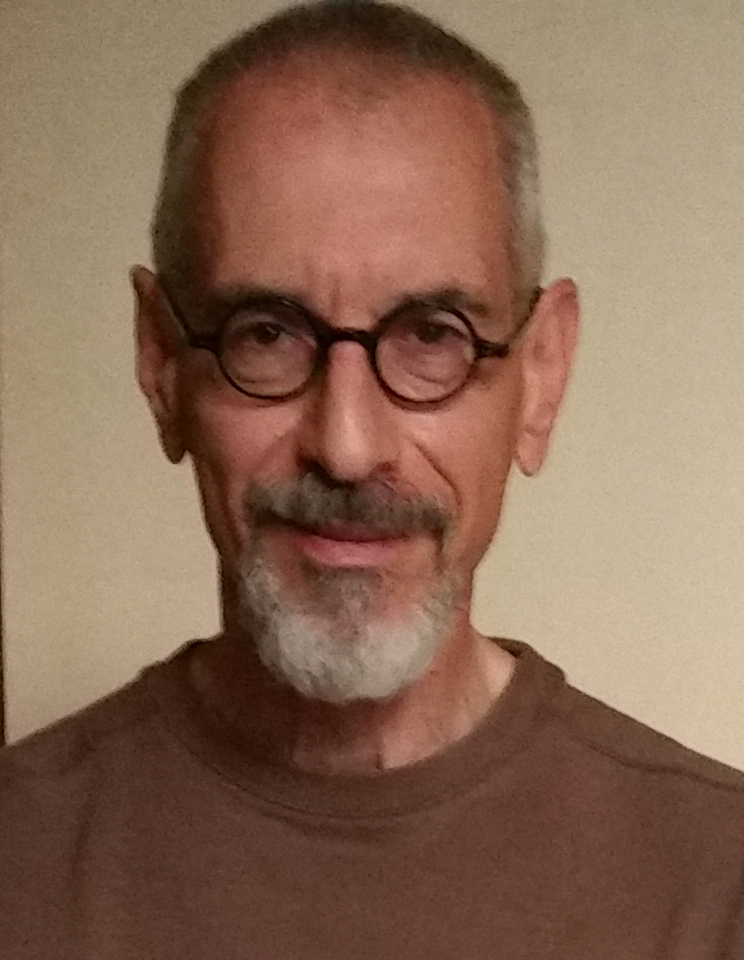
Poetry & Photographs by Luis Cuauhtémoc Berriozábal
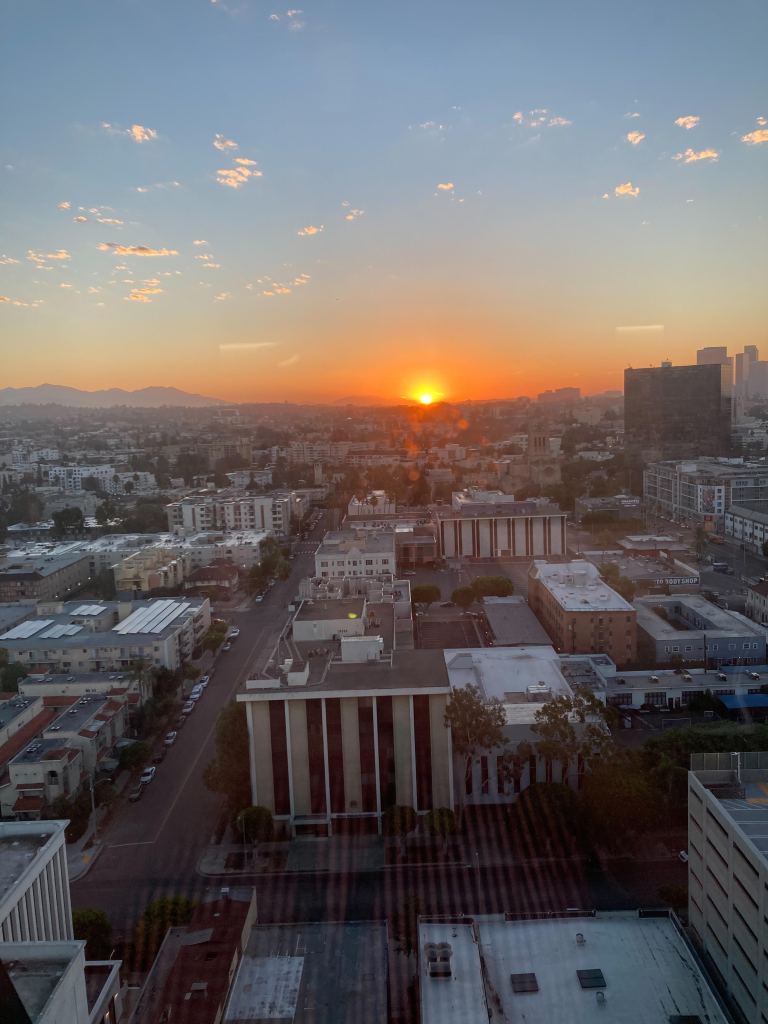
THE LIGHT

Who has seen the light?
Who has been blinded by the light?
The stars at night, the sun setting,
do you know it is not to be taken lightly?
Have you felt its significance?
Is the woman you love your light?
How much do you believe that?
You are surrounded by light.
Your head is filled with it.
There is a flash of light that shines on you
as your life is in danger.
You feel it on your skin.
It blinds your eyes, touches your heart.
If it ever goes away,
you will go away.
You must not take the light for granted.


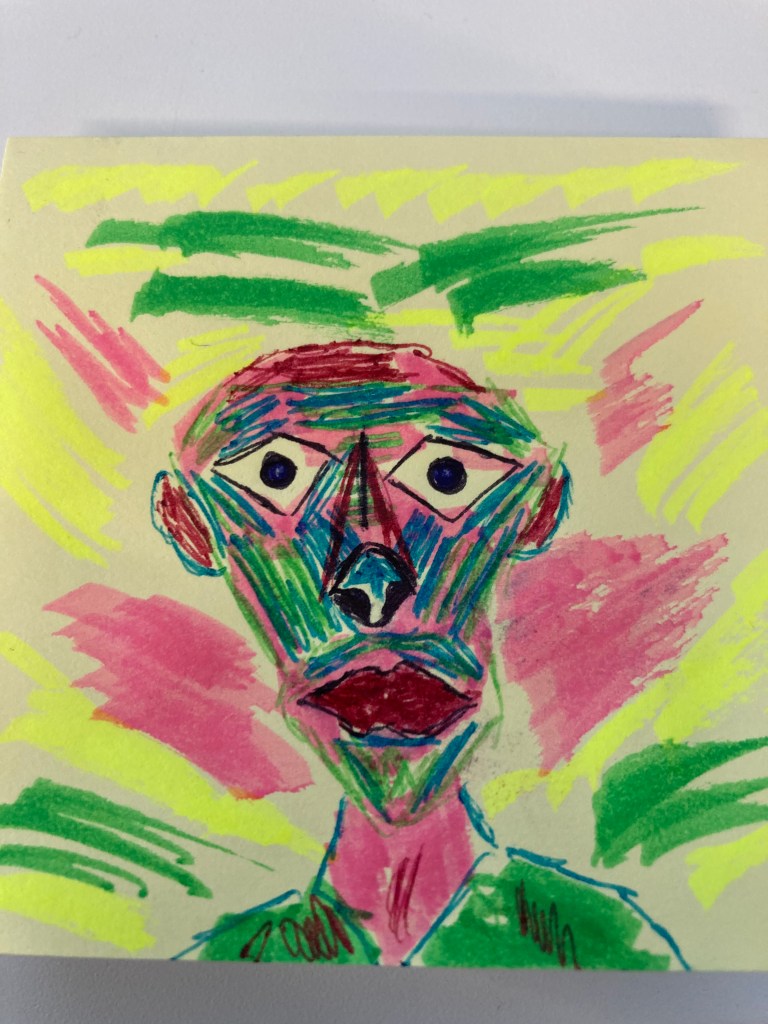
MY LIKENESS

Dear, who are you?
My likeness and enemy.
Weaving false stories.
Who may you be?
Am I to blame?
Soft are your punches.
Almost like words.
You want to kill me.
I love you still.
Born in Mexico, Luis Cuauhtémoc Berriozábal lives in California and works in the mental health field in Los Angeles, CA. His poetry has been published by Blue Collar Review, Borderless Journal, Escape Into Life, KendraSteiner Editions, Mad Swirl, SETU, and Unlikely Stories.
.
PLEASE NOTE: ARTICLES CAN ONLY BE REPRODUCED IN OTHER SITES WITH DUE ACKNOWLEDGEMENT TO BORDERLESS JOURNAL
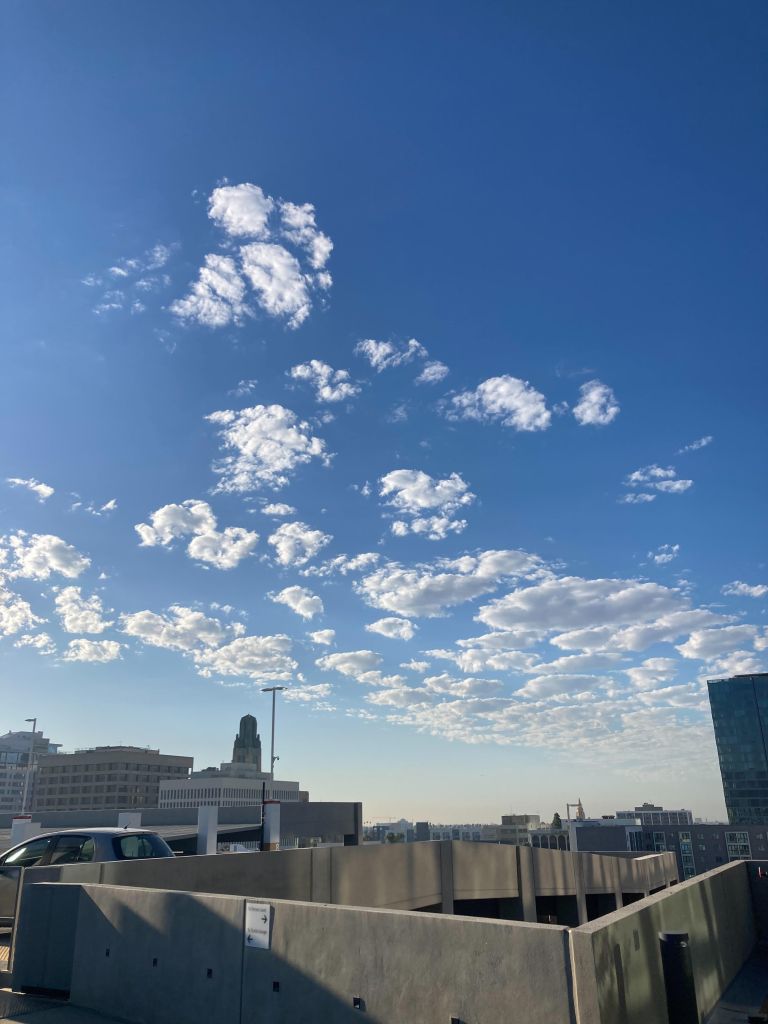
CLOUD MONSTERS

Moon tussles with cloud monsters.
Its shine is halfway showing.
Work traffic is like those cloud monsters.
A half hour drive turns into an hour.

I find an exit and use the streets.
The red lights are not the best
of colours when you are in a hurry.
Green lights are your best friend
when you are running late, tell that
to the cloud monster traffic.

I see green lights for blocks and
no one is moving. I should have
stayed home and declared this a
vacation day and just slept in.

That half-moon light is something
to behold still. It is getting clear
with the sun coming up as well
and the traffic dies down enough
that you just might not be late
to work or a dollar short this time.
The cloud monsters disappear like
a puff of smoke into the abyss.

SHIFT SHAPE CLOUDS

There goes the lasso
and there goes the headless
horse and the rider is hanging
on for dear life as the clouds
shift their shapes in the sky.

There goes the seahorse
out of its element unless
its sea is the blue horizon
and its white puffiness
will brace its shape shift fall.

There goes the head of the
headless horse and its rider
with its cowboy hat not far
behind, the rest of the horse
is just a round shaped cloud now.

Down below I lift my arms
to the sky and shuffle my feet.
I do a little rain dance but
I just do not have the magic
or power to make it happen.

OPEN THE SEA

Open the sea,
there is agony deep below,
the essence of a shipwreck
that has lost its very soul.

Open the sky,
there is a mourner in space
with a powerful sob
dropping waves of cold rain.

When the warm light
withdraws from the sky, the sun sleeps,
as the night lights appear
for the lost to find their way.

Ready to die,
life’s infirm angels and devils
give time one last breath, and
admonish it for how it betrays.
Born in Mexico, Luis Cuauhtémoc Berriozábal lives in California and works in the mental health field in Los Angeles, CA. His poetry has been published by Blue Collar Review, Borderless Journal, Escape Into Life, KendraSteiner Editions, Mad Swirl, SETU, and Unlikely Stories.
.
PLEASE NOTE: ARTICLES CAN ONLY BE REPRODUCED IN OTHER SITES WITH DUE ACKNOWLEDGEMENT TO BORDERLESS JOURNAL
GIVE NIGHT

Give night
my purest blessings

and sky

my deepest thanks,
a solemn sigh,
the lost words
of a child that has
grown too fast.

It is not easy
to watch morning fade.
My eyes fixate on the sun
and the sound of nature
when I close my eyes.
The smell of your
absent scent

is a smell I miss.
Between you and I,
I dread summer
and its heat
which finds joy

in my suffering. A
day does not go by
where sleeping soothes
these tears.
Suddenly,
the fiery sun
and the smell of you

not being here
reminds me how far
away you are. Funeral
processions
fill my thoughts. The dead
go to the light.

In this state of being
it is hard to think.

The cool breeze fills the room
as I shake the sheets.
My soft pillow awaits
to take me to a new land.
I open my mind
and give in to sleep.

Give night
my dark blessings
and let the sleeping begin.

TAKEN DOWN

Taken down
by the huge
security guards
at the break
of dawn. This
village is
not for all
of us. I
feel like First
Blood Rambo.
I just want
a place where
I could sleep
till five in
the a.m.
I will get
off the floor
at five or
four forty-
five. No one
is working
here until
six or so.
I was slammed
on my face.
I am not
so pretty.
I look worse
now than I
did last night.
Luis Cuauhtémoc Berriozábal is a Mexican-born author, who resides in California and works in the mental health field in Los Angeles. His poems have appeared in Blue Collar Review, Kendra Steiner Editions, and Unlikely Stories.
.
PLEASE NOTE: ARTICLES CAN ONLY BE REPRODUCED IN OTHER SITES WITH DUE ACKNOWLEDGEMENT TO BORDERLESS JOURNAL








 Borderless