Categories
Tagore Translations

Rabindranath’s Hymn to an Autumnal Goddess

Written in 1908, Amra Bedhechhi Kasher Guchho (We have Tied Bunches of Kash) was published as a part of Gitanjali in Bengali in 1910.

Kaash. Courtesy: Creative Commons
We have Tied Bunches of Kaash

We have tied bunches of kaash* and strung garlands of shefali.
We have decorated the wicker tray with new-sprung paddy. 
Welcome autumnal goddess on your chariot of white clouds! 
Ride on angelic azure paths,
Travel through clean bright glittering forested mountains.
Come wearing a crown of white lotus, sparkling with dewdrops. 
On the banks of Ganges, in a solitary bower
Carpeted with the flowers of fallen malati,
Swans flap their wings as your entourage. 
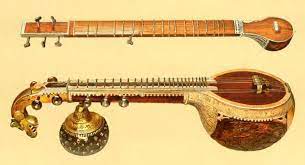
When you pluck the strings of your golden bina*,
Soft sweet notes, 
Usher laughter amidst transient tears. 
Like the magical parasmani* emanating light,
Stroke the flames of compassion in our hearts—
Brighten our thoughts and replace darkness with light. 

*kaash: Wild grass flowers
*Bina: Musical instrument 
*Parasmani: A magical touchstone

Bina. Courtesy: Creative Commons
A Bengali rendition of the song performed by a contemporary artiste, Rezwana Choudhury Bannya

In 1913, Tagore received a Nobel Prize for his own translation, Gitanjali: Song Offerings, published in England. Only 69 of the original 157 of the Bengali Gitanjali made it into the English translation.

An essay, ‘Publication of Tagore’s song offerings, the Gitanjali : A Study’ by Partha Pratim Ray, a librarian in Vishwa Bharati, contends: “Rabindranath Tagore himself took the task of the translation of Gitanjali (Song Offerings) when he sailed for England on 27 May 1912. There he handed over the poems to William Rothenstein whom he met earlier in Calcutta in the year 1911. Moved by the poems, Rothenstein in turn gave the poems to W.B. Yeats to read. The literary and artistic circle of Yeats decided to publish the poems after Yeats made a selection of them and wished to write an introduction to it. That is how Gitanjali was first published by India Society of London on November 1912.”

The article further elucidates: “The next edition of Gitanjali was published in the next year (March 1913) by Macmillan and Company, London. The number of poems in Bengali and English Gitanjali are not the same. In Bengali there were 157 poems, but in English it was 103. The poems were first published in different Kavyagrantha. At the end of the Indian edition of India Society or Macmillan there was a statement: ‘These translations are of poems contained in three books- Naivedya, Kheya and Gitanjali…’”

Yeats wrote the introduction for Song Offerings.  He wrote, “these prose translations from Rabindranath Tagore have stirred my blood as nothing has for years” and “Mr. Tagore, like the Indian civilization itself, has been content to discover the soul and surrender himself to its spontaneity.”

This poem has been translated by Mitali Chakravarty with editorial input from Sohana Manzoor on behalf of Borderless Journal

.

PLEASE NOTE: ARTICLES CAN ONLY BE REPRODUCED IN OTHER SITES WITH DUE ACKNOWLEDGEMENT TO BORDERLESS JOURNAL

Click here to access the Borderless anthology, Monalisa No Longer Smiles

Click here to access Monalisa No Longer Smiles on Kindle Amazon International

Categories
Review

The Story of an Incredible ‘Lightman’

Book Review by Bhaskar Parichha

Title: The Wizard of Festival Lighting – The Incredible Story of Srid

Author: Samragngi Roy

Publisher: Speaking Tiger Books

There are two things that make this book interesting. Firstly, it is the story of a man who decorated lights during festivals and got worldwide fame for what he did. Secondly, the author of the biography is a young writer. The Wizard of Festival Lighting: The Incredible Story of Srid is written by the protagonist’s granddaughter, Samragngi Roy, who published her debut novel, a young adult fiction in 2017.

Nevertheless, what makes this book stand out most is its unconventional theme. History is presented innovatively in this 352-page book, and folklore is at the center. Just like Durga puja can’t be mentioned without Kolkata, Jagatdhatri puja can’t be mentioned without lighting. This isn’t just West Bengal’s festival history, but India’s. Here’s how one man conquered the world through his vision. Documents like this are historical.

The blurb reads: “Eleven year old Sridhar was fascinated by light. Growing up among a dozen siblings in a mud cottage in Chandannagar in West Bengal, he longed to create something beautiful. A school dropout who never studied beyond Class Eight, he taught himself about lights and electricity by doing odd jobs at an electrician’s shop—an act that earned him a severe beating from his father. In spite of his family’s opposition, he grew up to become a celebrated light artist and inventor, setting new standards for festival lighting and pioneering new techniques.”

Recalls Sridhar “In 1968, when I was hired by the Bidyalankar Puja Committee for the purpose of providing street lighting, I had volunteered to additionally decorate the banks of our old pond too for three primary reasons. Number one, I had grown up next to it. Number two, it had been the source of some of our most sumptuous meals in childhood. And number three, it had been the setting for several of my childish shenanigans.

“However, when the lights glowed around the pond after sundown, the space enclosed by the banks of the pond looked extremely empty. But of course, I couldn’t have done anything about it because the enclosed space contained nothing but neck-deep water. That’s when I first contemplated the possibility of making lights glow under water and laughed at myself for being so impractical.”

The narrative continues: “So, I closed my eyes, muttered a quick prayer and used my stick to smash a glowing lamp. Then I waited for the impact. There was none that I could feel. My muscles, which had been tense and stiff all along, slowly relaxed. Parashuram and I looked at each other, and my gentle nod was met with a happy little jig that he performed on the steps of the ghat, bursting with excitement. But then the idea stuck with me for a while and what had seemed impossible in the evening had started to seem like an idea worth giving a shot by the night. I wasn’t even sure if the idea was feasible since it was unprecedented.”

Sridhar Das’s work received great acclaim throughout the world. His work has been exhibited in the Festival of India in Russia, Ireland, Los Angeles and Malaysia. The cover of the book is based on his exhibit in the Thames Festival in London — his famous illuminated peacock boat in three dimensions.

As a result of his fame and commitment to work, Sridhar, along with those closest to him, suffered from a variety of issues. His wife had to combat illness and loneliness to care for the family, leaving her husband free to forge his own path. His daughter grew up with her famous father largely absent. The telling encapsulates the true story of his meteoric rise, as well as his family with an unflinching exploration of what his meteoric rise cost him. 

The story, poignantly related by his granddaughter, is both a subtle portrait of a complex individual and an affectionate tribute to a grandfather loved by his grandchildren. It takes readers back to vanished times, and introduces them to a man who pursued his dreams and created his own field through sheer determination. 

.

Bhaskar Parichha is a journalist and author of UnbiasedNo Strings Attached: Writings on Odisha and Biju Patnaik – A Political Biography. He lives in Bhubaneswar and writes bilingually. Besides writing for newspapers, he also reviews books on various media platforms.

.

PLEASE NOTE: ARTICLES CAN ONLY BE REPRODUCED IN OTHER SITES WITH DUE ACKNOWLEDGEMENT TO BORDERLESS JOURNAL
Click here to access the Borderless anthology, Monalisa No Longer Smiles

Click here to access Monalisa No Longer Smiles on Kindle Amazon International

Categories
Slices from Life

A Homecoming Like No Other

By Saumya Dwivedi

The prawn curry was getting cold. “What’s taking you guys this long to finish a match point?” I demanded while dipping my index finger in the curry bowl and touching it to my tongue. “We never got to the end, Nina. Siddh fell on the grass and couldn’t get up after. He’s in immense pain. We’re going to have a long night,” Arko said.  

The line clicked, but I stood there holding the telephone. 

Little did we know then that Siddh would not be able to stand on his feet that evening and every evening until after two months.

Only last week, my favourite trio – brother Siddh, his wife, Saanvi, and their toddler, Uma, had arrived in India for a grand family reunion. This week the fun was planned at my home. After spending a day indoors, we slid into our sneakers for a walk in the park. The toddler at the swing, sisters-in-law chewing the fat, the boys at a badminton rally – the season of life we were all waiting for was finally here.

The twilight hours chimed in with the chirping of crickets. My niece asked me while rubbing her eyes, “What time do crickets go to bed?” “Not until morning. Crickets are night creatures,” I said. “Let’s sing a lullaby to crickets so they hit the bed on time,” Uma urged. Saanvi and I decided to walk back home, so the only person who went to bed on time was Uma.

The boys stayed on… 

This park has an endearing presence in my life—an all-weather friend, where I end up on my good days and bad days. Just a stone’s throw away from where I live, the road to the house of this picturesque friend is never too long.

When I learned that Siddh had broken his leg in the lap of this green landscape…in the lap of my trusted friend, I felt thoroughly betrayed. No one had told me the road to the house of a friend could be bumpy too!

It took a village to lift my brother and settle him into a wheelchair. One emergency room, two hospitals, and three X-rays later, Siddh came home post-midnight…leaning on a walking frame, trembling in pain, falling apart.

The house went dead and silent, broken frequently by Siddh’s grunts and groans. Hiding behind the door tugging at a curtain, I anguished over what was tougher – to be afflicted by pain or watch someone you love suffer in pain.

The misery continued the following day – dialling up ambulances, moving between stretchers, painstakingly slow MRIs, mammoth injections, multiple doctor consultations, and whatnot. Reports said Siddh had suffered both a fracture and a ligament tear resulting in a full leg cast for six weeks!

The season of life we were all waiting for had gone awry. If there were a list of the ‘biggest holiday failures’, this would feature right at the top. Siddh seemed crestfallen – six weeks of staying in bed! Saanvi had a bewildered look on her face. Uma showed a big heart in saying she could wait until the next day for her Papa’s leg to get better so they could play chase. The dispirited Mom, Dad, and cousins drifted in different directions to make arrangements. Arko and I looked at each other and then looked around – we had gone from two to five to nine folks in a span of three days. Suddenly, my mind went elsewhere, “When was the last time we got together as one big family, with three generations living under one roof? When was the last time we sat face-to-face, speaking for hours, without a virtual screen orchestrating our conversations?” 

I insisted that the trio stay with us during the recovery period. While no amount of caregiving could alleviate Siddh’s pain during the initial stage, nestling in a place of warmth and care helped him get through one day at a time. When he showed indomitable resilience in not just returning to working remotely only a few days after the accident but also stepping out on a whim while still using a walking aid, it only reaffirmed my belief that families do have the placebo effect.  

Making lemonade out of lemons life had thrown at us, we often brought the house down with game nights, barbecue, drinks, karaoke, good music, and all that. On his birthday evening, when Siddh entered the living area, clacking his walker against the floor, shielding his discomfort with a grin, the message on the birthday cake sent him and everyone else into peals of laughter – Happiness is NOT playing badminton. The icing on the cake exhibited a passionate boy in the act of hitting a shuttle with a badminton racquet, wearing a replica of the red tee Siddh had worn on the evening he fell. Tongue-in-cheek, but everything is fair in love and life. 

From sharing homes and hearts to strengthening family bonds, it only felt like this page in the book of our lives was written in stars.

Days and weeks rolled by. The long leg cast came off. The season of life began anew.

.

Siddh and Saanvi posted a handwritten note from London, “Years ago, anthropologist Margaret Mead was asked by a student what she considered to be the first sign of civilisation in a culture.

“Mead said that the first sign of civilisation in an ancient culture was a femur (thighbone) that had been broken and then healed. Mead explained that in the animal kingdom, if you break your leg, you die. You cannot run from danger, get to the river for a drink or hunt for food. You are meat for prowling beasts. No animal survives a broken leg long enough for the bone to heal.

“A broken femur that has healed is evidence that someone has taken time to stay with the one who fell, has bound up the wound, has carried the person to safety and has tended the person through recovery. Helping someone else through difficulty is where civilisation starts, Mead said.”

I cast my mind back to the evening we saw them off at the airport. A strange sense of accomplishment filled me – Siddh back on his feet, Saanvi’s beaming face, and Uma settled in my arms, making a toddler promise to visit Nina’s home in India ‘next week’.

Storing the sweet note of love in my memory box, I thought to myself, “There’s nothing more fulfilling than being there for your family in a difficult time. We are at our best when we lift each other up.”

Saumya Dwivedi often pens down anecdotes about her life. Her story ‘To the deep end’ has been published in a morning English daily. Passionate about skydiving, she keeps the spirit of flying alive in whatever she does.

PLEASE NOTE: ARTICLES CAN ONLY BE REPRODUCED IN OTHER SITES WITH DUE ACKNOWLEDGEMENT TO BORDERLESS JOURNAL
Click here to access the Borderless anthology, Monalisa No Longer Smiles

Click here to access Monalisa No Longer Smiles on Kindle Amazon International

Categories
Excerpt

Siddhartha: The Boy Who Became the Buddha

Title: Siddhartha: The Boy Who Became the Buddha

Author: Advait Kottary

Publisher: Hatchette India

‘King Bimbisara is completely enamoured with Amrapali. He seems to be in love with her, and for that, Ajaatshatru seems to detest him. They are not on speaking terms anymore. Moreover, when I was there, Ajaatshatru did not speak a word even to me…’

‘Are you sure you did not do anything to upset him?’ asked Shuddhodana, concerned. Ajaatshatru giving Siddhartha the cold shoulder was worrying news indeed. He was only a few years younger than Siddhartha and was poised to take the throne from Bimbisara. If, in the future, the rulers of Kapilavastu and Magadha could not see eye to eye, then what would be the point of this trade route that they had so carefully worked on? What would be the point of the independence from the trade route through Kosala?

‘Father, how could I have upset him when he wouldn’t even speak to me? He chose to go hunting both on the day that I arrived as well as the day that I left.’

‘This is not good,’ said Shuddhodana. ‘This is the result of Bimbisara’s own foolishness. The only reason that Ajaatshatru dislikes you is because Bimbisara keeps comparing him to you. He was always very taken by your insight.’

‘But if that were the case, then we have no reason to worry! If I try to establish friendly relations with Ajaatshatru, then perhaps we will not have anything to fear!’

Shuddhodana was taken aback at how optimistic Siddhartha sounded. He wished he could share his optimism but was wary of saying anything to take away his son’s enthusiasm for affairs of the state.

‘But there was still something wrong with King Bimbisara; he seemed to not have any relations at all with Queen Kosala. Instead, he spent most of his time with the courtesan Amrapali. I believe Ajaatshatru took offence to that too, for he didn’t seem interested in spending any time with me.’

‘I wouldn’t give it too much thought, Siddhartha, there are things about that family that you do not know. Perhaps it is not right for us to ascertain from the outside, the merits of their dynamic, but they have shared a very troubled relationship, let us leave it at that…’

‘What do you mean, father?’

‘The stars are powerful, Siddhartha. Great things can be done and undone, depending on whether one has luck and destiny on his side or not. Parents may be invulnerable when it comes to anything else on earth, but they are powerless when it comes to their children. Once the idea that some misfortune might befall their children enters their heads, they will do anything to ensure that this does not happen.’

‘Including banishing every single crippled, injured or maimed person from their kingdom to live in misery?’

Shuddhodana gave Siddhartha a sharp look.

‘Who has told you of this?’ asked Shuddhodana.

‘I have seen Sukhibasti with my own eyes, Father.’

Shuddhodana felt like he had been hit square in the chest with a mace.

‘I did what I believe was right, Siddhartha,’ he said.

‘You could call it that, Father, but I am simply trying to understand how a man as great as you could love his family as much as you have, while showing no mercy to your subjects.’

Shuddhodana was insulted, more so because he was hearing these words from his own son. Siddhartha was crossing a line.

‘Siddartha, I am your Father but I am your king as well. Do not forget that.’

‘Do not threaten me, Father. I have seen what you created. How long did you plan to keep it a secret? How long did you plan to have it hidden from me? How many more lies are there to discover?’

‘Enough!’ bellowed Shuddhodana. ‘I did what I had to, to safeguard the kingdom and its heir from straying off the path that was chosen for him.’

‘Did you think that you needed to take the words of someone who hadn’t seen the future so seriously that it influenced the way you brought up your own child?’

‘He was my Guru, Siddhartha, just as Guru Kondanna was yours.’

‘Guru Kondanna is my guru!’ Siddhartha corrected an angry Shuddhodana.

‘You are overstepping your boundaries, Siddhartha. I have been very patient and understanding, but enough is enough. You cannot take the pain of others and make it your own all the time. At the end of the day, one’s duty must take precedence over everything else.’

Siddhartha calmed down and collected himself. He took off his armour and laid it on the floor of the courtroom at the foot of his father’s throne.

‘Forgive me, Father. I do not mean to disrespect you or my duty but what must one do when he is unable to see the reason behind one’s duty and dharma? When I left Kapilavastu, I encountered nothing but suffering and sadness. The farmers who grow the food we eat are exploited mercilessly by royal guards and collectors. I have been sleepless since I returned from Sukhibasti. Are you aware that our own injured and maimed soldiers are sent there? They fought for us and with us in the war. How can one call this duty?’

(Extracted from Siddhartha: The Boy Who Became the Buddha by Advait Kottary. Published by Hachette India, 2023.)

ABOUT THE BOOK

His family was happy to see him, but they had hoped to meet the Siddhartha they knew, not the Buddha he had become.

Long before Siddhartha became the enlightened leader [Buddha], he was a boy oblivious of the world. As the young prince navigates politics and relationships, he slowly begins to question his oppressively perfect life. Meanwhile his family struggles to maintain their deception in the hope that they can mould him into a dutiful king – from banishing the old and sick to hiding their own advancing age. In Advait Kottary’s intricately woven narrative, raw human emotion and conflict is tempered with the boundless compassion of the Buddha. Exciting and insightful in equal measure, Siddhartha is at once a riveting story and a profound meditation on our shared quest for truth.

ABOUT THE AUTHOR

Advait Kottary is a writer and actor residing in London. Passionate about cars and engineering, he worked as an engine designer before quitting his job to pursue his love of writing and the performing arts. He went on to lead the world’s biggest Bollywood musical Jaan-E-Jigar, and act in international productions such as Beecham House. Advait has also co-conceptualised the award-winning television show Molkki and voiced several audiobooks with Swedish platform Storytel. Siddhartha is his first novel, which stemmed from his own quest to understand the Self and his encounter with the Buddha’s teachings.

Click here to read the review/interview with Advait Kottary

PLEASE NOTE: ARTICLES CAN ONLY BE REPRODUCED IN OTHER SITES WITH DUE ACKNOWLEDGEMENT TO BORDERLESS JOURNAL

Categories
Slices from Life

From Gatwick to Kangaroo Island

Phtographs & Narrative by Meredith Stephens

When I recently flew from Australia into Gatwick Airport, London, I was struck by the ease of passing through customs and immigration. Once I exited the plane, I was ushered to an empty lane and directed to a machine to present my passport. As I had nothing to declare I walked through the green lane. A group of four customs officers were engaged in conversation and did not notice me. I had entered the UK seamlessly in about five minutes without making eye contact with a single person.

Not so when travelling within my home state of South Australia. Alex, Verity and I were on our way from Adelaide to Kangaroo Island, situated across Investigator Strait off the southern coast of South Australia. We would have preferred to sail there, but Alex’s boat was high and dry, awaiting repairs to the mast and windows in Yaringa, eight hundred kilometres away in the state of Victoria. We had made a booking for the three o’clock ferry from Cape Jervis to Penneshaw, on Kangaroo Island. We left Adelaide at 1 pm, allowing ninety minutes for the drive and thirty minutes to board, as we always do.

Half an hour into our trip, we were stuck in a traffic jam along the arterial roadway heading south. We had never been trapped in a traffic jam in this direction before, because it was leading away from Adelaide towards sparsely populated farmland.

“Oh no! It’s the Tour Down Under! The road is closed for the cycling race,” lamented Alex.

He did a U-turn and headed west to the side streets in the hope of finding an alternative route along the Esplanade. After winding through the coastal suburbs, we arrived at a T junction facing the Esplanade, and were greeted by a woman in a bright orange vest holding a prominent sign saying ‘Stop!’

Onlookers lined the streets holding their cameras ready to snap the cyclists. We waited, all the while nervously checking the time on our phones, wondering whether we would miss our ferry. A few minutes later we heard an excited murmur run through the crowd, and sure enough, a group of cyclists whizzed past.

We glanced at the woman in the orange vest, hoping she would let us pass. She was on her walkie talkie and shook her head at us. Soon another group of cyclists raced past. Then the woman let us on to the Esplanade and we headed south. Soon after we were stopped by a police officer on a bicycle, who directed us away from the Esplanade. We turned east to weave our way back to our original route.

“We won’t make it to the ferry on time!” complained Alex, pressing heavily on the accelerator.

We arrived back on the highway that we had originally departed from and tried to turn right so that we could head south to Cape Jervis. A line of cars from the north were trying to turn right into our street.

“We’ll be here for hours. Best turn left and then do a U-turn,” announced Alex.

Alex turned left, accelerated, and braked when he found a gap in the oncoming traffic. He quickly did a U-turn and then headed south, passing the line of cars waiting to turn right onto the road where we had been waiting.

Would all of this be in vain? Would we get to Cape Jervis just after 3 pm to watch the ferry departing, on its way to Penneshaw? I held my phone to check the distance to Cape Jervis and noted that the estimated time of arrival was 2.54 pm. Alex tried to make up time by driving to the speed limit. A truck was labouring up the hill in front of us. Alex waited until we reached a passing lane, and then floored the accelerator. The estimated time of arrival was now 2.52 pm. Sitting next to Alex as he sped along the highway was more exciting than rides on a fairground had been when I was a child. I trusted his judgment and felt safe all the while enjoying the exhilarating speed. Next, there was a red car dawdling in front of us. Again, Alex waited until we reached a passing lane, and overtook them. The estimated time of arrival was still 2.52 pm. At least we had not been losing time as we were delayed by the slow coaches ahead of us. We entered the township of Cape Jervis, rounded the hill, and then descended to the ferry port, arriving as predicted at 2.52 pm. We expected boarding to be well underway. Instead, four lanes of cars were waiting in the line-up to board the empty ferry, which was running late. We slid into the shortest lane and turned off the engine. A biosecurity officer approached Alex’ window, his curly auburn ponytail blowing in the wind. Alex wound down the car window.

“Do you live on Kangaroo Island or are you just visiting?” he asked.

“We’re just visiting.”

“Oh, lovely! Do you have any honey?”

“No honey.”

“Do you have any bee-keeping equipment?”

“No, definitely not.”

“How about fruit?”

“We have some apples.”

“Are they from the supermarket?”

“Yes.”

“Where did you buy them?”

“In Adelaide.”

“How about potatoes?”

“No.”

“Do you have any plants?”

“We have some caper plants in the back.”

He looked at the back of our vehicle in acknowledgement.

“Oh capers! They look nice. Where did you get them?”

“From a business in Port Adelaide.”

The biosecurity officer seemed satisfied and waved us on.

“Have a lovely trip!”

Shortly after we boarded the 45-minute ferry for Penneshaw. We had been asked more biosecurity questions than at any other place on our travels, and we hadn’t even left our home state. I yearned for the ease of passing through immigration at Gatwick Airport. I had felt perversely miffed at Gatwick for having been ignored by immigration and customs officials.

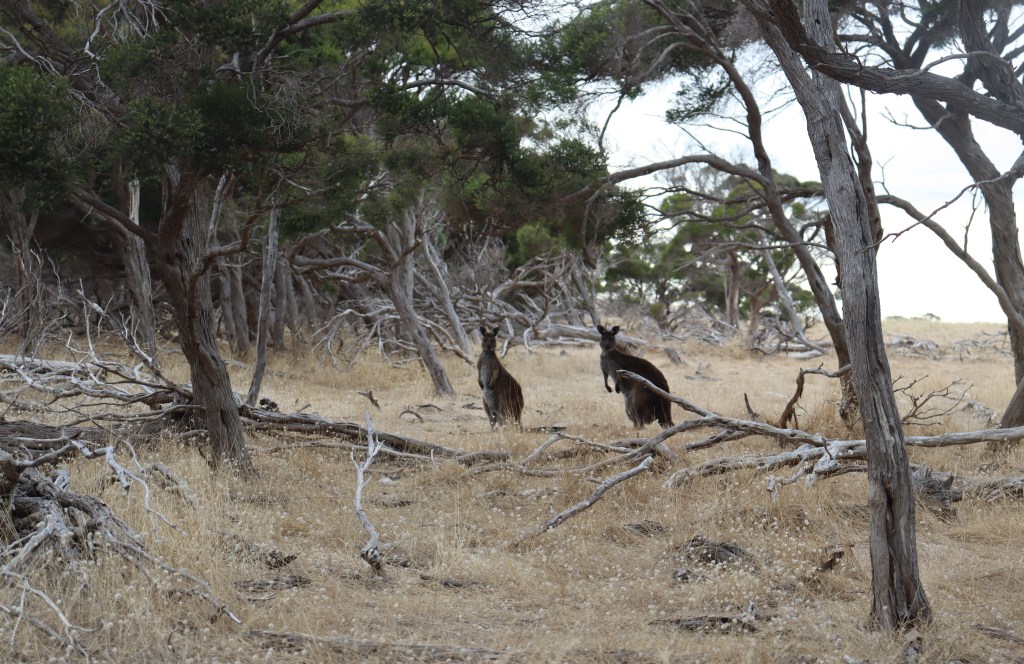
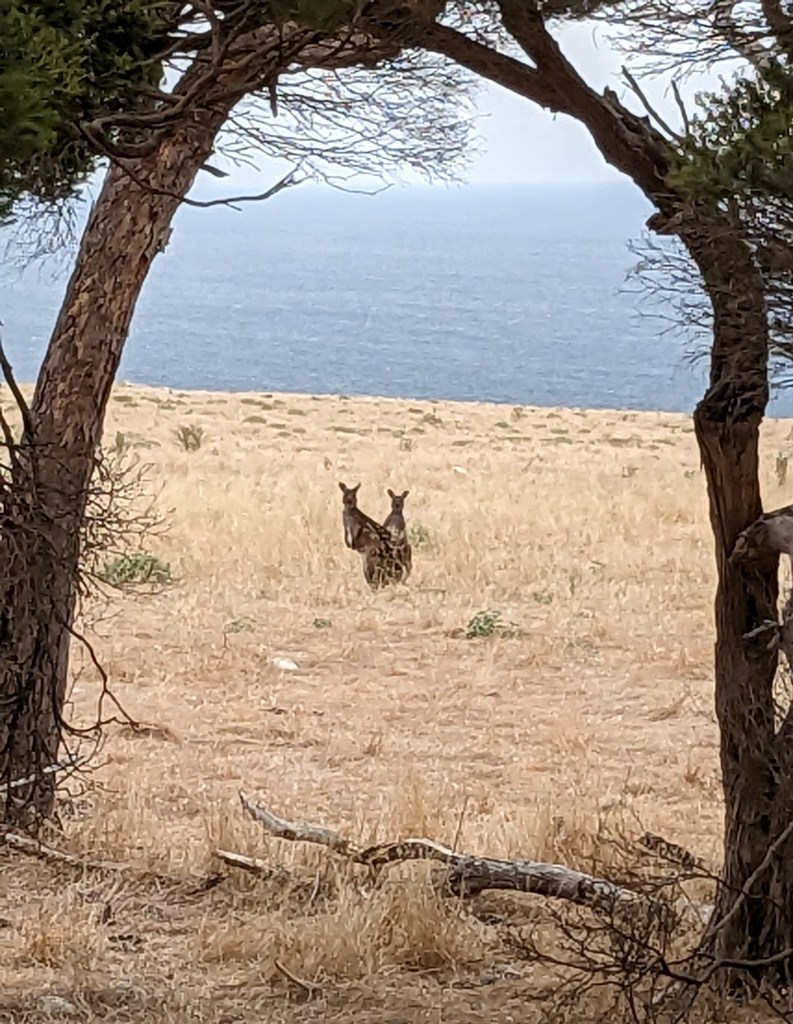
No sooner had we arrived at our destination though, did we spot a marvellous mob of kangaroos bounding across the property.

Then the following day we had a charming encounter with a Rosenberg’s Monitor looking for a drink of water – a species that is endangered on the mainland.

Rosenberg’s monitor lizard

Verity later came across an elusive short-beaked echidna.

Short-beaked echidna

At last I could appreciate that protecting the fauna and flora of Kangaroo Island was important and necessary, and well worth the interrogations of a biosecurity officer.

Meredith Stephens is an applied linguist from South Australia. Her work has appeared in Transnational Literature, The Muse, The Font – A Literary Journal for Language Teachers, The Journal of Literature in Language Teaching, The Writers’ and Readers’ Magazine, Reading in a Foreign Language, and in chapters in anthologies published by Demeter Press, Canada.

PLEASE NOTE: ARTICLES CAN ONLY BE REPRODUCED IN OTHER SITES WITH DUE ACKNOWLEDGEMENT TO BORDERLESS JOURNAL

Click here to access the Borderless anthology, Monalisa No Longer Smiles

Categories
Review

Of the Raj, Maharajas and Me

Book Review by Bhaskar Parichha


Title: Of the Raj, Maharajas and Me

Author: MA Sreenivasan

Publisher: Speaking Tiger Books

This is a delightful book for two reasons: One, it is a reminiscence of a civil service official with the princely state of Mysore and Gwalior, and later with the government of British India. Secondly, the stream of language and the lucidness with which the author has penned his recollections is remarkable. What is more, it reflects on the administrative practices of the former princely states of India.

M.A. Sreenivasan (1897-1998) lived through almost the entire 20th century and was among the very few people who witnessed at close quarters the enormous changes that took place in India during this period. Born in Madras, he belonged to a family that traced his subsequent generations of Pradhans (ministers) of successive kings of Mysore for 150 years. Sreenivasan joined the Mysore Civil Service in 1918 and, after a varied career both with the Mysore Government and the Government of British India. He became a Pradhan of the Maharaja of Mysore in 1943. In 1947, he was invited by the Maharaja of Gwalior to become the Dewan of that State. During that momentous year, he was a member of the Constituent Assembly of India and in regular touch with many of the leading figures (including Mountbatten) involved in the transfer of power from British to Indian hands.

Much more than an autobiography, the book is a rare portrait of India during and immediately after the British Raj. The princely States of India have been neglected by scholars, many of whom have tended to be unfairly critical. There is much in this book on the effectiveness of administration in two major princely States. It redresses the balance and makes the book a valuable document on the subject. Further, Sreenivasan provides sharp insights into the negotiations that led to the end of the Raj, and into the new polity that emerged after Independence. 

Writes Sreenivasan about Louis Mountbatten: “I had seen and talked to Mountbatten at lunch parties in Viceroy’s House and meetings of the Chamber of Princes. Tall of stature, with an enviable reputation as Supreme Commander of the Allied Forces during the War, he impressed everyone with his fine personality and pleasing manner. Standing on the dais that day, wearing his bright, white naval uniform, festooned with medals and decorations, he addressed the gathering as Crown Representative of His Majesty, the King of Great Britain, his cousin, and spoke of the King’s concern for the Princes of India with whom the Crown’s long-standing associations and obligations were soon to come to an end.”

Elsewhere in the book he writes about Sir CP Ramaswamy Iyer: “He was a remarkable man. Endowed with a fine personality and a keen intellect, he was learned and brilliant, an eloquent speaker, and a brave and dynamic administrator. In his early years, he was a much sought-after lawyer and one of the first, most ardent, champions of Home Rule for India. CP, as he was called by friends, was among the leaders and statesmen whose views were sought by successive British missions. He did not, however, take part in the Constituent Assembly or its committees. I knew he had plans of making Travancore an independent maritime State. I had always held him in esteem as a distinguished elder statesman and called on him at Travancore House in New Delhi, asking him why he had not agreed to the accession of Travancore.”

Write Shashi Tharoor in the foreword: “This book is simultaneously an exploration of the region’s glorious past and present and a memorable personal history, tracing Sreenivasan’s life and career, which was as challenging as it was deeply interesting. From the ups and downs of local politics to navigating the bureaucracy of nascent independent India, not to mention moving forays into Sreenivasan’s home life particularly relating to his beloved and constantly supportive wife, Chingu, there is little that is not covered. The reader follows the author through his myriad journeys, from Mysore to New York and London, to the Chambal Valley and beyond.”

The last few chapters of the book are notable. Whether it is the merger of the princely states or Prime Minister Nehru, Sardar Patel and the two Nobel laurates- CV Raman and Dalai Lama – Sreenivasan’s chronicles make for an absorbing read.

In the epilogue, he writes: “The years have witnessed revolutionary changes in India. There has been impressive progress in many directions and many remarkable achievements. The scourge of smallpox and plague has been eradicated. The shame of human beings carrying night soil has ended in many cities and towns. Infant mortality has been reduced, and life expectancy enhanced.

“The production of food grains and other needed crops has vastly increased. Thanks to generous foreign aid and increased revenues, huge dams and reservoirs have been built. Hydro-and thermal power generating stations installed. An industrial revolution has taken place. Thousands of mills and factories turn out myriads of products, from cotton cloth and silk to telephones, television sets, computers, locomotives, motorcars, and aeroplanes. Transport and communication have also been revolutionized. Scores of universities, hundreds of engineering and medical colleges and research institutions have been started and equipped. India can boast of having perhaps the largest surplus of scientists and technologists in the world for export. But progress has not come with both hands full. With great gains have come great losses. An irreparable loss is the grievous vivisection of India.”

This captivating life story will be of particular interest to students and scholars of modern Indian history as well as the general reader.

Bhaskar Parichha is a journalist and author of UnbiasedNo Strings Attached: Writings on Odisha and Biju Patnaik – A Political Biography. He lives in Bhubaneswar and writes bilingually. Besides writing for newspapers, he also reviews books on various media platforms.

.

PLEASE NOTE: ARTICLES CAN ONLY BE REPRODUCED IN OTHER SITES WITH DUE ACKNOWLEDGEMENT TO BORDERLESS JOURNAL

Click here to access the Borderless anthology, Monalisa No Longer Smiles

Categories
Poetry

Cracking the Code

By Jenny Middleton

Courtesy: Creative Commons
CRACKING THE CODE
 
The Rubik’s Cube Craze was pushed
like some mathematician’s drug
by parents, teachers and TV

but still  I thought more of jelly shoes
and whether they were maybe made
partly at least -- of jelly cubes --
the type eaten at parties
and turned in to trifles
pulled from the elastic
of their gelatinous blocks
and dissolved from their geometry
in boiling water -- growing paler and smoother
with each stir
-- or pushed --
the way my diabetic uncle pops them
with urgent desire into his hot mouth’s cavern
chewing sugar into his blood

and I thought, when I was eight
about sweetness, about needing
something beyond yourself and
about how hard things have to be
before it gets easy  
twist life right.

Jenny Middleton is a working mum and writes whenever she can amid the fun and chaos of family life. Her poetry is published in several printed anthologies, magazines and online poetry sites.  Jenny lives in London with her husband, two children and two very lovely, crazy cats.  You can read more of her poems at her website  https://www.jmiddletonpoems.com 

PLEASE NOTE: ARTICLES CAN ONLY BE REPRODUCED IN OTHER SITES WITH DUE ACKNOWLEDGEMENT TO BORDERLESS JOURNAL. 

Click here to access the Borderless anthology, Monalisa No Longer Smiles

Categories
Review

The Shaping of Modern Calcutta through Lottery Sales

Book Review by Somdatta Mandal

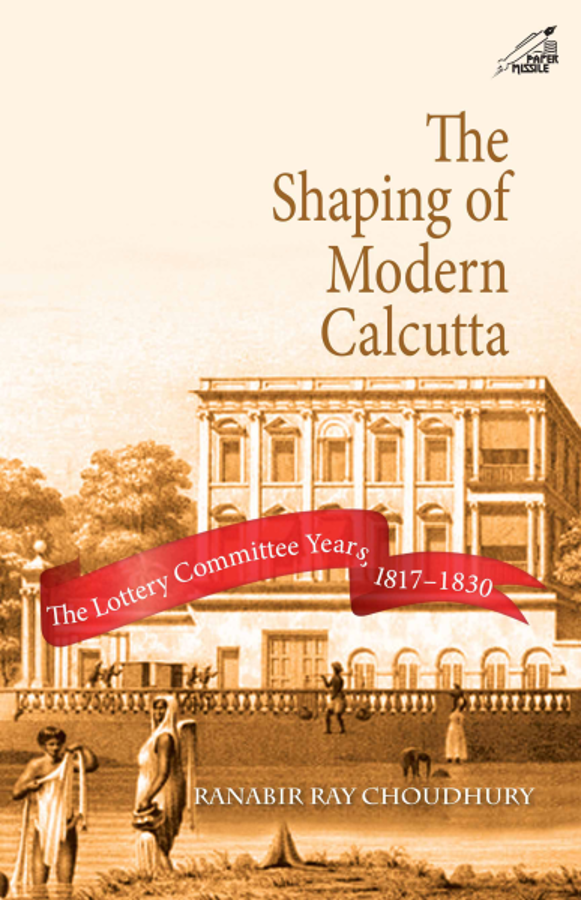
Title: The Shaping of Modern Calcutta: The Lottery Committee Years, 1817 – 1830

Author: Ranabir Ray Chaudhury

Publisher: Niyogi Books

If you ask any layman about the city of Calcutta (now rechristened as Kolkata) you will get three major pieces of information — namely, it was founded by Job Charnock in 1690; it was the seat of East India Company and capital of British India till 1911; and that it was divided roughly into two sections — the white English town at the centre and towards the south and the native town in the north. Beyond that, very few people have the idea of how the city developed spatially and how several major arterial roads, tanks and squares were built systematically during the beginning of the nineteenth century and this is where The Shaping of Modern Calcutta: The Lottery Committee Years, 1817 – 1830 by Ranabir Ray Chaudhury gives us plenty of information about the gradual development of Calcutta. This was undertaken by raising money through sale of lottery tickets and implemented by the creation of a Lottery Committee which functioned specifically for thirteen years from October 1817 to 1830.

Under the system then prevalent, the surplus lottery funds remained with the Bank of Bengal which would continue to be involved in the sale of tickets and the payment of prizes but would have nothing to do with other payments. The three senior members of the committee were John Eliot, Charles Trower and Henry Wood who had already looked after the construction of the square and tank at Baparitala (Wellington Square) and the new road being built from Dharamtala Road to Bowbazar. Later officials like Henry Shakespear and Barwell, G. Gordon and A. Colvin were inducted, and featuring in various sub-committees, they were also deeply engaged in the city’s development work.  

In 1830, for all practical purposes, the functions of the committee relating to the improvement of the city ceased effectively. Though the beneficial impact of the committee’s work affected everyone, native and European alike, and there was nothing remotely furtive about it, yet the Directors of the East India Company in London were not happy with what was happening in distant Calcutta on the city-development front, choosing to view the evolving picture in a different light. Keeping in mind the virtues of economy in expenditure, the Company wrote to its Government of Bengal that whenever there was any activity relating to general and public utility, some part of the charges ought to be borne by the inhabitants. Further, the Lottery Committee was handling large sums of money and perhaps there was the Company’s deep-seated skepticism about the sensibility of such expenditure in general and a tendency to conclude that the money was not being spent efficiently. The work done by the committee was phenomenal because the projects conceived and implemented by it still cast a long shadow on life in modern Calcutta. 

It becomes very clear that the city of Calcutta gained immensely from the development work carried out by the Lottery Committee since October 1817. The Strand Road had spruced up the eastern bank of the River Hooghly beyond recognition; the western side of Tank Square (today’s BBD Bagh) down to the Maidan till the West Bengal Legislative Assembly, had been given its modern shape with its grid of streets; pucka drains had been built and upgraded all over the city; the major north-south arterial road extending from Park Street in the south to Shyambazar in the north with four squares along it had been constructed; Free School Street had been made; the entire area south of Park Street up to Circular Road had been transformed into ‘virgin’ land ready to be settled in by the genteel (for the most part, sahib) population of Calcutta; and the modernisation of the Garden Reach area, reaching up to Khidirpur in the north, had been begun.

Among other things, the Lottery Committee built the major arterial roads in the northern and central parts of the city, which in time determined the layout of the contiguous residential areas. Dalhousie Square and the entire ground between Park Street and Circular Road were developed by the committee. Previously, a large part of the ground south of Park Street was low-lying and marshy, generating pestilence all around. Bustee clusters were located here probably because of the availability of Gangajal from Tolly’s Nullah (the Adi Ganga) through the existing network of drains, the river being some way off to the west.

The story of the making of Strand Road is narrated in detail, as with increasing economic activity and population pressure, it would provide the inhabitants with easier access to the river, both for recreation and commerce. The Lottery Committee was also responsible for putting up the first brick-and-mortar decorative balustrade which still adorns the Chowringhee area and Red Road. Thus, in its 13 years of effective functioning (till 1830), the committee had been successful in providing the critical push necessary to transform Calcutta from the topographical shape it had inherited since the years immediately following the landing of Job Charnock at Sutanati in August 1690 into one which, in a manner of speaking, would make the city ready to be launched into the 20th century and beyond.

The interest in reading the book persists throughout because apart from the maps, figures, numbers, statistics, and other logistic details, we get a lot of information of the different hindrances the Lottery Committee faced while implementing their projects. Human nature has not really changed much and so we read about people at that time who flouted the rules to line their own pockets and for whom profiteering was the norm.

The basic premise here is that human nature being what it is, there are some aspects of life and behaviour which are universal in their reach, both temporally and spatially. Another very interesting area of study is how the officials encountered the problem of encroachment, the process of land acquisition and the demand for compensation by native plot holders. The committee was aware of matters affecting the native sentiment and there are instances of how they altered the alignment of a major road to suit the convenience of the natives. Even then in some instances tiffs and legal hassles with local residents in North Calcutta were also recorded. Apart from private property rights, religious considerations too played an important role in the decision-making process of the committee.


Before concluding it is worthwhile mentioning a few lines about the author of this volume. During his quarter-century with The Statesman in Calcutta (1970-94), principally as a leader writer, Ranabir Ray Choudhury became interested in the past of a great city which the East India Company had selected as the nerve centre for its operations in the Indian subcontinent and further to the east, extending to Singapore and beyond. In time, this growing interest led to three compilations – Glimpses of Old Calcutta 1835-1850 (1978), Calcutta a Hundred Years Ago 1880-1890 (1987), and Early Calcutta Advertisements 1875-1925 (1992). He next wrote The Lord Sahib’s House, Sites of Power: Government Houses of Calcutta 1690-1911 (2010). A City in the Making, Aspects of Calcutta’s Early Growth (2016).

This volume under review is his sixth book and thematically is a sequel to the last one. That work ended with the formation of the Lottery Committee in 1817: this book takes up the story from there. From a connoisseur of the city, we get details of its development to a point that a lot of unknown facts are provided to the reader which the author garnered from documents and archival material available at the West Bengal State Archives.

Though he is not a historian, trained or otherwise, the author mentions in the ‘Introduction’ how he faced the constant struggle to avoid getting enmeshed in detail and to refocus attention on the broad current of policy and the effects of its implementation. Attention to the specific problems faced in the day-to-day execution of projects also does help to throw light on the precise nature of hurdles encountered at the grassroots level. The book is therefore highly recommended for scholars of history, architecture, town planning and every layman reader who is interested in Kolkata – a city which has been defined in multifarious ways as a city of joy, a city of palaces, a dead city, and so on.

.

Somdatta Mandal, an academic, critic and translator, is a former Professor of English at Visva-Bharati, Santiniketan, India.

PLEASE NOTE: ARTICLES CAN ONLY BE REPRODUCED IN OTHER SITES WITH DUE ACKNOWLEDGEMENT TO BORDERLESS JOURNAL

Click here to access the Borderless anthology, Monalisa No Longer Smiles

Categories
Essay

T.S Eliot’s The Waste Land: Finding Hope in Darkness

By Dan Meloche

One hundred years ago, T.S Eliot wrote ‘The Waste Land’ to find meaning in troubled times. As we wrestle with trouble in our own times, an examination of Eliot’s paean to chaos can prove instructive. Horrified by the return of war in Europe, disturbed by the looming threat of environmental collapse, and fatigued by over two years of a resilient pandemic, we crave relief and inklings of hope. In Eliot’s poem, relief does not come without tarrying with the darkness. In his 433-line poem, slivers of hope are crowded by the ubiquitous memento mori, the constant reminders of death. With his own hope compromised by a series of personal crises, Eliot’s fractured self mirrored a Europe fractured by the incomprehensibility of the millions sacrificed on European battlefields. To heal the fracturing, the poem represents a therapeutic exercise not only for the poet, but also a generation. After the questionably named Great War, cultural revisions produced modernism, representing a significant departure from traditional poetic sensibilities. 

Before World War I, war retained a nobility exemplified in the “six hundred” of Tennyson’s ‘Light Brigade‘ (1854). After World War I, Tennyson’s sentiment of “Theirs not to reason why, / Theirs but to do and die” no longer reflected the misery and absurdity of millions sacrificed for a few acres of mud. As the world changes, so does its art. To restore both a fractured mind and a fractured generation, ‘The Waste Land’ assembles meaning from ruins and conflated mythologies to spring hope. Rife with allusions, sometimes obvious, often obscure, Eliot’s poem aligns with modernist principles as multiple narrative voices range freely across landscapes of time and memory.

In the poem’s opening section, hope does not sing forth as in a Dickinson (1830-1886) poem, but lays disassembled in the ruins of desolate imagery. A spark of hope is initiated by a female narrative voice recalling an idyllic childhood tobogganing episode: “In the mountains, there you feel free.” The pleasant recollection shifts dramatically into the middle of a land of “stony rubbish,” “broken images,” and a “dead tree (that) gives no shelter, the cricket no relief”. In a parenthetical note, a whispering narrator offers a hint to relief: “Only there is shadow under this red rock, (Come in under the shadow of this red rock).” The secret told in that shadow comes in the following four lines:

"And I will show you something different from either 
Your shadow at morning striding behind you 
Or your shadow at evening rising to meet you: 
I will show your fear in a handful of dust."

What you leave behind is the past and what rises to meet you is the future. The “something different” is what lies between: the eternal present. In ‘The Waste Land’, our reckoning with death produces a despair that can only be relieved by moving meditatively out of time.

In 1922, the war has ended, yet trauma echoes within the workers who return to re-ignite the engine of economic growth. In the final stanza of the opening section, the poet gives us London’s financial district (The City) and a crowd flowing over London Bridge. Emotionally wrought automatons, the men carry a despair that manifests their drudgery: “Sighs, short and infrequent, were exhaled, / And each man fixed his eyes before his feet”. Within this crowd, the narrator recognises his comrade and calls to him: “Stetson! / You were with me in the ships at Mylae!” He does not recognise him from Passchendaele or the Somme, but from the first Punic War between Rome and Carthage in 330 B.C. Whether in modern Europe or ancient Rome, war is inevitable, and solace is often elusive. The dead, “planted” and sustained in our collective memory, can serve to assuage our despondency: “That corpse you planted last year in your garden, / Has it begun to sprout? Will it bloom this year?” April is indeed “the cruellest month” as the lilacs bred “out of the dead land” are fertilised by dead soldiers. Such is the dubious shape of hope in the aftermath of industrial scale war.

To conjure further hope, Eliot assembles mythologies and merges fragments with references to the Hindu Upanishads, Shakespeare, and the myth of the Fisher King. In the poem’s final section, reference to the Upanishads serves as an incantation to “controlling hands” of a governing Thunder that gives, sympathizes, and controls. Like a “broken Coriolanus”, we are compelled to surrender on the path of cruel iniquities that lead to our “obituaries”. Without surrender, we may suffer the same fate as Coriolanus, whose excess pride cost him his life. As Thunder exhorts humility, Eliot, as narrator, assumes the place of the Fisher King, the wounded sovereign who governs his barren lands: “I sat upon the shore / Fishing, with the arid plain behind me”.  In ‘The Waste Land’, will a hero fulfill the myth of the Fisher King by arriving to restore both the wounded king and the “arid plain”? Eliot’s answer comes with the rhetorical question, “Shall I at least set my lands in order?” A hero will not come, and the fracturing of both Eliot and his generation endures as aridity persists. In the worst times, the only way to elicit hope comes with adjusting our expectations. For Eliot, his “fishing” is the resumption of his creative endeavours despite the prevailing aridity. To carry on, we must make peace with the circumstances of our time. Eliot invokes this in his final line with the chant that ends each Upanishad: “Shantih     shantih     shantih.”

In his notes on the poem, Eliot equates this final line with Philippians 4:7 and the “peace that passeth all understanding”. Sifting through the ashes of a destroyed Europe or diagnosing the causes of psychological fracture will not yield peace. Peace comes not from understanding why the trauma happened, but from reaching outside the chaos to a higher order. Eliot’s final allusion marks a harbinger to his conversion to Anglicanism in 1927, wherein he found community and peace for the rest of his life.

As the war continues in the Ukraine, memories of the dead live on in the trauma of the living. To cope with that trauma, hope sustains those huddled in the Kyiv metro stations. Below the missile bursts above, Ukrainians singing traditional songs and the national anthem will not bring back the dead, but it will limit the fracturing: “The glory and freedom of Ukraine has not yet perished.”

.

Dan Meloche is a full-time professor at Algonquin College in Ottawa. When he isn’t teaching English, social psychology, and economics, he reads widely and writes reviews and personal account essays.

Click here to access the Borderless anthology, Monalisa No Longer Smiles

PLEASE NOTE: ARTICLES CAN ONLY BE REPRODUCED IN OTHER SITES WITH DUE ACKNOWLEDGEMENT TO BORDERLESS JOURNAL
Categories
Poetry

Winter’s Score

By Jenny Middleton

WINTER’S  SCORE

It’s easy to admire
the skater’s bladed boot resting on her partner’s thigh,
his hands firm on her waist hoisting
her above the rink into glitzy, gaping lights
carving the ice together with the arced geometry of dance

few think of
scientists, at the poles, drilling metal cylinders
in to glaciers collecting the traces fallen things --
pollen’s sweat, snow compressed by mammoths
a deluge of poisoned rain – racked with signs

of change and how this shifts particles
flaying memories like the swan – trapped that winter
in ice and fishing nets
its feathers beating sound from still air
in flightless desperation

or how a body aches long after
the surgeon’s slice through skin
blurring its dead, rutted scar
amongst live veins

no – it is easier to love what doesn’t scream -- 
a world that winks sequins and whispers
soft, snowy songs to a tired audience
sitting in the arena’s dark. 

Jenny Middleton has written poetry throughout her life. Some of this is published in printed anthologies or on online poetry sites. Jenny is a working mum and writes whenever she can amid the fun and chaos of family life. She lives in London with her husband, two children and two very lovely, crazy cats.  You can read more of her poems at her website  https://www.jmiddletonpoems.com  

.

PLEASE NOTE: ARTICLES CAN ONLY BE REPRODUCED IN OTHER SITES WITH DUE ACKNOWLEDGEMENT TO BORDERLESS JOURNAL