Categories
Contents

Borderless, May 2024

Painting by Sohana Manzoor

Editorial

Though I Sang in my Chains like the Sea… Click here to read

Translations

Three poems by Nazrul have been translated by Niaz Zaman from Bengali. Click here to read.

Projapoti (Butterfly) by Nazrul has been translated by Fakrul Alam from Bengali. Click here to read.

Human by Manzur Bismil has been translated by Fazal Baloch from Balochi. Click here to read.

Now, What I Can Do by Ihlwha Choi has been translated from Korean by the poet himself. Click here to read.

Chhora or Rhymes by Tagore has been translated from Bengali by Mitali Chakravarty. Click here to read.

Poetry

Click on the names to read the poems

Michael Burch, Kirpal Singh, Ryan Quinn Flanagan, Shamik Banerjee, Stuart McFarlane, Mary Tina Shamli Pillay, George Freek, Radhika Soni, Craig Kirchner, Tapas Sarkar, Stephen Philip Druce, Anjali Chauhan, Michael Lee Johnson, Milan Mondal, Rhys Hughes

Poets, Poetry & Rhys Hughes

In Dylan on Worm’s Head, Rhys Hughes describes a misadventure that the Welsh poet had while hiking as a tribute to him on Dylan Thomas Day. Click here to read.

Musings/Slices from Life

Hooked for Life and Beyond…

Ravi Shankar looks at the computer revolution in a light vein. Click here to read.

Sundays are Only for Some…

Snigdha Agrawal introduces us to the perspectives of a child of parents who iron clothes for the middle class in India. Click here to read.

Eternalising the Beauty of Balochistan

Munaj Gul gives an in memoriam for a photographer from Balochistan. Click here to read.

Musings of a Copywriter

In Is this a Dagger I See…?, Devraj Singh Kalsi gives a tongue-in-cheek account of a writer’s dilemma. Click here to read.

Notes from Japan

In A Golden Memory of Green Day in Japan, Suzanne Kamata tells us of a festival where she planted a tree in the presence of the Japanese royalty. Click here to read.

Essays

When the Feminist and the Revolutionary Met

Niaz Zaman writes of the feminist leanings of Nazrul’s poetry in context of Madam Roquiah, a contemporary of the poet. Click here to read.

Metaphorical Maladies

Satyarth Pandita looks into literature around maladies. Click here to read.

The Storied Past of Khiva

Gita Viswanath takes us to the heritage city in Uzbekistan. Click here to read.

Akbar Barakzai: A Timeless Poet

Hazaran Rahim Dad explores the universal poetry of Akbar Barakzai. Click here to read.

Stories

Don Quixote’s Paradise

Farouk Gulsara takes us through a dystopian adventure. Click here to read.

The Buyback

Devraj Singh Kalsi gives a tale of reconnecting with the past. Click here to read.

Pier Paolo’s Idyll

Paul Mirabile traces a story of a young boy in the outskirts of Rome. Click here to read.

Conversations

Ratnottama Sengupta in conversation with Sohini Roychowdhury, who tries to bridge cultures with dance. Click here to read.

A brief overview of Rajat Chaudhuri’s Spellcasters and a discussion with the author on his book. Click here to read.

Book Excerpts

An excerpt from Selected Essays: Kazi Nazrul Islam, translated by Radha Chakravarty from Bengali. Click here to read.

An excerpt from Aruna Chakravarti’s Jorsanko. Click here to read.

Book Reviews

Somdatta Mandal reviews Radha Chakravarty’s translation of Selected Essays: Kazi Nazrul Islam. Click here to read.

Malashri Lal reviews Lakshmi Kannan’s Nadistuti: Poems. Click here to read.

Ajanta Paul reviews Bitan Chakraborty’s The Blight and Seven Short Stories. Click here to read.

Bhaskar Parichha reviews Will Cockrell’s Everest, Inc. The Renegades and Rogues who Built an Industry at the Top of the World. Click here to read.

.

Click here to access the Borderless anthology, Monalisa No Longer Smiles

Click here to access Monalisa No Longer Smiles on Amazon International
Categories
Essay

Akbar Barakzai: A Timeless Poet

By Hazaran Rahim Dad

Akbar Barakzai (1939-2022) was born in Shikarpur Sindh, Pakistan. He received his early Education from Karachi and later he graduated from University of Karachi. Barakzai  is considered as one of the most defiant progressive voices in modern Balochi literature. His poetry reflects the objective realities of life and ambitions of his people. Boundless love for masses, profound desire for peace and prosperity, and unwavering resolve to resist and defy the tyranny are some of the commonplace themes of his poetry.

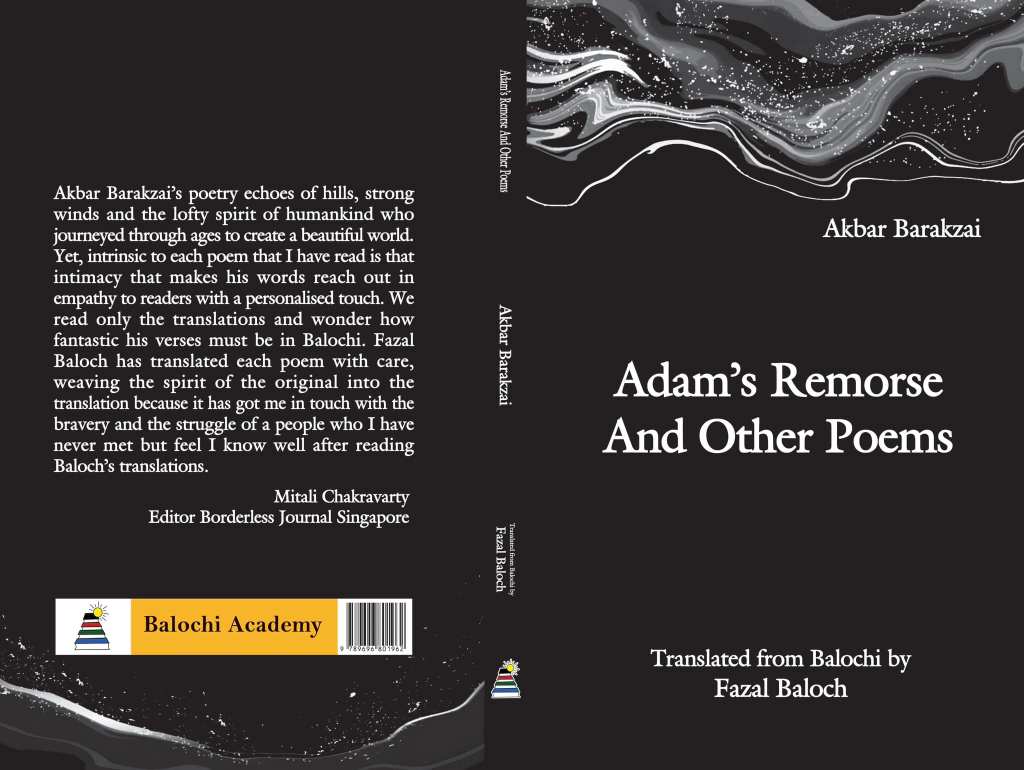
 “Akbar Barakzai belongs to the generation of the poets that witnessed the political and literary activism of Muhammad Hussain Unqa, Sher Mohammad Mari, Mir Gul Khan Naseer and Azat Jamaldini”, writes Fazal Baloch, a renowned translator who most recently brought out the anthology of Barakzai’s translated poems under the title Adam’s Remorse and Other Poems, published by Balochi Academy Quetta in 2023.

In his literary career, which spans over a half century, Barakzai has managed to bring out only two of his anthologies. Some selected poems by Barakzai have been translated from Balochi to English by Fazal Baloch, a college professor in Turbat, and a prominent literary translator.

Akbar Barakzai was an honest and dedicated political and social activist whose aim was progress of Baloch people. He as poet could not only express the human sentiments but could also express their aspirations for their life of Freedom and Dignity. “He served … his people admirably and deserves our respect and love,” says Meer Mohammad Ali Talpur, a Baloch intellectual.

Barakzai’s poems are rich in linguistic and literary expressions. His language is both simple and philosophical. In his poetry, he celebrates resistance, challenges oppression, and expresses a belief in a better future without losing hope. He emphasises resilience to overcome suffering. He writes:

I am the tree of immortality,
O, you tyrant brute!
The more you hew me down,
the more I sprout

The imagery of the tree symbolises the strength and the life cycle of a tree which remains steadfast midst harsh weathers.

In another poem, titled ‘Not Forever’, Barakzai continues to convey themes of resistance and defiance. As he says:

The rule of chains and fetters
Will last only for today, not forever.
The age of tyranny and oppression
Will last only for today, not forever.

He inscribes that the current state of being oppressed or controlled (“rule of chains and fetters,” “tyranny and oppression”) is temporary. Barakzai implies hope for a future where such oppression will end, indicating a belief in the eventual triumph of freedom and justice.

Barakzai sought to reshape the prevailing socio-political views and wrote for freedom and liberty, peace and prosperity and dignity of mankind. His love for human dignity transcends all geographical and cultural frontiers and becomes universal, added Fazal Baloch.

Indeed, Barakzai’s poetry transcends borders and speaks to universal themes. In his poem ‘Who Can Snuff Out the Sun?’ written in response to Che Guevara’s execution, he celebrates Che Guevara’s heroism and the universal struggle for justice and freedom. By acknowledging Che Guevara’s courage and sacrifice, Barakzai connects with a broader global struggle for human rights and liberation.

"Who can snuff out the sun? 
Who can suppress the light?"

And in the last lines of the poem, he notes,

I'm Ernesto Che Guevara
I'm Immortal
Everywhere in the world

“This is not only Barakzai’s most quoted poem, but it is also one of the most remarkable Balochi poems touching the theme of resistance and defiance,” contends Fazal Baloch.

Similarly, in his another poem like ‘I’m Viet Cong’, he expresses solidarity with the people of Vietnam, few lines are written as such:

I'm the spirit of freedom and liberty 
Who can enslave me?
Who can kill me?
After all
I'm Viet Cong I'm Viet Cong.

He might have shown solidarity with Afghanistan in his poem ‘April 1978’. His lines read:

Let's sing for the Saur
Let’s extol the groom
A garden in our heart has bloomed
Doves chant and herald the news
Revolution has arrived
Arrived what we desired

One of the ways in which Barakzai weaves the West and the East into his poetry. He has a poem called ‘Waiting for Godot’. Samuel Beckett’s Godot is emblematic of an ideal that we keep waiting for. Barakzai has captured the essence of the whole play in his poem with his refrain —

Arise! O friends from this deep slumber 
Godot will not, will never show up

In one of his most powerful poems, ‘Word’, Barakzai conveys the power of speaking up for one’s rights and the importance of not remaining silent in the face of oppression. He believes that by voicing one’s grievances and advocating for justice, freedom, and salvation can be achieved, ultimately leading to the end of oppression as these lines indicate:

Don’t ever bury the word
In the depth of your chest
Rather express the word
Yes, speak it out.
The word brings forth
Freedom and providence
Of course, freedom and providence.

In ‘How Long’, Barakzai starts by portraying a bleak situation where life is filled with distress and young people are dying tragically. He inscribes,

For how long
Life will remain in utter distress
Handsome youths keep falling to bullets
And mirror like hearts
Continue to shatter into shards?

Then, he shifts the tone to one of hope and optimism, and writes,

Light-- the very essence of freedom 
Will not forever remain in prison
Life will not suffer distress
The serpent of tyranny
Will vanish evermore
The sapling of envy and hatred
Will wither away.

He suggests that despite the current darkness, better days are ahead. He expresses confidence that “light”, symbolic of freedom, will not remain imprisoned forever. He predicts an end to the suffering and the disappearance of tyranny. The imagery of the “serpent of tyranny” vanishing and the “sapling of envy and hatred” withering away conveys the idea of a brighter future where oppression and negativity are eradicated.

Barakzai’s poetry is a ray of hope in the midst of suffering from atrocities and hatred and envy. His poetry reflects his love for humanity resonating with the voices of the oppressed and for them.

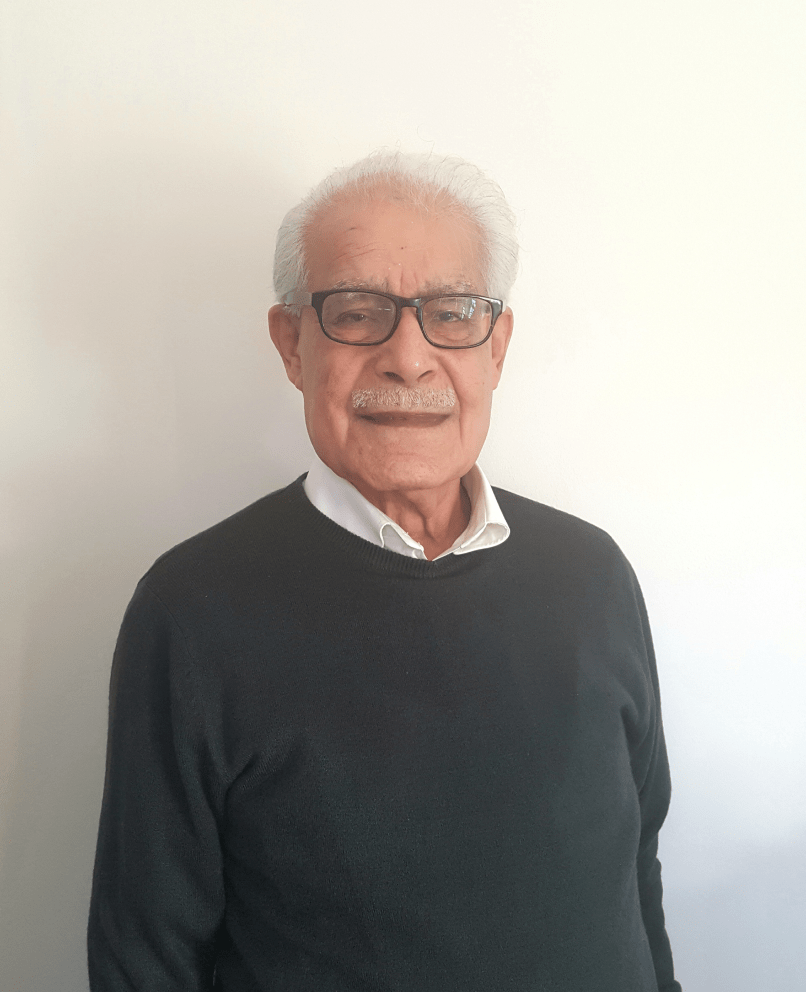
Hazaran Rahim Dad is a poet and writer. She writes on sociopolitical issues focusing on the right of fishermen. Currently she is pursuing her MPhil degree in English literature from Karachi.

PLEASE NOTE: ARTICLES CAN ONLY BE REPRODUCED IN OTHER SITES WITH DUE ACKNOWLEDGEMENT TO BORDERLESS JOURNAL

Click here to access the Borderless anthology, Monalisa No Longer Smiles

Click here to access Monalisa No Longer Smiles on Kindle Amazon International