Categories
Nazrul Translations

Break All Shackles: Nazrul

Professor Fakrul Alam transcreates powerful lyrics by Kazi Nazrul Islam

From Public Domain

Smash the iron shackles of prisons.
Make them all disappear.
Free yourself from the shackle of worship.
Young ones—do what befits you best
Sounding horns signifying demolition,
Break through all Eastern ramparts.
Play music for the Supreme One.
Who’ll Lord over you? Dare to act kingly
Or threaten to punish you?
Who is truly free and really sovereign?
Ha, ha, ha! I feel like laughing.
Will God Himself wear a noose? Destroyer!
Who tipped the flame with such awful news?
Oh crazy, forgetful one, storm and rock prison bars.
Yank them with sudden force.
Pull, pull them with gale force.
Bear on your shoulder a kettle drum,
Beating it rhythmically, summon Death.
Let drumbeats bring it back to life!
Let’s see you shake the base of all forbidding prisons.
Kick them hard; break, break their locks.
Burn, burn all prisons and do away with them!
A rendition of the song in Bengali from Coke Studio, Bangladesh

Born in united Bengal, long before the Partition, Kazi Nazrul Islam (1899-1976) was known as the  Bidrohi Kobi, or “rebel poet”. Nazrul is now regarded as the national poet of Bangladesh though he continues a revered name in the Indian subcontinent. In addition to his prose and poetry, Nazrul wrote about 4000 songs

Fakrul Alam is an academic, translator and writer from Bangladesh. He has translated works of Jibonananda Das and Rabindranath Tagore into English and is the recipient of Bangla Academy Literary Award (2012) for translation and SAARC Literary Award (2012).

PLEASE NOTE: ARTICLES CAN ONLY BE REPRODUCED IN OTHER SITES WITH DUE ACKNOWLEDGEMENT TO BORDERLESS JOURNAL

Click here to access the Borderless anthology, Monalisa No Longer Smiles

Click here to access Monalisa No Longer Smiles on Amazon International

Categories
Tribute

How Nazrul Stirred the Winds of Change

Kazi Nazrul Islam was born in Churulia in India on 24th May, and he died a Bidrohi poet in Bangladesh. When he was born in 1899, it was before the McMahon Line of Partition had been drawn. He looked up to Rabindranath Tagore as his mentor but his form of poetry was more rebellious and his lyrics, different, though no less beautiful. His heart belonged to a united Bengal as can be seen from much of his works. He started magazines, supported feminism, brought out Begum Rokeya’s work in his journal, spoke of rising beyond borders and he has even written of climate change more than a hundred years ago…

His essay on melting icebergs has been translated by Radha Chakravarty. Today, we celebrate Nazrul’s birth anniversary with translations of his works from Bengali. These showcase the diversity in his writings, broadness of his thought and his concern for global issues that remain unresolved to date: his essay on climate change, a story grown out of his experiences as a soldier translated by Sohana Manzoor, a poem on poverty and lyrics on women and living in a world that transcends human constructs rendered in English by Fakrul Alam and more. Welcome to Nazrul’s world!

Poetry

Arise O Woman and Two Flowers on One Leafstalk, lyrics by Nazrul, have been translated from Bengali by Professor Fakrul Alam. Click here to read.

Daridro or Poverty by Nazrul has been translated from Bengali by Professor Fakrul Alam. Click here to read.

Prose

The Day of Annihilation, an essay on climate change by Kazi Nazrul Islam, has been translated from Bengali by Radha Chakravarty. Click here to read.

Temples and Mosques: Kazi Nazrul Islam’s fiery essay translated by Sohana Manzoor. Click here to read.

 Deposition of a Political Prisoner: A Speech by Nazrul: A powerful speech by Nazrul from the Selected Essays: Kazi Nazrul Islam, translated by Radha Chakravarty. Click here to read.

Hena, a short story by Nazrul, has been translated by Sohana Manzoor. Click here to read.

Categories
Review

Short Stories by Nazrul

Book Review by Somdatta Mandal

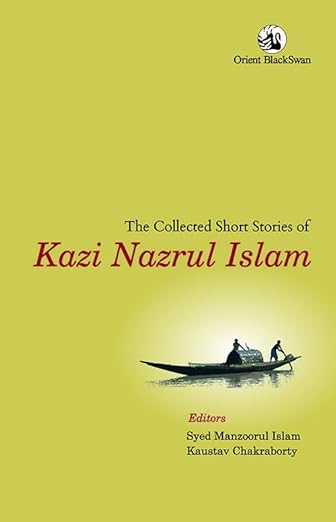
Title: The Collected Short Stories of Kazi Nazrul Islam

Editors: Syed Manzoorul Islam and Kaustav Chakraborty

Publisher: Orient Blackswan

He dons many mantles. Kazi Nazrul Islam (1899 – 1976), the national poet of Bangladesh, was a prolific Bengali poet, revolutionary, essayist, journalist, editor, activist and composer of songs. The very mention of his name conjures up the figure of a fiery iconoclast who fought against the structures of oppression and orthodoxy in society to bring about progress and change. In fact, his self-styled image as the volatile bidrohi or ‘rebel poet’ overshadows his other literary achievements and that is how ordinary people still remember him.

This unique volume presents all twenty of Kazi Nazrul Islam’s short stories for the first time in English translation. Done by different hands, they feature rich imagery, evocative landscapes, references to music, classical poetry, folktales and more. The prominent characteristics of these stories are simplicity, vivacity and emotionality. They have been sourced from different anthologies. The first six stories are from the collection Harvest of Sorrow1.  The opening story of the collection titled “Harvest of Sorrow”, is a collage of tales narrated by the three characters: Dara, Bedoura and Saiful Mulk. Dara, located in Iran’s Golestan, narrates his tale of love, separation and devotion to his motherland through a series of reminiscences. After that, we hear the same set of events narrated from Bedoura’s perspective. Then follows the account narrated by Saiful Mulk, portrayed as a sinner who tempted Bedoura into losing her virginity. Overcome by guilt, he joins the freedom struggle where he encounters Dara. What follows is a tale of redemption loss and transcendence of physical love to a more spiritual kind of love. “Hena”, the second story of the collection, is narrated by Sohrab, and its theme is also love and war – both internal and external battle. “In the Relentless Rain” is basically a story of love between strangers. The author doesn’t provide us the names of the lovers – rather both are addressed as dark-skinned. The next story, “Half Asleep”, is divided into two parts: Azhar’s story and Pari’s story. Azhar’s story is mainly about his sacrifices and why he favours detachment from the sensuousness. His renunciation of carnal pleasures towards attaining greater contentment ends his relationship with Pari, whose marriage he arranges with one of his friends. He ensures that Pari remains confined within the household structure. By making Pari assert that she will not betray her role as a loving wife without pretending to erase the love that she has for her former lover, Nazrul offers a critique of the conventional notion of ‘loyalty’ of wives to serve their husbands. The first-person narrator of “Insatiate Desire” soliloquizes on a saga of disunited love where the narrator falls in love with his childhood friend, feigns disinterest in her when her marriage is arranged to another man, and characterises his own actions as stemming from the most noble impulses. The final piece of the volume, “Letter from a Political Prisoner”, is an epistolary story of a political prisoner who has also been diagnosed with fatal tuberculosis. The story is addressed to the lady of his dreams, Manashi, who does not seem to have reciprocated his love.

 The title story of the next section is from an anthology of the same name, The Agony of the Destitute2. The story centres around the glorification of war but in the process, it also raises questions related to war and gender. In sharp contrast to the narrator-protagonist of this narrative who detaches himself from domesticity to join the war, the protagonist of the very next story, “Autobiography of a Vagabond” suffers a tragic end to his domestic life and thereafter joins the army and eventually dies while fighting in Baghdad. “Meher Negar”, the third story of this section, is another tale of war and conflicts in love. Yusuf Khan, the protagonist, is a Pathan from the mountains of Waziristan who meets Meher Negar (whose actual name is Gulshan) after reaching a distant land to learn music. Later he joins the War of Independence for Afghanistan. Unable to forget her, he visits Meher Negar one last time only to discover that she is no more. As an allegorical piece of writing, “Evening Star” is about a man’s love for a distant beloved that is ultimately futile because of the probable demise of the beloved.

“Rakshasi” is written in the language spoken by the Bagdi community of the Birbhum district in West Bengal in which the speaker Bindi is a woman who complains to her friend about how society has stigmatized her as a demoness because she has killed her husband to save him from abandoning her and getting remarried to a notorious girl.“Salek” is a short moral story where, through a series of events, a dervish (later revealed to be Hafiz) shows an arrogant Kazi the path to salvation; the former becomes the latter’s salek or the one who shows the way. In “The Widow”, Begum, the narrator, speaks of her sorrowful youth, her happy married life and the miseries of her widowhood to her friend Salima. The story challenge multiple stereotypes that are often associated with the women of South Asia. The concluding tale of this volume is titled “The Restless Traveller” which is an impressionistic story centered round the urge towards finding freedom by restless youth.

The four stories that comprise the third volume of Nazrul’s stories and the next section, called The Shiuli Mala3, speak about Nazrul’s ecological sensitivity. The opening story “The Lotus-Cobras” is about Zohra and her human and non-human intimacies. As the editors rightly point out, “In the portrayal of Zohra’s attachment with her serpent sons, Nazrul seems to be very close to the essence of posthumanism where radical posthuman subjectivity is understood on the basis of an intersectional ethics of plurality”. “The King of the Djinns” is a tragicomic story about how Alla-Rakha, the protagonist, resorts to a series of tricks to get married to Chan Bhanu, the woman he desires. “The Volcano” deals with the disaster that is caused by the sudden eruption of repressed anger and egotistic pride in Sabur, the humble, helpful and uncomplaining protagonist of the story. It is a study of the anxiety of manliness. “The Shiuli Mala”, the concluding story of this section, is a testimony to Nazrul’s love for the trope of separated lovers or unrequited love. Set in Shillong, it primarily deals with a platonic and disunited love between Azhar, a well-known chess player, and Shiuli, the daughter of another brilliant chess player, Professor Chowdhury. Structured as a flashback, Azhar narrates the story to his friends who are part of a regular chess adda.

Two unanthologised stories end the collection. “Letter from a Lost Boy” is an epistolary account of a boy who writes to his mother about some incidents in his life that have occurred since he had left her until the time of his return. The story is a critique of child marriage and the consequent early widowhood that brings never-ending misery in the life of a woman. “The Hawk-Cuckoo from the Woods” tells the story of a marital discord between Dushasan Mitra and his wife Romola. Their friction widens after Romola becomes too attached to an injured hawk-cuckoo and her husband feels agitated by her gradual disconnect from their conjugal life.  The story ends with Romola flaying her husband for throwing the bird away, finding and hugging the dying bird to her heart and plunging into the waters of the Padma.

All these twenty stories invite the reader to re-evaluate the ‘rebel poet’ as an empathetic humanitarian who also excelled in human relationships. Nazrul is essentially multilingual – he uses Hindi, Urdu, Arabic and Persian words along with Bangla. This book is the outcome of a project sponsored by the Nazrul Centre for Social and Cultural Studies, Kazi Nazrul University, Asansol, West Bengal. The volume is a transnational, collaborative labour of love bringing together the editors and translators from Bangladesh and India. Most of them are academics and have taken up the challenge to translate the stories, which in their infinite variety, is indeed a difficult task. The stories are accompanied by a timeline of Nazrul’s life and a detailed critical introduction that not only provides foundational context for the stories, but also highlights Nazrul’s attempt to counter majoritarianism and various hegemonies by dismantling hierarchies and celebrating intimate pluralities. In fact, at the end of their introduction, the editors Syed Manzoorul Islam and Kaustav Chakraborty ask two very pertinent questions. “In which category can we place Nazrul? Is there a need to formulate a different category altogether in order to position him?” The answers of course lie with the readers of the translated stories to decide. All said and done, this volume of short stories is strongly recommended for all classes of readers who are keen to discover the multi-faceted genius of Kazi Nazrul Islam and who could not earlier savour their uniqueness because they were only written in Bangla.

  1. Byathar Daan (Harvest of Sorrows) published in March 1922 ↩︎
  2. Rikter Bedon (Agony of the Destitute) published in January 1925 ↩︎
  3. Shiuli Mala (Garland of Jasmines) published in October 1931 ↩︎

Somdatta Mandal, critic, academic and translator, is a former Professor of English at Visva-Bharati University, Santiniketan, India.

PLEASE NOTE: ARTICLES CAN ONLY BE REPRODUCED IN OTHER SITES WITH DUE ACKNOWLEDGEMENT TO BORDERLESS JOURNAL

Click here to access the Borderless anthology, Monalisa No Longer Smiles

Click here to access Monalisa No Longer Smiles on Amazon International

Categories
Nazrul Translations

Wantonly Dancing Feet

Nazrul’s lyrics transcreated by Professor Fakrul Alam

Roomu Jhoomu Roomu Jhoomu

Roomo Jhoomo Roomo Jhoomo—anklet bells sound.
Addicted to dancing, bangles jingle jangle to that beat.
The dresses’ borders keep swaying in the restless wind.
Who could be moving with such wantonly dancing feet?
Stranger though she is and so close to the riverbank
I think I know this dancer on the move. Her movements
Fill this heart of mine. Her swan or peacock-like steps
Cast a spell, like a mirage in a desert will. With her smile
She even enchants the forest deer. Her big eyes dance,
Making the sea waves lilt. Forests in the high hills sway,
Sway away to the beat and music of her dancing feet.

Born in united Bengal, long before the Partition, Kazi Nazrul Islam (1899-1976) was known as the  Bidrohi Kobi, or “rebel poet”. Nazrul is now regarded as the national poet of Bangladesh though he continues a revered name in the Indian subcontinent. In addition to his prose and poetry, Nazrul wrote about 4000 songs.

Fakrul Alam is an academic, translator and writer from Bangladesh. He has translated works of Jibonananda Das and Rabindranath Tagore into English and is the recipient of Bangla Academy Literary Award (2012) for translation and SAARC Literary Award (2012).

.

PLEASE NOTE: ARTICLES CAN ONLY BE REPRODUCED IN OTHER SITES WITH DUE ACKNOWLEDGEMENT TO BORDERLESS JOURNAL

Click here to access the Borderless anthology, Monalisa No Longer Smiles

Click here to access Monalisa No Longer Smiles on Amazon International

Categories
A Special Tribute

Blazing across the Darkness: Kazi Nazrul Islam

Why fear destruction? It’s the gateway to creation!
The new will arise and rip through the unlovely.
Hair disheveled and dressed carelessly
Destruction makes its way gleefully.
Confident it can destroy and then build again!
Ring bells of victory!

-- Prolloyullash (The Frenzy of Destruction) by Nazrul; translated from Bengali by Professor Fakrul Alam

As the world swerves in disarray, Kazi Nazrul Islam, who died the same month as Tagore, leaves behind a treasury of prose and poetry which, if we imbibe into our blood and bones, could perhaps heal dysfunctional constructs made by humans. Given the current situation, one cannot but help recall Nazrul’s lines from his poem, Prolloyullash (The Frenzy of Destruction), hoping for better times. Known as the rebel poet of Bengal, in his poem, Bidrohi (Rebel), he becomes the force that creates the change. His powerful writing and idealism continues to inspire over the decades.

Tagore saw brilliance in him and even wrote a poem for him that Radha Chakravarty has shared in her essay as a tribute on his 48th death anniversary. We also revisit his own inspiring words with translations of his poetry, lyrics and fiction by Professor Alam and Sohana Manzoor, along with the tribute by Chakravarty.

Poetry

Rebel or ‘Bidrohi’ by Nazrul has been translated by Professor Fakrul Alam. Click here to read.

Two Songs of Parting by Nazrul have been translated by Professor Fakrul Alam. Click here to read. 

Prose

The Snakecharmer, Shapuray by Nazrul, has been translated from Bengali by Sohana Manzoor. Click here to read.

The Comet’s Trail: Remembering Kazi Nazrul Islam

Radha Chakravarty pays tribute to the rebel poet of Bengal. Click here to read.

Categories
Essay

The Comet’s Trail: Remembering Kazi Nazrul Islam

By Radha Chakravarty    


The abiding image of Kazi Nazrul Islam (1899-1976) is that of the “Rebel Poet,” who defines himself as a fiery comet streaking across the firmament, emblazoning in the sky a message of revolutionary change. Unlike Rabindranath Tagore, Nazrul was not born into social and intellectual privilege. He has been described, in fact, as “the ‘other’ of the elite Kolkata bhadralok”.[1] Born in Churulia village in the Bardhaman district of Bengal, Nazrul was the son of the head of a mosque, studied in an Islamic school, and during his youth, joined a Leto group, a travelling band of local performers. When in high school, he was recruited into the British army, and served in Karachi. Even after he returned to Bengal as a young poet who had already acquired fame and repute, he remained something of an outsider to the intellectually sophisticated world of the literati. It was from this position of an outsider that he fashioned his own image as the bidrohi or ‘Rebel poet’ who challenged the structures of the political, social, cultural and literary establishment with the sheer force of his iconoclastic writings.

Though best known as a poet, composer and revolutionary, Nazrul’s oeuvre also includes novels, essays, stories, editorials and journalistic pieces on a remarkable variety of topics. He was also a lyricist and composer, creator of the iconic genre called “Nazrulgeeti”. Nazrul’s brilliant literary career lasted from 1919 to 1942, when illness brought it to a sudden end. During this short span of time, he wrote on an amazing range of subjects, including politics, nationalism, social change, religion, communalism, education, philosophy, nature, love, aesthetics, literature and music. He saw it as his mission to arouse public awareness about pressing issues, and to jolt them out of their complacency and general apathy. Remembering Nazrul on the 48th anniversary of his death, it is daunting to think about his extraordinary legacy, but also a timely moment to reflect upon his significance for our own times.

In his political stance, Nazrul argued passionately in favour of armed struggle for total independence from colonial rule, rejecting the Gandhian path to advocate a freedom won via armed resistance. The trope of violence recurs in his writings. Yet his apparent espousal of the principle of destruction springs from a utopian dream of constructive change. “Reform can be brought about, not through evolution, but through an outright bloody revolution,” he says in the essay ‘World Literature Today’. “We shall transform the world completely, in form and substance, and remake it, from scratch. Through our endeavours, we shall produce new creation, as well as new creators”.[2]

Nazrul’s ideas on education counter the colonial pattern, advocating instead a curriculum that draws on indigenous contexts and models. He feels that the new education policy should emphasise empathy, inclusiveness and heterogeneity, with a special focus on psychological and emotional development. “It is our desire that our system of education should be such that it progressively makes our life-spirit awakened and alive,” he says in ‘A National Education’, adding: “… We would rather produce daredevils than spineless young men.” [3]

Inclusiveness and acceptance of heterogeneities are central to Nazrul’s vision. During his stint as a soldier in Karachi in his young days, he became interested in Marxist thought. The influence of this line of thinking can be felt in his emphasis on economic egalitarianism, and his passionate support of the cause of the downtrodden peasantry, particularly in his journal Langal. Following the 1926 riots in Kolkata, he expresses his anguish at the communal antagonism between Hindus and Muslims, critiquing different forms of orthodoxy in both religions. In the poem ‘Samyabadi (Egalitarian)’ [4], he declares:

I sing the song of equality—
Where all divisions vanish and barriers dissolve,
Where Hindu-Buddhist-Muslim-Christian
merge and become one …

Nazrul was also a supporter of women’s rights. In his poetry, he speaks of equality between men and women. In ‘Nari (Woman)’ he argues: “If man keeps woman captive, then in ages to come, / He will languish in a prison of his own making”.[5]

Not surprisingly, Nazrul’s fearless, unconventional attitude aroused hostility in many quarters. His bold, outspoken magazine Dhumketu enraged the British. The journal was banned, and Nazrul condemned to rigorous imprisonment. At his trial in 1923, he delivered a resounding rejoinder in his speech ‘Rajbandir Jabanbandi (Deposition of a Political Prisoner)’.  He remained a thorn in the flesh for the British administration because of his revolutionary views. Nazrul’s religious views also raised many hackles. He married Ashalata Sengupta, or Pramila, who belonged to the Brahmo Samaj. This antagonised conservative Hindus as well as orthodox Muslims.

Nazrul’s success as a writer, especially Rabindranath Tagore’s appreciation of his work, also caused jealousy among contemporary writers. For Tagore had dedicated his play Basanta to Nazrul, and also sent a telegram to him when he was in prison, exhorting him to give up his hunger strike. In 1922, Tagore had written a poem addressed to Nazrul, which appeared in successive issues of the journal Dhumketu[6]:

Come, O shining comet! Blaze
Across the darkness, with your fiery trail.
Upon the fortress-top of evil days,
Let your victory-pennant sail.
What if the forehead of the night
Bear misfortune’s sinister sign?
Awaken, with your flashing light,
All who lie comatose, supine.

Rabindranath Tagore’s recognition of Nazrul’s talent created a lot of envy in literary circles. In 1926-27, parodies of Nazrul’s poetry started appearing in Shanibarer Chithi, a journal published by the Tagore circle. It came to be rumoured that Tagore had not liked Nazrul’s use of the Persianate word khoon (blood) instead of the Sanskritised word rakta, in his composition ‘Kandari Hushiar’. This gave rise to a controversy that became known as khooner mamla (the bloody affair), which drew a strong reaction from a deeply perturbed Nazrul, in the shape of an essay ‘Boror Piriti Balir Baandh” (A Great Man’s Love is a Sandbank)’, in which he blamed Tagore’s followers for the entire misunderstanding. The situation was resolved through the mediation of friends, and relations between Tagore and Nazrul remained cordial. When Tagore died in 1941, Nazrul broadcast a moving elegy, “Robi-Hara”, on Calcutta Radio.

In some ways, Nazrul was ahead of his time. Not many people know that he was aware of environmental issues and the threat of climate change, pressing problems in our own times. In ‘The Day of Annihilation’, he writes in a prophetic vein, of global warming, dissolving ice-caps and a changing ecology, cautioning his readers that if humans exploit the planet, we will eventually be responsible for the destruction of life on earth.

In Nazrul’s life and writings, we encounter the constant pull of contraries. His consciousness was simultaneously rooted in local culture, and infused with a broad transnational spirit. He felt inspired by movements in other parts of the world, such as the Turkish Revolution, the Irish Revolution and the Russian Revolution. In the essay ‘Bartaman Viswasahitya (World Literature Today)’, we discover his awareness about literary developments across the globe. In his political writings he espouses the path of violence, but he also composes exquisitely tender love songs, devotional songs drawing on both Hindu and Muslim imagery, and songs about the beauty of nature.

Nazrul’s style is a volatile mix of colloquial, idiomatic expressions, formal Bengali, Sanskrit and Persianate vocabulary, a smattering of English, and multiple registers of language. His polyglot sensibility also surfaces in his practice as a translator. He translated Omar Khayyam and Hafez from Persian into Bengali. His translations from Arabic into Bengali include 38 verses of the Qu’ran, part of the Mirasun Nagmat (a treatise on Hindustani classical music) and some poems. He translated Whitman’s ‘O Pioneer’ from English into Bengali. He is also known for his innovative ghazals in Bengali.

In 1942, Nazrul suddenly lost his speech. His illness brought his literary life to an abrupt end. All the same, the impact of his writings continued to be felt. In the Bangladesh Liberation War of 1971, the freedom fighters adopted Nazrul’s music as a source of inspiration. He was later declared the National Poet of Bangladesh. Today, while Nazrul’s poems and songs continue to delight and inspire, the true extent of his achievement remains in shadow. It is time for a comprehensive reappraisal of this much underestimated literary genius, because his writings have so much to offer us in our present world.

[1] The Collected Short Stories of Kazi Nazrul Islam, ed. Syed Manzoorul Islam and Kaustav Chakraborty (Hyderabad: Orient Blackswan, 2024), p. xviii. Bhadralok translates to gentleman

[2] Kazi Nazrul Islam, Selected Essays, translated by Radha Chakravarty (New Delhi: Penguin Random House, 2024), p. 137.

[3]  Kazi Nazrul Islam, Selected Essays, trans. Radha Chakravarty (2024), p. 60.

[4] Translation by Radha Chakravarty

[5] Translation by Radha Chakravarty

[6] The Essential Tagore, ed. Fakrul Alam and Radha Chakravarty. Cambridge, Massachusetts: Harvard University Press, 2011, pp. 115-116; Translation mine.

Radha Chakravarty is a writer, critic, and translator. She has published 23 books, including poetry, translations of major Bengali writers, anthologies of South Asian literature, and critical writings on Tagore, translation and contemporary women’s writing. She was nominated for the Crossword Translation Award 2004.

.

PLEASE NOTE: ARTICLES CAN ONLY BE REPRODUCED IN OTHER SITES WITH DUE ACKNOWLEDGEMENT TO BORDERLESS JOURNAL

Click here to access the Borderless anthology, Monalisa No Longer Smiles

Click here to access Monalisa No Longer Smiles on Kindle Amazon International

Categories
Nazrul Translations

Songs of Parting by Nazrul

Translations from Bengali by Professor Fakrul Alam

Nazrul’s Bidai Shondha Ashilo has been translated as ‘The Evening of Parting’

THE EVENING OF PARTING 

The evening of parting is here; darkness encases the eyes.
Dearest, don’t let tears make my path of parting more slippery.
Like a flower would, I drifted with the tide and came here
Unintentionally. Why, dearest, did you err and pick the flower up?
Why did you put the flower in your tresses, only to fling it away,
Letting it drift once again with the tide? Here no one understands
Each other. The one you crave only slights you; the one you desire
Won’t be your own. Here there is no real love in the heart’s depths.
How will you understand how my pain wilts the garland of union?
The song I sing takes wings and reaches the sky, craving for you.

Nazrul’s Masjideri Pashe Amai Kabar Diyo Bhai has been translated as’Bury Me’

BURY ME 

Make sure to bury me next to a mosque, dear brother of mine,
So that from my grave I’ll hear the muezzin’s prayer call all the time.
As those in the congregation pass me by, I’ll hear too their holy steps
This sinner will thus be saved from the evil spirits close to the grave!
So many pious people—God’s devotees and our prophet’s disciples—
Come to this mosque and recite verses from the Holy Quran here.
Those verses uplift my soul and mind. Many dervishes and fakirs
Come to the mosque’s compound too. Till deep into the night
They recite God’s name repeatedly, though hidden from sight.
I too would like to repeat with them His Holy name, all in tears.
I too would so like to keep repeating His Holy name thus!

.

Fakrul Alam is an academic, translator and writer from Bangladesh. He has translated works of Jibonananda Das and Rabindranath Tagore into English and is the recipient of Bangla Academy Literary Award (2012) for translation and SAARC Literary Award (2012).

.

PLEASE NOTE: ARTICLES CAN ONLY BE REPRODUCED IN OTHER SITES WITH DUE ACKNOWLEDGEMENT TO BORDERLESS JOURNAL

Click here to access the Borderless anthology, Monalisa No Longer Smiles

Click here to access Monalisa No Longer Smiles on Amazon International

Categories
Nazrul Translations

Nazrul’s Lines for Tagore

Ghumaite Dao Shranto Robi Re (Let Robi Sleep in Peace) was written by Nazrul in 1941 for Tagore, when he died. It has been translated from Bengali by Professor Fakrul Alam

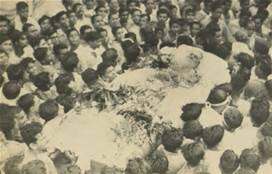
Tagore takes his leave on August 7, 1941. Photo from Public Domain
Let the spent Robi sleep on.
Please, please don’t try to wake him up.
Let not the one who spread light all his life
Be awakened; don’t disturb his sleep.
Let the one who gave light and delighted thousands,
And has now collapsed at mother earth’s bosom,
Be ritually smeared with sandal paste on his forehead;
Don’t redden his face by weeping incessantly!
Even at the risk of straining yourself, stretch out your palms
To accept the power and the strength he has given you.
The departed Sun and Supreme One will enable us to succeed
Let the poet sleep on!
The departed Sun’s glow will still light up our interiors.
So, from within yourself pay him homage every day.
Don’t make him weep by shedding continuous tears!

A recording of the first performance of Nazrul’s lyrics in Bengali

Born in united Bengal, long before the Partition, Kazi Nazrul Islam (1899-1976) was known as the  Bidrohi Kobi, or “rebel poet”. Nazrul is now regarded as the national poet of Bangladesh though he continues a revered name in the Indian subcontinent. In addition to his prose and poetry, Nazrul wrote about 4000 songs.

.

Fakrul Alam is an academic, translator and writer from Bangladesh. He has translated works of Jibonananda Das and Rabindranath Tagore into English and is the recipient of Bangla Academy Literary Award (2012) for translation and SAARC Literary Award (2012).

.

PLEASE NOTE: ARTICLES CAN ONLY BE REPRODUCED IN OTHER SITES WITH DUE ACKNOWLEDGEMENT TO BORDERLESS JOURNAL

Click here to access the Borderless anthology, Monalisa No Longer Smiles

Click here to access Monalisa No Longer Smiles on Amazon International

Categories
Nazrul Translations

Nur Jahan by Nazrul

Translated from Bengali by Fakrul Alam

Nur Jahan (1577-1645)
Nur Jahan, Nur Jahan,
Floating down a river you came
To a land full of clouds
A land of gardens—Iran!
You had your plate filled
With Nargis flowers, poppies and roses
And had brought them all along.
You brought as well legends
Of Shirin and Farhad and Shiraz.
With your graceful and slim self came
Bulbuli, Dilruba and Rabab’s songs.
Your love healed even Emperor Salim’s lunacy!
You daubed sandalwood paste on yourself
And bore the stigma in front of everyone --
A stigma the moon bears in the blue sky
Smilingly. It’s what is written in lovers’ tales.
I’ll ensure that it ambles along pathways
Forever, questing for love’s pleasures,
Despite any infamy linked to the affair.
Jahangir(Prince Salim) and his beloved empress, Nur Jahan
Nazrul’s Nur Jahan sun by the legendary Feroza Begum

Born in united Bengal, long before the Partition, Kazi Nazrul Islam (1899-1976) was known as the  Bidrohi Kobi, or “rebel poet”. Nazrul is now regarded as the national poet of Bangladesh though he continues a revered name in the Indian subcontinent. In addition to his prose and poetry, Nazrul wrote about 4000 songs.

.

Fakrul Alam is an academic, translator and writer from Bangladesh. He has translated works of Jibonananda Das and Rabindranath Tagore into English and is the recipient of Bangla Academy Literary Award (2012) for translation and SAARC Literary Award (2012).

.

PLEASE NOTE: ARTICLES CAN ONLY BE REPRODUCED IN OTHER SITES WITH DUE ACKNOWLEDGEMENT TO BORDERLESS JOURNAL

Click here to access the Borderless anthology, Monalisa No Longer Smiles

Click here to access Monalisa No Longer Smiles on Amazon International

Categories
Celebration

Welcome to Nazrul’s World

I’m a cyclone, a whirlwind,
I pommel all that lie in my path,
I am a dance-driven swing,
I dance to my own beat, I’m a free spirit, high on life...

-- Kazi Nazrul Islam, Rebel or Bidrohi, translated by Prof Fakrul Alam.
Young Nazrul

Nazrul’s writing has the power of whirlwind or a tornado — it can break with its force and make with love. His songs are a law unto themselves and called Nazrul geeti. And all this remains popular and still relevant more than a century after he was born.

Kazi Nazrul Islam (1899-1976) was born in Burdwan, a part of the Bengal Presidency that stretched from Bengal to Singapore during colonial times. Nazrul lived through the colonial rule, the independence of the subcontinent, the Partition and the creation of Bangladesh. He was multifaceted — he had tried his hand at soldiering and then settled for being a poet, writer, journalist, and musician. He is now regarded as the national poet of Bangladesh, the Bidrohi Kobi or the rebel poet. 

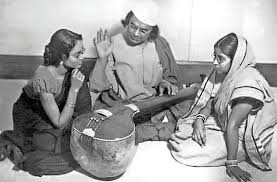
Nazrul teaching Nazrul Geeti

Here, we have tried to gather flavours of his writing and life. We start with the translation of his lyrics (a Nazrul geeti) on butterflies, translated by Fakrul Alam performed by the legendary Feroza Begum, move on to his response to Tagore’s poetry — they had a vibrant relationship as Somdatta Mandal has reflected in her discussion on Radha Chakravarty’s recent translation of his Selected Essays. It’s followed by more translations of three of his poems by Niaz Zaman, who has also written about Nazrul’s support for women. A searing essay on religious divides and socio economic gaps, translated by Sohana Manzoor, also brings to focus the plight of a beggar woman torn by poverty. A short story , showcasing him as a fiction writer, is borne of his experiences as a soldier. Last but not the least, we have a fiery speech by Nazrul from Chakravarty’s translation.

On Nazrul’s 125th birth anniversary, we welcome you to muse on him and his world…

Poetry

Projapoti (Butterfly) by Nazrul has been translated by Fakrul Alam from Bengali. Click here to read.

Nazrul’s rejoinder to Tagore’s 1400 Saal has been translated by Professor Fakrul Alam. Click here to read.

Three poems by Nazrul have been translated by Niaz Zaman. Click here to read.

Prose

 Deposition of a Political Prisoner: A Speech by Nazrul

A fiery speech by Nazrul from the Selected Essays: Kazi Nazrul Islam, translated by Radha Chakravarty from Bengali. Click here to read.

Temples and Mosques

Kazi Nazrul Islam’s fiery essay translated by Sohana Manzoor. Click here to read.

Hena

A story that grew out of Nazrul’s experiences as a soldier translated by Sohana Manzoor. Click here to read. 

Discussions

Nazrul and His World View

Somdatta Mandal writes about Radha Chakravarty’s translation of Selected Essays: Kazi Nazrul Islam and in the process explores his life and times. Click here to read.

When the Feminist and the Revolutionary Met

Niaz Zaman writes of the feminist leanings of Nazrul’s poetry in context of Madam Roquiah, a contemporary of the poet. Click here to read.