In the market several ‘instantly get rich’ books are available. And of course, these are available in all languages as well. But the twist in the tale is that the author might not have followed the advice s/he dispenses through their writings. Samuel Langhorne Clemens, who is popular through his pen name as ‘Mark Twain’, is an example in context.
Every English fiction reader worth his name would have read Mark Twain’s TheAdventures of Tom Sawyer and Adventures ofHuckleberry Finn. Twain is one of those rare writers who achieved success and fame during his lifetime through his writings. He earned a substantial amount of money from his works.
Twain is also famous for quotes and predictions. He made two accurate predictions. The most popular one was about his death. Twain was born in the year 1835 CE when Halley’s Comet made its appearance. Twain wrote in 1909 CE that he was born when Halley’s comet appeared in 1835 CE and when it would appear next (i.e., in the year 1910 CE), it would be a great disappointment if they both didn’t go out together. True to his words, Twain died of heart attack shortly after Halley’s comet’s closest approach to the Sun.
Perhaps a lesser-known prediction is in Twain’s quote, “Buy land, they are not making it anymore”. Yet Twain rarely invested in land. His favourite investment was science and technology. During his lifetime, Twain is reported to have unwisely invested about US$300,000 (present-day valued at approx. US$8 million) in failed technologies. All this in a span of about 14 years which not only speaks volumes about his loss but also about Twain’s earning’s through writings. Added to this, Twain’s children’s poor health put him in financial difficulties. He is said to have even filed for bankruptcy. Nevertheless, at the time of his death, Twain owned an estate valued at US$471,000 (present-day value about US$11 million). Ironically, Twain’s family fizzled out either to disease or to alcoholism and pills.
On the other hand, a lesser-known individual who’s a contemporary of Twain, a Mr. Friedrich Trump, a German emigrant to United States of America, invested heavily in land, real estate, hotels and brothels. By 1904 CE, Trump is said to have visited his home country Germany upon insistence of his wife whence he is believed to have deposited an amount in the excess of US$600,000 into a bank.
Trump invested in land heavily in America. Owing to his German credentials, Trump maintained a low-profile during world war I. However, due to flu and secondaries, Trump died in the year 1918 CE. Trump’s wife and his son continued the real estate projects after Trump’s death. Trump’s legacy lives in the form of present-day American President Donald Trump who happens to be Friedrich’s grandson.
Note. It is not known to the present author whether Friedrich knew about Twain’s predictions.
.
Chetan Datta Poduri is a doctorate in Biotechnology. After about a decade of teaching in premier institutes across India, Chetan turned to full-time Writing. Also, presently Chetan self-finances his research. More about him at https://cdpoduri.wordpress.com/
.
PLEASE NOTE: ARTICLES CAN ONLY BE REPRODUCED IN OTHER SITES WITH DUE ACKNOWLEDGEMENT TO BORDERLESS JOURNAL
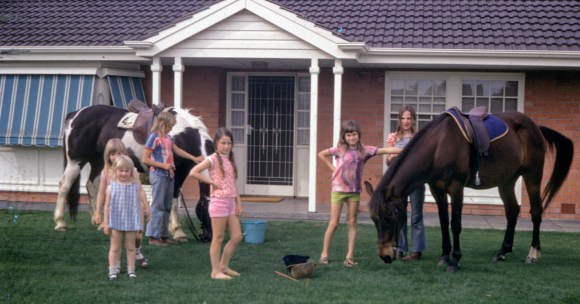
Sisters and friends and the author with horses, Whisky and Macka, outside Grandma’s house, in 1972. Photo Courtesy: Judith Stephens.
December 1972, Adelaide
I opened the fridge, pulled out some carrots and put them into the back pocket of my jeans. Then I headed into the backyard shed to retrieve my saddle and bridle. I slung the saddle over the handlebars of my bicycle and placed the bridle in the basket. Then I cycled to the first gateway to the riverbank. I left the bicycle by the fence and walked up the riverbank to find my bay steed, Macka. I couldn’t see him. Then I returned to my bike and cycled to the next entrance to the riverbank and looked for him. Still no Macka. When I entered the third entrance, I spotted him grazing by the river. I pulled out a carrot from my back pocket and held it out to him on my flattened palm. He pricked his ears, looked at me and headed towards me. He picked the carrot up with his soft lips and started crunching it. I slung the reins over his head, placed the bit in his mouth, and bridled him. Then I led him to a spot by the river where I could take advantage of the slope to stand higher than him and jumped on his back. I could never fatten him up, and his backbone pressed into my rear as I sat on him slightly askew. I regularly fed him chaff, and he grazed all day, but like some people, he remained forever thin. I rode him back to where the bicycle was, saddled him up, and trotted and cantered along the riverbank towards the sea.
This was my daily routine after school. Homework was rarely set, so I hardly ever studied in the evenings. Why would you study when you had already been at school all day? Sometimes my black labrador Jason accompanied me. In those days there were no rules about keeping your dog on a leash, so Jason would follow me, even if this meant swimming behind Macka and me to cross the river.
January 1973, Adelaide
“Meredith!” came the voice from my window at 5 am. It was my best friend, Debbie. Debbie owned a 16-hand piebald heavy horse, taller than her, called Whisky. Debbie knew that without pressure from her I would not rise this early. On this occasion, rather than being on the riverbank, Macka was stationed in the corral that Mum and Dad had built in the backyard.
I rose, dressed, and made my way to the corral to bridle Macka. Then I led him to the front yard where Debbie was waiting for me on Whisky. Today we were riding bareback, because our destination was the beach, and we were going to sit astride our horses as they swam. We headed to the riverbank and rode a kilometre to the mouth of the river. Then we rode across the sand and entered the water. When the horses started swimming, we started floating above them, my legs rising above Macka’s sides. I grabbed his mane so as not to part company with him. Then we turned the horses back towards shallow water. Once Whisky had found his feet, Debbie turned around and stood on his rump. From there she dived into the sea, quickly swam back and mounted him again. I wasn’t confident enough to attempt the same feat on Macka. Next, we headed back to shore and dismounted. We lifted the reins over the horses’ heads and held them while they rolled in the sand, thrashing their legs in the air. Then we jumped back on them, and galloped along the sand, before retracing our steps upriver.
August 2025, Monarto, South Australia
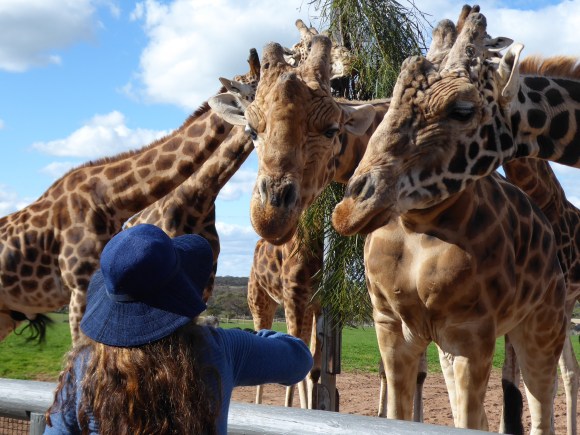
We were visiting the largest open-range safari park outside of Africa, Monarto Safari Park, an hour’s drive from Adelaide. Of all the African animals, I was most looking forward to seeing the giraffes and was excited to find myself a place on the giraffe tour. I took a seat on the bus and listened to the guide’s spiel as we made our way to the giraffe feeding station. The guide provided a bucket of carrot sticks for the tourists to feed to the giraffes.
I dipped my hand into the bucket, retrieved a carrot stick and offered it to the giraffe. He inclined his neck towards me, extended his enormous blue tongue to the carrot, gently took it between his lips, and started crunching it. I stood back in order to give the other tourists a chance to do the same, and a few came forward. In the next interval, I retrieved another carrot stick and offered it to the first giraffe. I stood back again for the other tourists, but few were interested. I ended up giving most of the carrot sticks to the giraffes because no-one else seemed to be as engrossed with this as I was. As soon as the bucket was empty the giraffes lost interest and gently loped away. I realised that the reason I was enjoying this so much was that I was reliving the experience of over fifty years earlier of feeding carrots to Macka.
In the years since the 1970s, although I never lost my love of horses, motherhood and working overseas took precedence over riding. My early years of daily caring for Macka felt like a distant dream. And yet in a distant time and space, I sometimes yearned for a simple life where I could care for large herbivores. I cannot return to 1973, and am unlikely to own a horse again, but at least I could re-experience the thrill of feeding carrots to gentle giant herbivores at Monarto Safari Park.
Feeding giraffes at Monarto Safari Park in 2025. Photo Courtesy: Cathie Noble.
Meredith Stephens is an applied linguist from South Australia. Her recent work has appeared in Syncopation Literary Journal, Continue the Voice, Micking Owl Roost blog, The Font – A Literary Journal for Language Teachers, and Mind, Brain & Education Think Tank. In 2024, her story Safari was chosen as the Editor’s Choice for the June edition of All Your Stories.
PLEASE NOTE: ARTICLES CAN ONLY BE REPRODUCED IN OTHER SITES WITH DUE ACKNOWLEDGEMENT TO BORDERLESS JOURNAL
“This is just like Midsomer Murders without the murders!” I quipped to Alex.
Midsomer Murders was one of my favourite British crime shows. In particular, I loved the depiction of English village life, where villagers gossiped on the village green. The only problem was when the happy village life was interrupted by a gruesome and unexpected murder. Then I had to place my hands before my eyes to block out the scene of the murder in case the camera lingered there too long.
Alex, Verity and I were visiting the Mypunga Markets in the South Australian countryside. The first vendor was selling a wide selection of eye-wateringly delectable Greek cakes. To our right was an Italian wine-grower selling his wines, such as Pinot Grigio, from a nearby vineyard. A Korean stall holder was selling kimchi[1]. Perhaps the offerings were a tad more multicultural that those depicted on the village green in Midsomer Murders. Farmers sold organic vegetables and local dairies sold cheeses. We stopped to soak in the sounds of a group of elderly ukulele players. Shoppers were wearing home-spun hand-knitted jumpers, scarves and beanies, carrying shopping bags made of cheesecloth. I revelled at being on the set of the South Australian equivalent of the village green in Midsomer.
Our purpose for driving into the countryside was twofold. After the market, we went to the shed at Alex’s hobby farm to collect some firewood. Alex unlocked the gates at the roadside entrance, and we drove through the spotted eucalypts, wound up and down the hill through the gorge to eventually arrive at the shed. The roller door was wide open. This was the first time we had been greeted by an open roller door. We parked and peeked inside.
“Don’t go in, Dad!” screamed Verity.
Plastic tubs had their lids off. Children’s toys were scattered. Furniture was tipped over. The new off-grid battery modules, in the process of being installed, had been ripped out and strewn on the floor. We could not turn on the lights because they were powered by the batteries.
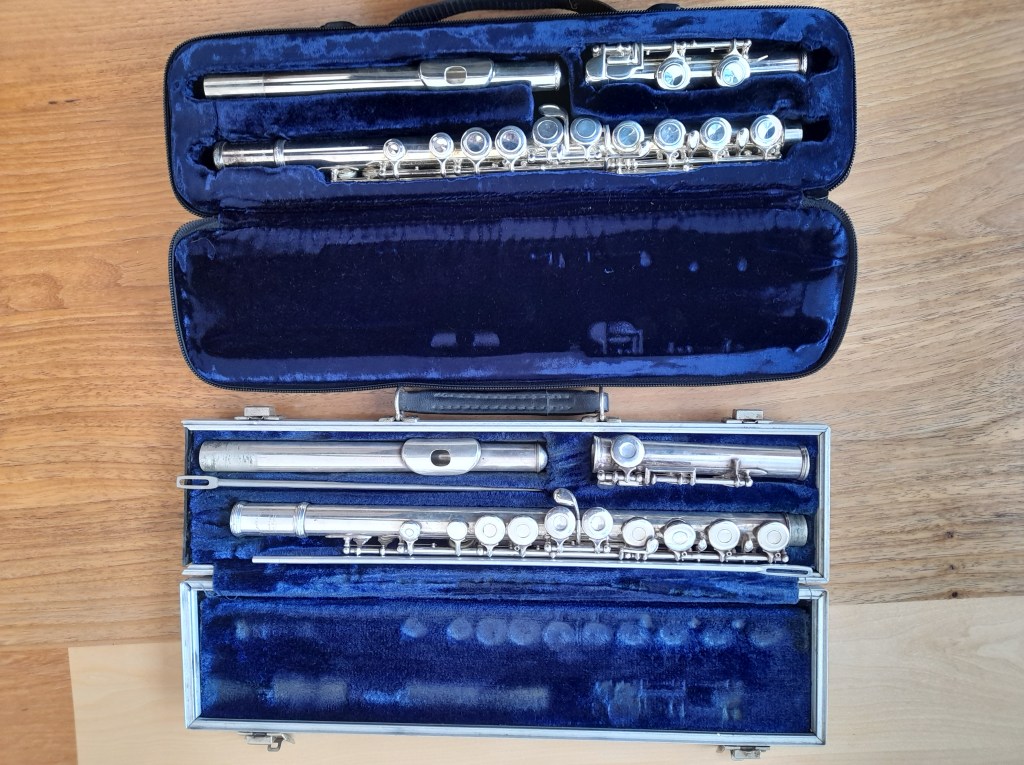
We carefully continued our entry into the huge dark shed lest we surprise the burglars and become a victim ourselves. No-one was there. I looked in the ancient sideboard I had inherited from my grandmother and opened the top drawers. My forty-year-old flutes were missing. Were the burglars flautists?
We righted the upturned furniture, returned the toys to the plastic tubs, affixed the lids and stacked them neatly. Then Alex got on the phone to his young employee, Troy.
“Would you mind getting hold of a battery-powered camera and placing it up high in the gum tree facing the shed door?” he asked. “We need surveillance.”
It was Saturday and Troy’s day off, but he was willing to assist Alex, and by 9 pm that evening he had purchased a camera and placed it where requested. He used the drop-down menu to ensure that notifications of camera images would come to his phone.
We returned home with the firewood. At least the burglars hadn’t stolen that. We lit a fire in the fireplace and luxuriated in front of it, savouring the delights we had purchased at the Mypunga markets. Now we had a camera installed, surely, we would be safe.
At 5 am the next morning the telephone rang. It was Troy. Alex’ phone had been on bedtime mode, and he could not have received calls any earlier.
“They’ve broken in again,” said Troy. “At 2.38 am. This time with a car. The footage came to my phone.”
“Are you there now?” asked Alex.
“Yes. I came straight here when I got the notification.”
“OK. We’ll head over there this morning. Have you called the police?”
“Yes. They’re coming shortly.”
Usually, I savour sleeping in on the weekend, or in fact on any day, but suddenly I had no desire to continue nestling between the brushed cotton sheets. I had been jolted awake.
“Are we going now?” I asked Alex.
“Soon. I have to wait for the hardware store to open. I want to buy some metal reinforcements to secure the shed door. Because we have no power, I’ll have to buy an inverter to power my tools.”
We drove towards Mypunga, first stopping at the hardware store en route to buy the bolts and then at an electronic’s store to buy the inverter. When we arrived at the farm we stopped at the gates to check the locks. The chain had been cut with bolt cutters. Then came a phone call from Troy.
“Are the police here?” asked Alex.
“Yes. They have collected fingerprints and DNA samples. They are coming out now to talk to you.”
Soon we were joined at the gates by four detectives and Troy. It was 11 am. Troy had been on the site for at least six hours, not to mention having been there at 9 pm the night before to install the cameras. He excused himself and the detectives explained to Alex the evidence they had found. The visit from the previous day had been a stake-out on foot. Once they had discovered the batteries, they had resolved to return with a car. The batteries were too heavy to have been carried out on foot. But not the flutes. They were much lighter than the batteries.
The police promised to examine the footage carefully. It captured the arrival of the car, and three men with torches circling the shed. One of the men had spied the camera, seized it, and thrown it down the hill. After that the images from the camera were of the surrounding grass. The detectives left and Alex and I drove up and down the winding track to the shed. The roller door was wide open. We entered, and the carefully stacked boxes again were opened and the lids strewn around the shed. Toys and hats were scattered. The drawer from which my flutes had been removed was now firmly wedged against the sideboard. They had clearly opened and shut it again, even after having removed the flutes the day before.
Unlike in Midsomer, no-one had been murdered, but there was a strong sense of violation. Burglars had staked out Alex’s shed, upturned the contents, and left with the roller door still open. Returning the very next day after having staked out the property was brazen. There was a dark underside in this countryside location despite the peaceful scene we had observed the previous day in Mypunga, with shoppers in their home-spun hand-knitted jumpers carrying their organic produce in cheesecloth bags. Most likely the thieves were from elsewhere and had followed the battery installer’s vehicle emblazoned “Remote Power Australia”.
A few days later Alex received a call from the detectives requesting a DNA sample, in order to rule him out. Some tools in the shed had been used to remove the batteries, and they had produced a DNA sample from these. Alex agreed, and a constable arrived at the house the next day to take a swab.
“Have you made any progress on the case?” asked Alex.
“We’ve identified the car the burglars used from the footage. It’s a Ford Maverick. That narrows it down quite a bit.”
Meanwhile Alex and Troy restored the camera to the eucalyptus tree, and bought another one which they affixed it to another tree one hundred and fifty feet away. At the detective’s suggestion, the second camera was aimed at the first one. If a burglar took down the first camera they would be filmed by the second camera. Since the batteries had been stolen and there was no power in the shed, the cameras were operated by solar panels. Alex could regularly check for notifications on his phone.
Two months later Alex received a phone call from a constable with a strong northern English accent that transported you to a distant time and place. It was the kind of English you would hear on a British detective show, although not the southeastern English accent of the fictional Midsomer.
“This is Senior Constable Jane Michaels. We have found two flutes. They may be yours. Can you identify them from the photo? I took it with my bodycam.”
Alex showed me his phone. I couldn’t identify them from the photo. However, they had to be mine. Flute theft must be a much rarer crime than battery theft. More people are in need of batteries than a flute.
“If you prefer to identify them in person, I can make myself available next week,” explained the Senior Constable. “The burglars were not what you would call a musical family,” she quipped.
“I’ll give you my partner’s number so that you can contact her directly,” offered Alex.
The next Wednesday a call came from an unknown number. I let it ring out because I never answer unless I know who is calling. Then I listened to the recorded message the caller had left behind.
“It’s Senior Constable Jane Michaels from the Camden Police Station. I’m hoping you can identify those flutes. Please call me back.”
Hearing this English accent made me feel like I was on the set of Midsomer Murders. A frisson of excitement tingled up my spine. It was a warm, old-world and unpretentious accent that I associated with the north of England. (When you hear an English accent by a worker in South Australia, you may feel like you are on the set of a detective show like me, or you may assume they are in the health or policing professions because of the recruitment drives in Britain in these professions.)
“Can you come to Camden Station to identify them? We’ll be there in half an hour.”
I drove to the address she provided, entered through the imposing gates, and parked outside a giant warehouse. I entered the building and pressed a button marked ‘Property recovery’. A constable greeted me from behind a glass partition.
“What have you come to collect?” he asked.
“Two flutes.”
He looked at me quizzically. Flute theft is probably an uncommon crime.
“What?” he asked again.
“Flutes,” I repeated.
He disappeared to the room behind, and Senior Constable Jane Michaels appeared bearing the flutes in their cases. Despite her old-world accent on the phone, she was surprisingly young.
“Are these in fact yours?”
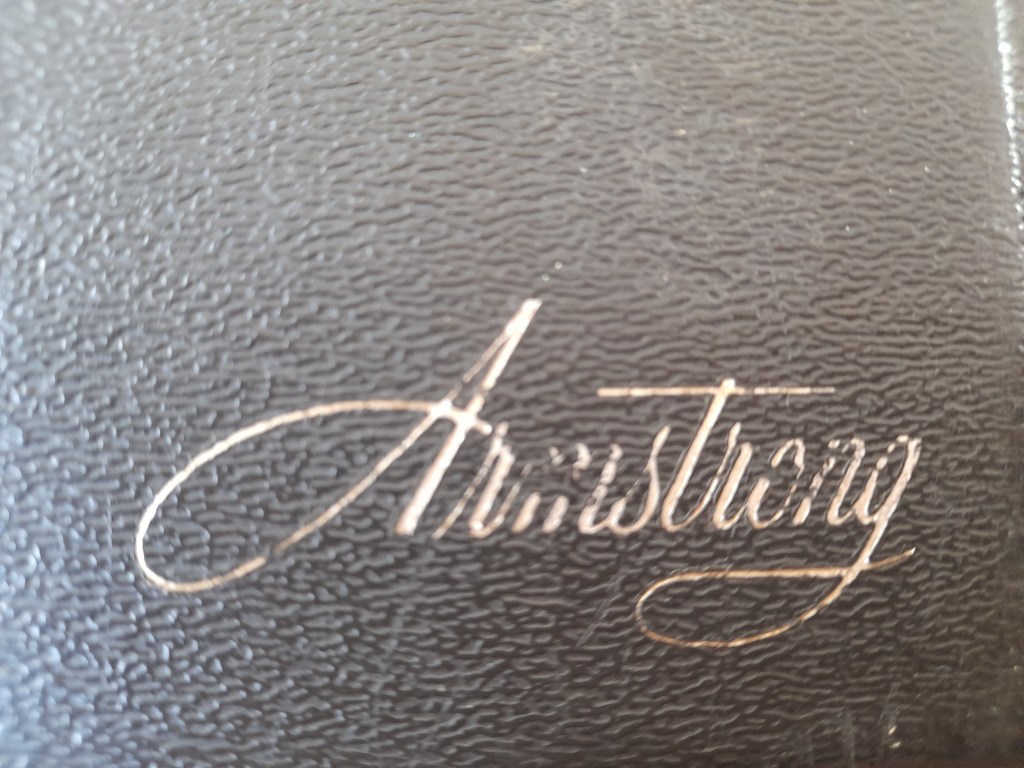
I looked at the cover of the box for the brand, and sure enough, ‘Armstrong’ was written in faded silver letters. This was the flute I had owned since my teenage years.
“How about the batteries? Are you likely to find them?” I asked hopefully.
“We didn’t find them at the property, but it’s an ongoing investigation,” she explained. I could tell from her apologetic tone that she thought we would be unlikely to retrieve them.
I thanked her and left. I returned to my car, the sole one in the enormous car park. As I drove off two constables headed to close the enormous gates behind me, smiling and waving, happy that I had been reunited with my stolen flutes.
I have to hope for Alex’ sake that the batteries will be found. Meanwhile, I haven’t played my Armstrong flute in over forty years, but now that it has been stolen and recovered in a raid, I feel compelled to take it up again. What’s more, who knows whether the recovered flutes will be instrumental in solving the crime of the stolen batteries?
Meredith Stephens is an applied linguist from South Australia. Her recent work has appeared in Syncopation Literary Journal, Continue the Voice, Micking Owl Roost blog, The Font – A Literary Journal for Language Teachers, and Mind, Brain & Education Think Tank. In 2024, her story Safari was chosen as the Editor’s Choice for the June edition of All Your Stories.
PLEASE NOTE: ARTICLES CAN ONLY BE REPRODUCED IN OTHER SITES WITH DUE ACKNOWLEDGEMENT TO BORDERLESS JOURNAL
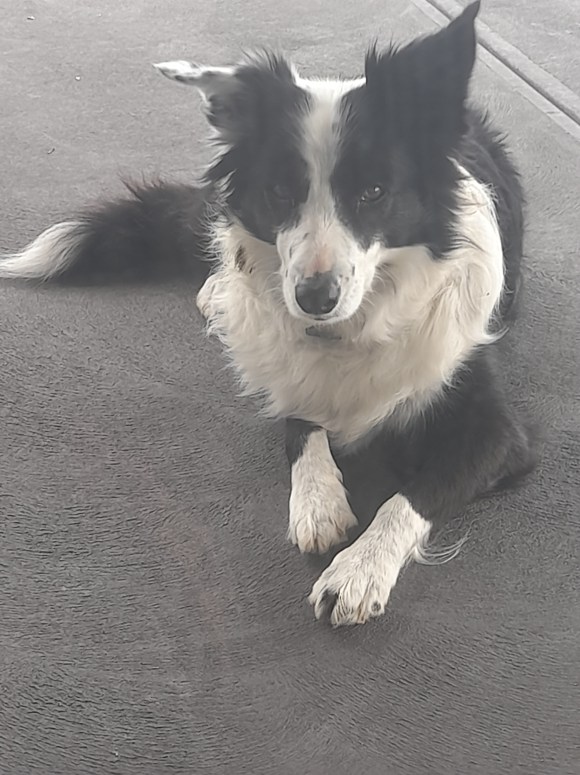
In an ideal world I would sleep in every morning and enjoy a leisurely breakfast, but I can indulge in no such luxury because I have a border collie. Her name is Haru. She has an elongated body, a pointy white snout scattered with black dots, one black ear and one black and white spotted ear, all-knowing brown eyes, feathered forelegs, and a bushy tail with a white tip. She looks more like a cross between a fox and a border collie than a pure border collie. As soon as she hears my voice when I wake up, she starts whining from the courtyard below, nagging me to take her for a walk. I much more looking forward to my breakfast than the walk, but Haru is the opposite.
Haru. Photograph by Meredith Stephens
One Tuesday, as usual, I affixed her leash and walked her towards the esplanade. Haru has memorised the route. She strained in front of me to the point where we crossed the road and then continued to drag me towards the pedestrian crossing. Then she made a beeline for the stairs leading down to the beach. I released the leash and threw the ball down to the sand. She raced down the stairway ahead of me and ran to catch the ball. In the winter months along this coastline, dogs are allowed to run off the leash as long as they are under the owner’s control. I was joined by a throng of other dog lovers and their canines, running to catch balls. Haru is interested neither in other dogs nor other people. All she cares about is the ball. Other dogs approached her and chased her, but she’s indifferent, solely focused on the ball in my hand.
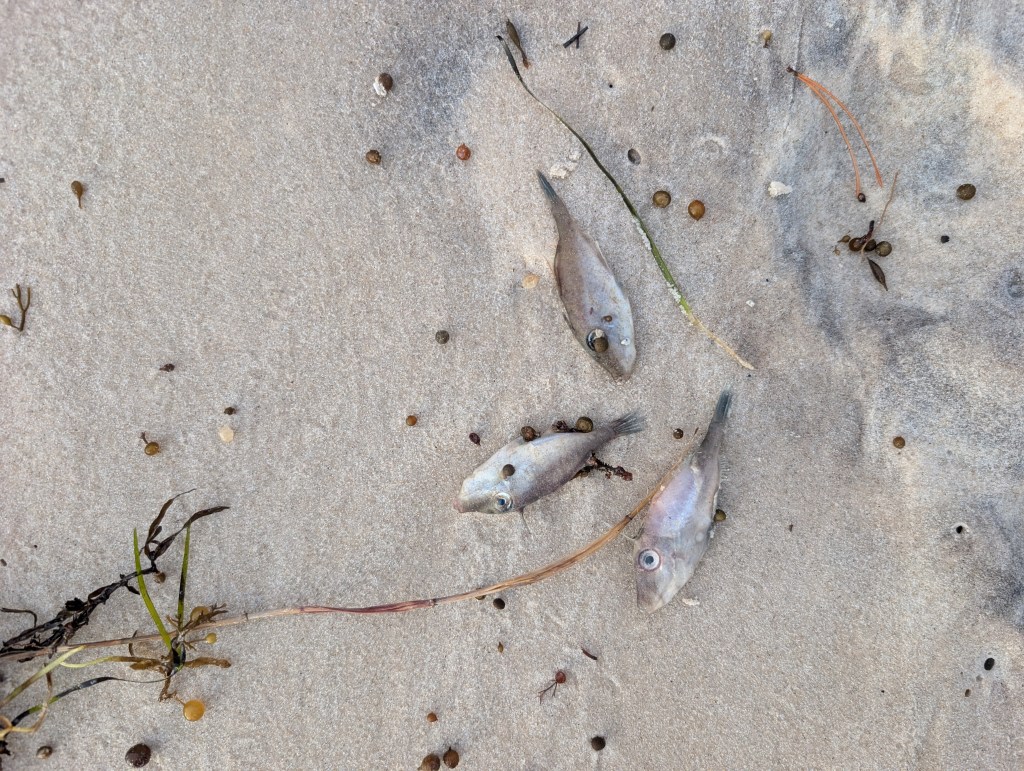
This is good for me because I get exercise when I otherwise would not, and experience vicarious pleasure in her excitement at retrieving the ball. Maybe this is more fun than breakfast after all. However, my walk last Tuesday was unlike those of previous weeks. I spotted an entire fish washed up on the shore amongst the seaweed. I had never seen this before on my daily beach walks over the last five years. Then I looked up and saw a rounded shape of a mammal a few hundred metres in the distance. I walked towards it, and once up close I realised that it was the head of a dolphin. “Sorry,” I said, feeling complicit in the damage wreaked by climate change. Haru was normally quick to sniff out a carcass and chew it, but she showed no interest.
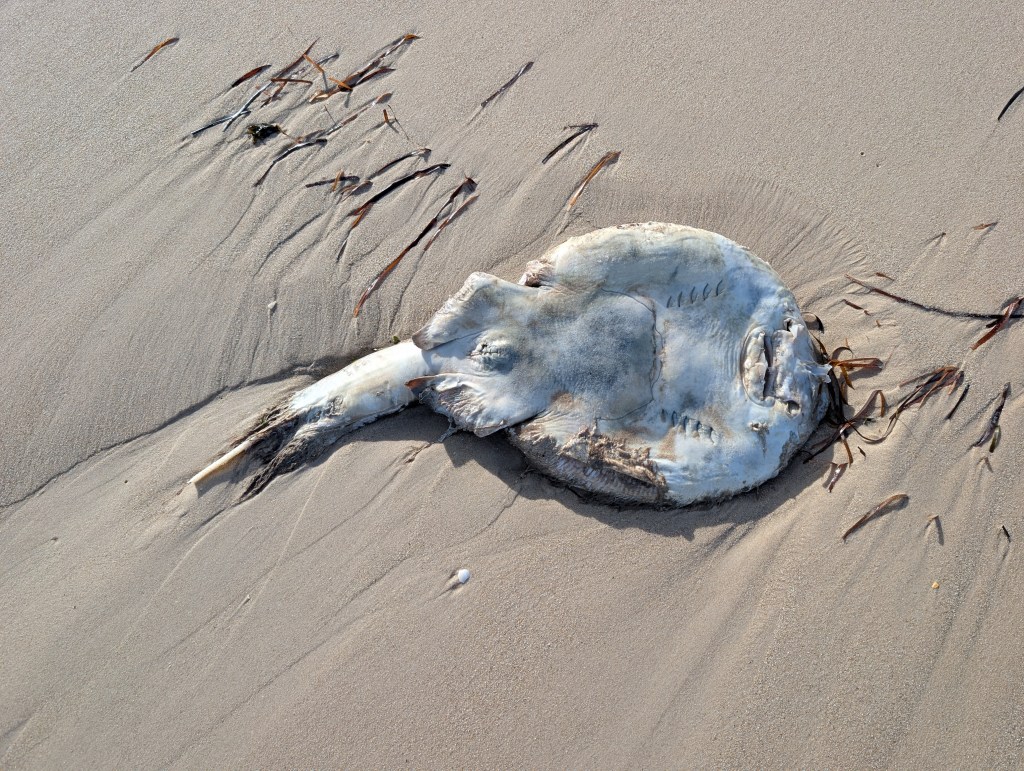
The next day I chatted to a neighbour who told me that on her beach walk she had seen a range of species washed up on the beach that she didn’t know existed. We were witnessing the aftermath of an algae bloom, known as Karenia Mikomotoi, from September 2024. This had arisen in response to a rise in the sea surface temperatures of 2.5 degrees. The recent storms in June 2025 had washed the bodies of these sea creatures ashore. On my next beach walk I came across a small stingray, completely intact, directly in my path. I had seen stingrays before swimming in the shallows but never washed up on the beach. It was so beautifully formed that I could tell it had met an untimely death. Something untoward and unusual had happened. Again, Haru showed no interest in the stingray, despite usually being interested in decaying fish or animals.
Dead StingrayFish washed up on the beachPhotographs by Alan Noble
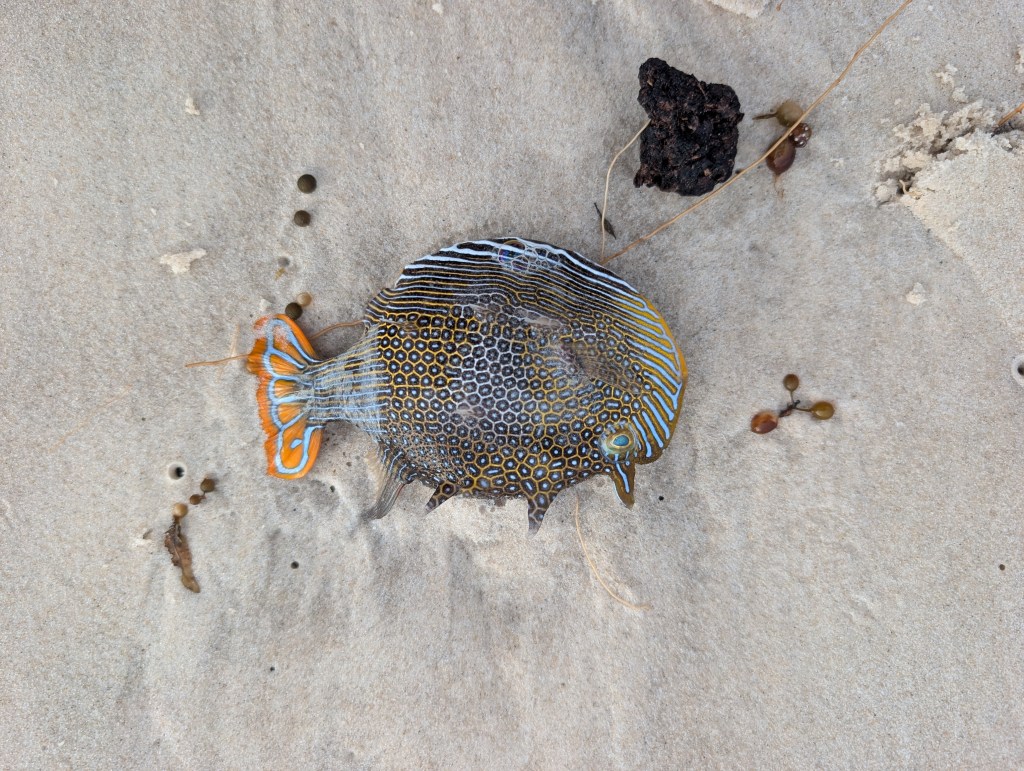
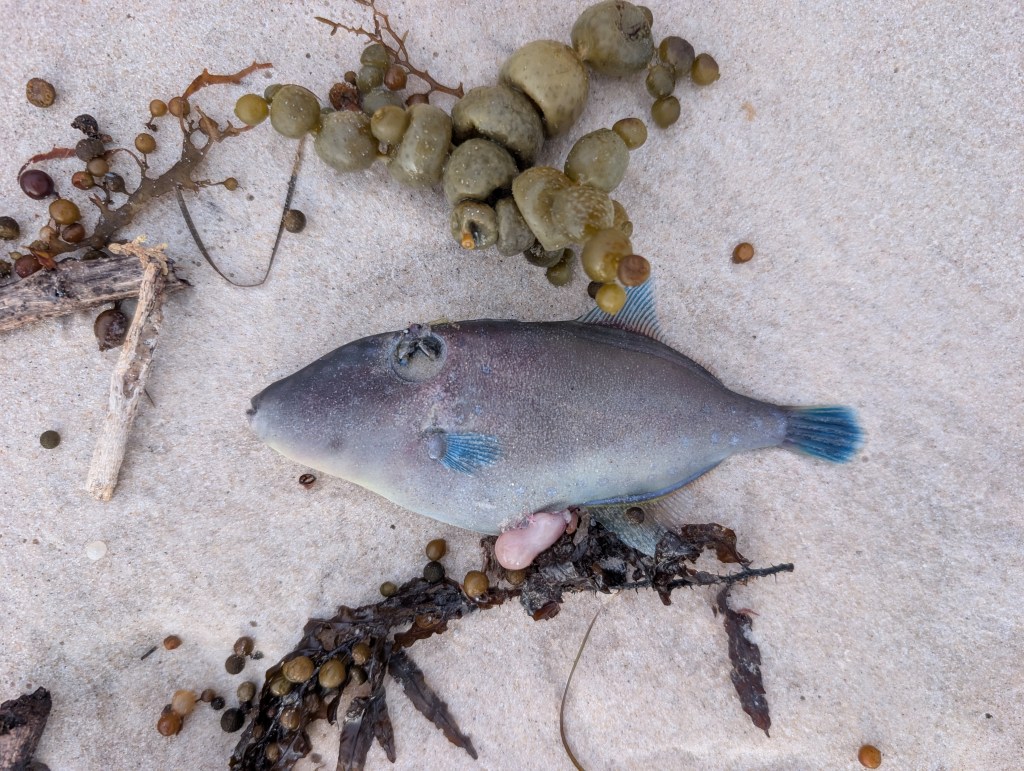
Weeks later I continued to spot fish washed up on the shore that I have never seen before. I came across much smaller fish a couple of centimetres long, some slightly larger fish, and another small stingray. These were the kind of colourful fish that I would see when snorkelling in pristine waters, not washed up on a suburban beach. Haru continued to ignore these dead creatures and skipped along the beach anticipating my ball-throwing. Or perhaps she somehow sensed they contained toxins. At least she was unlikely to be poisoned by eating them.
Small fish washed upon the beachBlue fish dead on the beachPhotographs by Alan Noble
She delights in catching not only one ball that I throw her, but sometimes two. She doesn’t like to relinquish a ball, so I have another one on hand to throw her so that she can chase all the while holding the first one in her mouth. After chewing the ball down to a smaller size and squashing it, she can sometimes fit two into her mouth. Once she has managed this, she runs away from me into the wintry waters, oblivious to the cold, triumphant that she has two balls and trying to get as far away from me as she can in case, I try to take one away from her. Sometimes she skips through patches of the dirty foam left by the algal bloom.
I wish I could provide a happy ending to this story, but the algal bloom is not predicted to end soon, so my idyllic morning and evening beach walks with the oblivious Haru are likely to be punctuated with sightings of innocent marine creatures being washed ashore, victims of climate change and warming temperatures.
One consolation occurred the day my fiancé, Alex, and I left the mainland to sail across Investigator Strait to Kangaroo Island. Over the years there has never been a crossing during which we have not seen dolphins. In the back of my mind, I feared that this would be the first time. An hour into our crossing, Alex heard the familiar splash of breaking water and sighted a pod of dolphins. Not only that, once in the bay at Kangaroo Island, we spotted a sea lion. Thankfully, the marine life that can escape the algae is still undisturbed. I hope the scientists will find a way to address the marine heatwave so that life in our oceans can again thrive, and beachgoers can be spared the sight of these innocent creatures being washed up on local beaches. We can’t simply delegate to the scientists, though. Witnessing this marine carnage is a strong impetus for ordinary citizens to live more sustainably.
Meredith Stephens is an applied linguist from South Australia. Her recent work has appeared in Syncopation Literary Journal, Continue the Voice, Micking Owl Roost blog, The Font – A Literary Journal for Language Teachers, and Mind, Brain & Education Think Tank. In 2024, her story Safari was chosen as the Editor’s Choice for the June edition of All Your Stories.
PLEASE NOTE: ARTICLES CAN ONLY BE REPRODUCED IN OTHER SITES WITH DUE ACKNOWLEDGEMENT TO BORDERLESS JOURNAL
There’s a kind of man who doesn’t need to announce his presence. You don’t see him on podiums, and his name rarely appears in headlines. He won’t interrupt a conversation, let alone command a crowd. And yet, if you were to trace the quiet veins of compassion that pulse through a place, you’d likely find him at their heart.
In Pulwama, that man is Gamgeen Majeed.
He doesn’t wear a badge. He doesn’t quote speeches. And yet, when someone needs a ride to the hospital, when a blood bank sends out a late-night request, or when a neighbour needs someone to listen as he’s already on his way. He doesn’t do it because he must. He does it because, for him, there is no other way.
In a time when kindness is often curated and shared online, Gamgeen’s way of living feels rare. It’s a quiet, unadvertised generosity. A way of being that seeks no witness. It is the opposite of performance as it is presence.
Gamgeen Majeed is from Pingalgam, a modest village in South Kashmir. If you ever pass through, you might notice the walnut trees, or the scent of burning wood curling up from small homes. You might see the narrow road that winds quietly through the landscape, lined with aging willows and old stories.
It’s not the kind of place you read about in books. But it’s the kind of place where lives like his are made humble, rooted, unwavering.
Gamgeen has spent decades doing what many people only dream of: living in service to others. He’s never been part of an NGO. He has no titles. There are no newspaper features with his name in bold. And yet, people remember him. Not for what he owns or says, but for the space he holds in the lives of others.
He has mopped hospital floors after storms, held hands in silence when words would only fail, and stood vigil in hospital corridors while doctors worked inside. His acts are not scripted. They are not fuelled by ambition. They arise, quietly and surely, like spring after a hard winter.
Perhaps the only visible trail of his quiet mission lies in the numbers: 207 pints of blood donated over the course of his lifetime. That number is staggering but not just for what it means physiologically, but for what it says about the man behind it.
But even numbers fail to tell the full story. Gamgeen didn’t walk into hospitals only when it was convenient. He answered calls in the middle of the night. He trekked in snow to reach clinics. He gave blood before breakfast. He often waited in hospital lobbies without being asked — just in case someone might need him.
He once said, softly and without ceremony:
“My blood is the least I can give. If it keeps someone breathing, that’s enough reward for me.”
There’s no fundraising banner that can capture that kind of thinking. No award can quite do it justice. Because his belief isn’t in acts of charity. It’s in human continuity — in being part of the thread that keeps another person alive, even if just barely.
From LD Hospital in Srinagar to the dust-covered wards of small rural clinics, Gamgeen’s blood has likely flowed through hundreds of lives. Children. Elders. Strangers. People he never met and never will. That’s the thing about quiet heroes: they don’t trace their impact. They simply live it.
It would be easy to call Gamgeen a saint or a hero. But doing so might miss the point. What makes his story remarkable is not grand achievement but his belief in small, repeatable, often unseen acts of goodness.
He visits patients he doesn’t know. He buys fruit for old men sitting alone in hospital lawns. He once stood for hours outside a labour ward because a nurse had mentioned they might need help if a donor didn’t show up. No one called him. He just showed up anyway.
There’s a term in philosophy — “ethics of care.” It speaks to a form of moral life cantered not on rules, but on relationships. It’s about showing up. Again, and again. Even when no one’s watching. Even when no one says thank you.
You might wonder where this kind of spirit comes from. Some say it’s upbringing. Others say it’s temperament. Maybe it’s both. But perhaps it’s also born from quiet observation from watching elders serve without speech, or mothers feed neighbours before eating themselves.
In the old ways of village life, compassion wasn’t taught. It was modelled. It was lived. You saw it when your uncle lent a hand to fix someone’s roof. You saw it when your grandmother lit an extra oil lamp — not for herself, but for the family next door.
It’s tempting to imagine that service comes only in certain shapes: doctors, social workers, teachers. But Gamgeen reminds us that you don’t need a role to make a difference. You don’t need an organization to help someone. You only need willingness and the courage to act.
Over the years, he’s become a sort of myth in the region — not because of anything he’s done to earn it, but precisely because he hasn’t tried to. His story spreads in whispers. A nurse tells a new recruit. A mother tells her son. A shopkeeper shakes his head in admiration when recounting how Gamgeen showed up one snowy evening, carrying warm tea and blankets for a patient’s family stuck outside.
He doesn’t knock. He doesn’t wait for praise. He just walks in, offers help, and leaves. Sometimes without even saying goodbye.
In a world where we’re often overwhelmed by scale — global problems such as climate change, mental health issues, deforestation — a man like Gamgeen is a kind of anchor. He reminds us that you don’t have to change the world to matter. You only have to show up for the person in front of you.
He reminds us that kindness doesn’t need to be viral. It needs to be real.
He reminds us that integrity doesn’t require recognition. It only requires consistency.
And perhaps, most of all, he reminds us that the greatest legacies are not built through declarations but through deeds.
We spend so much of our lives chasing light — chasing visibility, acknowledgment, a moment in the sun. But maybe the real task is not to find the light, but to let it fall where it belongs.
Because in every village, in every small place tucked away from the maps, there lives someone like him — someone who teaches, simply by living, showing that kindness doesn’t need permission.
It only needs practice.
.
Gowher Bhat is an author, columnist, freelance journalist, book reviewer, and educator from Kashmir. His work explores the human condition with depth and sincerity. He believes in the quiet power of words to inspire change and compassion.
.
PLEASE NOTE: ARTICLES CAN ONLY BE REPRODUCED IN OTHER SITES WITH DUE ACKNOWLEDGEMENT TO BORDERLESS JOURNAL
That is the question Ratnottama Sengupta is asking with so many grey heads since London’s Westminster voted in favour of Assisted Dying
From Public Domain
“She was in so much pain these last four months that we are not mourning her final exit. We are celebrating her liberation.”
Speaking with Bhabhi’s[1] nephew last week forced me to readjust my emotions regarding the final goodbye. Condolences are in order, worldwide, when a dear one departs the mortal world. But of late I have been noticing that people “celebrate the life’ of the departed soul rather than mourn the death. Yes, every departure is a loss, taking an emotional toll of those left behind. And still I am not shocked nor angry that on June 20, a day after Bhabhi breathed her last in Singapore, the British Parliament voted in favour of a bill to legalise Assisted Dying for terminally ill people.
This has paved the way for a long debated social change that has, for as long as I can remember, been held in abeyance. Because? It has always been argued that, since we cannot bring the dead to life, we do not have the right to take away life. Indeed, the UK parliamentarians voted on the subject 10 years after it was first proposed, I learn from the news reports. And even as the Wise Men of London debated the issue, demonstrators outside were crying out, “Kill the Bill, Not the Ill.”
Once the Bill is passed by the House of Lords, the Terminally Ill Adults (End of Life) Law will give “mentally competent, terminally ill adults in England and Wales with six months or less life to live, the right to choose to end their life with medical assistance. Those who would want the procedure would have to gain the compassionate “Aye!” of two doctors and a panel of experts.
While the scrutiny by the Upper House might take months, it is unlikely to be blocked now that it has gone past the Commons and secured a nod from the PM.
*
My first acquaintance with the concept was garbed in the words, ‘Mercy Killing’. I was a school-going teenager when I read a Bengali courtroom drama, Parashuramer Kuthar (1989, Parashuram’s Axe) where the son was in the dock, fighting the charge of murdering his mother with morphine. “Night after night she would cry out of acute pain. Night after night I sat by her bed, watching her inch towards death. The doctor had prescribed the morphine that let her sleep at night. But when that failed, I gave her a repeat dose so she could go to sleep…”
Half a century ago that sounded ominous. Now, having seen — and digested — the ‘Assisted Suicide’ of celluloid icon Jean Luc Godard[2] in the autumn of 2022, I have been weighing my responses to the concept.
Godard, born on July 7, 1930, had lived in France from where he had revolutionised cinema across the globe. At the age of 91, with “multiple disabling pathologies” — to quote his doctors — he went to Switzerland because that was the only country to have legalised euthanasia as long back as 1941. Albeit they have specifications, the overriding one being this: the person assisting the suicide must not have any selfish — read, monetary — motive to provide the seeker the means to exit.
*
“Euthanasia is death with dignity,” my Jyotish Pishamoshai had said three decades ago. At 90 something, the man who went around all his life in trams and buses, to look up his younger cousins, simply hated to be bed bound. Besides, he had seen his youngest brother Dinesh “hang till death” at age 20, without a trace of remorse for having bombed the Writers Building in the Capital of the Raj. So why would the elder brother, his memory intact, want to “be a burden” to even his only son? Mercifully, Sudhir Da did not have to go the way of Parashuram. The almighty in heaven voted for the nonagerian’s exit.
*
My response to the issue peaked when I read this poem, ‘Antim Akanksha’ (The Last Wish) , by Purnendu Ghosh of Jaipur. This IIT-ian from Kanpur, a diehard cinema aficionado, has penned the same thoughts in Bengali and English too. But I had already translated his anguish in Hindi before I spoke with him. “I had written these lines when I was sitting by my mother-in-law, then languishing in the hospital. When I had first seen her, she was 46. Over the next 46 years, I was witness to the transformation age had forced upon her I could only watch, helpless, because the final exit is in the hands of only the Almighty.”
I am still weighing my responses. Yes, I believe in the Existence of a Superior Force. Still, when a person has to lie waiting to bid goodbye to pain, would he or she wait for His mercy, or that of the medics?
Ratnottama Sengupta, formerly Arts Editor of The Times of India, teaches mass communication and film appreciation, curates film festivals and art exhibitions, and translates and writes books. She has been a member of CBFC, served on the National Film Awards jury and has herself won a National Award.
.
PLEASE NOTE: ARTICLES CAN ONLY BE REPRODUCED IN OTHER SITES WITH DUE ACKNOWLEDGEMENT TO BORDERLESS JOURNAL
Narrative by Meredith Stephens& photographs by Alan Noble
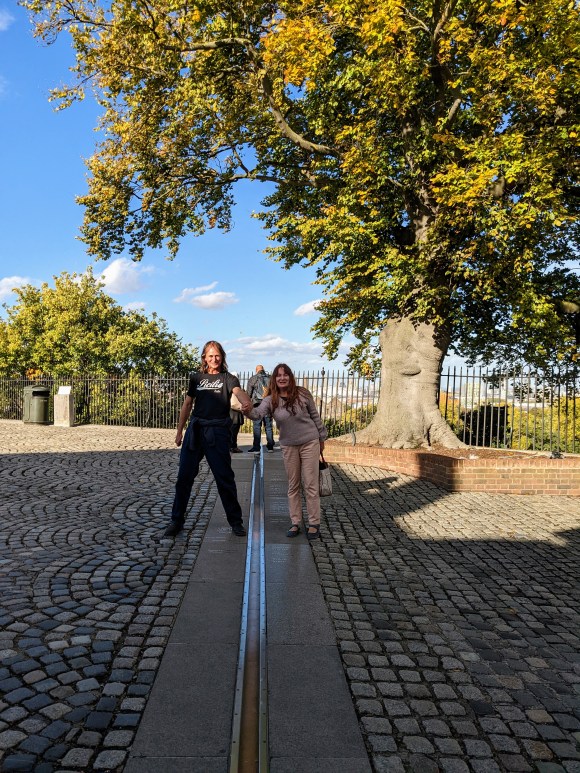
The Prime Meridian Line.
Whenever we visit another city, Alex and I always head straight for a science or maritime museum. When we spent a day in London several years ago, Alex insisted that we visit the National Maritime Museum in Greenwich, and then the Royal Observatory. The highlight of the latter was John Harrison’s marine timekeepers, which made the calculation of longitude at sea possible, therefore making navigation safer. A fun part of visiting the Observatory was standing on either side of the Prime Meridian Line, which defines zero longitude and divides the eastern and western hemispheres of the earth. If you are facing north, the person on the left is in the western hemisphere, and the person to the right is in the eastern hemisphere. We had to queue behind other couples to stand either side of the line. The couple in front of us were taking an inordinate amount of time to have their photo taken here, from which global time is calculated.
“Time’s up!” quipped someone behind us.
“What’s time?” came a philosophical comment from someone else.
The quick banter between strangers is one of the many reasons why I love visiting London.
During our short stay we devoted hardly any time to visiting any other tourist sites. The changing of the guard at Buckingham Palace held little allure. After visiting the Royal Observatory, we strolled past the historic British clipper ship “Cutty Sark” and then caught a ferry back from Greenwich to Central London. We briefly hopped off to see the Houses of Parliament, but after having visited the Royal Observatory Alex’s curiosity was sated.
Fast forward to March 2025 and we found ourselves in a remote town in Western Australia called Carnarvon. The first attraction Alex wanted to visit was the Carnarvon Space and Technology Museum. Carnarvon has a little-known relationship to Cape Canaveral in Florida. Many people have heard of Cape Canaveral and its rocket launching site, but who has heard of the not dissimilar-sounding town of Carnarvon?
Unlike the grand public museums in Western Australia, this one is self-funded and run by volunteers. NASA established a tracking station at Carnarvon in 1964, which played a critical role for both the Gemini and Apollo programs. Carnarvon was strategically located as the most distantly located site on the earth diametrically opposite from Cape Canaveral, providing the ability to track spacecraft over the Indian Ocean that were out of range from Cape Canaveral. The most famous launch was Apollo 11 in July 1969, which achieved humanity’s dream of landing humans on the Moon and safely returning them to Earth.
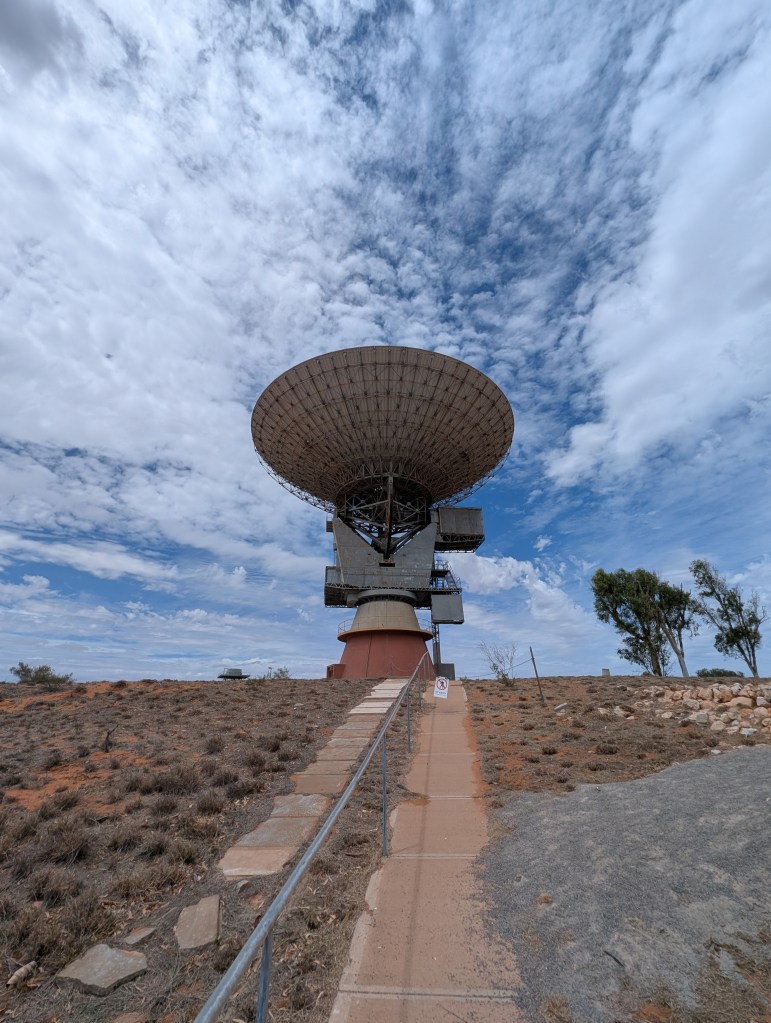
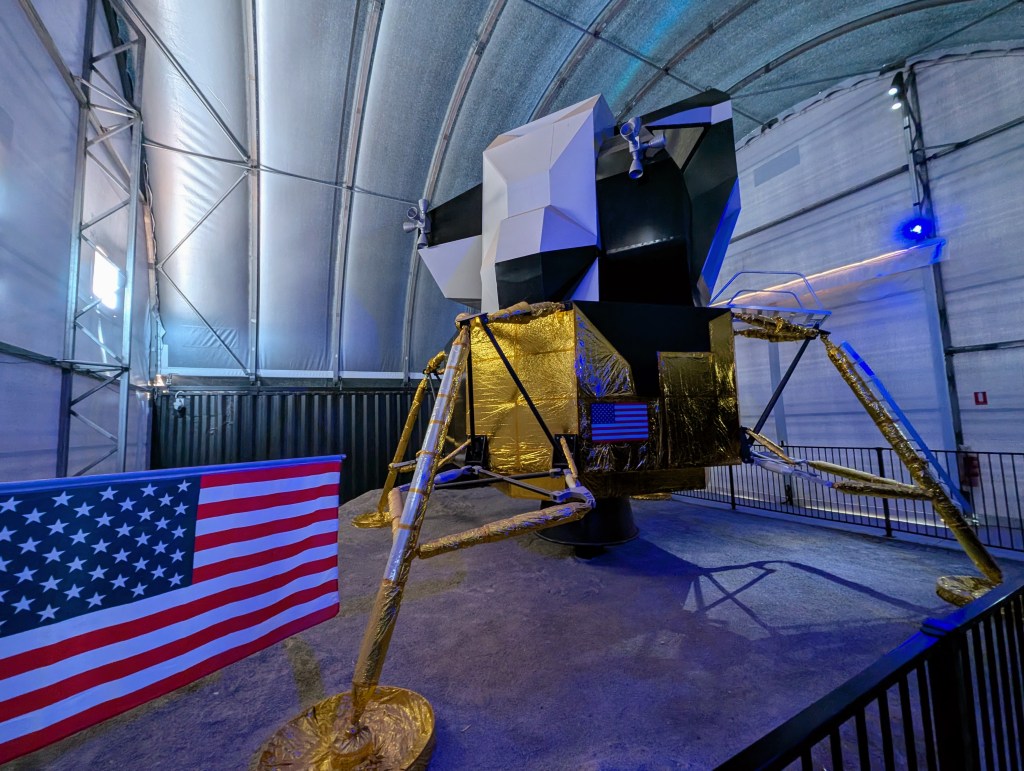
Radio Astronomy Dish Apollo 11 Lunar Lander Module (replica)Exhibits at Carnarvon Space and Technology Museum
This museum was different from public museums in that when we visited it was managed by a grey nomad couple from the east coast. (“grey nomad” is an Aussie term for retirees who embark on an extended period of travel around the country, usually in a caravan.) A resident cat curled himself into a ball proudly on the reception desk. It was the only museum we visited in Western Australia that required a fee to enter. The first experience we sought was to hop in the replica of the Apollo capsule to get a feel for the astronauts during the July 1969 launch. I was worried about a panic attack coming on in a confined space but the manager assured me that he would open the door to let me out at any time if I felt uncomfortable. We lay down with the lower half of our bodies propped up on a platform in what we hoped was an astronaut launching posture, while footage from the 1969 launch played out on the screen in front of us. Countdown on the screen was followed by lift-off. Not only did I not have a panic attack, it felt exhilarating to be transported to Cape Canaveral in 1969. Having watched this on black and white television when we were in primary school, it was all the more meaningful to watch it as adults. After touring the rest of the museum, we returned to the Apollo capsule to experience it a second time, like the space nerds we were.
We braced ourselves to face the oppressive heat as we headed outside to view the original satellite dish. Rather than languishing as ancient technology the dish has been leased to an overseas company who were upgrading it to track satellites orbiting Earth.
After viewing numerous 1960s space memorabilia, such as a replica of a Gemini capsule, which had preceded the Apollo series of capsules, and a life-sized replica of the lunar lander module, we bought some tourist T-shirts, chatted with the manager couple, and bade farewell to the resident cat. This was the most thrilling of the magnificent museums we visited in Western Australia. Thanks to Alex, we had a bias to visit maritime museums, including The WA Maritime Museum in Fremantle, The Museum of Geraldton, and The WA Shipwrecks Museum. They provided rich accounts of the many arrivals from distant lands to the west Australian shores since Dutchman Dirk Hartog’s nearby landing at Shark Bay in 1616. All visits were immensely educational and informative, but somehow the less glamorous Carnarvon Space and Technology Museum stood out. Unlike the public museums, it was somewhat ramshackle, but this was more than made up for in terms of authenticity and charm. Who would have thought that this outpost in regional Western Australia that even many Australians have not heard of, could have played such a pivotal role in the tracking of Apollo 11? This museum enjoys none of the fame of the Royal Observatory in Greenwich, but the role it played in history is just as moving.
.
Meredith Stephens is an applied linguist from South Australia. Her recent work has appeared in Syncopation Literary Journal, Continue the Voice, Micking Owl Roost blog, The Font – A Literary Journal for Language Teachers, and Mind, Brain & Education Think Tank. In 2024, her story Safari was chosen as the Editor’s Choice for the June edition of All Your Stories.
PLEASE NOTE: ARTICLES CAN ONLY BE REPRODUCED IN OTHER SITES WITH DUE ACKNOWLEDGEMENT TO BORDERLESS JOURNAL
It was late evening in the Valley—the kind of dusky calm that usually tucks our village into a blanket of silence before nightfall. But that night, the situation wasn’t peaceful. It was tense, suffocating. A silence not of rest, but of retreat. A silence that echoed with the footsteps of the displaced, the sobs of children, and the distant rumble of a war edging ever closer.
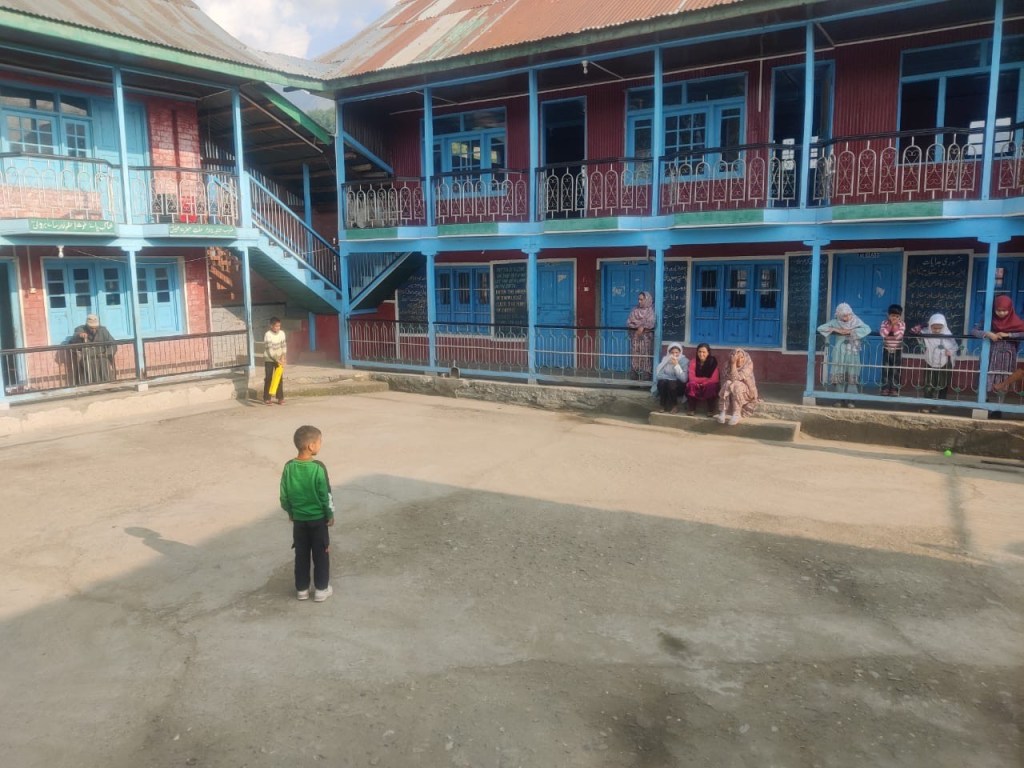
Nestled along the Srinagar-Muzaffarabad Highway, my village (Sheeri) had never imagined becoming a place of refuge. But over the past few days, it had slowly transformed into a shelter—not by design, but out of sheer necessity. It wasn’t a government-built camp or an official safe zone. It was a modest private school—its classrooms stripped of desks, Its walls were painted green, and its floors were covered with modest mats. The blackboard still bore lessons from a world that now felt impossibly far away.
They came by the dozens—families from the frontier town of Uri and other nearby hamlets, fleeing the deadly storm that had erupted along the Line of Control. The shells and gunfire hadn’t spared anyone. Mothers clutching newborns, elderly men barely able to walk, children with dust in their hair and tears in their eyes—each carried with them a fear that couldn’t be packed away. Their homes? Gone or abandoned. Their cattle? Lost. Their belongings? Scattered to the wind. All they had brought with them was survival.
We did what little we could, each small act stitched together into a fragile lifeline—volunteers arriving with rations and essential supplies, neighbours wrapping strangers in donated blankets, and someone rigging a single battery-powered generator in the school courtyard to pierce the darkness—just enough light to charge phones and confirm what we already feared through shaky mobile updates: India and Pakistan were at war again.
Just as we began preparing food that night, the sky above us erupted into unnatural color—bursts of red and orange, glowing like fireworks. For a breathless second, we hoped it was a celebration somewhere far away. But the thunderous roar that followed shattered that hope. These were no celebrations. They were drones. Missiles. Rockets. Tools of destruction lighting up the sky like angry constellations.
Photographs from the shelter camp: Provided by Rayees Ahmad
Panic was instant. Some people ran instinctively, nowhere in particular. Others froze. Mothers clutched children closer. Prayers spilled into the night air like smoke. The school—our fragile sanctuary—quaked with fear. And so did we.
I had heard stories of war. I had seen its images in books and on screens. But that night, war had a smell. A taste. A sound. That night, war breathed down our necks.
We stayed awake through the dark hours, huddled close under a full moon that bore witness to everything. The distant mountains glowed—not from moonlight, but from mortar fire.
The explosions echoed back and forth across the valley like angry giants arguing. Sleep was impossible. For many, so was hope.
For four harrowing days, the shelling continued. Relentless. Unforgiving. As India and Pakistan traded fire, villages on both sides were emptied. The front-lines moved like ghosts—never visible, always fatal. Each explosion wasn’t just an act of violence; it was a theft. It stole security, trust, homes, futures.
The ones who suffered weren’t the architects of war. They weren’t the men in polished suits or behind mahogany desks. They were farmers, schoolteachers, shopkeepers, daily wage earners. The ones who raised goats and crops, not guns. The ones who wanted nothing more than to be left alone.
And yet, here they were—broken by a war they didn’t start, begging for a peace that never came.
The soldiers too—barely out of their teens—were casualties in a different way. Sent to defend lines drawn generations ago, they carried weapons they barely understood, defending ideologies they didn’t create. On both sides, the blood spilled looked the same. The mothers’ grief sounded the same.
And as the bombs fell, something else collapsed quietly: Faith. Faith in leaders who promise peace and deliver bullets. Faith in ceasefires that last only until the next provocation. Faith that tomorrow would be better.
When the ceasefire was finally announced, there was no celebration. There were no cheers. Just silence—and not the comforting kind. It was the silence of disbelief, of loss too deep for words. People walked back not to homes, but to ruins. Entire communities had been reduced to ash and rubble. Crops were destroyed, livestock gone, schools turned into shelters or craters.
How do you rebuild a life when all that remains is dust?
These are the questions that haunt the air like the smoke refusing to clear —
Where should the birds fly after the last sky?
Where should we go after the last frontiers?
Where should the plants sleep after the last breathe of air? – Mahmoud Darwish
Ahmad Rayees is a freelance journalist and a fellow at Al-Sharq Youth fellow program.
.
PLEASE NOTE: ARTICLES CAN ONLY BE REPRODUCED IN OTHER SITES WITH DUE ACKNOWLEDGEMENT TO BORDERLESS JOURNAL
Narrative by Meredith Stephens & Photographs by Alan Noble
I have read about overtourism in Spain and Greece. Locals have been overwhelmed with the visitors, and some even displayed signs for tourists to go home. According to Fortune magazine (17 July 2024), some locals in Barcelona turned on tourists with water pistols, and others in the Canary Islands embarked on a hunger strike in response to the numbers of tourists. Images of overtourism in Santorini, Greece prompted me to search for an unpopulated area, and I didn’t have to look much further than our own state of South Australia. We hoped to visit deserted towns, dotted with ruins, where there are more sheep than people.
Alex, Verity and I headed out of Adelaide on a bleak wintery day, caravan in tow, to the outback. First stop was Burra, a former mining town where copper was mined from 1845 until 1877. Copper brought prosperity to the state of South Australia saving it from bankruptcy. The small town centre featured a proudly-standing rotunda. Businesses were open, and there were grand buildings and churches which overwhelmed this small town, standing testament to a thriving past.
The caravan was too big for a parking spot, so we parked it parallel to the kerb straddling several spots. We entered the tourist bureau, and as there was no-one in line, headed straight to the desk. We were greeted warmly by the assistant, who handed us a map and explained the various places where we could stay overnight in a caravan. There were free sites, a caravan park, and if you bought a meal at the pub you could camp in their grounds.
Then she pointed out the many historic sites on the map, fixing her eyes on me with a wide smile. I could sense Alex pulling away ever so slightly, as he was anxious to secure a caravan site and do some sightseeing before nightfall, but I was captivated by the enthusiasm of the guide and tried to remember as much as I could of what she was telling us. We headed to one of the recommended sites for the night and investigated the former mining sites with original equipment that had been shipped out from Cornwall, England, in the1800s. We were the only tourists at the site.
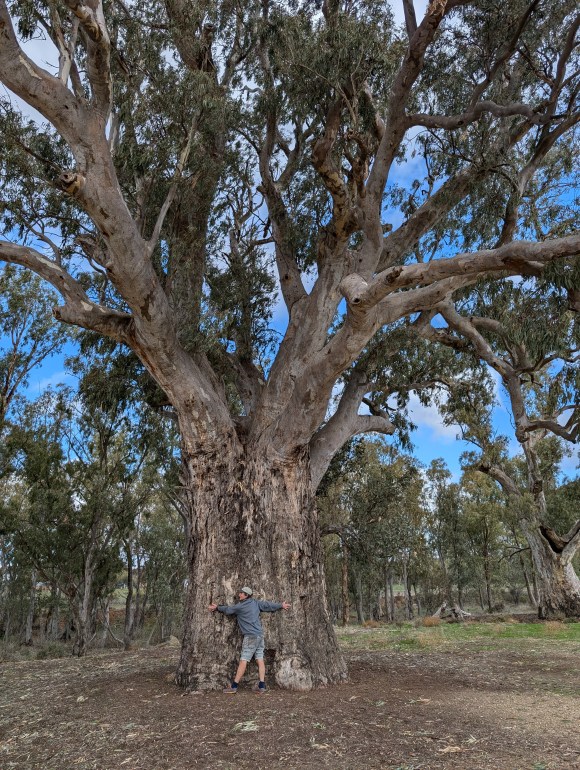
The next day we drove through Peterborough and Orroroo. We entered the cafe in Orroroo for lunch and asked the assistant what there was to see there. She gave us a map and explained that we absolutely had to see a spectacularly large 500-year-old tree on the outskirts of town.
Tree outside Orroroo
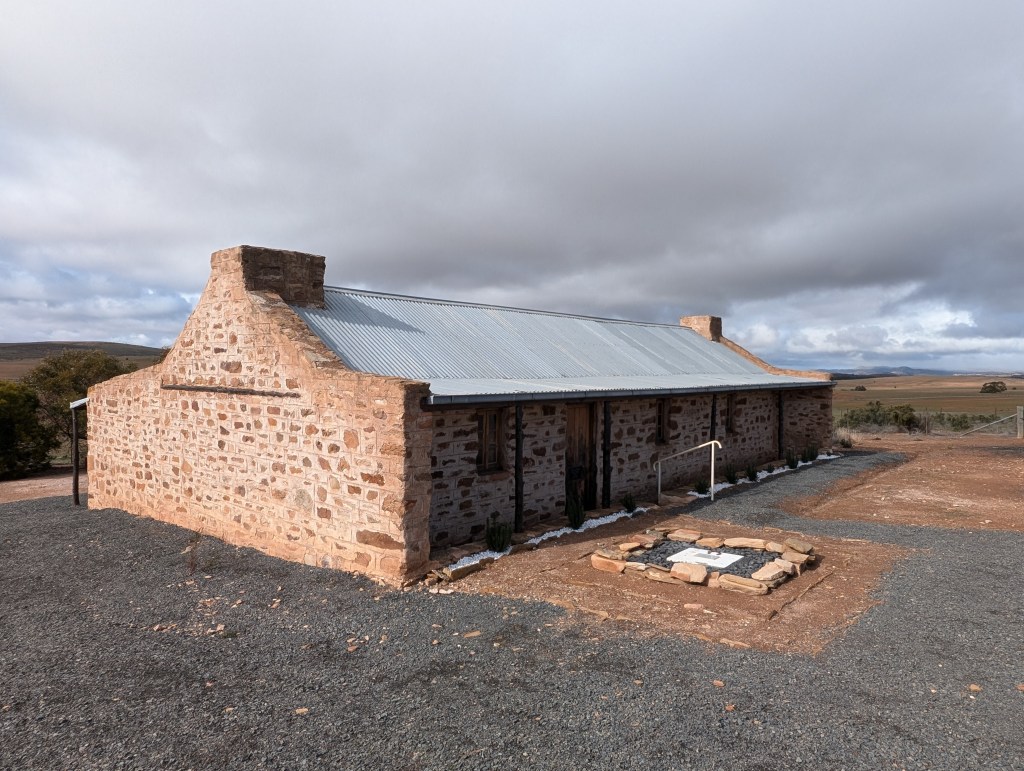
Next, we headed to the very small town of Hallet. There at the general store we asked for a key which would open the door to the now deserted birthplace of the polar explorer and aviator, Sir Hubert Wilkins. It was the first time we had been given a key to let ourselves into a tourist attraction, and we felt very privileged. We drove twenty kilometres to the home along dirt roads. Again, we were the only visitors. We made our way to the front door and unlocked it. This home, formerly rubble, had been lovingly restored by the Australian Geographic Society as a tribute to the explorer.
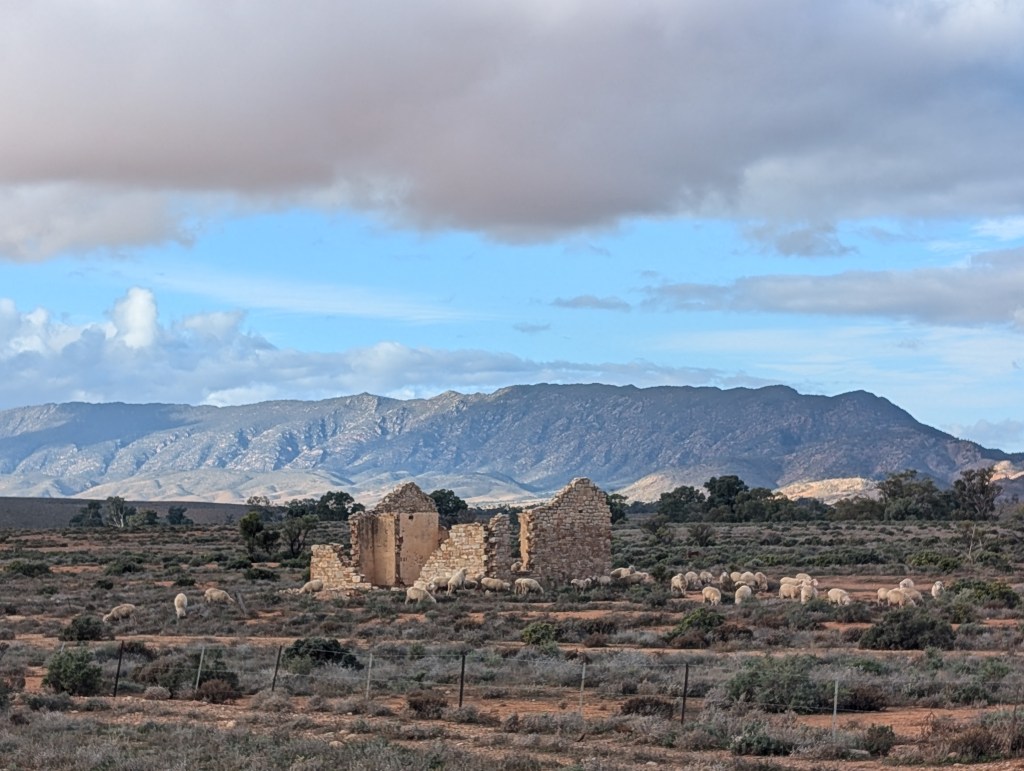
Ruins in the OutbackRestored home
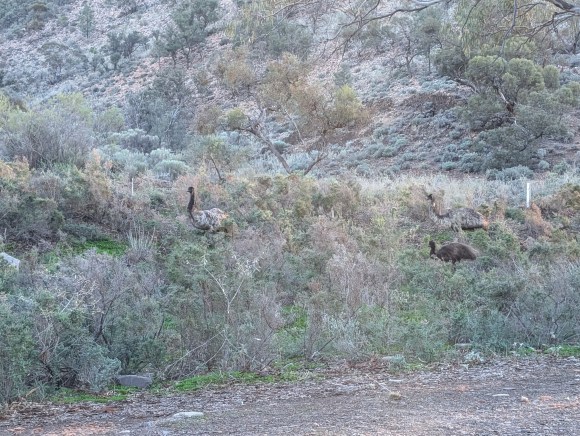
We continued to the Parachilna Gorge in the Flinders Ranges where we spent the night. Alex made a campfire, and we dined outside. Again, we were surrounded by ancient trees with generous girths in a dry riverbed. In the morning Alex woke to spot families of emus passing by, camouflaged by the foliage.
Emu family in Parchina Gorge
We continued onto the deserted nineteenth-century town of Farina that day. People started to abandon the town in the late 1800s, and the last of the inhabitants had left by the 1960s. Fortunately volunteers are keen to preserve the history and the ruins and manage the town during the school holidays. We were given a hearty welcome by a volunteer at the entrance to the bakery and received a map of the town.
Finally, on the 700kilometre drive back to Adelaide, we were low on diesel and made a brief detour to a small town off the highway. After putting the diesel in the car, I went inside to pay.
“Thanks, darling!” the cashier gushed.
“I like your dog! Is he a kelpie?” I asked.
Then I was given an enthusiastic account of how the kelpie had been rescued from a shelter. I think the owners may have been deprived of human company and were glad to see a new face. Alex came in because he was wondering what had become of me, engrossed in conversation. We had the impression that we were their only clients for the day. Eventually, I managed to extricate myself.
On this trip we had no experience of overtourism. Rather we visited sites where few tourists could be seen. Guides were so enthusiastic that they fawned over us. One reason that there were so few tourists is that it was the middle of winter and there was intermittent rain. Another was the geographical isolation of the outback. Australia is distant from countries with large populations. South Australia is distant from the large Australian cities on the east and west coasts and the outback further still—although closer to Adelaide than any other Australian capital city.
The landscape of the outback feels as different as another country. Our city, Adelaide, has a multitude of houses and new freeways, but the outback has few houses and many ruins. These ruins attest to a time of optimism when settlers believed the rains would be consistent. We enjoy hitching up the caravan and driving to the outback, where there are so few tourists that the sight of another human being results in an effusive welcome.
.
Meredith Stephens is an applied linguist from South Australia. Her recent work has appeared in Syncopation Literary Journal, Continue the Voice, Micking Owl Roost blog, The Font – A Literary Journal for Language Teachers, and Mind, Brain & Education Think Tank. In 2024, her story Safari was chosen as the Editor’s Choice for the June edition of All Your Stories.
PLEASE NOTE: ARTICLES CAN ONLY BE REPRODUCED IN OTHER SITES WITH DUE ACKNOWLEDGEMENT TO BORDERLESS JOURNAL
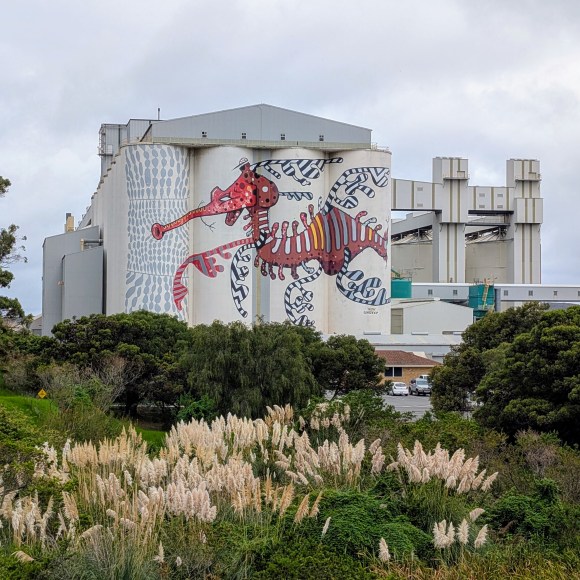
Ruby Seadragon, Albany Silo Art by Yok & Sheryo. Photo Courtesy: Alan Noble
“Will the passenger who borrowed my mobile phone please return it?” came the announcement in an American accent from the bus driver. I had never heard a bus driver with an American accent before, which was all the more surprising on a bus in regional Western Australia. The woman next to me rose from her seat and walked up the aisle to the driver to return his phone.
I was catching the bus from Albany to Perth at the conclusion of my Indian Ocean sailing adventure with Alex. I had enjoyed sailing in the Indian Ocean despite the sensation of being inside a washing machine on the odd occasion. However, I couldn’t face a succession of nights at sea on the next leg in the lonely and capricious Southern Ocean. Nor did I have the confidence to perform adequately as crew if I had to rescue a man overboard. Instead, Alex enlisted a qualified sailor to join him for the eastward crossing of the Great Australian Bight, and I decided to return to South Australia by bus and plane.
The woman passenger turned to me.
“I had to leave my twelve-year-old son alone at the bus stop,” she explained. “His father had not yet arrived to pick him up and I had to catch this bus. It only runs once a day so I couldn’t wait. I tried to call my son to see if his Dad had arrived, but his battery had run out. I couldn’t call his father either because he has blocked me. That’s why I borrowed the phone from the driver. When I reached my ex on the bus driver’s phone, he reassured me that he had picked up our son.”
I could sense she felt embarrassed at being called up to return the phone to the bus driver. I also sensed that she needed to share her anguish with someone, and that person happened to be me because I was sitting next to her.
“I understand the feeling of feeling worried about your children,” I confided in her. “My children have grown up now, but I still worry about them every day.”
It was true. Sailing for months along the coast of Western Australia, exploring uninhabited islands, and heading ashore on the paddleboard to visit coastal towns had been an unparalleled adventure, but this didn’t stop me from worrying about my daughters back in Adelaide. I would ring them daily from the boat. If they were busy, I would tell them that I just needed to hear their voice and then I would let them go. I could understand this mother’s anguish at having left her young son at the bus stop not knowing when his father would arrive to pick him up.
“Worrying about your children is lifelong,” I continued. “But if we don’t worry about them no-one else will as much as we do. There’s a reason for it.”
She murmured agreement.
I stared ahead of me rather than returning to my book, not knowing whether she wanted to continue with the conversation. It felt rude to turn away from her in her distress, nor did I want to distract her with details of my own life story. I glanced outside and the sun pierced into my eyes. After a period of companionable silence, I returned to my book.
Several hours later we arrived at the town of Popanyinning. She rose from her seat and turned to fix her eyes on me.
“Have a wonderful Easter! All the best to you!”
I had forgotten Easter was coming up but knew that her farewell had nothing to do with Easter. It was an appreciation for our conversation in her moments of distress.
“Take care. I hope it all works out,” was all I could manage in the short time we had as she moved up the aisle of the bus. Our paths will never cross again, but her story lingers in my mind.
Meredith Stephens is an applied linguist from South Australia. Her recent work has appeared in Syncopation Literary Journal, Continue the Voice, Micking Owl Roost blog, The Font – A Literary Journal for Language Teachers, and Mind, Brain & Education Think Tank. In 2024, her story Safari was chosen as the Editor’s Choice for the June edition of All Your Stories.
PLEASE NOTE: ARTICLES CAN ONLY BE REPRODUCED IN OTHER SITES WITH DUE ACKNOWLEDGEMENT TO BORDERLESS JOURNAL

 Borderless