Categories
Slices from Life

Honeymoon Homecoming

By Meredith Stephens

“Please show me your international driver’s licence.”

“Certainly!”

Alex produced the licence.

“This is out of date! I’m sorry but we can’t hand over the car.”

“No! It’s current! It’s valid for five years.”

We scrutinized the licence. The start date was prominently displayed, but not the expiration date. As we squinted to decipher the fine print on page three, we discovered that it had expired three years ago. Alex had thought it would be valid for five years, but it was only valid for one. We attributed it to his light-heartedly referred to “OCD Deficit Disorder”. And that is how a one-week road trip suddenly became a public transport and taxi trip.

This was my first visit back to Japan after having left at the beginning of the pandemic. Alex and I had been deliberating where to spend our honeymoon, and we agreed that the island of Shikoku in western Japan where I had spent over twenty years would be our first choice.

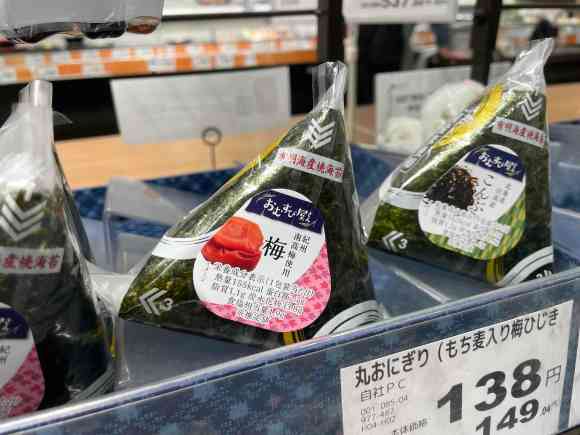
Onigiri. Photo courtesy:
Mariko Hisamatsu

There were so many things to look forward to. The first thing I did, before even leaving Kansai Airport, was rush into the convenience store and buy an onigiri flavoured with an umeboshi pickled plum. An onigiri is a triangle of rice, with a choice of flavours in the centre such as fish, seaweed, or the aforementioned umeboshi. It is wrapped in a crisp sheet of seaweed. Before eating it you gently pull away a thin layer of wrapping which protects the outer seaweed from absorbing the moisture of the rice. As you bite into it you can enjoy the three distinct textures and flavours – the piquant centre, the contrasting bland rice, and the crisp outer layer of seaweed. Next, I purchased a mugwort daifuku. This is a Japanese sweet, consisting of a layer of pounded mugwort-flavoured rice around a centre of sweet azuki bean paste. All of this was washed down with a bottle of green tea.

From the above account, it might sound like I was returning to Japan to indulge in simple culinary delights from a convenience store, and maybe this is a possibility I am unwilling to admit to myself. Of course, the main purpose was to reconnect with old friends, the second to reconnect with old pleasures, such as the aforementioned onigiri and daifuku, and the third, to stay in a traditional Japanese house.

After having been refused permission to drive our hire car, we headed back towards the terminal and searched for the railway station. We caught trains out to the UNESCO heritage listed site of Koyasan to enjoy the autumn leaves, and then seven trains and two buses later, to Wakayama station. Finally, we caught a taxi to our accommodation, which turned out to be a house that was over two hundred years ago, dating from the end of the Edo Period.

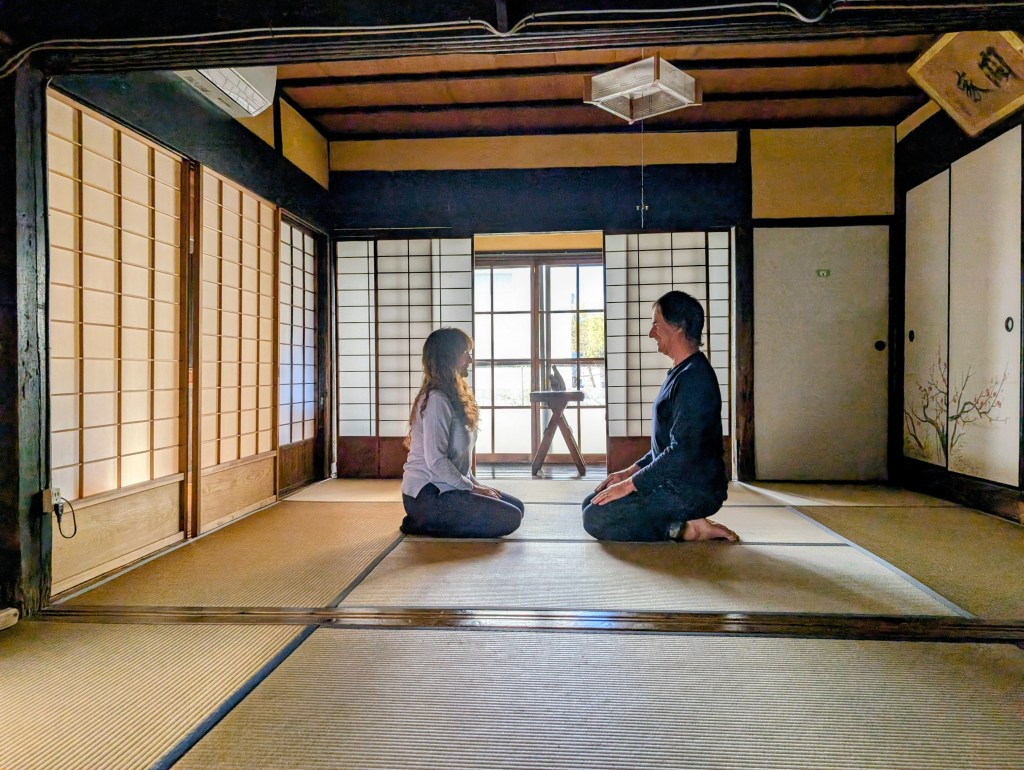
The door slid open to reveal an earthen floor. We walked down the hall to the kitchen, left our shoes in the sunken area, and donned the provided slippers. The kitchen opened onto two traditional tatami rooms, with fusuma sliding cupboards, and latticed paper shoji screens leading onto the garden. Beyond the shoji was a narrow hall known as an engawa, with a small wooden table and chair where you could enjoy sipping a drink while looking out over the garden. This was the kind of room I had been longing for during my five years away from Japan.

But we hadn’t had dinner yet and I was longing to ride to a local supermarket to purchase a ready meal.

‘“Do you have any bicycles?” I asked the host.

“Certainly. We have mountain bikes too!”

“You don’t want to go cycling in the dark?” queried Alex. “Not after a long-distance flight, seven trains, two buses, and a taxi ride? Surely not!”

I insisted, and Alex gave up persuading me otherwise. Rather than a mountain bike I chose the mamachari, a vintage bike replete with a shopping basket attached to the front handlebars.

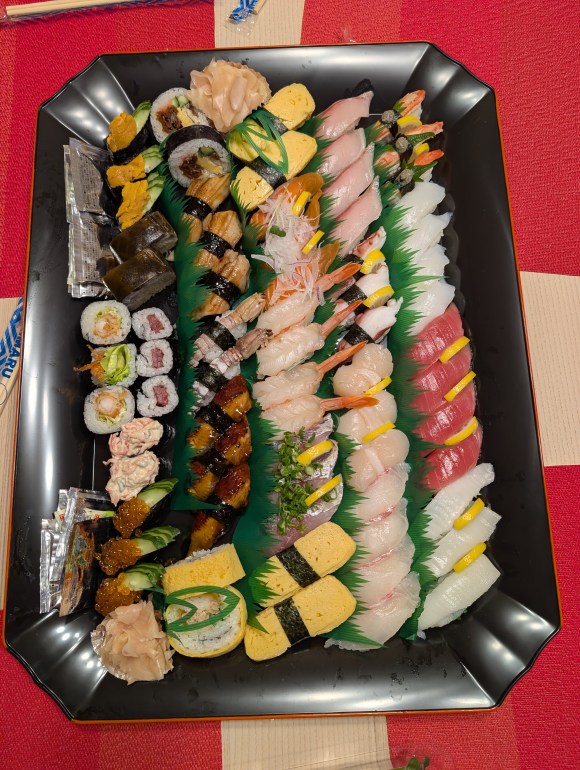
We cycled to the supermarket, as I had done almost daily during my twenty years of living in Shikoku. There we bought sushi and sashimi ready meals, and cycled home, scanning to avoid roadside ditches with sheer drops and no guard rails. Once safely home, we indulged in the much longed for sushi and sashimi, enjoyed the traditional deep Japanese bath, spread out the futons on the tatami, and luxuriated in a deep sleep.

The next morning, we woke to a gentle light streaming through the latticed paper shoji screens. We cycled to Wakayama castle, Alex on the mountain bike and me on the mamachari. We strolled around the traditional garden before entering the castle and then completed it with a visit to the adjacent tearoom, where we enjoyed green tea and a sweet bean paste confectionery.

The following day, we bid farewell to our Edo Period home, and our kind host drove us to the ferry terminal. As soon as I saw the sign in Japanese for Tokushima, I could feel the colour rising to my cheeks. This had been my home in Japan for fifteen of my twenty years in Shikoku, until the day I departed for a routine visit to Australia, just before the international borders were closed due to COVID. Little did I know that the pandemic would prevent me from returning to Japan. I boarded the ferry as I had so many other times after returning from various work trips, but this time I was visiting on my honeymoon. The two-hour crossing readied me for the arrival in my old stomping ground and was heralded by the sentimental music played to signal a homecoming. Alex and I exited the ferry to be met by my old friend and writing mentor, Suzanne. Overcome with emotion, I covered my face with my hands to spare her the sight of my crumpled features and then gave her a hug. Then I went back to covering my swollen eyes and gave her another hug.

Platter of Sushi at Sally’s home. Photo courtesy: Alan Noble

Suzanne drove us to the home of the son of another old friend, Sally, who had kindly offered us a couple of nights’ accommodation. That evening a subset of old friends dropped in to see us and eat sushi. I braced myself for the entry of each friend into the house, trying to compose my features, after an unanticipated five-year interval. My eyes, however, betrayed me. I caught the expressions of those who returned by gaze, and they could sense my relief and excitement of meeting them again. Over five years people’s appearances were a little different. Those who had long hair now wore it shorter. Those with shorter hair had grown it. Those who were curvaceous were now svelte, and those who were svelte were now curvaceous. A child had now become a lanky teenager. I’m sure I must have looked different to them too. What had not changed was people’s smiles, conversation and sense of humour. People who I would normally see a few times over a month were now all present in the same room in the space of a few hours.

A few days later, we took the bus across Shikoku to Matsuyama, where another happy reunion took place of eight friends from six different countries. I was freshly aware of the joys of the expat life, where you can make friends from a greater range of countries, and a greater range of ages, than you would at home.

Ranma Carvings in a traditional room. Photo Courtesy: Alan Noble

I had been craving another stay in a traditional house, and we savoured a room with ranma carvings suspended from the ceiling, letting in light and air flow from the adjacent room. We sat at the kotatsu low heated table on the tatami, and slept on futon, in a room featuring shoji paper screens facing outside and fusuma cupboards where futons were stored. Features which had once seemed so ordinary were now infused with nostalgia.

Family obligations called us back to Australia after only one week of our Japanese honeymoon. A taxi was followed by a bus which took us on the long trek back across Shikoku, driving through impossibly long tunnels, crossing elegant bridges, with views of the sea and mountains. Once we crossed the final bridge onto the largest main island of Honshu, the landscape was transformed into high rise apartments, and dense traffic. We alighted from the bus at Kobe’s Sannomiya Station.

There we asked directions to the airport limousine bus and made a final purchase of onigiri. My favourite umeboshi pickled plum one was not on sale, so I had to make do with a tuna mayonnaise one and a pickled seaweed one. We ran to the bus stop, purchased tickets, and skipped into the bus holding our luggage. There was no time to store the luggage in the hold. Once the bus pulled into the traffic, we knew we could relax after our long and complicated journey. I gently pulled away the wrapping separating the layers of the tuna mayonnaise onigiri and savoured the contrasting flavours and textures. Our fleeting trip to Japan was punctuated by savouring onigiri on both arrival and departure. We bade farewell to this land of delectable tastes, exquisite arts, historic houses, hair-raising bicycle rides, and precious friends.

.

Meredith Stephens is an applied linguist from South Australia. Her recent work has appeared in Syncopation Literary Journal, Continue the Voice, Micking Owl Roost blog, The Font – A Literary Journal for Language Teachers, and Mind, Brain & Education Think Tank. In 2024, her story Safari was chosen as the Editor’s Choice for the June edition of All Your Stories.

PLEASE NOTE: ARTICLES CAN ONLY BE REPRODUCED IN OTHER SITES WITH DUE ACKNOWLEDGEMENT TO BORDERLESS JOURNAL

Click here to access the Borderless anthology, Monalisa No Longer Smiles

Click here to access Monalisa No Longer Smiles on Amazon International
Categories
Slices from Life

The Rule of Maximum Tolerance?

By Jun A. Alindogan

From Public Domain

In the Philippines, ‘maximum tolerance’ refers to peacekeepers practicing a high level of restraint during public gatherings to ensure safety and maintain peace, while law enforcement implements action against violent demonstrators and shows tolerance towards those who are peaceful. Essentially, it means tolerating an individual’s capacity for patience, endurance, and long-suffering in the face of behavioral challenges.

Until now, I have maintained a close relationship with an orphaned nephew of a colleague of mine. Our bond grew stronger when he moved to our church shelter from a nearby mountainous town to live with his uncle. I have always empathised with him, as my family also provided care for fatherless children. The purpose of his relocation was to enable him to complete his college education. He eventually graduated with a degree in computer science from an institution that claims to have an Asian focus, despite lacking a physical campus during the Covid-19 pandemic. Understandably, he struggled to find employment. He returned home to stay with his aunt’s family, patiently waiting for an opportunity to secure a job, which proved to be challenging.

During his studies, we would occasionally meet for meals to discuss the work on his paper requirements before graduation and plan his group thesis. When the pandemic hit, our conversations shifted online, but his willingness to seek my assistance remained strong, and I gladly supported him.

His first job involved selling organic powdered coffee imported from Malaysia at an office in the heart of Quezon City. When the Covid-19 virus spiked, all the company’s employees had to work from home. However, there were times when they were asked to come to the office despite the significant health risk.

My friend refused to do so, which was quite reasonable as he lived with his elderly aunt and uncle. As a result, he was reprimanded and issued a memo for unauthorised leave of absence. I had to help him draft a letter in response to the memo. This situation challenged him to assert his rights as an employee as not every human resource policy is beneficial. At times, companies will test your threshold of tolerance to the limit which is not necessarily wrong. Upon repeated emails that we sent to the HR department, he was finally given his last paycheck months after his resignation.

His next job was as a management trainee for a Canadian-based coffee shop in a mall chain. Coffee shops and fast-food stores often hire college graduates from any field to fill staffing gaps caused by high employee turnover, even if their majors are unrelated to the food industry. Unfortunately, he did not pass the probationary period because he said he was verbally mistreated by the store manager over work principles and practices.

His initial job application at a global fast-food chain was unsuccessful, as he did not receive an interview. He ended up taking a part-time online job at a small pharmaceutical company to earn money for his expenses. After a year of waiting, he was finally invited for a management interview at the same fast-food chain in a city near his hometown. He got the job.

He has been working for the global fast-food chain for over two years now and enjoys his role as a specialist manager due to his interest in computing and ordering items. However, the local store management has not been supportive in terms of taking care of their team. For example, when he had a high-grade fever while working, he was not allowed to go home until the next shift manager arrived, in the midst of a heavy, rainy evening. There was even an instance where he had to attend a management meeting at another store after his graveyard shift.

On a particular rest day after his graveyard shift, he was instructed to attend management classes in a southern city for three days, without being given additional days off to offset his attendance during his rest day. Another schedule required him to report at 2pm after working a graveyard shift. At times, he was also instructed to go to other stores to manage, without any fare allowances. All these cases are documented online. The goal is for the team to hit the sales target at whatever cost and without offering any additional incentives. Even when he had toe-surgery and had to go on sick leave, he was still expected to work from home regarding stock orders. The global fast food chain’s work-life balance policy is only superficial.

Maximum tolerance does not mean to allow individuals, communities, and corporations to exploit us to unimaginable levels, where our self-worth is solely dependent on our output. Outstanding results should be based on a holistic approach that recognises everyone’s basic humanity. Resignation prevails simply because individuals are not allowed to exercise and enjoy their humanness in any circumstances. This should not be the case.

This scenario is not only limited to corporations, but also to religious institutions. In the church that I regularly attend, the resident minister encourages members to be involved in various programs, as leadership should not be dependent on a single individual but on the collective efforts of everyone. However, in doing so, he expects every member to participate in a series of activities all day on Sundays. Sundays, or any Sabbath day, should be a day of spiritual and physical refreshment and renewal. However, with the onslaught of day-long programmes each Sunday, the maximum tolerance of members is tested to the point where most skip events instead of feeling encouraged, as the minister makes them feel guilty. Saying ‘n’o is not a sin of omission.

I look forward to a time when it will be common for business enterprises and social institutions to implement appropriate mechanisms that help individuals to be more human, rather than just robots mindlessly following instructions.

Manuel A. Alindogan, Jr. or Jun A. Alindogan is the Academic Director of the Expanded Alternative Learning Program of Empowered East, a Rizal-province based NGO in the Philippines and is also the founder of Speechsmart Online that specialises in English test preparation courses. He is a freelance writer and a member of the Freelance Writers’ Guild of the Philippines (FWGP).

.

PLEASE NOTE: ARTICLES CAN ONLY BE REPRODUCED IN OTHER SITES WITH DUE ACKNOWLEDGEMENT TO BORDERLESS JOURNAL

Click here to access the Borderless anthology, Monalisa No Longer Smiles

Click here to access Monalisa No Longer Smiles on Kindle Amazon International

Categories
Slices from Life

Embracing the Earth and Sky…

By Prithvijeet Sinha

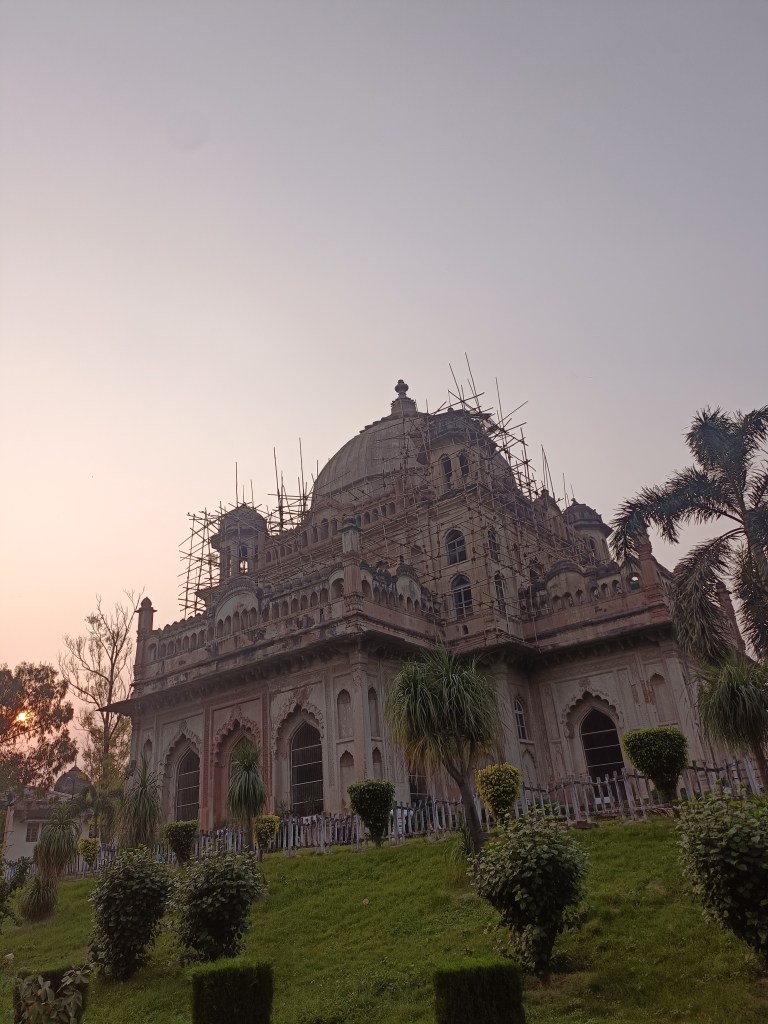
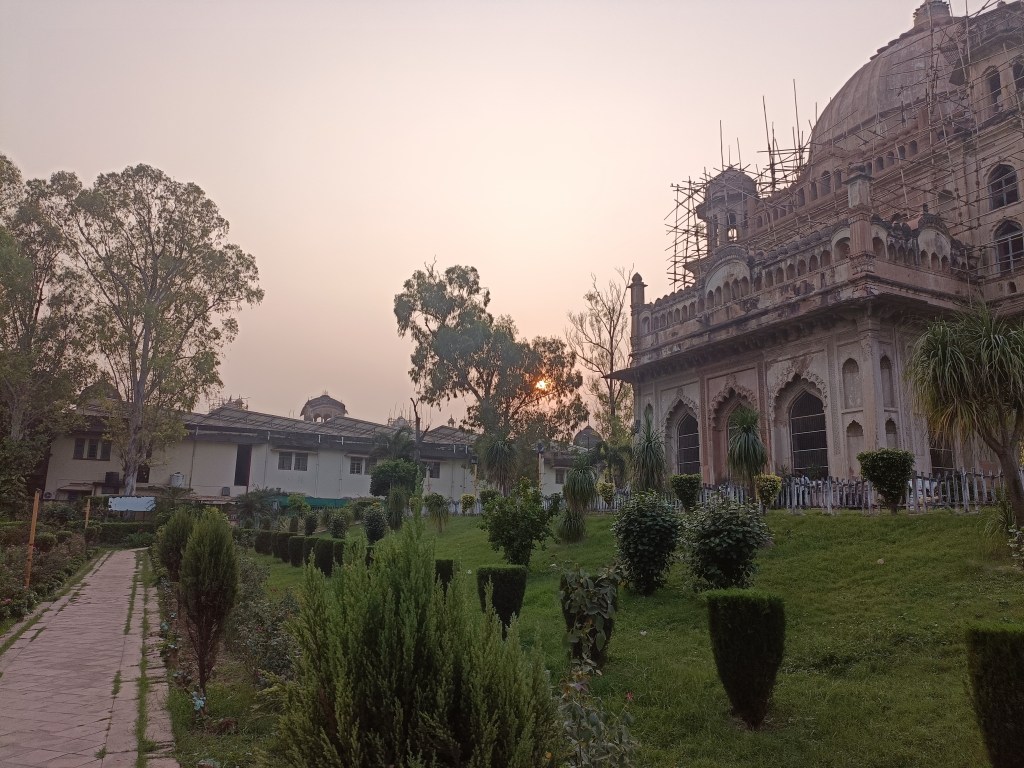
Saadat Ali Khan’s tomb. Photo Courtesy: Prithvijeet Sinha

In Lucknow, there’s a peculiar yet quintessential fascination with preserving the dead, ensuring that monuments to revere them are not only easy on the eyes but also constructed with a certain soulfulness. The sublime, inevitable poetry of mortality is hence the reason why multiple Imambaras and Maqbaras (resting places and tombs) eulogise the architects of a region that led the charge by invigorating secularism, architecture and employment to the masses.

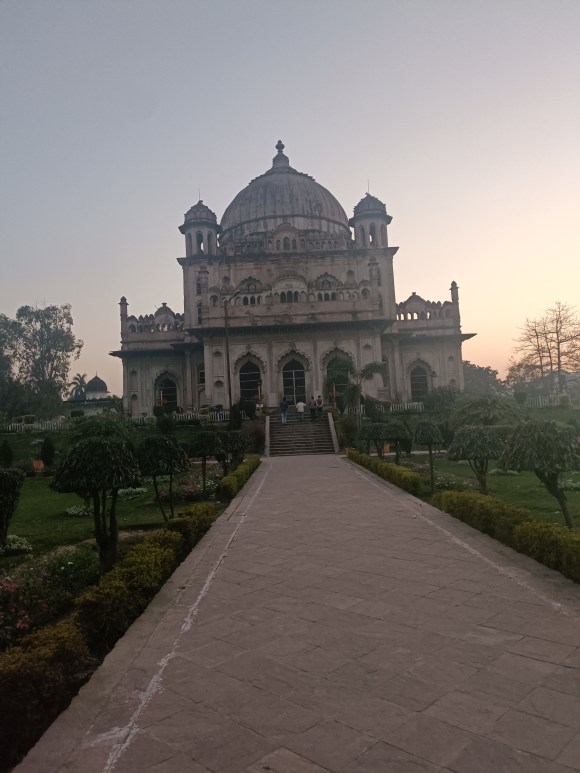
The stunning Saadat Ali Khan tomb testifies to all these features with poignant grace till this present era. Built by Ghazi-ud-Din Haider, the crowned King of Awadh in the early years of the 19th century in memory of his father, the eponymous Nawab Wazir of Awadh, Saadat Ali Khan, it was a palace of refined craftsmanship that took on the sombre hues of remembrance and eternal memory by being rebuilt as a tomb. Such is the fervour of familial legacies. Those eternal memories of wives and children now rest in the vaults that have been preserved in the inner chamber of the structure in its rear end.

On his part, Ghazi-ud-Din Haider (1769-1827) was a man of poise and taste. But he was also operating at a time when colonial powers were shareholders of Awadh as much as any other part of the country. Being a ruler may have been as much a nominal position for him as it was for his father, Yameen-ud Daula Saadat Ali Khan II Bahadur (1752 – 1814). But they both walked on common ground as they ensured that administrative duties fuelled by colonial interests didn’t usurp the spirit of their homeland. Lucknow was much more to Ghazi-ud-Din Haider and his father than just a city. Hence, their architectural aesthetics came into play to build a monumental legacy. If father Saadat Ali Khan was the mind who gave Lucknow a large number of memorable monuments between the city’s fabled Kaiserbagh and Dilkusha corridor then son Ghazi was no flash in the pan himself. The majestic Chattar Manzil, the quietly captivating Vilayati Bagh (built in memory of his beloved English wife Mary Short/ Padshah Begum) and the impressive Shah Najaf Imambara (modelled after the holy Shia site of Najaf in Iran) are all beholden to his vision. They all occupy pivotal central areas of the city today and are a visitors’ delight. He was also the pioneer behind a printing press, employing English and local scholars who were versed in multiple languages and enriched his court with the compilation of an extensive Persian dictionary.

Saadat Ali Khan’s Tomb extends his legacy, it’s a stunning architectural design of a palace turned resting place for dearly departed retaining Lucknow’s exquisite stamp. The magnificent dome, arches, unbridled calligraphy of designs, decorative motifs and the pillars echo with two hundred years and more of all that the structure represents. The distinctive wash of yellow, brown and sometimes bleached lemon in the building are all captivating to discerning eyes. Under this dome and the parapets, one walks in circles and picks up the nuances of beauty that surround it. Chief among them being huge windows framed with nets, galloping squirrels and various potted plants covering the expanse.

Even more wonderful is the tomb of Mursheer Zadi, Saadat Ali Khan’s beloved wife, that stands parallel to his tomb. With its similarly constructed structure and darker tones, the confluence of dome, spires, parapets, inner chamber and decorative motifs become breathtaking. If the morning reveals these structures as enchanting dual partners, afternoons suffuse them with a time-honoured glow while the evenings bathe them with shades of devotion to this cityscape.

Visitors people the verandahs that surround it. At the Saadat Ali Khan Tomb and Garden, we relive the permanence of smiling flowers, the majestic architecture and the surreal power of its mystique. It’s a structure that seems to literally rise out of the earth and court the sky in reverence to both. We, in turn, understand its juxtapositions of mortality and muted grandeur as die-hard Lucknawis.

As scaffolds populate the tombs and restoration work ensures more renewed glint for its overall structure in the new year as also for its neighbouring Chattar Manzil, this site becomes the classical storyteller it has always been. Its saga is continuous, eternal. Its haunting understories are as soaked in legends and myths as is the wonderful city of Lucknow. The dead don’t just rest in peace here, they converse in whispers that become the wind and birdcalls.

Photo Courtesy: Prithvijeet Sinha

Prithvijeet Sinha  is an MPhil from the University of Lucknow, having launched his prolific writing career by self-publishing on the worldwide community Wattpad since 2015 and on his WordPress blog An Awadh Boy’s Panorama. Besides that, his works have been published in several journals and anthologies. 

PLEASE NOTE: ARTICLES CAN ONLY BE REPRODUCED IN OTHER SITES WITH DUE ACKNOWLEDGEMENT TO BORDERLESS JOURNAL

Click here to access the Borderless anthology, Monalisa No Longer Smiles

Click here to access Monalisa No Longer Smiles on Kindle Amazon International

Categories
Slices from Life

The Final Voyage

Narrative by Meredith Stephens

I stretched the boat hook as far as I could towards the mooring buoy, but it slid beneath the bow.

“Go back!” I shouted to Alex back at the helm, but my voice was carried away in the wind.

I pointed at the buoy under the net, and Alex reversed. The waves were dancing in front of me and the buoy would not stay in place long enough for me to reach it. On the second attempt, I forced all of my attention on the rope attached to the buoy, and tried to pull it aboard. It was much too heavy so I screamed for Alex to come, and he raced from behind, pulled the buoy up and secured it to the bow.

How would I alight into the dinghy in these waves? Alex lowered it into the water and it lunged towards the stern and back in succession. I doubted I would be able to board in these conditions.

“How about if I move the dinghy to the side of the boat and you enter via a ladder?”

“Worth a try!” I answered.

Alex brought the dinghy to the side of the boat and slung a ladder made of strong fabric overboard. I gingerly stepped down but once I glanced at the water raging beneath me, I lost confidence and gave up.

“I think I had better hop in from the stern after all,” I told Alex.

He moved the dinghy back to the stern. As I walked towards it, I slipped and fell on my thigh. There was no time to feel sorry for myself, so I picked myself up and continued heading for the dinghy. It lunged back and forth in the waves.

“Now!” commanded Alex.

I placed one foot in the centre of the dinghy to centre myself and then sat down on the bench. As hard as it was for me it was not hard for Haru, my border collie. I called her in and tapped the dinghy behind me because I knew she was hard of hearing. She leapt behind me with alacrity. It was so much easier for her to board the dinghy, not least because of her four legs.

Alex was locking the door back on the boat. The dinghy kept lunging toward the stern, and I was scared of getting knocked off when it hit the stern. I screamed as hard as I could.

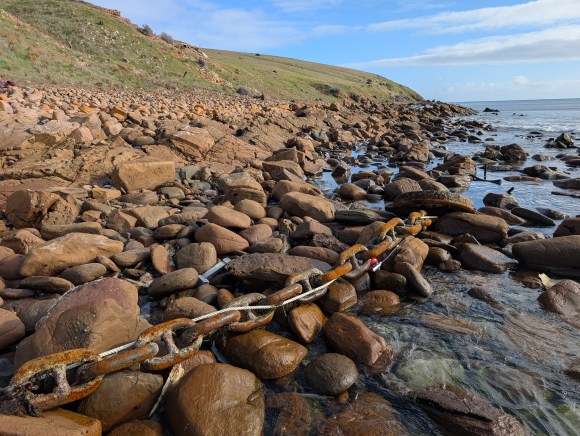
“Okay!” replied Alex and hopped in behind me. Then he turned on the engine and headed for the shore, except that the shore was unrecognisable. Instead of a sandy beach, there were rocks.

Alex headed for the most promising spot. “Hop out!” commanded Alex, and I disembarked one leg after the other and headed to climb over the rocks. As usual, Haru leapt out and ran ashore.

I thought I was clear of the rocks and the menacing water, when Alex called out to me.

“Take my backpack! The laptops are in here. They can’t get wet. I realised then that we should have put them into the dry bag.”

I walked over the slippery rocks and strained to grasp the shoulder straps of the backpack. Once they were in my hands I returned to shore over the rocks, ready for the trek up to the holiday house.

I was so longing for the warmth of the fireplace and the view of the setting sun over the bay. I walked effortlessly up the hill, with Haru trotting happily beside me. The shelter and glow of the house was just as I had imagined. It was worth the hardship of getting there.

That night the winds continued to build, but it was pleasurable to hear them passing over the house as we enjoyed the safety and warmth of being inside.

Around one in the morning, the whole house shuddered when hit by a particularly strong gust, which was violent enough to briefly wake Alex.

No sooner was it light that I heard Alex enter the room. He must have been out before the wee hours.

“The boat has drifted to shore. I had a bad feeling and got up early to check the position of the boat. From the cliffs I could see that the mast was too close to the shore. Then my fears were confirmed when I saw that it had been blown ashore.”

Dragged moorings. Photo Courtesy: Alan Noble

“Didn’t the mooring hold?” I asked.

“Evidently not. I’m going to check it out now. Want to come?”

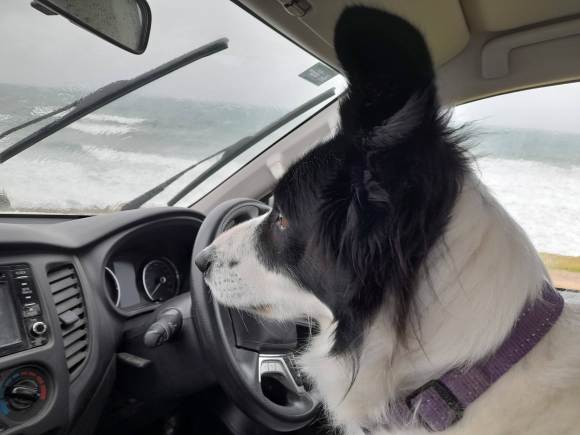
I agreed, and we drove out to the cliff with Haru in the back seat. Once at the cliff, I remained in the car because I couldn’t face the gale-force winds that were now gusting to forty knots. Meanwhile, Alex, in his wetsuit, walked down the dirt road towards the beach, entered the water, and pulled himself aboard. I kept my eyes focused on him until I saw his figure exit the boat, swim ashore, and walk up the track back toward me.

“It’s finished. There’s nothing we can do, beyond salvage.”

Alex’s boat of sixteen years and our home away from home for the last five years was no more. In years past, we had circumnavigated Tasmania, sailed to New Caledonia and back, and across the Great Australian Bight to sail north on the Indian Ocean. Exiting a marina and heading towards the waves was a symbol of leaving our troubles behind and anticipation of adventure. I could no longer take this adventure for granted.

Alex reached out to Thompson’s Marine Salvage, and they arrived at the bay within two hours. The plan was to attach one end of a heavy rope to a tractor at the top of the cliff, and the other end to the boat, and drag it onto the sand to save it from smashing on the rocks.

Alex again donned his wetsuit, descended the cliffs, and swam to the boat. I sheltered from the wind in the car at the top of the cliffs with Haru. Then I thought that I should walk towards the boat in case there was anything I could do. Just as I reached the shore, a young man in a wetsuit approached me.

Haru observing from inside the car. Photo Courtesy: Meredith Stephens

“Watch out for the rope. We’re ready to begin!”

It was too late. The operation had started, and the rope was heading towards me, as the tractor started to try and haul the boat to the shore.

“Jump!” the young man urged.

I’m glad the young man thought this was a possibility, but I haven’t jumped for years. My days of jumping are decades behind me. Unable to jump, I met the full force of the rope and was knocked on my back. My head hit some rocks. I uttered an expletive “sh..!” which I reserve for extreme situations. I lay there for seconds before slowly getting back to my feet. My head was aching from the blow and my whole being was in shock. I gave up on rendering assistance and walked slowly back to the car. There I sheltered from the wind until Alex eventually returned to the boat.

“The operation has failed. The boat is still stuck on the rocks,” he explained.

Late in the day, a twenty-ton excavator arrived on the scene. I spent the day bent over holding a rubbish bag, picking up rubble from the boat. Haru trotted around me enjoying being freed from the confines of the house. The excavator approached the boat like a giant menacing dinosaur. I grabbed Haru by the collar and removed myself to a distant spot on the other side of the boat. I could not face another industrial accident. The hand of the excavator grappled the mast and moved it to a safe spot on the rocks. I watched the dinosaur make its retreat back to the road while I maintained a hold on Haru’s collar.

The following day a second twenty-ton excavator descended onto the beach. The first excavator lifted the stern while the second lifted the bow. Slowly, the airborne boat was moved off the rocks and onto land. I was invited to view it, but I couldn’t face seeing the destruction of our home. That evening, I ventured out to the paddock where the boat now rested high and dry, like a beached whale. Amongst the devastation, I retrieved the remains of my dressing gown, which had somehow become entangled in the bow.

Over the next few days, I continued to return to the beach to extract boat rubble from the shore and pull up items of clothing and bedding from the sand. Alex drove down to the beach in his off-road vehicle, and we loaded up the tray with bags of rubble. Different items washed ashore each day.

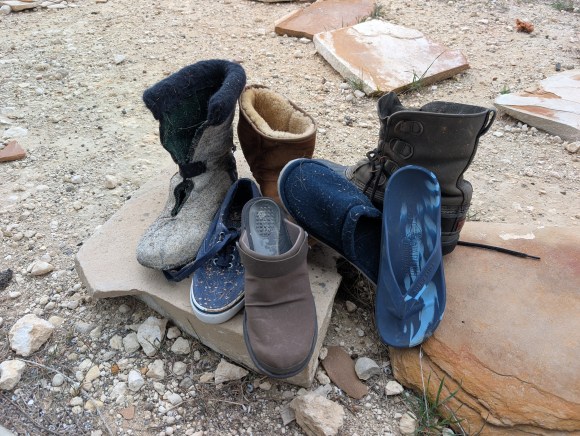
Salvaged shoes. Photo Courtesy: Alan Nobel

The bump on my head continued to heal, only feeling pain when touched. The bruises on my legs changed colour as they too healed. And eventually the bay would heal too. We continued daily beach clean-ups. Seven odd shoes were salvaged, an odd snorkel fin, and odd gloves. Two months later the other fin washed up, but none of the missing shoes ever made an appearance. We continued to fill our off-road vehicle, and rubbish bags, with debris. Our beloved nautical home sat out of place in a paddock awaiting salvage. We came away with a renewed appreciation and respect for the destructive power of the ever-changing sea, but it would take more than a broken boat to diminish our desire to sail again. For now, our sailing adventures were on hold, but once we had the opportunity, we would again return to the sea. This would not be our final voyage.

.

Meredith Stephens is an applied linguist from South Australia. Her recent work has appeared in Syncopation Literary Journal, Continue the Voice, Micking Owl Roost blog, The Font – A Literary Journal for Language Teachers, and Mind, Brain & Education Think Tank. In 2024, her story Safari was chosen as the Editor’s Choice for the June edition of All Your Stories.

PLEASE NOTE: ARTICLES CAN ONLY BE REPRODUCED IN OTHER SITES WITH DUE ACKNOWLEDGEMENT TO BORDERLESS JOURNAL

Click here to access the Borderless anthology, Monalisa No Longer Smiles

Click here to access Monalisa No Longer Smiles on Amazon International

Categories
Slices from Life

Linen at Midnight

By Pijus Ash

Kindness is a virtue in every religion. But for a decade, I’ve been chased by a single, unsettling act of kindness. It returns whenever I see a remote train station at sunset, or a quiet backyard touched by green. Sometimes, even in a glimpse of flowers laid on stone.

It began during a month-long training in the Netherlands in June 2015.

Days were spent in Hilversum; my nights, in the sleepy town of Bussum.

The journey from Kolkata to Amsterdam had blurred into airport queues and cross-continent menus. All I craved was rest. Bussum seemed to offer it.

The town was near empty when I arrived—just a few locals cycling away from the platform. I followed an early-arrival email and made my way to a small hotel tucked into a quiet street. A kind young man named Erick checked me in.

My room was on the second floor, at the back. It was hot, and I was drained. After a light dinner, I collapsed into sleep.

Then came the noise.

A low, grinding sound—like stone dragged against stone. Dull but insistent.

It came from just below my window. My water bottle was empty. The sound, unrelenting.

I got up and drew the curtain. My room overlooked a moonlit field. A quick check on my phone confirmed what my gut had already whispered: it was the Bussum graveyard.

I couldn’t stay in the room. I slipped into the hallway, mind spiralling.

Then I saw her.

A woman in a white uniform stood at the far end, carrying folded linen. She appeared just when I needed her — arms full of linen, and something like calm. She walked toward me with a curious smile.

“Hi, what happened?” she asked.

Too shaken for pleasantries, I got to the point. “There’s a noise from the backyard. I can’t sleep.”

“Oh, is there? Let me see.”

She stepped into the room and looked out the window with an odd indifference. Then she quietly closed the blinds and adjusted the air conditioning. The noise stopped instantly.

As if she had flipped a switch.

She placed a bottle of water on the table and turned to leave. “Everyone will be sleeping now,” she said. “You should try to as well.”

Kind lady, I murmured.

The next morning, I went to the reception. “The laundry shouldn’t make that much noise at night,” I said, describing the sound and the woman.

Erick looked puzzled. “The laundry shuts down by 4 p.m. And there’s no machine that could make such a noise, let alone carry a bottle to your room.” He hesitated. “We don’t have night staff. No janitor. No night housekeeping.”

I didn’t trust Erick a hundred percent. So, I checked.

Went to the kitchen, laundry, housekeeping corner—she wasn’t there. Wasn’t anywhere.

A housekeeping roster hung on the wall. I stared at it for a long time.

Erick was right.

I stayed for three weeks but asked for a room at the front. The noise of the road was better than that sound from the graveyard.

But it’s not the grinding or the cemetery that keeps returning.

It’s her.

Even now, when I pass a tiny station with a green patch beside it, the same question returns—Who was she?

Someone who took pity on a weary traveller in the middle of a ritual not meant for me?

Did she silence the stones… just for me?

I never found answers in Bussum. I don’t have them now.

But when the memory returns, I still see her—curious smile, arms full of white linen—like someone quietly closing a door so you can sleep.

A kindness that stayed.

A kindness that chases.

Pijus Ash, a Kolkata-based journalist and writer, publishes in Space Ink, Newsclick, and more. He enjoys grayscale photography and listens closely to silence when away from the page.

.

PLEASE NOTE: ARTICLES CAN ONLY BE REPRODUCED IN OTHER SITES WITH DUE ACKNOWLEDGEMENT TO BORDERLESS JOURNAL

Click here to access the Borderless anthology, Monalisa No Longer Smiles

Click here to access Monalisa No Longer Smiles on Kindle Amazon International
Categories
Slices from Life

Two Lives – A Writer and A Businessman

By Chetan Datta Poduri

(Based on True lives)

Disclaimer. With apologies to everyone.

In the market several ‘instantly get rich’ books are available. And of course, these are available in all languages as well. But the twist in the tale is that the author might not have followed the advice s/he dispenses through their writings. Samuel Langhorne Clemens, who is popular through his pen name as ‘Mark Twain’, is an example in context.

Every English fiction reader worth his name would have read Mark Twain’s The Adventures of Tom Sawyer and Adventures of Huckleberry Finn. Twain is one of those rare writers who achieved success and fame during his lifetime through his writings. He earned a substantial amount of money from his works.

Twain is also famous for quotes and predictions. He made two accurate predictions. The most popular one was about his death. Twain was born in the year 1835 CE when Halley’s Comet made its appearance. Twain wrote in 1909 CE that he was born when Halley’s comet appeared in 1835 CE and when it would appear next (i.e., in the year 1910 CE), it would be a great disappointment if they both didn’t go out together. True to his words, Twain died of heart attack shortly after Halley’s comet’s closest approach to the Sun.

Perhaps a lesser-known prediction is in Twain’s quote, “Buy land, they are not making it anymore”. Yet Twain rarely invested in land. His favourite investment was science and technology. During his lifetime, Twain is reported to have unwisely invested about US$300,000 (present-day valued at approx. US$8 million) in failed technologies. All this in a span of about 14 years which not only speaks volumes about his loss but also about Twain’s earning’s through writings. Added to this, Twain’s children’s poor health put him in financial difficulties. He is said to have even filed for bankruptcy. Nevertheless, at the time of his death, Twain owned an estate valued at US$471,000 (present-day value about US$11 million). Ironically, Twain’s family fizzled out either to disease or to alcoholism and pills.

On the other hand, a lesser-known individual who’s a contemporary of Twain, a Mr. Friedrich Trump, a German emigrant to United States of America, invested heavily in land, real estate, hotels and brothels. By 1904 CE, Trump is said to have visited his home country Germany upon insistence of his wife whence he is believed to have deposited an amount in the excess of US$600,000 into a bank.

Trump invested in land heavily in America. Owing to his German credentials, Trump maintained a low-profile during world war I. However, due to flu and secondaries, Trump died in the year 1918 CE. Trump’s wife and his son continued the real estate projects after Trump’s death. Trump’s legacy lives in the form of present-day American President Donald Trump who happens to be Friedrich’s grandson.

Note. It is not known to the present author whether Friedrich knew about Twain’s predictions.

.

Chetan Datta Poduri is a doctorate in Biotechnology. After about a decade of teaching in premier institutes across India, Chetan turned to full-time Writing. Also, presently Chetan self-finances his research. More about him at https://cdpoduri.wordpress.com/

.

PLEASE NOTE: ARTICLES CAN ONLY BE REPRODUCED IN OTHER SITES WITH DUE ACKNOWLEDGEMENT TO BORDERLESS JOURNAL

Click here to access the Borderless anthology, Monalisa No Longer Smiles

Click here to access Monalisa No Longer Smiles on Kindle Amazon International
Categories
Slices from Life

Feeding Carrots to Gentle Herbivores

Narrative by Meredith Stephens


Sisters and friends and the author with horses, Whisky and Macka, outside Grandma’s house, in 1972. Photo Courtesy: Judith Stephens.

December 1972, Adelaide

I opened the fridge, pulled out some carrots and put them into the back pocket of my jeans. Then I headed into the backyard shed to retrieve my saddle and bridle. I slung the saddle over the handlebars of my bicycle and placed the bridle in the basket. Then I cycled to the first gateway to the riverbank. I left the bicycle by the fence and walked up the riverbank to find my bay steed, Macka. I couldn’t see him. Then I returned to my bike and cycled to the next entrance to the riverbank and looked for him. Still no Macka. When I entered the third entrance, I spotted him grazing by the river. I pulled out a carrot from my back pocket and held it out to him on my flattened palm. He pricked his ears, looked at me and headed towards me. He picked the carrot up with his soft lips and started crunching it. I slung the reins over his head, placed the bit in his mouth, and bridled him. Then I led him to a spot by the river where I could take advantage of the slope to stand higher than him and jumped on his back. I could never fatten him up, and his backbone pressed into my rear as I sat on him slightly askew. I regularly fed him chaff, and he grazed all day, but like some people, he remained forever thin. I rode him back to where the bicycle was, saddled him up, and trotted and cantered along the riverbank towards the sea.

This was my daily routine after school. Homework was rarely set, so I hardly ever studied in the evenings. Why would you study when you had already been at school all day? Sometimes my black labrador Jason accompanied me. In those days there were no rules about keeping your dog on a leash, so Jason would follow me, even if this meant swimming behind Macka and me to cross the river.

January 1973, Adelaide

“Meredith!” came the voice from my window at 5 am. It was my best friend, Debbie. Debbie owned a 16-hand piebald heavy horse, taller than her, called Whisky. Debbie knew that without pressure from her I would not rise this early. On this occasion, rather than being on the riverbank, Macka was stationed in the corral that Mum and Dad had built in the backyard.

I rose, dressed, and made my way to the corral to bridle Macka. Then I led him to the front yard where Debbie was waiting for me on Whisky. Today we were riding bareback, because our destination was the beach, and we were going to sit astride our horses as they swam. We headed to the riverbank and rode a kilometre to the mouth of the river. Then we rode across the sand and entered the water. When the horses started swimming, we started floating above them, my legs rising above Macka’s sides. I grabbed his mane so as not to part company with him. Then we turned the horses back towards shallow water. Once Whisky had found his feet, Debbie turned around and stood on his rump. From there she dived into the sea, quickly swam back and mounted him again. I wasn’t confident enough to attempt the same feat on Macka. Next, we headed back to shore and dismounted. We lifted the reins over the horses’ heads and held them while they rolled in the sand, thrashing their legs in the air. Then we jumped back on them, and galloped along the sand, before retracing our steps upriver.

August 2025, Monarto, South Australia

We were visiting the largest open-range safari park outside of Africa, Monarto Safari Park, an hour’s drive from Adelaide. Of all the African animals, I was most looking forward to seeing the giraffes and was excited to find myself a place on the giraffe tour. I took a seat on the bus and listened to the guide’s spiel as we made our way to the giraffe feeding station. The guide provided a bucket of carrot sticks for the tourists to feed to the giraffes.

I dipped my hand into the bucket, retrieved a carrot stick and offered it to the giraffe. He inclined his neck towards me, extended his enormous blue tongue to the carrot, gently took it between his lips, and started crunching it. I stood back in order to give the other tourists a chance to do the same, and a few came forward. In the next interval, I retrieved another carrot stick and offered it to the first giraffe. I stood back again for the other tourists, but few were interested. I ended up giving most of the carrot sticks to the giraffes because no-one else seemed to be as engrossed with this as I was. As soon as the bucket was empty the giraffes lost interest and gently loped away. I realised that the reason I was enjoying this so much was that I was reliving the experience of over fifty years earlier of feeding carrots to Macka.

In the years since the 1970s, although I never lost my love of horses, motherhood and working overseas took precedence over riding. My early years of daily caring for Macka felt like a distant dream. And yet in a distant time and space, I sometimes yearned for a simple life where I could care for large herbivores. I cannot return to 1973, and am unlikely to own a horse again, but at least I could re-experience the thrill of feeding carrots to gentle giant herbivores at Monarto Safari Park.


Feeding giraffes at Monarto Safari Park in 2025. Photo Courtesy: Cathie Noble.

Meredith Stephens is an applied linguist from South Australia. Her recent work has appeared in Syncopation Literary Journal, Continue the Voice, Micking Owl Roost blog, The Font – A Literary Journal for Language Teachers, and Mind, Brain & Education Think Tank. In 2024, her story Safari was chosen as the Editor’s Choice for the June edition of All Your Stories.

PLEASE NOTE: ARTICLES CAN ONLY BE REPRODUCED IN OTHER SITES WITH DUE ACKNOWLEDGEMENT TO BORDERLESS JOURNAL

Click here to access the Borderless anthology, Monalisa No Longer Smiles

Click here to access Monalisa No Longer Smiles on Kindle Amazon International
Categories
Slices from Life

Instrumental in Solving the Crime

By Meredith Stephens

“This is just like Midsomer Murders without the murders!” I quipped to Alex.

Midsomer Murders was one of my favourite British crime shows. In particular, I loved the depiction of English village life, where villagers gossiped on the village green. The only problem was when the happy village life was interrupted by a gruesome and unexpected murder. Then I had to place my hands before my eyes to block out the scene of the murder in case the camera lingered there too long.

Alex, Verity and I were visiting the Mypunga Markets in the South Australian countryside. The first vendor was selling a wide selection of eye-wateringly delectable Greek cakes. To our right was an Italian wine-grower selling his wines, such as Pinot Grigio, from a nearby vineyard. A Korean stall holder was selling kimchi[1]. Perhaps the offerings were a tad more multicultural that those depicted on the village green in Midsomer Murders. Farmers sold organic vegetables and local dairies sold cheeses. We stopped to soak in the sounds of a group of elderly ukulele players. Shoppers were wearing home-spun hand-knitted jumpers, scarves and beanies, carrying shopping bags made of cheesecloth. I revelled at being on the set of the South Australian equivalent of the village green in Midsomer.

Our purpose for driving into the countryside was twofold. After the market, we went to the shed at Alex’s hobby farm to collect some firewood. Alex unlocked the gates at the roadside entrance, and we drove through the spotted eucalypts, wound up and down the hill through the gorge to eventually arrive at the shed. The roller door was wide open. This was the first time we had been greeted by an open roller door. We parked and peeked inside.

“Don’t go in, Dad!” screamed Verity.

Plastic tubs had their lids off. Children’s toys were scattered. Furniture was tipped over. The new off-grid battery modules, in the process of being installed, had been ripped out and strewn on the floor. We could not turn on the lights because they were powered by the batteries.

We carefully continued our entry into the huge dark shed lest we surprise the burglars and become a victim ourselves. No-one was there. I looked in the ancient sideboard I had inherited from my grandmother and opened the top drawers. My forty-year-old flutes were missing. Were the burglars flautists?

We righted the upturned furniture, returned the toys to the plastic tubs, affixed the lids and stacked them neatly. Then Alex got on the phone to his young employee, Troy.

“Would you mind getting hold of a battery-powered camera and placing it up high in the gum tree facing the shed door?” he asked. “We need surveillance.”

It was Saturday and Troy’s day off, but he was willing to assist Alex, and by 9 pm that evening he had purchased a camera and placed it where requested. He used the drop-down menu to ensure that notifications of camera images would come to his phone.

We returned home with the firewood. At least the burglars hadn’t stolen that. We lit a fire in the fireplace and luxuriated in front of it, savouring the delights we had purchased at the Mypunga markets. Now we had a camera installed, surely, we would be safe.

At 5 am the next morning the telephone rang. It was Troy. Alex’ phone had been on bedtime mode, and he could not have received calls any earlier.

“They’ve broken in again,” said Troy. “At 2.38 am. This time with a car. The footage came to my phone.”

“Are you there now?” asked Alex.

“Yes. I came straight here when I got the notification.”

“OK. We’ll head over there this morning. Have you called the police?”

“Yes. They’re coming shortly.”

Usually, I savour sleeping in on the weekend, or in fact on any day, but suddenly I had no desire to continue nestling between the brushed cotton sheets. I had been jolted awake.

“Are we going now?” I asked Alex.

“Soon. I have to wait for the hardware store to open. I want to buy some metal reinforcements to secure the shed door. Because we have no power, I’ll have to buy an inverter to power my tools.”

We drove towards Mypunga, first stopping at the hardware store en route to buy the bolts and then at an electronic’s store to buy the inverter. When we arrived at the farm we stopped at the gates to check the locks. The chain had been cut with bolt cutters. Then came a phone call from Troy.

“Are the police here?” asked Alex.

“Yes. They have collected fingerprints and DNA samples. They are coming out now to talk to you.”

Soon we were joined at the gates by four detectives and Troy. It was 11 am. Troy had been on the site for at least six hours, not to mention having been there at 9 pm the night before to install the cameras. He excused himself and the detectives explained to Alex the evidence they had found. The visit from the previous day had been a stake-out on foot. Once they had discovered the batteries, they had resolved to return with a car. The batteries were too heavy to have been carried out on foot. But not the flutes. They were much lighter than the batteries.

The police promised to examine the footage carefully. It captured the arrival of the car, and three men with torches circling the shed. One of the men had spied the camera, seized it, and thrown it down the hill. After that the images from the camera were of the surrounding grass. The detectives left and Alex and I drove up and down the winding track to the shed. The roller door was wide open. We entered, and the carefully stacked boxes again were opened and the lids strewn around the shed. Toys and hats were scattered. The drawer from which my flutes had been removed was now firmly wedged against the sideboard. They had clearly opened and shut it again, even after having removed the flutes the day before.

Unlike in Midsomer, no-one had been murdered, but there was a strong sense of violation. Burglars had staked out Alex’s shed, upturned the contents, and left with the roller door still open. Returning the very next day after having staked out the property was brazen. There was a dark underside in this countryside location despite the peaceful scene we had observed the previous day in Mypunga, with shoppers in their home-spun hand-knitted jumpers carrying their organic produce in cheesecloth bags. Most likely the thieves were from elsewhere and had followed the battery installer’s vehicle emblazoned “Remote Power Australia”.

A few days later Alex received a call from the detectives requesting a DNA sample, in order to rule him out. Some tools in the shed had been used to remove the batteries, and they had produced a DNA sample from these. Alex agreed, and a constable arrived at the house the next day to take a swab.

“Have you made any progress on the case?” asked Alex.

“We’ve identified the car the burglars used from the footage. It’s a Ford Maverick. That narrows it down quite a bit.”

Meanwhile Alex and Troy restored the camera to the eucalyptus tree, and bought another one which they affixed it to another tree one hundred and fifty feet away. At the detective’s suggestion, the second camera was aimed at the first one. If a burglar took down the first camera they would be filmed by the second camera. Since the batteries had been stolen and there was no power in the shed, the cameras were operated by solar panels. Alex could regularly check for notifications on his phone.

Two months later Alex received a phone call from a constable with a strong northern English accent that transported you to a distant time and place. It was the kind of English you would hear on a British detective show, although not the southeastern English accent of the fictional Midsomer.

“This is Senior Constable Jane Michaels. We have found two flutes. They may be yours. Can you identify them from the photo? I took it with my bodycam.”

Alex showed me his phone. I couldn’t identify them from the photo. However, they had to be mine. Flute theft must be a much rarer crime than battery theft. More people are in need of batteries than a flute.

“If you prefer to identify them in person, I can make myself available next week,” explained the Senior Constable. “The burglars were not what you would call a musical family,” she quipped.

“I’ll give you my partner’s number so that you can contact her directly,” offered Alex.

The next Wednesday a call came from an unknown number. I let it ring out because I never answer unless I know who is calling. Then I listened to the recorded message the caller had left behind.

“It’s Senior Constable Jane Michaels from the Camden Police Station. I’m hoping you can identify those flutes. Please call me back.”

Hearing this English accent made me feel like I was on the set of Midsomer Murders. A frisson of excitement tingled up my spine. It was a warm, old-world and unpretentious accent that I associated with the north of England. (When you hear an English accent by a worker in South Australia, you may feel like you are on the set of a detective show like me, or you may assume they are in the health or policing professions because of the recruitment drives in Britain in these professions.)

“Can you come to Camden Station to identify them? We’ll be there in half an hour.”

I drove to the address she provided, entered through the imposing gates, and parked outside a giant warehouse. I entered the building and pressed a button marked ‘Property recovery’. A constable greeted me from behind a glass partition.

“What have you come to collect?” he asked.

“Two flutes.”

He looked at me quizzically. Flute theft is probably an uncommon crime.

“What?” he asked again.

“Flutes,” I repeated.

He disappeared to the room behind, and Senior Constable Jane Michaels appeared bearing the flutes in their cases. Despite her old-world accent on the phone, she was surprisingly young.

“Are these in fact yours?”

I looked at the cover of the box for the brand, and sure enough, ‘Armstrong’ was written in faded silver letters. This was the flute I had owned since my teenage years.

“How about the batteries? Are you likely to find them?” I asked hopefully.

“We didn’t find them at the property, but it’s an ongoing investigation,” she explained. I could tell from her apologetic tone that she thought we would be unlikely to retrieve them.

I thanked her and left. I returned to my car, the sole one in the enormous car park. As I drove off two constables headed to close the enormous gates behind me, smiling and waving, happy that I had been reunited with my stolen flutes.

I have to hope for Alex’ sake that the batteries will be found. Meanwhile, I haven’t played my Armstrong flute in over forty years, but now that it has been stolen and recovered in a raid, I feel compelled to take it up again. What’s more, who knows whether the recovered flutes will be instrumental in solving the crime of the stolen batteries?

[1] A spicy Korean salad

Meredith Stephens is an applied linguist from South Australia. Her recent work has appeared in Syncopation Literary Journal, Continue the Voice, Micking Owl Roost blog, The Font – A Literary Journal for Language Teachers, and Mind, Brain & Education Think Tank. In 2024, her story Safari was chosen as the Editor’s Choice for the June edition of All Your Stories.

PLEASE NOTE: ARTICLES CAN ONLY BE REPRODUCED IN OTHER SITES WITH DUE ACKNOWLEDGEMENT TO BORDERLESS JOURNAL

Click here to access the Borderless anthology, Monalisa No Longer Smiles

Click here to access Monalisa No Longer Smiles on Kindle Amazon International
Categories
Slices from Life

Menaced by a Marine Heatwave

By Meredith Stephens

In an ideal world I would sleep in every morning and enjoy a leisurely breakfast, but I can indulge in no such luxury because I have a border collie. Her name is Haru. She has an elongated body, a pointy white snout scattered with black dots, one black ear and one black and white spotted ear, all-knowing brown eyes, feathered forelegs, and a bushy tail with a white tip. She looks more like a cross between a fox and a border collie than a pure border collie. As soon as she hears my voice when I wake up, she starts whining from the courtyard below, nagging me to take her for a walk. I much more looking forward to my breakfast than the walk, but Haru is the opposite.

Haru. Photograph by Meredith Stephens

One Tuesday, as usual, I affixed her leash and walked her towards the esplanade. Haru has memorised the route. She strained in front of me to the point where we crossed the road and then continued to drag me towards the pedestrian crossing. Then she made a beeline for the stairs leading down to the beach. I released the leash and threw the ball down to the sand. She raced down the stairway ahead of me and ran to catch the ball. In the winter months along this coastline, dogs are allowed to run off the leash as long as they are under the owner’s control. I was joined by a throng of other dog lovers and their canines, running to catch balls. Haru is interested neither in other dogs nor other people. All she cares about is the ball. Other dogs approached her and chased her, but she’s indifferent, solely focused on the ball in my hand.

This is good for me because I get exercise when I otherwise would not, and experience vicarious pleasure in her excitement at retrieving the ball. Maybe this is more fun than breakfast after all. However, my walk last Tuesday was unlike those of previous weeks. I spotted an entire fish washed up on the shore amongst the seaweed. I had never seen this before on my daily beach walks over the last five years. Then I looked up and saw a rounded shape of a mammal a few hundred metres in the distance. I walked towards it, and once up close I realised that it was the head of a dolphin. “Sorry,” I said, feeling complicit in the damage wreaked by climate change. Haru was normally quick to sniff out a carcass and chew it, but she showed no interest.

The next day I chatted to a neighbour who told me that on her beach walk she had seen a range of species washed up on the beach that she didn’t know existed. We were witnessing the aftermath of an algae bloom, known as Karenia Mikomotoi, from September 2024. This had arisen in response to a rise in the sea surface temperatures of 2.5 degrees. The recent storms in June 2025 had washed the bodies of these sea creatures ashore. On my next beach walk I came across a small stingray, completely intact, directly in my path. I had seen stingrays before swimming in the shallows but never washed up on the beach. It was so beautifully formed that I could tell it had met an untimely death. Something untoward and unusual had happened. Again, Haru showed no interest in the stingray, despite usually being interested in decaying fish or animals.

Weeks later I continued to spot fish washed up on the shore that I have never seen before. I came across much smaller fish a couple of centimetres long, some slightly larger fish, and another small stingray. These were the kind of colourful fish that I would see when snorkelling in pristine waters, not washed up on a suburban beach. Haru continued to ignore these dead creatures and skipped along the beach anticipating my ball-throwing. Or perhaps she somehow sensed they contained toxins. At least she was unlikely to be poisoned by eating them.

She delights in catching not only one ball that I throw her, but sometimes two. She doesn’t like to relinquish a ball, so I have another one on hand to throw her so that she can chase all the while holding the first one in her mouth. After chewing the ball down to a smaller size and squashing it, she can sometimes fit two into her mouth. Once she has managed this, she runs away from me into the wintry waters, oblivious to the cold, triumphant that she has two balls and trying to get as far away from me as she can in case, I try to take one away from her. Sometimes she skips through patches of the dirty foam left by the algal bloom.

I wish I could provide a happy ending to this story, but the algal bloom is not predicted to end soon, so my idyllic morning and evening beach walks with the oblivious Haru are likely to be punctuated with sightings of innocent marine creatures being washed ashore, victims of climate change and warming temperatures.

One consolation occurred the day my fiancé, Alex, and I left the mainland to sail across Investigator Strait to Kangaroo Island. Over the years there has never been a crossing during which we have not seen dolphins. In the back of my mind, I feared that this would be the first time. An hour into our crossing, Alex heard the familiar splash of breaking water and sighted a pod of dolphins. Not only that, once in the bay at Kangaroo Island, we spotted a sea lion. Thankfully, the marine life that can escape the algae is still undisturbed. I hope the scientists will find a way to address the marine heatwave so that life in our oceans can again thrive, and beachgoers can be spared the sight of these innocent creatures being washed up on local beaches. We can’t simply delegate to the scientists, though. Witnessing this marine carnage is a strong impetus for ordinary citizens to live more sustainably.

Meredith Stephens is an applied linguist from South Australia. Her recent work has appeared in Syncopation Literary Journal, Continue the Voice, Micking Owl Roost blog, The Font – A Literary Journal for Language Teachers, and Mind, Brain & Education Think Tank. In 2024, her story Safari was chosen as the Editor’s Choice for the June edition of All Your Stories.

PLEASE NOTE: ARTICLES CAN ONLY BE REPRODUCED IN OTHER SITES WITH DUE ACKNOWLEDGEMENT TO BORDERLESS JOURNAL

Click here to access the Borderless anthology, Monalisa No Longer Smiles

Click here to access Monalisa No Longer Smiles on Kindle Amazon International
Categories
Slices from Life

The Man from Pulwama

Gowher Bhat

By Gowher Bhat

There’s a kind of man who doesn’t need to announce his presence. You don’t see him on podiums, and his name rarely appears in headlines. He won’t interrupt a conversation, let alone command a crowd. And yet, if you were to trace the quiet veins of compassion that pulse through a place, you’d likely find him at their heart.

In Pulwama, that man is Gamgeen Majeed.

He doesn’t wear a badge. He doesn’t quote speeches. And yet, when someone needs a ride to the hospital, when a blood bank sends out a late-night request, or when a neighbour needs someone to listen as he’s already on his way. He doesn’t do it because he must. He does it because, for him, there is no other way.

In a time when kindness is often curated and shared online, Gamgeen’s way of living feels rare. It’s a quiet, unadvertised generosity. A way of being that seeks no witness. It is the opposite of performance as it is presence.

Gamgeen Majeed is from Pingalgam, a modest village in South Kashmir. If you ever pass through, you might notice the walnut trees, or the scent of burning wood curling up from small homes. You might see the narrow road that winds quietly through the landscape, lined with aging willows and old stories.

It’s not the kind of place you read about in books. But it’s the kind of place where lives like his are made humble, rooted, unwavering.

Gamgeen has spent decades doing what many people only dream of: living in service to others. He’s never been part of an NGO. He has no titles. There are no newspaper features with his name in bold. And yet, people remember him. Not for what he owns or says, but for the space he holds in the lives of others.

He has mopped hospital floors after storms, held hands in silence when words would only fail, and stood vigil in hospital corridors while doctors worked inside. His acts are not scripted. They are not fuelled by ambition. They arise, quietly and surely, like spring after a hard winter.

Perhaps the only visible trail of his quiet mission lies in the numbers: 207 pints of blood donated over the course of his lifetime. That number is staggering but not just for what it means physiologically, but for what it says about the man behind it.

But even numbers fail to tell the full story. Gamgeen didn’t walk into hospitals only when it was convenient. He answered calls in the middle of the night. He trekked in snow to reach clinics. He gave blood before breakfast. He often waited in hospital lobbies without being asked — just in case someone might need him.

He once said, softly and without ceremony:

 “My blood is the least I can give. If it keeps someone breathing, that’s enough reward for me.”

There’s no fundraising banner that can capture that kind of thinking. No award can quite do it justice. Because his belief isn’t in acts of charity. It’s in human continuity — in being part of the thread that keeps another person alive, even if just barely.

From LD Hospital in Srinagar to the dust-covered wards of small rural clinics, Gamgeen’s blood has likely flowed through hundreds of lives. Children. Elders. Strangers. People he never met and never will. That’s the thing about quiet heroes: they don’t trace their impact. They simply live it.

It would be easy to call Gamgeen a saint or a hero. But doing so might miss the point. What makes his story remarkable is not grand achievement but his belief in small, repeatable, often unseen acts of goodness.

He visits patients he doesn’t know. He buys fruit for old men sitting alone in hospital lawns. He once stood for hours outside a labour ward because a nurse had mentioned they might need help if a donor didn’t show up. No one called him. He just showed up anyway.

There’s a term in philosophy — “ethics of care.” It speaks to a form of moral life cantered not on rules, but on relationships. It’s about showing up. Again, and again. Even when no one’s watching. Even when no one says thank you.

You might wonder where this kind of spirit comes from. Some say it’s upbringing. Others say it’s temperament. Maybe it’s both. But perhaps it’s also born from quiet observation from watching elders serve without speech, or mothers feed neighbours before eating themselves.

In the old ways of village life, compassion wasn’t taught. It was modelled. It was lived. You saw it when your uncle lent a hand to fix someone’s roof. You saw it when your grandmother lit an extra oil lamp — not for herself, but for the family next door.

It’s tempting to imagine that service comes only in certain shapes: doctors, social workers, teachers. But Gamgeen reminds us that you don’t need a role to make a difference. You don’t need an organization to help someone. You only need willingness and the courage to act.

Over the years, he’s become a sort of myth in the region — not because of anything he’s done to earn it, but precisely because he hasn’t tried to. His story spreads in whispers. A nurse tells a new recruit. A mother tells her son. A shopkeeper shakes his head in admiration when recounting how Gamgeen showed up one snowy evening, carrying warm tea and blankets for a patient’s family stuck outside.

He doesn’t knock. He doesn’t wait for praise. He just walks in, offers help, and leaves. Sometimes without even saying goodbye.

In a world where we’re often overwhelmed by scale — global problems such as climate change, mental health issues, deforestation —   a man like Gamgeen is a kind of anchor. He reminds us that you don’t have to change the world to matter. You only have to show up for the person in front of you.

He reminds us that kindness doesn’t need to be viral. It needs to be real.

He reminds us that integrity doesn’t require recognition. It only requires consistency.

And perhaps, most of all, he reminds us that the greatest legacies are not built through declarations but through deeds.

We spend so much of our lives chasing light — chasing visibility, acknowledgment, a moment in the sun. But maybe the real task is not to find the light, but to let it fall where it belongs.

Because in every village, in every small place tucked away from the maps, there lives someone like him — someone who teaches, simply by living, showing that kindness doesn’t need permission.

It only needs practice.

.

Gowher Bhat is an author, columnist, freelance journalist, book reviewer, and educator from Kashmir. His work explores the human condition with depth and sincerity. He believes in the quiet power of words to inspire change and compassion.

.

PLEASE NOTE: ARTICLES CAN ONLY BE REPRODUCED IN OTHER SITES WITH DUE ACKNOWLEDGEMENT TO BORDERLESS JOURNAL

Click here to access the Borderless anthology, Monalisa No Longer Smiles

Click here to access Monalisa No Longer Smiles on Kindle Amazon International